
AI Business Phone System Buyer’s Guide 2026: Intelligent Routing with CallMissed


Compare an AI business phone system, routing flows, human handoff, analytics and setup criteria to evaluate CallMissed confidently in 2026.
AI Business Phone System Buyer’s Guide 2026: Intelligent Routing with CallMissed
What happens when a customer calls at 11:47 p.m.—does your business understand the request, route it correctly, or simply lose the opportunity? In 2026, an AI business phone system is no longer just a digital switchboard: it can combine conversational AI, intelligent call routing, business context, and controlled human handoff to make every inbound call more useful.
Why phone-system intelligence matters in 2026
Traditional routing depends largely on fixed menus: “Press 1 for sales, press 2 for support.” Modern automated call routing can instead use the caller’s stated intent, operating hours, language, department, and agent availability to determine the next step. A well-designed flow might answer a routine question automatically, transfer a high-value sales enquiry, collect details for a callback, or direct an urgent request to an approved human queue.
The distinction matters particularly for an Indian cloud phone system for small business. Regional language coverage, mobile-first customer behaviour, variable staffing, and after-hours demand can expose the limitations of rigid interactive voice response systems. CallMissed reports native Speech-to-Text and Text-to-Speech support across 22 Indian languages, giving businesses a foundation for serving regional audiences without treating Indic speech as an afterthought.
This guide will explain how to evaluate:
- A virtual business phone number and the inbound experience connected to it
- Department-based and intent-based routing rules
- Business-hours, after-hours, overflow, simultaneous, and fallback handling—where explicitly supported
- AI receptionist integration, call transfers, and human escalation
- Knowledge-base answers, consent boundaries, transcripts, and analytics
- Reliability, language coverage, implementation effort, pricing, and support
- The practical difference between an AI PBX and conventional rule-based telephony
CallMissed is part of this shift, combining AI voice agents with WhatsApp chatbots, WhatsApp Business calling, knowledge-base retrieval, and an omnichannel inbox for connected customer engagement.
What buyers should verify—not assume
“AI-powered” does not guarantee that a product supports every carrier, transfer method, overflow pattern, recording policy, or fallback route. Buyers should ask vendors to demonstrate the exact call journey—from the first ring through authentication, intent detection, transfer, failed-transfer recovery, and final disposition—using realistic scenarios.
The goal is not to remove humans from business call management. It is to reserve human attention for conversations that require judgement while giving routine callers faster, consistent assistance. By the end of this buyer’s guide, you will have a practical framework for comparing systems, mapping inbound flows, identifying unsupported assumptions, and choosing an architecture that fits your customers, team, languages, compliance obligations, and growth plans.
Is an AI business phone system with CallMissed right for you? It is worth evaluating when you need one managed number, clear inbound routing, AI-assisted answering, dependable human escalation, and measurable call outcomes—but every required feature, region, integration, and fallback method should be confirmed before purchase.

CallMissed is worth evaluating when your business needs one managed number, structured inbound routing, AI-assisted answering, reliable human escalation, and measurable call outcomes. It is not an automatic fit: buyers should verify the required number availability, routing logic, integrations, transfer behaviour, regional coverage, and failure recovery through a live demonstration before purchasing.
Strong indicators that CallMissed may fit
An AI business phone system is most useful when call volume, staffing constraints, or inconsistent handling make a basic mobile number or traditional switchboard difficult to manage. CallMissed may be relevant if your organisation needs to:
- Present a consistent virtual business phone number rather than publishing employees’ personal numbers.
- Answer common questions using an AI voice agent connected to an approved knowledge base.
- Apply intelligent call routing based on caller intent, department, language, business hours, or human availability—subject to confirming each rule.
- Transfer sensitive, urgent, or commercially important conversations to an authorised employee.
- Connect voice interactions with WhatsApp, email, web conversations, and an omnichannel inbox.
- Review transcripts, dispositions, escalation rates, and other call outcomes for quality improvement.
Language coverage is particularly relevant in India. CallMissed states that its Speech-to-Text and Text-to-Speech capabilities cover 22 Indian languages, supporting businesses that serve multilingual regional audiences. Buyers should still test real callers, accents, code-switching, background noise, industry vocabulary, and proper nouns rather than treating a language-support list as an accuracy guarantee.
Situations that demand careful validation
A cloud phone system for small business must remain dependable when AI confidence is low or a human does not answer. Before deployment, ask CallMissed to demonstrate the complete flow for:
- A routine enquiry answered successfully by AI.
- A sales caller routed to the correct department.
- An after-hours caller offered an approved next step.
- An unsuccessful transfer or unavailable human queue.
- A caller requesting an immediate human representative.
- A low-confidence transcription or unsupported request.
Do not assume that automated call routing includes every PBX convention. Simultaneous ringing, sequential fallback, queue limits, call recording, voicemail, number porting, carrier support, geographic availability, emergency calling, and failover to another destination should each be confirmed explicitly. The demonstration should also establish what the caller hears during transfer, how long the system waits, and what happens after failure.
When another architecture may be preferable
CallMissed may require additional evaluation if the organisation needs complex contact-centre workforce management, certified integration with specialised legacy telephony, unusual carrier arrangements, or tightly regulated data residency and retention controls. A conventional PBX may remain appropriate where calls follow stable extensions and AI adds little operational value; conversely, an AI PBX becomes more compelling when understanding intent and resolving repetitive requests matter more than keypad menus.
Use measurable acceptance criteria
Evaluate business call management against documented outcomes rather than an “AI-powered” label. Set target measures for answer rate, transfer success, containment, callback completion, latency, caller abandonment, escalation accuracy, and unresolved intents. CallMissed uses transparent credit pricing in which one credit equals ₹1, alongside a free tier and pay-as-you-go access, but buyers should model expected call duration, AI usage, telephony charges, and support requirements before comparing total cost.
The right system is the one that passes realistic call-flow tests—including the failure paths—not merely the polished primary scenario.
How do a virtual business phone number, AI PBX, and cloud phone system for small business differ?
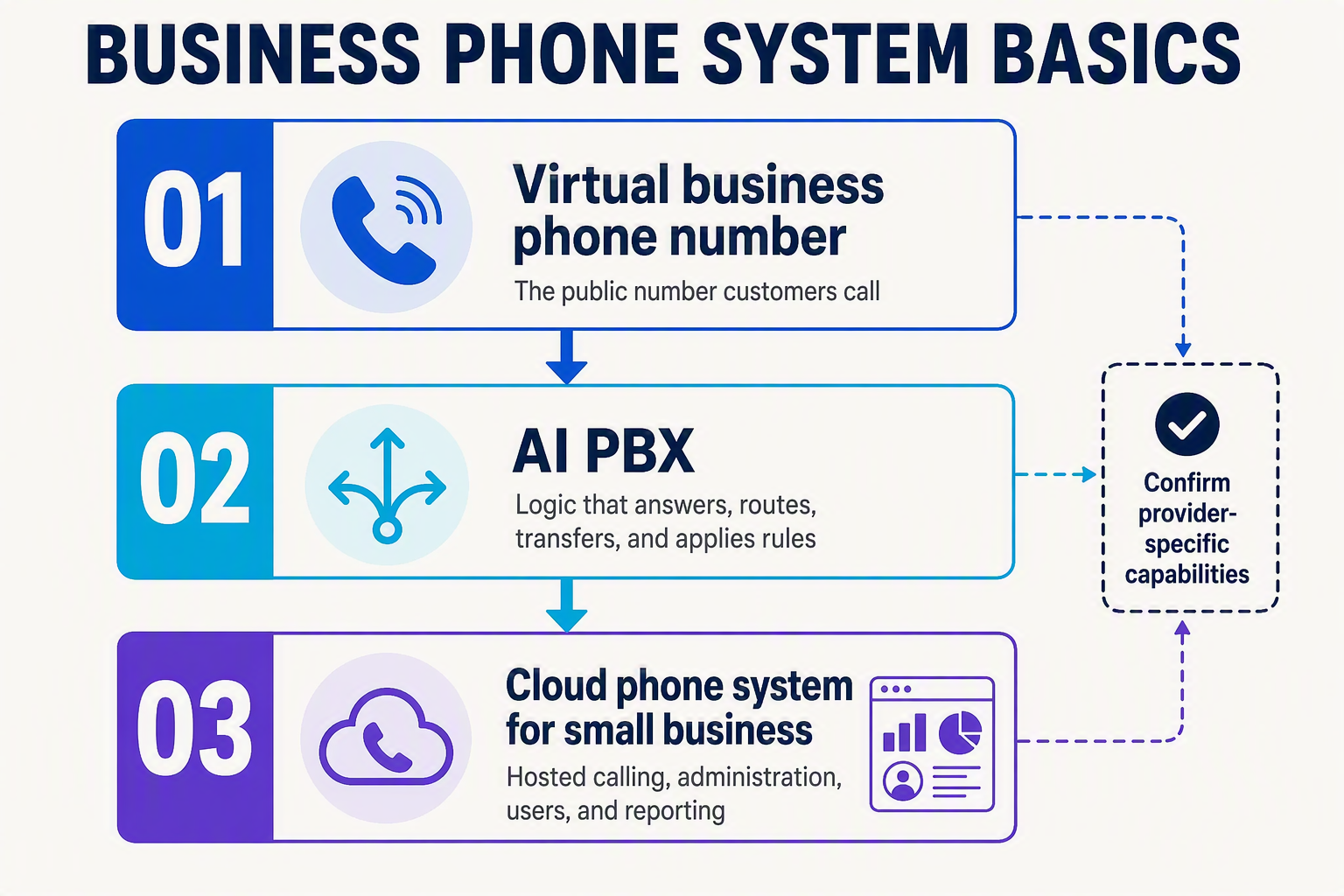
A virtual business phone number is the customer-facing address, a cloud phone system is the underlying calling infrastructure, and an AI PBX is the intelligence layer that interprets conversations and determines what happens next. These terms overlap in vendor marketing, but they describe different parts of an AI business phone system and should not be treated as interchangeable.
Virtual business number: the entry point
A virtual number is not tied to one physical desk phone or fixed line. Calls to the number are handled through a cloud platform and can be directed to employees, departments, devices, queues, or automated agents according to the system’s supported configuration.
The number itself does not guarantee intelligent call routing. Buyers must separately confirm which capabilities sit behind it, including:
- Local, mobile, toll-free, or other available number types
- Inbound and outbound calling support
- Number provisioning, porting, ownership, and geographic availability
- Concurrent-call limits and what callers hear when capacity is reached
- Recording, consent announcements, retention, and access controls
- Transfer destinations and failed-transfer behaviour
A virtual number therefore answers where customers call, not necessarily how their requests are understood or resolved.
Cloud phone system: the communications foundation
A cloud phone system for small business moves call control from on-premises telephone hardware into provider-managed software. Administrators can typically configure users, business hours, routing rules, queues, and reporting through an online interface, although exact features vary by vendor and plan.
Conventional cloud telephony commonly uses deterministic rules. For example:
- Check whether the business is open.
- Play an interactive voice response menu.
- Send the caller to the selected department.
- Apply an overflow or voicemail action if nobody answers.
This form of automated call routing can be effective for predictable call journeys. However, a rules engine does not inherently understand that “my package still hasn’t arrived” is a delivery-support request unless the caller selects the corresponding menu option or the system includes a conversational intelligence layer.
AI PBX: the interpretation and orchestration layer
A traditional private branch exchange connects calls between external numbers, extensions, and departments. The term AI PBX generally describes a software-based evolution that adds speech recognition, natural-language understanding, contextual responses, and dynamic routing.
Instead of requiring “Press 2 for support,” an AI-enabled flow may classify a spoken request, retrieve an approved answer, collect relevant details, or initiate a human handoff. Effective AI-based business call management can consider:
- Intent: sales, support, appointment, billing, cancellation, or emergency
- Context: customer identity, prior interaction, order details, or account status
- Language: the language spoken and the available agent or model coverage
- Operational state: opening hours, queue availability, and approved escalation rules
- Confidence: whether the system has enough certainty to answer or route safely
“AI PBX” is not a standardised feature bundle. Buyers should require a live demonstration of intent recognition, transfer execution, fallback handling, transcript generation, and behaviour when the AI is uncertain.
How the layers fit together
A complete deployment may use a virtual business phone number as the public entry point, cloud telephony to carry and control the call, and an AI agent to converse and select the next action. CallMissed, for example, combines AI voice agents with broader WhatsApp, email, web, knowledge-base, and inbox workflows, illustrating how phone infrastructure can become part of an omnichannel engagement architecture.
The practical buying question is therefore not “Which label sounds most advanced?” It is which layer supplies each required capability, and what happens when that layer fails or cannot confidently proceed?
Which automated call routing capabilities should buyers verify in 2026?
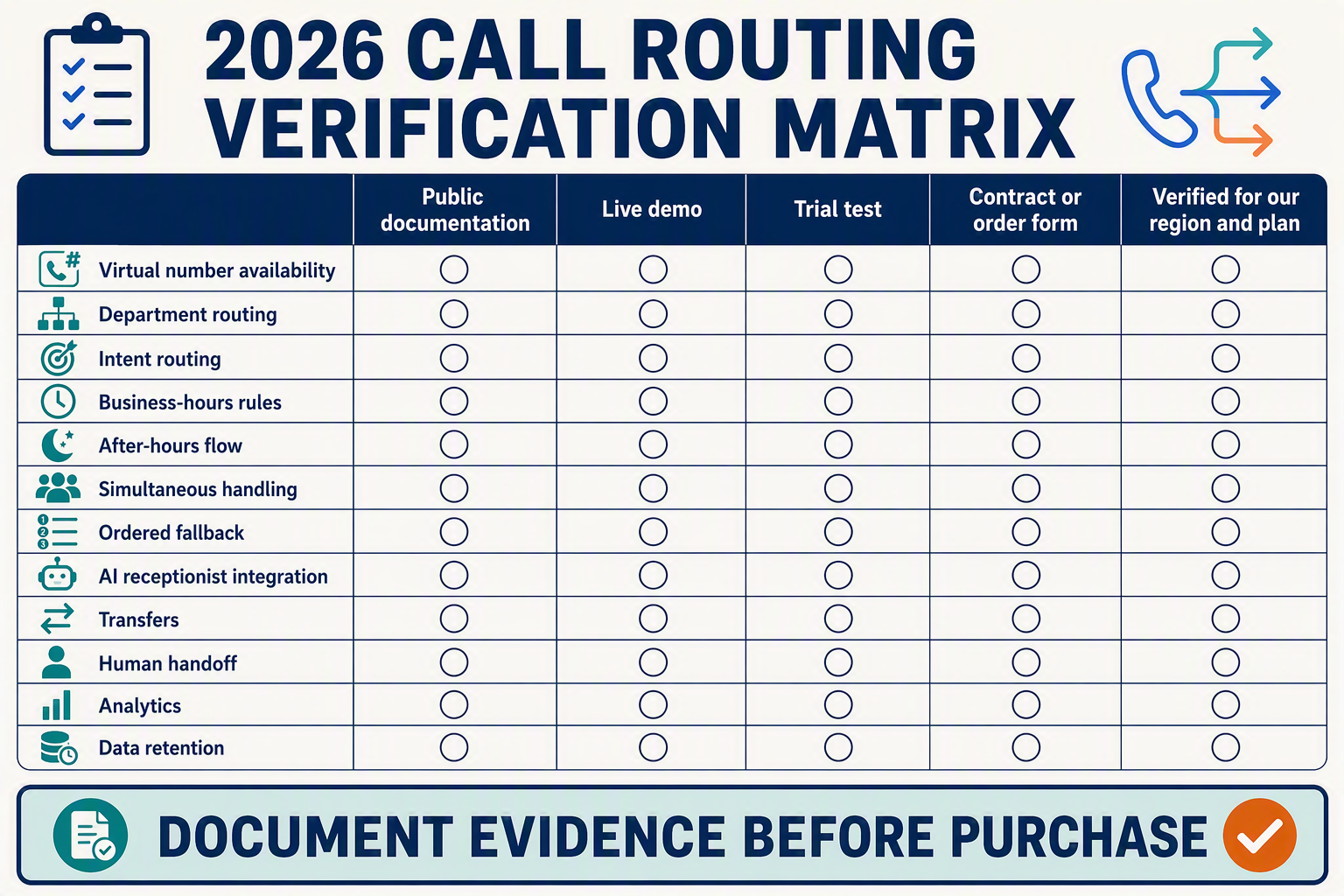
Buyers should verify routing behaviour through live, end-to-end tests rather than relying on an “AI-powered” label. Capabilities in an AI business phone system may come from standard telephony rules, AI models or third-party integrations. Availability can also depend on the buyer’s CallMissed plan, carrier, number type, country, configuration and connected systems.
2026 capability-verification checklist
| Capability | Function type | What buyers should verify | Live test to request | Evidence to retain |
|---|---|---|---|---|
| Number and inbound routing | Standard telephony; carrier- and region-dependent | Whether the required virtual business phone number type, country, inbound calling, concurrency and porting options are available; identify the party that controls the number and any port-out restrictions | Call from relevant mobile and fixed networks; test caller-ID presentation, a repeat caller and a withheld or unavailable caller ID | Carrier and country coverage, number-assignment terms, porting policy, concurrency limits and applicable fees |
| Department and rule-based routing | Standard telephony; configuration-dependent | Whether calls can be routed by keypad input, schedule, caller ID, queue, agent availability or CRM data; confirm which rules administrators can edit | Select each menu option, call from a known CRM contact and trigger an unmatched rule | Routing configuration, rule priority, administrator permissions and fallback path |
| Intent-based routing | AI-dependent; language, model and configuration-dependent | Whether spoken requests are classified reliably for the buyer’s actual use cases; establish the response to ambiguous or low-confidence input | Say “My payment went through twice” without naming a department, then repeat with accents, noise and incomplete phrasing | Supported-language documentation, intent definitions, confidence or fallback settings, test results and misroute records |
| Business-hours and after-hours flows | Standard telephony; configuration-dependent | Time-zone selection, holiday calendars, temporary closures, voicemail, callback capture and urgent escalation | Call immediately before and after closing and during a configured holiday | Calendar settings, after-hours flow, callback responsibilities and escalation permissions |
| Queue, simultaneous-ring and overflow handling | Standard telephony; plan, carrier and configuration-dependent | Whether calls ring simultaneously, sequentially or by queue or skill; check maximum concurrent calls and what occurs when agents or channels are unavailable | Place enough concurrent calls to reach the documented limit and reject or ignore selected calls | Queue and concurrency limits, ring duration, overflow order, timeout behaviour and usage charges |
| AI receptionist and human handoff | AI plus telephony; integration- and configuration-dependent | What caller information can be collected and passed during transfer; whether warm, blind or consultative transfer is supported in the intended setup; how failed transfers are handled | Ask an out-of-scope question, request a person and make the destination busy or unreachable | Transfer configuration, context passed to the recipient, caller notices, integration requirements and recovery flow |
| Recordings, transcripts and analytics | Mixed; plan, consent, region and configuration-dependent | Which events are logged; whether recordings or transcripts are available; retention, export, access controls and deletion options; applicable notice or consent settings | Complete answered, abandoned, transferred and failed calls, then compare the call records with what occurred | Sample exports, field definitions, retention settings, role permissions and audit records |
| Failure and continuity handling | Mixed; vendor-, carrier- and integration-dependent | Behaviour during carrier, model, webhook or CRM failures; determine whether fallback routing is automatic or must be configured | Disable or invalidate a test integration, reject a transfer and submit low-confidence speech | Documented fallback routes, error logs, service-status information, support process and incident responsibilities |
Distinguish configured logic from AI-dependent behaviour
An AI PBX is not a standardized capability label. A system may combine deterministic telephony rules with speech recognition, language models or other automated components. Buyers should identify which component makes each decision and what happens if that component is unavailable.
For example, routing keypad selection “2” to billing is configured logic. Interpreting “I was charged twice” as a billing request is intelligent call routing and should be tested against representative vocabulary, accents, call quality and background noise. A published language list indicates intended support, not guaranteed recognition or response accuracy for every speaker or environment.
CallMissed language, transcription, text-to-speech, AI receptionist, transfer and analytics capabilities should be confirmed against current product documentation and the proposed account configuration. Buyers should also verify whether a feature requires a particular plan, telephone number, carrier, region, integration or manual setup before including it in acceptance criteria.
Questions to put into the contract
For a cloud phone system for small business, define the purchased configuration and measurable routing outcomes. Ask:
- Which functions are standard telephony rules, which depend on AI, and which require a separate integration?
- What happens when speech cannot be recognized or intent confidence is too low?
- Can administrators change automated call routing, schedules and fallback paths without vendor intervention?
- Does a failed transfer return to the automated flow, enter another queue, offer voicemail, capture a callback or disconnect?
- Are simultaneous ringing, queues and overflow included in the proposed plan and supported by the selected carrier and number type?
- What concurrency limits, per-minute charges, transfer charges or fair-use restrictions apply?
- Which events appear in business call management records, and how are answered, abandoned, transferred, contained and failed calls defined?
- Are recordings and transcripts enabled by default or by configuration, and how are notice, retention, deletion, export and access controls handled?
- Which CRM or help-desk fields can be read or written, and what occurs when that integration is unavailable?
- What documentation or service commitment applies to outages, porting and support escalation?
Finally, test complete journeys using the proposed production-like configuration. Acceptance testing should cover the first ring, schedules, language handling where applicable, rule- and intent-based routing, human escalation, unavailable destinations, integration failures and final call disposition. Record any feature that has not been demonstrated for the relevant account, carrier, region and integration as pending validation, rather than inferring support from a related feature.
How should intelligent call routing connect departments, caller intent, after-hours flows, AI receptionist integration, transfers, and human handoff?
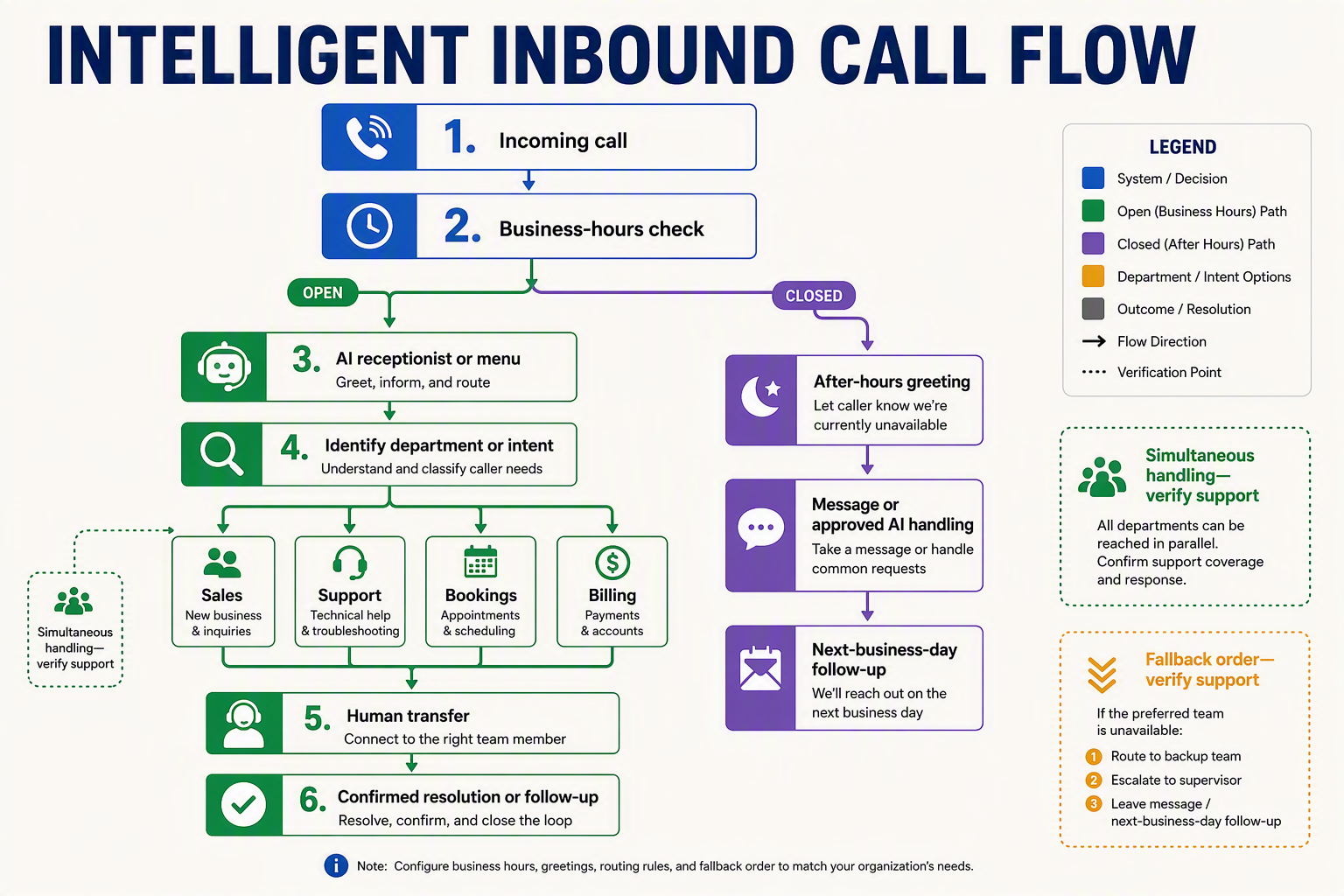
An effective intelligent call routing design connects caller intent to a controlled sequence: identify the request, apply department and time rules, let the AI receptionist resolve approved tasks, and transfer to a human with context when necessary. Every route should also define what happens when an agent is unavailable or a transfer fails.
Build one routing map around intent and operating context
A virtual business phone number should serve as the entry point, not determine the destination by itself. The routing engine should evaluate several signals before selecting an action:
- Caller intent: sales enquiry, order status, appointment, billing, technical support, complaint, or emergency
- Department ownership: the team accountable for resolving that intent
- Business context: opening hours, holidays, customer tier, language, location, and campaign source
- Availability: eligible agents, queue status, and approved overflow destinations
- Risk level: whether the AI may answer, collect information, or must escalate immediately
Department routing and intent routing are complementary. “Sales” is a department; “requesting a product demonstration in Hindi” is an intent with language and action requirements. An AI business phone system should translate the second into the correct department, queue, language experience, and disposition.
Use the AI receptionist before—not instead of—the routing policy
The AI receptionist can greet the caller, identify language and purpose, retrieve approved knowledge, and complete low-risk actions. CallMissed states that its voice stack supports Speech-to-Text and Text-to-Speech across 22 Indian languages, enabling a multilingual route to continue in the caller’s language rather than merely detecting it.
A practical flow is:
- Answer and disclose: identify the business and AI assistant, and provide any required recording or data-use notice.
- Classify: capture intent, language, urgency, and essential identifiers.
- Resolve or route: answer from the approved knowledge base or select the responsible department.
- Confirm: tell the caller what will happen next before transferring or scheduling follow-up.
- Record disposition: save the outcome, transcript permissions, routing reason, and unresolved issue.
This makes automated call routing auditable instead of allowing an opaque model to choose destinations without policy constraints.
Design after-hours, transfer, and failure branches explicitly
After-hours handling should vary by intent. A routine pricing enquiry may receive an AI answer and callback option, while an urgent service issue may enter an approved on-call route. Where a vendor supports simultaneous ringing, overflow queues, or fallback numbers, buyers should verify the precise trigger, timeout, destination order, and billing behaviour rather than assuming those features exist.
A transfer and a human handoff are not identical. A transfer moves the live call; a human handoff should also deliver useful context, including:
- Caller identity and verified details
- Detected intent and language
- A concise conversation summary
- Actions already completed
- Reason for escalation and urgency
- Recovery action if the recipient does not answer
For a cloud phone system for small business, failed-transfer recovery is especially important: return to the receptionist, offer voicemail or callback, or route to another approved destination without forcing the caller to start over.
An AI PBX should therefore be evaluated as a policy-driven system for business call management, not simply as conversational software. Test every branch—including silence, ambiguous intent, unavailable staff, dropped transfers, and after-hours exceptions—before production deployment.
How do analytics, QA, and sector evidence improve business call management?
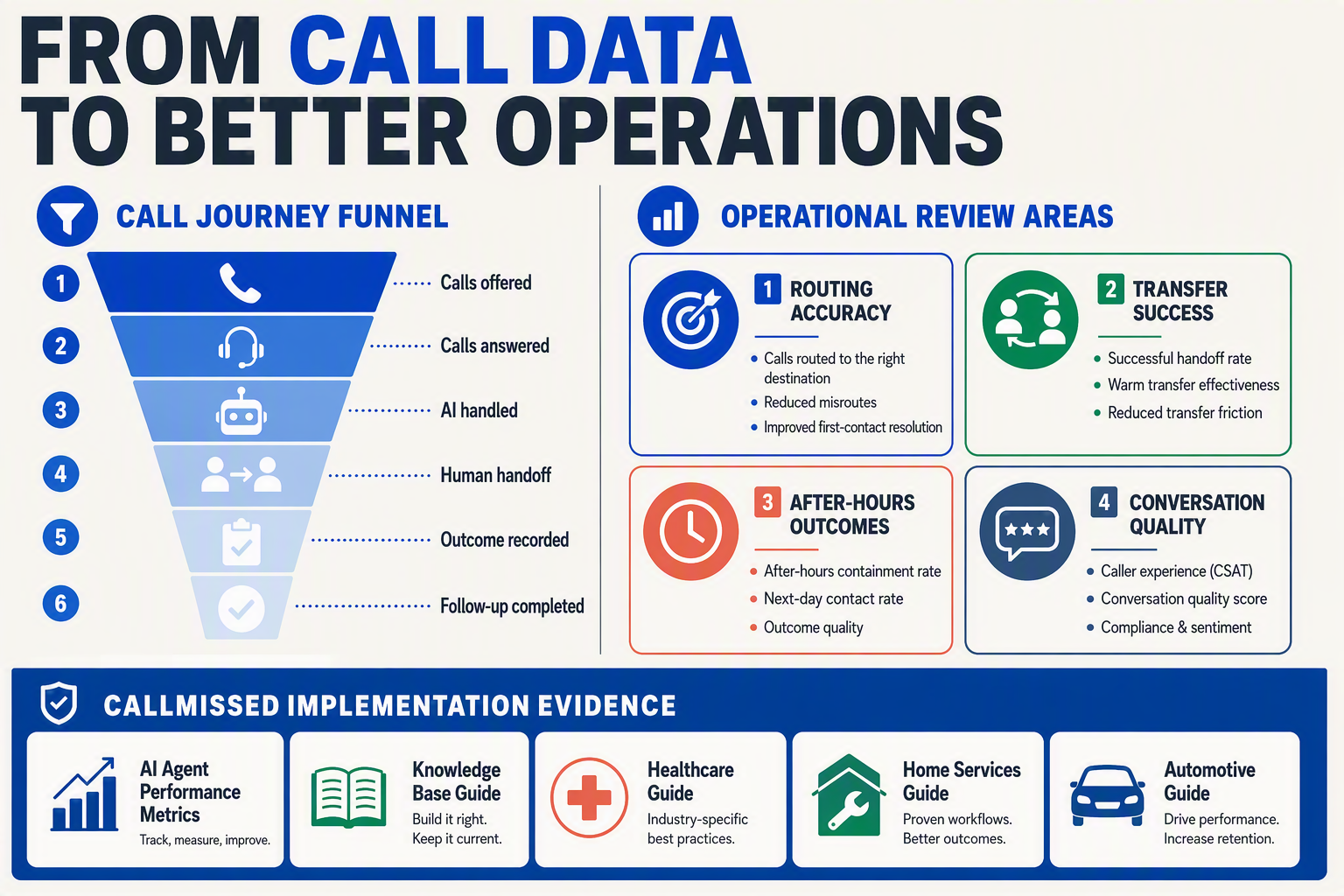
Analytics, quality assurance (QA), and sector-specific evidence turn call handling from guesswork into a measurable operating process. Buyers should use analytics to identify routing failures, QA to assess conversation quality, and deployment guides to verify that an AI business phone system fits the workflows and risks of their industry.
Measure outcomes across the complete call journey
For effective business call management, reporting should connect what the caller wanted with what ultimately happened. A high answer rate can hide poor intent recognition, unnecessary transfers, or unresolved enquiries.
Start with operational measures such as:
- Answer and abandonment rates: How many calls were answered, missed, or abandoned before service began?
- Intent and department distribution: Which reasons for calling generate the greatest demand?
- Automation and escalation rates: Which enquiries were completed by the AI receptionist, and which required human judgement?
- Transfer outcomes: Did the destination answer, and what happened after a failed or declined transfer?
- First-contact resolution: Was the caller’s need resolved without another call or channel switch?
- Latency and conversation quality: Were pauses, interruptions, and speech-recognition errors affecting the experience?
- After-hours dispositions: Did callers receive an answer, leave callback details, or reach an approved escalation path?
The CallMissed analytics and QA guide provides a focused framework for evaluating AI-agent performance. Metrics should be segmented by language, intent, time period, department, and routing destination rather than averaged into a single headline score.
Combine QA reviews with knowledge-base evidence
QA should examine both what the system did and why it did it. Review a representative sample of successful calls, escalations, failed transfers, low-confidence interactions, and complaints—not merely the shortest or highest-rated conversations.
A practical QA scorecard can assess:
- Intent accuracy: Did the system correctly understand the caller?
- Routing accuracy: Did intelligent call routing select the appropriate queue, department, or fallback?
- Answer grounding: Was the response supported by approved business information?
- Disclosure and consent: Were recording, automation, and data-use notices delivered where required?
- Handoff quality: Did the human agent receive sufficient context to continue without repetition?
- Outcome accuracy: Does the recorded disposition match the conversation?
The CallMissed Knowledge Base Guide explains how approved content can ground voice, WhatsApp, and email agents. Knowledge retrieval should also be monitored for unanswered questions, outdated material, conflicting policies, and answers that require human approval.
Validate routing against sector-specific operating conditions
A virtual business phone number and automated call routing flow should be tested using realistic sector scenarios. Healthcare callers may describe urgent symptoms, education enquiries can involve minors’ data, and ecommerce customers may need order or return verification.
Relevant implementation references include:
- Healthcare AI receptionist guide
- Education admissions automation guide
- Automotive dealer and service-centre guide
- Ecommerce communication guide
- Home-services call-answering guide
For Indian deployments, the multilingual WhatsApp and voice deployment guide is especially relevant. CallMissed reports Speech-to-Text and Text-to-Speech coverage across 22 Indian languages, but every buyer should still test accents, code-switching, names, addresses, and industry vocabulary before production.
In 2026, whether evaluating an AI PBX or a cloud phone system for small business, require baseline metrics, documented QA ownership, traceable knowledge sources, and regular routing reviews. Sector guides inform test design; production analytics determine whether the deployed system actually works.
What should telecom, operations, security, legal, and customer-experience experts review before deployment?

Before deployment, telecom, operations, security, legal, and customer-experience owners should jointly approve the complete call journey, data lifecycle, failure behaviour, and escalation model. An AI business phone system should not enter production until each team has tested realistic calls and documented who owns every routing rule, integration, and compliance decision.
Telecom and operations architecture
Telecom specialists should verify that the virtual business phone number, carrier connectivity, transfer method, and capacity model work in every intended geography. Do not assume that a vendor’s general feature list guarantees a particular carrier, number type, simultaneous-call pattern, or transfer destination.
Ask the vendor to demonstrate:
- Inbound number provisioning, porting feasibility, caller-ID behaviour, and geographic availability
- Department, language, queue, and intent-based intelligent call routing
- Transfer to mobile numbers, contact-centre queues, SIP infrastructure, or another approved endpoint
- Busy, no-answer, failed-transfer, timeout, and carrier-outage behaviour
- Concurrent-call limits, rate limits, latency targets, maintenance procedures, and service-level commitments
- Ownership of routing changes, release approvals, rollback plans, and incident escalation
For a cloud phone system for small business, operational simplicity matters as much as feature breadth. Confirm whether non-technical administrators can safely change opening hours, holiday schedules, department destinations, and after-hours messages without accidentally disrupting production traffic.
Security, privacy, and legal controls
Security teams should map every system that receives audio, transcripts, summaries, caller details, authentication data, or analytics. The assessment should cover encryption in transit and at rest, role-based access, administrator audit logs, secret management, tenant isolation, subprocessors, data location, deletion workflows, backups, and incident notification.
Legal review should determine the lawful purpose and notice requirements for recording, transcription, profiling, and follow-up. India’s Digital Personal Data Protection Act, 2023 establishes obligations concerning digital personal data, including notice, consent where relied upon, security safeguards, and erasure when retention is no longer necessary; counsel should assess how the applicable framework affects the specific deployment.
Document clear boundaries:
- Whether callers are told they are speaking with an AI agent
- When recording or transcription begins and how notice is delivered
- Which sensitive information the agent must never request or repeat
- How callers can reach a human or challenge an automated outcome
- How long recordings, transcripts, extracted fields, and logs remain available
- Whether outbound callbacks or WhatsApp follow-ups require separate permission
If business call management spans voice and messaging, review each channel separately. For example, CallMissed can connect AI voice agents with WhatsApp Business calling and chat workflows, but businesses must still configure permissions, retention, and escalation according to their own use case and legal advice.
Customer-experience acceptance testing
Customer-experience leaders should test the automated call routing system with accents, code-switching, background noise, interruptions, ambiguous requests, silence, and emotionally distressed callers. An AI PBX must fail safely rather than confidently routing a caller to the wrong department.
Before launch, require measurable acceptance criteria for:
- Intent accuracy: correct destination for representative call scenarios.
- Handoff quality: context reaches the human without forcing repetition.
- Fallback safety: uncertainty triggers clarification, callback capture, or an approved queue.
- Accessibility: prompts remain understandable, concise, and interruptible.
- Accountability: dashboards expose transfers, abandoned calls, unresolved intents, latency, and failure reasons.
Production approval should be a cross-functional decision, followed by a limited rollout, monitored routing changes, and scheduled reviews of transcripts, outcomes, complaints, and security events.
What does this mean for your buying decision, setup plan, and CallMissed comparison shortlist?
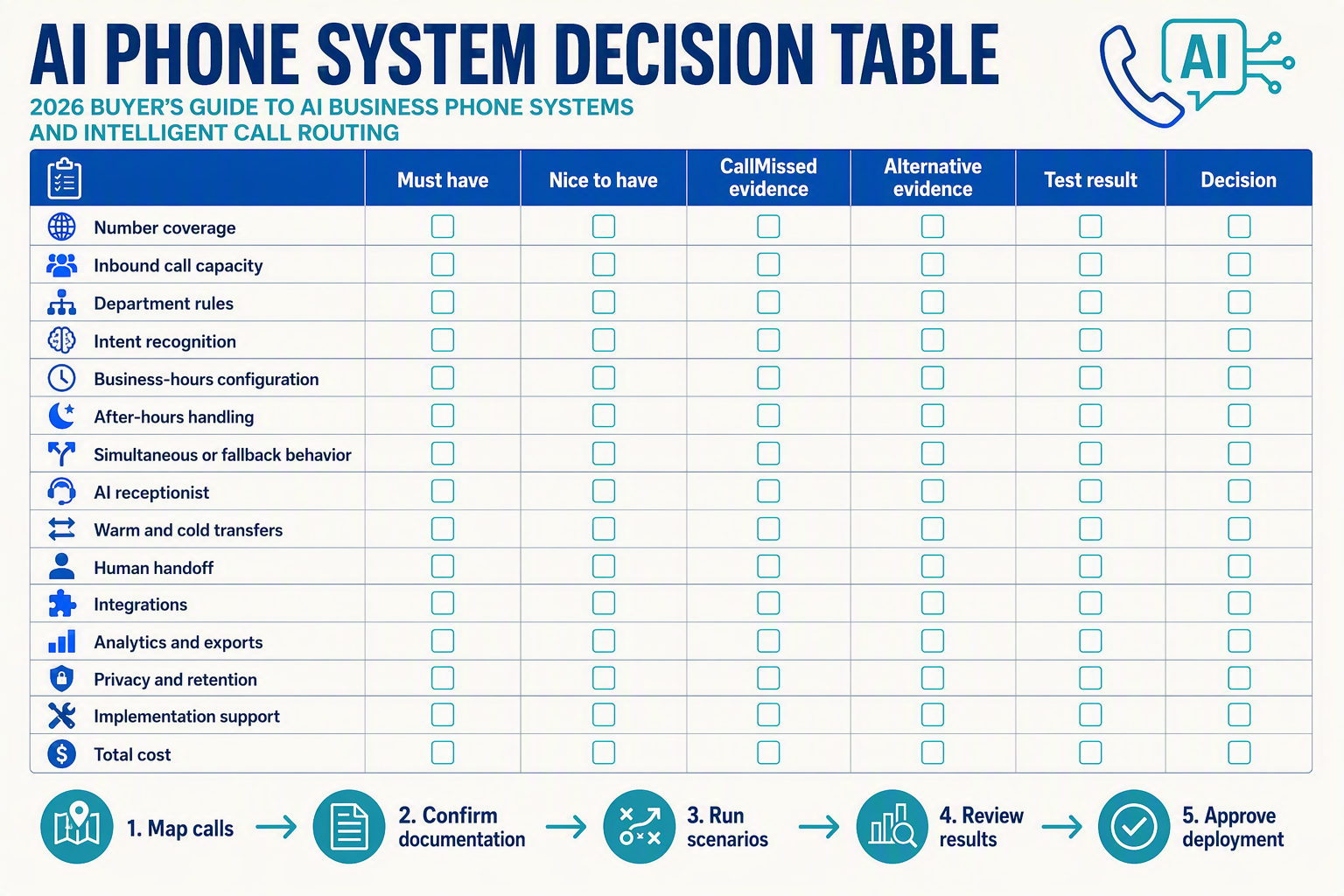
Choose an AI business phone system by validating complete call journeys, not by comparing feature labels. Your shortlist should reflect number availability, routing logic, language quality, escalation reliability, governance, and the operational effort required after launch.
Buyer shortlist and evidence checklist
| Decision area | Evidence to request | Acceptance test | CallMissed comparison point |
|---|---|---|---|
| Number and inbound coverage | Supported number types, regions, carriers, porting rules, concurrency limits | Call the proposed virtual business phone number from relevant networks and locations | Confirm number provisioning, carrier dependencies, and inbound-call configuration for your specific deployment |
| Routing intelligence | Department, intent, language, business-hours, overflow, and fallback rules | Test ambiguous requests, multiple intents, unavailable teams, and misrecognised speech | Evaluate how the AI voice agent identifies intent and uses business context before transferring or responding |
| Human handoff | Transfer methods, caller-context delivery, failed-transfer recovery, callback capture | Make the destination unavailable and verify that the caller receives an approved fallback | Ask for a live demonstration of transfers, escalation rules, and the information passed to human staff |
| Language experience | Speech-to-Text, Text-to-Speech, code-switching, pronunciation controls | Test real callers, regional accents, names, addresses, and mixed-language sentences | CallMissed documents native Speech-to-Text and Text-to-Speech coverage across 22 Indian languages, an important shortlist factor for Bharat-facing teams |
| Knowledge and automation | Retrieval sources, answer controls, update process, confidence thresholds | Ask outdated, unsupported, sensitive, and adversarial questions | Review knowledge-base retrieval across voice and connected engagement channels rather than judging a scripted demo |
| Operations and governance | Transcripts, call outcomes, permissions, retention, auditability, support process | Trace sample calls from first ring to disposition and verify access controls | Assess CallMissed’s omnichannel inbox and analytics alongside its voice, WhatsApp, email, and web workflows |
Translate requirements into a setup plan
A credible implementation should proceed in controlled stages:
- Map demand: document departments, common intents, languages, opening hours, urgent cases, and prohibited automations.
- Design routing: define what the AI may answer, when it must transfer, and what happens when a person or destination is unavailable.
- Configure knowledge: add approved material, assign content owners, and establish review dates.
- Pilot realistically: test quiet and noisy calls, interruptions, mixed-language speech, repeat callers, and after-hours enquiries.
- Launch gradually: start with a limited number, queue, location, or call type before expanding.
- Review outcomes: monitor containment, transfer success, abandonment, latency, incorrect routing, callbacks, and customer complaints.
Treat simultaneous ringing, queue overflow, voicemail, carrier failover, and callback automation as capabilities requiring explicit verification. A vendor’s reference to automated call routing or an AI PBX does not prove that every routing pattern is available in every geography or telephony configuration.
Make the final comparison operational
For each shortlisted cloud phone system for small business, score both capability and evidence:
- Must have: supported inbound number, clear consent handling, reliable human escalation, and after-hours recovery.
- High priority: multilingual recognition, intent-based routing, contextual transfers, and actionable analytics.
- Useful extension: unified WhatsApp, email, web, and voice history for broader business call management.
- Commercial check: implementation fees, usage pricing, support coverage, contract terms, and costs for transfers, storage, or additional channels.
In 2026, intelligent call routing should be purchased as a measurable operating system for customer conversations—not as an impressive voice demo. Select the platform that passes your real-world call tests, documents unsupported scenarios honestly, and provides a practical path from pilot to monitored production.
Frequently asked questions: What is an AI business phone system? Can one virtual number route multiple departments? How does intent routing work? What happens after hours? Can CallMissed transfer callers to people? Does it support simultaneous or fallback handling? Which analytics and setup questions matter?
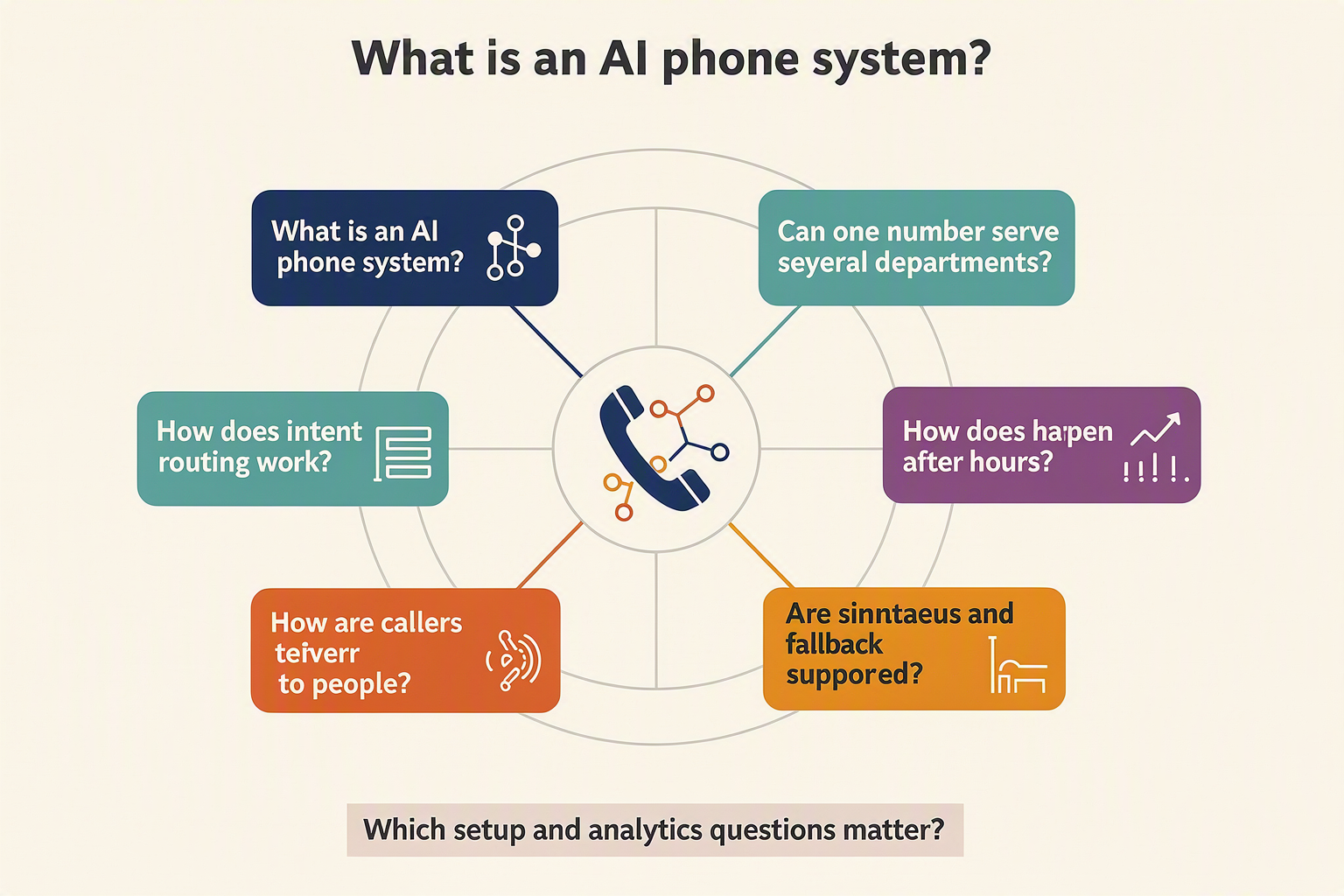
What is an AI business phone system, and how is it different from an AI PBX?
Can one virtual business phone number route calls to multiple departments?
How does intelligent call routing identify a caller’s intent?
What should an AI business phone system do with calls after business hours?
Can CallMissed transfer callers to people and support simultaneous or fallback handling?
Which analytics and setup questions matter when choosing a cloud phone system for small business?
Conclusion
Choosing an AI business phone system in 2026 means evaluating the complete caller journey—not simply comparing feature lists. The right architecture should connect a virtual business phone number with reliable intelligent call routing, contextual automation, and controlled human escalation.
Key takeaways for buyers:
- Map every inbound path, including department and intent routing, business-hours handling, after-hours responses, failed-transfer recovery, and fallback options.
- Ask vendors to demonstrate automated call routing with realistic calls rather than assuming every transfer method, carrier, or overflow pattern is supported.
- Treat an AI PBX as a way to augment staff—not eliminate them—by automating routine enquiries while preserving human judgement for urgent, sensitive, or high-value conversations.
- For an Indian cloud phone system for small business, verify regional-language performance, setup effort, knowledge-base accuracy, analytics, consent controls, and pricing. CallMissed reports native Speech-to-Text and Text-to-Speech coverage across 22 Indian languages.
Looking ahead, watch whether platforms can maintain context across voice, WhatsApp, email, and web while making handoffs more transparent and measurable. Effective business call management will increasingly depend on orchestration across these channels.
To explore this shift, visit CallMissed, an AI communication infrastructure platform for voice agents, multilingual chatbots, and WhatsApp Business calling. What would your ideal inbound journey do when the next customer calls after hours?
Related Reading
Discussion
Related Posts
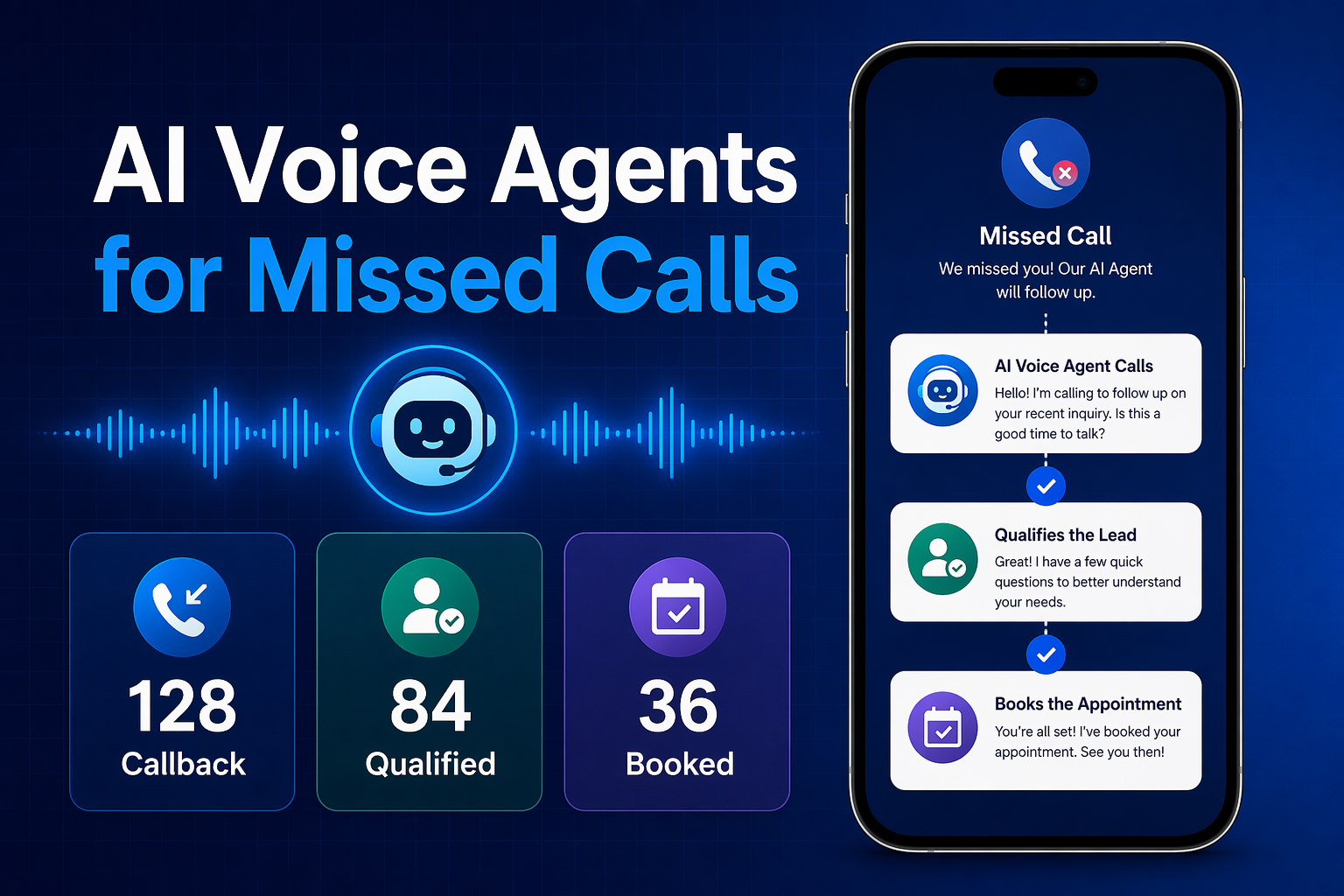
Ready to automate customer conversations?
Launch AI voice agents and WhatsApp bots with CallMissed — one API, 22+ Indian languages.