AI receptionist vs human: Clinic & Salon Costs in India


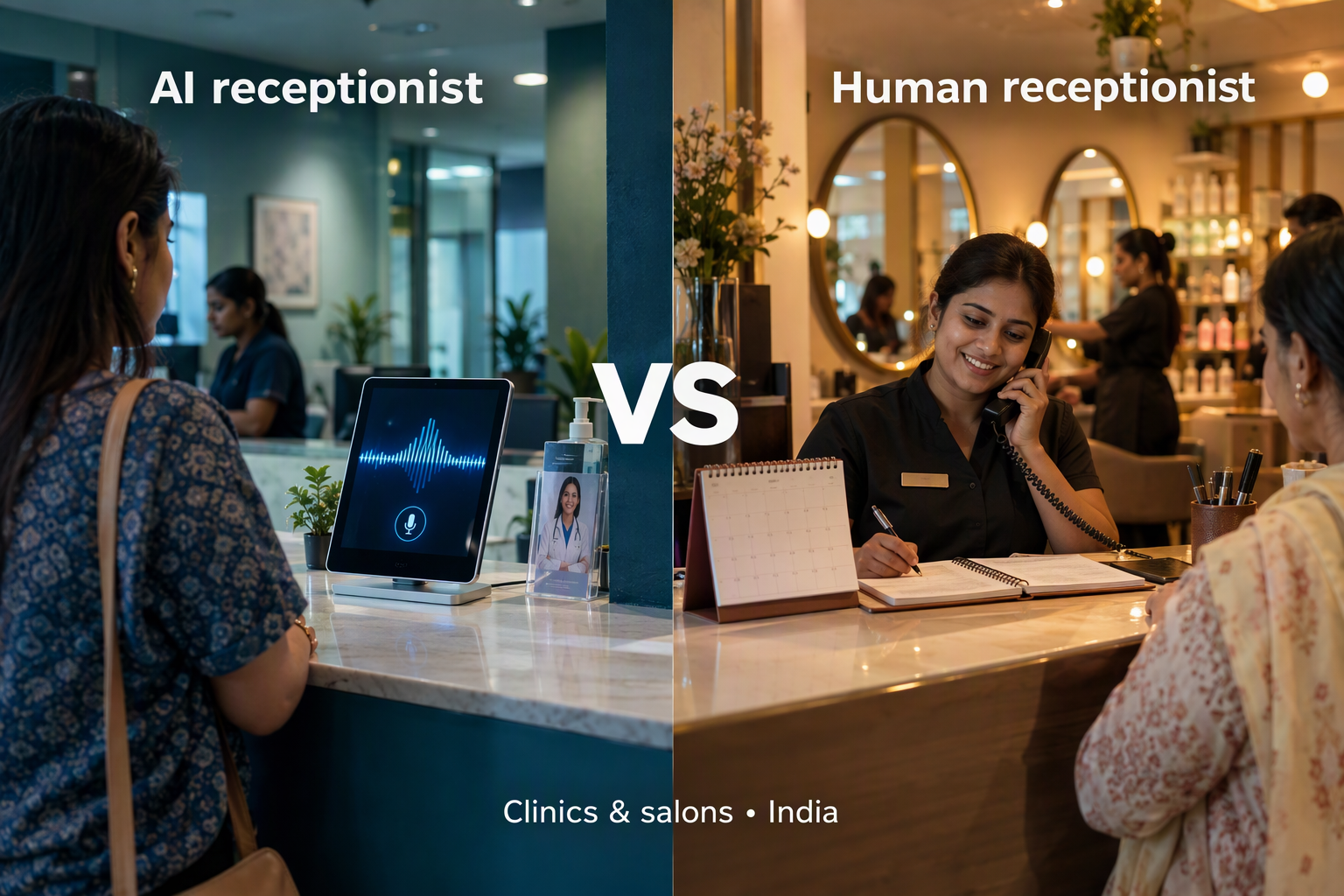
Compare AI receptionist vs human costs for Indian clinics and salons, with staffing overheads, call-minute budgets, booking ROI and hybrid options.
AI receptionist vs human: Clinic & Salon Costs in India
Could a ₹4-per-minute AI receptionist cost more than a salaried employee—or save money while still leaving your front desk understaffed? AI receptionist vs human is not simply a software-versus-salary calculation: for Indian clinics and salons, the real comparison includes call volume, appointment accuracy, customer experience, and work that requires someone physically present.
Indeed’s salon receptionist salary page, supplied for this October 2026 comparison, lists an Indian average of ₹19,621 per month, although the excerpt does not specify when that figure was updated. Salary.com’s supplied Bengaluru clinic receptionist page lists ₹38,642 per month, also without an update date in the excerpt. These are different roles and geographies—not interchangeable national benchmarks—but they illustrate why a realistic comparison needs local hiring costs rather than a single headline salary.
What should clinics and salons actually compare?
The question is not whether AI can answer a telephone. It is whether the combination of technology and staffing can handle your particular workload at an acceptable total cost.
A salon receptionist may answer pricing questions while welcoming walk-ins and coordinating stylists. A clinic receptionist may manage appointments while helping an anxious patient at the counter. Automating the telephone portion does not automatically remove the need for those in-person responsibilities.
For an October 2026 comparison, CallMissed’s verified Standard voice-agent rate is ₹4 per minute, covering speech recognition, the language model, and voice, with a 30-second minimum per connected call and phone carriage billed separately.
That gives us a concrete starting point, not a complete monthly bill. In an illustrative scenario, 1,000 billable minutes at ₹4 per minute equal ₹4,000, before phone carriage and any other applicable costs. Whether those minutes represent useful appointments, repetitive enquiries, or conversations that still need staff follow-up changes the business outcome.
Why does the cheapest option sometimes disappoint?
A lower telephone-handling bill is not necessarily a lower operating cost. If customers must repeat their requests to a person, or staff spend extra time correcting appointment details, some apparent savings can disappear.
Equally, assigning every routine call to an employee has an opportunity cost: time spent answering the same opening-hours question cannot simultaneously be spent assisting a visitor.
This comparison will examine:
- Monthly cost scenarios: salary versus usage-based AI charges, with assumptions made explicit.
- Operational outcomes: appointment handling, unanswered calls, escalation, and customer confidence.
- Practical limits: tasks AI can support versus responsibilities requiring human presence or judgment.
- Hybrid economics: when AI handles routine calls while a person manages exceptions and the front desk.
The goal is a defensible decision for your clinic or salon—not a promise that AI always replaces a receptionist, or that a human is always the better investment.
Which is better for clinics and salons? AI for routine calls, humans for in-person care
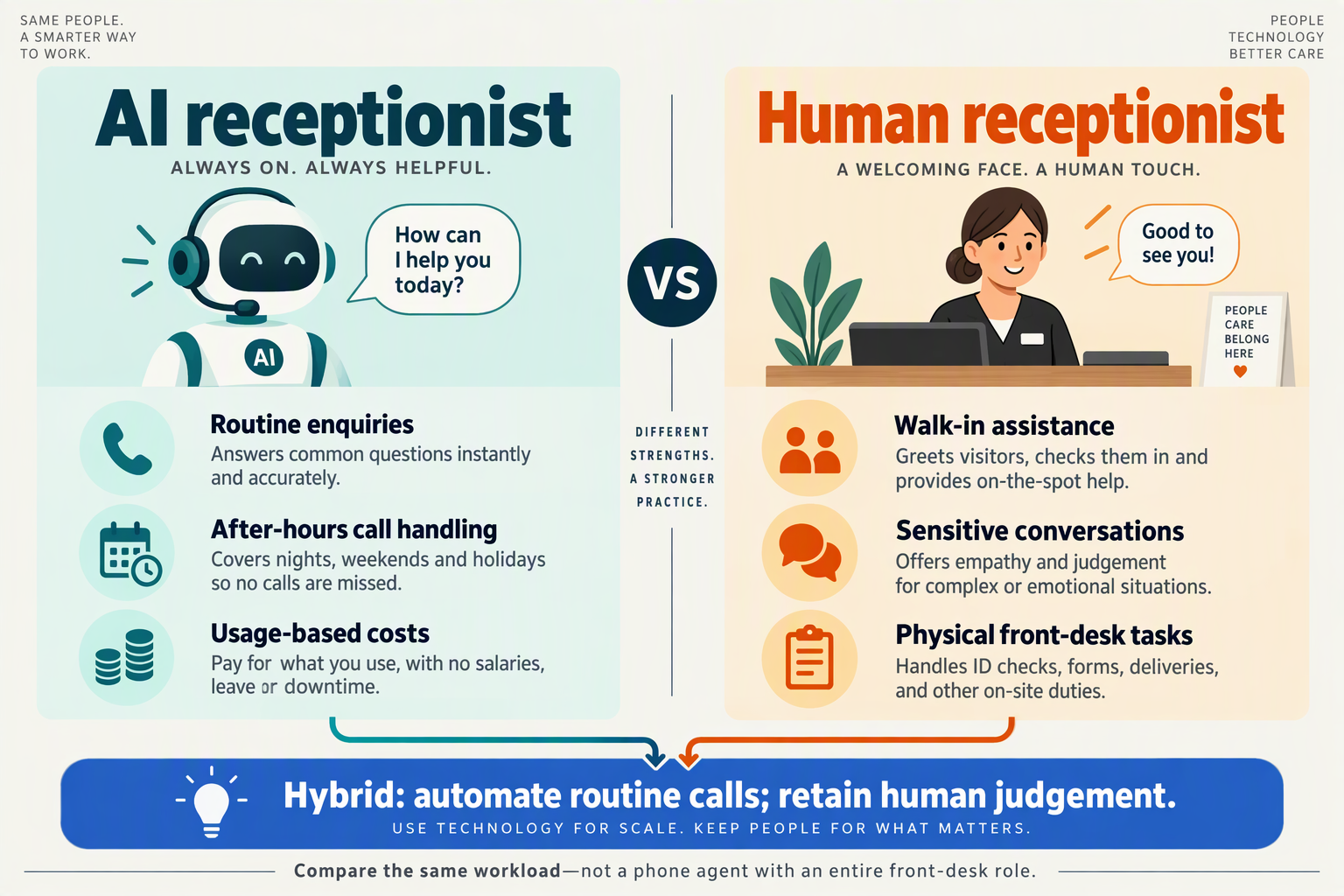
AI is better suited to repeatable telephone tasks; humans remain essential for physical reception and sensitive exceptions. For clinics and salons, the strongest starting point is a hybrid workflow—not an assumption that software replaces the entire front desk.
Which calls should an AI receptionist handle?
- AI—routine enquiries: Start with 3 tightly defined categories: opening hours, published service prices, and appointment preparation instructions approved by the business. A salon bot can explain a listed haircut price; a clinic bot can repeat approved arrival instructions. Neither should invent a discount, treatment recommendation, or exception to policy.
- AI—appointment requests: Require 4 confirmed details before treating a booking as complete: customer name, contact number, requested service or appointment type, and agreed slot. Without access to authoritative availability and a successful booking confirmation, the system should record a request—not tell the caller that an appointment is secured.
- AI—regional-language calls: As of October 2026, CallMissed’s verified fact sheet lists speech recognition in 22 Indian languages plus English, including Hinglish, and natural text-to-speech in 10 Indian languages plus English. That distinction matters: understanding a caller’s language and replying naturally in that language are separate capabilities to test before deployment.
- AI—message capture: Callpad’s salon receptionist job-description excerpt, supplied for this October 2026 comparison with no publication date shown, includes “passing messages to stylists.” Automating message capture can help, but use 2 completion checks: confirm the message with the caller and ensure the intended staff member receives it. Recording alone is not resolution.
Which responsibilities should stay with a human receptionist?
- Humans—in-person service: Keep physical tasks outside the automation business case: visitor check-in, queue coordination, and counter assistance still need someone present. For example, answering a pricing call does not help a receptionist simultaneously locate a patient’s paperwork or guide a salon customer to the correct stylist.
- Humans—sensitive exceptions: Define at least 3 escalation categories before launch: medical concerns, disputed charges, and distressed callers. A clinic AI receptionist should not diagnose symptoms or independently decide that a potentially urgent concern can wait. Staff need an agreed escalation procedure, including what happens when the usual contact is unavailable.
- Hybrid—workload allocation: In an illustrative 100-call audit, classify each call as routine, exception, or unresolved before choosing staffing levels. If 70 are routine, that identifies a possible automation workload—not evidence of a 70% staffing saving. Reception employees also perform non-call duties, and automated conversations may still generate follow-up work.
- Hybrid—outcome measurement: Track 4 measures during a pilot: confirmed bookings, booking corrections, unresolved requests, and staff follow-up minutes. Compare equivalent opening hours and similar call volumes rather than counting answered calls alone. In an AI receptionist vs human receptionist comparison, success means customers reach the right outcome without transferring hidden cleanup work to the front desk.
What can each receptionist handle in a clinic or salon?
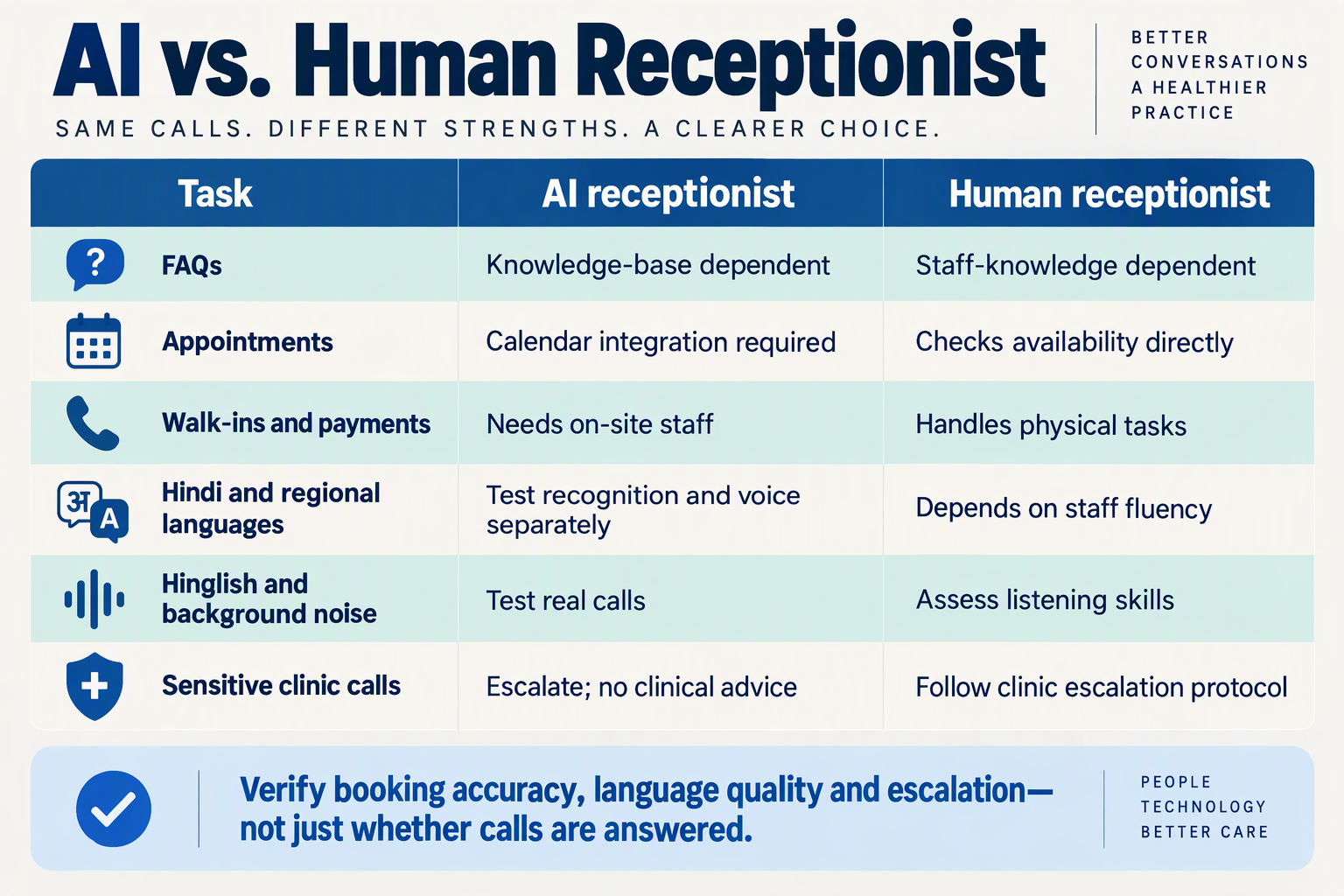
An AI receptionist can handle routine conversations and configured booking workflows; a human receptionist handles physical reception, exceptions, and interpersonal judgment. For clinics and salons, compare responsibility by task—not simply whether someone answers the phone.
- AI receptionist: Best suited to bounded requests: opening hours, approved service prices, appointment availability, and collecting details for staff follow-up.
- Human receptionist: Needed for physical tasks such as welcoming visitors, handling documents, checking the waiting area, and coordinating staff when plans change.
- CallMissed: As of October 2026, CallMissed’s verified fact sheet lists Google Calendar and Cal.com integrations, custom REST tools, and speech recognition in 22 Indian languages plus English; natural text-to-speech covers 10 Indian languages plus English.
- Salon workflow: Callpad’s job-description excerpt supplied for this October 2026 comparison includes “passing messages to stylists and following up with clients who haven't confirmed.” These are separate responsibilities: capturing a message does not ensure someone acts on it.
Which clinic and salon tasks suit AI or a person?
The table describes deployment requirements, not measured performance benchmarks. AI booking actions depend on connected systems, configured permissions, and rules; human performance depends on training and access to accurate information.
| Task | AI receptionist | Human receptionist | Practical boundary |
|---|---|---|---|
| Hours, directions, service prices | Answers from an approved knowledge base | Answers and explains exceptions | Maintain one current source for both |
| Booking or rescheduling | Can act through configured calendar tools | Resolves clashes and unusual requests | Confirm provider, service, duration, and slot |
| Patient or client intake | Collects predefined details conversationally | Clarifies sensitive or confusing answers | Collect only information needed for the task |
| Walk-ins and waiting-room coordination | Can capture a remote enquiry | Sees arrivals and manages the physical queue | Keep an on-site owner for reception |
| Symptoms or treatment questions | Gives approved administrative information and escalation instructions | Refers clinical questions to qualified staff | Neither receptionist replaces a clinician |
| Complaints and service changes | Records the issue and follows configured routing | Negotiates within authorised limits | Define who can approve refunds or exceptions |
How should you test whether a task is genuinely covered?
- Booking test: Try four illustrative cases before launch: a new appointment, rescheduling, cancellation, and an unavailable provider. For each, check the actual calendar result—not just a confident spoken confirmation—and verify that service duration and staff assignment remain correct.
- Escalation test: Try three illustrative exceptions: a distressed patient, a disputed salon charge, and a calendar outage. Specify the receiving person, what information reaches them, and what the caller hears if nobody is available; a recorded request alone is not a completed handoff.
For this AI receptionist vs human receptionist comparison, count a task as covered only when its final outcome is verified. A confirmed appointment, an acknowledged staff message, and a visitor successfully checked in are different outcomes—and may require different combinations of software and people.
How much do AI and human receptionists cost in India in 2026?
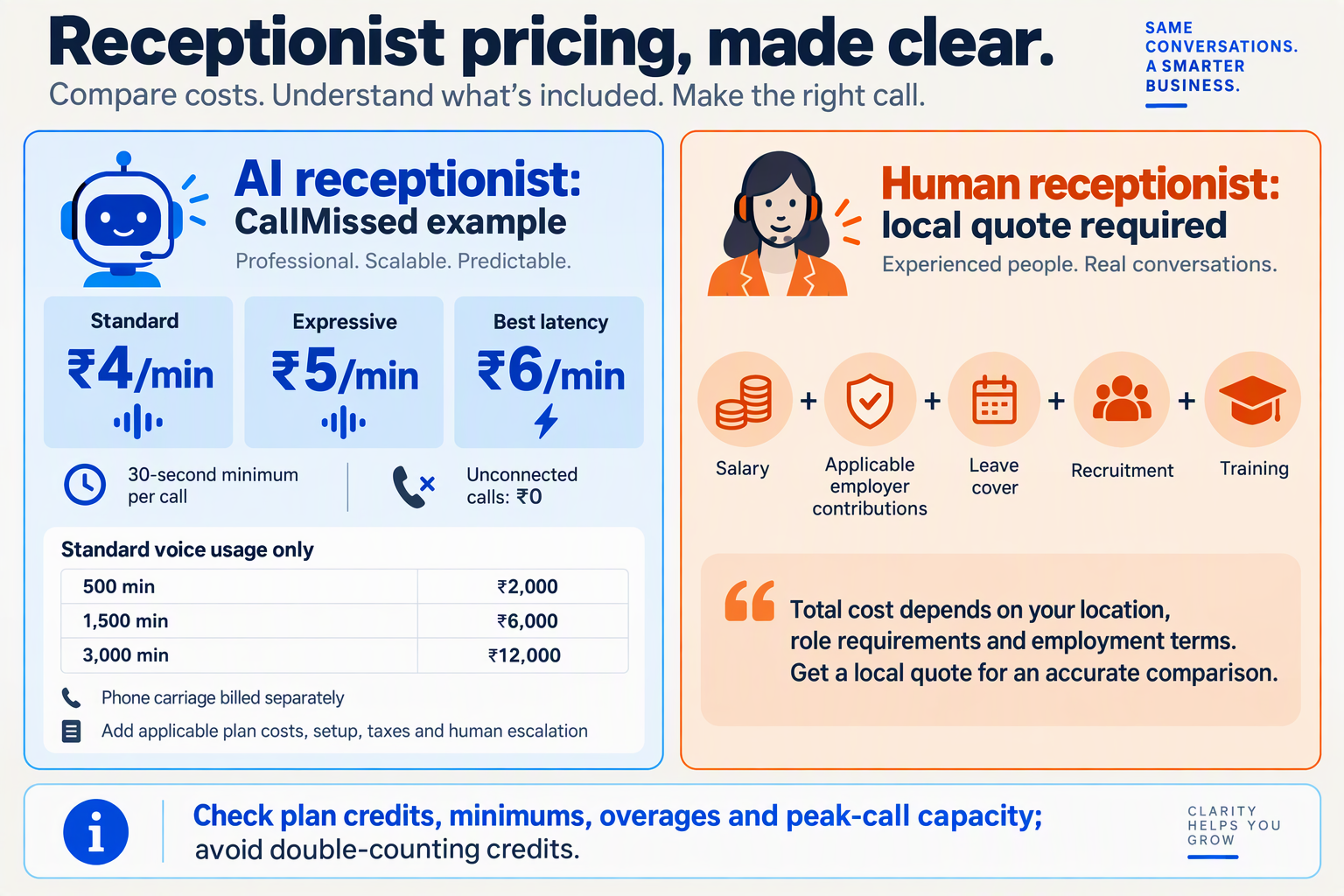
AI receptionist costs in India depend on billable call minutes; human receptionist costs depend on salary and staffing needs. Compare telephone-handling costs separately from the cost of keeping a clinic or salon front desk staffed.
- AI pricing: As of October 2026, CallMissed’s verified voice-agent rates are ₹4/minute Standard, ₹5/minute Expressive, and ₹6/minute Best latency, including speech recognition, the language model, and voice. Flat-rate plans have a 30-second minimum per connected call; unconnected calls cost nothing, and phone carriage is billed separately.
- Human salary benchmarks: Indeed’s supplied salon receptionist excerpt lists ₹19,621/month across India, while Salary.com’s supplied Bengaluru clinic receptionist excerpt lists ₹38,642/month. These figures are reference points for this October 2026 comparison, not verified October salary surveys: neither excerpt provides its update date, and their roles and locations differ.
What do different monthly receptionist workloads cost?
The following October 2026 planning scenarios use the Standard rate and illustrative monthly volumes—not measured clinic or salon usage. Human rows show salary only; AI rows show voice-agent usage only.
| Option | Monthly assumption | Base cost | Excluded costs |
|---|---|---|---|
| Human: salon | Indeed salary reference | ₹19,621 | Hiring, cover, applicable employer costs |
| Human: Bengaluru clinic | Salary.com reference | ₹38,642 | Hiring, cover, applicable employer costs |
| AI: light workload | 500 billable minutes × ₹4 | ₹2,000 | Phone carriage, setup work |
| AI: moderate workload | 1,500 billable minutes × ₹4 | ₹6,000 | Phone carriage, setup work |
| AI: heavy workload | 5,000 billable minutes × ₹4 | ₹20,000 | Phone carriage, setup work |
| Hybrid: salon + AI | ₹19,621 salary + 1,500 minutes | ₹25,621 | Employer costs, carriage, setup work |
How should clinics and salons calculate the real budget?
- Call-volume estimate: An illustrative 25 connected calls per day × 2 minutes × 30 days = 1,500 minutes/month. That produces the ₹6,000 Standard usage scenario above. Use actual connected-call duration rather than total enquiries, because walk-ins and text messages are not voice minutes.
- Short-call adjustment: Under the verified October 2026 flat-rate terms, 100 connected calls lasting 10 seconds each incur 50 billable minutes, not approximately 16.7 minutes. At ₹4/minute, that is ₹200 before carriage. Short calls therefore make raw conversation duration an unreliable billing estimate.
- Salary-equivalent threshold: Using these October 2026 planning inputs, ₹19,621 ÷ ₹4 = approximately 4,905 billable minutes. Beyond that volume, Standard voice usage alone exceeds the cited salon salary. This is a spending threshold—not proof that either option delivers equivalent appointments, working hours, or front-desk coverage.
- Hybrid budget: Keeping the receptionist and adding 1,500 AI minutes produces a ₹25,621 base monthly budget, not a salary saving. Evaluate whether the additional ₹6,000 reduces interruptions or captures useful calls, then add carrier charges, configuration time, exception handling, and any applicable employment costs before deciding.
What are the real service-quality advantages and drawbacks?
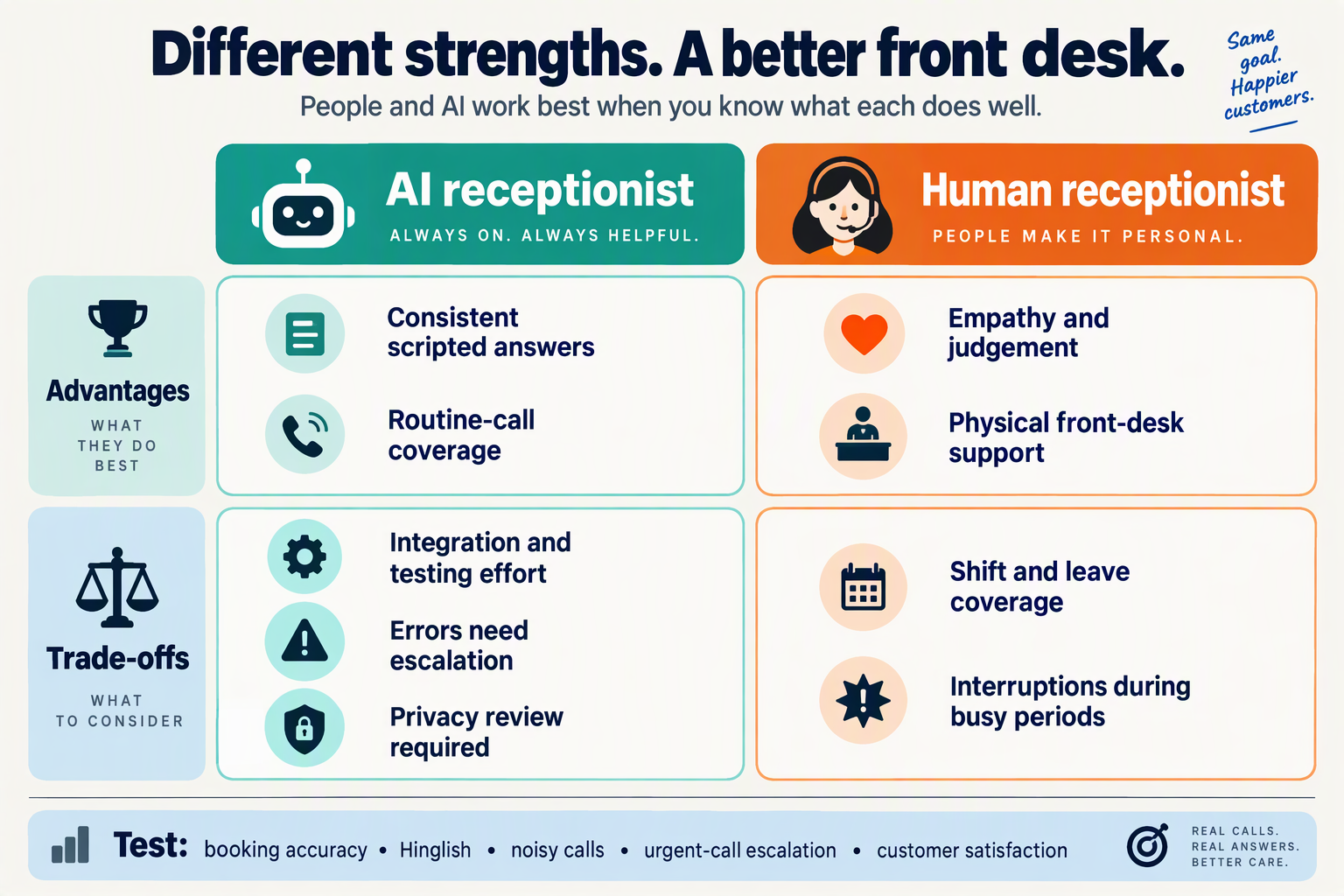
An AI receptionist offers repeatable handling of routine enquiries; a human receptionist offers situational judgment and physical assistance. For this October 2026 comparison, service quality depends on accurate completion and effective escalation—not simply whether someone answers.
- AI: Use automation for defined requests such as opening hours, service descriptions, and appointment preferences; connect booking tools before treating a conversation as a completed reservation.
- Human: Keep a person responsible for exceptions involving distressed patients, disputed charges, accessibility needs, or salon requests that require checking with a stylist.
- Evidence: The supplied research contains no head-to-head appointment-accuracy or customer-satisfaction benchmark; claiming either option produces a specific percentage improvement would be unsupported.
How do AI and human receptionists compare on service quality?
| Service dimension | AI receptionist advantage | Human receptionist advantage | Main drawback or safeguard |
|---|---|---|---|
| Routine enquiries | Can reuse an approved knowledge base for hours, policies, and service information. | Can clarify unusual questions and check with colleagues. | AI needs maintained information; staff also need a reliable reference. |
| Appointment handling | Can collect structured details and use connected scheduling tools. | Can negotiate exceptions involving staff availability or special requirements. | Confirm the actual calendar update, not merely the caller’s requested slot. |
| Regional-language calls | Speech models can support multiple languages and code-mixed conversations. | Fluent staff can interpret local expressions and conversational context. | Test recognition and spoken replies separately; language coverage alone does not establish accuracy. |
| Anxiety and complaints | Can acknowledge concerns and follow a defined escalation process. | Can adapt tone and take responsibility for resolving sensitive situations. | Neither should provide clinical judgment outside their role; route medical concerns appropriately. |
| In-person coordination | Can support the telephone portion of reception work. | Can welcome visitors, identify queues, and coordinate directly with staff. | Telephone automation does not supply physical front-desk coverage. |
| Quality review | Recordings, transcripts, and scoring can make supported interactions reviewable. | A supervisor can coach staff and discuss context behind decisions. | Apply appropriate recording notices, access controls, and review procedures. |
What should a clinic or salon test before relying on AI?
- Language coverage: According to CallMissed’s verified fact sheet, as of October 2026, speech recognition supports 22 Indian languages plus English, including Hinglish; natural text-to-speech supports 10 Indian languages plus English. Those are different capabilities, so test both with representative callers.
- Escalation: As of October 2026, CallMissed’s verified fact sheet lists live supervisor monitoring with listen, whisper, and barge-in controls, plus call scoring against custom QA rubrics. These support oversight, but only when an available supervisor and clear intervention rules exist.
- Pilot scorecard: Run an illustrative 50-call test: 20 booking requests, 10 changes, 10 information enquiries, and 10 exceptions. Record correct resolutions, booking errors, repeated questions, and completed escalations for both options; these counts are a proposed test design, not published results.
Judge success by the resolved task: a confirmed booking, an accurate answer, or a safe transfer to someone who can help. A fluent conversation that leaves staff repairing the outcome is not high-quality reception.
When does AI pay for itself? Separate clinic, salon and hybrid examples
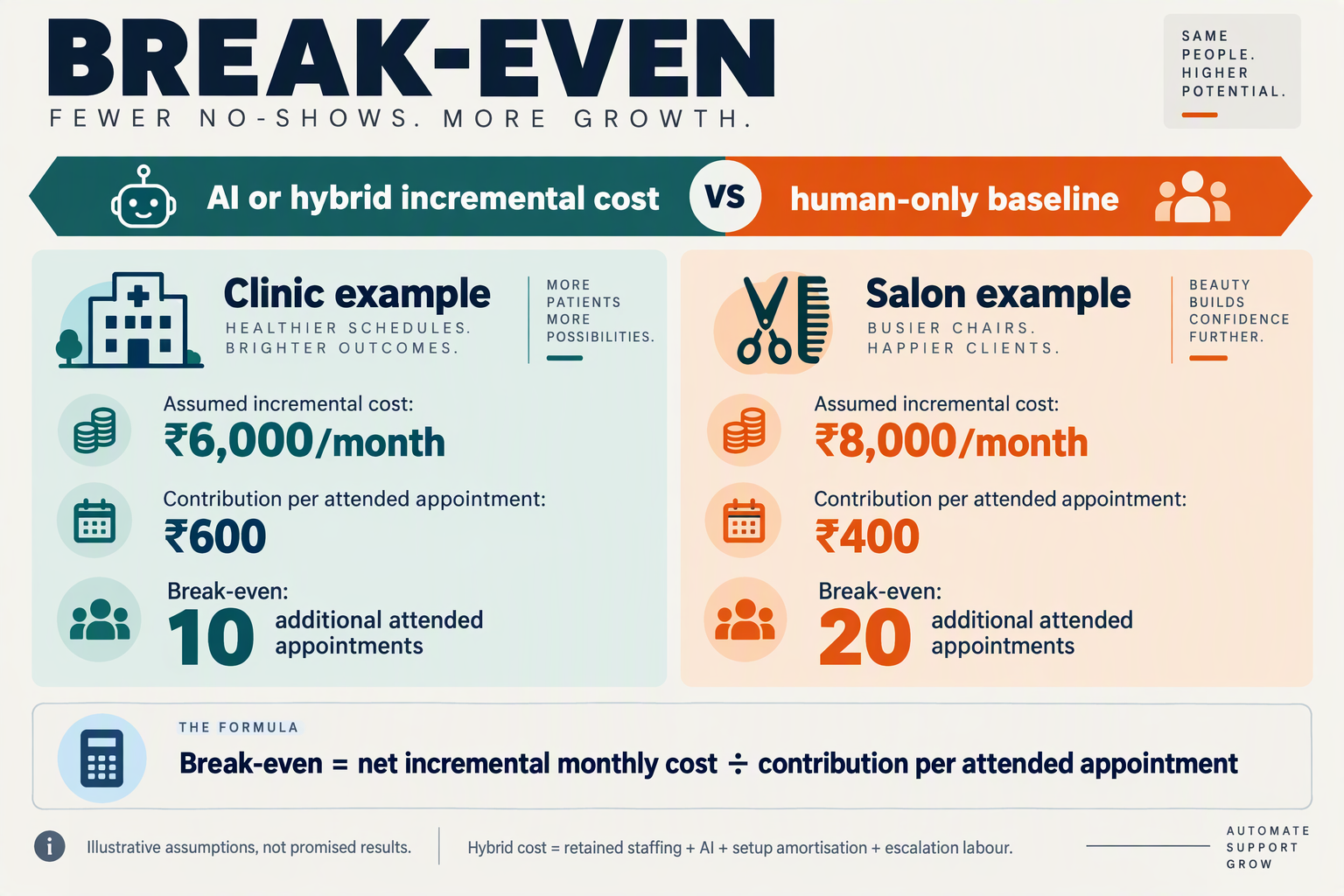
AI pays for itself when additional appointment contribution plus genuinely avoided costs exceeds the full AI bill. The October 2026 examples below are illustrative business models—not measured results or promises of salary savings.
When does an AI receptionist pay for itself in a clinic?
- Clinic cost assumption: Budget 1,500 billable minutes × ₹4 = ₹6,000 monthly, using CallMissed’s verified October 2026 Standard voice-agent rate. Add an illustrative ₹2,000 allowance for phone carriage, setup amortisation and staff review: ₹8,000 total. Replace that allowance with actual quotes and measured review costs before deciding.
- Clinic break-even: Assume each additional completed appointment contributes ₹400 after variable costs. Recovering an ₹8,000 monthly AI bill requires 20 additional completed appointments—not merely bookings. If only 80% of incremental bookings become completed visits, the clinic needs 25 incremental bookings; that percentage is a modelling assumption, not an industry benchmark.
- Clinic outcome test: At 30 additional completed appointments, contribution reaches ₹12,000, leaving ₹4,000 after the assumed AI bill. A separate illustrative ₹12,000 upfront implementation expense would then take three months to recover. Keep clinical questions and urgent concerns outside the routine booking workflow, and include staff escalation time in the calculation.
When does an AI receptionist pay for itself in a salon?
- Salon cost assumption: Model 900 billable minutes × ₹4 = ₹3,600, plus an illustrative ₹1,400 allowance for carriage, configuration amortisation and exception handling: ₹5,000 monthly. Count actual billable minutes rather than multiplying enquiries by an optimistic average duration; transfers, repeated questions and corrections can change the economics.
- Salon break-even: At an assumed ₹250 contribution per additional completed service, the salon needs 20 extra completed services monthly. If a recovered enquiry produces a booking but the customer cancels, record ₹0 realised contribution unless a retained fee applies. Use service-specific margins: a ₹1,000 sale does not necessarily provide ₹1,000 toward AI costs.
- Salon staffing limit: Indeed’s supplied salary reference lists ₹19,621 monthly for an Indian salon receptionist; its update date is unspecified in this October 2026 comparison. Adding the illustrative ₹5,000 AI budget produces ₹24,621 combined monthly spending, before other employment costs—not a saving unless extra contribution or genuinely avoided staffing costs covers the addition.
When does a hybrid receptionist model pay for itself?
- Hybrid break-even: Keep the receptionist and assume 1,200 billable AI minutes, costing ₹4,800, plus ₹1,200 in other monthly costs. The ₹6,000 incremental budget requires 20 additional completed appointments at ₹300 contribution each. Alternatively, documented reductions in paid overtime or temporary cover can offset part of that budget.
- Hybrid measurement: Run a four-week pilot tracking completed appointments, contribution, correction time and actual staffing expenditure. Salary.com’s supplied Bengaluru clinic reference lists ₹38,642 monthly, with no update date in the excerpt; that salary remains payable when the employee stays. Freed-up hours are an operational benefit, but count them as cash savings only when expenditure actually falls.
Should you choose AI, a human receptionist or a hybrid workflow?
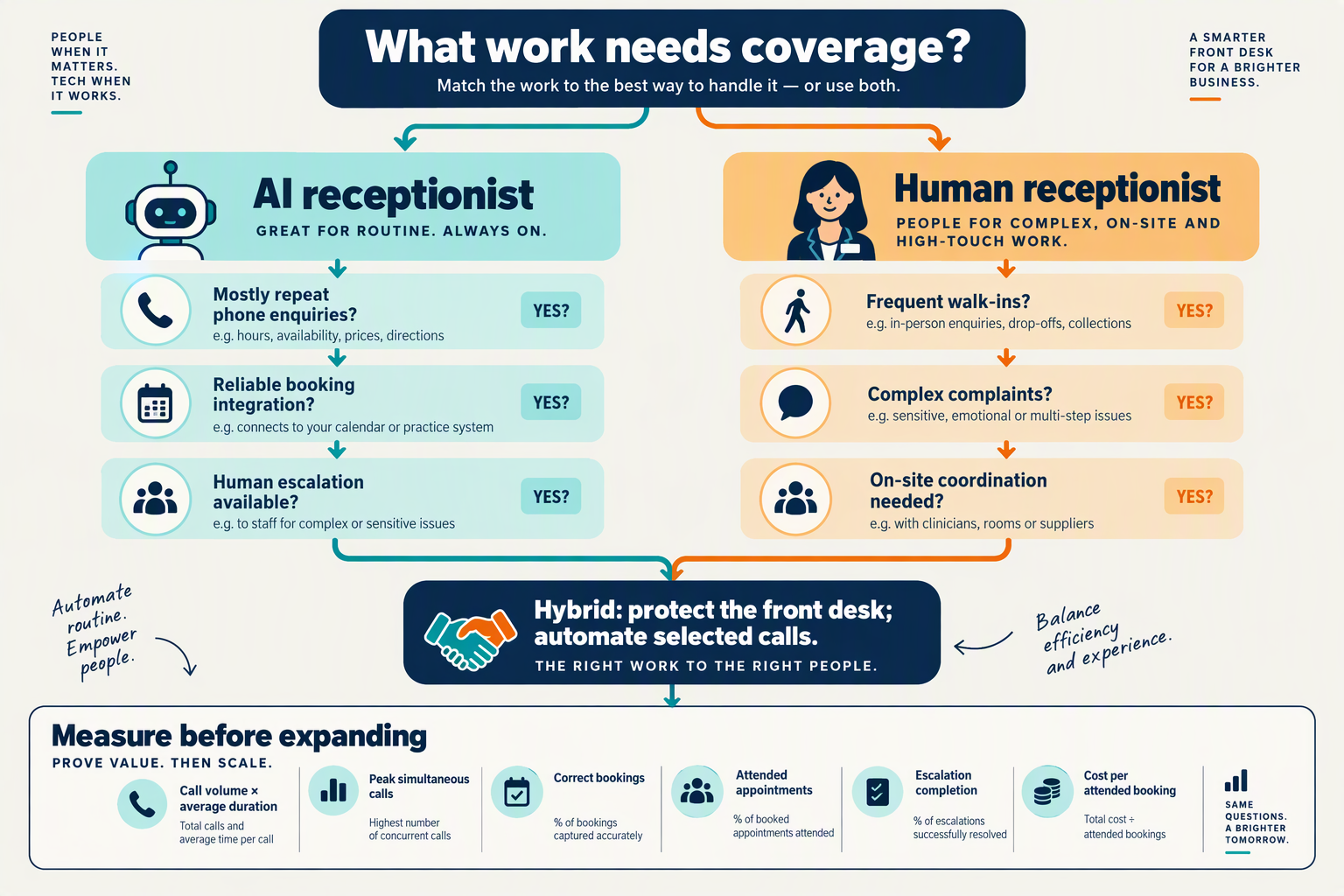
Choose a hybrid workflow when calls overlap with walk-ins; choose AI-led reception for tightly bounded telephone tasks, and human-led reception when exceptions dominate. For clinics and salons, decide which work can move—not simply which monthly bill looks smaller.
When should you choose an AI receptionist?
- AI-led reception: Choose this when your main telephone workload fits a defined menu: opening hours, service information, appointment requests, and booking changes. Keep diagnosis, treatment advice, disputed payments, and sensitive complaints outside the automated scope.
- Booking readiness: Before allowing automatic confirmations, require access to current availability, service duration, and provider eligibility. Test three failure cases explicitly: a fully booked day, an unavailable practitioner or stylist, and a customer requesting two services together.
- Language fit: As of October 2026, CallMissed supports speech recognition in 22 Indian languages plus English, including Hinglish, and natural text-to-speech in 10 Indian languages plus English. Test recognition and spoken responses separately; those language counts describe different capabilities.
- Operational boundary: AI-led telephone reception does not mean an unattended premises. Name the person responsible for arrivals, accessibility assistance, physical paperwork, and exceptions before removing any staffed hours from your rota.
When should you keep a human receptionist?
- Human-led clinics: Keep a person responsible when calls frequently involve distressed patients, unclear requests, or coordination requiring discretion. Establish a clinician-approved escalation procedure; a receptionist—human or AI—should not independently diagnose symptoms or determine treatment.
- Human-led salons: Retain front-desk capacity when stylists need frequent schedule adjustments and customers require face-to-face coordination. Callpad’s receptionist job-description excerpt, supplied for this October 2026 comparison, specifically includes “passing messages to stylists” and following up with unconfirmed clients.
- Cost baseline: Obtain a local hiring quote covering wages, leave cover, and recruitment rather than treating unrelated salaries as interchangeable. Indeed’s supplied ADCPL page lists ₹2,07,889 annually for Receptionist/Assistant; its update date is unspecified, and it is not a clinic or salon benchmark.
- Exception workload: Log interruptions for five working days before choosing a staffing model. Separate routine calls from complaints, payment issues, walk-in assistance, and practitioner coordination; a small call count can still conceal substantial front-desk work.
How should you test a hybrid workflow?
- Hybrid routing: Give AI approved information and straightforward scheduling tasks; assign people ambiguous requests, complaints, and in-person service. Define what happens when a booking cannot be completed, including who receives the request and the promised callback window.
- Pilot design: Run an illustrative two-week pilot against a comparable baseline period, keeping opening hours and staffing consistent. Review at least four measures: completed bookings, appointment errors, abandoned calls, and staff minutes spent correcting or following up.
- Outcome economics: Calculate total reception cost ÷ correctly completed bookings, alongside the broader service workload. Include retained wages, AI usage, phone carriage, setup, and correction time; adding automation without reducing paid hours is added expenditure unless it creates measurable value.
- Decision threshold: Set acceptance criteria before testing—for example, no unresolved double-bookings and every urgent concern routed under the clinic’s approved procedure. Expand automation only when the pilot meets those criteria; otherwise narrow its scope rather than assuming more automation means better reception.
Frequently Asked Questions
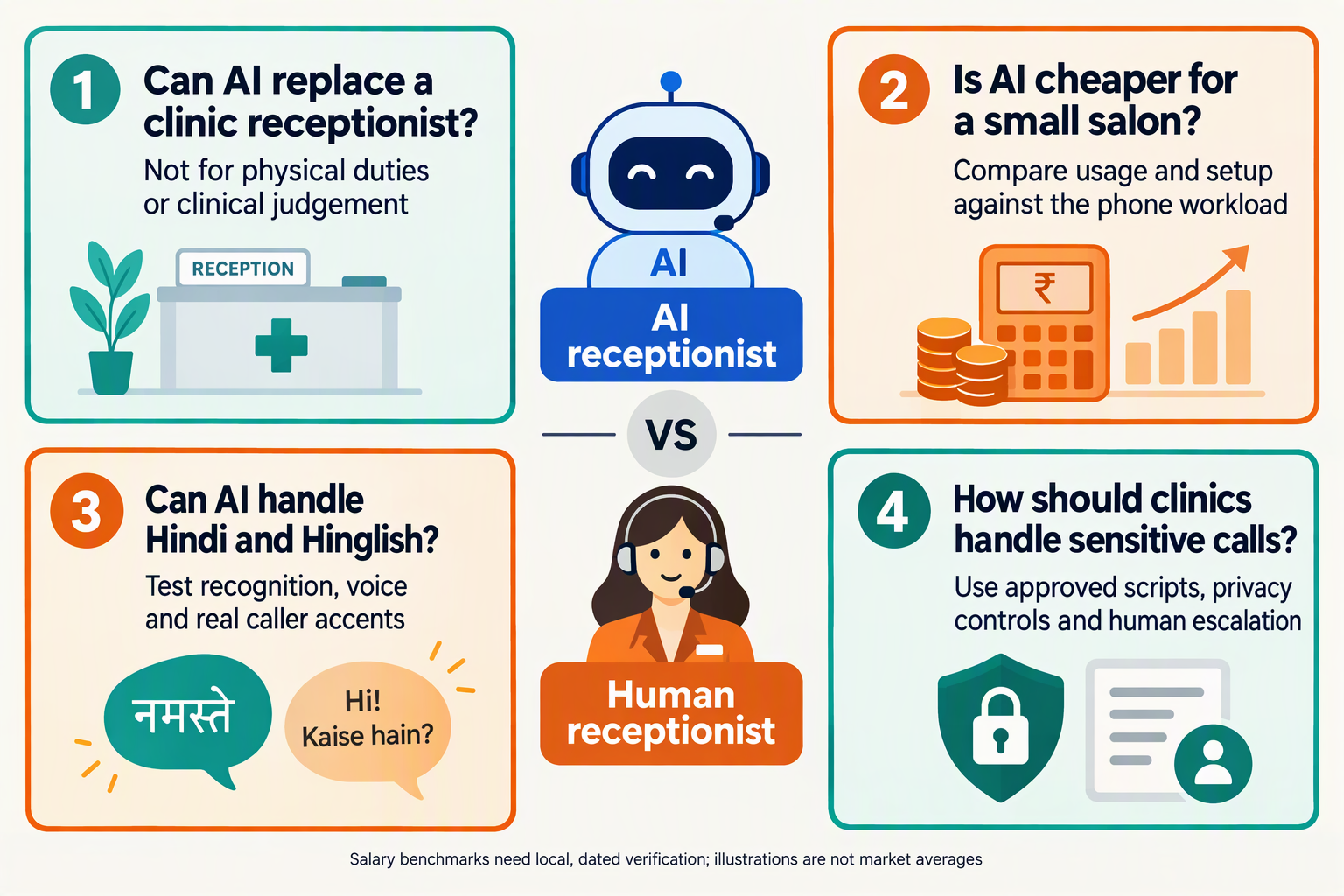
AI can replace some telephone tasks, but replacing reception staff requires a separate assessment of physical duties, exception handling, and total operating costs. These six questions help clinics and salons make that distinction.
- Q: In an AI receptionist vs human receptionist comparison, can AI replace the entire front desk?
A: Not if the role includes welcoming visitors, coordinating queues, or resolving situations that need someone physically present. GlossGenius’s salon receptionist job-description guide, supplied for this October 2026 comparison, treats reception as a combination of duties rather than telephone answering alone. List each responsibility and assign an owner before reducing staffing; otherwise, cheaper call handling can leave essential counter work uncovered.
- Q: What extra costs should clinics and salons check before buying an AI receptionist?
A: As of October 2026, CallMissed’s verified Expressive and Best latency voice-agent plans cost ₹5 and ₹6 per minute, respectively, with phone carriage billed separately. Budget for configuration, knowledge-base maintenance, integration work, applicable taxes, and staff time spent reviewing exceptions—not just conversation minutes. Request an itemised estimate for your expected call mix, and distinguish provider charges from internal operating costs.
- Q: How do short calls affect an AI receptionist’s monthly bill?
A: Check the minimum billable duration, because brief connected calls can cost more than their actual speaking time suggests. Under CallMissed’s verified October 2026 Standard pricing, a connected 10-second call reaches the 30-second minimum and costs ₹2 before carriage; 100 such calls would therefore cost ₹200, an illustrative calculation rather than a usage benchmark. Calls that never connect cost nothing, so separate connected calls from unsuccessful attempts when forecasting expenditure.
- Q: How should clinics measure AI receptionist vs human receptionist results?
A: Compare cost per correctly completed task, not simply cost per answered call, using the same appointment rules for both approaches. During an illustrative four-week pilot, record booking accuracy, unresolved requests, escalation frequency, and staff correction time; these are proposed evaluation measures, not published performance claims. Review clinic and salon results separately, because a service-price enquiry and a sensitive patient request require different standards of success.
- Q: Can an AI receptionist handle medical questions and urgent patient calls?
A: A clinic should restrict automated answers to approved administrative information and establish a clear route to qualified staff for medical questions. Do not treat fluent speech as evidence of clinical competence or assume a receptionist system can safely triage emergencies. Before deployment, test urgent-language scenarios, unavailable-staff situations, and the exact instructions callers receive when immediate human help is needed.
- Q: Should a salon hire a receptionist or use AI alongside existing staff?
A: Choose a hybrid arrangement when telephone interruptions are the bottleneck but visitors still need in-person assistance. Indeed’s India salon salary page and Salary.com’s Bengaluru clinic salary page, supplied for October 2026, describe different roles and locations and provide no update dates in the excerpts; neither establishes your local replacement cost. Obtain a local hiring quote and compare the proposed hybrid setup against your actual workload, including cover during breaks and leave.
Conclusion
AI receptionist vs human receptionist is a total-cost and service-quality decision—not simply a comparison between per-minute pricing and a monthly salary. For Indian clinics and salons, the strongest approach is the one that handles calls accurately without leaving visitors, patients, or staff unsupported.
- Compare complete costs, not headline prices. For this October 2026 comparison, Indeed’s supplied page lists an Indian salon receptionist average of ₹19,621 per month, while Salary.com’s supplied Bengaluru clinic receptionist page lists ₹38,642 per month; neither excerpt specifies an update date. These figures describe different roles and locations, so local hiring costs remain essential. CallMissed’s verified Standard voice-agent price, as of October 2026, is ₹4 per minute, including speech recognition, the language model, and voice. However, phone carriage is separate, and connected calls have a 30-second minimum. The illustrative ₹4,000 charge for 1,000 billable minutes is therefore a starting point—not a complete operating budget or proof that AI will be cheaper.
- Measure useful outcomes alongside spending. A lower call-handling bill matters only if customers receive accurate information and appointments require little correction. Unanswered calls, repeated explanations, escalation, and staff follow-up all affect the practical value of automation. Compare how much work each approach actually completes, rather than treating every answered call as an equivalent result. A routine opening-hours enquiry and a complicated appointment request can consume similar telephone time while creating very different workloads afterward.
- Keep physical presence and human judgment in the calculation. Clinics still need someone to assist an anxious patient at the counter; salons still need someone to welcome walk-ins and coordinate stylists. Automating telephone conversations does not automatically remove these responsibilities or eliminate a receptionist’s salary. Equally, asking front-desk staff to answer every repetitive enquiry can reduce the attention available to visitors. The relevant question is which tasks benefit from automation and which require a person—not whether one option can replace every part of the other.
- Evaluate hybrid economics against your workload. AI handling routine calls while a person manages exceptions and in-person service is a practical option to assess, not a guaranteed saving. Its value depends on call volume, appointment accuracy, customer confidence, and the amount of follow-up that remains. Explore CallMissed as one platform for testing this division of work, while keeping the comparison grounded in your actual costs and service requirements.
Looking ahead, watch whether AI reduces corrections and handoffs—not merely whether it answers more calls. Before changing your front desk, what would you measure to prove that customers are better served and total costs genuinely improve?
Related Reading
- Twilio Alternatives: CallMissed vs Twilio Costs in India
- AI Receptionist Pricing for Small Business: US vs India
- Human-in-the-Loop for AI Voice Agents: Safety Playbook