Twilio Alternatives: CallMissed vs Twilio Costs in India


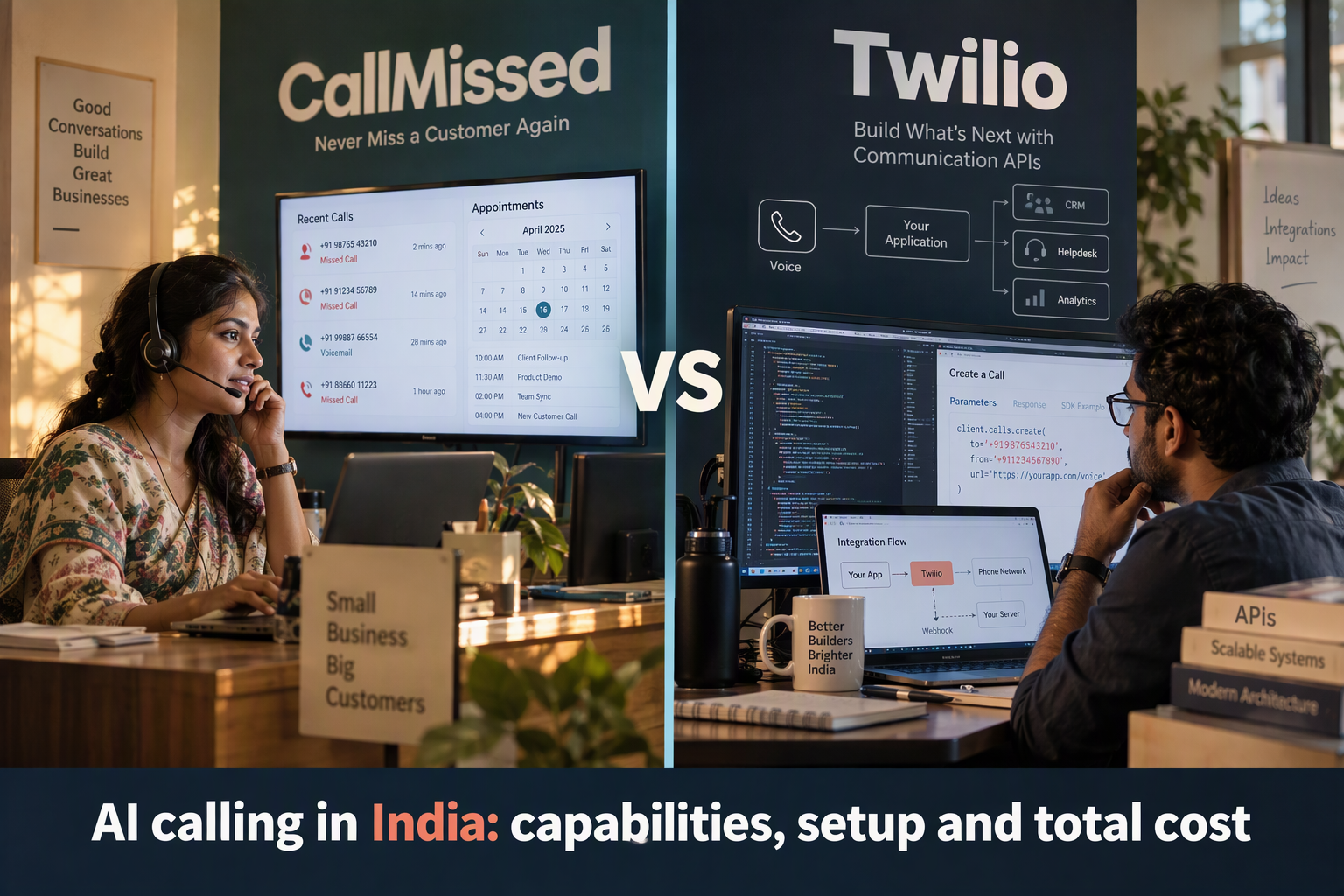
Compare Twilio alternatives for AI calling in India with itemized costs, setup requirements, language support, and practical selection criteria.
Twilio Alternatives: CallMissed vs Twilio Costs in India
What if the cheapest calling rate leaves out most of the cost of your AI agent? Comparing Twilio alternatives for Indian businesses means looking beyond telephone minutes to speech recognition, language models, voice generation, integration work and ongoing operations.
For this October 2026 comparison, the distinction matters: Twilio’s India SIP Trunking pricing page states that phone numbers are priced separately from voice usage, while Twilio’s Conversation Relay documentation describes speech-to-text and text-to-speech connected through a WebSocket API, using the AI of your choice. Neither description, by itself, gives you a complete AI-calling budget.
As of October 2026, CallMissed offers a no-code voice-agent builder and flat-rate AI voice plans at ₹4, ₹5 or ₹6 per minute, covering speech recognition, the language model and voice, with phone carriage billed separately and a 30-second minimum per connected call.
That creates a useful comparison—not a universal winner. The right choice depends on whether your team wants to assemble and maintain a programmable calling application or configure an agent around an existing business workflow. It also depends on which costs each quote includes.
What should an AI-calling cost comparison include?
A useful comparison separates telephony costs, AI processing costs and implementation effort. Otherwise, a low advertised rate can look attractive while leaving important expenses outside the calculation.
For an Indian business, the practical questions include:
- Calling: What does each inbound or outbound minute cost, and are number rental charges separate?
- AI processing: Are speech recognition, the language model and synthesized speech bundled or metered individually?
- Setup: Who connects business knowledge, booking tools and customer records?
- Operations: Who reviews transcripts, investigates failed interactions and updates the agent?
Consider a hypothetical workload of 10,000 billable AI-agent minutes per month. Every ₹1 difference in the effective per-minute rate changes that monthly subtotal by ₹10,000—before number rental, phone carriage or other applicable charges. This is arithmetic, not a vendor benchmark, but it shows why comparing equivalent workloads matters more than comparing headline prices.
What will this CallMissed vs Twilio comparison explain?
This guide compares capabilities, setup effort and total cost for AI-powered business calling in India. We will distinguish a calling API from a configured voice agent, examine Indian-language requirements and explain which charges belong in a realistic monthly estimate.
We will also identify where the supplied pricing information is insufficient for a firm Twilio total, rather than fill those gaps with assumed rates. The goal is straightforward: help you choose a setup that fits your technical resources, customer conversations and budget—not simply the smallest number on a pricing page.
Which is better: CallMissed for no-code setup or Twilio for a custom stack?
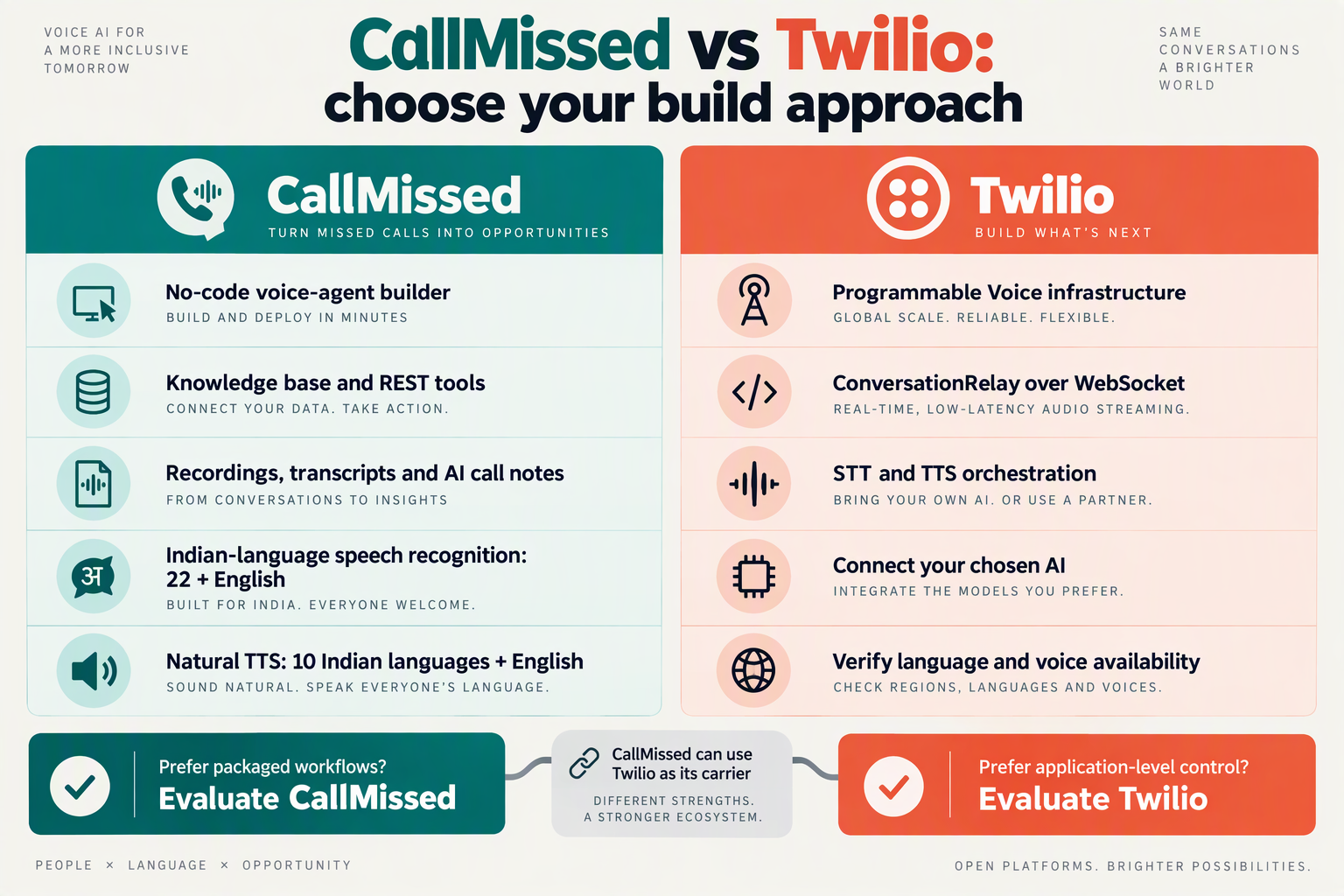
CallMissed is the more direct fit for configuring an AI calling agent without building the application layer; Twilio Conversation Relay fits teams that want to develop that layer themselves. For this October 2026 comparison, the deciding factor is who will own business logic, integrations and ongoing changes—not simply who supplies the telephone connection.
- No-code route: Configure prompts, knowledge, tools and call settings in a builder; reserve engineering effort for workflows that actually need custom integration.
- Custom-stack route: Twilio’s Conversation Relay documentation describes speech recognition and speech generation connected through a WebSocket API, with the AI model chosen by the developer.
- Evidence boundary: The supplied sources establish these two implementation paths, but do not support a measured setup-time comparison or a complete Twilio AI-calling price.
What does each setup path include?
The table compares verified product capabilities and documentation available for this October 2026 assessment; “not established” means the supplied research does not answer that question, not that a capability is unavailable.
| Setup decision | CallMissed: configured agent | Twilio: custom application |
|---|---|---|
| Agent configuration | No-code prompt, voice, language, tools and variables | Conversation Relay connects calls to application logic through WebSocket |
| Business knowledge | RAG from text, web pages and PDFs | Equivalent knowledge setup not established by supplied sources |
| External actions | Custom REST tools and tools from any MCP server by URL | Application architecture determines business-tool integration |
| Release management | Agent versioning with publish and rollback | Agent-release workflow not established by supplied sources |
| Speech and model layer | Voice plans bundle recognition, language model and voice | Conversation Relay supplies STT/TTS with the AI of your choice |
| Carrier choice | Rented numbers or Twilio, Plivo and any SIP trunk | Twilio documents Programmable Voice and SIP Trunking separately |
How should an Indian business choose between them?
- Workflow test: Use one concrete task, such as answering a policy question and booking an appointment. Check whether the agent can retrieve the right information, invoke the booking tool and handle an unsuccessful response; a fluent greeting alone does not validate the workflow.
- Engineering ownership: Twilio’s developer article, “My Voice AI Demo Was Hit by a $982 Traffic-Pumping Attack!”, describes a Conversation Relay assistant built with FastAPI. In this October 2026 assessment, that example illustrates application ownership—not a typical loss estimate or a reason to reject custom development.
- Operational ownership: As of October 2026, the CallMissed fact sheet lists call transcripts, CRM-pushed AI notes, custom QA scoring, evaluation suites and A/B experiments. Teams should assess these alongside setup controls because reviewing failures and safely changing an agent remain necessary after launch.
Choose the configuration-first path when existing builder controls match your workflow; choose the custom-stack path when application-level control justifies engineering ownership. A useful pilot compares the same task, tool failures and release process on both paths—without assuming either approach guarantees faster deployment or lower total cost.
What is the total cost for the same India call volume—not just the AI rate?
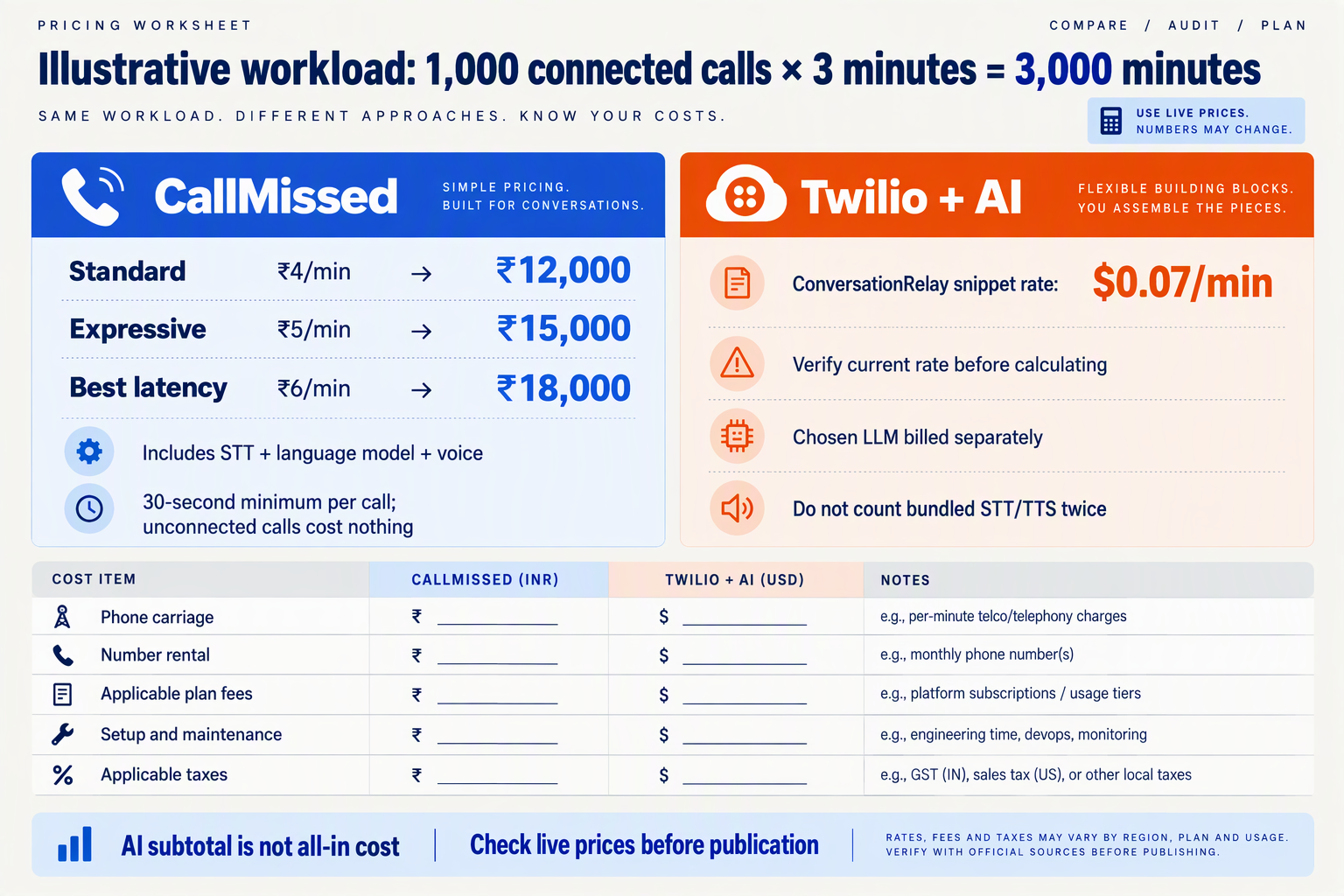
For 10,000 billable AI-agent minutes, the monthly AI subtotal is ₹40,000–₹60,000 on CallMissed, but neither vendor’s complete India calling cost can be established without telephony charges. Compare the same connected-call workload, then add number rental, implementation and ongoing operations.
- CallMissed: As of October 2026, its verified pricing bundles speech recognition, the language model and voice; phone carriage is billed separately.
- Twilio: In the supplied October 2026 research, Twilio describes Conversation Relay as speech-to-text and text-to-speech orchestrated through a WebSocket API with “the AI of your choice”; obtain pricing for the selected language model as well.
- Workload: Keep inbound/outbound mix, destinations, connected duration and call-length distribution identical; 10,000 conversation minutes do not necessarily produce 10,000 billable minutes under every billing rule.
- Evidence limit: The supplied Twilio India pricing excerpts do not contain numerical calling or Conversation Relay rates, so a rupee-denominated Twilio total would require additional pricing—not an assumed figure.
What does the same 10,000-minute workload cost?
The following October 2026 illustration uses published CallMissed rates and arithmetic, not a customer benchmark. “Quote required” means the supplied evidence does not establish that charge.
| Cost component | CallMissed | Twilio | Budget treatment |
|---|---|---|---|
| Standard AI, 10,000 minutes | ₹40,000 at ₹4/min | Quote required for selected stack | Alternative AI subtotal |
| Expressive AI, 10,000 minutes | ₹50,000 at ₹5/min | Quote required for selected stack | Alternative AI subtotal |
| Best latency AI, 10,000 minutes | ₹60,000 at ₹6/min | Quote required for selected stack | Alternative AI subtotal |
| Phone carriage | Separately billed | India route rates required | Add usage charges |
| Phone-number rental | Obtain applicable rental | Separately priced from voice usage | Add monthly rental |
| Setup and ongoing operations | Estimate actual team effort | Estimate actual team effort | Add implementation and maintenance |
Which billing details can change the final estimate?
- Plan selection: Choose one of the three AI subtotals above; do not add them together. The ₹20,000 spread between Standard and Best latency is calculated for this illustrative volume, before carriage or other expenses.
- Short calls: As of October 2026, CallMissed’s flat-rate plans have a 30-second minimum per connected call. For example, 1,000 connected calls lasting 10 seconds each would produce 500 billable AI minutes, rather than approximately 167 elapsed minutes; calls that never connect cost nothing.
- India telephony: Twilio’s India SIP Trunking pricing page states that numbers are priced separately from usage; its VoiceCountry Resource documentation organizes outbound prices by prefix and inbound prices by number type. Match the actual routes rather than substitute a generic international rate.
- Total-cost worksheet: Calculate AI processing + phone carriage + number rental + recurring operations + amortized setup, then account for applicable taxes and currency conversion. Allocate implementation over a stated period—such as 12 months—and avoid counting speech processing twice when a quoted bundle already includes it.
What setup work separates an integrated platform from a programmable stack?
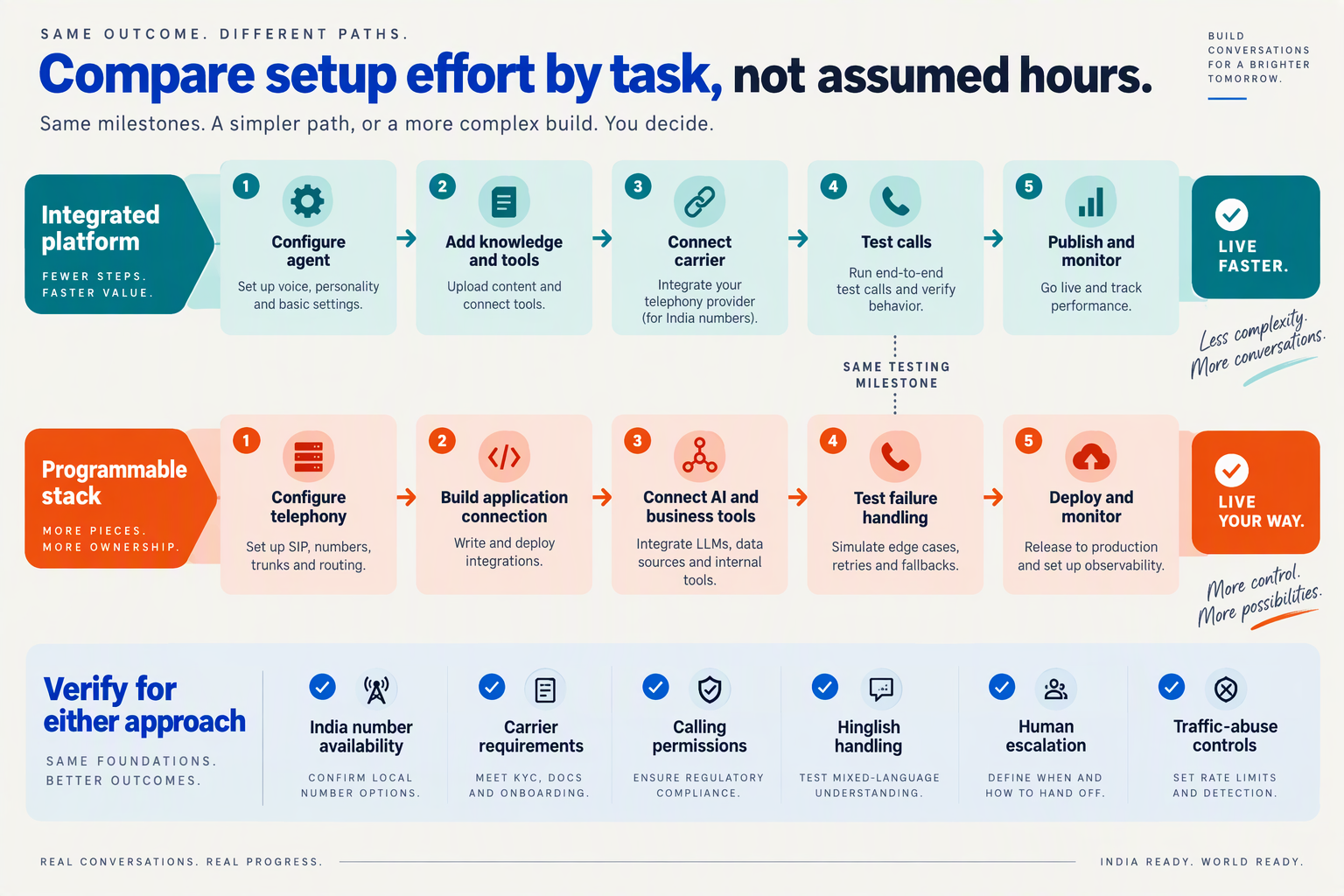
An integrated platform shifts setup toward configuring business workflows; a programmable stack requires application code connecting those workflows to the call. The practical difference is who owns the knowledge connections, tool execution, deployment and maintenance—not simply who provides the telephone number.
- CallMissed: As of October 2026, CallMissed’s verified feature sheet lists knowledge-base ingestion from text, web pages and PDFs, custom REST tools, variables, and agent versioning with publish and rollback. Setup therefore includes preparing source material, defining tool inputs and testing published versions, rather than treating a working voice demo as a finished business agent.
- Twilio: As of October 2026, Twilio describes Conversation Relay as speech-to-text and text-to-speech combined with the “AI of your choice” through a WebSocket API. That gives developers control over the application behind the conversation; teams must plan how their chosen AI accesses business knowledge, invokes tools and handles unsuccessful requests.
- CallMissed: As of October 2026, the verified feature sheet supports bringing Twilio, Plivo or any SIP trunk, alongside integrations including Cal.com, Google Calendar and HubSpot. An integrated platform need not mean replacing every existing service: implementation can focus on connecting the carrier, booking system or CRM already used by the business.
- Twilio: Twilio’s developer security article, included in the October 2026 research, describes a FastAPI voice assistant connected through Conversation Relay. This is a concrete example of the programmable approach: budget ownership for the application service, WebSocket connection and deployment process, while recognizing that FastAPI is an example—not a mandatory framework.
What should your team test before launching an AI calling workflow?
- Booking workflow: Test three outcomes: an available appointment, an unavailable slot and a failed booking request. For either architecture, confirm that the agent checks availability before promising a time and distinguishes a successful reservation from an attempted one. A named calendar integration is a starting point, not proof that your workflow is ready.
- Knowledge preparation: Create an acceptance set covering opening hours, cancellation rules, service eligibility and escalation. Verify answers against approved business documents, including contradictory or outdated material. The setup task is not merely uploading content; it is deciding which source governs the answer when two documents disagree.
- Security ownership: Twilio’s developer article supplied for this October 2026 comparison reports a $982 traffic-pumping attack against a voice-AI demo. That incident is not a typical-cost benchmark, but it supports a practical launch checklist: restrict exposed entry points, review abnormal traffic and assign responsibility for investigating unexpected calling activity.
- Effort comparison: Ask each implementation team to quote four deliverables separately: carrier connection, knowledge preparation, business-tool integration and production testing. The supplied research provides no verified setup-hour benchmark for either platform. Compare documented work and ongoing ownership rather than assuming “integrated” means zero configuration or “programmable” means an unsuitable project.
What are the pros and trade-offs of each calling architecture?
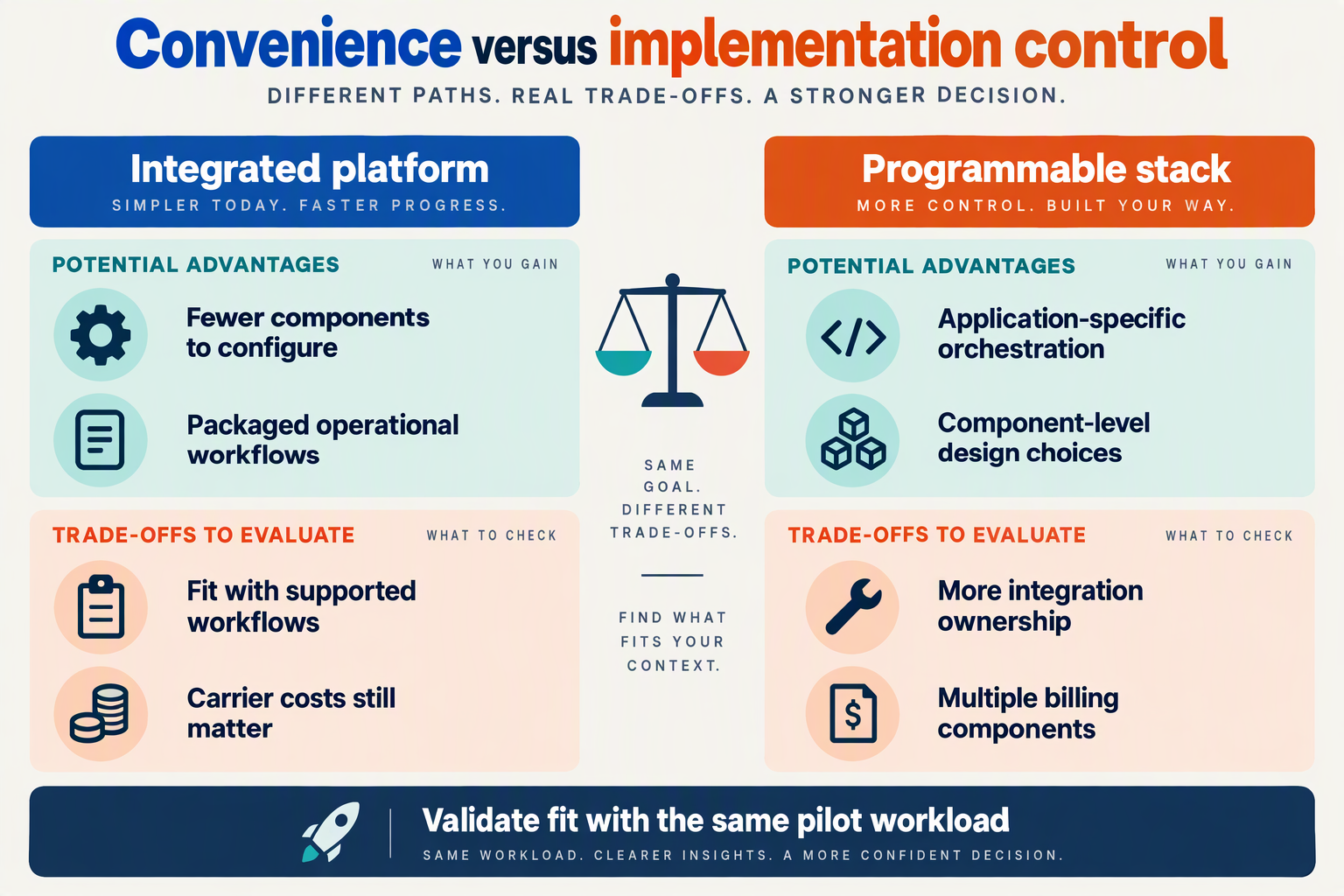
CallMissed’s configured-agent architecture suits teams that want built-in business workflows; Twilio Conversation Relay suits teams designing their own application around a WebSocket connection. The trade-off is configuration versus application-level control—not a universal winner.
- Configured agents: Compare built-in workflow coverage against your requirements before commissioning custom development.
- Programmable applications: Compare the flexibility of your own application against the engineering and operational responsibilities it introduces.
The architecture comparison below reflects October 2026 product information from the CallMissed fact sheet and Twilio documentation; missing prices or capabilities are not treated as evidence of absence.
| Decision point | Configured-agent architecture | Twilio Conversation Relay architecture | Practical trade-off |
|---|---|---|---|
| Agent setup | No-code builder with prompts, tools, variables and call settings | Connects speech recognition and synthesized speech to your application through WebSocket | Configuration-led setup versus application-led integration |
| Model selection | Bundled AI plans or a custom component stack | Uses “the AI of your choice,” according to Twilio | Compare available choices with your model requirements |
| Business knowledge | Knowledge base accepts text, web pages and PDFs | Business knowledge must be addressed in the application design; supplied documentation does not specify its implementation | Test retrieval quality, not just document ingestion |
| Live-call supervision | Supervisors can listen, whisper or barge in | Supplied Conversation Relay excerpts do not establish equivalent supervision features | Verify the complete proposed solution |
| Change management | Agent versioning supports publish and rollback | Application changes follow the deployment process your team implements | Decide who approves and reverses production changes |
| Carrier strategy | Rented numbers or an existing carrier, including Twilio, Plivo or any SIP trunk | Twilio documents country-specific inbound and outbound pricing resources | Architecture and carrier selection need not be the same decision |
Which architecture reduces operational work?
- Configured agents: As of October 2026, the verified fact sheet lists transcripts, AI call notes, CRM updates and scoring against your own QA rubrics; check whether those outputs match your review process.
- Programmable applications: Twilio’s October 2026 documentation describes WebSocket orchestration of speech-to-text and text-to-speech; map the surrounding responsibilities for tool execution, records and escalation before estimating effort.
- Release management: Test a changed booking tool, an outdated knowledge document and an interrupted call; these reveal maintenance requirements that a successful greeting demo cannot.
What should you validate before choosing?
- Custom metering: As of October 2026, the verified fact sheet specifies per-second component billing with no minimum for a custom stack; compare that option using your actual call-duration distribution.
- Security controls: Twilio’s supplied developer article reports a $982 traffic-pumping attack on a voice-AI demo; treat this as one incident, not a typical loss, and review access restrictions and spending controls.
- Total-cost evidence: Request a quote that separates carrier usage, numbers, AI processing and implementation; Twilio’s supplied India pricing excerpts do not provide enough numerical detail to establish a comparable all-in total.
Which approach should your Indian business choose after a pilot?
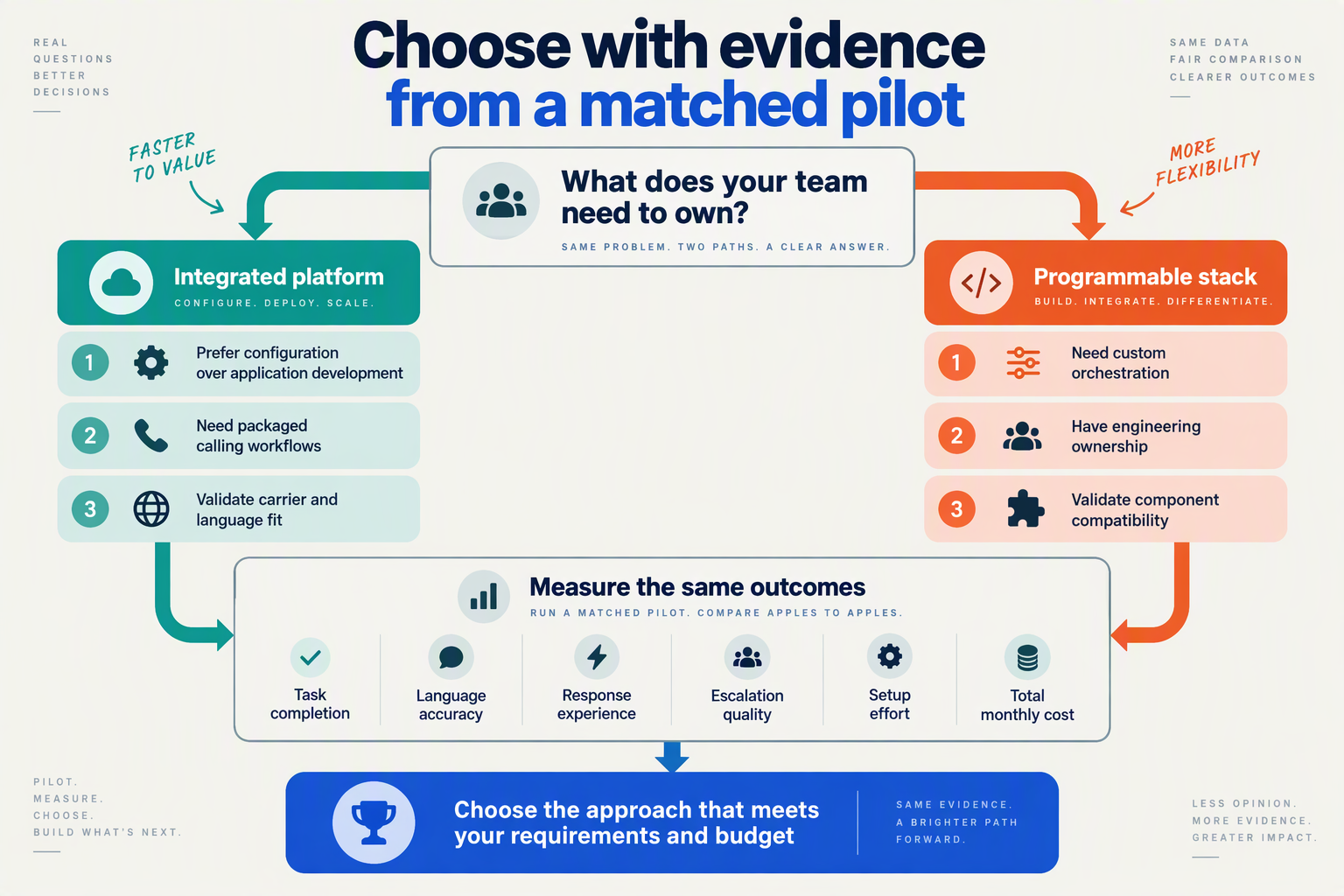
Choose the approach that meets your pilot’s quality targets with an operating cost and maintenance workload your team can sustain. For this October 2026 decision, use measured outcomes—not the most impressive demonstration.
Which pilot results should determine your choice?
- Task completion: Score outcomes separately for booking, lead qualification and support—not just whether calls connected. An illustrative acceptance gate is 90 successful outcomes per 100 eligible calls, with zero unauthorized commitments; this is a suggested business target, not a vendor benchmark. Review failed calls before expanding traffic.
- Language coverage: Test each required language separately, including code-switching, names, addresses and background noise. For example, 30 Hindi, 30 English and 30 Hinglish calls provide an initial diagnostic sample, not proof of production reliability. Do not let strong English results conceal failures in a regional-language workflow.
- Human escalation: Include at least 10 deliberately difficult scenarios, such as disputed charges, unavailable appointments and requests outside policy. Measure whether the customer reaches the correct person with useful context. Decide in advance which failures block launch and which can be corrected through prompts, tools or routing changes.
Which operating model fits your team?
- CallMissed: As of October 2026, CallMissed’s verified fact sheet lists agent versioning with publish and rollback, live supervisor listening, whisper and barge-in, and call scoring against your own QA rubrics. Favor this configured operating model when business supervisors need to review calls and manage agent changes; validate those workflows during the pilot.
- Twilio: Twilio’s Conversation Relay documentation, supplied for this October 2026 comparison, describes speech recognition and voice generation orchestrated through a WebSocket API, using your chosen AI. Favor this programmable approach when your engineering team wants application-level control and accepts responsibility for maintaining its integration. Require a named owner for releases and incident response.
- Maintenance effort: Record engineering and supervisor hours separately over a two-week pilot, including tool failures, knowledge updates and regression checks. If one approach saves eight engineering hours monthly, multiply eight by your actual loaded hourly cost. Treat that saving as a measured operational benefit—not an assumed advantage of either vendor.
How should you approve the production budget?
- Cost per completed task: Divide the pilot’s total attributable cost by successful outcomes. A hypothetical ₹12,000 pilot producing 240 completed tasks costs ₹50 per completion; the same spend producing 120 costs ₹100. Include AI processing, carriage, number rental and implementation labor consistently, rather than rewarding cheaper minutes that produce fewer usable outcomes.
- Contract and rollout checks: Twilio’s India SIP Trunking pricing page states, in the context supplied for October 2026, that “Phone numbers are priced separately from voice usage.” Obtain destination-specific rates and confirm billing increments, taxes and AI charges before signing. Expand through a limited production cohort first, with agreed spending limits and rollback criteria.
Frequently Asked Questions
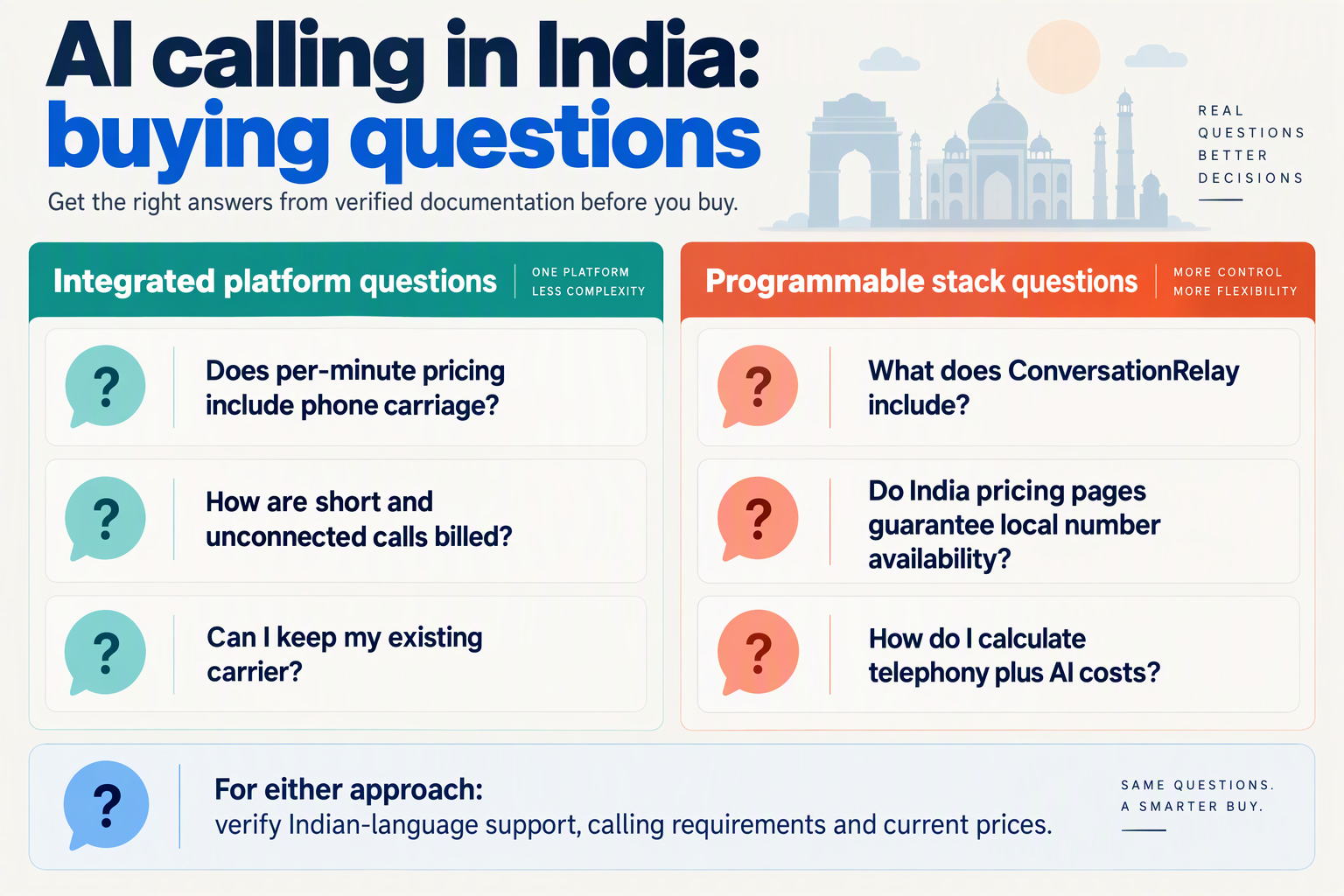
Verify a written, workload-specific quote and test real customer conversations before buying. For this October 2026 comparison, these six questions turn headline capabilities into practical acceptance criteria.
- Q: How should I compare the total cost of Twilio alternatives for AI calling in India?
A: Request separate line items for number rental, telephone carriage, speech recognition, language-model usage, voice generation and support, plus minimum billing increments and applicable taxes. As of October 2026, Twilio’s VoiceCountry Resource documentation describes outbound prices by destination prefix and inbound prices by number type, so one headline rate cannot represent every calling route. Ask each supplier to price the same call-duration distribution, including short connected calls and unsuccessful attempts, rather than comparing average minutes alone.
- Q: Can I switch from Twilio without rebuilding my AI calling application?
A: As of October 2026, CallMissed’s verified product fact sheet lists a Twilio-compatible Calls API, with migration through a base-URL and credential change, plus support for bringing a Twilio, Plivo or other SIP trunk. That compatibility should not be treated as proof that every existing application dependency transfers unchanged. Inventory the endpoints, callbacks and carrier configuration your application uses, then validate a representative inbound and outbound workflow before moving production traffic.
- Q: Which Indian languages should I test when evaluating Twilio alternatives?
A: As of October 2026, CallMissed’s verified product fact sheet specifies speech recognition in 22 Indian languages plus English, including Hinglish, and natural text-to-speech voices in 10 Indian languages plus English. Recognition coverage and voice coverage are different requirements; check both for every language your customers use. Run representative tests involving regional accents, background noise, names, addresses and code-switching, and measure whether the agent completes the task—not merely whether the transcript looks plausible.
- Q: Does Twilio Conversation Relay include the complete business AI agent?
A: As of October 2026, Twilio’s Conversation Relay product page describes speech-to-text and text-to-speech orchestration through a WebSocket API, using “the AI of your choice.” Before purchasing, establish who supplies the language model, business knowledge, booking logic, customer-record access and escalation workflow. Ask for a demonstration that completes a real business task and recovers from a failed tool request, rather than accepting a fluent conversation as sufficient evidence.
- Q: What compliance and recording requirements should an Indian business verify?
A: Ask the supplier and your carrier to document requirements for your intended inbound or outbound use case, including customer permissions, recording notices and applicable calling restrictions. Verify where recordings and transcripts are stored, who can access them, and how retention and deletion work. Treat these as contract and legal-review questions: a feature checklist alone does not establish that your particular deployment is compliant.
- Q: How can I prevent unexpected charges from an AI voice-agent demo?
A: In the research supplied for this October 2026 comparison, Twilio’s developer blog describes a voice-AI demo hit by a $982 traffic-pumping attack, illustrating that unauthorized traffic can create material costs. Before exposing a demo, request authentication controls, destination restrictions, usage alerts and enforceable spending limits, and verify which are actually available. Test the response to suspicious activity and assign someone responsibility for disabling access; an alert is useful only when someone acts on it.
Conclusion
The strongest Twilio alternatives for AI voice calling in India should be evaluated on complete costs, setup effort and operational fit—not telephone rates alone. This October 2026 comparison points to a practical decision: choose the approach your team can configure, maintain and budget for confidently.
- Compare equivalent costs, not headline prices. Separate phone carriage, number rental, speech recognition, language-model processing and voice generation before comparing quotes. As reviewed in October 2026, Twilio’s India SIP Trunking pricing page states that phone numbers are priced separately from voice usage. That distinction matters because a calling rate alone cannot establish the monthly cost of an AI-powered business conversation.
- Match setup effort to your technical resources. A programmable calling application and a configured voice agent involve different implementation choices. As reviewed in October 2026, Twilio’s Conversation Relay documentation describes speech-to-text and text-to-speech connected through a WebSocket API, using the AI of your choice. Evaluate who will connect business knowledge, booking tools and customer records—and who will maintain those connections after launch.
- Understand what bundled AI pricing includes. According to CallMissed’s verified product information, as of October 2026, CallMissed offers a no-code voice-agent builder and AI voice plans at ₹4, ₹5 or ₹6 per minute, covering speech recognition, the language model and voice generation. Phone carriage remains separate, and connected calls have a 30-second minimum. These boundaries make the AI subtotal easier to identify without turning it into an all-inclusive telephony estimate.
- Include ongoing operations in the decision. Budgeting should account for reviewing transcripts, investigating unsuccessful interactions and updating agent behaviour—not just launching the initial integration. Indian-language requirements also belong in the evaluation: the right setup must fit the conversations your customers actually have. Neither a low minute rate nor a convenient builder, considered alone, establishes the right choice for every business.
What should Indian businesses watch next?
Watch how clearly providers distinguish AI processing charges from telephony charges, and whether implementation becomes easier without obscuring ongoing responsibilities. As your calling workload grows, compare the same billable minutes, language requirements and business workflows rather than assuming that two advertised rates cover equivalent services.
The next useful step is a workload-based estimate, not a universal winner. Where the supplied Twilio pricing information does not establish a complete total, request the missing charges rather than filling the gaps with assumptions.
Explore CallMissed as one platform for configuring AI-powered business calling, then assess it against your technical resources and customer needs. Before choosing, ask: what will a successful customer conversation actually cost—including the work required to keep it successful?
Related Reading
- Vapi alternatives: Retell vs CallMissed for Startups
- DeepSeek V4.1 Flash Now on CallMissed API: 1M Context
- Bulbul V4 Flash Now on CallMissed API: Sarvam's Fast TTS