Best AI voice agents in India: 2026 Comparison Guide


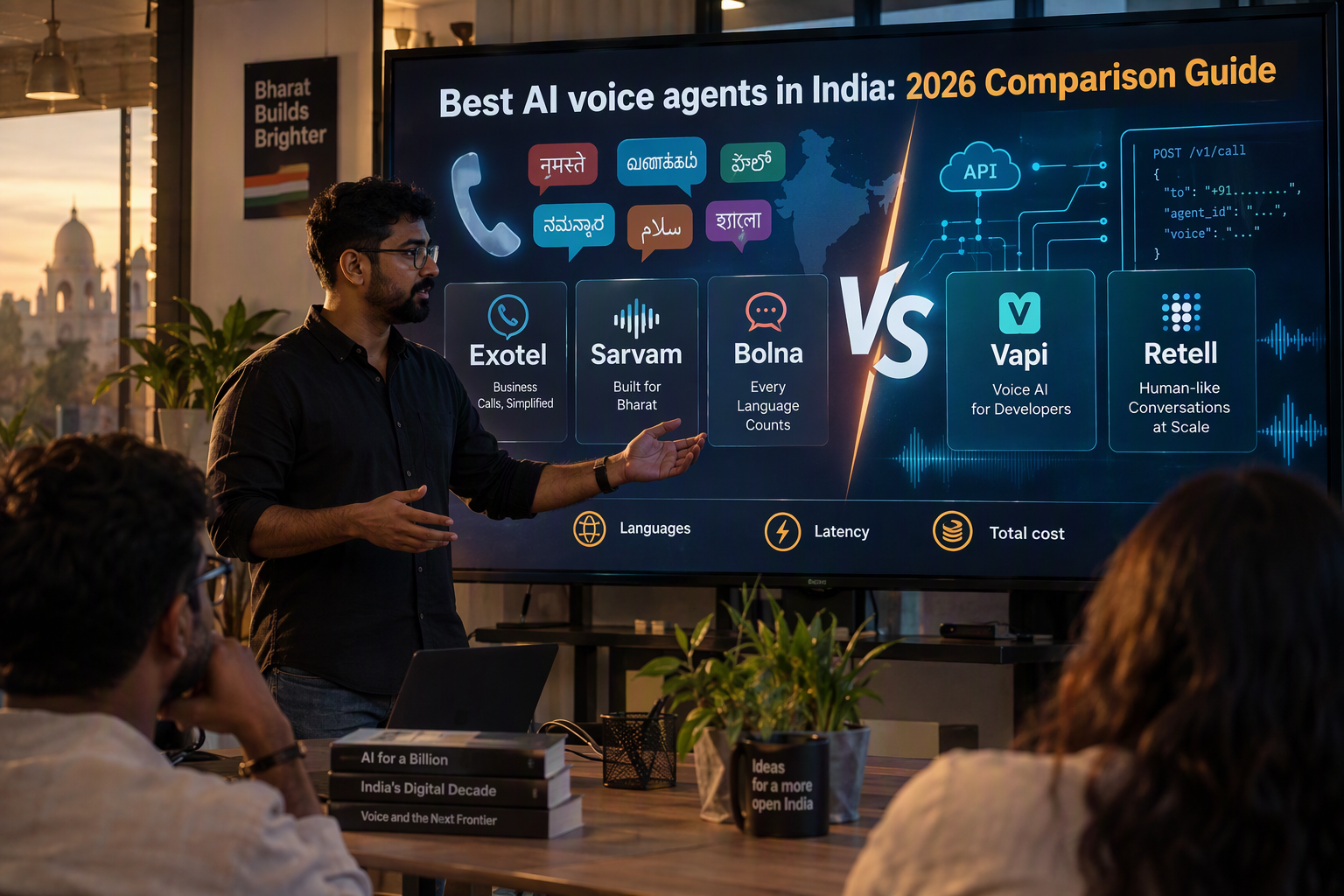
Best AI voice agents in India compared by INR costs, language coverage and PSTN latency evidence to help you shortlist the right platform.
Best AI voice agents in India: 2026 Comparison Guide
Could a voice agent understand your customer’s Hinglish perfectly—and still lose the conversation by replying too slowly? Best AI voice agents in India are worth comparing on more than realistic voices: the right choice depends on language coverage, conversational responsiveness, integrations, and the complete cost of handling a call.
The stakes are clear in the October 2026 research: Exotel advertises sub-300 ms voice latency for its Voicebot offering on AgentStream infrastructure, while Retell AI reports measured latency near 600 ms in its own phone-support comparison. Those figures make responsiveness a buying consideration, but they are not automatically comparable: buyers need to understand what each measurement includes before treating either number as a performance verdict.
For Indian businesses, the practical question is not simply whether an agent sounds human. It is whether the agent can handle regional-language conversations, recognise interruptions, retrieve accurate information, and transfer a customer to the right person without creating another support problem.
What should Indian businesses compare before choosing an AI voice agent?
This guide compares platforms through the decisions that matter in deployment—not just the features that look impressive in a demo:
- Languages: Which languages support speech recognition and voice output, and how does the agent handle code-mixed speech?
- Latency: Does the quoted figure measure audio transport, a processing stage, or the complete conversational response?
- Features: Can the platform connect to business tools, follow call flows, and support human intervention?
- Pricing: Does the advertised rate include speech recognition, the language model, voice generation, and telephone carriage?
These distinctions prevent expensive misunderstandings. A platform’s orchestration fee, for example, should not be compared directly with another platform’s bundled per-minute rate without accounting for the remaining components. Likewise, understanding a language does not necessarily mean offering a natural-sounding voice in that language.
How will this comparison help you choose?
As of October 2026, CallMissed offers bundled voice-agent plans at ₹4–₹6 per minute, covering speech recognition, the language model, and voice generation, with phone carriage billed separately—an example of why this guide separates AI processing costs from telephony costs.
You will learn how to shortlist platforms for your business, interpret vendor latency claims, and compare language capabilities without confusing speech recognition with text-to-speech. We will also examine where no-code setup, developer flexibility, call controls, and integrations influence the buying decision.
The goal is a practical shortlist rather than a universal winner. A clinic managing appointment enquiries, a retailer answering order-status questions, and a development team building custom workflows may need different platforms—even when their monthly call volumes look similar.
Which AI voice agent is best in India? Match your shortlist to languages, workflows and total cost
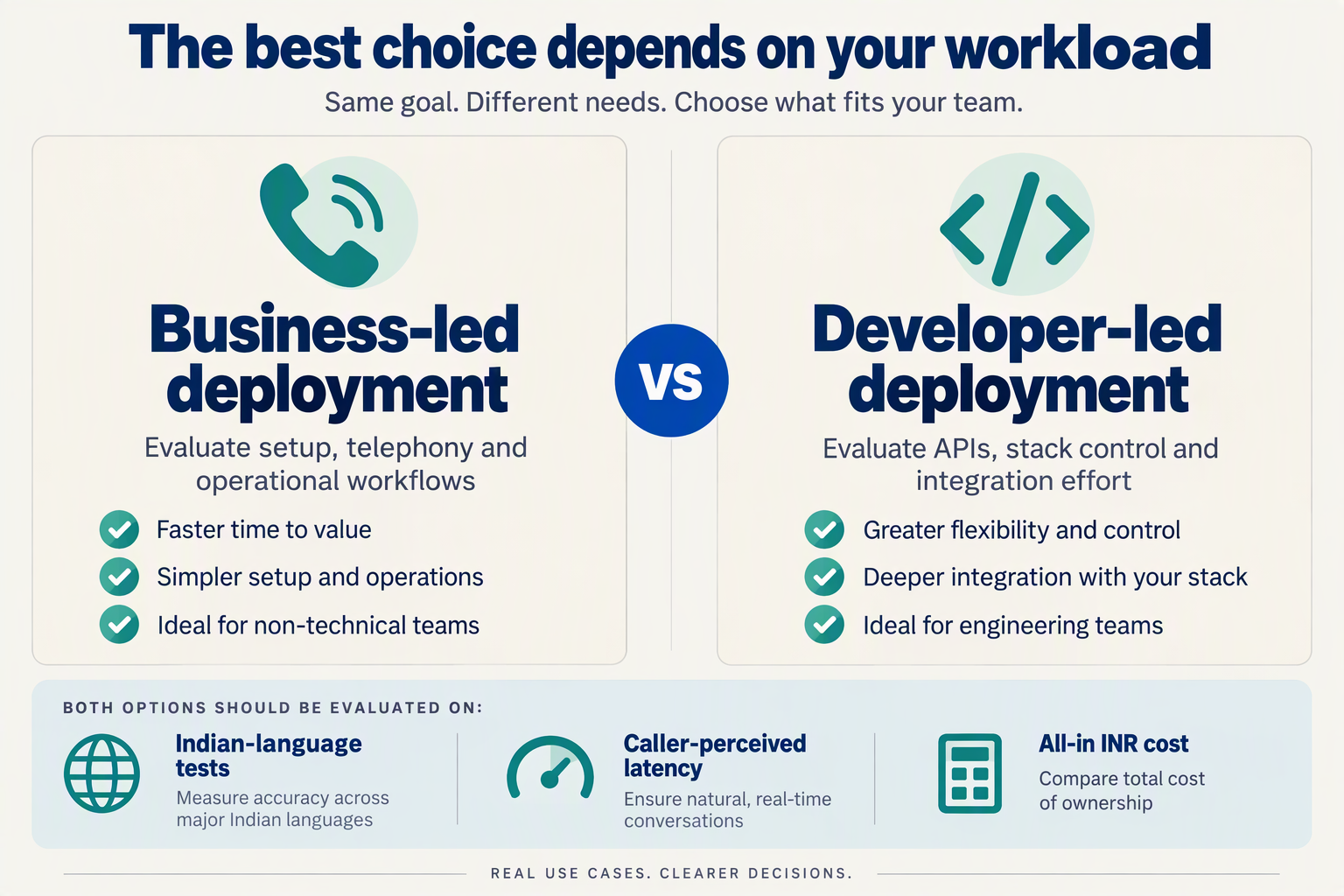
The best AI voice agent in India is the one that fits your actual call workflows, required languages and fully loaded cost—not the platform with the strongest demo. Build your shortlist around these eight buying decisions.
- CallMissed — regional-language workflows: As of October 2026, CallMissed supports speech recognition in 22 Indian languages plus English, including Hinglish, and natural text-to-speech in 10 Indian languages plus English. Its no-code builder, knowledge bases, custom REST tools and supervisor listen, whisper and barge-in controls make it worth evaluating for regional support—not merely multilingual greetings.
- CallMissed — predictable billing: As of October 2026, CallMissed applies a 30-second minimum per connected call, while calls that never connect cost nothing; phone carriage is separate. At its ₹4/min Standard rate, 1,000 connected calls lasting exactly 20 seconds would incur ₹2,000 in AI charges, illustrating why minimum billing matters alongside the headline rate.
- Exotel — infrastructure-led deployments: Exotel’s reference architecture, available in the October 2026 research, specifies under 20 ms AgentStream media latency and an under 800 ms end-to-end target. Shortlist Exotel when evaluating a streaming architecture, but ask which speech recognition, language model and voice services complete the stack: media transport alone does not determine conversational responsiveness.
- Vapi — developer-controlled stacks: Arobit’s guide, included in the October 2026 research, describes Vapi’s base orchestration fee as approximately $0.05/minute, rather than a complete bundled call price. Engineering teams should request a component-level estimate covering speech recognition, language-model usage, voice generation and telephony before comparing Vapi with platforms that bundle those AI components.
- Sarvam Samvaad — Indian-language evaluation: The Prayas India’s October 2026 research snapshot describes Sarvam AI voice interactions across 10 Indian languages and English, with “sub-second latency” and mixed-language handling. Swadeshi Apps identifies Samvaad as its enterprise conversational platform. Verify which capabilities apply specifically to the proposed Samvaad deployment, rather than assuming every ecosystem capability is included.
- Retell AI — phone-support evaluation: Retell AI’s own comparison, available in the October 2026 research, cites $0.07/minute pay-as-you-go pricing and a test programme involving 1,400 calls over six weeks. Treat that evidence as vendor-published, not an independent ranking; request the exact configuration, included components and billing conditions behind the advertised rate before estimating an Indian deployment.
- Language acceptance test — prove task completion: For an October 2026 shortlist, use the same 30 scripted scenarios per platform as a practical starting point—not an industry benchmark. Include Hindi-English switching, regional accents, names, addresses and interruptions. Score recognition accuracy, spoken-language quality and successful booking or order lookup separately; a fluent response can still contain the wrong customer details.
- Total-cost comparison — normalise the quote: For October 2026 procurement, compare every vendor against one workload, such as 10,000 connected minutes monthly, plus your expected short-call distribution. Request separate figures for AI processing, telephone carriage, number rental, minimum billing and applicable taxes. Also require a live demonstration of tool failure and human escalation: cheap minutes are poor value when callers must repeat the task.
How do CallMissed, Exotel, Bolna, Sarvam, Vapi and Retell compare on features?
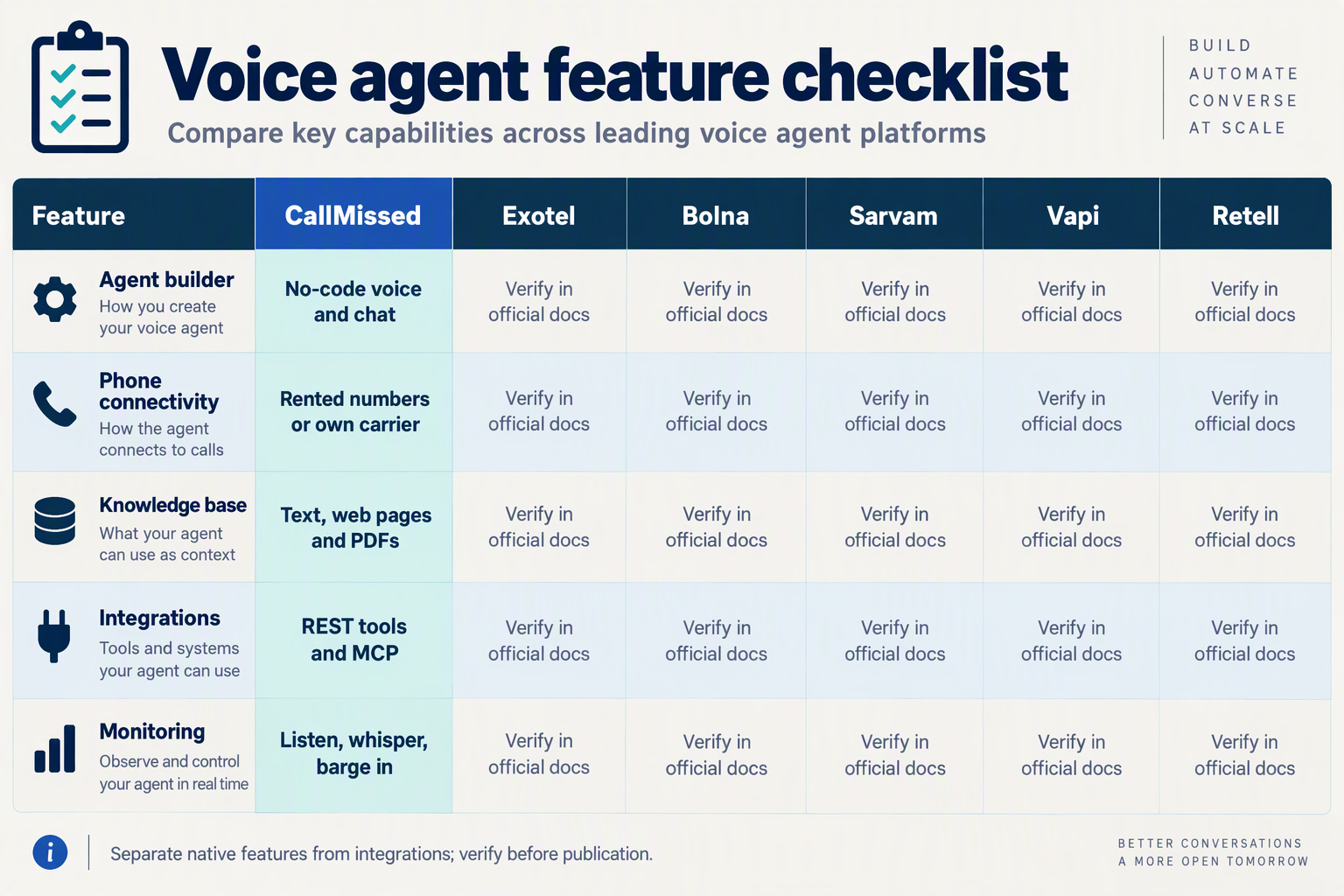
CallMissed, Exotel, Bolna, Sarvam, Vapi and Retell are not interchangeable: compare their agent-building tools, telephony controls and integration scope before comparing headline performance. This October 2026 feature snapshot separates documented capabilities from details the supplied research does not establish.
- Evidence standard: A feature not documented below is unverified in this research, not necessarily unavailable.
- Comparison scope: The six-platform table focuses on deployment and workflow features; latency and pricing need separate, like-for-like checks.
| Platform | Agent and workflow features | Calling and language evidence | Source / verification boundary |
|---|---|---|---|
| CallMissed | No-code builder; knowledge bases from text, webpages and PDFs; custom REST tools; publish and rollback | Inbound/outbound calls; Twilio, Plivo or SIP trunks; DTMF menus; recognition in 22 Indian languages plus English | Verified product facts, October 2026; natural voice output covers 10 Indian languages plus English, not 22 |
| Exotel | Voicebot on AgentStream infrastructure; barge-in handling | Raw-audio streaming to an agent; Exotel documents a reference architecture using LiveKit | Exotel’s October 2026 research materials; architecture guidance does not establish every packaged Voicebot feature |
| Bolna | Feature details not supplied | Language coverage, carrier support and call controls require verification | No Bolna-specific source in the supplied October 2026 research |
| Sarvam | Sarvam Samvaad is described as an enterprise conversational-AI platform | The Prayas India reports accents, dialects and mixed-language speech across 10 Indian languages and English | Swadeshi Apps and The Prayas India, reviewed October 2026; verify product-specific coverage |
| Vapi | Engineering teams configure voice, conversation flow, telephony and integrations | AITools.fyi describes support answering, lead qualification, appointment scheduling and outbound calling | Third-party listing reviewed October 2026; confirm individual integrations and controls directly |
| Retell AI | Phone-first voice-agent platform | Shunya describes inbound and outbound calling | Shunya comparison dated 14 September 2026; detailed workflow controls are not established by the supplied excerpt |
Which features should Indian businesses verify in a demo?
- CallMissed: As of October 2026, the verified feature sheet includes live supervisor listen, whisper and barge-in, agent-to-agent call handoffs, and CRM-pushed summaries, action items and dispositions. Demonstrate these with a support escalation, rather than treating a successful FAQ answer as proof of production readiness.
- Language coverage: The Prayas India’s Sarvam coverage, reviewed in October 2026, reports 11 languages overall. Ask vendors to demonstrate recognition and spoken output separately using the same Hindi-English appointment enquiry; an overall language count does not identify every supported speech component.
- Telephony architecture: Exotel’s reference architecture, reviewed in October 2026, explicitly recommends streaming raw audio through AgentStream rather than high-latency REST calls. Ask whether that architecture is included in the proposed deployment or requires your engineering team to assemble additional services.
- Workflow completion: Use three concrete acceptance tests: retrieve an order status, book an appointment and escalate to a person. Vapi’s third-party listing supports appointment-scheduling use cases, while Shunya documents Retell’s calling scope; neither excerpt alone proves your chosen CRM connector, booking write-back or human-transfer configuration.
How should buyers handle missing comparison data?
- Procurement checklist: Request written confirmation of carrier compatibility, language-specific voice output, transfer behaviour and integration ownership. Keep Bolna on the evaluation list, but leave undocumented cells open until a dated product document or working demo supplies the evidence.
Which platforms handle Indian languages best? Test recognition, voices and code-switching separately
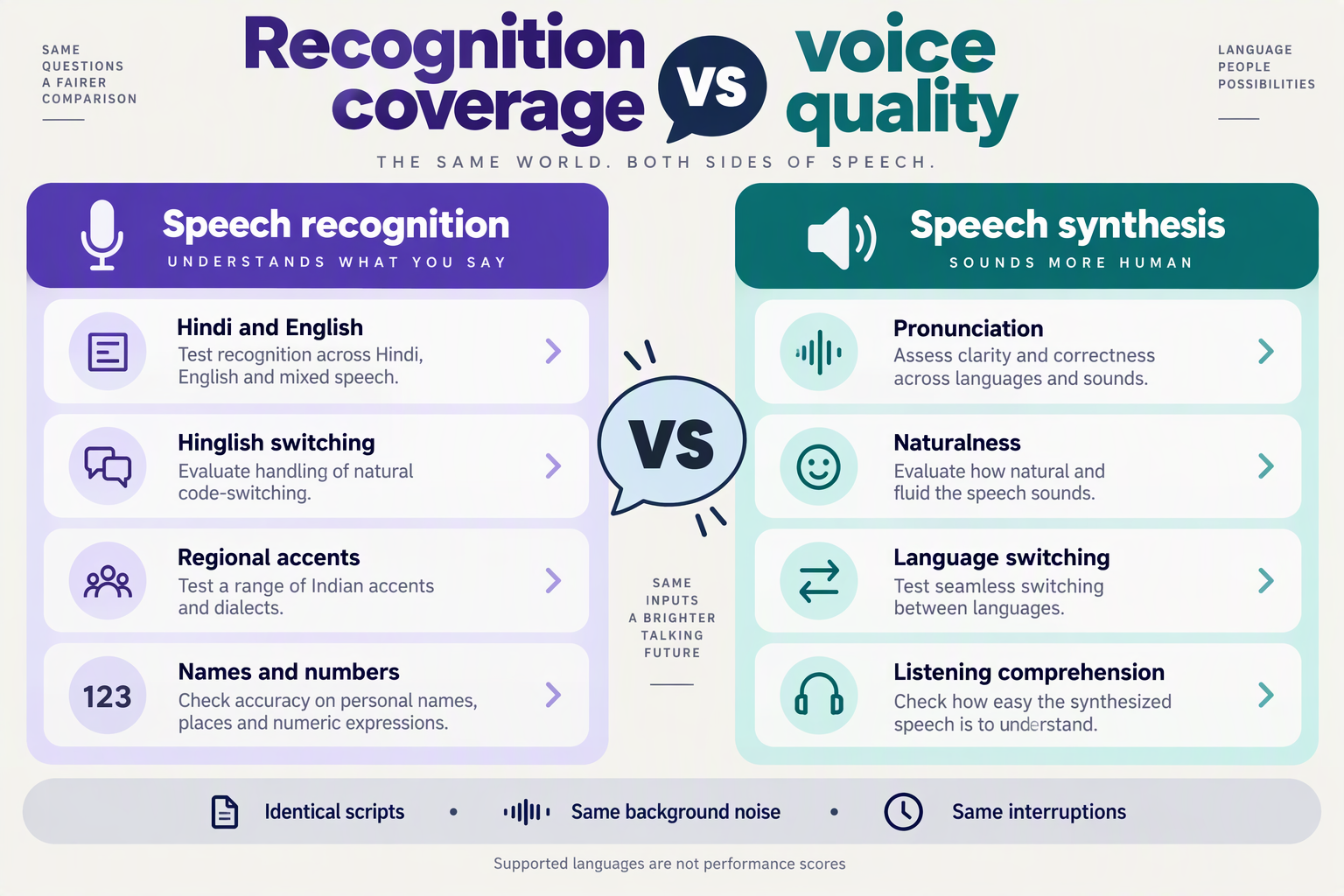
Compare Indian-language recognition, voice output and code-switching separately: a language count does not establish quality across all three. The supplied October 2026 research supports capability-based shortlisting, not a measured language-quality winner.
- CallMissed: As of October 2026, CallMissed’s verified product facts list speech recognition in 22 Indian languages plus English, including code-mixed speech such as Hinglish, and natural text-to-speech in 10 Indian languages plus English. More output languages are available through other voice models. These are separate coverage figures—not evidence that every recognised language has the same voice selection or recognition accuracy.
- Sarvam AI: In the research supplied for this October 2026 comparison, The Prayas India describes Sarvam AI as supporting 10 Indian languages plus English, including accents, dialects and mixed-language speech. That makes Sarvam AI relevant to an Indian-language shortlist, but the source does not separately enumerate speech-recognition coverage, text-to-speech coverage or per-language accuracy. Request those details before treating “11 languages” as an equivalent specification.
- Exotel, Vapi and Retell AI: The supplied October 2026 sources emphasise latency, architecture or pricing rather than comparable Indian-language test results. Exotel discusses AgentStream infrastructure; aitools.fyi describes Vapi’s orchestration capabilities; Retell AI reports phone-support testing. None of these supplied excerpts establishes a language-quality ranking. Ask each vendor which recognition model and voice will actually power your Hindi, Tamil or Marathi deployment.
How should you test Indian-language voice agents before buying?
- Speech recognition: Use a proposed 100-utterance test per priority language, including regional accents, background noise, names, addresses and spoken amounts. Score both word error rate and correct extraction of business-critical fields. An agent that transcribes most words correctly but mistakes “₹1,500” for “₹15,000” can still fail the workflow; report those errors separately rather than hiding them inside an average.
- Voice output: Give every shortlisted platform the same 20 response scripts per language and have native speakers score intelligibility, pronunciation and naturalness on a 1–5 scale. Include appointment times, medicine names, locality names and English product names embedded in regional-language sentences. Test the actual configured voice, not a different voice featured in a vendor demo.
- Code-switching: Add a proposed 30 mixed-language utterances per language pair, such as “Mera order kal deliver hoga?” and “Appointment Tuesday ko reschedule kar do.” Check whether the agent preserves intent, dates and entities, then replies in the requested language. Include switches midway through a sentence: recognising Hindi and English independently does not prove reliable Hinglish handling.
- Acceptance criteria: Label these sample sizes as buyer-designed tests, not published vendor benchmarks. Agree on thresholds before running identical audio through each configuration, and record the test date, model and voice. Weight errors by business consequence: incorrect payment amounts should count more heavily than harmless punctuation differences, while repeated pronunciation complaints should influence the final voice choice.
How should you compare latency on Indian PSTN? Measure median and tail response times
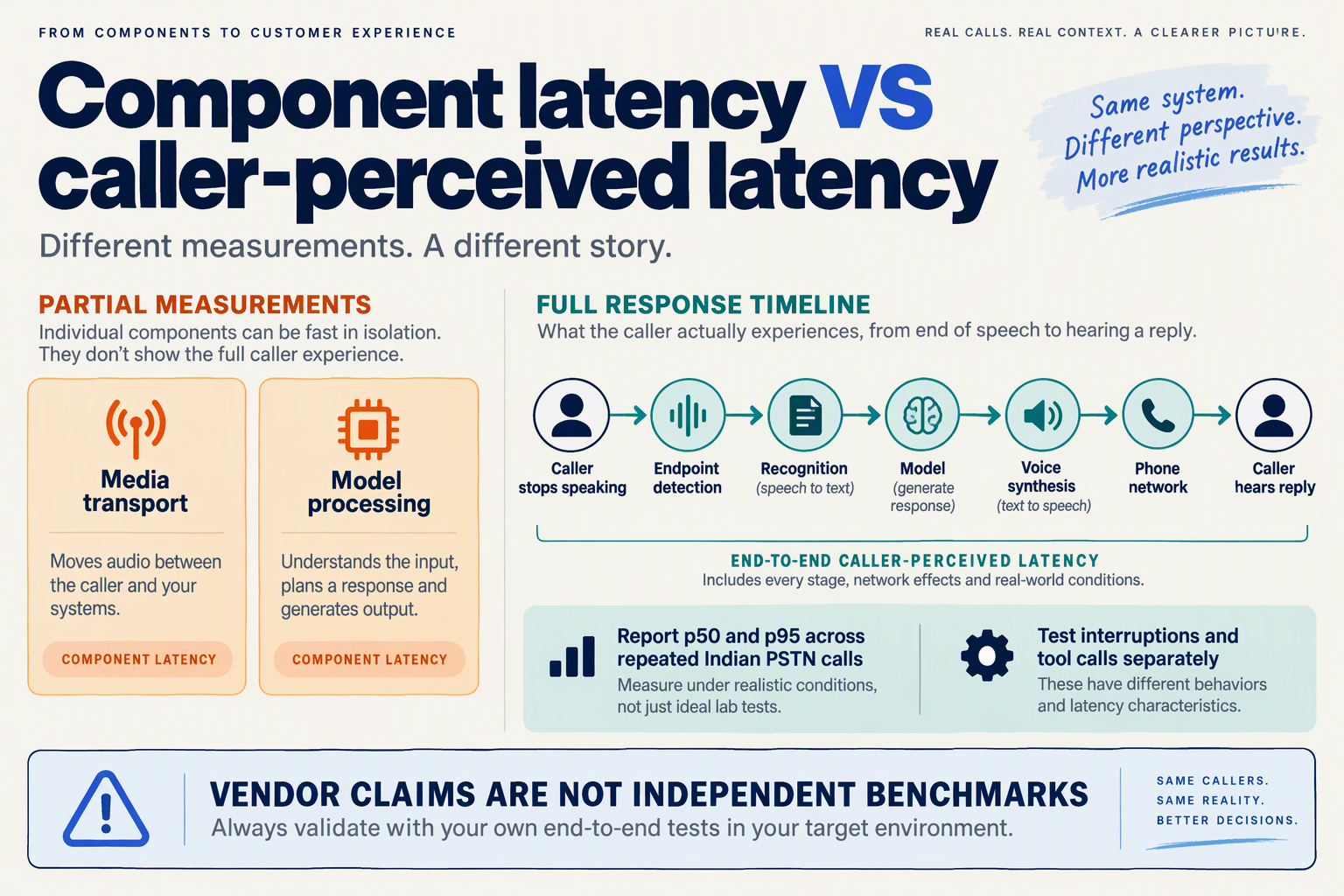
Compare Indian PSTN latency from the customer’s last spoken sound to the first audible agent reply, reporting both median and tail response times. Use identical telephone routes and workflows: a fast audio-streaming component does not establish fast conversational performance.
Which latency measurements should buyers request?
- End-to-end response time: Measure the interval between the caller finishing a turn and hearing the agent’s first reply on the telephone connection—not merely when the server generates audio. Include endpoint detection, speech recognition, model processing, tool execution, speech synthesis, and delivery. Keep browser demonstrations separate from Indian public switched telephone network (PSTN) results.
- Median and tail latency: Request p50, p95, and p99 for the same test population: these describe the median and the thresholds below which 95% and 99% of measured responses fall. Report completed turns, timeouts, and failures separately so missing responses cannot make the latency distribution look artificially better.
- Exotel’s component-versus-total distinction: In the reference architecture available in October 2026, Exotel cites AgentStream media latency below 20 ms and an industry-benchmark requirement of under 800 ms end-to-end latency. These measure different scopes; neither establishes a measured p95 for your deployment. Ask which stages and telephone legs each quoted figure includes.
- CallMissed’s plan distinction: As of October 2026, CallMissed’s verified fact sheet describes its “Best latency” voice-agent plan as offering its fastest replies, alongside custom-stack configuration. Treat that description as a reason to test the configuration, not as a numerical PSTN benchmark. Compare plans using the same script, carrier, language, knowledge base, and tool workload.
How should you run an Indian PSTN comparison?
- Controlled test matrix: As a proposed procurement protocol—not a published benchmark—run 100 calls per shortlisted configuration, covering Hindi, English, and Hinglish across quiet and noisy environments. Spread calls across peak and off-peak periods. Record carrier, call direction, deployment region, configuration version, and test date; avoid mixing configuration changes into one aggregate result.
- Separate task workloads: Measure straightforward answers, knowledge-base retrieval, and external-tool requests independently. An appointment enquiry that calls a calendar service should not share an unexplained average with a greeting. Record tool duration separately, while retaining it in the customer-facing end-to-end measurement: customers experience the complete wait, regardless of which service caused it.
- Interruption and endpointing tests: Include callers pausing mid-sentence, correcting a date, and interrupting the agent. Measure how quickly agent audio stops after an interruption, separately from response latency. Flag premature replies and clipped speech: lowering the silence threshold can improve a stopwatch result while making normal conversations less usable.
- Acceptance criteria: Set workload-specific p50 and p95 targets before demonstrations, then inspect p99 alongside the longest pauses and failed turns. Choose acceptable limits through customer testing rather than borrowing a vendor headline. For order-status calls, also verify correctness and completion: a rapid acknowledgement followed by prolonged silence is not a fast, useful answer.
What do these platforms really cost in INR, including telephony and minimums?
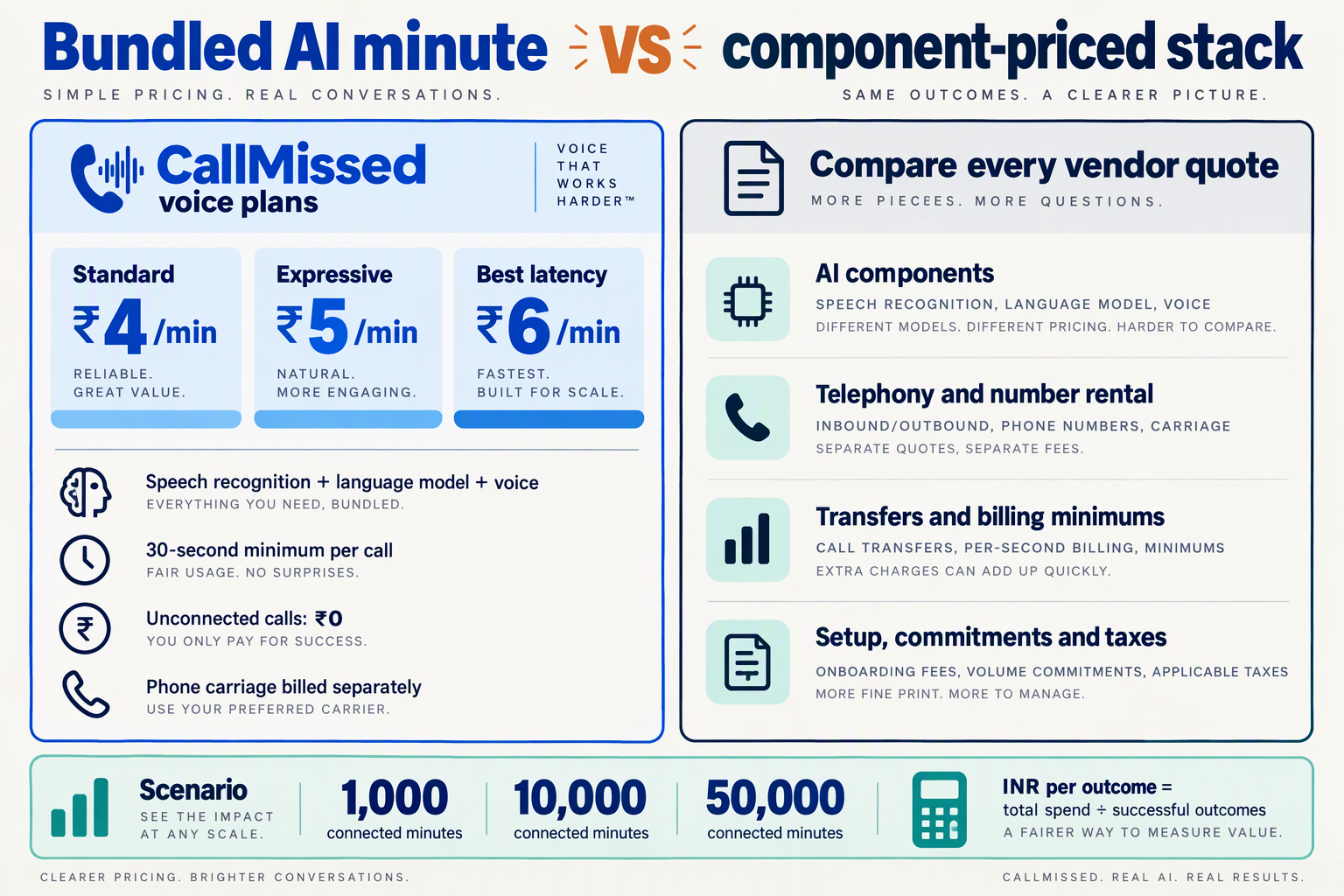
Compare the complete call bill—not just the advertised AI rate. As of October 2026, the supplied research does not establish an all-inclusive INR price for every platform, so telephony and billing minimums must remain separate comparison items.
What are the published AI voice agent prices in INR?
The conversions below use an illustrative ₹96/US$, consistent with CallMissed’s October 2026 pricing fact sheet—not a live foreign-exchange quote. “Not specified” means the supplied evidence does not establish the charge or policy; it does not mean free.
| Platform | AI price in INR | What the quoted rate covers | Telephony | Billing minimum |
|---|---|---|---|---|
| CallMissed | ₹4 Standard; ₹5 Expressive; ₹6 Best latency/min | Speech recognition, LLM and voice | Billed separately | 30 seconds/call; unconnected calls cost nothing |
| Vapi | About ₹4.80/min ($0.05) | Base orchestration fee, according to Arobit | Not established in supplied excerpt | Not specified |
| Retell AI | ₹6.72/min ($0.07) | Advertised pay-as-you-go rate; component coverage not established here | Not established in supplied excerpt | Not specified |
| Exotel Voicebot | Not specified | Supplied Exotel research describes capabilities, not pricing | Request an itemised quote | Not specified |
| Sarvam Samvaad | Not specified | Supplied Swadeshi Apps research describes the platform, not pricing | Request an itemised quote | Not specified |
How do telephony and minimums change the real cost?
- Vapi: Arobit’s guide, reviewed for this October 2026 comparison, describes approximately $0.05/min as an orchestration fee. At the illustrative exchange rate, 10,000 minutes means ₹48,000 for that fee alone—not an established total including speech services, models and carriage.
- Retell AI: Retell AI’s 2026 phone-support comparison advertises $0.07/min pay-as-you-go pricing, equivalent to ₹6.72 at the illustrative rate. For 10,000 minutes, that is ₹67,200 at the quoted rate; confirm included components before treating it as an all-in budget.
- CallMissed: Its October 2026 fact sheet specifies a 30-second minimum for bundled plans. A connected 10-second Standard-plan call therefore incurs ₹2 in AI charges, before carriage; its custom-stack alternative bills each component by the second with no minimum.
- Telephony: Ask each shortlisted vendor for inbound and outbound carriage rates, number-rental charges, and carrier billing increments. Calculate these separately across your expected 10,000 monthly minutes; the supplied research does not provide comparable carriage tariffs for these platforms.
- Short calls: Minimums matter most when calls end quickly. In a hypothetical 1,000-call workload averaging 10 connected seconds, a 30-second minimum produces 500 billable minutes, compared with approximately 167 minutes under exact second-based billing.
- Exotel and Sarvam: Neither supplied platform description establishes an INR tariff or minimum commitment as of October 2026. Request written pricing for the same workload, languages, carrier arrangement and support requirements rather than interpreting missing public figures as higher or lower costs.
- Procurement: Compare AI processing + carriage + number rental + committed fees + applicable taxes. Ask whether silence, hold time, transfers and failed connections are billable, and require a worked invoice for your call mix before signing; these answers can change the ranking materially.
What are each platform's pros and cons after evidence checks?
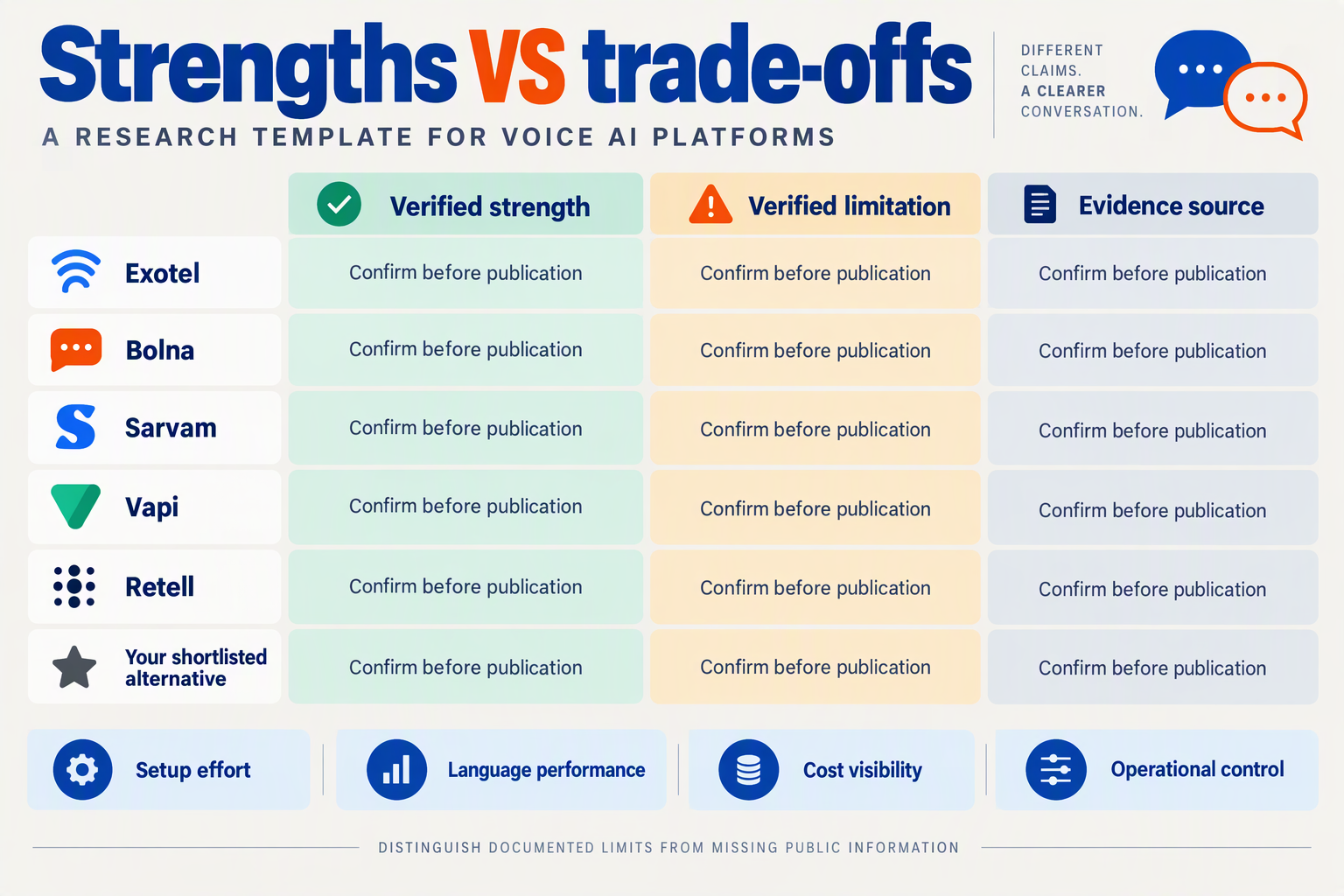
The evidence supports a use-case shortlist, not an overall winner: published strengths differ, and missing information should remain an evidence gap—not become an invented disadvantage. The checks below reflect the supplied research as of October 2026, rather than independent testing.
- Evidence quality: Separate verified product specifications, vendor-reported tests and third-party summaries; these provide different levels of confidence.
- “Cons”: Distinguish a documented constraint, such as separately billed telephony, from an unanswered question about pricing or performance.
- Selection rule: Prefer the platform whose documented strengths match your workflow, then test the unresolved points before signing.
| Platform | Evidence-backed pros | Constraints or evidence gaps | Best-fit evaluation |
|---|---|---|---|
| CallMissed | Its verified October 2026 fact sheet lists no-code agent building, live supervisor listen/whisper/barge-in, and call scoring against custom QA rubrics. Speech recognition covers 22 Indian languages plus English; natural voice output covers 10 Indian languages plus English. | Bundled calls have a 30-second minimum, with phone carriage charged separately; custom component billing has no minimum. The fact sheet provides no numerical latency benchmark. | Consider for regional-language support requiring operational controls. Test code-mixed recognition and voice output separately, and validate response timing on your actual carrier. |
| Exotel | Exotel’s October 2026 comparison describes barge-in handling and AgentStream infrastructure. Its reference architecture explains streaming raw audio rather than relying on higher-latency REST interactions. | The supplied extracts do not establish a complete agent price or language-by-language coverage. Exotel’s “zero-dropped-call design” wording is a vendor claim, not an independently verified uptime guarantee. | Consider when telephony architecture is central; request measured results for the complete speech-to-response pipeline, not merely the media layer. |
| Vapi | The October 2026 aitools.fyi listing describes configurable voice, conversation flow, telephony and integrations—a relevant combination for engineering-led deployments. | Arobit reports an orchestration fee of approximately $0.05/minute; that is not evidence of an all-inclusive calling rate. The supplied sources do not verify Indian-language coverage. | Consider for a configurable stack; obtain separate speech recognition, model, voice-generation and carrier costs before comparing totals. |
| Sarvam Samvaad | The Prayas India’s October 2026 context reports 10 Indian languages plus English, including accents, dialects and mixed-language speech. Swadeshi Apps identifies Samvaad as an enterprise conversational platform. | These are third-party summaries; the supplied evidence does not separate recognition from voice-output coverage or establish pricing and test methodology. | Consider for Indian-language conversations, subject to direct confirmation of supported voices, deployment options and performance on regional recordings. |
| Retell AI | Retell AI’s October 2026 comparison reports six weeks and 1,400 test calls, providing more evaluation context than an unexplained latency headline alone. | The testing is vendor-published. Its reported $0.07/minute rate does not, in the supplied excerpt, establish every component included in the final bill. | Consider for phone-support evaluation; reproduce representative calls and confirm configuration, telephony charges and Indian-language performance. |
What evidence should buyers request before choosing?
- Language proof: Request separate recognition and voice-output lists, then test names, addresses, interruptions and Hindi–English switching using recordings representative of your customers.
- Latency proof: Ask for the measurement boundary, carrier, model configuration and response-time distribution; a single headline cannot establish performance during peak traffic.
- Cost proof: Obtain an itemised quote covering AI components, telephone carriage, minimum billing increments and disconnected calls, then price the same sample workload across every shortlisted platform.
Which should you choose for regional-language support, developer control or outbound sales?
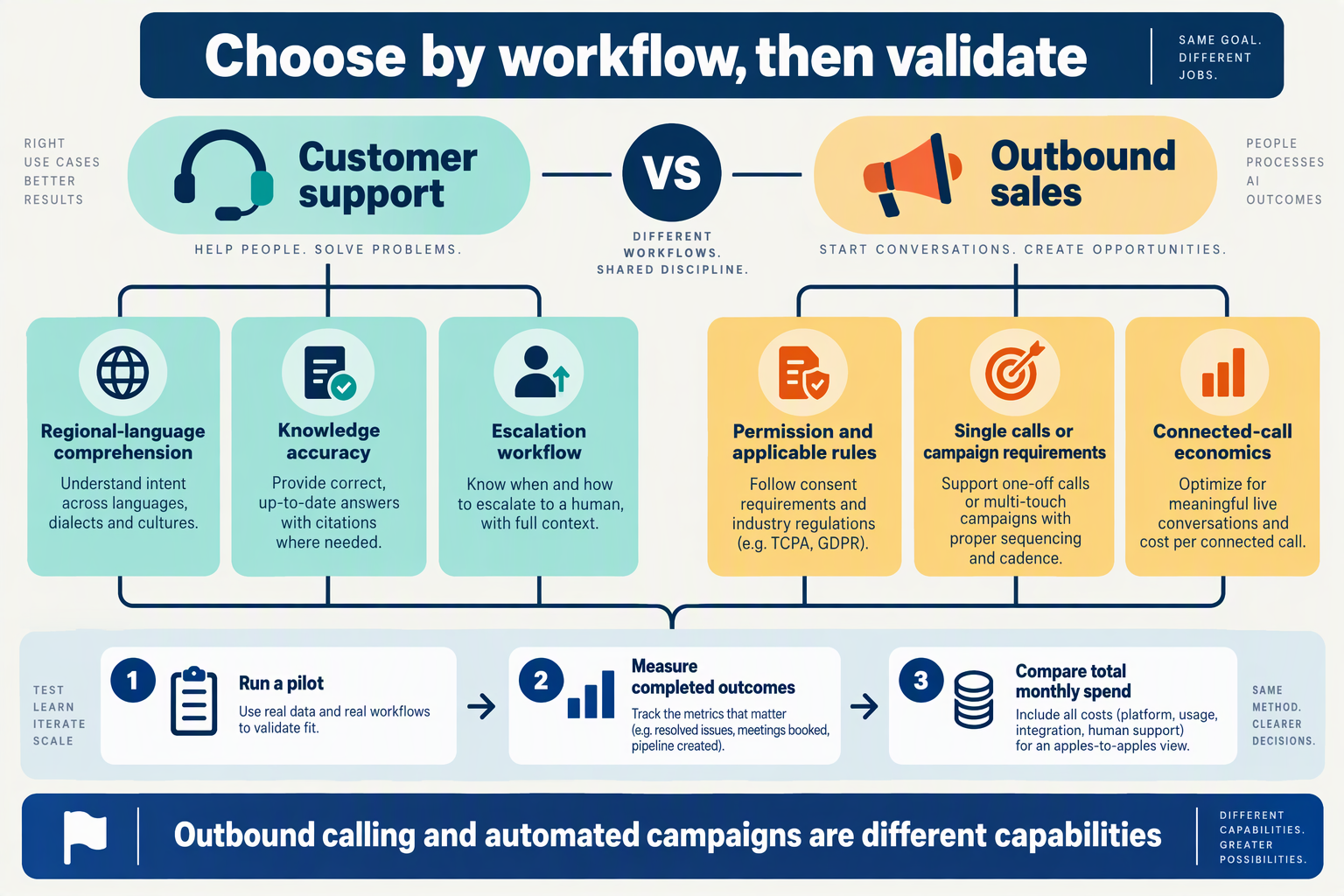
Choose regional-language coverage for local support, API flexibility for custom development, and outbound workflow fit for sales. Shortlist by those priorities—not by a single headline latency figure.
- CallMissed — regional-language support: As of October 2026, CallMissed’s verified fact sheet lists speech recognition in 22 Indian languages plus English, including Hinglish, and natural text-to-speech in 10 Indian languages plus English. Shortlist it for multilingual support, but verify both recognition and voice availability for each required language; input coverage does not guarantee matching output coverage.
- Sarvam Samvaad — Indian-language evaluation: As of October 2026, The Prayas India describes Sarvam AI voice interactions across 10 Indian languages and English, including accents, dialects and mixed-language speech, with claimed “sub-second latency.” Evaluate it when regional conversation quality is central, using actual customer phrases rather than treating the language count as proof of accuracy.
- CallMissed — developer control: As of October 2026, CallMissed’s verified fact sheet lists 140 models, OpenAI-compatible and Anthropic-compatible endpoints, custom REST tools, and MCP-server connections. Shortlist it for reusable integrations and configurable stacks; its Twilio-compatible Calls API also supports migration by changing the base URL and credentials, while existing business workflows still need testing.
- Vapi — engineering-led configuration: As of October 2026, aitools.fyi describes Vapi as supporting configurable voice, conversation flows, telephony and integrations, including outbound sales calls. Arobit reports an approximate $0.05-per-minute base orchestration fee; request current component-level pricing before budgeting, because an orchestration charge should not be treated as the complete cost of running a call.
- Retell AI — phone-first sales shortlist: Shunya’s 14 September 2026 comparison describes Retell AI as supporting inbound and outbound calling. In research supplied for October 2026, Retell AI reports approximately 600 ms measured latency across 1,400 test calls over six weeks; use that vendor-reported result as a testing reference, not an independently established performance advantage.
- Exotel — telephony-led architecture: As of October 2026, Exotel’s reference architecture describes AgentStream media latency below 20 ms and an end-to-end design target below 800 ms. Consider this approach when your team wants to assemble speech recognition, language-model and voice services; measure the complete response path rather than comparing media transport with conversational latency.
- Outbound sales — verify the calling workflow: For the October 2026 shortlist, distinguish single outbound calls, click-to-call, and automated campaigns before choosing. Ask shortlisted vendors to demonstrate lead ingestion, permission checks, retry controls, opt-outs and CRM updates; an outbound-calling capability alone does not establish that all five workflow requirements are available.
- Final selection — run one comparable pilot: Test shortlisted platforms with the same regional-language recordings, code-switching examples and sales objections. Track task completion, transcription errors, interruption recovery and full-call cost separately; choose the platform that meets your operational thresholds, rather than averaging incompatible latency claims or selecting solely on advertised language totals.
Frequently Asked Questions
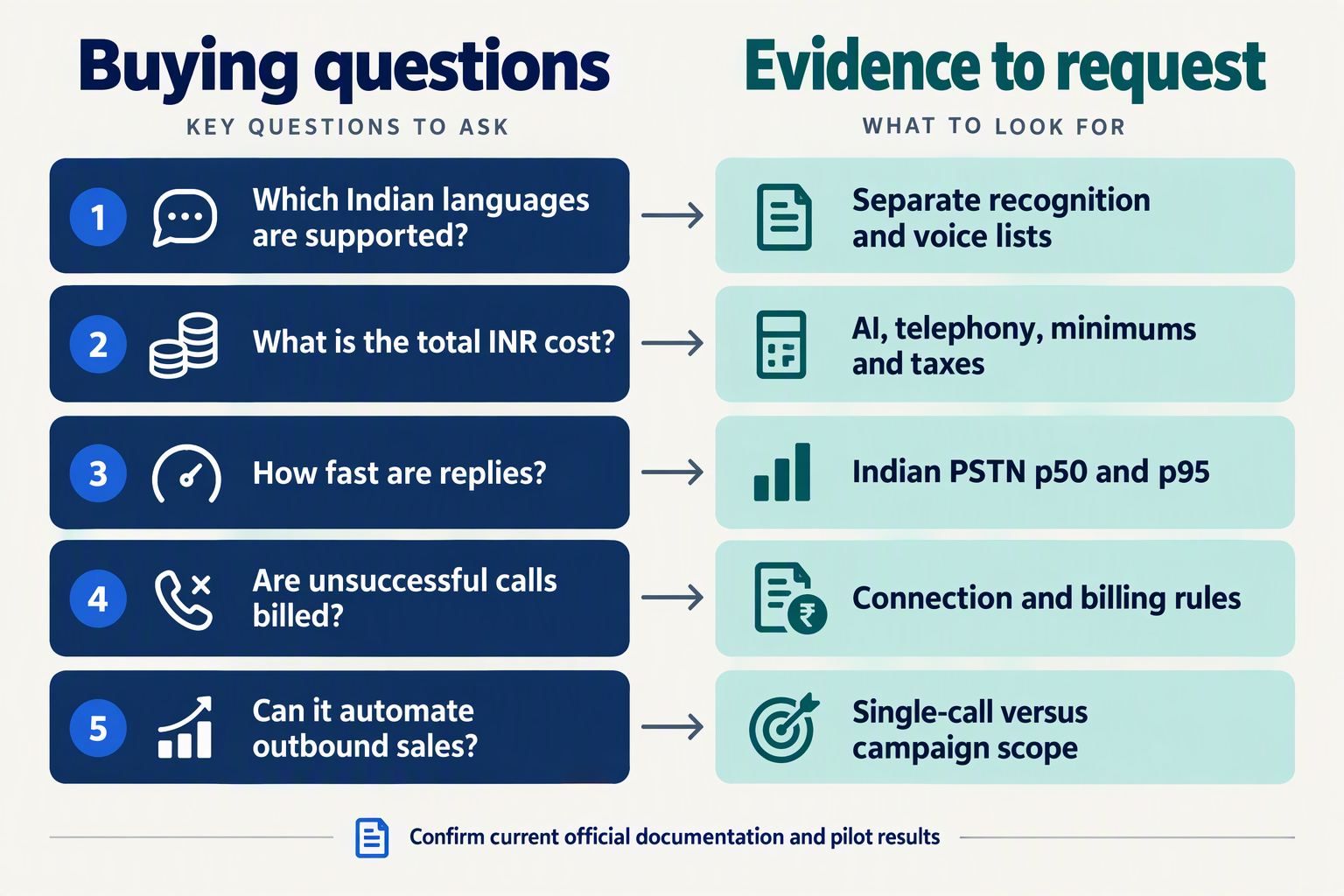
Compare language coverage, complete call costs, and end-to-end latency before choosing a platform; advertised figures often measure different things.
- Q: Which best AI voice agents in India support regional languages?
A: As of October 2026, CallMissed’s verified product facts list speech recognition in 22 Indian languages plus English, including Hinglish, and natural text-to-speech voices in 10 Indian languages plus English. The Prayas India describes Sarvam AI as supporting voice interactions across 10 Indian languages and English in the supplied October 2026 research. Ask vendors to demonstrate both recognition and voice output in your required language: understanding speech does not guarantee an equally natural spoken response.
- Q: How much do the best AI voice agents in India cost per minute?
A: As of October 2026, CallMissed lists Standard at ₹4/min, Expressive at ₹5/min, and Best latency at ₹6/min, including speech recognition, the language model, and voice generation; phone carriage costs extra, and connected calls have a 30-second minimum. Arobit’s supplied pricing guide describes Vapi’s base orchestration fee as about $0.05/min, while Retell AI’s supplied comparison quotes $0.07/min. These are starting points, not equivalent total-cost quotes: confirm included models, voices, telephony, and billing rules before comparing.
- Q: How is AI voice agent latency measured?
A: End-to-end conversational latency should measure the interval between the customer finishing speaking and the agent beginning an audible reply, rather than only audio transport or one processing stage. In the supplied October 2026 research, Exotel advertises sub-300 ms voice latency, while its separate architecture guide cites under-20 ms AgentStream media latency and an under-800 ms end-to-end benchmark. Retell AI reports measured latency near 600 ms; these vendor-reported figures need matching measurement definitions before they support a ranking.
- Q: Can AI voice agents understand Hinglish and Indian accents reliably?
A: Language support is a useful shortlist filter, but it does not establish accuracy for your customers’ accents, background noise, or mid-sentence language switching. The Prayas India’s Sarvam AI overview, included in the October 2026 research, describes handling accents, dialects, and mixed-language speech. Test representative recordings containing names, addresses, amounts, and Hindi-English switches, then score transcription correctness and task completion separately so fluent-sounding replies do not conceal misunderstood details.
- Q: What hidden costs should Indian businesses check before buying a voice agent?
A: Request a written breakdown of AI processing, telephone carriage, number rental, minimum billing, and applicable taxes, rather than budgeting from the headline minute rate alone. For illustration, 1,000 minutes at ₹4/min produces ₹4,000 in AI charges before separately billed items; this is arithmetic, not an all-inclusive quotation. Ask how disconnected calls, silence, transfers, and rounding affect invoices, because identical advertised rates can produce different effective costs.
- Q: How should Indian businesses choose an AI voice agent platform?
A: Run the same pilot across shortlisted platforms using your required languages, business tools, and realistic telephone conditions. Measure task completion, incorrect answers, interruption handling, human handoff, and response-time distributions—not just a polished demonstration or average latency. Choose the platform that meets your workflow and budget with documented results, rather than treating a language count or vendor-reported speed figure as proof of universal superiority.
Conclusion
The best AI voice agent for an Indian business is the platform that fits its customers, workflows, and complete operating budget—not necessarily the one with the most impressive demo. This October 2026 comparison points to four practical buying priorities: language coverage, conversational responsiveness, deployment features, and transparent pricing.
- Test language understanding and voice output separately. Recognising a customer’s regional language does not automatically mean producing a natural-sounding reply in that language. Shortlist platforms against the languages your customers actually use, including Hinglish and other code-mixed conversations. Then test realistic enquiries rather than relying only on a supported-language list. An agent that understands the opening question but struggles when the customer switches languages may still create friction during an otherwise straightforward support call.
- Compare equivalent latency measurements, not headline numbers. As of October 2026, Exotel advertises sub-300 ms voice latency for its Voicebot offering, while Retell AI reports measured latency near 600 ms in its phone-support comparison. These vendor-reported figures should not be treated as directly comparable without understanding their measurement boundaries. Ask what each number includes, then assess the complete conversational experience: how quickly replies arrive, whether interruptions are handled naturally, and whether retrieving business information changes responsiveness.
- Choose features around the workflow you need to complete. No-code setup, developer flexibility, integrations, call controls, and human intervention matter differently across businesses. A clinic handling appointment enquiries and a retailer answering order-status questions should not automatically use the same selection criteria. Prioritise whether the agent can retrieve accurate information, connect to the relevant business tools, and transfer a customer appropriately. A convincing voice is useful, but completing the customer’s task is the more meaningful deployment test.
- Calculate the complete cost of a handled call. Separate orchestration charges from speech recognition, language-model processing, voice generation, and telephone carriage before comparing prices. According to CallMissed’s verified product information, as of October 2026 its bundled voice-agent plans cost ₹4–₹6 per minute, including speech recognition, the language model, and voice generation, with phone carriage billed separately. Readers can explore CallMissed as one platform offering this bundled approach, while evaluating whether its capabilities match their own deployment requirements.
Looking ahead, watch for improvements in regional-language conversations, interruption handling, and end-to-end responsiveness—but keep demanding clear measurement definitions and complete pricing. Better demonstrations should lead to better buying evidence, not replace it.
Build a practical shortlist, run the same representative conversations across platforms, and compare outcomes alongside costs. Which agent can understand your customers, respond without awkward delays, and complete the job at a cost your business can sustain?
Related Reading
- Local Voice Agents: What IBM Granite 4.2 Means in 2026
- Best LLM for Voice Agents in 2026: GPT-6 vs Claude
- Best LLM for Voice Agents in 2026: GPT-6 Astra vs Claude Fable 5.1