
Best LLM for Voice Agents in 2026: GPT-6 vs Claude


Find the best LLM for voice agents in 2026 by comparing GPT-6 and Claude 5.5 on speed, tools, safety, cost, and deployment design.
Best LLM for Voice Agents in 2026: GPT-6 vs Claude
What if the smartest model makes your AI receptionist feel worse? In a live phone call, a brilliant answer that arrives after an awkward pause can be less useful than a simpler, faster response. That is why choosing the best LLM for voice agents in 2026 is not a leaderboard exercise: it is a systems decision involving latency, speech orchestration, tool execution, safety and recovery.
The timing matters because the market has moved beyond text-only chatbots. OpenAI’s September 2026 API documentation describes GPT-6 Luna as its “most efficient model for focused, high-volume tasks.” OpenAI’s API changelog lists GPT-6 Sol at $2 for input and $10 for output, versus $0.10 for input and $0.50 for output for GPT-6 Luna, as of September 2026. Those published gaps make routing strategy financially significant at receptionist scale—even before speech-to-text, text-to-speech, telephony and monitoring costs are added.
This guide compares GPT-6 Sol, GPT-6 Luna, Claude Sonnet 5.5 and Claude Opus 5.5 around the operational decisions that determine whether an AI receptionist succeeds in production. You will learn how to evaluate:
- Response speed and turn-taking: why first-token latency is only one part of perceived call latency, and how streaming, interruption handling and speech synthesis shape the customer’s experience.
- Speech and multimodal integration: how each model fits into speech-to-text, text-to-speech and real-time audio pipelines, rather than assuming the LLM alone “does voice.”
- Tool calling and function reliability: what to test when the agent books appointments, retrieves CRM data, updates tickets or triggers an escalation.
- Production controls: context management, customer-data safety, multilingual workflows, API availability, monitoring, human handoff and model fallbacks.
- Cost architecture: when a fast, economical model should handle routine turns and when a more capable model should take over.
Rather than declaring a winner from a vendor benchmark, the guide treats an AI receptionist as an end-to-end service with measurable failure modes: missed tool arguments, duplicate actions, lost context, unsafe data exposure and transfers that arrive too late. Real call traces, task success rates and tail latency matter more than a single headline score.
Platforms such as CallMissed, the OpenAI-compatible AI gateway, reflect this multi-model approach: as of September 2026, CallMissed offers one API key and balance across 138 models, with caller-chosen fallbacks, usage logs and 25 real-time voice-agent models.
The practical answer, therefore, may be a tested routing policy—not one model used for every call, market or customer journey in production.
Which model is best for an AI receptionist? Shortlist GPT-6 Luna for focused, high-volume turns, then choose among Luna, Sol, Sonnet 5.5, and Opus 5.5 using measured call latency and tool success
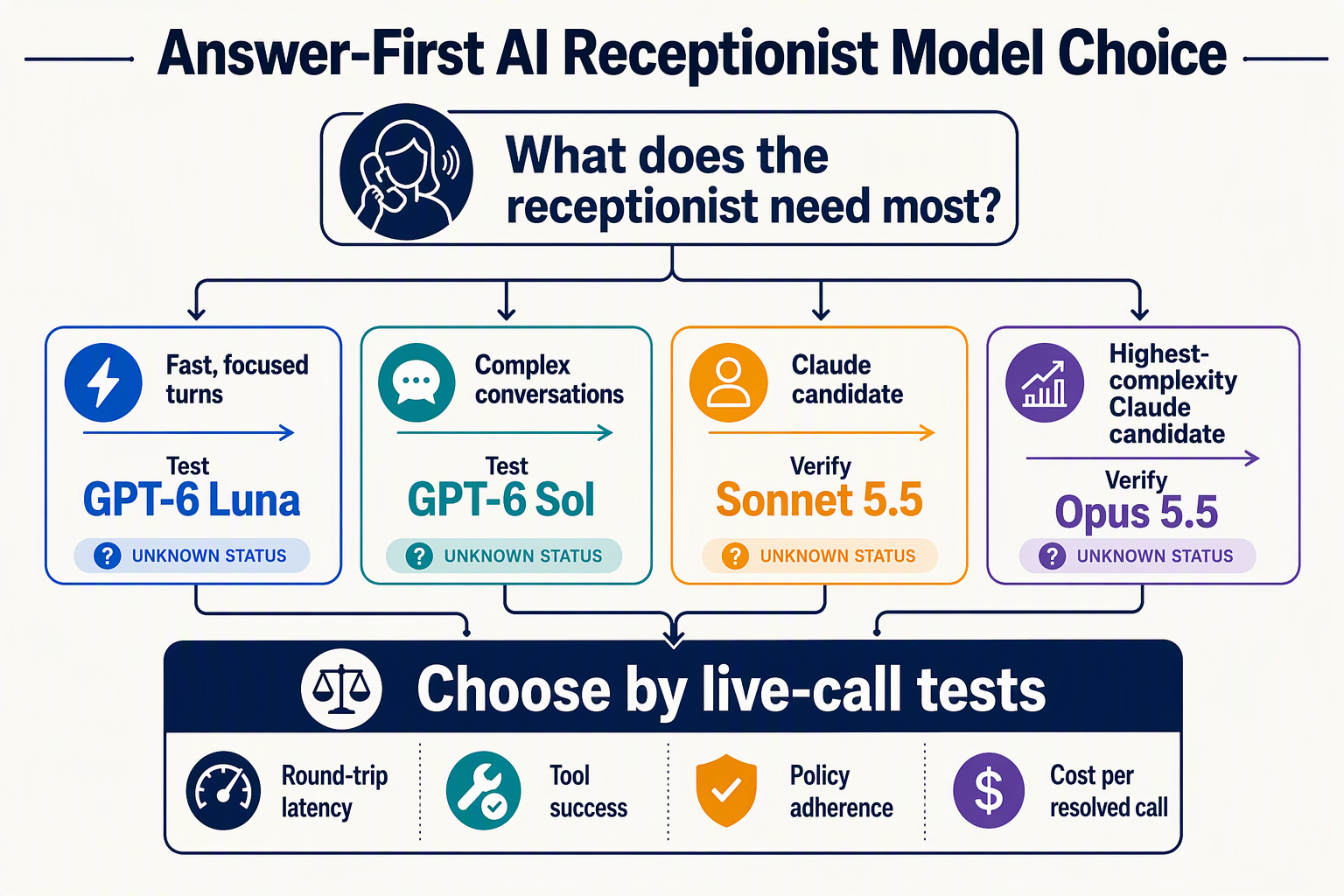
Start with GPT-6 Luna for routine, high-volume receptionist turns, but do not select the production model until GPT-6 Luna, GPT-6 Sol, Claude Sonnet 5.5 and Claude Opus 5.5 have completed the same call-level evaluation. The winner should meet your latency target while completing tools correctly—not merely produce the most polished transcript.
Why should GPT-6 Luna make the initial shortlist?
OpenAI describes GPT-6 Luna as its “most efficient model for focused, high-volume tasks,” which closely matches repetitive receptionist work such as identifying intent, answering business-hours questions and collecting contact details.
OpenAI’s September 2026 API pricing makes GPT-6 Sol 20 times more expensive than GPT-6 Luna for both uncached input and output tokens. That price difference creates a strong case for testing Luna as the default route, while reserving more expensive models for turns that demonstrably require them.
However, vendor positioning is only a hypothesis. Run GPT-6 Sol, GPT-6 Luna, Claude Sonnet 5.5 and Claude Opus 5.5 against identical prompts, tool schemas, context and audio conditions. Do not infer comparative speed or function reliability from model names; the provided sources do not publish directly comparable receptionist-call results for all four models.
How should AI receptionist latency be measured?
Measure the complete customer experience rather than isolated LLM generation speed. A useful call trace separates:
- End-of-speech detection: time taken to decide that the caller has finished.
- Speech recognition: time to produce a stable transcript.
- Model response: time to the first usable token or valid tool call.
- Tool execution: CRM lookup, calendar availability or ticket creation time.
- Speech synthesis: time until the caller hears the first intelligible audio.
Record median, p95 and p99 latency for each stage. A model with a strong median but frequent five-second tail delays can produce more awkward calls than a consistently moderate model.
Also test interruption recovery. When a caller says “Actually, make that Friday,” the agent should stop speaking, retain the correction and avoid executing the superseded booking.
How should tool-calling reliability decide the winner?
Create a test set of at least 300 representative turns, including noisy audio, incomplete dates, repeated names, corrections and unavailable appointment slots. Score every model on:
- Schema validity: Were all required function arguments present and correctly typed?
- Semantic accuracy: Did “next Friday afternoon” become the correct date and time range?
- Execution success: Did the external system accept and complete the request?
- Duplicate-action rate: Was a booking, message or CRM update triggered more than once?
- Recovery quality: Did the model clarify ambiguity instead of guessing?
- Confirmation discipline: Did it confirm consequential actions before execution?
A receptionist model should not receive credit merely for emitting syntactically valid JSON. End-to-end tool success means the correct action occurred once, for the correct customer, with a confirmation the caller could understand.
Which model should handle each call?
Use the evaluation results to define a routing policy:
- Keep GPT-6 Luna as the default only if it satisfies both latency and tool-success thresholds.
- Route failed, ambiguous or policy-sensitive turns to the best-performing alternative among GPT-6 Sol, Claude Sonnet 5.5 and Claude Opus 5.5.
- Escalate to a human when confidence remains low or a tool fails repeatedly.
- Re-run the benchmark after prompt, model-version, speech-provider or tool-schema changes.
The practical winner is therefore the model—or combination of models—that delivers the highest completed-call success rate within your latency and cost limits.
What has changed in GPT-6 and Claude 5.5, and which claims are confirmed as of September 29, 2026?

As of September 29, 2026, OpenAI’s primary documentation confirms GPT-6 Sol and GPT-6 Luna, including their API pricing and Luna’s intended workload. The supplied source record does not contain equivalent Anthropic documentation confirming Claude Sonnet 5.5 or Claude Opus 5.5 specifications, pricing or API availability, so those claims should remain unverified until Anthropic publishes primary-source material.
Which GPT-6 claims are officially confirmed?
OpenAI’s September 2026 announcement, “Introducing GPT-6 Sol and Luna,” confirms that GPT-6 Sol and GPT-6 Luna belong to the GPT-6 model family. OpenAI’s model documentation identifies gpt-6-luna as the API model name and describes GPT-6 Luna as its “most efficient model for focused, high-volume tasks.”
OpenAI’s API changelog confirms these token prices as of September 29, 2026:
- GPT-6 Sol: $2 per unit of input, $0.20 for cached input and $10 for output.
- GPT-6 Luna: $0.10 per unit of input, $0.01 for cached input and $0.50 for output.
- Price difference: Sol’s published input and output rates are each 20 times Luna’s corresponding rates.
That pricing supports a testable purchasing hypothesis: Luna may suit repetitive receptionist turns, while Sol may justify evaluation for difficult reasoning or exception handling. It does not prove that Luna answers 20 times faster, that Sol completes tools more reliably or that either model delivers better call outcomes.
Which AI receptionist capabilities remain unconfirmed?
The available OpenAI sources do not provide enough evidence to assign production-grade values for first-token latency, tokens per second, tool-call success, malformed-argument rates or speech interruption recovery. Buyers should not convert broad phrases such as “efficient” or “frontier intelligence” into operational guarantees.
The following questions still require API documentation or direct testing:
- Does the model accept native real-time audio, or must speech pass through separate speech-to-text and text-to-speech services?
- Can it stream tool calls early enough to avoid long pauses?
- Does it produce schema-valid arguments consistently?
- How does reasoning effort affect latency and cost?
- What context limits, regional processing options and data-retention controls apply?
OpenAI’s older GPT-5.6 pages are useful historical context, but their performance statements cannot automatically be attributed to GPT-6. For example, OpenAI’s July 30, 2026 update says GPT-5.6 Luna’s price fell by 80%; that is not evidence of a GPT-6 latency or reliability improvement.
What is confirmed about Claude Sonnet 5.5 and Claude Opus 5.5?
No Anthropic announcement, model card, pricing page or API documentation for Claude Sonnet 5.5 or Claude Opus 5.5 appears in the supplied evidence. Consequently, this guide cannot responsibly confirm their release status, context windows, multimodal inputs, tool-use behavior, pricing or regional availability as of September 29, 2026.
Before procurement, require a dated Anthropic source confirming:
- Exact API model identifiers and general availability
- Input, cached-input and output pricing
- Streaming, vision and tool-use support
- Context limits and data-handling terms
- Deprecation policy and rate limits
The defensible conclusion is therefore asymmetric: GPT-6 Sol and Luna are documented; Claude 5.5 details remain unverified in the current source set. Any four-model comparison should label unavailable fields clearly rather than filling them with rumours, extrapolations or results from earlier Claude generations.
How do GPT-6 Sol, GPT-6 Luna, Claude Sonnet 5.5, and Claude Opus 5.5 compare?
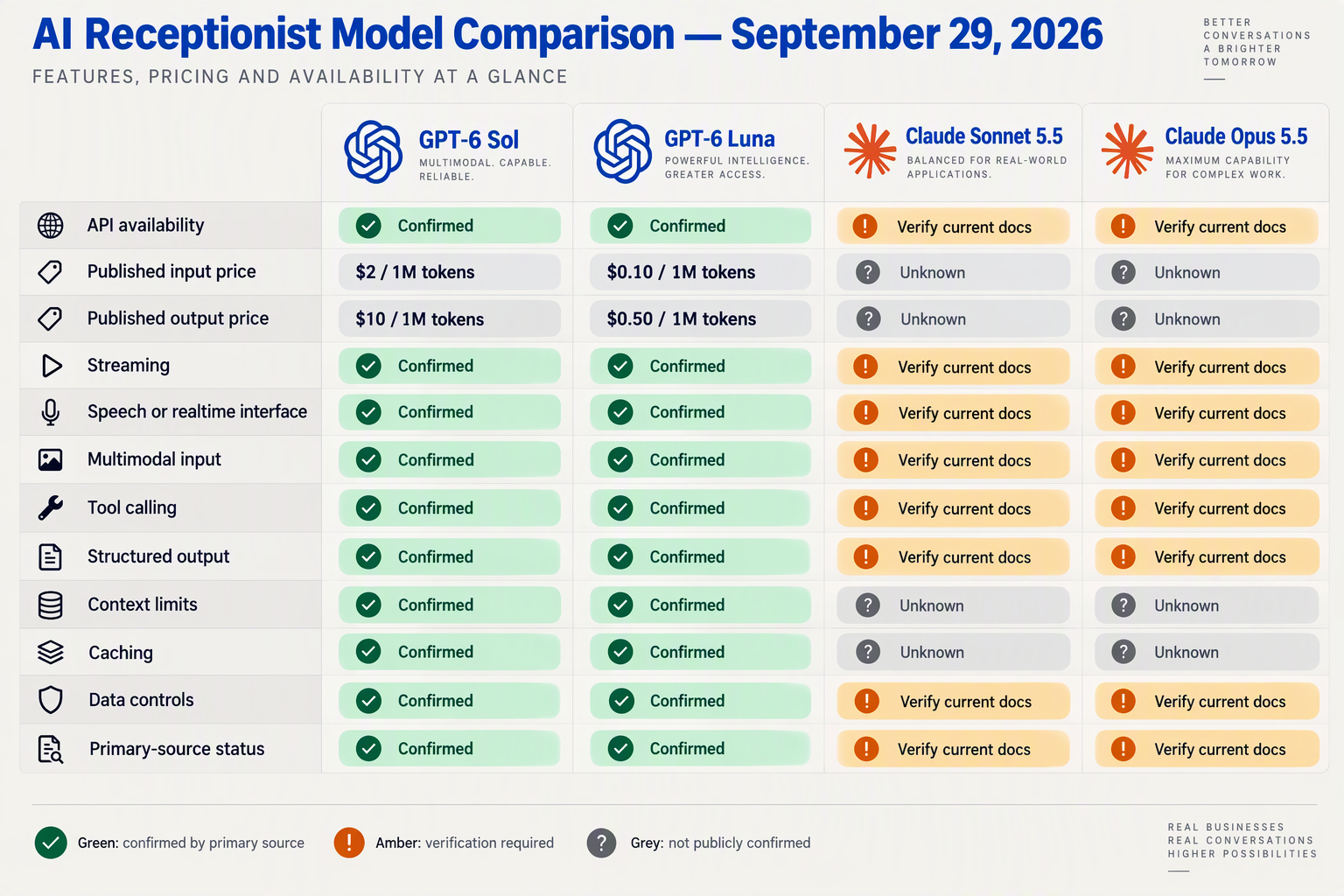
GPT-6 Luna has the clearest documented fit for routine, high-volume receptionist turns, while GPT-6 Sol should be evaluated when a workflow needs more complex reasoning. No verified, like-for-like latency or function-success data is available in the supplied research for Claude Sonnet 5.5 and Claude Opus 5.5, so buyers should not infer production performance from model names or vendor tiers.
What does the four-model comparison show?
| Evaluation area | GPT-6 Sol | GPT-6 Luna | Claude Sonnet 5.5 | Claude Opus 5.5 |
|---|---|---|---|---|
| Documented positioning | Higher-priced GPT-6 option; test for complex turns | “Most efficient” for focused, high-volume tasks | Confirm positioning in Anthropic’s current API documentation | Confirm positioning in Anthropic’s current API documentation |
| Published API price | $2 input; $10 output | $0.10 input; $0.50 output | No verified price in the research provided | No verified price in the research provided |
| Relative token cost | 20× Luna’s published input and output rates | Lowest documented rate in this comparison | Compare live rates using the same token assumptions | Compare live rates using the same token assumptions |
| Response speed | Benchmark streaming and tail latency | Strong shortlist candidate, but efficiency does not prove lower latency | Measure on identical prompts and regions | Measure on identical prompts and regions |
| Speech integration | Validate streaming text within the complete audio pipeline | Validate streaming text within the complete audio pipeline | Confirm current audio and streaming API support | Confirm current audio and streaming API support |
| Tool reliability | Test schemas, retries and duplicate-action protection | Test schemas, retries and duplicate-action protection | Run the same function-call test suite | Run the same function-call test suite |
| Best initial trial role | Exceptions, ambiguous requests and difficult reasoning | Greetings, routing, FAQs and structured intake | Balanced-route candidate pending testing | Complex-route candidate pending testing |
OpenAI’s API changelog listed GPT-6 Sol at $2 for input and $10 for output as of September 2026. The same OpenAI changelog listed GPT-6 Luna at $0.10 for input and $0.50 for output as of September 2026, making Sol’s published input and output rates 20 times Luna’s.
OpenAI’s September 2026 model documentation calls GPT-6 Luna its “most efficient model for focused, high-volume tasks.” That supports Luna as a starting point for repetitive receptionist work, but it does not establish call latency, multilingual accuracy or booking success.
Which specifications matter most for an AI receptionist?
Do not compare these models solely through conversational samples. Run a controlled test covering:
- End-to-end response time: Measure from the caller finishing a sentence to audible playback beginning. Report median, p95 and p99 latency rather than only average first-token latency.
- Function completion: Track whether each model selects the right tool, supplies valid arguments and interprets the result correctly.
- Action safety: Use idempotency keys and confirmation steps so retries cannot create two appointments, refunds or CRM records.
- Interruption recovery: Test whether the agent stops speaking, preserves context and responds correctly after caller barge-in.
- Escalation quality: Score whether transfers occur before repeated misunderstandings or sensitive disclosures.
How should buyers interpret missing Claude 5.5 data?
Treat unavailable specifications as a procurement question, not permission to guess. Before selecting Claude Sonnet 5.5 or Claude Opus 5.5, verify Anthropic’s current API availability, regional data handling, context limits, streaming support, tool-use schema, rate limits and prices.
Then replay the same anonymized call set across all four models. A defensible decision should report successful task cost, not merely token price: total model and speech spend divided by correctly completed calls, with failed tools, unnecessary transfers and excessive latency counted explicitly.
How should you test response speed, interruptions, silence handling, and speech integration?
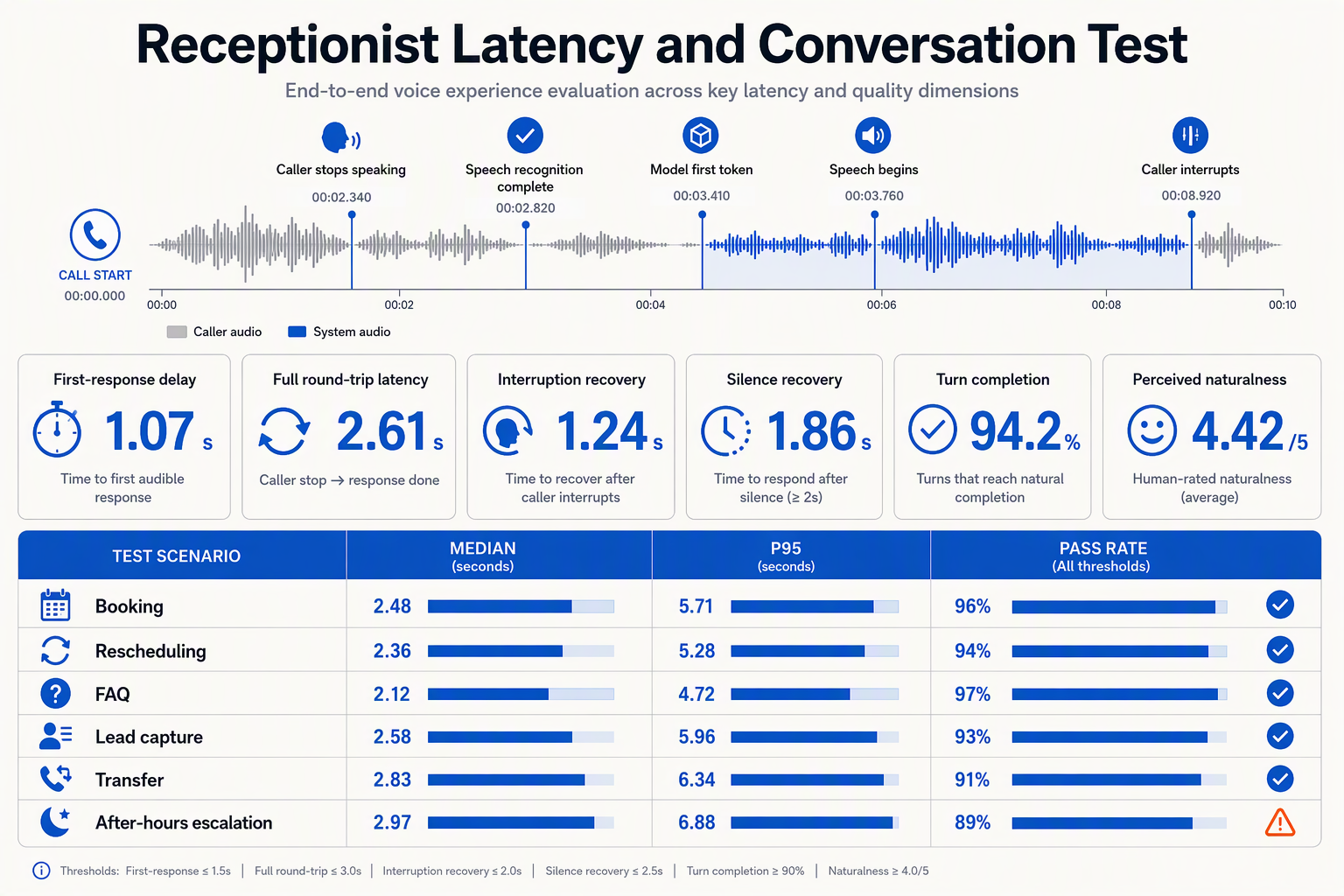
Test GPT-6 Sol, GPT-6 Luna, Claude Sonnet 5.5 and Claude Opus 5.5 inside the same end-to-end voice pipeline, using recorded and live calls rather than text prompts alone. Measure what callers experience—from the end of their speech to the first intelligible audio response—plus interruptions, silence recovery and task completion.
Which latency metrics should an AI receptionist measure?
First-token latency is useful, but it does not represent total conversational delay. Instrument timestamps for every stage:
- Caller stops speaking.
- Voice activity detection marks the end of the turn.
- Speech-to-text produces an interim and then final transcript.
- The application sends the model request.
- The model returns its first token and completes any tool call.
- Text-to-speech generates its first audio chunk.
- Telephony begins playback.
Track median, p95 and p99 latency, not only the average. A model may appear fast in a short demonstration while producing long pauses on complex requests or during traffic spikes.
Use a practical internal scorecard:
- End-of-speech to first audible response
- Time to first model token
- Time to first synthesized audio
- Complete-turn duration
- Tool-call round-trip time
- Percentage of turns exceeding your pause budget
- Latency by language, prompt length and task type
OpenAI describes GPT-6 Luna as its “most efficient model for focused, high-volume tasks” in its September 2026 API documentation. Treat that positioning as a reason to test Luna for routine reception turns—not as proof of lower end-to-end call latency, which also depends on transcription, orchestration, tools, synthesis and carrier performance.
How should interruption and barge-in handling be tested?
A receptionist must stop talking when the caller interrupts. Run scripted barge-in tests at the beginning, middle and end of synthesized responses, including interruptions such as “No,” “Actually, tomorrow,” and “Let me speak to someone.”
Measure whether the system:
- Detects speech while audio is playing
- Stops playback promptly without leaking queued audio
- Preserves the caller’s correction
- Cancels obsolete model or tool activity
- Avoids executing both the original and corrected request
- Resumes with a concise acknowledgment
Repeat each scenario under background noise, speakerphone echo and code-mixed speech. As of September 2026, CallMissed supports speech recognition in 22 Indian languages plus English, including Hinglish, making it possible to evaluate regional and code-mixed receptionist workflows rather than relying only on English test calls.
How should silence and incomplete speech be handled?
Test short hesitation, long silence, abandoned sentences and muted callers separately. Configure escalating behavior rather than one universal timeout:
- A brief pause should not prematurely close the turn.
- An ambiguous pause can trigger: “Take your time—are you looking for a morning or afternoon appointment?”
- Repeated silence should lead to a graceful retry, human-transfer option or call closure.
- Silence after a tool action must not cause duplicate booking or payment attempts.
Record false end-of-turn rate, reprompt frequency and accidental hang-ups. Tune silence thresholds from real call distributions because language, accessibility needs and network conditions affect speaking cadence.
How should speech and multimodal integration be compared fairly?
Keep the speech recognizer, voice, telephony connection, tools and prompts constant while changing only the LLM. Then repeat with alternative speech components to expose model–pipeline interactions.
Use identical audio sets containing names, addresses, dates, confirmation numbers, accents and noisy conditions. Score transcription accuracy, semantic correction, interruption recovery, spoken-answer naturalness and completed receptionist tasks. This controlled design reveals whether GPT-6 Luna, GPT-6 Sol, Claude Sonnet 5.5 or Claude Opus 5.5 improves the actual call—or merely performs better in an isolated text benchmark.
Which model calls tools and functions most reliably during real customer conversations?
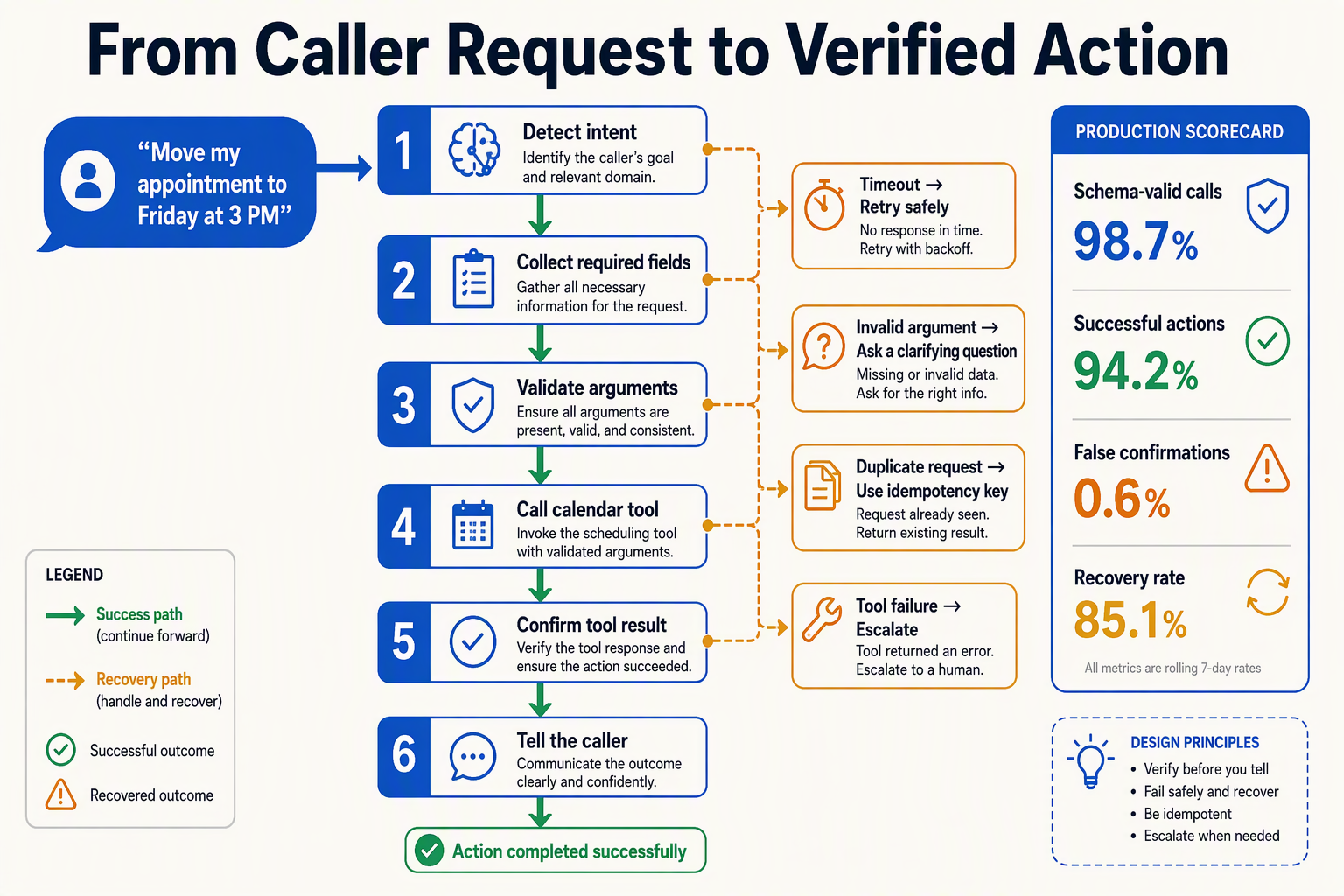
No credible vendor-neutral evidence available as of September 2026 proves that GPT-6 Sol, GPT-6 Luna, Claude Sonnet 5.5 or Claude Opus 5.5 is universally the most reliable tool caller. For an AI receptionist, the defensible choice is the model that achieves the highest end-to-end task success rate on your own booking, CRM, support and escalation workflows—not the model with the strongest general benchmark score.
How should you measure function-calling reliability?
A syntactically valid function call is not necessarily a successful customer outcome. Evaluate each model across complete conversations, including noisy transcripts, corrections and interruptions.
Track these production-oriented metrics:
- Tool-selection accuracy: Did the model choose
check_availabilityrather thancreate_bookingbefore confirming a slot? - Argument validity: Were required fields present, correctly typed and constrained to the permitted schema?
- Grounded argument accuracy: Did the phone number, date and service match what the caller actually said?
- Execution success: Did the downstream CRM, calendar or ticketing system accept the request?
- Task completion rate: Did the caller receive the intended result without human repair?
- Duplicate-action rate: Did a retry create two appointments, refunds or tickets?
- Recovery rate: After a timeout or validation error, did the agent retry safely, clarify the input or escalate?
A useful headline metric is:
End-to-end tool success = correctly completed customer tasks ÷ all eligible tool-based tasks.
Report the median and worst-case results separately by workflow. An overall average can conceal a model that performs well on CRM lookups but fails disproportionately on rescheduling or cancellation.
What test set reflects real receptionist calls?
Run GPT-6 Luna, GPT-6 Sol, Claude Sonnet 5.5 and Claude Opus 5.5 against the same frozen schemas, prompts, transcripts and tool responses. Your evaluation set should include at least these scenarios:
- A clean, single-intent booking.
- An ambiguous date such as “next Friday afternoon.”
- A caller who changes the requested time midway through the call.
- Missing or malformed customer details.
- Two people or services with similar names.
- A tool timeout followed by a retry.
- A caller interrupting while the agent confirms an action.
- A request requiring consent or human escalation.
OpenAI describes GPT-6 Luna as its “most efficient model for focused, high-volume tasks” in its September 2026 API documentation. That positioning makes Luna a logical candidate for constrained functions, but it does not establish superior function reliability; only matched call-trace testing can do that.
How can you prevent costly tool-call failures?
Reliability depends as much on orchestration as on the selected model. Apply these controls to all four candidates:
- Use strict JSON schemas, enums and server-side validation.
- Separate read operations from consequential write operations.
- Require confirmation before bookings, cancellations, payments or record changes.
- Add idempotency keys so retries cannot duplicate actions.
- Return structured, model-readable errors rather than raw stack traces.
- Set per-tool timeouts and explicit retry limits.
- Escalate when confidence is low instead of guessing missing arguments.
- Log the transcript, proposed arguments, validated arguments, tool result and final spoken confirmation.
For multi-model testing, CallMissed, the OpenAI-compatible AI gateway, supports function calling, structured outputs, caller-chosen fallback models, and request and usage logs as of September 2026. Those controls can help teams compare models and recover from failures without treating fallback as permission to repeat a consequential write.
Which model should handle which functions?
Begin with GPT-6 Luna or Claude Sonnet 5.5 for tightly scoped, reversible actions, then test GPT-6 Sol and Claude Opus 5.5 on ambiguous, multi-step cases. Promote a model only when it meets workflow-specific thresholds for task success, duplicate prevention, recovery and tail latency; a model that calls tools correctly but responds too slowly can still deliver a poor receptionist experience.
How should speech, multimodal input, context, multilingual calls, and escalation fit together?
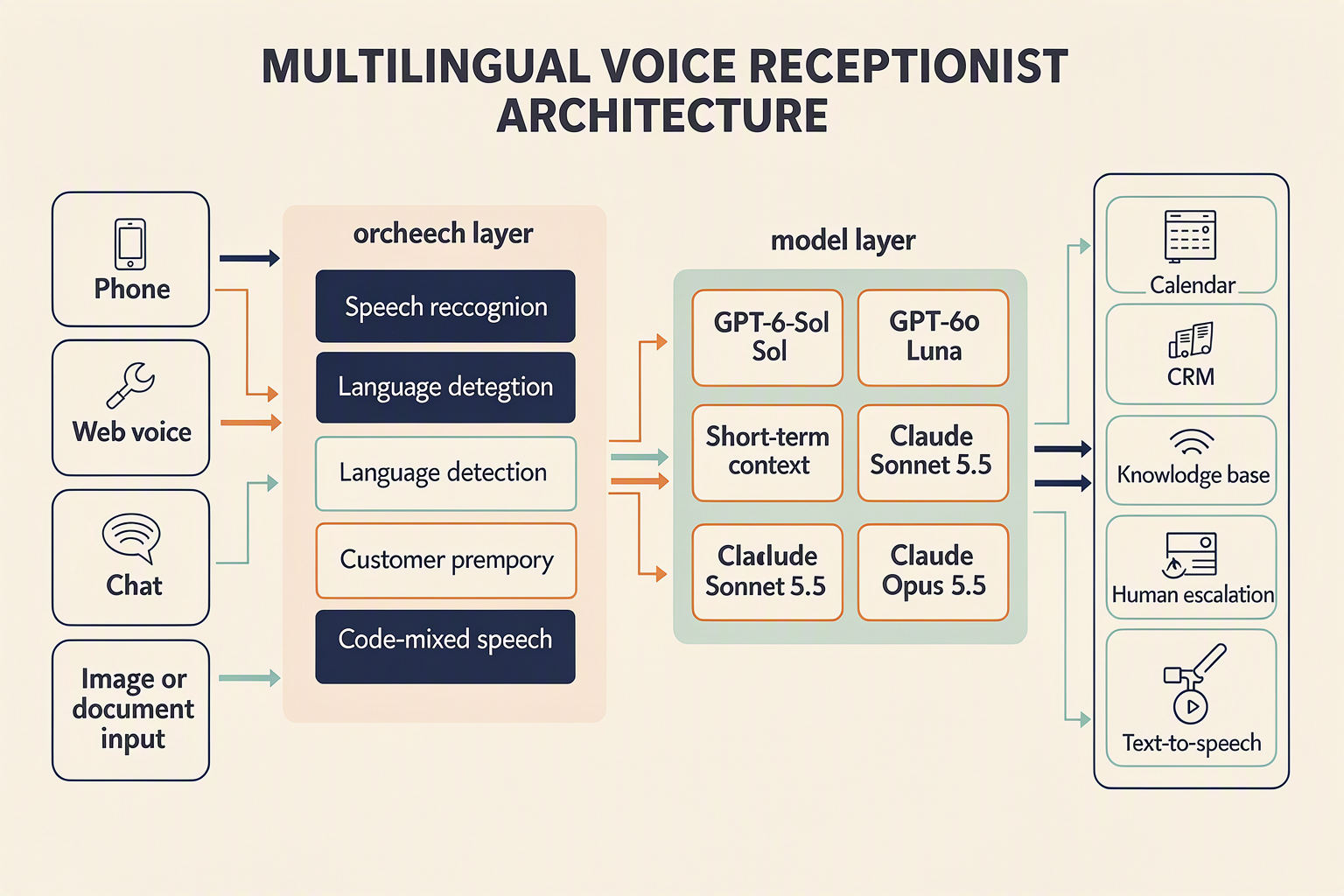
Speech, multimodal input, context, multilingual handling and escalation should operate as separate but coordinated layers around the LLM. Whether the reasoning engine is GPT-6 Luna, GPT-6 Sol, Claude Sonnet 5.5 or Claude Opus 5.5, every call should share the same normalized events, bounded context and deterministic handoff rules.
How should speech and multimodal input reach the model?
Treat voice as a streaming pipeline rather than assuming the LLM handles the entire call:
- Speech recognition converts audio into partial and final transcripts.
- A turn manager detects interruptions, silence and completed requests.
- The selected model interprets the request and invokes approved tools.
- Text-to-speech streams the response back to the caller.
- Telephony controls process transfers, queues, keypad input and hang-ups.
This separation lets teams compare models without changing the speech stack. Measure speech-recognition delay, model time to first token, tool duration, text-to-speech startup and end-to-end response time independently; otherwise, a slow CRM lookup may be misdiagnosed as an LLM problem.
Multimodal data should become a structured event. If a customer sends an invoice image, for example, extract the invoice number and confidence score before adding them to the call state. Preserve the original file for authorized review, but do not repeatedly place large images, PDFs or complete transcripts into every prompt.
How much context should an AI receptionist retain?
Give the model the smallest context sufficient to complete the current task. A practical hierarchy is:
- Current-turn context: the latest transcript and interruption state.
- Call state: verified identity, intent, collected fields and tool results.
- Customer context: relevant appointments, open tickets or account preferences.
- Policy context: approved knowledge passages and escalation constraints.
- Conversation summary: a compact record of earlier turns, not an unlimited transcript.
Separate verified tool output from caller-provided claims. “The caller says the invoice is paid” and “the billing system confirms payment” must remain distinct facts. Sensitive fields should be redacted from logs and excluded from model context unless the active workflow requires them.
How should multilingual calls and code-switching work?
Language selection should be continuous, not a one-time menu choice. Detect language from streaming speech, retain product names and addresses verbatim, and allow code-switching without forcing the caller to restart.
The speech layers require separate testing because recognition and voice coverage are not interchangeable. As of September 2026, CallMissed supports speech recognition in 22 Indian languages plus English, including Hinglish, while its natural text-to-speech coverage includes 10 Indian languages plus English. For every target language, test names, numbers, dates, addresses, accents and mixed-language tool arguments—not merely conversational fluency.
When should the AI receptionist escalate to a person?
Escalation should be a designed workflow, not an apology after repeated failure. Trigger handoff when:
- The caller explicitly requests a person.
- Recognition confidence remains low after one clarification.
- A required tool fails, times out or returns conflicting data.
- Identity verification cannot be completed safely.
- The request involves an exception, complaint or restricted decision.
- Repeated interruptions indicate frustration or urgency.
Send the human agent a concise packet containing the caller’s intent, verified details, completed actions, unresolved issue and recommended next step. If no person is available, offer a queue, callback or message path rather than trapping the caller in a loop. This architecture allows model routing to change while preserving a consistent, auditable customer experience.
How do you protect customer data and build monitoring, evaluation, and fallback architecture?
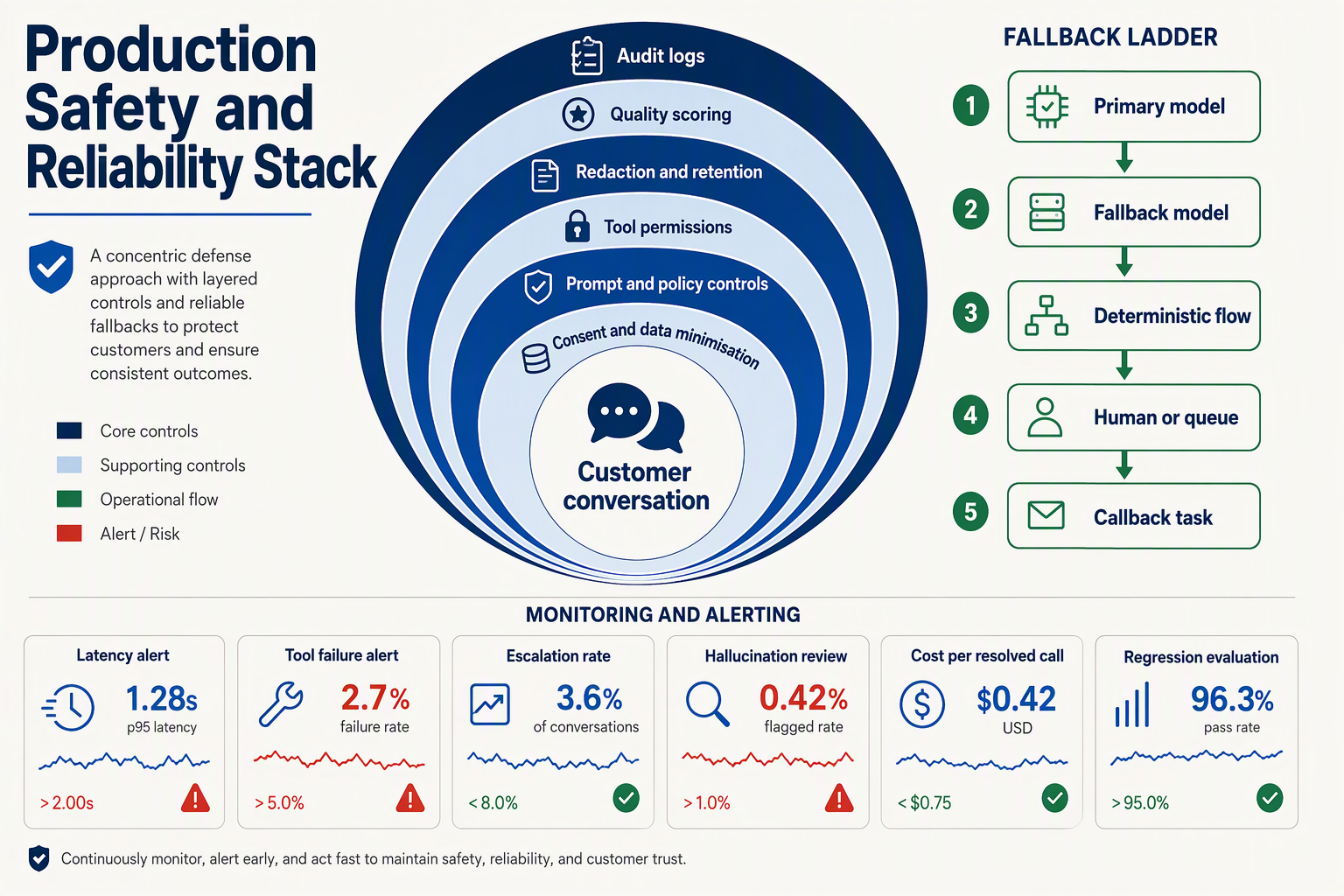
Protect customer data with data minimisation, strict tool permissions, redacted observability and documented retention, then evaluate the complete call workflow rather than the language model alone. Build fallbacks as a controlled state machine: retry only safe operations, preserve conversation state and transfer to a human before repeated failures damage the customer experience.
How should an AI receptionist protect customer data?
Treat every transcript, recording, tool argument and retrieved CRM record as potentially sensitive. Do not place unrestricted customer histories, payment details or authentication credentials in the model context merely because the context window permits it.
Use these controls for both GPT-6 and Claude 5.5 deployments:
- Map every data flow: Document what moves through telephony, speech recognition, the LLM, text-to-speech, logging, analytics and external tools. Verify each provider’s current retention, training-use, residency and deletion terms contractually.
- Minimise context: Retrieve only the fields required for the current task. A booking workflow may need a customer ID and available times—not an entire CRM timeline.
- Separate secrets from prompts: Store API keys and credentials in a secrets manager. Tools should execute server-side with scoped service accounts rather than exposing credentials to the model.
- Redact observability data: Mask phone numbers, email addresses, account identifiers and authentication phrases before traces enter dashboards or evaluation datasets.
- Restrict actions: Give the receptionist explicit allow-listed functions, schema validation and least-privilege access. Require additional verification or human approval for refunds, account changes and other high-impact actions.
Prompt injection should also be treated as an access-control problem. Content retrieved from a webpage, PDF or CRM note must never be allowed to redefine system policies or grant itself additional tool permissions.
What should you monitor in production?
Measure the customer journey, not just model availability. Attach one trace ID to the call, model turns, speech events and tool executions so operators can reconstruct failures without searching disconnected systems.
Monitor at least:
- Latency: speech-end detection, model time to first token, tool duration, synthesis start time and end-to-end p50, p95 and p99 response time.
- Conversation quality: interruptions, repeated questions, silence duration, caller abandonment and human-transfer rate.
- Function reliability: valid tool arguments, successful task completion, duplicate actions, timeouts and correction attempts.
- Safety and privacy: redaction failures, prohibited disclosures, unusual tool access and policy violations.
- Cost: tokens, audio processing, tool calls and cost per completed customer task.
As of September 2026, OpenAI describes GPT-6 Luna as its “most efficient model for focused, high-volume tasks.” OpenAI’s September 2026 API changelog prices GPT-6 Luna at $0.10 per input unit and $0.50 per output unit, compared with $2 and $10 respectively for GPT-6 Sol; monitoring should therefore report both quality and marginal cost when escalation routes a call to Sol.
How do you evaluate models before changing traffic?
Create a versioned test set from redacted, representative calls, covering accents, code-mixing, background noise, interruptions, ambiguous dates, unavailable appointments and tool failures. Score transcript understanding, policy compliance and final business outcome separately.
Run each prompt, model and tool-schema change through:
- Offline regression tests with fixed expected actions
- Adversarial privacy and prompt-injection tests
- Simulated timeouts and malformed tool responses
- Small canary deployments with automatic rollback thresholds
- Human review of high-risk and low-confidence calls
What is a safe fallback architecture?
Use a deliberate sequence: retry transient transport errors, route to an alternative model, switch to a deterministic menu for essential tasks, and finally transfer to a person. Never automatically replay a state-changing function unless it uses an idempotency key and the system has confirmed that the first attempt did not succeed.
Keep conversation state in a provider-neutral store so GPT-6 Sol, GPT-6 Luna, Claude Sonnet 5.5 or Claude Opus 5.5 can receive the same compact, redacted task state. As of September 2026, CallMissed supports caller-chosen fallback models, request logs, metric alerts, evaluation suites and call scoring against custom QA rubrics—controls that illustrate how multi-model routing should remain observable rather than becoming an invisible retry chain.
What do these choices mean for your calls, budget, and missed-call workflows? A CallMissed test plan
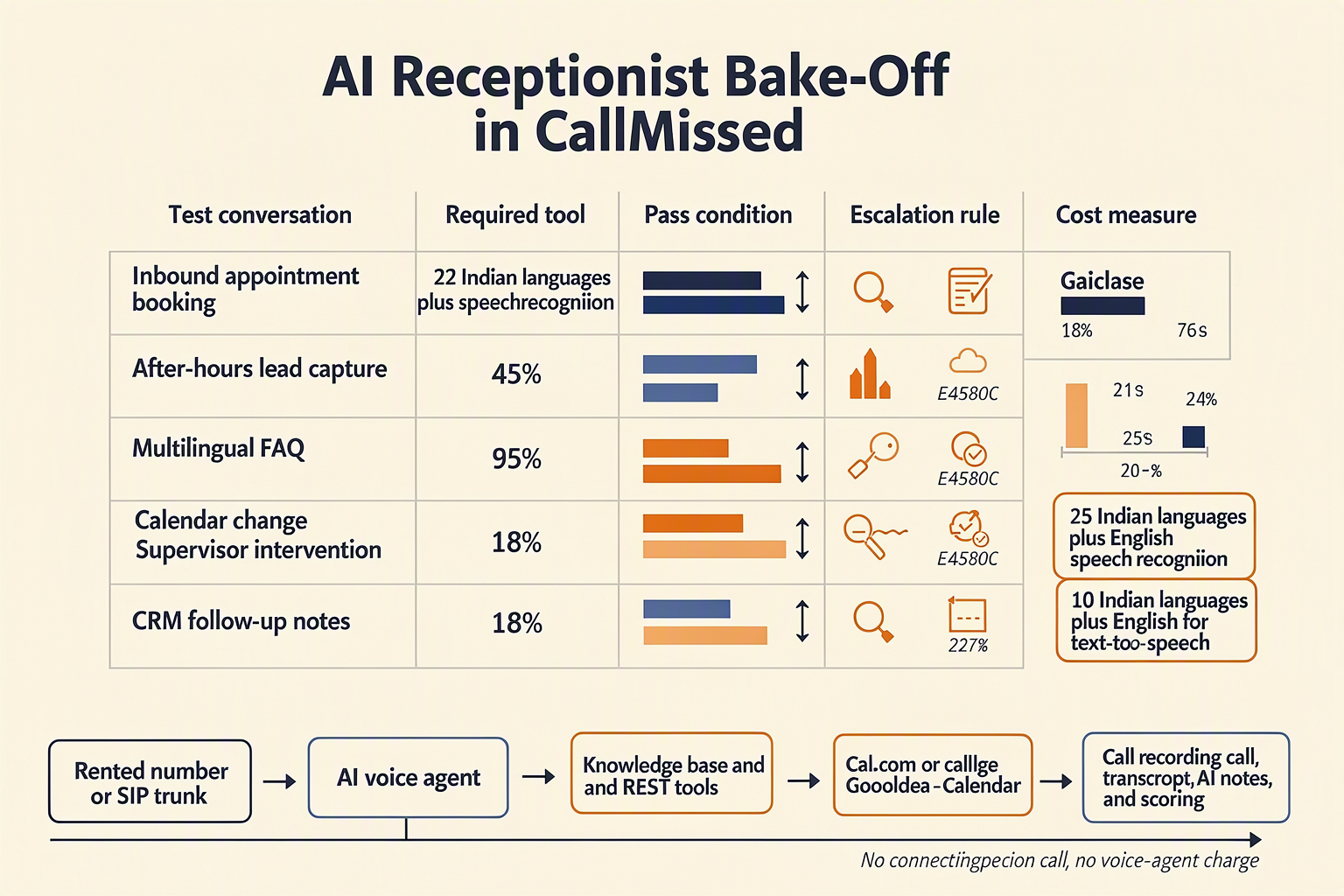
The model choice affects how quickly callers hear a useful response, how reliably actions complete, and how much each resolved call costs. Test GPT-6 Luna, GPT-6 Sol, Claude Sonnet 5.5 and Claude Opus 5.5 on identical call recordings and tool schemas before setting a routing policy.
What should the CallMissed test plan measure?
Run each candidate through representative calls—not synthetic trivia—and score the complete workflow from greeting to resolution. Use the same speech recognition, text-to-speech voice, prompt, knowledge base and network region so that the LLM remains the primary variable.
| Test scenario | What to measure | Suggested production gate | Routing implication |
|---|---|---|---|
| Opening and intent capture | Time to first audible response; correct intent | No awkward silence; intent captured without repetition | Default fast model for routine calls |
| Appointment booking | Valid arguments; tool success; duplicate writes | Correct slot and zero duplicate bookings | Escalate after validation or tool failure |
| CRM or order lookup | Correct record; authentication; data exposure | No cross-customer disclosure | Block action and hand off on identity mismatch |
| Long, interrupted call | Context retention; interruption recovery | Resumes without repeating completed steps | Route complex histories to stronger model |
| Multilingual or code-mixed call | Intent accuracy; names, dates and numbers | Pass language-specific human review | Route by detected language and confidence |
| Missed-call recovery | Voicemail capture; notes; queue or follow-up creation | Correct disposition and actionable record | Retry tools once, then create human task |
Test at least 50–100 calls per major intent and report medians plus the 95th percentile; averages can conceal the pauses callers notice most. Separate LLM latency, tool execution time, speech recognition and speech synthesis in the trace.
How should model cost change call routing?
OpenAI’s API changelog listed GPT-6 Sol at $2 per million input tokens and $10 per million output tokens, while GPT-6 Luna cost $0.10 and $0.50 respectively, as of September 2026. GPT-6 Sol’s published token prices were therefore 20 times GPT-6 Luna’s prices for both input and output.
For a simplified turn containing 500 input tokens and 100 output tokens, the listed rates imply approximately:
- GPT-6 Luna: $0.00010 in LLM token cost.
- GPT-6 Sol: $0.00200 in LLM token cost.
- Claude Sonnet 5.5 and Claude Opus 5.5: calculate from the provider’s current invoice rates rather than assuming prices remain static.
These figures exclude transcription, synthesis, telephony, retrieval and tool infrastructure. Track cost per successfully resolved call, not merely cost per token; a cheap turn that causes a failed booking or unnecessary transfer can be operationally expensive.
How should missed-call and escalation workflows behave?
Adopt a deterministic recovery ladder:
- Retry only safe reads automatically. Do not blindly repeat payments, bookings or CRM writes.
- Check tool results before confirming success to the caller.
- Switch models once when the first model produces invalid structured arguments or insufficient confidence.
- Transfer or queue the call when identity, safety or repeated tool failures prevent resolution.
- Preserve the transcript, summary, disposition and attempted actions so the human agent does not restart discovery.
As of September 2026, CallMissed supports caller-selected fallback models, request and usage logs, call queues, voicemail drops, live supervisor intervention, CRM-ready AI call notes, QA scoring and A/B experiments. Teams can either test a custom stack billed by component per second or use CallMissed voice-agent plans at ₹4, ₹5 or ₹6 per minute, with a 30-second minimum and phone carriage billed separately; calls that never connect cost nothing.
The production winner should be the routing policy that achieves the required tail latency, verified tool success and resolution cost—not necessarily one model assigned to every call.
Frequently Asked Questions
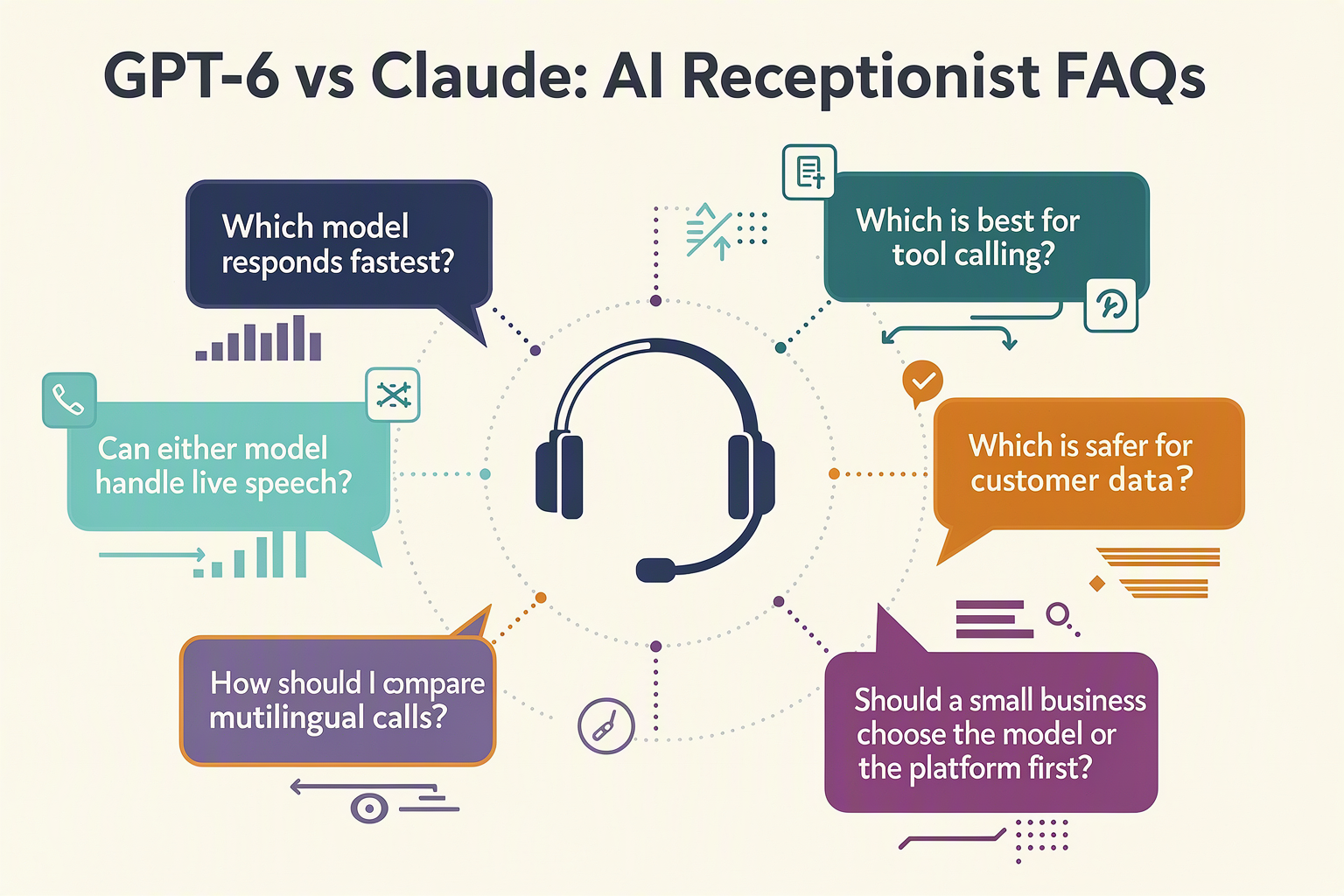
Which is better for an AI receptionist, GPT-6 vs Claude 5.5?
How should I compare GPT-6 vs Claude response speed for voice calls?
Do GPT-6 and Claude 5.5 provide native speech for an AI receptionist?
How do I test GPT-6 vs Claude tool calling and function reliability?
How should an AI receptionist protect customer data and manage long conversations?
What is the most cost-effective fallback architecture for a multilingual AI receptionist?
Conclusion
There is no universal winner between GPT-6 Luna, GPT-6 Sol, Claude Sonnet 5.5 and Claude Opus 5.5 for an AI receptionist. The right choice is the model—or routing policy—that delivers the best combination of conversational speed, correct tool execution, safe data handling and recoverable failures on your actual calls.
What should buyers remember?
- Optimise for the whole voice pipeline, not a model leaderboard. Measure speech recognition, LLM processing, text-to-speech, streaming and interruption handling together. Track median and tail latency because an occasional long pause can damage the caller experience even when average response time looks acceptable.
- Use GPT-6 Luna as a practical baseline for routine traffic. OpenAI described GPT-6 Luna as its “most efficient model for focused, high-volume tasks” in September 2026. OpenAI’s September 2026 API changelog priced GPT-6 Luna at $0.10 per input unit and $0.50 per output unit, compared with $2 and $10 respectively for GPT-6 Sol, making selective escalation materially more economical than sending every turn to Sol.
- Test tool reliability with real business workflows. Evaluate GPT-6 Sol, GPT-6 Luna, Claude Sonnet 5.5 and Claude Opus 5.5 on appointment booking, CRM retrieval, ticket updates and human transfers. Score valid arguments, completed tasks, duplicate actions, context retention and recovery after timeouts—not merely whether the model produced a plausible answer.
- Design fallbacks before production. A resilient receptionist should be able to retry safely, switch models, preserve relevant context and transfer to a person before the conversation deteriorates. Monitoring should capture transcripts, tool traces, latency, escalation timing and customer-data exposure so failures become measurable engineering issues.
What will matter next?
Watch for improvements in real-time multimodal APIs, function-call consistency, multilingual turn-taking and price-performance. Model releases will continue, but the durable advantage will come from an architecture that can evaluate and replace models without rebuilding the entire speech, telephony and business-tool stack.
As of September 2026, CallMissed, the OpenAI-compatible AI gateway, provides one API key and balance across 138 models, including 25 real-time voice-agent models, with caller-chosen fallbacks and request logs. Teams can explore CallMissed when testing a multi-model voice architecture.
The final buying question is not “Which model is smartest?” but “Which tested system completes the caller’s task quickly, safely and reliably—and recovers well when something fails?”
Related Reading
- Best LLM for Voice Agents in 2026: GPT-6 Astra vs Claude Fable 5.1
- Claude Fable 5.1 vs GPT-5.6 Sol: Pricing, Coding & Voice Agents
- GPT-6 Luna vs Claude Opus 5.5: 2026 API Comparison
Sources
Discussion
Related Posts

Ready to automate customer conversations?
Launch AI voice agents and WhatsApp bots with CallMissed — one API, 22+ Indian languages.