
GPT-6 Luna vs Claude Opus 5.5: 2026 API Comparison


Compare GPT-6 Luna vs Claude Opus 5.5 on verified access, API prices, context, coding, reasoning, multimodality, agents and safety.
GPT-6 Luna vs Claude Opus 5.5: 2026 API Comparison
GPT-6 Luna costs just $0.10 per million input tokens—one-fifth of its $0.50 output-token price—according to OpenAI’s API changelog in September 2026. That striking economics makes GPT-6 Luna vs Claude Opus 5.5 a consequential comparison for teams building coding copilots, reasoning workflows, multimodal applications, and tool-using agents at scale. Yet the matchup demands caution: OpenAI’s primary documentation confirms gpt-6-luna API access, while Anthropic’s official launch and platform documentation confirm Claude Opus 5.5, its claude-opus-5-5 model ID, 1M-token context window, 128K maximum output, and $4/$20 per-million-token pricing.
This guide separates confirmed facts from unknowns and compares availability, API compatibility, token pricing, context limits, coding and complex reasoning, multimodal support, agentic tool use, latency, and safety. For developers evaluating models across providers, CallMissed offers an OpenAI-compatible gateway with one API key and balance for 138 models as of September 2026, illustrating the broader shift toward portable, multi-model infrastructure.
Which is better in 2026? The answer-first verdict
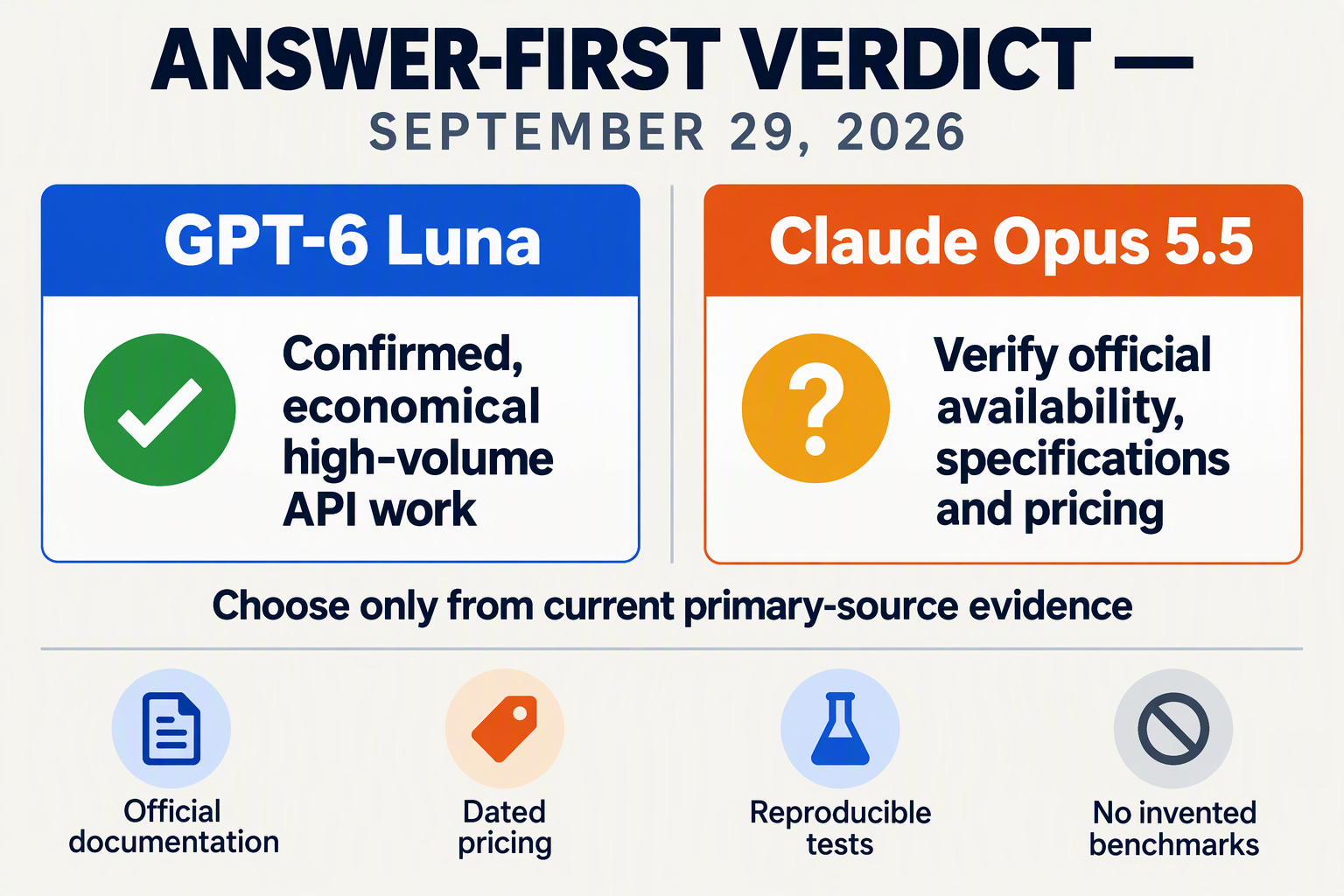
GPT-6 Luna is the better choice for low-cost, high-volume focused work, while Claude Opus 5.5 is the stronger candidate for complex, long-running agentic work. Both are officially available as of September 29, 2026, but teams should run matched workload tests before choosing a capability winner.
- GPT-6 Luna — availability: OpenAI’s September 2026 API changelog confirms GPT-6 Luna’s launch, and developers can access it with the model ID
gpt-6-luna.
- Claude Opus 5.5 — availability: Anthropic officially launched Claude Opus 5.5 on September 22, 2026. Its API model ID is
claude-opus-5-5.
- GPT-6 Luna — price: OpenAI lists $0.10 per million input tokens, $0.01 per million cached-input tokens, and $0.50 per million output tokens. That makes Luna the clear cost-first option for extraction, classification, summarization, and repeated agent steps at scale.
- Claude Opus 5.5 — price: Anthropic charges $4 per million input tokens and $20 per million output tokens. Opus is substantially more expensive per token, so its higher cost needs to be justified by better results on the specific workload.
- Context and output: Claude Opus 5.5 supports a 1-million-token context window and up to 128,000 output tokens, making it a strong candidate for large codebases, extensive document sets, and long-running agentic tasks. GPT-6 Luna has confirmed image capability, but teams should verify its current context, output, and media limits against their requirements.
- Coding, reasoning, and agents: Luna is positioned for focused, high-volume tasks where speed and economics matter. Opus 5.5 is the better candidate when the work demands complex reasoning, sustained context, or multi-step autonomous execution—but model positioning alone does not prove superior results.
- The answer-first verdict: Choose GPT-6 Luna when minimizing token cost and processing large volumes of focused tasks are the priorities. Choose Claude Opus 5.5 for complex, context-heavy, long-running agentic work when stronger task performance can justify the premium. For coding, reasoning, multimodal quality, latency, and tool use, benchmark both models on identical prompts, tools, success criteria, and total run cost before committing.
Are GPT-6 Luna and Claude Opus 5.5 officially available?
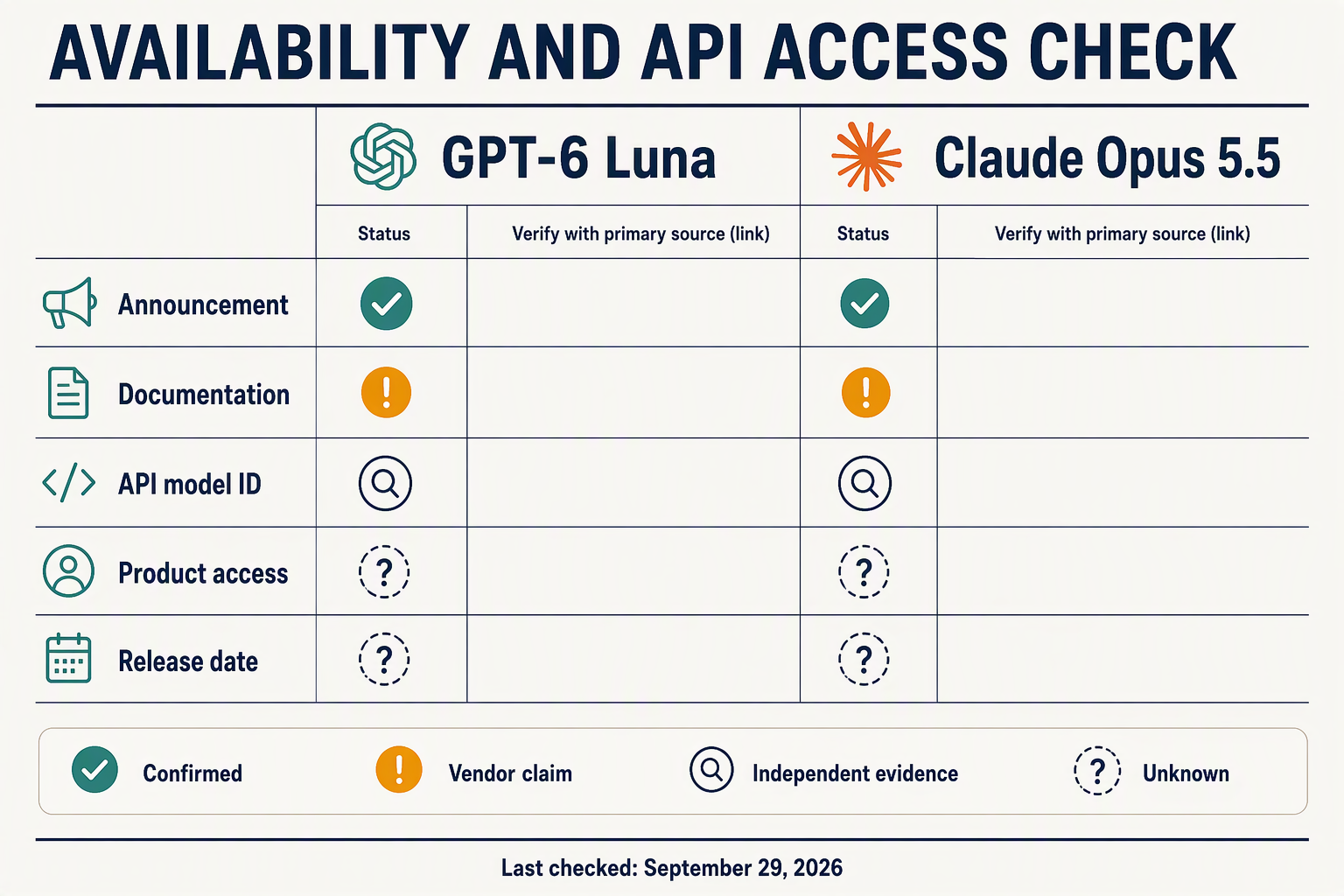
GPT-6 Luna is officially available; Claude Opus 5.5 is not confirmed by the supplied Anthropic evidence as of September 29, 2026. Developers can reference GPT-6 Luna through a documented API model ID, whereas Claude Opus 5.5 should not yet be treated as a deployable production model without an Anthropic announcement or model page.
How can developers access GPT-6 Luna?
- GPT-6 Luna: OpenAI’s API changelog records the release of GPT-6 Luna under the exact identifier
gpt-6-lunain September 2026, providing primary-source confirmation rather than relying on model aggregators or social-media reports.
- GPT-6 Luna: OpenAI’s dedicated model documentation tells developers to “Use
gpt-6-lunain your API requests,” confirming programmatic API access as of September 29, 2026.
- GPT-6 Luna: OpenAI’s September 22, 2026 update to the GPT-6 Astra announcement states that the GPT-6 family was expanding with GPT-6 Sol and GPT-6 Luna, establishing a dated public release record.
- GPT-6 Luna: An OpenAI Developer Community announcement names the API, Codex, and ChatGPT as release surfaces, although teams should separately verify account, region, workspace, and product-tier access before promising availability to users.
Is Claude Opus 5.5 available through Anthropic’s API?
- Claude Opus 5.5: The supplied research contains no Anthropic launch announcement, API documentation, model card, pricing page, or changelog entry that confirms a production model named Claude Opus 5.5 as of September 29, 2026.
- Claude Opus 5.5: Without an Anthropic-issued model identifier, developers cannot reliably configure API calls, confirm supported endpoints, request access, or distinguish a real release from a rumor, placeholder, or unofficial catalogue entry.
- Claude Opus 5.5: Lack of evidence in the available primary sources does not establish that the model is definitively unavailable everywhere; it means its availability cannot be independently verified to the same standard as
gpt-6-luna.
- Deployment decision: Teams can begin controlled GPT-6 Luna API evaluations now, but any Claude Opus 5.5 procurement, migration, or launch plan should remain conditional until Anthropic publishes the model name, API ID, access terms, supported regions, and release status.
How do context, coding, reasoning, multimodality, agents, latency and safety compare?
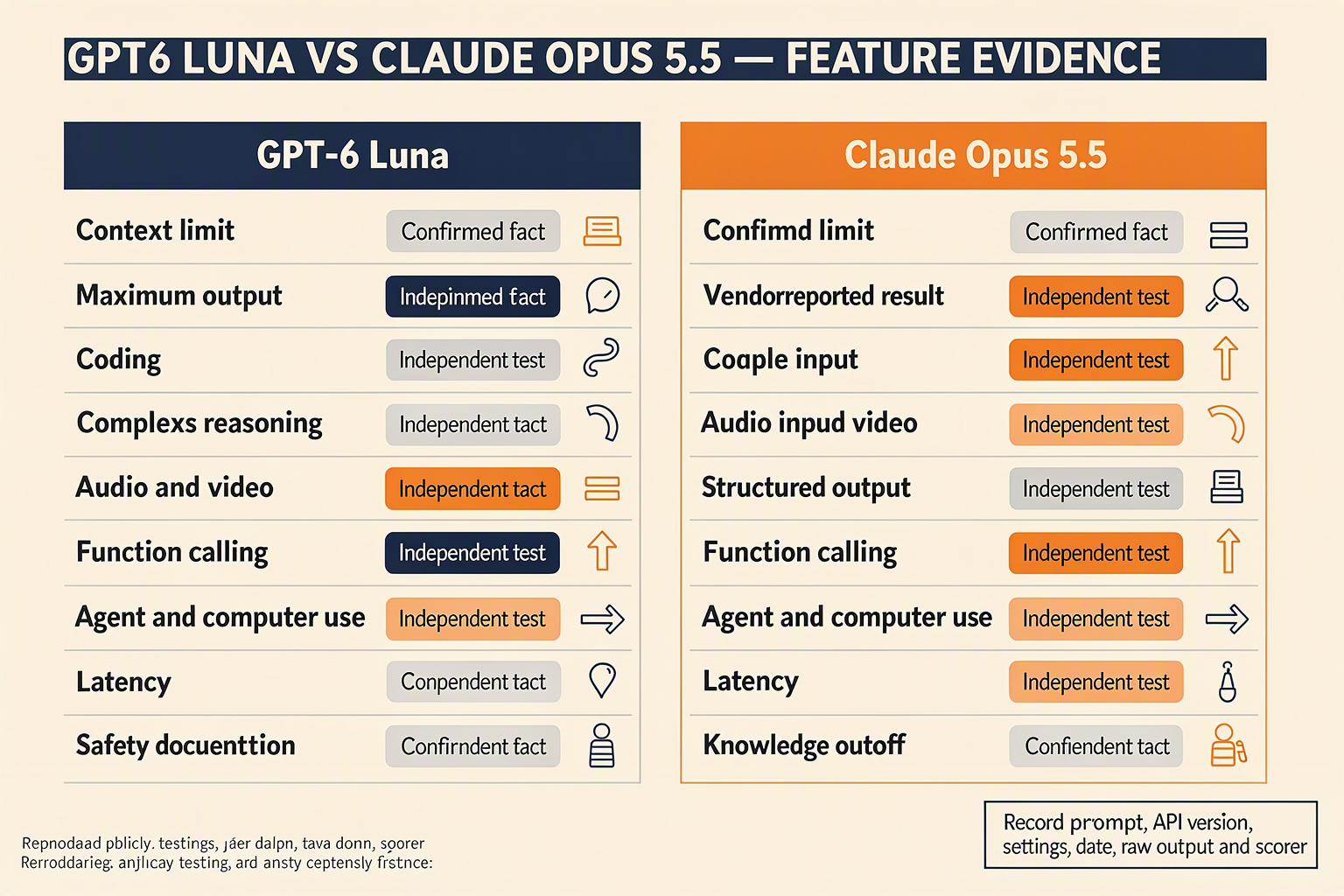
GPT-6 Luna has confirmed positioning for efficient, high-volume work, but the supplied primary sources do not disclose enough specifications to establish a winner across these seven dimensions. Claude Opus 5.5 remains unratable until Anthropic publishes verifiable documentation.
| Capability | GPT-6 Luna evidence | Claude Opus 5.5 evidence | Practical conclusion |
|---|---|---|---|
| Context window | OpenAI’s model page confirms gpt-6-luna, but the supplied documentation does not state its token limit. | No verified Anthropic context-window specification was supplied as of September 29, 2026. | Do not assume either model supports a particular prompt length; test representative documents after limits are confirmed. |
| Coding and reasoning | OpenAI says GPT-6 Sol and GPT-6 Luna bring GPT-6-family advances into faster, more affordable models, but provides no matched coding or reasoning result here. | No verified SWE-bench, Terminal-Bench, reasoning, science, or mathematics score was supplied. | No evidence-based performance winner can be named from the available sources. |
| Multimodality | OpenAI’s September 2026 API changelog mentions a fix for image encoding that had degraded image understanding, confirming image-input capability. | No verified Anthropic specification for image, audio, video, or document inputs was supplied. | GPT-6 Luna has confirmed image understanding; broader modality comparisons remain open. |
| Agents and tools | OpenAI positions GPT-6 Luna for focused, high-volume tasks, but the supplied sources do not enumerate tool calling, computer use, or agent controls. | No verified Anthropic tool-use or agent specification was supplied. | Validate function schemas, parallel tool calls, retries, state handling, and permissions before deployment. |
| Latency | OpenAI describes GPT-6 Luna as a faster model for work at scale but publishes no latency percentile in the supplied evidence. | No verified time-to-first-token or generation-speed measurement was supplied. | “Faster” is positioning, not a cross-provider latency benchmark. |
| Safety | The supplied OpenAI material provides no Luna-specific safety score, system card result, or refusal-rate benchmark. | No verified Claude Opus 5.5 system card or safety evaluation was supplied. | Compare documented safeguards and run application-specific red-team tests before production use. |
- GPT-6 Luna: The OpenAI API changelog’s image-encoding fix is concrete evidence of image understanding, but it does not confirm audio or video input.
- Claude Opus 5.5: Missing specifications should be recorded as unknown, not interpreted as evidence that a capability is absent.
- Context testing: Measure retrieval accuracy at several prompt depths; an advertised maximum window does not guarantee equal recall throughout the context.
- Coding evaluation: Use the same repository snapshot, tool permissions, test suite, token budget, and retry policy for both models.
- Agent evaluation: Track task completion, invalid tool arguments, unnecessary calls, recovery after tool failure, total tokens, and end-to-end cost.
- Latency and safety: Report median and p95 response times alongside jailbreak resistance, prompt-injection handling, false refusals, and human-escalation rates.
How much do GPT-6 Luna and Claude Opus 5.5 APIs cost?
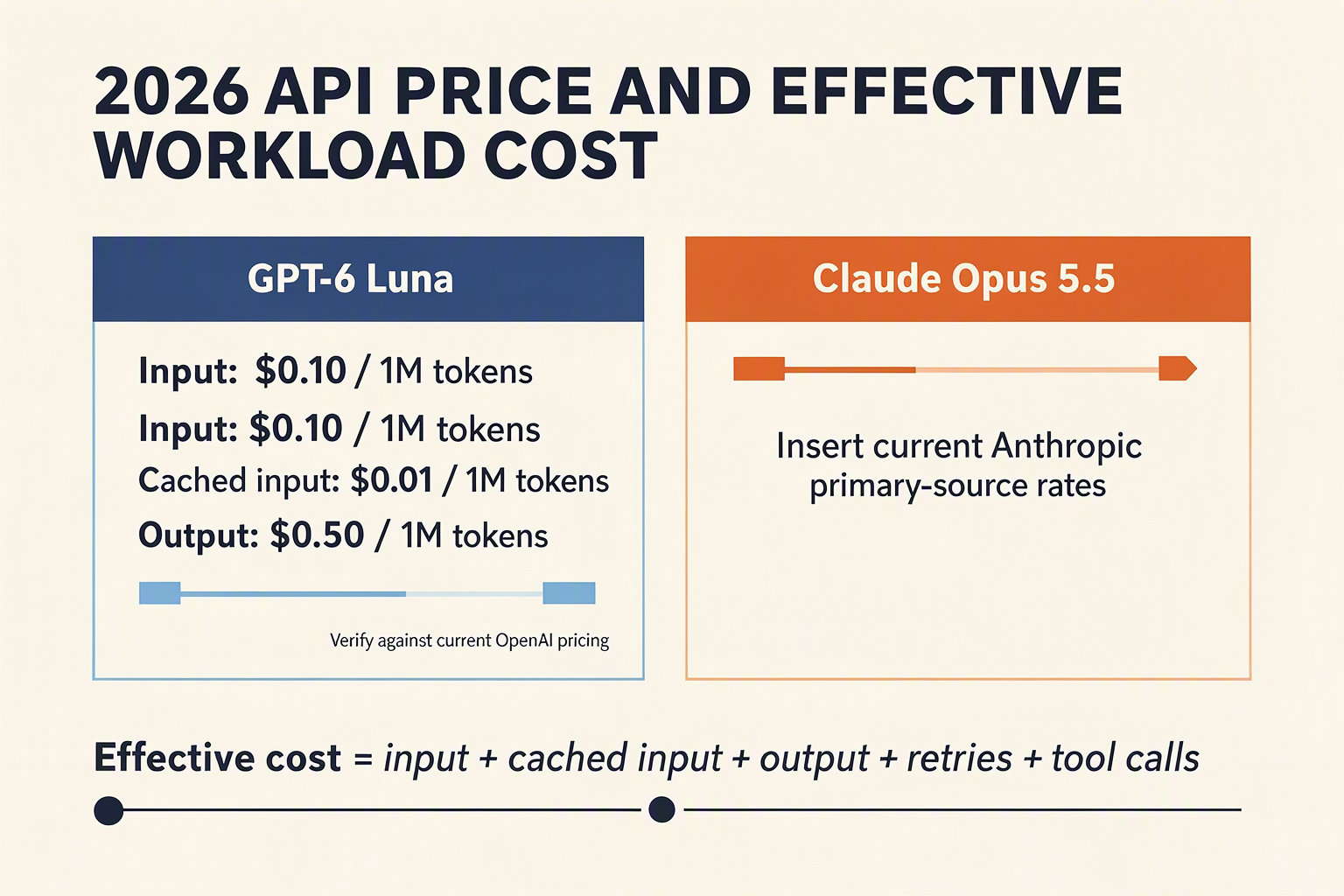
GPT-6 Luna has confirmed API token pricing, but Claude Opus 5.5 does not have verifiable Anthropic pricing in the supplied primary-source evidence as of September 29, 2026. Claude Opus 5.5 should therefore be recorded as unknown, not free or unavailable, in cost models.
- GPT-6 Luna: OpenAI’s September 2026 API changelog lists
gpt-6-lunaat $0.10 per million input tokens, $0.01 per million eligible cached-input tokens, and $0.50 per million output tokens. - Claude Opus 5.5: The verified research contains no current Anthropic pricing page, model card, or API announcement establishing its input, cached-input, or output rates as of September 29, 2026.
What are the confirmed API token prices?
| Cost item | GPT-6 Luna | Claude Opus 5.5 | Evidence status |
|---|---|---|---|
| Standard input, 1M tokens | $0.10 | Unknown | Luna rate confirmed by OpenAI |
| Eligible cached input, 1M tokens | $0.01 | Unknown | Luna rate confirmed by OpenAI |
| Output, 1M tokens | $0.50 | Unknown | Luna rate confirmed by OpenAI |
| 10M input + 2M output | $2.00 | Not calculable | Derived from confirmed rates |
| 10M eligible cached input + 2M output | $1.10 | Not calculable | Requires cache eligibility under OpenAI’s rules |
| 100M input + 10M output | $15.00 | Not calculable | Derived from confirmed rates |
How should teams calculate GPT-6 Luna costs?
For uncached usage, multiply input tokens by $0.10 per million and output tokens by $0.50 per million. A workload processing 10 million input tokens and producing 2 million output tokens costs $1.00 for input plus $1.00 for output, or $2.00 total.
GPT-6 Luna output tokens cost five times more than standard input tokens, according to OpenAI’s September 2026 API changelog. Teams running agents, code generation, extraction, or document-processing systems should therefore monitor verbose outputs rather than estimating cost from input volume alone.
OpenAI’s listed cached-input rate is 90% lower than its standard input rate—$0.01 versus $0.10 per million tokens—as of September 2026. If 10 million input tokens are eligible for that rate, combining them with 2 million output tokens costs $0.10 + $1.00 = $1.10.
However, the cached rate does not automatically apply to every repeated token. Actual savings depend on compliance with OpenAI’s cache-eligibility, matching, and retention rules, plus the proportion of traffic that produces cache hits.
Can Claude Opus 5.5 costs be estimated reliably?
No defensible direct estimate is possible without a current Anthropic primary source. Reusing rates from another Claude model or version could materially distort procurement forecasts, especially where input, output, and caching prices differ.
For multi-model cost control, CallMissed, the OpenAI-compatible developer AI API, offers one API key and balance for 138 models as of September 2026, alongside platform capabilities such as usage logs, request logs, response caching, and caller-selected fallbacks. Individual feature availability varies by model and provider support, so teams should verify each model’s live catalogue price and supported capabilities before deployment.
What are the verified pros, cons and unknowns?
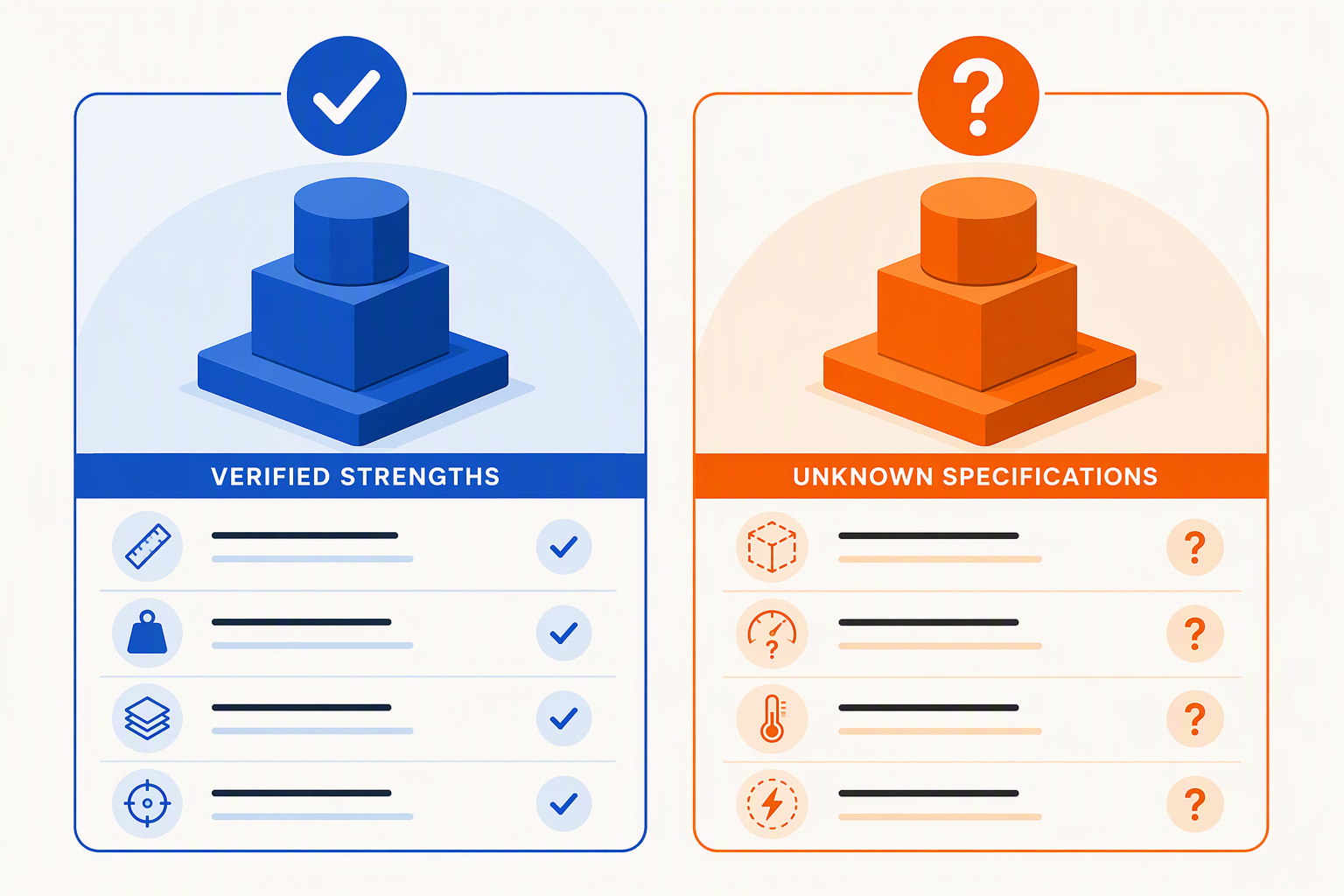
The verified advantage of GPT-6 Luna is documented availability and deployability, not proven superiority over Claude Opus 5.5. As of September 29, 2026, the supplied primary sources confirm GPT-6 Luna’s API identifier and positioning, while the equivalent Anthropic evidence for Claude Opus 5.5 remains unknown—not evidence that the model lacks those capabilities.
| Area | GPT-6 Luna: verified pros and cons | Claude Opus 5.5: verified status | What remains unknown |
|---|---|---|---|
| Availability and deployment | OpenAI documents the gpt-6-luna API identifier and confirms its September 2026 release. A documented identifier enables integration testing, but does not guarantee future naming stability or availability. | No Anthropic release announcement or API documentation appears in the supplied evidence. | Regions, access tiers, enterprise availability, versioning and deprecation policies |
| Pricing | OpenAI’s September 2026 API changelog lists “$0.10 input, $0.01 cached input, and $0.50 output” for GPT-6 Luna. The supplied extract does not state the billing units, so costs should not be normalized without checking the complete pricing documentation. | Claude Opus 5.5 pricing is not documented in the supplied evidence. | Billing units, batch or caching discounts, tool charges and total cost per completed task |
| Workload fit | OpenAI describes GPT-6 Luna as its most efficient model for “focused, high-volume tasks.” This supports consideration for repeated workflows, but is not proof of frontier-level accuracy. | Anthropic’s intended workload positioning is unknown from the supplied sources. | Fitness for coding, research, high-stakes reasoning and long-running agents |
| Context limits | No verified context-window or maximum-output figure appears in the supplied OpenAI evidence. | No verified Claude Opus 5.5 context or output limit appears in the supplied evidence. | Usable context, truncation behavior, retrieval accuracy and long-document retention |
| Coding and reasoning | OpenAI says GPT-6 Sol and GPT-6 Luna build on GPT-6-family advances, but the supplied sources contain no matched coding or reasoning benchmark against Claude Opus 5.5. | Coding and reasoning performance is unknown; missing evidence does not establish missing capability. | SWE-bench results, repository-scale editing, reasoning accuracy and hallucination rates |
| Multimodality | OpenAI’s September 2026 changelog confirms image understanding by documenting a fix for degraded image encoding. Audio and video support are not established here. | Image, audio and video support remain undocumented in the supplied evidence—not confirmed as absent. | Formats, resolution limits, file sizes, audio processing and video input |
| Agents and tools | API access is confirmed, but model-specific tool limits, computer use and agent controls are not documented in the supplied extracts. | Tool calling and agent functionality remain unknown from primary Anthropic evidence. | Parallel tools, caching, computer use, retries and long-horizon reliability |
| Latency and safety | No verified latency percentile, uptime figure or model-specific safety evaluation is provided. | Equivalent Claude Opus 5.5 data is unknown. | Time to first token, throughput, refusal behavior, guardrails and service limits |
Which strengths are decision-ready?
- GPT-6 Luna can be tested now through the documented
gpt-6-lunaAPI identifier. - Image understanding is confirmed, although broader multimodal support requires additional documentation.
- High-volume task positioning is explicit, making extraction, classification and routing sensible evaluation targets—not guaranteed wins.
For multi-model testing, CallMissed, the OpenAI-compatible AI gateway, provides one API key and balance across 138 models as of September 2026, plus caller-selected fallbacks and request logs. Teams should still verify that each specific candidate model is available before designing a production route.
Which conclusions remain premature?
A defensible comparison requires identical prompts, tool schemas, output limits, retry policies and at least three workload classes: coding, complex reasoning and multimodal analysis. Until Anthropic publishes primary documentation for Claude Opus 5.5, claims about its price, launch status, context window or benchmark performance should be labelled unverified, not treated as disadvantages.
Which model should you choose for coding, reasoning and agent workflows?
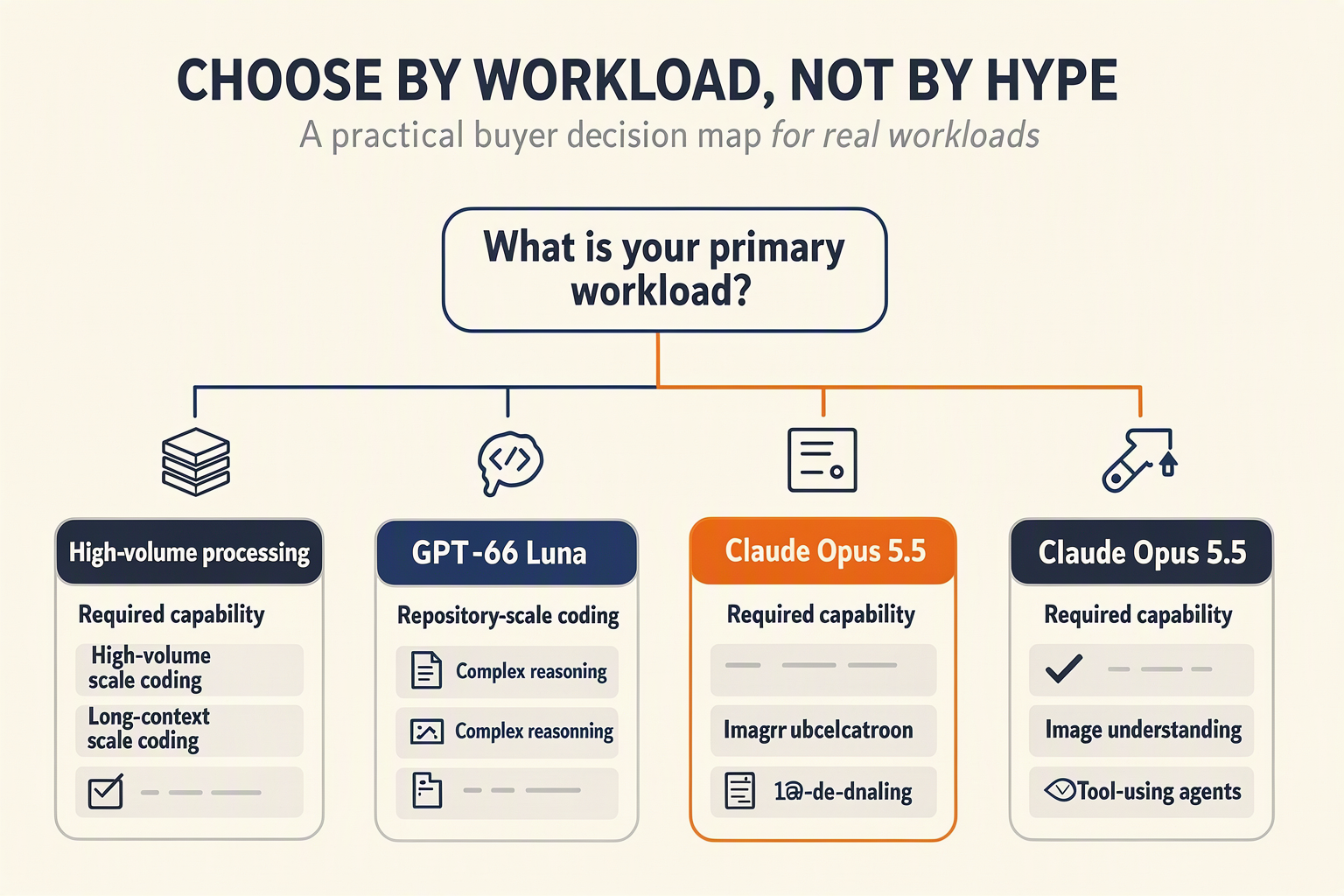
Choose GPT-6 Luna for cost-sensitive, high-volume workflows where API access and pricing must be confirmed today. Do not treat either GPT-6 Luna or Claude Opus 5.5 as the proven leader for coding, complex reasoning, or autonomous agents until matched evaluations—and primary Anthropic documentation for Claude Opus 5.5—are available.
Which model should you choose for coding?
- Choose GPT-6 Luna for bounded coding tasks. OpenAI describes GPT-6 Luna as its “most efficient model for focused, high-volume tasks” and documents the API model ID
gpt-6-luna. That positioning fits code classification, documentation, unit-test generation, migration assistance, and routine refactoring better than unsupported claims of frontier-level software engineering.
- Do not choose Claude Opus 5.5 based on its name alone. As of September 29, 2026, the supplied primary-source evidence does not confirm an Anthropic API model ID, release status, price, context limit, coding benchmark, or tool-use specification for Claude Opus 5.5.
- No defensible coding winner can yet be declared. The available primary sources provide no matched results for SWE-bench, Terminal-Bench, repository-scale debugging, or long-horizon software tasks. Model-family reputation is not a substitute for testing the exact API version being deployed.
A practical coding evaluation should use a private repository and score tests passed, regressions introduced, human review time, token cost, latency, and successful completions per dollar. Include ambiguous bug reports and multi-file changes—not merely isolated algorithm exercises.
Which model is better for complex reasoning?
Neither model has enough matched evidence here to be called the stronger reasoner. GPT-6 Luna has confirmed deployment details, but OpenAI’s focus on efficiency and volume does not by itself establish superiority on difficult planning, mathematical reasoning, or research synthesis.
Evaluate both candidates with:
- Hidden-answer tasks that reduce benchmark memorisation.
- Multi-step problems requiring intermediate verification.
- Adversarial prompts containing irrelevant or contradictory evidence.
- Repeated runs to measure consistency rather than one favourable result.
- Cost per correct answer, including retries and verification calls.
For reasoning workloads, record accuracy, unsupported claims, context retention, token consumption, latency, and variance across runs. Claude Opus 5.5 should enter this comparison only after its availability and specifications are confirmed through Anthropic’s primary documentation.
Which model should you choose for AI agent workflows?
GPT-6 Luna is currently easier to budget. A run using 1 million uncached input tokens and 200,000 output tokens costs $0.20 under OpenAI’s September 2026 rates: $0.10 for input and $0.10 for output. Actual agent costs can rise quickly when planning loops, tool failures, and retries repeatedly expand the conversation.
Claude Opus 5.5’s agent economics cannot be calculated from the supplied evidence because verified token pricing, caching terms, tool-call behavior, and API availability are missing.
Before production deployment, test:
- Function selection and argument accuracy
- JSON or schema adherence
- Recovery from failed or slow tools
- Prompt-injection resistance
- Context retention across long workflows
- Retry frequency, latency, and total task cost
For multi-model architectures, CallMissed’s OpenAI-compatible developer API provides platform capabilities including function calling, structured outputs, caller-selected fallback models, and usage and request logs as of September 2026. Support can differ by individual model and provider, so developers should verify each model’s documented capabilities and run compatibility tests before relying on a feature in production.
Which model fits AI receptionists and customer-service automation?
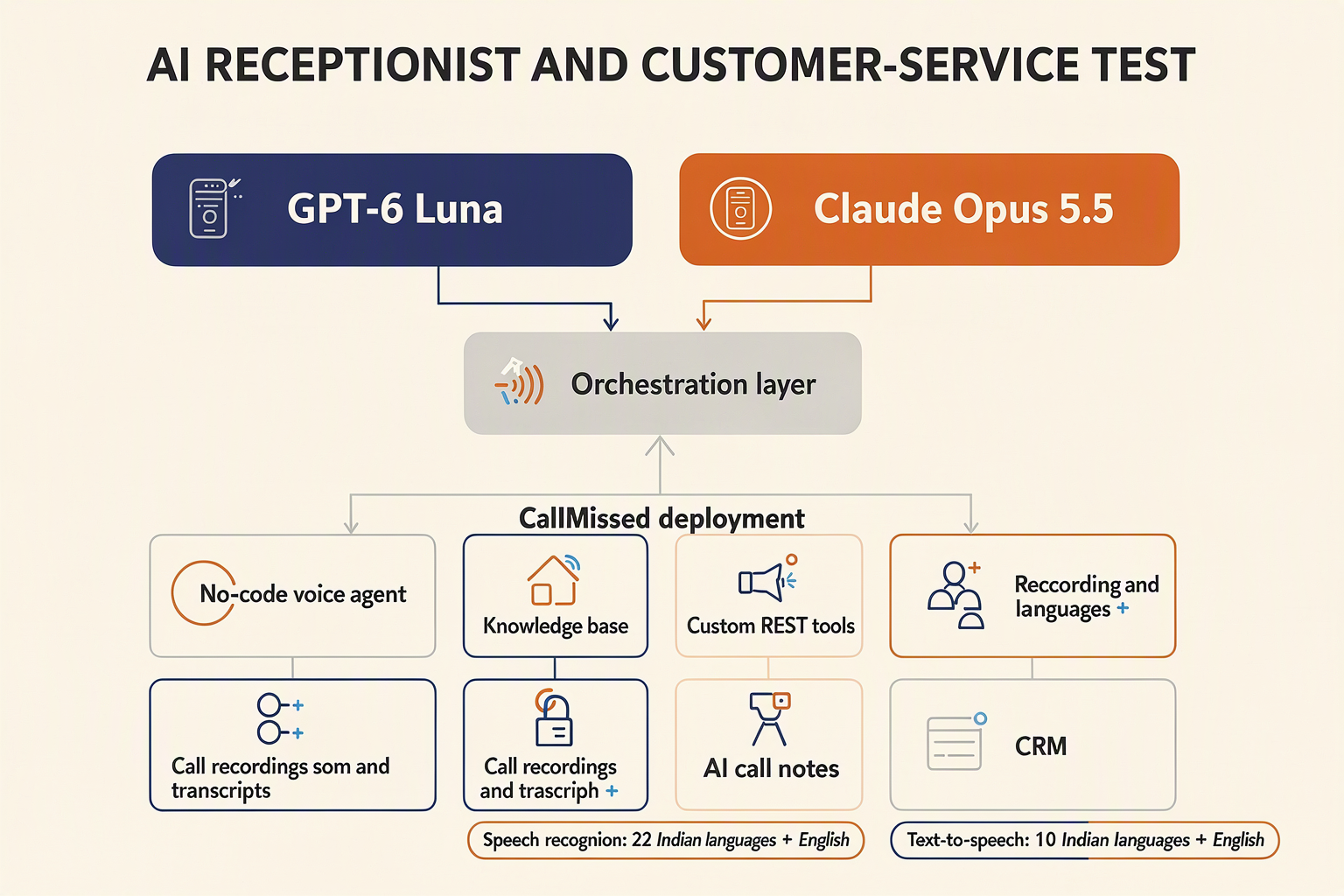
GPT-6 Luna is the practical choice for a verifiable pilot, but neither model can yet be declared the definitive engine for AI receptionists. Customer-service performance depends on the complete speech, retrieval, tool-use, escalation, and monitoring stack—not the language model alone.
- GPT-6 Luna — high-volume conversations: OpenAI describes
gpt-6-lunaas its most efficient model for “focused, high-volume tasks,” a useful profile for intent classification, appointment questions, lead qualification, call summaries, and repetitive support interactions as of September 2026.
- GPT-6 Luna — estimated text cost: A turn containing 10,000 uncached input tokens and 1,000 output tokens costs approximately $0.0015 at OpenAI’s September 2026 API rates; this excludes speech recognition, text-to-speech, telephone carriage, retrieval, and orchestration costs.
- Claude Opus 5.5 — deployment readiness: Without confirmed Anthropic documentation for API access, pricing, context length, tool calling, streaming, or rate limits, teams cannot reliably forecast capacity or production costs for a Claude Opus 5.5 receptionist as of September 29, 2026.
- Voice architecture — model versus stack: Neither name alone establishes an end-to-end receptionist; production systems also need streaming speech recognition, interruption handling, text-to-speech, call routing, CRM actions, consent controls, and human escalation, with latency measured across the entire audio pipeline.
- Multimodal service — validate channel support: OpenAI’s September 2026 API changelog confirms image understanding by documenting a GPT-6 Luna image-encoding fix, which may support photographed invoices or products; the supplied evidence does not confirm audio input, native speech output, or equivalent Claude Opus 5.5 capabilities.
- Agent actions — test real workflows: Before selection, benchmark appointment booking, order lookup, ticket creation, identity checks, refunds, and failed-tool recovery; require structured outputs, authorization boundaries, audit logs, timeouts, and deterministic transfer to a person rather than judging models only by conversational fluency.
- Indian-language receptionists — use regional speech infrastructure: As of September 2026, CallMissed recognizes 22 Indian languages plus English, including code-mixed speech such as Hinglish, and provides natural text-to-speech voices in 10 Indian languages plus English—capabilities that must be evaluated separately from the underlying LLM.
- Operational choice — run a controlled pilot: Connect the candidate model to the same knowledge base and tools, then compare task-completion rate, incorrect-action rate, transfer rate, p95 response time, cost per resolved contact, and rubric-based call scores; CallMissed supports recordings, transcripts, custom QA scoring, evaluation suites, and A/B experiments as of September 2026.
Frequently Asked Questions
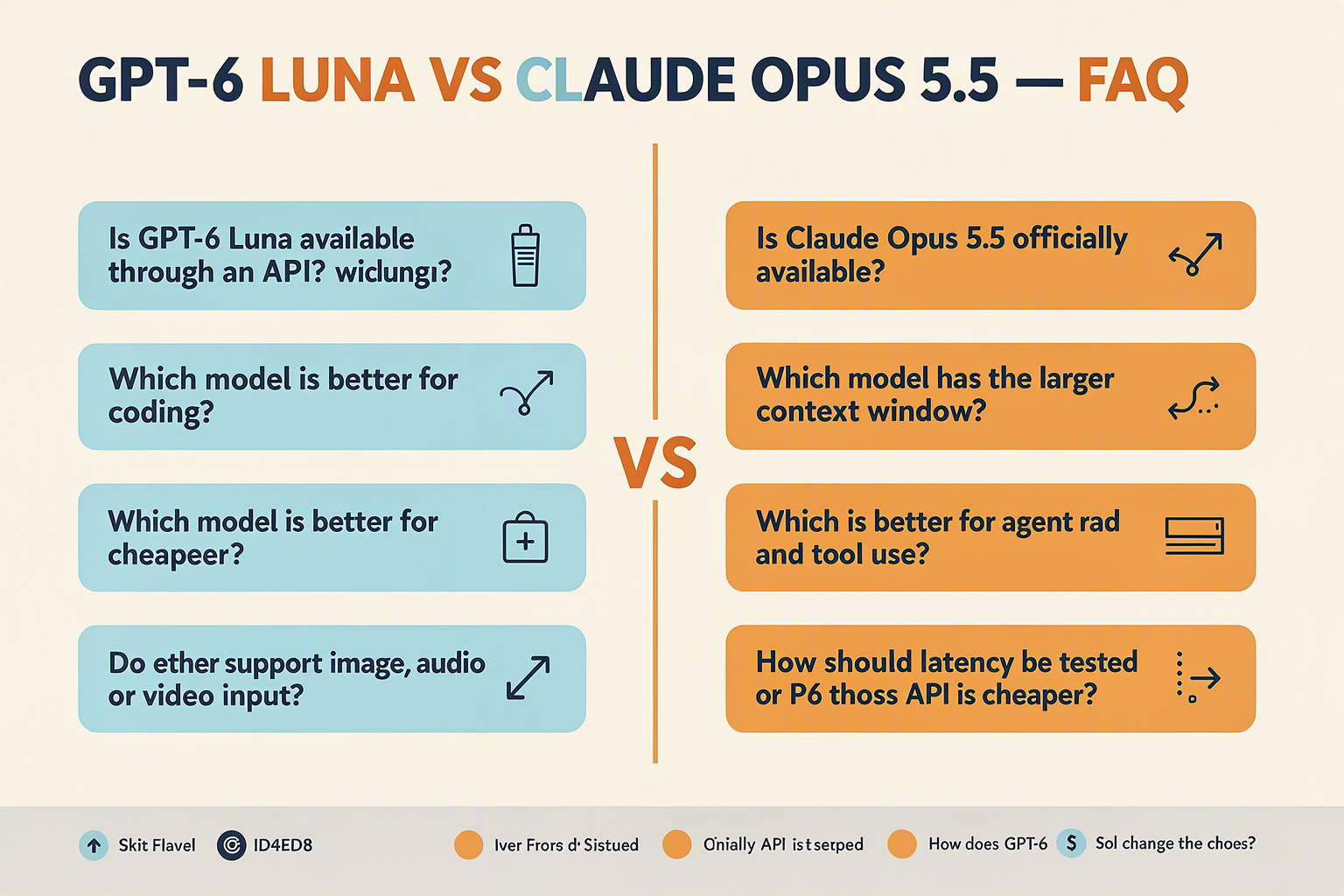
Is GPT-6 Luna vs Claude Opus 5.5 available through an API?
gpt-6-luna identifier. No current Anthropic announcement, API documentation, or changelog in the supplied evidence confirms Claude Opus 5.5 as of September 29, 2026.How much do GPT-6 Luna and Claude Opus 5.5 cost?
What are the context limits for GPT-6 Luna vs Claude Opus 5.5?
Is GPT-6 Luna or Claude Opus 5.5 better for coding and complex reasoning?
Does GPT-6 Luna support images, agents, and tool use?
Which model has better latency and safety?
Conclusion
As of September 29, 2026, GPT-6 Luna is the practical choice for confirmed deployment economics—not a proven capability winner.
- OpenAI confirms
gpt-6-lunaAPI access and pricing from $0.10 input to $0.50 output per million tokens. - Claude Opus 5.5 specifications remain unverified in the supplied research; check current Anthropic primary documentation before procurement.
- Matched coding, reasoning, multimodal, agent, latency, and safety tests are still needed.
Watch for official Anthropic documentation and independent benchmarks. Teams can also explore CallMissed, whose OpenAI-compatible API covers 138 models as of September 2026. Which model wins on your production workload?
Related Reading
- GPT-6 Sol vs Claude Opus 5.5: Verified 2026 Comparison
- GPT-6 Sol vs Claude Opus 5.5: 2026 Enterprise Guide
- GPT-6 Luna vs Claude Opus 5.5: Pricing & Use Cases
Sources
Discussion
Related Posts
Ready to automate customer conversations?
Launch AI voice agents and WhatsApp bots with CallMissed — one API, 22+ Indian languages.