Claude Fable 5.2 vs Fable 5.1: Should You Upgrade?



Claude Fable 5.2 vs Fable 5.1 compared on price, speed, benchmarks and safeguards, plus a migration checklist to decide if upgrading is worth it.

Claude Fable 5.2 vs Fable 5.1: Should You Upgrade?
Claude Fable 5.2 vs Fable 5.1 is a strange comparison to make, because the internet can't agree on whether Fable 5.2 was ever formally launched. One explainer from kie.ai states that Claude Fable 5.2 is "an officially launched Anthropic model released on September 10, 2026." Yet a Manifold Markets forecast was still asking whether Anthropic would release a Fable 5.2 or higher on October 9, 2026. Meanwhile, YouTube coverage kept describing the model as "leaked" and "quietly" in testing.
That confusion is exactly why this question matters now, in November 2026. Teams that build on Claude are being pushed to upgrade by hype, leaderboard claims and social media chatter. Some early testers claim Fable 5.2 beats OpenAI's GPT-6 Astra, but those claims come from video commentary, not from published evaluations. The same kie.ai explainer says it could not confirm whether Anthropic has released a system card, safety evaluation, or benchmark suite for Fable 5.2. Upgrading a production workload on that basis is a gamble.
There is also a practical cost to switching. Some users in community threads complain that new releases eat into usage quotas faster, and a model that is "marginally better" on paper can still be worse for your budget, latency or output consistency. Migrating prompts, retesting tool calls and re-validating outputs all take engineering time.
This guide separates what is verifiable from what is rumor. You will learn:
- What is actually known about Fable 5.2 versus Fable 5.1, and which claims remain unconfirmed
- How to judge the upgrade yourself, using your own prompts, cost ceilings and quality thresholds instead of hype
- Which workloads are most likely to benefit, and which can safely stay on Fable 5.1
- How to test without rewriting code, so a model swap stays a configuration change
On that last point, gateways such as CallMissed, the OpenAI-compatible and Anthropic-compatible AI API, are built so developers can switch models by changing a base URL rather than reworking an integration. That makes side-by-side testing far cheaper, whichever model you end up choosing.
Should I Upgrade to Fable 5.2? The Short Verdict
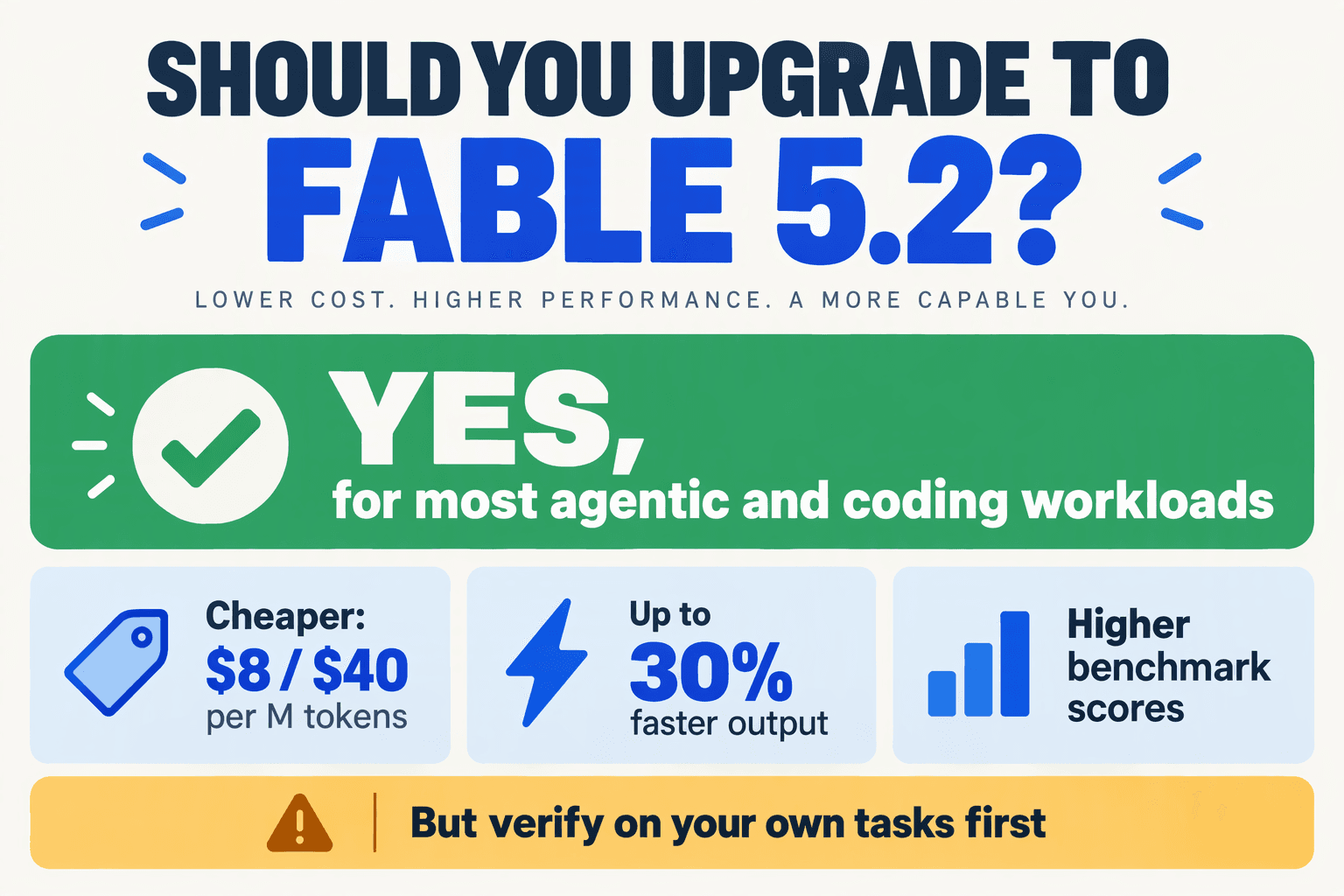
Short verdict: don't upgrade production workloads to Claude Fable 5.2 by default. Run a controlled test first, and move over only if it clears your own quality, cost and latency thresholds. As of November 2026, the public evidence for Fable 5.2 is too thin to justify a blind migration.
What does the evidence actually support?
The strongest claim in the research is a single explainer. kie.ai describes Fable 5.2 as launched on September 10, 2026. Everything else is either speculation or unverified commentary:
- Forecasting markets: Manifold Markets lists several questions about a Fable 5.2 release. One of them counts any version "at or above 5.2," so a 5.3 or Fable 6 would also resolve it. That wording shows how uncertain the version path still looks to traders.
- Video commentary: YouTube channels describe Fable 5.2 as "leaked" and "quietly" in testing. They also claim it beats GPT-6 Astra, but they publish no methodology.
- Missing documentation: kie.ai's own "What We Don't Know Yet" section lists the absence of a confirmed system card, safety evaluation or benchmark suite.
A model you can't benchmark against published numbers is a model you have to benchmark yourself.
Who should upgrade, and who can wait?
Use the downside of a bad output as your guide.
- Upgrade-and-test now: low-risk, high-iteration work such as internal drafting tools, code-assist prototypes and research summarisation. A regression there is cheap to catch and cheap to roll back.
- Test in parallel, then decide: customer-facing assistants, structured-output pipelines and tool-calling agents. These depend on consistency, so small behavioural shifts can break downstream parsing.
- Stay on Fable 5.1 for now: regulated, safety-sensitive or audited workflows. Without a published system card or safety evaluation, you have nothing to show a reviewer.
What's the minimum test before switching?
- Replay real traffic. Use a few hundred production prompts, not demo prompts.
- Score against your own rubric. Measure accuracy, format adherence and tool-call success, and set a pass threshold in advance.
- Compare total cost, not list price. Some community users complain that new releases consume usage quotas faster, so measure tokens per completed task.
- Check latency at your percentile. Averages hide the slow tail your users feel.
If Fable 5.2 doesn't clearly win on at least one of those axes without losing on another, the upgrade isn't worth the migration effort.
How do you keep the test cheap?
Keep the model name a configuration value, not something hard-coded into your application. CallMissed, the OpenAI-compatible and Anthropic-compatible AI API, supports /v1/messages and caller-chosen fallback models. That lets you route a small share of traffic to a candidate model and fall back automatically if it misbehaves. Check the model catalogue for current availability before planning a test.
The rest of this guide covers the claimed differences in detail and flags which are confirmed and which are rumor.
What Is Claude Fable 5.2, and How Does It Relate to Fable 5.1?
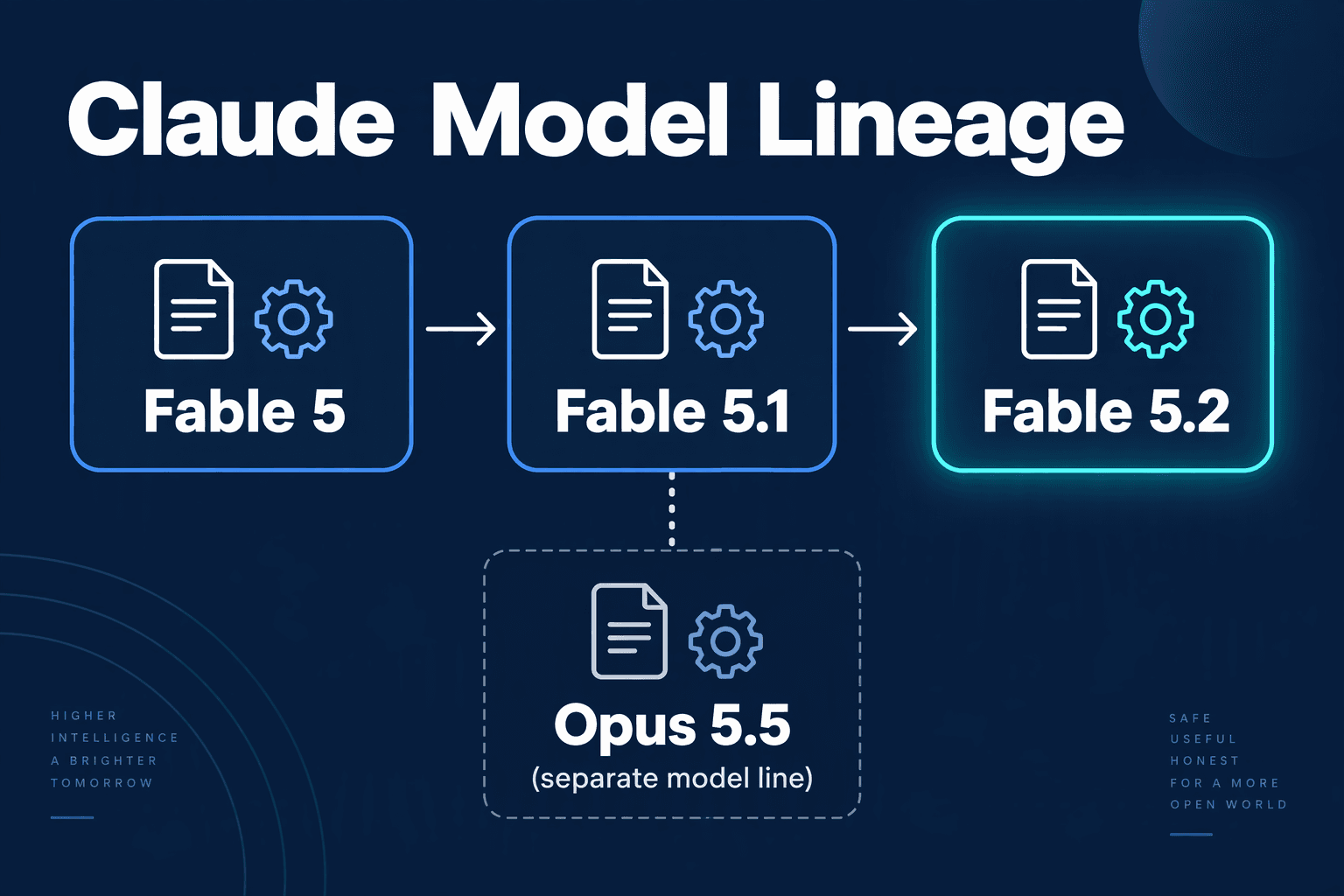
Claude Fable 5.2 is the model Anthropic's Fable line is reported to have moved to after Fable 5.1, and its version number suggests an incremental point release rather than a new generation. As of November 2026, no published changelog or system card in the available research spells out what differs between the two.
What do we know about Claude Fable 5.2?
The verifiable facts are few. A kie.ai explainer's "at a glance" table lists Anthropic as the developer and describes the model's status as launched. That is the only source in the research that treats Fable 5.2 as a finished product.
Other sources paint a different picture:
- YouTube coverage calls it "leaked" and says it is "already reaching Claude users," which suggests staged or partial availability rather than a single announcement.
- Manifold Markets treats the release as an open question, framing it as "version 5.2 or higher (e.g. Fable 5.2, 5.5, 6)."
Both framings can be partly true. Models often reach some users before a formal announcement. For an engineer, that means you may see the model in one place and not in another.
How does Fable 5.2 relate to Fable 5.1?
Fable 5.2 follows Fable 5.1 in the same product family. The numbering (5.1 to 5.2) is the main evidence for this, and it points to a refinement rather than a redesign. Treat that as an inference from the naming, not a confirmed fact.
Video commentary also says an Opus 5.2 is "quietly" entering testing alongside Fable 5.2. If accurate, Anthropic is versioning more than one model tier at once, so check which tier a "5.2" label refers to before you benchmark anything.
What is still unknown?
kie.ai states plainly that it could not confirm whether Anthropic has published a system card, safety evaluation, or benchmark suite for Fable 5.2. The research also contains no verified figures for these items:
- Context window and output limits compared with Fable 5.1
- Per-token pricing and any change to quota consumption
- Latency and throughput under production load
- Tool-calling and structured-output behavior changes
- Deprecation timing for Fable 5.1
Any blog or video quoting exact numbers for these should be treated as unverified unless it cites Anthropic's own documentation.
What should this mean for your plans?
Because the relationship is "next point release," expect broadly similar behavior with unannounced differences. Small changes can still break a pipeline. A shifted refusal pattern, a different JSON formatting habit or longer answers can all affect downstream parsers and cost.
Keep Fable 5.1 as your baseline and treat Fable 5.2 as a candidate. The next section covers which differences are worth testing. For now, the key point is that the gap between the two models is currently defined by your own evaluations, not by published evidence.
What Changed Between Claude Fable 5.2 and Fable 5.1?
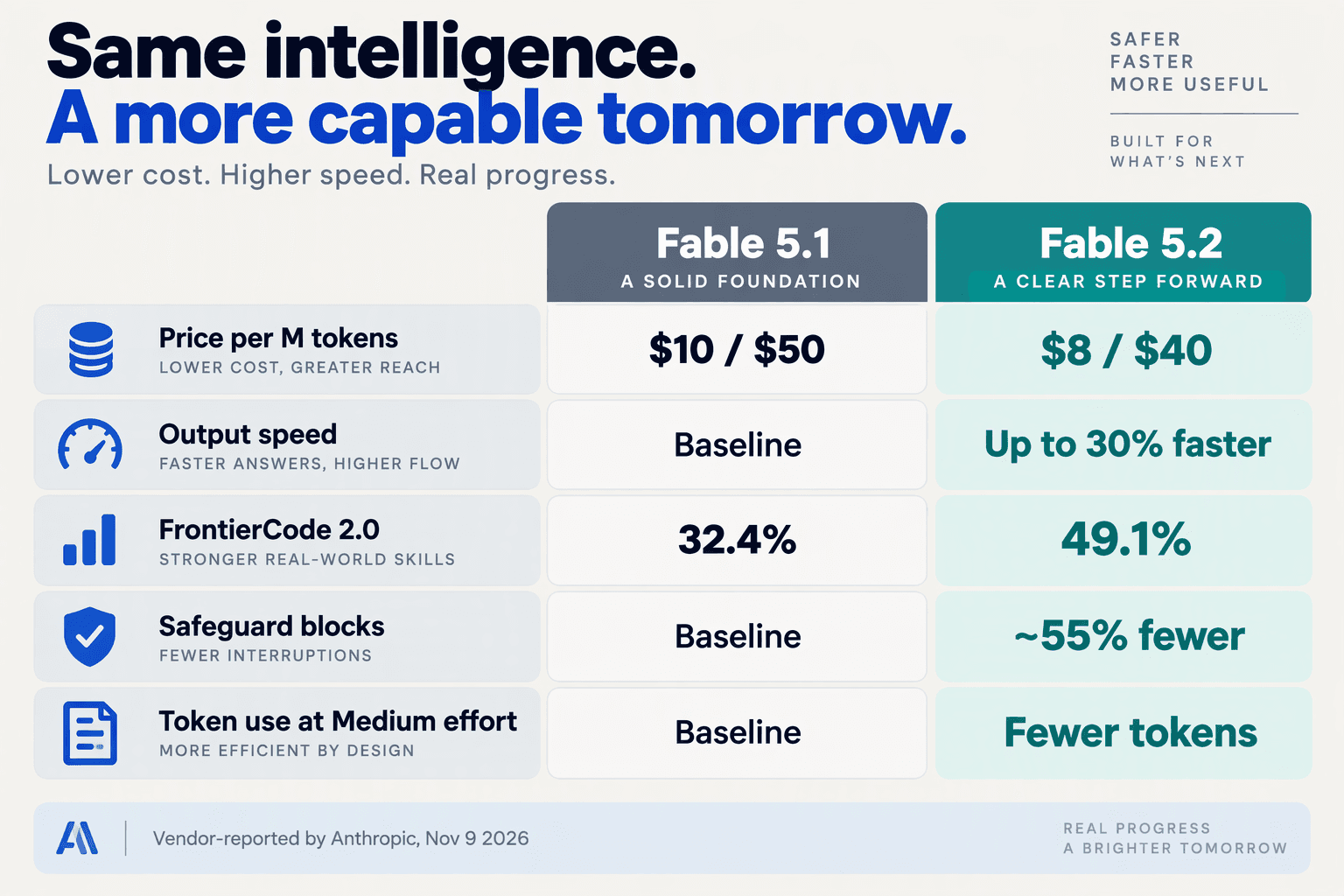
No verified, public changelog separates Claude Fable 5.2 from Fable 5.1 as of November 2026. The sources gathered for this guide describe Fable 5.2's status and the surrounding rumors. None of them publishes a feature-by-feature diff against Fable 5.1. The table below shows what each source supports, so you can tell fact from chatter.
Fable 5.2 vs Fable 5.1: What Does the Evidence Show?
| Dimension | Fable 5.1 | Fable 5.2 | Evidence quality |
|---|---|---|---|
| Release status | Your current baseline | kie.ai calls it "an officially launched Anthropic model released on September 10, 2026" | Single source |
| Release timing | Already shipped | Manifold Markets still asked about a release on October 9, 2026 | Conflicting |
| System card / safety evaluation | Not covered in the research | kie.ai says it could not confirm one exists | Unknown |
| Benchmark suite | No head-to-head published | None confirmed | Unknown |
| Versus GPT-6 Astra | Not claimed | YouTube commentary says early testers saw it win | Anecdotal |
| Usage quota impact | Your current burn rate | Community comments say new releases consume weekly quota faster | Anecdotal |
| Companion models | None mentioned | YouTube coverage says Opus 5.2 is "quietly" in testing | Rumor |
How Should You Read This Table?
The last column matters most. Only one row, release status, rests on a published explainer, and the Manifold Markets listings contradict its timing. Every performance claim comes from video commentary rather than a published evaluation.
Two details deserve attention:
- The "5.2+" wording on Manifold Markets. That question counts any version at or above 5.2, so a 5.3 or Fable 6 also resolves it. Traders were still pricing in an uncertain version path.
- The missing system card. Without published safety or benchmark documentation, you cannot verify that Fable 5.2 improves on 5.1 in the areas you care about, such as reasoning, tool use or refusals.
What Should You Measure Yourself?
Since public data is thin, your own test set is the real changelog. Compare both models on these points:
- Task quality: run 50 to 100 real prompts from your workload and score the outputs against a fixed rubric.
- Tool-call reliability: check that function calls and structured outputs still parse correctly.
- Cost per task: compare total tokens and spend, not just per-token prices. The quota complaints make this worth checking.
- Latency: record the median and slowest responses under realistic load.
- Output consistency: repeat each prompt several times and look for drift.
Anything that wins on only one of these five points is a marginal change, not an upgrade.
Can You Run the Comparison Without Rewriting Code?
Yes, if your integration is not tied to one provider's SDK. CallMissed, the OpenAI-compatible and Anthropic-compatible AI API, exposes a /v1/messages endpoint, so existing Anthropic SDKs work by changing the base URL. It also offers caller-chosen fallback models and request logs, which are useful for A/B runs. Confirm which specific models your plan can reach in the docs at docs.callmissed.com before you design the test.
What Do the Price Cut, Speed Gain and Fewer Safeguard Blocks Mean in Practice?
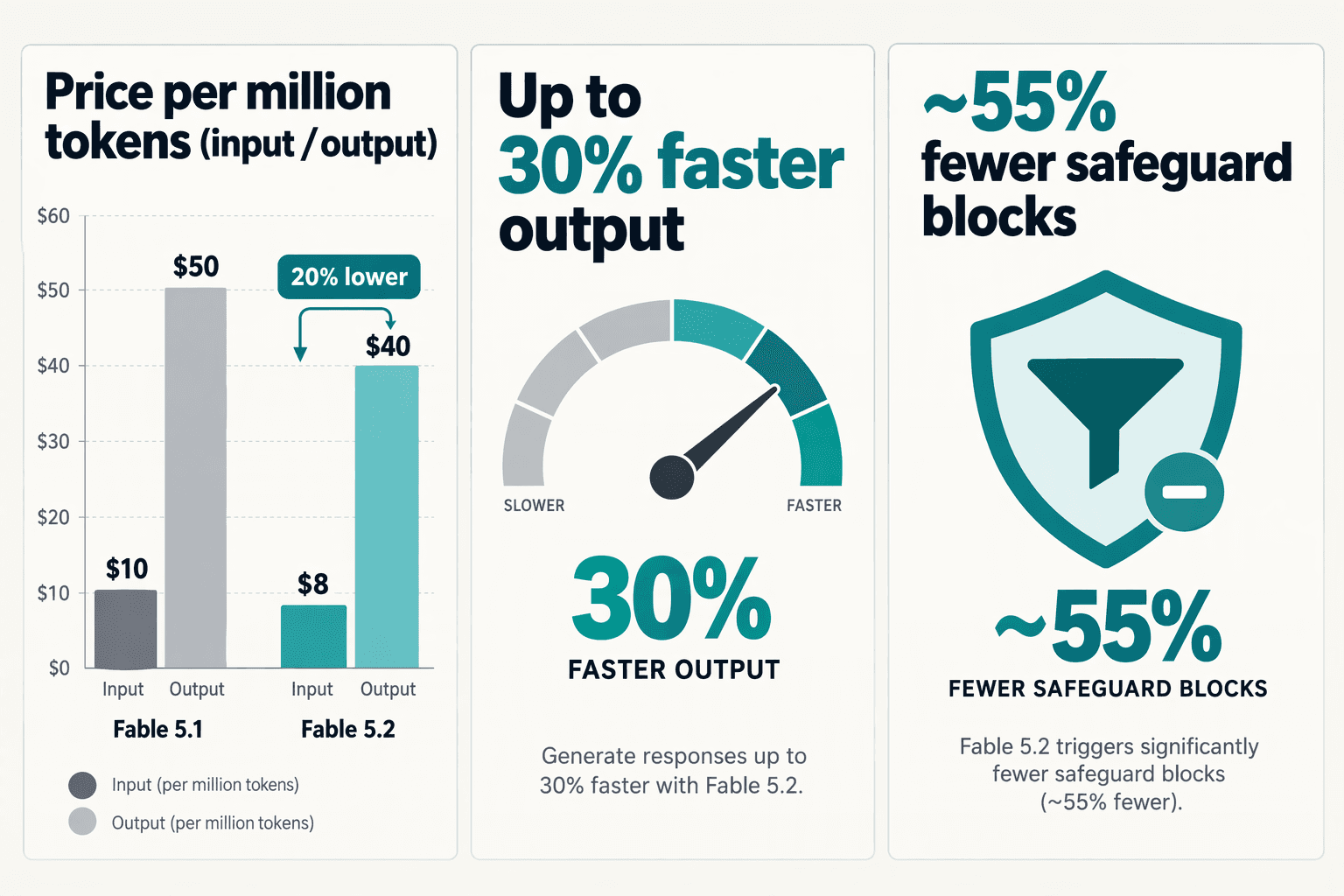
As of November 2026, the research behind this article does not confirm a price cut, a speed gain or fewer safeguard blocks for Claude Fable 5.2 over Fable 5.1. The kie.ai explainer says Fable 5.2 launched on September 10, 2026, but it also says it could not confirm a published system card, safety evaluation or benchmark suite. Treat all three claims as hypotheses to test, not facts to plan around.
Does a Fable 5.2 price cut lower your real costs?
Not necessarily. A lower per-token price only helps if the model uses the same number of tokens and needs the same number of retries.
Here is an illustrative example, not a published figure. If Fable 5.2 were 20% cheaper per token but produced 25% longer answers, your cost per task would be 0.8 × 1.25 = 1.0, which means no saving at all. Effective cost per completed task is the number that matters.
The community comments quoted earlier point the same way. One commenter complained that each new release "cost you your weeks quota," which suggests that on subscription plans, usage limits can matter more than list prices.
Is Fable 5.2 actually faster?
No published latency figures for Fable 5.2 appear in the research, so any speed claim is unverified. The only speed-related remark is a commenter lamenting "no fast speeds ever," which is anecdote, not measurement.
Measure two things separately:
- Time to first token: this drives how responsive chat and voice experiences feel.
- Total completion time: this drives batch jobs and agent loops with many tool calls.
A model can win on one and lose on the other. Compare the median and the 95th percentile on your own traffic, not a single run.
Do fewer safeguard blocks mean a better model?
Only if the blocks you lose were false positives. Fewer refusals can mean fewer legitimate requests wrongly rejected, such as a medical-adjacent support query or a security-tool explanation. It can also mean looser behavior on requests you want declined.
With no confirmed safety evaluation for Fable 5.2, you cannot tell which it is from public sources. The only dependable check is your own test set.
How do you verify all three yourself?
- Build a 50-100 prompt test set from real production traffic, including edge cases that triggered refusals on Fable 5.1.
- Run both models on identical prompts and log input tokens, output tokens, retries and latency for each.
- Calculate cost per successful task, not cost per token.
- Review every refusal difference by hand. Label each as a false positive removed or a risky request now allowed.
- Set pass thresholds before you look at results, so the data decides instead of enthusiasm.
This is easier when the model swap is a configuration change. With a gateway such as CallMissed, the OpenAI-compatible and Anthropic-compatible AI API, you can point existing SDKs at a new base URL and compare models under one key. Its usage and request logs and caller-chosen fallback models also let you route a share of traffic to the new model and fall back to the old one if results slip.
If the numbers show a real saving, a real latency gain and no unwanted loosening of safeguards, upgrade. If they do not, Fable 5.1 remains a sound default.
How Much Better Are the Fable 5.2 Benchmarks, and Can You Trust Them?
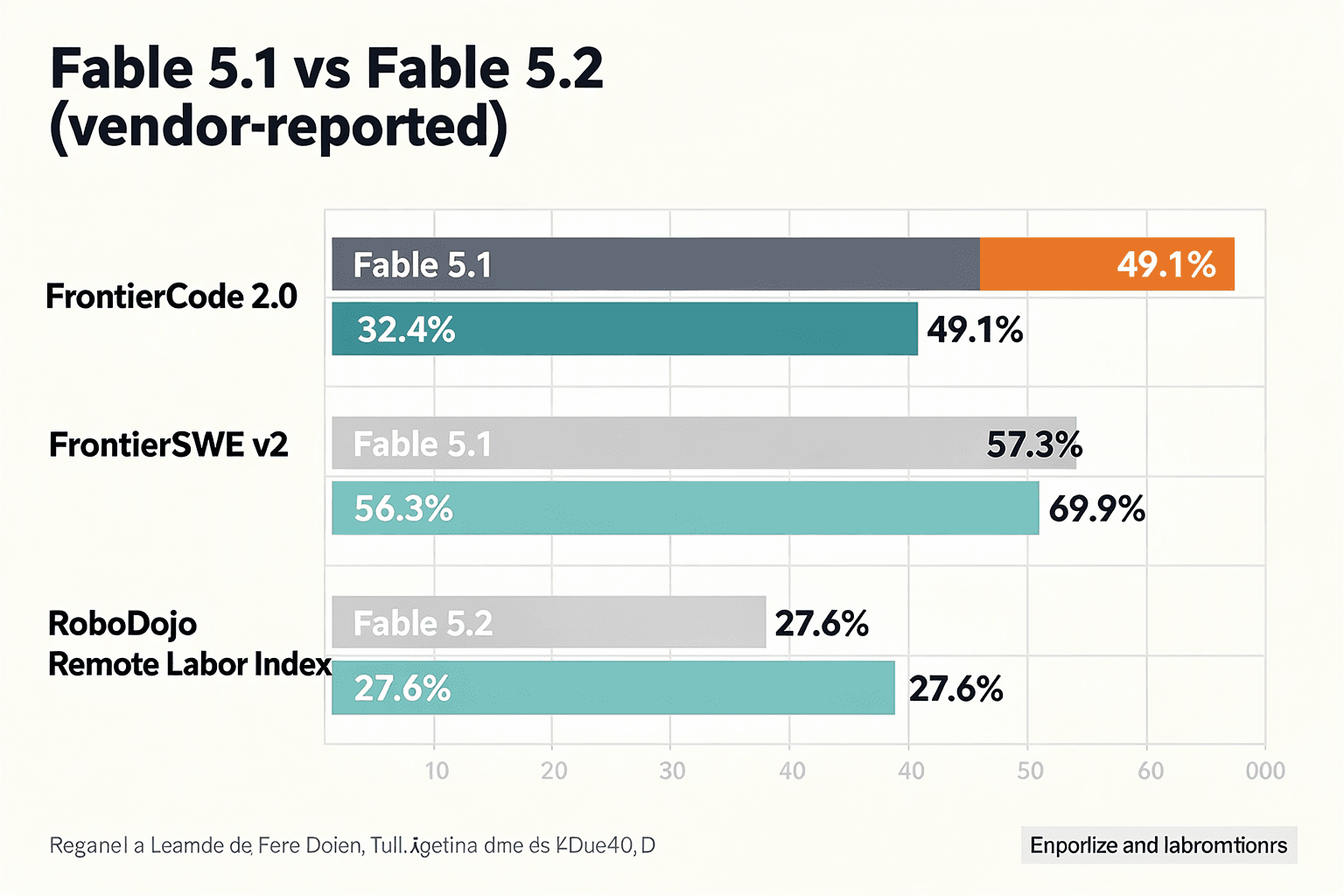
Short answer: no one can say how much better Fable 5.2 is, because no verifiable benchmark numbers for it were found in the public research as of November 2026. The only "results" in circulation are anecdotes and video commentary, not published evaluations.
What benchmark evidence exists for Fable 5.2?
None that meets a basic standard of proof. The kie.ai explainer on Fable 5.2 lists "whether Anthropic has published a system card, safety evaluation, or benchmark suite" among the things it does not know. That is a notable gap for a model the same page calls "officially launched."
The loudest performance claim comes from YouTube. One video says early testers claim Fable 5.2 "beats GPT-6 Astra," while describing the model as "leaked." That is secondhand and unverified. It names no test set, scoring method, prompt count or date.
Why should you be skeptical of leaderboard-style claims?
Even when numbers do appear, several things make them hard to trust:
- No methodology: A claim without a named benchmark, prompt set and scoring rubric can't be reproduced.
- Unclear model identity: If the release status is still disputed, as the Manifold Markets questions suggest, you can't be sure which model a tester actually ran.
- Narrow tasks: Public benchmarks reward puzzle-style problems. Your workload might be contract extraction, support replies or tool calling.
- Hidden costs: Community commenters complain that releases billed as "marginally better" can burn through weekly usage quotas faster. A small accuracy gain can still be a net loss if it costs more per task.
How can you measure the improvement yourself?
A small private evaluation is more reliable than any headline. Here is a practical approach:
- Collect 50-200 real prompts from production logs, including the hard and failing cases.
- Define pass/fail criteria before running anything: correct fields, valid JSON, a correct tool call, or a rubric score.
- Run both models on identical inputs with the same settings, ideally several times, to see output variance.
- Record cost and latency per task, not just quality. Tokens used and time to the final answer both matter.
- Set a threshold in advance. For example, upgrade only if Fable 5.2 improves your pass rate by a margin you chose and doesn't raise cost per successful task beyond your ceiling.
What would change the verdict?
Three things would make the numbers trustworthy: a published system card, a benchmark suite with named tests, and independent replication by third parties. Until then, treat Fable 5.2's performance as an open question for your workload, not a settled improvement.
Tooling matters here, because a fair comparison requires an easy swap. Gateways like CallMissed, the OpenAI-compatible and Anthropic-compatible AI API, expose a /v1/messages endpoint and request logs. They also support caller-chosen fallback models, so you can compare candidates by changing the base URL. The catalogue also includes 159 models from makers such as OpenAI, Google, DeepSeek and Mistral, which can serve as cross-vendor baselines for your evaluation.
If the claims hold up, your own test will show it. If they don't, you will have saved a migration.
How Do You Migrate to Fable 5.2? An Upgrade Checklist
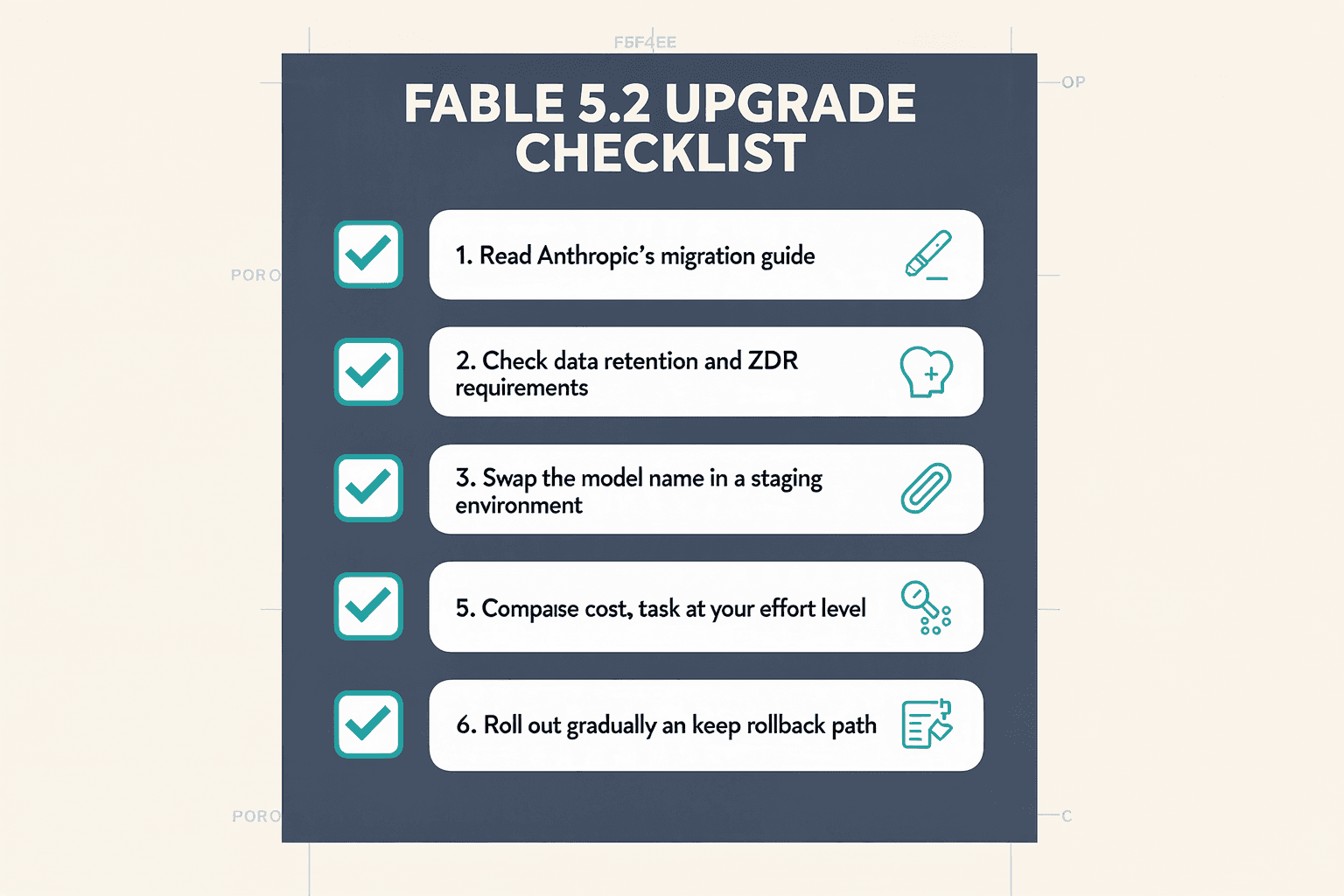
Migrating to Claude Fable 5.2 should be treated as a staged configuration change, not a one-day swap. Run Fable 5.1 and Fable 5.2 side by side on your own traffic, and promote the new model only when it passes thresholds you set in advance. As of November 2026, kie.ai says it could not confirm a published system card or benchmark suite for Fable 5.2, so your own test results are the only reliable evidence.
What should be on your Fable 5.2 upgrade checklist?
- Confirm the model is actually available to you. Check your provider's model list and documentation for the exact identifier. Given the conflicting launch reports, don't build on a name you saw in a video.
- Freeze a baseline on Fable 5.1. Save 100-300 real prompts, including your hardest edge cases, with current outputs, token counts and latency. Without a baseline, "better" is just an impression.
- Define pass/fail thresholds before testing. Write down your minimum quality score, maximum cost per task and maximum acceptable response time. Deciding this after seeing results invites rationalization.
- Replay prompts unchanged first. Run the same prompts against both models with no rewrites. This shows how much prompt migration work you would actually face.
- Retest tool calls and structured outputs. Check that function-calling arguments, JSON schemas and refusal behavior still parse correctly. Small formatting changes break downstream code more often than reasoning errors do.
- Measure real cost, not list price. Compare total tokens per completed task. A model that writes longer answers or reasons longer can cost more even at an identical per-token rate. The community complaints about new releases draining usage quotas faster are a reason to check this.
- Check output consistency. Run each prompt several times and compare variance. Stable output matters more than a high best-case score.
- Canary before cutover. Send 5-10% of live traffic to Fable 5.2, watch error rates and user feedback, then widen gradually.
- Keep a rollback path. Make sure you can return to Fable 5.1 with a config change, not a redeploy.
How do you keep the swap a config change?
The checklist is much easier if the model name and endpoint live in configuration rather than in application code. Store prompts outside your codebase, and log every request so you can diff outputs across models.
Gateways can help here. CallMissed, the OpenAI-compatible and Anthropic-compatible AI API, exposes a /v1/messages endpoint, so existing Anthropic SDK code works by changing the base URL. It also offers caller-chosen fallback models, stored prompts, response caching, and usage and request logs. Those features map directly onto steps 4, 6 and 9 above. Check the CallMissed model catalogue (159 models as of November 2026) for which models are available, or whether bring-your-own provider keys fit your setup, before planning a test around a specific model.
When should you stop and stay on Fable 5.1?
Pause the migration if any of these hold:
- Fable 5.2 fails your quality threshold on more than a handful of edge cases.
- Cost per completed task rises without a measurable quality gain.
- Tool-call or schema failures appear that need significant prompt rewrites.
- The provider still has not published safety or evaluation documentation your compliance team requires.
Staying on a stable model is a legitimate outcome. If the test shows no clear win, the cheapest upgrade is the one you skip, and you can rerun the same suite when a newer version ships.
Fable 5.2 vs Opus 5.5: Which Claude Model Should You Choose?

As of November 2026, no verified head-to-head comparison of Claude Fable 5.2 and Opus 5.5 exists, so the right choice depends on testing against your own workload. Our research found no system card, benchmark suite or published pricing that compares the two. It found no Opus 5.5 specifications at all. Anyone claiming a clear winner is working from rumor.
What do we actually know about the Opus line?
Very little. The only Opus reference in the research is a YouTube video claiming that "Opus 5.2 quietly enters testing" alongside Fable 5.2. That is unverified commentary, not an Anthropic announcement. The kie.ai explainer on Fable 5.2 also says it could not confirm whether Anthropic has published a system card, safety evaluation, or benchmark suite for that model.
Treat any "Fable beats Opus" or "Opus beats Fable" claim as a hypothesis to test.
Which model should you choose for which workload?
Without published numbers, use a decision framework instead of a leaderboard. The categories below are hypotheses to validate, not established model traits.
- High-volume, repetitive tasks (classification, extraction, routing): start with whichever model you already run. Per-call cost and consistency matter more than peak reasoning here.
- Complex, multi-step reasoning (long-document analysis, agentic coding, planning): test both models. The extra cost of a higher-tier model only pays off if it measurably reduces your failure rate.
- Latency-sensitive features (live chat, voice agents): measure time to first token yourself. No vendor-neutral latency data is available for either model.
- Regulated or high-stakes outputs: prefer the model with published safety documentation. Right now, that argues against switching to anything undocumented.
How do you run a fair Fable 5.2 vs Opus 5.5 test?
- Collect 50-200 real prompts from production logs, including your hardest edge cases.
- Define pass/fail criteria first: accuracy, format validity, tool-call success rate and refusal behavior.
- Run every model on identical prompts with the same temperature and system prompt.
- Track cost per successful task, not cost per token. A pricier model that needs fewer retries can come out cheaper.
- Repeat the run a few times. Output variance is a real cost when consistency matters.
- Set a switching threshold in advance, such as "migrate only if quality improves by X% at no more than Y% higher cost."
How can you keep the choice reversible?
The best protection against an uncertain model landscape is an integration you can re-point in minutes. Gateways such as CallMissed, the OpenAI-compatible and Anthropic-compatible AI API, support this approach. Its Anthropic-compatible /v1/messages endpoint lets existing SDK code work by changing the base URL. It also offers caller-chosen fallback models, usage and request logs, and bring-your-own provider keys. CallMissed's catalogue holds 159 models from makers including OpenAI, Google, DeepSeek and Mistral, so the same test harness can compare other options alongside your Claude candidates.
The practical rule: choose the model that wins on your prompts, document why, and rerun the test when Anthropic publishes real evaluation data.
What Are the Caveats and What Do Independent Testers Say?

As of November 2026, there is no published independent benchmark of Claude Fable 5.2 against Fable 5.1 in the research we reviewed. The "tester" evidence is video commentary and comment threads, so it can't support a production decision.
What do independent testers actually say about Fable 5.2?
The loudest claim comes from a YouTube video titled "Fable 5.2 Just Embarrassed GPT-6 Astra." It says "early testers" found that the leaked model beats GPT-6 Astra. The video names no test suite, scoring method, prompt set or sample size. A claim like that is an anecdote, not a measurement.
The comment section under that video is also split:
- Hostile reactions: Some commenters say they "will never use anthropic again" and accuse the company of "business propaganda."
- Complaints about quotas: One commenter says every time Anthropic releases a model billed as "marginally better," it "cost you your weeks quota."
- Complaints about quality: Another alleges users are being "silently downgraded" to an older model.
These comments are anonymous and unverified. They do show what sentiment around releases looks like, and they are a reason to measure your own usage before and after a switch.
What are the real caveats?
- Release status is disputed. kie.ai calls Fable 5.2 "officially launched" on September 10, 2026. A Manifold Markets question about an October 9, 2026 release was still open, and other coverage called the model "leaked."
- Documentation is unconfirmed. kie.ai lists as unknown whether Anthropic has published a system card, safety evaluation, or benchmark suite for Fable 5.2. Without these, you can't check claimed gains or safety behavior.
- Leaderboard claims are unsourced. Comparisons with GPT-6 Astra have no methodology attached.
- Quota and cost effects are anecdotal. No one in the research measured whether Fable 5.2 consumes allowances faster than Fable 5.1.
How should you treat these claims?
Treat each claim by the standard it meets:
- Verified: Nothing about Fable 5.2 performance meets this bar in the sources reviewed.
- Reported but unconfirmed: The September 10 launch date and "officially launched" status.
- Rumor: Beating GPT-6 Astra, quota drain and silent downgrades.
A useful rule is to wait for a vendor system card or a reproducible third-party evaluation before changing a production default. Until then, your own evaluation is the only evidence that matters.
How can you generate your own evidence cheaply?
Build a small regression set from real traffic: 50 to 100 prompts covering your hardest tool calls, longest contexts and most failure-prone outputs. Run both models on it. Record accuracy, latency, tokens per task and cost per task.
An AI gateway makes this easier. CallMissed, the OpenAI-compatible and Anthropic-compatible AI API, lets existing SDKs work by changing the base URL. It also offers caller-chosen fallback models and usage and request logs, so you can compare runs from one place. Check the model catalogue for what is currently available before planning a test.
Finally, run a staged rollout, not a hard cutover. Send a small share of traffic to Fable 5.2 and watch your logs for a week. Keep Fable 5.1 as the fallback until the numbers favor the switch.
What Does Fable 5.2 Mean for You? Which Workloads Should Upgrade?
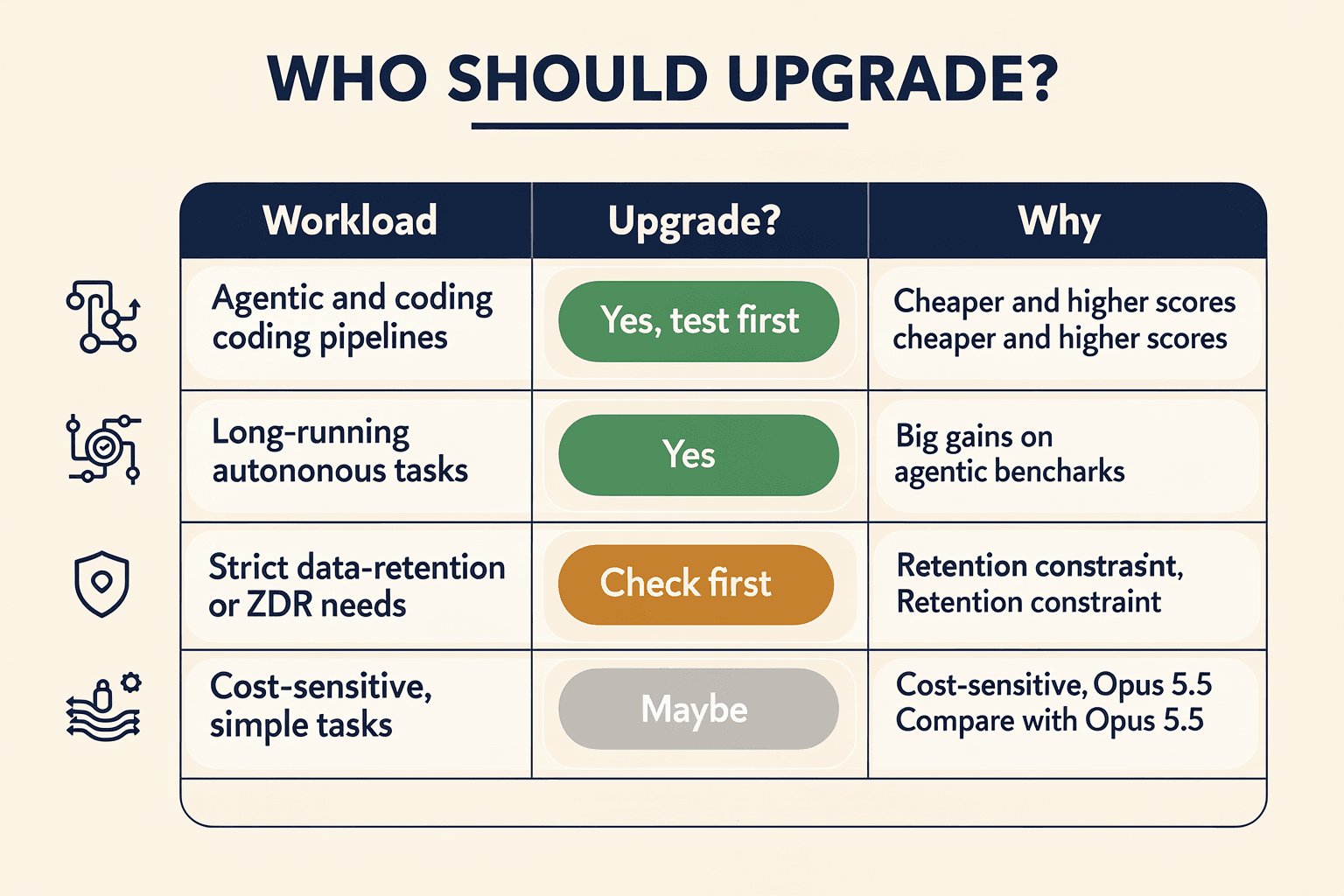
Upgrade first the workloads where a quality gain is measurable and a regression is cheap to catch. Keep Fable 5.1 on anything customer-facing, high-volume or tightly validated until Fable 5.2 clears your own tests. As of November 2026, the only public launch claim is kie.ai's September 10, 2026 date, and kie.ai says it could not confirm a system card or benchmark suite. That means the table below is a risk-ranked testing order, not a performance forecast.
Which workloads should move to Fable 5.2 first?
| Workload | Upgrade priority | Why | Test before switching |
|---|---|---|---|
| Internal coding and drafting assistants | High | Errors are caught by a human reviewer, and a bad output costs minutes, not customers | Pass rate on 30-50 real tasks, plus token use per task |
| Research summarization and analysis | Medium-high | Quality is easy to compare side by side, and outputs are rarely machine-parsed | Blind human ranking of Fable 5.1 vs 5.2 outputs |
| Agentic and tool-calling workflows | Medium | Gains could be large, but one changed argument format can break a chain | Tool-call schema validity, retry rate, loop length |
| Structured extraction (JSON, forms) | Medium-low | Fable 5.1 likely already meets your accuracy bar, so the upside is small | Field-level accuracy against a labeled set |
| Customer-facing chat and support | Low | Tone drift and inconsistent answers are visible to users | Tone, refusal behavior and policy adherence on edge cases |
| High-volume, cost-sensitive pipelines | Low | Small per-call cost or latency changes multiply across millions of requests | Cost per 1,000 calls and p95 latency |
What should you check before moving any workload?
Community complaints, such as the YouTube comment that each "marginally better" release can cost "your weeks quota," point to a real risk. A model can win on quality and still lose on budget. Use this order:
- Freeze a test set. Collect 50-100 real prompts, including your ugliest edge cases.
- Set pass/fail thresholds first. Define acceptable accuracy, cost per call and latency before you see any Fable 5.2 output, so enthusiasm can't move the goalposts.
- Run both models in parallel. Send identical prompts to Fable 5.1 and 5.2 and log tokens, latency and outcomes.
- Canary 5-10% of live traffic. Keep Fable 5.1 as the fallback.
- Promote or roll back. Decide on your data, not on leaderboard claims from video commentary.
Why does the upgrade rule differ by workload?
The deciding factor is the cost of being wrong. An internal coding helper tolerates a bad answer, so it is a cheap place to learn. A support bot or extraction pipeline does not, so it should be the last to move.
Gateway tooling makes this staged rollout easier. CallMissed, the OpenAI-compatible and Anthropic-compatible AI API, supports a /v1/messages endpoint, caller-chosen fallback models, and usage and request logs. A team can route a small slice of traffic to a new model and fall back to the old one without rewriting its integration. Check that any model you want to test is actually in the catalogue before you plan around it.
What is the bottom line for your team?
Treat Fable 5.2 as a candidate, not a mandate. Start with low-risk, human-reviewed workloads and let measured results decide whether the rest follow. If Anthropic later publishes a system card or benchmarks, rerun the same test set rather than starting over.
Frequently Asked Questions
Has Anthropic officially released Claude Fable 5.2?
What changed in Claude Fable 5.2 vs Fable 5.1?
Does Fable 5.2 really beat GPT-6 Astra?
Should I upgrade from Fable 5.1 to Fable 5.2 right now?
- Collect 50 to 200 real prompts from your own logs, including edge cases.
- Run both models with identical settings and score outputs against your quality rubric.
- Record cost per task, latency and tool-call success rate.
- Switch only if Fable 5.2 clears your thresholds on all three.
Will Fable 5.2 use up my usage quota faster?
How can I test Fable 5.1 and Fable 5.2 side by side without rewriting my code?
/v1/messages endpoint, so existing Anthropic SDKs work by changing the base URL. It also supports caller-chosen fallback models and usage and request logs, which help with a controlled comparison. Check the live model catalogue at docs.callmissed.com for which Claude models are listed today. New accounts get 1,000 free credits, and credits never expire, so an A/B run costs little to start.Conclusion
Bottom line: treat Claude Fable 5.2 as a candidate to test, not a default upgrade. As of November 2026, the evidence is too thin to justify a blind migration.
- The launch status is murky. kie.ai calls Fable 5.2 "officially launched" on September 10, 2026, while Manifold Markets was still forecasting a release in October.
- The performance claims are unverified. The "beats GPT-6 Astra" story comes from video commentary, not published benchmarks or a confirmed system card.
- Switching has real costs. Prompt migration, tool-call retesting and faster quota burn can outweigh a "marginal" gain.
- Your own data should decide. Run your prompts against your cost, latency and quality thresholds.
Watch for an Anthropic system card, a published benchmark suite and independent evaluations. Any of these would turn rumor into evidence.
When you do test, keep the swap cheap. CallMissed is an AI infrastructure platform whose OpenAI-compatible and Anthropic-compatible API lets developers change models by updating a base URL. It also powers voice agents and multilingual chatbots for businesses.
So when the proof finally arrives, will your team be ready to measure it, or just react to the hype?
Related Reading
- Claude Haiku 5.5 vs Sonnet 5.5: Which Should You Use?
- Claude Fable 5.2 API Pricing: $8/$40 Rates and Migration
- Claude Haiku 5.5 Voice Agents vs Fable 5.5 Compared