Claude Haiku 5.5 Voice Agents vs Fable 5.5 Compared


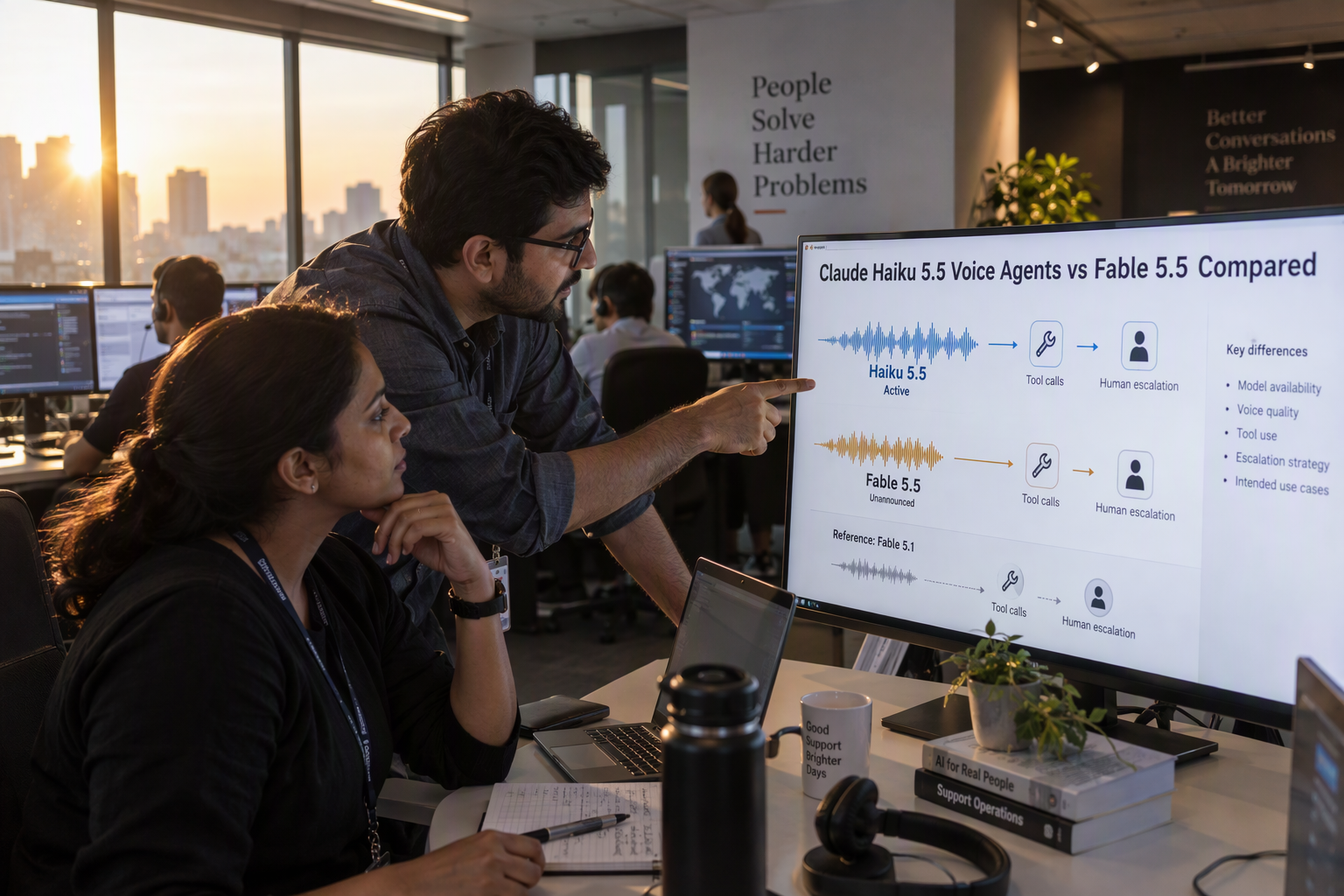
Claude Haiku 5.5 voice agents are compared with confirmed Fable 5.1 across latency, API cost, context, tools, routing, and voice constraints.
Claude Haiku 5.5 Voice Agents vs Fable 5.5 Compared
What if one model in your “Claude versus Claude” shortlist does not officially exist? Claude Haiku 5.5 voice agents are now a practical production topic, but Claude Fable 5.5 is not an announced Anthropic model as of October 14, 2026. Anthropic has launched Claude Haiku 5.5 and describes it as its “cheapest, fastest, and most capable small model,” designed for high-volume, cost-sensitive work such as summaries, database queries, classification, and repetitive requests.
That distinction matters because customer-support and voice agents can process thousands of short turns, where differences in response time, API cost, and tool-call reliability compound quickly. However, the language model is only one component of a real-time voice stack: speech recognition, orchestration, business-tool calls, text-to-speech, and telephony all affect what customers experience. A fast model does not automatically guarantee fewer awkward pauses, accurate escalations, or a lower cost per resolved case.
The naming confusion creates another risk: teams may compare confirmed Claude Haiku 5.5 specifications with rumored Fable 5.5 numbers that have no official basis. A defensible comparison must instead put launched Haiku 5.5 beside the confirmed Fable 5.1 baseline, label every version clearly, and avoid projecting Fable 5.1 pricing, context limits, or quality onto an unannounced successor. Where a vendor has not published a figure, “not disclosed” is more useful than false precision.
This guide will compare the criteria that matter in production:
- Latency and real-time fit: whether each model supports natural conversational turn-taking.
- API economics: token, caching, speech, and telephony costs.
- Context and quality: how effectively each option applies policies, customer history, and retrieved knowledge.
- Tool calling: reliability when checking orders, updating CRM records, booking appointments, or escalating to humans.
- High-volume support: which workloads suit Haiku 5.5 or Fable 5.1—and why Fable 5.5 should remain outside procurement assumptions until announced.
Model choice is increasingly an infrastructure decision. CallMissed, an AI customer-communication platform and developer AI API, provides one balance for 140 models—including 24 real-time voice-agent models—as of October 2026, plus Anthropic-compatible endpoints and a managed voice-agent WebSocket.
By the end, you will have a practical framework for choosing between documented options while separating launched capabilities from speculation.
Which model can you choose today? Haiku 5.5 is launched, while Fable 5.5 is unannounced as of October 14, 2026
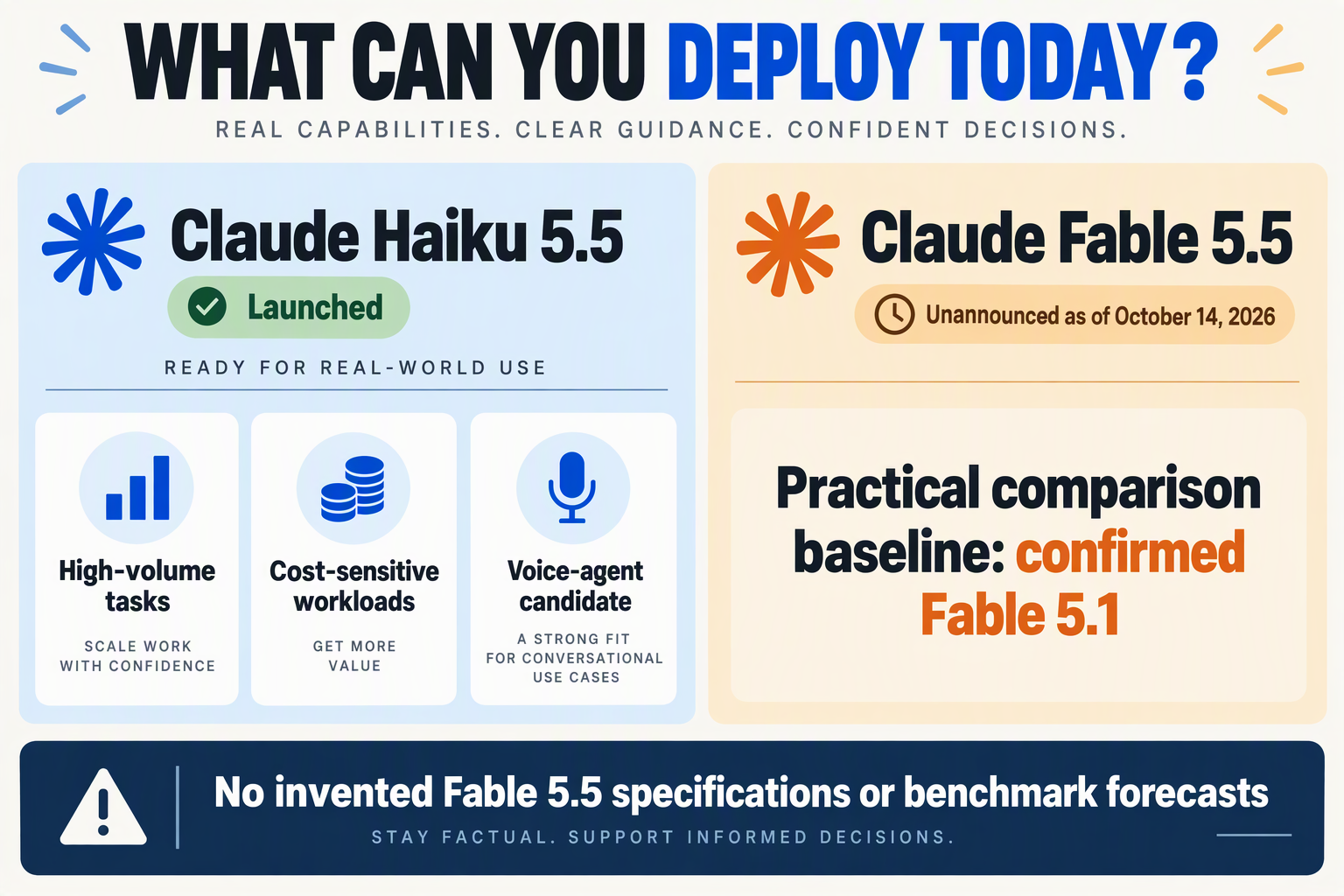
Claude Haiku 5.5 is the only one of the two named 5.5 models that teams can choose today. Claude Fable 5.5 has not been announced by Anthropic as of October 14, 2026, so it has no official API identifier, price, context limit, benchmark results, or release date.
Is Claude Fable 5.5 an announced Anthropic model?
No. Anthropic’s published announcement describes Claude Haiku 5.5 as its “cheapest, fastest, and most capable small model” as of October 14, 2026, while Anthropic has published no corresponding Fable 5.5 announcement.
The name also warrants careful verification. Anthropic’s March 2024 Claude 3 family comprised three tiers—Claude Haiku, Claude Sonnet, and Claude Opus—according to Anthropic. A product page, API documentation entry, and valid model identifier should therefore take precedence over references to “Claude Fable 5.5” in third-party posts, screenshots, or generated comparison pages.
For procurement purposes, classify the options as follows:
- Claude Haiku 5.5: launched and suitable for production evaluation.
- Fable 5.1: use only the specifications confirmed for that exact baseline; do not extrapolate them to version 5.5.
- Claude Fable 5.5: unannounced and unsuitable for budgeting or architecture decisions as of October 14, 2026.
What can teams verify about Claude Haiku 5.5 today?
Anthropic explicitly positions Claude Haiku 5.5 for high-volume, cost-sensitive workloads. Anthropic’s October 2026 announcement names summaries, context compaction, database queries, classification, and quick repetitive requests as target use cases.
Those workloads map directly to customer-support operations:
- Classifying intent before routing a conversation.
- Summarizing a long ticket for human handoff.
- Extracting an order number or requested appointment time.
- Querying a customer or product database.
- Drafting short answers from retrieved support content.
That positioning makes Haiku 5.5 a credible candidate for testing, not an automatic production winner. Teams still need measured results for time to first token, complete-response latency, tool-call accuracy, escalation behavior, and cost per resolved conversation under their own prompts and traffic patterns.
How should Fable 5.1 be used in this comparison?
Use Fable 5.1 only as a version-locked baseline where its origin, model identifier, and specifications can be independently confirmed. The supplied evidence does not provide Fable 5.1 pricing, context-window size, latency, or tool-calling benchmarks, so assigning numbers to those fields would create false precision.
A defensible evaluation process is:
- Test Haiku 5.5 through its documented production endpoint.
- Test Fable 5.1 using only its confirmed endpoint and published limits.
- Run identical support transcripts, tools, retrieval results, and grading rubrics.
- Label every result with the exact model version and test date.
- Leave Fable 5.5 out of forecasts until an official release supplies verifiable specifications.
For voice agents, also measure the complete pipeline rather than the language model alone. Speech recognition, retrieval, API tools, text-to-speech, and telephony can add latency or failure points even when Haiku 5.5 responds quickly. The practical choice today is therefore Haiku 5.5 versus a verified Fable 5.1 deployment—not Haiku 5.5 versus a hypothetical Fable 5.5.
Why must Fable 5.1 be the baseline for this comparison?

Fable 5.1 must be the baseline because it is the confirmed Fable release that teams can test, price, and evaluate against production workloads. Fable 5.5 remains an unannounced model as of October 14, 2026, so treating it as an upgrade would replace evidence with assumptions.
Why can’t Fable 5.5 specifications be estimated from Fable 5.1?
Model-family names do not guarantee predictable changes in price, latency, context capacity, or agent quality. A newer version may use a different architecture, inference configuration, pricing model, or product positioning.
Anthropic’s own releases demonstrate why linear projections are unsafe. Anthropic states that Claude Opus 5.5 costs 40% less than Opus 5 on typical workloads at default settings, while its input and output prices are 20% lower at $4 and $20 per million tokens, respectively, as of October 2026. Those are material changes that could not be derived reliably from the Opus 5 name alone.
Consequently, teams should not take a Fable 5.1 measurement and apply an arbitrary improvement factor to an imagined successor. Until Anthropic publishes Fable 5.5 documentation, the following remain unknown:
- API input, output, and prompt-caching prices
- Time to first token and sustained generation speed
- Context-window and maximum-output limits
- Tool-selection and argument-generation accuracy
- Supported API features and model identifiers
- Availability dates, regions, and rate limits
What does a Fable 5.1 baseline establish?
A baseline is not a prediction that Fable 5.5 will behave similarly. It is a reproducible reference point for deciding whether Claude Haiku 5.5 already meets the workload’s requirements.
Teams should test Fable 5.1 and Haiku 5.5 with the same:
- Support conversations: billing questions, returns, troubleshooting, policy exceptions, and escalation requests.
- System prompts: identical instructions, safety rules, response formats, and tone requirements.
- Knowledge inputs: the same retrieved documents, customer history, and product records.
- Tool workflows: order lookup, CRM update, appointment booking, refund eligibility, and human handoff.
- Voice pipeline: unchanged speech recognition, orchestration, text-to-speech, and telephony components.
This isolates the language model rather than accidentally crediting it for improvements elsewhere in the stack. Record median and p95 response latency, total tokens, cost per resolved interaction, tool-call success, unsupported claims, escalation accuracy, and task completion.
Why is Haiku 5.5 the practical challenger to that baseline?
Anthropic describes Claude Haiku 5.5 as its “cheapest, fastest, and most capable small model” as of October 2026. Anthropic specifically positions Haiku 5.5 for high-volume, cost-sensitive tasks such as summaries, compactions, database queries, classification, and repetitive requests—all common components of customer-support automation.
However, lower cost and higher speed do not settle every use case. Anthropic’s Project Deal experiment compared Claude Opus 4.5 with Claude Haiku 4.5 and concluded that “agent quality does make a difference,” reinforcing the need to test model capability rather than select solely by tier.
The defensible comparison is therefore launched Haiku 5.5 versus measured Fable 5.1. Fable 5.5 should enter the evaluation only after Anthropic announces it and publishes testable API specifications.
What are the key Claude release and naming developments?
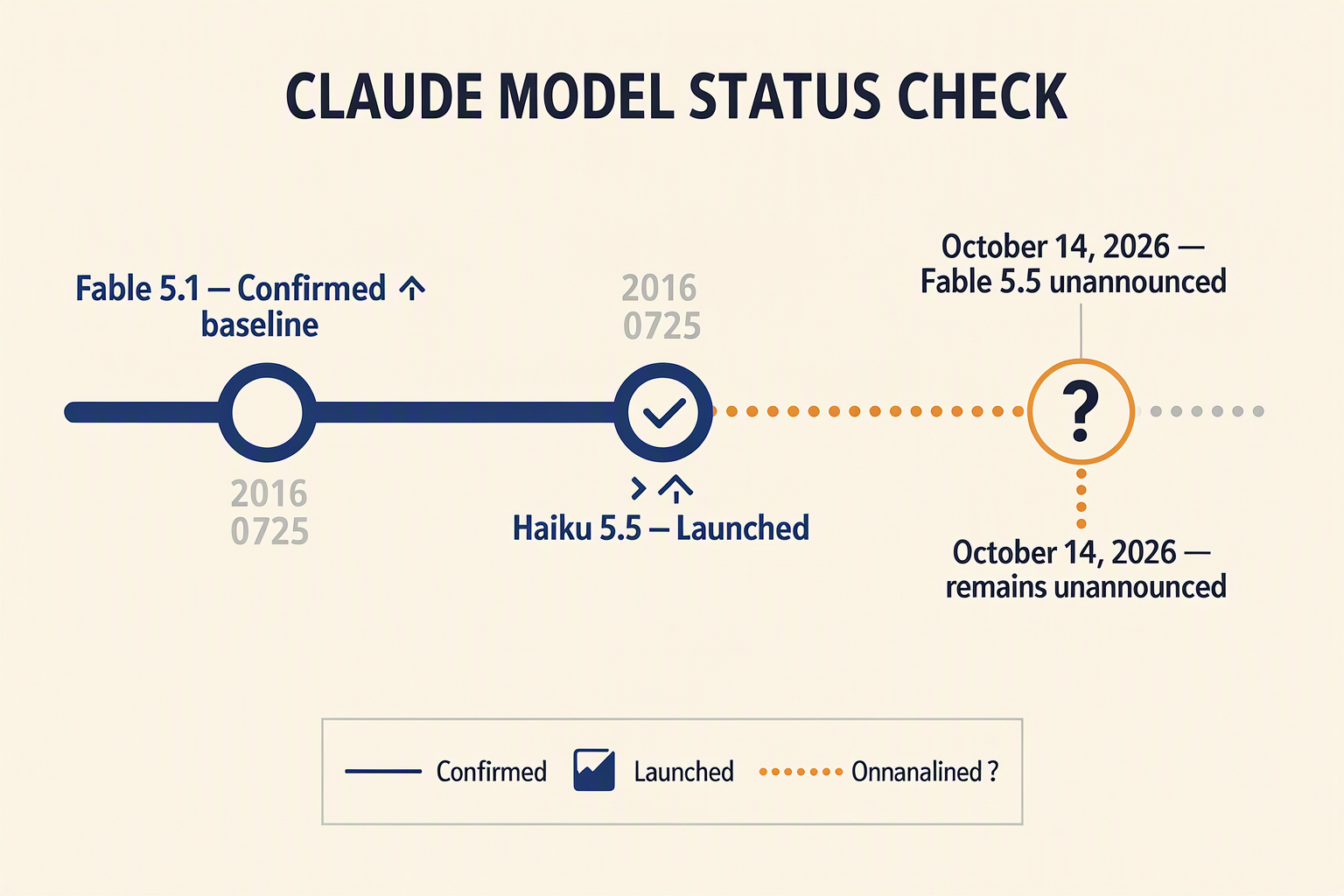
Anthropic’s Claude naming is no longer a simple, synchronized ladder in which every family receives the same version simultaneously. As of October 14, 2026, Claude Haiku 5.5 and Claude Opus 5.5 are announced products, while Claude Fable 5.5 remains unannounced; the documented Fable reference point for this comparison is Fable 5.1.
How has Claude’s model naming changed?
Anthropic originally presented Claude 3 as one generation containing three capability tiers: Haiku, Sonnet, and Opus. Anthropic described those models as being arranged “in ascending order of capability,” making the family name and generation number relatively easy to interpret.
Subsequent releases show why buyers must now read the complete model name, not just the number:
| Model or family | Official status on Oct. 14, 2026 | Naming development | Practical interpretation |
|---|---|---|---|
| Claude 3 family | Announced earlier | Haiku, Sonnet, and Opus shared one generation | Established the original three-tier naming structure |
| Claude Haiku 4.5 and Opus 4.5 | Confirmed earlier models | Different tiers carried the same 4.5 suffix | Tier identity remained as important as version |
| Claude Fable 5.1 | Confirmed baseline | Added Fable as a model-family name | Use published 5.1 evidence only when assessing Fable |
| Claude Haiku 5.5 | Launched | Advanced the small-model line to 5.5 | Available for high-volume, cost-sensitive workloads |
| Claude Opus 5.5 | Launched | Shares the 5.5 suffix with Haiku | Same version number does not mean identical cost or workload fit |
| Claude Fable 5.5 | Unannounced | No official release or specifications | Exclude from production and procurement assumptions |
Anthropic calls Claude Haiku 5.5 its “cheapest, fastest, and most capable small model” and identifies summaries, compaction, database queries, and classification as target workloads. That description is useful for support routing and repetitive customer requests, but it does not establish anything about a hypothetical Fable 5.5.
Does “5.5” mean every Claude model has equivalent capabilities?
No. A shared version suffix does not make Claude Haiku 5.5, Claude Opus 5.5, and any possible future Fable release interchangeable. Family names communicate different product positions, while each launch has its own pricing, performance, and deployment documentation.
For example:
- Anthropic priced Claude Opus 5.5 at $4 per million input tokens and $20 per million output tokens as of October 2026.
- Anthropic reported in October 2026 that Claude Opus 5.5 costs 40% less than Opus 5 on typical workloads at default settings.
- Those Opus 5.5 figures cannot be transferred to Haiku 5.5 or an unannounced Fable 5.5.
- Likewise, confirmed Fable 5.1 behavior cannot be treated as a guaranteed specification for Fable 5.5.
How should teams track Claude releases accurately?
Use a three-part release discipline:
- Record the full family and version, such as “Claude Haiku 5.5,” rather than shortening it to “Claude 5.5.”
- Require an official model identifier and documentation before adding a model to architecture plans or cost forecasts.
- Date every comparison, because API availability, prices, context limits, and model aliases can change independently.
For this article, that means comparing launched Claude Haiku 5.5 with confirmed Claude Fable 5.1, while marking every Claude Fable 5.5 field as unannounced or not disclosed as of October 14, 2026.
How do Haiku 5.5, Fable 5.1 and unknown Fable 5.5 data compare?
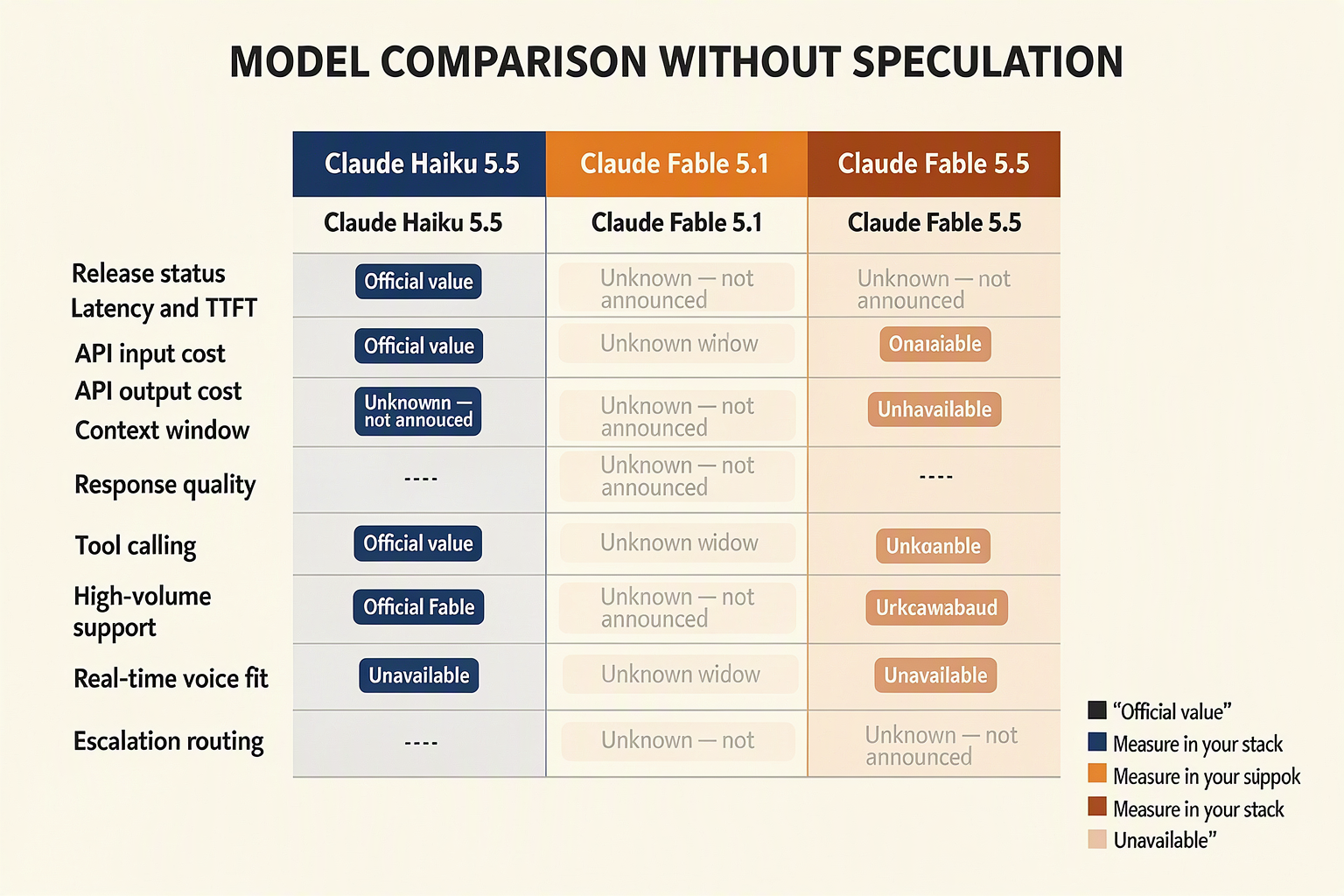
Claude Haiku 5.5 has a documented launch and workload positioning, while Claude Fable 5.1 is the confirmed comparison baseline but lacks specification data in the supplied official context. Claude Fable 5.5 remains unannounced as of October 14, 2026; every technical or commercial field for it must therefore be marked unknown.
What does the available model data show?
| Criterion | Claude Haiku 5.5 | Claude Fable 5.1 | Claude Fable 5.5 | Production implication |
|---|---|---|---|---|
| Availability | Launched by Anthropic | Confirmed baseline; availability terms not provided here | Unannounced as of October 14, 2026 | Haiku 5.5 is the documented 5.5 option for procurement and testing |
| API price | Exact token rates not included in the supplied launch context | Not provided in the verified context | Unknown; no official price | Request a dated pricing sheet before forecasting support costs |
| Context window | Exact token limit not stated in the supplied sources | Not provided in the verified context | Unknown | Test policy retrieval and conversation-history limits directly |
| Latency and real-time fit | Anthropic calls it its “fastest” small model; no milliseconds-to-first-token figure is supplied | No verified latency figure provided | Unknown | Benchmark complete voice turns rather than relying on family labels |
| Quality and tool use | Positioned as Anthropic’s “most capable small model,” including database-query workloads | No comparable benchmark or tool-call score supplied | Unknown | Measure valid arguments, task completion and escalation accuracy |
| High-volume support | Explicitly designed for “high-volume, cost-sensitive tasks” such as summaries and classification | Workload positioning not documented here | Unknown | Haiku 5.5 has the clearest published fit for repetitive support traffic |
Which comparisons are supported by Anthropic?
Anthropic described Claude Haiku 5.5 in October 2026 as its “cheapest, fastest, and most capable small model” and identified summaries, compactions, database queries and classification as target workloads. That makes Haiku 5.5 relevant to ticket triage, intent detection, post-call summaries and short order-status interactions.
However, those labels are relative positioning, not operational measurements. “Fastest” does not reveal time to first token, tokens per second or the end-to-end delay after speech recognition, tool execution and text-to-speech. “Most capable” likewise does not provide a customer-support resolution rate or a voice-agent interruption benchmark.
Pricing must also remain model-specific. Anthropic reported in October 2026 that Claude Opus 5.5 costs $4 per million input tokens and $20 per million output tokens, and that typical default-setting workloads cost 40% less than Opus 5. Those Opus 5.5 figures demonstrate why dated vendor data matters, but they must not be copied into estimates for Haiku 5.5, Fable 5.1 or an unannounced Fable 5.5.
How should teams fill the missing data?
Run the same evaluation set against each model that is actually accessible:
- Record median and p95 end-to-end turn latency, including speech and tool calls.
- Calculate cost per resolved interaction, not merely token price.
- Measure tool-call success, schema-valid arguments and recovery from API errors.
- Score policy adherence, factual grounding, escalation precision and summary accuracy.
- Preserve “unknown” for Fable 5.5 until Anthropic publishes an API identifier, pricing and technical documentation.
This approach prevents a future model name from becoming a false procurement assumption while producing evidence that reflects the real customer-support stack.
How should you measure Claude Haiku 5.5 latency for a real-time voice agent?
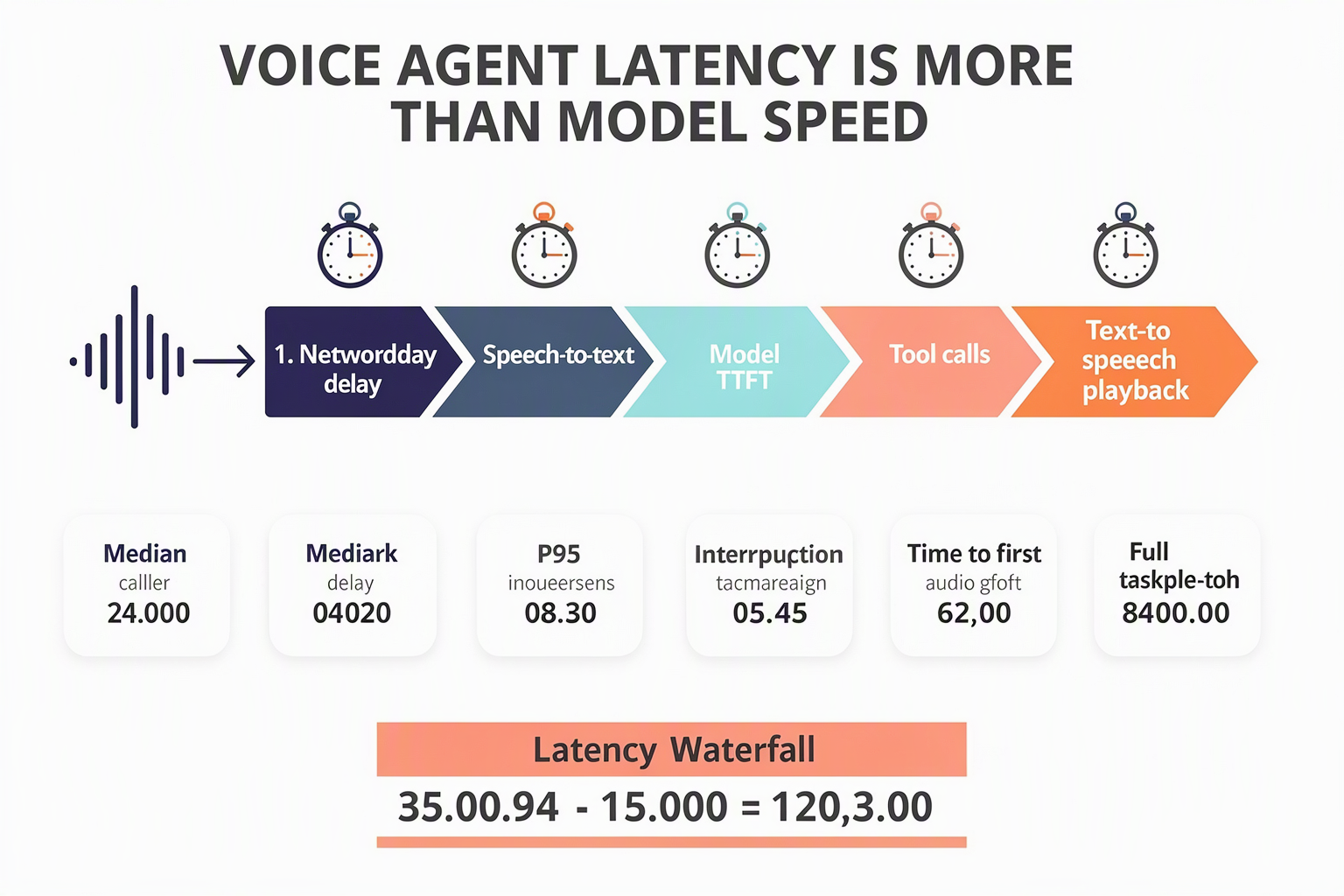
Measure Claude Haiku 5.5 latency across the complete voice pipeline—not just the model API—and report median, p95, and p99 results under realistic concurrency. The decisive metric is end-of-user-speech to first audible agent audio, because that captures the pause customers actually experience.
Which voice-agent latency metrics should you track?
Instrument every turn with synchronized timestamps. At minimum, capture:
- Endpointing delay: Time between the user effectively finishing and speech recognition deciding the turn is complete.
- Speech-to-text latency: Time required to produce the final transcript.
- Time to first token (TTFT): Time from sending the model request to receiving its first output token.
- Output-token rate: Streaming generation speed after the first token arrives.
- Tool-call latency: Time spent checking an order, querying a database, updating a CRM, or booking an appointment.
- Text-to-speech time to first audio: Time from submitting text to receiving playable audio.
- End-to-end response latency: Time from the user’s final word to the agent’s first audible word.
- Barge-in recovery: Time required to stop playback, process an interruption, and begin the revised response.
Do not collapse these into an average. Median latency describes a typical turn, while p95 and p99 expose the long pauses that damage real conversations.
How should you run a realistic Claude Haiku 5.5 benchmark?
Use a repeatable test suite rather than timing a handful of playground prompts:
- Build at least 100 representative turns across greetings, knowledge retrieval, classification, tool use, escalation, and policy-heavy questions.
- Test short and long conversation histories separately because input size can affect model processing.
- Run warm and cold requests, including cached and uncached prompts where applicable.
- Measure at expected concurrency levels—for example, 1, 10, 50, and 100 simultaneous sessions—without assuming single-request performance will persist under load.
- Repeat tests from the same cloud region and telephony route used in production.
- Record accuracy alongside speed; a quick but incorrect tool call can increase total resolution time.
Anthropic described Claude Haiku 5.5 in October 2026 as its “cheapest, fastest, and most capable small model” and positioned it for high-volume tasks such as summaries, compactions, database queries, and classification. That positioning makes Haiku 5.5 a strong candidate for latency testing, but it is not a substitute for workload-specific measurements.
How can you compare Haiku 5.5 with Fable models fairly?
Run Claude Haiku 5.5 and the confirmed Claude Fable 5.1 through the identical prompts, tools, token limits, regions, and concurrency profile. Report Fable 5.1 under its exact version name; Claude Fable 5.5 remains unannounced as of October 14, 2026, so no defensible Fable 5.5 latency benchmark exists.
Use a scorecard combining:
- End-to-end p50, p95, and p99 latency
- TTFT and streamed output speed
- Tool-call success and retry rates
- Interruption recovery time
- Task completion and escalation accuracy
- Cost per successfully resolved conversation
For integrated testing, CallMissed’s managed voice-agent WebSocket supports real-time voice sessions, while its developer API provides access to 24 real-time voice-agent models as of October 2026. Whatever infrastructure you use, publish the model identifier, test date, region, sample size, and pipeline configuration so another team can reproduce the result.
Which model fits high-volume support, tool calls and escalation routing? A CallMissed implementation example
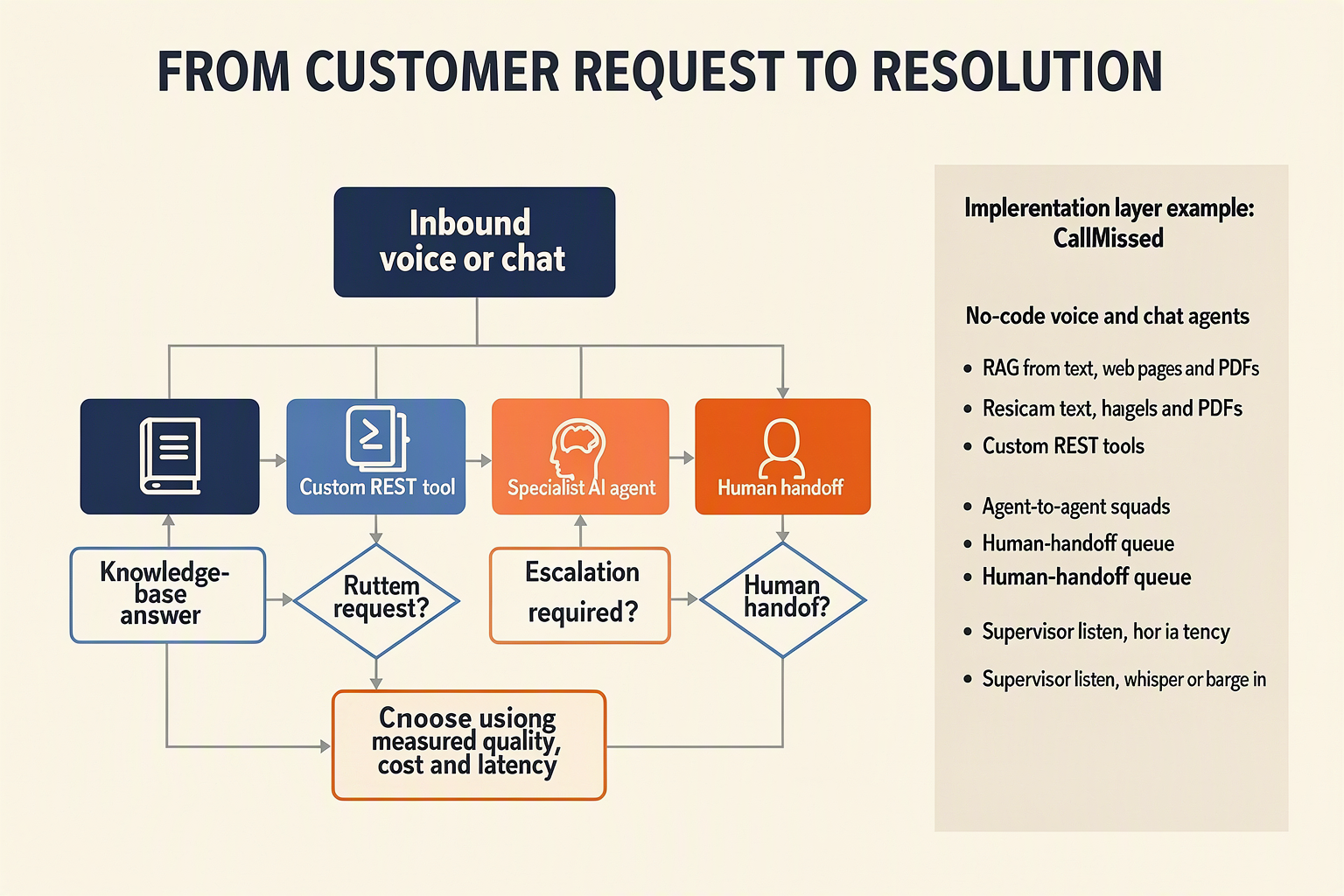
Claude Haiku 5.5 fits high-volume support, routine tool calls, and first-pass escalation routing because Anthropic explicitly designed it for fast, cost-sensitive workloads. Claude Fable 5.1 should enter the route only when controlled evaluations show a measurable quality gain; Claude Fable 5.5 remains unannounced as of October 14, 2026.
Which support requests should Claude Haiku 5.5 handle?
Anthropic describes Claude Haiku 5.5 as its “cheapest, fastest, and most capable small model” and specifically names summaries, database queries, classification, compaction, and repetitive requests as target workloads in October 2026. Those capabilities map directly to the highest-volume customer-support tasks:
- Classifying intent, language, urgency, and sentiment
- Retrieving order, booking, delivery, or account information
- Summarising a conversation before human handoff
- Applying straightforward refund or cancellation policies
- Producing structured fields for CRM updates
- Selecting the correct escalation queue
For voice agents, use Haiku 5.5 as the default conversational model when responses depend on short context and clearly defined tools. The model should request an action, not invent its result: an order-status tool returns the actual status, while the model converts that structured response into customer-friendly language.
When should Claude Fable 5.1 receive an escalation?
Fable 5.1 should be an evaluation-backed exception route, not an assumed upgrade. Route cases to it only if offline and production tests demonstrate better outcomes for scenarios involving ambiguous policies, conflicting evidence, extended histories, or delicate complaint handling.
A practical routing policy is:
- Start with Haiku 5.5 for identification, intent classification, retrieval, and routine resolution.
- Retry a failed tool call deterministically after validating arguments against a schema.
- Route to Fable 5.1 only when a defined trigger is met and internal evaluations support that decision.
- Escalate to a person for repeated tool failures, explicit customer requests, policy exceptions, or low-confidence decisions.
Do not configure a “Fable 5.5” production route. Anthropic had published no API identifier, pricing, context window, or release date for Claude Fable 5.5 by October 14, 2026.
How would this routing work in CallMissed?
Consider an ecommerce voice agent implemented through CallMissed, the Anthropic-compatible AI API and customer-communication platform:
- Speech recognition captures the caller’s request, including code-mixed speech such as Hinglish; CallMissed supports speech recognition in 22 Indian languages plus English as of October 2026.
- Haiku 5.5 classifies the request and calls a Shopify or custom REST tool to retrieve the order.
- The agent confirms the tool result, explains the status, and records structured notes.
- A routing rule sends unusual policy conflicts to an evaluated Fable 5.1 configuration.
- If the customer requests a person, the conversation enters CallMissed’s human-handoff queue with its transcript and context.
CallMissed’s developer API supports function calling, structured outputs, streaming, request logs, and caller-chosen fallback models as of October 2026. Its default limits range from 60 requests per minute on Free to 10,000 requests per minute on Enterprise, according to CallMissed’s published specifications.
What should teams measure before deploying the route?
Compare configurations using production-shaped test cases rather than model reputation:
- Resolution rate without human intervention
- Valid tool-call rate and argument accuracy
- Incorrect escalation and missed-escalation rates
- Time from completed speech to first audio response
- Cost per resolved case, including speech, model, voice, and telephony
- Policy compliance across languages and edge cases
The defensible architecture is therefore Haiku 5.5 by default, Fable 5.1 where measured evidence justifies it, and human escalation where automation should stop.
What do first-party claims and independent voice tests actually prove?
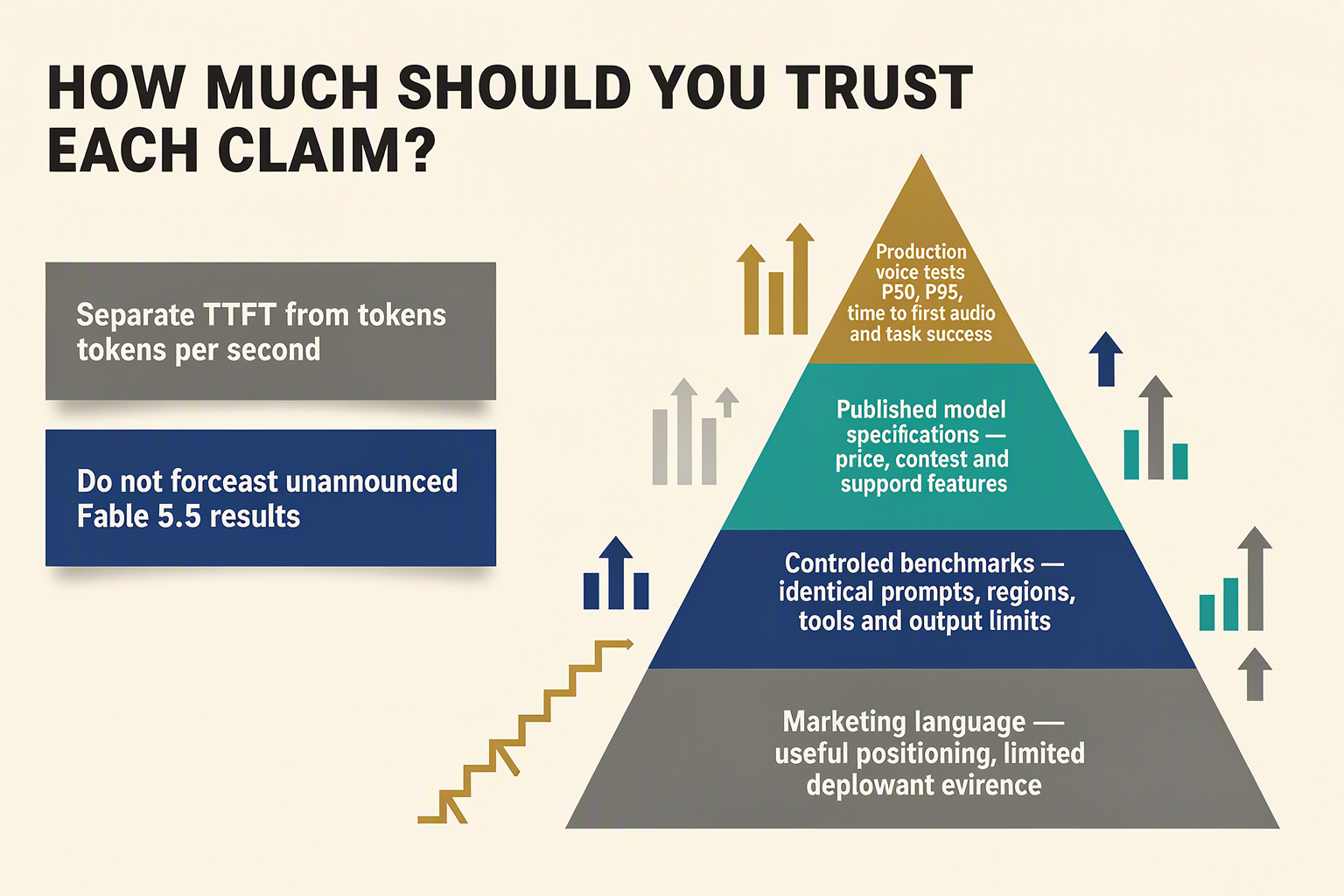
First-party claims prove that Claude Haiku 5.5 is positioned for fast, economical, high-volume workloads; they do not prove that it will deliver the lowest end-to-end voice latency or the highest support resolution rate in every deployment. Independent voice tests are more operationally useful, but only when they measure the complete pipeline under controlled, reproducible conditions.
What does Anthropic actually claim about Claude Haiku 5.5?
Anthropic calls Claude Haiku 5.5 its “cheapest, fastest, and most capable small model” as of October 14, 2026. Anthropic specifically identifies summaries, compactions, database queries, classification, and other quick, repetitive requests as intended workloads.
That positioning supports a credible hypothesis: Haiku 5.5 should suit high-volume customer-support tasks such as:
- Classifying tickets and detecting intent
- Summarising conversations for human agents
- Retrieving order or account information through tools
- Answering repetitive policy questions
- Routing calls according to urgency or topic
However, “fastest” is a comparison within Anthropic’s stated model category, not a guarantee of the fastest complete voice agent. Anthropic’s announcement, as provided here, does not disclose a universal time-to-first-token figure, tokens-per-second result, support-resolution rate, or tool-call success percentage.
Anthropic’s earlier Project Deal experiment found that agent quality differed when comparing Claude Opus 4.5 with Claude Haiku 4.5. That first-party result demonstrates that model tier can affect agent performance, but it does not establish how Haiku 5.5 compares with Fable 5.1 on customer-support calls.
What can independent voice-agent tests prove?
A well-designed independent test can establish relative performance for a defined workload and stack. It cannot prove that one model will perform identically across languages, telephony providers, prompts, tools, or customer populations.
A credible test should report at least:
- Turn latency: Measure from the end of the customer’s speech to the beginning of audible agent speech.
- Tool-call accuracy: Verify both tool selection and argument correctness for CRM, order, booking, and escalation actions.
- Task completion: Score whether the customer’s issue was resolved, transferred appropriately, or left incomplete.
- Interruption handling: Test whether the agent stops speaking and responds correctly when the caller barges in.
- Cost per resolved interaction: Include model tokens, speech recognition, text-to-speech, telephony, retries, and failed calls—not merely API token prices.
Tests should publish the prompt, model version, temperature, voice stack, network region, sample size, percentile latency, and failure criteria. Averages alone can hide poor tail performance; p50, p95, and p99 latency are more informative for live conversations.
Can tests prove anything about Claude Fable 5.5?
No test can substantiate Claude Fable 5.5 performance because Anthropic had not announced that model as of October 14, 2026. Any purported Fable 5.5 latency, quality, context, price, or tool-use result should be treated as unverified unless Anthropic publishes the model and researchers disclose a valid API identifier.
Teams can instead benchmark launched Haiku 5.5 against confirmed Fable 5.1, keeping model versions explicit. Platforms such as CallMissed can support controlled evaluations through model access, request logs, caller-selected fallbacks, and managed voice-agent WebSockets, but the meaningful verdict must come from each organisation’s own calls, tools, languages, and resolution criteria.
What does this model comparison mean for your support workload?
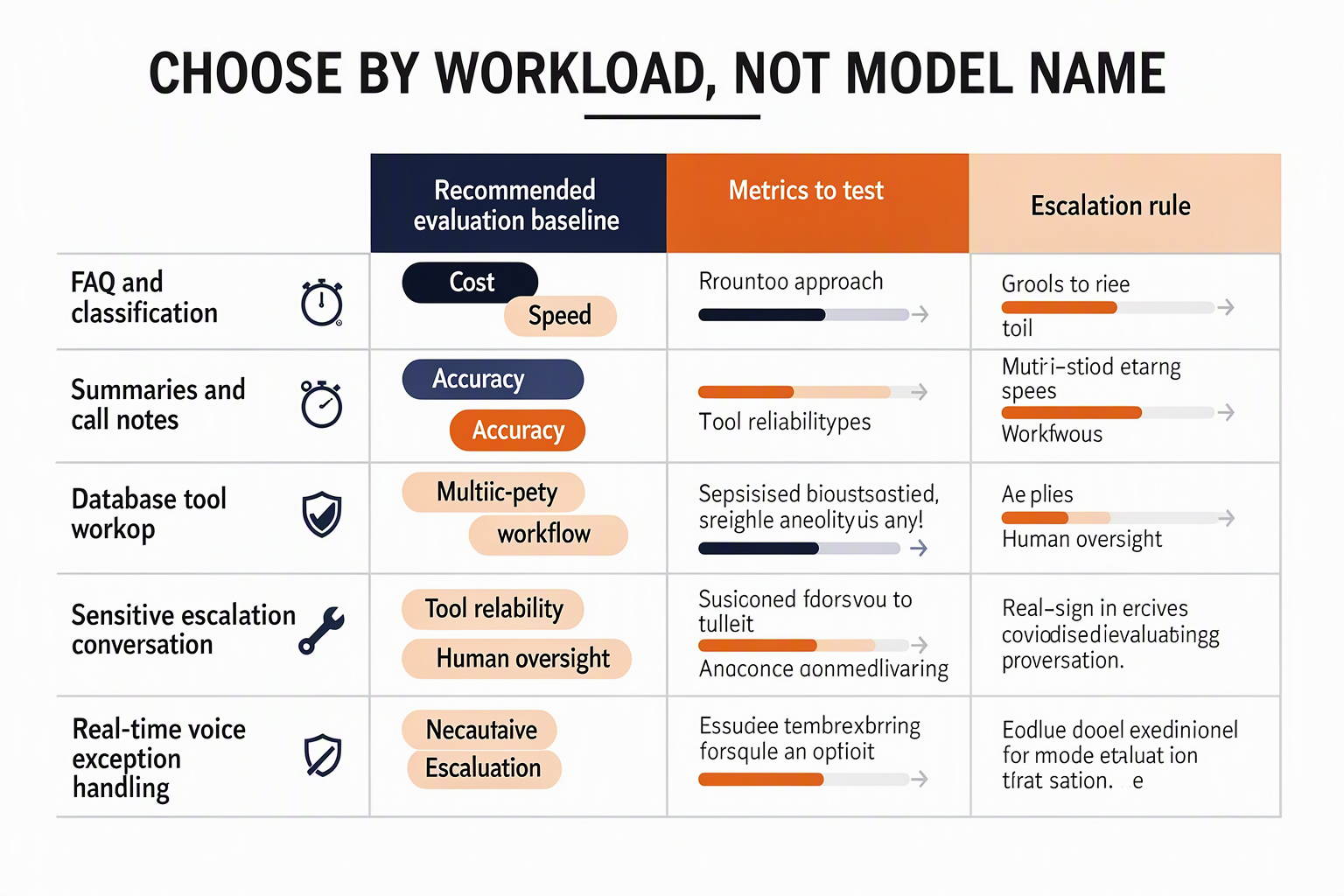
For most support teams, Claude Haiku 5.5 should handle high-volume, repeatable interactions, while confirmed Claude Fable 5.1 should be evaluated as a challenger for cases where additional reasoning quality justifies its measured latency and cost. Claude Fable 5.5 should receive no production allocation because Anthropic had not announced it as of October 14, 2026.
Which model should handle each customer-support workload?
Anthropic describes Claude Haiku 5.5 as its “cheapest, fastest, and most capable small model” and specifically targets summaries, classification, database queries, compaction, and repetitive requests. That profile makes Haiku 5.5 the logical default for intent detection, ticket triage, conversation summaries, knowledge-base answers, and short tool-driven workflows.
Fable 5.1 should not automatically receive every difficult ticket. Route requests to it only when controlled testing demonstrates a meaningful improvement in resolution quality, policy adherence, or tool execution. Because Fable 5.5 remains unannounced, assigning it projected performance or pricing would make workload forecasts unreliable.
| Support workload | Haiku 5.5 role | Fable 5.1 role | Fable 5.5 status |
|---|---|---|---|
| Intent classification and routing | Primary model | Challenger only | Do not plan around it |
| FAQ and knowledge-base answers | Primary for grounded, repetitive queries | Test on ambiguous questions | Unannounced |
| Ticket and call summaries | Primary model | Use only if evaluation shows better fidelity | No published specifications |
| Order checks and CRM updates | Use with validated tool schemas | Compare tool-call accuracy and recovery | No official API model |
| Policy exceptions and complex complaints | Triage, gather facts, then escalate | Candidate after quality testing | Exclude from procurement |
| Real-time voice conversations | Default candidate for short turns | Test where added quality offsets delay | Cannot be production-tested |
How should teams route support requests between models?
Use risk-based routing, rather than selecting one model for the entire support operation:
- Send routine, reversible tasks to Haiku 5.5, including categorization, summarization, retrieval-grounded FAQs, and status lookups.
- Escalate ambiguous or high-impact cases to Fable 5.1 only after measuring it against the same prompts, tools, and knowledge base.
- Transfer regulated, emotionally sensitive, or financially consequential decisions to a human when confidence or tool results fall below defined thresholds.
- Keep Fable 5.5 out of capacity plans until Anthropic publishes an official model identifier, specifications, pricing, and availability.
This structure prevents an expensive reasoning model from being used where a smaller model already meets the service-level target. It also avoids treating model quality as a substitute for human escalation, deterministic validation, and permission controls.
What should a voice-agent pilot measure?
For voice support, measure the complete interaction rather than model output in isolation. Track:
- Time to first audible response and total turn latency.
- Tool-call success rate, including retries and malformed arguments.
- Containment and human-transfer rates by intent.
- Cost per resolved contact, including speech recognition, model tokens, text-to-speech, and telephony.
- Policy adherence and factual accuracy using scored conversation samples.
As of October 2026, CallMissed provides one balance for 140 models, including 24 real-time voice-agent models, plus Anthropic-compatible /v1/messages endpoints and a managed voice-agent WebSocket. That architecture can help teams test Haiku 5.5 and confirmed alternatives behind consistent application logic, while keeping the unannounced Fable 5.5 outside operational assumptions.
The practical decision is therefore not “Fable 5.5 versus Haiku 5.5.” It is Haiku 5.5 for documented, high-volume production work versus Fable 5.1 as a measured challenger, with human escalation covering cases where neither clears the required quality threshold.
Frequently Asked Questions
Is Claude Fable 5.5 available, and when will Anthropic release it?
Which has lower latency in a Claude Fable 5.5 vs Claude Haiku 5.5 comparison?
What is Claude Haiku 5.5 API pricing for high-volume customer support?
Is Claude Haiku 5.5 fast enough for real-time voice agents?
How should businesses evaluate Claude Fable 5.5 vs Claude Haiku 5.5 for tool calling and context?
How can developers test Claude Haiku 5.5 voice agents without locking their application to one model?
/v1/messages endpoints, one balance for 140 models, caller-chosen fallbacks, request logs, and a managed voice-agent WebSocket, enabling controlled comparisons without treating the unannounced Fable 5.5 as a deployable option.Conclusion
Claude Haiku 5.5 is the practical choice for evaluation today; Claude Fable 5.5 should not appear in procurement assumptions until Anthropic officially announces it. As of October 14, 2026, Fable 5.5 has no confirmed API identifier, pricing, context limit, benchmarks, or release date.
- Haiku 5.5 targets production volume. Anthropic calls Claude Haiku 5.5 its “cheapest, fastest, and most capable small model,” positioning it for repetitive, cost-sensitive tasks such as classification, summaries, and database queries.
- Use Fable 5.1—not speculation—as the comparison baseline. Test the confirmed model on latency, API cost, context handling, response quality, and tool calling without projecting those results onto an unannounced successor.
- Measure the complete voice-agent stack. Speech recognition, orchestration, tool execution, text-to-speech, and telephony can affect pauses and resolution costs as much as the underlying language model.
- Run workload-specific evaluations. Customer-support teams should test policy compliance, CRM updates, retrieval accuracy, escalation behavior, and cost per resolved case under realistic traffic.
Watch for an official Anthropic announcement covering Fable 5.5 availability, pricing, context, tool-use performance, and real-time suitability. Until then, platforms such as CallMissed—with one balance for 140 models, Anthropic-compatible endpoints, and a managed voice-agent WebSocket as of October 2026—can help teams evaluate documented options without hardwiring one model.
Which model delivers the best measurable customer outcome in your own production workflow?
Related Reading
- Best LLM for Voice Agents in 2026: GPT-6 Astra vs Claude Fable 5.1
- Claude Fable 5.1 vs GPT-5.6 Sol: Pricing, Coding & Voice Agents
- Claude Fable 5.5 vs Bulbul V4 Flash: Voice AI Guide