Claude Haiku 5.5 latency: Voice-Agent Evaluation Guide



Measure Claude Haiku 5.5 latency across speech, tools, and playback. Build reproducible tests for reasoning trade-offs and cost per successful call.
Claude Haiku 5.5 latency: Voice-Agent Evaluation Guide
A cheaper model can still make an expensive voice agent if callers spend the savings waiting. Claude Haiku 5.5 latency should therefore be evaluated as an end-to-end conversation metric—not just the time Anthropic’s model takes to generate text.
The timing matters. According to Notebookcheck, Anthropic released Claude Haiku 5.5 on October 7, 2026, replacing Haiku 4.5 and making the model selectable across Claude’s free and paid app plans. In the supplied Hacker News trending snapshot, the discussion attracted 798 points and 391 comments in 12.2 hours—a signal of developer interest, not evidence of production readiness.
The economics also warrant attention. Lapaas reports that Anthropic’s October 7, 2026 launch claims approximately 75% lower average running costs than Haiku 4.5, while explicitly distinguishing that workload-based estimate from a universal bill reduction. DataNorth reports launch API pricing of $0.10 per million input tokens and $0.50 per million output tokens on October 7, 2026. Neither figure tells you how quickly a customer hears a useful answer.
What should developers test before using Claude Haiku 5.5 in a voice agent?
Start with the interval between the caller finishing a turn and the first audible response. That interval includes speech recognition, endpoint detection, model processing, network transit, and text-to-speech startup. A fast first token can still produce a slow conversation if the speech pipeline waits for a complete sentence or a tool request stalls.
This guide will show you how to evaluate:
- Time to first token versus first audio: measure both, rather than treating text streaming as the caller’s experience.
- Median and tail latency: inspect p50, p95, and p99 under representative concurrency, not just a single successful demo.
- Tool-use delays: test booking lookups, CRM queries, failures, and retries with realistic backend response times.
- Interruption handling: check whether speech stops promptly when callers interrupt and whether the next response preserves context.
- Quality-adjusted cost: track completed tasks, incorrect actions, and escalation alongside token spend.
For example, “Can you move my appointment to Friday?” tests much more than response speed: the agent must identify the booking, check availability, confirm the intended date, and avoid announcing success before the update completes.
As of October 2026, CallMissed’s developer AI API offers Anthropic-compatible endpoints and request logs, capabilities relevant to integration and evaluation workflows.
The goal is not to prove that a model marketed as fast belongs in every voice stack. It is to establish whether its latency, reliability, and conversational accuracy meet your workflow’s requirements together.
How should you evaluate Claude Haiku 5.5 for voice agents? Test audible latency, tool accuracy, task success, and cost
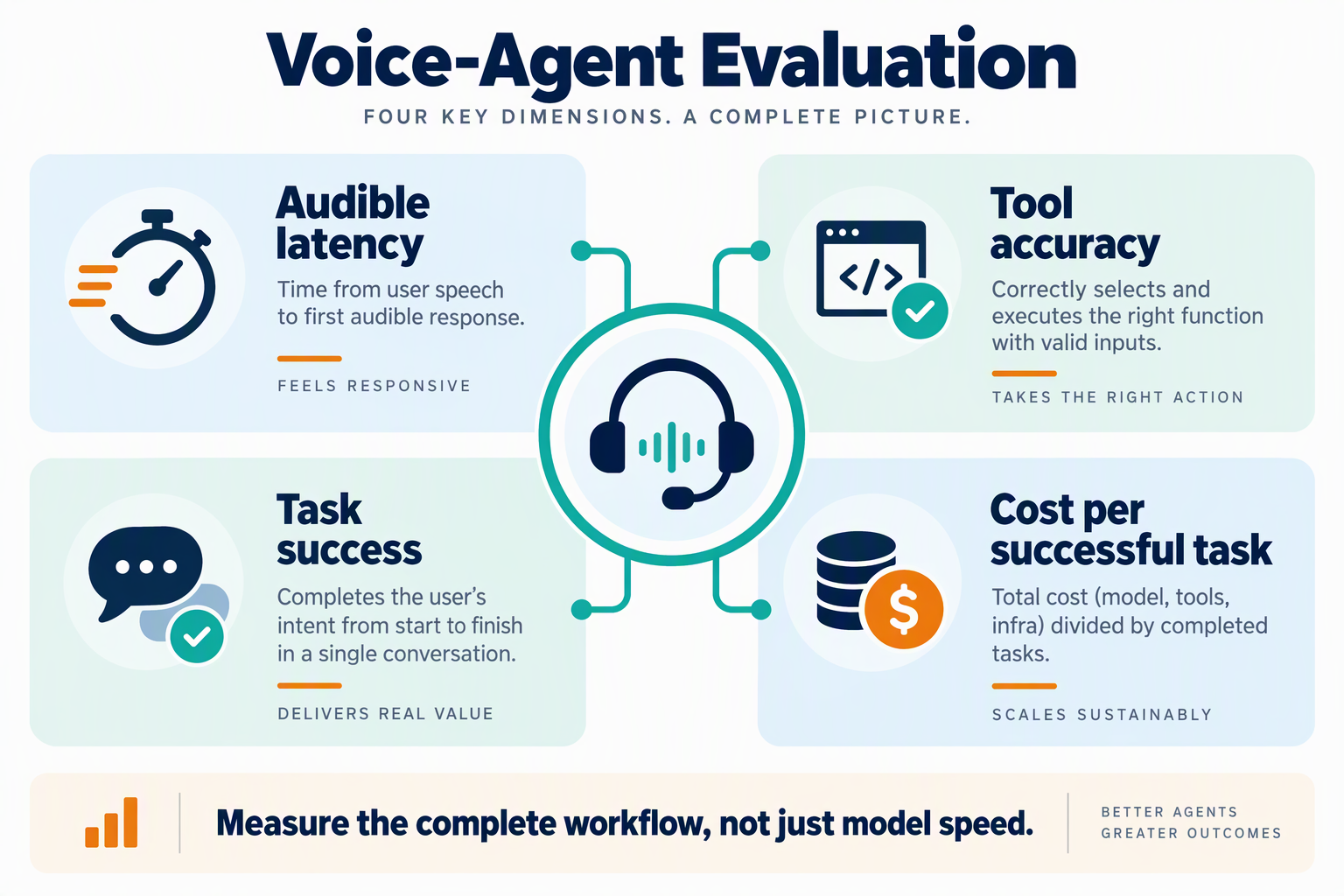
Evaluate Claude Haiku 5.5 for voice agents with a controlled, end-to-end test suite that measures audible latency, correct tool execution, completed tasks, and total cost per successful outcome. Set acceptance criteria before testing so a lower token bill cannot conceal slower conversations or incorrect actions.
How do you build a fair voice-agent evaluation?
Keep the speech recognizer, text-to-speech engine, tool backends, prompts, and deployment region constant while changing the language model. Otherwise, an apparent model improvement may actually come from a faster voice engine or a nearby server.
According to Unite.AI, Claude Haiku 5.5 became available on the Claude Platform, Amazon Web Services, Google Cloud, and Microsoft Azure on October 7, 2026. That deployment choice makes it important to record the provider and region alongside every result rather than treating all routes as equivalent.
Build a replayable test set from representative, appropriately anonymized conversations:
- Straightforward requests: opening hours, order status, and appointment availability.
- Ambiguous instructions: “Friday afternoon” without a date or time zone.
- Corrections and interruptions: a caller changes the requested service mid-response.
- Backend problems: timeouts, empty results, unavailable slots, and rejected updates.
- Speech variation: accents, background noise, names, numbers, and code-switching relevant to your audience.
Label the expected outcome for each scenario before running it. “Ask for clarification” can be the correct result; completing an action is not always success.
What should each test run measure?
Use one trace identifier to connect audio events, model requests, tool calls, and the final business outcome. Apply the same scoring rules to Haiku 5.5 and your existing model.
- Audible latency: Record caller speech end, endpoint detection, first model token, first audio playback, and first useful spoken answer. A quick “Let me check” should not hide a long wait for the requested information.
- Tool accuracy: Check tool selection, argument validity, authorization, and consistency with backend results. Valid JSON is insufficient if the agent updates the wrong appointment.
- Task success: Verify the resulting booking, order, or support record against the expected state. Score unnecessary escalation and repeated questions separately.
- Workflow cost: Include model tokens, speech services, telephony, retries, and fallback requests. Divide total test spend by verified successful tasks.
Repeat scenarios under expected concurrency and report sample size with latency percentiles. Separate ordinary turns from tool-dependent turns so fast FAQ answers do not mask slow booking workflows.
How do you decide whether Haiku 5.5 passes?
Define hard gates for consequential mistakes and softer targets for conversational quality. An unauthorized booking change should fail a test even when the response is immediate and inexpensive.
For an illustrative appointment-rescheduling test, require the agent to:
- Resolve the intended date and identify the correct booking.
- Retrieve availability before offering a slot.
- Obtain confirmation before committing the change.
- Announce success only after the backend confirms the update.
DataNorth reports Claude Haiku 5.5 launch pricing of $0.10 per million input tokens and $0.50 per million output tokens on October 7, 2026. At those reported rates, an illustrative request using 2,000 input tokens and 300 output tokens costs $0.00035 for model tokens alone, excluding caching adjustments and other services.
That calculation is a starting point, not the verdict. Choose Haiku 5.5 only when repeated tests show acceptable conversational delays, reliable actions, and a favorable cost per verified resolution.
What prerequisites and benchmark settings should you record before testing?
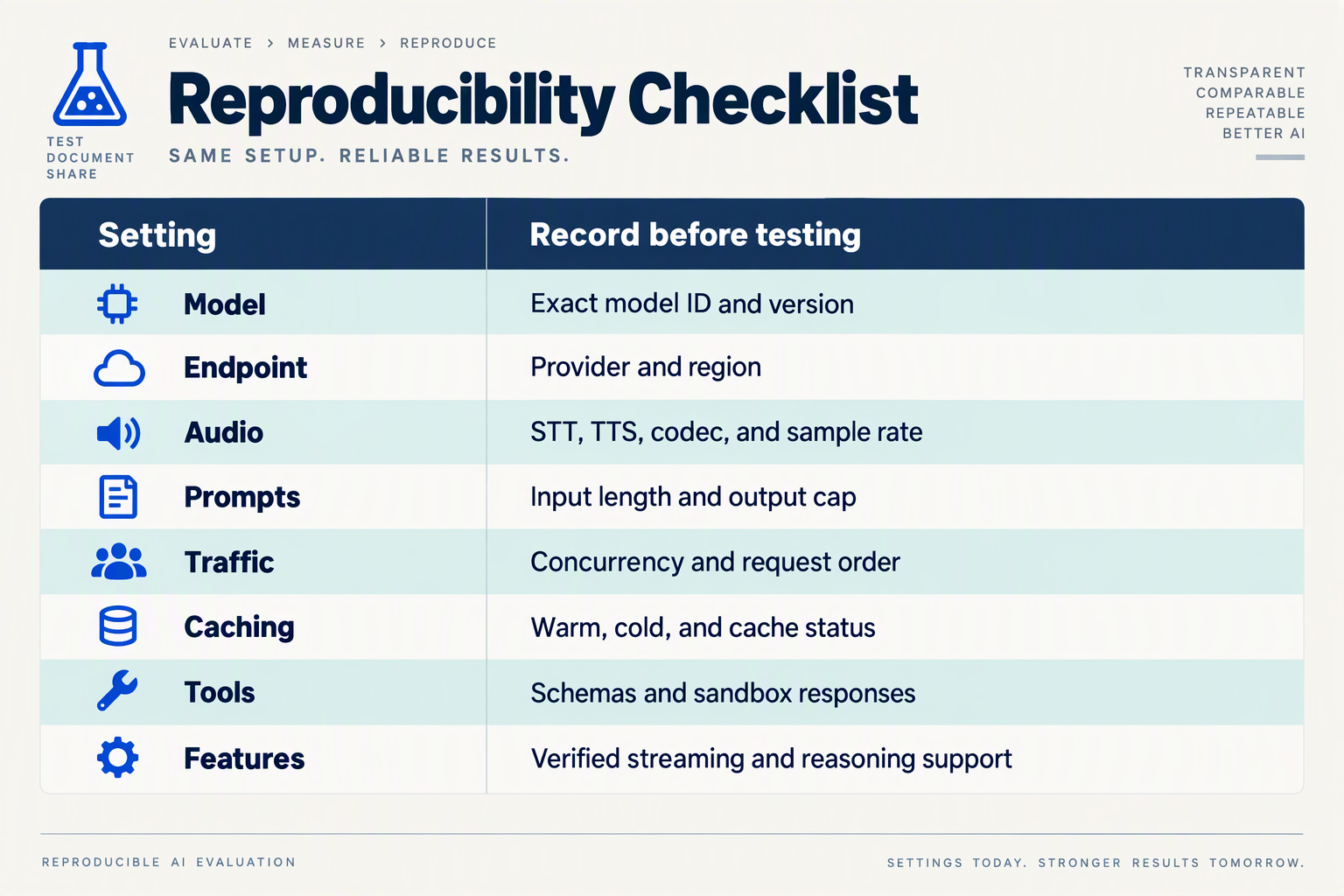
Before testing Claude Haiku 5.5 for voice-agent workflows, record a reproducible configuration covering model access, audio processing, generation settings, tools, workload, and load conditions. Save this benchmark manifest with every run so configuration changes cannot masquerade as model improvements.
What belongs in a voice-agent benchmark manifest?
Use the following checklist for an October 2026 evaluation. The suggested test conditions are experimental settings, not published Claude Haiku 5.5 performance benchmarks.
| Category | Record before testing | Suggested comparison | Why it matters |
|---|---|---|---|
| Model and access | Exact API model ID, provider, endpoint, region, SDK version, test date | Candidate versus incumbent on comparable routes | Routing and version changes can confound results |
| Audio pipeline | Speech-recognition model, endpointing threshold, audio codec, sample rate, voice model | Identical audio settings across models | Silence detection and synthesis affect response timing |
| Generation | System prompt, token cap, temperature where supported, effort setting, streaming mode | Fixed settings first; tuned settings separately | Different answer lengths or effort levels change latency |
| Tools and context | Tool schemas, permissions, retrieval inputs, history length, timeout and retry rules | Normal, delayed, and failed tool responses | Backend conditions can dominate a conversation |
| Test corpus | Audio files, transcripts, language mix, task labels, expected outcomes | Same cases and order for each candidate | Unequal workloads invalidate comparisons |
| Load and accounting | Concurrency, request rate, cache state, connection reuse, token usage, billing basis | Single-session baseline versus expected peak load | Queueing and caching can distort speed and cost |
Which access and capability checks should come first?
Confirm that your account can invoke the exact model identifier through the intended production route. According to Unite.AI’s October 7, 2026 reporting, Claude Haiku 5.5 launched on the Claude Platform, Amazon Web Services, Google Cloud, and Microsoft Azure; that availability report does not establish identical quotas, routing, or feature support across providers.
Run a smoke test before collecting measurements:
- Send a minimal request and save the returned model identifier.
- Verify streaming, tool calls, cancellation, and required output formats.
- Confirm account quotas and record rate-limit responses.
- Exercise the full audio path using synthetic, non-sensitive customer data.
Firstpost’s October 2026 launch coverage reports adjustable effort settings for Claude Haiku 5.5. Record the actual setting exposed by your endpoint, and mark unsupported controls explicitly rather than assuming that similarly named options behave identically.
How should you make benchmark runs comparable?
Freeze prompts, recordings, tool fixtures, and expected outcomes before comparing models. Separate controlled backend tests, which isolate model behavior, from live integration tests, which expose real network and service variability.
For example, use the same appointment-rescheduling recording with three deliberately configured lookup conditions:
- Normal: a simulated 150-millisecond response.
- Delayed: a simulated 1,500-millisecond response.
- Failure: a timeout requiring recovery or escalation.
Those numbers are proposed fixture settings—not measured provider performance. Record tool timings separately so a slow booking service is not incorrectly attributed to Claude Haiku 5.5.
Finally, report sample counts, errors, and exclusions beside every result. Alternate candidate and baseline runs to reduce time-of-day bias, separate cold starts from reused connections, and avoid presenting a small sample’s p99 as a stable production estimate. A reproducible manifest makes the next latency or quality finding explainable—and actionable.
How do you get started with a streaming baseline and a repeatable voice-agent test suite?
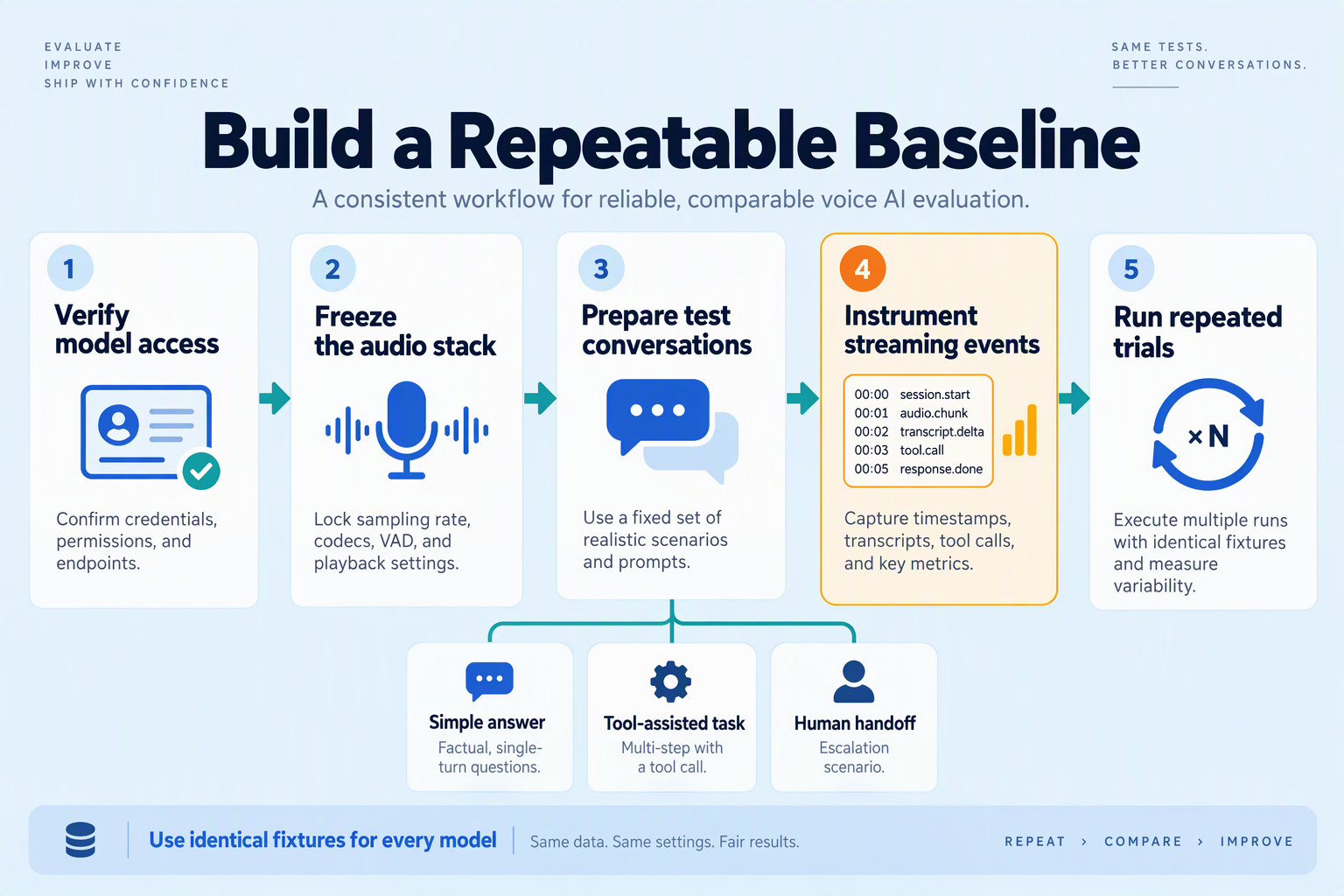
Start with a text-streaming baseline, then connect the same prompts to a fixed speech pipeline and replay a versioned set of conversations. A repeatable Claude Haiku 5.5 voice-agent test suite should preserve configuration, inputs, tool responses, and timing events so that differences can be attributed to a specific change.
How do you establish a clean streaming baseline?
First, verify the model identifier and streaming request format against your provider’s current documentation. According to Unite.AI, Claude Haiku 5.5 became available on the Claude Platform, Amazon Web Services, Google Cloud, and Microsoft Azure on October 7, 2026; do not assume those deployment routes have identical configuration or performance.
Build a minimal runner before adding speech:
- Freeze the request: save the system prompt, conversation history, tool schemas, output-token limit, and any supported sampling or effort settings.
- Enable streaming: timestamp request submission, the first text-bearing event, subsequent text chunks, and stream completion.
- Capture outcomes: store the complete response, tool calls, token usage when supplied, errors, and provider request identifiers.
- Repeat unchanged inputs: separate initial requests from subsequent requests and record cache status where exposed.
Use a monotonic clock for elapsed time. A stream-start event or metadata chunk is not necessarily the first usable text, so label those events separately.
What should your first voice-agent test set contain?
Start with a small, inspectable suite rather than hundreds of loosely defined conversations. The following 12-scenario starter set is a proposed test design, not a published benchmark:
- Three straightforward tasks: opening-hours lookup, order-status inquiry, and appointment availability.
- Three clarification tasks: ambiguous dates, missing account details, and corrected names or numbers.
- Three tool-path tasks: successful lookup, empty result, and backend timeout.
- Three conversation-control tasks: caller interruption, silence after a question, and a request for human assistance.
Give each scenario a fixture containing the caller audio, expected intent, permitted tool arguments, mocked backend response, and pass/fail rules. Include regional accents or code-mixed speech when those reflect your actual callers.
For the appointment-change example, require the agent to clarify “Friday” when necessary, select the correct booking, and announce completion only after the update succeeds. Exact wording can vary; the underlying action must not.
How do you make end-to-end runs comparable?
Keep speech recognition, endpointing, text-to-speech, audio buffering, and deployment region constant while testing the model. Then change one component at a time.
Record an event trace for every turn:
- Caller audio ends.
- Speech transcript becomes available.
- Model request starts and first usable text arrives.
- Tool request starts and finishes, if applicable.
- First synthesized audio reaches the playback boundary.
Measure actual playback separately if the client exposes that signal. Server-side audio generation alone does not establish when the caller heard the response.
As of October 2026, CallMissed’s developer AI API provides Anthropic-compatible /v1/messages endpoints, streaming, and usage and request logs. These capabilities can support integration and diagnostics, but confirm Claude Haiku 5.5 availability separately and instrument audio timing in your own harness.
What should you save before changing anything?
Create a baseline manifest with configuration versions, fixture hashes, provider route, test date, concurrency, and repetition count. Save raw traces alongside a summary of latency distributions, task success, incorrect actions, and usage.
Run deterministic tool fixtures first, then live integrations. This separates model behavior from backend variability and gives every subsequent optimization a reproducible comparison point.
How do you measure TTFT and end-to-end voice latency step by step, including p50, p95, and p99?
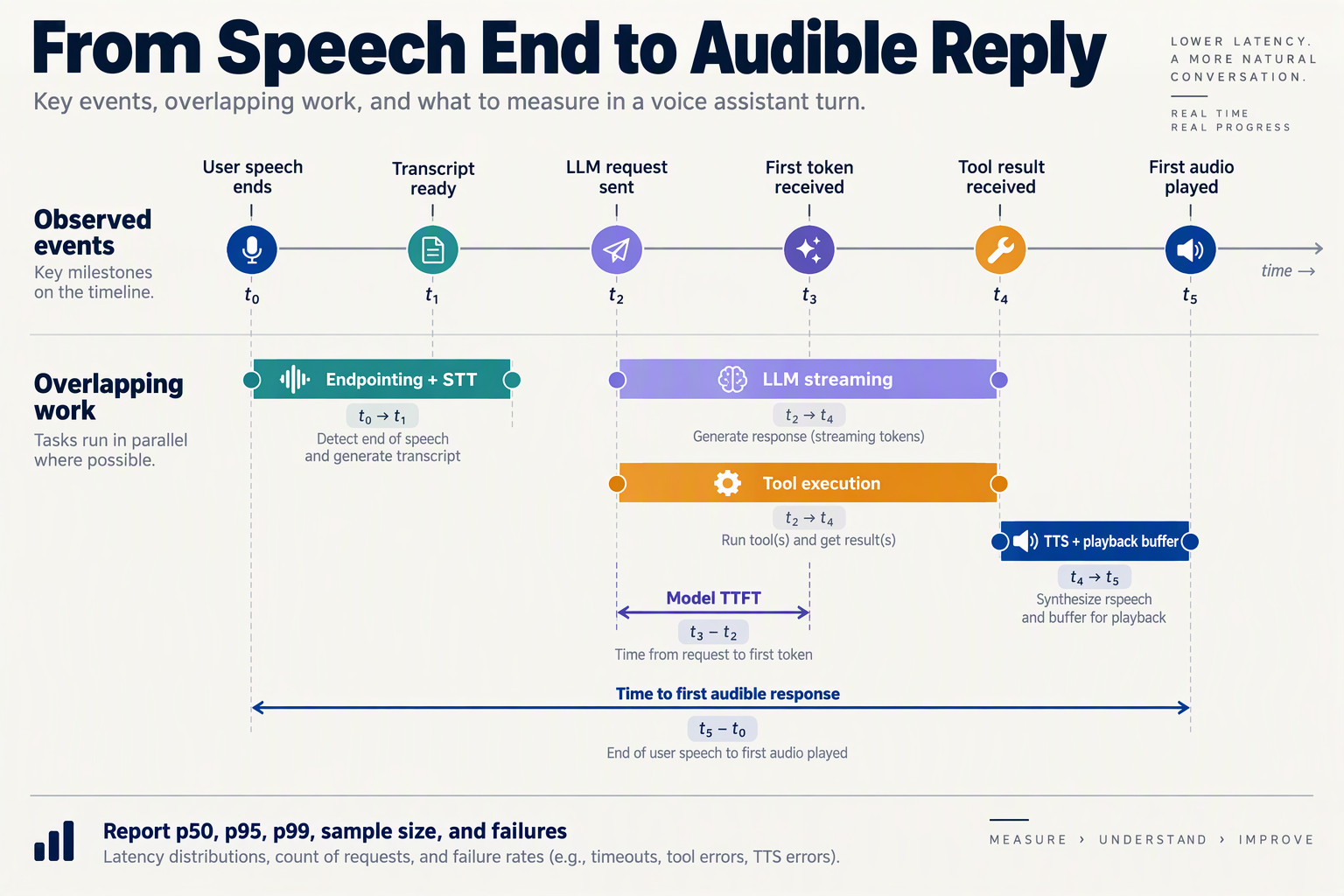
Measure TTFT from dispatching the model request to receiving its first text-content delta, and measure end-to-end voice latency from the caller’s actual speech end to the first audible agent response. Calculate p50, p95, and p99 from individual turn measurements, keeping model latency separate from the caller’s experience.
Which timestamps should you capture for each voice turn?
- Assign a trace ID. Attach a conversation ID, turn ID, and model-request ID to speech recognition, model, tool, and text-to-speech events. Record the model identifier, configuration, deployment region, and test date.
- Mark the caller’s actual speech end. For prerecorded tests, annotate the last speech sample in the input audio. Separately timestamp when the endpoint detector declares the turn complete; otherwise, endpointing delay disappears from your measurement.
- Instrument the response pipeline. Capture these events:
- Final transcript available.
- Model request dispatched.
- First text-content delta received.
- First text chunk submitted to text-to-speech.
- First synthesized audio chunk received.
- First response audio played at the caller endpoint.
Use monotonic clocks for elapsed durations. Measure speech end and response playback on the same client clock where possible; do not subtract unsynchronized client and server timestamps. Server-side audio delivery is only a proxy for audibility because buffering, transport, and playback introduce additional delay.
How do you calculate TTFT and audible response latency?
- Compute both metrics per turn:
- TTFT = first text-content arrival − model-request dispatch.
- Audible latency = first response playback − actual caller speech end.
- Endpointing delay = turn-complete detection − actual speech end.
Exclude connection events, empty streaming frames, and internal reasoning from your first-text marker. For tool-first responses, record time to first tool call separately rather than treating a tool payload as spoken text.
In a hypothetical October 2026 test, speech ends at 0 ms, the model request starts at 280 ms, the first text arrives at 460 ms, and playback begins at 810 ms. TTFT is 180 ms, but audible latency is 810 ms—the difference identifies work outside the model’s initial response.
Also label whether the first audio is useful content or merely an acknowledgment. “Let me check” can improve first-audio timing without reducing time to the booking result.
How should you calculate p50, p95, and p99?
- Collect representative turns and sort each metric independently. With the nearest-rank method, percentile p is the value at position ceil(p × N) in the ascending list.
For an illustrative 10,000-turn evaluation, p50 is observation 5,000, p95 is observation 9,500, and p99 is observation 9,900. These represent the median, the threshold covering 95% of observations, and the threshold covering 99%, respectively.
Report sample size, percentile method, and run-to-run variation. Do not average subgroup p95 values: recompute percentiles from pooled observations when presenting an overall result.
What makes the latency benchmark trustworthy?
- Repeat under controlled workload slices. Separate tool-free and tool-dependent turns, cold and warm requests, prompt lengths, languages, and concurrency levels. Hold speech recognition, text-to-speech, region, and network conditions constant when comparing models.
Unite.AI reports that Claude Haiku 5.5 became available across multiple cloud platforms on October 7, 2026; identify the actual deployment path rather than treating every route as equivalent.
Publish completion rate, errors, retries, and timeouts alongside latency percentiles. A timeout has no observed first-audio duration: report it explicitly rather than silently removing it and presenting a misleadingly fast benchmark.
Which tool-calling tests reveal incorrect arguments, duplicate actions, retries, and incomplete workflows?
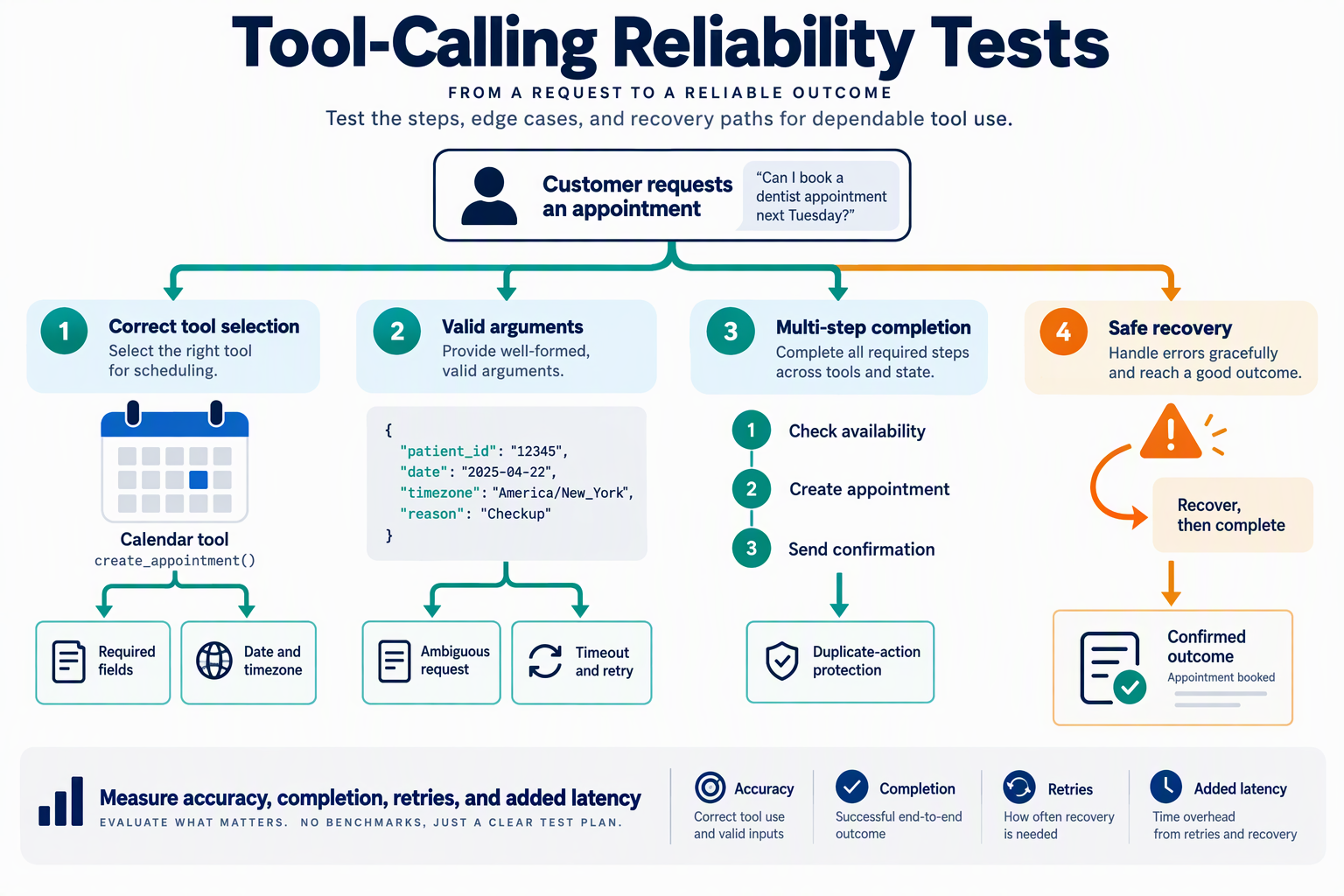
Test argument correctness, exactly-once effects, bounded retries, and verified workflow completion against a backend whose state you can inspect. For Claude Haiku 5.5 voice-agent workflows, a convincing spoken response should never substitute for evidence that the intended action happened—and happened only once.
DataNorth reports Claude Haiku 5.5 launch pricing of $0.10 per million input tokens and $0.50 per million output tokens on October 7, 2026. Those token prices make repeated evaluation economical, but they do not measure the business cost of a duplicate booking or an incorrect CRM update.
Which tests expose incorrect tool arguments?
Use a sandbox with known contacts, appointments, time zones, and permissions. Judge both schema validity and semantic correctness: a correctly formatted booking ID can still identify the wrong appointment.
Include these adversarial cases:
- Ambiguous identity: two contacts named Priya Sharma. Require disambiguation before changing either record.
- Date ambiguity: “Next Friday afternoon” with a frozen test clock and explicit business time zone. Check that clarification follows your scheduling policy.
- Spoken corrections: “Make it four—sorry, five.” Verify that the final confirmed time, not the abandoned value, reaches the tool.
- Missing information: omit a required appointment ID. The agent should retrieve or request it, not invent one.
- Permission boundaries: request an update to another customer’s booking. Confirm that backend authorization rejects unauthorized changes.
Save the expected arguments beside each fixture. Avoid grading only whether the tool accepted the request.
How do you detect duplicate actions and unsafe retries?
Inject a timeout after the backend commits an action. This is more revealing than a failure before execution: the agent receives no confirmation, but retrying could create a second booking.
Test transport retries and model-generated retries separately:
- Return a temporary failure before any state change; check that retry attempts stay within a configured budget.
- Commit a booking, then drop the response; check whether the application reconciles state before resubmitting.
- Return a validation error; require corrected arguments or clarification rather than an identical retry.
- Interrupt the agent with “Actually, don’t book that”; inspect whether an already-started action completed and whether cancellation is needed.
Use an application-generated idempotency key for each intended write operation, and preserve it across retries. Exactly-once effects require backend enforcement; they are not something the model can guarantee through prompting.
How should you test incomplete multi-step workflows?
Represent the workflow as explicit checkpoints rather than a single “success” label:
- Identify the customer and existing booking.
- Retrieve available replacement slots.
- Obtain confirmation for the selected slot.
- Submit the update.
- Verify the final booking state.
- Report the verified outcome to the caller.
Inject failures between checkpoints. If availability retrieval succeeds but the update fails, the agent must not say “Your appointment is moved.” If a required downstream notification fails after the booking changes, report partial completion accurately instead of repeating the booking operation.
Which metrics should determine a pass?
Track semantic argument accuracy, duplicate committed actions, retry-budget violations, verified task completion, and false success claims. Separate model mistakes from orchestration defects using tool requests, responses, and backend audit records.
As of October 2026, CallMissed’s voice-agent builder supports custom REST tools and eval suites—relevant capabilities for exercising these workflows. Set acceptance thresholds before testing, and retain every unsafe-action failure for regression testing rather than letting a strong average score conceal it.
How should you compare Haiku 5.5 vs Haiku 4.5 and test explicit reasoning trade-offs?
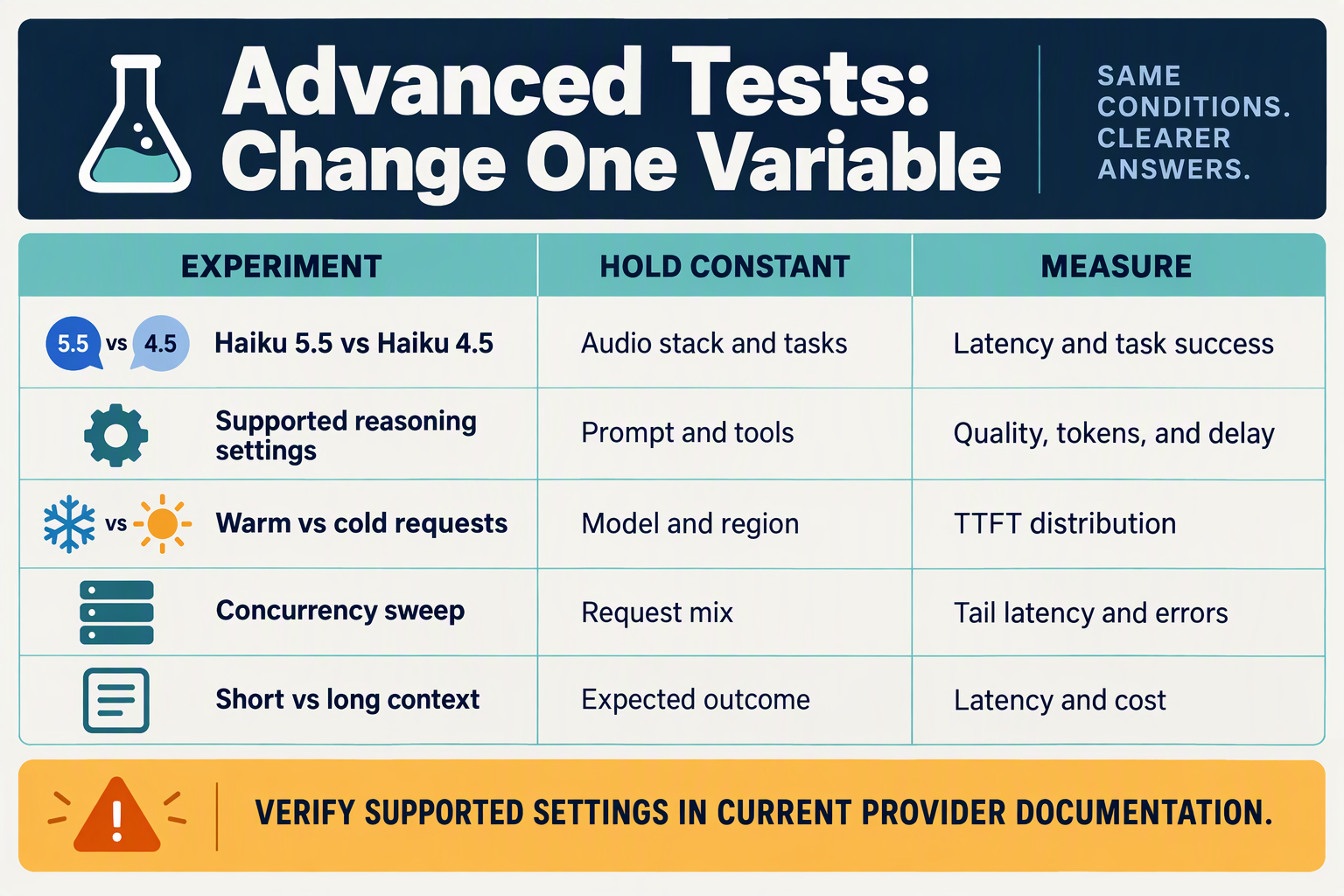
Compare Claude Haiku 5.5 versus Haiku 4.5 using paired tests on identical voice-agent tasks, then vary Haiku 5.5’s reasoning effort separately. The key question is whether additional reasoning improves decisions enough to justify its added response time and cost—not whether the newer model wins an aggregate benchmark.
What should a Haiku 5.5 versus Haiku 4.5 comparison include?
As of October 2026, Firstpost reports that Claude Haiku 5.5 introduces adjustable effort settings. WorldAttention also reports OpenRouter’s announcement of reasoning-effort support for Haiku 5.5. These reports justify testing explicit reasoning, but they do not establish identical controls, defaults, or billing across providers.
Use the following matrix as an evaluation plan, not a published performance comparison:
| Test dimension | Haiku 4.5 baseline | Haiku 5.5 comparison | Decision criterion |
|---|---|---|---|
| Configuration | Record supported settings | Record provider and effort settings | Reproducible requests |
| Routine requests | Replay simple intents | Test default and lowest supported effort | Correct answers without unnecessary delay |
| Ambiguous requests | Replay missing-detail cases | Compare supported effort levels | Necessary clarification before action |
| Tool selection | Use identical tool schemas | Repeat with each effort setting | Correct tool and valid arguments |
| Conflicting constraints | Apply identical business rules | Test whether extra effort helps | No unauthorized commitments |
| Resource use | Record billed usage per task | Include reasoning usage where reported | Lower cost per correct completion |
Keep the prompt, conversation history, tool responses, output limits, speech pipeline, and provider region unchanged wherever possible. If a setting cannot be matched across models, label that difference rather than presenting the result as a controlled model-only comparison.
How should developers isolate explicit reasoning trade-offs?
Run two experiments: model replacement and reasoning-effort adjustment. Mixing them makes it difficult to tell whether an improvement comes from Haiku 5.5 itself or from allocating more computation.
- Establish the replacement baseline. Compare your deployed Haiku 4.5 configuration with Haiku 5.5’s documented default configuration.
- Sweep supported effort settings. Use only values accepted by the selected endpoint; do not assume a universal parameter name or identical behavior across providers.
- Separate tasks by difficulty. Evaluate routine FAQs independently from rescheduling, policy exceptions, and conflicting customer instructions.
- Repeat paired cases. Randomize execution order and score outputs against the same rubric, ideally without revealing the model identity to reviewers.
For a concrete test, ask: “Move my appointment to Friday afternoon, but keep my current booking if nothing is available before 3 p.m.” A correct agent must distinguish checking availability from committing a change. Extra reasoning earns its place only if it reduces mistakes such as cancelling the original appointment prematurely.
Do not request private chain-of-thought as an evaluation artifact. Score observable decisions, tool arguments, clarification questions, and final outcomes instead.
When is additional reasoning worth enabling?
Enable more reasoning selectively when measured improvements outweigh the conversational penalty:
- Routine lookup: prefer the lowest effort that reliably answers correctly.
- Ambiguous action: prioritize clarification and preservation of existing state.
- Policy-sensitive request: require correct rule application before execution.
Calculate total evaluated spend divided by correctly completed tasks, including retries and failed attempts. A cheaper response is not necessarily a cheaper completed workflow.
As of October 2026, CallMissed’s developer AI API provides reasoning-effort control and usage and request logs. Those capabilities can support this evaluation workflow, but verify the selected model’s supported controls rather than assuming every catalogue model exposes the same options.
What common mistakes make voice-agent benchmarks misleading?
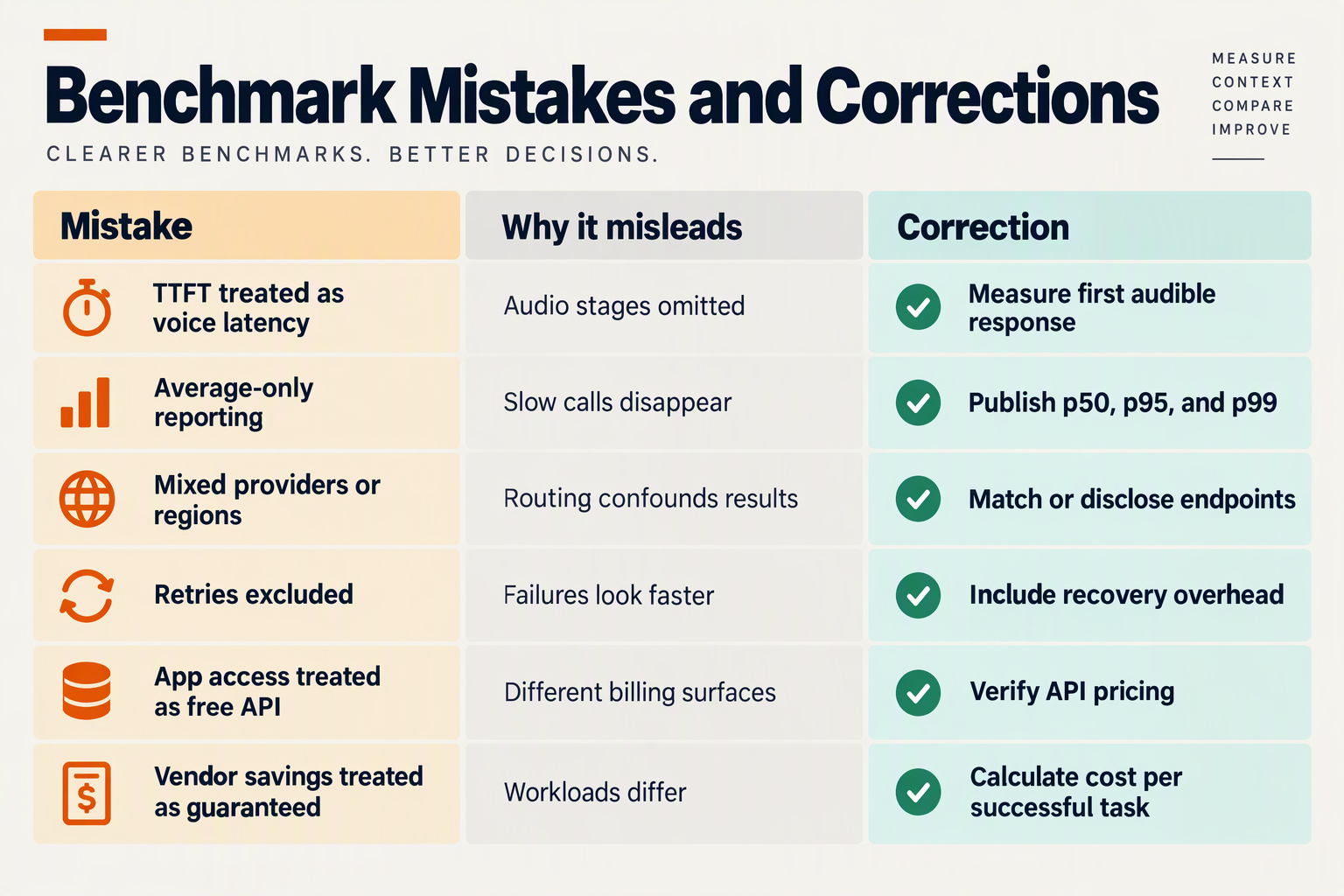
Voice-agent benchmarks become misleading when they compare different workloads, exclude failed calls, or let caching and test order determine the winner. For Claude Haiku 5.5, the key safeguard is a controlled comparison that preserves difficult conversations—not a leaderboard built from successful demos.
Which benchmarking mistakes should developers eliminate?
Use this checklist when reviewing an October 2026 evaluation. Each mistake can make a model appear faster, cheaper, or more reliable without improving the caller’s actual experience.
| Benchmark mistake | Why results become misleading | Better testing practice |
|---|---|---|
| Changing several components together | A new voice, endpoint detector, or network route can explain the apparent model improvement. | Keep the surrounding stack fixed; document every intentional change. |
| Replaying identical prompts without separating cache states | Repeated requests may benefit from caching that real conversations do not consistently receive. | Report cold-cache and warm-cache results separately, with cache settings recorded. |
| Running one model before the other | Provider load and backend conditions can change between test windows. | Interleave or randomize model assignments across comparable time windows. |
| Removing failed or abandoned calls | Successful-call averages hide timeouts, disconnects, and callers who leave while waiting. | Include every started test session; classify failures and abandonment explicitly. |
| Testing only rehearsed dialogue | Familiar wording misses corrections, ambiguous dates, accents, and unexpected caller behavior. | Reserve unseen scenarios and vary phrasing, audio conditions, and caller intent. |
| Letting evaluators know the model name | Brand expectations can influence judgments about naturalness and helpfulness. | Blind reviewers to model identity and use a written scoring rubric. |
A benchmark should explain what changed and what stayed constant. If that information is missing, treat the result as exploratory evidence rather than a deployment decision.
How can developers prevent test-set leakage?
Separate development scenarios from held-out evaluation scenarios before tuning prompts. Otherwise, repeated prompt revisions can optimize the agent for the test script rather than the underlying business task.
For an appointment workflow, reserve cases such as a caller correcting “Friday” to “next Friday,” changing the requested service midway, or giving a name that matches multiple records. These test whether the agent handles the same task under unfamiliar conditions.
- Freeze the prompt, tool schemas, and scoring rules before the final comparison.
- Record model identifiers, configuration settings, and test timestamps.
- Review disagreements between automated scoring and human assessment.
As of October 2026, CallMissed’s developer AI API provides usage and request logs, caller-chosen fallback models, and response caching. Those capabilities make configuration tracking relevant: a benchmark should disclose whether a fallback answered a request and whether caching was enabled, rather than attributing every result to the selected model.
Why should launch claims stay separate from benchmark conclusions?
According to Lapaas’s October 7, 2026 launch coverage, Anthropic estimated Claude Haiku 5.5’s average running cost at approximately 75% below Haiku 4.5, but described that as workload-dependent rather than a universal bill reduction. That claim is a reason to investigate—not a substitute for measuring your workflow.
Keep the final report explicit about:
- Observed results: what your controlled tests actually measured.
- Vendor claims: externally reported pricing or performance statements.
- Remaining uncertainty: untested languages, traffic patterns, or failure modes.
A credible benchmark can conclude that Claude Haiku 5.5 is promising while still identifying conditions where the evidence is insufficient. That distinction makes the evaluation useful for engineering decisions, not just persuasive in a launch-week discussion.
Frequently Asked Questions
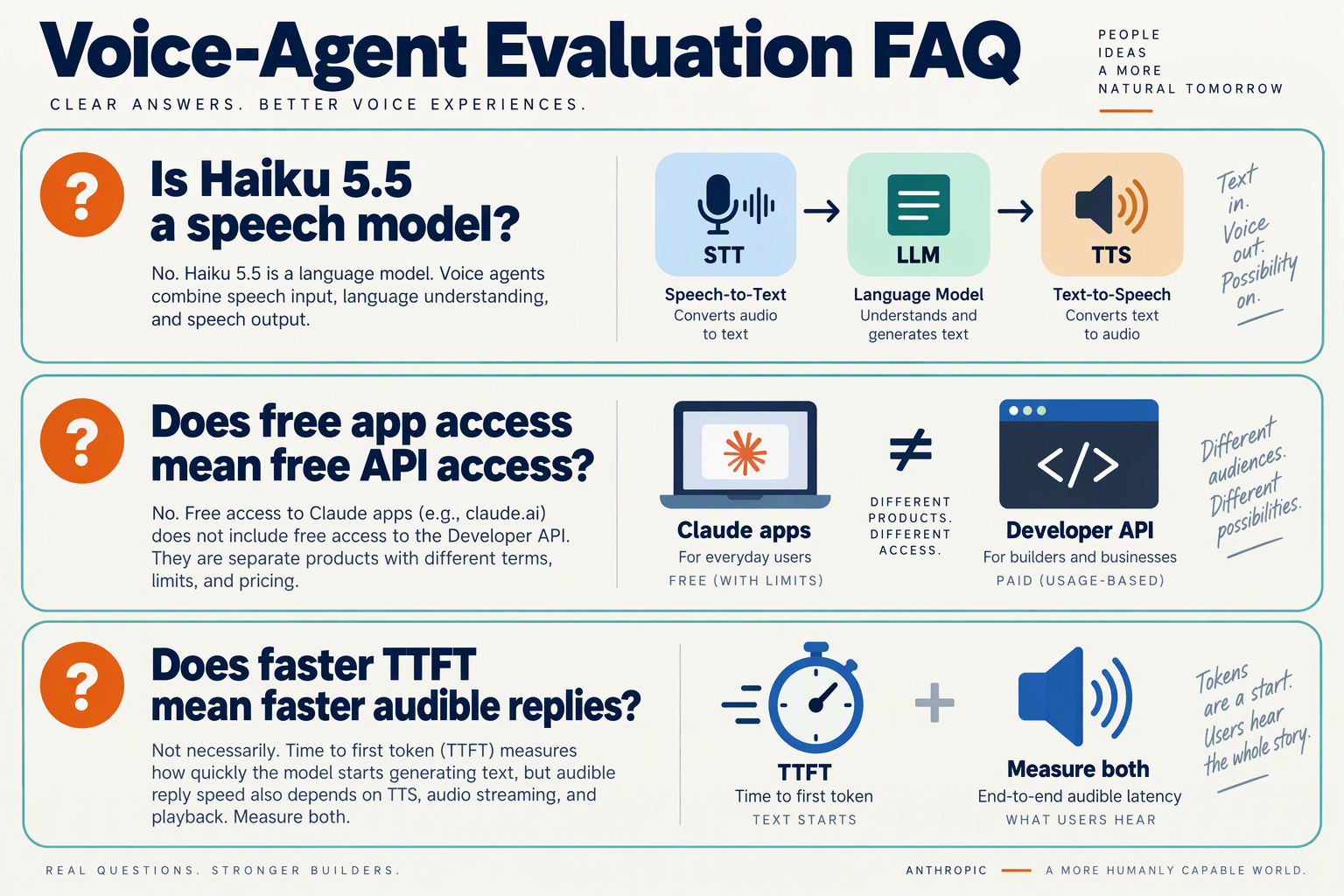
Is Claude Haiku 5.5 a speech model for voice agents?
Is Claude Haiku 5.5 API access free?
Does lower Claude Haiku 5.5 latency mean faster voice replies?
Should a voice agent use the lowest reasoning effort setting?
How much does the language model contribute to total voice-agent cost?
Can an Anthropic-compatible gateway simplify voice-agent evaluation?
/v1/messages endpoints, usage and request logs, and caller-chosen fallback models—capabilities relevant to running and inspecting evaluation requests. Verify Haiku 5.5 availability separately, and label fallback responses in your measurements so a successful fallback is not mistakenly counted as the target model’s performance.What resources and next steps should you use, including CallMissed’s Anthropic-compatible API after checking model availability?
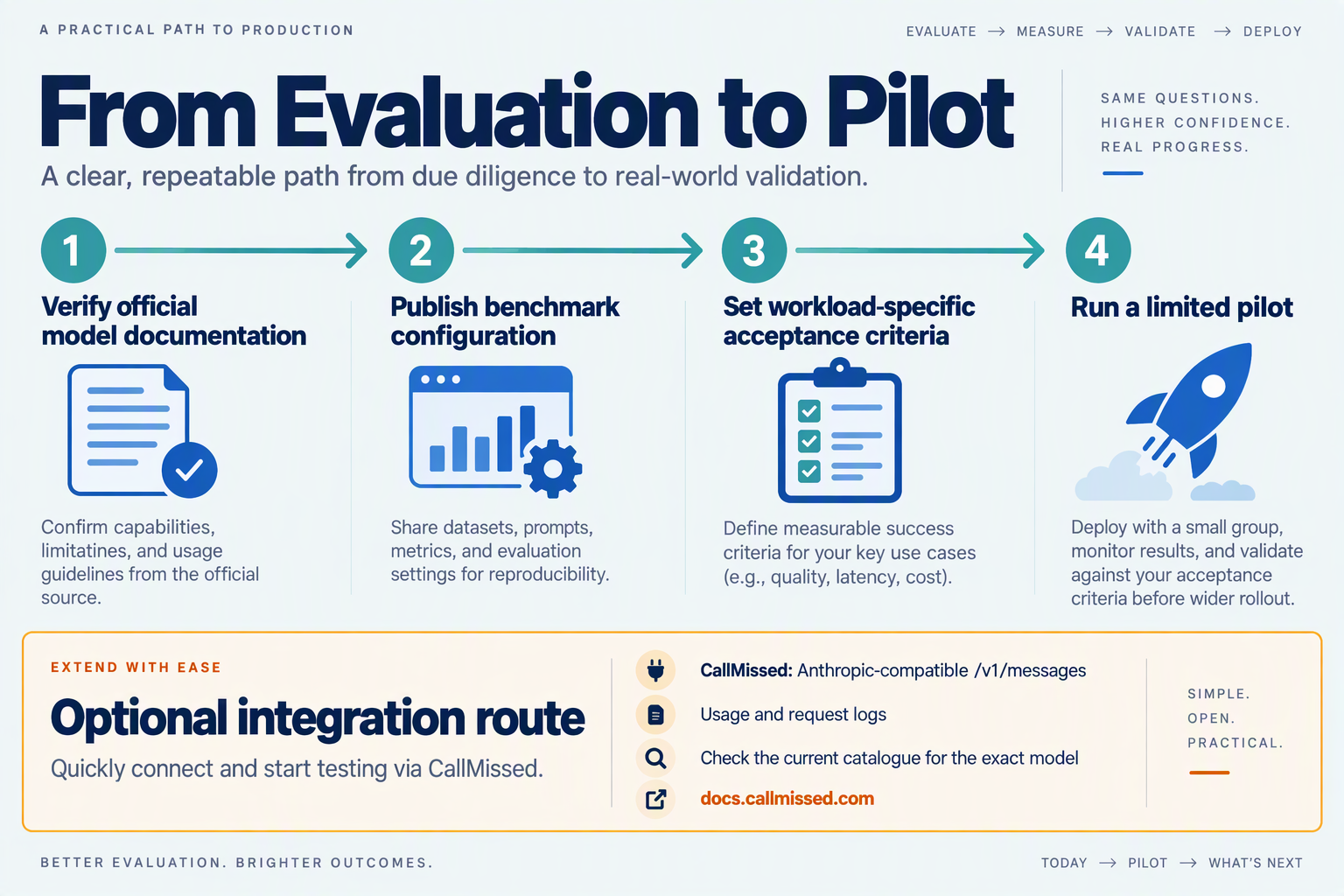
Use Anthropic’s model documentation, your deployment provider’s model catalog, and a reproducible evaluation repository before moving Claude Haiku 5.5 into a voice workflow. CallMissed’s Anthropic-compatible API is an integration option after you confirm that the exact model is available; endpoint compatibility alone does not establish model availability.
Which Claude Haiku 5.5 resources should developers check first?
Start with primary documentation for model identifiers, supported parameters, limits, and billing. Use launch coverage to understand the announcement, but resolve implementation questions against the documentation for the endpoint you will actually call.
Unite.AI reports that Anthropic released Claude Haiku 5.5 on October 7, 2026, with immediate availability on the Claude Platform, Amazon Web Services, Google Cloud, and Microsoft Azure. That reported availability does not mean every region, account, gateway, or deployment configuration exposes the same model.
Build a short resource checklist:
- Anthropic model documentation: confirm the exact API model identifier, supported inputs, tool-use behavior, and any documented effort controls.
- Provider catalog and account console: verify access for your account and deployment region rather than assuming that app availability implies API access.
- API reference and SDK documentation: check streaming events, tool-result formatting, error responses, and timeout configuration.
- Current pricing documentation: confirm the rates your selected provider actually charges, including any separately billed services.
As of October 13, 2026, the supplied coverage includes Firstpost’s report of adjustable effort settings for Claude Haiku 5.5. Treat that as a documentation question to investigate—not permission to assume that every compatible endpoint accepts identical settings.
How should you approach CallMissed’s Anthropic-compatible API?
As of October 2026, CallMissed’s verified product fact sheet lists an Anthropic-compatible /v1/messages endpoint, allowing existing SDK integrations to work by changing the base URL. The same fact sheet lists streaming, function calling, caller-chosen fallback models, and usage and request logs—useful capabilities for integration testing and operational review.
However, the supplied fact sheet does not confirm Claude Haiku 5.5 availability. Check the current catalog or obtain confirmation before configuring the model identifier; do not substitute a guessed name.
Once availability is confirmed:
- Make a minimal request using the documented identifier and required credentials.
- Exercise the integration contract: verify streamed text, tool requests, tool results, and error handling.
- Check optional parameters individually: compatibility should be tested at the feature level, not inferred from a successful basic response.
- Keep routing explicit: record the requested model and any fallback configuration so results remain attributable.
What should your final evaluation package contain?
Turn the earlier tests into a versioned release decision, not another collection of impressive demos. A compact repository should include:
- Configuration manifest: model identifier, provider, test date, prompt version, speech components, and tool definitions.
- Sanitized fixtures: representative conversations and mocked backend responses without unnecessary customer data.
- Results summary: measured outcomes, observed failures, actual spend, and unresolved limitations.
- Deployment runbook: rollout owner, monitoring checks, escalation procedure, and rollback conditions.
The next step is a bounded pilot with explicit approval criteria. Promote Claude Haiku 5.5 only when the recorded evidence supports your workflow; if access, parameter support, or results remain uncertain, keep the existing configuration and document what must change before reconsideration.
Conclusion
Claude Haiku 5.5 latency should be judged by how quickly callers hear a useful, correct response—not by token speed alone. The adoption decision is whether the complete voice workflow delivers acceptable latency, reliable actions, and lower cost per successful task together.
According to Lapaas, Anthropic’s October 7, 2026 launch claimed approximately 75% lower average running costs than Haiku 4.5, a workload-based estimate rather than a guaranteed reduction for every deployment. Those potential savings justify evaluation, but they do not replace it: waiting, retries, incorrect actions, and unnecessary escalations can undermine attractive token economics.
Carry these four takeaways into your evaluation:
- Measure the caller’s experience. Record the interval from the caller finishing a turn to the first audible response, alongside time to first token. Speech recognition, endpoint detection, network transit, and text-to-speech startup all contribute to the delay. A faster model matters only if that improvement reaches the conversation.
- Evaluate the distribution, not the demo. Compare p50, p95, and p99 latency under representative concurrency. A smooth single-call demonstration cannot establish how consistently the agent responds when demand increases. Define acceptable response-time thresholds before testing so that deployment decisions reflect workflow requirements rather than an impressive isolated result.
- Test actions and interruptions together. Appointment changes, CRM queries, backend failures, and retries expose weaknesses that simple conversational prompts miss. Confirm that the agent stops speaking promptly when interrupted, retains context, and never announces a completed action before the underlying update succeeds. Speed without conversational accuracy is not a successful outcome.
- Calculate quality-adjusted cost. Track completed tasks, incorrect actions, and escalations alongside token spending. For an appointment-rescheduling workflow, the meaningful result is a correctly updated booking—not merely a cheap response saying the booking changed. Compare configurations using the same tasks and realistic backend response times.
What should developers watch next?
Watch whether lower model costs translate into consistently faster, more reliable end-to-end conversations as voice stacks evolve. The supplied Hacker News snapshot’s developer attention is a reason to investigate Claude Haiku 5.5, not a substitute for production evidence. Keep repeating the same evaluation as model behavior and integration settings change; otherwise, apparent progress may simply reflect different test conditions.
As of October 2026, CallMissed’s developer AI API provides Anthropic-compatible endpoints and usage and request logs—capabilities readers can explore when building integration and evaluation workflows around this trend.
Start with one representative task, establish your latency and accuracy thresholds, and test the complete conversation. Does Claude Haiku 5.5 make that task faster and cheaper to complete correctly—or merely cheaper to generate text?
Related Reading
- Claude Opus 5.5 Evaluation Review: Support and Voice AI
- AI voice agent data privacy: Questions Before Deployment
- Claude Sonnet 5.5 Review for Support and Voice Agents