When security concerns slow adoption: AI Support in India



When security concerns slow adoption, use this India-focused guide to assess vendors, protect customer data and launch a measured AI support pilot.
When security concerns slow adoption: AI Support in India
What happens when AI becomes a business priority before a company is ready to trust it with customer data? Around 70% of Indian organisations prioritise AI, according to Dell Technologies’ Modern Enterprise Readiness Study 2026, reported by Express Computer—but security concerns slow adoption alongside infrastructure constraints. For customer-support teams, that tension is practical: every automated conversation can involve personal information, account details or access to business systems.
As of October 2026, the question is no longer simply whether AI belongs in customer support. It is how to introduce AI without creating avoidable exposure. YourStory’s coverage of the Dell study identifies security concerns and inadequate infrastructure as significant barriers to deploying AI at scale. Crucially, prioritising AI does not mean deploying it safely—or deploying it everywhere.
The research also deserves context. Dell Technologies’ 2026 study surveyed 2,950 business and IT decision-makers across 35 countries, including 150 respondents from India, according to IT Voice. These findings capture decision-maker sentiment, not a security audit of every Indian enterprise. Still, they highlight a useful distinction: enthusiasm for AI and operational readiness are different things.
Customer support makes that distinction especially important. Consider an AI assistant handling a delivery query: finding an order status is relatively straightforward, but changing a delivery address requires identity checks and tightly scoped permissions. A helpful answer and an authorised action are not the same. Connecting an assistant to more systems can increase usefulness while expanding the consequences of a mistake.
Platforms such as CallMissed, an India-hosted AI customer-communication platform, reflect this shift with knowledge-base-backed agents and a human-handoff queue, although hosting location alone does not establish security or compliance.
How can Indian firms adopt AI support without weakening security?
This guide explains how to move from broad AI ambition to a controlled customer-support rollout. You will learn how to:
- Map sensitive data: identify what conversations contain, where information travels and what should never enter a prompt.
- Limit permissions: separate answering questions from issuing refunds, changing records or accessing restricted systems.
- Evaluate vendors: examine retention policies, access controls, subprocessors and incident-response responsibilities rather than relying on marketing labels.
- Pilot with safeguards: start with bounded use cases, test failure scenarios and provide a clear route to human support.
The goal is not to choose between innovation and caution. It is to make security part of the adoption plan—so teams can expand automation based on evidence, not just excitement or fear.
How can Indian firms balance AI and security? Start with low-risk support, minimal data and human escalation
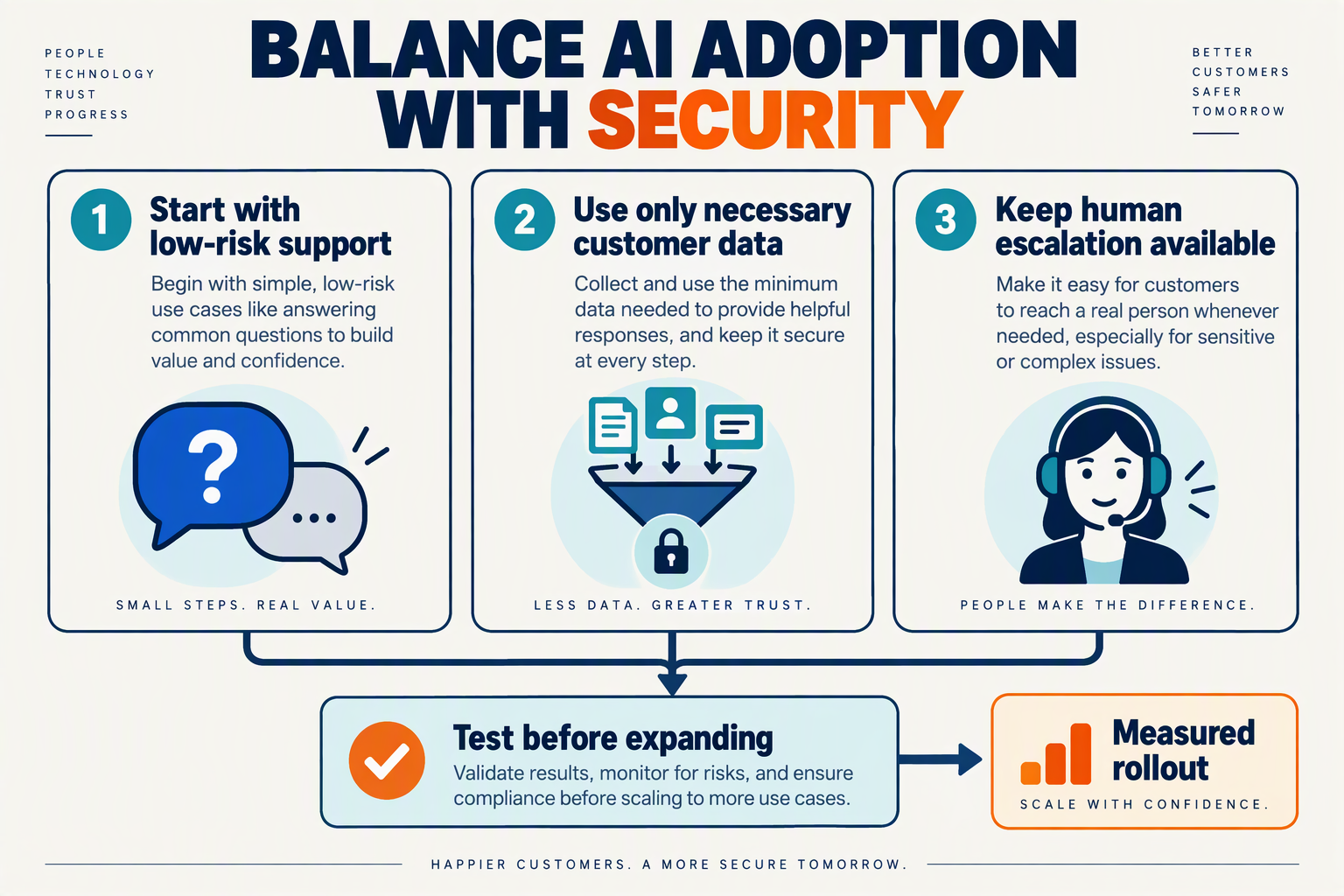
Indian firms can balance AI adoption and security in customer support by automating low-risk answers first, exposing only the data each task needs, and escalating sensitive decisions to a verified human workflow. Treat the first deployment as a bounded service—not an assistant with unrestricted access to customer accounts.
Which customer-support tasks should Indian firms automate first?
Start with questions whose answers come from approved, non-sensitive information: store hours, product specifications, troubleshooting instructions and published return policies. These tasks let teams test answer quality without giving AI permission to change business records.
YourStory’s October 2026 coverage of Dell Technologies’ Modern Enterprise Readiness Study 2026 identifies security concerns and inadequate infrastructure as barriers to scaling AI. A narrow pilot addresses that tension: teams can learn from real interactions without immediately connecting every customer database or transaction system.
Divide proposed tasks into three groups:
- Answer-only: explain a published warranty policy or guide customers through standard troubleshooting.
- Verified, read-only: retrieve a specific order’s delivery status after an appropriate identity check.
- Human-controlled: approve refunds, change account ownership, resolve suspected fraud or handle requests involving sensitive documents.
“Read-only” does not automatically mean safe. Revealing another customer’s order information is a security failure even if no record changes.
How much customer data should an AI assistant receive?
Use task-level data minimisation: give the assistant the smallest useful response, not an entire customer profile. For a delivery question, an authorised backend might return the delivery stage and estimated arrival window while withholding payment details, unrelated orders and internal notes.
Apply this boundary across the workflow:
- At collection: discourage customers from sharing passwords, OTPs, PINs or full payment-card details.
- Before model processing: remove unnecessary identifiers and redact sensitive content where feasible.
- At retrieval: restrict results to the verified customer and the specific support request.
- In logs: decide what must be retained, who can access it and when it should be deleted.
Do not rely on a prompt saying “keep customer data private.” Authentication, authorisation and data filtering should be enforced by application code and backend services.
When should AI customer support escalate to a human?
Escalate when the requested action exceeds the assistant’s permissions, identity verification fails, source information conflicts, or the customer reports fraud or asks for a person. Define these triggers before launch rather than leaving the model to improvise.
A useful escalation includes the customer’s issue, verification status and steps already attempted—but only the information the receiving employee needs. Human escalation is a controlled workflow, not permission to bypass verification.
How can teams decide whether a pilot is safe to expand?
Test both normal queries and deliberate misuse, including requests to reveal another customer’s details or ignore system instructions. Track unauthorised disclosures, incorrect answers, failed verification handling and successful handoffs alongside resolution rates.
As of October 2026, CallMissed, an AI customer-communication platform, offers custom REST tools, call scoring against a team’s own QA rubrics and evaluation suites. These capabilities can support a bounded rollout, but teams must still enforce permissions in connected systems.
Expand only when testing shows that the assistant respects its boundaries. Faster responses matter; reliable refusal and safe escalation matter just as much.
What does the Modern Enterprise Readiness Study 2026 mean by “70% of Indian firms prioritise AI”?
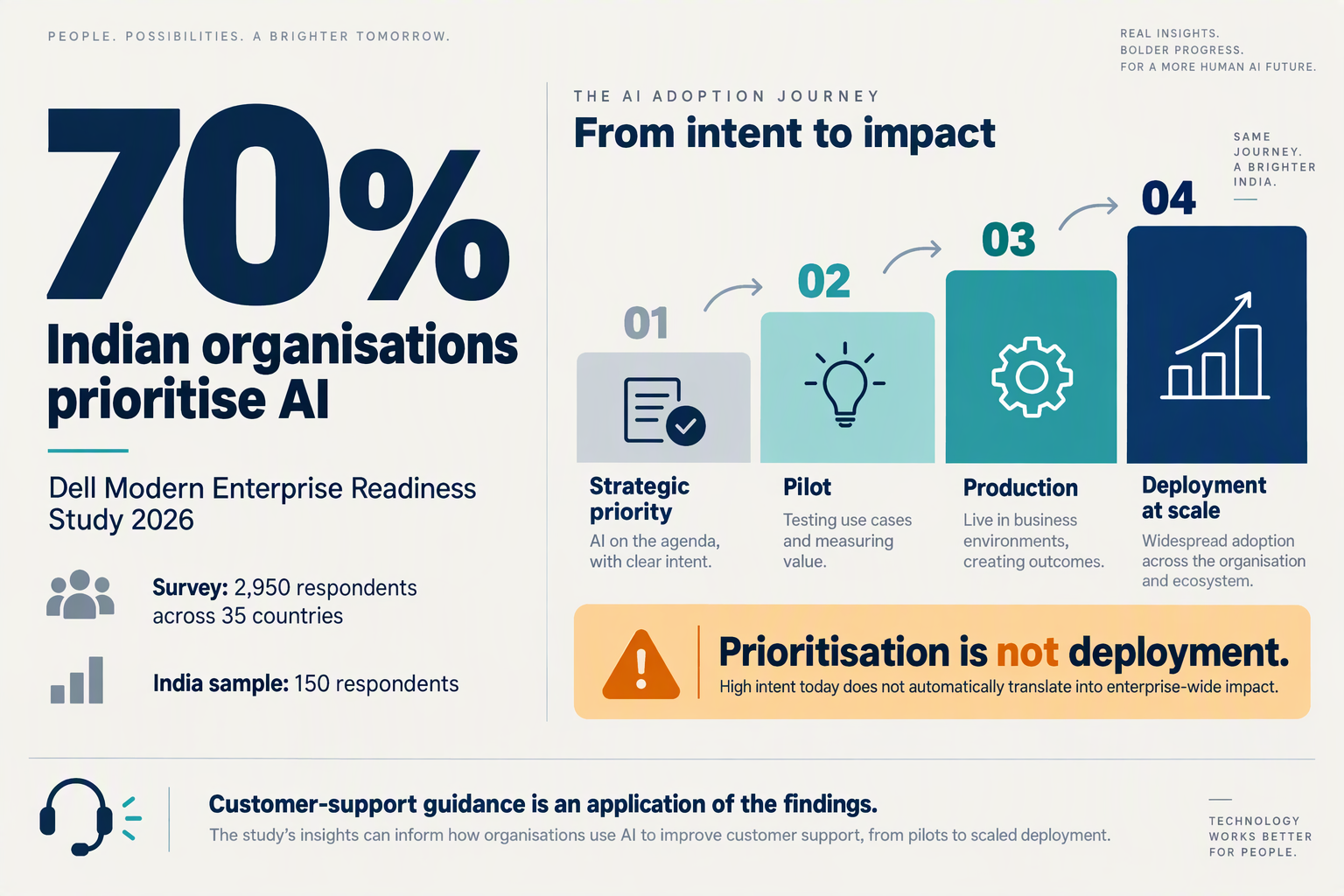
“70% of Indian firms prioritise AI” means AI is a reported organisational priority—not that 70% have deployed production-ready AI customer support. As of October 2026, Express Computer’s coverage of Dell Technologies’ Modern Enterprise Readiness Study 2026 reports that around 70% of Indian organisations prioritise AI; the headline does not establish deployment scale, security maturity or business results.
For support leaders, the finding is best understood as a signal of strategic intent. It makes AI readiness an important planning question, but it is not a benchmark for how much customer interaction your organisation should automate.
Does prioritising AI mean Indian firms are already using it successfully?
No. Priority, adoption and readiness are different measures, and treating them as interchangeable can lead to premature purchasing or rollout decisions.
A useful way to separate them is:
- Priority: Leadership identifies AI as important to the business.
- Adoption: Teams use AI in defined workflows, whether experimentally or operationally.
- Readiness: The organisation has the infrastructure, permissions, governance and staff needed to operate those workflows responsibly.
- Outcomes: Evidence shows whether AI improves service quality, cost or customer experience.
These are analytical distinctions, not categories attributed to Dell’s survey. The supplied coverage does not provide the exact questionnaire wording or a breakdown of what respondents meant by “prioritise.”
Consequently, the 70% figure cannot tell a customer-support manager how many firms have autonomous agents, how many remain in pilots or how many have demonstrated measurable returns. Do not turn a sentiment statistic into a deployment statistic.
How representative is the Dell study of Indian businesses?
The study offers a decision-maker perspective rather than a census of Indian firms. As of October 2026, IT Voice reports that Dell Technologies’ Modern Enterprise Readiness Study 2026 includes 950 respondents across Asia Pacific, Japan and Greater China, alongside its India sample.
That regional context matters, but it does not make the India findings automatically representative of every industry or company size. The supplied reporting does not establish the Indian sample’s sector distribution, organisation-size mix, weighting or statistical margin of error.
An Indian retailer, hospital and software exporter may therefore recognise the same broad pressure to adopt AI while facing very different constraints. The headline is useful for understanding market direction; your own workflow and risk assessment must determine implementation decisions.
What do security and infrastructure barriers mean for customer support?
As of October 2026, YourStory’s reporting on Dell Technologies’ study identifies security concerns and inadequate infrastructure as significant barriers to deploying AI at scale. The supplied context does not quantify each barrier’s contribution, so it would be misleading to assign a percentage to security-related delays.
For customer support, translate that finding into three planning questions:
- What business problem needs solving? Define a specific target, such as reducing the time agents spend finding approved policy information.
- What dependencies could prevent reliable operation? Check knowledge quality, system connectivity and whether existing applications support appropriately limited access.
- What evidence would justify expansion? Set acceptance criteria for answer accuracy, escalation quality and unauthorised-action prevention before increasing scope.
The practical takeaway is not “join the 70%.” It is turn AI priority into a testable readiness plan, with business benefits and security requirements evaluated together.
What security and infrastructure readiness checks come before an AI support pilot?
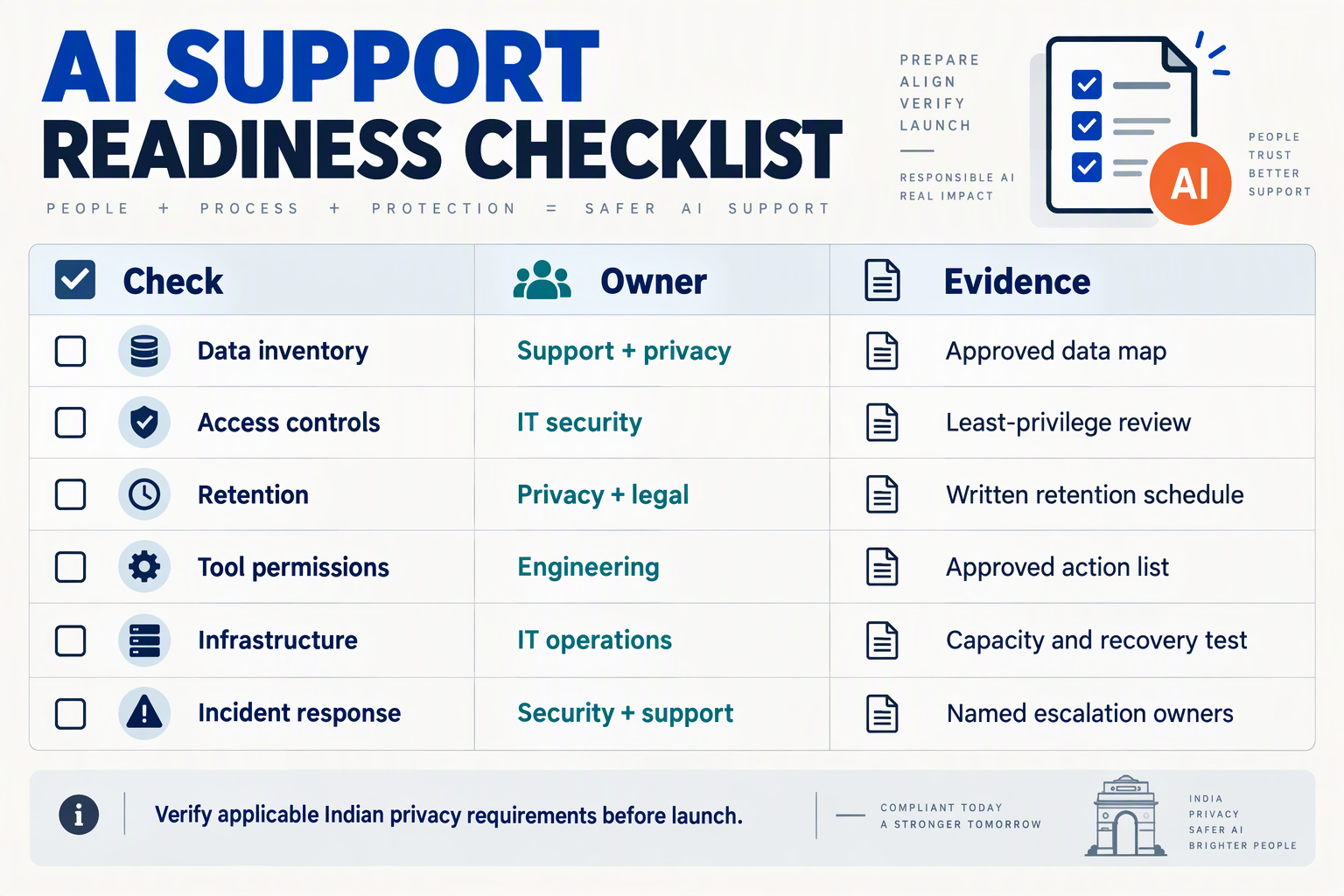
Before an AI customer-support pilot, verify data handling, access controls, integration safety, capacity, monitoring and recovery. Each check should produce evidence—such as a permissions review or failure-test result—not merely a vendor assurance.
YourStory’s October 2026 coverage of Dell Technologies’ Modern Enterprise Readiness Study 2026 identifies inadequate infrastructure and security concerns as barriers to scaling AI. For a pilot, translate those concerns into specific launch gates: can the system protect customer information, withstand expected demand and fail safely?
What should an AI support readiness checklist include?
Use this checklist for an October 2026 readiness review. The acceptance criteria below are recommended pilot controls, not benchmarks reported by Dell Technologies.
| Readiness check | What to inspect | Test before launch | Evidence required |
|---|---|---|---|
| Data handling | Conversation data, logs, retention, model-provider processing and subprocessors | Trace a synthetic customer record through every connected service | Documented data flow, approved retention rules and deletion responsibilities |
| Identity and permissions | Service accounts, credentials, customer verification and tool access | Attempt to retrieve another customer’s record or invoke a prohibited action | Denied requests and a reviewed permission matrix |
| Knowledge and input safety | Approved documents, retrieval boundaries and untrusted customer instructions | Insert instructions to reveal secrets or override policy into messages and documents | Restricted information remains inaccessible; unsafe instructions do not trigger tools |
| Infrastructure capacity | API quotas, concurrency, network reliability and downstream CRM limits | Run expected peak traffic, then simulate rate limits and unavailable dependencies | Measured response times, error rates and a functioning fallback |
| Monitoring and response | Security events, tool-call logs, redaction and escalation ownership | Trigger a suspicious request and trace the alert to its owner | Useful, access-controlled logs and a documented response procedure |
| Recovery and continuity | Agent configuration, connector disablement and human-support capacity | Disable a connector, revert a configuration and transfer a conversation | Demonstrated recovery without losing the customer’s support context |
How should teams test infrastructure without exposing customer data?
Start with synthetic records, not copied production conversations. Include realistic complications: duplicated customer names, stale order information, missing fields and slow CRM responses.
For example, an order-status assistant should retrieve only the authenticated customer’s order. If the order system times out, the assistant should explain that it cannot confirm the status—not invent a delivery date or repeatedly call the failing API.
Measure these dimensions separately:
- Performance: end-to-end response time, concurrent sessions and dependency errors.
- Safety: unauthorised retrieval attempts, blocked tool actions and sensitive-data leakage.
- Continuity: successful transfers, preserved context and recovery time.
A fast answer is not evidence of secure access; a blocked unsafe request is not evidence that infrastructure can handle peak demand.
What evidence should decide whether the pilot launches?
Assign each launch gate an owner and record the result. Avoid averaging security failures into an otherwise impressive performance score.
- Block launch for critical exposure: cross-customer data access, exposed credentials or unauthorised account changes require remediation.
- Set workload-specific targets: agree on acceptable response times and fallback behaviour before testing.
- Retest after changes: model, prompt, knowledge-base and connector updates can change behaviour.
As of October 2026, CallMissed’s verified product fact sheet lists eval suites, A/B experiments, and agent versioning with publish and rollback. These capabilities can support controlled testing and recovery, but teams must still verify permissions, data handling and dependency behaviour for their own deployment.
Launch when the evidence supports the defined workload—not simply when the demonstration looks convincing.
How do you start a low-risk chat pilot? Use a knowledge base and human handoff, with CallMissed as one example
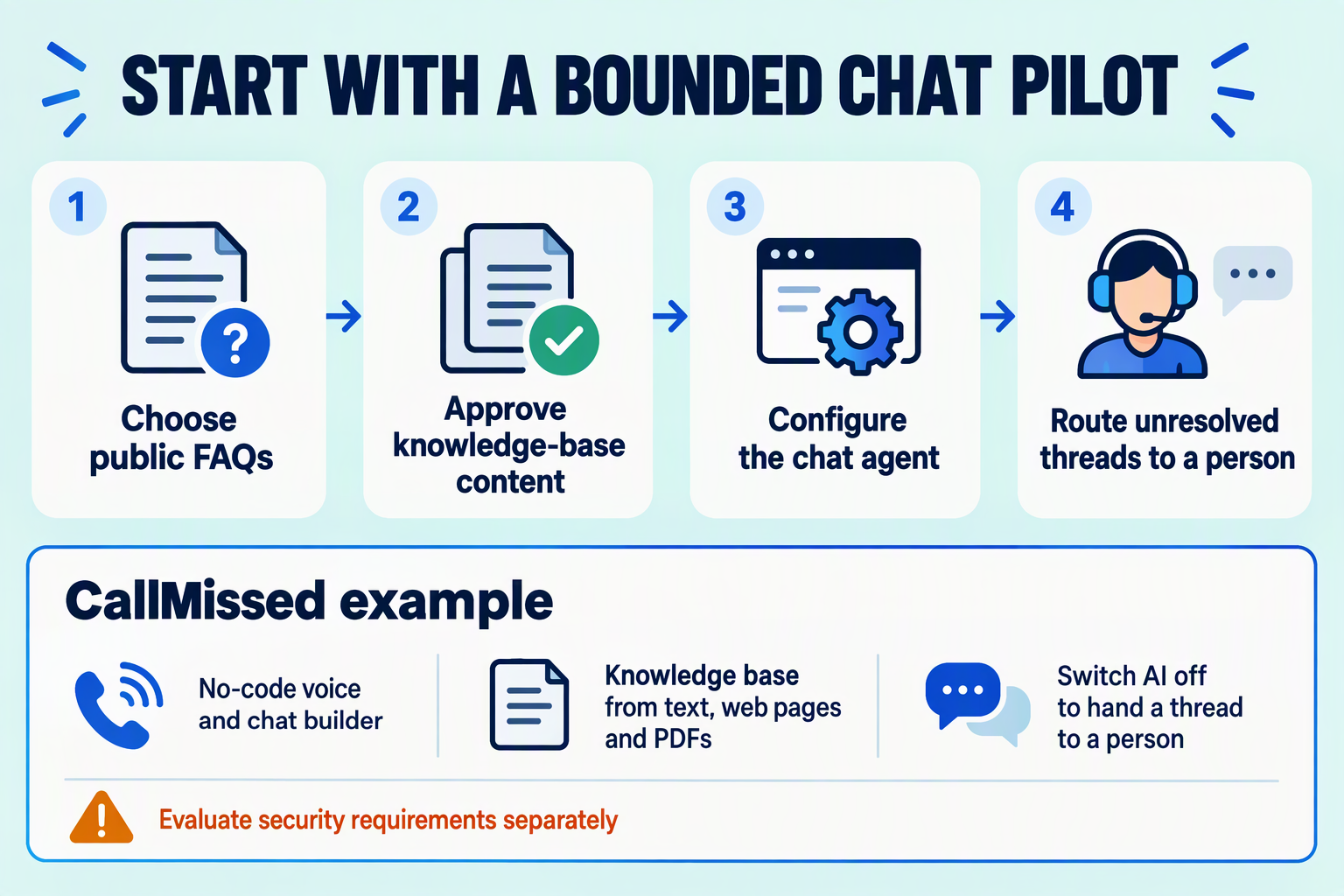
Start a low-risk chat pilot with public-information questions, a curated knowledge base and a clearly staffed human-handoff route. Keep the first release separate from customer accounts and transaction tools, then expand only after testing shows that answers and escalations work reliably.
YourStory’s October 2026 coverage of Dell Technologies’ Modern Enterprise Readiness Study identifies security concerns and inadequate infrastructure as barriers to scaling AI. A bounded pilot turns those concerns into testable operational questions: does the assistant stay within approved information, recognise its limits and let customers reach a person?
What should go into an AI support knowledge base?
Choose one narrow support journey, such as explaining delivery policies or helping customers find product manuals. A delivery-policy assistant should explain published timelines—not retrieve an individual customer’s order or change their address.
Build a small, reviewed source collection:
- Include: published FAQs, approved troubleshooting instructions, product documentation and current policy pages.
- Exclude: customer tickets, internal discussions, credentials and documents containing personal information.
- Assign ownership: give each document a reviewer, revision date and process for removing outdated guidance.
- Resolve contradictions: reconcile conflicting refund windows or warranty terms before uploading documents.
Knowledge-base retrieval can help ground responses in approved material, but retrieval is not an access-control mechanism or a guarantee of correctness. Test whether the assistant actually follows the supplied policy rather than assuming that uploading a PDF makes every answer trustworthy.
How can you configure a pilot with CallMissed?
As of October 2026, CallMissed’s no-code builder supports chat agents configured with prompts and knowledge bases sourced from text, web pages and PDFs, alongside versioning with publish and rollback. CallMissed also provides an embeddable web chat widget and a human-handoff queue; switching the AI off hands the thread to a person.
Use those capabilities in a deliberately constrained setup:
- Write a bounded instruction: answer only the selected support topics using approved sources; do not request passwords, payment credentials or identity documents.
- Leave action tools out: the initial pilot does not need a custom REST tool that updates records or triggers business actions.
- Publish a reviewed version: record the prompt and document versions used in testing so changes can be traced and reversed.
- Rehearse handoff: verify how staff switch off AI, take ownership of the thread and respond during staffed hours.
These are deployment choices, not claims that the platform automatically enforces every safeguard. Confirm the behaviour in your own configuration.
When should the chatbot hand a conversation to a person?
Define escalation situations before launch: unsupported questions, contradictory source material, requests involving account access, complaints requiring judgement and explicit requests for a human. Confirm which situations need staff intervention rather than assuming automatic routing.
For example, “What is your return window?” belongs in the pilot. “My return was rejected; override the decision” belongs with a person. If support is unavailable, explain the next contact route without promising an unverified response time.
What evidence should you collect before expanding?
Use a fixed test set containing ordinary questions, ambiguous wording, outdated-policy traps and instructions such as “ignore your rules.” Track policy accuracy, unsupported claims, sensitive-data requests and successful handoffs, not just how many chats avoid human support.
Treat any credential request, unauthorised action or broken handoff as a launch blocker. Expand to another topic only when the current workflow is dependable; a successful FAQ pilot does not establish readiness for account-level automation.
How do you launch securely, step by step—from data mapping to a gated rollout?
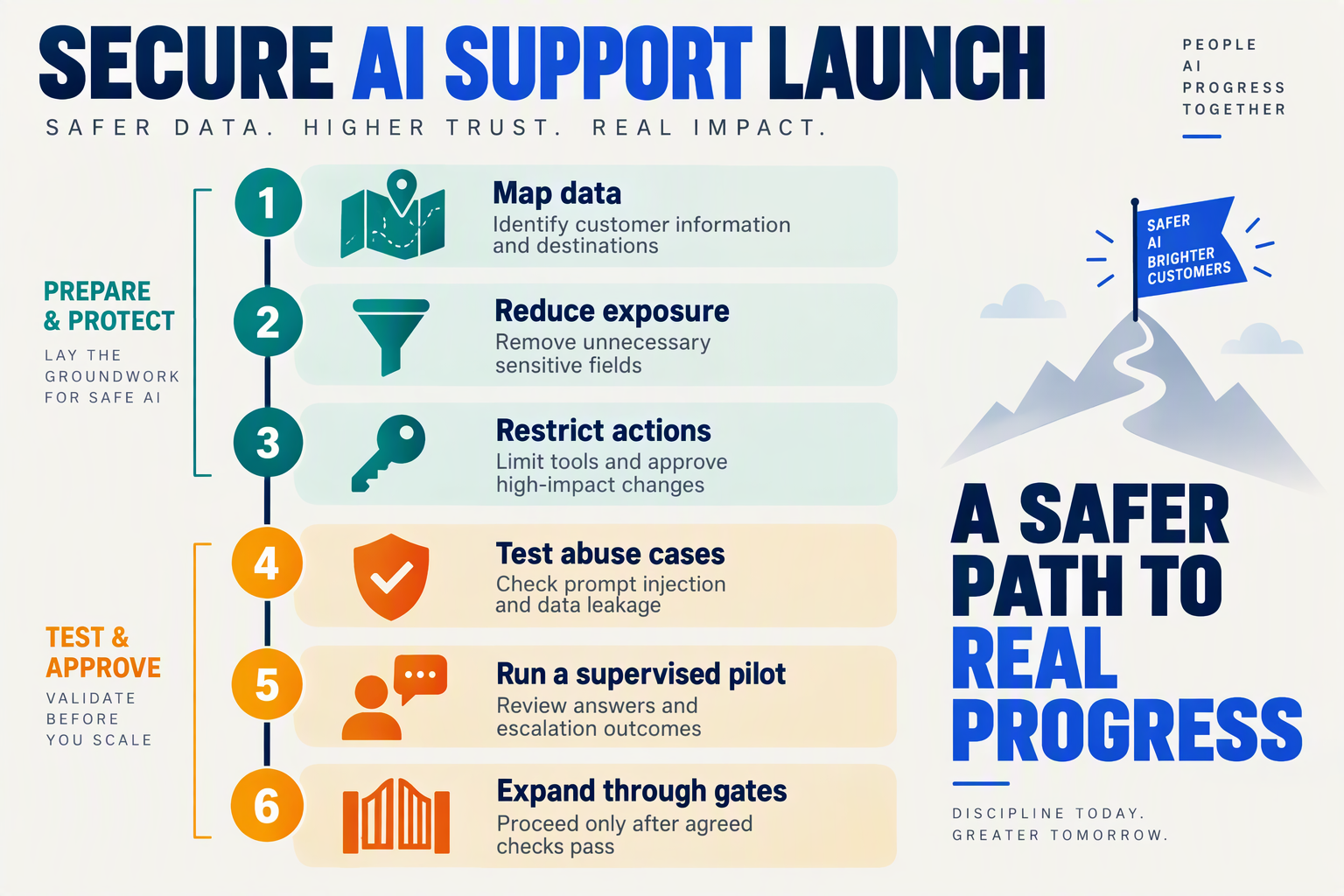
Launch securely by treating each stage as a release gate: map the data, constrain access, test failure scenarios, then expand only after named owners approve the evidence. For Indian customer-support teams planning deployments in October 2026, this turns security from a general concern into a practical go/no-go process.
What should your customer-data map contain?
- Trace one complete support journey before building the agent. For a delivery-status query, document how information moves from the customer’s message through the AI provider, order system, transcript store and support inbox.
Create a simple register covering:
- Data fields: phone number, order identifier, address and conversation text.
- Destinations: every service receiving those fields, including logging systems.
- Purpose and retention: why each destination needs the data and when it should be deleted.
- Owner: who approves access and handles deletion or incident requests.
Gate: do not proceed while a destination, retention period or responsible owner remains unknown. Include regional-language transcripts and audio recordings where relevant—not just English chat messages.
How do you convert the map into enforceable controls?
- Write an allowed-actions contract for each use case. Specify permitted inputs, approved knowledge sources, callable tools and the conditions requiring human intervention.
For example, an order-status agent may retrieve a delivery estimate after verification but cannot change an address. Enforce that restriction in the backend: hiding a tool in the prompt is not equivalent to denying permission.
Gate: demonstrate that a forbidden action fails even when the model requests it. Use narrowly scoped service credentials, and keep credentials outside prompts and knowledge documents.
What must be ready before connecting production systems?
- Build a separate test environment with synthetic records. Confirm provider retention terms, approved data-processing locations, access permissions and deletion procedures before sending real conversations.
Test infrastructure as well as model behaviour. YourStory’s October 2026 coverage of Dell Technologies’ Modern Enterprise Readiness Study 2026 identifies inadequate infrastructure alongside security concerns as barriers to scaling AI.
Gate: simulate an unavailable order system and verify that the agent neither invents an answer nor repeatedly submits the same request.
Which security tests should block launch?
- Test adversarial and ordinary failures together. Include attempts to retrieve another customer’s order, instructions embedded in retrieved documents, requests for credentials and ambiguous identity claims.
Check that:
- Unauthorised data retrieval is blocked.
- Sensitive information stays out of unnecessary logs.
- Human escalation works when verification fails.
- Tool timeouts produce a safe, understandable response.
Gate: treat any observed cross-customer disclosure or unauthorised write as a launch blocker. Passing a test suite is evidence—not a guarantee of security.
How should a gated pilot work?
- Start in shadow mode, then permit a bounded live pilot. First compare proposed AI responses with human decisions without sending them to customers; next enable one queue or use case with staffed escalation.
As of October 2026, CallMissed provides agent versioning with publish and rollback, evaluation suites and a human-handoff queue—capabilities teams can incorporate into this process, rather than treat as proof of security.
Gate: agree pilot thresholds in advance for answer accuracy, escalation handling and policy violations.
When can you expand the rollout?
- Require joint operational and security sign-off. Record test results, unresolved risks, the approved agent version and a named rollback owner. Expand one dimension at a time—traffic, language or tool access—so failures remain attributable and reversible.
How can strategic partnerships strengthen security without blurring accountability?
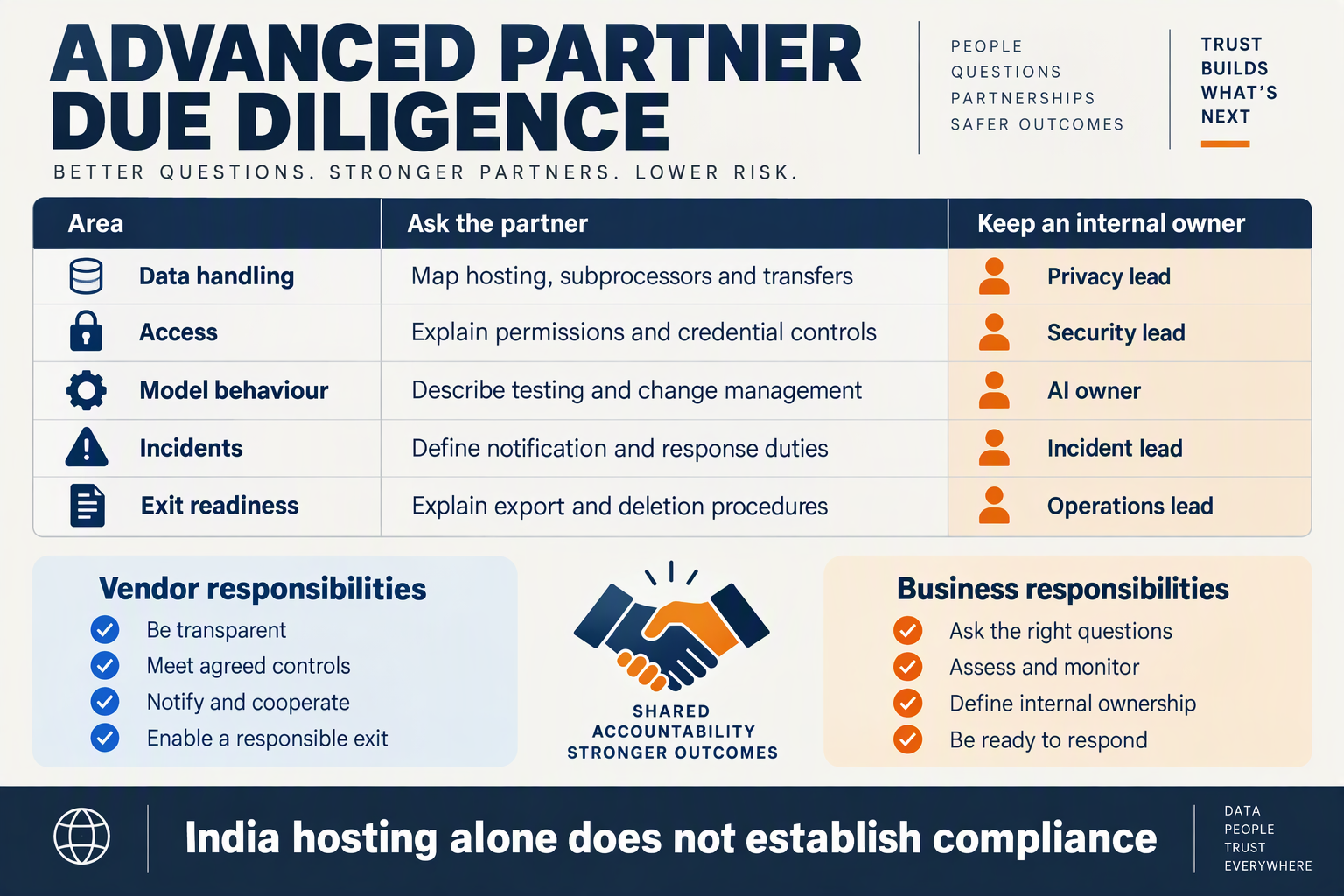
Strategic partnerships strengthen AI customer-support security when they supply specialist expertise without transferring ownership of business decisions. Indian firms should assign a named internal owner to every critical control, then define what each technology provider, implementation partner and security specialist must deliver.
Express Computer’s October 2026 coverage of Dell Technologies’ Modern Enterprise Readiness Study 2026 places strategic partnerships alongside security and infrastructure as priorities for Indian organisations. The practical takeaway is to buy expertise where needed—not assume that adding partners automatically reduces risk.
Who should own security across an AI support partnership?
Use the following responsibility matrix as a starting point for partner agreements. Each row should have one accountable internal owner, even when several organisations carry out the work.
| Security workstream | Partner contribution | Internal accountable owner | Evidence to require |
|---|---|---|---|
| Architecture and data flows | Document connections, processing locations and dependencies | Enterprise architect | Approved, versioned data-flow diagram |
| Agent permissions | Configure agreed access and tool restrictions | Business application owner | Permission inventory and denied-action tests |
| Integration changes | Build connectors and manage deployment changes | Engineering lead | Change records and rollback demonstration |
| Security testing | Test misuse, data exposure and unauthorised actions | Security lead | Findings, remediation owners and retest results |
| Incident response | Investigate affected services and supply technical evidence | Incident commander | Escalation contacts and joint exercise results |
| Exit and continuity | Support agreed export, deletion and disconnection | Service owner | Exit checklist and recovery test |
Accountable means having authority to approve the outcome and answer for it internally; it does not mean performing every technical task. The matrix is an operational tool, not a substitute for legal advice about contractual or statutory responsibilities.
What should a partnership agreement make explicit?
Turn broad assurances into obligations that can be checked. Before production access, agree on:
- Change authority: identify who can alter prompts, connect tools, replace models or publish an agent version—and which changes require internal approval.
- Dependency visibility: require disclosure of relevant downstream providers and advance notice of material changes to the agreed service.
- Incident coordination: specify notification triggers, escalation routes, evidence-preservation duties and responsibility for customer communications.
- Exit assistance: establish how credentials will be revoked, integrations disconnected and agreed data exports or deletion completed.
Keep commercial relationships separate from control decisions. An implementation partner should not approve its own security exceptions simply because it manages the deployment.
How can firms test whether shared accountability works?
Run a joint exercise before expanding the pilot. For example, simulate an AI assistant attempting an unauthorised refund through a connector configured by an implementation partner.
- Trace the decision: identify the agent version, connector configuration and business rule involved.
- Contain the issue: confirm who can disable the affected capability and who authorises that action.
- Close the gap: assign remediation, require independent retesting and record who approves restoration.
As of October 2026, CallMissed supports custom REST tools, agent versioning with publish and rollback, and evaluation suites. These capabilities can support such workflows, but the customer must still define permitted actions, approval authority and acceptance criteria.
The partnership succeeds when a failure produces a clear response—not a chain of vendors pointing elsewhere. Specialist execution can be shared; internal accountability should remain explicit.
Which common mistakes undermine secure AI customer support?
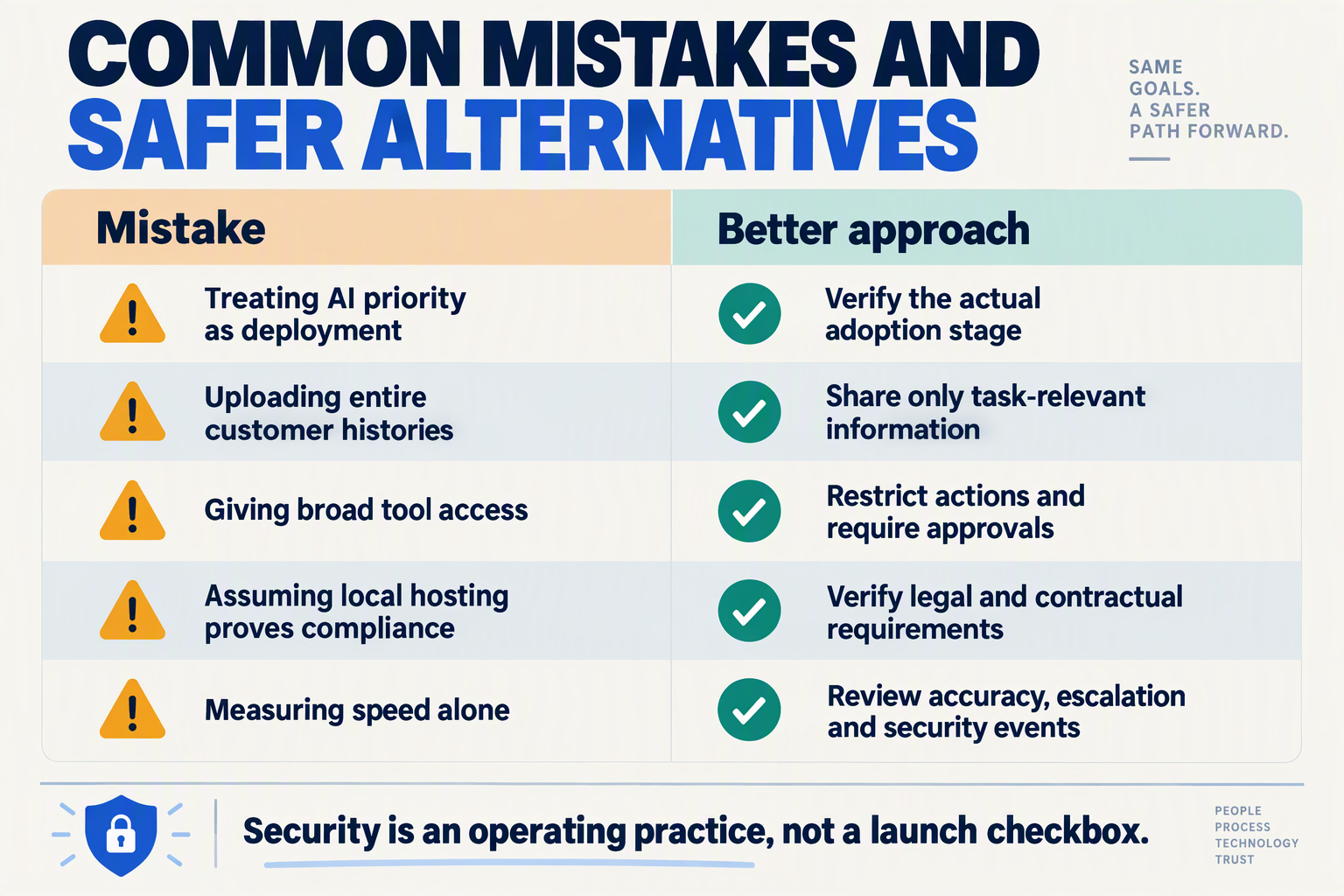
The most damaging mistakes in secure AI customer support are trusting unverified instructions, leaving sensitive data in operational logs, and expanding automation without retesting controls. Indian firms should treat these as deployment defects—not problems that a better prompt alone will solve.
As of October 2026, YourStory’s coverage of Dell Technologies’ Modern Enterprise Readiness Study 2026 identifies security concerns and inadequate infrastructure as barriers to scaling AI. For support leaders, the practical lesson is to inspect what happens between a customer’s message, the model’s response and any connected business action.
Which AI support mistakes should teams check first?
Use this table as an operational review checklist. The examples are illustrative failure scenarios, not findings attributed to the Dell study.
| Common mistake | Customer-support failure | Safer practice | Verification step |
|---|---|---|---|
| Treating retrieved text as instructions | An uploaded document tells the assistant to disclose internal information. | Treat documents and messages as untrusted content; enforce permissions outside the model. | Insert hostile instructions into a test document and check that access remains blocked. |
| Logging entire conversations by default | Customer identifiers appear in debugging exports or copied error reports. | Minimise logged fields, redact sensitive content and set retention limits. | Inspect a sample across application logs, monitoring tools and exports. |
| Assuming fallback models behave identically | A replacement model handles tool requests or sensitive questions differently. | Test every permitted model and review its data-handling terms. | Trigger a simulated provider failure and inspect the fallback response. |
| Letting configuration changes bypass review | A prompt edit makes an account-change workflow less restrictive. | Version prompts, tools and knowledge sources; require approval for consequential changes. | Rerun security tests before publishing and verify rollback works. |
| Measuring only speed and resolution | An assistant closes a case quickly despite giving an unauthorised answer. | Track unsafe disclosures, incorrect actions and escalation failures alongside efficiency. | Review failed tests and sampled conversations, not just averages. |
| Passing excessive context to human agents | An escalation carries unnecessary personal information into another queue. | Transfer the minimum useful summary through an approved workflow. | Check what the receiving agent can see and whether access matches their role. |
Why can a successful pilot still become unsafe?
A pilot tests one configuration under limited conditions. Adding another language, knowledge source, integration or model changes the system being evaluated—even when the customer-facing interface looks unchanged.
For example, a delivery assistant might safely answer questions from an approved policy document. Uploading a supplier PDF containing malicious instructions creates a new prompt-injection test case; adding an address-update tool creates a separate authorisation challenge.
As of October 2026, CallMissed provides agent versioning with publish and rollback, evaluation suites and A/B experiments. These capabilities can support controlled releases, but teams must still define security-specific tests and approval criteria.
How should support leaders turn this checklist into action?
Assign an owner and evidence requirement to each failure mode:
- Before release: test hostile inputs, denied actions, fallback behaviour and escalation.
- After each material change: rerun the relevant tests rather than relying on the original pilot.
- During operation: review incidents and sampled conversations, with an explicit route to pause affected automation.
Keep two distinctions visible in every review:
- A correct answer is not proof of authorised access.
- A clean dashboard is not proof that sensitive data stayed out of logs.
The aim is not zero change. It is ensuring that every expansion of AI customer support carries a corresponding expansion of verification.
Frequently Asked Questions
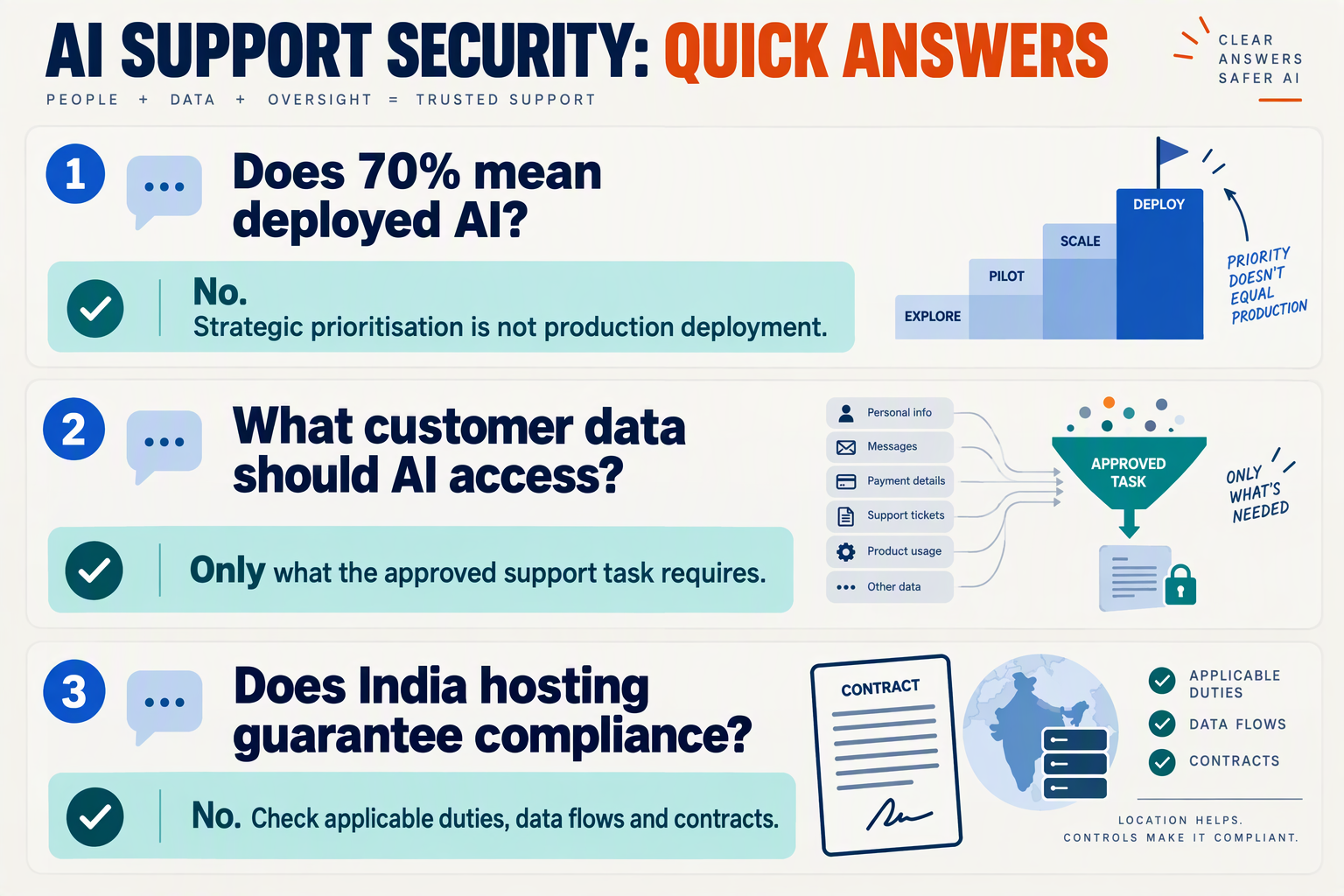
Does the Dell study mean 70% of Indian firms have deployed AI?
What customer data should AI access to balance AI adoption with security?
Does hosting customer-support AI in India guarantee compliance?
Will an AI customer-support provider use our conversations to train models?
How can Indian firms balance AI adoption with security when agents issue refunds?
When is an AI customer-support pilot ready to scale?
Which resources and next steps help you move forward? Review Dell coverage, privacy guidance and CallMissed docs
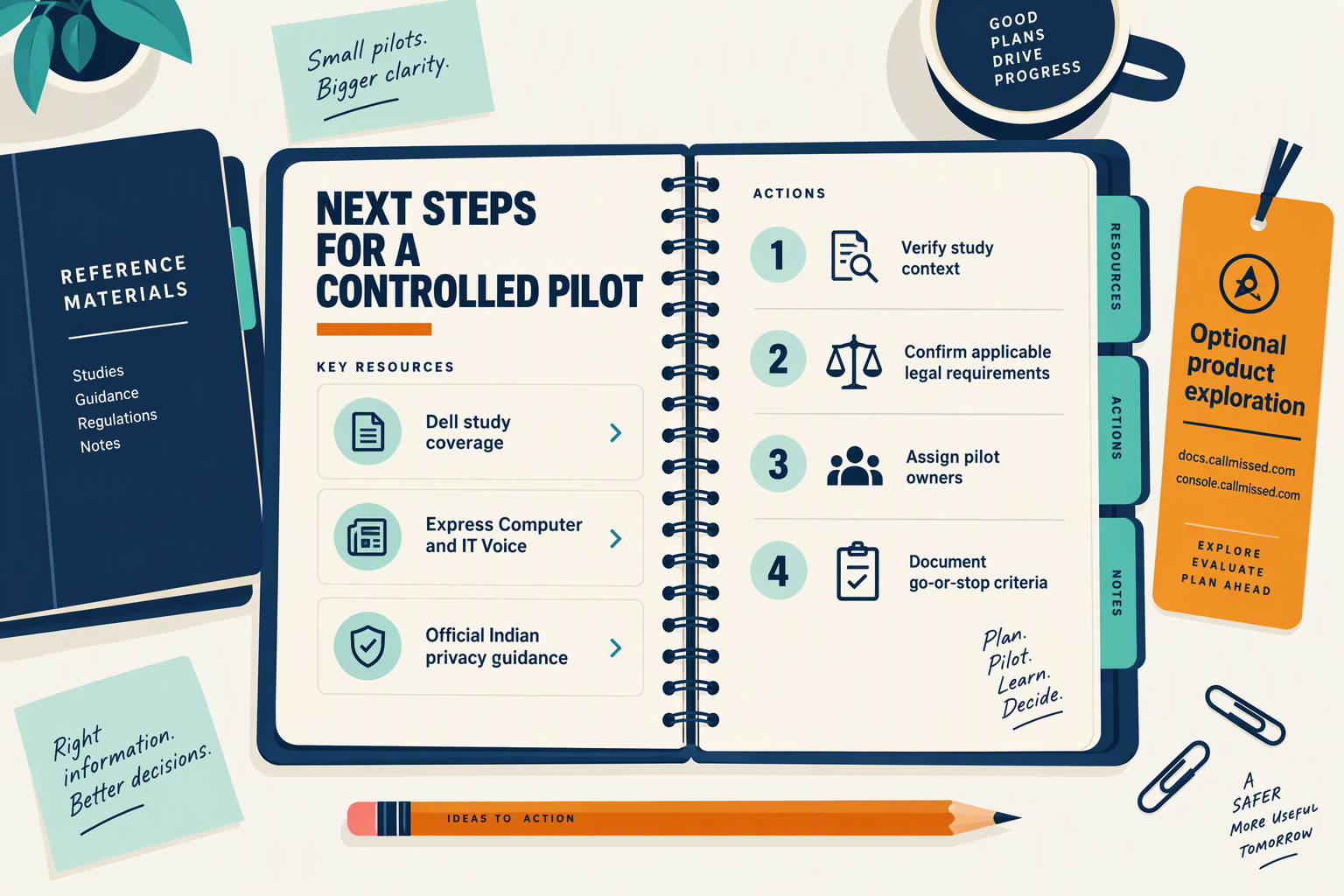
Use Dell study coverage to frame the business case, official privacy guidance to establish obligations, and product documentation to verify implementation choices. As of October 2026, the most useful next step is a short decision pack that turns these resources into named owners, evidence requirements and a pilot approval—not another broad AI strategy presentation.
Which Dell study coverage should your team read?
Start with Express Computer’s coverage of Dell Technologies’ Modern Enterprise Readiness Study 2026, then read YourStory’s reporting for its emphasis on security and infrastructure barriers. Together, these resources help explain why investment appetite does not automatically translate into deployment readiness.
Dell Technologies’ Modern Enterprise Readiness Study 2026 included 150 Indian respondents within a global sample of 2,950 decision-makers across 35 countries, according to IT Voice’s coverage available in October 2026. Use that sample information when presenting the findings: this is a decision-maker survey, not proof that a particular customer-support deployment is secure.
Give colleagues a focused reading assignment:
- Business sponsor: identify the customer problem the proposed investment should solve.
- IT owner: identify infrastructure dependencies that could block the pilot.
- Security owner: translate the reported concerns into questions requiring evidence.
Avoid using the widely reported 70% AI-priority figure as a target for your own automation. Market sentiment supports a discussion; your operating requirements should determine the rollout.
Where should you look for Indian privacy guidance?
Consult the Ministry of Electronics and Information Technology (MeitY) for official materials concerning India’s Digital Personal Data Protection Act, 2023, including relevant rules, notifications and commencement information. As of October 2026, verify the applicable requirements directly rather than relying on an older blog’s summary or assuming every provision has the same effective date.
Ask your legal or privacy adviser to produce a dated, use-case-specific note covering:
- Which obligations apply to the proposed support workflow.
- What customer-facing notices and consent arrangements, where applicable, need review.
- How customer requests and complaints will reach the responsible team.
- What contracts and evidence are needed from vendors.
For technical testing, consult the OWASP Top 10 for Large Language Model Applications. Record the edition you use and turn relevant risks into test cases; OWASP guidance complements legal review but does not establish compliance.
What should you verify in CallMissed documentation?
As of October 2026, CallMissed’s verified capabilities include agent versioning with publish and rollback, evaluation suites, A/B experiments and custom REST tools. Review CallMissed’s documentation to understand how these capabilities fit your proposed workflow, then request clarification where security or operational details remain unanswered.
Build a documentation checklist around concrete questions: Who approves a published version? What does rollback change? Which tool actions will the pilot permit? What evaluation evidence will be retained? A documented feature is a starting point for verification, not a security guarantee.
What should your team complete next?
Use a proposed two-week preparation sprint, rather than treating this timeframe as an industry benchmark:
- Days 1–3: assemble the source pack and a dated privacy-applicability note.
- Days 4–7: resolve documentation gaps and assign owners to unanswered questions.
- Days 8–10: prepare test results and a written go/no-go recommendation.
Finish with a one-page approval record listing scope, unresolved risks, acceptance criteria and the person authorised to pause deployment. That gives Indian firms a practical bridge from AI ambition to accountable customer-support adoption.
Conclusion
Indian firms can balance AI adoption with security in customer support by starting with bounded use cases, restricting access to customer data and expanding only when testing supports it. The next step is not automation everywhere; it is a rollout that makes useful answers, authorised actions and human accountability work together.
Around 70% of Indian organisations prioritise AI, according to Dell Technologies’ Modern Enterprise Readiness Study 2026, reported by Express Computer as of October 2026. YourStory’s coverage identifies security concerns and inadequate infrastructure as barriers to deployment at scale. For support leaders, the implication is clear: business enthusiasm must be matched by operational readiness.
Four takeaways should guide the adoption plan:
- Start with low-risk support tasks. Knowledge-base answers and straightforward order-status queries provide a more controlled starting point than actions that change customer records. Treat answering a question and executing a transaction as different responsibilities, with different checks. A successful informational exchange does not establish that an assistant should receive broader permissions.
- Map sensitive data and limit permissions. Identify what conversations contain, where information travels and what should never enter a prompt. Give an assistant only the access its assigned task requires. For example, retrieving delivery information should not automatically confer permission to change a delivery address without the appropriate identity checks.
- Evaluate vendors beyond marketing labels. Examine retention policies, access controls, subprocessors and incident-response responsibilities before connecting support systems. India-based hosting can be relevant to an evaluation, but hosting location alone does not establish security or compliance. The important question is whether the vendor’s practices support the particular workflow you intend to deploy.
- Pilot, test and preserve human support. Begin with a bounded rollout, test failure scenarios and provide a clear route to a person. Use those findings to decide whether to expand, adjust permissions or keep a task human-led. Security should inform these decisions throughout adoption, rather than becoming a final check after systems are connected.
What should Indian support teams watch next?
Watch whether growing AI ambition translates into stronger infrastructure, clearer vendor accountability and evidence-backed expansion. The meaningful signal will be how confidently teams can explain what an assistant accesses, what actions it can take and when a person takes over—not simply how widely automation is deployed.
To explore this direction, readers can consider CallMissed, an India-hosted AI customer-communication platform that, as of October 2026, offers knowledge-base-backed agents and a human-handoff queue. Those capabilities belong within a wider security evaluation, not in place of one.
Which low-risk support workflow could your team pilot next—with explicit data boundaries, limited permissions and a clear human fallback?
Related Reading
- LLM vendor evaluation checklist: Before Support Pilots
- Cost per resolved ticket: An LLM Support Evaluation Guide
- LLM evaluation for customer support: An SMB Test Plan