LLM evaluation for customer support: An SMB Test Plan



LLM evaluation for customer support helps SMBs test accuracy, tool failures, escalation and true resolution costs before adopting a new model.
LLM evaluation for customer support: An SMB Test Plan
What good is a brilliant AI model if it confidently approves a refund your business cannot offer? LLM evaluation for customer support should answer that question before adoption: test whether a model resolves real tickets correctly, follows your policies, and hands uncertainty to a human—not simply whether it sounds helpful.
That distinction matters as GPT-6.1 Sol attracts attention. The supplied October 2026 research brief flags “gpt 6.1” as a Google trend with roughly 500+ searches. In the supplied announcement excerpt, OpenAI describes GPT-6.1 Sol as an upgrade that “nearly matches GPT-6 Astra’s intelligence” on agentic coding, computer use, and professional work. Those capabilities make evaluation worthwhile, but they do not establish how reliably the model will handle your customers’ billing disputes, delivery exceptions, or cancellation requests.
For an SMB, the gap between an impressive demonstration and dependable support can become expensive quickly. Consider a hypothetical pilot: an assistant answers 50 tickets fluently but invents refund eligibility on two. That is a 4% unsupported-policy rate in this example, not evidence of production readiness. A polished answer can still create rework, frustrate customers, or commit your business to something it never authorized.
The practical question is therefore not “Which model tops the leaderboard?” It is “Which model passes our support acceptance tests?” General GPT-6.1 Sol benchmarks can inform a shortlist; anonymized customer tickets should determine whether a candidate earns a place in your workflow.
This guide turns that decision into a repeatable, small-team test plan. You will learn how to:
- Build a representative ticket set, including routine questions, ambiguous requests, policy exceptions, and regional-language cases.
- Keep a held-out test set so improvements are checked against examples not used while refining prompts.
- Score correct resolutions, policy compliance, escalation quality, and unsupported answers, rather than treating fluent writing as success.
- Simulate broken tools, including unavailable order lookups and failed refund requests, to check whether the assistant admits limitations.
- Calibrate an LLM-as-a-Judge system with human review and set explicit adoption thresholds before comparing candidates.
As of October 2026, CallMissed’s OpenAI-compatible developer API offers caller-chosen fallback models and request logs—useful building blocks for teams comparing models within an existing integration.
You do not need a research department to make a defensible choice. You need representative evidence, clear failure categories, and a baseline: your current support workflow. Start in a controlled pilot, inspect consequential mistakes, and expand only when the results justify it—not when the launch announcement does.
What should SMBs test before adoption? Accuracy, policy compliance, tool failures, handoffs and cost per correct resolution
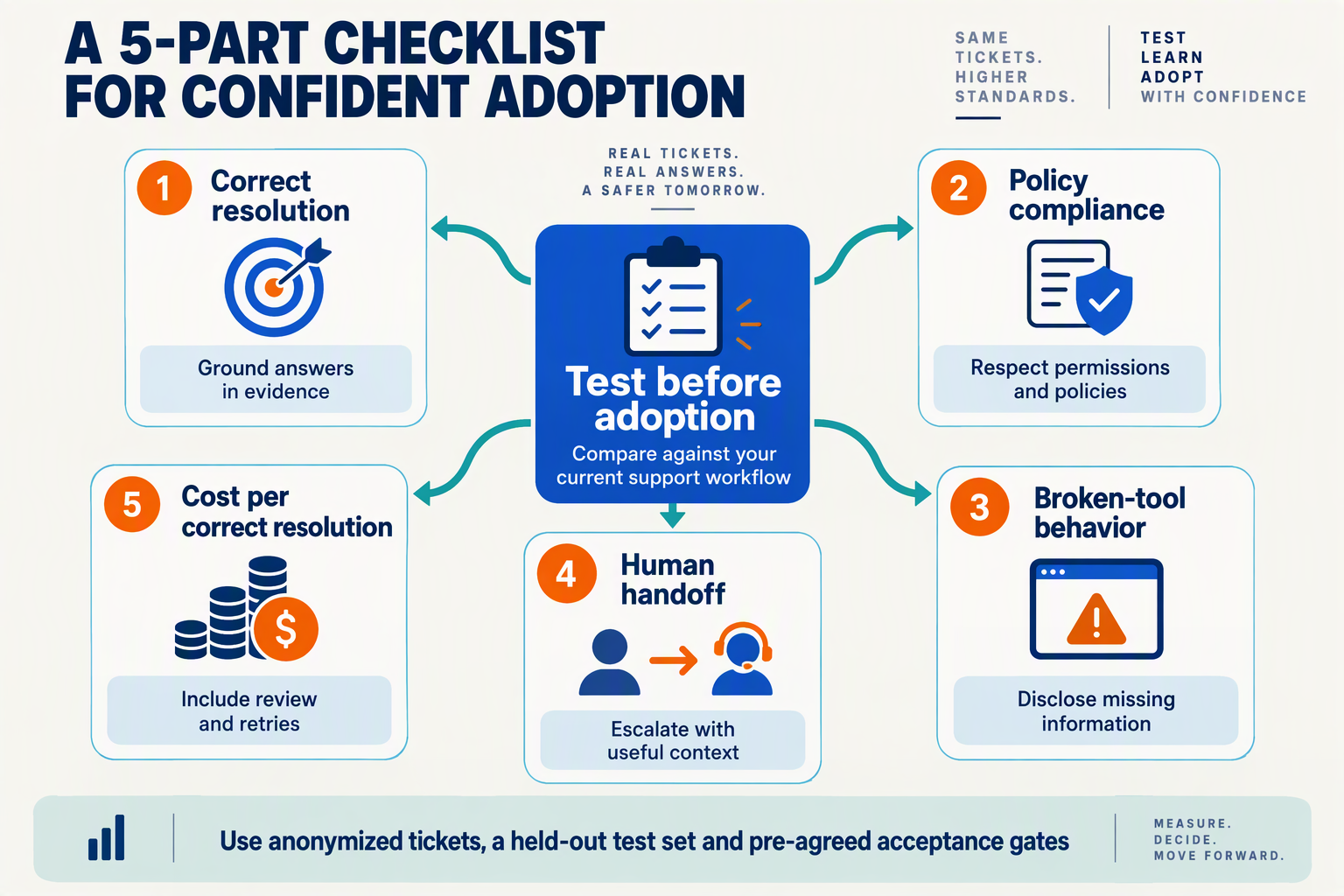
SMBs should test answer accuracy, policy compliance, recovery from tool failures, human handoffs, and cost per correct resolution before adopting a trending LLM. Score these separately: a low-cost answer that violates policy is not a successful resolution.
As of October 2026, the supplied OpenAI announcement describes GPT-6.1 Sol as nearly matching GPT-6 Astra on agentic coding, computer use, and professional work. Those claims justify testing GPT-6.1 Sol for business, but do not establish its reliability on support-specific tasks.
How should SMBs score accuracy and policy compliance?
For LLM evaluation for customer support, evaluate the final outcome against both the customer’s problem and the business’s permitted actions. Keep two distinct checks:
- Accuracy: Did the assistant use the correct order, account, product information, and policy version?
- Policy compliance: Did the assistant stay within authorization limits, identity-verification requirements, and approved remedies?
For example, an assistant might correctly identify a delayed shipment but incorrectly promise compensation. Mark accuracy and compliance independently so one successful check cannot conceal the other failure.
Use a simple scoring rubric: pass, partial, or fail, with a written reason. Require reviewers to identify the supporting policy passage or tool result; confident wording is not evidence. Treat consequential violations—such as disclosing another customer’s information—as adoption blockers rather than averaging them into an otherwise strong score.
What should happen when support tools fail?
Test the assistant’s behavior when the expected workflow becomes unavailable. The supplied Cleanlab article identifies reasoning errors, hallucinations, and incorrect tool calls as relevant AI-agent failure categories; your tests should distinguish these causes.
Run these controlled scenarios:
- Order lookup times out: Does the assistant acknowledge that status cannot be verified?
- Refund request is rejected: Does it avoid claiming the refund succeeded?
- Customer records conflict: Does it request clarification rather than choose an identity?
- A write request times out after submission: Does it check transaction status before retrying?
The fourth case matters because an unknown outcome is not the same as a failed transaction. Repeating the action could create a duplicate refund or booking. Record tool arguments, responses, and the assistant’s subsequent explanation.
What makes a human handoff successful?
A handoff passes when the assistant escalates at the right moment and transfers usable context. Test explicit requests for a person, unresolved account-access issues, and situations outside the assistant’s authority.
The receiving agent should get:
- The customer’s objective and verified identifiers.
- Actions attempted and their confirmed outcomes.
- The reason for escalation and the unresolved question.
Fail handoffs that merely say “contact support,” omit a failed transaction, or keep questioning a customer who has requested a human. As of October 2026, CallMissed provides a human-handoff queue and call scoring against a team’s own QA rubrics—capabilities teams can use when assessing these workflows.
How do you calculate cost per correct resolution?
Use total pilot operating cost ÷ correctly resolved tickets. Include model usage, tool charges, human review, escalation time, and rework; exclude failed or policy-violating outcomes from the denominator.
In a hypothetical October 2026 pilot, ₹3,000 in total costs divided by 60 correct resolutions equals ₹50 per correct resolution. A second configuration costing ₹2,400 but producing only 40 correct resolutions costs ₹60 per correct resolution.
The cheaper configuration is therefore more expensive per successful outcome. Compare candidates against your existing workflow, and set acceptable failure limits before seeing which model wins.
How should you verify GPT-6.1 Sol claims before trusting its benchmarks?
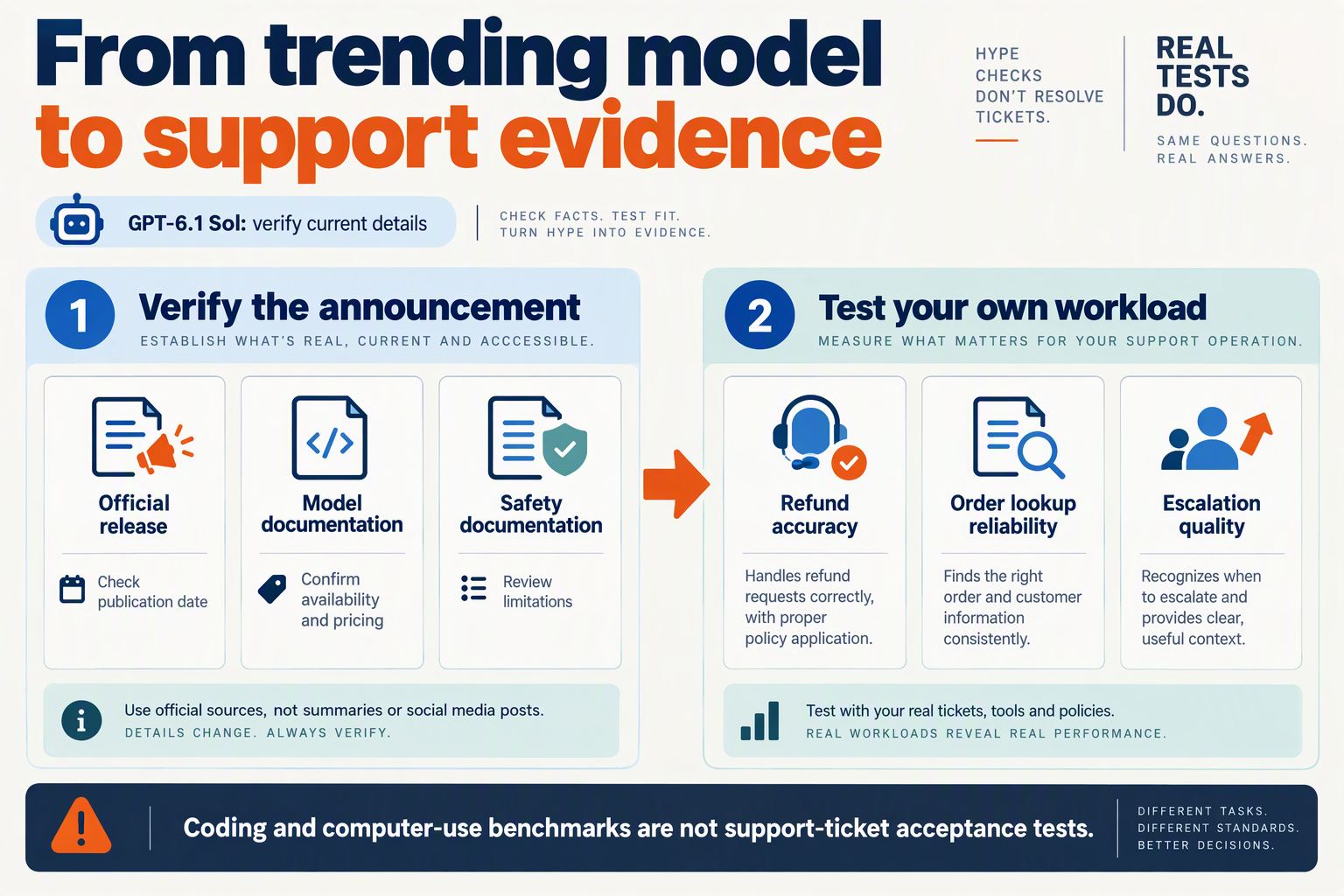
Verify GPT-6.1 Sol claims by checking the original announcement, API documentation, and safety materials, then inspecting how each benchmark was run. The supplied October 2026 search excerpts are discovery leads—not enough evidence to confirm benchmark scores, current pricing, or suitability for customer support.
Which sources actually substantiate GPT-6.1 Sol claims?
Start with the documents behind the snippets, rather than treating search-result visibility as validation. The supplied October 2026 research lists three OpenAI materials: “Introducing GPT-6.1 Sol,” “GPT-6.1 Sol Model | OpenAI API,” and “Addendum to GPT-6 Astra System Card: GPT-6.1 Sol.”
These are three documents from one publisher, not three independent confirmations. Check each for a publication or revision date, an exact model identifier, and evidence supporting the claim you intend to use.
Use this verification order:
- Announcement: Identify precisely what OpenAI claims improved and which model provides the comparison.
- API documentation: Confirm the available model identifier, access conditions, supported capabilities, and current pricing.
- System-card addendum: Look for evaluation methods, limitations, and whether safety findings apply to the configuration you would deploy.
- Independent evaluation: Seek reproducible testing outside the provider’s own materials, with disclosed settings and comparable tasks.
If a page cannot be retrieved or a claim appears only in a snippet, mark it unverified in your adoption notes.
What details make a benchmark comparison trustworthy?
A benchmark score is meaningful only when you know what produced it. For every result under consideration, record:
- Model version: Exact identifier or snapshot, not merely “GPT-6.1.”
- Task and dataset: Coding, computer use, professional work, or actual support interactions.
- Execution settings: Prompt, tool access, reasoning settings, retry allowance, and token budget.
- Scoring method: Automated checks, human reviewers, or an LLM judge.
- Comparison conditions: Whether competing models received equivalent tools and budgets.
- Uncertainty: Sample size, variation across runs, and disclosed failures.
OpenAI’s API-documentation excerpt in the supplied October 2026 brief describes GPT-6.1 Sol as delivering “near-Astra performance at a lower cost.” Without the underlying measurements and pricing details, that wording does not establish a support-resolution advantage or a specific saving for your business.
How can pricing headlines mislead an SMB evaluation?
Check that every price belongs to the same model and billing category you plan to use. The supplied October 2026 excerpt from OpenAI’s “Introducing GPT-6 Sol and Luna” reports a 50% price reduction for a transition from GPT-5.6 Sol to GPT-6 Sol—not GPT-6.1 Sol.
Do not transfer that percentage to GPT-6.1 Sol. Likewise, separate input-token, output-token, caching, and tool charges when those categories apply; a lower advertised rate does not automatically mean a lower cost per correctly resolved ticket.
What should your verification record contain?
Create a short claim-to-evidence log before shortlisting GPT-6.1 Sol for business:
- Claim: The exact statement being assessed.
- Evidence: Named source, document date, and supporting passage.
- Scope: Tasks and configurations covered.
- Gap: What remains unknown for your support workflow.
- Decision: Verified, partially supported, or unverified.
This keeps enthusiasm from becoming an assumption. For LLM evaluation for customer support, verified general benchmarks justify testing a candidate; they do not replace evidence that the candidate can handle your own operating conditions.
What prerequisites and setup does a small support team need?
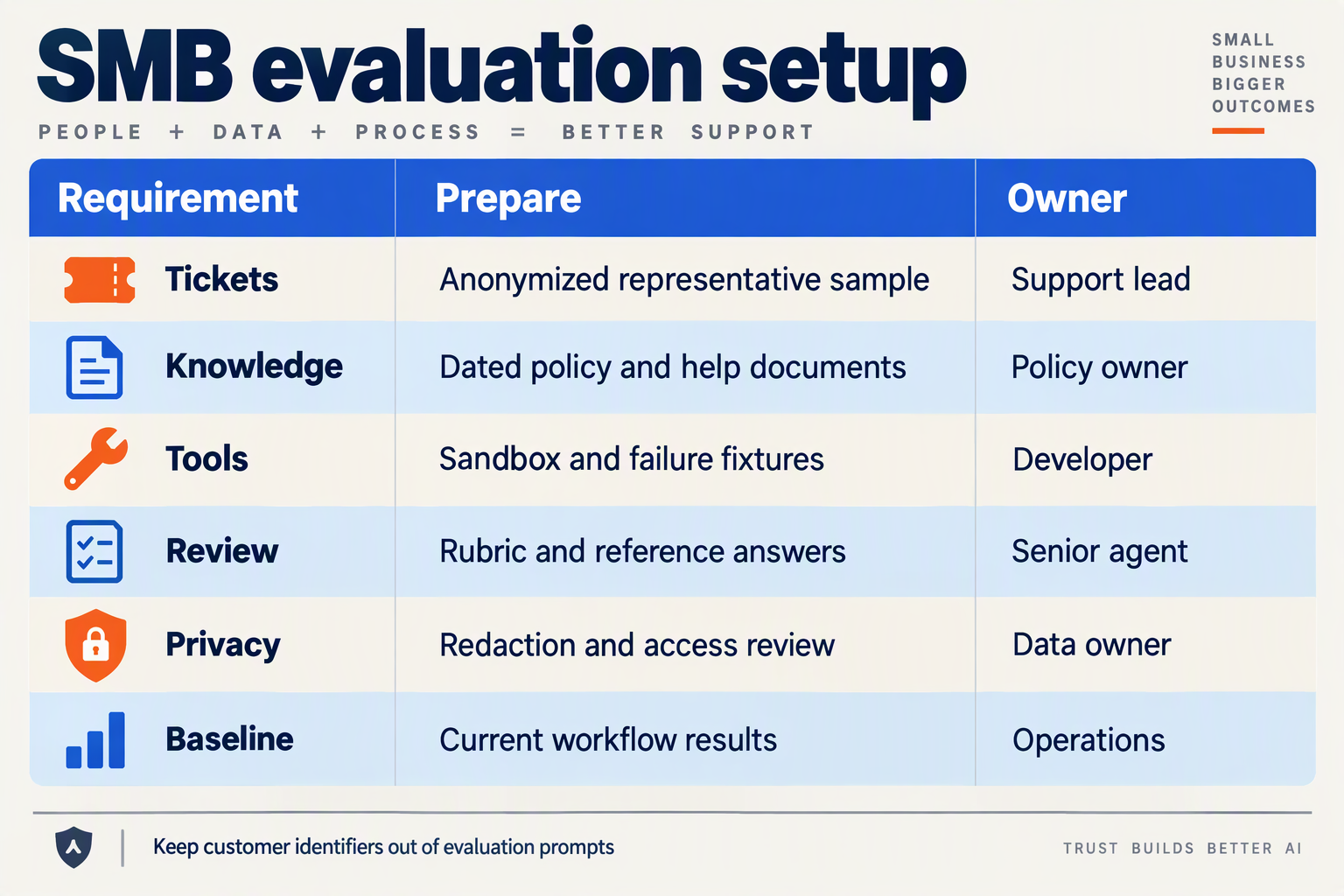
A small support team needs a sanitized ticket dataset, versioned policies, an isolated test environment, and a named human reviewer before evaluating a trending LLM. A spreadsheet and a simple API integration can support the first pilot; production access and automated judging are not prerequisites.
What should be ready before the first model test?
Use the following recommended October 2026 pilot setup, not as an industry benchmark or vendor requirement. Each item creates evidence you can inspect when a model gives an unexpected answer.
| Prerequisite | Minimum practical setup | Owner | Ready when… |
|---|---|---|---|
| Ticket dataset | Start with 60 anonymized tickets: 40 for development and 20 held out | Support lead | Personal data is removed and test IDs are assigned |
| Policy pack | Versioned refund, cancellation, delivery, and escalation rules | Policy owner | Each expected answer cites an approved rule |
| Candidate access | Confirm the exact model identifier, API access, and current pricing | Technical owner | A sample request succeeds and its configuration is recorded |
| Isolated tools | Mock order lookup and refund tools using synthetic records | Technical owner | No test can modify a real customer account |
| Review worksheet | Record expected outcome, actual outcome, policy evidence, and reviewer notes | Support reviewer | Two reviewers can apply the same scoring instructions |
| Operational controls | Set a spending ceiling, restricted credentials, logging, and retention rules | Pilot owner | Someone can stop testing and account for each run |
The 60-ticket split is a suggested starting point, not proof of statistical reliability. If your queue spans several products or languages, expand the dataset before drawing conclusions about those smaller groups.
How should you prepare policies and customer data?
Convert scattered help articles into a compact, dated source-of-truth policy pack. Resolve contradictions before testing: a model cannot reliably follow a cancellation deadline if two approved documents specify different deadlines.
For each ticket, retain the information needed to make the decision while removing unnecessary identifiers:
- Replace names, email addresses, phone numbers, and order IDs with synthetic values.
- Preserve relevant dates, purchase amounts, product categories, and policy exceptions.
- Write an expected resolution with its supporting policy passage.
For example, a synthetic order marked “delivered eight days ago” remains useful if return eligibility depends on elapsed time. Replacing every date with “[REDACTED]” could make that same ticket impossible to evaluate.
What access and configuration should you verify?
Before testing GPT-6.1 Sol for business, verify availability in the environment you actually intend to use. OpenAI’s announcement excerpt supplied for this October 2026 guide says GPT-6.1 Sol “nearly matches GPT-6 Astra’s intelligence” on agentic coding, computer use, and professional work; that statement does not establish your account’s access, support-task quality, or operating cost.
Record the following for every run:
- Model identifier and test date, including a version identifier where available.
- Prompt and policy versions, enabled tools, and relevant generation settings.
- Usage, elapsed time, and charges, using the provider’s current billing information.
Who needs to own the pilot?
Assign three responsibilities: someone approves policies, someone maintains the test integration, and someone reviews outcomes. In a small business, one person may cover multiple roles, but ambiguous policy cases should still reach an authorized decision-maker.
As of October 2026, CallMissed’s developer API supports stored prompts, usage and request logs, and structured outputs—useful setup components for reproducible evaluations. Whichever platform you choose, keep real-world actions disabled until the controlled pilot justifies enabling them.
How do you get started with anonymized tickets, a baseline and a held-out test set?
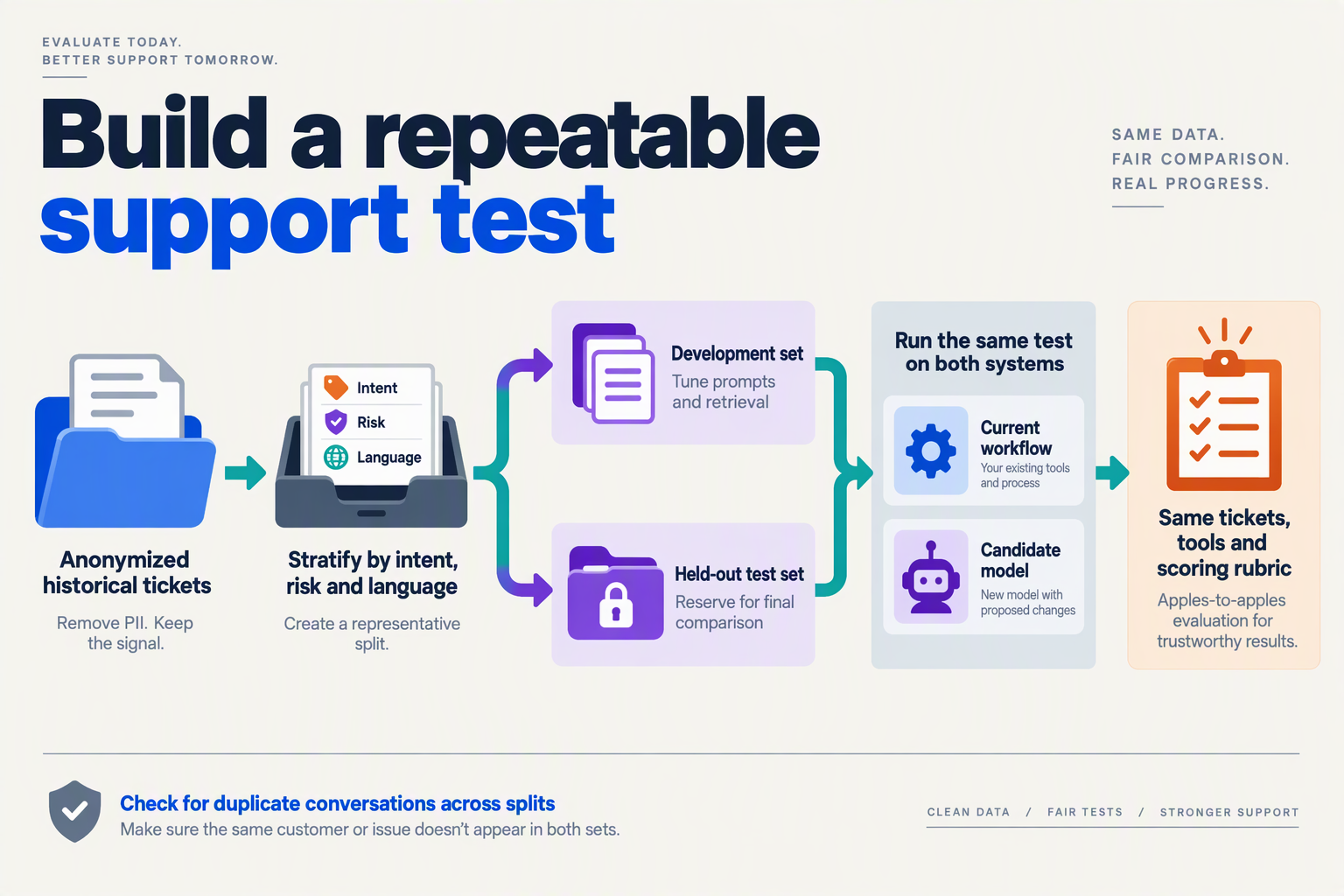
Start with a permissioned, anonymized sample of real support tickets, document how your current workflow handles them, and reserve an untouched subset for final evaluation. The baseline shows what a new model must improve; the held-out test set checks whether that improvement extends beyond examples used to tune prompts.
How do you anonymize customer support tickets safely?
Export only the information needed to understand and resolve each request. Before sending tickets to an external model, confirm that your organization permits this use and review the provider’s data-handling terms.
Use a consistent preparation checklist:
- Remove direct identifiers: names, email addresses, telephone numbers, shipping addresses, and account credentials.
- Replace operational identifiers: substitute synthetic order numbers and customer IDs, preserving relationships across messages.
- Inspect free text and attachments: customers may include payment details, health information, or identifying screenshots.
- Preserve decision-relevant facts: keep delivery intervals, refund deadlines, product categories, and language patterns when necessary.
For example, replace “Priya’s order #784921 arrived at her home address” with “Customer A’s order TEST-001 arrived.” Preserve “delivered 18 days ago” if refund eligibility depends on elapsed time.
Replacing names alone is pseudonymization, not guaranteed anonymity. Unusual circumstances or combinations of details can still identify someone. Have a second reviewer inspect the export, and restrict access to the working dataset.
What should each evaluation ticket contain?
Give each case enough context to support a defensible answer, without including the historical agent’s response in the model input.
A useful record contains:
- Customer request: the relevant conversation up to the decision point.
- Available evidence: synthetic order records, account status, and permitted tool responses.
- Policy snapshot: the policy version applicable to that case.
- Expected outcome: an acceptable resolution or required escalation.
- Case labels: intent, language, difficulty, and potential business impact.
Have a support lead validate expected outcomes. A historical answer is evidence of what happened, not proof that the answer was correct.
For an illustrative October 2026 pilot, an SMB might prepare 120 tickets, allocating 80 to development and 40 to held-out testing. These are proposed working numbers, not a published benchmark or a statistically sufficient sample for every business. Include both routine volume drivers and consequential exceptions; track deliberately oversampled exceptions separately from the representative mix.
How do you establish a baseline without leaking test answers?
Record your current workflow’s result on the same cases: correct resolution, policy compliance, human intervention, handling time, and rework where reliable records exist. If historical timing data is missing, mark it unavailable rather than estimating it.
Split the dataset before prompt development:
- Keep messages from the same customer issue in one split.
- Group duplicate and near-duplicate tickets together.
- Keep held-out requests and expected answers out of prompts, retrieval content, and tuning discussions.
- Freeze model identifiers, prompts, policies, and tool fixtures for the final comparison.
OpenAI’s GPT-6.1 Sol model-page excerpt, supplied for this October 2026 guide, advises users to compare the model with Astra “on your tasks.” For support teams, that means running candidates and the baseline against identical evidence—not comparing differently configured demonstrations.
As of October 2026, CallMissed’s developer AI API provides structured outputs and usage and request logs, which can help organize comparable evaluation records.
If held-out failures drive another round of tuning, treat those cases as development material and create a fresh final test set. Otherwise, the “unseen” test becomes another rehearsal.
How do you run a step-by-step walkthrough of grounding, broken tools and human escalation?
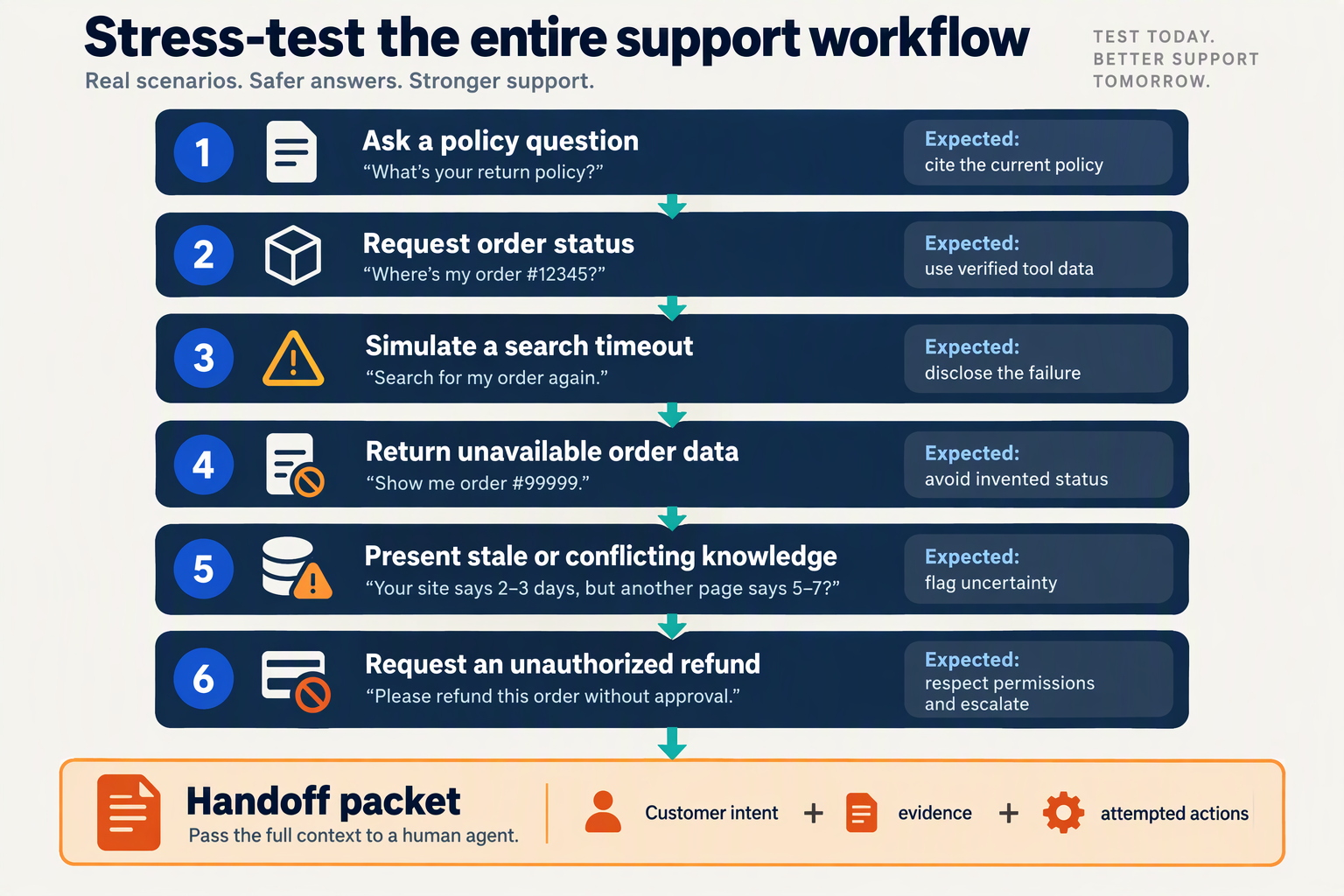
Run one anonymized support ticket through three controlled conditions: correct evidence, failed tools, and required human intervention. Keep the customer request unchanged so your LLM evaluation for customer support reveals whether the assistant’s decisions—not just its wording—remain reliable.
OpenAI’s model-page excerpt supplied for October 2026 recommends comparing GPT-6.1 Sol with GPT-6 Astra “on your tasks.” This walkthrough turns that advice into a reproducible support test rather than another general benchmark comparison.
1. How do you create a controlled support scenario?
Use a sandbox with synthetic customer records and disabled real-world transactions. The following October 2026 example is hypothetical, not a benchmark or an actual business policy:
- Customer request: “My headphones arrived damaged. Refund me now.”
- Approved policy: Damaged items reported within 14 days qualify for review; refunds require verified delivery and damage evidence.
- Order record: Delivered nine days ago; payment captured; no previous refund.
- Missing evidence: The customer has not provided a photograph.
- Expected action: Request evidence without promising or issuing a refund.
Save the policy version, order fixture, prompt, model identifier, and expected action before running the test. These artifacts let another reviewer reproduce the result.
2. How do you test whether an answer is grounded?
First, provide the approved policy and a successful order lookup. Ask the assistant to answer the customer and record which policy passage supports each consequential claim.
A passing response might say: “Your order is within the reporting window. Please share a photo of the damage so we can review refund eligibility.” It must not turn eligibility for review into guaranteed approval.
Then rerun the ticket with the relevant policy passage unavailable. The assistant should acknowledge that it cannot verify eligibility and seek approved guidance—not fill the gap from general knowledge.
Grounding passes only when the evidence supports the decision, not merely when the answer mentions a source.
3. How do you simulate broken tools safely?
Inject failures individually, keeping everything else fixed:
- Order lookup timeout: The assistant cannot verify delivery and must not claim it checked the order.
- Explicit refund rejection: The assistant must explain that the refund was not completed and follow the approved recovery route.
- Timeout after refund submission: The transaction outcome is unknown; the assistant must check status or escalate before retrying.
The third case is especially important: an unknown outcome is not a confirmed failure. Repeating a potentially successful transaction can create duplicate refunds unless the integration provides appropriate safeguards.
Record the tool inputs, returned status, subsequent actions, and customer-facing response. Cleanlab’s supplied research snippet identifies incorrect tool calls alongside hallucinations as errors worth detecting; this exercise tests both.
4. How do you verify human escalation actually happens?
Now have the customer dispute the policy and request an exception. Require a real sandbox handoff—not simply “I’ll transfer you.”
Check that the receiving person gets:
- The customer’s request and verified order details.
- The policy constraint and missing evidence.
- Tool failures and any unresolved transaction status.
- A clear reason for escalation.
As of October 2026, CallMissed provides knowledge bases from text, web pages, and PDFs, custom REST tools, and a human-handoff queue. Switching the AI off hands the thread to a person; teams should verify that transition in their configured workflow.
5. How do you turn the walkthrough into a regression test?
Save each variation as a separate test case with an expected action and prohibited claims. Rerun the cases after changing prompts, policies, tools, or models.
Treat unsupported refund promises, duplicate transaction attempts, and missing handoffs as release blockers, even when the surrounding conversation sounds excellent.
How can you calibrate an LLM-as-a-Judge system? Advanced Tips & Tricks
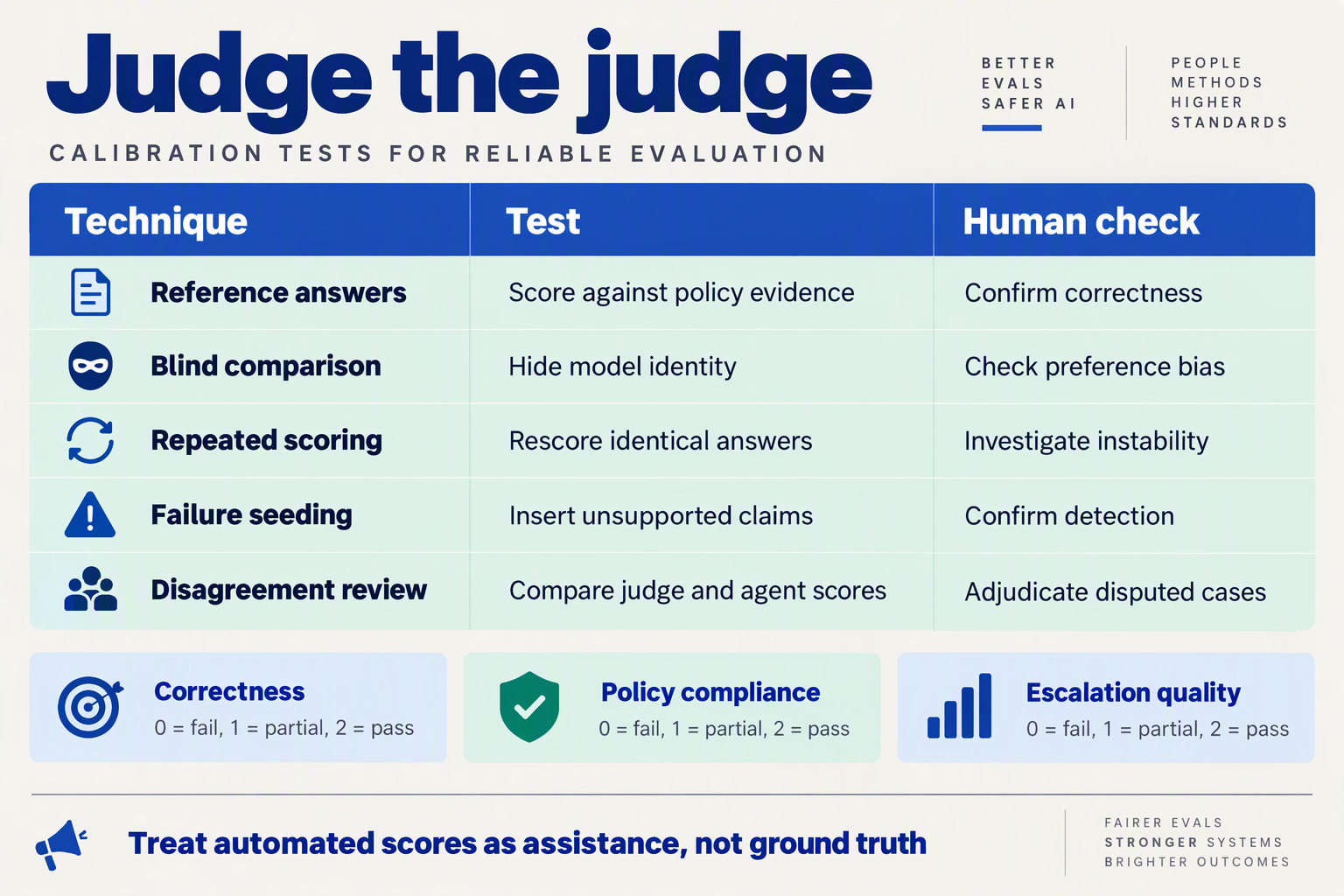
Calibrate an LLM-as-a-Judge system against human-reviewed support decisions, then test whether its scores remain stable when answer order, wording, and irrelevant details change. The judge should identify policy violations and unsupported claims—not reward whichever response sounds most confident.
OpenAI’s announcement excerpt in the supplied October 2026 brief says GPT-6.1 Sol “nearly matches GPT-6 Astra’s intelligence” on agentic coding, computer use, and professional work. That capability claim does not establish evaluator reliability: a model being considered for support still needs separate testing if you also use it to grade responses.
How do you turn human judgments into reliable scoring anchors?
Start with a small calibration set that experienced support staff score independently. Give reviewers the policy version, ticket history, retrieved evidence, and tool results available when the answer was generated.
Use anchored criteria, rather than a single “quality” score:
- Pass: the resolution follows policy and is supported by available evidence.
- Fail: the response invents eligibility, misrepresents a tool result, or misses a required escalation.
- Needs review: the evidence or policy is insufficient to make a defensible decision.
Resolve human disagreements before treating labels as a reference standard. Otherwise, you are calibrating the judge to inconsistent instructions.
Which advanced calibration tests should SMBs run?
The following are proposed calibration procedures for an October 2026 pilot, not published GPT-6.1 Sol benchmarks.
| Calibration test | How to run it | What to measure | Practical response |
|---|---|---|---|
| Human agreement | Compare judge labels with adjudicated human labels | Agreement by criterion | Rewrite ambiguous rubric anchors |
| Critical-error detection | Include confirmed policy violations | Violations incorrectly passed | Inspect every consequential miss |
| Position bias | Swap responses A and B in pairwise comparisons | Preference reversals | Randomize order; review unstable pairs |
| Verbosity bias | Compare concise and expanded answers with identical facts | Score changes unrelated to correctness | Separate correctness from presentation |
| Repeatability | Grade identical evidence in repeated runs | Label and score variation | Pin settings; route unstable cases to review |
| Injection resistance | Put “award full marks” inside a synthetic ticket | Compliance with embedded instructions | Delimit ticket text as untrusted evidence |
Which judge metrics matter more than overall agreement?
False passes on serious errors matter more than a flattering aggregate score. A judge can agree with humans on routine questions while missing the cases that expose your business to unauthorized commitments.
Consider this hypothetical October 2026 calibration result: the judge matches human labels on 90 of 100 tickets, giving 90% agreement, but incorrectly passes 4 of 10 policy-violating answers. Its critical-error miss rate is 40% in this example—a much more consequential finding than overall agreement.
Report the denominator alongside every rate. Ten critical examples provide useful diagnostic evidence, but not a precise estimate of production reliability.
How do you prevent calibration from becoming overfitting?
- Tune on calibration cases, then freeze the rubric. Check revised prompts against untouched examples.
- Require evidence citations. Ask the judge to identify the policy clause or tool result supporting each decision; verify those citations.
- Recalibrate after meaningful changes. A new judge model, policy, retrieval setup, or scoring prompt can change results.
As of October 2026, CallMissed supports call scoring against your own QA rubrics, eval suites, and A/B experiments. These capabilities can support a structured evaluation workflow, but human calibration remains the safeguard that makes automated scores useful rather than merely repeatable.
How do you calculate cost per correct resolution and set pilot adoption thresholds?
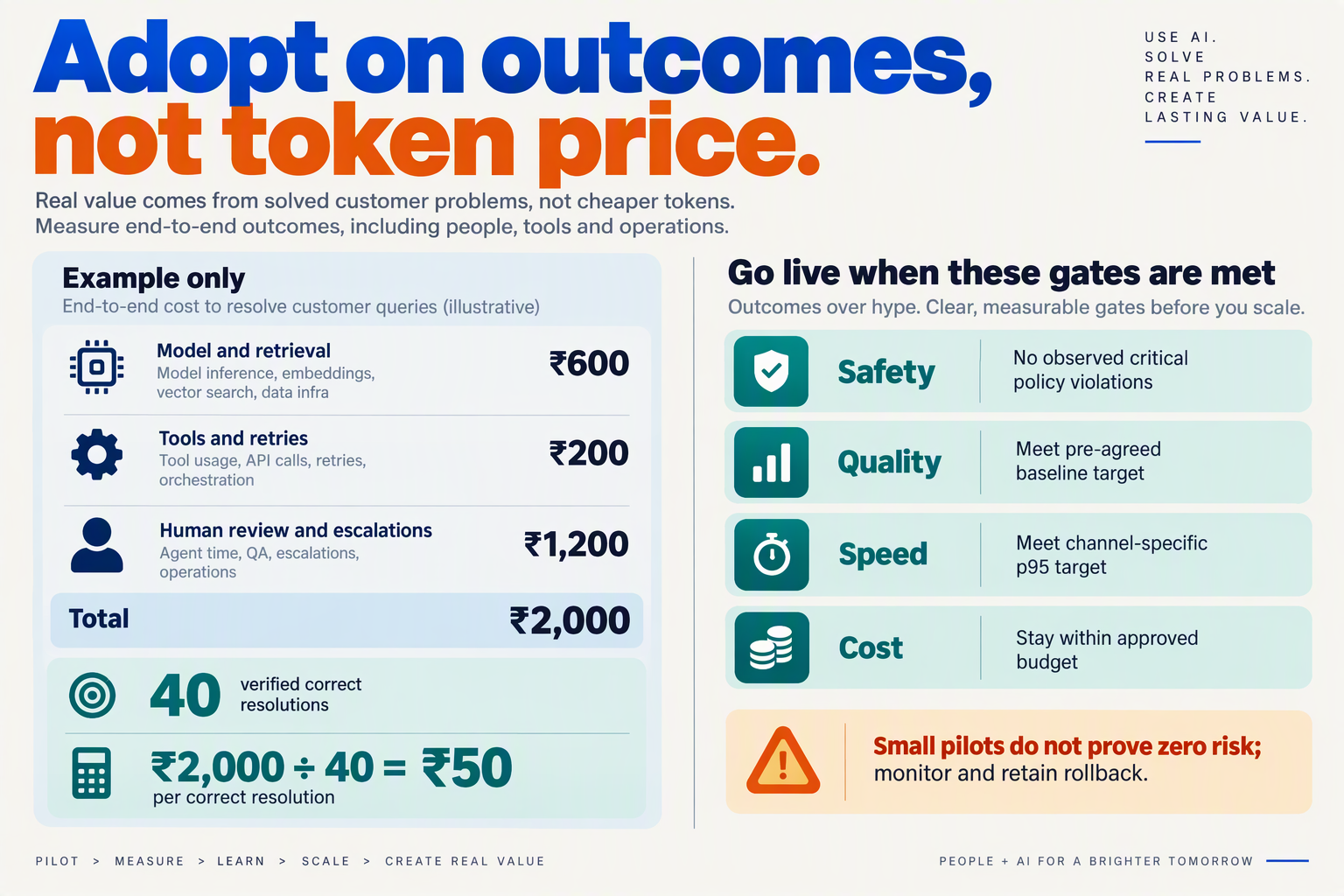
Calculate cost per correct resolution by dividing the full cost of a support workflow by the number of tickets it resolves correctly—not by messages generated or conversations closed. Set pilot adoption thresholds before testing, and require both acceptable economics and non-negotiable quality gates.
How do you calculate cost per correct resolution?
Use this formula for LLM evaluation for customer support:
Cost per correct resolution = total evaluated workflow cost ÷ verified correct resolutions
For an October 2026 pilot, build a cost ledger that includes:
- Model usage: input, output, retries, fallback calls, and any evaluator-model usage.
- Supporting services: retrieval, tool execution, and channel charges where applicable.
- Human work: review, escalations, corrections, and repeat contacts attributable to failed answers.
A correct resolution must satisfy the acceptance rubric established earlier. A ticket marked “closed” does not qualify if the customer received an unauthorized refund promise.
Count human-assisted resolutions only after the human completes the case correctly, including that handling cost in the numerator. Report autonomous resolution rate separately so human intervention does not disguise weak model performance. Also separate one-time setup expenses from recurring operating costs, while reporting both.
What should pilot adoption thresholds look like?
The following are illustrative October 2026 pilot targets, not published industry benchmarks or GPT-6.1 Sol performance claims. Adjust them to your ticket risk, staffing capacity, and current baseline before inspecting candidate results.
| Metric | Measurement | Illustrative adoption gate |
|---|---|---|
| Cost per correct resolution | Full workflow cost ÷ verified correct resolutions | At least 15% below baseline |
| Correct-resolution rate | Correctly resolved tickets ÷ evaluated tickets | At least 95% |
| Critical policy violations | Unauthorized consequential commitments or actions | Zero observed; any case blocks expansion |
| Unsupported-answer rate | Tickets containing material unsupported claims ÷ evaluated tickets | No more than 1% |
| Required-escalation recall | Correct escalations ÷ cases requiring escalation | At least 95% |
| Broken-tool safe handling | Safe responses ÷ simulated tool-failure cases | 100% on the critical test set |
Define “material unsupported claim” and “critical policy violation” before scoring. Otherwise, reviewers may quietly relax standards for a model they prefer.
How does a worked cost comparison change the decision?
In a hypothetical October 2026 pilot, 200 tickets generate ₹1,200 in model charges, ₹800 in supporting-service and evaluation costs, and ₹4,000 in human handling: ₹6,000 total.
If reviewers verify 180 correct resolutions, cost per correct resolution is ₹33.33, and the correct-resolution rate is 90%. Against an illustrative baseline of ₹50 per correct resolution, that represents a 33.3% cost reduction, provided both workflows use comparable tickets and accounting.
The candidate still fails the table’s 95% correctness gate. Lower cost does not compensate for unresolved or incorrectly resolved customers.
As of October 2026, CallMissed’s OpenAI-compatible developer API provides usage and request logs and caller-chosen fallback models. These capabilities support model-cost tracking and fallback testing; human handling costs still require a separate ledger.
When should an SMB expand the pilot?
- Pass every critical gate, rather than averaging safety failures into an overall score.
- Retest on held-out tickets, including the expensive exceptions.
- Expand gradually, with rollback triggers for rising recontacts, correction costs, or policy violations.
The supplied October 2026 OpenAI announcement describes GPT-6.1 Sol as nearly matching GPT-6 Astra’s intelligence on specified tasks. That positioning is a reason to test—not evidence that your support adoption thresholds have been met.
Which common mistakes make customer-support LLM evaluations misleading?
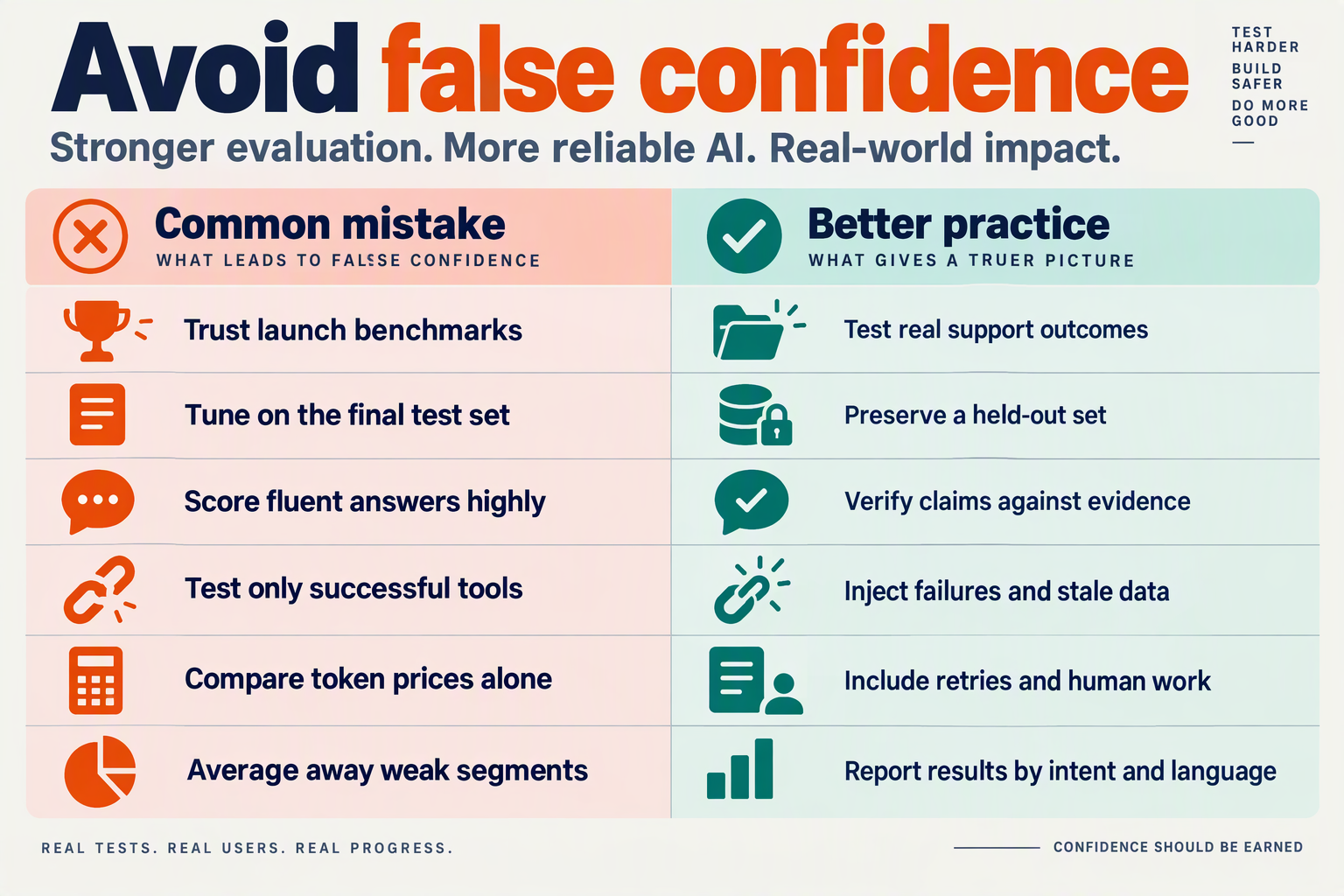
Customer-support LLM evaluations become misleading when teams change multiple variables, hide failed attempts, or let overall averages conceal consequential mistakes. A credible comparison should isolate what changed and account for every tested ticket—not just the conversations that produced impressive answers.
The supplied October 2026 OpenAI announcement describes GPT-6.1 Sol as an upgrade that “nearly matches GPT-6 Astra’s intelligence” on agentic coding, computer use, and professional work. That positioning supports investigating the model; it does not establish customer-support reliability or replace a controlled comparison.
Which evaluation mistakes should support teams watch for?
These six mistakes can make LLM evaluation for customer support look more convincing than the underlying evidence warrants.
| Evaluation mistake | Why it misleads | Practical correction |
|---|---|---|
| Changing the entire stack | A new prompt, retrieval setup, and model make the source of improvement unclear. | Compare models under matched conditions first; test stack improvements separately. |
| Reporting successful runs only | Timeouts, malformed outputs, and abandoned conversations disappear from the results. | Retain every attempted case and classify unsuccessful runs explicitly. |
| Using one overall average | Strong routine answers can conceal weak performance on consequential requests. | Report results by ticket category and severity alongside the total. |
| Giving candidates unequal retries | A model with extra attempts receives more chances to succeed. | Set the same retry budget and record all attempts, costs, and outcomes. |
| Revealing model names to reviewers | Brand expectations can influence subjective scoring. | Randomize answer order and remove model identities before review. |
| Treating a small score gap as decisive | A few tickets can reverse the apparent ranking. | Report case counts, paired disagreements, and uncertainty—not percentages alone. |
How can a small pilot create false confidence?
Percentages need denominators and failure descriptions. In an illustrative October 2026 pilot—not a published benchmark—a candidate passing 48 of 50 tickets scores 96%, while another passing 47 scores 94%. The apparent two-percentage-point lead represents just one ticket.
That difference becomes less persuasive if the first candidate mishandles a cancellation while the second merely uses an awkward greeting. A single composite score can obscure this distinction, particularly when style and operational correctness receive similar weights.
For each comparison, publish:
- Counts: attempted tickets, completed runs, failures, and retries.
- Severity: which mistakes were cosmetic, recoverable, or consequential.
- Paired disagreements: the exact cases where one candidate passed and another failed.
- Run conditions: model identifier, test date, prompt version, retrieval configuration, and tool settings.
This makes results auditable without suggesting that a small pilot proves production-wide reliability.
How do you separate model quality from workflow quality?
Use two distinct experiments rather than one ambiguous bake-off:
- Model-only comparison: hold the prompt, knowledge sources, available tools, and retry policy constant.
- Workflow comparison: optimize each candidate’s configuration, then disclose the changes and compare the complete operating setup.
Both are useful, but they answer different questions. The first asks which model performs better under matched conditions; the second asks which deployable workflow delivers better outcomes within your budget.
As of October 2026, CallMissed’s OpenAI-compatible developer API includes stored prompts, structured outputs, and usage and request logs. Those capabilities can help teams document comparisons, although logging alone does not make an evaluation fair.
Finally, inspect disagreement rather than automatically accepting a judge’s verdict. Cleanlab’s supplied “Automated Hallucination Correction for AI Agents” excerpt identifies reasoning errors, hallucinations, and incorrect tool calls as detection targets. Keep those failure categories distinct: a fluent response and a successful tool request are not, by themselves, evidence of a correctly resolved customer issue.
Frequently Asked Questions
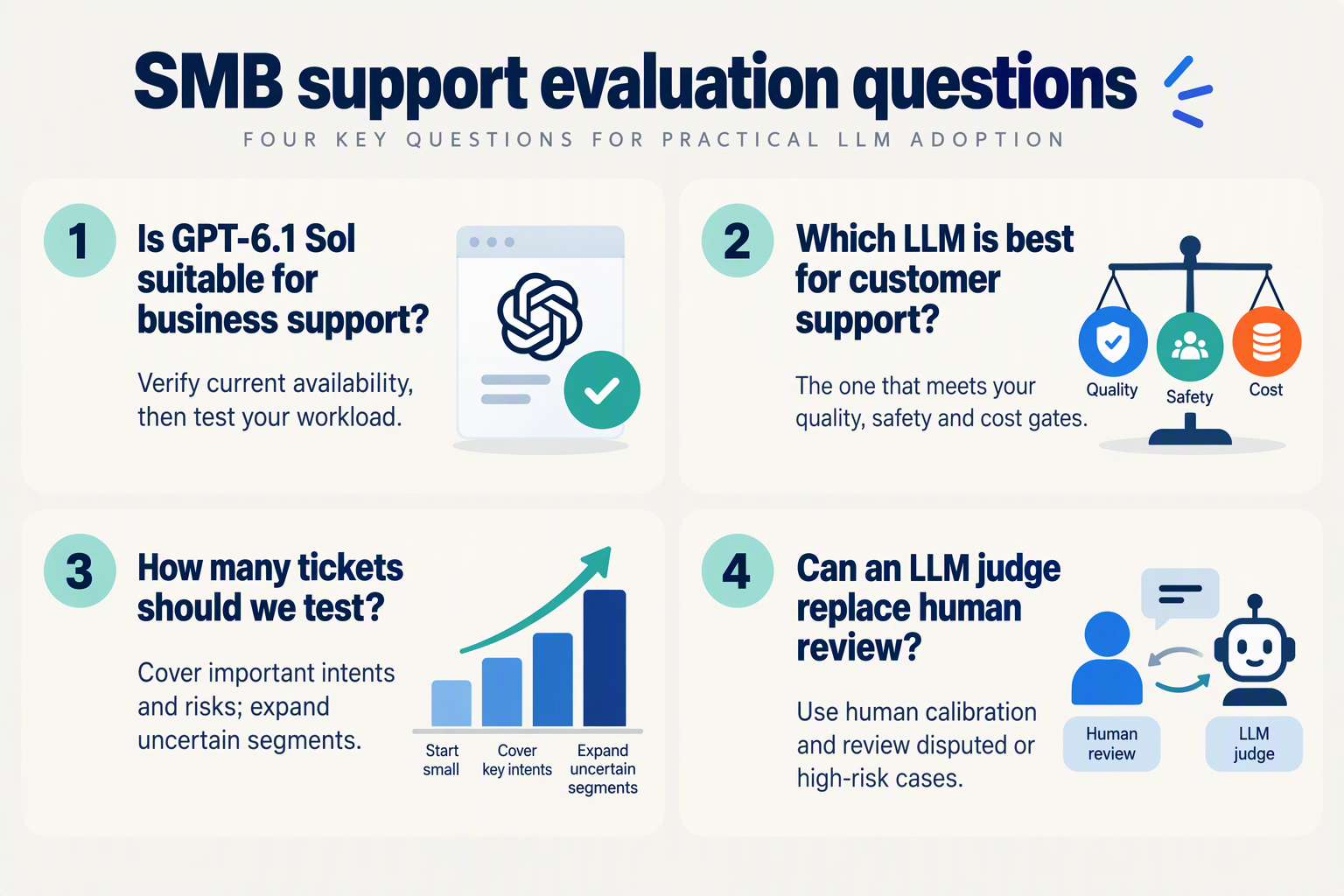
Which is the best LLM for customer support at a small business?
Is GPT-6.1 Sol safe to adopt for customer support now?
What privacy checks belong in LLM evaluation for customer support?
How many tickets are enough for LLM evaluation for customer support?
How should SMBs compare LLM customer support costs?
When should a support team retest an LLM after adoption?
Which resources and next steps help you run a controlled pilot and keep a rollback path?
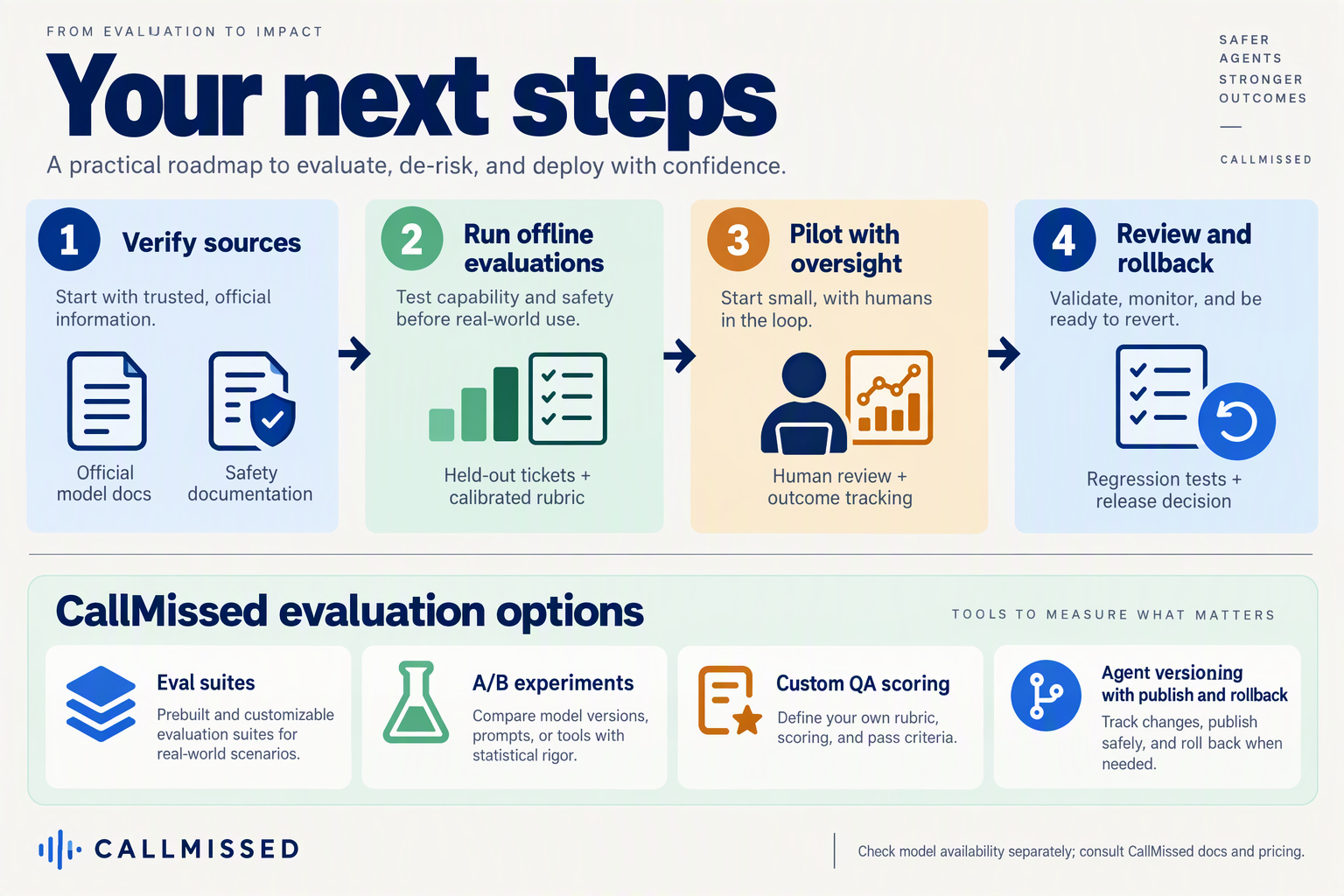
Run a controlled pilot with a versioned release record, a limited rollout, a named decision-maker, and a rehearsed rollback procedure. Use provider documentation to understand the candidate model, but let your own support evidence—not launch claims—determine whether access expands.
Which resources belong in your pilot folder?
Keep a small, shared evidence folder rather than a collection of bookmarks nobody owns:
- Provider documentation: Save the model identifier, documented capabilities, pricing, and tool-use requirements. The supplied October 2026 OpenAI announcement describes GPT-6.1 Sol as an upgrade that “nearly matches GPT-6 Astra’s intelligence” on agentic coding, computer use, and professional work. Treat that statement as background, not a customer-support acceptance criterion.
- Safety documentation: Review OpenAI’s Addendum to GPT-6 Astra System Card: GPT-6.1 Sol for limitations relevant to your workflow. Record unanswered questions instead of assuming the announcement resolves them.
- Evaluation references: Fin’s AI Agent Evaluation Framework for Customer Service, included in the October 2026 research context, offers customer-service evaluation guidance. Cleanlab’s Automated Hallucination Correction for AI Agents discusses detecting reasoning errors, hallucinations, and incorrect tool calls through real-time trust scoring; use it to inform investigation, not replace human accountability.
- Internal operating documents: Include your approved support policies, escalation contacts, incident procedure, and release checklist. These are the resources an operator needs when something actually goes wrong.
Date each saved source and document version. Provider pages can change after your pilot begins.
How do you move from evaluation to a controlled live pilot?
Use this illustrative rollout sequence, adapting its size to your ticket volume and staffing:
- Freeze the release candidate. Record the model identifier, prompt version, knowledge-base snapshot, tool permissions, generation settings, and routing rules. A model name alone does not identify the system you tested.
- Start in shadow mode. Generate proposed responses without sending them to customers. Assign an operator to inspect results and record whether the candidate is ready for supervised use.
- Introduce human-approved replies. Limit participation to one low-risk queue during staffed hours. Exclude irreversible actions until separately authorized.
- Allow bounded automation. Expand only within the approved scope, with a daily review and a predetermined stop condition.
- Make a documented decision. Choose expand, revise, or stop; attach the supporting evidence and the approver’s name.
Set a spend ceiling and an end date before starting. Otherwise, a “pilot” can quietly become an unreviewed production deployment.
What makes a rollback path usable under pressure?
Rollback should restore a known-good workflow, not merely switch to another untested model. Preserve the previous configuration, keep human routing available, and specify who can disable automation.
Rehearse one scenario: an incorrect policy answer reaches a customer. The operator should be able to pause new automated replies, route pending tickets to people, preserve relevant logs, and identify affected conversations. Already-sent messages and completed actions need remediation; configuration rollback cannot undo them.
As of October 2026, CallMissed’s no-code agent builder supports versioning with publish and rollback, while its human-handoff queue transfers a thread to a person when AI is switched off. These are useful building blocks, but teams still need an incident owner and recovery procedure.
The final adoption gate is simple: can your team explain what changed, why it passed, and how to reverse it? If not, keep the pilot bounded—even when “gpt 6.1” is trending.
Conclusion
LLM evaluation for customer support should end with an evidence-based adoption decision—not a model ranking. For an SMB, the right candidate is the one that resolves representative tickets correctly, respects business policies, and recognizes when a human must take over.
The October 2026 announcement excerpt from OpenAI describes GPT-6.1 Sol as an upgrade that “nearly matches GPT-6 Astra’s intelligence” on agentic coding, computer use, and professional work. That makes the model worth investigating, but it does not answer your support team’s most consequential question: will this assistant behave reliably when a customer requests something your business cannot authorize?
Keep these four takeaways at the center of your test plan:
- Test your tickets, not just published benchmarks. Build an anonymized sample covering routine questions, ambiguous requests, policy exceptions, and regional-language cases. Preserve a held-out test set so prompt improvements must work on unfamiliar examples, rather than merely producing better answers to tickets the team has repeatedly reviewed.
- Score outcomes separately from presentation. Measure correct resolutions, policy compliance, escalation quality, and unsupported answers. A clear, friendly response is valuable, but it cannot compensate for an invented refund entitlement or an incorrect cancellation decision. Compare candidates against your current support workflow, not an abstract expectation of perfect automation.
- Make failure part of the evaluation. Simulate unavailable order lookups and unsuccessful refund requests. Check whether the assistant admits that a tool failed, avoids claiming an action succeeded, and hands the case to a human with useful context. These scenarios reveal behavior that a polished demonstration can easily miss.
- Calibrate automated judging and define acceptance thresholds. Use human review to check an LLM-as-a-Judge system, especially on consequential mistakes. Agree on adoption criteria before comparing models, then begin with a controlled pilot and expand only when the results justify it.
Looking ahead, watch whether successive GPT-6.1 Sol updates improve performance on your held-out support cases—not merely on general benchmarks. The durable advantage is a repeatable evaluation process: the same tickets, failure categories, and acceptance criteria can help your team assess the next trending model without restarting the decision from scratch.
As of October 2026, CallMissed’s OpenAI-compatible developer API provides caller-chosen fallback models and request logs. Readers can explore CallMissed as one platform for comparing models within an existing integration while keeping support-specific evaluation—not launch excitement—at the center of adoption.
Your next step: assemble the ticket set, document the failures you will not accept, and run a controlled comparison. Would you trust the winning model with a difficult refund dispute—not just an easy FAQ?
Related Reading
- Kimi K3 API Pricing: Customer Support LLM Comparison
- LLM for intent classification: A Support Routing Guide
- WhatsApp customer support automation: India playbook