
Kimi K3 API Pricing: Customer Support LLM Comparison


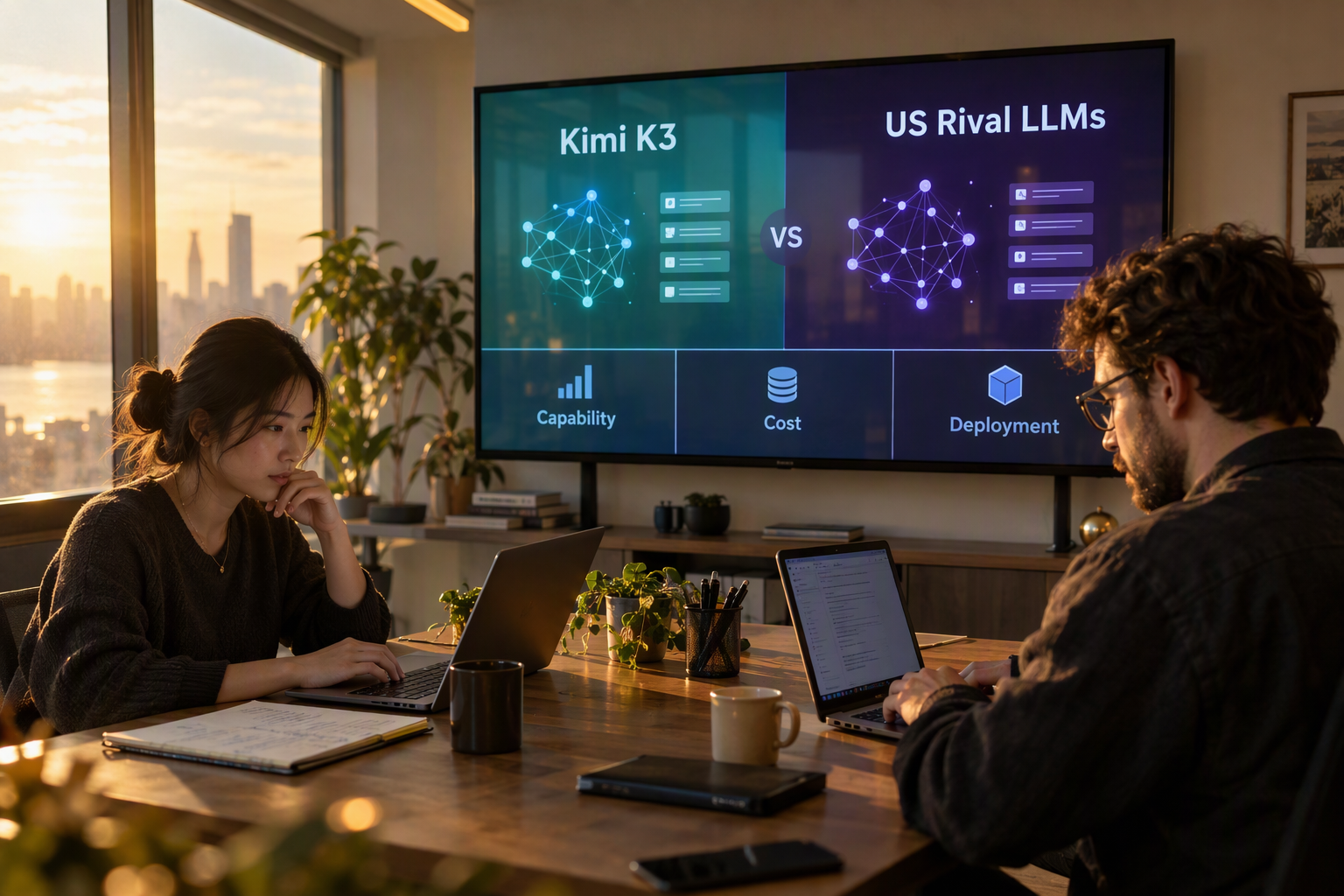
Evaluate Kimi K3 API pricing against support resolution quality, hidden operating costs and deployment demands with a practical testing framework.
Kimi K3 API Pricing: Customer Support LLM Comparison
Can a 2.8-trillion-parameter model make customer support cheaper without making answers less reliable? Kimi K3 API pricing matters only alongside resolution quality, response speed and deployment requirements—not as an isolated token rate.
As of October 2026, the supplied reporting from The Hindu describes Moonshot AI’s Kimi K3 as an open model with 2.8 trillion parameters, while noting Moonshot’s acknowledgement that its overall performance trails powerful proprietary US models. That makes the debate about whether China’s latest AI equals US rivals more nuanced than a benchmark headline suggests—and more useful for businesses choosing a customer-support LLM.
What should a customer-support LLM comparison measure?
For support teams, the meaningful question is not simply whether Kimi K3 matches a rival on reasoning or coding. It is whether the model can answer a policy question accurately, retrieve the right order information, execute an authorised action and recognise when a human should take over.
The distinction matters because a convincing answer can still be operationally wrong. Consider a customer requesting a refund outside the standard return window: the model must distinguish an exception permitted by company policy from an exception it has merely invented. A polished explanation cannot compensate for an unauthorised refund.
This comparison will therefore examine three connected trade-offs:
- Capability: Grounded answers, reliable tool use, multilingual conversations and appropriate escalation.
- Cost: Input and output charges, conversation length, retries, retrieval overhead and human review.
- Deployment: Hosted access versus open-weight deployment, integration effort, data handling and operational responsibility.
As of October 2026, CallMissed’s verified product information lists an OpenAI-compatible developer API with Moonshot among its catalogue providers, illustrating how unified gateways can simplify integration without establishing that any particular Kimi release is available.
Why does token pricing alone miss the real cost?
A model with a lower token rate can still produce a more expensive support workflow if it needs longer prompts, generates unnecessarily lengthy replies or requires repeated corrections. Conversely, a higher-priced model may justify its cost when it completes a difficult interaction accurately with fewer retries.
Imagine comparing models on the same collection of anonymised billing, delivery and account-access tickets. Alongside model charges, record whether each answer follows policy, whether tool calls succeed and whether escalation happens at the right moment. That produces a decision grounded in your workload rather than a vendor’s strongest benchmark.
We will also separate reported model capabilities from verified commercial terms. The supplied context does not establish official Kimi K3 API rates, so this comparison will not invent a price advantage. Instead, it will explain what pricing evidence to request, which support behaviours to test and how to judge whether a new model genuinely improves your cost per successfully resolved conversation.
At a Glance: Is Kimi K3 Better for Support? Verify Quality, Total Cost and Deployment Before Choosing
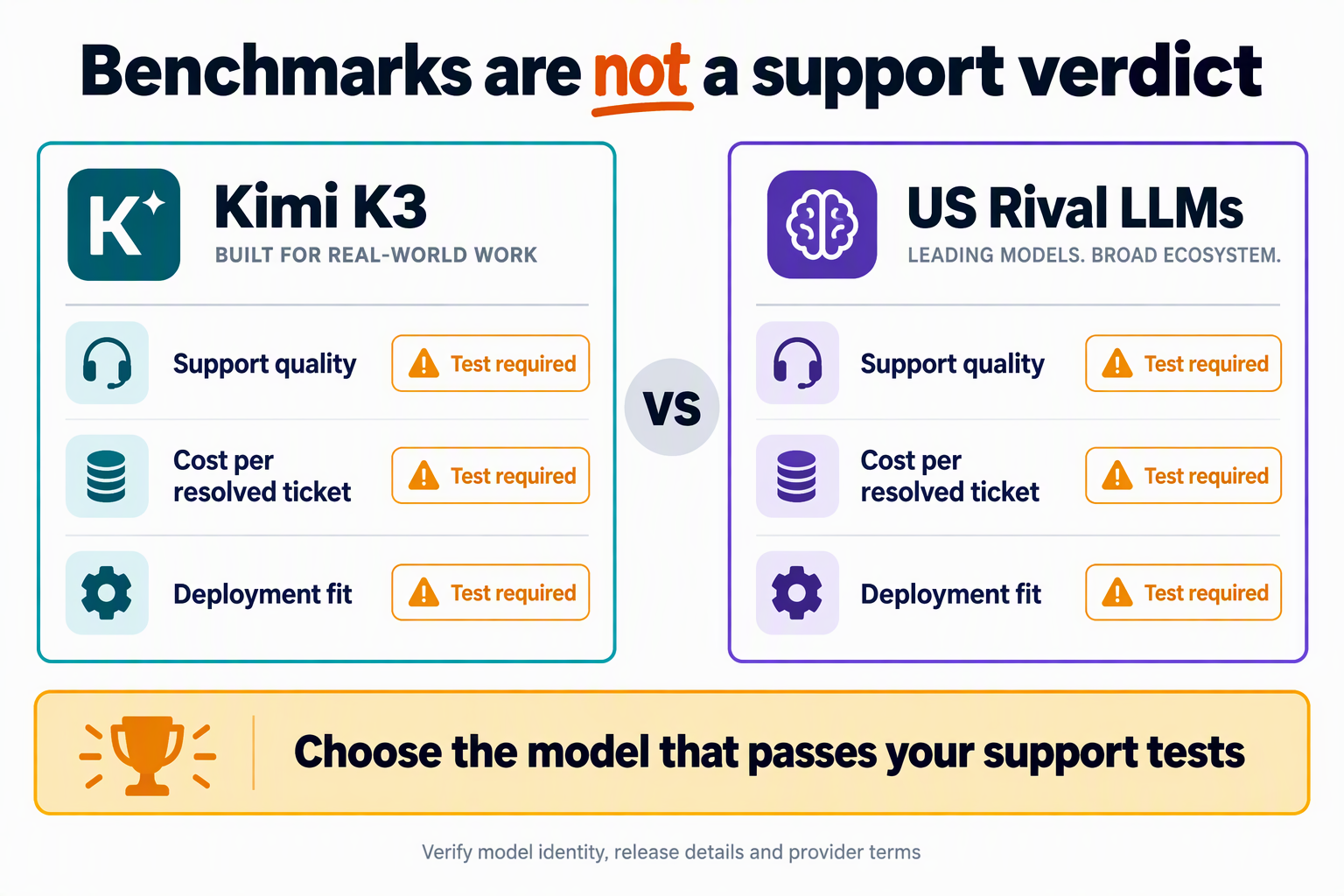
Kimi K3 is a candidate to test, not a proven better choice for customer support. As of October 2026, the supplied reporting does not establish independently measured support-resolution quality or verified Kimi K3 API pricing.
What should teams verify before choosing Kimi K3?
- Kimi K3 — evidence quality: The Hindu’s reporting, available in the supplied October 2026 context, distinguishes Moonshot AI’s “open model” from an “open-source model.” Before treating openness as a deployment advantage, check the actual licence, commercial-use permissions, available weights and documentation; the label alone does not establish what your business can legally or practically deploy.
- US rivals — comparison fairness: Compare Kimi K3 with the exact OpenAI or Anthropic model version your team would purchase, using identical retrieval documents, tools and output limits. The supplied October 2026 summaries describe competitive benchmark results but provide no independently verified customer-support win rate, so neither nationality nor a leaderboard position establishes the better operational choice.
- Quality — a controlled support test: Start with an illustrative 200-ticket evaluation, split across billing, delivery, account access and policy exceptions. Score answers against approved reference outcomes, not fluency alone. Record unauthorised actions separately from ordinary mistakes: one incorrect refund or account change can matter more than several awkward but factually correct replies.
- Languages — test your actual conversations: For an India-facing pilot, include English, Hindi and Hinglish, plus whichever regional languages customers actually use. Measure policy accuracy and tool completion separately for each language. A model’s general reasoning result does not demonstrate that it understands code-mixed addresses, regional product names or a customer switching languages halfway through a complaint.
- Total cost — divide by successful resolutions: Use total workflow spend ÷ correctly resolved tickets, including retrieval, retries, infrastructure and human review. In an illustrative calculation—not vendor pricing—₹4,000 spent on 800 correct resolutions equals ₹5 each; ₹3,000 spent on 500 equals ₹6 each. The cheaper aggregate bill therefore produces the more expensive successful outcome.
- Deployment — compare equivalent workloads: Evaluate hosted API access against operating available model weights at the same expected traffic and service requirements. Request written estimates for accelerator capacity, redundancy, monitoring and maintenance. As of October 2026, the supplied context establishes no verified Kimi K3 hosting configuration, hardware requirement or service-level commitment; these remain procurement questions, not assumed advantages.
- CallMissed — simplify the integration test: As of October 2026, CallMissed’s verified fact sheet lists 43 general-purpose LLMs, OpenAI-compatible endpoints and caller-chosen fallback models. Those capabilities can support comparative integration testing through a common interface, but Moonshot’s presence in the catalogue does not confirm Kimi K3 availability. Verify the exact model identifier before designing the pilot.
- Decision rule — set gates before testing: Establish explicit release conditions: zero unauthorised actions in the evaluation, an agreed resolution-quality target and acceptable peak-load response times. These are proposed acceptance criteria, not reported Kimi K3 results. Choose the model that clears your gates at a sustainable total cost, and retain human escalation for unresolved or high-risk requests.
Which Model Handles Grounded Answers, Policy Rules, Multilingual Tickets and Tools Best?
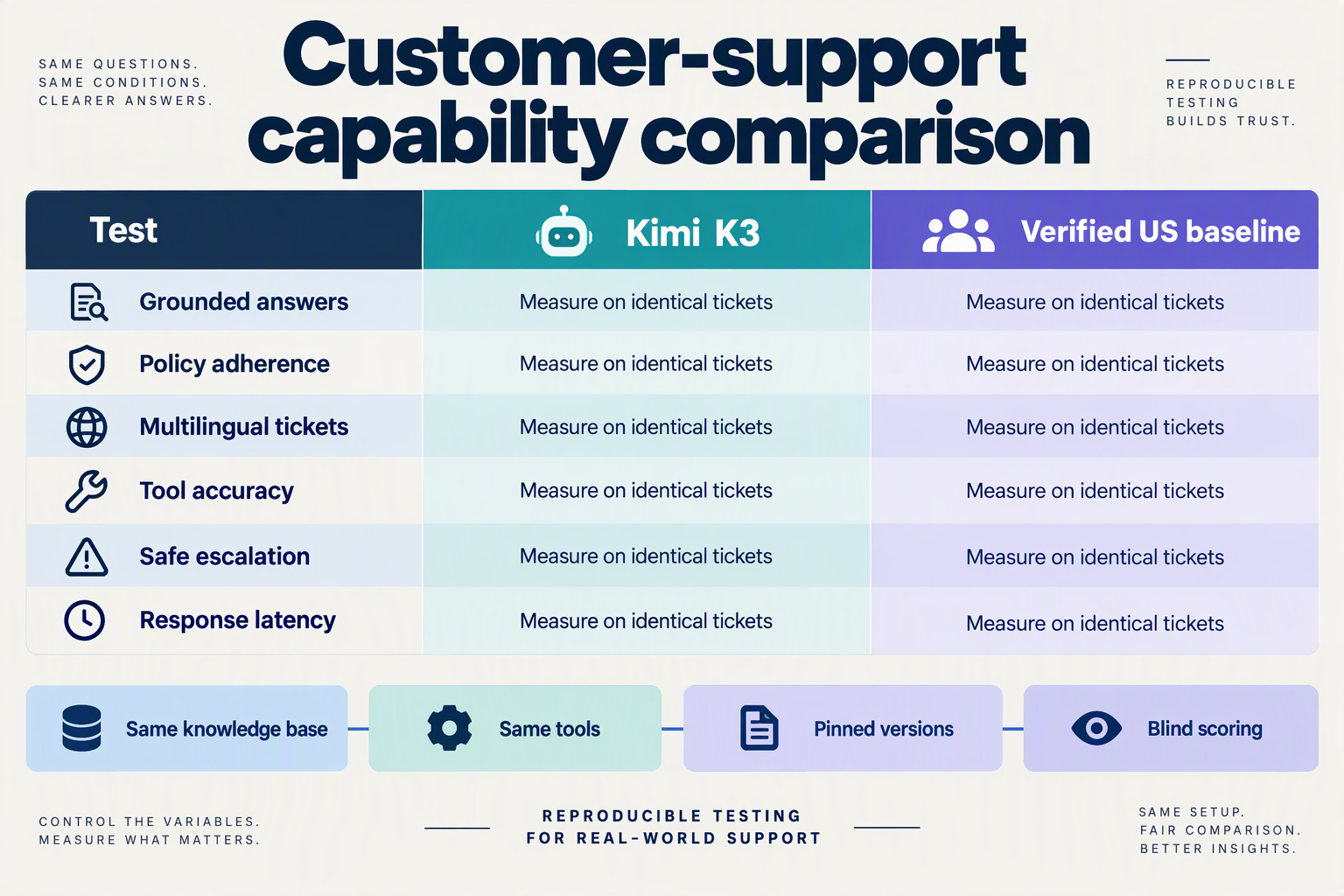
No model can be named the customer-support winner from the supplied evidence alone. As of October 2026, Kimi K3 and proprietary US rivals need the same ticket-level evaluation before claims about grounded answers, policy compliance, multilingual accuracy or tool reliability are justified.
- Kimi K3: Seeflection’s reporting, supplied for this October 2026 comparison, describes progress in coding and agentic workloads; those capabilities make tool-use testing relevant, but do not establish reliable refunds, account changes or support resolutions.
- US rivals: The Hindu’s reporting, supplied for this October 2026 comparison, quotes Moonshot AI acknowledging that Kimi K3 trails “powerful proprietary models” overall; that acknowledgement does not identify which model handles your company’s policies best.
- Comparison design: Use a proposed 240-ticket evaluation, divided into six groups of 40, with identical policy documents, retrieval results and tool permissions for every candidate. These are recommended test counts—not published model benchmarks—and should include straightforward cases alongside adversarial or ambiguous requests.
How should you compare LLMs on real customer-support tasks?
The following October 2026 evaluation framework measures operational outcomes rather than assuming that reasoning or coding rankings transfer directly to support.
| Test group | Proposed test cases | Measure | Selection rule |
|---|---|---|---|
| Grounded answers | 40 questions covering documented, missing and conflicting information | Supported-answer rate; invented claims | Prefer evidence-backed answers and explicit uncertainty |
| Policy compliance | 40 refund, warranty and eligibility edge cases | Correct decisions; unauthorised exceptions | Reject candidates that bypass mandatory rules |
| Multilingual tickets | 40 tickets across your actual language mix | Meaning preservation; policy accuracy by language | Check each language separately, not just the average |
| Read-only tools | 40 order, invoice and account lookups | Correct tool, arguments and final answer | Prefer complete lookups without fabricated records |
| Write-action tools | 40 cancellation or address-change scenarios | Authorisation, confirmation and duplicate actions | Require permission checks before consequential changes |
| Human escalation | 40 ambiguous, sensitive or unresolved cases | Appropriate handoffs; unnecessary escalation | Balance safe escalation against avoidable agent workload |
- Grounding and policy: Score factual support separately from rule compliance: an answer can quote the correct return policy while still authorising an invalid exception. For write actions, enforce permissions in application code; a strong model score is not a substitute for a server-side authorisation check.
- Multilingual deployment: Evaluate native-language tickets and code-mixed messages independently, with fluent reviewers checking meaning and tone. As of October 2026, CallMissed’s verified product information lists speech recognition in 22 Indian languages plus English, including Hinglish; that is an input capability, not evidence that every connected LLM answers equally well in those languages.
- Final selection: Treat unauthorised actions as hard failures, then compare grounded resolution rate, latency and cost per correctly resolved ticket among eligible candidates. Retest the strongest two models on unseen tickets: choosing after prompt tuning alone risks rewarding memorisation of your evaluation examples rather than dependable support behaviour.
How Does Kimi K3 API Pricing Translate Into Cost per Resolved Ticket?
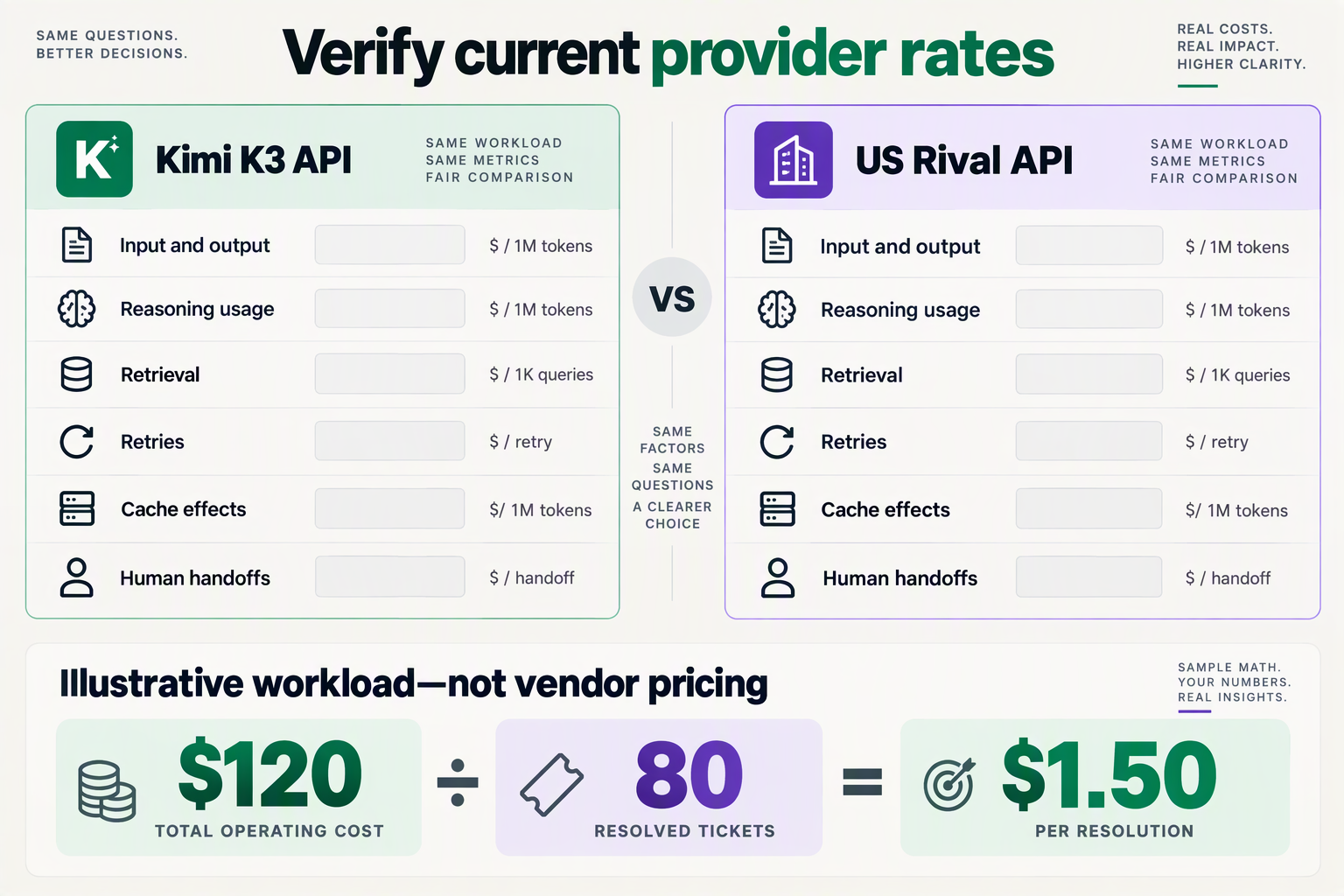
Kimi K3 API pricing cannot yet be converted into a verified cost per resolved ticket because the supplied sources do not establish official token rates as of October 2026. The calculation below uses explicitly hypothetical prices to show how billing and resolution quality interact.
- Pricing evidence: As of October 2026, The Outpost’s supplied coverage frames Kimi K3 as a lower-cost challenger, but its excerpt provides no input-token price, output-token price or billing conditions; that framing is not a procurement-ready quotation.
- Calculation: Divide total measured support-workflow spending by verified resolutions during the same evaluation period; for the narrower model-only metric, divide API spending by verified resolutions and label excluded costs explicitly.
- Test workload: The October 2026 illustration below assumes 1,000 attempted tickets, averaging 6,000 input tokens and 1,500 output tokens each, including all conversation turns, retrieved context and retries—not those quantities per message.
What would different token rates mean for the same support workload?
Every figure in this table is an illustrative October 2026 assumption, not an official Kimi K3 price or measured benchmark. Scenarios A and B compare different price-and-quality combinations; Scenario C isolates weaker resolution performance at A’s prices.
| Metric | A: Baseline | B: Higher price | C: Lower resolution |
|---|---|---|---|
| Input price per million tokens | $1 | $2 | $1 |
| Output price per million tokens | $4 | $8 | $4 |
| Tokens across 1,000 tickets | 6M in / 1.5M out | 6M in / 1.5M out | 6M in / 1.5M out |
| Total model spending | $12 | $24 | $12 |
| Verified resolutions | 800 / 80% | 900 / 90% | 600 / 60% |
| Model cost per resolution | $0.015 | $0.0267 | $0.020 |
- Resolution sensitivity: In this October 2026 illustration, reducing verified resolutions from 800 to 600 increases model cost per resolution by 33.3%, despite unchanged token rates and identical spending; cheap generation does not automatically mean cheap resolution.
- Human-work sensitivity: Assuming 200 escalations, five minutes each and labour at $12/hour, human handling adds $200 in this illustration—far exceeding Scenario A’s $12 model bill; include that spending when measuring the complete workflow.
- Measurement infrastructure: As of October 2026, CallMissed’s verified developer API supports usage and request logs, response caching and caller-chosen fallback models; these capabilities can support cost evaluation, but neither confirm Kimi K3 availability nor establish its rates.
How should teams validate a vendor quote before deployment?
- Confirm the billing units: Obtain dated input, output and cached-input rates, plus any separately billed reasoning tokens, minimum charges or provider fees.
- Replay one fixed test set: Keep retrieval content, tools and resolution criteria consistent; record every retry and fallback rather than counting only the final response.
- Reconcile quality with invoices: Check policy compliance and repeat contacts before accepting a resolution, then add retrieval, monitoring and human-handling costs using the same reporting window and denominator.
What Are the Pros and Cons of Hosted APIs Versus Self-Hosting?
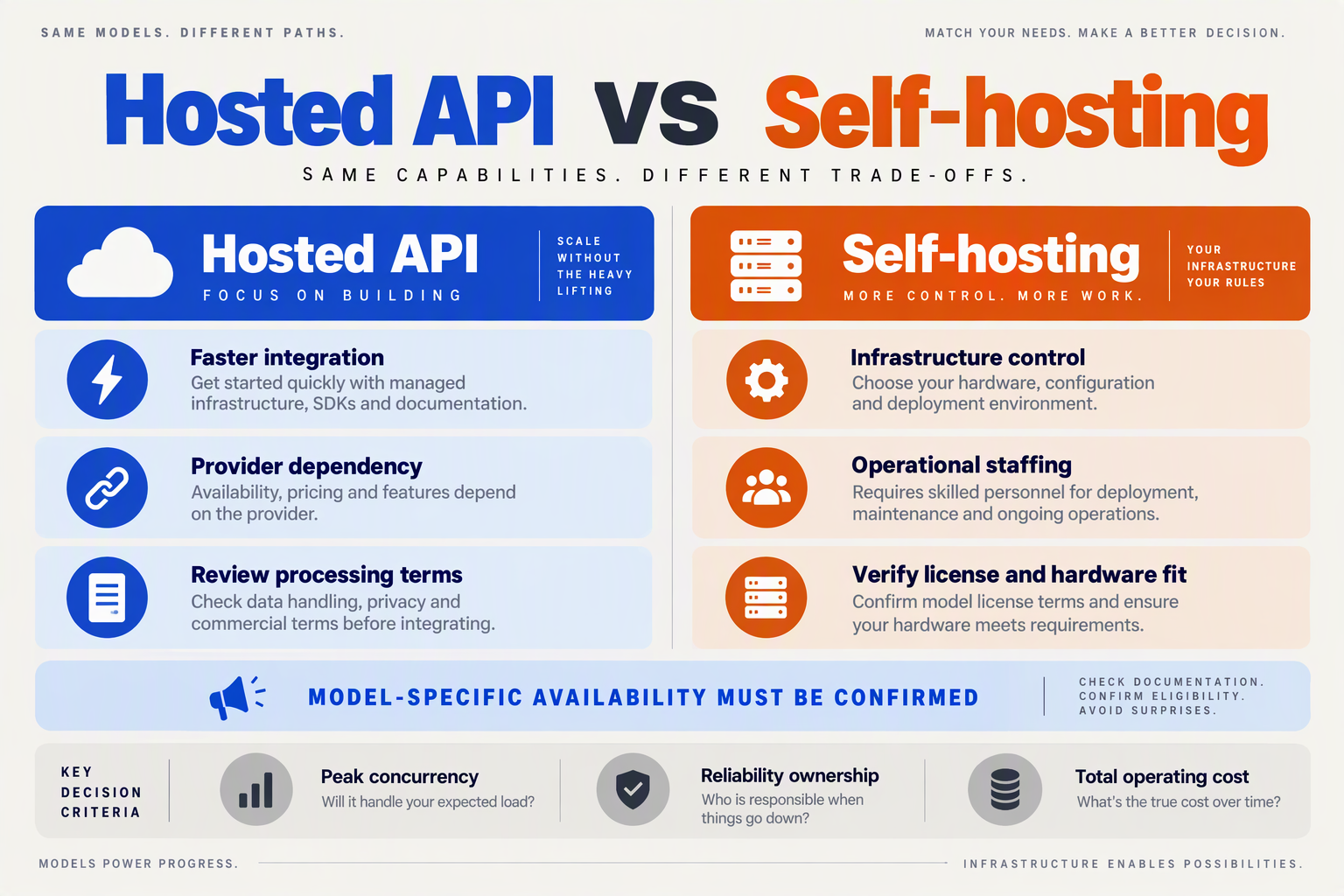
Hosted APIs reduce infrastructure work; self-hosting gives teams more control but makes them responsible for serving, security and capacity. For customer support, compare cost per resolved ticket, not token prices alone.
- Hosted APIs: Start without provisioning accelerators, but verify retention policies, processing regions, rate limits and model-version controls before sending customer records.
- Self-hosting: Control deployment and upgrade timing, but budget for hardware, inference engineering, monitoring, security patches and spare capacity—not just model weights.
How do hosted APIs and self-hosting compare?
The following deployment trade-offs apply as of October 2026; actual prices and limits require provider quotes or measurements on your chosen hardware.
| Decision factor | Hosted API | Self-hosting | Support-team implication |
|---|---|---|---|
| Initial setup | Integrate endpoints and authentication | Deploy weights, serving software and hardware | Include engineering time in launch cost |
| Cost structure | Usage charges; possible committed capacity | Infrastructure plus operational staffing | Compare complete monthly costs |
| Traffic spikes | Subject to provider quotas and availability | Subject to provisioned capacity | Test peak-hour queues and throttling |
| Data handling | Provider terms govern processing and retention | Team controls its deployed environment | Audit logs, backups and access controls |
| Model updates | Version availability depends on provider | Team chooses upgrade timing | Re-run support evaluations before changes |
| Reliability | Provider operates inference; client needs recovery logic | Team operates inference and recovery | Test timeouts, retries and escalation |
Does an open model make self-hosting practical?
- Moonshot AI’s Kimi K3: In the supplied reporting reviewed in October 2026, The Hindu calls Kimi K3 an “open model,” explicitly distinguishing that from “open-source”; check licensing, weight availability and serving documentation separately.
- Memory planning: Using The Hindu’s reported 2.8 trillion parameters, an illustrative two-byte-per-parameter representation would require 5.6 TB for weights alone; this excludes runtime memory, cache and serving overhead and is not a verified Kimi K3 deployment specification.
That calculation illustrates why downloadable weights do not automatically mean affordable deployment. Quantisation can reduce weight storage, but its effects on support accuracy and serving performance must be measured rather than assumed.
Which deployment should a support team choose?
- Hosted pilot: As of October 2026, CallMissed’s verified fact sheet lists OpenAI-compatible endpoints and caller-chosen fallback models; those capabilities support integration and recovery planning without confirming Kimi K3 availability.
- Self-hosting threshold: Calculate monthly infrastructure, staffing and redundancy costs, then divide by successfully resolved tickets; compare that figure with API charges, retries and review costs under the same workload.
A practical hybrid is to keep retrieval and customer-system access in your controlled environment while sending only necessary context to a hosted model. However, hybrid does not mean private by default: map every field crossing the API boundary and verify contractual protections before deployment.
Where Can You Access Kimi K3, and What Must a Support Deployment Guide Verify?
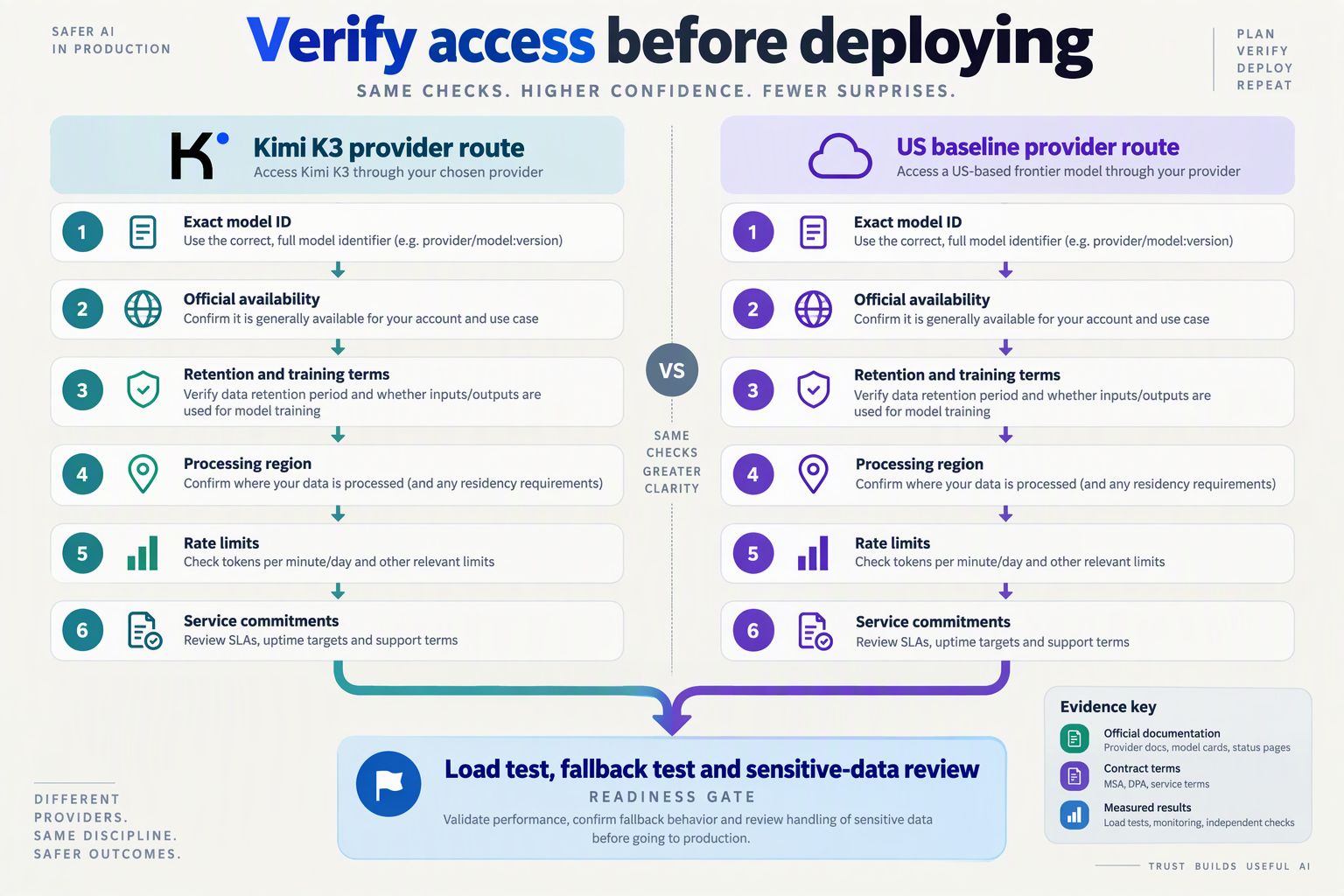
The supplied reporting does not verify a production Kimi K3 endpoint, downloadable weights or official API prices as of October 2026. A support deployment guide must confirm those access routes directly before recommending one.
Where should teams verify Kimi K3 access?
- Moonshot AI access: Check Moonshot AI’s official documentation for the exact Kimi K3 model identifier, account eligibility, supported regions and production endpoint. Record the verification date and distinguish a consumer chat interface from developer API access: testing answers in a browser does not establish that support software can invoke the same model.
- Open-weight access: As reviewed in October 2026, The Hindu describes Kimi K3 as an “open model,” explicitly distinguishing that from “open-source.” Before recommending self-hosting, verify an official weights repository, licence, commercial-use permissions and deployment instructions. The reporting alone does not establish unrestricted redistribution or a supported serving configuration.
- Gateway access: As of October 2026, CallMissed’s verified fact sheet lists 138 models, Moonshot among its providers, and OpenAI-compatible and Anthropic-compatible endpoints. That does not confirm Kimi K3 availability. Check the live catalogue for the exact release and test required endpoint behaviour before treating gateway integration as a deployable option.
- Release identity: Pin the model identifier, revision and access provider in the deployment guide. Ask whether an alias can change underneath an integration and whether updates are announced. A successful evaluation becomes difficult to reproduce if production silently switches versions, so document a rollback route rather than relying on a brand-level “Kimi” label.
What must a customer-support deployment guide verify?
- Commercial limits: As of October 2026, the supplied context establishes no official Kimi K3 API pricing. Require a dated rate card covering input, output, cached tokens where applicable, currency and billing conditions. Also verify requests-per-minute limits, token-throughput limits and concurrency; a low advertised token rate does not guarantee sufficient capacity during support peaks.
- Interface compatibility: Confirm streaming, structured outputs, tool calling, context limits and maximum response length against the actual endpoint. Use a concrete acceptance test: retrieve an order, return a schema-valid answer and refuse an unauthorised refund. Compatibility with an SDK is not proof that every support-critical feature behaves identically across providers.
- Data handling: Document where prompts, retrieved customer records and logs are processed; retention periods; training-use terms; and deletion procedures. Verify contractual commitments rather than inferring them from the provider’s headquarters or a gateway’s location. For account-access tickets, redact credentials and minimise personal data before sending requests to any model.
- Operational readiness: Require measured first-token delay, complete-response time and error rates under expected concurrency, with separate results for priority support languages. Specify timeout, retry and human-handoff behaviour. For self-hosting, obtain a tested hardware configuration and operating-cost estimate; for hosted access, verify incident communication and contractual service commitments before launch.
Which Model Should You Choose for Routine Tickets, Complex Cases and Sensitive Workloads?
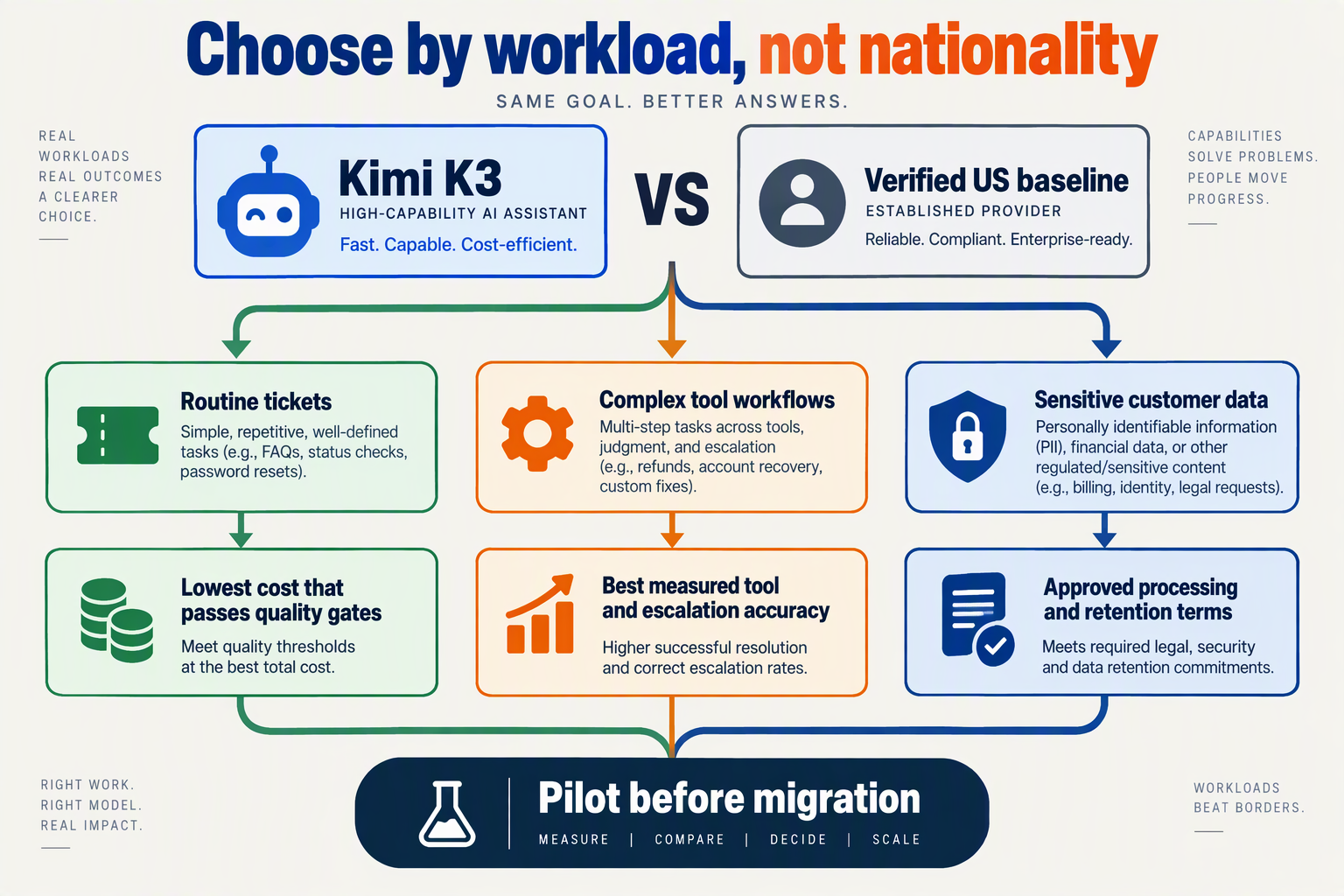
Choose the least expensive model that passes your workload-specific tests; reserve stronger reasoning and tighter deployment controls for consequential cases. Ticket risk—not model nationality—should determine routing.
Which LLM should handle routine customer-support tickets?
- Routine-ticket model: For delivery updates, opening hours and standard return policies, prioritise grounded retrieval and predictable tool use over elaborate reasoning. Test a proposed 200-ticket sample drawn from your queue, measuring correct resolutions, unnecessary escalations and total cost per resolved ticket; this is an evaluation design, not an industry benchmark.
- Low-cost candidate: Require the model to distinguish “no matching policy found” from “refund approved.” A sensible proposed launch gate is zero unauthorised actions in your test set, followed by supervised production sampling; passing a finite test does not establish that future errors are impossible.
- Multilingual candidate: Evaluate each supported language separately, including code-mixed messages, misspelled product names and ambiguous dates. For example, test whether “cancel yesterday’s order” retrieves the correct purchase before requesting confirmation. Do not let a strong English average conceal failures in the regional languages your customers actually use.
Which model should handle complex support cases?
- Reasoning-focused model: Route disputed charges, conflicting policies and multi-order investigations to the candidate that completes the full workflow most reliably. Score policy interpretation, evidence retrieval, tool arguments and escalation separately: an articulate explanation should not compensate for selecting the wrong transaction or overlooking a refund restriction.
- Moonshot AI Kimi K3: As of October 2026, the supplied reporting from The Hindu says Moonshot acknowledges that Kimi K3’s overall performance trails “powerful proprietary models” from the US. Treat K3 as an evaluation candidate, not an automatic replacement; that acknowledgement also does not prove it loses on your particular support tasks.
- Higher-priced candidate: Pay more only when measured improvements justify the premium. In a hypothetical comparison, reducing human escalations from 20 to 10 per 100 tickets avoids 10 reviews; multiply that saving by your actual review cost, then subtract additional model, retrieval and retry charges before deciding.
Which deployment should handle sensitive workloads?
- Restricted-data deployment: For identity documents, payment disputes or health-related conversations, establish retention, access controls, processing locations and contractual requirements before selecting a model. Open weights do not automatically mean compliant deployment: operating infrastructure, securing logs and controlling tool permissions remain responsibilities that must be explicitly assigned.
- CallMissed integration: As of October 2026, CallMissed’s verified fact sheet lists caller-chosen fallback models, usage and request logs, and OpenAI-compatible endpoints. These capabilities can support comparative testing and routing implementation, but sensitive-data approval still requires reviewing the complete processing chain; platform hosting in India alone does not establish every upstream provider’s processing location.
How Can You Run a Controlled Support Pilot With CallMissed?
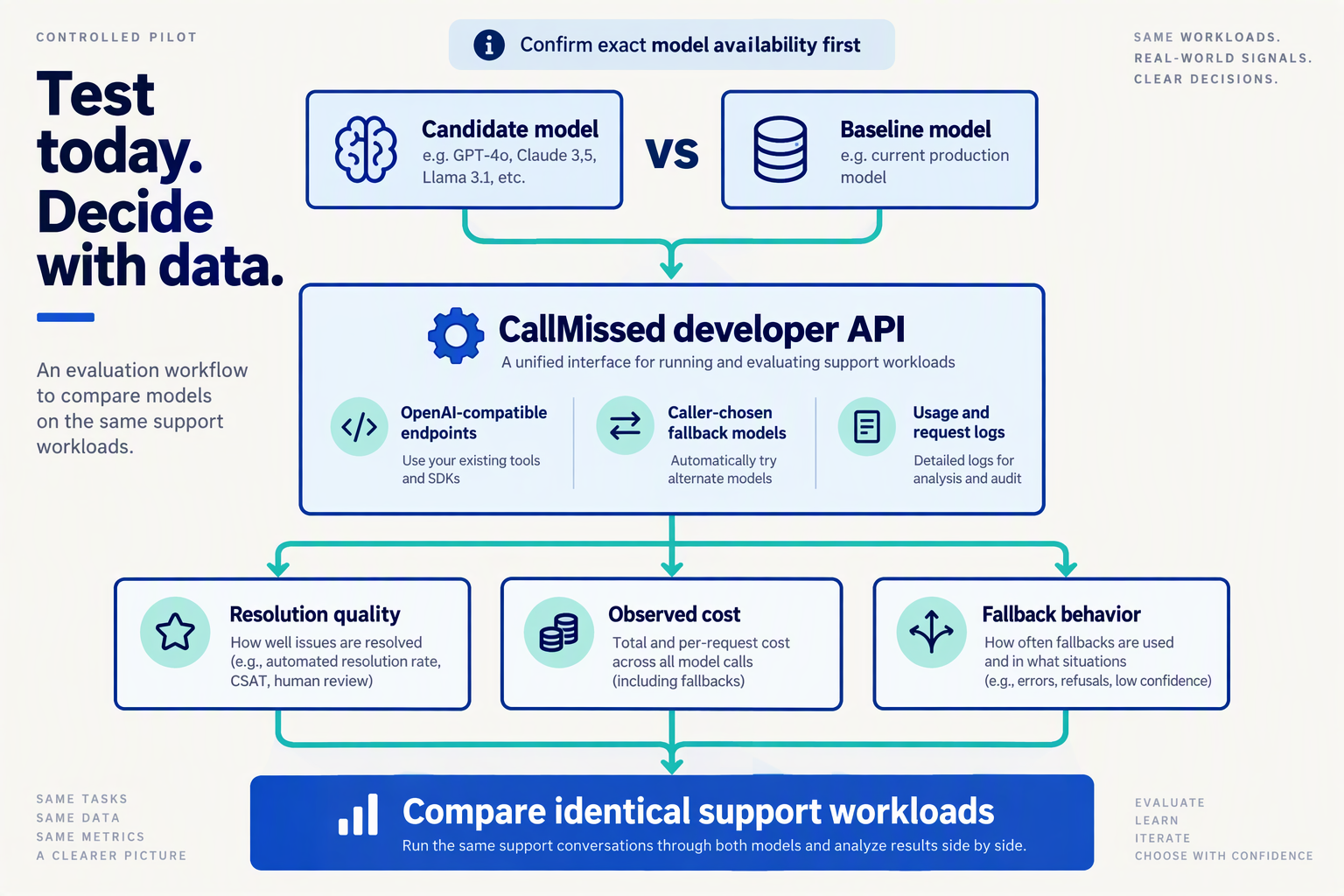
Run a controlled support pilot by keeping policies, tools and test cases identical across models, then comparing verified resolutions—not benchmark rankings. Use the following October 2026 pilot plan, with proposed sample sizes and thresholds rather than claimed performance results.
What should you control, measure and budget?
- Integration: As of October 2026, CallMissed’s verified fact sheet lists OpenAI-compatible endpoints, caller-chosen fallback models, and usage and request logs. Connect your existing SDK by changing its base URL, then verify each candidate’s exact model identifier and supported features before testing; gateway compatibility does not guarantee identical behaviour across models.
- Candidate selection: Compare two available models against your current support workflow. The Hindu’s reporting supplied for this October 2026 comparison distinguishes Moonshot AI’s Kimi K3 as an open model, not an open-source model. Confirm actual access, licence terms and API pricing before including Kimi K3; catalogue membership alone does not establish release availability.
- Test-set design: Start with 200 anonymised tickets, divided into four proposed groups of 50: policy questions, order lookups, account problems and escalation cases. Include missing information, conflicting documents and malicious instructions embedded in customer messages. Reserve 40 additional unseen tickets for validation after prompt adjustments, rather than repeatedly optimising against your evaluation set.
- Controlled configuration: Freeze one policy snapshot, one retrieval corpus and one tool schema for both candidates. Match output limits and sampling settings where supported, while recording unavoidable differences. Disable automatic fallback during the primary comparison so a stronger backup model cannot hide failures; evaluate fallback separately as a deployment configuration.
- Safety and scoring: Give reviewers a rubric covering policy accuracy, evidence grounding, authorised tool use and appropriate escalation. Blind reviewers to model identity, and require human approval for refunds or account changes during the pilot. Treat any unauthorised action as a proposed release blocker, even when the average answer-quality score looks strong.
- Cost and latency: Calculate cost per verified resolution from model charges, retrieval, retries and review effort; separately track median and 95th-percentile latency. For example, a hypothetical ₹600 run with 120 verified resolutions costs ₹5 per resolution, before omitted expenses. Record actual provider prices and measurement dates rather than substituting unverified Kimi K3 token rates.
- Budget controls: As of October 2026, CallMissed’s verified fact sheet lists 1,000 signup credits, with 1 credit = ₹1, and a default free-tier limit of 60 requests per minute per key. Set your own spending ceiling below the available balance, pace requests within applicable limits, and check candidate-specific charges before estimating test volume.
- Release decision: Move from offline evaluation to a proposed 10% low-risk traffic pilot only after safety checks pass. Retain human escalation, review failures daily and define rollback triggers before launch. Promote a candidate only when it improves verified resolution economics without weakening policy compliance; keep difficult or sensitive cases outside automated action-taking until separately validated.
Frequently Asked Questions
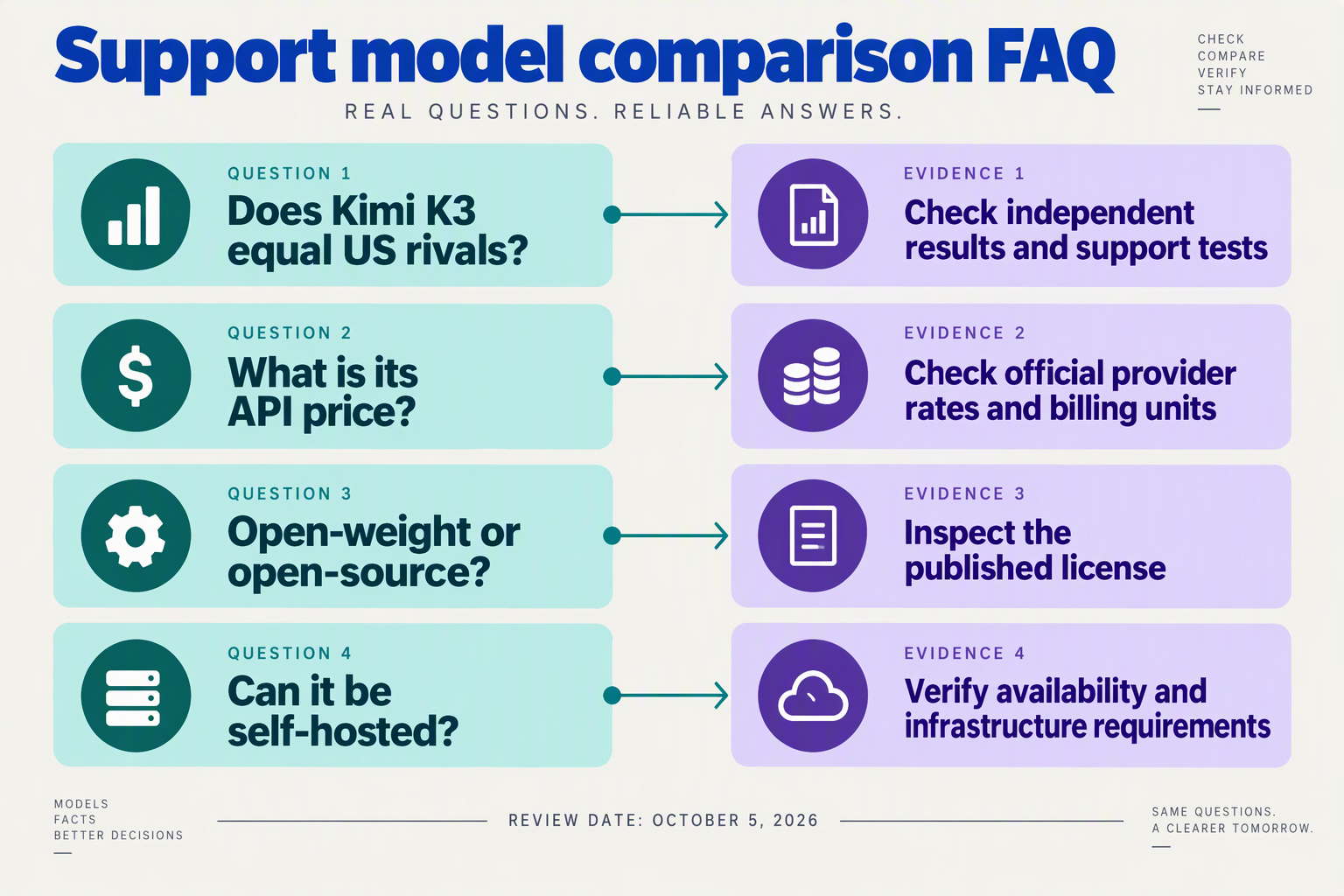
Kimi K3 is not established as equal to leading US models overall, and the supplied reporting does not verify its API price or deployment licence.
- Q: Does Kimi K3 equal leading US AI models for customer support?
A: As of October 2026, The Hindu reports that Moonshot AI acknowledges Kimi K3 trails “powerful proprietary models” from the US overall, despite its impressive scale. Neither parameter count nor selected reasoning benchmarks establishes customer-support parity; compare models on your own policy adherence, retrieval accuracy, authorised tool actions and escalation tests before treating them as interchangeable.
- Q: Is Kimi K3 API pricing officially confirmed?
A: As of October 2026, the supplied sources do not establish official Kimi K3 API pricing, so a defensible comparison cannot quote input-token, output-token or cached-input rates. Request a dated provider rate card identifying the exact model, billing units and any reasoning-token charges; then check whether advertised rates exclude gateway fees, taxes or other deployment costs.
- Q: Is Kimi K3 open-weight or fully open-source?
A: As of October 2026, The Hindu explicitly describes Kimi K3 as an “open model,” not an open-source model, while NammaKPSC describes it as open-weight. These labels should not be treated as equivalent: inspect the actual release and licence for commercial-use rights, redistribution conditions and available training materials rather than assuming downloadable weights grant unrestricted use.
- Q: Can Kimi K3 be self-hosted on business infrastructure?
A: The supplied October 2026 reporting does not establish a verified hardware configuration or licence permitting your intended deployment, so self-hosting remains a conditional option, not a confirmed turnkey capability. Using The Hindu’s reported 2.8 trillion parameters, storing every parameter at two bytes would require approximately 5.6 TB for weights alone—an illustrative calculation excluding runtime overhead, not a published hardware requirement.
- Q: How should businesses compare Kimi K3 API pricing with US alternatives?
A: Compare cost per correctly resolved ticket, not token rates alone, using identical test cases and accounting for retrieved context, generated tokens, retries and human review. For an illustrative 100-ticket trial, divide total workflow expenditure by the number resolved correctly without unauthorised actions; report response time and escalation quality separately so a cheaper but less reliable model does not appear artificially attractive.
- Q: What is the safest way to trial Kimi K3 for customer support?
A: Begin with anonymised tickets and read-only tools, then require explicit approval before enabling refunds, account changes or other consequential actions. As of October 2026, CallMissed’s verified product information lists an OpenAI-compatible developer API and Moonshot among its catalogue providers, but does not establish Kimi K3 availability; confirm the exact model identifier before designing a gateway-based trial.
Conclusion
Kimi K3 API pricing should be judged by the cost of a correctly resolved support ticket—not the price of tokens alone. The practical choice depends on grounded answers, reliable actions, response speed and the operational demands of deployment.
- Capability matters more than model size. As of October 2026, the supplied reporting from The Hindu describes Moonshot AI’s Kimi K3 as an open model with 2.8 trillion parameters, while noting Moonshot’s acknowledgement that overall performance trails powerful proprietary US models. That makes claims of parity workload-dependent rather than settled. For customer support, test whether a model follows refund policies, retrieves accurate order information and recognises when a person should take over.
- Measure total workflow cost, not isolated token rates. Longer conversations, retrieval overhead, failed tool calls, retries and human corrections can erase an apparent pricing advantage. Compare models on the same anonymised billing, delivery and account-access tickets, then calculate the cost of successful resolution. A higher-priced model can be economical if it completes the task accurately with less rework; a cheaper model can be valuable when it reliably handles straightforward requests.
- Treat deployment as part of the comparison. Hosted access and open-weight deployment create different responsibilities for integration, data handling and ongoing operations. Neither approach automatically delivers better value. Support teams should assess the effort required to connect business systems, maintain policy grounding and manage escalation alongside model charges. The relevant question is whether the deployment fits the organisation’s capabilities—not simply whether the model is available to run independently.
- Keep reported capabilities separate from verified commercial terms. As of October 2026, the supplied context does not establish official Kimi K3 API rates. Until those terms are verified, a precise price ranking would imply certainty the evidence does not support. Likewise, access to Moonshot models through a provider catalogue should not be treated as confirmation that a specific Kimi release is available.
What should customer-support teams watch next?
Watch for verified Kimi K3 pricing, clearer availability information and support-specific evaluations that measure policy compliance, tool execution and appropriate escalation. As the debate over Chinese and US model capabilities develops, repeat workload-based tests rather than assuming that a new benchmark leader will improve every customer interaction.
To explore the integration side of this shift, consider CallMissed, the OpenAI-compatible developer AI API. As of October 2026, CallMissed’s verified product information lists Moonshot among its catalogue providers and supports existing SDK integrations by changing the base URL—without establishing Kimi K3 availability.
Before choosing your next support LLM, ask: which model resolves your customers’ problems reliably, at an acceptable total cost, within a deployment your team can operate?
Related Reading
- Cheapest LLM API Provider in India (2026): Real Token Pricing, INR Cost Guide & Verdict
- Cheapest LLM API Provider India: 2026 Pricing Comparison
- Large Language Models: Customer Support's Future in 2026
Sources
Discussion
Related Posts


Ready to automate customer conversations?
Launch AI voice agents and WhatsApp bots with CallMissed — one API, 22+ Indian languages.