Qwen 3.5 Plus benchmarks: Math and Logic Explained


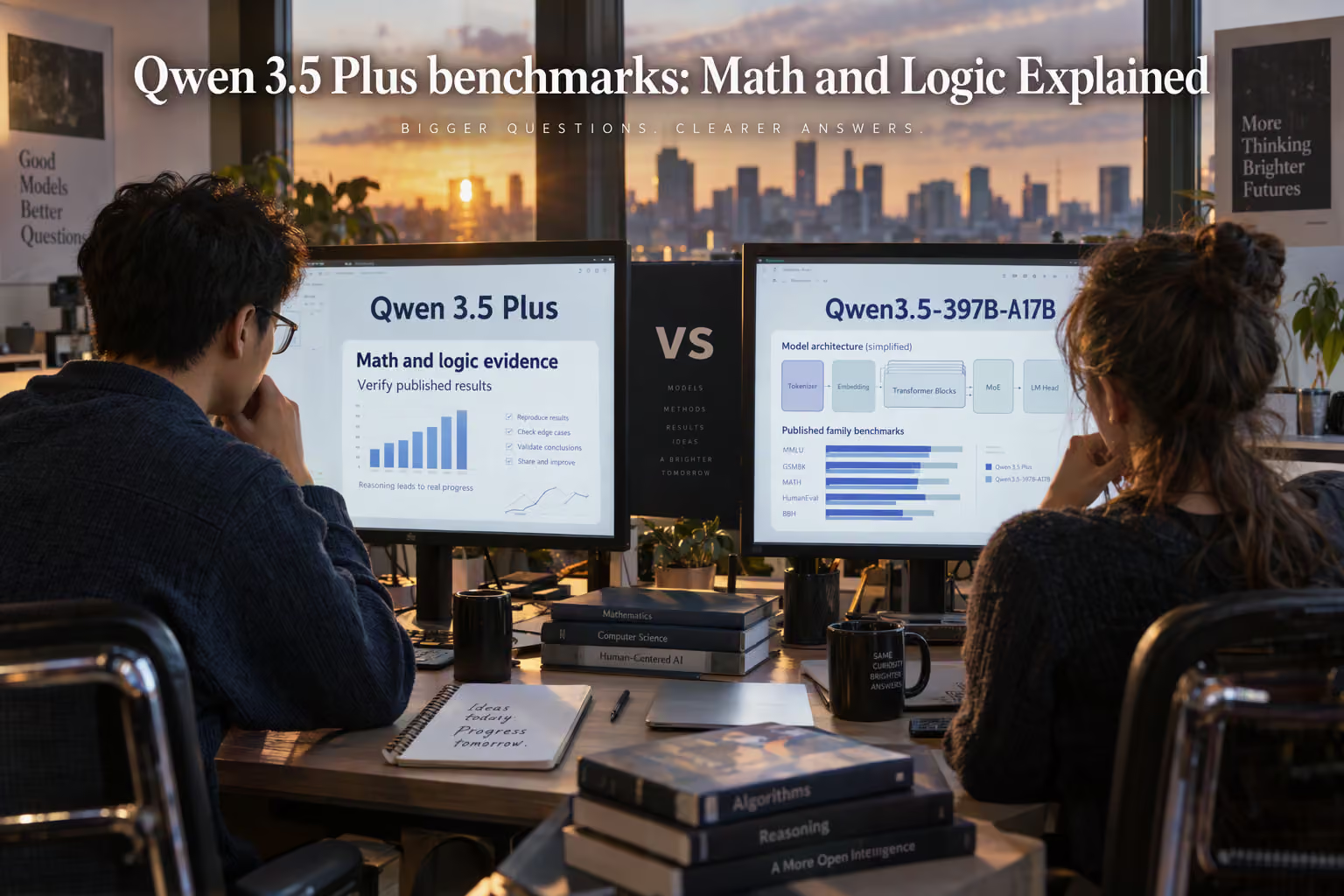
Compare Qwen 3.5 Plus benchmarks with clearly labeled family results, check pricing sources, and learn which math and logic claims remain unverified.

Qwen 3.5 Plus benchmarks: Math and Logic Explained
Qwen’s published model scores 91.3 on AIME26—but the supplied benchmark table does not identify that model as Qwen 3.5 Plus. For buyers searching for Qwen 3.5 Plus benchmarks, that distinction matters: strong results for one Qwen variant are not automatically evidence for another.
As of November 2026, the supplied Qwen.ai comparison reports 91.3 on AIME26, 80.9 on IMOAnswerBench, and 73.3 on PolyMATH for Qwen3.5-397B-A17B. These are useful signals of mathematical capability, but they do not establish verified scores for a separately named Qwen3.5-Plus endpoint. This guide explains what those results measure, where the listed model leads or trails, and what buyers should verify before choosing a production model.
What do Qwen’s math benchmarks actually show?
The headline is task-dependent performance, not universal mathematical superiority. In Qwen.ai’s supplied benchmark table, reviewed as of November 2026, Qwen3.5-397B-A17B scores 91.3 on AIME26, compared with 96.7 for GPT5.2 and 90.6 for Gemini-3 Pro.
The ranking changes across other tests. According to Qwen.ai’s supplied table, reviewed as of November 2026, Qwen3.5-397B-A17B scores 73.3 on PolyMATH, above GPT5.2’s 62.5 but below Claude 4.5 Opus’s 79.0 and Gemini-3 Pro’s 81.6.
Visual mathematics presents another contrast. Qwen.ai’s supplied table, reviewed as of November 2026, reports a MathVision score of 88.6 for Qwen3.5-397B-A17B, versus 83.0 for GPT5.2 and 86.6 for Gemini-3 Pro. A buyer evaluating diagram-based problems could therefore reach a different conclusion from someone prioritizing competition-style text questions.
Do math scores prove strong logical reasoning?
Math benchmarks provide evidence about the tested tasks; they do not prove reliability across every logic workflow. The supplied context does not include a dedicated formal-logic benchmark for Qwen3.5-Plus, and its broader “Reasoning” category also contains coding, browsing, and tool-use evaluations.
That matters when the purchasing question is practical: can a model consistently apply eligibility rules, detect contradictory requirements, or calculate a refund under several constraints? Those workflows need representative tests, not simply the highest headline score.
This guide separates three questions:
- Model identity: Which exact model or API endpoint produced the reported result?
- Benchmark relevance: Does the test resemble your text, visual-math, or business-logic workload?
- Evaluation comparability: Were prompting, tools, reasoning settings, and scoring conditions aligned?
What should buyers take away?
You will learn how to read the comparisons without conflating model names, distinguish mathematical accuracy from broader reasoning, and build a small evaluation around your actual requirements.
As of November 2026, CallMissed’s verified product facts include an OpenAI-compatible developer API with reasoning-effort control and request logs—capabilities relevant to structured model evaluation, without implying that a particular Qwen endpoint is available. The buying principle remains simple: verify the model first, then test the work you need it to perform.
What do Qwen 3.5 Plus benchmarks actually show about math and logic?
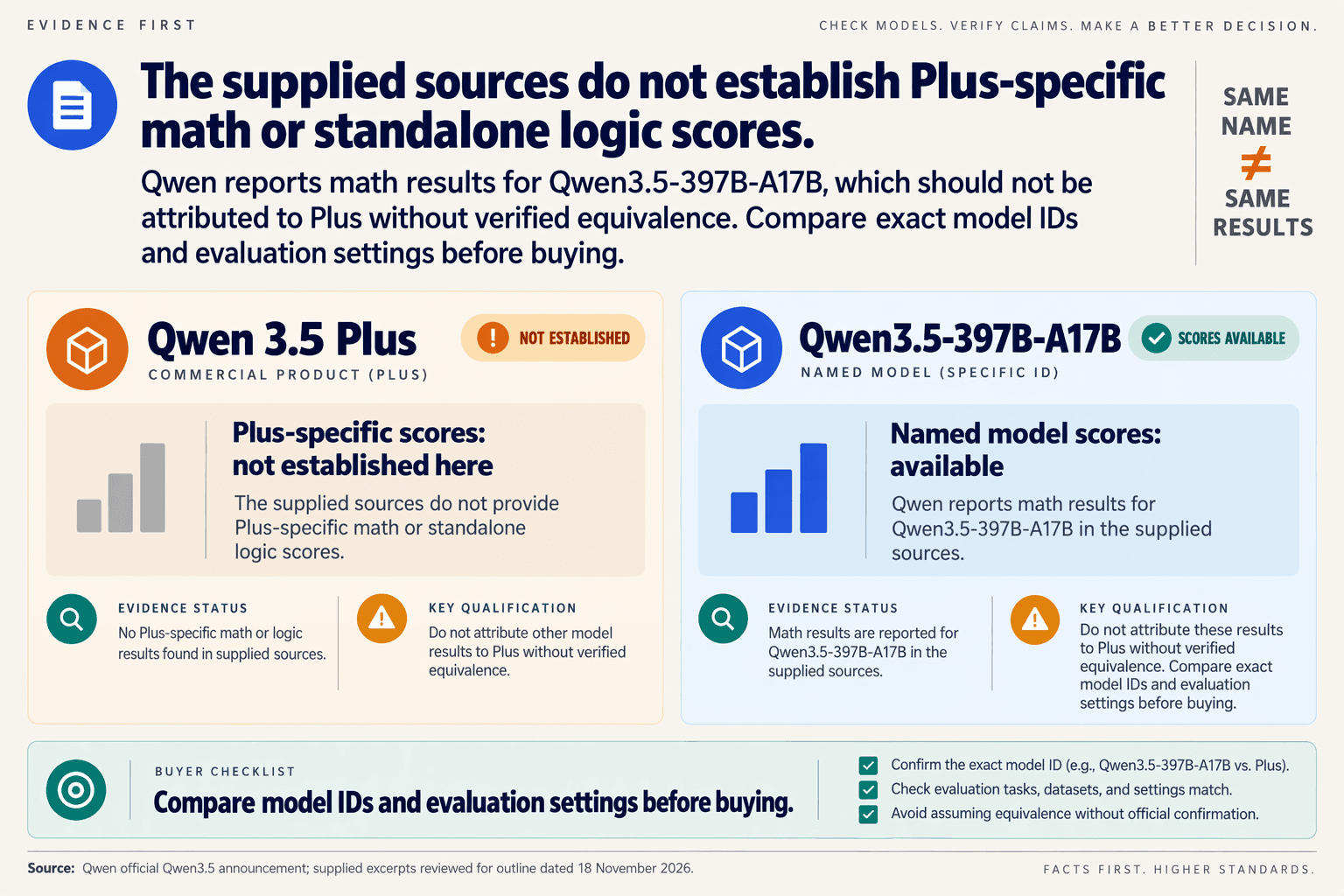
The supplied benchmarks show strong visual-math performance and mixed results on reasoning-related tasks—not verified scores for a separately identified Qwen3.5-Plus endpoint. Buyers should treat the Qwen3.5-397B-A17B results as model-specific evidence, rather than a guarantee of production logic accuracy.
Where does Qwen lead or trail on visual mathematics?
- MathVista (mini): Qwen.ai’s supplied table, reviewed as of November 2026, reports 90.3 for Qwen3.5-397B-A17B, versus 90.1 for K2.5-1T-A32B, 87.9 for Gemini-3 Pro, and 83.1 for GPT5.2. Qwen leads these listed models, but its 0.2-point margin over K2.5 should not be mistaken for a decisive operational advantage.
- We-Math: Qwen.ai’s supplied table, reviewed as of November 2026, gives Qwen3.5-397B-A17B 87.9, ahead of Gemini-3 Pro at 86.9 and GPT5.2 at 79.0. That strengthens the case for evaluating Qwen on image-based mathematical questions, while leaving open how accurately a particular deployed endpoint handles your documents and diagrams.
- DynaMath: Qwen.ai’s supplied table, reviewed as of November 2026, reports 86.3 for Qwen3.5-397B-A17B, compared with 86.8 for GPT5.2 and 85.1 for Gemini-3 Pro. This reverses the Qwen–GPT ranking seen on We-Math: even within visual mathematics, the choice of benchmark changes which model appears stronger.
Which results are relevant to following complex rules?
- IFBench: Qwen.ai’s supplied table, reviewed as of November 2026, lists 76.5 for Qwen3.5-397B-A17B, versus 75.4 for GPT5.2 and 70.4 for Gemini-3 Pro. This is relevant evidence when screening instruction-following capabilities, but the score alone does not establish correctness on tax calculations, eligibility decisions, or other business-rule workflows.
- MultiChallenge: Qwen.ai’s supplied table, reviewed as of November 2026, reports 67.6 for Qwen3.5-397B-A17B, above Gemini-3 Pro’s 64.2 and GPT5.2’s 57.9. However, Qwen’s IFEval score of 92.6 trails their 93.5 and 94.8, respectively. Buyers should therefore avoid describing instruction-following performance as uniformly superior across evaluations.
- TAU2-Bench: Qwen.ai’s supplied table, reviewed as of November 2026, gives Qwen3.5-397B-A17B 86.7, below Claude 4.5 Opus at 91.6 and GPT5.2 at 87.1, but above Gemini-3 Pro at 85.4. Keep this result separate from mathematical accuracy: Qwen.ai places it under “Reasoning,” alongside several distinct task categories.
What must buyers verify before using these scores?
- Endpoint identity and evaluation conditions: As of November 2026, the supplied excerpt does not establish that Qwen3.5-Plus equals Qwen3.5-397B-A17B or provide enough methodology to reproduce every comparison. Request the exact model identifier, reasoning settings, tool permissions, scoring procedure, and repeat-run results before transferring any published score to a purchase decision.
- Production testing: Evaluate arithmetic accuracy, constraint compliance, contradiction detection, and justified abstention separately. As of November 2026, CallMissed’s OpenAI-compatible developer API provides reasoning-effort control and usage/request logs—useful capabilities for documenting comparisons, but not evidence that a specific Qwen endpoint is available or matches these published results.
Who is Plus for, and how does it differ from the 397B and 9B models?
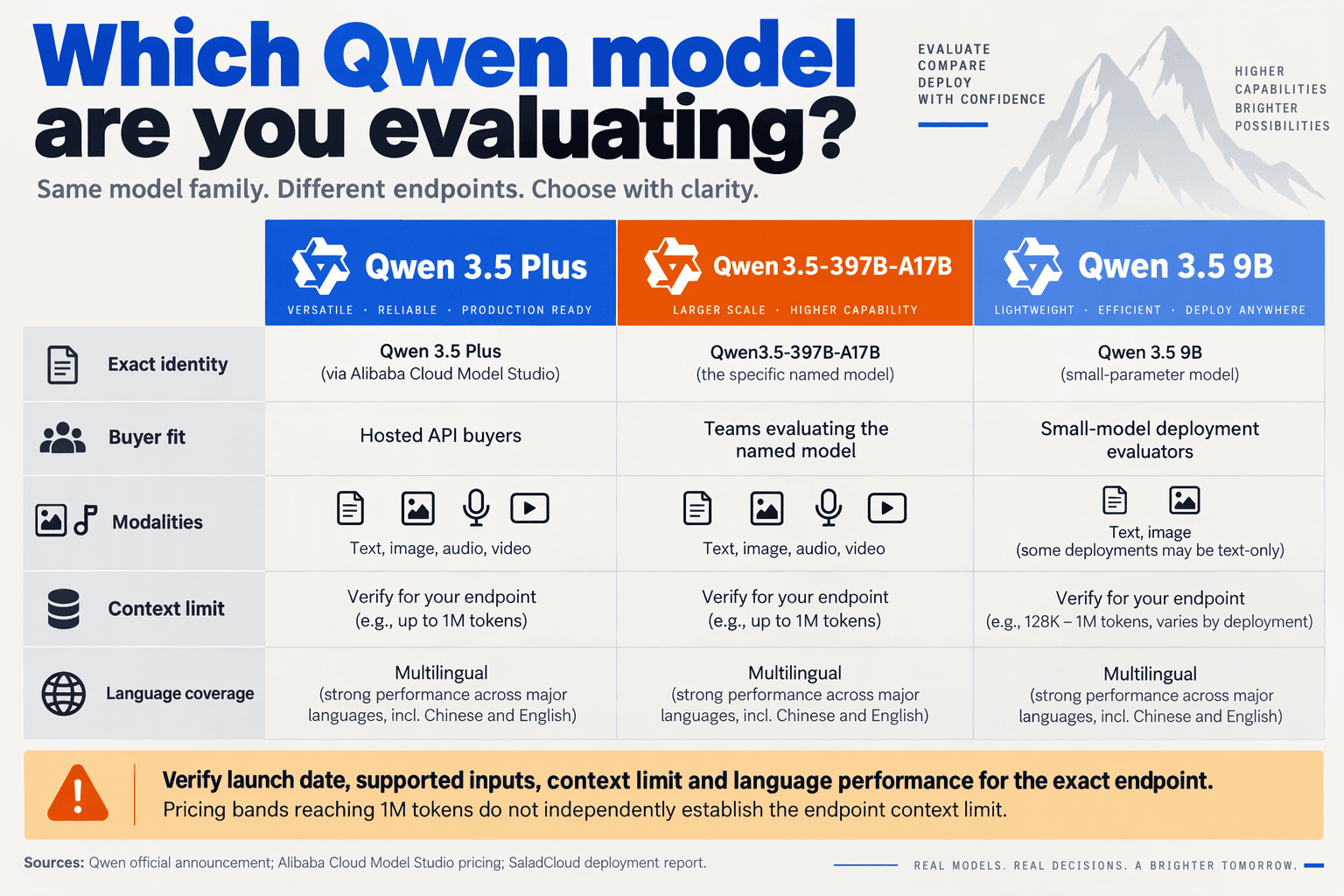
Qwen3.5-Plus is a candidate for buyers evaluating a named API endpoint; Qwen3.5-397B-A17B is the model identified in the supplied benchmark evidence. As of November 2026, that evidence does not establish Plus’s architecture, its equivalence to 397B, or comparable results for a 9B model.
- Plus buyers: Request the exact endpoint identifier, model-version policy, and endpoint-specific evaluation results before treating published Qwen scores as purchasing evidence.
- 397B buyers: Use Qwen3.5-397B-A17B as the documented comparison candidate, while separately checking deployment availability, infrastructure requirements, and commercial terms.
- 9B buyers: Consider a smaller-model evaluation when resource constraints matter, but do not assume acceptable mathematical accuracy—or a particular deployment footprint—from the “9B” label alone.
How do Plus, 397B, and 9B compare on verified evidence?
The table separates documented facts from purchasing questions. “Not supplied” means the provided research does not establish the answer; it does not mean the capability is absent.
| Comparison point | Qwen3.5-Plus | Qwen3.5-397B-A17B | Qwen 3.5 9B |
|---|---|---|---|
| Identity in supplied evidence | Not separately benchmarked | Explicitly named by Qwen.ai | Not documented |
| Math benchmark attribution | No verified endpoint-specific scores supplied | Named in published math results | No scores supplied |
| Instruction-following evidence | Not supplied | IFBench: 76.5 | Not supplied |
| Multi-constraint evidence | Not supplied | MultiChallenge: 67.6 | Not supplied |
| Long-context evaluation | Not supplied | LongBench v2: 63.2 | Not supplied |
| Price and serving requirements | Verify with endpoint provider | Not supplied | Not supplied |
According to Qwen.ai’s supplied comparison, reviewed as of November 2026, Qwen3.5-397B-A17B scores 76.5 on IFBench, 67.6 on MultiChallenge, and 63.2 on LongBench v2. These additional results help frame instruction-heavy and context-heavy evaluations, but they are not substitutes for endpoint-specific math tests or a dedicated formal-logic assessment.
Which model should a buyer shortlist for math and logic?
- Plus: Shortlist the endpoint if its delivery model suits your application, then require evidence tied to that exact identifier. Ask whether model updates can change behavior and whether evaluation settings are reproducible.
- 397B: Shortlist the documented model when published benchmark evidence is important. Its named results give you a reference point, not a guarantee that another hosted endpoint reproduces them.
- 9B: Shortlist the smaller candidate only alongside a workload-specific acceptance threshold. Test arithmetic, constraint satisfaction, and contradiction detection separately rather than collapsing them into one “reasoning” score.
- All three: Run an illustrative 100-case evaluation with identical prompts and scoring rules; this is a recommended test design, not a published benchmark. Record correct answers, rule violations, response times, and actual charges, then compare cost per correct answer rather than token price alone.
For a refund workflow, include partial returns, expired eligibility windows, and conflicting discount rules. A model that calculates correctly but ignores one policy condition still fails the business task—regardless of its family name or headline benchmark standing.
How do the published math scores compare with GPT, Claude, Gemini and Qwen 3?
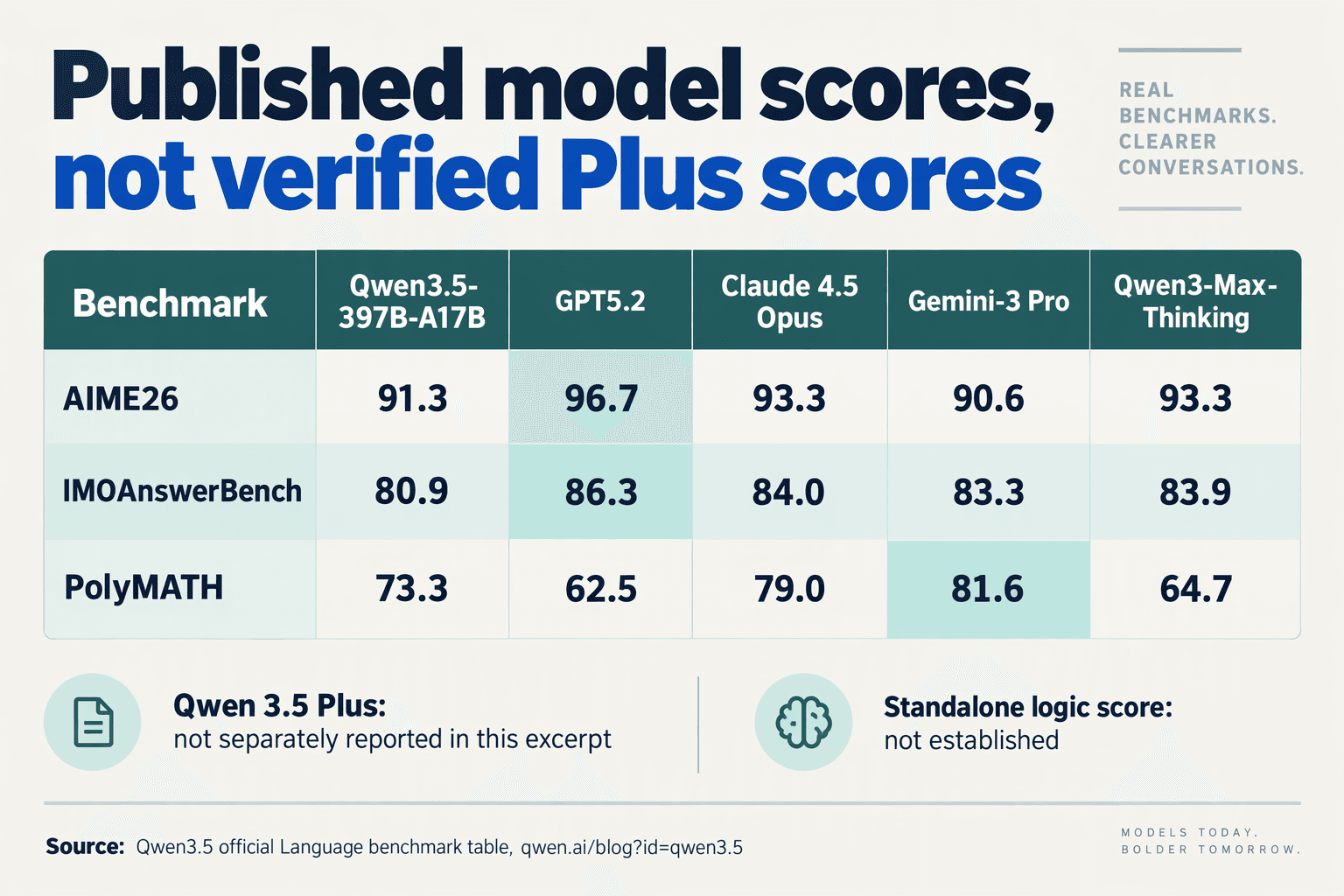
GPT5.2 leads the published AIME26 and IMOAnswerBench comparisons, while Gemini-3 Pro leads PolyMATH and Qwen3.5-397B-A17B leads MathVision. These are benchmark-specific rankings, not a verified scorecard for Qwen3.5-Plus.
- Source: Qwen.ai’s “Qwen3.5: Towards Native Multimodal Agents” supplies the scores below, reviewed as of November 2026; this is a vendor-published comparison, not an independently reproduced evaluation.
- Reading the table: Bold numbers identify the highest supplied score in each column; “—” means the supplied comparison does not report that model on that benchmark, not that the model scored zero.
| Model | AIME26 | IMOAnswerBench | PolyMATH | MathVision |
|---|---|---|---|---|
| GPT5.2 | 96.7 | 86.3 | 62.5 | 83.0 |
| Claude 4.5 Opus | 93.3 | 84.0 | 79.0 | 74.3 |
| Gemini-3 Pro | 90.6 | 83.3 | 81.6 | 86.6 |
| Qwen3.5-397B-A17B | 91.3 | 80.9 | 73.3 | 88.6 |
| Qwen3-Max-Thinking | 93.3 | 83.9 | 64.7 | — |
| Qwen3-VL-235B-A22B | — | — | — | 74.6 |
Which differences matter when choosing a model?
- GPT5.2: Qwen.ai’s supplied comparison, reviewed as of November 2026, places GPT5.2 ahead of Qwen3.5-397B-A17B by 5.4 score points on AIME26 and 5.4 on IMOAnswerBench. For a shortlist centered on these two mathematical evaluations, GPT5.2 has the stronger published result; that does not establish superiority on visual mathematics or production business rules.
- Claude 4.5 Opus: Qwen.ai’s supplied comparison, reviewed as of November 2026, places Claude 5.7 points above Qwen3.5-397B-A17B on PolyMATH, but 14.3 points below on MathVision. A buyer should therefore distinguish text-oriented mathematical requirements from image-dependent problems rather than treating “math reasoning” as one interchangeable capability.
- Gemini-3 Pro: Qwen.ai’s supplied comparison, reviewed as of November 2026, gives Gemini a PolyMATH advantage of 8.3 points over Qwen3.5-397B-A17B, while Qwen leads Gemini by 2.0 points on MathVision. Those opposite rankings make workload selection more useful than choosing whichever model wins the largest number of unrelated tests.
- Qwen 3 predecessors: Qwen.ai’s supplied comparison, reviewed as of November 2026, shows Qwen3.5-397B-A17B 2.0 points below Qwen3-Max-Thinking on AIME26, yet 8.6 points above on PolyMATH. Its 14.0-point MathVision improvement uses Qwen3-VL-235B-A22B as the baseline—a different predecessor, which must not be silently substituted for Qwen3-Max-Thinking.
- Buyer evaluation: Keep these benchmarks separate rather than averaging them into an unsupported “overall logic score.” Test your actual inputs with consistent prompts, reasoning settings, tool permissions, and scoring rules; record the exact endpoint so results from Qwen3.5-397B-A17B are not relabeled as Qwen3.5-Plus benchmarks.
- CallMissed: As of November 2026, CallMissed’s verified developer API supports reasoning-effort control, structured outputs, and usage/request logs. These capabilities can support a documented evaluation workflow, but the supplied fact sheet does not establish availability of the specific Qwen endpoint discussed here.
Are these comparisons reproducible on real math and multi-step logic tasks?
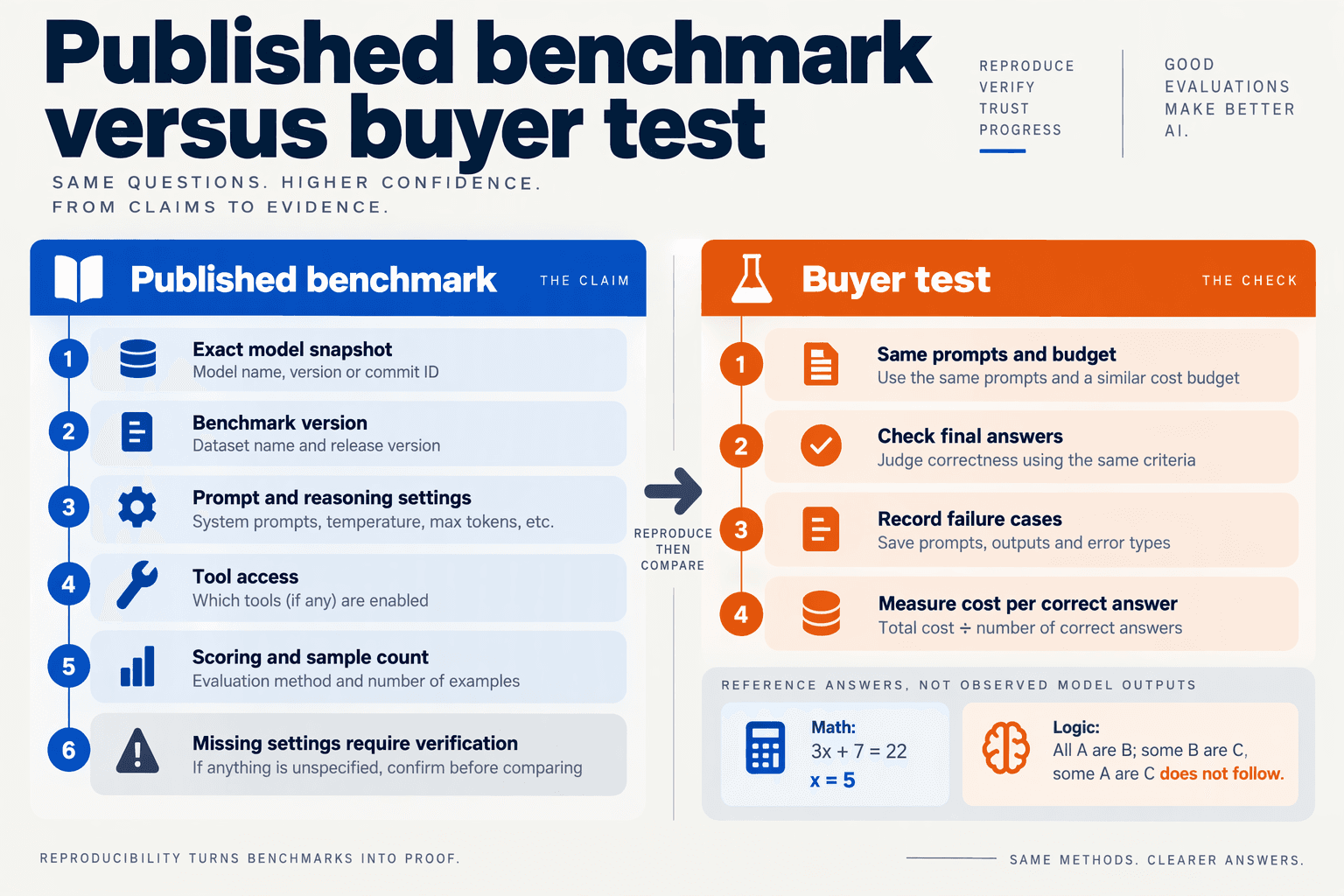
Not yet verified: the supplied Qwen.ai tables support score comparisons, but do not provide enough evaluation settings to independently reproduce them. For Qwen 3.5 Plus benchmarks on math and logic, buyers need both an identified endpoint and a controlled, workload-specific test.
What must match before benchmark results are reproducible?
- Model identity: As of November 2026, Qwen.ai’s supplied Qwen3.5 table labels its evaluated model Qwen3.5-397B-A17B, not Qwen3.5-Plus. Record the exact API model identifier, provider, test date, and any available version information; otherwise, a repeat run could evaluate a different deployment without making that difference visible.
- Evaluation configuration: The supplied Qwen.ai excerpt, reviewed in November 2026, does not specify prompts, sampling settings, reasoning budgets, or tool permissions for the math results. Capture those settings alongside output-token limits and timeout rules. Matching a benchmark name without matching its configuration does not establish an equivalent test.
- Scoring protocol: Specify whether accuracy means one correct first answer, success across repeated attempts, or a judge-assessed response. Qwen.ai’s separate Qwen3.8-Max post explicitly identifies MEAN@5 results and an August 3, 2026 leaderboard cutoff; that disclosure illustrates useful reporting detail, not a scoring protocol transferable to Qwen3.5’s math table.
- Test materials: Preserve the dataset version, problem text, images, answer key, and scorer. Separate text-only questions from diagram-based tasks, and disclose calculator or code-execution access. An answer generated with external computation should not silently share a score category with an answer produced without tools.
How should buyers test real math and multi-step logic?
- Proposed evaluation set: Start with 100 held-out tasks: 40 arithmetic or algebra problems, 30 rule-based logic cases, 20 multi-step business calculations, and 10 image-based questions where supported. This is a suggested buyer protocol, not a published Qwen benchmark. Keep category scores separate so strong arithmetic cannot conceal weak constraint handling.
- Worked logic example: Test a ₹2,000 order with a 10% discount, followed by a 5% fee on the discounted amount: the expected total is ₹1,890. Add an explicit rule that refunds apply only within 14 days, then test days 14 and 15 to expose boundary-condition errors.
- Reliability and cost: Run each of the 100 tasks three times per model, producing 300 responses. Report first-run accuracy, consistency across repeats, invalid outputs, observed response times, and actual billed cost. Do not present “correct at least once” as equivalent to dependable first-attempt performance in a customer-facing workflow.
- Implementation: As of November 2026, CallMissed’s OpenAI-compatible developer API offers reasoning-effort control, structured outputs, and usage and request logs—useful capabilities for instrumenting an evaluation. These features do not establish Qwen3.5-Plus availability or benchmark parity; verify the endpoint separately and keep fallback behavior explicit rather than mixing models into one score.
How much does Qwen 3.5 Plus cost, and what determines value?
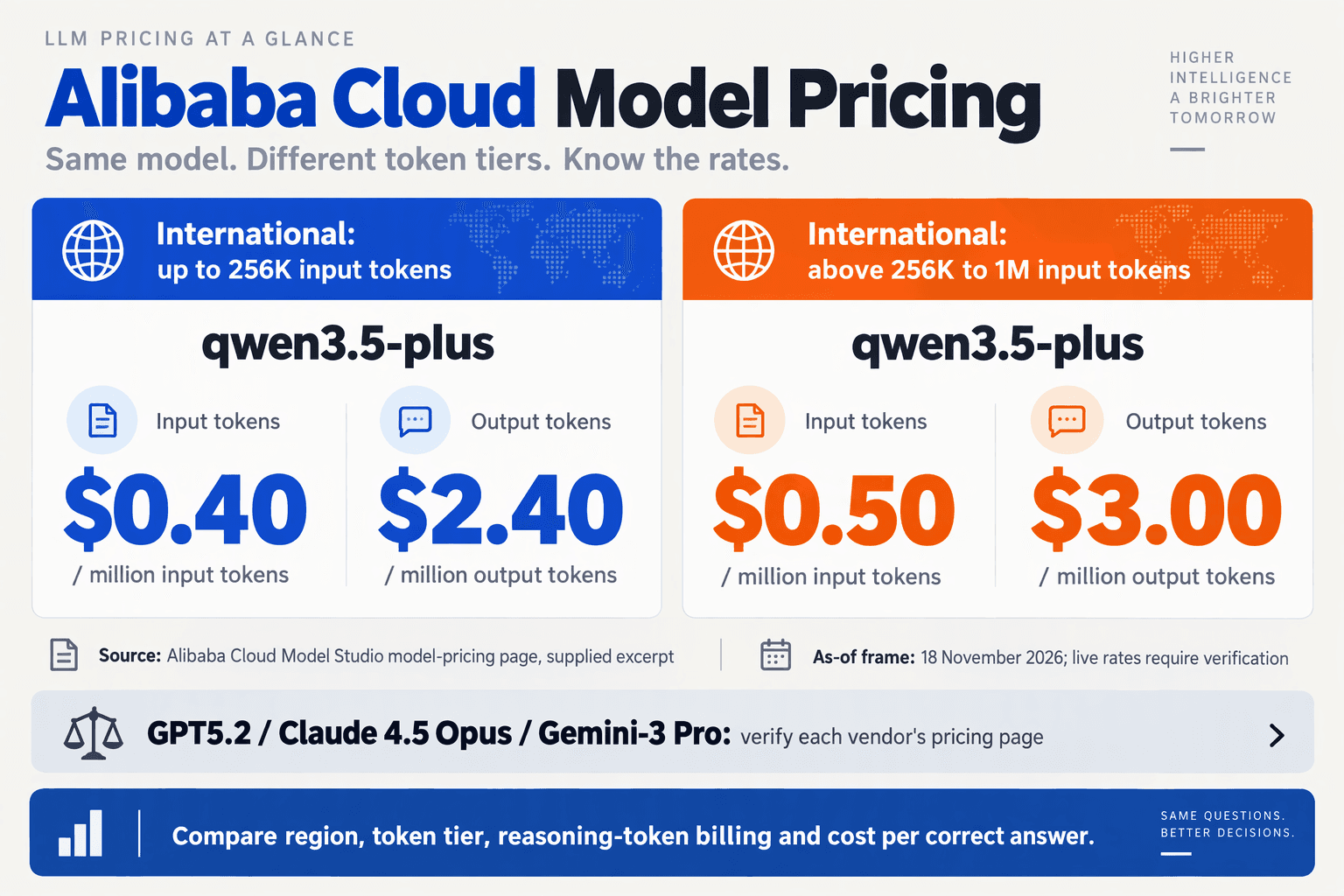
Qwen 3.5 Plus pricing cannot be verified from the supplied sources as of November 2026: no input-token, output-token, or cached-input rates are provided. Compare cost per accepted answer, not just token prices or scores attributed to a different Qwen model.
- Pricing evidence: Qwen.ai’s supplied Qwen3.5 article provides benchmark results, but the excerpt contains no Qwen3.5-Plus price schedule; a numerical price comparison would therefore require additional verified documentation.
- Model identity: Before requesting a quote, record the provider, exact endpoint identifier, region, and reasoning settings; do not assume Qwen3.5-Plus and Qwen3.5-397B-A17B have identical pricing or performance.
What pricing details should buyers verify?
The following purchasing checklist reflects information available—or missing—in the supplied context as of November 2026, rather than an advertised Qwen price list.
| Cost factor | Verified Qwen3.5-Plus rate | What to request | Why it affects value |
|---|---|---|---|
| Input tokens | Not supplied | Price per million input tokens | Long prompts increase spend |
| Output tokens | Not supplied | Price per million output tokens | Longer answers increase spend |
| Cached input | Not supplied | Cache rate and eligibility | Repeated context may cost less |
| Reasoning tokens | Not supplied | Billing and usage-accounting rules | Extra computation can change costs |
| Context tiers | Not supplied | Thresholds and tier-specific rates | Larger requests may price differently |
| Tools and retries | Not supplied | Separate fees and retry policy | Token charges may exclude other costs |
- Quote comparison: Normalize every offer to the same currency and one million tokens, then check taxes, regional availability, minimum commitments, and whether the quotation covers your intended endpoint.
- Reasoning budget: Test at least two supported reasoning settings on identical questions; measure accepted answers, billed usage, and completion time rather than assuming more reasoning always provides better value.
- Benchmark relevance: Qwen.ai’s supplied table, reviewed as of November 2026, reports 80.9 on IMOAnswerBench for Qwen3.5-397B-A17B; that result neither establishes Qwen3.5-Plus accuracy nor predicts your production acceptance rate.
How do you calculate value for math and logic tasks?
- Evaluation design: Build a proposed 100-question pilot with fixed prompts and scoring rules, covering numerical accuracy, contradictory constraints, and incomplete information; count an answer as accepted only when it meets your predefined requirements.
- Worked example: In a hypothetical pilot—not a Qwen measurement—₹120 spent for 80 accepted answers equals ₹1.50 per accepted answer, while ₹150 for 95 equals approximately ₹1.58; the cheaper accepted answer still comes with more failures.
- Infrastructure: As of November 2026, CallMissed’s verified developer API supports reasoning-effort control, usage and request logs, and caller-chosen fallback models; those capabilities support controlled evaluations, but the supplied facts do not confirm Qwen3.5-Plus availability.
Calculation: Cost per accepted answer = total evaluation spend ÷ accepted answers. For a production decision, add human-review and correction costs to spend: a low token bill can be poor value when mistakes require expensive intervention.
What are the evidence-backed strengths and purchase risks?
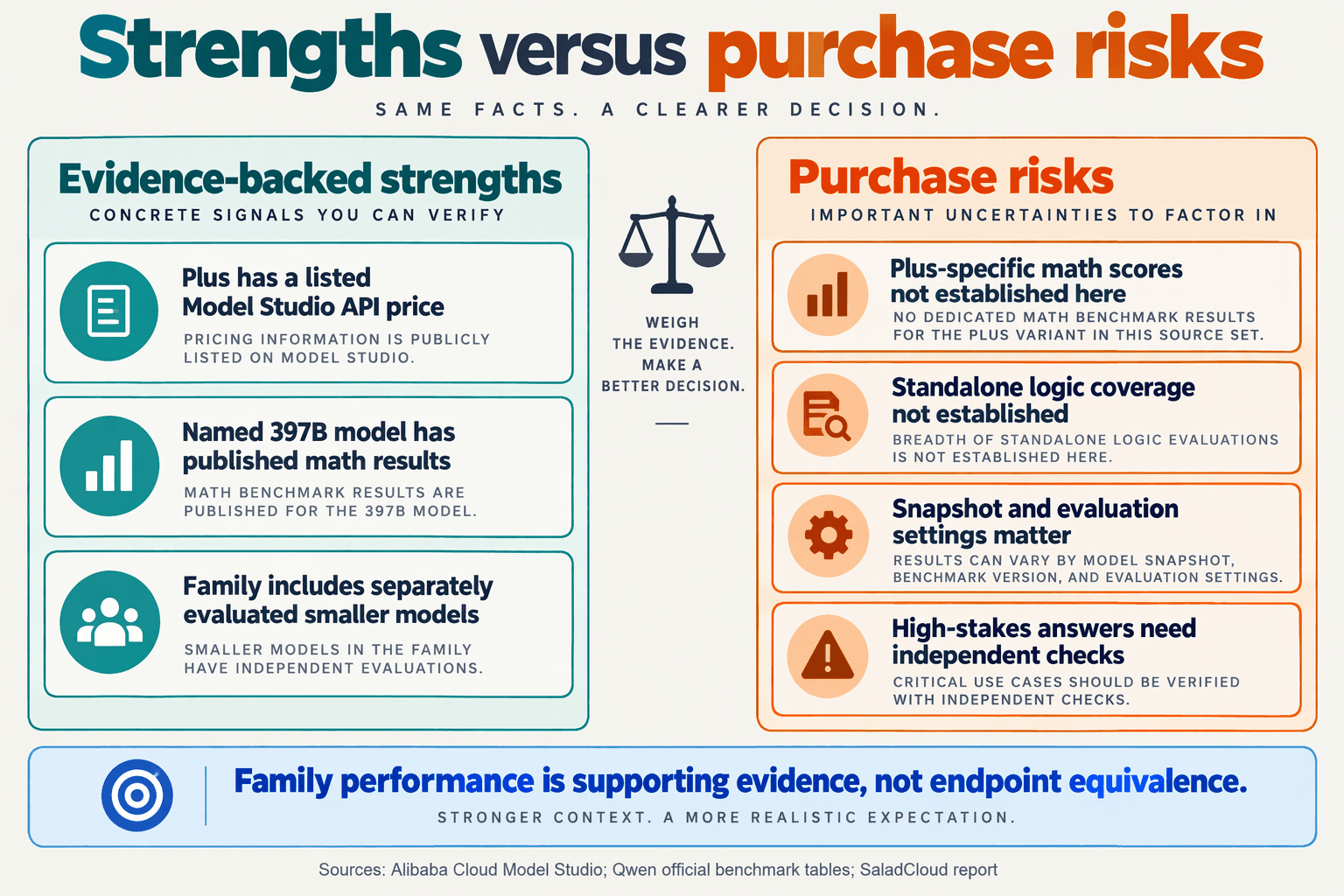
The evidence supports shortlisting Qwen3.5-397B-A17B for visual mathematics and multi-constraint tasks, not purchasing Qwen3.5-Plus on assumed equivalence. As of November 2026, the main purchase risks are unverified endpoint identity, uneven benchmark performance, and missing production-cost evidence.
Which strengths and risks should buyers compare?
| Evaluation area | Evidence-backed strength | Purchase risk | Buyer action |
|---|---|---|---|
| Visual mathematics | Qwen.ai’s table, reviewed in November 2026, reports 87.9 on We-Math for Qwen3.5-397B-A17B, versus Gemini-3 Pro’s 86.9. | A benchmark lead does not establish accuracy on your scanned worksheets, diagrams, or image quality. | Test representative images, including ambiguous labels and low-resolution inputs. |
| Dynamic mathematics | Qwen.ai’s table, reviewed in November 2026, reports 86.3 on DynaMath for Qwen3.5-397B-A17B, versus GPT5.2’s 86.8. | Qwen does not lead every visual-math evaluation. | Compare performance across your problem types rather than selecting one favorable score. |
| Multiple constraints | Qwen.ai’s table, reviewed in November 2026, reports 67.6 on MultiChallenge for Qwen3.5-397B-A17B, versus Gemini-3 Pro’s 64.2. | This result does not establish formal-logic correctness or dependable policy execution. | Include conflicting rules, exceptions, and missing information in acceptance tests. |
| Instruction compliance | Qwen.ai’s table, reviewed in November 2026, reports 92.6 on IFEval for Qwen3.5-397B-A17B, versus GPT5.2’s 94.8. | Mathematical competence and instruction-following are separate purchasing criteria. | Score answer correctness and compliance independently. |
| Model identity | The supplied Qwen.ai comparison identifies Qwen3.5-397B-A17B, as reviewed in November 2026. | The supplied evidence does not verify those scores for a Qwen3.5-Plus endpoint. | Obtain the exact endpoint identifier and benchmark mapping before contracting. |
| Production economics | The supplied context contains no verified Qwen3.5-Plus price or latency figures, as reviewed in November 2026. | Benchmark scores alone cannot establish cost-effectiveness or response-time suitability. | Measure billed usage, retries, and response times on your workload. |
What should a purchase decision require?
- Evidence provenance: Treat Qwen.ai’s November 2026-reviewed table as publisher-reported evidence; the supplied context does not provide an independent replication or complete evaluation settings.
- Score interpretation: The We-Math advantage is 1.0 score point, while the DynaMath deficit is 0.5 score points; neither difference demonstrates statistical significance without uncertainty estimates.
- Logic validation: Use separate checks for arithmetic, rule application, contradiction detection, and refusal to guess; a correct final number can conceal an invalid decision process.
- Pilot design: Start with 100 buyer-selected cases as a practical screening exercise, not a statistically definitive benchmark; include ordinary cases, edge cases, and known failure traps.
- Integration controls: As of November 2026, CallMissed’s OpenAI-compatible developer API offers reasoning-effort control, caller-chosen fallback models, and request logs; these support controlled comparisons, but the fact sheet does not confirm Qwen3.5-Plus availability.
- Purchase gate: Require three deliverables before commitment: verified model identity, workload-level quality results, and measured operating costs; leave unsupported claims marked “unverified” rather than converting them into purchasing assumptions.
Which model should you choose, and how can you try it today?
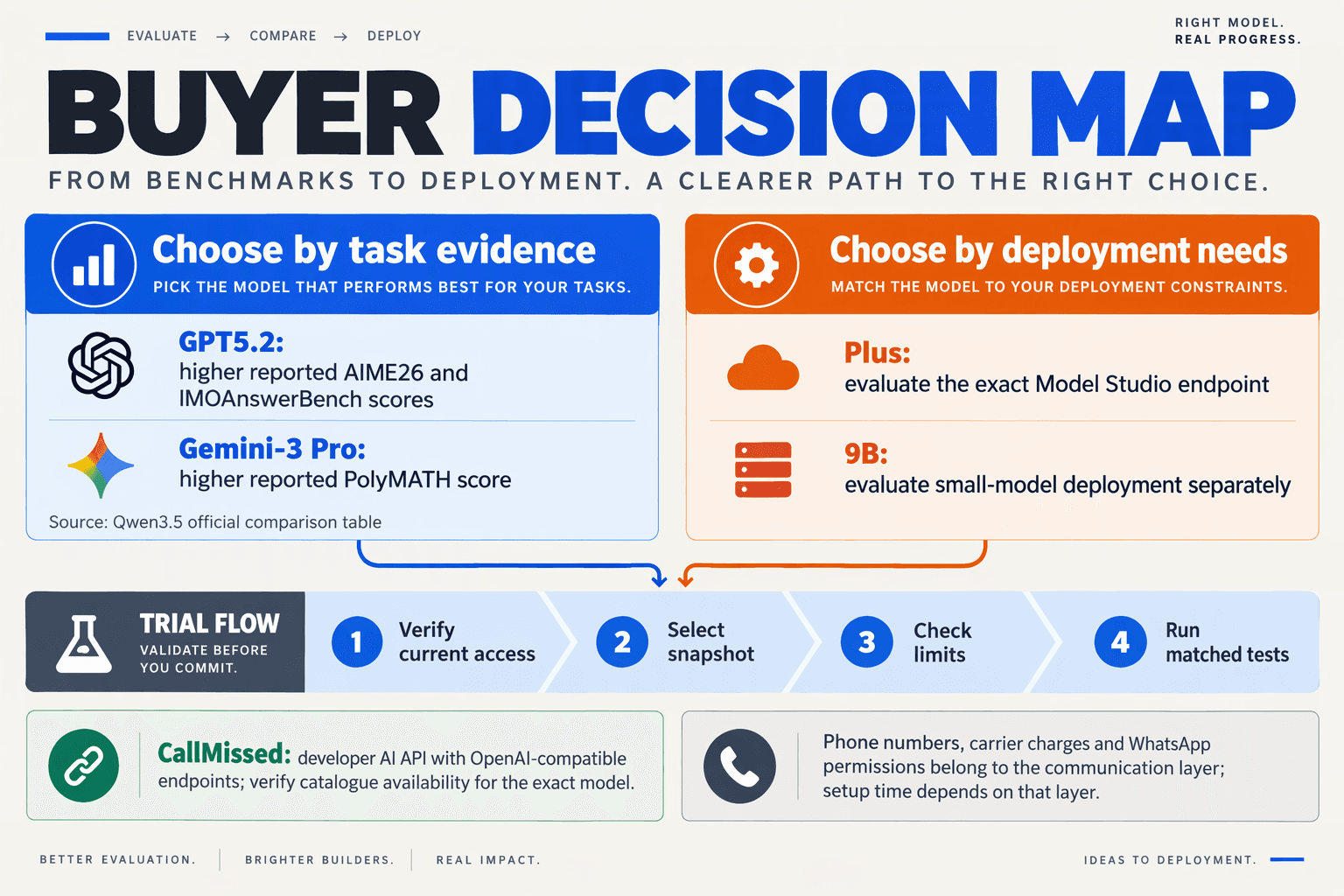
Shortlist by workload, then choose using an evaluation of the exact API endpoint you can buy. Qwen3.5-397B-A17B’s published results justify testing it for visual mathematics, but they do not establish Qwen 3.5 Plus benchmarks on math and logic.
Which model fits your math and logic workload?
- GPT5.2: Prioritize an evaluation of GPT5.2 for competition-style, text-based mathematics. According to Qwen.ai’s comparison reviewed in November 2026, GPT5.2 scores 86.3 on IMOAnswerBench, versus 80.9 for Qwen3.5-397B-A17B. Treat that result as a shortlisting signal—not a guarantee that GPT5.2 will handle your financial calculations or business rules correctly.
- Gemini-3 Pro: Include Gemini-3 Pro when your workload combines mathematical questions with other reasoning tasks. Qwen.ai’s table reviewed in November 2026 reports 90.7 on LiveCodeBench v6 for Gemini-3 Pro, versus 83.6 for Qwen3.5-397B-A17B. That coding result is relevant to executable problem-solving, but it is not a dedicated formal-logic score.
- Qwen3.5-397B-A17B: Shortlist this exact variant for image-based mathematics. According to Qwen.ai’s table reviewed in November 2026, Qwen3.5-397B-A17B scores 90.3 on Mathvista(mini) and 87.9 on We-Math. However, GPT5.2 scores 86.8 on DynaMath, narrowly above Qwen’s 86.3, illustrating why one visual benchmark should not determine your purchase.
- Qwen3.5-Plus: Require endpoint-specific evidence before choosing the separately named Plus offering. As of November 2026, the supplied Qwen.ai comparison identifies Qwen3.5-397B-A17B, not Qwen3.5-Plus. Ask the provider for the model identifier, version, benchmark configuration, and current pricing; without those details, a defensible Plus-specific recommendation remains unavailable.
How can you run a useful trial today?
- Endpoint verification: Before testing, record the provider, exact model ID, access date, and supported inputs. For a November 2026 purchase decision, confirm whether “Plus” is a product label or the benchmarked model identity. Do not assume similarly named endpoints share weights, reasoning settings, tool access, or published results.
- Trial design: As a suggested starting point—not a published benchmark—assemble 60 representative cases: 20 numerical calculations, 20 constraint-based decisions, and 20 visual problems if images matter. Include missing information and contradictory instructions. Keep prompts, tool permissions, output requirements, and reasoning budgets comparable wherever the endpoints permit.
- Buyer scorecard: Measure correct final answers, rule violations, response time, and actual billed cost. Calculate cost per correct answer as total trial spend divided by correctly solved cases. A model with a lower token price can still cost more per successful result if it requires repeated attempts or manual correction.
- CallMissed: As of November 2026, CallMissed’s verified developer API offers OpenAI-compatible endpoints, reasoning-effort control, and usage and request logs, with 1,000 free signup credits. Those capabilities can support trials of available models; the supplied fact sheet does not confirm Qwen3.5-Plus availability, so verify the catalogue before planning a Qwen-specific integration.
Frequently Asked Questions
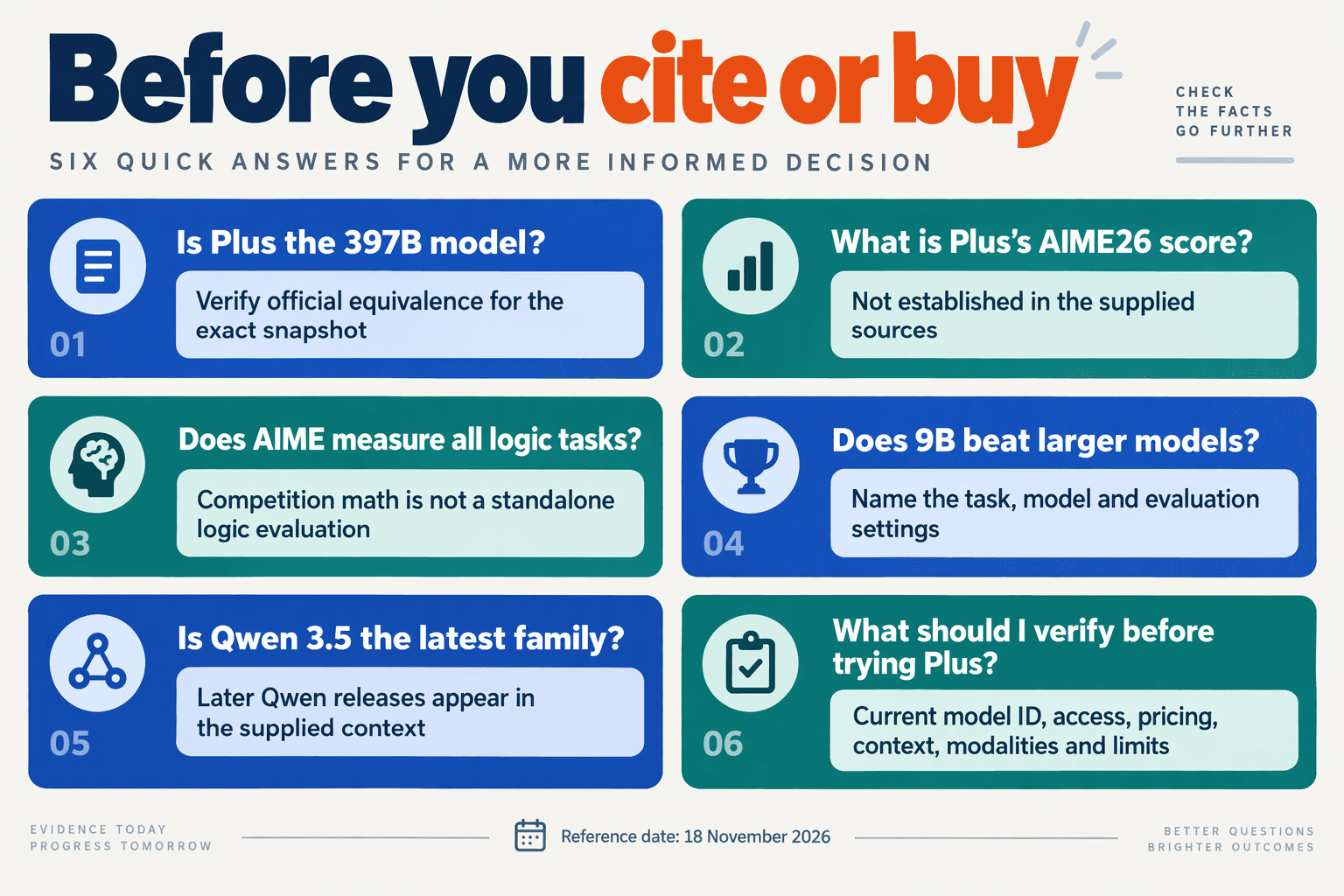
The supplied evidence does not establish that Qwen3.5-Plus is Qwen3.5-397B-A17B. Verified here means traceable to Qwen.ai’s published table—not independently reproduced or confirmed for the Plus endpoint.
- Q: Is Qwen 3.5 Plus the same model as Qwen3.5-397B-A17B?
A: As of November 2026, the supplied Qwen.ai benchmark table explicitly names Qwen3.5-397B-A17B, not Qwen3.5-Plus, so treating those identities as interchangeable is unsupported by this evidence. Before purchasing access, request documentation connecting the exact Plus endpoint and model version to the benchmarked model; a similar family name alone does not establish equivalent performance or evaluation settings.
- Q: Which Qwen 3.5 Plus benchmarks on math and logic are verified?
A: Qwen.ai’s supplied table, reviewed as of November 2026, reports 91.3 on AIME26, 80.9 on IMOAnswerBench, and 73.3 on PolyMATH for Qwen3.5-397B-A17B; these are publisher-reported results, not established Plus scores. The supplied material contains neither a separately identified Plus benchmark column nor a dedicated formal-logic evaluation for Plus, so those claims remain unverified within this evidence set.
- Q: Does Qwen outperform GPT5.2 and Gemini-3 Pro on mathematics?
A: According to Qwen.ai’s supplied table, reviewed as of November 2026, Qwen3.5-397B-A17B trails GPT5.2 on AIME26 by 5.4 score points but leads Gemini-3 Pro by 0.7 points. On PolyMATH, the same source places Qwen above GPT5.2 but below Gemini-3 Pro and Claude 4.5 Opus, making “better at mathematics” too broad a purchasing conclusion without specifying the benchmark and workload.
- Q: Which published Qwen results are relevant to visual mathematics?
A: Qwen.ai’s supplied table, reviewed as of November 2026, reports 90.3 on Mathvista(mini), 87.9 on We-Math, and 86.3 on DynaMath for Qwen3.5-397B-A17B. Those results are relevant when comparing models for image-based mathematical questions, but buyers should retain the exact benchmark labels—especially “mini”—and should not present them as verified Qwen3.5-Plus results or guaranteed accuracy on customer documents.
- Q: Do Qwen 3.5 Plus benchmarks on math and logic prove reliable business-rule reasoning?
A: No: as of November 2026, the supplied Qwen.ai evidence does not establish Plus-specific reliability for eligibility decisions, contradictory requirements, or multi-condition refund calculations. Evaluate those workflows separately with cases covering boundary values, missing information, conflicting rules, and expected refusal or escalation behavior; a mathematical benchmark score cannot substitute for checking whether the model consistently applies your actual policy.
- Q: How should buyers compare a Plus endpoint fairly before deployment?
A: Record the exact endpoint, evaluation date, prompts, tool access, reasoning settings, scoring rules, and observed cost, then run identical cases against each candidate rather than comparing unmatched headline scores. As of November 2026, CallMissed’s OpenAI-compatible developer API offers reasoning-effort control and usage and request logs that can support evaluation recordkeeping, but its verified fact sheet does not establish Qwen3.5-Plus availability or benchmark equivalence.
Conclusion
Qwen 3.5 Plus benchmarks on math and logic remain unverified in the supplied comparison: Qwen.ai’s table identifies Qwen3.5-397B-A17B, not a separately named Qwen3.5-Plus endpoint. The practical conclusion is to treat the published results as evidence for the listed model—not as interchangeable proof for every Qwen variant.
- Verify model identity before comparing scores. According to Qwen.ai’s supplied benchmark table, reviewed as of November 2026, Qwen3.5-397B-A17B scores 91.3 on AIME26 and 80.9 on IMOAnswerBench. Those results establish a useful mathematical reference point, but neither establishes a verified Qwen3.5-Plus score. Before purchasing access, ask which exact model or endpoint produced the cited benchmark and whether that identity matches the service you will actually deploy. A similar product name is not enough to resolve that question.
- Choose the benchmark that resembles your workload. According to Qwen.ai’s supplied table, reviewed as of November 2026, Qwen3.5-397B-A17B scores 73.3 on PolyMATH, above GPT5.2’s 62.5, but below Claude 4.5 Opus’s 79.0 and Gemini-3 Pro’s 81.6. That comparison supports a task-specific assessment rather than a blanket winner. Buyers prioritizing competition-style questions, multilingual mathematical problems, or diagram-based calculations should not assume that one ranking settles all three requirements.
- Keep visual mathematics separate from text-only results. According to Qwen.ai’s supplied table, reviewed as of November 2026, Qwen3.5-397B-A17B scores 88.6 on MathVision, compared with 83.0 for GPT5.2 and 86.6 for Gemini-3 Pro. This changes the purchasing picture for diagram-based problems. It also explains why a model that trails on one mathematical benchmark can remain worth evaluating for another: the input format and tested skills matter as much as the headline score.
- Test business logic directly under comparable conditions. The supplied context contains no dedicated formal-logic benchmark for Qwen3.5-Plus. Mathematical performance therefore does not establish dependable handling of eligibility rules, contradictory requirements, or constrained refunds. Build a small evaluation around those actual tasks, keeping prompts, tools, reasoning settings, and scoring conditions aligned. The decision should rest on repeatable performance against your requirements, not an assumption that mathematical accuracy guarantees broader logical reliability.
Looking ahead, watch for explicit Qwen3.5-Plus benchmark attribution and clearly documented evaluation settings. Those details would make future comparisons more useful than another isolated headline score, particularly when buyers need to distinguish mathematical capability from production-ready business reasoning.
As of November 2026, CallMissed’s OpenAI-compatible developer API includes reasoning-effort control and request logs—capabilities readers can explore when organizing their own model evaluations. Before choosing an endpoint, can you verify both its identity and its performance on the problems your business actually needs solved?
Related Reading
- Qwen 3.8 Voice Agent Benchmarks: A Builder’s Guide
- Fable 5.2 vs GPT-6 Astra vs Gemini 4 Carbon: Benchmarks
- Nemotron 3 Super Explained: What It Is and Its Maker