STT for Hinglish: Compare Code-Mixed Speech APIs in 2026


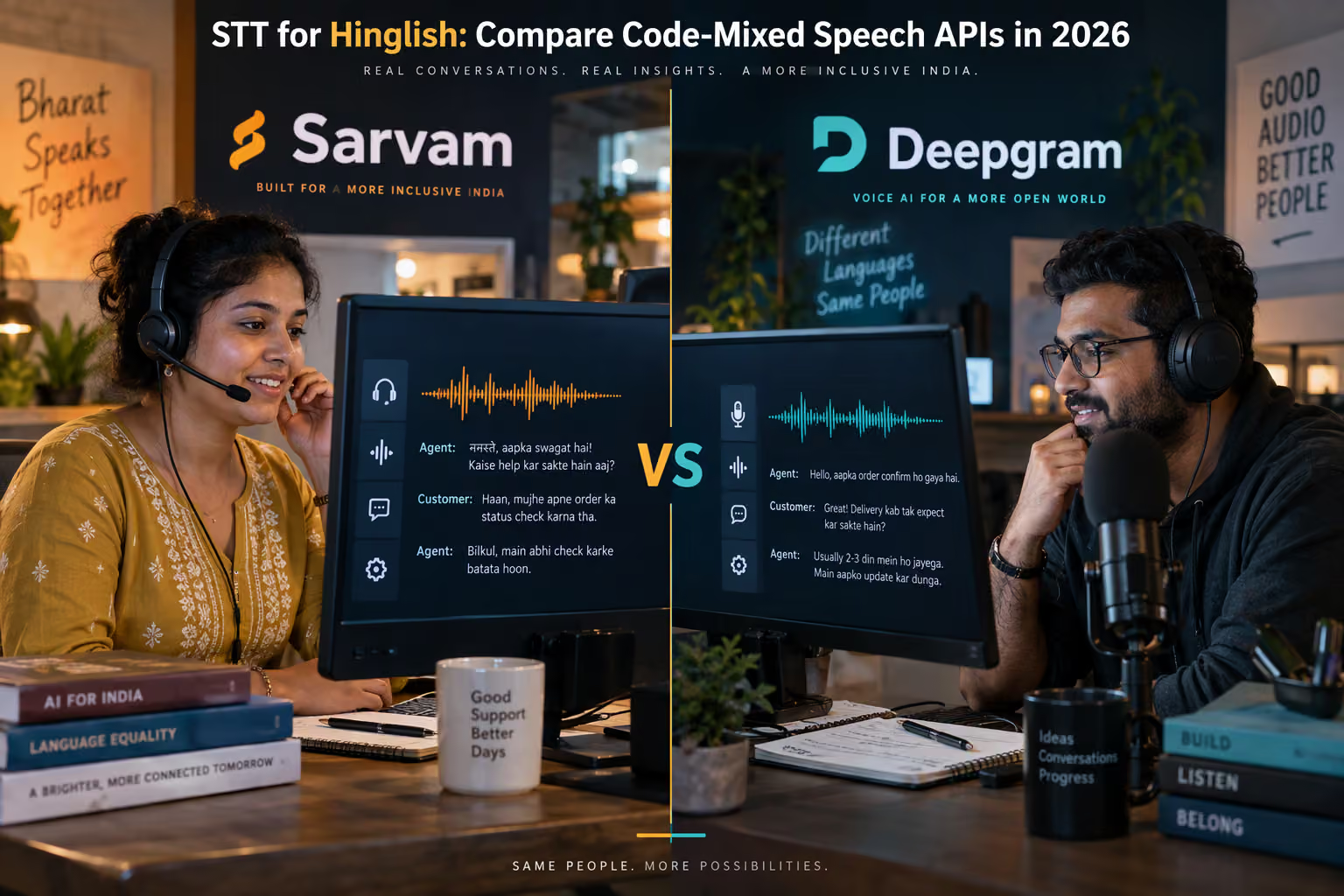
Compare STT for Hinglish by code-switching evidence, streaming needs, integration effort and sourced costs to shortlist APIs for Indian support.

STT for Hinglish: Compare Code-Mixed Speech APIs in 2026
Can your speech API recognise “delivery address change kar do”—without losing either language? The best STT for Hinglish is the API that preserves Hindi-English switches, names, numbers and intent on your actual recordings—not necessarily the one with the strongest English-only benchmark.
That distinction matters for support calls, voice agents and order-taking systems. A transcript can look readable while getting the crucial detail wrong: a delivery address, a payment amount or the product a customer wants replaced. For buyers comparing code-mixed speech APIs in November 2026, multilingual coverage is a starting point, not proof of Hinglish accuracy.
Which speech-to-text APIs should Hinglish buyers shortlist?
The supplied November 2026 comparison from Bolna identifies Sarvam saaras:v4 as handling regional accents and code-mixed speech, while Soniox stt-rt-v5 detects and switches languages mid-sentence. Bolna lists Soniox support for English and nine Indian languages, and Sarvam support for 11 Indian languages plus English within Bolna’s integration.
Those capabilities make Sarvam and Soniox relevant candidates to test—not automatic winners. Sarvam’s speech-to-text examples illustrate why: Hindi sentences contain English brands, product names, addresses and amounts, including Flipkart, Samsung Galaxy and ₹12,499. A buyer needs those details preserved, not merely a transcript that captures the conversational gist.
This comparison will help you distinguish:
- Code-switching support from a simple list of supported languages.
- Streaming transcription for live conversations from prerecorded transcription.
- Entity accuracy from overall transcript readability.
- Native-script and Romanised output requirements from recognition quality itself.
How much should price influence your decision?
Price matters, but only after you establish acceptable accuracy for your workload. AssemblyAI’s comparison, dated November 4, 2026, lists prerecorded transcription at $0.21/hour for AssemblyAI Universal-3.5 Pro and $0.258/hour for Deepgram Nova-3. These are provider-published comparison figures, not evidence that either model performs better on your Hinglish calls.
The supplied pricing sources also distinguish streaming from prerecorded processing. That difference changes the buying decision: an inexpensive recording workflow may be unsuitable for an agent that must respond during a live conversation.
As of November 2026, CallMissed’s developer AI API offers 50 speech-to-text models, with speech recognition supporting 22 Indian languages plus English, including code-mixed speech such as Hinglish.
What will this comparison help you decide?
You will learn which APIs deserve a pilot, what to measure and where headline claims need qualification. The practical test is straightforward: run the same representative recordings through each shortlisted model, then check language switches, names, amounts, addresses, response timing and total cost.
The goal is a defensible buyer’s decision: choose the API that understands your customers reliably enough for the job you need it to do.
For Hinglish STT, shortlist Sarvam for India-focused transcription and Deepgram for documented multilingual code-switching. Neither is a proven universal winner; test the exact models on your support audio before choosing.
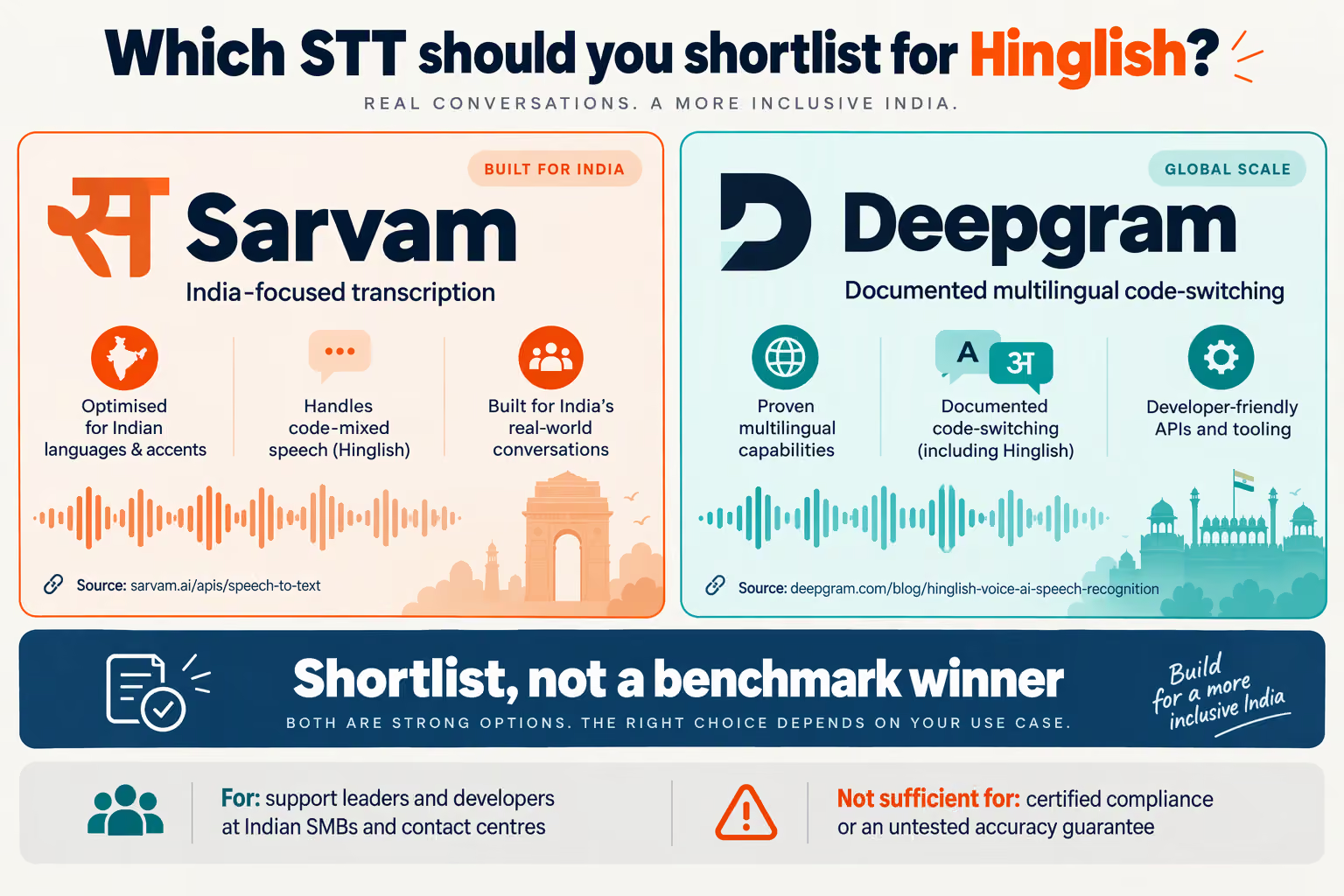
Shortlist Sarvam for India-focused transcription and Deepgram for multilingual evaluation, but do not treat either as the proven best STT for Hinglish. The supplied November 2026 evidence supports testing specific models—not declaring a universal winner.
Which Sarvam and Deepgram models should buyers test?
- Sarvam saaras:v4: Bolna’s integration comparison, supplied for November 2026, identifies this model for Indian languages and regional accents. Start here when your workload contains Hindi-English conversations, but record the exact model version: evidence about saaras:v4 should not automatically transfer to another Sarvam model or configuration.
- Deepgram Nova-3 multilingual: AssemblyAI’s comparison dated November 4, 2026, separately discusses prerecorded code-switching and realtime Nova-3 Multi results. This makes Nova-3 multilingual a relevant evaluation candidate, but the supplied excerpt does not establish a Hinglish-specific, independently verified advantage. Request the underlying languages, dataset and scoring methodology before relying on benchmark comparisons.
- Deepgram Nova-2: Bolna’s November 2026 comparison lists 30+ languages and instructs users to “set the language explicitly.” That configuration is materially different from automatic language switching. Do not assume that selecting Hindi, or seeing Hindi and English in a language list, guarantees reliable recognition when speakers alternate between both.
What changes the shortlist for live support calls?
- Deepgram Flux: Bolna’s November 2026 comparison describes English and a multilingual variant, with turn detection inside the model enabling barge-in. Evaluate this separately from Nova-3: turn detection determines when an agent should respond, while transcription accuracy determines whether the agent understood the request. Neither measurement substitutes for the other.
- Deepgram pricing: AssemblyAI’s November 4, 2026 comparison lists Nova-3 multilingual streaming at $0.0092/minute, versus $0.0077/minute for monolingual streaming. That equals $55.20 versus $46.20 for 100 audio hours, calculated from those published rates. Budget against the multilingual configuration you actually test, rather than applying a cheaper monolingual headline price.
What evidence should decide the purchase?
- Your pilot: As a proposed November 2026 buying test—not a published benchmark—use 100 consented support recordings, divided across clean audio, background noise, regional accents and frequent language switches. Run identical files through each candidate, hold preprocessing constant, and preserve model identifiers and settings so the comparison can be reproduced.
- Your acceptance criteria: For that pilot, report three separate measures: transcription error under a declared script-normalisation policy, exact-match accuracy for business-critical entities, and live response timing. Score amounts, phone numbers and addresses independently; a transcript with fewer overall errors can still be the worse purchase if it corrupts details needed to complete a transaction.
- CallMissed: As of November 2026, CallMissed’s developer AI API provides OpenAI-compatible audio transcription endpoints, one API key and usage/request logs. Those integration capabilities can simplify an evaluation workflow, but they are not accuracy evidence: confirm the exact available model and its configuration before treating any gateway-based test as equivalent to a provider-direct result.
How do Sarvam, Deepgram, Soniox, Google, Azure and CallMissed compare?
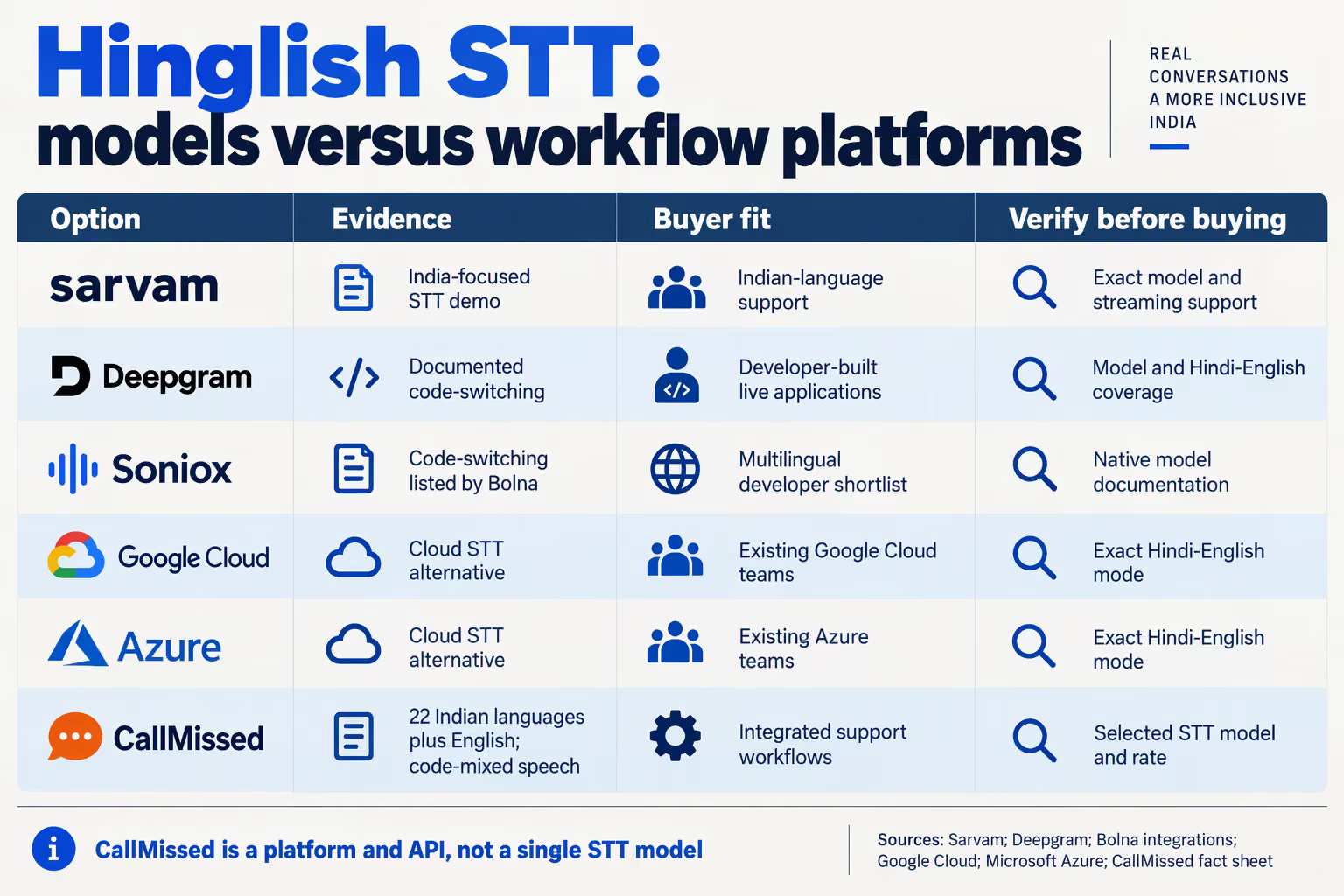
Sarvam and Soniox merit code-switching pilots; Deepgram, Google Cloud and Microsoft Azure need model-specific testing, while CallMissed provides a multi-model integration route. This November 2026 comparison separates documented capabilities from pricing evidence—not a universal Hinglish accuracy ranking.
How do the six speech-to-text options compare as of November 2026?
| Option | Hinglish evidence | Price evidence | Buyer consideration |
|---|---|---|---|
| Sarvam saaras:v4 | Bolna reports regional-accent and code-mixed support across 11 Indian languages plus English within its integration. | Standalone STT price not supplied. | Test English entities embedded in Hindi speech. |
| Deepgram | Bolna lists Nova-2 with explicit language selection; AssemblyAI separately evaluates Nova-3 code-switching. | AssemblyAI lists Nova-3 multilingual streaming at $0.0092/minute. | Specify the model and language mode before comparing results. |
| Soniox stt-rt-v5 | Bolna reports mid-sentence language switching, English and nine Indian languages. | Price not supplied. | Pilot conversations with repeated Hindi-English switches. |
| Google Cloud Speech-to-Text | Supplied sources do not establish Hinglish-specific accuracy. | AssemblyAI lists $0.016/minute for the first 500,000 monthly minutes. | Confirm the selected model, configuration and billing tier. |
| Microsoft Azure AI Speech | Supplied sources do not establish Hinglish-specific accuracy. | AssemblyAI lists US East real-time transcription at $1/hour. | Resolve conflicting batch-price references before budgeting. |
| CallMissed developer AI API | Its verified fact sheet lists code-mixed recognition, including Hinglish, and 50 STT models. | Model-specific STT rates are not supplied; 1 credit = ₹1. | Use OpenAI-compatible audio transcription endpoints; evaluate the chosen model separately. |
What should buyers verify before choosing a Hinglish STT API?
- Sarvam: Sarvam’s supplied product examples contain addresses, brands and currency amounts. Build acceptance tests around exact entity preservation: recognising the surrounding sentence is insufficient if an apartment number or payment amount changes.
- Soniox: Bolna’s November 2026 comparison explicitly describes language switching within one sentence. Test switches in both directions—Hindi to English and English to Hindi—rather than relying on separate monolingual recordings.
- Deepgram: AssemblyAI’s November 4, 2026 comparison distinguishes multilingual streaming from monolingual streaming. At $0.0092/minute, multilingual streaming calculates to $0.552/hour; do not budget a code-switching workflow using the lower monolingual rate.
- Google Cloud: AssemblyAI’s November 2026 comparison lists $0.016/minute, equivalent to $0.96/hour, for the first 500,000 monthly minutes. Deepgram’s guide gives a $0.72–$0.96/hour range tied to data logging, so configuration matters.
- Microsoft Azure: The supplied November 2026 sources disagree on batch pricing: AssemblyAI quotes $0.18/hour in US East, while Deepgram quotes $0.36/hour. Treat neither as a universal quote; confirm region and processing mode.
- Benchmark evidence: AssemblyAI publishes code-switching results for Deepgram, but the supplied excerpt does not establish a Hinglish-only evaluation. Those figures cannot responsibly become a six-provider Hinglish leaderboard or prove performance on Indian telephone audio.
- Output requirements: Specify whether your application needs Devanagari, Romanised Hindi or mixed-script transcripts. Score that requirement separately from recognition accuracy so formatting preferences do not obscure incorrect words, names or numbers.
- Pilot decision: Run identical recordings through shortlisted configurations, then compare entity errors, switch-boundary errors, streaming behaviour and cost per usable transcript. Choose the lowest-cost option that passes your operational thresholds—not the longest language list.
Which language, telecom and integration constraints can rule an option out?
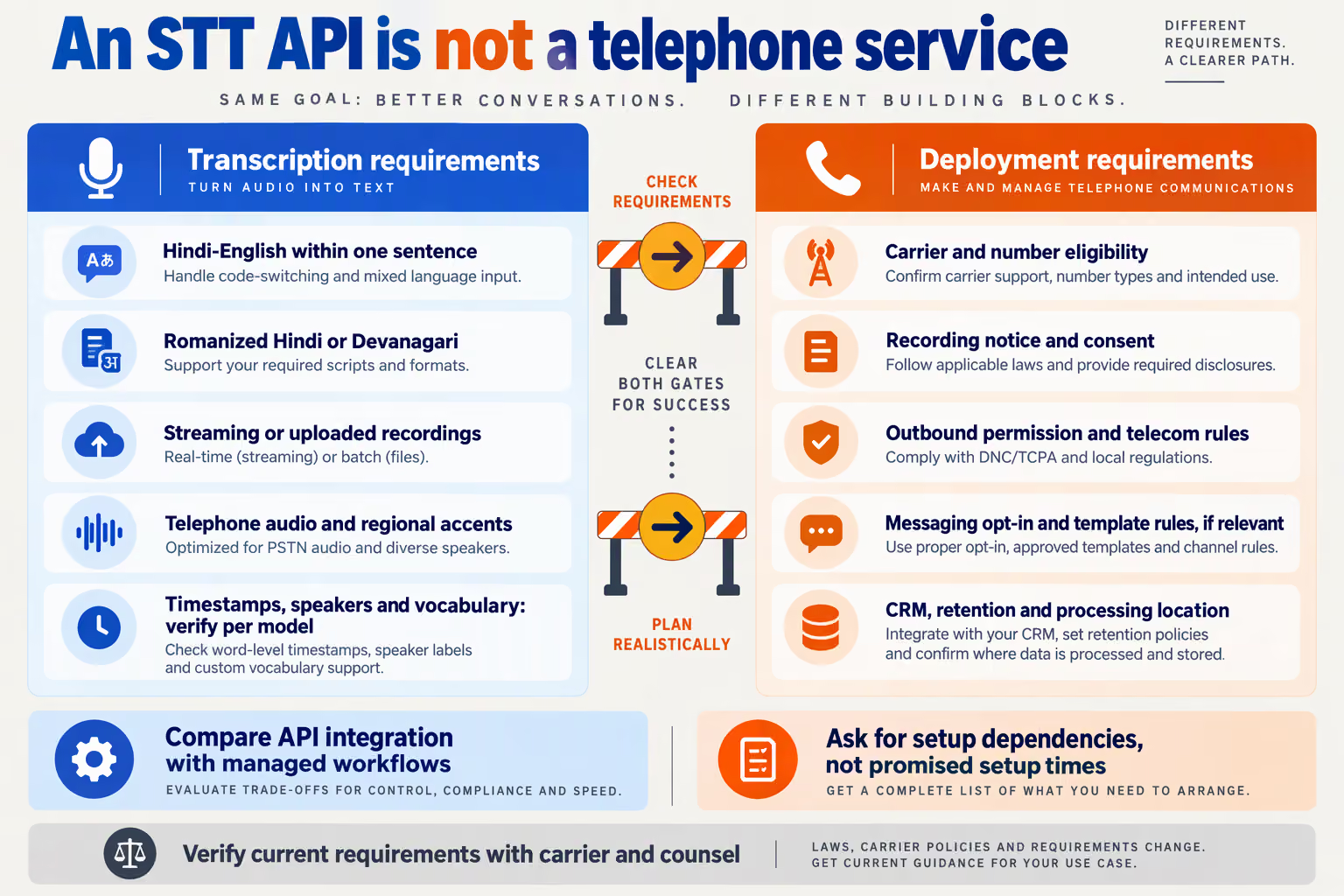
Rule out a speech-to-text option if it cannot handle your required language switches, telephone audio or application interface. Hinglish recognition alone is insufficient when the production workflow requires a specific script, live partial transcripts or carrier integration.
Which language requirements can disqualify an STT model?
- Language selection: Bolna’s November 2026 comparison says Deepgram Nova-2 requires an explicitly selected language. If callers switch unpredictably between Hindi and English, require a demonstration using that exact configuration; “30+ languages” does not establish automatic switching within one utterance. Reject configurations that force your application to guess the caller’s language incorrectly.
- Output script: Specify whether downstream systems require Devanagari, Romanised Hindi or mixed-script text before testing. Sarvam’s speech-to-text page, supplied for this November 2026 comparison, illustrates Hindi text alongside English entities such as “Flipkart” and “Samsung Galaxy.” That example does not establish selectable transliteration modes; verify the required output directly.
- Model version: Bolna’s November 2026 integration page names Deepgram Nova-2, Deepgram Flux, Sarvam saaras:v4 and Soniox stt-rt-v5, while AssemblyAI’s November 4, 2026 comparison discusses Deepgram Nova-3. Treat these as distinct configurations: language support, pricing and behaviour reported for one model should not be transferred to another.
Which telephone-audio and streaming constraints matter?
- Telephone input: Make 8 kHz telephone audio, your actual codec and your channel layout explicit acceptance-test inputs where applicable. Ask whether conversion is required, then test the converted audio rather than clean microphone recordings. Reject a setup if conversion consistently loses names, address digits or short Hindi-English switches.
- Live transcription: Require a working demonstration of partial transcripts, final transcripts and interruption handling for voice-agent workloads. Bolna’s November 2026 comparison attributes built-in turn detection to Deepgram Flux; that is a model-specific capability, not proof that every Deepgram transcription endpoint provides equivalent conversational behaviour.
- Streaming budget: AssemblyAI’s November 4, 2026 comparison lists Deepgram Nova-3 monolingual streaming at $0.0077/minute and multilingual streaming at $0.0092/minute. Those rates imply $462 versus $552 for 60,000 minutes, before other services. Budget against the required multilingual mode—not a cheaper prerecorded or monolingual configuration.
Which integration requirements should buyers verify?
- API fit: As of November 2026, CallMissed’s developer AI API provides OpenAI-compatible audio-transcription endpoints, while CallMissed’s voice platform supports Twilio, Plivo or any SIP trunk. These are separate integration strengths: transcription compatibility does not itself establish telephone connectivity. CallMissed’s verified fact sheet also specifies that phone carriage is billed separately.
- Operational acceptance: Require written answers on data location, retention, deletion, file-size limits, concurrent streams and disconnect recovery before committing. The supplied November 2026 comparison does not establish these limits across shortlisted providers. If any requirement is mandatory, an undocumented answer is a procurement blocker—not something to infer from language coverage or benchmark results.
How should you benchmark Hindi and English mixed speech beyond WER?
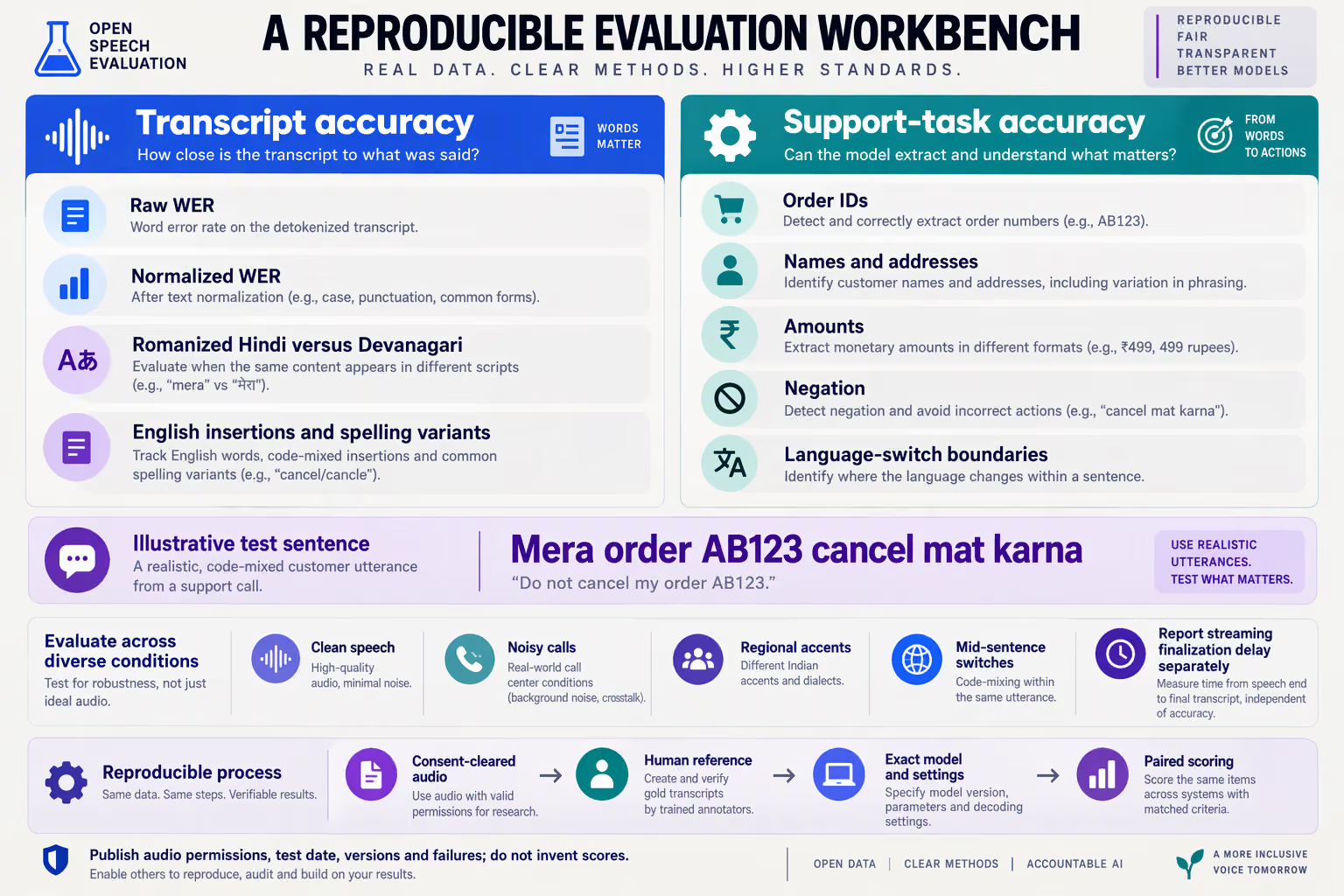
Benchmark Hindi-English mixed speech on critical-detail accuracy, code-switch boundaries and streaming stability—not just word error rate (WER). Use the following buyer-designed test protocol for November 2026; sample sizes and acceptance thresholds are recommendations, not published provider results.
Which accuracy metrics matter beyond WER?
- Representative test set: Start with 200 consented clips from at least 30 speakers, covering quiet speech, telephone audio, background noise and regional accents. Include both Hindi-dominant and English-dominant conversations. Keep speakers in the final evaluation separate from any development recordings used to adjust vocabulary or settings.
- Normalised WER: Calculate substitutions, deletions and insertions against human-reviewed reference transcripts, but publish both raw and normalised scores. Define acceptable equivalences before testing: “₹500,” “500 rupees” and “पाँच सौ रुपये” may represent the same amount, while “₹5,000” must remain an error regardless of formatting.
- Critical-entity accuracy: Separately score exact matches for amounts, phone numbers, order IDs, product names and addresses. Sarvam’s speech-to-text page, supplied for this November 2026 comparison, illustrates ₹12,499 inside mixed-language speech. Report amount accuracy independently so hundreds of correctly recognised filler words cannot hide one financially significant mistake.
- Switch-boundary accuracy: Manually label at least 100 Hindi-to-English and English-to-Hindi transitions, then measure recognition errors immediately around each switch. Bolna’s integration comparison, supplied for November 2026, describes Soniox stt-rt-v5 as switching languages mid-sentence; test that capability on your recordings rather than treating the description as measured accuracy.
How should you score live-call usefulness and buying risk?
- Streaming latency and revisions: Record median and p95 time to first partial transcript, final transcript and stable critical entity. Replay identical audio at real-time speed through each streaming API. A quickly displayed number that changes twice before finalisation may be less useful to a voice agent than a slightly later, stable result.
- Task-success rate: Test 50 representative workflows, such as changing a delivery address or confirming a refund amount, using the same downstream extraction rules. Measure whether the transcript produces the correct structured fields and action. Count a missing negation—“cancel mat karna” becoming “cancel karna”—as a task failure even when overall WER looks acceptable.
- Slice-level acceptance gates: Publish results separately for noisy calls, accents, language direction and native-script versus Romanised output. An illustrative buying gate is ≥98% exact amount recognition and ≥95% task success, with no priority slice below its agreed minimum. Set thresholds according to business risk before seeing provider results, not afterward.
- Reproducibility and integration: Log model version, language settings, vocabulary hints, audio format, failures and billed usage for every run. As of November 2026, CallMissed’s developer AI API provides OpenAI-compatible audio-transcription endpoints and usage and request logs, offering a consistent integration approach; compatibility alone does not establish equivalent Hinglish accuracy across models.
How much do the options cost, and what does each price include?
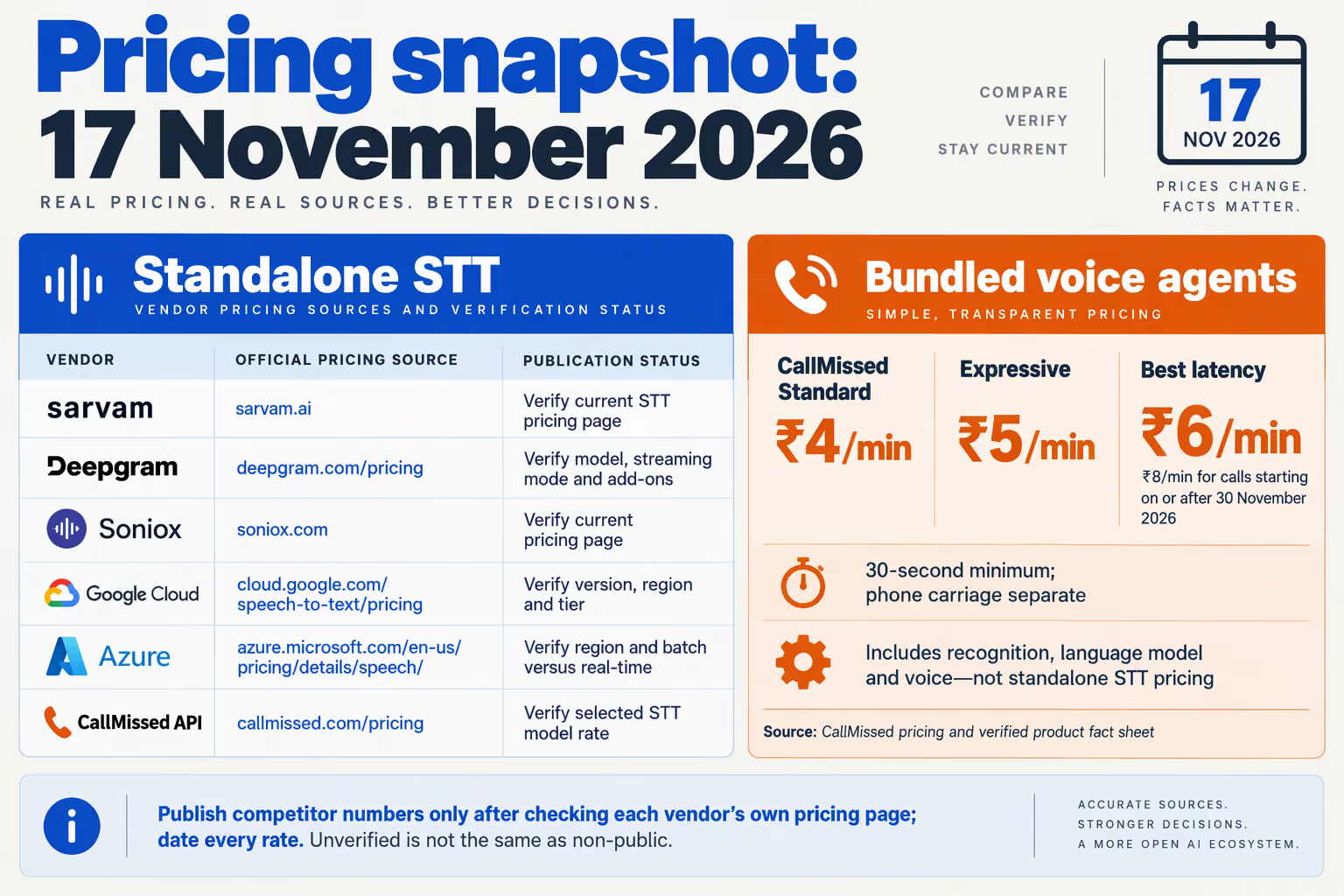
Hinglish STT costs depend on processing mode, language configuration and what the rate includes—not just the cheapest headline price. The supplied November 2026 sources quote transcription rates; these should not be treated as complete voice-agent costs.
- Compare equivalent workloads: Separate prerecorded transcription from live streaming, and monolingual streaming from multilingual streaming. For a Hindi-English conversation, an English-only streaming quote is not a reliable budget for the configuration you intend to test.
- Check the billing scope: Ask whether your quote includes only recognition or also the language model, generated voice and phone carriage. Confirm minimum billable duration, rounding, failed-request charges and any optional processing before estimating production spend.
How do the shortlisted speech-to-text prices compare?
All figures below reflect the supplied sources available for this November 2026 comparison, rather than independently verified checkout quotes.
| Option | Published transcription price | What the quote covers | Source / qualification |
|---|---|---|---|
| AssemblyAI Universal-3.5 Pro | $0.21/hour | Prerecorded transcription | AssemblyAI, November 4, 2026; not a streaming quote |
| Deepgram Nova-3 | $0.258/hour prerecorded; $0.462/hour monolingual streaming; $0.552/hour multilingual streaming | Separate recognition modes | AssemblyAI, November 2026 comparison; multilingual rate converted from $0.0092/minute |
| Google Cloud Speech-to-Text | $0.016/minute, equivalent to $0.96/hour | Standard transcription, first 500,000 minutes/month | AssemblyAI, November 2026 comparison; higher-volume rates step down |
| Microsoft Azure AI Speech | $1.00/hour real-time; $0.18–$0.36/hour batch across supplied comparisons | Real-time or batch recognition | AssemblyAI quotes $0.18/hour in US East; Deepgram quotes $0.36/hour |
| Sarvam saaras:v4 | Standalone rate not supplied | Bolna lists recognition as included in its flat rate | Bolna, supplied November 2026 context; bundle price not provided |
| Soniox stt-rt-v5 | Rate not supplied | Pricing scope cannot be established from context | Bolna describes code-switching support, but supplies no price |
What should buyers verify before choosing the lowest rate?
- Deepgram: At the supplied November 2026 rates, 1,000 hours cost $258 prerecorded, $462 monolingual streaming or $552 multilingual streaming, before extras. These are arithmetic estimates, not volume-discount quotes; select the relevant mode before comparing vendors.
- Azure: The supplied November 2026 sources disagree on batch pricing: AssemblyAI lists $0.18/hour, while Deepgram lists $0.36/hour. Do not average them; verify the applicable region, service configuration and current billing terms directly.
- Google Cloud: AssemblyAI’s November 2026 comparison separates standard recognition at $0.016/minute from medical models at $0.078/minute. Medical pricing is not the baseline for ordinary Hinglish support calls; model selection materially changes the calculation.
- Sarvam and Soniox: Missing prices are unknown, not zero. Request written quotes for the same monthly audio volume and live-versus-recorded workload; Sarvam’s inclusion in Bolna’s flat rate does not establish standalone API pricing.
- CallMissed: As of November 2026, CallMissed’s verified fact sheet lists 50 STT models, one API key and one balance, plus 1,000 signup credits. It does not supply model-specific STT rates here, so compare those separately.
- Accuracy-adjusted cost: For the best STT for Hinglish, measure cost per usable transcript: recognition spend plus correction effort divided by accepted transcripts. A lower hourly rate is not a saving if agents must repeatedly repair addresses, amounts or product names.
What are the advantages and trade-offs of each STT shortlist?
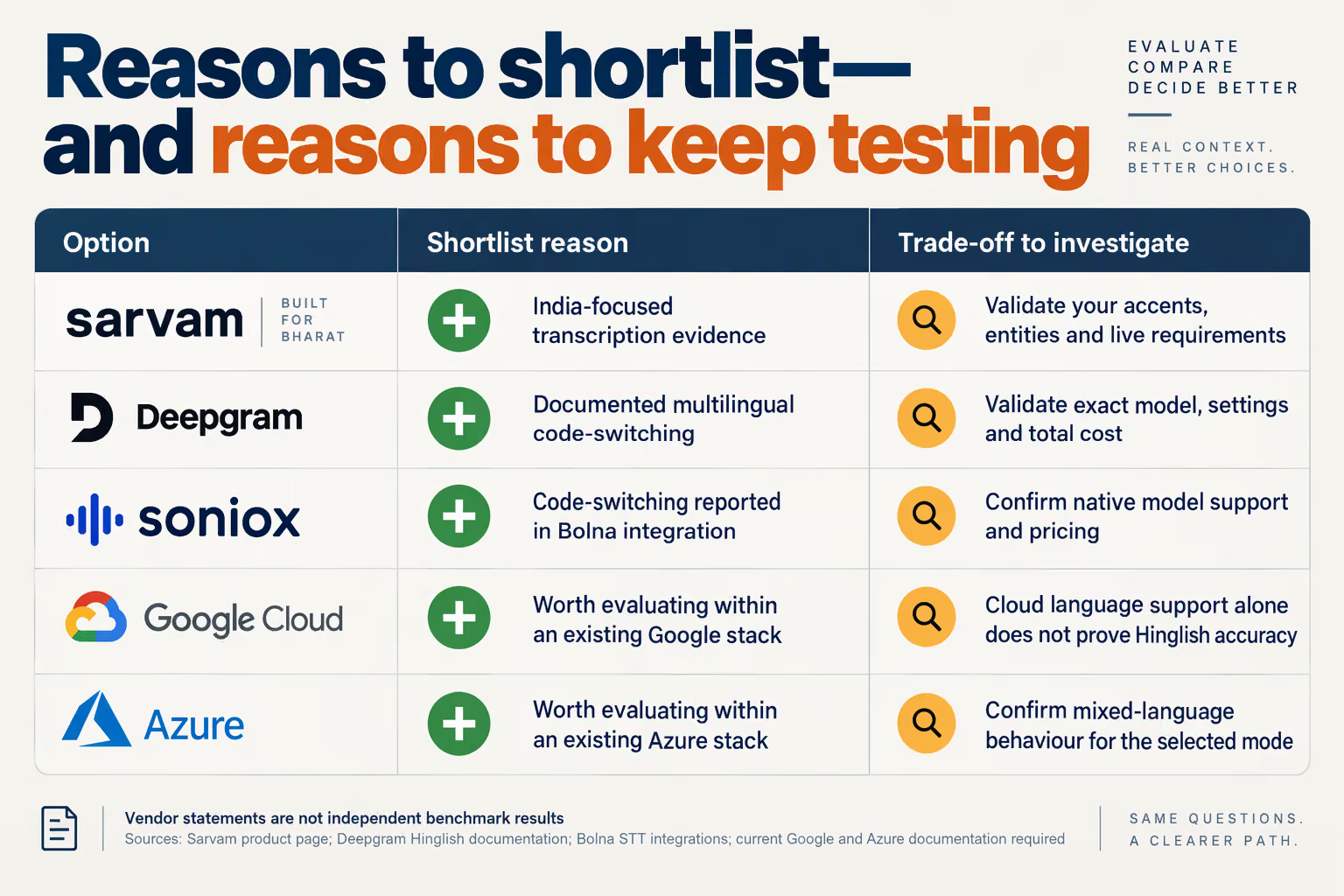
The best STT for Hinglish depends on whether you prioritise automatic language switching, regional speech, live-agent behaviour or recording costs. This November 2026 shortlist separates documented strengths from capabilities that still need validation on your audio.
- Evidence standard: The supplied comparisons do not establish an independent Hinglish winner; provider descriptions, integration coverage and vendor-published benchmarks answer different questions.
- Version discipline: Compare exact model versions and processing modes—especially AssemblyAI Universal-3.5 versus Universal-3.6, and Deepgram Nova-2 versus Nova-3.
| STT shortlist | Documented advantage | Main trade-off | Buyer’s pilot priority |
|---|---|---|---|
| Sarvam saaras:v4 | Bolna’s November 2026 comparison describes regional-accent and code-mixed recognition, with 11 Indian languages plus English on Bolna. | Integration coverage does not establish accuracy for every accent or output format. | Test regional callers, English product names and Hindi-English switches together. |
| Soniox stt-rt-v5 | Bolna’s November 2026 comparison lists mid-sentence language switching, English and nine Indian languages. | Automatic detection still needs testing on short utterances and ambiguous words. | Check whether brief English insertions remain intact without manual language selection. |
| AssemblyAI Universal | Bolna’s November 2026 FAQ says Universal-3.6 Pro code-switches across 32 languages. | AssemblyAI’s quoted $0.21/hour recording price concerns Universal-3.5 Pro, not necessarily 3.6. | Confirm the exact model, supported languages and applicable rate before comparing results. |
| Deepgram Nova-3 | AssemblyAI’s November 4, 2026 comparison lists distinct prerecorded, monolingual-streaming and multilingual-streaming rates. | The cheaper monolingual rate is not the appropriate cost assumption for multilingual streaming. | Evaluate Nova-3 Multi separately from recording transcription and Nova-2 integrations. |
| Google Cloud Speech-to-Text | AssemblyAI’s November 2026 comparison lists volume-based pricing starting at $0.016/minute. | That pricing evidence does not establish Hinglish code-switching quality. | Verify the selected model and language configuration before testing entity preservation. |
| Microsoft Azure AI Speech | Both supplied 2026 comparisons list real-time transcription at $1/hour. | Batch quotes conflict: AssemblyAI lists $0.18/hour in US East; Deepgram lists $0.36/hour. | Confirm region, processing mode and current SKU rather than averaging incompatible quotes. |
Which trade-offs should determine your STT pilot?
- Streaming cost: AssemblyAI’s November 4, 2026 comparison quotes Deepgram Nova-3 multilingual streaming at $0.0092/minute, equivalent to $0.552/hour; budget using that mode-specific figure rather than a prerecorded or monolingual headline price.
- Benchmark relevance: AssemblyAI’s November 2026 comparison reports substantially different code-switching results across models, but the supplied excerpt does not establish a Hinglish-only test population; treat those figures as screening evidence, not a prediction for your callers.
- Operational fit: For a live agent, evaluate partial-transcript stability and final entity correctness separately; for recordings, prioritise complete transcripts and processing cost. A model suitable for reviewing yesterday’s calls may not satisfy an interactive conversation.
- Integration flexibility: As of November 2026, CallMissed’s verified fact sheet lists OpenAI-compatible audio-transcription endpoints and 50 STT models; this offers another integration route, but model choice should still follow your own Hinglish evaluation.
Decision rule: Shortlist Sarvam and Soniox for explicitly documented code-mixing capabilities, then add alternatives according to your streaming, pricing and integration requirements—not an unsupported universal ranking.
Which should you choose for your team size and audio volume?
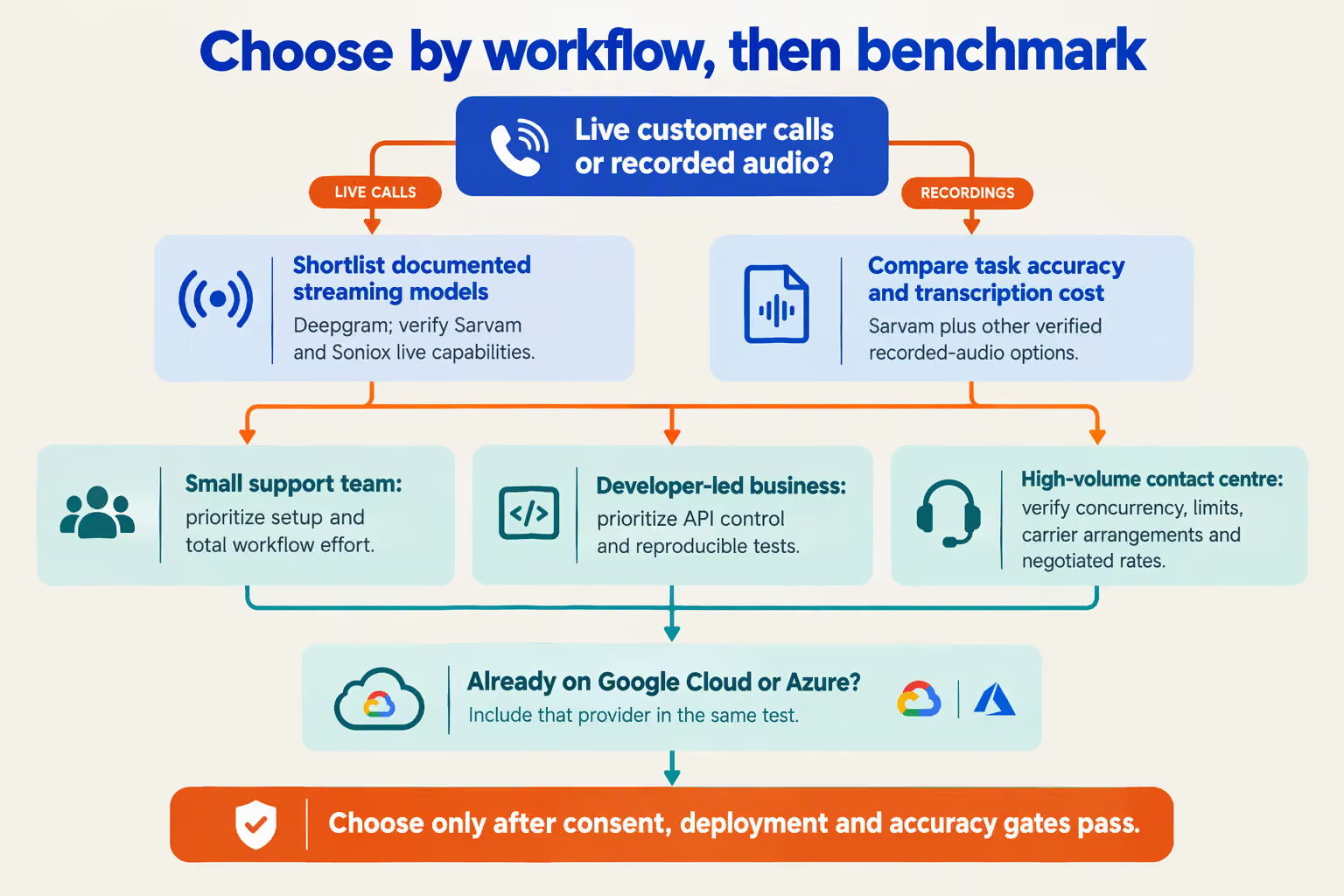
Choose the best STT for Hinglish by matching your workload to accuracy, processing mode and operating cost—not headcount alone. Use the following team sizes and volumes as planning examples, not provider limits.
Which STT should a small team pilot first?
- Small teams testing live calls: Shortlist Sarvam saaras:v4 and Soniox stt-rt-v5 before committing to a monthly volume contract. Bolna’s comparison, supplied for November 2026, identifies Sarvam with regional accents and code-mixed speech, and Soniox with mid-sentence language switching. Neither capability establishes accuracy on your customers’ recordings; use the same evaluation set for both.
- Teams processing 100 recorded hours monthly: Budget approximately $21 for AssemblyAI Universal-3.5 Pro or $25.80 for Deepgram Nova-3, calculated from AssemblyAI’s November 4, 2026 published rates. These are transcription-only estimates, not complete workflow costs. At this volume, a small price difference may matter less than correcting addresses, amounts and product names.
- Teams without dedicated speech engineers: Prefer an integration that makes switching models practical. As of November 2026, CallMissed’s developer AI API offers 50 speech-to-text models, one API key and one balance, with OpenAI-compatible audio-transcription endpoints. Verify the selected model’s language coverage and processing mode rather than treating catalogue breadth as proof of Hinglish performance.
- Teams choosing a pilot size: Start with a proposed 100 representative clips, covering clean speech, background noise, regional accents and frequent Hindi-English switches. This is a practical evaluation recommendation, not a published benchmark. Score critical entities separately, and record correction time: a readable transcript can still create expensive operational mistakes.
Which STT should higher-volume or live-agent teams choose?
- Teams processing 1,000 recorded hours monthly: AssemblyAI’s November 4, 2026 rates imply approximately $210 for Universal-3.5 Pro versus $258 for Deepgram Nova-3, a $48 monthly difference before discounts and extras. Compare that saving with your measured correction workload; the cheaper API is not cheaper overall if staff must repair more transcripts.
- Teams running 1,000 hours of multilingual streaming: AssemblyAI’s November 2026 comparison lists Deepgram Nova-3 multilingual streaming at $0.0092/minute, implying $552 for 60,000 minutes. Do not budget using the lower prerecorded rate or the monolingual streaming rate. Confirm that the specific endpoint supports your Hindi-English switching requirements before forecasting production spend.
- Teams approaching enterprise scale: Request written quotes specifying audio minutes, peak simultaneous streams, language configuration and support terms. AssemblyAI’s November 2026 comparison reports Google Cloud’s standard rate as $0.016/minute for the first 500,000 monthly minutes, with lower rates at higher volumes. That threshold concerns usage pricing—not a guarantee of code-mixed recognition quality.
- Teams making the final selection: Set two acceptance gates before signing: acceptable critical-entity accuracy and acceptable end-to-end response time on your own audio. Then compare total monthly cost, including transcription, retries and human corrections. For live agents, test interruptions and transcript revisions; for recordings, prioritise final transcript quality and processing turnaround.
Frequently Asked Questions
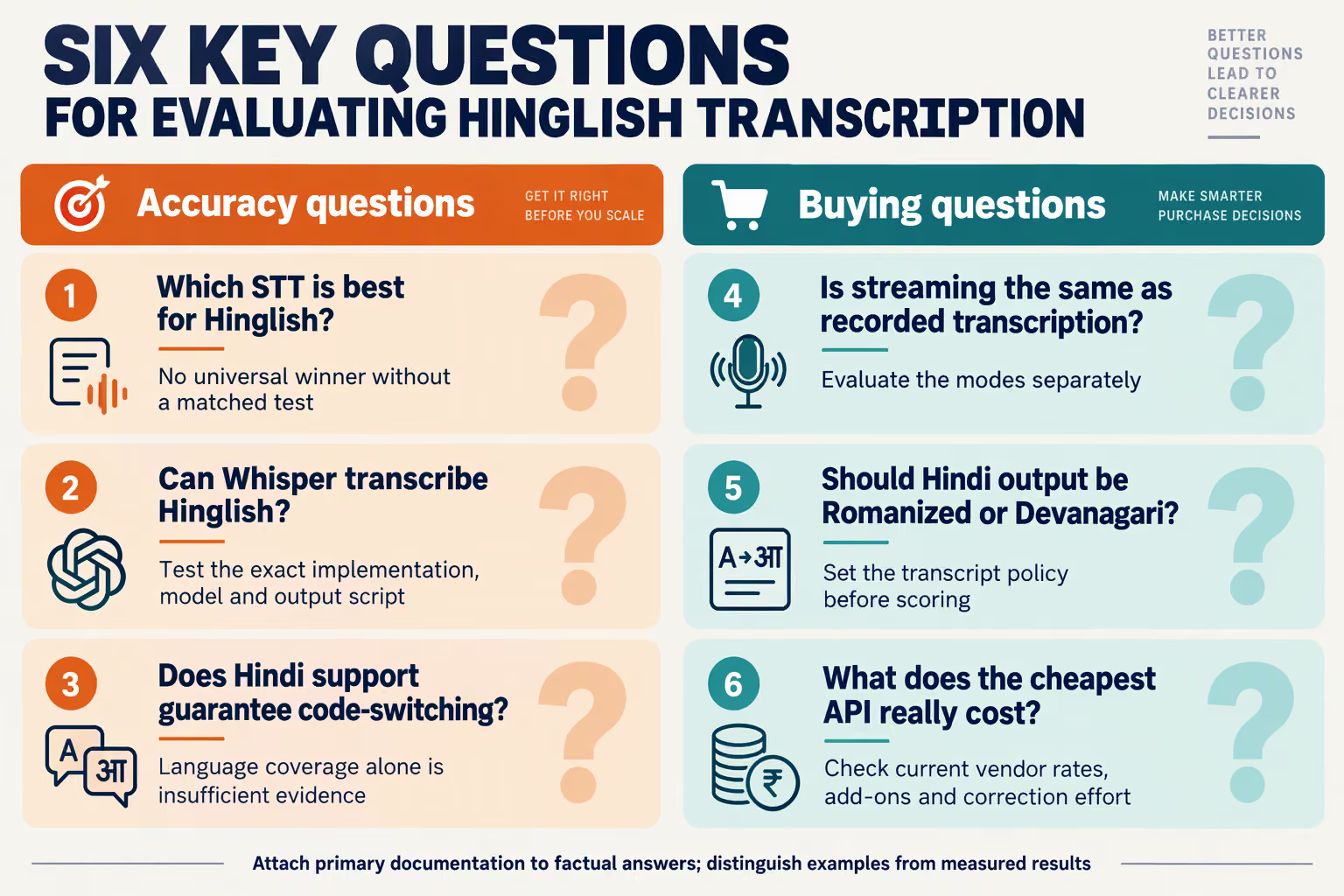
- Q: What is the best STT for Hinglish and code-mixed speech?
A: No supplied benchmark establishes a universal Hinglish winner; shortlist models with explicit code-switching support, then choose using your own recordings. As of November 2026, Bolna identifies Sarvam saaras:v4 for regional accents and code-mixed speech and Soniox stt-rt-v5 for mid-sentence language switching. Treat those descriptions as reasons to pilot both, not as independently verified accuracy rankings.
- Q: How should I benchmark the best STT for Hinglish on customer calls?
A: Run identical, consented recordings through each candidate and measure word error rate, entity accuracy and language-switch errors separately, keeping audio quality and transcription settings consistent. Include regional accents, interruptions, background noise and different Hindi-English mixing patterns rather than testing only clean scripted speech. Sarvam’s examples, available in November 2026, include “Flipkart,” “Samsung Galaxy” and “₹12,499”—use similarly consequential names and amounts to test whether a transcript preserves actionable details.
- Q: Does multilingual speech recognition automatically support Hinglish code-switching?
A: No: supporting Hindi and English separately does not establish that a model recognises both reliably within one sentence. Bolna’s November 2026 integration comparison says Deepgram Nova-2 requires an explicitly selected language, while Soniox stt-rt-v5 detects and switches languages mid-sentence. Ask vendors whether automatic switching applies to your chosen model and endpoint, then verify mixed utterances rather than accepting a language-count claim as proof.
- Q: Should I use streaming or prerecorded STT for a Hinglish voice agent?
A: Choose streaming STT for conversations requiring responses before the recording ends; prerecorded processing suits completed-call analysis and transcription workflows. Measure time to usable text, final-transcript corrections and interruption handling separately, because readable final output can conceal an awkward live experience. As of November 2026, AssemblyAI lists Deepgram Nova-3 at $0.0077/minute for monolingual streaming and $0.0092/minute for multilingual streaming, making endpoint selection relevant to both testing and cost.
- Q: Can Hinglish STT produce Romanised Hindi instead of Devanagari?
A: Do not assume Romanised output from a claim of Hinglish recognition: speech recognition and script formatting are separate requirements, and the supplied November 2026 sources do not establish a universal Romanisation capability. Request an output sample before buying and test whether Hindi words, English brands and addresses retain your required spelling. If downstream transliteration is necessary, evaluate that additional step separately because it can introduce errors after otherwise successful recognition.
- Q: Can I compare multiple Hinglish STT models through one API?
A: As of November 2026, CallMissed’s developer AI API provides 50 speech-to-text models through one API key and balance, with OpenAI-compatible audio transcription endpoints; its speech recognition supports 22 Indian languages plus English, including Hinglish. A shared integration can simplify model trials, but platform-wide language coverage does not establish identical capabilities or accuracy for every model. Check each candidate’s supported languages, processing mode and output format before running your comparison.
Conclusion
The best STT for Hinglish and code-mixed speech is the API that preserves language switches, critical details and intent on your recordings. For buyers comparing options in November 2026, the strongest decision is a workload-specific pilot—not a winner selected from English-only benchmarks or language counts.
- Shortlist for code-switching, not multilingual coverage alone. Bolna’s November 2026 comparison identifies Sarvam saaras:v4 as handling regional accents and code-mixed speech, and Soniox stt-rt-v5 as detecting and switching languages mid-sentence. These capabilities justify testing both models, but they do not establish which will perform better on your support calls. Use the same representative recordings across candidates, including customers who switch languages within a sentence rather than between separate sentences.
- Prioritise names, numbers and intent over readable transcripts. Sarvam’s speech-to-text examples, supplied for this November 2026 comparison, include Flipkart, Samsung Galaxy, addresses and ₹12,499 within Hindi-English speech. Those examples illustrate the details a buyer should inspect individually. A transcript that sounds natural but changes the payment amount or delivery address can be operationally worse than a less polished transcript that preserves the customer’s request. Check native-script and Romanised output requirements separately from recognition quality.
- Evaluate live and prerecorded workflows separately. A recording pipeline and a conversational voice agent have different requirements: the former processes completed audio, while the latter needs transcription during the conversation. Confirm that the shortlisted model supports your intended workflow before comparing costs. Do not assume that a provider’s prerecorded results, language support or headline price describe its streaming configuration equally well.
- Compare price only after setting an accuracy threshold. AssemblyAI’s comparison dated November 4, 2026, lists prerecorded transcription at $0.21/hour for AssemblyAI Universal-3.5 Pro and $0.258/hour for Deepgram Nova-3. These provider-published prices are useful buying inputs, not proof of Hinglish performance. First establish which models preserve your required entities and language switches; then compare the price of the configuration you would actually deploy.
What should Hinglish STT buyers watch next?
Watch for clearer code-switching evaluations, especially results that distinguish streaming from prerecorded transcription and entity preservation from overall readability. As models evolve, rerun the same representative recordings rather than assuming a newer release automatically improves your particular Hindi-English workload.
To explore this trend, consider CallMissed’s developer AI API: according to its verified November 2026 product facts, the platform offers 50 speech-to-text models, with speech recognition supporting 22 Indian languages plus English, including Hinglish.
Your next step is a controlled pilot. Which API correctly captures “delivery address change kar do”—and preserves the address that follows?
Related Reading
- Speech-to-text APIs for Indian Languages Compared 2026
- GPT-4o API pricing 2026: Compare Compatible API Costs
- Best Speech-to-Text API for Indian Languages: 2026