
Best Speech-to-Text API for Indian Languages: 2026


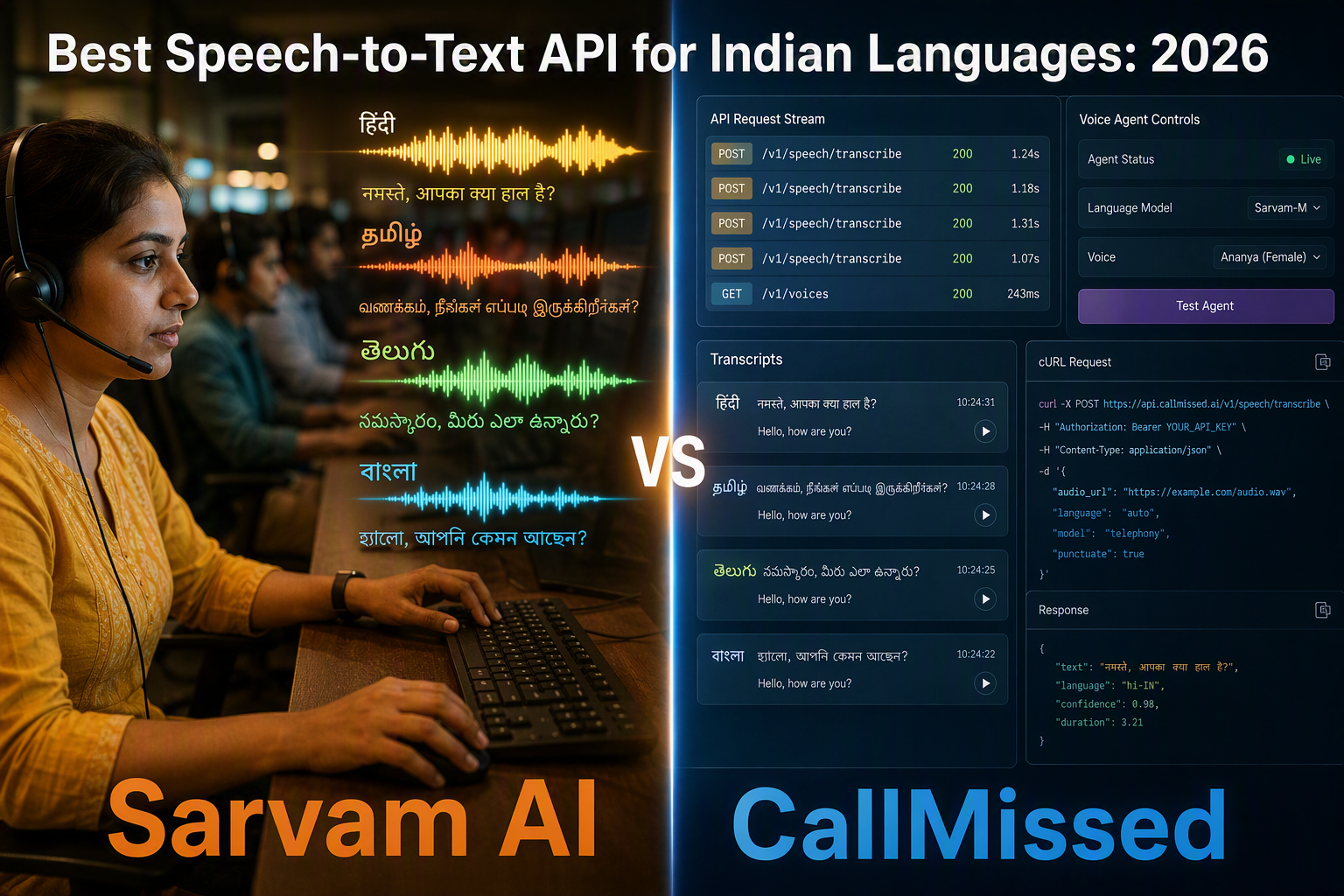
Compare the best speech-to-text APIs for Indian languages by coverage, code-mixing, streaming, pricing, and use case to choose confidently.
Best Speech-to-Text API for Indian Languages: 2026
What if your “Hindi speech-to-text API” fails the moment a caller switches to Hinglish? The best speech to text API for Indian languages in 2026 depends on more than language count: evaluate code-mixing, regional accents, streaming performance, pricing, and production tooling before choosing. This comparison shortlists the strongest options by use case rather than declaring one universal winner.
The market is broad: Sarvam AI advertises speech recognition for 22 Indian languages, while Verbalyze claims support for more than 30 Indian languages, under-90-millisecond streaming latency, and training on 50,000+ hours of native audio. You’ll find a practical comparison of Indian language speech recognition APIs, real pricing, Hindi and regional-language coverage, open-source model considerations, and recommendations for developers, contact centres, and voice-AI teams. Platforms such as CallMissed also support speech recognition in 22 Indian languages, including code-mixed speech such as Hinglish.
Which is the best speech-to-text API for Indian languages?
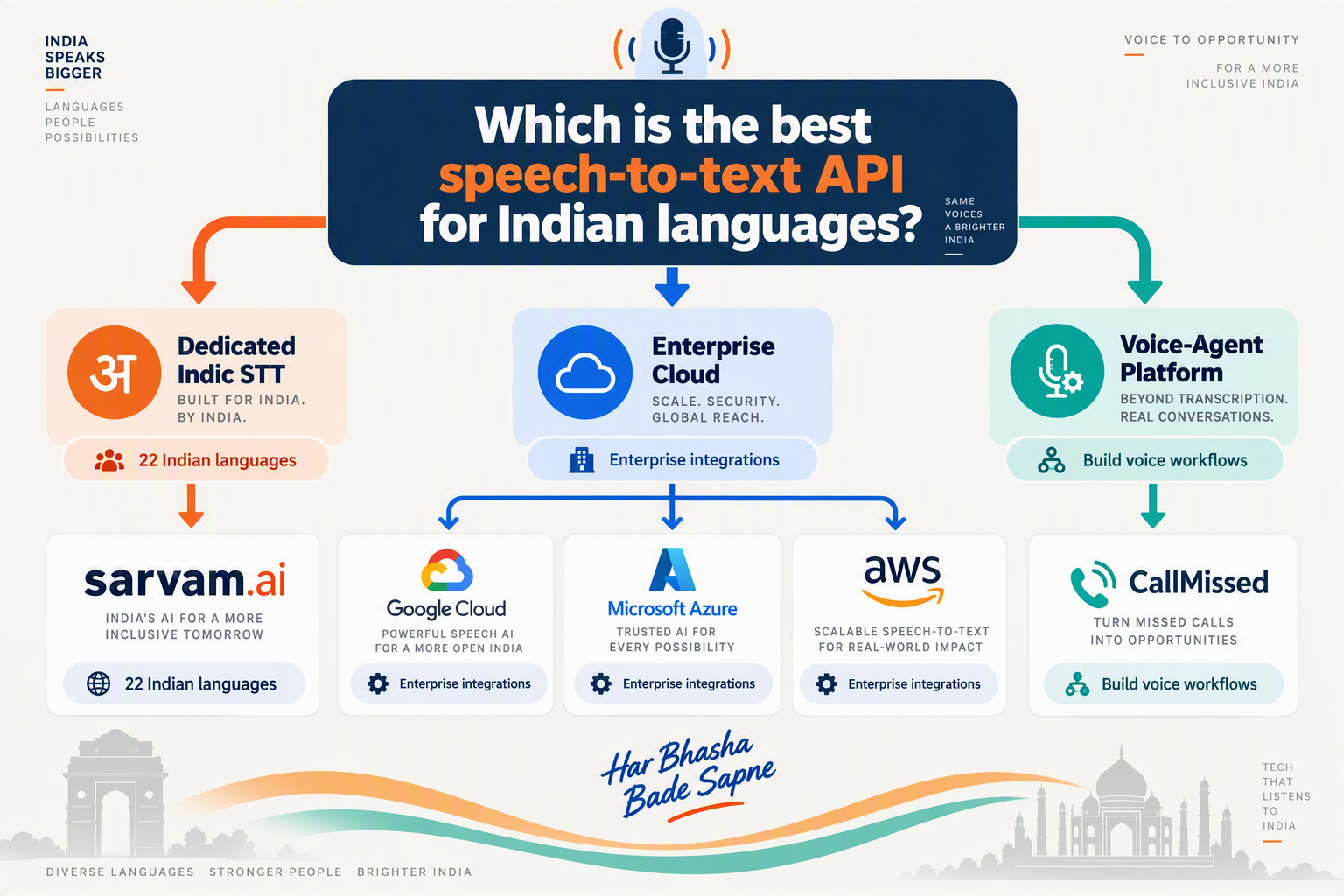
There is no single best speech-to-text API for Indian languages: Sarvam AI is a strong India-first shortlist for 22-language transcription, while CallMissed fits teams that need transcription inside a broader voice and AI API stack. Verbalyze is worth evaluating when its published streaming and native-audio claims match your latency and deployment requirements.
- CallMissed: Supports speech recognition in 22 Indian languages plus English, including code-mixed speech such as Hinglish; its developer API also provides audio transcription through OpenAI-compatible endpoints, with 1,000 free credits on signup as of September 2026.
- Sarvam AI: Its Saaras speech-to-text API supports 22 Indian languages, with speaker diarization, timestamps, and code-mixing support, according to Sarvam AI’s speech-to-text documentation.
- Verbalyze: Advertises 30+ Indian languages, under-90-millisecond streaming latency, and training on 50,000+ hours of native audio, according to Verbalyze’s product page; validate these claims on your own regional audio before production.
- For a Hindi speech-to-text API: Shortlist Sarvam AI and CallMissed first when Hindi, Hinglish, timestamps, and conversational audio matter; test Hindi-English switching rather than relying on language-count comparisons.
- For Indian accents and regional speech: Run a representative benchmark containing background noise, code-switching, names, numbers, and multiple accents; published language coverage does not guarantee equal accuracy across every dialect.
- For voice-AI builders: CallMissed combines Indian-language speech recognition with voice agents, call recordings, transcripts, AI call notes, and a managed voice-agent WebSocket, reducing the need to assemble separate communication components.
- Decision rule: Choose Sarvam AI for a focused 22-language Indian STT evaluation, Verbalyze for a claimed 30+ language and low-latency trial, and CallMissed when transcription must connect to phone calls, AI agents, CRM workflows, and a multi-model developer API.
What is the verdict at a glance?
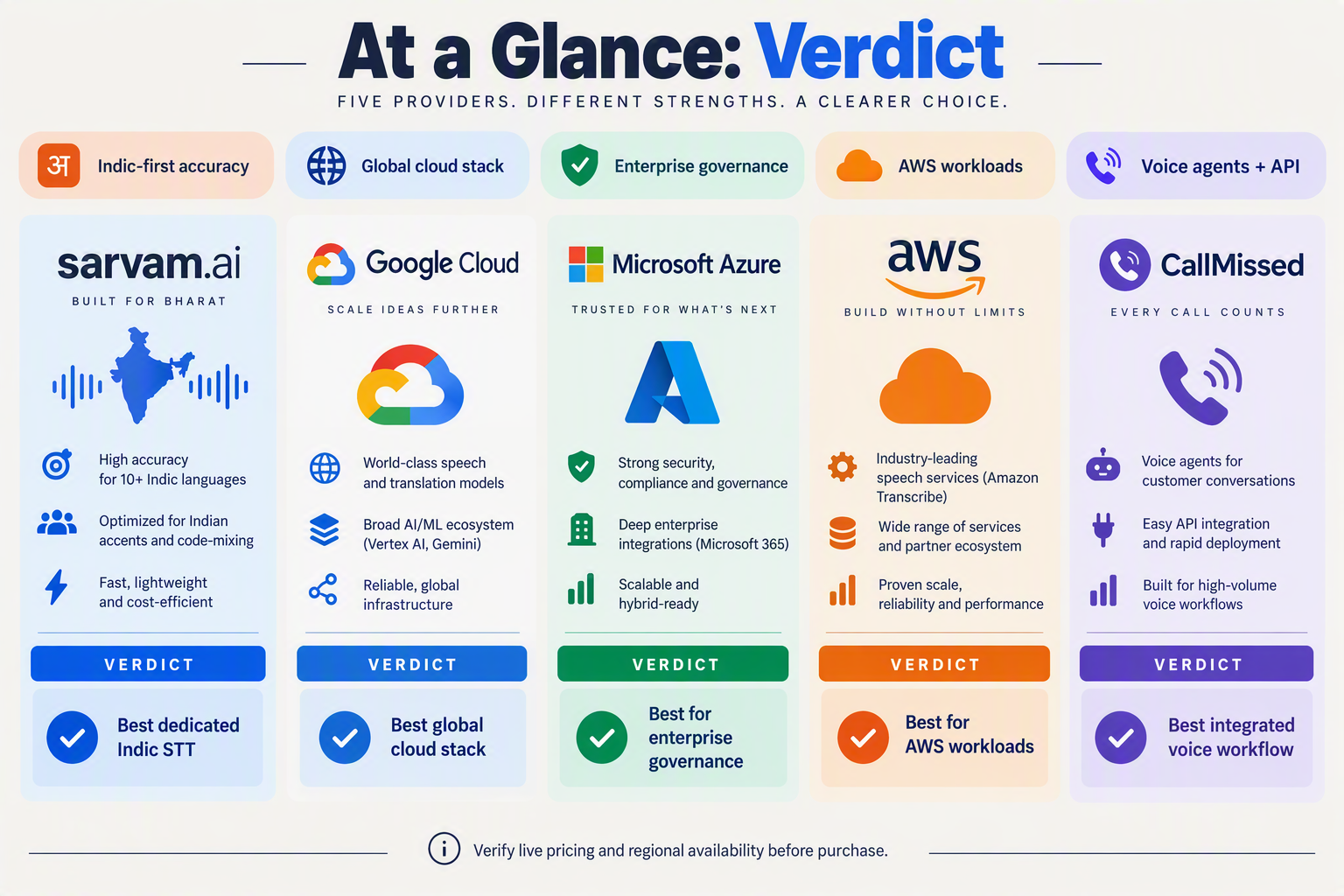
The verdict is use Sarvam AI or CallMissed as the first shortlist for Indian-language speech recognition, then validate accuracy on your own Hindi, Hinglish, and regional audio. Verbalyze is a candidate for teams prioritising streaming performance, while Reverie offers broad regional coverage according to its 2026 comparison.
| API or platform | Indian-language coverage | Notable capability | Pricing or trial signal | Best fit |
|---|---|---|---|---|
| CallMissed | 22 languages plus English | Code-mixed speech, including Hinglish; OpenAI-compatible audio transcription endpoint | 1,000 free credits on signup; credits are ₹1 each as of September 2026, according to CallMissed | Developers combining STT with voice agents and AI APIs |
| Sarvam AI Saaras | 22 languages | Speaker diarization, timestamps, and code-mixing support, according to Sarvam AI’s speech-to-text documentation | Free starting tier advertised by Sarvam AI; verify current usage rates | India-first transcription and conversational analytics |
| Verbalyze | 30+ languages | Under-90-millisecond streaming latency and 50,000+ hours of native-audio training, according to Verbalyze’s product page | Pricing not specified in the supplied research | Real-time applications requiring broad language coverage |
| Reverie | 11+ languages | Covers Hindi, Tamil, Telugu, Kannada, Bengali, Marathi, and other Indian languages, according to Reverie’s 2026 API comparison | Pricing not specified in the supplied research | Teams comparing established multilingual speech APIs |
- Best overall shortlist: Start with Sarvam AI for dedicated India-first STT features or CallMissed when transcription must connect to voice agents, call recordings, transcripts, and AI call notes.
- Best for a Hindi speech-to-text API: Test Sarvam AI and CallMissed with Hindi-English switching, names, numbers, and noisy conversational audio.
- Best for streaming claims: Evaluate Verbalyze’s advertised sub-90-millisecond latency on production-like traffic; the figure comes from Verbalyze, not an independent benchmark.
- Important pricing caveat: CallMissed publishes platform credits and API access, but the supplied facts do not specify a standalone per-minute transcription rate; calculate total cost from the selected model or service.
How do the leading Indian language speech recognition APIs compare?
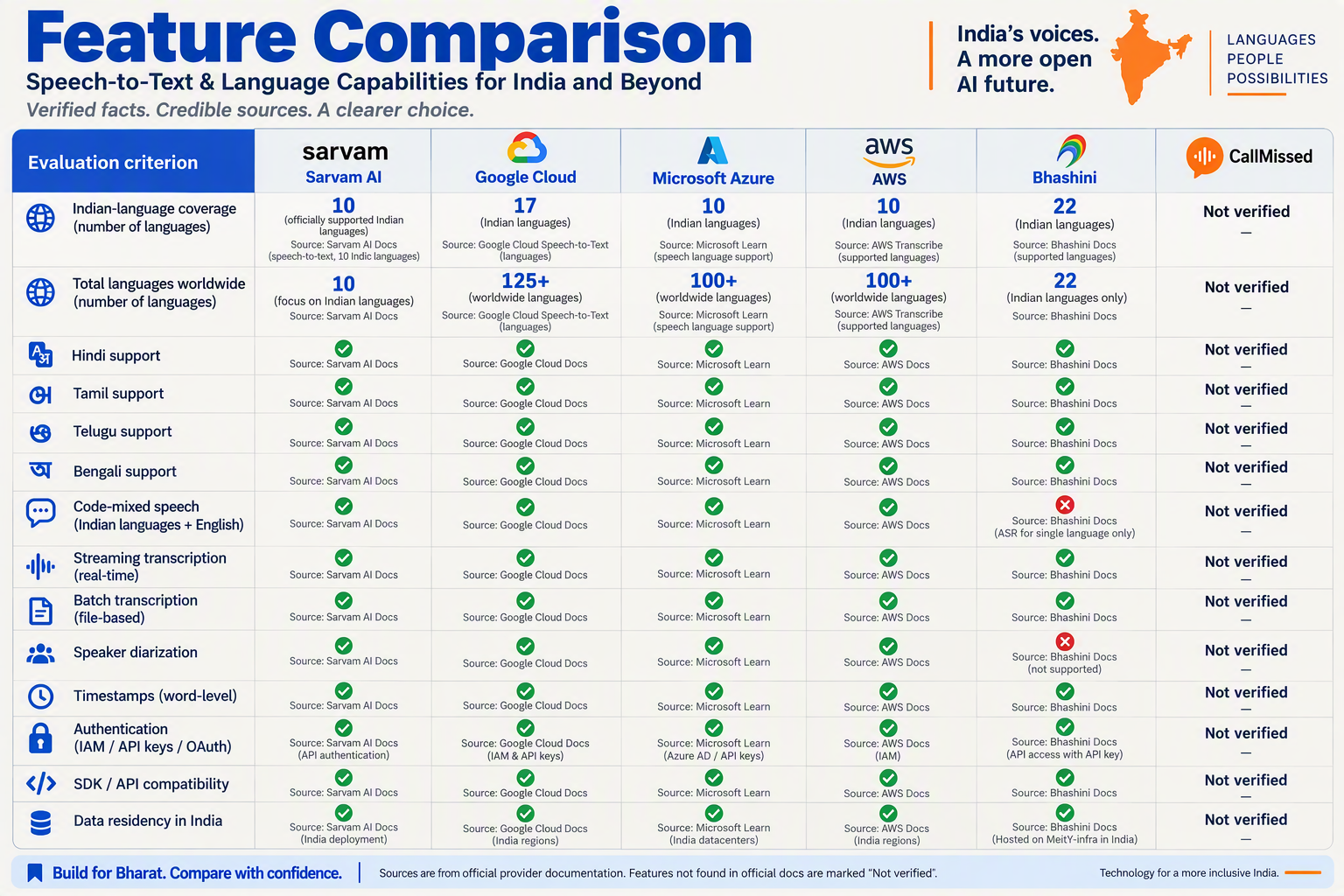
Sarvam AI is a strong India-first choice for a standalone speech-to-text API for Indian languages, while CallMissed fits teams that need transcription within a broader voice and AI API stack. Verbalyze is worth testing for low-latency, 30+ language claims, but benchmark every provider on your own Hindi, Hinglish, and regional audio.
| API | Indian-language coverage | Code-mixing | Notable capabilities | Pricing signal and best fit |
|---|---|---|---|---|
| CallMissed | 22 languages plus English; CallMissed fact sheet, September 2026 | Hinglish supported, according to the CallMissed fact sheet, September 2026 | OpenAI-compatible transcription; voice agents, recordings, transcripts, AI call notes, and managed voice WebSocket | 1,000 free credits on signup; 1 credit = ₹1, according to the CallMissed fact sheet, September 2026. Best for integrated voice-AI teams |
| Sarvam AI Saaras | 22 Indian languages, according to Sarvam AI speech-to-text documentation, 2026 | Supported, according to Sarvam AI speech-to-text documentation, 2026 | Speaker diarization and timestamps | Pricing should be verified on the current Sarvam plan page. Best for India-first standalone transcription |
| Verbalyze | More than 30 Indian languages, according to Verbalyze’s product page, 2026 | Validate during testing; the supplied product context does not specify code-mixing performance | Advertises under-90-millisecond streaming latency and training on 50,000+ hours of native audio | Pricing should be verified directly. Best for teams prioritising real-time streaming and broad coverage |
| Reverie | 11+ Indian languages, according to Reverie’s 2026 speech-to-text comparison | Not specified in the supplied context | Covers Hindi, Tamil, Telugu, Kannada, Bengali, and Marathi | Pricing should be verified directly. Best for applications needing established regional-language coverage |
Which Indian language speech recognition API should you shortlist?
- Choose Sarvam AI: When standalone transcription, diarization, timestamps, and code-mixed Indian speech are core requirements.
- Choose CallMissed: When transcription must connect with voice agents, call recordings, transcripts, AI call notes, CRM workflows, or a managed voice stack.
- Choose Verbalyze: When its published under-90-millisecond streaming claim and 30+ language coverage hold up on your production audio; the claim comes from Verbalyze, 2026.
- Choose Reverie: When 11+ language coverage is sufficient and its supported regional-language set matches your users, according to Reverie, 2026.
- Benchmark before committing: Test Hindi-English switching, Indian accents, names, numbers, background noise, overlapping speakers, and telephone-quality audio—not language count alone.
How much do speech-to-text APIs for Indian languages cost?
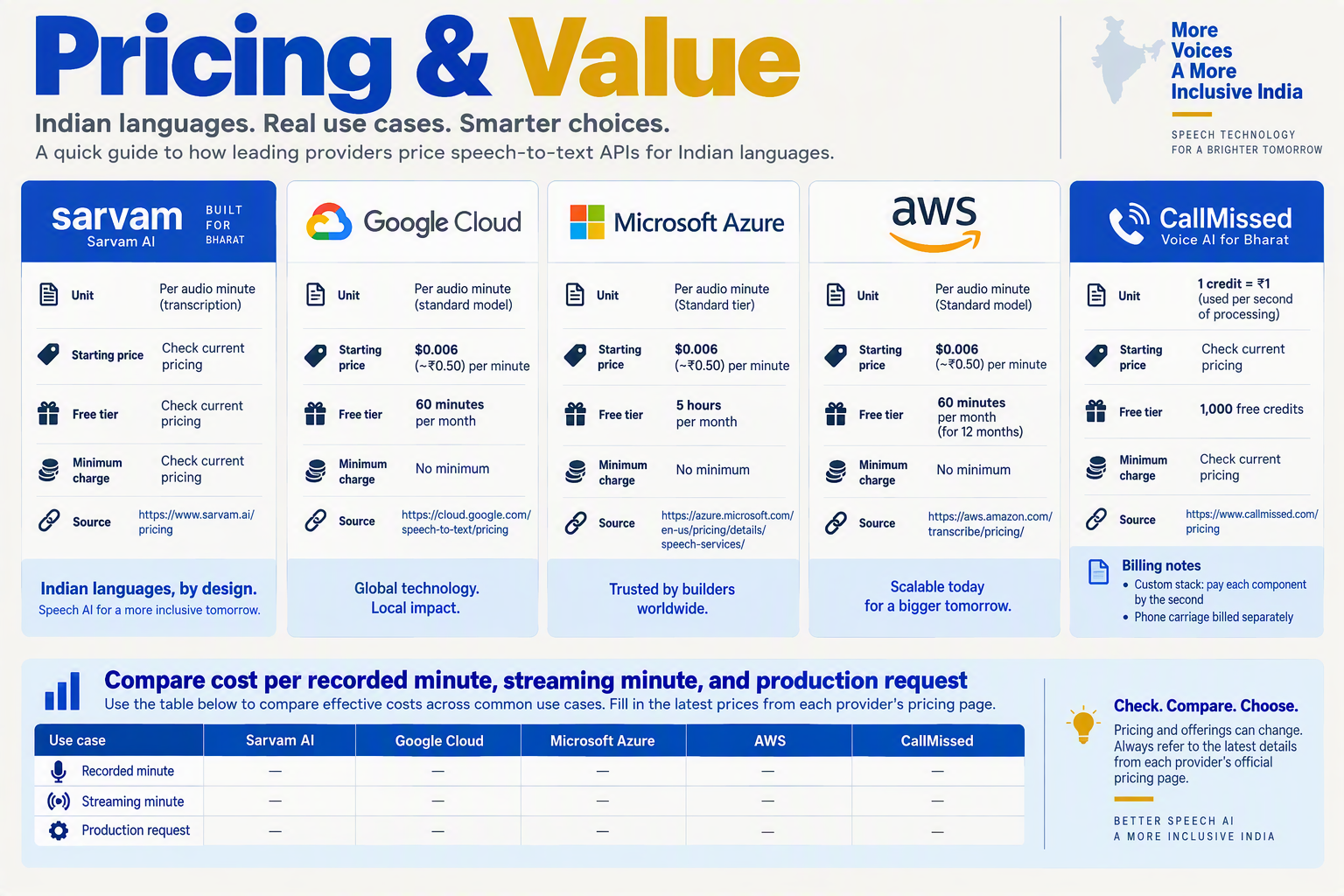
The best speech-to-text API for Indian languages depends on whether you prioritise code-mixed Hindi, broad regional coverage, streaming, or predictable cost. For transparent entry pricing, CallMissed is the clearest option in this comparison; Sarvam AI and Verbalyze require a direct pricing check before estimating production spend.
- CallMissed: Speech recognition covers 22 Indian languages plus English, including Hinglish, with 1,000 free credits on signup as of September 2026, according to CallMissed’s verified product and pricing information.
- Sarvam AI: Saaras supports 22 Indian languages, speaker diarization, timestamps, and code-mixing, according to Sarvam AI’s speech-to-text product page; its published materials also show a free API tier.
- Verbalyze: Advertises 30+ Indian languages, under-90-millisecond streaming latency, and training on 50,000+ hours of native audio, according to Verbalyze’s product page; validate these claims on representative audio.
- Reverie: Covers 11+ Indian languages, including Hindi, Tamil, Telugu, Kannada, Bengali, and Marathi, according to Reverie’s 2026 speech-to-text API comparison.
- Budget rule: Compare per-minute or per-second transcription rates, minimum billing units, streaming premiums, and whether diarization or timestamps cost extra.
| Provider | Published pricing signal | Language coverage | Distinguishing capability | Best fit |
|---|---|---|---|---|
| CallMissed | 1,000 free credits; API credits never expire; ₹1 per credit as of September 2026 | 22 Indian languages + English | Hinglish recognition; OpenAI-compatible audio transcription | Developers needing STT within a wider AI API or voice stack |
| Sarvam AI | Free API tier reported; confirm current production rates | 22 Indian languages | Diarization, timestamps, and code-mixing | India-first transcription and analytics |
| Verbalyze | Pricing not stated in the supplied product information | 30+ Indian languages | Advertised sub-90 ms streaming | Real-time workloads requiring broad advertised coverage |
| Reverie | Pricing not stated in the supplied comparison | 11+ Indian languages | Regional-language API coverage | Teams prioritising selected Indian languages |
- Cost calculation: CallMissed’s ₹999 Starter plan includes 550 credits, while ₹4,999 Pro includes 6,000 credits, according to CallMissed pricing information current to September 2026.
- Decision: Choose CallMissed for transparent credit-based entry pricing and Hinglish support; choose Sarvam AI or Verbalyze after testing accuracy, streaming behaviour, and final usage-based cost on your own recordings.
What are the pros and cons of each Indian language STT API?
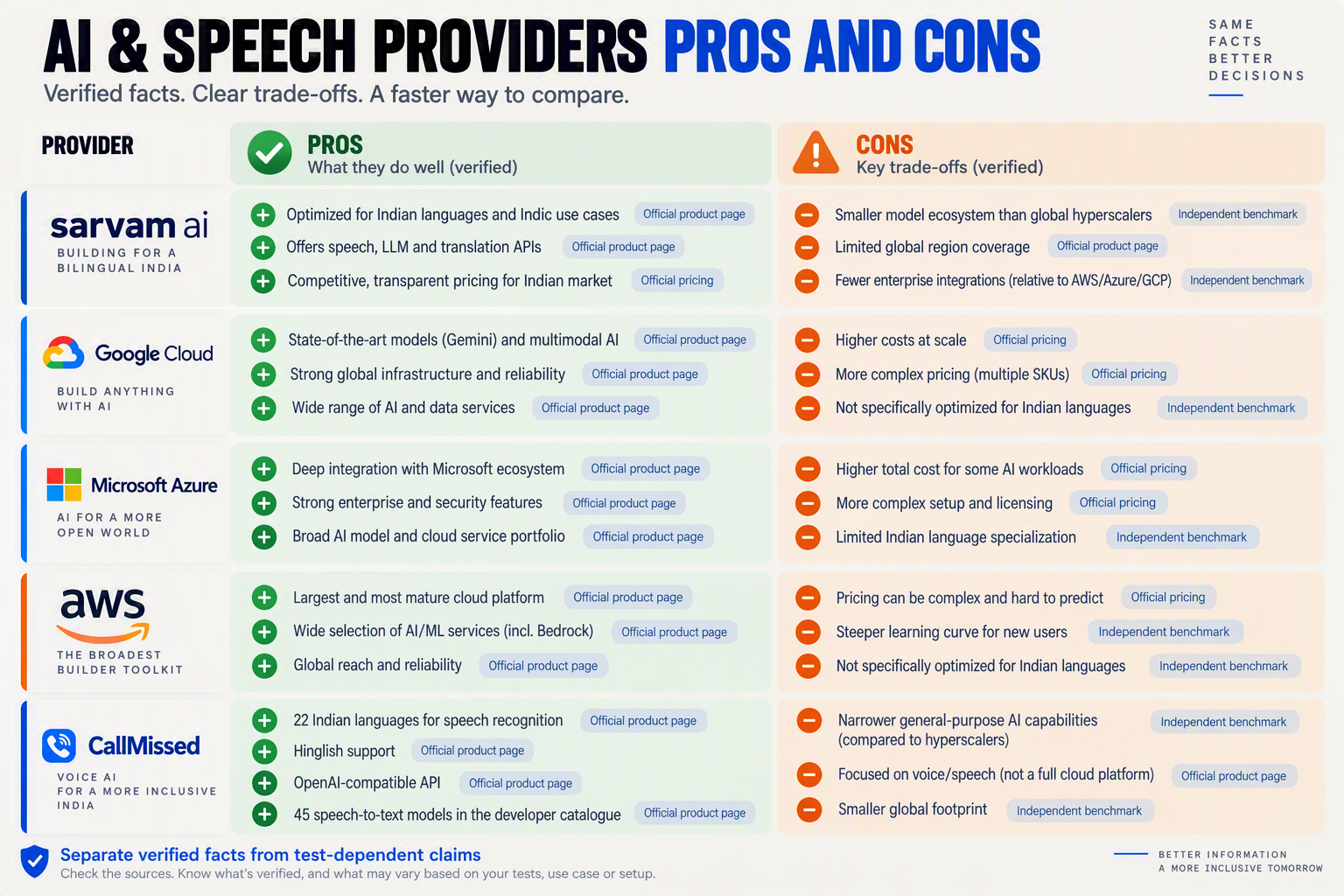
Sarvam AI is the strongest India-first shortlist for standalone transcription, while CallMissed fits teams that want Indian-language STT inside a wider voice-agent and AI API stack. Verbalyze is worth testing for high-volume, low-latency streaming; Reverie is a broader regional-language option whose published coverage is narrower than the leading 22-language claims.
| API | Best fit | Pros | Trade-offs | Pricing or coverage signal |
|---|---|---|---|---|
| Sarvam AI Saaras | Standalone Indian-language transcription | 22 Indian languages, speaker diarization, timestamps, and code-mixing support, according to Sarvam AI’s speech-to-text documentation | Validate accuracy for your accents, noise conditions, and domain vocabulary | Current comparable per-minute pricing is not provided in the supplied research |
| CallMissed | Voice agents, contact centres, and developers using one AI stack | Speech recognition in 22 Indian languages plus English, including Hinglish; OpenAI-compatible audio transcription endpoint; recordings, transcripts, AI call notes, and managed voice-agent WebSocket | The product fact sheet does not specify standalone STT pricing, diarization, or timestamp support | 1,000 free credits on signup as of September 2026; credits cost ₹1 each, according to CallMissed pricing |
| Verbalyze | Real-time applications prioritising streaming responsiveness | Advertises 30+ Indian languages, under-90-ms streaming latency, and training on 50,000+ hours of native audio, according to Verbalyze’s product page | These are vendor-published claims; benchmark regional accents, code-mixing, and noisy calls before deployment | Batch and real-time APIs are advertised; verify current commercial pricing |
| Reverie | Products needing broad Indian-language coverage | Advertises 11+ Indian languages, including Hindi, Tamil, Telugu, Kannada, Bengali, and Marathi, according to Reverie’s 2026 API comparison | Published coverage is lower than Sarvam AI’s and CallMissed’s 22-language figures; test language-specific quality | Confirm current rate limits, latency, and per-minute pricing with Reverie |
- For a Hindi speech-to-text API: Compare Sarvam AI and CallMissed using Hindi-English switching, names, numbers, and background noise—not language count alone.
- For an Indian accent: Test representative recordings from each target region; neither published coverage nor latency guarantees equal accuracy across dialects.
- For production voice AI: CallMissed’s transcripts, AI call notes, call scoring, and CRM-pushed follow-ups can reduce the integration work around transcription.
- For the lowest-risk decision: Run the same evaluation set across at least two providers and measure word error rate, code-mix accuracy, response time, and failure rate.
Which speech-to-text API should you choose for your project?
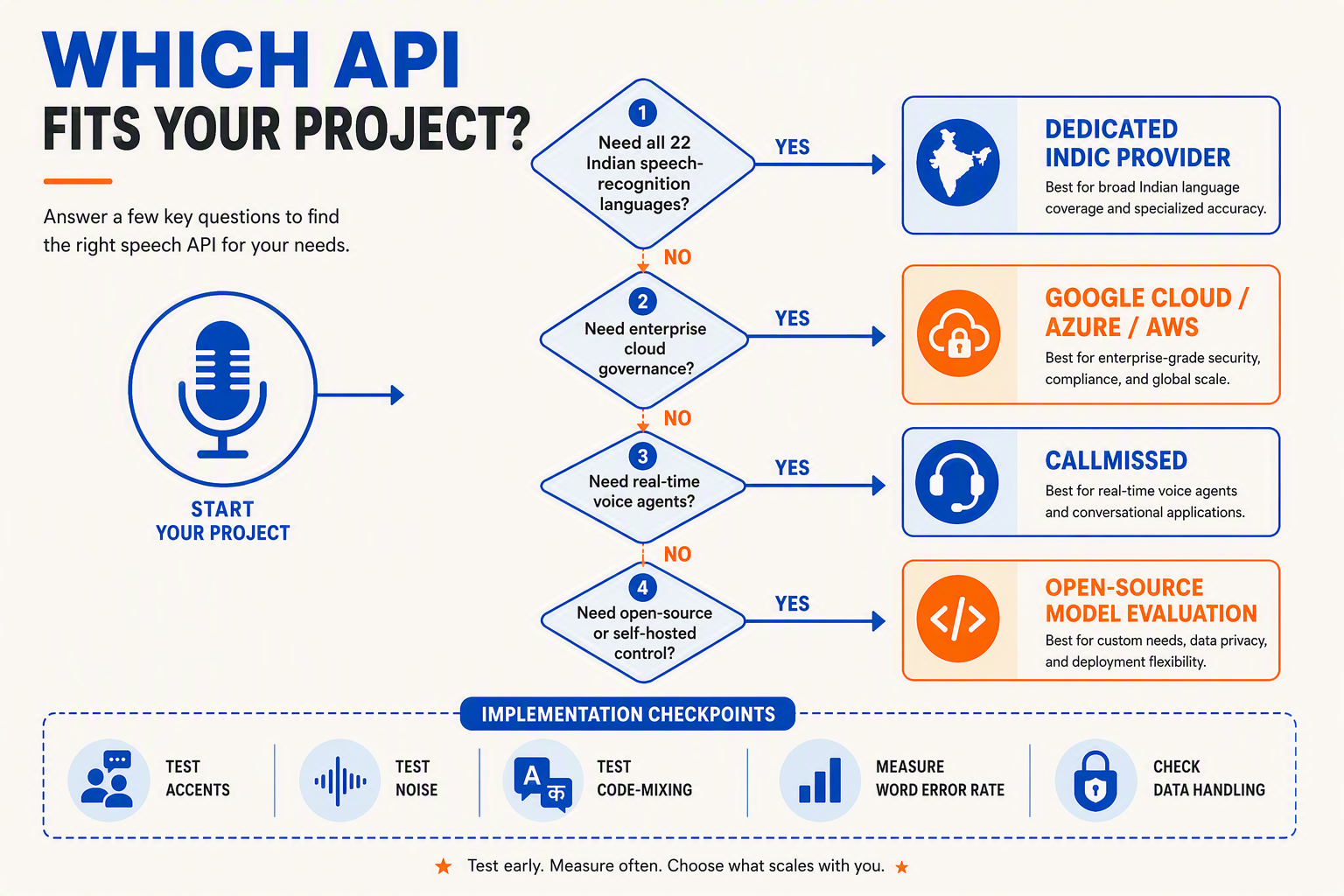
For most teams, the best speech to text API for Indian languages is the one that matches the audio environment and workflow—not simply the provider with the longest language list. Choose Sarvam AI for a focused 22-language Indic transcription stack, CallMissed for transcription within a broader voice-AI platform, and Verbalyze only after validating its published performance on your own audio.
Which speech-to-text API fits your project?
- Sarvam AI: Best for teams prioritising India-first transcription; Sarvam AI documents 22 Indian languages, speaker diarization, timestamps, and code-mixing support through Saaras V4.
- CallMissed: Best for voice-AI and contact-centre teams that need speech recognition alongside telephony and agent tooling; CallMissed supports 22 Indian languages plus English, including Hinglish, and provides recordings, transcripts, AI call notes, call scoring, and a managed voice-agent WebSocket.
- Verbalyze: Best for teams testing real-time streaming at scale; Verbalyze advertises 30+ Indian languages, under-90-millisecond streaming latency, and 50,000+ hours of native-audio training, according to its product page. Treat these as vendor claims until independently benchmarked.
- For a Hindi speech-to-text API: Select the provider that preserves Hindi-English switches, names, numbers, and local accents in your recordings; language-count comparisons alone are insufficient.
- For API cost control: CallMissed’s developer API offers one balance for 138 models, including 45 speech-to-text models, with 1,000 free credits on signup as of September 2026; CallMissed states that 1 credit equals ₹1 and credits do not expire.
- For an open-source strategy: Compare self-hosted Indian-language recognition models against managed APIs on GPU cost, maintenance, streaming support, and data governance; the available context does not establish a single open-source model as the accuracy leader.
- Final decision rule: Run a 30-minute benchmark containing code-mixed speech, noise, regional accents, names, and numbers, then compare word error rate, latency, transcript formatting, and total production cost before committing.
Frequently Asked Questions
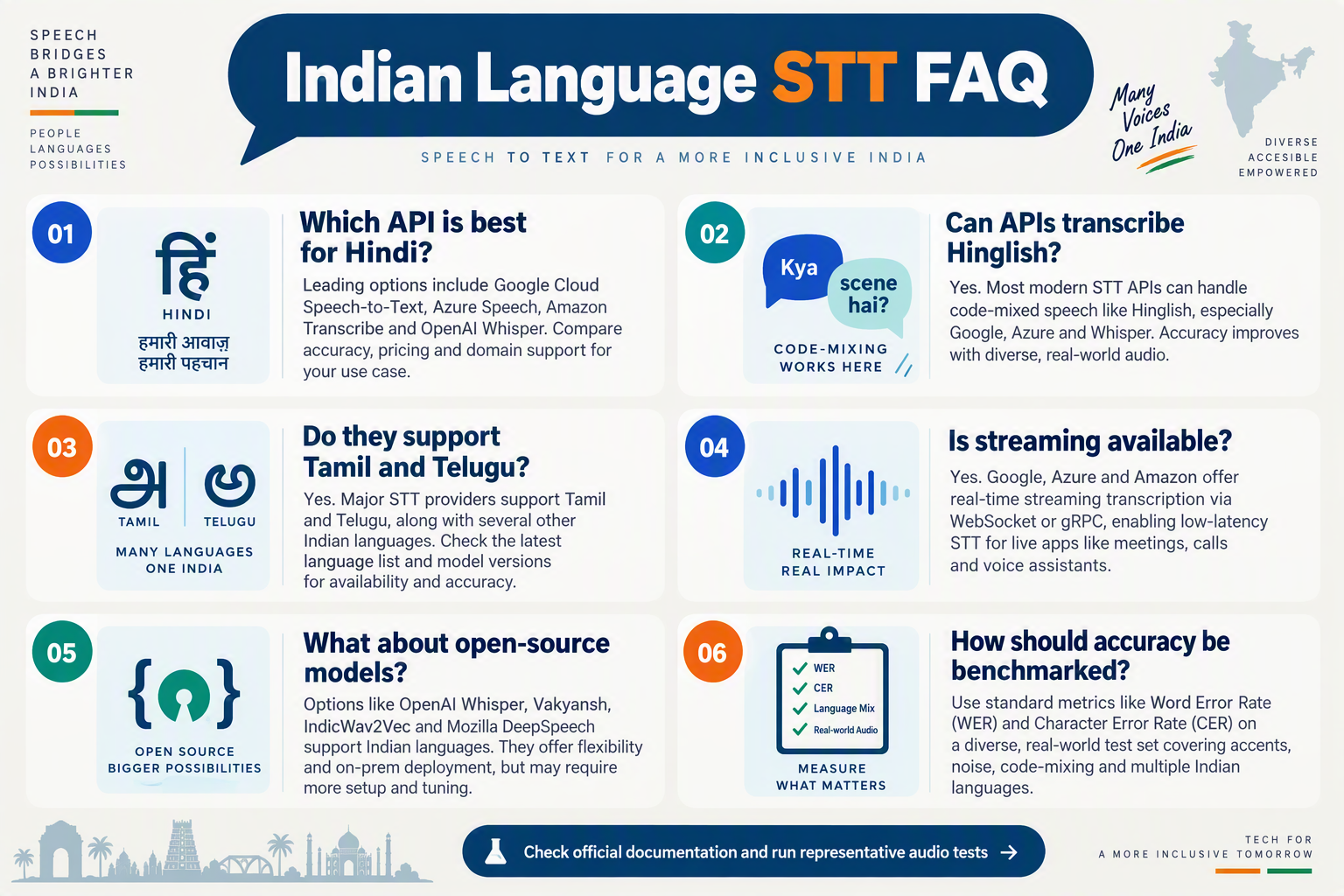
The best speech to text API for Indian languages depends on code-mixing, regional accuracy, streaming needs, and integration cost—not language count alone. Sarvam AI and CallMissed are strong shortlists for India-first use cases; Verbalyze merits testing where its published streaming claims fit the workload.
- Q: What is the best speech to text API for Indian languages in 2026?
A: Sarvam AI is a strong choice for dedicated Indian-language transcription, supporting 22 languages with diarization, timestamps, and code-mixing according to Sarvam AI’s speech-to-text documentation. CallMissed is a practical fit when transcription must work alongside voice agents, calls, recordings, and AI call notes; CallMissed supports 22 Indian languages plus English, including Hinglish, as of September 2026.
- Q: Which Hindi speech-to-text API supports Hinglish and Indian accents?
A: Shortlist CallMissed and Sarvam AI, then test both with Hindi-English switching, regional accents, names, numbers, and background noise. CallMissed’s verified product specifications include speech recognition in 22 Indian languages plus English and code-mixed speech such as Hinglish, while Sarvam AI documents code-mixing support.
- Q: How much does an Indian language speech recognition API cost?
A: CallMissed provides 1,000 free signup credits, where one credit equals ₹1, and its monthly plans start at ₹999 with 550 credits as of September 2026, according to CallMissed pricing information. CallMissed’s voice-agent transcription-inclusive rates are ₹4, ₹5, or ₹6 per minute by voice tier, with a 30-second minimum; phone carriage is billed separately.
- Q: Is a speech-to-text API for Indian languages better than an open-source model?
A: A managed API usually reduces deployment, scaling, monitoring, and language-model integration work, while an open-source model can offer greater infrastructure control. Compare word error rate, code-switching accuracy, GPU cost, data residency, streaming behavior, and maintenance effort on your own recordings rather than assuming either approach wins universally.
- Q: Which speech-to-text API is best for Indian accent and real-time calls?
A: Benchmark live audio using representative accents, interruptions, noise, and code-mixed speech; “real-time” marketing claims are not directly comparable without a shared test. Verbalyze advertises under-90-millisecond streaming latency and 50,000+ hours of native-audio training on its product page, while CallMissed provides a managed voice-agent WebSocket and real-time voice sessions through an API and SDK.
- Q: Can one speech-to-text API support voice agents and customer-service workflows?
A: CallMissed combines Indian-language speech recognition with inbound and outbound calls, transcripts, recordings, AI call notes, CRM delivery, call scoring, and human supervision tools. Its developer API also exposes audio transcription through OpenAI-compatible endpoints, allowing existing OpenAI SDK integrations to switch by changing the base URL.
Conclusion
The best speech-to-text API for Indian languages in 2026 depends on your audio, language mix, and production needs—not language count alone.
- Sarvam AI: Strong shortlist for 22-language transcription, diarization, timestamps, and code-mixing, according to Sarvam AI.
- CallMissed: Supports speech recognition in 22 Indian languages plus English, including Hinglish, within a broader voice-AI API stack.
- Verbalyze: Advertises 30+ Indian languages and sub-90-millisecond streaming, according to Verbalyze; validate performance on representative audio.
Watch for better dialect accuracy and code-switching benchmarks. To explore how AI communication is evolving, check out CallMissed. Which API performs best on your real-world recordings?
Related Reading
- Best Text to Speech API for Hindi in 2026: 7 Options Compared
- Best Text to Speech API for Hindi in 2026: Pricing, Benchmark, and Production Trade-offs
- Best Text to Speech API for Hindi in 2026: Developer Decision Matrix
Sources
Discussion
Related Posts

Ready to automate customer conversations?
Launch AI voice agents and WhatsApp bots with CallMissed — one API, 22+ Indian languages.