unified LLM API gateway: Claude, Gemini and GPT Compared


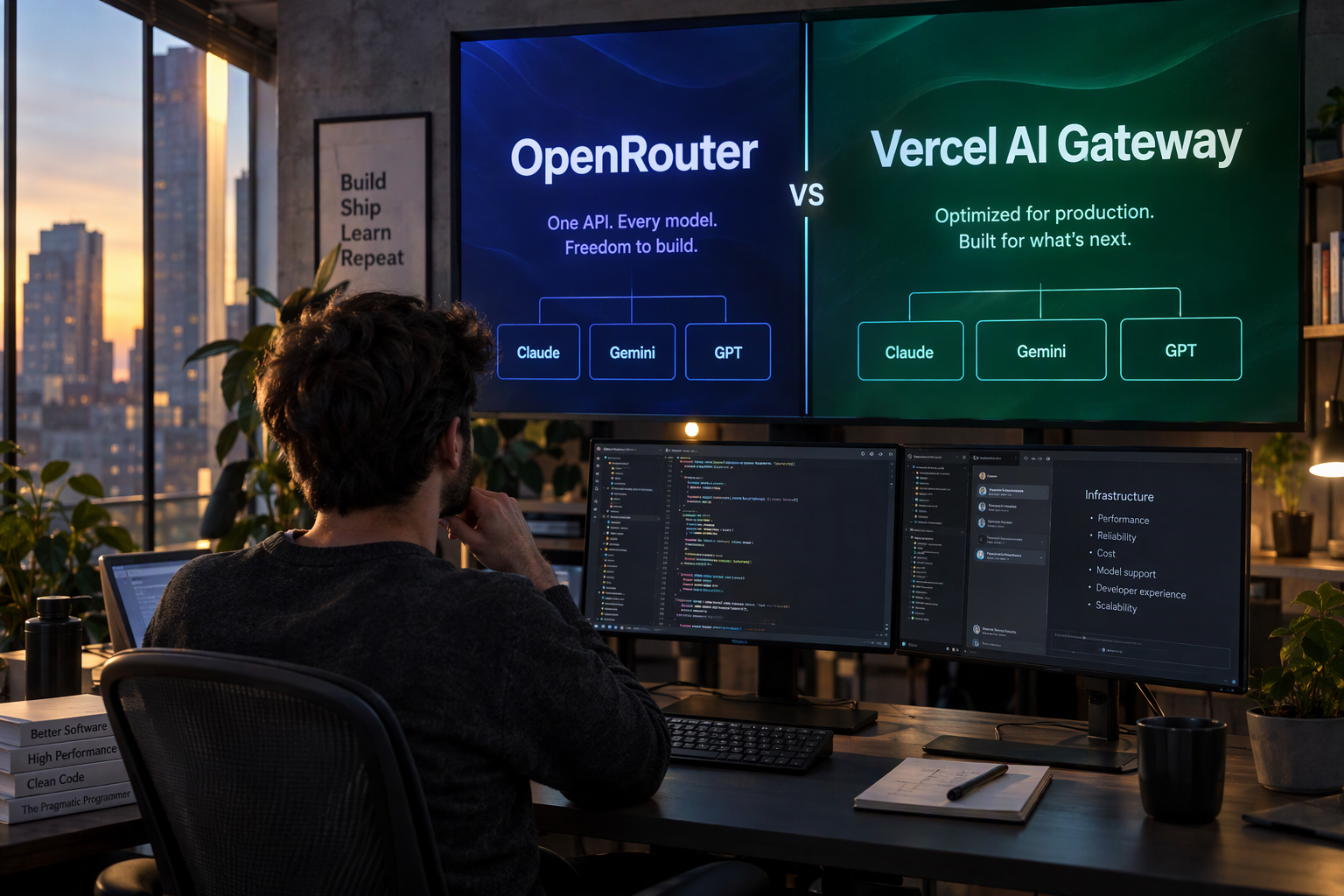
Compare unified LLM API gateway options for Claude, Gemini and GPT, with pricing checks, compatibility tests and clear recommendations by use case.
unified LLM API gateway: Claude, Gemini and GPT Compared
Why maintain three separate integrations when a unified LLM API gateway can connect an application to Anthropic Claude, Google Gemini and OpenAI GPT through one interface? A single API for all major LLMs can simplify integration, but “unified” does not mean every model supports identical tools, parameters or billing arrangements.
As of November 2026, the practical comparison is no longer just which model produces the strongest answer. Developers also need to understand how a gateway handles model selection, provider credentials, streaming, failures and usage tracking—and which capabilities remain provider-specific. Those details determine whether switching models is straightforward or introduces unexpected engineering work.
What does a unified LLM API gateway actually do?
An LLM gateway sits between your application and model providers, giving developers a common interface for requests. In its May 2026 guide, Klymentiev.com describes the gateway as a “control plane” that handles routing, failover, observability, cost tracking and caching.
That definition matters because a gateway is more than a convenient endpoint. It can centralize operational controls that would otherwise need to be implemented separately for Claude, Gemini and GPT. However, the features available depend on the gateway, its configuration and the underlying model.
Vercel’s supplied 2026 comparison describes both Vercel AI Gateway and OpenRouter as unified APIs for routing requests to multiple model providers. This establishes the core answer to the target question: accessing major model families through a single integration is possible, but choosing that integration requires checking the supported catalog and operational trade-offs.
Why does this comparison matter now?
The growing range of AI workloads makes integration choices consequential. A customer-support assistant might need structured tool calls, a document workflow might require image input, and an interactive application might prioritize streamed responses.
As of November 2026, CallMissed, the OpenAI-compatible developer AI API, offers one API key and one balance for 146 models—including 44 general-purpose LLMs—with OpenAI-compatible and Anthropic-compatible endpoints, illustrating the move toward consolidated access rather than separate integrations.
Crucially, protocol compatibility is not proof of model availability. An Anthropic-compatible endpoint does not, by itself, establish that a gateway offers Anthropic Claude; developers must verify the actual model catalog.
What will this Claude, Gemini and GPT comparison cover?
This comparison separates model capabilities from gateway capabilities so you can evaluate both without confusing them. You will learn how to assess:
- Model access: whether the gateway supports the specific Claude, Gemini and GPT versions your application needs.
- API compatibility: which request formats, tools and response features translate cleanly.
- Reliability controls: how fallback choices and request visibility affect production operations.
- Cost transparency: whether billing combines provider charges, gateway fees or separate credentials.
The goal is a practical selection framework—not a blanket winner—so you can choose a single API that fits your workload without assuming every model is interchangeable.
Can you use Claude, Gemini and GPT through one API?
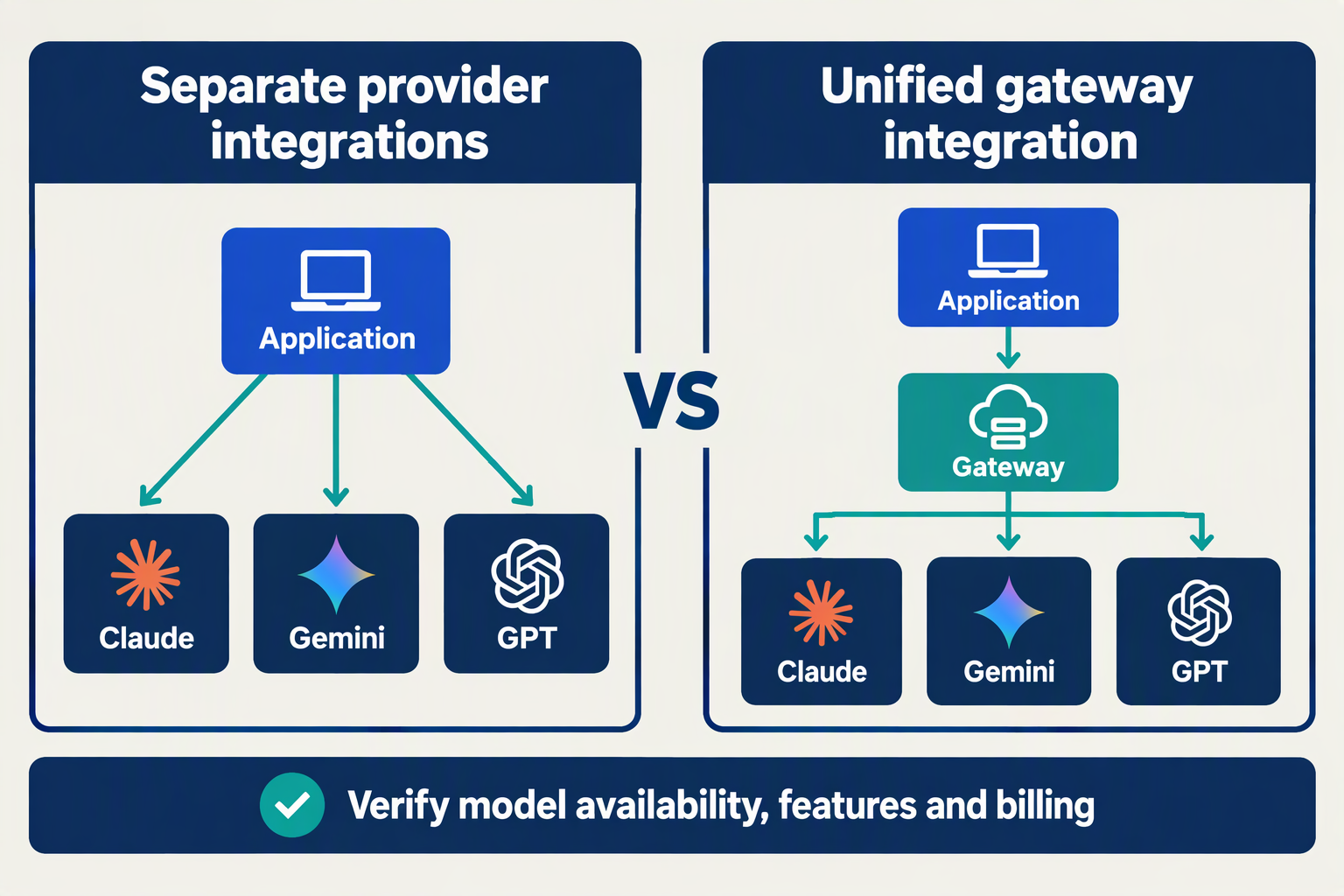
Yes—a single API for Claude, Gemini and GPT is possible through a multi-provider gateway. As of November 2026, distinguish gateways that supply model access from gateways that unify access to provider accounts you already hold.
Which gateways let you access Claude, Gemini and GPT?
- OpenRouter: MESHLAUNCH’s 2026 OpenRouter guide describes one API key for GPT, Claude, Gemini and 400+ models, with streaming, fallback routing and bring-your-own-key options. That establishes cross-provider access, but its examples—GPT-4o, Claude 3.5 and Gemini 2.5—are examples, not evidence that those are the latest available versions.
- Vercel AI Gateway: Vercel’s supplied 2026 comparison identifies Vercel AI Gateway and OpenRouter as unified APIs for multiple model providers. Vercel emphasizes deployment identity, project usage and budgets; for a Claude–Gemini–GPT deployment, verify each required model identifier rather than treating “multiple providers” as a complete availability guarantee.
- Portkey: Yangmao.ai’s supplied gateway overview describes unified routing across OpenAI, Anthropic, Gemini, Azure and Amazon Bedrock. Its relevance is especially clear for teams already managing multiple provider keys: the overview highlights logs, caching, retries, budget controls and fallback, while noting that token costs depend on upstream providers or billing configuration.
- CallMissed: As of November 2026, CallMissed’s verified developer API supports caller-chosen fallback models, response caching, bring-your-own provider keys, and usage and request logs. These are concrete gateway capabilities; however, the supplied catalog does not establish Claude availability, so CallMissed should not be presented here as verified access to all three families.
What should you verify before choosing one API?
- Model identifiers: Require three explicit catalog entries: the Anthropic Claude version, Google Gemini version and OpenAI GPT version your application needs. A family name is insufficient for reproducible deployments. Record the selected identifiers and verification date, then check whether aliases can change the underlying model without a code change.
- Feature compatibility: Test streaming, tool calls, structured outputs and image input independently for each selected model. A common request format reduces integration work; it does not establish identical behavior. For example, run the same order-status tool schema against all three models and validate arguments before executing any business action.
- Billing scope: Separate gateway charges, upstream token charges and provider-account billing when comparing costs. Yangmao.ai explicitly cautions that Portkey’s real token costs depend on the upstream provider or billing setup. Ask whether “one API” also means one prepaid balance, or merely one endpoint connected to several separately funded accounts.
- Fallback behavior: Define whether a failed Claude request may switch to Gemini or GPT, and test the resulting response against your application’s requirements. MESHLAUNCH’s 2026 guide lists OpenRouter fallback routing, but availability alone is not an acceptance test: record the model actually used, validate its output and measure the cost of retries.
Which gateway should you shortlist first?
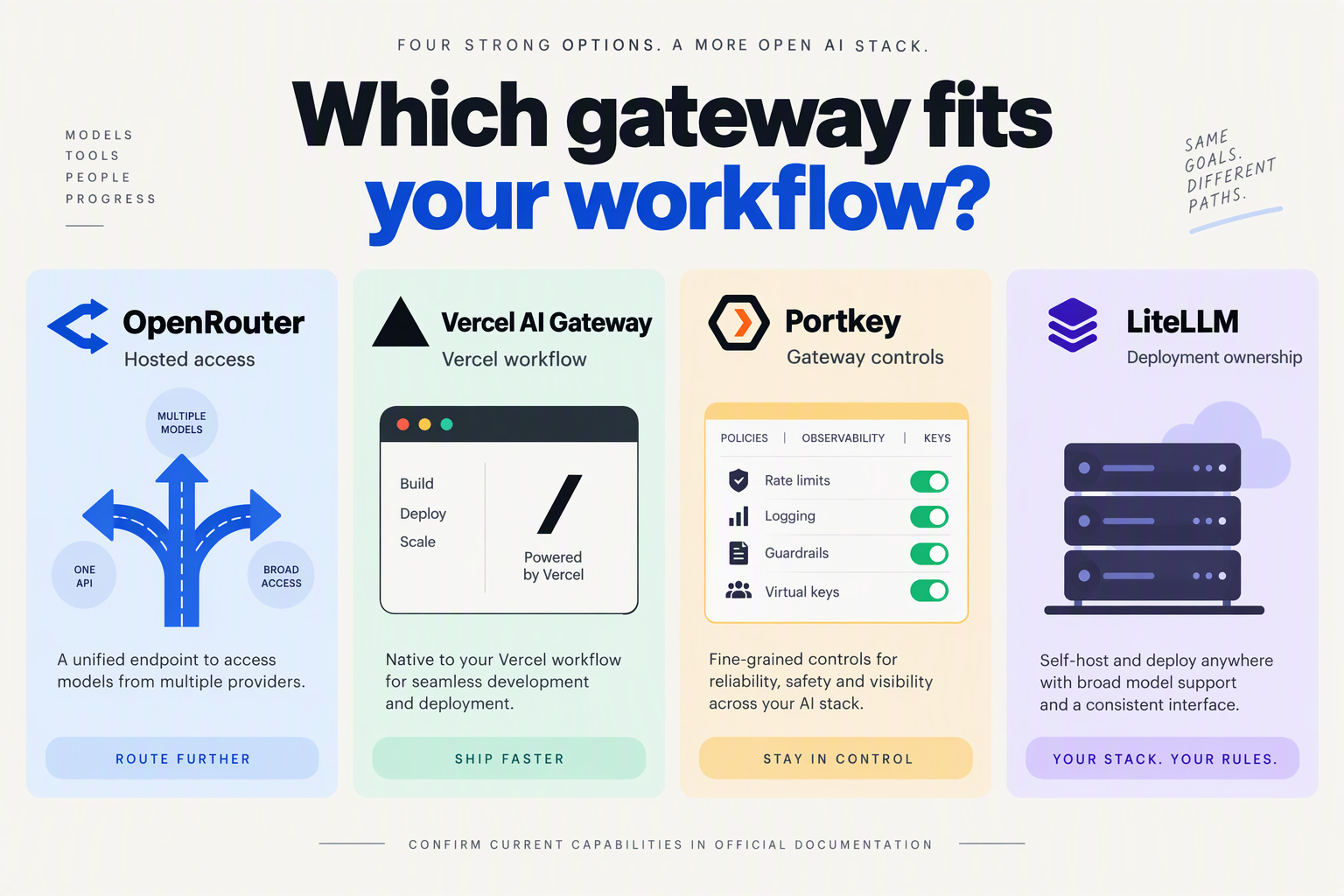
Shortlist OpenRouter first for explicit Claude, Gemini and GPT access; add Vercel AI Gateway if your application uses Vercel’s AI SDK. Treat this as an evaluation order, not a universal ranking: exact model versions, billing arrangements and operational requirements should decide the winner.
Which gateways belong on your initial shortlist?
- OpenRouter: MESHLAUNCH’s 2026 guide explicitly documents one-key access to OpenAI GPT, Anthropic Claude and Google Gemini, making OpenRouter the clearest starting point for this specific query. The guide reports 400+ models, but its examples include older model generations; verify the exact November 2026 model IDs before committing.
- Vercel AI Gateway: Vercel’s supplied 2026 comparison identifies deployment identity, project usage and budgets as distinguishing integration considerations. Vercel also describes AI Gateway as the default provider in AI SDK v7. Shortlist Vercel alongside OpenRouter when fitting the gateway into your existing application matters more than maximizing catalog breadth.
- Portkey: Yangmao.ai’s supplied guide describes unified routing across OpenAI, Anthropic, Gemini, Azure and Amazon Bedrock, alongside logging, caching, retries, budget controls and fallbacks. Put Portkey on the shortlist when you already manage several provider keys and need centralized operational controls; confirm current plan limits rather than assuming every control is included.
- CallMissed: As of November 2026, CallMissed’s verified fact sheet lists caller-chosen fallback models, response caching, stored prompts, bring-your-own provider keys, and usage logs. Its Pro plan costs ₹4,999 monthly with a default 3,000 requests-per-minute limit per key. Consider these concrete strengths, but do not shortlist CallMissed specifically for Claude without catalog confirmation.
What should you verify before selecting a gateway?
- Exact model availability: Require three working model IDs—one each for Claude, Gemini and GPT—and run a real request against each. A gateway advertising hundreds of models may still lack the particular release or deployment you need. Record the verification date as November 2026 rather than relying on a generic “2026 guide.”
- Billing structure: Separate gateway charges, upstream model costs and optional provider-key arrangements. Yangmao.ai notes that Portkey’s actual token costs depend on the upstream provider or billing configuration. Compare the same input/output workload across your shortlisted services; neither a monthly subscription nor a large catalog establishes the lowest total cost.
- Integration effort: Build one small application workflow with streaming, structured output and a tool call, then switch between the three model families. Record unsupported parameters and response differences. This produces a more useful comparison than testing only a successful text completion, because application-level compatibility is what determines migration effort.
- Failure handling: Test one invalid model ID, one rate-limit response and one unavailable-provider scenario before production. Check whether fallback changes the selected model, how that change appears in logs, and whether your application can reject unsuitable substitutes. Your first shortlist should become a purchase decision only after these checks pass.
Which features actually work across providers?
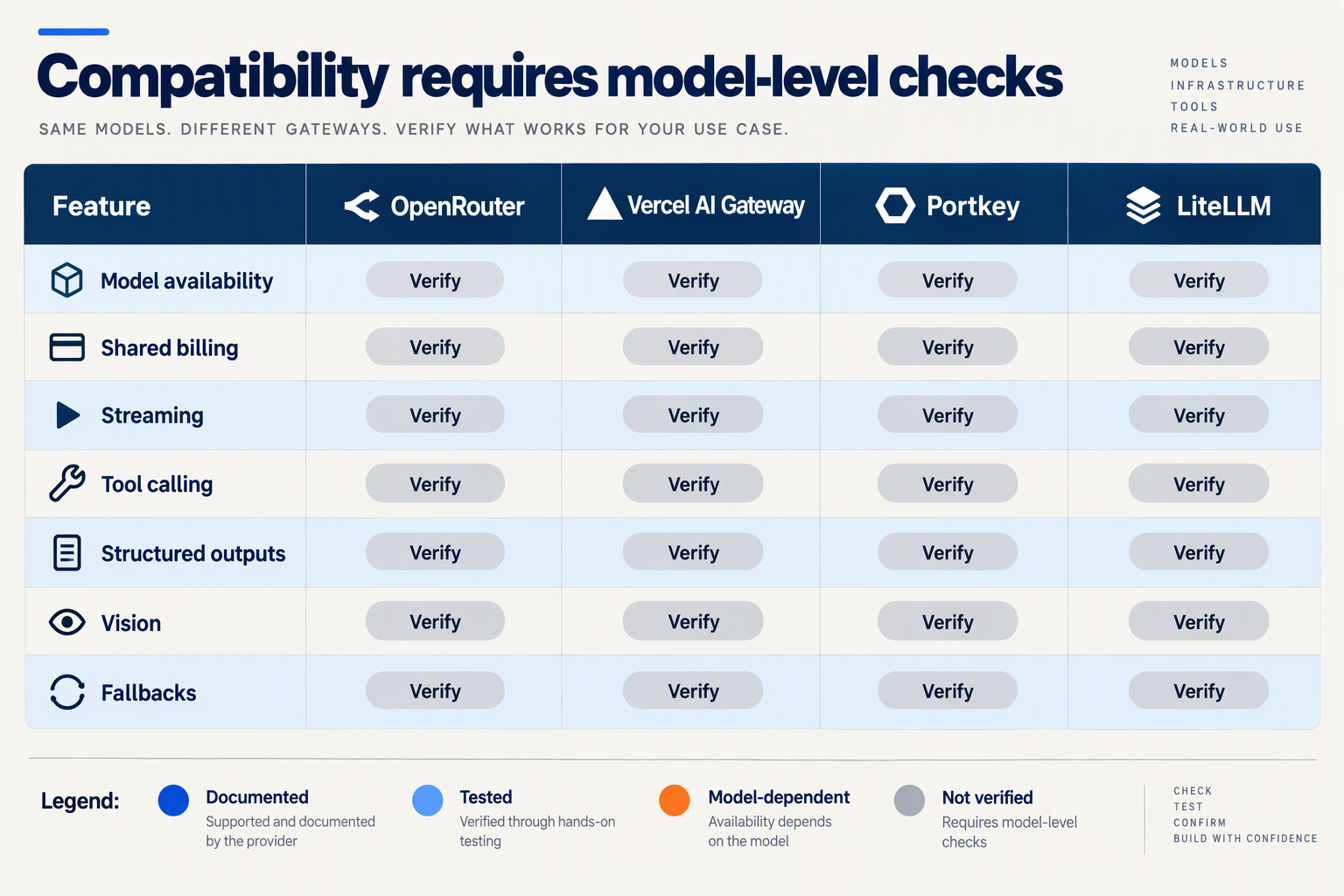
A single API for Claude, Gemini and GPT can standardize request handling, but feature portability must be checked model by model. As of November 2026, separate gateway features—routing, logging and budgets—from model features such as tool calling, image input and structured output.
- Gateway controls: Klymentiev.com’s May 2026 guide describes an LLM gateway as a “control plane” for routing, failover, observability, cost tracking and caching—not a guarantee of identical model behavior.
- Comparison scope: Vercel’s supplied 2026 comparison confirms that Vercel AI Gateway and OpenRouter provide unified multi-provider APIs; it does not establish feature parity across every Claude, Gemini and GPT version.
| Feature | What can be unified? | What must you verify? |
|---|---|---|
| Streaming | One application interface for receiving incremental responses | Event types, tool-call fragments, cancellation and how interrupted streams are reported |
| Function calling | A common format for tool definitions and returned arguments | Whether each selected model supports the tools, argument schemas and tool-selection settings you require |
| Structured outputs | A shared request setting and validation workflow | Supported JSON Schema constraints; valid JSON alone does not prove schema compliance |
| Vision input | A common way to submit images alongside text | Whether the exact model accepts images, supported formats and request-size restrictions |
| Fallback routing | Gateway-level selection of alternative models or providers | Whether the fallback preserves required capabilities rather than merely returning a response |
| Usage and caching | Centralized request records, cost tracking and cache controls | Token accounting, cache eligibility and whether changing models changes the meaning of reported usage |
How do you check whether features survive a model switch?
Treat the table as an acceptance-test checklist, not a declaration that every gateway implements all six features. The supplied research establishes unified access and operational controls, but provides no controlled benchmark proving identical behavior across Anthropic Claude, Google Gemini and OpenAI GPT.
- CallMissed: According to its verified fact sheet, as of November 2026, CallMissed’s developer AI API supports streaming, function calling, structured outputs, vision input, caller-chosen fallback models, response caching, and usage and request logs; these gateway capabilities should still be tested against each selected model.
- Provider credentials: The supplied Yangmao.ai Portkey overview describes routing across OpenAI, Anthropic, Gemini, Azure and Bedrock, with logs, caching, retries and fallback; it also notes that upstream provider costs and billing configuration remain relevant.
- Budget controls: Vercel’s supplied 2026 comparison associates Vercel AI Gateway with deployment identity, project usage and budgets; those controls concern operations, not whether two models follow the same output schema.
- Catalog precision: Record exact model identifiers for all three families before testing; “Claude-compatible” request formatting is not evidence that a particular Claude model is available.
Use three reproducible checks before switching production traffic:
- Schema check: Send the same required fields, enums and nested objects to each model; validate responses rather than relying on visual inspection.
- Tool check: Run one successful tool invocation and one tool-error scenario; compare arguments, error handling and subsequent responses.
- Fallback check: Force a primary-route failure, then confirm that the replacement supports the original request’s images, tools and output constraints.
The practical goal is one integration with explicit capability checks, not an assumption that every provider behaves identically.
What will you actually pay for a unified API?
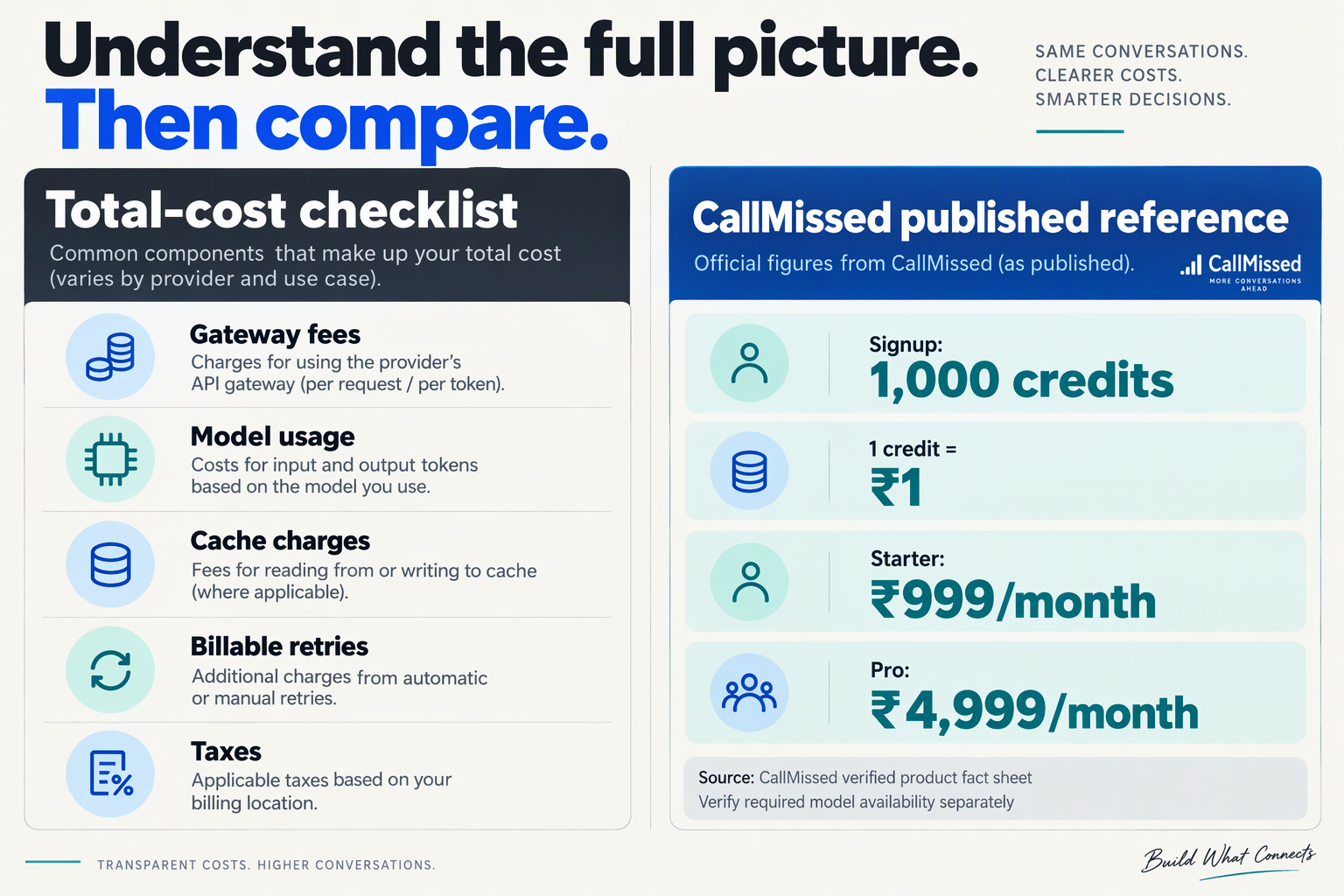
A single API for Claude, Gemini and GPT does not necessarily mean a single price per token. Your bill depends on model usage, gateway charges and whether you pay providers directly or through a prepaid balance.
- Total cost: Compare input tokens, output tokens, gateway fees, subscription charges and applicable taxes separately. A unified endpoint simplifies integration, but it does not establish that every model has identical rates or that provider charges are included.
- Evidence boundary: As of November 2026, the supplied research identifies several unified gateways but does not provide verified competitor fee schedules. The comparison below marks those prices as unspecified rather than treating missing information as evidence of free service.
- OpenRouter: MESHLAUNCH’s 2026 guide discusses pricing and bring-your-own-key access alongside unified model access. However, the supplied excerpt contains no numerical fee schedule; check funding charges and BYOK terms before estimating a production workload.
- Vercel AI Gateway: Vercel’s supplied 2026 comparison describes project usage and budgets, while identifying OpenRouter’s provider-pricing filters. Those controls help evaluate spending, but neither feature establishes a particular token price, discount or monthly allowance.
Which unified API costs can you verify?
The table separates documented billing details from prices absent from the supplied evidence; it is not a cheapest-provider ranking.
| Option | Billing evidence | Verified price | What to check |
|---|---|---|---|
| OpenRouter | Pricing and BYOK discussed by MESHLAUNCH, 2026 | Not specified | Model rates and funding fees |
| Vercel AI Gateway | Project usage and budgets described by Vercel, 2026 | Not specified | Model rates and gateway charges |
| Portkey AI | Yangmao.ai distinguishes upstream costs from billing setup | Not specified | Provider bills and plan limits |
| LiteLLM | Included in Klymentiev.com’s May 2026 gateway comparison | Not specified | Hosting and operational costs |
| CallMissed | Verified fact sheet, November 2026: prepaid credits and monthly plans | ₹1 per credit; Starter ₹999/month | Model credit rates and request limits |
How do you calculate a realistic monthly API budget?
- Worked example: At hypothetical—not quoted provider—rates of $1 per million input tokens and $5 per million output tokens, 10 million input tokens plus 2 million output tokens cost $20 before gateway charges and taxes. Substitute each shortlisted model’s actual rates.
- CallMissed: According to the verified November 2026 fact sheet, signup includes 1,000 free credits, and Starter costs ₹999/month, with 550 credits in month one and 500 thereafter. Credits never expire; these allowances are not equivalent to a fixed token quantity.
- BYOK comparison: Yangmao.ai’s supplied Portkey guide notes that actual token costs depend on the upstream provider or billing configuration. Budget for provider usage separately whenever your own credentials are charged directly; avoid counting prepaid gateway credits against that same expenditure.
- Production allowance: Estimate normal requests, output length, retries and fallback attempts separately, then run a representative workload. Compare cost per successfully completed task, not subscription price alone: a low monthly fee cannot establish affordability without model-level usage rates.
What are the trade-offs of each option?
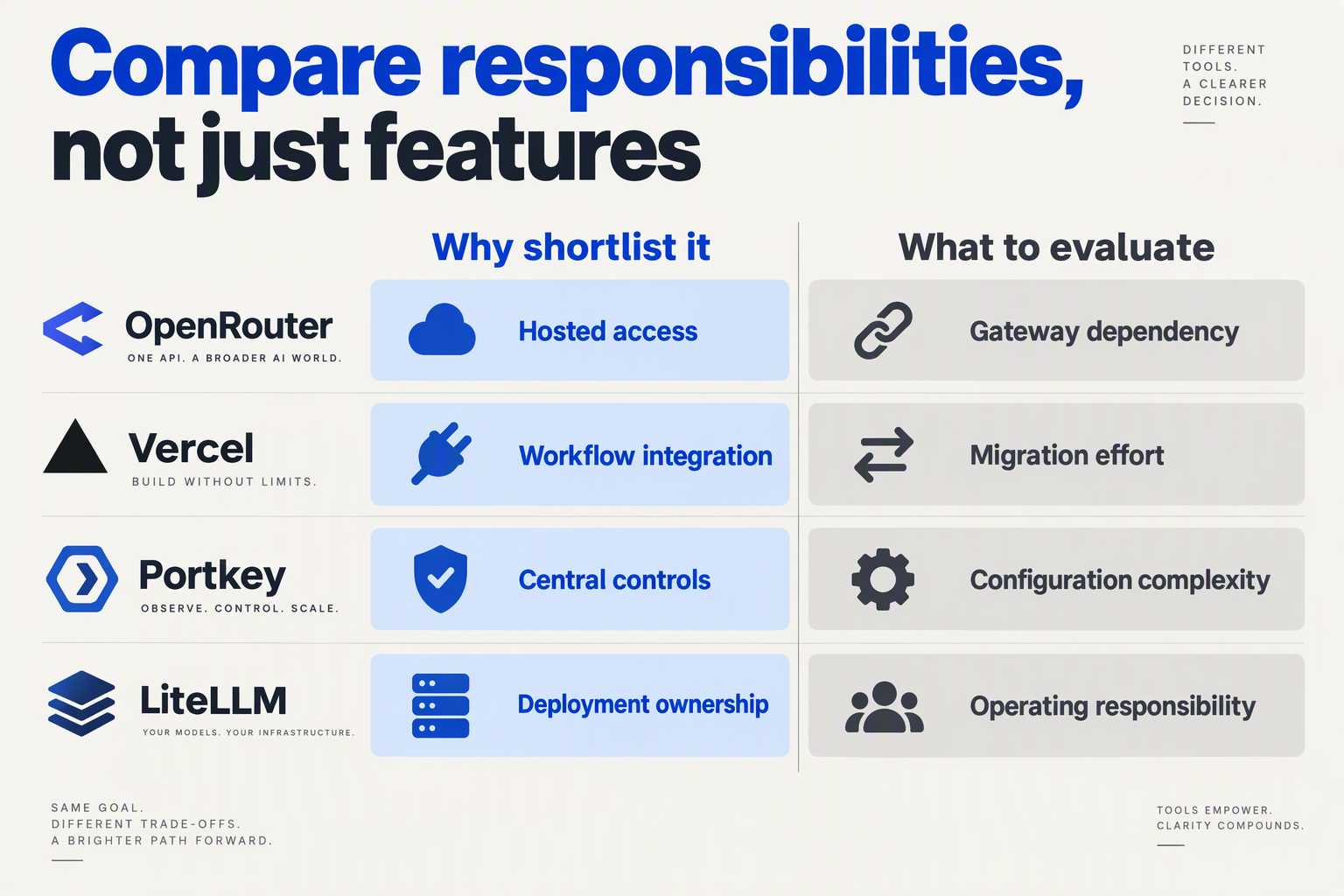
The trade-off in choosing a single API for all major LLMs, including Claude, Gemini and GPT, is integration convenience versus control over provider-specific behavior. As of November 2026, evaluate catalog coverage, billing responsibility and failure handling separately—not as one bundled promise.
| Option | Main advantage | Trade-off to evaluate | Evidence |
|---|---|---|---|
| OpenRouter | Consolidated access to GPT, Claude and Gemini | Confirm exact model versions, routing choices and billing terms before committing | MESHLAUNCH’s 2026 guide covers streaming, fallback routing and bring-your-own-key access |
| Vercel AI Gateway | Connects deployment identity with project usage and budgets | Decide whether deployment-linked controls match your infrastructure and accounting boundaries | Vercel’s supplied 2026 comparison describes these integrations |
| Portkey AI | Unified routing across OpenAI, Anthropic, Gemini, Azure and Amazon Bedrock | Separate gateway-plan allowances from upstream token charges | Yangmao.ai describes plan-dependent requests, log retention and team features |
| CallMissed | Caller-chosen fallback models, response caching and bring-your-own provider keys | Verify the required Claude model separately; Anthropic-compatible endpoints do not establish Claude availability | CallMissed’s verified November 2026 fact sheet |
| Direct provider APIs | Direct access to each provider’s native request format | Your application must coordinate separate integrations, credentials and failure policies | Architectural alternative to the gateway “control plane” described by Klymentiev.com in May 2026 |
Which trade-offs should developers test before choosing?
- OpenRouter: MESHLAUNCH’s 2026 guide reports access to 400+ models, but catalog size is not a workload benchmark; test your exact Claude, Gemini and GPT identifiers rather than treating the total as proof of feature parity.
- Vercel AI Gateway: Vercel’s supplied 2026 comparison highlights project usage and budgets; check whether your application needs spending boundaries per deployment, customer or internal team, and verify which boundaries the configuration actually enforces.
- Portkey AI: Yangmao.ai’s supplied context distinguishes gateway allowances from upstream token costs; calculate both for a representative workload, and check request allowances and log retention before assuming the gateway subscription covers model consumption.
- CallMissed: As of November 2026, the verified fact sheet lists 60 requests per minute on Free, 500 on Starter and 3,000 on Pro; match expected bursts to the plan limit rather than estimating capacity from monthly spending alone.
- Direct APIs: Using three provider integrations preserves native interfaces but makes your team responsible for cross-provider coordination; compare that engineering effort with gateway configuration, rather than comparing token prices alone.
- Fallback testing: Send the same structured-output request to the primary model and fallback model; validate the response schema, tool arguments and error handling before allowing a production workflow to continue automatically.
- Billing testing: Measure successful requests, failed attempts and retries separately during a controlled test; confirm which events appear in gateway usage records and upstream invoices instead of assuming one dashboard captures every charge.
- Selection rule: Choose the option that passes your required model, interface and operational tests; a larger catalog cannot compensate for a missing model version or an incompatible tool-calling workflow.
How do you test GPT, Claude and Gemini with the same client?
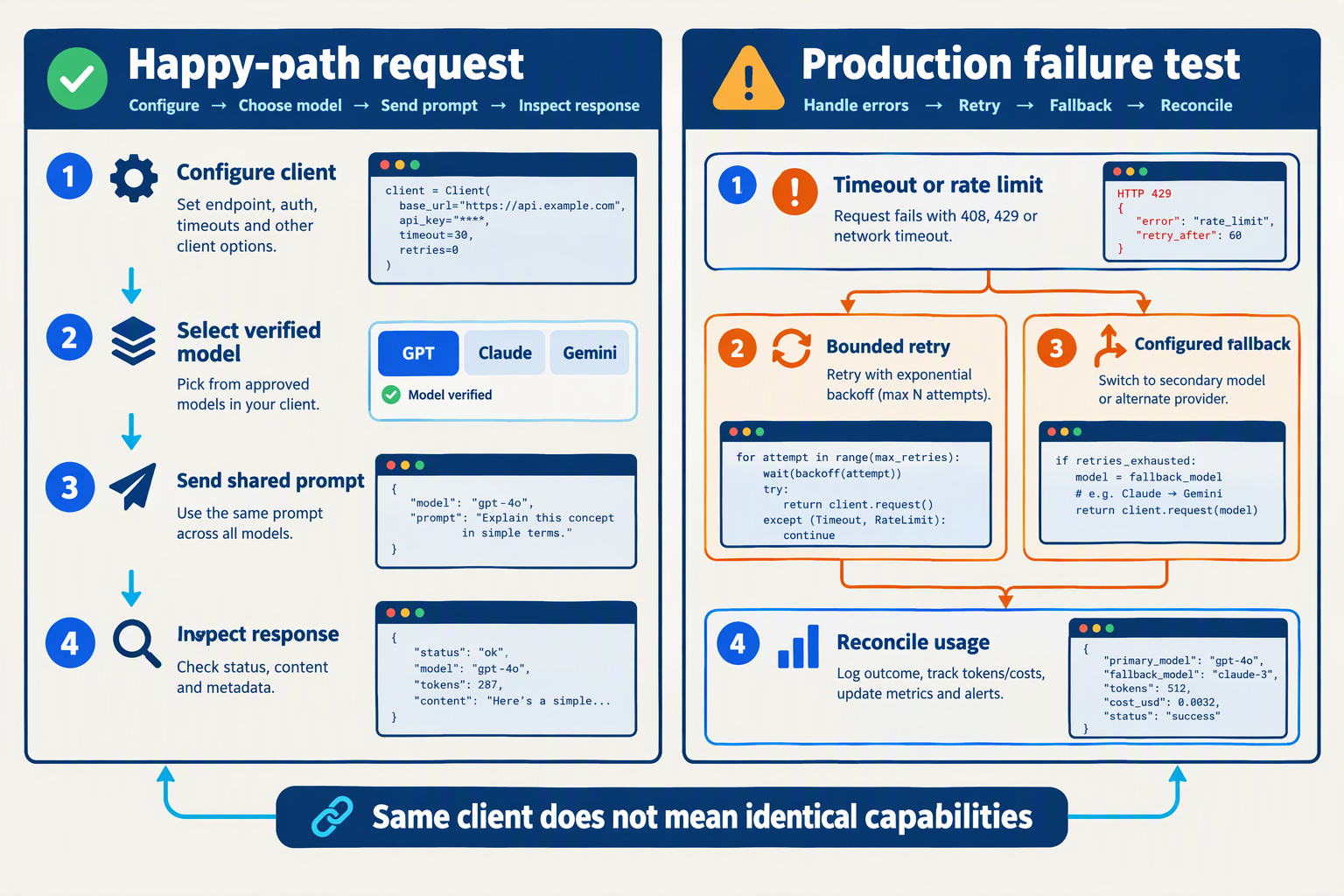
Test GPT, Claude and Gemini with the same OpenAI-compatible client, changing the gateway’s model identifier while keeping prompts and scoring rules fixed. First verify that the gateway actually lists all three model families.
How do you configure one client for GPT, Claude and Gemini?
- Gateway selection: MESHLAUNCH’s 2026 OpenRouter guide describes one API key for GPT, Claude, Gemini and 400+ models. Treat that as a starting point, not a guarantee of specific versions: copy three currently available model identifiers from your chosen gateway’s catalog before running the comparison.
- Client configuration: In Python, initialize the OpenAI SDK once with
client = OpenAI(base_url=gateway_base_url, api_key=gateway_key). Then callclient.chat.completions.create(model=model_id, messages=messages)for each identifier. Keep the gateway address and credentials unchanged; this tests switching through one integration, rather than comparing three separately configured SDKs.
- Request parity: Send identical system instructions, user messages and source documents to all three models. Start with plain-text requests and a shared output-length target; add tools, images and reasoning controls only after confirming support. Identically named parameters do not necessarily produce equivalent behavior across GPT, Claude and Gemini.
- CallMissed compatibility: As of November 2026, CallMissed’s verified fact sheet lists OpenAI-compatible and Anthropic-compatible endpoints, plus usage and request logs. Those capabilities support integration testing, but Anthropic protocol compatibility alone does not establish Claude availability; verify the catalog before choosing CallMissed for this particular three-family comparison.
What should you measure in a fair three-model comparison?
- Test coverage: Build a proposed 100-prompt evaluation set: 25 extraction tasks, 25 grounded support questions, 25 coding tasks and 25 instruction-following tasks. Testing three models produces 300 initial requests. These are suggested experiment sizes—not published benchmarks—and each task should include an expected answer or explicit scoring rubric.
- Response quality: Score extraction against required fields, coding against executable tests, support answers against supplied documents, and instruction following against stated constraints. Use pass rate = successful responses ÷ evaluated responses × 100. Inspect failures separately: a valid JSON response can still contain an incorrect customer identifier or unsupported claim.
- Speed and cost: Record time to first token for streaming requests, total completion time, input/output usage and billed cost. Report median and p95 latency alongside cost per successful task. Klymentiev.com’s May 2026 guide calls an LLM gateway a “control plane” for observability and cost tracking; your application measurements should complement gateway logs.
- Repeatability and failures: Repeat the same 300-request set three times, creating 900 planned requests before retries. Record exact model identifiers, test date, SDK version, errors and retry counts. Disable automatic fallback for the baseline comparison, then test fallback separately so another model’s successful answer is not mistakenly credited to GPT, Claude or Gemini.
Which option should you choose for your application?
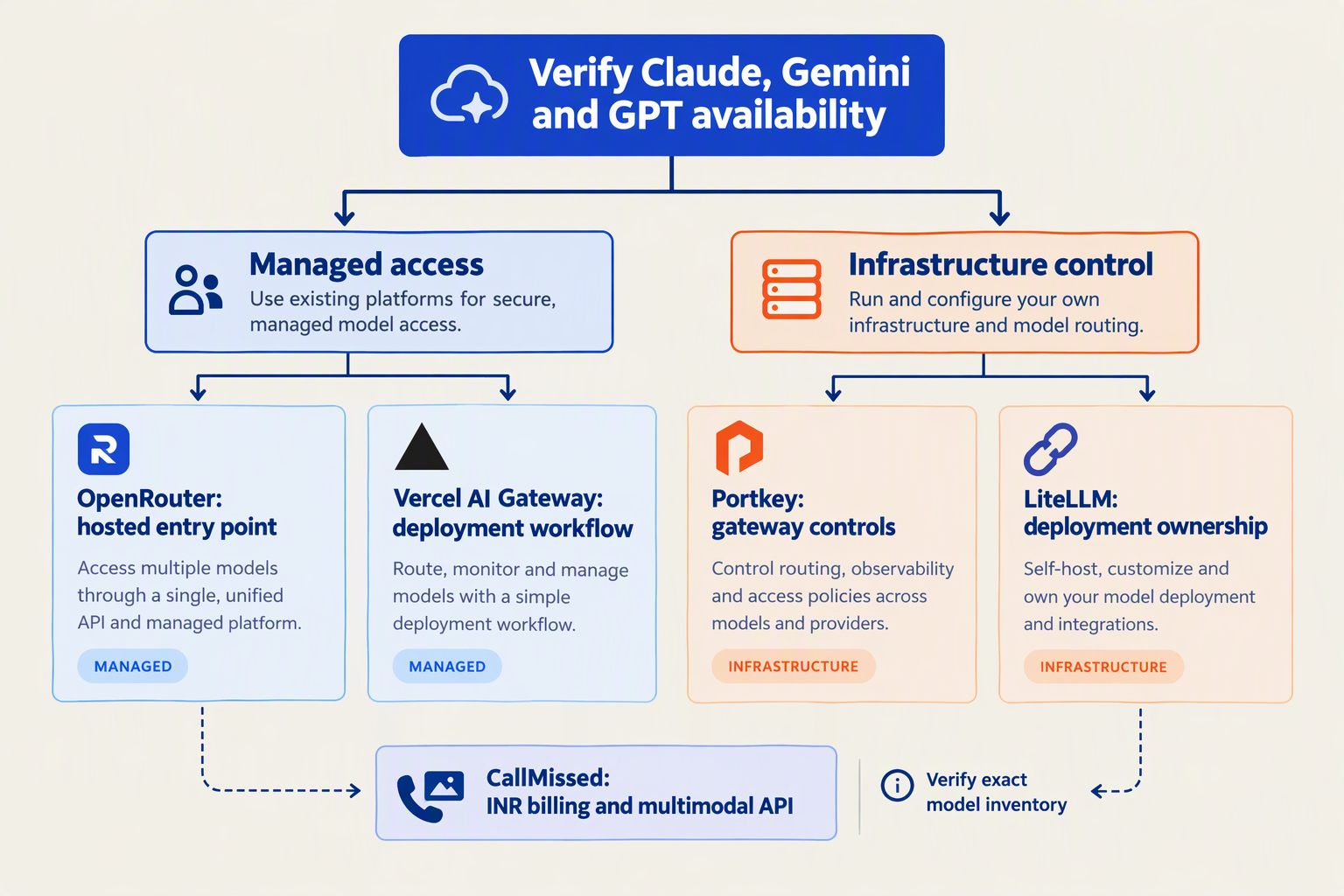
Choose OpenRouter for straightforward multi-provider access, Vercel AI Gateway for Vercel-centered applications, or Portkey when managing existing provider credentials matters most. As of November 2026, verify the exact Claude, Gemini and GPT model IDs before committing: a shared interface does not guarantee identical capabilities.
Which gateway fits your application’s deployment model?
- OpenRouter: Choose this for a prototype that needs Claude, Gemini and GPT behind one integration. MESHLAUNCH’s 2026 guide reports access to 400+ models through one API key, with streaming, fallback routing and bring-your-own-key options. Treat catalog size as a discovery advantage—not evidence that every listed model supports your required tools or output schema.
- Vercel AI Gateway: Choose this when your application already uses Vercel and its AI SDK. Vercel’s supplied 2026 comparison says the gateway connects deployment identity, project usage and budgets; its alternatives guide identifies the gateway as the default provider in AI SDK v7. That alignment is useful when deployment and AI spending should share project boundaries.
- Portkey: Evaluate this when you already hold separate OpenAI, Anthropic and Google Gemini credentials. Yangmao.ai’s supplied guide describes unified routing alongside logs, caching, retries, budget controls and fallback. Check the current plan’s request allowances and log retention before budgeting; the supplied context does not establish a November 2026 price or retention limit.
- CallMissed: Consider this for Indian teams combining language-model access with audio or other AI workloads. According to CallMissed’s verified fact sheet, as of November 2026 its API supports UPI payments, GST invoices and default per-key limits of 500 requests/minute on Starter or 3,000 on Pro. Confirm Claude availability separately; Anthropic-compatible endpoints alone do not establish Claude access.
What should you test before choosing a single LLM API?
- Model coverage: Require three explicit catalog entries: your chosen Anthropic Claude, Google Gemini and OpenAI GPT versions. Record each model ID and supported endpoint during your November 2026 evaluation. A gateway that supports all three families can still lack the particular version, context capacity or feature your application requires.
- Feature parity: Run the same acceptance tests against streaming, function calling, structured output and image input wherever your workflow requires them. For an invoice assistant, test whether each selected model returns valid fields and invokes the correct tool. Prefer measured task success over assuming an OpenAI-compatible request guarantees equivalent behavior.
- Failure handling: Test a timeout, a rate-limit response and an unavailable primary model before launch. Klymentiev.com’s May 2026 guide describes a gateway as a “control plane” covering routing, failover, observability, cost tracking and caching. Verify which controls your selected service actually provides and whether fallback preserves required features.
- Total cost: Compare provider charges, gateway charges, retries and cache effects using one representative workload. Include failed requests and fallback attempts where billable, rather than comparing headline token prices alone. If your application needs only one provider-specific capability, a direct integration may be simpler than adopting a multi-provider gateway prematurely.
Frequently Asked Questions
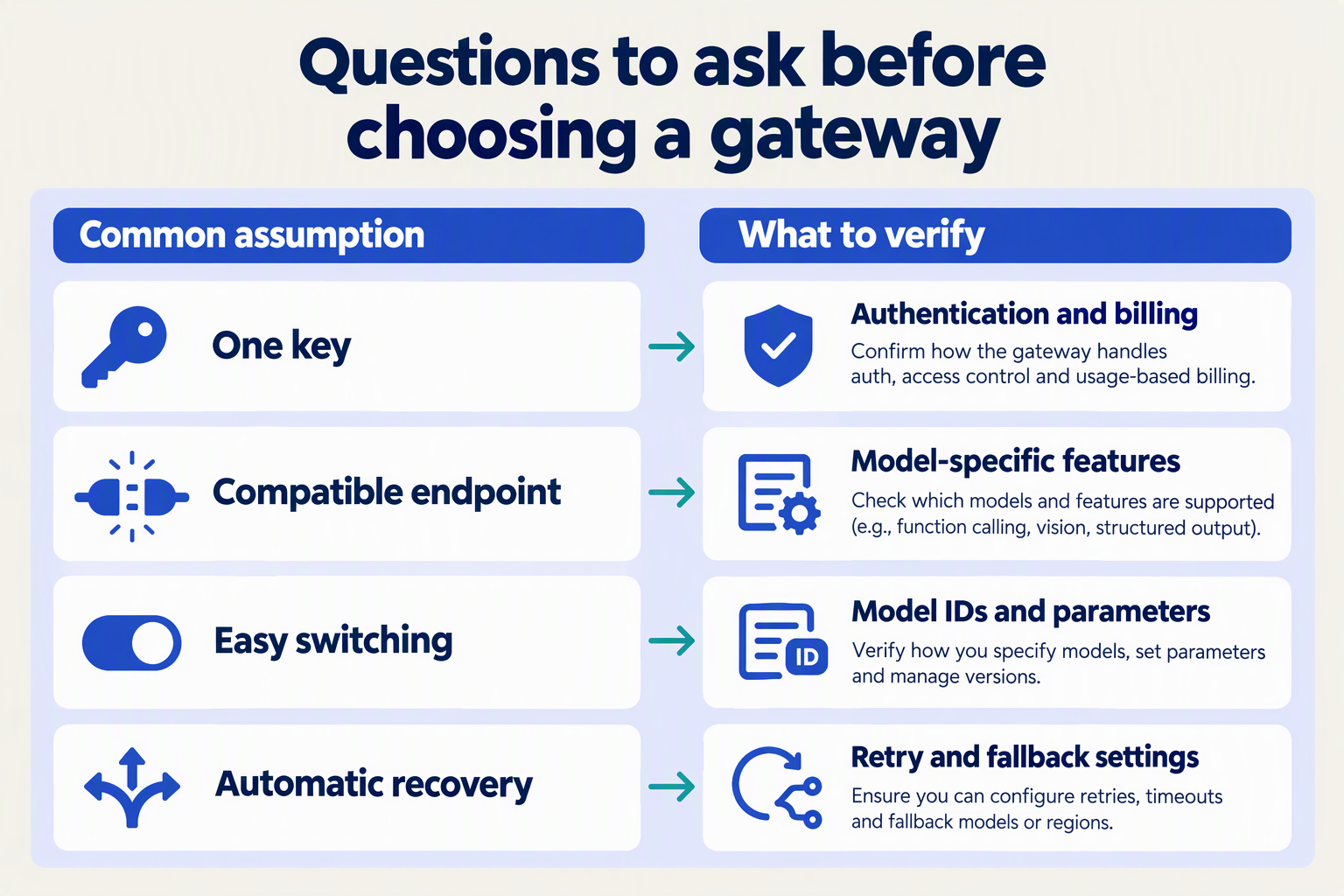
- Q: Which single API for all major LLMs including Claude Gemini and GPT should developers evaluate?
A: Evaluate OpenRouter and Vercel AI Gateway first, then verify the exact model versions your application requires rather than assuming every release is available. MESHLAUNCH’s 2026 OpenRouter guide describes access to GPT, Claude and Gemini, while Vercel’s 2026 comparison confirms that both gateways provide unified multi-provider APIs. For a November 2026 shortlist, compare supported endpoints, billing arrangements and deployment fit—not catalog size alone.
- Q: Can a single API for all major LLMs including Claude Gemini and GPT replace existing SDK integrations?
A: A compatible gateway can reduce integration changes, but API compatibility does not guarantee identical behavior across Anthropic Claude, Google Gemini and OpenAI GPT. Before migrating in November 2026, run the same requests against each target model and check tool-call arguments, structured-output validation, streaming events and error handling. Keep provider-specific options behind an adapter so application logic does not depend on one model’s request format.
- Q: Does one LLM API key also mean one bill for Claude, Gemini and GPT?
A: Not necessarily: a gateway’s authentication key and the credentials paying for upstream inference are separate concerns, especially with bring-your-own-key configurations. BrowseWiz’s supplied guide reports consolidated key-and-balance billing for Claude and GPT through OpenRouter and Vercel AI Gateway; confirm Gemini billing and account-specific terms before procurement in November 2026. Ask whether invoices separate model usage, gateway charges, cache charges and failed requests.
- Q: What happens when Claude, Gemini or GPT fails behind a unified API?
A: Failure behavior depends on the gateway’s configured retry and fallback policies, not simply whether multiple models are accessible. Klymentiev.com’s May 2026 guide describes an LLM gateway as a “control plane” handling routing, failover, observability, cost tracking and caching. For a payment or booking workflow, test timeout handling and repeated tool calls explicitly: switching models must not accidentally execute the same business action twice.
- Q: How should developers compare unified LLM API prices and rate limits?
A: Compare total workload cost, including input and output tokens, gateway charges, caching and retry overhead, rather than selecting the lowest advertised token price. As of November 2026, CallMissed’s verified fact sheet lists 1,000 signup credits, a ₹999 monthly Starter plan and default per-key limits of 60 requests per minute on Free and 500 on Starter. Treat request limits separately from model availability and token costs when estimating capacity.
- Q: How can developers avoid lock-in when using one API for multiple LLM providers?
A: Keep prompts, evaluation datasets and application state outside the gateway, and maintain a small interface for model selection and response normalization. Before a November 2026 production rollout, test three representative tasks—document extraction, tool execution and streamed conversation—against each shortlisted model. Record quality, latency and cost under your own workload; a portable integration still needs model-specific regression tests whenever versions or routing rules change.
Conclusion
A single API for all major LLMs, including Claude, Gemini and GPT, can simplify application development—but only when the gateway supports the exact models and capabilities your workload requires. As of November 2026, the practical decision is not simply which model answers best; it is which integration makes model selection, streaming, failures and usage tracking manageable without hiding provider-specific differences.
The comparison leads to four key takeaways:
- Verify model availability before choosing a gateway. OpenAI-compatible or Anthropic-compatible endpoints describe request formats, not a guaranteed model catalog. Check the specific Anthropic Claude, Google Gemini and OpenAI GPT versions you intend to use rather than assuming that protocol compatibility establishes access. This distinction matters when an application depends on a particular model’s tools or response behavior.
- Separate model capabilities from gateway capabilities. A common interface can reduce integration work, but it does not make every model support identical parameters, structured outputs or tool calls. Evaluate your actual workload: a customer-support assistant, document workflow and streamed interactive application may each expose different compatibility gaps. Switching a model name should be the start of testing, not proof that the migration is complete.
- Treat operational controls as part of the comparison. Klymentiev.com’s May 2026 guide describes an LLM gateway as a “control plane” handling routing, failover, observability, cost tracking and caching. Those controls help explain why a gateway is more than an endpoint. Compare what each service actually provides, how you configure it and what happens when a request fails—not just how quickly the first request succeeds.
- Check credentials, billing and usage visibility together. Consolidated access can simplify administration, but billing arrangements and provider-key requirements still deserve attention. Vercel’s supplied 2026 comparison identifies Vercel AI Gateway and OpenRouter as unified APIs for multiple providers; that shared description is a starting point, not evidence that their catalogs or operational trade-offs are identical. Choose the arrangement that fits your application’s integration and tracking needs.
For developers exploring this consolidation trend, CallMissed offers one API key and one balance for 146 models, including 44 general-purpose LLMs, as of November 2026, according to the CallMissed fact sheet. Its OpenAI-compatible and Anthropic-compatible endpoints make it a relevant platform to explore, while the same catalog-verification rule still applies: endpoint compatibility alone does not establish Claude availability.
Looking ahead, watch how gateways preserve provider-specific capabilities while making model switching, failure handling and usage tracking more consistent. A useful unified interface should reduce repetitive engineering without obscuring the differences that affect application behavior.
Before committing, test your real requests across the exact models you need: does the gateway simplify your application without hiding its trade-offs?
Related Reading
- Gemini vs Claude vs GPT (2026): Enterprise Buyer Guide
- Gemini vs Claude vs GPT (2026): Six-Model Buyer Guide
- Gemini 4 Argon vs GPT-6.1 Sol: API and Agent Integration