
Gemini 4 Argon vs GPT-6.1 Sol: API and Agent Integration



Compare Gemini 4 Argon vs GPT-6.1 Sol for coding and agents with source-audited access, pricing, tool support, and a workload checklist.
Gemini 4 Argon vs GPT-6.1 Sol: API and Agent Integration
What good is a benchmark lead if your team cannot access the model—or reproduce its results on a real codebase? Gemini 4 Argon vs GPT-6.1 Sol is ultimately a comparison of practical software engineering and professional agent work, not just leaderboard positions. As of September 30, 2026, Google confirms Argon’s announcement and restricted rollout, while OpenAI officially documents gpt-6.1-sol, its prices and Responses API requirements. A matched production evaluation is still needed to compare performance.
According to Google’s September 30, 2026 announcement, Gemini 4 Argon is “rolling out to a set of trusted cyber defenders through our Fairwind Program.” That detail matters immediately: an announced frontier model is not necessarily a model developers can put into production today. Unite.AI’s September 30, 2026 coverage describes Argon’s intended workloads as real-world software engineering, enterprise knowledge work—including legal and finance—and cybersecurity defense. These are consequential applications where a plausible answer is not enough; the output must survive tests, review, and operational constraints.
The timing makes this comparison especially useful. VentureBeat’s September 30, 2026 report says Google claims a lead on several enterprise-relevant benchmarks, while also emphasizing the limited release. That creates two separate questions for buyers: how strong is the reported performance, and how relevant is that performance to a system they can actually deploy? Without benchmark scores, evaluation conditions, and equivalent OpenAI documentation in the supplied sources, declaring an overall winner would turn an evidence gap into a marketing claim.
For coding, the meaningful test is whether a model can navigate an unfamiliar repository, implement a change, run the right checks, and fix failures without introducing new ones. For professional agents, the test expands to tool selection, reliable handoffs, permission boundaries, and completing multi-step tasks with an auditable trail. A successful demonstration and a dependable workflow are different things.
This comparison will help readers separate:
- Verified capabilities from positioning: what official announcements establish, versus what remains unconfirmed.
- Coding scores from engineering usefulness: whether evaluations reflect repository-level work rather than isolated answers.
- Agent intelligence from operational reliability: how to assess tool use, recovery, and human oversight.
- Model access from deployment readiness: why rollout restrictions, pricing, and integration requirements belong beside performance.
As of September 2026, CallMissed’s OpenAI-compatible developer AI API offers caller-chosen fallback models and usage and request logs—capabilities relevant to evaluating multi-model workflows, without implying that either model discussed here is available through CallMissed.
The goal is a defensible decision framework: what the available evidence supports today, what still needs verification, and which tests your team should run before trusting either model with consequential work.
Gemini 4 Argon vs GPT-6.1 Sol: API and agent verdict
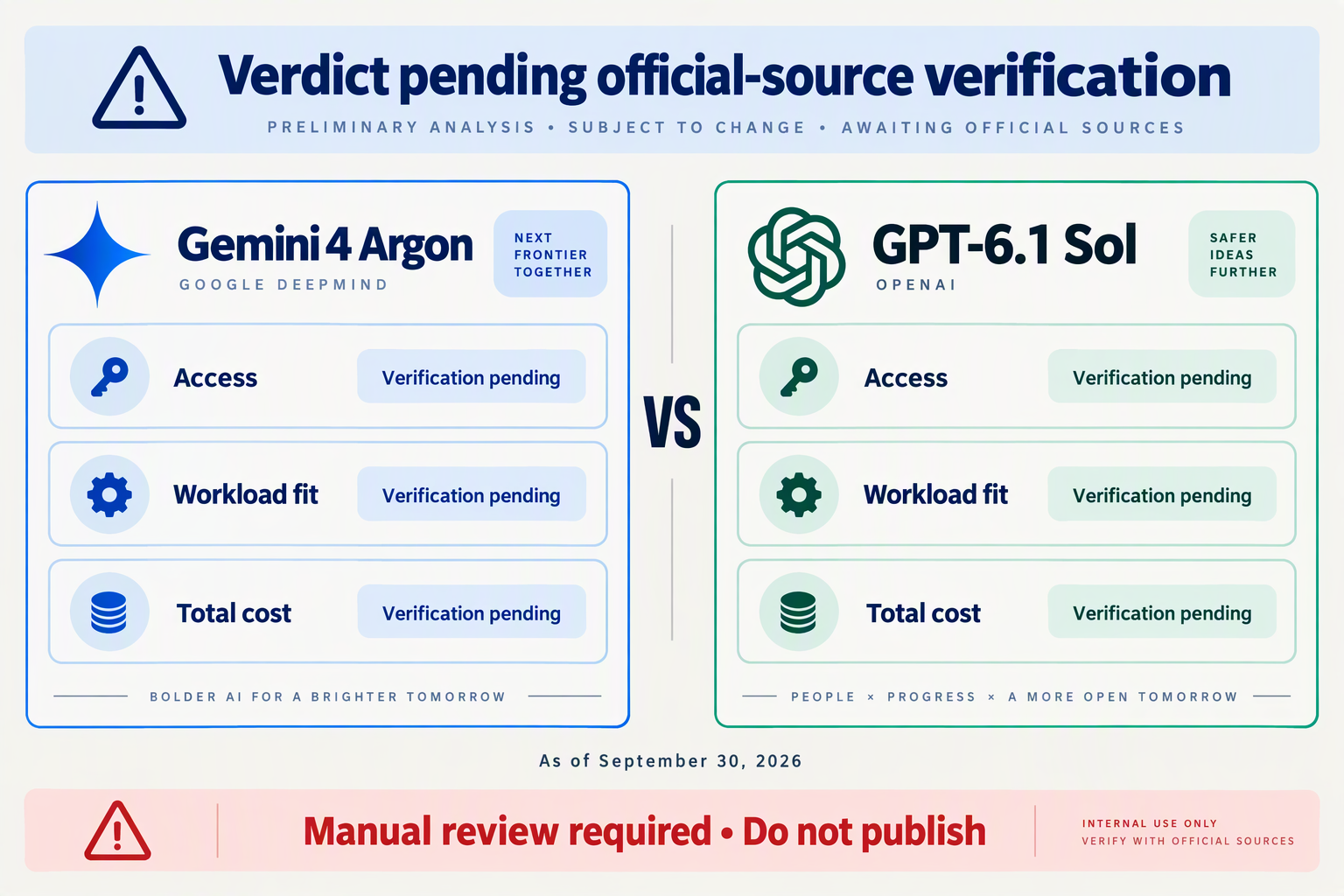
As of September 30, 2026, this is an API and agent-migration decision—not a verified performance win for either model. GPT-6.1 Sol has an official launch and documented API requirements; Gemini 4 Argon has an announced restricted rollout, but its public API identifier and universal access are not established.
- Gemini 4 Argon: Google’s September 30 announcement introduces Argon through the Fairwind Program. Treat that as restricted availability, not a generally accessible developer API. Before planning an integration, confirm eligibility, deployment channels, the exact model identifier, and permitted tool workflows. Source: Google’s Gemini 4 Argon launch announcement, September 30, 2026.
- GPT-6.1 Sol: OpenAI’s September 29 changelog and current model documentation establish
gpt-6.1-solas an official model for coding and professional work. Tool calling requires the Responses API, and multi-agent functionality is in beta. For an existing agent application, evaluate the Responses integration explicitly rather than assuming a model-name swap preserves your current tool loop. Sources: OpenAI changelog, September 29, 2026; current GPT-6.1 Sol model page.
- Performance verdict: Official availability and product positioning do not establish superior coding accuracy or agent reliability. Without matched evaluations, there is no defensible overall winner. For this section, prioritize API fit, access, tool execution, and migration effort; repository-level patch quality belongs in a separate coding comparison.
What should you compare before migrating an agent?
- Interface and orchestration: Test tool schemas, argument validation, conversation state, tool-result handling, retries, and permission boundaries. For Sol, validate your application against its Responses API requirements and assess the multi-agent beta separately from your production baseline. For Argon, obtain confirmed interface documentation through the restricted rollout before assuming compatibility.
- Pricing at your workload size: Argon’s announced introductory rates are $2 per million input tokens and $10 per million output tokens. Its announced 95% cache discount implies $0.10 per million cached input tokens. Later rates are $4/$20, but an introductory-price expiry date is not verified. These announced prices do not establish public API access. Source: Google’s September 30 launch announcement.
- Sol’s pricing multipliers: For requests with up to 272K input tokens, Standard pricing is $2 per million input tokens, $10 per million output tokens, $0.10 per million cache-read tokens, and $2.50 per million cache-write tokens. Above 272K input tokens, input and cache rates are 2×, and output rates are 1.5×, applied to the full request, not just the excess tokens. Fast is 2× Standard; Batch and Flex are 50% of Standard, according to the model documentation. Source: OpenAI’s current GPT-6.1 Sol model page.
- Operational acceptance: Run representative workflows with recoverable tool failures, documented handoffs, and human approval for consequential actions. Measure completion quality, retries, review effort, and total workflow cost—not token prices alone.
Recommendation: Evaluate Sol’s documented interface if you need to assess an integration now. Evaluate Argon once your Fairwind access and API details are confirmed. Choose on demonstrated workflow fit, not an unsupported winner label.
Can you access either model? Audit Google’s official announcement and exact GPT-6.1 Sol docs/changelog
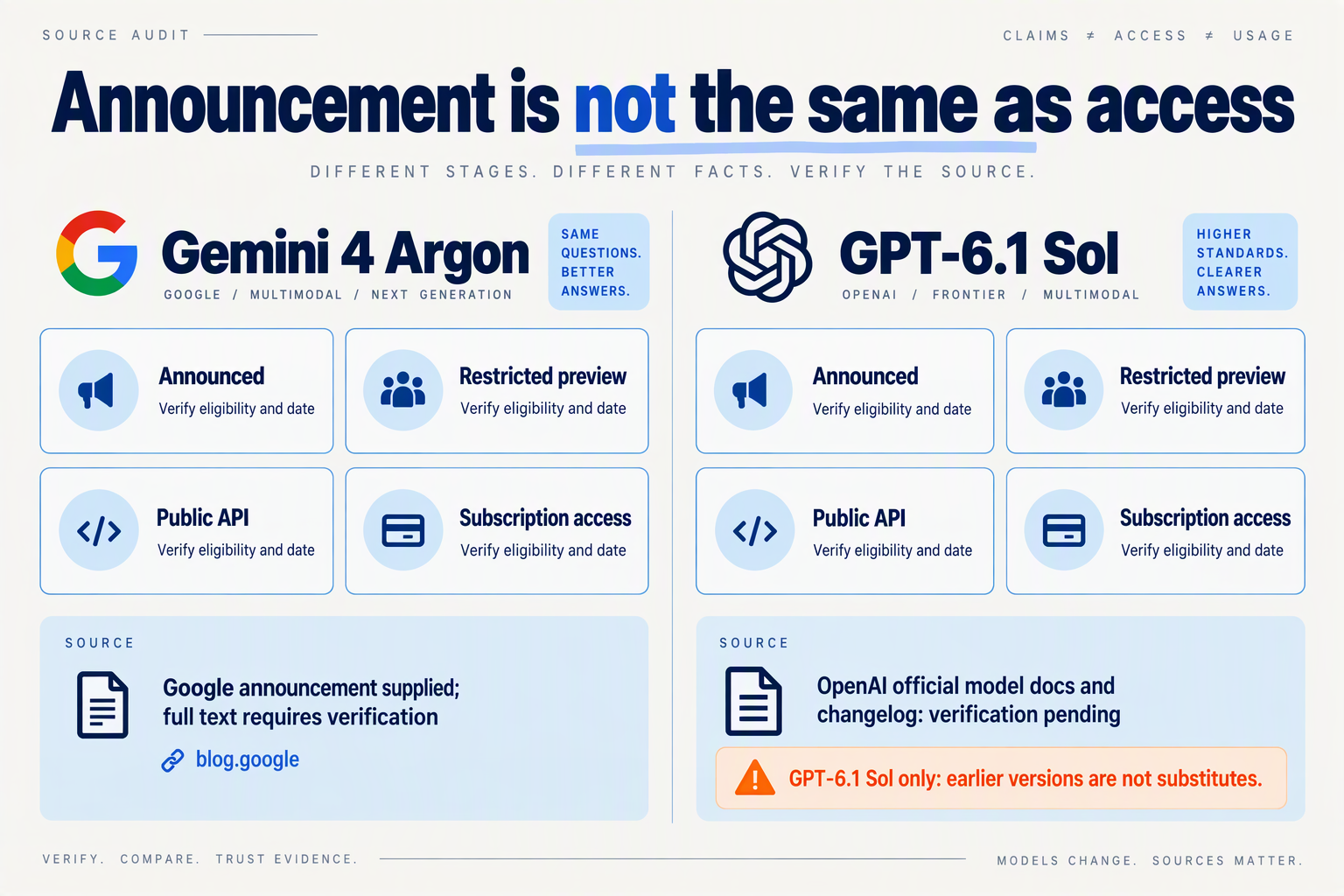
The supplied evidence does not establish general developer access to either Gemini 4 Argon or GPT-6.1 Sol as of September 30, 2026. Google’s announcement supports a restricted rollout; the research packet contains no official OpenAI documentation establishing GPT-6.1 Sol’s availability.
Can developers access Gemini 4 Argon?
- Google’s official announcement: Google’s September 30, 2026 article, “Gemini 4 Argon: our next era of frontier intelligence,” is the primary-source anchor for this comparison. Its supplied excerpt establishes an announcement and Fairwind Program rollout, but does not establish a public API endpoint, self-service signup route, or generally available developer release.
- Access eligibility: Google’s September 30, 2026 wording identifies “a set of trusted cyber defenders,” not all developers or enterprise subscribers. For a software engineering team, the practical next step is to verify eligibility through Google rather than assume an existing Gemini subscription or cloud account includes Argon access.
- Pricing and limits: As of September 30, 2026, the supplied Google excerpt provides no verified token prices, context-window size, output-token ceiling, or request-rate limits for Gemini 4 Argon. Those omissions prevent a defensible cost estimate for repository analysis, repeated test runs, or long-running professional agent tasks.
- Secondary-source boundary: VentureBeat’s September 30, 2026 report describes a limited release, consistent with Google’s supplied rollout language. However, the numerical claims and eligibility details appearing in other search snippets are not substitutes for official specifications; do not convert reported or leaked limits into confirmed deployment requirements.
Do official OpenAI docs establish GPT-6.1 Sol access?
- OpenAI documentation: As of September 30, 2026, this research packet contains no official OpenAI model page, API reference, release note, or changelog entry for GPT-6.1 Sol. That establishes an evidence gap—not proof that the model does not exist, and not permission to borrow specifications from another OpenAI model.
- Exact model identity: Before testing GPT-6.1 Sol, require an official OpenAI document connecting the product name to an exact API model identifier and any dated snapshot. Record whether access is API-based, application-only, preview, or generally available; a display name alone cannot establish reproducible access or stable behavior.
- Changelog audit: Request a dated OpenAI changelog entry covering GPT-6.1 Sol’s release status, supported endpoints, tool interfaces, and availability restrictions. For professional agents, also check documented changes affecting structured outputs and tool calling; without that record, attributing integration behavior to this specific model would be speculative.
- Procurement decision: As of September 30, 2026, classify Gemini 4 Argon as announced with restricted access evidenced, and GPT-6.1 Sol as unverified in the supplied official-source record. Keep both outside a production shortlist until your team can confirm access, pricing, limits, and a reproducible test configuration for its own workload.
How do features compare: input context, max output, reasoning, tools, Responses API requirements, multi-agent beta and safety?
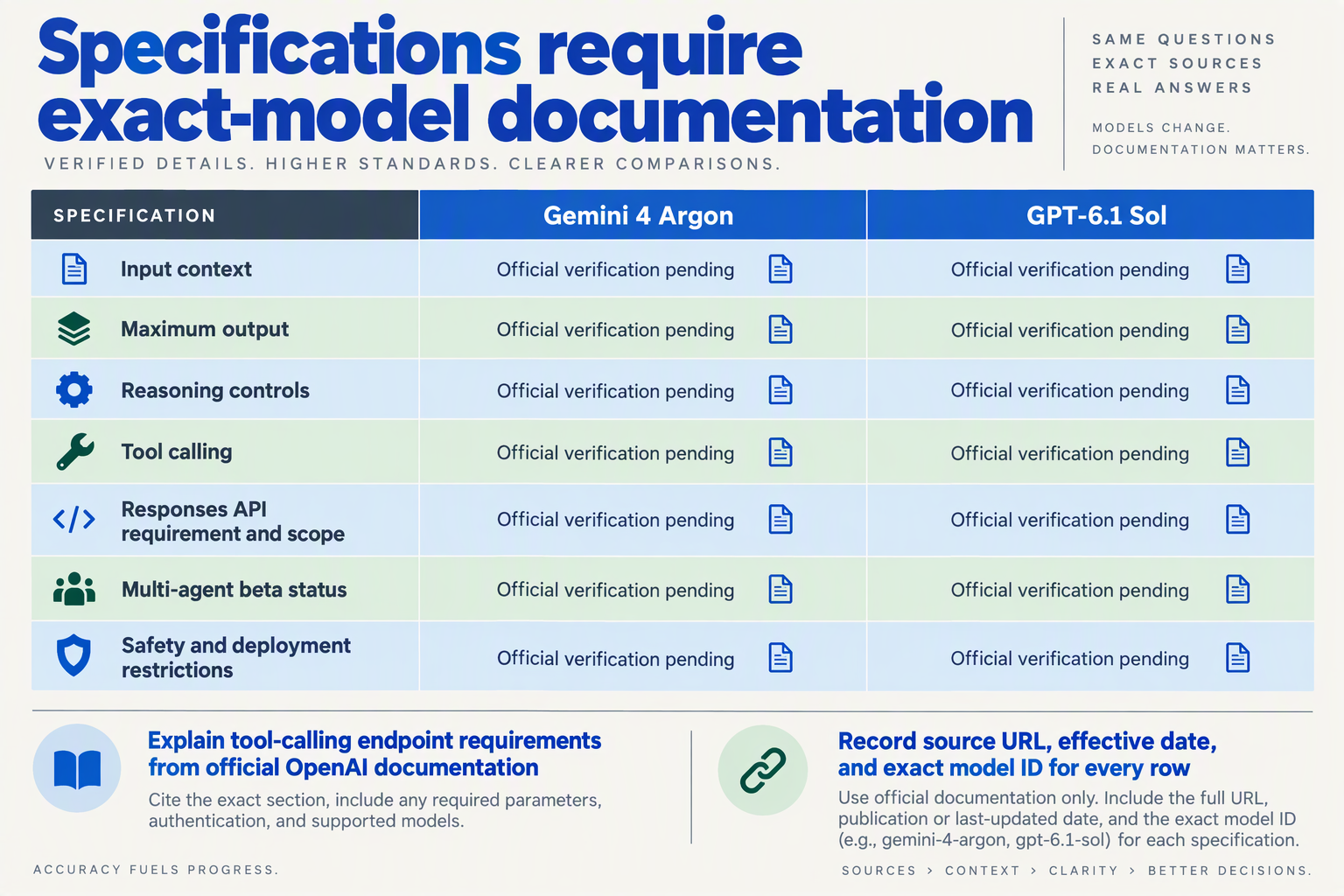
Gemini 4 Argon vs GPT-6.1 Sol cannot yet support a verified specification-by-specification winner. As of September 30, 2026, the supplied Google announcement establishes Argon’s positioning and restricted access, while the supplied research contains no official OpenAI specification for GPT-6.1 Sol.
- Evidence standard: “Not established” below means the supplied sources do not verify the feature—not that the model lacks it.
- Gemini 4 Argon: CometAPI’s mid-September 2026 rumor coverage mentions a 256,000-token output limit, but that is not an officially verified Argon specification in the supplied announcement excerpt.
What model specifications are actually verified?
| Feature | Gemini 4 Argon | GPT-6.1 Sol | What to verify before deployment |
|---|---|---|---|
| Input context | Official token limit and supported input modalities not established here. | No official specification supplied. | Context ceiling, modality support, and whether tool results consume the same budget. |
| Maximum output | Official limit not established; CometAPI reports a 256k rumor. | No verified output limit supplied. | Per-response cap, truncation behavior, and limits during tool execution. |
| Reasoning controls | Reasoning settings and budgets not established. | No verified reasoning controls supplied. | Available settings, billing treatment, and compatibility with streaming. |
| Tools | Defensive cybersecurity positioning is documented; callable tool interfaces are not. | No verified tool specification supplied. | Function schemas, sandbox permissions, timeouts, and execution ownership. |
| Responses API requirements | OpenAI Responses API compatibility is not established. | Any mandatory Responses API requirement is unverified. | Supported endpoints, SDK versions, state handling, and migration requirements. |
| Multi-agent beta | Beta availability, orchestration interfaces, and limits not established. | No official beta documentation supplied. | Eligibility, handoff semantics, shared state, and separate agent permissions. |
| Safety and access | Google’s September 30, 2026 announcement identifies trusted cyber defenders through Fairwind. | No official safety or access documentation supplied. | Use policies, approval requirements, monitoring, and incident escalation. |
Which gaps matter most for engineering and professional agents?
- Context and output: For a repository migration, test whether the model retains dependency relationships across files and produces complete patches; a large advertised window alone does not establish either capability.
- Reasoning and tools: Measure completed tasks, failed tool calls, retries, and human interventions under the same permissions. According to Unite.AI’s September 30, 2026 coverage, Argon targets software engineering, legal, finance, and cybersecurity; those workload categories do not establish specific API capabilities.
- Responses API: Separate model requirements from gateway features. As of September 2026, CallMissed’s developer AI API supports OpenAI-compatible Responses API endpoints, function calling, and structured outputs; that does not establish availability or compatibility for either model compared here.
- Multi-agent safety: Treat “beta” as a deployment condition requiring documentation, not a reliability guarantee. Before enabling autonomous handoffs, require explicit permissions, recorded tool actions, bounded retries, and human approval for consequential changes; Google’s Fairwind access statement does not independently verify these controls.
How much do they cost: verified pricing tiers, caching, batch eligibility, reasoning billing and illustrative economics?
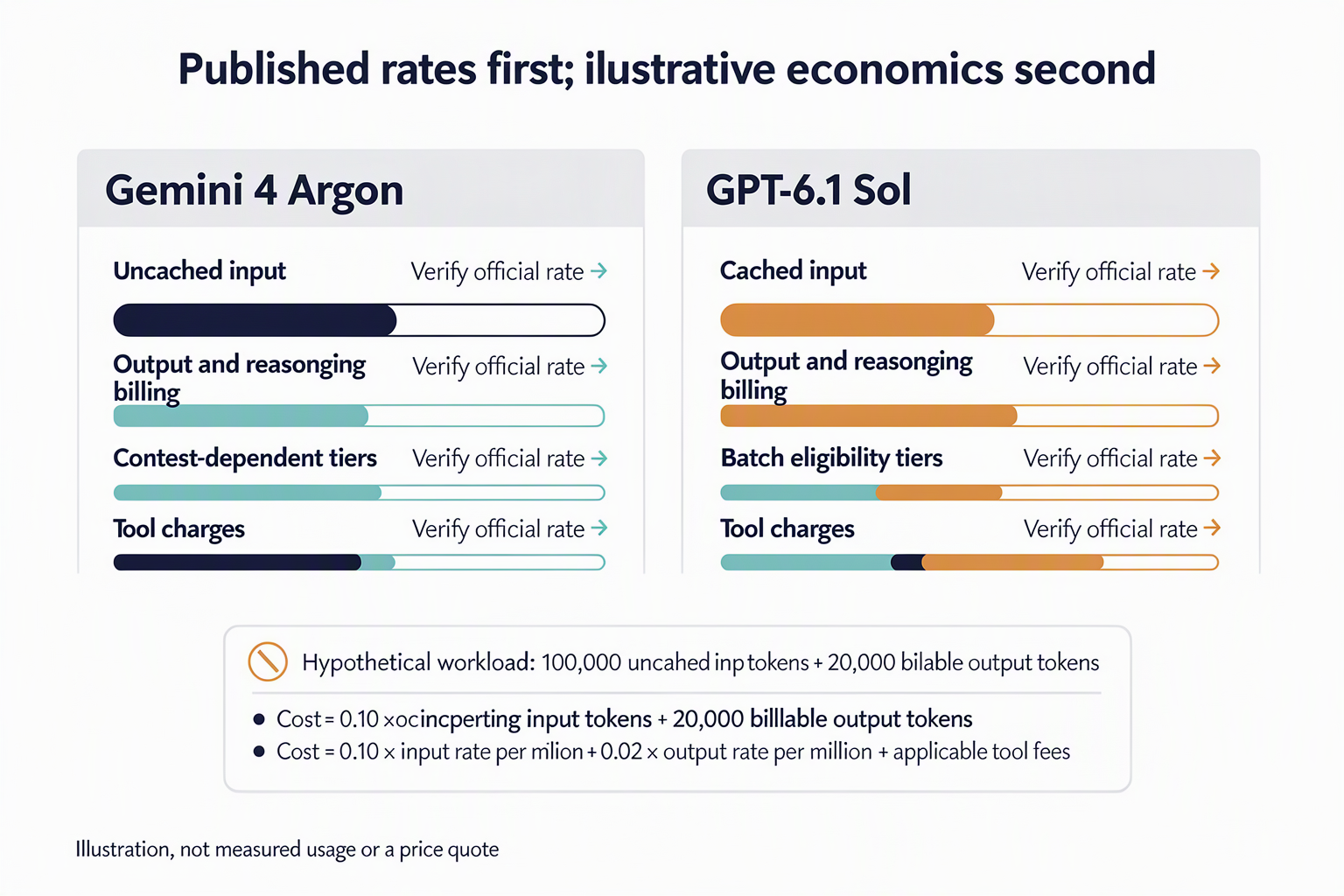
Neither Gemini 4 Argon nor GPT-6.1 Sol has verified pricing in the supplied evidence as of September 30, 2026. A defensible cost comparison must therefore separate unconfirmed commercial terms from explicitly hypothetical workload economics.
- Gemini 4 Argon: Google’s September 30, 2026 announcement establishes a Fairwind Program rollout, but the supplied announcement excerpt does not establish API prices, subscription tiers, discounts, or billing rules.
- GPT-6.1 Sol: No official OpenAI pricing documentation appears in the supplied September 30, 2026 evidence; borrowing prices or billing policies from another OpenAI model would create a misleading comparison.
Which pricing terms are actually verified?
The table records evidence availability as of September 30, 2026, not a claim that either provider has no commercial terms. “Unverified” means the supplied material cannot substantiate the item.
| Pricing item | Gemini 4 Argon | GPT-6.1 Sol | Budgeting implication |
|---|---|---|---|
| Access and pricing tiers | Restricted rollout verified; tiers unverified | Unverified | Obtain applicable access terms |
| Input-token price | Unverified | Unverified | Cannot price repository ingestion |
| Output-token price | Unverified | Unverified | Cannot price generated patches |
| Prompt caching | Rates and eligibility unverified | Rates and eligibility unverified | Do not assume cache savings |
| Batch processing | Eligibility and discount unverified | Eligibility and discount unverified | Do not assume asynchronous discounts |
| Reasoning billing | Treatment unverified | Treatment unverified | Confirm billable token categories |
- Source boundary: VentureBeat’s September 30, 2026 report emphasizes Argon’s limited release; that supports an access caveat, not a token-price estimate. A headline mentioning “pricing” is not sufficient evidence without the underlying rates and conditions.
- Procurement checklist: Request the exact model identifier, currency, effective date, context-dependent tiers, cache-read and cache-write charges, batch eligibility, reasoning-token treatment, and tool charges. Keep consumer subscription fees separate from API usage costs.
How should teams calculate illustrative agent economics?
The following figures are hypothetical assumptions for this September 30, 2026 comparison, not Google or OpenAI prices. They demonstrate why repository reuse and reasoning accounting can materially change a software-agent budget.
- Uncached example: Assume $2 per million input tokens and $10 per million output tokens. A task using 200,000 input tokens and 20,000 output tokens costs $0.60: $0.40 for input plus $0.20 for output.
- Cached example: If 150,000 input tokens instead qualify for a hypothetical $0.50-per-million cache-read rate, the same task costs $0.375, or 37.5% less, excluding any cache-write or storage charges.
- Reasoning example: If 30,000 additional reasoning tokens are billable at the assumed $10-per-million output rate, they add $0.30, raising the uncached task to $0.90. Neither model’s actual treatment is verified here.
- Decision metric: Compare cost per accepted task, not token price alone. Across 100 hypothetical attempts costing $0.60 each, 80 accepted outcomes imply $0.75 per accepted task, before sandbox compute, tool fees, and human review.
What do benchmarks prove? Separate vendor claims from evidence and apply a matched workload checklist
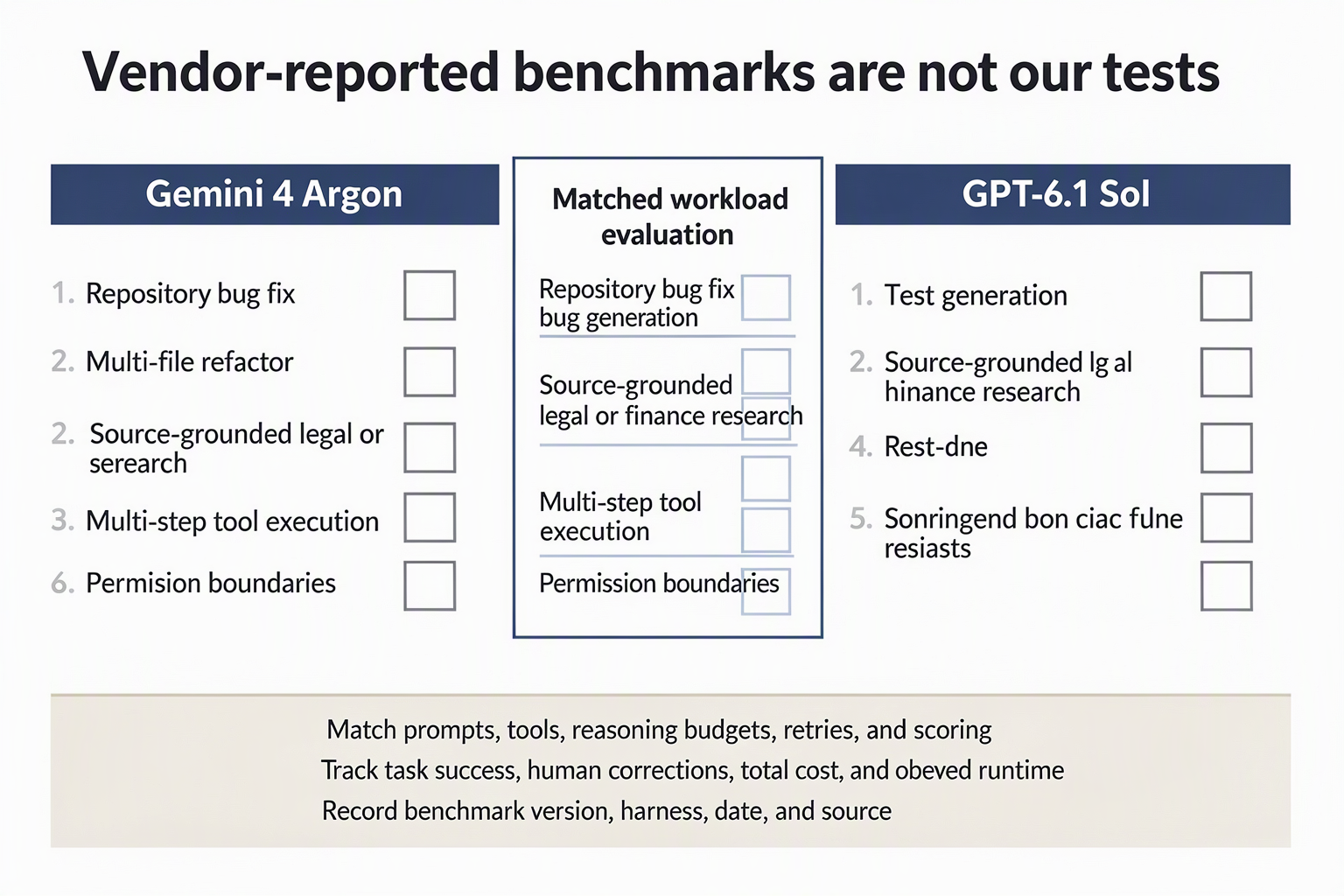
Benchmarks establish performance on a particular test under particular conditions—not universal engineering superiority. For Gemini 4 Argon vs GPT-6.1 Sol, the supplied evidence does not support a reproducible, head-to-head winner as of September 30, 2026.
Which benchmark claims are supported by the available sources?
- Gemini 4 Argon: VentureBeat’s September 30, 2026 report says Google claims leadership on “several enterprise-relevant benchmarks,” but the supplied excerpt contains no scores, benchmark versions, sample sizes, or evaluation settings. Treat this as an attributed vendor claim, not an independently reproduced result; secondary coverage alone does not establish reproducibility.
- GPT-6.1 Sol: The supplied September 30, 2026 context includes no official OpenAI model documentation or benchmark results for GPT-6.1 Sol. Record its comparison cells as “not established from supplied evidence,” rather than zero or a loss. Missing documentation cannot establish either weaker performance or equivalence to Gemini 4 Argon.
What belongs in a matched workload checklist?
- 1. Match tasks and acceptance criteria: Use the same repository commit, issue description, dependencies, and hidden acceptance tests for both models. Include bug fixes, feature implementation, and regression prevention. For professional agents, use identical source documents and required deliverables; define success before running either system, rather than rewarding whichever output looks more polished.
- 2. Match tools and permissions: Give both models the same shell, browser, retrieval sources, credentials, and network restrictions. Record every tool call and denied action. A model with privileged database access is not directly comparable with one restricted to uploaded documents, even when both receive the same natural-language request.
- 3. Match inference budgets: Fix maximum elapsed time, token allowance, tool-call allowance, and retry policy; disclose reasoning settings where available. Report single-attempt success separately from success after retries. A result achieved through repeated attempts answers a different operational question from a reliable first-pass completion, especially when human review is expensive.
- 4. Match the agent harness: Separate the model from its surrounding orchestration: prompts, planning loops, memory, retrieval, and repair logic. Evaluate both within one shared harness where feasible, then label any native-product comparison separately. Otherwise, an apparent model advantage may reflect better scaffolding, additional context, or a more effective test-running loop.
- 5. Measure completed work and failure severity: Report accepted tasks divided by attempted tasks, with the raw counts alongside percentages. Track regressions, unsupported citations, unauthorized actions, and required human interventions separately. For example, a passing software patch and a finance report containing an invented source should not receive equivalent “completed” labels merely because both produced deliverables.
- 6. Publish uncertainty and operational cost: Repeat tasks, document exclusions, and disclose variability rather than presenting one favorable run. Compare cost per accepted task, elapsed time, and reviewer effort—not token prices alone. Until matched results and verified pricing exist, the defensible September 30, 2026 conclusion is an evidence gap, not a declared winner.
What are the pros and cons: documented strengths, access limits, integration effort and evidence gaps?
Gemini 4 Argon has a documented announcement and a restricted rollout; GPT-6.1 Sol lacks official specifications in the supplied evidence. As of September 30, 2026, the defensible comparison is therefore documented promise versus procurement and evaluation uncertainty—not a verified performance ranking.
| Decision factor | Gemini 4 Argon: documented strength | Limitation or evidence gap | GPT-6.1 Sol: evidence status |
|---|---|---|---|
| Official documentation | Google’s September 30 announcement establishes the model and rollout. | The supplied announcement excerpt does not establish a complete API specification. | No official OpenAI announcement or model documentation supplied. |
| Software engineering | Unite.AI’s September 30 coverage identifies real-world software engineering as an intended workload. | No repository-level success rates, test conditions, or reproducible results supplied. | Coding capabilities and evaluation results remain unverified here. |
| Professional agents | Unite.AI identifies enterprise knowledge work, including legal and finance, on September 30. | Intended applications do not establish reliable tool execution or task completion. | Tool-use capabilities, permissions, and agent interfaces are undocumented here. |
| Benchmark claims | VentureBeat’s September 30 report attributes several enterprise-relevant benchmark leads to Google. | No numerical scores or matched evaluation settings supplied. | No equivalent official results supplied for a defensible head-to-head comparison. |
| Access and procurement | Google names its Fairwind Program rollout on September 30. | Access is restricted to selected trusted cyber defenders; general availability is not established. | Availability, eligibility, quotas, and procurement routes are unverified here. |
| Integration and cost | Google’s announcement provides an identifiable program to investigate. | API identifiers, SDK compatibility, pricing, context limits, and rate limits are not established here. | The same deployment-critical details require official OpenAI documentation. |
What should teams verify before choosing either model?
- Gemini 4 Argon: Google’s September 30, 2026 wording—“rolling out to a set of trusted cyber defenders through our Fairwind Program”—makes eligibility the first procurement checkpoint, before architecture planning.
- GPT-6.1 Sol: Require an official OpenAI model identifier and access documentation before treating the name as a deployable option; missing evidence is not proof of either poor performance or nonexistence.
- Engineering evaluation: Run both candidates, if accessible, against the same repository tasks, test suite, tool permissions, and retry budget; report accepted patches separately from patches that merely compile.
- Professional-agent evaluation: Measure completed workflows, unauthorized actions, escalation frequency, and reviewer corrections; a legal-research answer with citations is different from a correctly executed, permission-controlled workflow.
- Cost comparison: Calculate cost per accepted task, including retries, tool execution, and human review; without verified September 2026 prices, a token-price comparison would create false precision.
- Integration effort: As of September 2026, CallMissed’s developer AI API supports OpenAI-compatible and Anthropic-compatible endpoints; compatibility can simplify existing SDK integrations, but does not establish availability of either model discussed here.
Bottom line: Give Argon credit for documented positioning, but keep benchmark leadership provisional until scores and methods are available. Keep GPT-6.1 Sol unranked until official evidence supports a meaningful comparison.
Which should you choose for coding, legal or finance agents, and defensive security? Use workload-specific gates
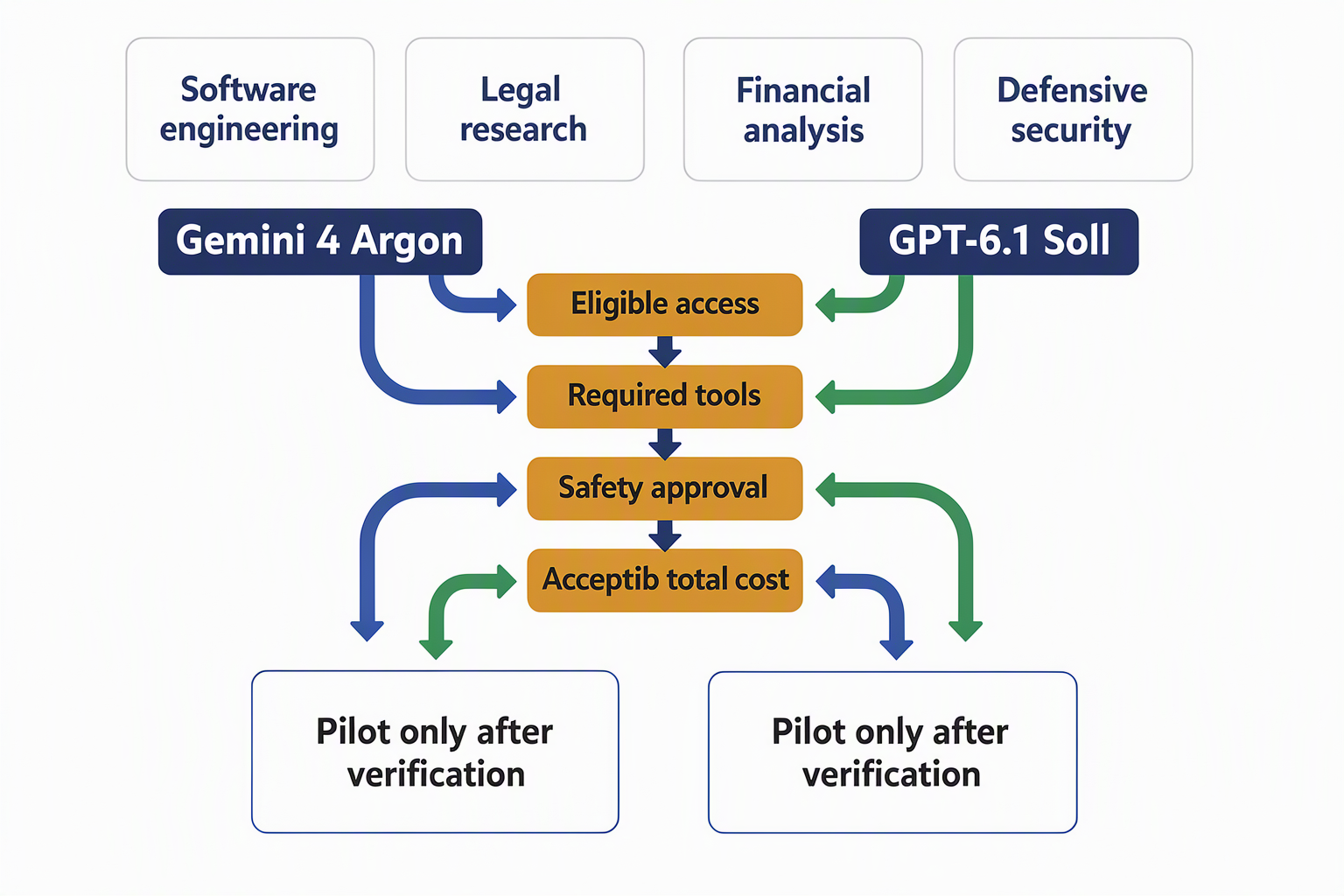
Choose the model that passes your workload’s access, correctness, permission, and cost gates, not the model with the strongest headline. For Gemini 4 Argon vs GPT-6.1 Sol, the following are proposed acceptance criteria—not reported benchmark results—as of September 30, 2026.
Which model should you choose for coding agents?
- Access gate: Evaluate Gemini 4 Argon only if your team has authorized access; Google’s September 30, 2026 announcement specifies rollout to “a set of trusted cyber defenders through our Fairwind Program.” For GPT-6.1 Sol, require official OpenAI documentation establishing the model identifier, availability, and supported tools before committing engineering resources.
- Repository gate: Test each accessible candidate on the same 30 repository tasks spanning bug fixes, feature changes, and refactoring. Require executable patches, passing existing tests, and no newly introduced critical vulnerabilities; record language, repository size, tool permissions, and retries so a Python maintenance result is not mistaken for evidence about TypeScript production work.
- Economics gate: Compare cost per accepted patch, including unsuccessful attempts, tool execution, and reviewer time—not token price alone. Set a completion-time ceiling before testing and report median and slowest-decile results separately; the supplied September 30, 2026 evidence does not establish comparable pricing or measured latency for these two models.
Which model should you choose for legal or finance agents?
- Legal gate: Use 20 jurisdiction-specific cases with authoritative source documents and require traceable citations for every material legal claim. Reject fabricated authorities and unsupported quotations; route consequential advice to a qualified reviewer. Unite.AI’s September 30, 2026 coverage identifies legal work as an Argon target, but positioning does not establish jurisdiction-specific reliability.
- Finance gate: Run 20 reconciliation, calculation, and disclosure tasks against independently checked answers. Require explicit currency, reporting period, rounding policy, and source provenance; keep payment execution and trading permissions disabled during evaluation. Select whichever verified candidate preserves accounting constraints and flags missing evidence rather than filling gaps with plausible numbers.
Which model should you choose for defensive security?
- Security gate: Evaluate only authorized defensive scenarios in an isolated environment, with zero production credentials and written asset scope. Require reproducible findings, evidence-backed severity ratings, and remediation checks; restricted access through Google’s Fairwind Program is an eligibility condition, not proof that Argon passes your organization’s security acceptance tests.
- Agent-control gate: Give both candidates identical tools and test 10 interruption or failure scenarios, including expired credentials, malformed tool responses, and injected instructions in retrieved documents. Require approval before consequential actions, bounded retries, and recoverable state; a completed task should fail acceptance if the agent exceeded its permissions.
- Deployment gate: Keep selection reversible. As of September 2026, CallMissed’s developer AI API supports caller-chosen fallback models and usage and request logs, useful infrastructure for comparing supported models; neither Argon nor Sol availability is established here. Promote a candidate only after verified access and workload-specific evidence support deployment.
Frequently Asked Questions
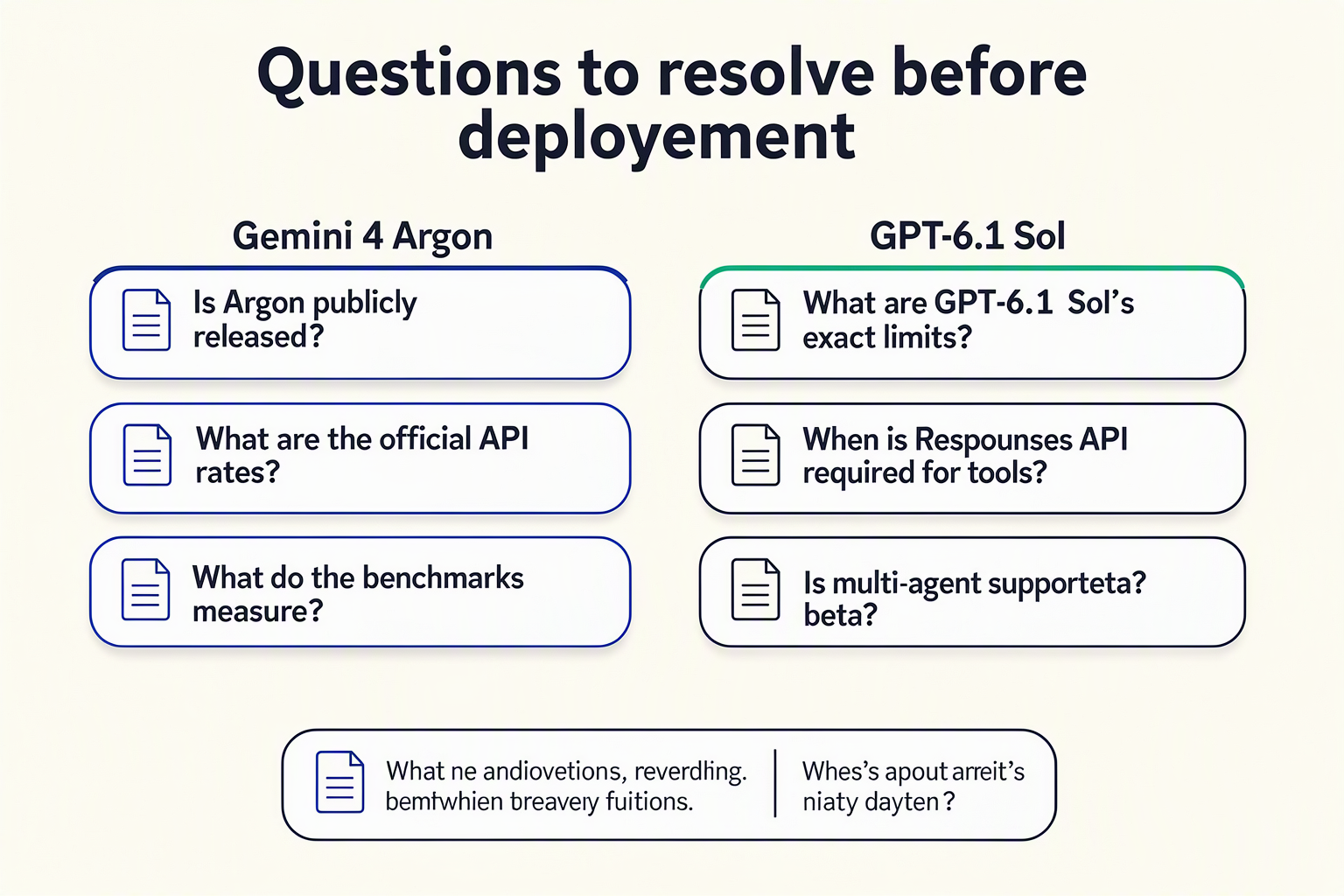
- Q: Is Gemini 4 Argon publicly released for developers as of September 30, 2026?
A: Google has announced Gemini 4 Argon, but the supplied evidence establishes restricted access—not general public availability. Google’s September 30, 2026 announcement says Argon is “rolling out to a set of trusted cyber defenders through our Fairwind Program,” while VentureBeat’s same-day coverage also emphasizes the limited release. For deployment planning, distinguish an announcement from access to a documented endpoint, published usage limits, and production terms.
- Q: What does Gemini 4 Argon vs GPT-6.1 Sol cost in September 2026?
A: Neither model’s pricing is verified in the supplied sources as of September 30, 2026, so a defensible dollar-per-million-token comparison is unavailable. The provided Google announcement excerpt establishes Argon’s rollout, but does not provide prices; the context supplies no official OpenAI GPT-6.1 Sol pricing documentation. Before budgeting, obtain model-specific input, cached-input, and output rates, plus any separately billed tool usage, rather than substituting prices from another model.
- Q: Does GPT-6.1 Sol require the OpenAI Responses API for tools?
A: The supplied evidence does not establish whether GPT-6.1 Sol requires the OpenAI Responses API for tool use as of September 30, 2026. Verify the exact model identifier and supported endpoints in current OpenAI documentation, then distinguish application-defined function calls from provider-hosted tools because endpoint requirements can differ. As of September 2026, CallMissed supports both chat completions and the Responses API, but that platform capability does not establish Sol availability or compatibility.
- Q: Is multi-agent support beta for Gemini 4 Argon or GPT-6.1 Sol?
A: No verified beta designation for either model’s multi-agent support appears in the supplied September 30, 2026 evidence. Google’s restricted Fairwind rollout describes access, not necessarily the release status of an orchestration framework, and the context provides no corresponding OpenAI documentation. Treat model capability, agent-framework maturity, and deployment permissions as separate checks; request explicit documentation for handoffs, shared state, tool permissions, and release status before making a production commitment.
- Q: Are older GPT-6.1 Sol specifications valid for a September 2026 comparison?
A: Older Sol specifications should not be treated as current without confirmation from dated, official OpenAI documentation. As of September 30, 2026, the supplied context does not verify Sol’s context window, output limits, pricing, benchmark scores, or tool support. Preserve the date and exact model identifier attached to every specification, and mark an older claim as unconfirmed rather than silently carrying it into a current comparison or procurement recommendation.
- Q: Which model wins Gemini 4 Argon vs GPT-6.1 Sol for software engineering?
A: The supplied evidence does not support an overall winner as of September 30, 2026. Unite.AI’s September 30 coverage identifies real-world software engineering, enterprise knowledge work, and cybersecurity defense as Argon’s intended workloads, while VentureBeat reports Google’s claimed benchmark lead without equivalent Sol evidence here. Evaluate accessible models on the same repositories, tests, tool permissions, and spending limits, measuring completed tasks and regressions rather than treating positioning as demonstrated performance.
Conclusion
Gemini 4 Argon vs GPT-6.1 Sol has no defensible overall winner on the evidence available as of September 30, 2026. The practical decision is not which model has the strongest positioning, but which can be accessed, evaluated fairly, and trusted to complete real software engineering and professional agent tasks.
Four takeaways should guide that decision:
- Access comes before adoption. Google’s September 30, 2026 announcement says Gemini 4 Argon is “rolling out to a set of trusted cyber defenders through our Fairwind Program.” That establishes a restricted rollout, not general developer availability. Teams should distinguish an announced capability from something they can integrate into a production workflow, and treat access requirements as part of the comparison rather than an administrative detail.
- Benchmark claims need reproducible evidence. VentureBeat’s September 30, 2026 report describes Google’s claimed lead on several enterprise-relevant benchmarks, while emphasizing the limited release. Without scores, evaluation conditions, and equivalent official documentation for GPT-6.1 Sol in the supplied evidence, a ranking would be premature. The useful next step is to compare documented results under matched conditions, not turn incomplete reporting into a purchasing recommendation.
- Coding usefulness means repository-level performance. A model must do more than produce a convincing code snippet: it should understand an unfamiliar codebase, implement the requested change, run appropriate checks, and recover from failures without creating new ones. For engineering teams, those outcomes connect model capability to actual delivery. A benchmark advantage matters most when it translates into changes that survive tests and human review.
- Professional agents need operational reliability. Unite.AI’s September 30, 2026 coverage identifies software engineering, enterprise knowledge work—including legal and finance—and cybersecurity defense as Argon’s intended workloads. In those settings, reliable tool selection, permission boundaries, human oversight, and auditable multi-step execution belong beside intelligence measures. A successful demonstration does not, by itself, establish a dependable workflow.
What should teams watch for next?
Watch for broader Gemini 4 Argon access, official GPT-6.1 Sol specifications, transparent benchmark methodologies, and comparable information on pricing and integration requirements. Those developments would make this comparison more actionable; until then, the strongest approach is to separate confirmed product facts from claims that still need validation.
To explore the infrastructure side of this trend, consider CallMissed, whose OpenAI-compatible developer AI API offers caller-chosen fallback models and usage and request logs as of September 2026. Those capabilities are relevant to evaluating multi-model workflows, without implying that either model compared here is available through CallMissed.
Before choosing a winner, ask: can your team reproduce the result on its own codebase—and audit every consequential agent action?
Related Reading
- Gemini 4 Argon vs GPT-6.1 Sol: Coding & Agents (2026)
- Gemini 4 Argon Pricing vs Claude Sonnet 5.5: Coding
- Claude Sonnet 5.5 vs GPT-6 Sol Coding Comparison 2026
Sources
Discussion
Related Posts

Ready to automate customer conversations?
Launch AI voice agents and WhatsApp bots with CallMissed — one API, 22+ Indian languages.