
Gemini 4 Argon vs Claude Sonnet 5.5: API Cost Comparison


Compare Gemini 4 Argon pricing with Claude Sonnet 5.5, separating access restrictions, coding evidence and token rates from actual task costs.
Gemini 4 Argon vs Claude Sonnet 5.5: API Cost Comparison
Gemini 4 Argon pricing vs Claude Sonnet 5.5 starts with equal $2/$10 per-million input/output rates during Argon’s announced introductory period, but different cache rates and access conditions. Google lists later Argon rates of $4/$20. As of September 30, 2026, Argon’s initial rollout is restricted; Sonnet 5.5 is officially released. Equal token prices do not establish equal completed-task costs.
According to the supplied excerpt from Anthropic’s September 28, 2026 announcement, Claude Sonnet 5.5 costs $2 per million input tokens, $10 per million output tokens and $0.20 per million cache-read tokens. The supplied Google Blog excerpt describes Gemini 4 Argon as targeting real-world coding, enterprise knowledge work and cyber defense, but says access is rolling out to trusted cyber defenders through the Fairwind Program, ahead of wider release.
That distinction matters immediately: enterprise teams need models they can actually deploy, not simply models they can read about. A useful comparison must separate announced capabilities from accessible APIs, published prices from effective task costs, and vendor claims from reproducible results.
What must be verified before comparing Gemini 4 Argon and Claude Sonnet 5.5?
The first checkpoint is primary-source verification. The supplied search excerpts provide a starting point, but they do not independently establish Google’s launch date, general developer access, Gemini 4 Argon’s API pricing or the full conditions attached to Anthropic’s quoted rates.
Before publication, this comparison needs confirmation of:
- Access restrictions: Who can use Gemini 4 Argon, through which products, and whether enterprise automation is permitted within the available rollout.
- Pricing conditions: Whether quoted rates depend on context length, processing mode, caching rules or other billing conditions.
- Deployment constraints: Applicable rate limits, regional availability and documented operational requirements.
Until those checks are complete, missing information remains unverified, rather than being filled with estimates or assumptions.
How should businesses compare coding quality, throughput and total cost?
The practical question is not which model produces the most impressive demonstration. It is which model completes a representative workload correctly, within the required time and budget.
Consider an automation that reads a repository, proposes a patch, runs tests and repairs a failure. Its cost includes repeated input, generated output, cache usage and unsuccessful attempts—not just the advertised price of one request. Anthropic’s supplied announcement claims Sonnet 5.5 typically needs fewer tokens for the same work; that claim still needs workload-specific testing.
This draft will therefore examine successful fixes, end-to-end completion time, retry frequency and cost per accepted result, without declaring a winner before comparable evidence exists. As of September 2026, CallMissed’s OpenAI-compatible developer API supports caller-chosen fallback models and usage logs, illustrating the broader move toward measurable, multi-model workflows—not confirming either named model’s availability through CallMissed.
Gemini 4 Argon vs Sonnet 5.5: pricing verdict
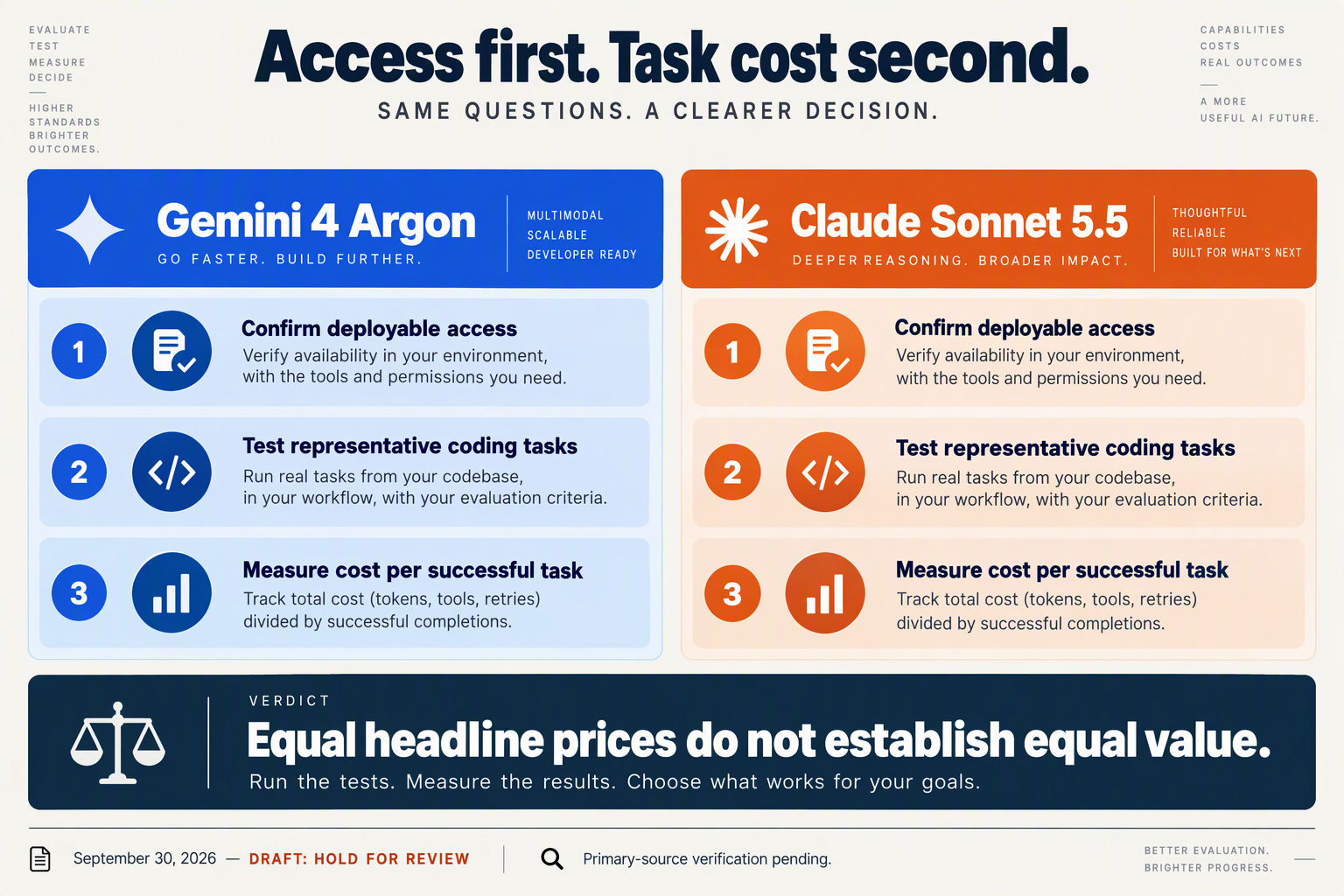
Gemini 4 Argon and Claude Sonnet 5.5 have the same introductory uncached token rates—but not necessarily the same cost per successful task. As of September 30, 2026, Argon’s limited Fairwind rollout makes access the first decision point. Its introductory cache-read pricing is lower, while Sonnet’s reported token-efficiency gains need validation on your workload.
What are the announced prices?
- Gemini 4 Argon: Google’s September 30 announcement describes a limited rollout through the Fairwind Program, not public general availability. Announced introductory pricing is $2 per million input tokens and $10 per million output tokens. A 95% discount on eligible cached input brings that rate to $0.10 per million tokens. Post-introductory rates are $4 input and $20 output per million tokens; the introductory offer’s expiry is unknown. Confirm eligibility and applicable billing conditions before budgeting. Source: Google’s official announcement feed.
- Claude Sonnet 5.5: Anthropic’s September 28 announcement identifies the model as
claude-sonnet-5-5, priced at $2 per million input tokens, $10 per million output tokens and $0.20 per million cache-read tokens—unchanged from Sonnet 5. Its reported up-to-30% task-cost savings come from using fewer tokens, not a 30% reduction in token rates. Source: Anthropic’s official announcements.
What would the same token workload cost?
For 10,000 input tokens and 1,000 output tokens, the illustrative arithmetic is:
- Uncached input: Argon at introductory rates and Sonnet 5.5 each cost $0.03: $0.02 input + $0.01 output.
- All input eligible for cache-read billing: Argon at introductory rates costs $0.011; Sonnet 5.5 costs $0.012.
- Argon after introductory pricing, with uncached input: The same workload costs $0.06.
These are illustrative calculations, not measured coding-task results, and exclude cache-write, storage, tool and other applicable charges. Equal uncached unit prices do not guarantee equal task costs: output length, cache eligibility, retries and repair calls can change the total.
Which should you choose?
Verify access, then compare total spend per accepted task. For Argon, confirm Fairwind eligibility, the deployable model identifier and introductory-price conditions. For Sonnet 5.5, confirm account access and quotas through the deployment route you intend to use.
Run the same tasks with identical acceptance checks, then divide all model spend—including failed attempts and repairs—by the number of accepted results. Treat Sonnet’s reported savings as a claim to test, and Argon’s introductory rates as temporary pricing rather than a permanent budget assumption.
If evaluating through CallMissed, its OpenAI-compatible developer API, usage and request logs, and caller-chosen fallback models can support comparisons of supported models. Neither Argon nor Sonnet 5.5 availability is established by CallMissed’s verified fact sheet; confirm catalogue support before planning either deployment.
What do primary sources establish about launch dates, access and pricing conditions?
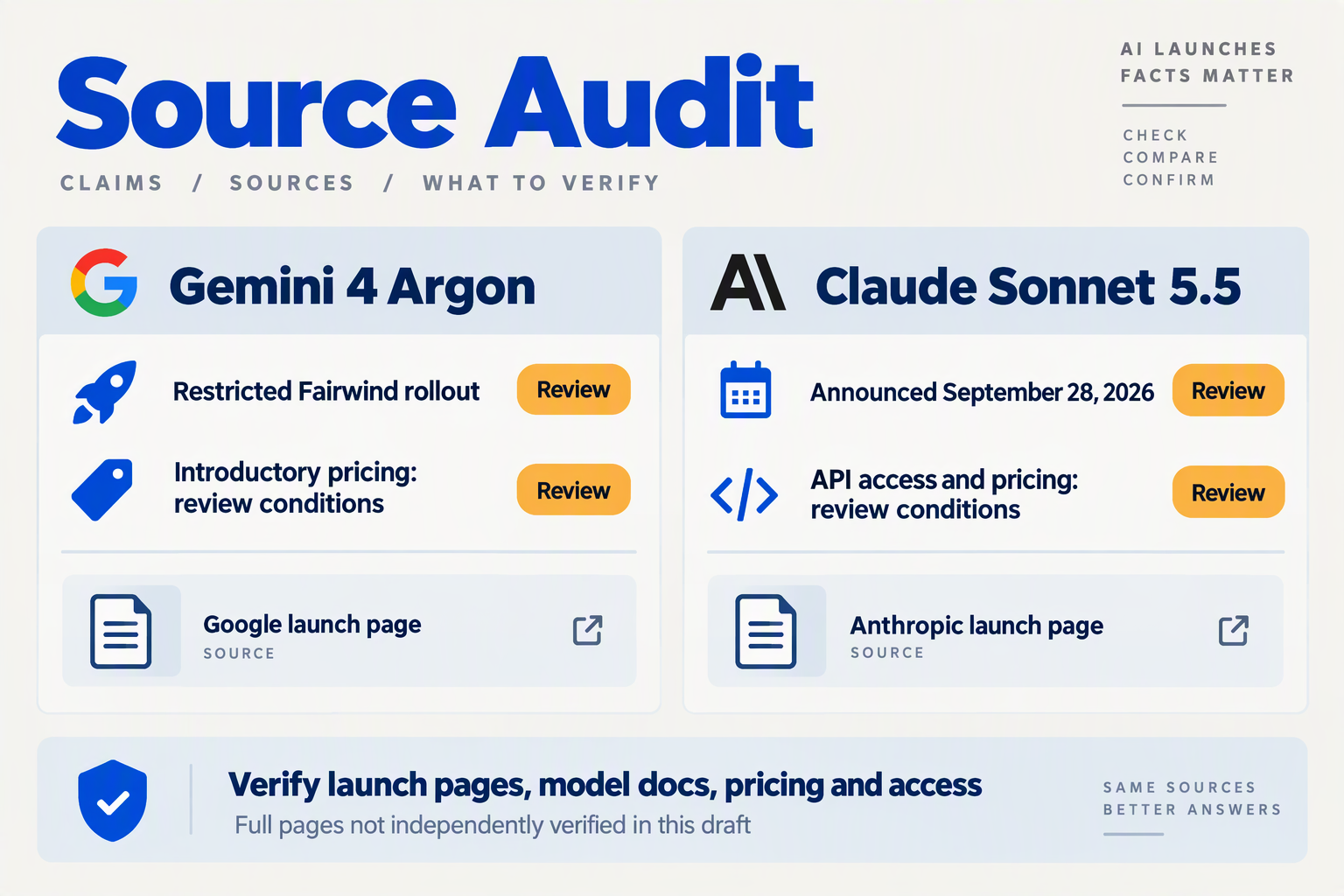
As of September 30, 2026, the supplied primary-source excerpts establish an Anthropic announcement date and quoted Sonnet 5.5 rates, but not Google’s exact Argon launch date or unrestricted API access. This comparison remains a draft held for review, not a deployment-ready pricing guide.
- Google: The supplied Google Blog excerpt says Gemini 4 Argon is “currently rolling out to trusted cyber defenders through the Fairwind Program”; that wording establishes a restricted rollout claim, not general availability.
- Anthropic: The supplied Anthropic announcement is dated September 28, 2026; confirming the announcement date does not establish every deployment channel, region or account’s access.
- Source scope: Google’s Gemini in Chrome announcements and Anthropic’s Claude Sonnet 4.5 availability statements do not establish access to Gemini 4 Argon or Claude Sonnet 5.5.
- Verification status: The evidence supplied here consists of search excerpts, not inspected announcement pages, API documentation or billing terms; publication requires checking those primary documents.
| Checkpoint | Gemini 4 Argon | Claude Sonnet 5.5 | Evidence and review status |
|---|---|---|---|
| Announcement date | Exact date absent from supplied excerpt | September 28, 2026 | Google Blog / Anthropic; Google date unresolved as of September 30, 2026 |
| Access route | Trusted cyber defenders through Fairwind Program | Deployment routes absent from supplied excerpt | Google Blog / Anthropic; verify eligibility, API access and regional restrictions |
| Input pricing | No rate supplied | $2 per million input tokens | Anthropic, September 28, 2026; billing conditions require confirmation |
| Output pricing | No rate supplied | $10 per million output tokens | Anthropic, September 28, 2026; included output categories require confirmation |
| Cache-read pricing | No rate supplied | $0.20 per million cache-read tokens | Anthropic, September 28, 2026; cache-write charges and eligibility remain unresolved |
| Operational conditions | No quotas or throughput figures supplied | No quotas or throughput figures supplied | Neither excerpt establishes production capacity as of September 30, 2026 |
Which primary-source checks are required before enterprise budgeting?
- Google launch: Inspect the Gemini 4 Argon announcement’s publication date and linked access documentation; record whether “rolling out soon” describes the model announcement, restricted access or a future wider release.
- Google eligibility: Confirm Fairwind Program admission requirements, permitted coding and enterprise-automation uses, and whether a documented API endpoint exists; do not treat cyber-defender access as an unrestricted procurement option.
- Anthropic billing: Check official pricing documentation for context-length thresholds, processing modes, cache-write charges and cache retention rules; the quoted $0.20 per million rate covers cache reads, not automatically all caching activity.
- Enterprise approval: Obtain documented rate limits, supported regions and applicable contractual terms before estimating throughput. Missing Argon prices must remain unknown, rather than zero-cost; missing capacity figures must remain unverified, rather than inferred from either company’s model positioning.
How do coding evidence, tool interfaces, context limits, reasoning controls and throughput compare?
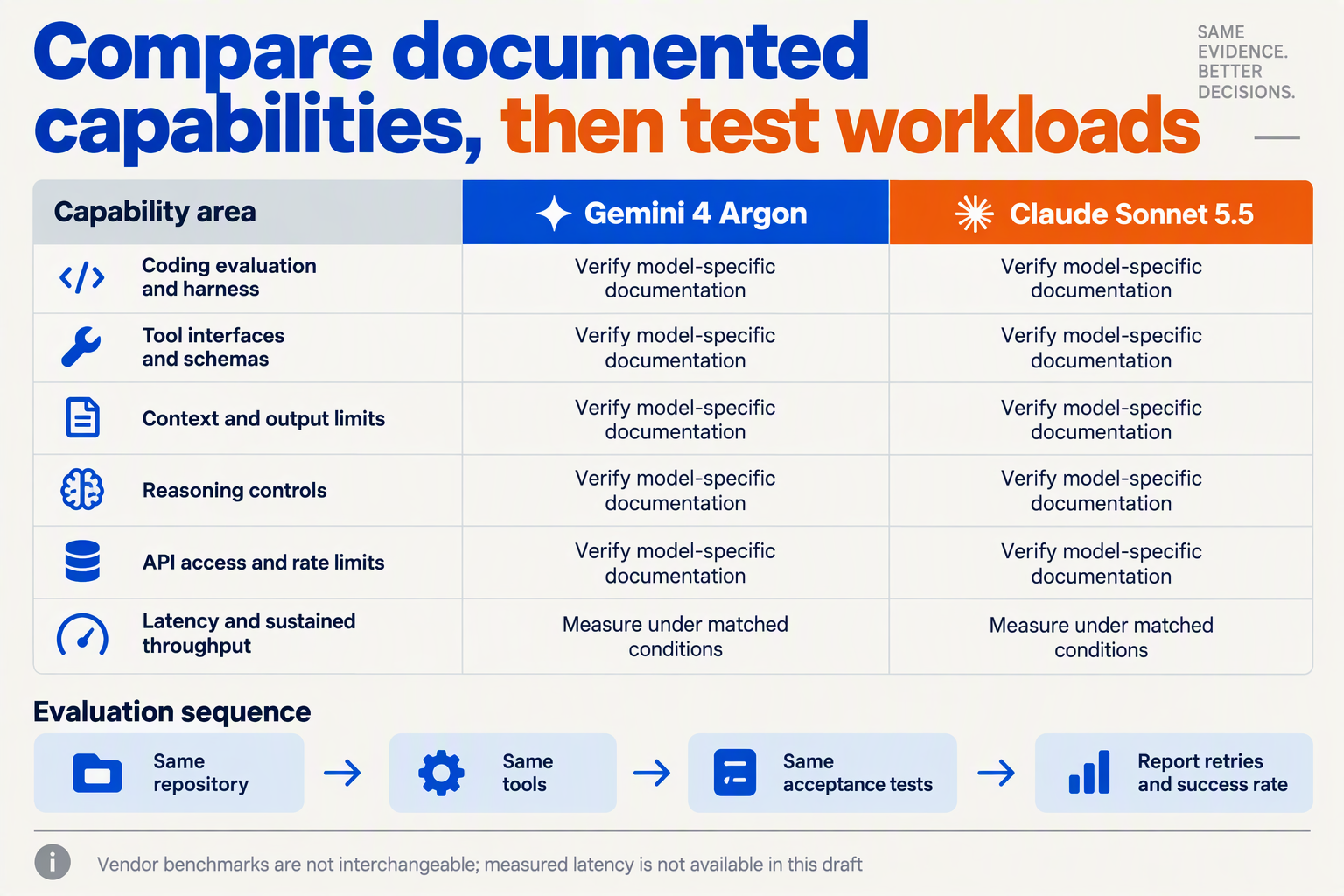
Neither model has enough documented evidence in the supplied excerpts to establish a coding or throughput winner as of September 30, 2026. This draft held for review separates source-supported claims from specifications that still require primary-document verification.
| Comparison area | Gemini 4 Argon | Claude Sonnet 5.5 | Evidence needed |
|---|---|---|---|
| Coding evidence | Google Blog names “real-world coding”; no benchmark supplied | Supplied Anthropic excerpt gives no coding score | Same tasks, test harness and acceptance criteria |
| Tool interfaces | Model-specific schemas unverified | Model-specific schemas unverified | Tool definitions, parallel calls, error handling |
| Context limits | Input and output limits unverified | Input and output limits unverified | Published limits and long-context billing rules |
| Reasoning controls | Available settings unverified | Available settings unverified | Supported controls and reasoning-token charges |
| Throughput | No measured performance supplied | No measured performance supplied | Completion time, concurrency and rate limits |
| Cost efficiency | API rates absent from supplied excerpt | Anthropic claims fewer tokens for equivalent work | Token accounting and cost per accepted result |
What coding and interface evidence should reviewers require?
- Gemini 4 Argon: As of September 30, 2026, the supplied Google Blog excerpt describes coding ambitions, not a reproducible coding result; reviewers should request benchmark methodology, repository versions and execution logs before treating that positioning as performance evidence.
- Claude Sonnet 5.5: Anthropic’s supplied September 28, 2026 announcement says the model “typically needs far fewer tokens to do the same work,” but provides no percentage reduction in the excerpt; measure that claim against accepted patches, not merely shorter responses.
- Coding evaluation: Use a proposed 30-task pilot split across bug fixes, feature additions and test repairs, with identical repository snapshots and tool permissions; record passing tests, regressions, human review decisions and attempts per accepted patch.
- Tool compatibility: Check both models’ actual API documentation for schema support, tool-result formatting, parallel execution and malformed arguments; a common client interface does not establish identical tool behavior or eliminate model-specific integration work.
How should context, reasoning and throughput be tested?
- Context limits: Verify maximum input and output tokens separately, then test repository retrieval at increasing prompt sizes; nominal capacity does not prove reliable use of distant files, and the supplied excerpts establish neither model’s limits as of September 30, 2026.
- Reasoning controls: Compare documented defaults and configurable settings only after verification; hold output budgets constant where possible, and include any billed reasoning tokens when calculating task cost rather than assuming visible answer length captures consumption.
- Throughput: Run a proposed concurrency sweep at 1, 5 and 10 simultaneous tasks, recording median and p95 completion time, rate-limit errors and retry counts; distinguish generation speed from the time required to deliver a tested, accepted result.
- CallMissed: As of September 2026, CallMissed’s verified fact sheet lists OpenAI-compatible and Anthropic-compatible endpoints, usage logs and caller-chosen fallback models; these capabilities can support comparative integration work, but do not establish Gemini 4 Argon or Claude Sonnet 5.5 availability in its catalogue.
How much does each successful task cost beyond headline token rates?
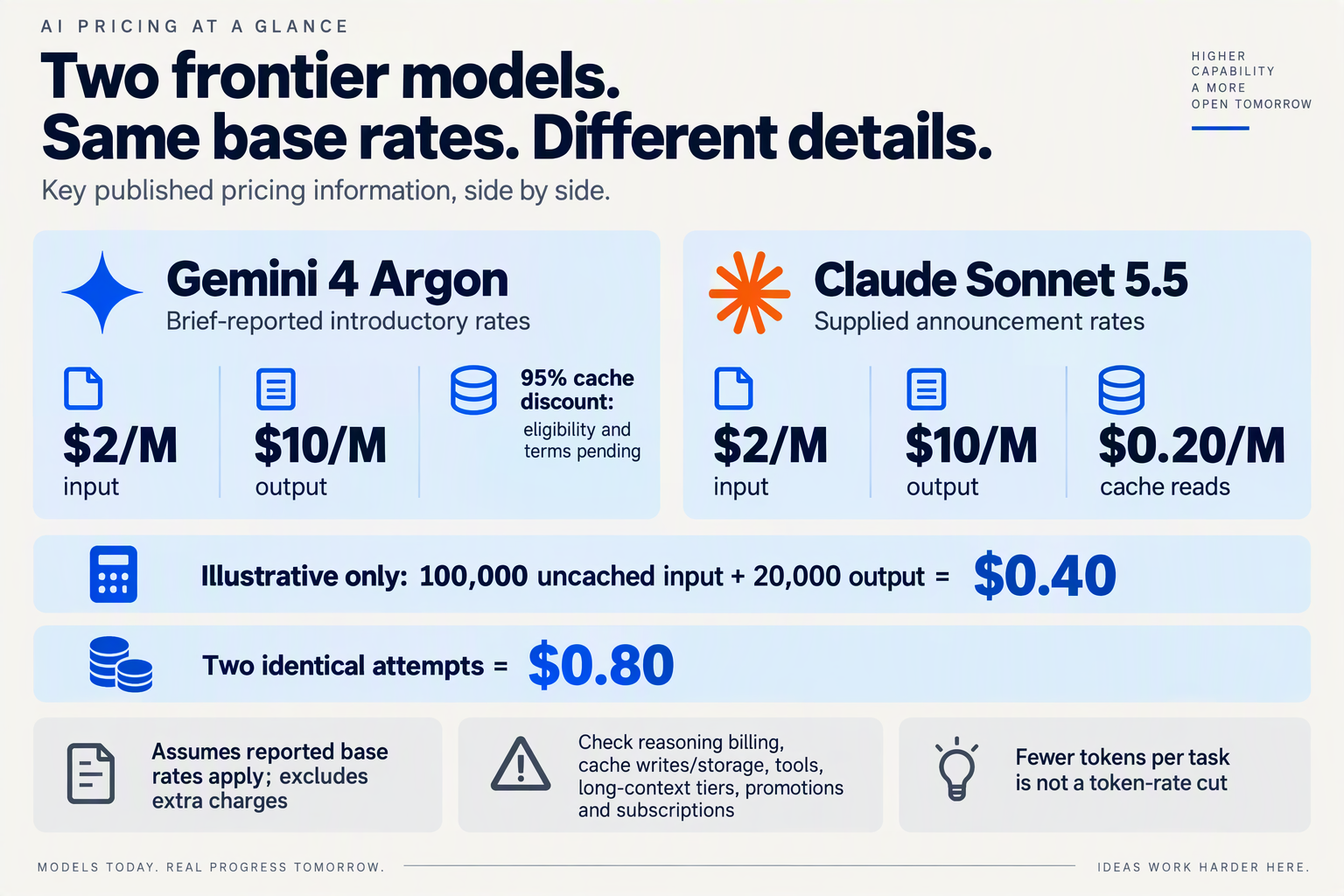
Cost per successful task equals total workflow spending divided by accepted results—not the price of one API request. For this September 30, 2026 draft held for review, Claude Sonnet 5.5 supports provisional arithmetic; Gemini 4 Argon does not yet support a defensible dollar comparison.
- Claude Sonnet 5.5: Anthropic’s supplied September 28, 2026 announcement quotes $2/million input tokens, $10/million output tokens and $0.20/million cache-read tokens; billing conditions still require primary-document verification.
- Gemini 4 Argon: As reviewed on September 30, 2026, the supplied Google Blog excerpt describes access through the Fairwind Program, but supplies neither API prices nor a verifiable launch date.
- Worked example: The September 30, 2026 illustration below assumes 20,000 uncached input tokens and 5,000 output tokens across one complete coding attempt—not necessarily one request.
- Comparison boundary: All calculated amounts below are illustrations using Anthropic’s quoted rates, not measured benchmarks; they exclude tools, infrastructure, taxes and any unverified billing adjustments.
| Cost component | Claude Sonnet 5.5 illustration | Gemini 4 Argon | Budget implication |
|---|---|---|---|
| 20,000 fresh input tokens | $0.040 | Rate unverified | Count repository rereads |
| 5,000 output tokens | $0.050 | Rate unverified | Include generated repairs |
| One complete attempt | $0.090 | Not calculable | Before external costs |
| Two identical attempts | $0.180 | Not calculable | Retry doubles token spend |
| 18,000 cached + 2,000 fresh input; 5,000 output | $0.0576 | Cache terms unverified | Excludes cache-write charges |
| Two minutes of review at assumed $90/hour | $3.00, model-independent | Same assumed labor cost | Review can dominate tokens |
How should teams measure cost per accepted coding task?
- Acceptance-adjusted cost: In a September 30, 2026 hypothetical test, 100 attempts costing $0.09 each with 80 accepted results produce $0.1125 per success: $9 divided by 80. Charge unsuccessful attempts to the workload rather than removing them from the denominator.
- Caching: The illustrative cached attempt costs 36% less than the $0.09 uncached attempt, before cache-write charges. Confirm eligibility, retention rules and actual cache hits before treating that saving as an enterprise forecast.
- Throughput: Record accepted tasks per hour, retry count and end-to-end duration alongside spending. A lower token bill can still be operationally expensive if queueing, test execution or human intervention prevents an automation from meeting its deadline.
- CallMissed: As of September 2026, CallMissed’s verified developer offering includes usage and request logs, response caching and caller-chosen fallback models. Those capabilities support cost tracking and routing experiments, but the fact sheet does not establish availability of either model compared here.
For procurement, require two comparable outputs: cost per accepted result and accepted results per hour. Keep the Gemini column unpriced until Google’s access and billing documentation is verified; do not substitute another Gemini model’s rates.
What are the practical advantages and trade-offs of each model?
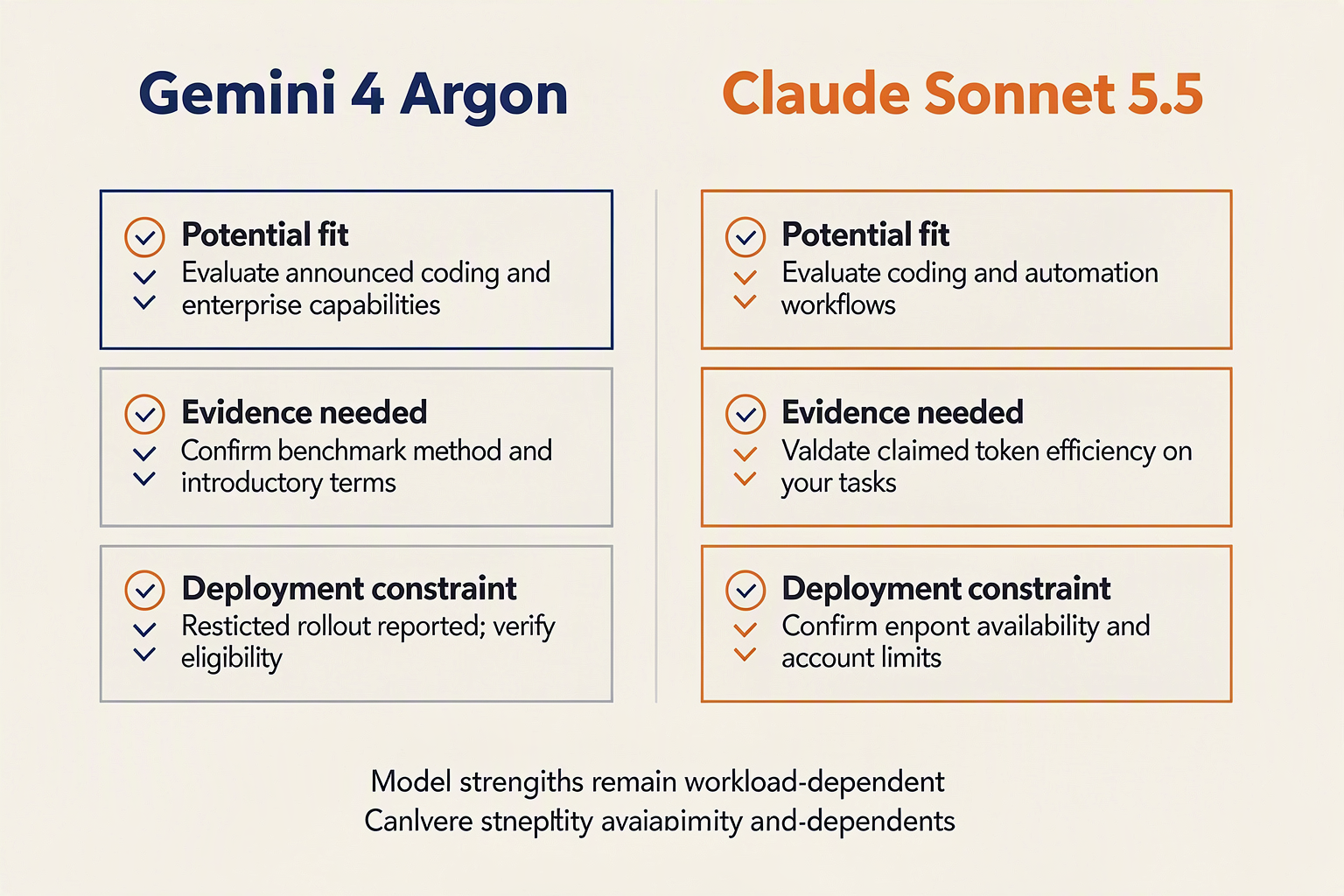
Claude Sonnet 5.5 offers a more calculable cost starting point; Gemini 4 Argon offers an announced focus on coding and enterprise work, but deployment suitability remains unresolved. This September 30, 2026 draft remains held for review: supplied excerpts do not independently verify Google’s launch date or either model’s complete production terms.
| Practical dimension | Gemini 4 Argon | Claude Sonnet 5.5 | Enterprise implication |
|---|---|---|---|
| Coding advantage | Google Blog describes a focus on “real-world coding”; no comparable results supplied. | Anthropic claims fewer tokens for equivalent work; no workload-specific evidence supplied. | Evaluate accepted patches, not vendor descriptions. |
| Deployment trade-off | Google Blog describes rollout to trusted cyber defenders through the Fairwind Program. | The supplied Anthropic announcement is dated September 28, 2026; account-level access is unverified. | Confirm usable API access before scheduling integration. |
| Base token costs | Input and output prices are unverified in the supplied material. | Anthropic’s September 28 excerpt quotes $2/M input and $10/M output. | Sonnet supports a provisional estimate; Argon does not yet support a price comparison. |
| Cache economics | Cache pricing and eligibility are unverified. | Anthropic quotes $0.20/M cache-read tokens; cache-write conditions are unspecified. | Repeated repository context may change effective costs substantially. |
| Throughput limits | No requests-per-minute or tokens-per-minute figures supplied. | No requests-per-minute or tokens-per-minute figures supplied. | Neither model has an evidenced throughput advantage here. |
| Enterprise controls | Regional availability, retention terms and operational limits remain unverified. | Regional availability, retention terms and operational limits remain unverified. | Require documented controls before processing sensitive code or records. |
What do these trade-offs mean for a coding budget?
- Claude Sonnet 5.5: Using Anthropic’s September 28, 2026 quoted rates, an illustrative task consuming 100,000 uncached input tokens and 10,000 output tokens costs $0.30, excluding tools, retries and other charges.
- Claude Sonnet 5.5 caching: If 80,000 of those input tokens qualify as cache reads, the same illustrative task costs $0.156—48% less; this calculation excludes cache-write charges and assumes unchanged output.
- Gemini 4 Argon: Treat pricing as unknown, not zero or “competitive”; procurement cannot establish a defensible break-even point without verified input, output and caching terms.
How should enterprise teams test the practical advantages?
- Coding evaluation: Run a proposed 30-task pilot across bug fixes, test generation and refactoring, using identical repositories and acceptance criteria; record human review time alongside model charges.
- Throughput evaluation: Test proposed concurrency levels of 1, 5 and 10 requests, measuring completed tasks per minute, p50/p95 completion times and throttling; these are test settings, not published model limits.
- Integration flexibility: As of September 2026, CallMissed’s developer AI API offers OpenAI-compatible and Anthropic-compatible endpoints plus caller-chosen fallback models; the verified fact sheet does not establish availability of either model compared here.
Before approving a rollout:
- Obtain dated primary-source access, pricing and data-handling documentation.
- Compare cost per accepted result, including unsuccessful attempts.
- Approve production use only after task quality and throughput meet the team’s documented thresholds.
Which should enterprises pilot for repository coding, high-volume tools and cost-sensitive automation?
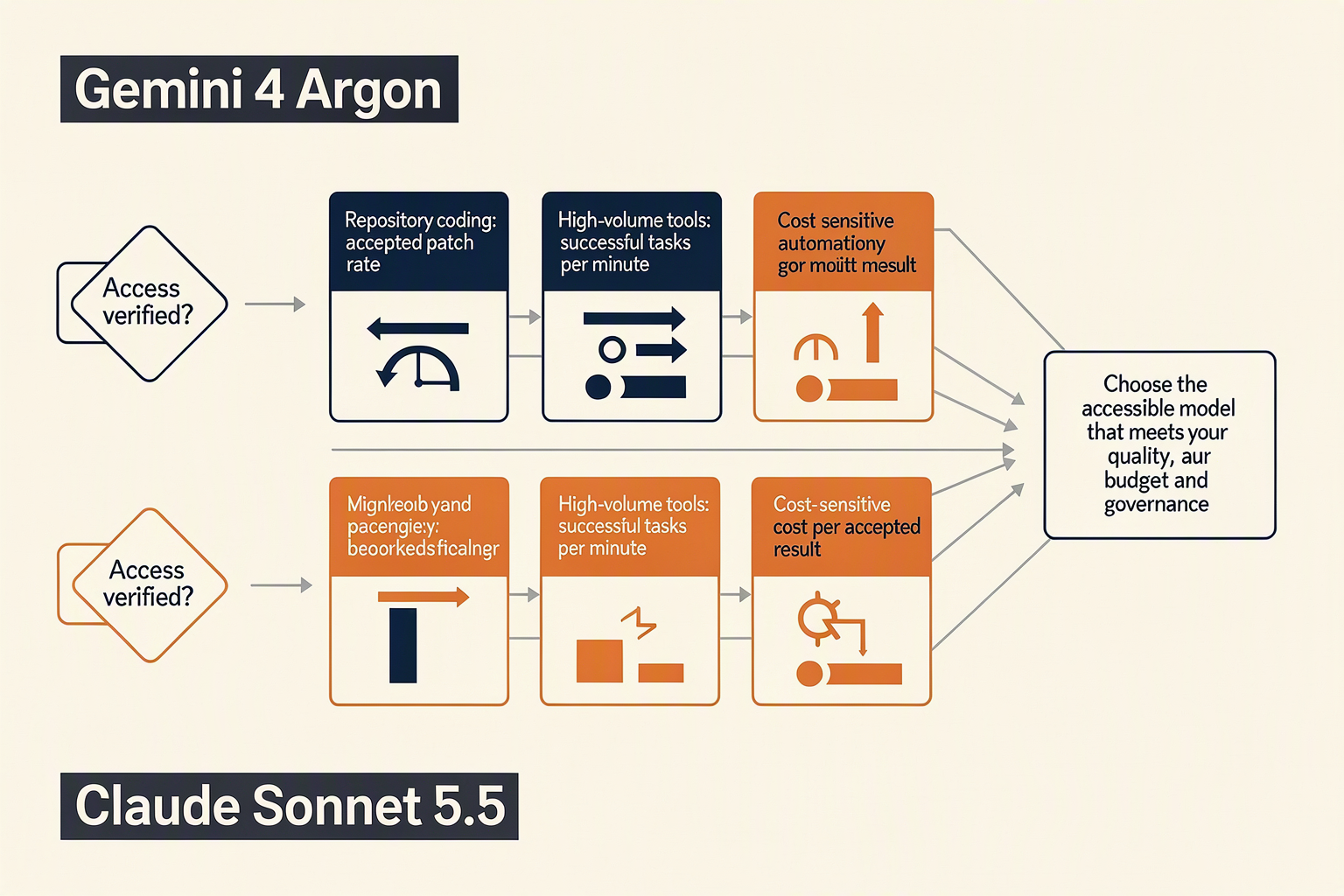
Pilot Claude Sonnet 5.5 first only if enterprise API access and billing terms are confirmed; keep Gemini 4 Argon conditional on verified eligibility. This September 30, 2026 draft recommends workload-specific trials, not a production winner.
Which model should enterprises pilot for repository coding?
- Claude Sonnet 5.5: Use a proposed 50-task repository trial spanning bug fixes, test generation, dependency upgrades and multi-file changes in your actual languages, such as Python and TypeScript. Anthropic’s supplied September 28, 2026 announcement establishes the stated release date, but the excerpt does not establish your account’s access, quotas or deployment conditions.
- Gemini 4 Argon: Require written confirmation of permitted access before scheduling the same trial. As reviewed on September 30, 2026, the supplied Google Blog excerpt says Argon is “currently rolling out to trusted cyber defenders through the Fairwind Program”; that does not establish general enterprise coding access, an exact launch date or API pricing.
- Repository evaluation: Give both models identical repository snapshots, tool permissions, test commands and retry budgets. Record accepted fixes out of 50, regressions, reviewer minutes and total billed tokens; require passing tests plus human acceptance. These are proposed pilot measurements, not published Gemini 4 Argon or Claude Sonnet 5.5 benchmark results.
- Coding safeguards: Start with read-only investigation and sandboxed patch execution, then permit pull-request creation after review. Apply the same three-attempt repair cap to both candidates and prohibit direct production merges. Count abandoned tasks and reviewer corrections in the scorecard so apparently successful patches do not hide operational costs.
How should enterprises test high-volume tools and automation costs?
- High-volume tools: Run proposed 1, 5 and 20 concurrent-task stages against representative ticket classification, structured extraction and tool-calling workflows. Measure successful jobs per minute, p50/p95 completion time, throttling and invalid tool arguments. Neither supplied announcement provides enough evidence to rank sustained throughput as of September 30, 2026.
- Claude Sonnet 5.5 cost: At the rates quoted in Anthropic’s September 28, 2026 announcement, an illustrative task using 100,000 uncached input tokens and 10,000 output tokens costs $0.30; another 1 million cache-read tokens adds $0.20. This arithmetic excludes cache writes, tools, retries and any additional pricing conditions requiring primary-document verification.
- Cost-sensitive automation: Compare total pilot spend divided by accepted outcomes, rather than input-token prices alone. Route low-risk extraction separately from repository repair, and test escalation after validation failures. Leave Gemini 4 Argon’s cost column “unverified” until Google’s applicable pricing documentation is checked; do not substitute another Gemini model’s rates.
- CallMissed: As of September 2026, CallMissed’s developer AI API offers OpenAI-compatible and Anthropic-compatible endpoints, request logs and caller-chosen fallback models, making it relevant to multi-model integration experiments. The verified catalogue does not establish support for either model here; confirm exact model identifiers before treating gateway availability as evidence of access.
Frequently Asked Questions
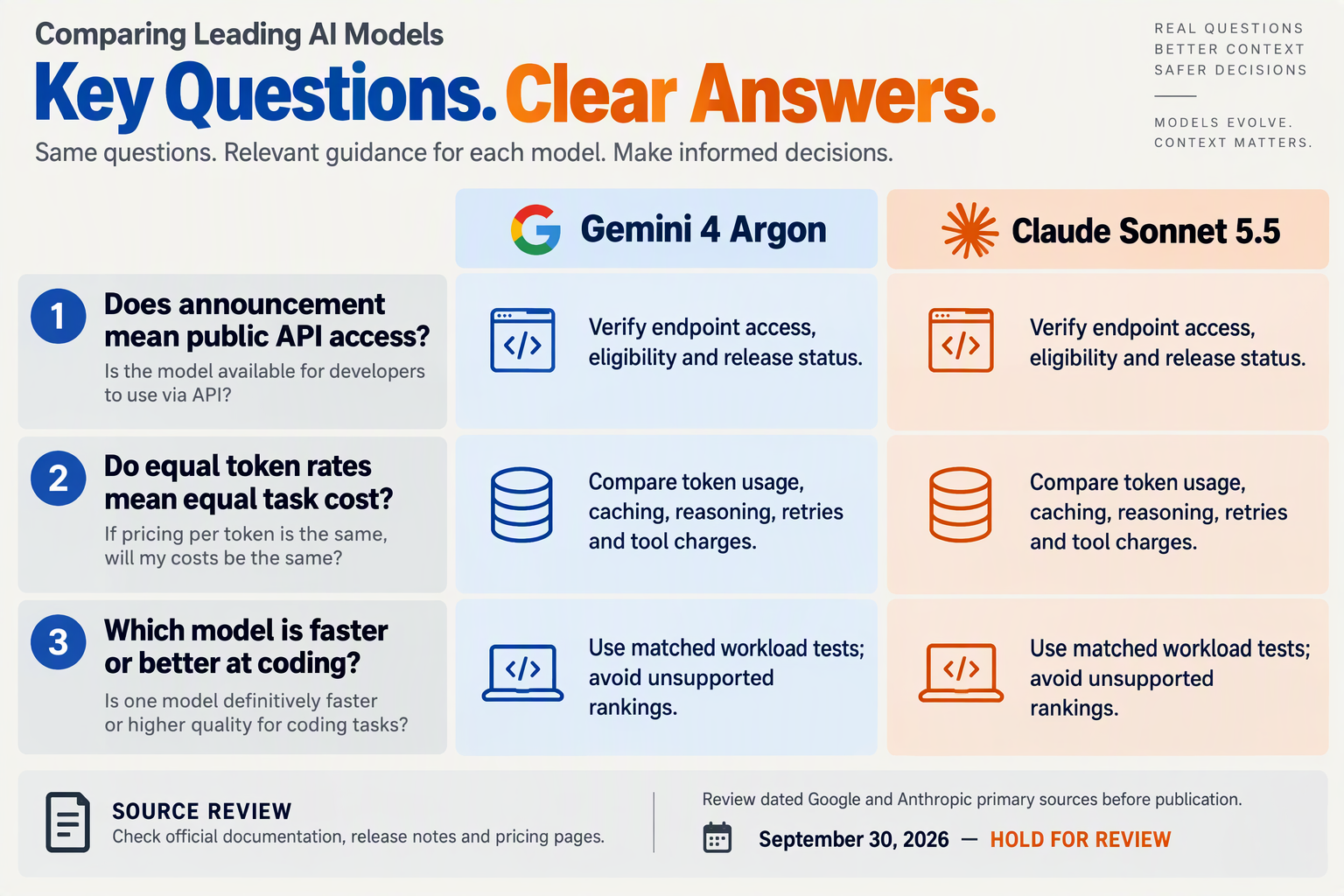
Draft held for review — September 30, 2026: Public Argon access, comparative token pricing and a speed winner remain unverified from the supplied excerpts.
- Q: Is Google Gemini 4 Argon publicly accessible as of September 30, 2026?
A: General public access is not established by the supplied Google Blog excerpt, which says Gemini 4 Argon is rolling out to trusted cyber defenders through the Fairwind Program before wider release. That supports a restricted-rollout description, not an unrestricted API launch; reviewers must confirm Google’s publication date, eligible users, supported endpoints and permitted enterprise workloads before treating Argon as deployable.
- Q: Does Gemini 4 Argon Pricing vs Claude Sonnet 5.5 show that Sonnet is cheaper per token?
A: No verified price comparison is possible because the supplied Google excerpt contains no Argon API rates. According to the supplied excerpt of Anthropic’s September 28, 2026 announcement, Claude Sonnet 5.5 costs $2 per million input tokens, $10 per million output tokens and $0.20 per million cache-read tokens; context-length, processing-mode and caching conditions still require primary-document review.
- Q: Which model is faster for coding: Gemini 4 Argon or Claude Sonnet 5.5?
A: The supplied sources provide no comparable latency or throughput measurements, so neither model can responsibly be named faster as of September 30, 2026. Test identical repositories, prompts, tools and concurrency settings, then report median and p95 completion time, output tokens per second and accepted fixes per minute, keeping unsuccessful attempts in the results rather than measuring only successful runs.
- Q: How should enterprises calculate Gemini 4 Argon Pricing vs Claude Sonnet 5.5 task costs?
A: Compare cost per accepted result, including input, output, cache usage, tool expenses and retries—not token prices alone. Using Anthropic’s September 28, 2026 quoted rates, an illustrative request with 100,000 uncached input tokens and 10,000 output tokens costs $0.30 before other charges; whether that request completes the task successfully determines its practical value.
- Q: Does Claude Sonnet 5.5 use fewer tokens for the same coding work?
A: Anthropic’s supplied September 28, 2026 announcement says Sonnet 5.5 “typically needs far fewer tokens to do the same work,” but the excerpt provides no percentage reduction or reproducible test methodology. Treat this as a vendor claim until matched coding evaluations measure token consumption alongside test-pass rates, patch acceptance and retries, because shorter answers are not automatically correct answers.
- Q: Can enterprises use one API to evaluate coding models before deployment?
A: An API gateway can simplify integrations, but teams must first verify model availability, billing conditions and operational limits for each candidate. As of September 2026, CallMissed’s verified fact sheet lists OpenAI-compatible and Anthropic-compatible endpoints, usage and request logs, and caller-chosen fallback models; it does not establish Gemini 4 Argon or Claude Sonnet 5.5 availability, so neither should be assumed supported.
Conclusion
As of September 30, 2026, this Gemini 4 Argon Pricing vs Claude Sonnet 5.5 comparison remains a draft held for review—not a basis for declaring a coding winner. The enterprise decision should turn on verified access, applicable pricing and the cost of completing accepted work, rather than announcement language or headline token rates.
Four takeaways should guide the next stage of evaluation:
- Verify deployable access before comparing performance. The supplied Google Blog excerpt describes Gemini 4 Argon as rolling out to trusted cyber defenders through the Fairwind Program, ahead of wider release; reviewed on September 30, 2026, that excerpt does not establish general developer availability. Google’s launch date, accessible products and permitted enterprise workloads still require primary-source confirmation.
- Treat published token prices as inputs, not total task costs. Anthropic’s supplied September 28, 2026 announcement quotes Claude Sonnet 5.5 at $2 per million input tokens, $10 per million output tokens and $0.20 per million cache-read tokens. Those figures provide a starting point, but the applicable pricing conditions must be checked before estimating production spending, and Gemini 4 Argon pricing remains unverified in this draft.
- Measure coding outcomes rather than persuasive demonstrations. Representative repository tasks should track successful fixes, test results, retry frequency and cost per accepted result. Anthropic’s supplied September 28, 2026 announcement says Sonnet 5.5 “typically needs far fewer tokens to do the same work,” but workload-specific testing is needed before translating that claim into expected savings.
- Compare practical throughput alongside correctness. End-to-end completion time matters more than a fast individual response when an automation must inspect code, propose changes, run tests and repair failures. A lower-priced request can still produce a more expensive workflow if additional attempts consume the apparent savings.
What should enterprise teams watch for next?
Watch for Google’s confirmed launch details, documented access restrictions and published Gemini 4 Argon API prices, alongside Anthropic’s complete pricing and deployment documentation. The next useful update to this comparison should replace unresolved assumptions with verified conditions and comparable coding results—not simply add another announcement.
For cost-sensitive enterprise automation, the strongest evidence will connect quality, completion time and spending within the same workload. Teams should preserve that discipline even if wider availability makes either model easier to test: access enables evaluation, but does not establish suitability.
Readers exploring this multi-model approach can also consider CallMissed, the OpenAI-compatible developer AI API. As of September 2026, CallMissed supports caller-chosen fallback models and usage and request logs—relevant capabilities for teams evaluating model choices, without implying access to either model discussed here.
Before committing an automation budget, which model can you actually deploy—and what does it cost to deliver a tested, accepted fix?
Related Reading
- Gemini 4 Argon vs GPT-6.1 Sol: Coding & Agents (2026)
- Claude Sonnet 5.5 API Pricing, Context and Access
- Claude Sonnet 5.5 vs GPT-6 Sol Coding Comparison 2026
Sources
Discussion
Related Posts



Ready to automate customer conversations?
Launch AI voice agents and WhatsApp bots with CallMissed — one API, 22+ Indian languages.