AI voice agent cost comparison for Indian SMBs (2026)


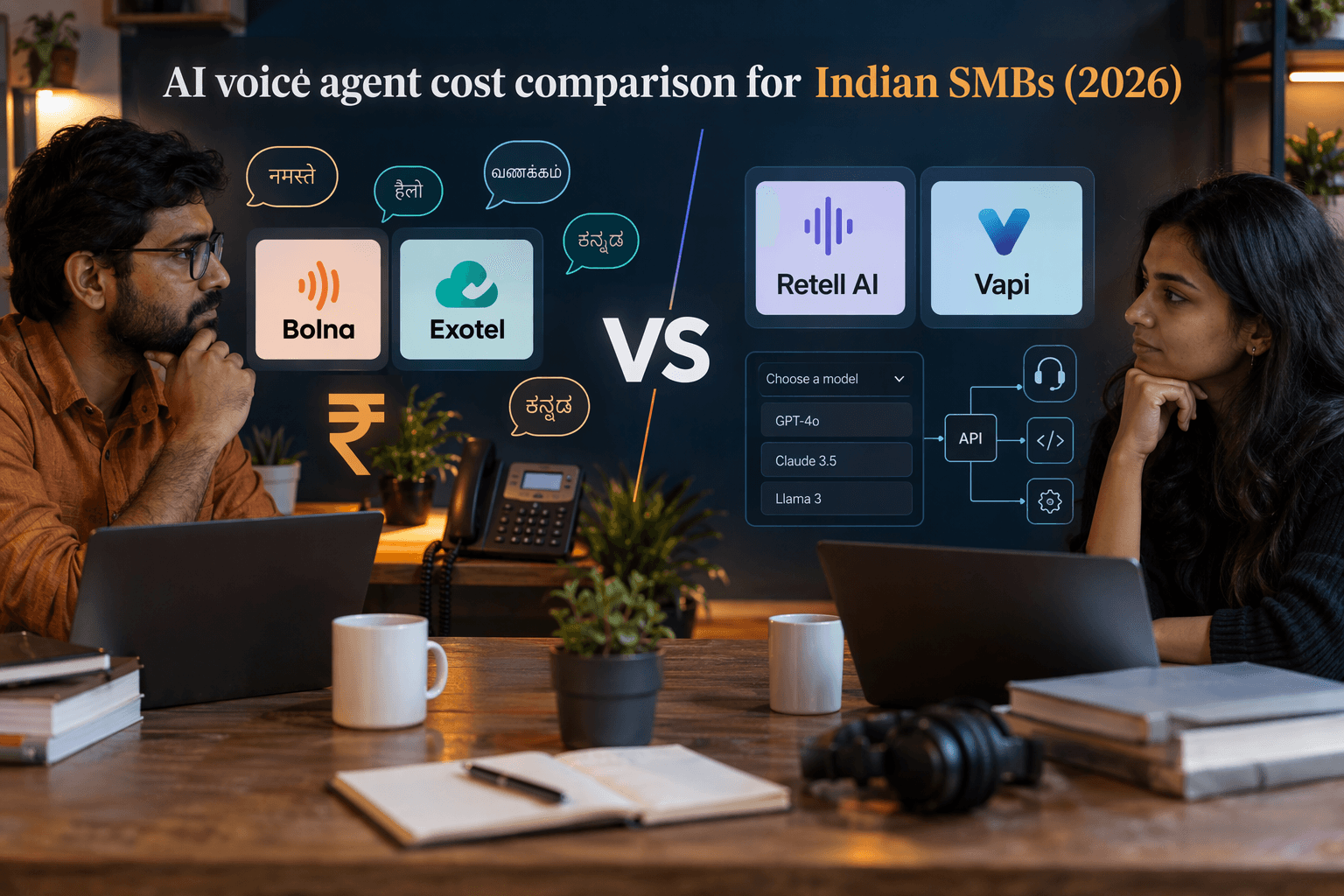
Use this AI voice agent cost comparison to assess INR budgets, Indian-language support, setup effort and handoff workflows for your SMB.

AI voice agent cost comparison for Indian SMBs (2026)
Could a voice agent advertised at $0.06 per minute cost more than a ₹4-per-minute plan? Yes—because the headline rate may exclude telephony, platform fees, or parts of the AI stack. This AI voice agent cost comparison helps Indian SMBs compare customer-support costs on a like-for-like basis, rather than treating every published “per minute” price as the final bill.
The difference matters in November 2026, when businesses can choose between bundled voice-agent plans and modular platforms that charge separately for infrastructure, language models, voices, and telephone connectivity. According to Bolna’s comparison dated 26 October 2026, Retell AI listed voice-agent pricing from $0.07 to $0.31 per minute, with telephony costing another $0.015 per minute in listed countries. That range makes the selected model and voice a budgeting decision—not merely a technical preference.
What does an AI voice agent’s advertised price actually include?
Bolna’s published comparison, reviewed for this November 2026 discussion, lists its bundled-model starting price at $0.06 per minute, with telephony and a platform fee added separately. Its description says speech recognition, the language model, and text-to-speech are included on bundled models; buyers still need to check the remaining charges.
For an Indian SMB, the practical question is therefore not “Which platform has the smallest number?” It is “What will our actual support workload cost?”
Consider a business expecting 1,000 connected support minutes per month. A difference of ₹1 per minute changes its usage bill by ₹1,000 before any other charges—simple arithmetic that becomes more consequential as call volumes grow.
A useful comparison separates:
- AI processing: speech recognition, language-model responses, and speech generation.
- Phone connectivity: carrier charges, number rental, and supported Indian calling arrangements.
- Billing rules: minimum call duration and treatment of calls that never connect.
- Operational fit: language coverage, integrations, and the work needed to deploy and maintain support agents.
Which costs and capabilities matter most for Indian SMBs?
As of November 2026, CallMissed’s verified product information lists its Standard voice-agent plan at ₹4 per minute, including speech recognition, the language model, and the voice, with phone carriage billed separately and a 30-second minimum per call.
That illustrates why bundled and modular pricing need different calculations. Neither structure automatically guarantees a lower bill: the answer depends on call duration, configuration, and carrier costs.
This guide compares published pricing, included components, Indian-language requirements, and deployment trade-offs. You will learn how to estimate a realistic monthly support budget, identify charges that deserve clarification, and shortlist platforms around your customers’ needs—not just an attractive starting rate.
Which AI voice agent platform should Indian SMBs shortlist? At-a-glance verdict
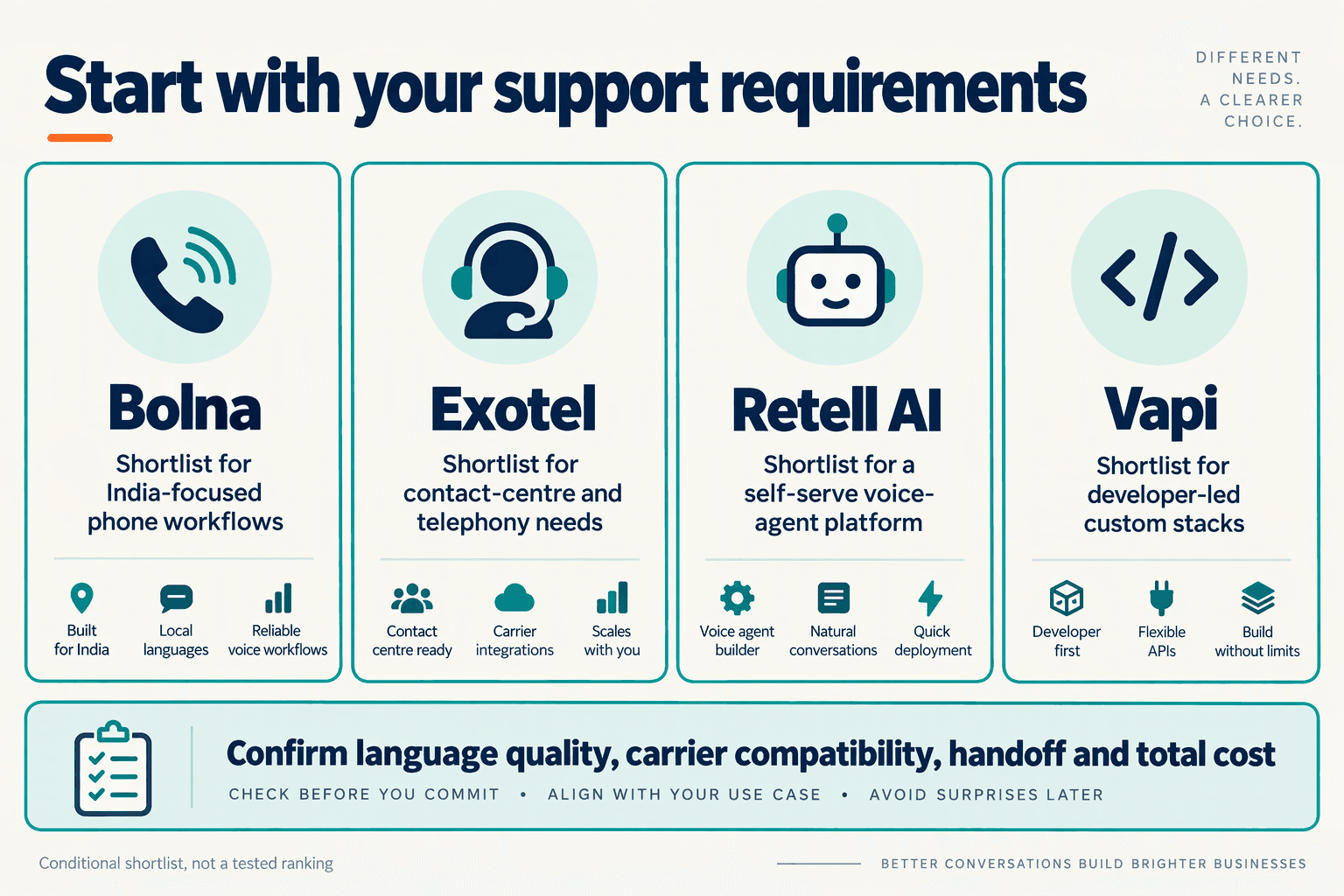
Shortlist CallMissed, Bolna, Retell AI and Vapi, then choose around language requirements, Indian phone connectivity and deployment effort—not a single advertised rate. As of November 2026, these are useful candidates for different support workflows, rather than a universal winner.
Which platforms fit which Indian SMB support needs?
- CallMissed: Shortlist for a no-code support workflow with regional-language coverage and human supervision. As of November 2026, CallMissed’s verified product information lists speech recognition in 22 Indian languages plus English, natural text-to-speech in 10 Indian languages plus English, and supervisor options to listen, whisper or barge into live calls; recognition coverage is not the same as voice coverage.
- Bolna: Shortlist when Indian carrier connections and multilingual conversations are central requirements. Bolna’s comparison, reviewed in November 2026, lists Plivo, Exotel and Vobiz as native connections and 20+ languages, including Hindi, Hinglish, Tamil and Telugu; it also describes language switching within a call and India-based call-data routing on enterprise plans.
- Retell AI: Shortlist for evaluation when you want provider-dependent language choices and can validate the required telephone setup. Bolna’s November 2026 comparison reports 55 languages in Retell AI’s documentation, including Hindi, Tamil, Marathi and Kannada, while noting that coverage depends on the speech and voice provider; test your selected combination rather than relying on the headline count.
- Vapi: Shortlist when a developer will own the implementation and model-provider selection. Bolna’s AI Voice Agent Companies in India (2026) describes Vapi as API-first, with integrations including OpenAI, Anthropic and ElevenLabs, and lists $0.05 per minute for hosting, with models and telephony billed separately; that is a component price, not a complete support-call quote.
What should decide the final shortlist?
- Language acceptance test: Use a proposed 20-call pilot: five Hindi-English code-mixed calls, five regional-language calls, five noisy calls and five difficult support requests. Score recognition, spoken replies and task completion separately; a platform that transcribes a language successfully still needs an appropriate voice and reliable handling of your business terminology.
- Indian number readiness: Require a written answer on number availability, compliance documents, carrier charges and SIP connectivity before committing. Bolna’s comparison reviewed in November 2026 says Indian numbers can be purchased through Plivo or Vobiz after compliance checks; availability should therefore be treated as an onboarding dependency, not an automatic entitlement.
- Support execution: Test three concrete outcomes: answering a policy question, retrieving an order detail and escalating an unresolved complaint. Ask each vendor to demonstrate the required integration and escalation path using your workflow; a convincing conversational demo does not establish that the agent can complete customer-support work.
- Evidence quality: Separate vendor-published claims, demonstrated capabilities and contractual commitments in your scorecard. The supplied competitor comparisons come from Bolna, not an independent benchmark; confirm November 2026 pricing and configuration directly with each shortlisted vendor before making a purchase decision.
Which platform fits Indian-language support and human handoff? Feature comparison
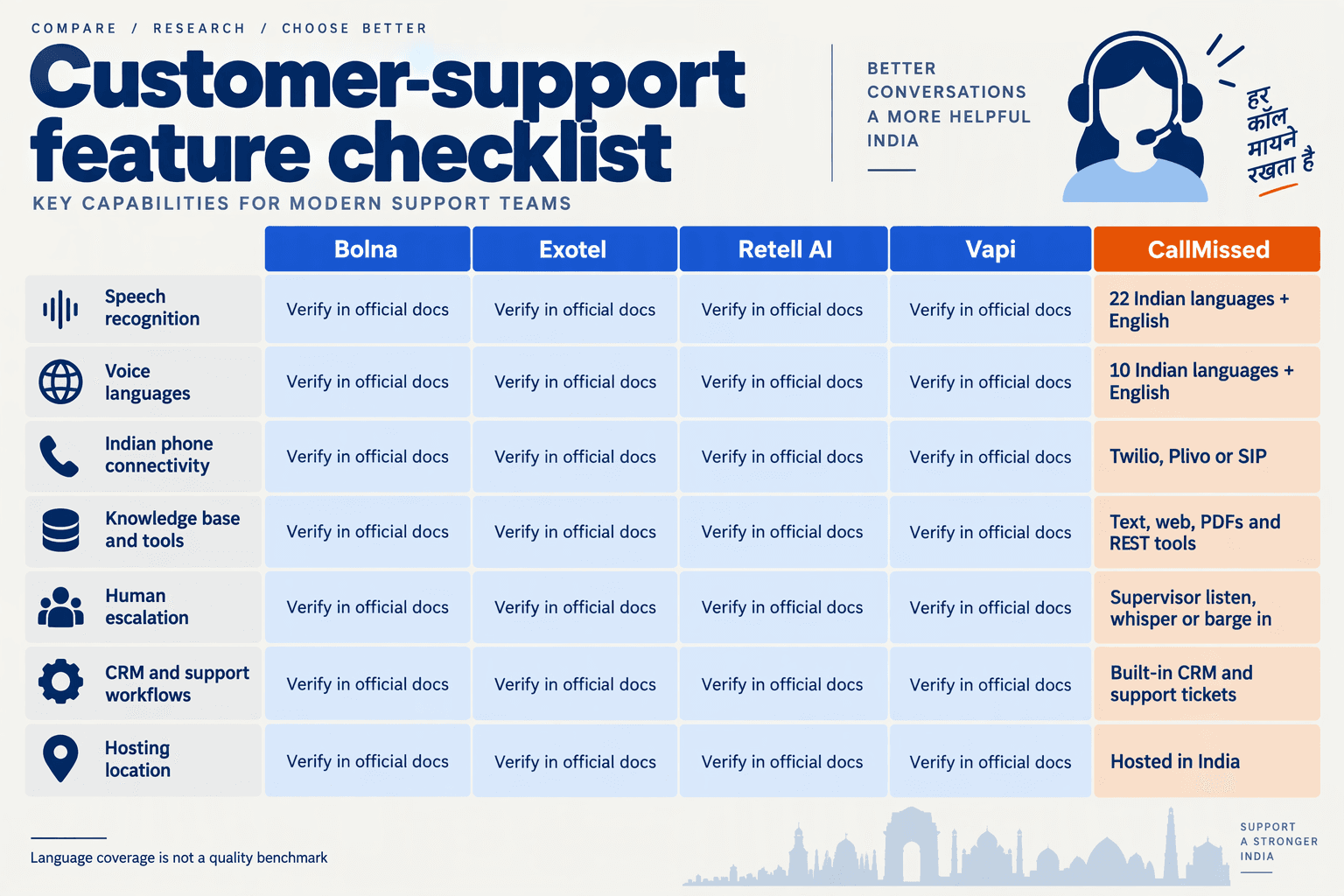
For Indian-language support, shortlist platforms by speech recognition, voice output, and human escalation separately—a single language count cannot establish all three. The November 2026 comparison below uses CallMissed’s verified product information and Bolna’s published comparisons; competitor details are vendor-reported, not independently benchmarked.
| Support requirement | CallMissed | Bolna | Retell AI |
|---|---|---|---|
| Indian-language recognition | 22 Indian languages plus English | 20+ languages advertised; recognition breakdown not supplied | 55 languages reported; coverage depends on providers |
| Indian-language voice output | Natural voices in 10 Indian languages plus English | Hindi, Tamil and Telugu among advertised languages | Hindi, Tamil, Marathi and Kannada among listed languages |
| Code-mixed conversations | Recognition includes Hinglish | Hinglish and mid-call language switching advertised | Code-mixing behavior not specified in supplied context |
| Live voice escalation | Supervisor can listen, whisper or barge in | Call transfer listed | Handoff details not supplied |
| Messaging handoff | Switching AI off puts the thread in a human-handoff queue | Not specified in supplied context | Not specified in supplied context |
| Indian phone connectivity | Rented numbers or your own Twilio, Plivo or SIP carrier | Native Plivo, Exotel and Vobiz connections | Platform-sold numbers are US/Canada, according to Bolna |
How should SMBs compare Indian-language coverage?
- CallMissed: As of November 2026, CallMissed’s verified product information lists speech recognition in 22 Indian languages plus English, but natural text-to-speech voices in 10 Indian languages plus English. Match both capabilities to your customer languages; recognition coverage does not automatically mean equivalent voice-output coverage.
- Bolna: Bolna’s comparison, reviewed in November 2026, advertises 20+ languages, including Hindi, Hinglish, Tamil and Telugu, plus switching languages within one call. Test a realistic request such as “Order cancel karna hai, refund kab milega?” rather than relying on clean, single-language demonstrations.
- Retell AI: Bolna’s comparison, reviewed in November 2026, reports 55 languages in Retell AI’s documentation and says coverage depends on the speech and voice provider. Ask which configured recognition-and-voice combination supports your required Indian languages; the headline total is not directly comparable with an Indian-language-specific count.
What should a human-handoff test include?
- Live-call escalation: Distinguish call transfer from supervisor listen, whisper and barge-in controls. During a demonstration, trigger a disputed payment or repeated misunderstanding and check whether a person can intervene without forcing the caller to restart the support request.
- Messaging escalation: A shared inbox does not by itself prove a complete escalation workflow. Test who receives the conversation, whether the AI stops replying, and whether the human can review prior messages before responding; keep these checks separate from telephone-call transfer.
- Evidence gaps: “Not specified” means the supplied research does not establish the capability—not that the platform lacks it. Before selecting an AI voice agent platform, request a language-specific demonstration, confirm Indian-number arrangements, and document escalation ownership and failure handling in your acceptance checklist.
How much does each platform really cost in INR? Pricing and value
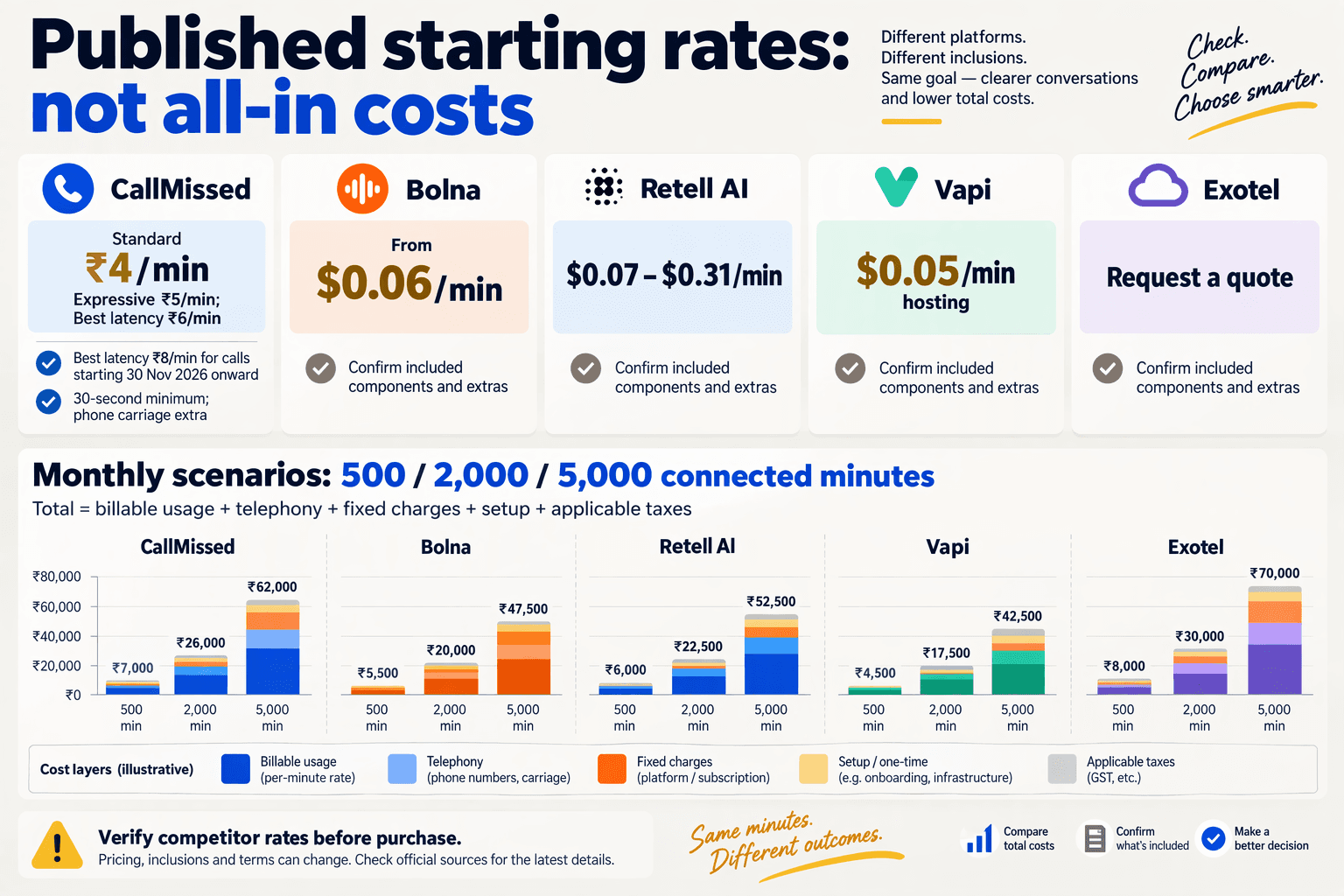
Budget ₹4,000–₹29,760 for 1,000 connected minutes across the configurations below, before applicable extras—not as an all-in quote. Compare the same workload, carrier arrangement and billing minimum before choosing a platform.
What are published AI voice agent prices in INR?
November 2026 comparison: dollar conversions use an illustrative ₹96/US$, matching CallMissed’s verified pricing reference, rather than a live exchange-rate quote. Competitor figures come from Bolna’s supplied comparisons; Bolna dates its Retell pricing observation to 26 October 2026.
| Platform / plan | AI rate in INR | 1,000 minutes | Included components | Additional charges |
|---|---|---|---|---|
| CallMissed Standard | ₹4/min | ₹4,000 | Recognition, LLM, voice | Phone carriage |
| CallMissed Expressive | ₹5/min | ₹5,000 | Recognition, LLM, voice | Phone carriage |
| CallMissed Best latency | ₹6/min currently | ₹6,000 | Recognition, LLM, voice | Phone carriage; rate changes below |
| Bolna bundled models | From ₹5.76/min | From ₹5,760 | Recognition, LLM, voice | Telephony + platform fee |
| Retell AI | ₹6.72–₹29.76/min | ₹6,720–₹29,760 | Infrastructure, LLM, voice | Telephony where applicable |
| Vapi | ₹4.80/min hosting | ₹4,800 hosting only | Hosting | Models at cost; telephony extra |
- Source confidence: Bolna publishes its bundled starting price as $0.06/min, Retell’s range as $0.07–$0.31/min, and Vapi hosting as $0.05/min in the supplied comparisons. These are vendor-published comparisons, not independently verified November checkout quotes; request current configurations before procurement.
- Currency consistency: Bolna’s India-company roundup gives approximately ₹5.52 for $0.06, but this table calculates ₹5.76 using ₹96/US$. Applying one conversion assumption across dollar-priced platforms avoids mixing exchange rates and creating a misleading apparent saving.
- Upcoming price change: According to CallMissed’s verified November 2026 product information, Best latency rises to ₹8/min for calls starting on or after 30 November 2026. That makes 1,000 minutes ₹8,000, while its custom-stack option separately charges components plus a ₹1/min platform fee.
Which billing details change the monthly total?
- Retell telephony: Bolna’s 26 October 2026 comparison lists $0.015/min in specified countries—₹1.44/min, or ₹1,440 per 1,000 minutes under this conversion. Do not assume that rate covers Indian connectivity; obtain the applicable carrier quote.
- Short-call minimums: A 30-second minimum means 1,000 connected calls lasting 10 seconds each become 500 billable minutes, despite only 166.7 elapsed minutes. At ₹4/min, that example costs ₹2,000, excluding phone carriage; total minutes alone therefore understate short-call workloads.
- Exotel quotes: Bolna’s supplied 2026 India-company roundup reports no figures on Exotel’s pricing page and describes custom quotes. Request separate amounts for AI usage, connectivity, number rental and any setup or recurring commitments rather than inventing a comparable per-minute rate.
- Budget formula: Calculate billable AI usage + carrier usage + number rental + applicable platform fees + taxes. Ask each vendor which items are included, and whether unused prepaid balances or monthly commitments affect your actual cash outlay.
- Value test: Pilot the same support scenarios and measure cost per successfully resolved enquiry, not merely cost per minute. Record resolution, escalation and repeat-contact outcomes alongside the invoice; the cheapest headline rate need not produce the cheapest completed support interaction.
What are the trade-offs between no-code and API-first platforms? Pros and cons
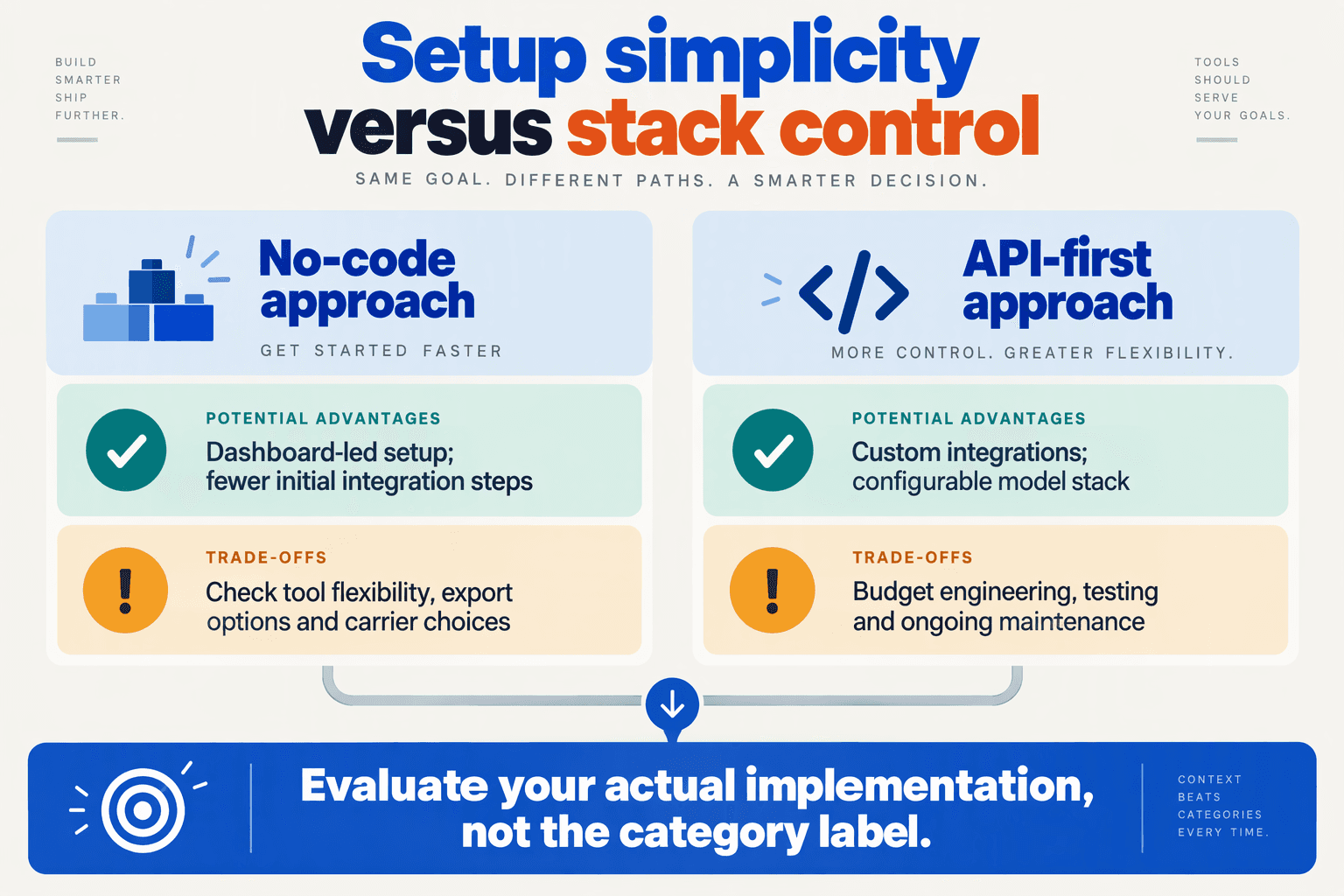
No-code platforms suit SMBs that want support teams to configure agents; API-first platforms suit businesses that need custom workflows and have developers to maintain them. Compare ownership and integration effort—not just the interface, because some platforms offer both.
How do no-code and API-first voice agents compare?
The following comparison is a buying framework for November 2026, not a claim that every platform in either category has identical capabilities.
| Decision factor | No-code approach | API-first approach | What to verify |
|---|---|---|---|
| Initial setup | Configure prompts, voices and workflows through a dashboard; less application code to maintain. | Build agent creation, call handling and application connections through code. | Can your team deploy one complete support workflow? |
| Workflow flexibility | Convenient for supported actions; unusual requirements may need custom tools. | Enables application-specific orchestration, but developers own implementation and debugging. | Test order lookup, identity checks and escalation. |
| Model selection | Presets simplify configuration but may constrain component choices. | Provider integrations can offer component-level control; compatibility still needs testing. | Can you change recognition, reasoning and voice independently? |
| Cost structure | Bundles can simplify forecasting; a dashboard does not guarantee bundled billing. | Modular charges require tracking infrastructure, models, voices and connectivity. | Request a component-by-component bill for the same workload. |
| Ongoing changes | Support managers can potentially edit prompts without application releases. | Code-managed changes can fit engineering review and deployment processes. | Check versioning, rollback and who can publish. |
| Operational ownership | Managed tooling can reduce setup work, but monitoring remains necessary. | Greater integration control brings responsibility for retries, errors and credentials. | Assign owners for failed calls and broken integrations. |
- No-code: Test whether a support manager can change a return-policy answer, publish it and restore the previous version without developer intervention; “visual builder” alone does not establish that capability.
- API-first: In Bolna’s AI Voice Agent Companies in India (2026) comparison, reviewed for November 2026, Vapi lists $0.05 per minute for hosting, with models charged at cost and telephony billed separately.
- Hybrid platforms: Bolna’s 2026 company comparison describes Bolna as self-serve and API, illustrating why “no-code versus API-first” is not always a binary shortlist.
- CallMissed: As of November 2026, CallMissed’s verified product information lists a no-code voice-and-chat builder, custom REST tools, and agent versioning with publish and rollback—useful when support owns content and developers own business-system connections.
What should an Indian SMB test before choosing?
- Maintenance test: Run three scenarios: a changed refund policy, an unavailable order API and a caller requesting a human. Record who fixes each problem and whether the fix requires a software release.
- Integration test: As of November 2026, CallMissed’s verified product information lists a Twilio-compatible Calls API and OpenAI-compatible developer endpoints; compatibility can reduce integration changes, but teams should still validate authentication, payloads and error handling.
Choose no-code when supported workflows cover your requirements. Choose API-first when customization justifies engineering ownership; choose a hybrid when responsibilities genuinely span both teams.
How should you test Hindi, Tamil and Telugu support calls before buying?
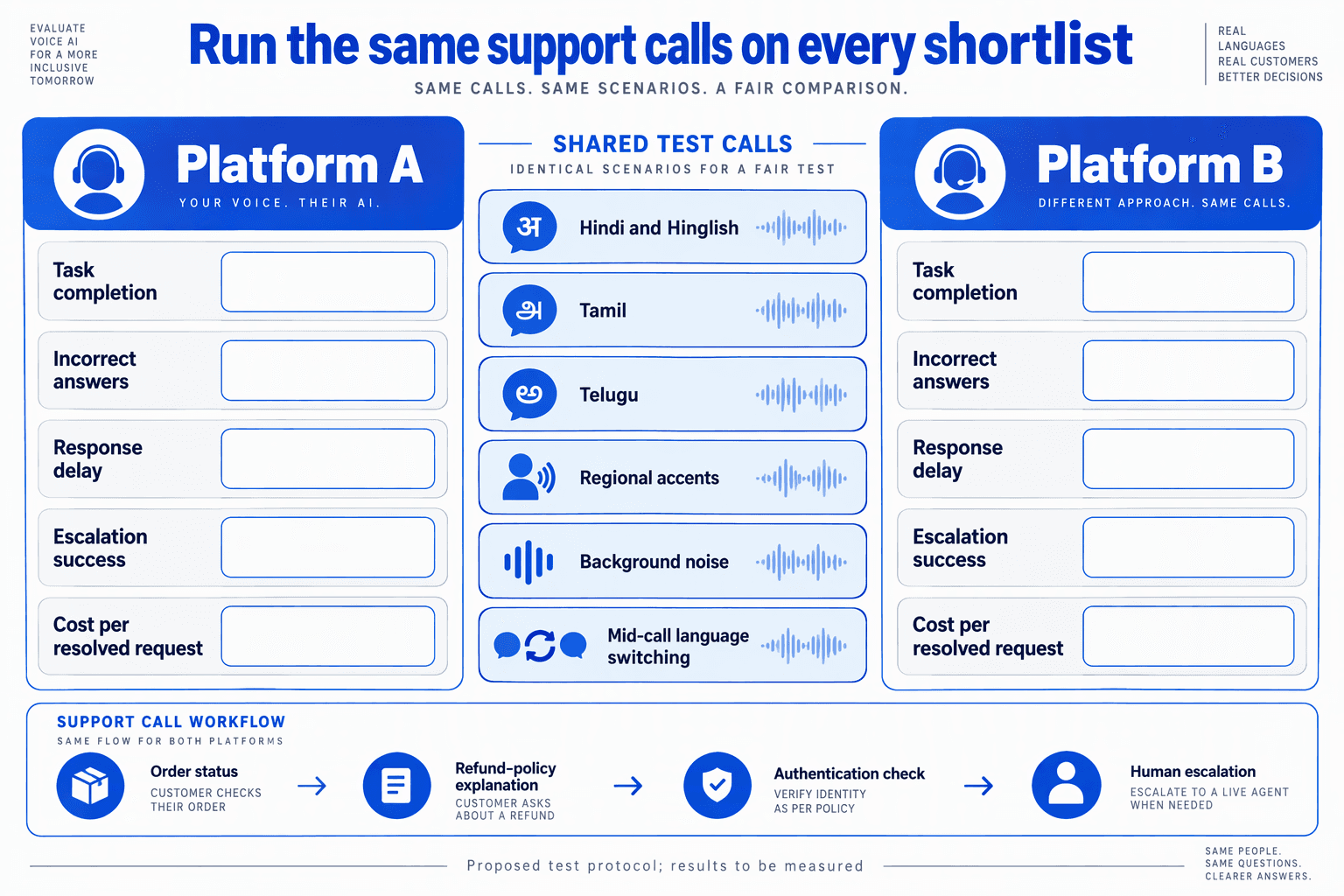
Test Hindi, Tamil and Telugu on identical support scenarios before buying, using native speakers to score outcomes. Treat language coverage as a shortlist filter—not proof that an agent can resolve your customers’ calls.
What should an Indian-language voice-agent pilot measure?
- Test set: For a November 2026 evaluation, run 90 calls per platform: 30 each in Hindi, Tamil and Telugu. Within each language, allocate 10 calls to order tracking, 10 to cancellations or refunds, and 10 to complaints. These are proposed pilot sizes, not industry benchmarks; use fictional customer records.
- Language coverage: Bolna’s comparison, reviewed in November 2026, lists 20+ languages, including Hindi, Hinglish, Tamil and Telugu. The same source reports 55 languages in Retell AI’s documentation, with coverage depending on speech and voice providers. Request the exact recognition model and voice for each language rather than accepting a platform-wide language count.
- Recognition versus speech: According to CallMissed’s verified product information, as of November 2026, CallMissed supports speech recognition in 22 Indian languages plus English, including Hinglish, and natural text-to-speech in 10 Indian languages plus English. Ask for demonstrations of your selected Hindi, Tamil and Telugu configurations: recognition coverage and spoken-output quality are separate checks.
- Code-mixing: Include five mixed-language calls within each language’s 30-call set. Try Hindi with English product names, Tamil with English delivery terminology, and Telugu with English payment references. Ask the caller to switch language after the first answer; score whether the agent preserves intent, order details and the requested response language.
- Critical details: Test six data types: customer names, order IDs, phone numbers, dates, rupee amounts and addresses. Include corrections such as “₹1,500, not ₹15,000.” Record whether the agent confirms ambiguous information before acting; a fluent response should not compensate for retrieving the wrong order or misquoting a refund amount.
- Audio and interruptions: Repeat selected scripts under three conditions: quiet room, street noise and speakerphone. Interrupt the agent during an explanation, pause before completing an order number, and speak at different speeds. Measure end-of-speech-to-first-audio delay consistently, reporting median and slowest observed responses rather than relying solely on subjective impressions.
- Support outcomes: Have two native-speaking reviewers per language score comprehension, pronunciation and resolution on a 1–5 scale. Separately mark task completion, incorrect policy statements and failed escalation. Keep model, voice, knowledge base and carrier settings documented; otherwise, configuration changes can make an apparent platform comparison misleading.
- Buying threshold: Set acceptance criteria before demonstrations—for example, at least 27 of 30 tasks completed per language, with no unauthorized refunds or invented policies. These are suggested buyer targets, not published vendor results. Compare total pilot spend divided by successfully resolved calls to connect language quality with your AI voice agent cost comparison.
Which should you choose for your budget, team and support workflow?
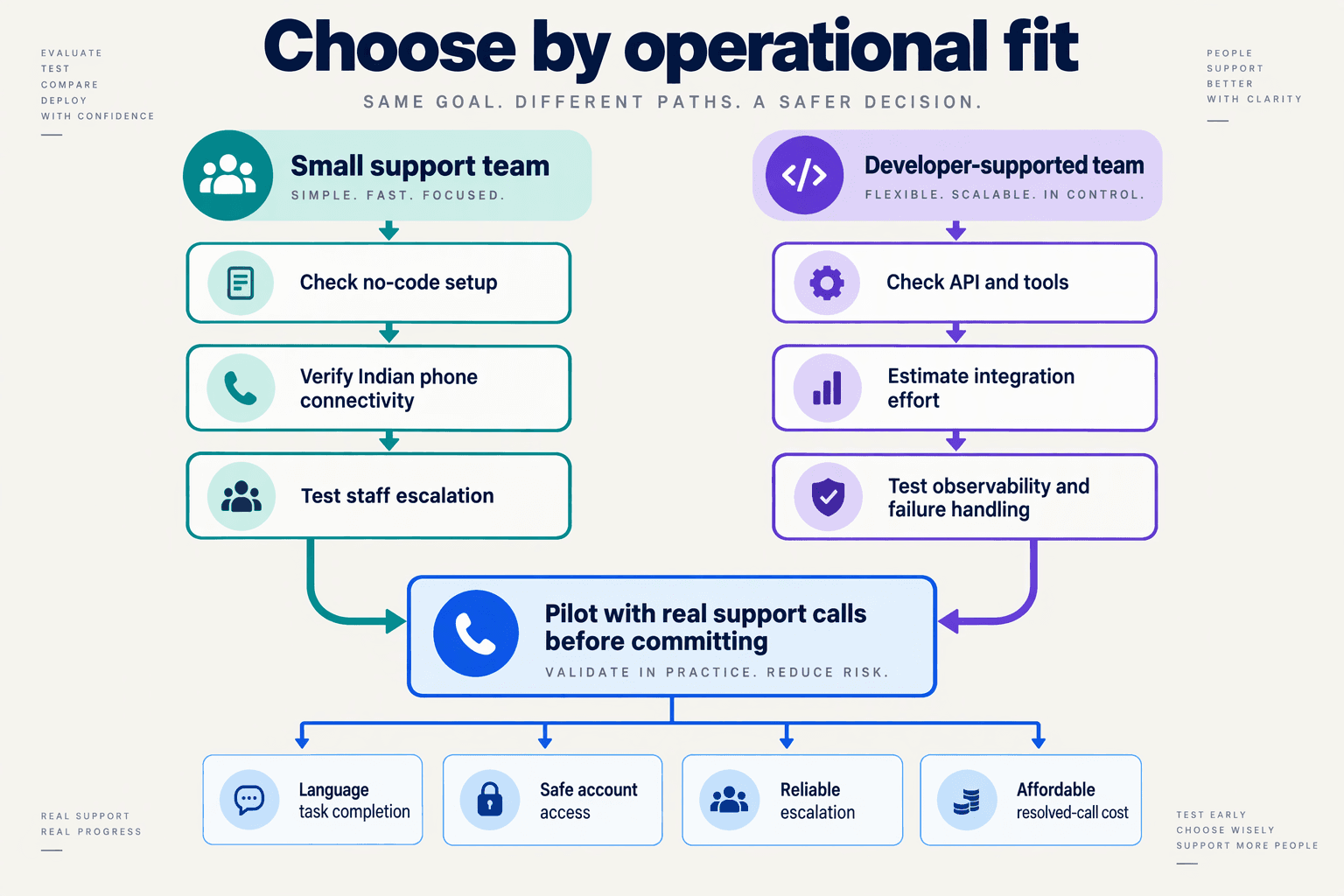
Choose the platform that fits your connected-minute budget, available engineering time and actual support workflow. Shortlist on total cost, then test language handling and resolution quality before committing.
Which platform fits your budget and team?
- CallMissed: For a support team wanting richer voices without assembling separate AI components, the Expressive plan costs ₹5/minute as of November 2026: 2,000 billable minutes means ₹10,000 before phone carriage. CallMissed’s verified product information also schedules Best latency pricing to rise from ₹6 to ₹8/minute for calls starting on or after 30 November 2026—important when forecasting December expenditure.
- Bolna: Consider Bolna when native Indian-carrier connections are a purchasing requirement. Bolna’s comparison, reviewed for November 2026, lists Plivo, Exotel and Vobiz connectivity. At its published $0.06/minute starting rate, 2,000 minutes means $120 before telephony and platform fees; request those additional charges before comparing the resulting quote with bundled alternatives.
- Retell AI: Consider Retell AI when your team wants to evaluate different model-and-voice configurations. According to Bolna’s comparison dated 26 October 2026, 2,000 minutes at Retell AI’s listed $0.07–$0.31 range would cost $140–$620 before telephony. Treat this competitor-authored comparison as a starting point and confirm your selected configuration directly with Retell AI.
- Vapi: Consider Vapi when developers will own provider selection and integration. Bolna’s 2026 India voice-AI roundup, reviewed in November 2026, lists Vapi hosting at $0.05/minute, with models and telephony charged separately. For 2,000 minutes, $100 is the hosting subtotal—not the complete budget; engineering and ongoing configuration work also belong in your internal estimate.
Which platform fits your support workflow?
- CallMissed: For teams managing conversations rather than just calls, CallMissed’s verified November 2026 information lists a no-code voice/chat builder, CRM-linked AI call notes, and supervisor listen, whisper and barge-in controls. Its WhatsApp Business Calling support lets an AI voice agent answer customer-initiated WhatsApp calls; Meta does not charge for those calls, but that does not make AI processing free.
- Regional-language support: Test the languages your customers actually use, not catalogue totals alone. Bolna’s comparison, reviewed in November 2026, describes 20+ languages and mid-call switching; it lists 55 languages for Retell AI, dependent on speech and voice providers. Use identical Hindi-English, Tamil and Telugu scenarios wherever those languages match your customer base.
- Quote-led procurement: Include Exotel when your purchasing process requires a tailored proposal. Bolna’s 2026 roundup, reviewed in November 2026, describes Exotel’s voice agents, contact centre and communication APIs but reports no public pricing figures. Request an itemised quote covering minutes, numbers, integrations and support rather than estimating an unpublished rate.
- Final selection: Run a proposed 100-call pilot using the same support questions across shortlisted platforms. Record cost per resolved enquiry, human-handoff rate and incorrect-answer rate, separating simple FAQs from order-status and escalation cases. Prefer the platform that meets your agreed quality threshold within budget—not necessarily the one advertising the lowest minute rate.
Frequently Asked Questions
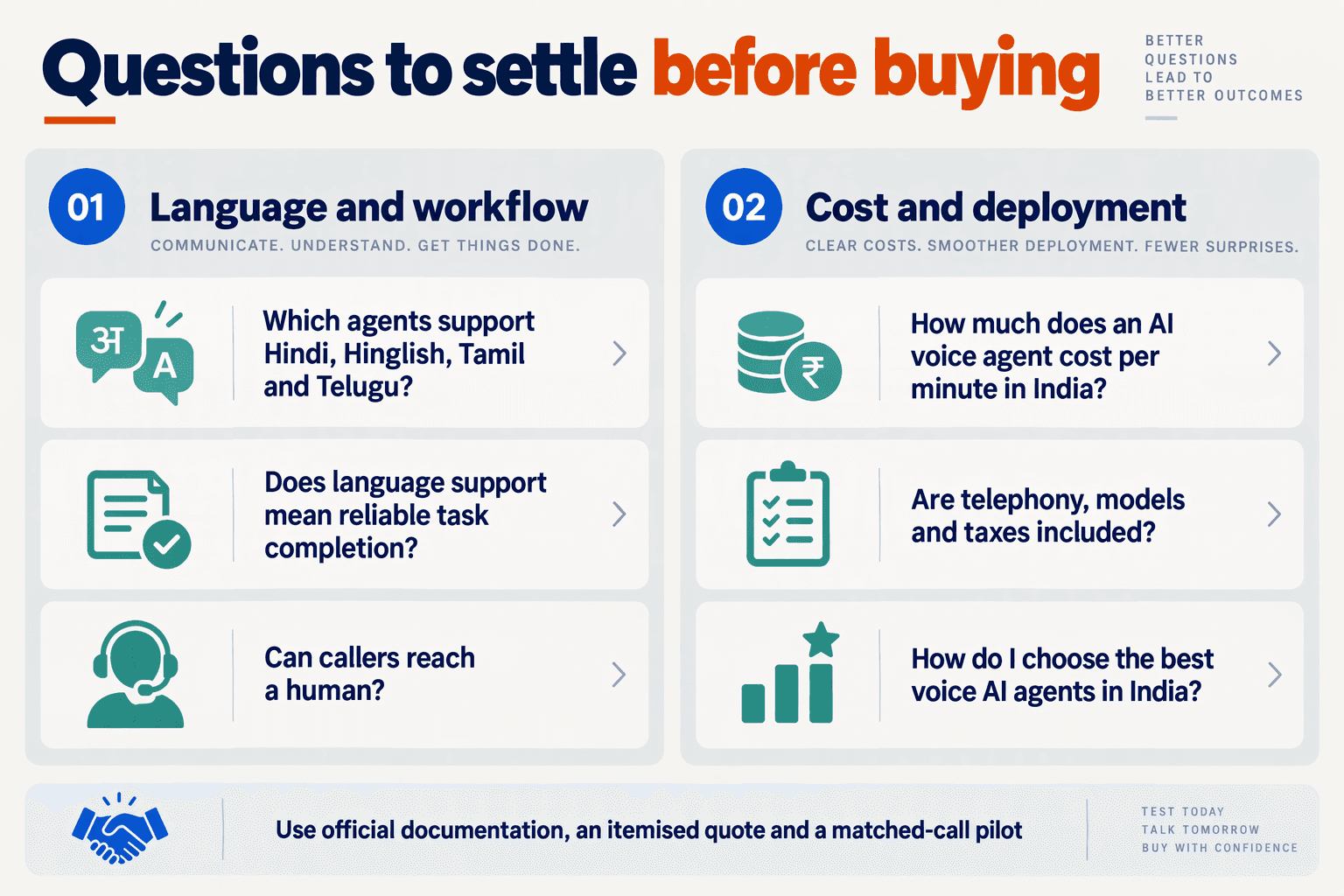
- Q: How should Indian SMBs compare Hindi, Hinglish and regional-language voice agents?
A: Compare speech recognition and spoken output separately: understanding a language does not guarantee an equally capable voice in that language. As of November 2026, CallMissed’s verified product information lists speech recognition in 22 Indian languages plus English, including Hinglish, and natural text-to-speech in 10 Indian languages plus English. Test your actual language pairs with local accents, customer names and mixed-language addresses before selecting a configuration.
- Q: What billing rules matter in an AI voice agent cost comparison?
A: Check minimum billable duration, disconnected-call treatment and whether a platform fee applies to your chosen configuration—not just the advertised minute rate. As of November 2026, CallMissed’s verified product information lists custom-stack components billed by the second without a component minimum, plus a separate ₹1-per-minute platform fee with a 30-second minimum; flat plans do not pay that fee. Its Best latency flat plan changes from ₹6 to ₹8 per minute for calls starting on or after 30 November 2026, with phone carriage separate.
- Q: Do AI voice agents support switching languages during a support call?
A: Some configurations support switching, but buyers should verify the exact recognition model and voice combination rather than relying on a headline language count. Bolna’s comparison, reviewed for November 2026, states that Bolna supports 20+ languages and mid-call switching, while listing 55 languages in Retell AI’s documentation with provider-dependent coverage. Include a test where a caller switches from Hindi to English while correcting an order number, because preserving meaning matters as much as detecting the switch.
- Q: Can an AI voice agent platform use an Indian business phone number?
A: Check separately whether the platform sells Indian numbers, connects your existing carrier and supports the required compliance process. Bolna’s comparison, reviewed for November 2026, lists native Plivo, Exotel and Vobiz connections and Indian-number purchasing through Plivo or Vobiz after compliance checks. The same source says numbers sold directly by Retell AI are US and Canadian numbers; that is not equivalent to saying Indian connectivity is impossible.
- Q: How do I make an AI voice agent cost comparison for short calls?
A: Calculate charges per call before aggregating monthly minutes, because billing minimums can distort short-call economics. In an illustrative November 2026 calculation, 100 calls lasting 10 seconds total approximately 16.7 actual minutes, but a hypothetical 30-second minimum produces 50 billable minutes. Apply each vendor’s actual rounding rules and carrier charges separately.
- Q: Which AI voice agent platform should an Indian SMB choose for customer support?
A: Shortlist around your required languages, Indian-number arrangement, support integrations and available implementation skills—not a universal winner. Run the same dated pilot script across candidates, covering order lookup, address correction, interruptions and escalation. Compare completed resolutions and total pilot spend, and request written confirmation of pricing, billing rules and deployment requirements before committing.
Conclusion
The practical conclusion of this AI voice agent cost comparison is that Indian SMBs should compare complete support costs, not advertised rates alone. As of November 2026, bundled and modular platforms require different budgeting calculations, and neither pricing structure automatically guarantees the lowest monthly bill.
- Compare the full stack before comparing prices. Speech recognition, the language model, speech generation, telephony, and platform fees all belong in the calculation. According to Bolna’s comparison dated 26 October 2026, Retell AI listed voice-agent rates of $0.07–$0.31 per minute, with telephony adding $0.015 per minute in listed countries. That country qualification matters: a published connectivity rate should not be assumed to apply to an Indian deployment without confirmation. Ask each shortlisted provider to identify included components and separately billed services.
- Calculate costs against your actual support workload. A business expecting 1,000 connected support minutes per month will spend an additional ₹1,000 for every ₹1-per-minute difference, before other charges. But connected minutes are only the starting point: minimum call durations, number rental, carrier charges, and the treatment of unconnected calls can change the final bill. Compare providers using the same expected call volume and duration profile, rather than comparing one platform’s bundled rate with another platform’s infrastructure-only charge.
- Balance pricing transparency with deployment fit. As of November 2026, CallMissed’s verified product information lists its Standard voice-agent plan at ₹4 per minute, covering speech recognition, the language model, and the voice; phone carriage remains separate, and a 30-second minimum applies per call. This provides a concrete bundled option to explore—not proof that every workload will cost less. Evaluate the complete configuration alongside the Indian-language coverage, integrations, and deployment work your support operation requires.
- Confirm published figures before committing. According to Bolna’s comparison dated 26 October 2026, Bolna’s bundled-model starting rate was $0.06 per minute, with telephony and a platform fee charged separately. The useful takeaway is not that one headline number wins, but that similar-looking rates can describe different purchases. Request a worked monthly estimate that separates AI processing, connectivity, and billing rules, then check whether the estimate reflects the model and voice you actually intend to deploy.
What should Indian SMBs watch next?
As AI voice offerings evolve, watch for changes in included components, model-and-voice pricing, carrier charges, and language coverage—the factors that can alter both affordability and operational fit. Explore CallMissed alongside other shortlisted platforms, and revisit the same workload-based calculation whenever pricing or configurations change.
Before choosing, can you explain what every minute of your customer-support bill includes—and what it leaves out?
Related Reading
- AI Voice Agent for Insurance India: Rules and Cost (2026)
- Twilio Voice Pricing in 2026: What an AI Agent Really Costs
- AI Voice Agent for Clinics India: Hindi Booking Guide 2026