AI Voice Agent for Insurance India: Rules and Cost (2026)



Buyer's guide to an AI voice agent for insurance India and NBFC lead follow-up: which rules apply, what needs a licensed human, and per-minute cost.
AI Voice Agent for Insurance India: Rules and Cost (2026)
An AI voice agent for insurance India can pass every TRAI check, from DLT registration to DND scrubbing, and still expose its owner to legal risk. According to SquadStack, a business can clear those telecom rules and still face exposure under the Digital Personal Data Protection (DPDP) Act 2023 if it lacks explicit data consent. For insurers, brokers and NBFCs, that gap is the difference between a lead-follow-up engine and a compliance headache.
The business case is easy to see. Insurance and lending leads go cold quickly, and human tele-callers can't call every inquiry within minutes, in the customer's own language, at 9 PM. An AI voice agent can. But as of October 2026, no single regulation governs the practice. As YuVerse.ai notes, there is no single "outbound calls" rule from the Insurance Regulatory and Development Authority of India (IRDAI). Several instruments together govern telecalling, including its Guidelines on Distance Marketing of Insurance Products, which say call hours must follow TRAI and DoT orders. Caller Digital adds that IRDAI's outsourcing guidelines (2017, updated 2023) apply to automated communication with policyholders. Layer on TRAI's DLT, DND and 140-series number rules, plus RBI expectations for NBFCs, and the regulatory map gets crowded fast.
Cost is the other half of the equation. Per-minute pricing varies widely, and the sticker rate rarely includes phone carriage, minimum call durations or the language model behind the voice. Platforms such as CallMissed, for example, offer Indian-language voice agents from ₹4 a minute (as of October 2026), with carriage billed separately, which shows why the real number depends on how you build.
This guide walks you through both sides of the decision:
- Consent: what DPDP-grade consent looks like for lead follow-up, and when a customer's inquiry is enough.
- TRAI rules: DLT registration, DND scrubbing, calling hours of 9 AM to 9 PM, and honoring opt-outs.
- IRDAI and NBFC obligations: what to say, what not to claim, and how to handle call recordings.
- Per-minute cost: a realistic 2026 budget, including the line items vendors tend to leave out.
By the end, you'll know what to ask your vendor and how to estimate what each qualified lead will cost.
Can an AI voice agent handle insurance and NBFC lead follow-up in India?
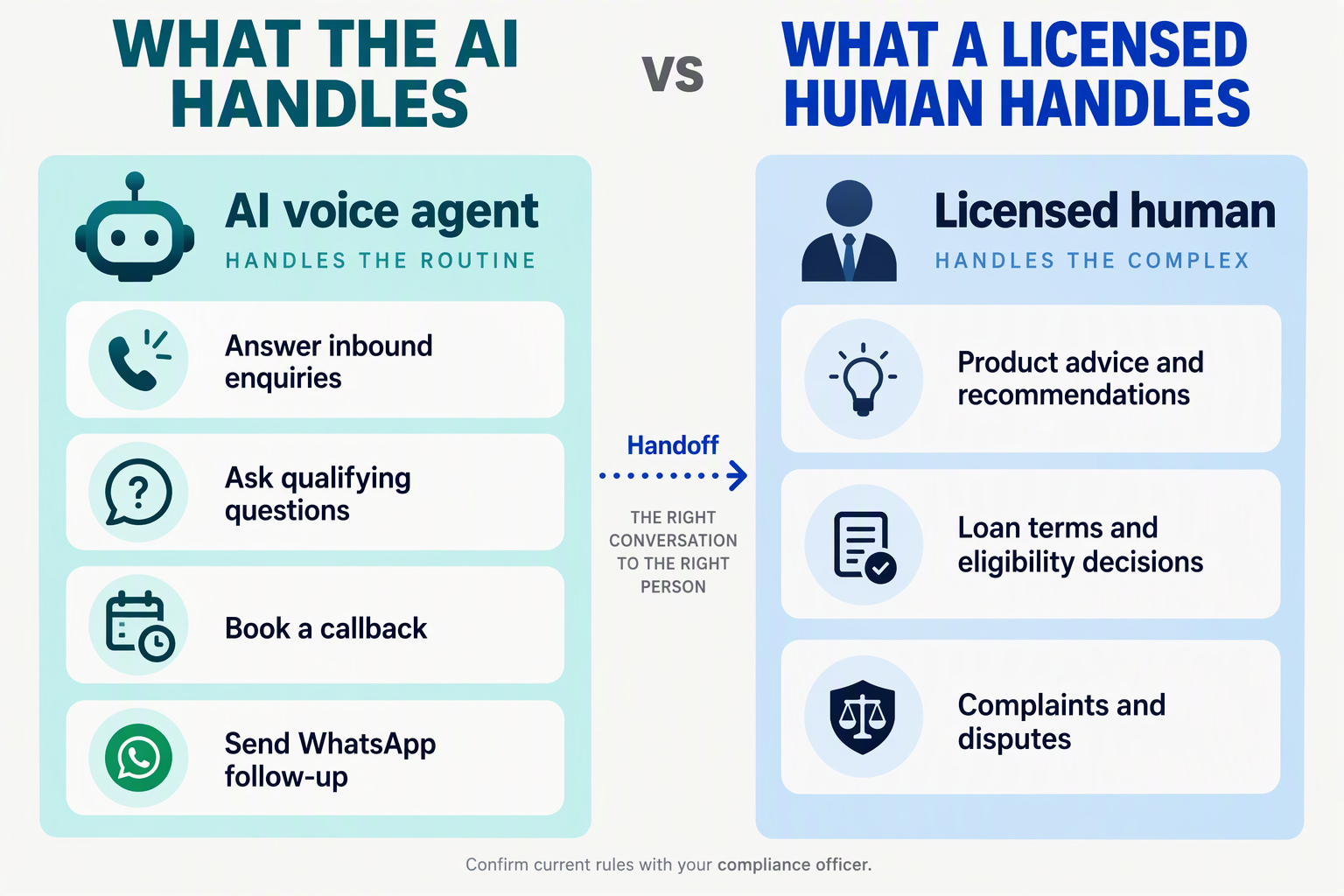
Yes. An AI voice agent can handle the first-touch and follow-up layer of insurance and NBFC lead management in India, provided it is built to qualify and hand off rather than to sell or advise. As of October 2026, the safest design is a narrow, scripted agent that calls leads who have already inquired, confirms their interest, collects a few facts and passes the warm ones to a licensed human.
What can an AI voice agent do in lead follow-up?
The strongest use cases are repetitive, time-sensitive and low-risk:
- Instant inquiry callbacks: calling a web-form or ad lead within minutes, before a competitor does.
- Qualification: asking age bracket, city, loan amount or existing cover, and capturing answers as structured fields.
- Renewal and EMI reminders: informing existing customers of due dates in their preferred language.
- Appointment booking: fixing a slot for a licensed advisor or loan officer.
- Document nudges: reminding applicants about pending KYC or income proofs.
Language is a practical advantage. Platforms like CallMissed offer speech recognition in 22 Indian languages plus English, including code-mixed speech such as Hinglish, and natural text-to-speech voices in 10 Indian languages plus English. For lenders serving Tier 2 and Tier 3 markets, that range decides whether a lead actually understands the call.
What should stay with a human?
Regulators draw the line at advice and persuasion. The Economic Times, reporting on IRDA's distance-marketing guidelines, noted that telecallers should ascertain whether customers are interested in continuing the conversation. That is a natural fit for an agent that asks "Is this a good time?" and ends politely on a no.
EchoLeads adds that insurance outbound calling must avoid misleading claims during initial contact. So keep these with a person:
- Product recommendations and premium or return illustrations.
- Underwriting, eligibility and interest-rate commitments.
- Complaints, disputes and distress or collections conversations.
- Anything a customer asks to discuss with a human.
What does a workable follow-up flow look like?
A typical flow has four steps:
- A lead arrives from a form, WhatsApp or CRM with a recorded inquiry and consent trail.
- The agent places a single outbound call, discloses that it is an AI assistant and confirms the customer wants to continue.
- It asks three to five qualifying questions, using keypad (DTMF) options where a tap is more reliable than speech.
- It transfers warm leads to a person or books a callback, then writes a summary, disposition and follow-up task into the CRM.
CallMissed supports this pattern with inbound and outbound phone calls, a Twilio-compatible Calls API, AI call notes pushed to the CRM, and squads that hand a live call from one agent to another. Note that CallMissed handles single outbound calls and click-to-call. It does not offer automated outbound calling campaigns, so a lead-triggered call from your own system is the right mental model, not a bulk dialer.
Where does it break down?
Voice agents fail in predictable ways: poor consent records, calls outside permitted hours, scripts that drift into advice, and weak escalation. None of these are technology limits. They are design and governance choices, which is why the next sections separate what the law requires from what a vendor claims.
What do you need in place before deploying a voice agent for insurance or loan leads?
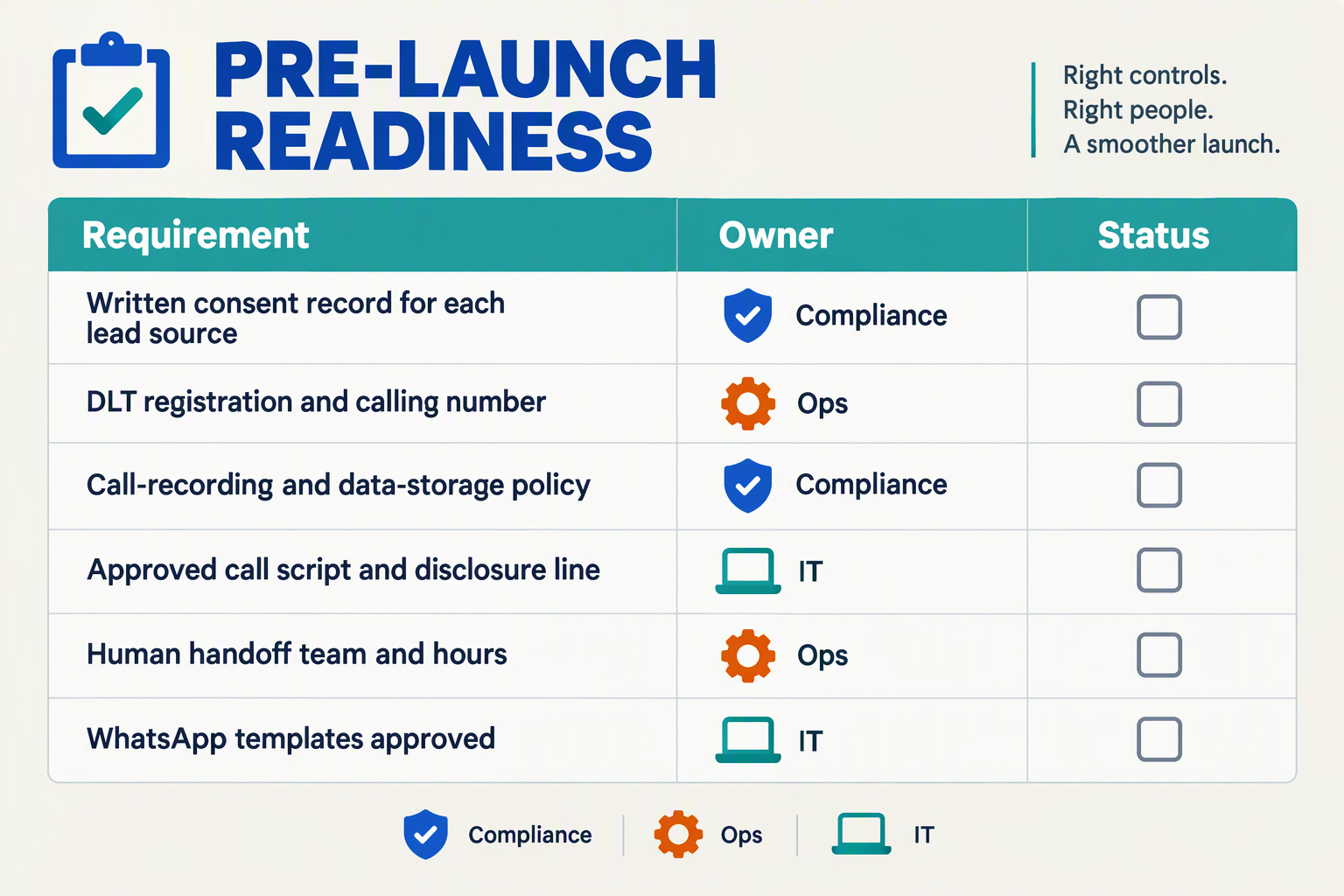
Before deploying a voice agent for insurance or loan leads, you need seven things in place: telecom registration, DND scrubbing, a consent record, call-hour controls, an approved script, a recording and data policy, and a human handoff path. As of October 2026, no single regulator issues one checklist, so the table below combines the requirements that Caller Digital, SquadStack and YuVerse.ai describe across TRAI, DPDP and IRDAI.
What is the pre-launch compliance checklist?
| Requirement | What it means in practice | Owner | Evidence to keep |
|---|---|---|---|
| TRAI DLT registration | The principal entity registers on the DLT platform. Headers (sender IDs) and templates are registered separately, according to Caller Digital. | Your business or client | DLT entity ID, header and template approvals |
| DND scrubbing and number series | Scrub lead lists against the DND registry and use 140-series numbers for promotional calling, per SquadStack. | Business and carrier | Scrub logs with dates |
| DPDP-grade consent | The DPDP Act 2023 adds explicit data consent obligations on top of TRAI rules, SquadStack notes. | Business (data fiduciary) | Timestamped consent text, source form, lead ID |
| Call-hour controls | Call only between 9 AM and 9 PM. IRDAI's distance marketing guidelines defer to TRAI and DoT orders on hours, as The Economic Times reported. | Business and platform | Call logs with timestamps |
| Approved script and disclosures | The agent should check whether the customer wants to continue, and avoid misleading claims on first contact. EchoLeads flags this under IRDAI's policyholder-protection rules. | Compliance team | Versioned script with sign-off |
| Recording and data handling | Recordings and transcripts are personal data. IRDAI's outsourcing guidelines (2017, updated 2023) apply to automated policyholder communication, per Caller Digital. | Business and vendor | Retention policy, vendor agreement |
| Human handoff and opt-out | Honor opt-outs and route interested or confused leads to a licensed person. | Operations | Opt-out list, handoff logs |
Which of these items do teams most often skip?
Teams most often skip the consent record. SquadStack warns that a business can pass the DLT and DND checks and still face DPDP exposure if consent is missing. A lead who filled in a web form is not automatically a lead who agreed to be called by an automated agent, so the form wording matters.
The second gap is the audit trail. A regulator or an internal audit asks for evidence of what was said, when and under which consent, and a policy that exists only in a slide deck won't satisfy them.
How should you map the checklist to your platform?
Ask your vendor to show where each row lives in the product:
- Script control: can you version, approve and roll back the agent's prompt?
- Carrier flexibility: can you use your own DLT-registered carrier or SIP trunk?
- Records: are recordings, transcripts and call notes stored and exportable?
- Escalation: can a live call or thread move to a human?
- Language coverage: does speech recognition handle code-mixed speech such as Hinglish?
Platforms such as CallMissed cover several of these. The no-code builder has publish-and-rollback versioning, and you can bring your own carrier (Twilio, Plivo or any SIP trunk). Calls produce recordings, transcripts and AI call notes pushed to your CRM, and speech recognition covers 22 Indian languages plus English. Outbound is lead-by-lead single calls and click-to-call, which suits an inquiry-callback design. The platform is hosted in India, which can simplify data-location questions for your counsel.
Treat the table as a starting point, not legal advice. NBFCs in particular should confirm RBI expectations on recovery and customer-contact conduct with their compliance officer before the first live call.
Which rules apply to which call type: inbound, outbound, renewal and WhatsApp?
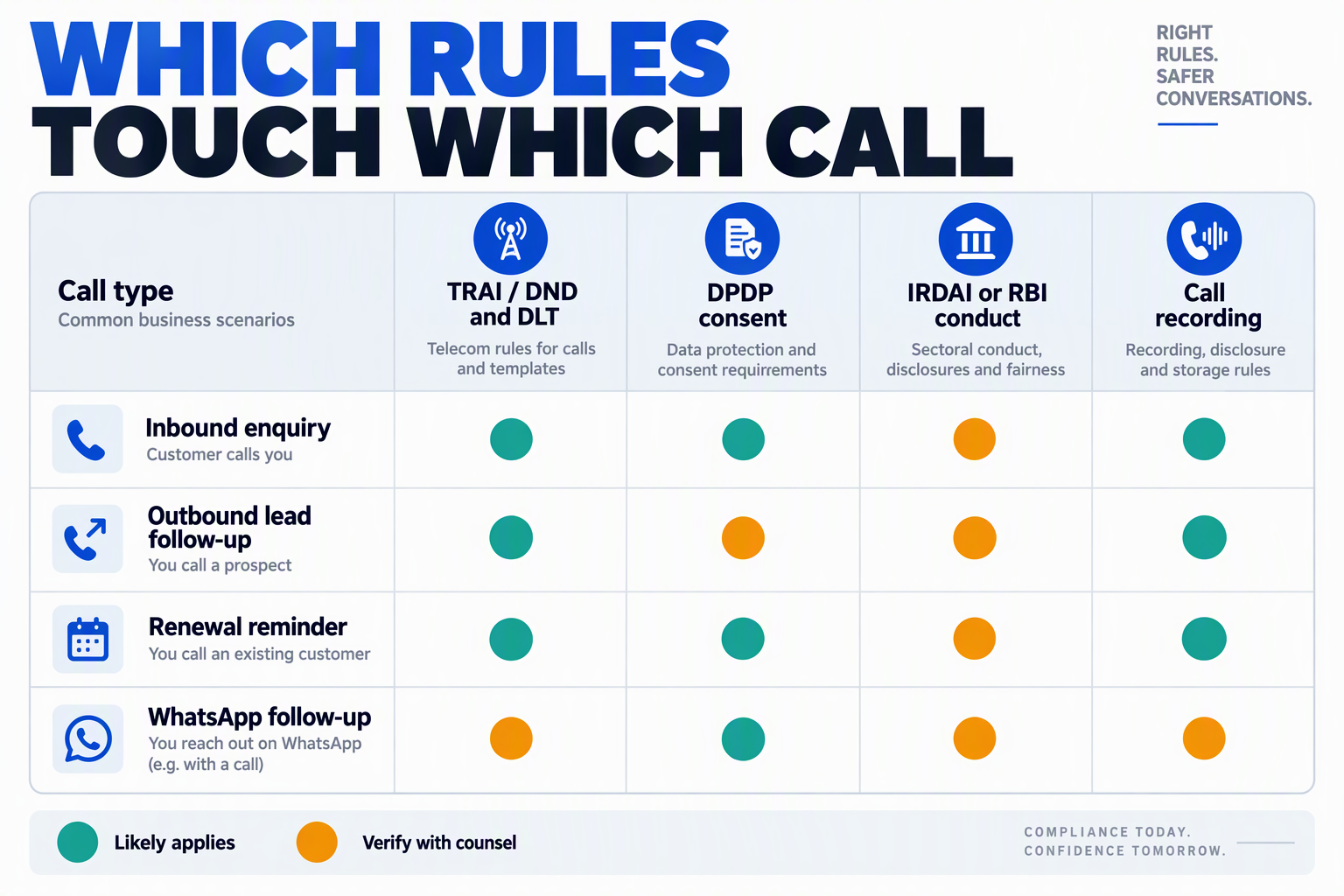
The rules depend on who starts the contact and why. Inbound calls carry the lightest telecom burden, outbound lead calls carry the heaviest, renewal calls sit in between, and WhatsApp follows Meta's policies rather than TRAI's telecom rules. As of October 2026, treat the DPDP Act 2023 as the common layer under all four.
Which rules apply to inbound calls?
When a customer dials you, DLT and DND scrubbing matter far less, because those rules govern outbound commercial communication. Caller Digital describes TRAI DLT as "the outbound layer," where the principal entity registers and then registers headers and templates separately.
Inbound still carries obligations:
- Disclose the AI and any recording at the start of the call.
- Collect only what you need, with a clear notice of purpose under DPDP.
- Avoid misleading claims. EchoLeads notes IRDAI's policyholder-protection rules bar misleading statements during initial contact.
Which rules apply to outbound lead follow-up calls?
Outbound lead calls face the full stack. According to SquadStack, the TRAI checklist is to register on DLT, scrub against DND, use 140-series numbers, call only between 9 AM and 9 PM, and honor opt-outs.
IRDAI adds two points for insurers and brokers. Its distance-marketing guidelines, reported by The Economic Times, say call hours must follow TRAI and DoT orders, and that telecallers should ascertain whether the customer is interested in continuing. Build that check into the script as an early "Is this a good time?" step. Where a third-party vendor runs the calls, Caller Digital notes IRDAI's outsourcing guidelines (2017, updated 2023) apply too.
For NBFCs, the same telecom and DPDP layers apply, with RBI expectations on top. Keep the agent to qualification and handoff, as covered earlier.
Do renewal reminders follow different rules?
Renewal calls go to existing policyholders, so the relationship and the data already exist. That usually makes them service-style communication, and IRDAI's outsourcing rules apply directly because the agent is speaking to policyholders on the insurer's behalf.
The risk appears when a renewal call pivots to cross-sell. At that point it starts to resemble promotional contact, and the stricter checks on DND, consent and calling hours matter more. Our practical advice is to keep renewal scripts to reminders, payment links and status, and route any new-product pitch through a separate, consented flow.
How does WhatsApp change the compliance picture?
WhatsApp runs on Meta's platform, not the telecom network, so DLT header and template registration is not the governing mechanism. Meta's Business policies apply instead. Business-initiated messages need an opted-in customer and approved templates, and DPDP consent still applies. Confirm the exact boundary with your counsel.
WhatsApp Business Calling is the new piece. Customers can call your business on WhatsApp, and an AI voice agent can answer. Businesses can call only customers who have given permission, and Meta does not charge for calls customers start. Platforms such as CallMissed support this through the official Meta Cloud API.
Quick comparison
| Call type | Heaviest rules | Main watch-out |
|---|---|---|
| Inbound | DPDP notice, recording disclosure, IRDAI conduct | AI and recording disclosure |
| Outbound lead | DLT, DND, 9 AM to 9 PM, opt-outs, DPDP | Consent evidence |
| Renewal | IRDAI outsourcing, DPDP | Cross-sell drift |
| Meta opt-in and templates, DPDP | Permission before business-initiated calls |
Where is the line between what the AI can say and what must go to a licensed human?

The AI voice agent can say anything factual, neutral and already public, and it can collect information. Anything that recommends a product, interprets terms, quotes a binding price or promises an outcome should go to a licensed human. As of October 2026, this is a design principle rather than a single rule, because, as YuVerse.ai notes, IRDAI has no single "outbound calls" regulation. Several instruments apply together, so the safest approach is a conservative script boundary. Confirm the exact limits with your compliance counsel.
What can an AI voice agent safely say on an insurance or NBFC call?
Keep the agent to disclosure, confirmation and information gathering:
- Identity and purpose: who is calling, on behalf of which company, and that it is an automated assistant.
- Permission to continue: the Economic Times, reporting on IRDAI's distance-marketing guidelines, notes that telecallers should ascertain whether customers are interested in continuing. Build this check into the first 20 seconds, and end the call politely on a "no."
- Qualifying questions: age band, city, product category, preferred callback time and language.
- Public, factual information: office addresses, documents generally required, how to reach customer care.
- Scheduling: booking a slot with a licensed advisor or loan officer.
What must go to a licensed human?
Treat these as hard handoff triggers:
- Product recommendations: "Which plan is right for me?" is advice, not qualification.
- Benefit, return or claim assurances: EchoLeads flags that IRDAI-aligned outbound calling must avoid misleading claims during initial contact, and an AI improvising here is the highest-risk failure mode.
- Interpreting policy terms: exclusions, waiting periods, surrender values and free-look rights.
- Loan specifics: a personalised interest rate, eligibility verdict, processing fees or approval promises.
- Complaints, distress or financial hardship: hand these to a person immediately.
- Any request for a human, said in any form or language.
How do you build the handoff so it holds up?
- Write a whitelist, not a blacklist. Give the agent a short list of permitted topics, and make everything else trigger "I'll have a licensed advisor call you."
- Ground answers in an approved knowledge base. Retrieval from compliance-reviewed text keeps the agent from improvising on terms.
- Hand over the context. The advisor should receive a summary, the lead's stated needs and the consent record, so the customer doesn't repeat themselves.
- Audit the calls. Sample recordings and score them against a rubric for forbidden phrases and missed disclosures.
Platforms such as CallMissed support this pattern. Its AI call notes produce a summary, action items, disposition and follow-up pushed to the CRM, and call scoring runs against your own QA rubrics. Supervisors can also listen to live calls, whisper or barge in. Its knowledge base (RAG) can be built from text, web pages and PDFs, which suits a reviewed script and product sheet.
Is "the AI never advises" enough?
No. A customer can lead the agent toward advice, so test with adversarial scenarios such as "Just tell me, is this plan good?" before launch. Re-test whenever the prompt or model changes. The goal is an agent that is helpful about process and firm about boundaries. If you document the boundary, the consent basis and the handoff rule, you can show a regulator or auditor why each call stayed on the right side of the line.
How do you build a lead follow-up flow step by step, from first call to WhatsApp message?
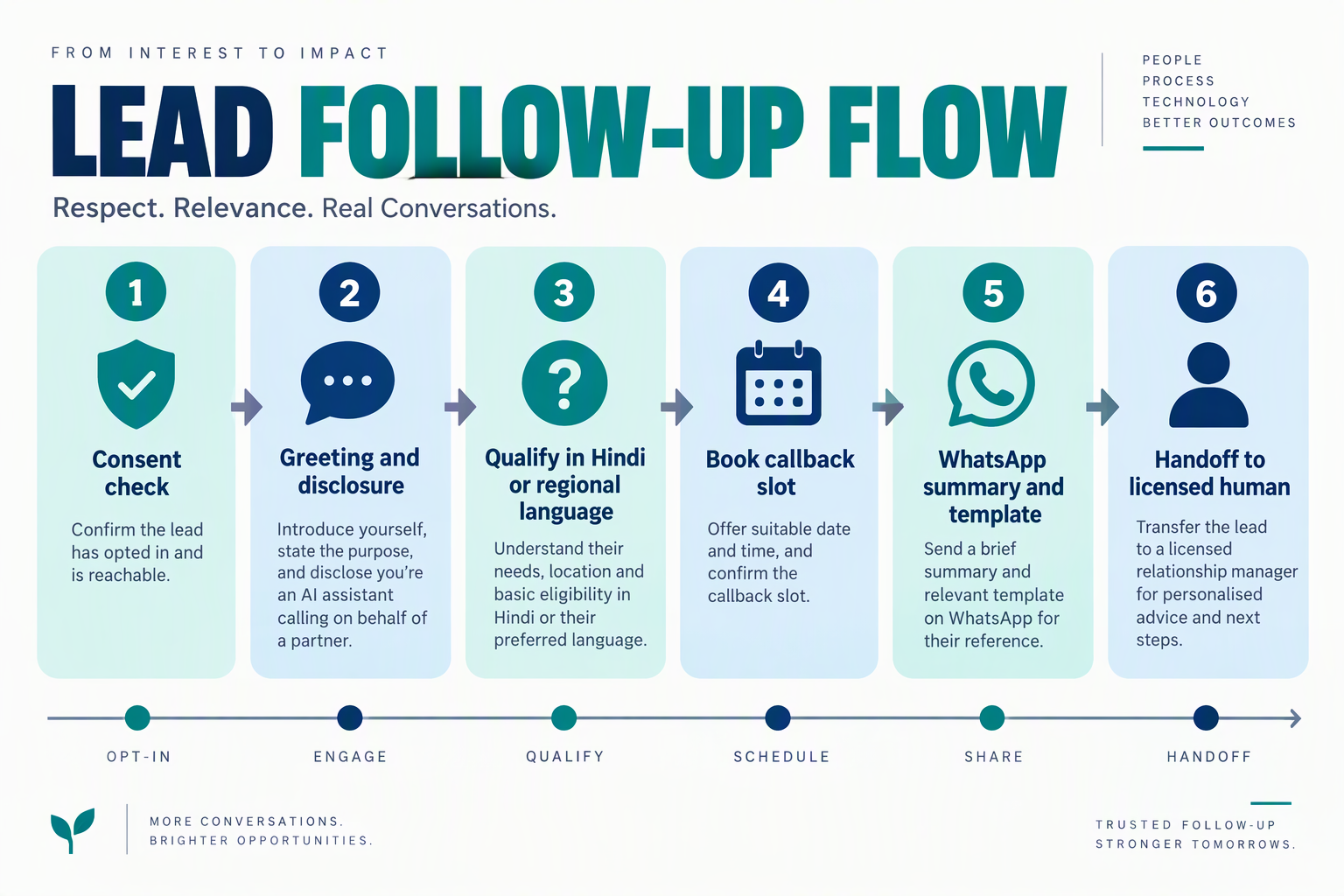
A compliant lead follow-up flow runs in six steps: capture consent, pre-screen the lead, place one outbound call, qualify and hand off, send a WhatsApp message, then log and audit everything. As of October 2026, here is how that looks in practice, using CallMissed, the Indian AI voice and WhatsApp platform, as the worked example.
Step 1: How do you capture the lead and consent at source?
Add consent wording to the web form or ad lead form. Store the timestamp, the exact text shown and the lead source in the CRM. CallMissed's built-in CRM supports custom fields, and CSV import uses AI column mapping, so consent data can travel with each contact. This record is what answers the DPDP exposure SquadStack warns about, which can remain even when TRAI checks pass.
Step 2: What checks should run before the call?
Run these in your own system before any call is triggered:
- DND scrub against the customer preference registry.
- Calling window: per SquadStack, calls are allowed only between 9 AM and 9 PM.
- Number and DLT setup: use 140-series numbers where required. According to Caller Digital, DLT headers and templates are registered separately, so confirm both before launch.
- Opt-out flag: suppress anyone who has previously declined.
Step 3: How do you trigger the outbound call?
Trigger one call per qualified lead from your CRM or backend. CallMissed supports single outbound calls and click-to-call, and its Twilio-compatible Calls API means teams on Twilio can switch by changing the base URL and credentials. You can use a rented number or bring your own carrier (Twilio, Plivo or any SIP trunk). It does not offer automated outbound calling campaigns, so your own system decides who gets called and when.
Step 4: What should the agent say and do on the call?
Keep the script narrow. The agent should:
- Disclose that it is an AI assistant, name the company and state the purpose.
- Ask if the customer wants to continue. The IRDAI distance marketing guidelines, as reported by The Economic Times, say telecallers should ascertain whether customers are interested in continuing.
- Qualify with a few variables: age band, city, product interest, preferred callback time.
- Avoid misleading claims. EchoLeads notes IRDAI expects transparent terms and no misleading claims during initial contact. Ground answers in a knowledge base (RAG) built from approved product PDFs.
Warm leads go to a licensed human. Supervisors can listen, whisper or barge in on live calls.
Step 5: How does the WhatsApp message follow the call?
Once the call ends, send a Meta-approved WhatsApp template through the official Cloud API. A typical message covers a summary of what was discussed, a document checklist and a booking link. CallMissed's WhatsApp Flows can collect KYC-adjacent details in a multi-screen in-chat form. If the lead replies, the shared inbox lets a human take over by switching the AI off.
Step 6: How do you log and audit the flow?
Every call should produce a recording, transcript and AI call notes (summary, action items, disposition, follow-up) pushed to the CRM. Score calls against your own QA rubric to catch script drift. Outbound webhooks can notify your compliance system when a lead opts out, so suppression takes effect immediately.
Budget note: CallMissed voice plans start at ₹4 a minute with a 30-second minimum per call, and a call that never connects costs nothing. Phone carriage is billed separately.
How much does an AI voice agent cost per minute in India, and what is the real monthly bill?
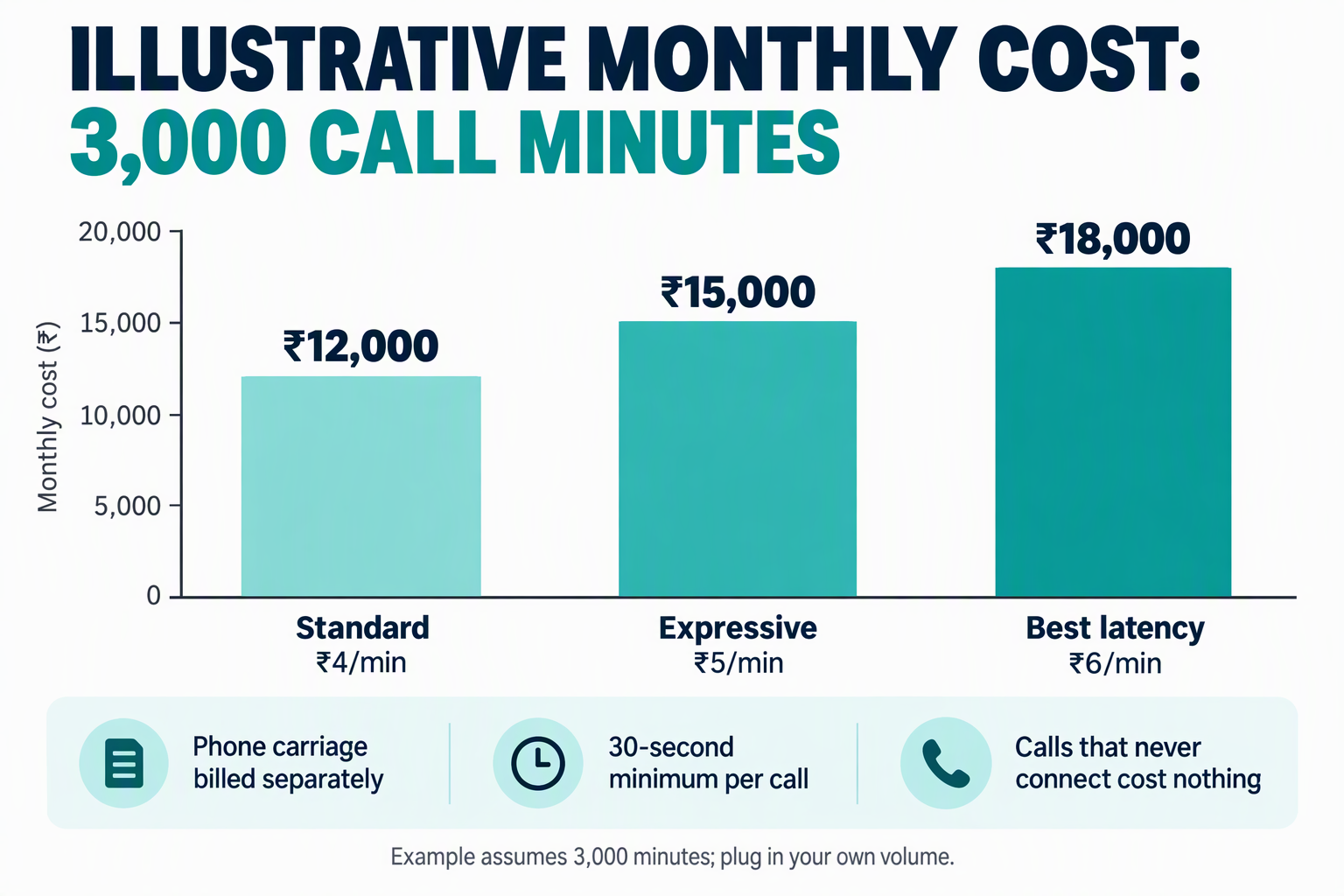
As of October 2026, an AI voice agent in India typically costs about ₹4 to ₹6 per minute on a flat-rate platform, but the real monthly bill is that rate multiplied by billable minutes, plus phone carriage and the compliance overhead around the calls. The sticker price is only one line of the budget.
What does a flat per-minute rate include?
CallMissed, the Indian AI customer-communication platform, publishes three voice-agent tiers, each a single rate that covers speech recognition, the language model and the voice:
- Standard, ₹4/min: natural Indian-language voices at the lowest price.
- Expressive, ₹5/min: richer voices across Indian and world languages.
- Best latency, ₹6/min: the fastest replies and the best-sounding voices.
Two billing rules matter more than the headline number. There is a 30-second minimum per call, and a call that never connects costs nothing. Phone carriage is billed separately, so ask your carrier or SIP provider for that quote. Teams that want control can build a custom stack and pay each component by the second with no minimum.
What does 1,000 leads a month actually cost?
The figures below are an illustrative model, not a benchmark. Swap in your own numbers.
Assumptions: 1,000 inquiry leads a month, 70% of calls connect (700 calls), 500 of those are full conversations averaging 3 minutes, and 200 are short hang-ups billed at the 30-second minimum.
- Full conversations: 500 × 3 min = 1,500 minutes.
- Short calls: 200 × 0.5 min = 100 minutes.
- Total billable voice minutes: 1,600.
| Tier | Rate | Monthly voice cost |
|---|---|---|
| Standard | ₹4/min | ₹6,400 |
| Expressive | ₹5/min | ₹8,000 |
| Best latency | ₹6/min | ₹9,600 |
If 15% of leads (150) qualify for a licensed human, the voice cost per qualified handoff is roughly ₹43 at Standard and ₹64 at Best latency. For loan and insurance leads, that is often well below the cost of the sales-agent time it saves, though your own conversion data should decide that.
What costs are easy to miss?
Voice minutes are rarely the whole bill. Budget separately for:
- Carriage: telecom charges for each connected call, quoted by your carrier. CallMissed supports rented numbers or your own carrier (Twilio, Plivo or any SIP trunk).
- Retries: a second attempt on an unanswered lead costs nothing on CallMissed if the call never connects, but a retry that connects bills at least 30 seconds.
- Compliance work: DLT registration, DND scrubbing and consent records, as covered earlier in this guide.
- Taxes: confirm how GST appears on the invoice. CallMissed issues GST invoices and accepts UPI, cards and net banking.
- Human closers: the licensed staff who take over warm leads.
How should you pick a tier and pilot it?
Start with Standard if your callers speak Hindi, Hinglish or a regional language, since speech recognition covers 22 Indian languages plus English, including code-mixed speech. Move up only if call tests show a quality or latency gap that costs you conversions.
CallMissed gives 1,000 free credits on signup (1 credit = ₹1), which at ₹4 a minute is roughly 250 Standard minutes, enough to test a script before committing. Note that CallMissed supports single outbound calls and click-to-call, not automated outbound campaigns, so plan to trigger each follow-up call from your CRM or lead event.
What advanced tips improve conversions and keep a voice bot on the right side of the rules?
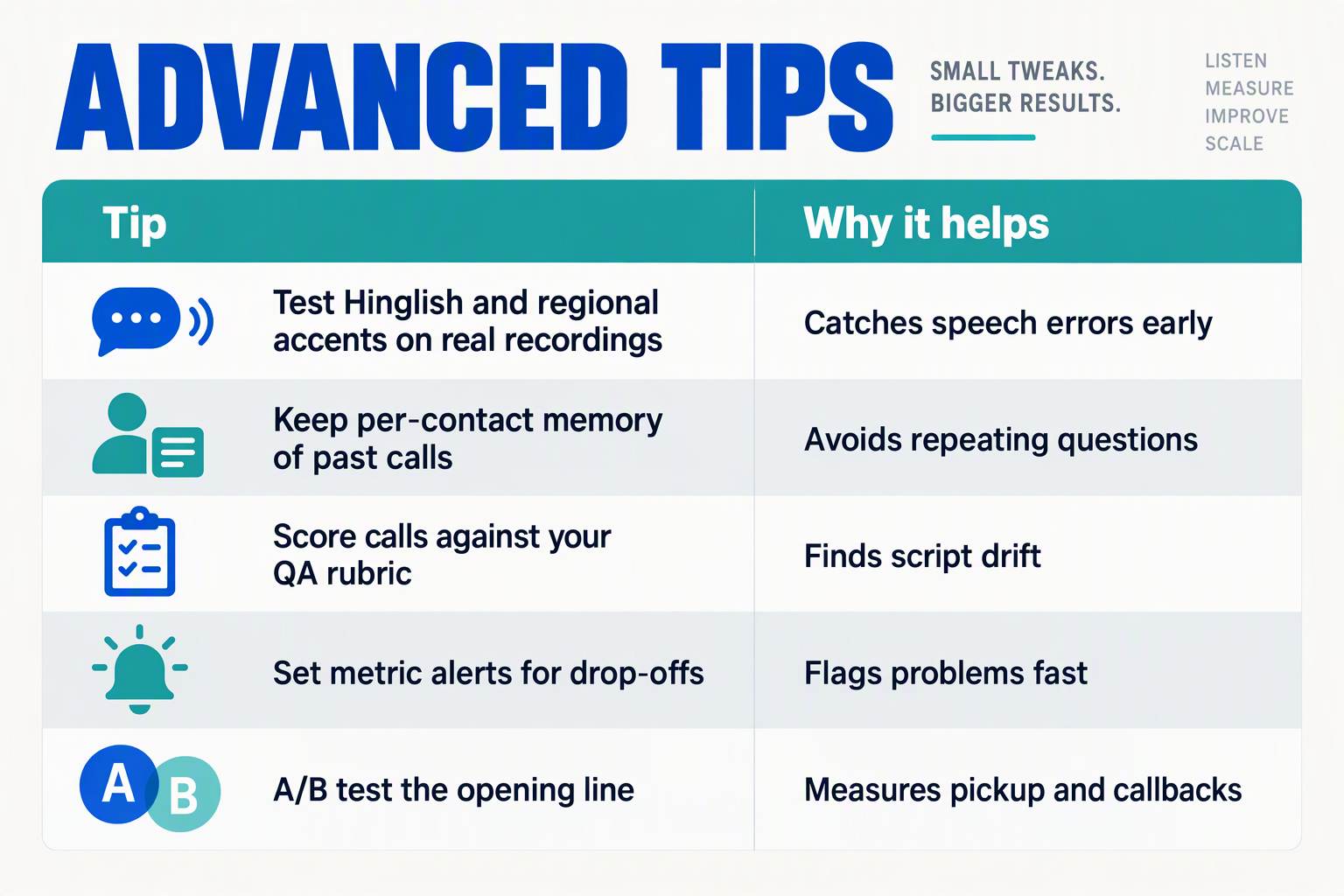
Three habits do most of the work: call fast, confirm consent and interest early, and hand off before the conversation turns into advice. As of October 2026, the same controls that protect you under TRAI, DPDP and IRDAI expectations also tend to lift conversion, because they make the call feel relevant instead of intrusive.
Which advanced tips improve conversions and compliance together?
| Tip | Conversion benefit | Rule or risk it addresses | How to implement |
|---|---|---|---|
| Call within minutes, and log the consent source | Fresh leads answer more readily | DPDP Act 2023 exposure when consent isn't recorded | Store form timestamp, page and consent wording on the CRM record |
| Open with "Is this a good time?" | Fewer hang-ups and better-quality conversations | IRDAI distance-marketing guidance that telecallers ascertain whether customers want to continue | Script a one-line check, then end politely on "no" |
| Disclose AI and recording up front | Builds trust and cuts "who is this?" drop-offs | Recording rules summarised by FreJun; transparency expectations | State it in the first 10 seconds and keep recordings and transcripts |
| Speak the lead's language, including Hinglish | Customers answer more openly in their own language | Mis-heard consent or details create disputes | Use speech recognition that handles code-mixed speech |
| Stay inside 9 AM to 9 PM and honor opt-outs at once | Protects sender reputation and reachability | TRAI hours and opt-out rules, per SquadStack | Flag "stop calling" intents in the CRM and block re-dials |
| Hand off before advice, quotes or claims | Warm, qualified leads reach a licensed human | IRDAI expectations against misleading claims, per EchoLeads | Pass an AI call summary and disposition to the CRM |
Why does the consent log matter more than the script?
SquadStack notes that a business can pass TRAI's DLT and DND checks and still face DPDP exposure if explicit data consent is missing. Your best script cannot repair a missing consent record. Treat the consent timestamp as a required field, not an optional note.
Caller Digital adds that IRDAI's outsourcing guidelines (2017, updated 2023) apply to automated communication with policyholders. That means you stay accountable for what your vendor's agent says. Review sample transcripts regularly instead of assuming the prompt is behaving.
How do you test the agent without guessing?
Run a short review loop each week:
- Score a sample of calls against your own checklist: AI disclosure given, interest confirmed, no premium or return promises, opt-out honored.
- Listen to live calls during the first rollout week, not just recordings afterwards.
- Change one variable at a time, such as the opening line or voice, and compare qualified-lead rates.
- Audit disposition accuracy by checking that "interested" leads were actually interested.
Platforms like CallMissed support this loop with call recordings, transcripts, call scoring against your own QA rubrics, live call monitoring (listen, whisper or barge in), and A/B experiments. Its AI call notes (summary, action items, disposition, follow-up) can be pushed to the CRM, so the human who picks up the lead sees the context. CallMissed supports single outbound calls and click-to-call rather than automated outbound campaigns, so confirm that your dialing workflow matches the platform's limits.
What should you avoid?
- Rate or return talk: let the agent qualify, never quote benefits, returns or eligibility.
- Vague consent: "you inquired once, two years ago" is a weak basis for a call today.
- Ignoring opt-outs: one repeat call after a "stop" request can undo months of goodwill.
None of this is legal advice. Have counsel review your consent wording and call scripts before launch.
What are the most common mistakes when automating insurance and NBFC calls?
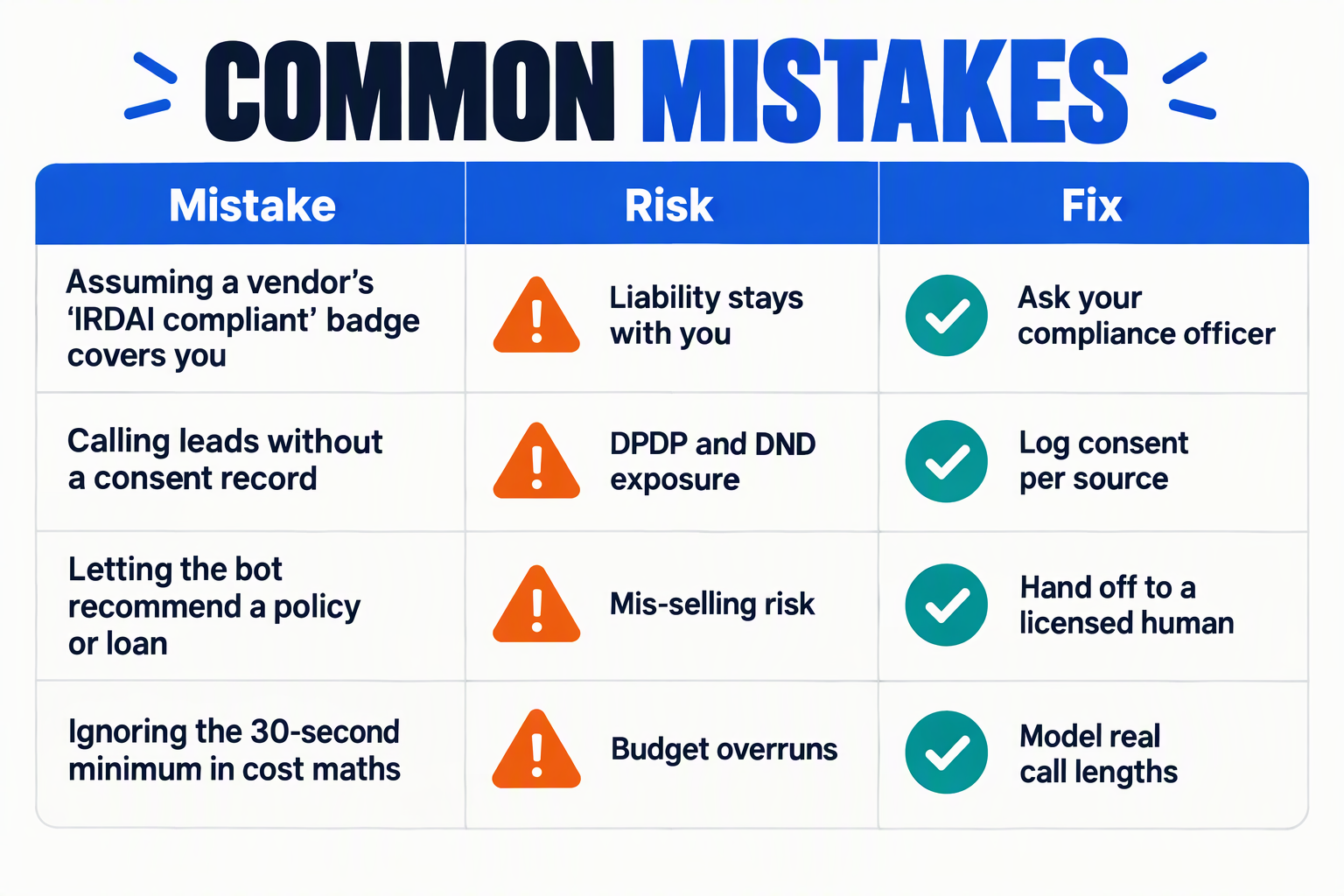
The most common mistakes when automating insurance and NBFC calls are treating telecom compliance as full compliance, letting the agent say too much, and budgeting from a headline per-minute rate. As of October 2026, most of them are design errors that are cheaper to avoid before launch than to fix after a complaint.
Which mistakes do insurers and NBFCs make most often?
| Mistake | Why it hurts | Fix |
|---|---|---|
| Treating TRAI clearance as full compliance | SquadStack notes a business can pass DLT and DND checks and still face exposure under the DPDP Act 2023 without explicit data consent. | Log consent source, timestamp and purpose for every lead before dialing. |
| Hunting for one IRDAI "outbound calls" rule | YuVerse.ai points out that no single rule exists; several instruments apply together, including the distance marketing guidelines. | Map every instrument to a script or process control, and include outsourcing obligations. |
| Ignoring outsourcing duties | Caller Digital says IRDAI's outsourcing guidelines (2017, updated 2023) cover automated communication with policyholders. | Treat the AI vendor as an outsourced activity: contract, audit trail, data location. |
| Letting the agent advise or oversell | EchoLeads says first contact must avoid misleading claims. Free-form answers about returns or eligibility invite them. | Script only qualification questions and route product questions to a licensed human. |
| Skipping the "do you want to continue?" check | The Economic Times reports IRDAI's distance marketing guidelines expect telecallers to ascertain whether customers want to continue, with call hours following TRAI/DoT orders. | Open with identity and purpose, then end the call politely on a "no". |
| Budgeting from the sticker rate | The per-minute price often excludes phone carriage, minimum billing and the language model. | Model cost per qualified lead, not per minute. |
How do you avoid the cost mistake in practice?
Ask every vendor three questions: what the rate includes, what the minimum billable call is, and whether carriage is separate. CallMissed, the Indian AI voice platform, bills a flat rate from ₹4 a minute that covers speech recognition, the language model and the voice (as of October 2026). It applies a 30-second minimum per call, charges nothing for a call that never connects, and bills phone carriage separately. A vendor that cannot answer those questions as precisely is a budget risk.
A quick worked check: a 2-minute qualification call at ₹4 a minute is ₹8 before carriage. If one in five calls reaches a qualified lead, voice cost alone is about ₹40 per qualified lead. Adding carriage and any unconnected-call overhead from your own telephony will move that figure, so compute it with your actual numbers.
What do teams forget after the call ends?
Three process gaps recur:
- No human handoff. An agent that qualifies a lead but cannot pass the live call or a summary to a licensed person wastes the speed advantage. Features such as live call monitoring, agent-to-agent transfers and AI call notes pushed to a CRM close that gap.
- Unreviewed recordings. Recording without disclosure, or keeping recordings indefinitely, creates its own risk. FreJun's guide to TRAI call recording rules in India covers the conditions for lawful recording in a commercial context. Disclose recording at the start, and set a retention period your compliance team has approved.
- No QA loop. Scripts drift. Scoring a sample of calls against your own rubric (for example, "never quoted a return" or "asked consent to continue") catches problems before a regulator or a customer does.
What is a sensible pre-launch checklist?
- Confirm consent evidence exists for every lead in the dialing list.
- Check DLT registration, DND scrubbing and the 9 AM to 9 PM window.
- Lock the script to qualification, with a clear opt-out path.
- Test the handoff to a licensed human end to end.
- Calculate cost per qualified lead using real carriage rates.
Run a small pilot on warm inquiry leads first, review every transcript, and scale only when the compliance and cost numbers both hold.
How do you choose a voice agent vendor, and where does CallMissed fit?
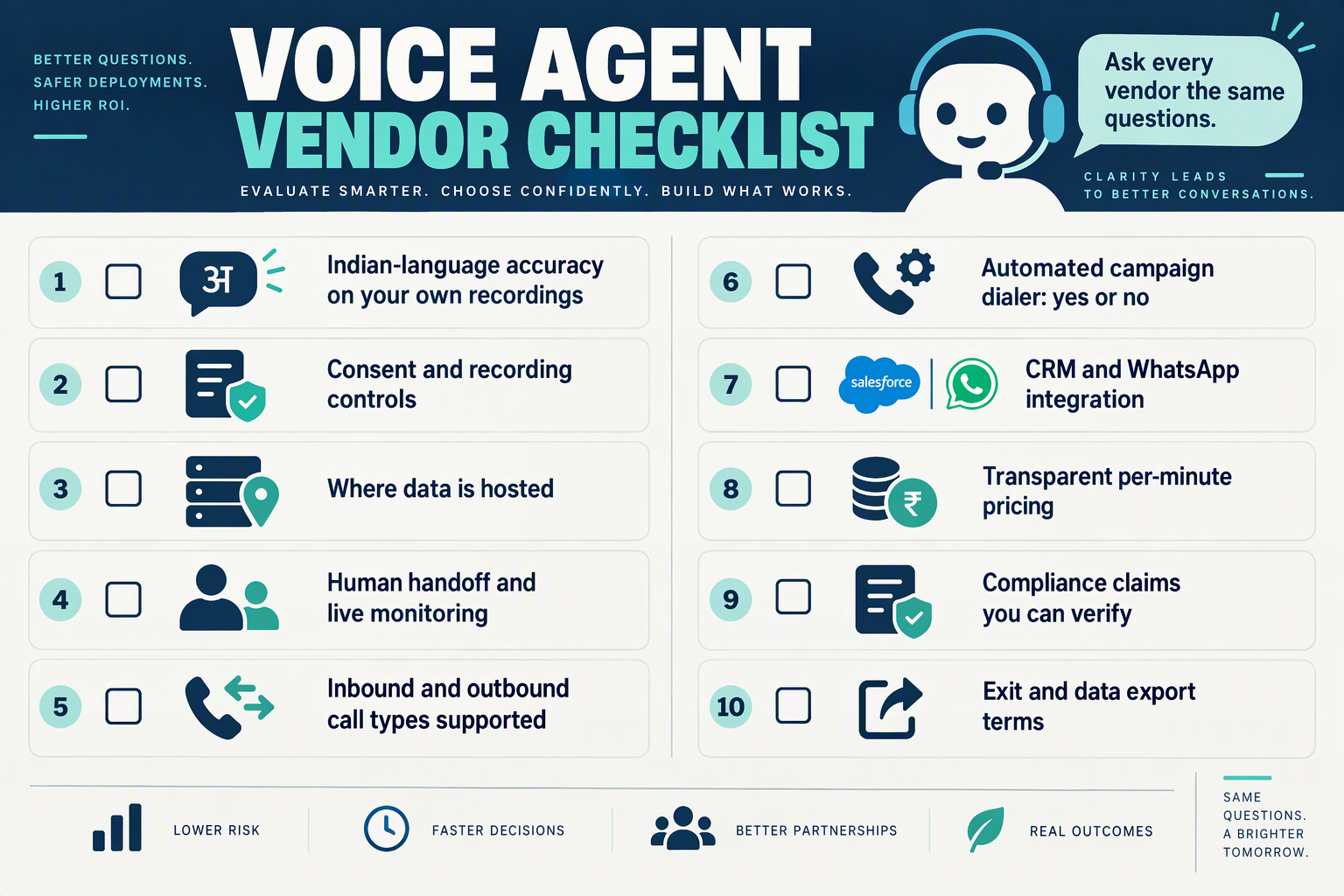
Choose a voice agent vendor by testing five things: language accuracy, how cleanly the platform separates consent and DND logic from the agent, handoff and recording controls, a transparent per-minute price, and whether it fits your existing telecom setup. Compliance is a shared responsibility. No vendor can make you compliant on its own, so you are looking for tooling that makes your obligations easier to meet.
What should you ask a voice agent vendor before signing?
Use this checklist in demos and pilots:
- Language and code-mixing: Ask for a live test in your customers' real speech, including Hinglish. Check that speech recognition and the voice each cover the languages you need, because the two lists often differ.
- Price per connected minute: Ask whether the rate bundles speech recognition, the language model and the voice, and what the minimum billable call length is. Confirm that phone carriage is quoted separately.
- Telecom flexibility: Ask whether you can bring your own carrier or SIP trunk, so your DLT-registered setup and number strategy stay in your hands.
- Human handoff: Ask how a live call or chat moves to a licensed person, and whether a supervisor can listen in.
- Evidence trail: Ask whether recordings, transcripts and call notes are stored per call and pushed to your CRM, so you can audit what was said.
- Scoring and testing: Ask whether you can score calls against your own rubric, for example "did the agent avoid promising returns?", and test script changes before they go live.
- Data location: Ask where the platform is hosted, since this feeds into your DPDP assessment.
Where does CallMissed fit?
CallMissed, an India-built AI customer-communication platform hosted in India, covers many of these items. It is one option among several, and it suits teams that want to build and tune their own follow-up agent.
- Languages: speech recognition in 22 Indian languages plus English, including code-mixed speech such as Hinglish. Natural text-to-speech voices cover 10 Indian languages plus English. The 22-language figure applies to recognition only.
- Pricing: as of October 2026, flat per-minute plans of ₹4 (Standard), ₹5 (Expressive) and ₹6 (Best latency), each covering recognition, model and voice. There is a 30-second minimum per call, and a call that never connects costs nothing.
- Telecom: rented numbers or your own carrier (Twilio, Plivo or any SIP trunk), with carriage billed separately.
- Oversight: live call monitoring with listen, whisper and barge-in, plus call recordings, transcripts, AI call notes pushed to the CRM, and call scoring against your own QA rubrics.
- Handoff: squads pass a live call between agents, and the omnichannel inbox has a human-handoff queue for chat.
A worked example: a three-minute qualification call on the ₹5 plan costs about ₹15 before carriage, so the real cost per lead depends on your carrier rate and your connect rate.
What should you check on your side?
CallMissed supports single outbound calls and click-to-call, not automated dialing campaigns. For lead follow-up, that means triggering one call per new inquiry, which matches the "call within minutes" pattern described earlier. Mass-dialing cold lists would be a poor fit for the tool and, as this guide has shown, for the rules.
Your consent records, DND scrubbing and script approval remain your responsibility under TRAI, DPDP and IRDAI or RBI expectations. Treat the platform as the execution layer, and keep your compliance sign-off and legal review in front of it. A two-week pilot on a small slice of consented leads, with every call scored and reviewed, will tell you more than any feature page.
Frequently Asked Questions
Is an AI voice agent for insurance India legal for lead follow-up?
Does IRDAI have a specific rule for AI outbound calls to insurance leads?
Do I need fresh consent to call a lead who filled out my web form?
How much does an AI voice agent for insurance and NBFC calls cost per minute in India?
What does a typical qualification call actually cost?
Can an AI voice agent speak my customers' languages, including Hinglish?
Conclusion
An AI voice agent for insurance and NBFC lead follow-up in India is workable in 2026, but only if compliance is built in from the start. The key takeaways:
- Consent comes first: SquadStack notes that a business can pass TRAI's DLT and DND checks and still face exposure under the DPDP Act 2023 without explicit data consent.
- Layered rules apply: IRDAI has no single outbound-calls rule. Its distance marketing and outsourcing guidelines sit alongside TRAI's 9 AM to 9 PM calling window and opt-out requirements.
- Design for qualify-and-hand-off: a narrow, scripted agent that calls people who have already inquired, then passes warm leads to a licensed human, is the safest model.
- Budget the full cost: as of October 2026, CallMissed's Standard voice plan starts at ₹4 a minute, with phone carriage billed separately and a 30-second minimum per call.
Expect regulators to keep tightening expectations around automated calls, consent records and call recordings, so watch for updates from IRDAI, TRAI and RBI. Build for auditability now, and later changes become adjustments rather than rebuilds.
To explore how AI communication is evolving, check out CallMissed, an AI infrastructure platform powering voice agents and multilingual chatbots for businesses. Could your lead follow-up prove consent for every call you made last month?
Related Reading
- AI Voice Agent for Clinics India: Hindi Booking Guide 2026
- Voice Agent API With LiveKit Support: Verified 2026 Comparison
- Voice Agent API with LiveKit Support: 2026 Comparison and Verdict