AI Voice Agent for Clinics India: Hindi Booking Guide 2026


Plan an AI voice agent for clinics India: Hindi appointment booking voice bot, reminders, missed-call recovery, DPDP consent and INR costs.
AI Voice Agent for Clinics India: Hindi Booking Guide 2026
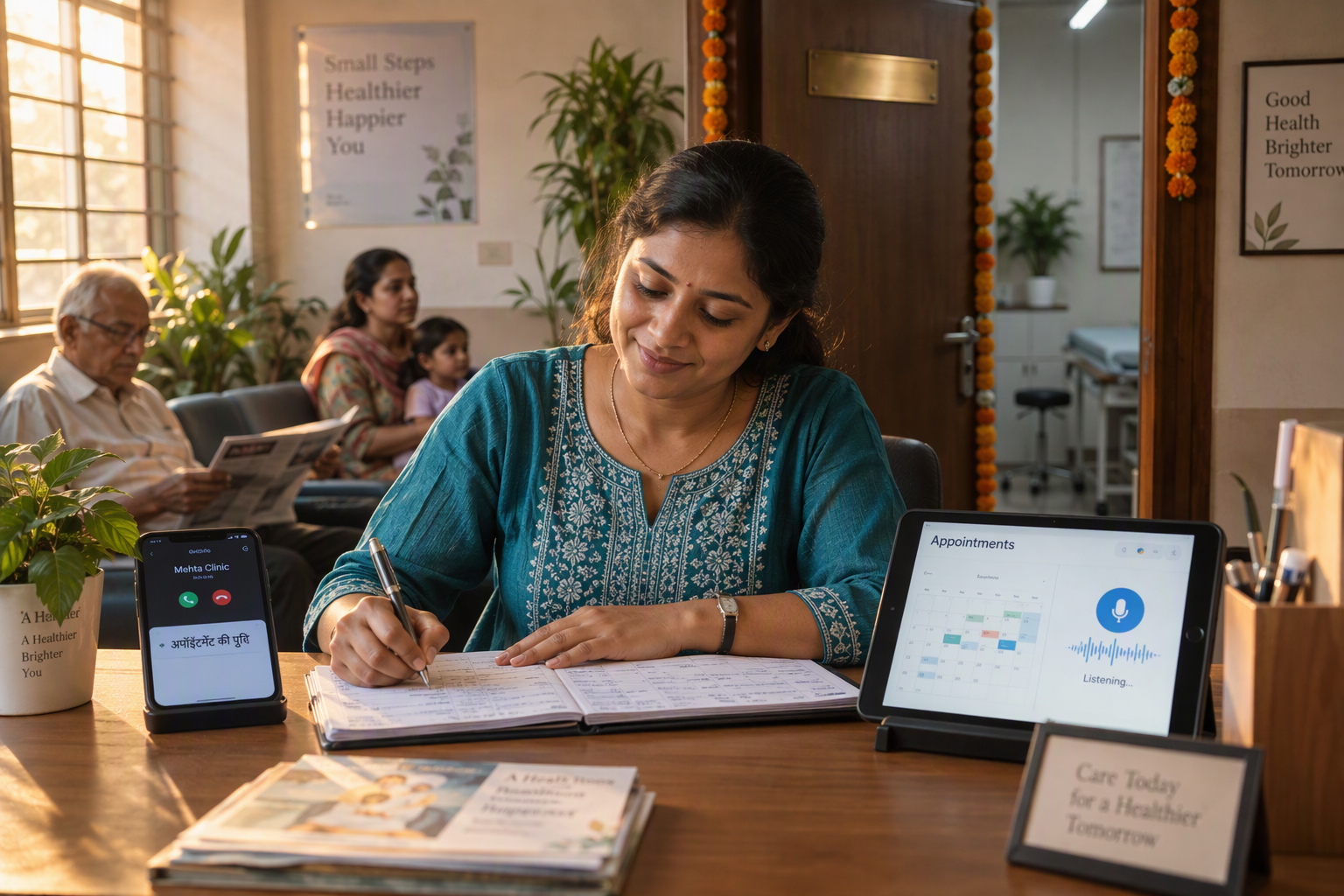
What happens when a patient rings your clinic at 8:40 pm, hears nothing but a ringtone, and calls the next doctor on the list? An AI voice agent for clinics India can pick up that call in Hindi, book the slot, send a reminder, and ring back anyone you missed. Most front desks can't do all of that between patients, and it is no longer a futuristic idea.
Two things make 2026 the year to take it seriously. First, patients want to speak, not type. Many are more comfortable in Hindi or Hinglish than in English, and a phone call is still the easiest way to book. Second, the rules around patient data have caught up with the technology. The Digital Personal Data Protection (DPDP) Act received Presidential assent on August 11, 2023, and, according to Ichelon Consulting, enforcement rules are being operationalised in phases through 2024-2026, with the Data Protection Board of India as the enforcement body.
For a clinic, this is practical, not abstract. MedHive notes that for anyone under 18 the Act generally requires verifiable consent from a parent or guardian, and law firm Khaitan-style analyses such as KS&K's note that using data collected for treatment for another purpose, like marketing, generally needs separate, explicit consent. A voice agent that handles names, phone numbers and symptoms on every call has to be set up with those rules in mind. Clinics that get data governance right also tend to benefit: a 2024 NASSCOM survey, as cited by DPDP Consultants, reported 23% fewer security incidents and 31% lower breach remediation costs for organisations with mature governance.
In this guide, you will learn:
- How Hindi appointment booking works on a live call, from greeting to confirmed slot
- How to set up automated reminders that cut no-shows without annoying patients
- How to recover missed calls before they turn into lost patients
- What consent and data-handling steps to build in under the DPDP Act
- What it costs to run, with real per-minute pricing
Platforms like CallMissed, an India-hosted platform that recognises 22 Indian languages including code-mixed Hinglish, reflect where this trend is heading. Let's start with what an AI receptionist actually does on a call.
What can an AI voice agent for clinics in India actually do?
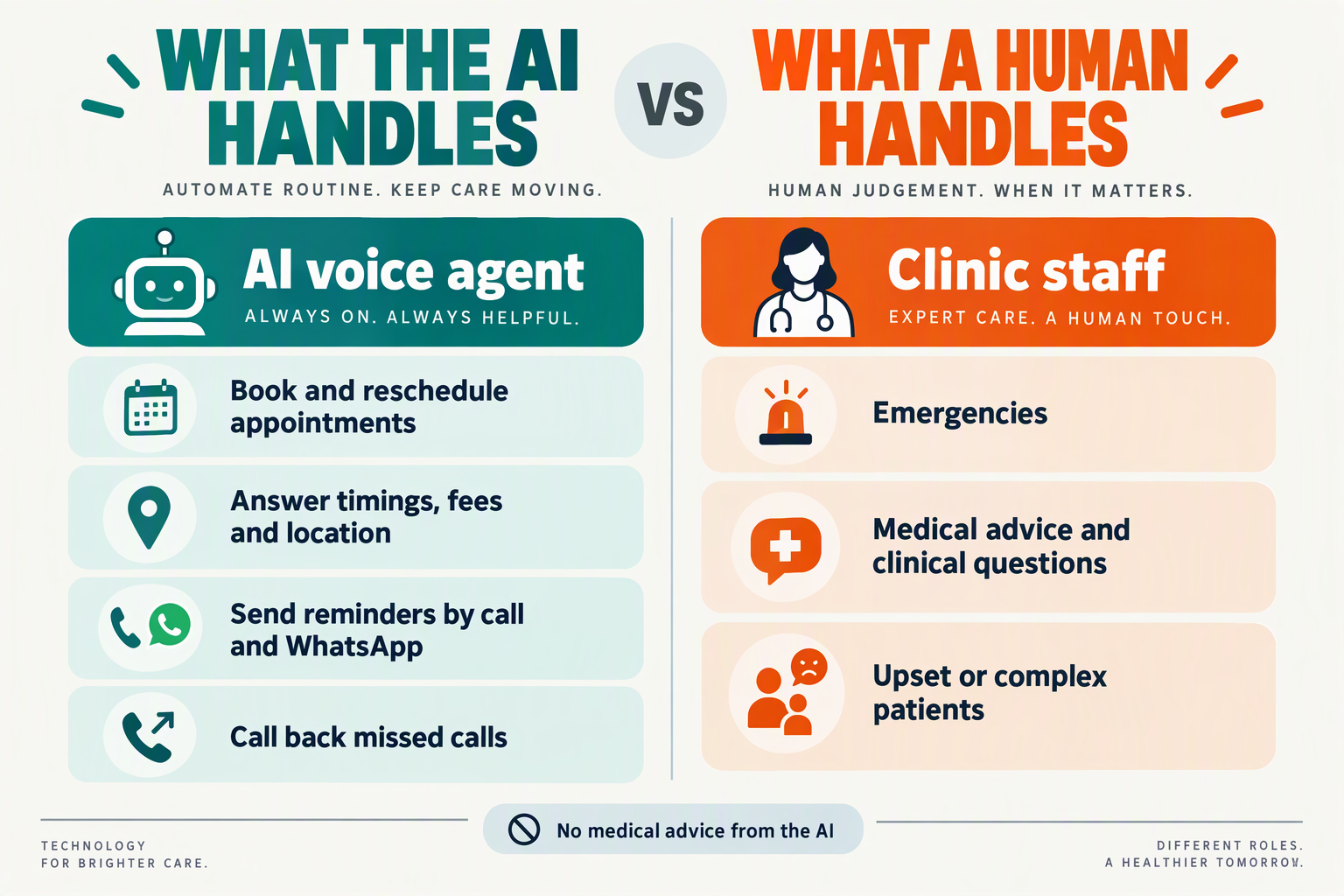
An AI voice agent for clinics answers calls in Hindi, Hinglish or English, books and reschedules appointments, answers routine questions, and follows up with patients who rang but never got through. It handles the repetitive front-desk work so your staff can focus on the patients standing in front of them.
What does an AI receptionist do on a clinic call?
As of October 2026, a well-configured agent can cover these jobs:
- Book, move and cancel appointments. The agent asks for the doctor, preferred day and time, checks availability, and confirms the slot aloud. Through Google Calendar, Cal.com or a custom REST tool, it can write directly to your schedule.
- Answer routine questions. Consultation fees, doctor timings, location, parking, and preparation for a blood test are all FAQ-style queries. You load them into a knowledge base from text, web pages or PDFs, and the agent answers from that material rather than guessing.
- Understand how patients really speak. CallMissed, an India-hosted AI communication platform, recognises 22 Indian languages plus English, including code-mixed speech such as Hinglish. A patient who says "kal shaam ko doctor sahab se appointment chahiye" is understood without being forced into English.
- Reply in a natural voice. Text-to-speech is available in 10 Indian languages plus English. This figure differs from the 22 languages of speech recognition, so check that your clinic's language is covered for the voice, not only for listening.
- Route callers. Keypad (DTMF) menus and a visual call-flow designer let you send emergencies, lab-report queries or billing questions to the right place.
How do reminders and missed-call recovery fit in?
Reminders and callbacks are the outbound half of the job, and they work best when each one is tied to a specific trigger. Your booking system can fire a webhook, which starts a single outbound call to that patient. The same approach works for a missed inbound call: the agent rings back that one number and offers to book.
CallMissed supports single outbound calls and click-to-call, but not automated outbound calling campaigns, so plan a trigger-based design rather than bulk dialling. For text-style reminders, WhatsApp Business through the official Meta Cloud API supports approved message templates and broadcast campaigns. Patients can also call your clinic on WhatsApp and reach an AI voice agent, and Meta does not charge for calls customers start.
What happens after the call ends?
Every call can produce a recording, a transcript and an AI call note with a summary, action items, disposition and follow-up. These notes can be pushed to a built-in CRM that holds contacts, deals, tasks and a timeline per record. Per-contact memory means the agent can recognise a returning patient's earlier context instead of starting from zero.
Which tasks should stay with humans?
Keep clinical judgment away from the agent. It should not diagnose, advise on medication, or decide whether symptoms are urgent. Write that boundary into the prompt, and give the agent a clear escalation path.
Two features help here. Squads can hand a live call from one agent to another, and live call monitoring lets a supervisor listen, whisper or barge in. A human-handoff queue keeps WhatsApp and Instagram conversations moving to a staff member when needed. Because call audio often includes health details, the consent steps covered later in this guide apply to everything above.
What do you need before setting up a Hindi AI voice agent?
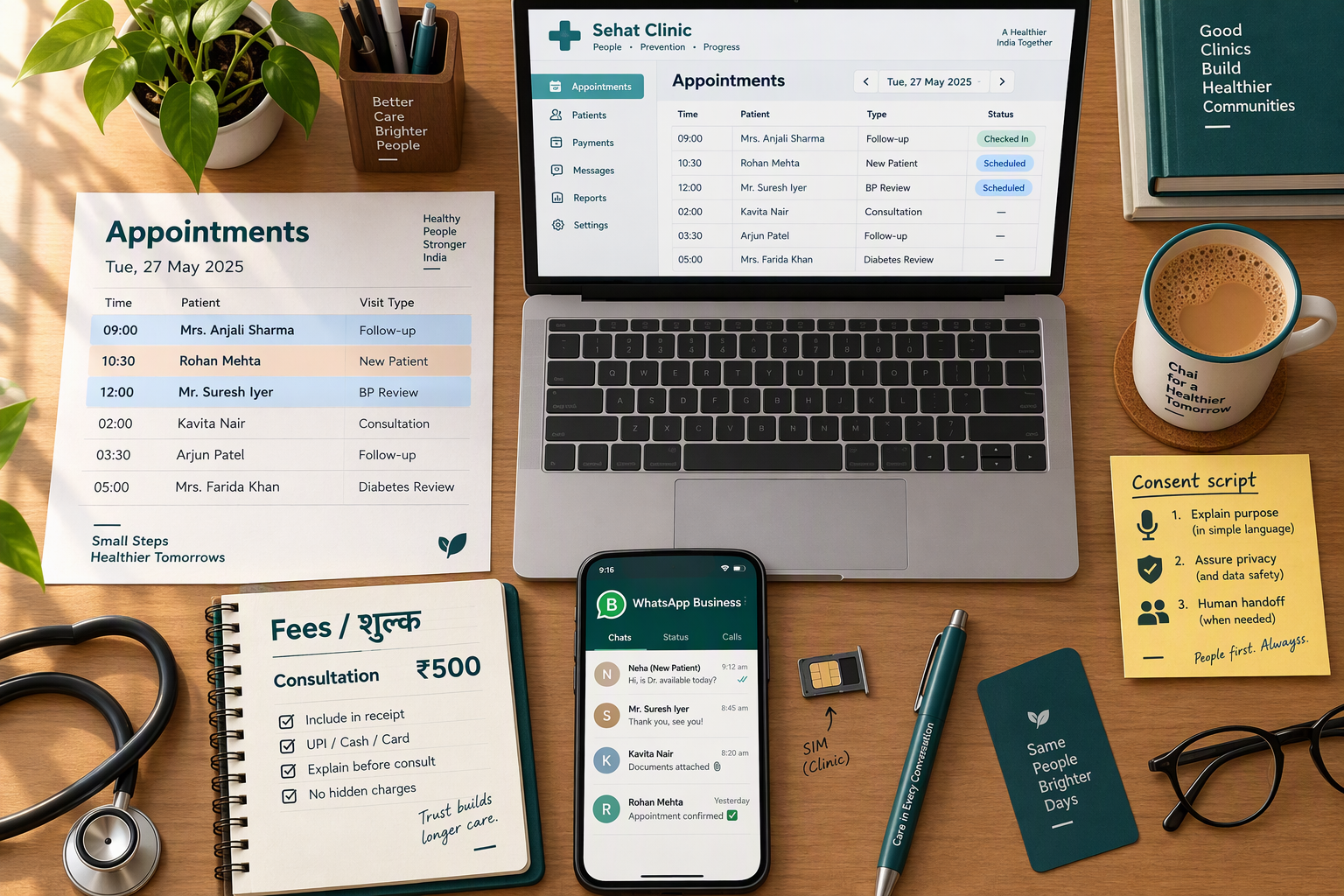
You need six things before launch: a phone number, a live schedule, a clinic knowledge base, a consent plan, a human fallback, and a WhatsApp channel for reminders. Getting these ready first usually matters more than which platform you pick. As of October 2026, here is the checklist.
What should a clinic prepare before going live?
| Prerequisite | What to prepare | Why it matters | How CallMissed supports it |
|---|---|---|---|
| Phone number | The number patients already call, or a new one | Patients won't change habits for a new number | Rented numbers, or bring your own carrier (Twilio, Plivo or any SIP trunk) |
| Live schedule | Doctor calendars with real slot lengths | The agent can only book what it can see | Google Calendar and Cal.com integrations, or a custom REST tool |
| Clinic knowledge | Timings, fees, doctors, address, parking, prep instructions | Stops wrong answers on routine questions | Knowledge base built from text, web pages and PDFs |
| Consent and privacy plan | A short spoken notice and a record of consent | DPDP Act compliance | Call recordings, transcripts and per-contact memory you can govern |
| Human fallback | Who takes over, and for which cases | Emergencies and complaints need a person | Human-handoff queue and live call monitoring |
| WhatsApp channel | A WhatsApp Business account and approved templates | Reminders reach patients where they already read | Official Meta Cloud API with templates and broadcasts |
Why does consent come before the first call?
Because a voice agent collects names, phone numbers and symptoms from the first ring. According to Ichelon Consulting, the DPDP Act received Presidential assent on August 11, 2023, with enforcement rules being operationalised in phases through 2024-2026. Confirm the current status of those rules with your legal adviser before launch.
Two points from the research shape your setup. MedHive notes that for anyone under 18 the Act generally requires verifiable consent from a parent or guardian, so your agent should ask who the patient is and who is calling. KS&K's analysis adds that using treatment data for something else, such as marketing, generally needs separate, explicit consent. Keep appointment reminders and promotional messages as separate consent choices.
How should you prepare the clinic's information?
Write down the answers your front desk gives most often. Then put them in one document the agent can read.
- List each doctor, their days, and typical appointment length.
- Note fees, accepted payment methods and what to bring (reports, ID, fasting instructions).
- Define what the agent must never do, such as giving medical advice or diagnosing.
- Write the escalation rule: for emergencies or distressed callers, the agent hands off to a person or tells the caller to go to the nearest hospital.
CallMissed's no-code builder lets you set the prompt, voice, language, tools and call settings in one place. It also has versioning with publish and rollback, so you can fix a script without risking live calls.
What will testing cost, and what language coverage do you get?
Start small. CallMissed gives 1,000 free credits on signup, and 1 credit equals ₹1. Voice agent plans are a flat per-minute rate covering speech recognition, the language model and the voice: Standard is ₹4/min, Expressive ₹5/min and Best latency ₹6/min. There is a 30-second minimum per call, and a call that never connects costs nothing. Phone carriage is billed separately.
Speech recognition covers 22 Indian languages plus English, including code-mixed Hinglish. That matters because patients rarely stick to pure Hindi. Natural text-to-speech voices cover 10 Indian languages plus English, so check that the voice you want speaks your patients' language.
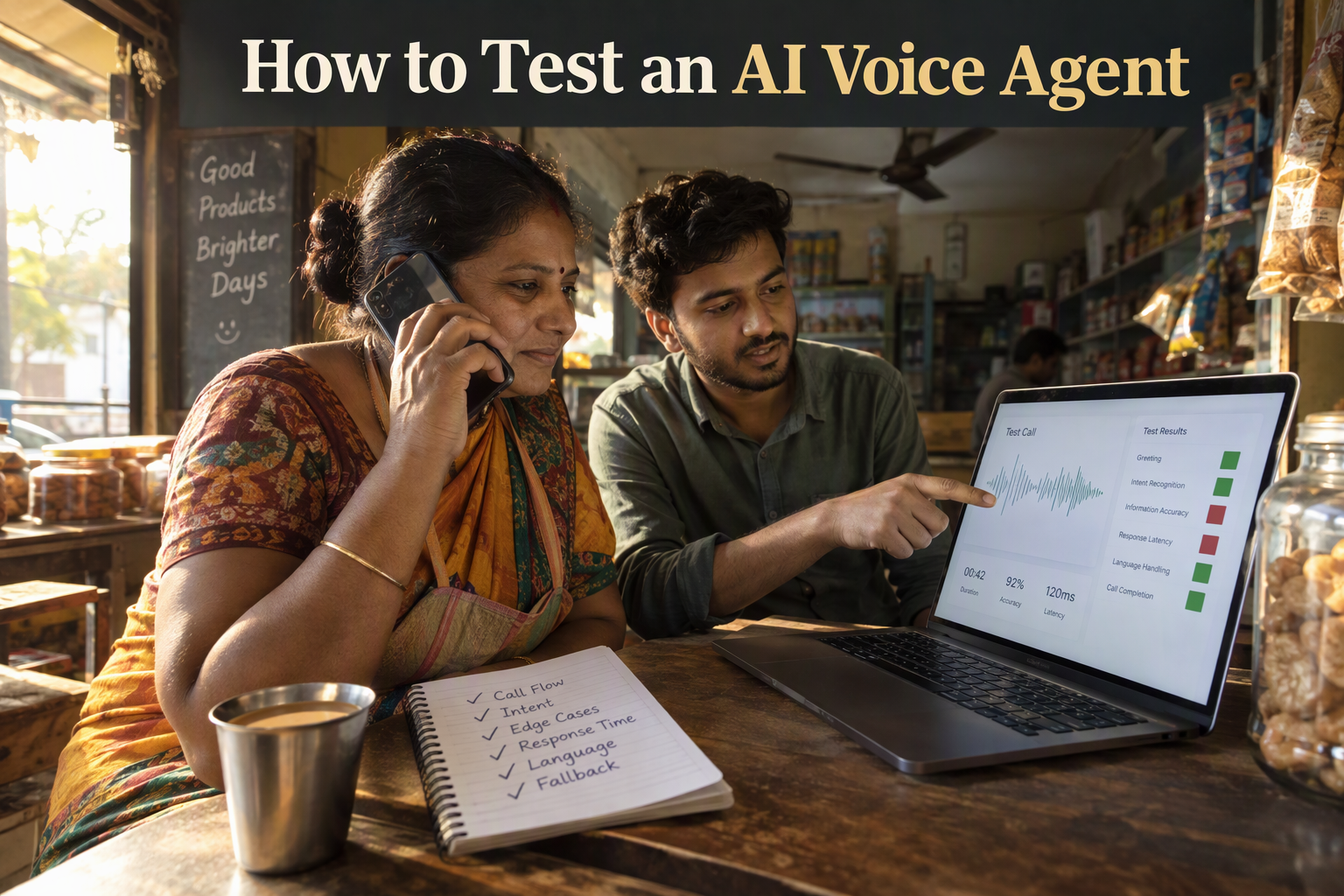
Before launch, place at least 20 test calls in Hindi, Hinglish and regional accents, and have staff try to break the flow. Fix what fails, then go live.
How much does an AI voice agent for healthcare cost per minute in India?
An AI voice agent for healthcare on CallMissed costs ₹4 to ₹6 per minute as of October 2026, depending on the voice tier. That is one flat rate covering speech recognition, the language model and the voice. Phone carriage is billed separately.
What are the per-minute voice agent plans?
CallMissed, the India-hosted AI communication platform, offers three plans. Each price already includes everything that happens inside the call.
- Standard, ₹4/min (about US$0.04): natural Indian-language voices at the lowest price. This suits most Hindi appointment-booking and FAQ calls.
- Expressive, ₹5/min (about US$0.05): richer, more expressive voices across Indian and world languages. It suits clinics with a mixed patient base, such as medical tourism or expatriate families.
- Best latency, ₹6/min (about US$0.06): the fastest replies and the best-sounding voices. It is worth considering for busy front desks where a pause feels awkward.
Credits are priced at ₹1 each (about US$0.0104, using US$1 = ₹96) and never expire. New accounts get 1,000 free credits on signup, enough to test real calls before committing.
How are short calls and missed calls billed?
Each call has a 30-second minimum. A 20-second "what are your timings?" call on Standard therefore costs ₹2. A call that never connects costs nothing, which matters for missed-call recovery.
Two billing details to plan around:
- Phone carriage is separate. Whether you rent a number or bring your own carrier (Twilio, Plivo or any SIP trunk), the carrier's charges come on top of the per-minute rate.
- Custom stacks bill by the second. If you assemble your own speech, model and voice components, you pay each component by the second with no minimum. This usually only makes sense for teams with specific technical requirements.
What does a typical clinic actually spend?
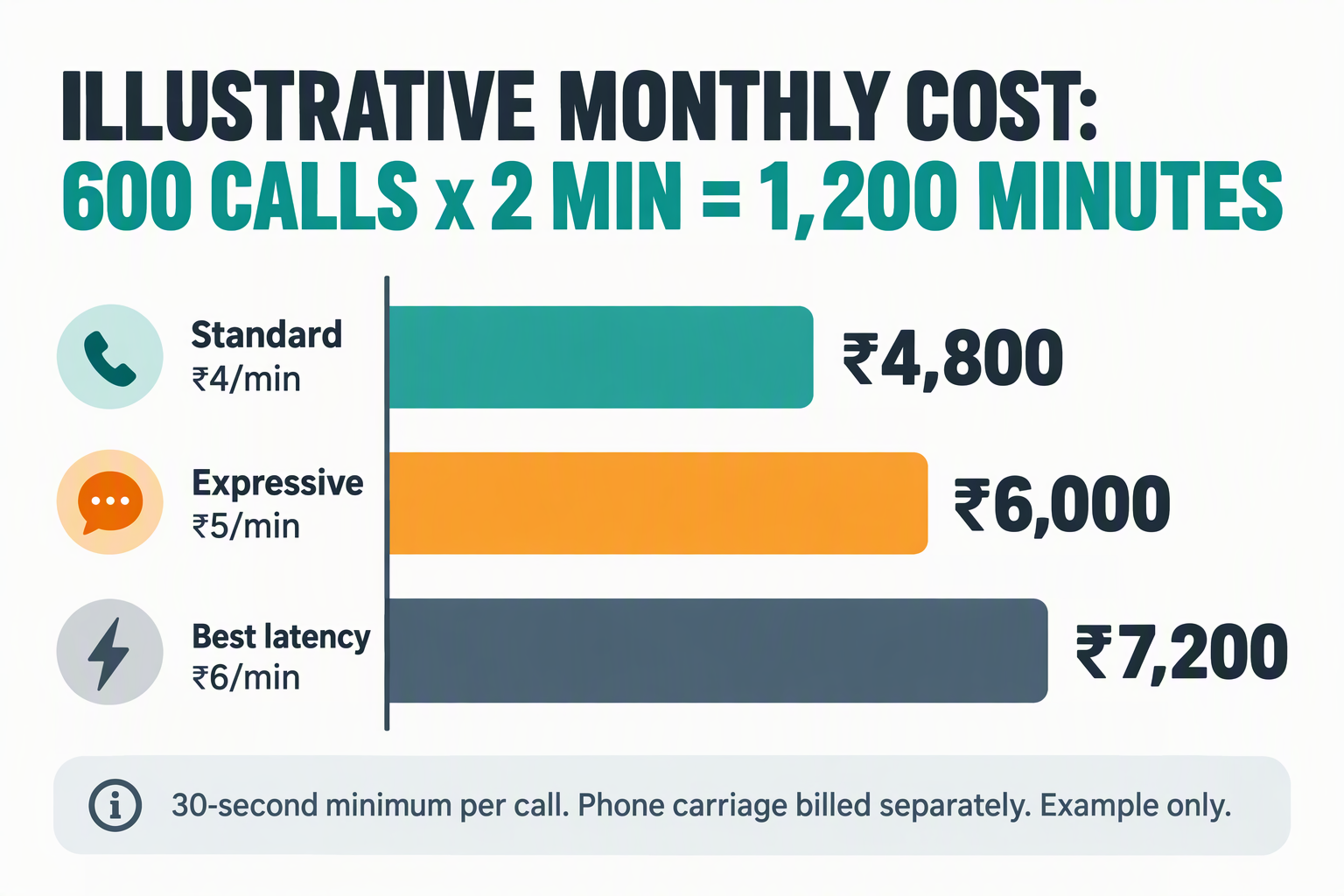
Here is a worked example. The call volumes are assumptions for illustration, not CallMissed benchmarks. Suppose a single-doctor clinic gets 600 AI-handled calls a month, averaging two minutes each. That is 1,200 minutes.
| Plan | Rate | Monthly voice cost |
|---|---|---|
| Standard | ₹4/min | ₹4,800 |
| Expressive | ₹5/min | ₹6,000 |
| Best latency | ₹6/min | ₹7,200 |
Carrier charges are not included in these figures. Add them once you know your provider's rates.
Do I also need a monthly subscription?
Not for the voice minutes. CallMissed is pay-as-you-go with no seat fees, so the front desk, a doctor and a manager can all have access without per-user charges. Credit top-ups run from 10 to 50,000 credits at ₹1 per credit, with no bulk-bonus packs. Payment is by UPI, cards or net banking, with GST invoices for your accounts team.
Monthly plans exist if you want bundled credits. Starter is ₹999, Pro is ₹4,999 and Enterprise is ₹20,000. Each adds credits on top, and the first month's bonus is larger than later months'.
How do I keep costs predictable?
- Start on Standard and move up only if patients complain about voice quality or pauses.
- Keep the knowledge base tight. Short, accurate answers about timings, fees and directions mean shorter calls.
- Use WhatsApp for simple confirmations. CallMissed's WhatsApp Business integration, built on the official Meta Cloud API, can handle templated reminders. Voice minutes are then reserved for conversations that need speech.
Review the call recordings and transcripts in your first month. They show which calls run long and why, and that is usually where the savings are.
How do you build Hindi booking, rescheduling and missed-call recovery flows?
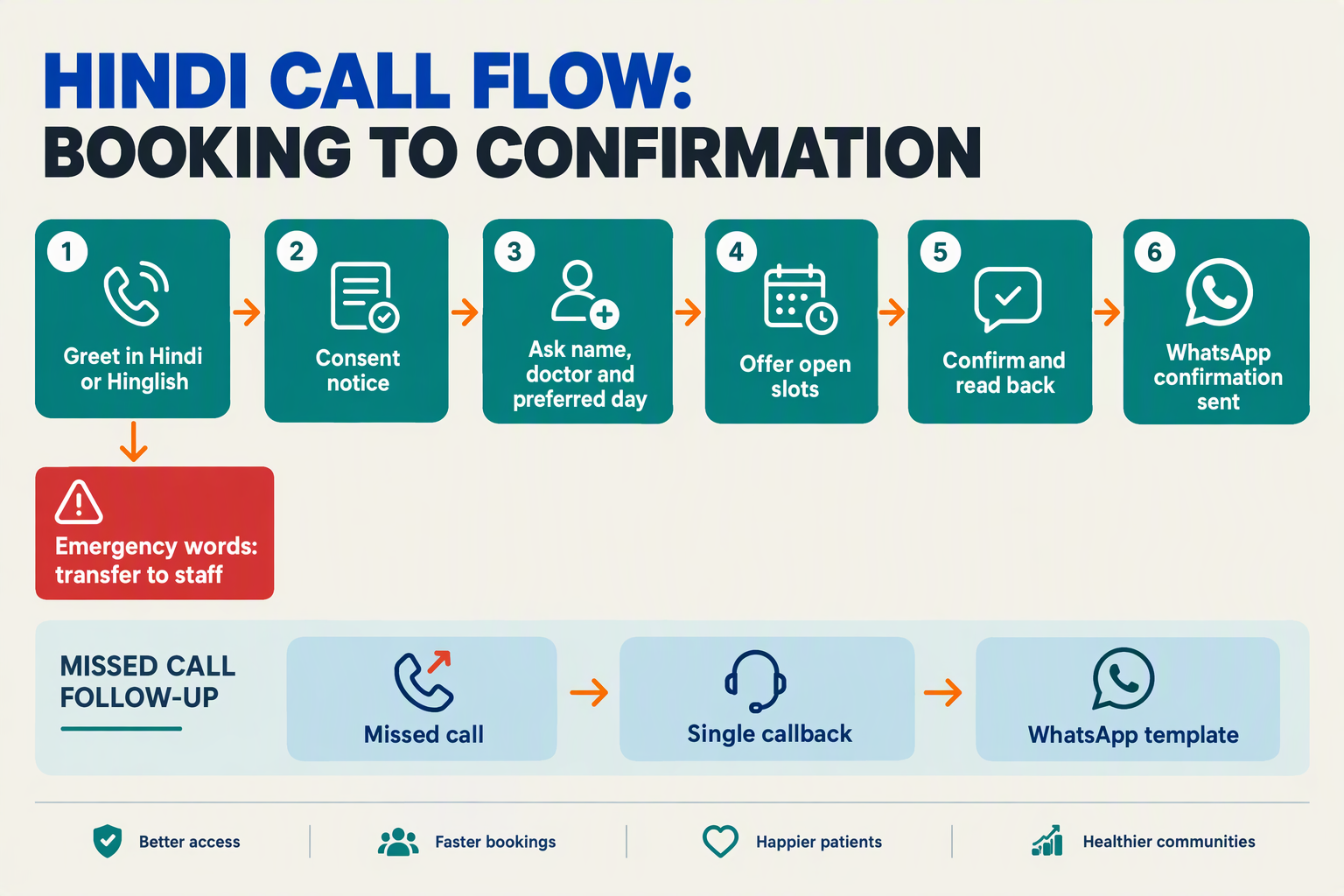
Build three flows in the CallMissed no-code agent builder (booking, rescheduling and missed-call recovery) and publish them as one agent. Each flow needs a Hindi prompt, a calendar connection and a clear fallback. Start with booking, because the other two reuse its pieces.
How do you build a Hindi appointment booking flow?
- Set the language and voice. Choose Hindi with Hinglish tolerance. CallMissed's speech recognition covers 22 Indian languages plus English, including code-mixed speech, so "kal shaam ko appointment mil jayega?" is understood as spoken.
- Write the prompt around variables. Define patient name, doctor, preferred date and time, and callback number as variables the agent must collect before booking.
- Open with disclosure and consent. For example: "Namaste, main Sharma Clinic ka AI sahayak hoon. Appointment ke liye main aapka naam aur number note karungi. Kya main aage badhoon?" This ties back to the DPDP consent points above, and the transcript records the answer.
- Connect your schedule. Link Google Calendar or Cal.com, or add a custom REST tool that talks to your clinic software.
- Load the knowledge base. Upload PDFs or web pages covering doctor timings, fees, address and parking so the agent answers from your facts.
- Add safety rules. Instruct the agent never to give medical advice, and to direct symptoms that sound urgent to emergency services or the nearest hospital.
- Confirm aloud. The agent should repeat the doctor, date and time in Hindi before the tool call writes the booking.
How should rescheduling work?
The agent uses the same calendar tool, with one extra step: finding the existing booking. Per-contact memory lets it recognise a returning caller, and it can ask for the registered phone number to locate the slot.
Have it offer two alternatives rather than an open question, such as "Kal subah 11 baje ya parson shaam 5 baje?". Fewer choices mean shorter calls. After the change, send a confirmation. On WhatsApp, CallMissed supports message templates (AI can draft them and sync them with Meta), so a reschedule notice can go out in the patient's language.
How do you recover missed calls in Hindi?
Treat a missed call as an event that triggers one follow-up. Outbound webhooks with per-agent event subscriptions can notify your own system, which then does one of two things:
- Send a WhatsApp template. A short Hindi message such as "Aapka call miss ho gaya, slot book karne ke liye reply karein" works well. The WhatsApp AI chatbot can then finish the booking in chat.
- Place a single outbound call. Use the Twilio-compatible Calls API or click-to-call so the voice agent rings the patient back.
One honest limit: CallMissed supports single outbound calls and click-to-call, not automated outbound calling campaigns. Your workflow decides who gets a callback and when. Only contact patients who have given permission. WhatsApp Business Calling likewise lets businesses call only customers who have opted in.
What will the flows cost, and how do you test them?
As of October 2026, voice agents on CallMissed's Standard plan cost ₹4 a minute, covering speech recognition, the language model and the voice. There is a 30-second minimum per call, and a call that never connects costs nothing. Phone carriage is billed separately.
Before going live, run test calls in Hindi, Hinglish and with background noise. Use versioning to publish, and roll back if a prompt change breaks a flow. After launch, review transcripts and call scoring against your own QA rubric.
What does the DPDP Act mean for a clinic's voice agent and patient data?
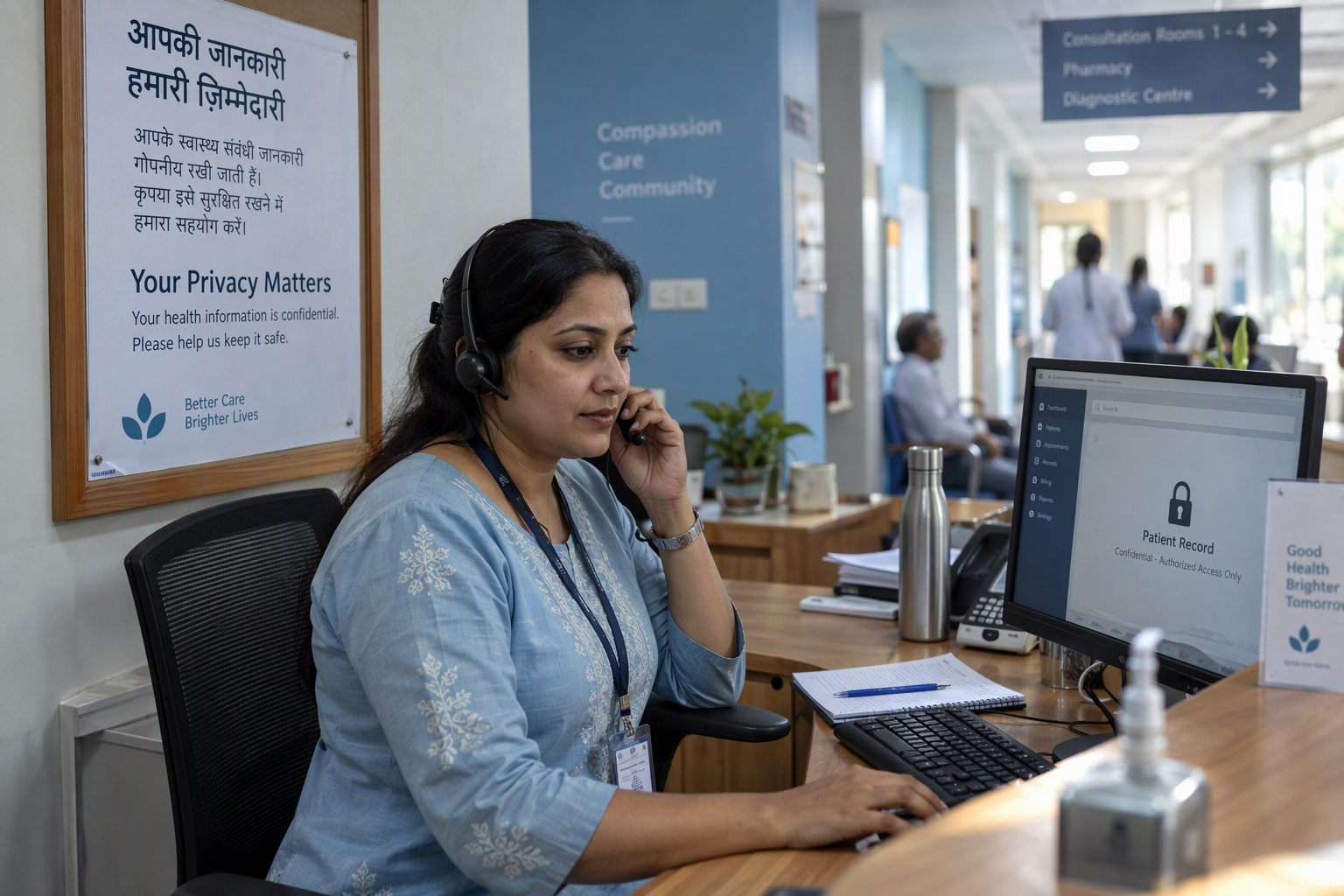
The DPDP Act treats your clinic as the Data Fiduciary, which means you stay responsible for patient data even when a voice agent vendor processes it. In practice, you need a clear consent notice, a defined purpose for every piece of data collected, and a way to honour patient requests. As of October 2026, the rules are still being operationalised in phases, so treat this as a working checklist and confirm details with a lawyer.
Which patient data does a clinic voice agent actually touch?
A single booking call can capture a name, phone number, preferred doctor, reason for visit and a voice recording. Each is personal data, and the reason for visit can reveal health information. Ichelon Consulting notes that the Data Protection Board of India is the enforcement body, so the cost of getting this wrong is a regulatory one.
The principle that matters most is purpose limitation. Data collected to book an appointment should be used to book that appointment. Per KS&K, secondary use of treatment data, such as marketing, needs separate, explicit consent unless specifically exempted.
How should a voice agent ask for consent on a call?
Build consent into the call flow instead of leaving it to a website footer. A workable pattern:
- Disclose first. The agent says in Hindi that it is an AI assistant, that the call may be recorded, and why.
- State the purpose. "Hum aapka naam aur number sirf appointment aur reminder ke liye use karenge."
- Ask for a clear yes. Record the answer so you can show consent later.
- Separate reminders from promotions. Appointment reminders are tied to the booking. Health-camp offers or discount messages need their own opt-in.
- Offer a human. If the patient declines, the agent hands the call to your front desk instead of ending it.
What about children and sensitive practices?
MedHive notes that for anyone under 18, verifiable parent or guardian consent is generally required, and the Rules include exemptions for healthcare providers in defined circumstances. A paediatric clinic's agent should therefore confirm it is speaking with a parent or guardian before saving a child's details. The Journal of Dr. NTR University of Health Sciences adds that mental health clinics and children's hospitals face special provisions, so those practices should be more conservative about what the agent collects.
How do you configure the agent to minimise risk?
- Collect less. Ask for the slot, not the diagnosis. Leave clinical questions to the doctor.
- Set retention rules. Decide how long recordings and transcripts are kept, and delete them on schedule.
- Plan for patient requests. You should be able to find, correct or erase one patient's data quickly.
- Check where data lives. Platforms like CallMissed are hosted in India and offer recordings, transcripts and AI call notes that you can review and push to your CRM. Hosting location is a useful point to verify, but it does not make you compliant on its own.
- Get the vendor terms in writing. Ask how recordings are stored and who can access them.
Is the effort worth it?
Beyond avoiding penalties, there is a practical payoff. A 2024 NASSCOM survey, as cited by DPDP Consultants, found organisations with mature data governance reported 23% fewer security incidents. For a clinic whose reputation rests on patient trust, a short consent line at the start of each call is a small price to pay.
How should an AI receptionist handle emergencies and human handoff?
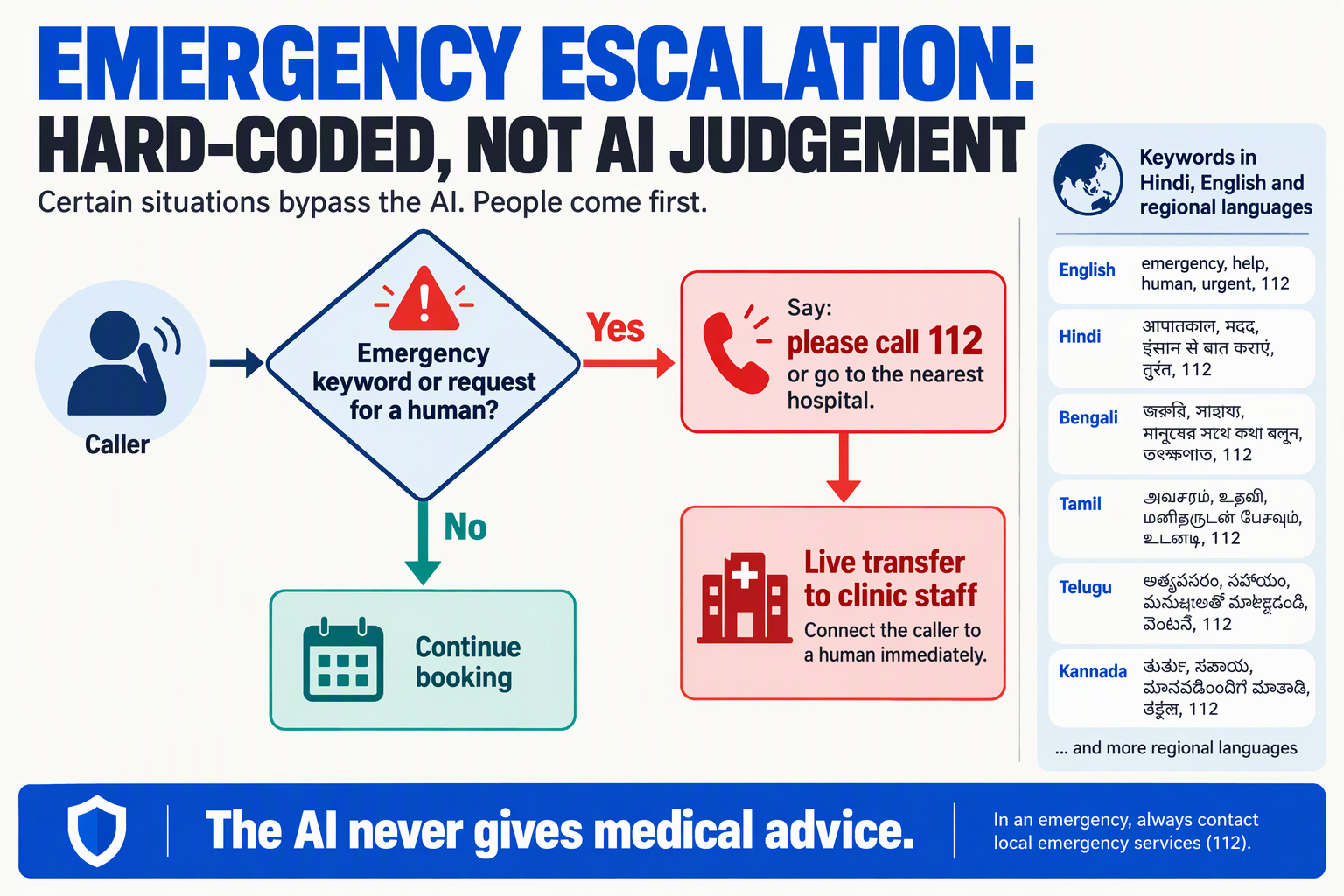
An AI receptionist should never try to judge an emergency. It should recognise warning signals, tell the caller to contact emergency services immediately, and pass the conversation to a human as fast as possible. Its job is to recognise, redirect and hand off, never to diagnose.
What counts as an emergency on a clinic call?
Define the triggers in writing before you go live, and have your doctor sign off on them. A starter list for a general clinic might include:
- Chest pain, breathlessness or fainting ("seene mein dard", "saans nahi aa rahi", "behosh ho gaye")
- Heavy bleeding, a serious injury or suspected poisoning
- Signs of stroke, such as sudden weakness on one side or slurred speech
- A child with a high fever, seizure or difficulty breathing
- Expressions of self-harm, especially relevant for mental health practices
Because patients mix languages mid-sentence, test these triggers in Hindi, Hinglish and English. CallMissed, the India-hosted voice platform, recognises 22 Indian languages plus code-mixed speech, so the same rules can apply across how your patients actually talk.
What should the agent say and do, step by step?
Keep the script short. A panicked caller needs instructions, not a conversation.
- Interrupt the booking flow. The moment a trigger appears, the agent stops asking for names and slots.
- Give one clear instruction. For example: "This sounds urgent. Please call 112 or go to the nearest hospital right now."
- Alert a human. Use a custom REST tool or an outbound webhook to notify your on-duty staff with the caller's number and a one-line summary.
- Offer a handoff. Route the call to a staffed call queue if someone is available.
- Log it. Save the transcript and AI call notes (summary, disposition, follow-up) so a doctor can review what happened.
The agent must never say "it's probably nothing" or suggest medicines. Write those prohibitions directly into the prompt.
How does human handoff work in practice?
Handoff is a design choice, not a single switch. On CallMissed, you can combine a visual call-flow designer, keypad (DTMF) menus, call queues and squads, which hand a live call from one agent to another. A common pattern is a front-desk agent for bookings that passes clinical or sensitive queries to a second agent with stricter rules, or to a person.
For chat and WhatsApp, the omnichannel inbox has a human-handoff queue: switching the AI off hands the thread to a staff member. During live voice calls, supervisors can listen in, whisper guidance or barge in, which helps during a clinic's busiest hours.
Be honest about limits. Outside clinic hours, nobody may be available to take a handoff. In that case the agent should repeat the emergency instruction, never leave the caller with a voicemail-style dead end, and flag the call for first-thing review.
Which non-emergency situations still need a person?
Hand off calmly, not urgently, for:
- Requests for test results or prescription changes
- Complaints, billing disputes and angry callers
- Calls where the agent fails to understand twice in a row
- Callers on behalf of minors, where consent matters. As MedHive notes, the DPDP Act generally requires verifiable parent or guardian consent for anyone under 18, and mental health clinics and children's hospitals face special provisions according to the Journal of Dr. NTR University of Health Sciences.
How do you check the safety net actually works?
Before launch, write 20-30 test calls covering each trigger in each language, and run them as an eval suite. After launch, use call scoring against your own QA rubric to review every escalated call weekly. As of October 2026, treat any missed escalation as a prompt bug to fix the same day.
Which advanced tips improve Hindi accuracy and cut patient no-shows?
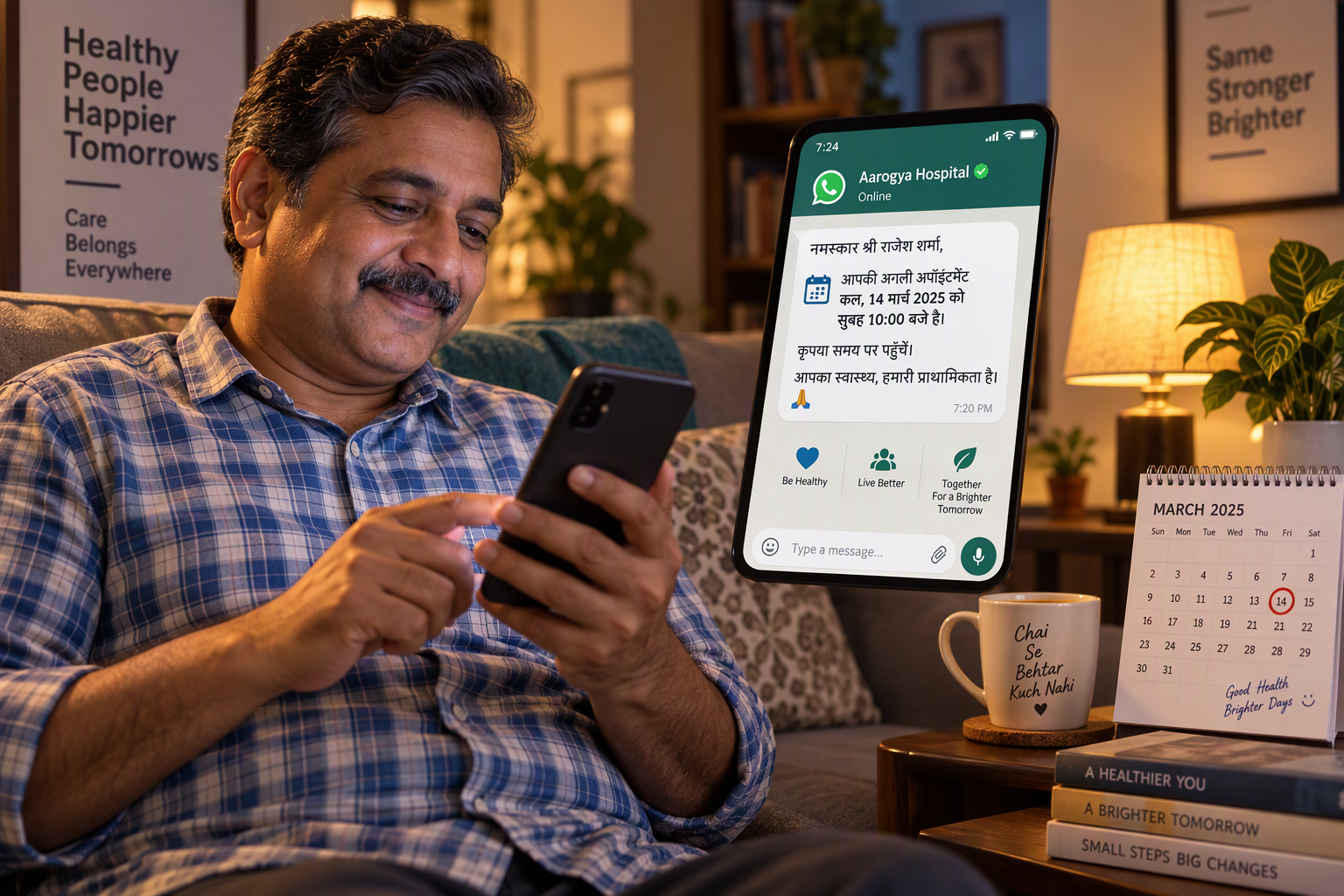
Three levers improve Hindi accuracy and cut no-shows: tune the agent's language handling for how patients actually speak, confirm every booking in more than one way, and review real calls every week. As of October 2026, each can be set up in a no-code builder like the one in CallMissed, the India-hosted AI voice platform.
Which tips matter most for Hindi accuracy and no-shows?
| Tip | What to do | Helps with | CallMissed feature |
|---|---|---|---|
| Expect Hinglish | Write the prompt in the mixed Hindi-English patients use ("kal evening ka slot"), not textbook Hindi | Accuracy | Speech recognition covers 22 Indian languages plus English, including code-mixed speech |
| Load clinic vocabulary | Add doctor names, department names, treatments and locality names to the knowledge base | Accuracy | Knowledge base (RAG) from text, web pages and PDFs |
| Read back and confirm | Have the agent repeat the date, time and doctor, then ask for a clear "haan" | Both | Prompt and variables in the agent builder |
| Send a WhatsApp reminder | Use an approved template with the slot details and a reschedule option | No-shows | WhatsApp message templates, synced with Meta |
| Offer easy rescheduling | Let the agent move the slot on the same call or message | No-shows | Google Calendar, Cal.com or custom REST tools |
| Add a keypad fallback | Offer "press 1 to confirm, press 2 to reschedule" when speech is unclear | Accuracy | Keypad (DTMF) menus and call-flow designer |
| Hand off tricky calls | Route urgent or emotional calls to a human | Trust | Human-handoff queue; squads for agent-to-agent transfers |
How do you make Hindi speech recognition more reliable?
Start with the words that cause errors: names of doctors, medicines and neighbourhoods. Put them in the knowledge base so the agent has a reference list, and keep the prompt short and specific about what the agent may and may not answer.
Choose a voice that sounds local. CallMissed offers natural text-to-speech in 10 Indian languages plus English. This is separate from the 22-language speech recognition figure, so check that your chosen voice supports your patients' language. The Standard plan at ₹4 a minute covers natural Indian-language voices. Expressive (₹5) and Best latency (₹6) cost more, so test them against your own call samples before paying extra.
What cuts no-shows without annoying patients?
Combine channels and keep each message useful. A WhatsApp template with the doctor, date and a one-tap reschedule path is usually less intrusive than a repeated phone call. Patients can also call your WhatsApp Business number and reach the AI voice agent. Meta does not charge for calls customers start.
Two limits are worth knowing. CallMissed supports single outbound calls and click-to-call, not automated outbound calling campaigns. Bulk reminders therefore belong on WhatsApp broadcasts, with calls kept for individual follow-ups.
Keep consent in view as well. According to KS&K, using treatment data for another purpose generally needs separate, explicit consent. So keep reminders strictly about the appointment and do not mix in promotions. MedHive notes that for patients under 18, the DPDP Act generally requires verifiable consent from a parent or guardian.
How do you keep improving after launch?
Treat the first month as a tuning period.
- Review transcripts weekly. Look for misheard names, repeated questions and calls that ended in handoff.
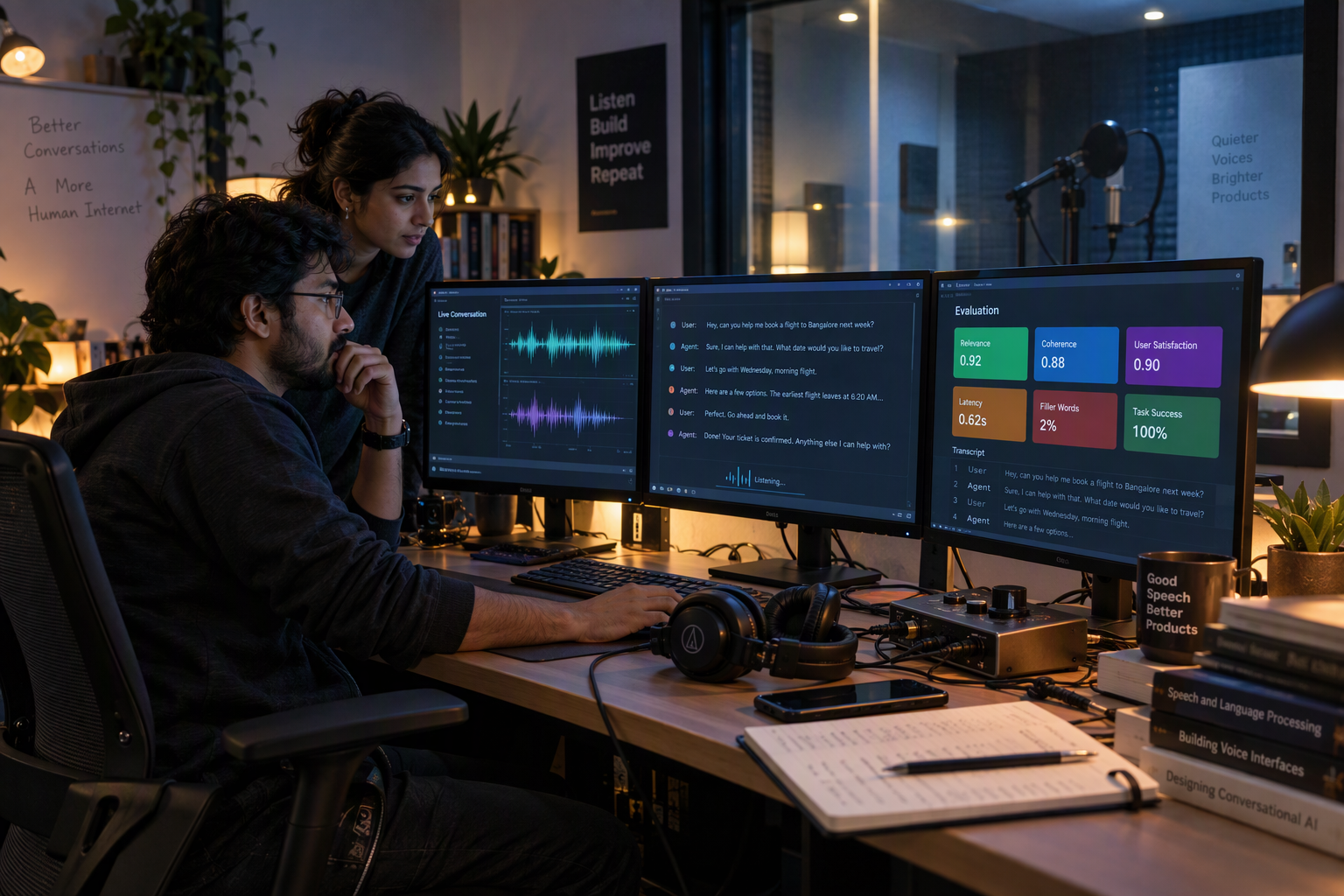
- Score calls against your own rubric. CallMissed's call scoring checks conversations against QA criteria you define, such as "confirmed date and time aloud."
- Test one change at a time. Use A/B experiments and eval suites to compare a new greeting or confirmation line before rolling it out.
- Use versioning. Publish changes and roll back quickly if accuracy dips.
- Push call notes to your CRM. AI call notes record the summary, disposition and follow-up, so staff see what happened.
Remember the 30-second minimum per call, and that a call that never connects costs nothing. Short, well-scripted confirmations keep per-call cost predictable.
What are the common mistakes when automating clinic calls?
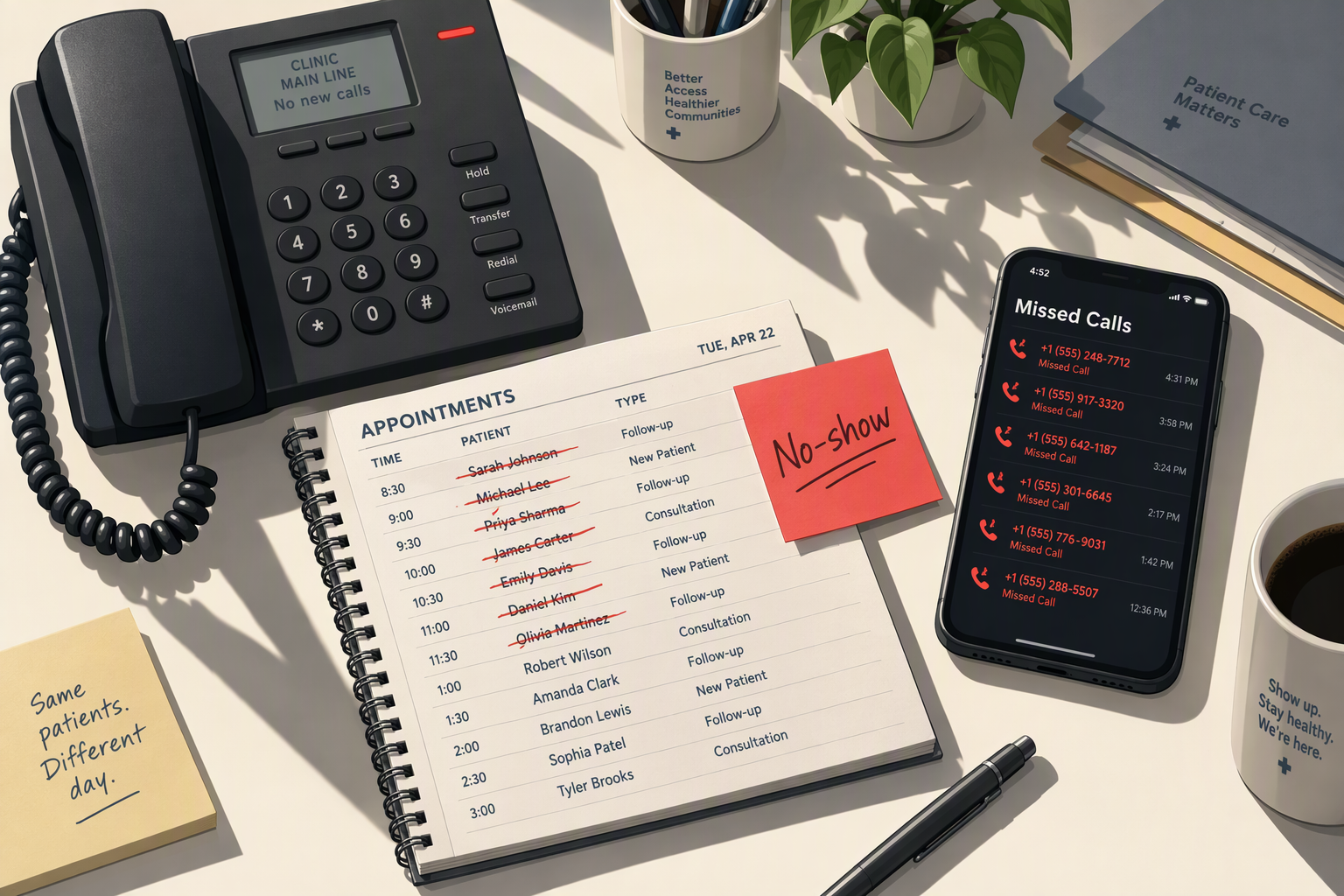
The most common mistakes when automating clinic calls are skipping consent, letting the agent wander into medical advice, ignoring regional language quirks, and having no path to a human. Most of them come from treating the voice agent as a "set and forget" tool rather than a front-desk team member that needs training and supervision.
Which mistakes do clinics make most often?
As of October 2026, these are the six patterns that cause the most trouble, along with the fix for each:
| # | Mistake | What goes wrong | Fix |
|---|---|---|---|
| 1 | No consent line at the start of the call | Patient data is collected without a clear notice, creating DPDP Act exposure | Open with a short Hindi disclosure about recording and data use, and log the patient's reply |
| 2 | Reusing treatment data for marketing | Patients get promotional calls they never agreed to | Keep reminder and marketing lists separate and ask for explicit opt-in |
| 3 | Treating minors like adults | A child's booking is confirmed on the child's say-so | Ask who is booking and capture a parent or guardian's consent for patients under 18 |
| 4 | Letting the agent give medical advice | A confident but wrong answer about symptoms or dosage | Restrict it to scheduling and FAQs, and route anything clinical to staff |
| 5 | Using an English-only script | Hinglish phrases and regional names are misheard, so patients hang up | Test with real code-mixed speech and review transcripts weekly |
| 6 | No human fallback | Emergencies and frustrated callers hit a dead end | Add a handoff path and a keypad option to reach the front desk |
Why do consent mistakes top the list?
Consent is where clinics carry the most legal risk. MedHive notes that for anyone under 18, the DPDP Act generally requires verifiable consent from a parent or guardian, although the Rules include exemptions for healthcare providers in defined circumstances. Law firm KS&K adds that when data collected for treatment is later used for another purpose, secondary use requires separate, explicit consent unless specifically exempted.
In practice, that means your appointment-reminder list should not quietly become a promotional list. Ichelon Consulting reports that enforcement rules are being operationalised in phases through 2024-2026, so it is safer to build the habit now. The upside is real: a 2024 NASSCOM survey, cited by DPDP Consultants, found 23% fewer security incidents among organisations with mature data governance.
How do you stop the agent from overreaching?
Write the boundaries into the prompt, not just the policy document. Tell the agent plainly that it books, reschedules, answers fee and timing questions from the knowledge base, and never interprets symptoms. For anything that sounds urgent, it should say so and transfer the call or give the clinic's emergency number.
A few practical safeguards:
- Keep the knowledge base short and current. Outdated fees or doctor timings are the most common cause of wrong answers.
- Use versioning. Platforms like CallMissed let you publish prompt changes and roll them back if a new version misbehaves.
- Review calls, not just totals. Call transcripts, QA scoring against your own rubric and live monitoring (where a supervisor can listen, whisper or barge in) show where patients get stuck.
What about cost and testing mistakes?
Clinics sometimes skip testing because they assume the pilot will be cheap anyway. It is, but the cost of a bad first impression is not. CallMissed's Standard voice plan is ₹4 per minute with a 30-second minimum per call, and a call that never connects costs nothing, so a few dozen test calls in Hindi, Hinglish and English cost very little. Run them before launch, including noisy-background and elderly-caller scenarios.
Finally, don't overpromise on outbound. Send appointment reminders through consented WhatsApp templates or single triggered calls, and keep volume modest. A reminder that respects the patient's preferences does more for no-shows than one that feels like spam.
Frequently Asked Questions
Can an AI voice agent for clinics in India understand Hindi and Hinglish?
How much does an AI voice agent for clinics cost in India in 2026?
Will an AI receptionist replace my front-desk staff?
How does missed-call recovery work with an AI voice agent?
Is an AI voice agent for clinics in India compatible with the DPDP Act?
- Telling callers at the start that an AI is on the line and that the call may be recorded
- Collecting only the details needed to book the visit
- Getting separate consent before any promotional follow-up
- Having a lawyer review your consent wording, since the rules are being operationalised in phases through 2026, according to Ichelon Consulting
CallMissed's platform is hosted in India, which may help clinics that prefer to keep data in-country.
Can patients book through WhatsApp calls, and can I keep my existing clinic number?
What is the rollout checklist and where should you start?
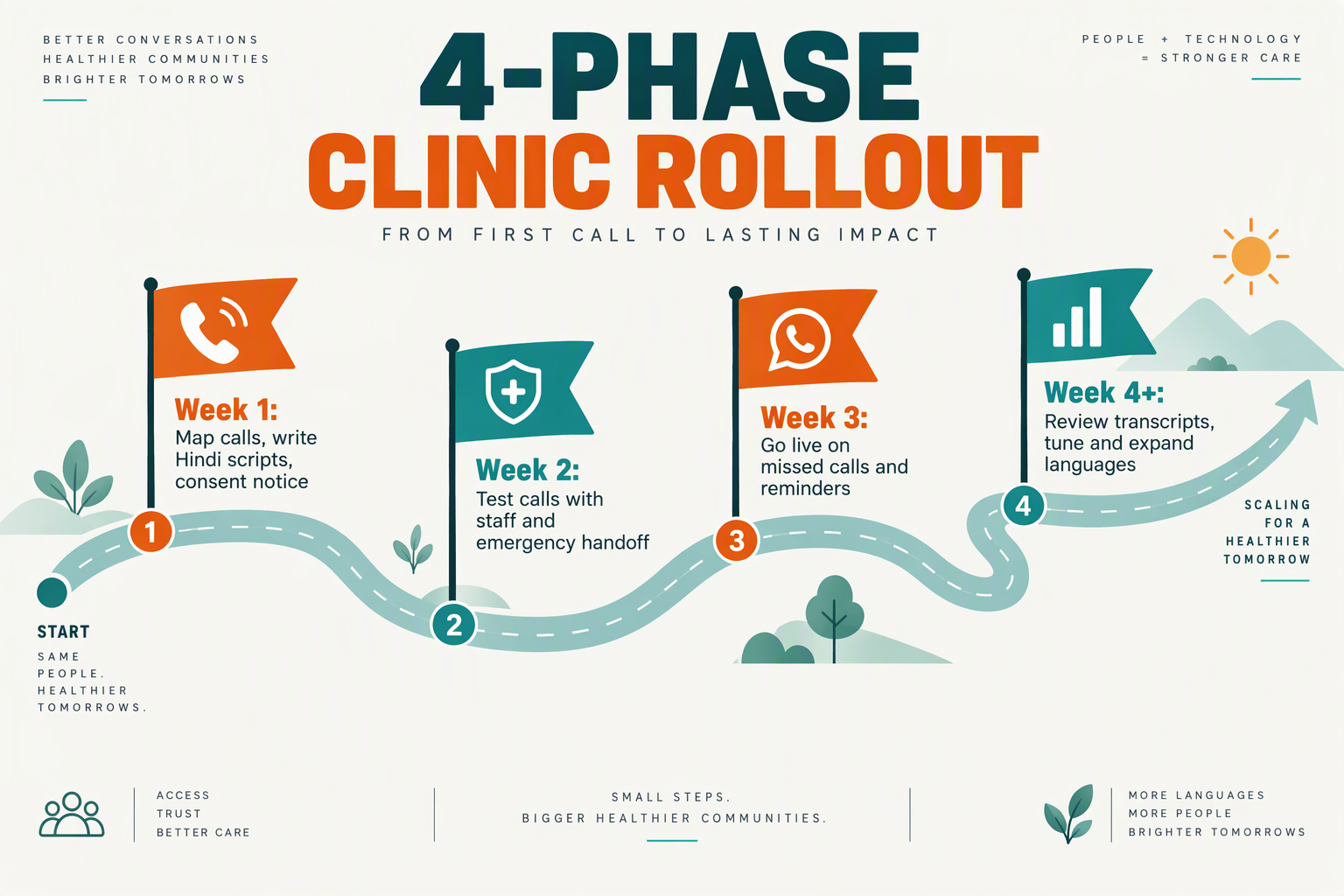
Start with one narrow job, usually after-hours calls and missed-call callbacks, and expand only after you have reviewed real transcripts. A phased rollout of about four weeks keeps risk low and gives your front desk time to trust the agent.
What is the rollout checklist for a clinic voice agent?
Work through these steps in order, as of October 2026:
- List your top five call reasons. Pull a week of call logs. Appointment booking, rescheduling, timings, fees and directions usually cover most volume. Write the exact answers your agent should give.
- Build the agent in a no-code builder. On CallMissed's console you set the prompt, voice, language, knowledge base and call settings. Load your fee list, doctor schedules and clinic FAQs as the knowledge base (text, web pages or PDFs).
- Connect your calendar. Link Google Calendar or Cal.com, or add a custom REST tool for your practice software, so a confirmed slot is a real slot.
- Write the consent script. Have the agent state, in Hindi, why it collects name and number and that the call may be recorded. Add a guardian prompt for patients under 18, since MedHive notes the DPDP Act generally requires verifiable parental consent for minors.
- Separate treatment from marketing. Because KS&K notes that secondary use of treatment data generally needs separate, explicit consent, keep promotional messages off the reminder flow unless the patient has opted in.
- Set a human handoff. Decide which calls go straight to staff: emergencies, medication questions, upset patients. Make the escape phrase work in Hindi and English.
- Test with staff, then a pilot. Call the agent yourselves with Hinglish phrases, background noise and interruptions. Fix the prompt, publish a new version, and roll back if a change makes things worse.
Where should you start?
Begin with missed-call recovery and after-hours answering. Nobody is currently picking up those calls, so the agent can only improve on the status quo, and your staff are not asked to change how they work.
Next, add appointment booking during working hours, then reminders. For reminders, WhatsApp message templates synced with Meta are a natural fit because patients can reply to confirm or reschedule. Use single outbound voice calls for high-priority follow-ups rather than assuming bulk dialling.
Finally, check your consent and retention practices against DPDP guidance. Ichelon Consulting notes that enforcement rules are being operationalised in phases through 2024-2026, so build the habits now rather than retrofitting later.
How much does a pilot cost?
CallMissed's voice agent plans are flat per minute, covering speech recognition, the language model and the voice: Standard ₹4/min, Expressive ₹5/min and Best latency ₹6/min. There is a 30-second minimum per call, and a call that never connects costs nothing. Phone carriage is billed separately.
New accounts receive 1,000 free credits, and 1 credit equals ₹1. At the Standard rate that is roughly 250 minutes of agent time before carriage costs, enough for a realistic pilot. Credits never expire, and payment works via UPI, cards or net banking with GST invoices.
What should you measure in the first month?
Track a small set of numbers weekly:
- Calls answered vs. missed, compared with your pre-pilot baseline
- Bookings completed without staff help
- Handoff rate and the reasons behind it
- No-show rate for patients who received a reminder
- Transcript review findings, such as misheard doctor names or wrong timings
Call transcripts, AI call notes and call scoring against your own QA rubric make this review practical. If the numbers hold after four weeks, widen the agent's scope. If not, adjust the prompt and knowledge base before adding anything new.
Conclusion
An AI voice agent can now take a clinic call in Hindi, Hinglish or English, which closes the gap that sends patients to the next doctor on the list. Here are the main takeaways from this guide:
- Booking: A Hindi voice agent can greet the caller, confirm the doctor and slot aloud, and write the appointment to your calendar.
- Reminders and missed calls: Timely reminders and quick follow-ups on unanswered calls protect revenue you would otherwise lose.
- Consent: Under the DPDP Act, build consent in from day one. That includes verifiable parental consent for patients under 18 and separate consent for marketing use.
- Cost: Voice agent plans on CallMissed run ₹4 to ₹6 per minute as of October 2026, with phone carriage billed separately.
Watch the Data Protection Board of India as the DPDP rules are operationalised in phases through 2026. Clinics with consent and data handling already in place will adopt new tools more easily.
To see how this works in practice, explore CallMissed, an India-hosted platform that recognises 22 Indian languages, including code-mixed Hinglish. New accounts get 1,000 free credits on signup, enough to test a Hindi booking flow before you commit.
So, how many patients did your clinic lose to an unanswered ring last week?
Related Reading
- Voice Agent API With LiveKit Support: Verified 2026 Comparison
- Voice Agent API with LiveKit Support: 2026 Comparison and Verdict
- How to Test an AI Voice Agent: Hinglish QA Checklist