
Voice Agent API With LiveKit Support: Verified 2026 Comparison


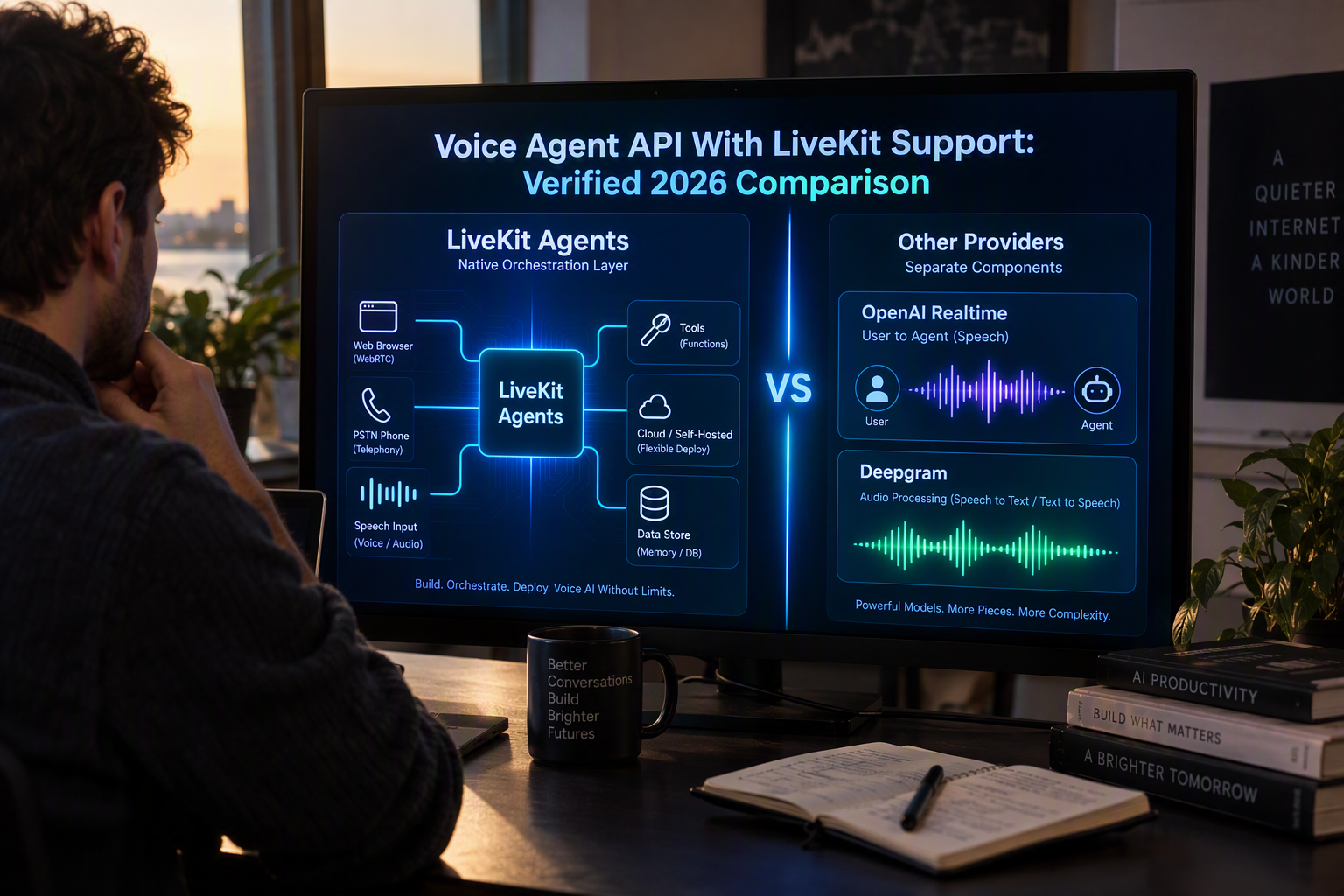
Compare LiveKit Agents, OpenAI Realtime, and Deepgram by LiveKit integration, verified 2026 pricing, architecture, and best-fit use cases.
Voice Agent API With LiveKit Support: Verified 2026 Comparison
What if the most important voice-agent decision in 2026 is not the AI model—but the real-time infrastructure connecting it to users? A voice agent API with LiveKit support can combine low-latency WebRTC transport, flexible model providers, and production-grade orchestration, making architecture as important as conversation quality. This comparison examines LiveKit Agents, OpenAI Realtime API, and Deepgram across streaming, turn detection, provider flexibility, deployment, pricing, and integration effort. The timing matters: OpenAI Realtime became generally available on 28 August 2025, while Ry Walker Research reports that LiveKit raised a $100 million Series C at a $1 billion valuation in January 2026. We’ll separate verified capabilities from marketing claims, clarify which APIs work directly with LiveKit, and map each option to practical use cases. Platforms such as CallMissed reflect the broader shift toward accessible, multilingual voice infrastructure for developers and businesses.
Which voice agent API with LiveKit support should you choose in 2026?
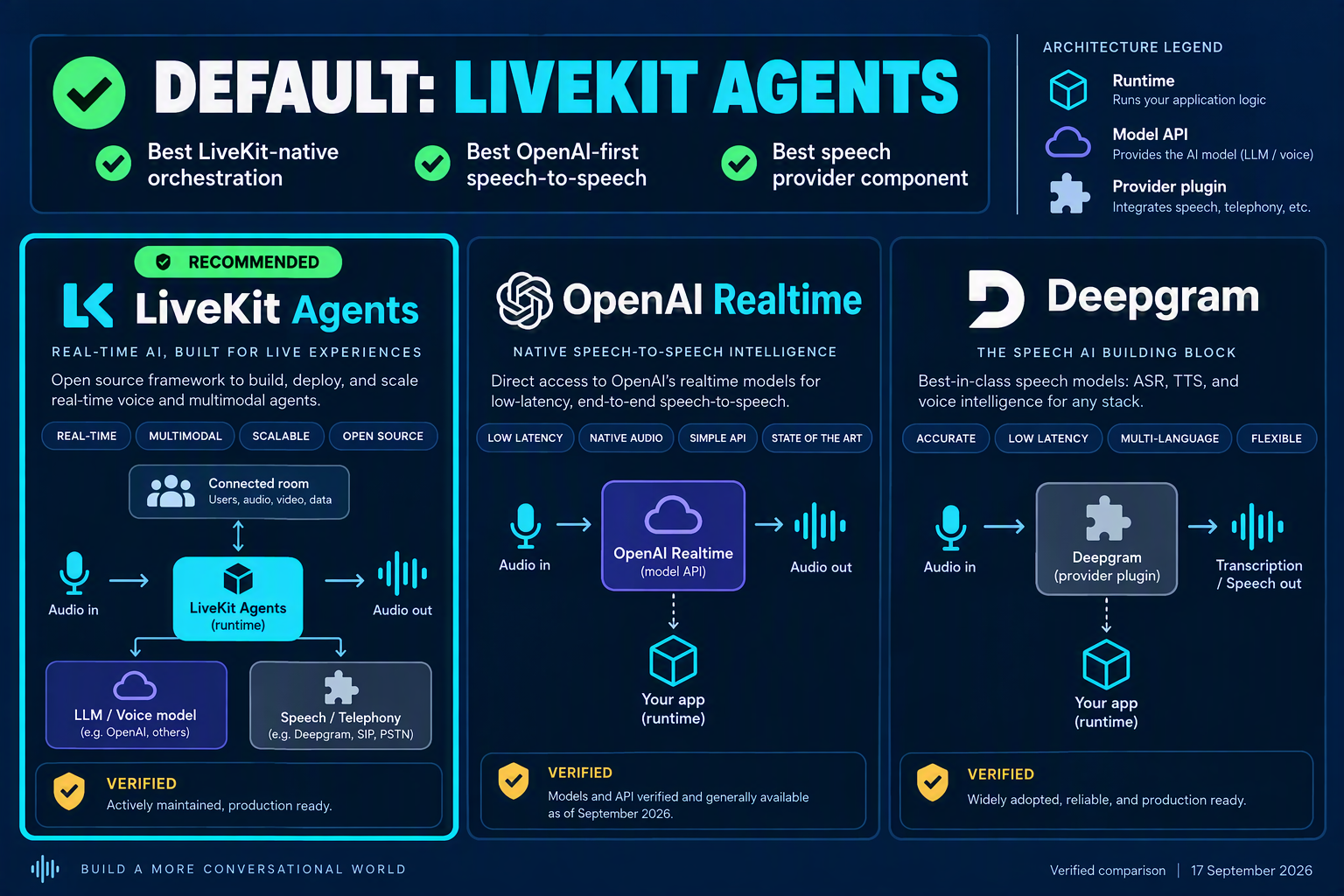
Choose LiveKit Agents when you need a flexible voice agent API with LiveKit support, provider choice, and control over transport and orchestration; choose OpenAI Realtime for a tightly integrated OpenAI voice-model stack; choose Deepgram when speech recognition and synthesis are your primary priorities. For India-focused applications, CallMissed offers a separate alternative: an OpenAI-compatible AI gateway with consolidated access to models and speech APIs, but this comparison does not imply that CallMissed supports LiveKit.
Which voice agent API with LiveKit support is best for flexible architectures?
LiveKit Agents is the strongest fit when your application needs WebRTC-based transport, reusable agent orchestration, and the freedom to combine providers. According to Ry Walker Research, LiveKit Agents is an open-source, self-hostable framework that supports OpenAI, Deepgram, ElevenLabs, other STT/LLM/TTS providers, and LiveKit Inference.
That architecture separates the realtime communications layer from the intelligence layer. Teams can therefore change speech, reasoning, or synthesis providers without rebuilding the entire call experience. Ry Walker Research also reports that LiveKit raised a $100 million Series C at a $1 billion valuation in January 2026, although funding is not itself a technical performance benchmark.
Choose LiveKit Agents when you need:
- A composable, multi-provider pipeline
- Self-hosting or greater infrastructure control
- LiveKit-native orchestration for realtime voice applications
- The option to combine different STT, LLM, and TTS vendors
When should you choose OpenAI Realtime?
Choose OpenAI Realtime when a single vendor’s realtime model and conversational behavior are more important than maximum provider flexibility. Forasoft reports that the OpenAI Realtime API became generally available on 28 August 2025 and identifies gpt-realtime-2.1 and gpt-realtime-2.1-mini as current 2026 models.
OpenAI Realtime can simplify architecture because the model-led voice experience is more vertically integrated. However, usage-based pricing requires careful forecasting. Aireiter reports a headline rate of $32 per million audio input tokens for OpenAI Realtime; actual spend depends on audio duration, token usage, model choice, and other API charges.
OpenAI Realtime is a practical choice for:
- OpenAI-centered conversational applications
- Teams prioritizing an integrated realtime model stack
- Prototypes that may benefit from fewer independently managed components
Is Deepgram a complete voice agent API?
Deepgram is best evaluated as a speech layer rather than a complete agent runtime. Its STT and TTS capabilities can serve speech-first applications, while LiveKit Agents can place Deepgram inside a broader pipeline that handles transport, orchestration, and reasoning.
Choose Deepgram plus LiveKit when speech recognition and synthesis are central requirements but the application also needs a separately selected LLM, tools, or agent workflow. This approach offers composability, but it also means budgeting and operating multiple components.
What is the best option for Indian-language voice agents?
CallMissed provides a different infrastructure model for teams that need regional-language coverage and a unified AI API. As of September 2026, CallMissed’s developer API provides one key and balance across 134 models, including LLM, realtime voice-agent, STT, TTS, image, and embedding models. CallMissed supports speech recognition in 22 Indian languages plus English, including code-mixed speech such as Hinglish; its natural TTS voices cover 10 Indian languages plus English.
The practical decision is:
- LiveKit Agents: flexible, self-hostable orchestration with LiveKit support
- OpenAI Realtime: integrated OpenAI realtime voice-model experience
- Deepgram plus LiveKit: speech-first, composable architecture
- CallMissed: India-focused, OpenAI-compatible access to multiple AI and speech APIs—without claiming LiveKit support
What does “LiveKit support” actually mean, and what is the verdict?
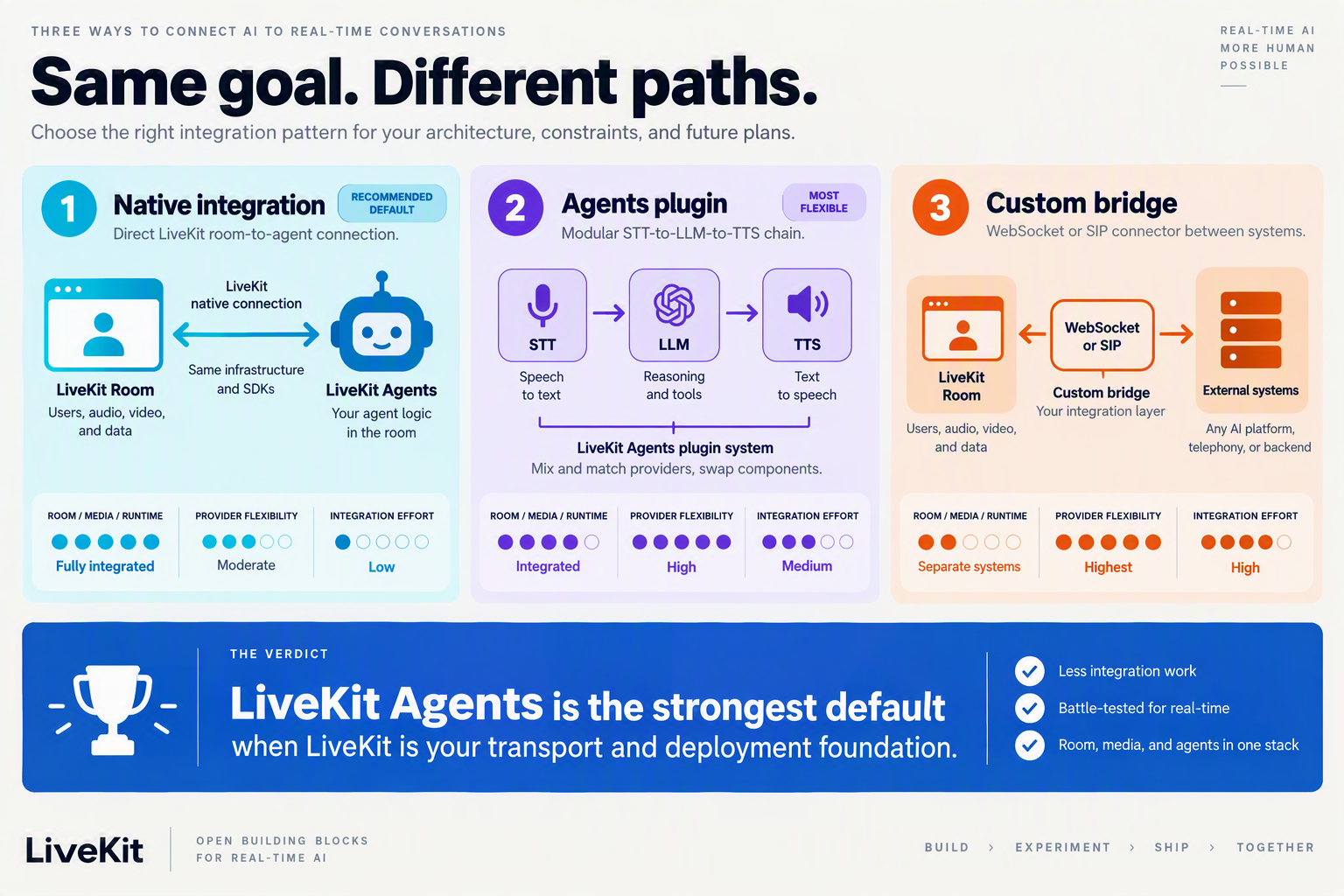
“LiveKit support” means more than sending audio to a WebRTC endpoint. A voice agent API with LiveKit support should connect to LiveKit Rooms and media tracks, stream bidirectional audio, and support the runtime behaviors that make conversations usable: turn detection, interruption handling, tool calls, and model streaming. By that standard, LiveKit Agents, OpenAI Realtime, and Deepgram occupy different layers rather than representing equivalent products.
What does LiveKit support include?
Look for these capabilities when evaluating an integration:
- LiveKit Rooms and media tracks: The system must participate in LiveKit’s real-time transport model, not merely accept an uploaded audio file.
- Bidirectional streaming: Audio should flow continuously between the user, agent runtime, and speech or language models.
- Conversation control: Turn detection, voice-activity detection, barge-in or interruption handling, and low-friction handoffs are central to production voice agents.
- Agent orchestration: Tools, function calls, session state, deployment controls, and observability determine whether the integration can move beyond a demo.
- Maintained adapters: A documented, maintained plugin or integration is stronger evidence of support than a generic SDK or a marketing reference to WebRTC.
How do LiveKit Agents, OpenAI Realtime, and Deepgram differ?
- LiveKit Agents is the most direct answer to the query “voice agent API with LiveKit support.” It is an open-source orchestration framework that connects LiveKit transport with providers such as OpenAI, Deepgram, and ElevenLabs, as well as LiveKit Inference. Ry Walker Research describes LiveKit Agents as self-hostable and highlights its provider flexibility. This makes it the runtime and transport layer in a composable architecture.
- OpenAI Realtime API is a model-and-realtime-session API, not a LiveKit media server. It can operate behind LiveKit Agents through an integration, but developers still need LiveKit for room management, WebRTC connectivity, and broader orchestration. Forasoft reports that OpenAI Realtime became generally available on August 28, 2025, with
gpt-realtime-2.1andgpt-realtime-2.1-miniavailable in 2026.
- Deepgram is primarily a speech-processing provider, offering speech-to-text and text-to-speech, rather than a confirmed equivalent to a LiveKit-native agent runtime. LiveKit Agents can use Deepgram for speech processing while routing transport, reasoning, tools, and session management through other components. Therefore, “Deepgram supports LiveKit” should usually be read as Deepgram can be used within a LiveKit-based stack, not that Deepgram itself replaces LiveKit Agents.
What is the pricing and architecture verdict?
Compare the complete stack instead of one headline rate. Aireiter reports OpenAI Realtime audio input at $32 per million audio input tokens; platform, transport, speech-processing, and telephony charges may remain separate. The practical cost depends on audio duration, model selection, interruptions, and whether STT and TTS are bundled or metered independently.
Verdict: Choose LiveKit Agents for an extensible, self-hostable orchestration layer; OpenAI Realtime for a tightly integrated realtime model experience; and Deepgram when speech processing is the component you need inside a broader runtime. CallMissed represents another API-led approach: its managed voice-agent WebSocket includes a Deepgram Voice Agent-compatible endpoint, while its platform provides speech recognition in 22 Indian languages plus English and natural TTS in 10 Indian languages plus English. That language distinction matters for India-focused deployments, but it should not be confused with confirmed native LiveKit runtime support.
How do LiveKit Agents, OpenAI Realtime, and Deepgram compare feature by feature?
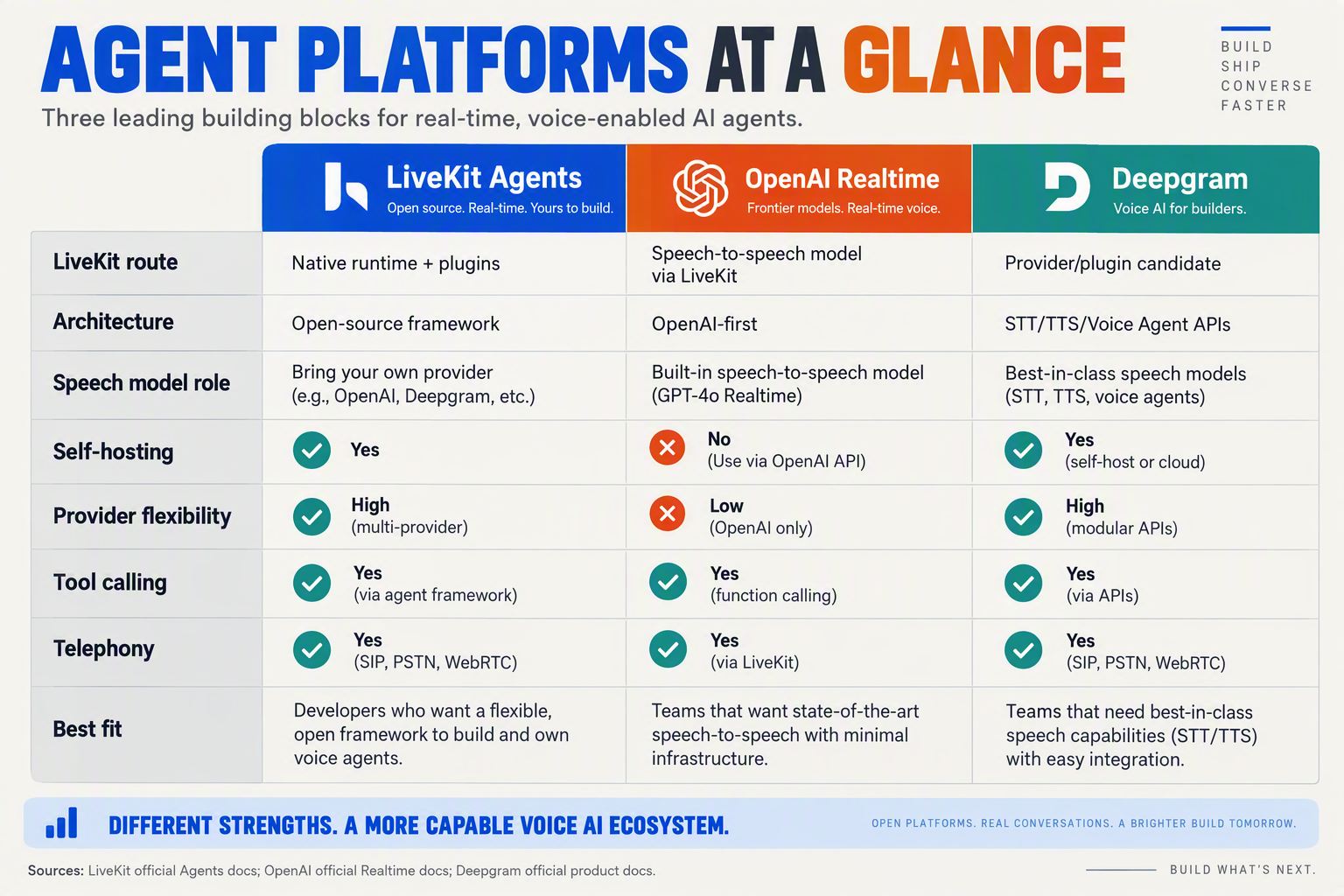
A voice agent API with LiveKit support is not a single product category: LiveKit Agents provides orchestration and realtime transport, OpenAI Realtime provides an integrated realtime model API, and Deepgram primarily provides speech recognition and synthesis. The table separates documented platform roles from integration assumptions that teams should validate against current SDKs, plugins, and runtime versions.
Feature-by-feature comparison
| Capability | LiveKit Agents | OpenAI Realtime | Deepgram | Practical implication |
|---|---|---|---|---|
| Primary role | Open-source agent framework with WebRTC infrastructure | Managed realtime model API combining conversational reasoning and audio interaction | Speech-to-text and text-to-speech provider | Select the orchestration layer, model layer, or speech layer your architecture lacks |
| LiveKit relationship | Native LiveKit agent runtime and transport | Requires application-level integration with LiveKit or another transport | Can be used as a speech provider in a LiveKit pipeline; confirm the current plugin and runtime status before deployment | Do not treat Deepgram as confirmed native or full LiveKit compatibility without version-specific verification |
| Provider flexibility | Supports configurable STT, LLM, and TTS providers; Ry Walker Research lists OpenAI, Deepgram, ElevenLabs, and LiveKit Inference | Primarily uses OpenAI’s realtime model stack | Focuses on speech services rather than a complete reasoning-and-orchestration loop | LiveKit Agents is designed for multi-provider composition |
| Deployment model | Self-hostable framework; LiveKit Cloud is also available | Managed OpenAI API | Managed Deepgram APIs | Self-hosting can increase control while adding infrastructure and operations work |
| Realtime model status | Framework-level choice; capabilities depend on the configured provider | Generally available since 28 August 2025, according to Forasoft, with gpt-realtime-2.1 and `gpt-realtime-2.1-mini cited in its 2026 guide | Speech models rather than a complete realtime reasoning agent | OpenAI offers a more vertically integrated path; LiveKit offers more assembly choices |
| Pricing structure | Transport, infrastructure, and model-provider costs may be separate | Aireiter reports $32 per million audio input tokens for Realtime-2.1; output and other usage are additional | Usage-based speech API pricing | Compare the complete call stack, including transport, speech, model, and telephony costs |
The most important distinction is architectural:
- LiveKit Agents is the orchestration choice when a team wants to combine realtime rooms, agent workflows, and multiple AI providers. Ry Walker Research describes it as an open-source framework and reported a $100 million Series C at a $1 billion valuation in January 2026; that financing is an industry signal, not a performance benchmark.
- OpenAI Realtime is suited to teams prioritising a managed, integrated realtime model experience. Forasoft reports that the API reached general availability on 28 August 2025, but developers should still verify model availability, pricing, and limits in OpenAI’s current documentation.
- Deepgram is a speech-layer option for transcription or synthesis when another system handles reasoning, turn-taking, and orchestration. Its use in a LiveKit pipeline should be checked against the specific LiveKit plugin, Deepgram model, SDK version, and runtime currently targeted.
- CallMissed’s developer AI API offers one OpenAI-compatible gateway to 134 models, including LLM, realtime voice-agent, speech-to-text, and text-to-speech models. As of September 2026, its speech recognition supports 22 Indian languages plus English, while its natural text-to-speech supports 10 Indian languages plus English—separate figures that matter when planning regional voice agents.
For a reliable comparison, test end-to-end latency, interruption handling, language quality, failure recovery, and total per-minute cost in the exact LiveKit pipeline you intend to deploy. The provider with the lowest individual speech or model price may not produce the lowest complete system cost.
How much does each option cost when you calculate the full voice-agent stack?
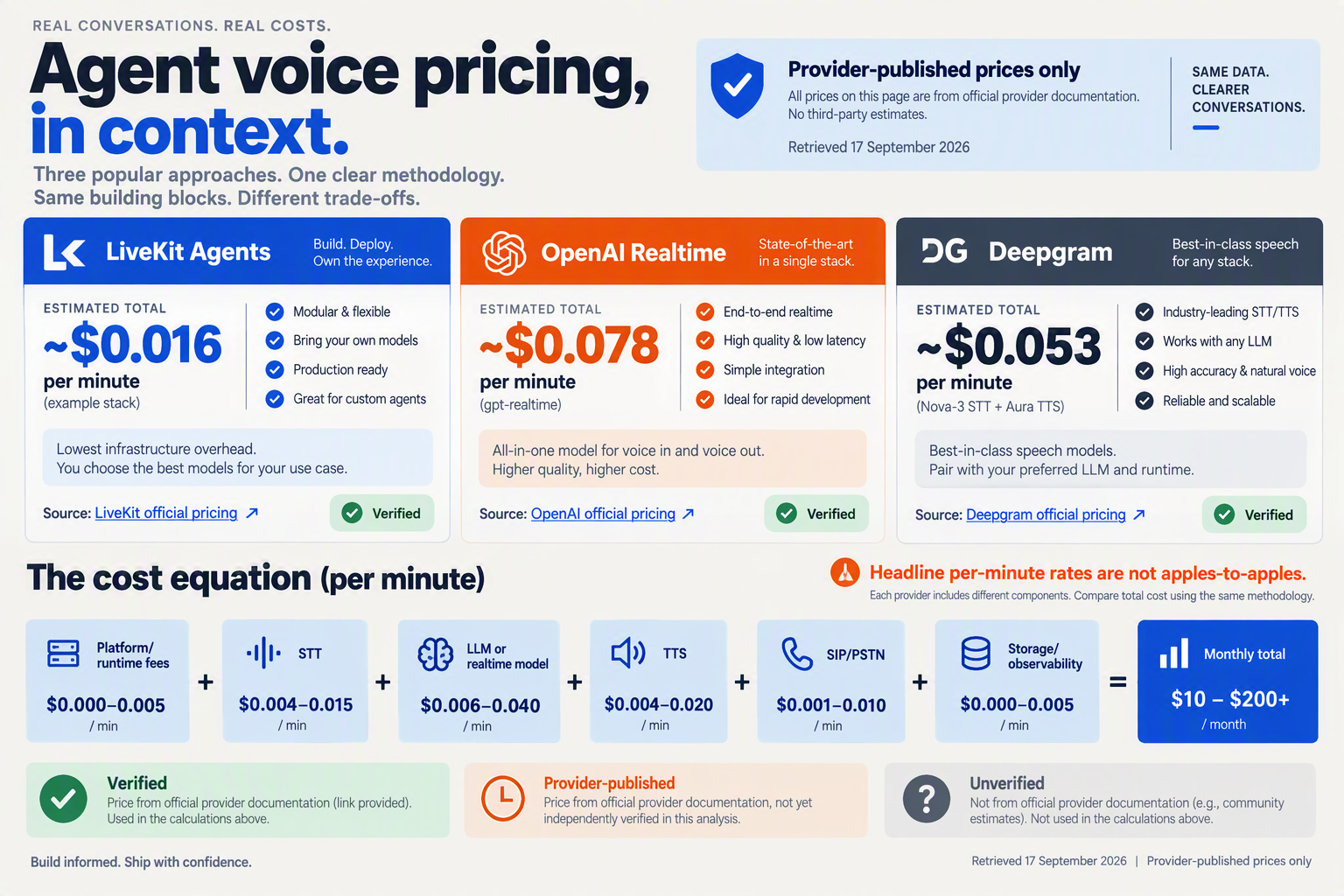
The most accurate way to compare voice-agent pricing is to calculate the complete stack, not a headline model rate. For every option, use this formula:
Total cost = runtime or platform fees + model and speech usage + telephony or WebRTC transport + storage, monitoring, and observability.
A browser voice agent may avoid phone-carrier charges, while a phone-based agent adds inbound or outbound minutes, numbers, recording, and related infrastructure. Public sources do not provide a single apples-to-apples, all-in per-minute price for LiveKit Agents, OpenAI Realtime, and Deepgram-based architectures as of September 2026.
What does the full voice-agent stack cost?
| Option | Published pricing signal | Costs to add to the estimate | Cost profile | Typical fit |
|---|---|---|---|---|
| LiveKit Agents + self-hosting | Open-source, self-hostable framework, according to Ry Walker Research (2026) | Compute, bandwidth, STT, LLM, TTS, telephony, storage, monitoring, and engineering operations | Maximum control; variable infrastructure cost | Teams with platform and DevOps capability |
| LiveKit Cloud + Agents | Managed LiveKit services with usage determined by selected products and configuration | STT, LLM, TTS, phone carrier, egress, recordings, and observability where applicable | Easier operations; usage still depends on the stack | Production teams wanting managed realtime transport |
| OpenAI Realtime API | $32 per million audio input tokens, according to Aireiter (2026) | Audio-output tokens, model usage, WebRTC or telephony integration, application hosting, storage, and monitoring | Fewer vendors to integrate; token consumption varies by conversation | Teams standardizing on OpenAI’s realtime models |
| Deepgram in a LiveKit pipeline | Speech pricing depends on the selected Deepgram STT and TTS models | LLM, orchestration, LiveKit transport, telephony, hosting, storage, and observability | Modular and configurable; requires billing aggregation | Speech-focused applications needing provider choice |
| CallMissed developer API and voice stack | 1 credit = ₹1, with 1,000 free signup credits; API access covers 134 models, including 27 on the free tier, as of September 2026 | Selected model and speech usage, telephony, and any external transport or storage used by the application | Consolidated API billing; exact usage depends on chosen models and services | Indian businesses and developers building multilingual agents |
The $32 per million audio input tokens cited by Aireiter is an OpenAI Realtime model-input figure, not an all-in voice-minute price. A production calculation must still include output audio, transport, telephony where relevant, and application-level monitoring.
LiveKit Agents adds an important architectural trade-off: Ry Walker Research (2026) describes provider flexibility across OpenAI, Deepgram, ElevenLabs, and LiveKit Inference. That flexibility can help teams select different providers for reasoning, speech recognition, and synthesis, but it also makes the final invoice a sum of multiple usage dimensions.
Deepgram should therefore be budgeted as a speech component, not a complete agent platform. The final estimate needs separate line items for the language model, orchestration layer, LiveKit transport, phone connectivity, and operational tooling.
CallMissed offers a consolidated developer API with OpenAI-compatible and Anthropic-compatible endpoints, streaming, function calling, structured outputs, vision, audio transcription, translation, speech, and a managed voice-agent WebSocket. For Indian-language deployments, CallMissed speech recognition supports 22 Indian languages plus English, while natural text-to-speech supports 10 Indian languages plus English. Its voice-agent plans are separately priced at ₹4, ₹5, or ₹6 per minute, depending on voice and latency tier; phone carriage is billed separately, and a 30-second minimum applies to connected calls.
What are the pros and cons of each LiveKit-compatible approach?
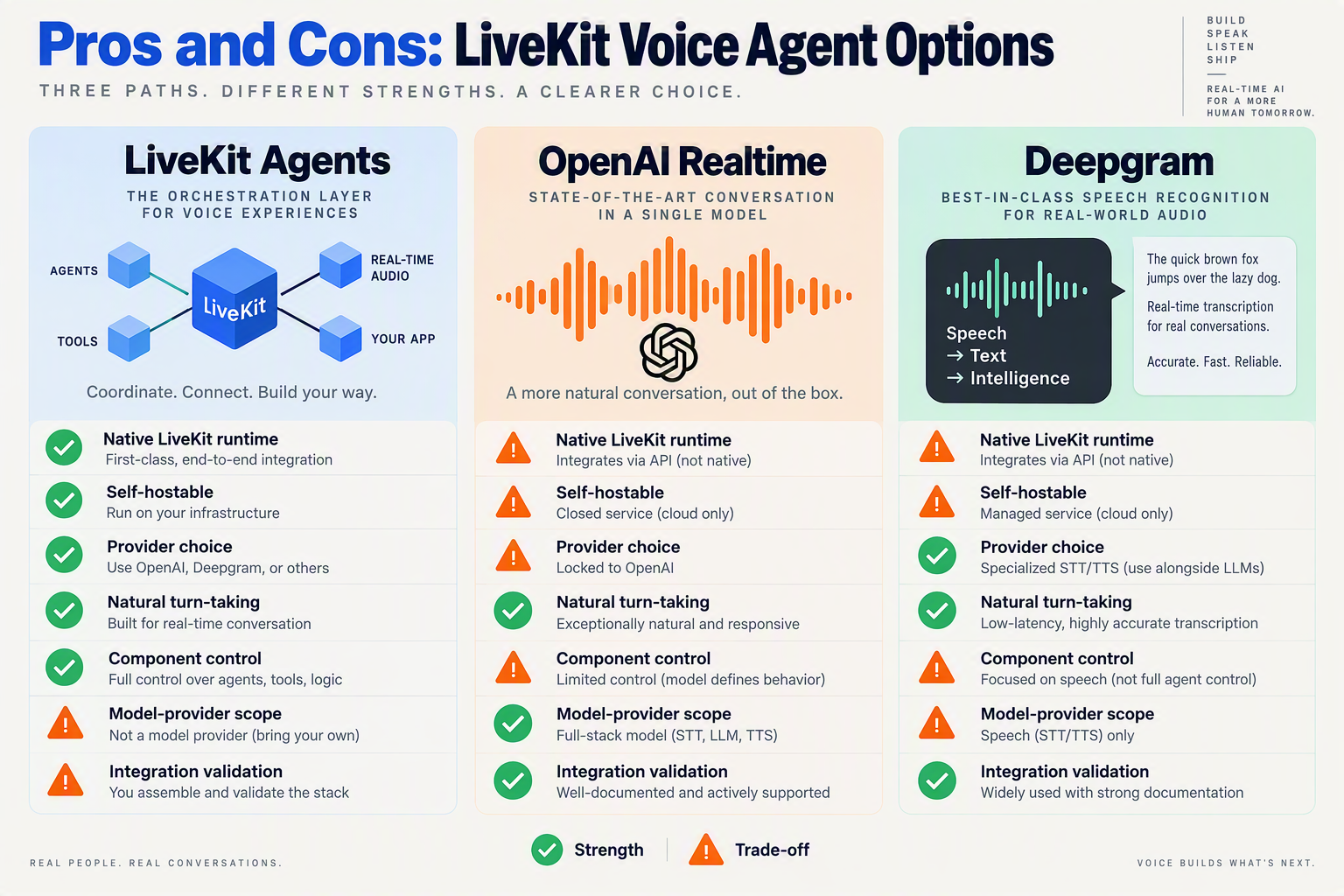
The right voice agent API with LiveKit support depends on whether you need an orchestration layer, an integrated realtime model, or specialist speech services. LiveKit Agents offers the most architectural flexibility; OpenAI Realtime reduces integration overhead; Deepgram is strongest as a speech component, but the available evidence does not establish it as a complete, standalone LiveKit agent runtime.
Comparison at a glance
| Dimension | LiveKit Agents | OpenAI Realtime API | Deepgram |
|---|---|---|---|
| Primary role | Open-source agent orchestration and WebRTC infrastructure | Integrated realtime speech-and-reasoning API | Speech-to-text and text-to-speech provider |
| LiveKit compatibility | Native framework integration | Connects through LiveKit Agents or custom bridges | Can serve as a speech layer in a broader LiveKit architecture; evidence does not confirm a complete Deepgram-native runtime |
| Provider flexibility | Supports OpenAI, Deepgram, ElevenLabs, other providers, and LiveKit Inference, according to Ry Walker Research | Primarily OpenAI’s model and API stack | Can be combined with separate LLMs, tools, and orchestration frameworks |
| Deployment model | Cloud or self-hosted; Ry Walker Research identifies LiveKit Agents as self-hostable | OpenAI-managed API with less infrastructure to operate | Managed speech APIs; application orchestration remains separate |
| Pricing signal | Infrastructure, model, transport, and telephony costs may be separate | Aireiter reports $32 per million audio input tokens; output and model usage also apply | Speech pricing is separate from LLM, transport, and telephony costs |
| Best fit | Multi-provider production agents and custom architectures | Teams seeking a direct, integrated realtime model | Teams prioritising STT/TTS while retaining LLM and runtime choice |
- LiveKit Agents: The main advantage is composability. According to Ry Walker Research, developers can combine providers such as OpenAI, Deepgram, and ElevenLabs, or use LiveKit Inference, while retaining control over orchestration and deployment. The trade-off is operational complexity: teams must design the agent pipeline and account separately for infrastructure, models, transport, and telephony.
- OpenAI Realtime API: OpenAI made the Realtime API generally available on 28 August 2025, according to Forasoft. Forasoft identifies
gpt-realtime-2.1andgpt-realtime-2.1-minias 2026 options, making this approach attractive for teams that want realtime speech and reasoning through one vendor’s API. The cost is tighter vendor coupling and less freedom to swap individual STT, TTS, or reasoning components.
- Deepgram: Deepgram is a sensible choice when transcription and synthesis are the central requirements, particularly if the application already has its own LLM, tools, and orchestration layer. However, the evidence available for this comparison supports Deepgram as a speech provider that can be used within a LiveKit-based architecture—not as a verified, complete Deepgram-native LiveKit agent runtime. That distinction matters when estimating engineering effort.
- CallMissed: For India-focused teams evaluating alternatives around the same voice-agent stack, CallMissed provides an OpenAI-compatible developer API covering 134 models, including LLM, realtime voice-agent, speech-to-text, text-to-speech, image, and embedding models, as of September 2026. Its speech recognition supports 22 Indian languages plus English, including code-mixed Hinglish; its natural text-to-speech voices support 10 Indian languages plus English. That language split is important when comparing regional voice coverage rather than treating “22 languages” as a TTS figure.
Which option is best for your product, team, and deployment model?
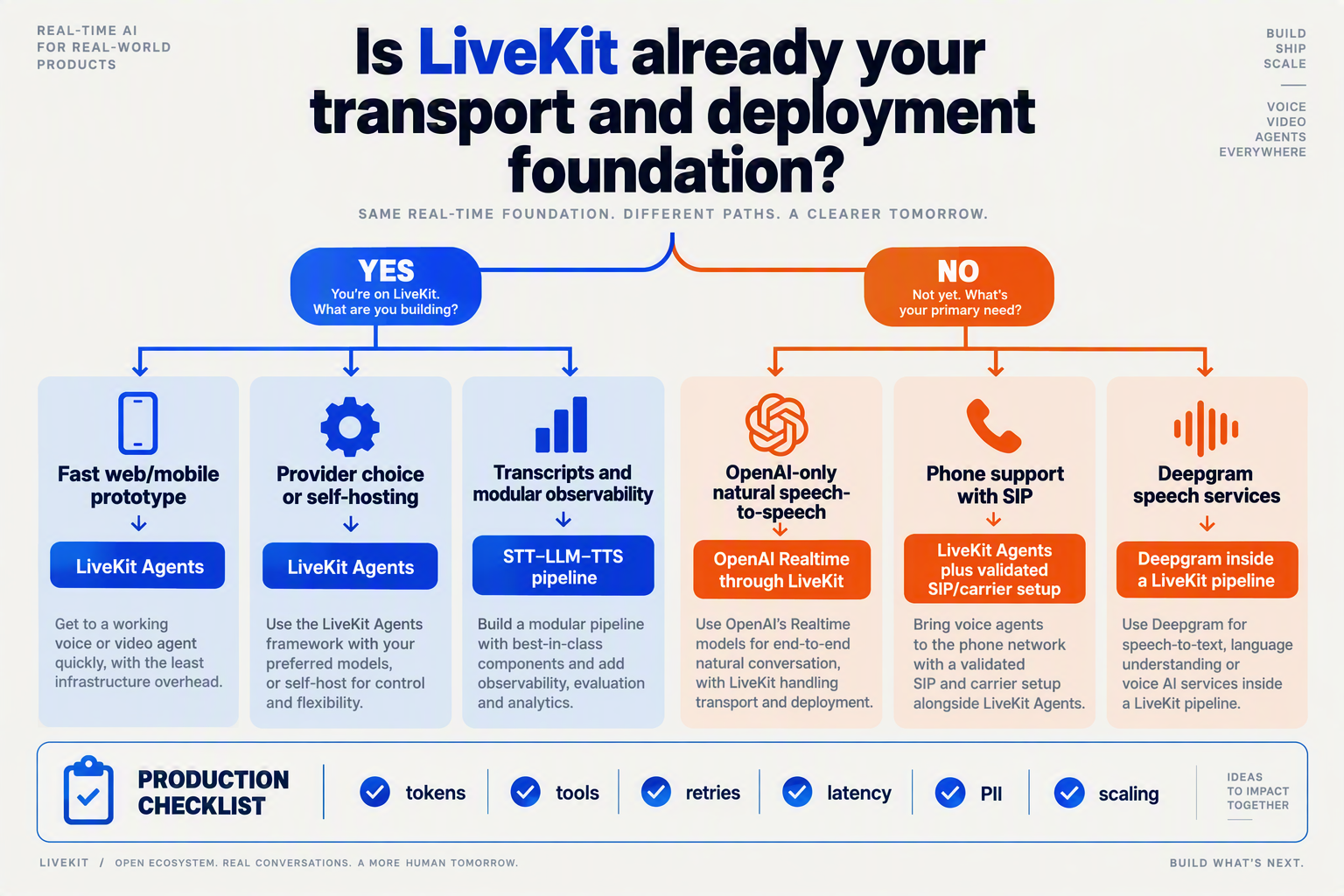
Choose based on where your product complexity lives: LiveKit Agents offers framework and infrastructure flexibility, OpenAI Realtime offers an integrated model-led experience, and Deepgram suits speech-first architectures. The right choice depends on verified requirements for provider portability, deployment control, language coverage, billing, and production behavior—not headline latency claims.
Which option fits each product and team?
- LiveKit Agents: A strong candidate for platform teams building multi-provider voice products. The open-source framework supports OpenAI, Deepgram, ElevenLabs, other STT, LLM, and TTS providers, as well as LiveKit Inference. Ry Walker Research describes LiveKit Agents as self-hostable; verify the current deployment, licensing, networking, and operational requirements directly against LiveKit’s documentation before selecting it for a regulated environment.
- OpenAI Realtime API: A practical fit for small-to-mid-sized teams prioritizing a model-led voice agent and a relatively consolidated provider experience. Forasoft reports that OpenAI made the Realtime API generally available on August 28, 2025, and identifies
gpt-realtime-2.1andgpt-realtime-2.1-minias current 2026 models. Confirm model availability, regional access, supported features, and pricing in OpenAI’s current documentation before implementation.
- Deepgram: Best suited to applications where speech recognition and speech synthesis are central product requirements. Deepgram can also be used within LiveKit Agents when a team wants Deepgram speech services alongside a different provider for reasoning, tools, or orchestration. Benchmark recognition quality with representative accents, interruptions, background noise, and domain vocabulary rather than relying on generalized performance claims.
- LiveKit Cloud versus self-hosting: LiveKit Cloud may suit teams seeking managed realtime infrastructure, while self-hosting may suit teams that need greater control over networking and operations. Treat this as an architecture decision, not a guaranteed deployment outcome: verify data handling, observability, scaling responsibilities, regional availability, and support terms for the exact plan and topology.
How should teams compare voice agent API costs?
Compare the complete voice pipeline, including audio input, speech recognition, model inference, speech synthesis, transport, telephony, storage, and observability. Aireiter reports OpenAI Realtime audio input at $32 per million audio tokens, while Finn reports bundled voice-agent pricing from approximately $0.07 per minute; those different billing units cannot be compared directly without a measured usage model.
For India-first or multilingual products, evaluate regional-language accuracy and billing together. As of September 2026, CallMissed provides speech recognition in 22 Indian languages plus English, including code-mixed speech such as Hinglish, while its natural text-to-speech voices cover 10 Indian languages plus English. CallMissed also provides an OpenAI-compatible gateway for LLM, speech, image, embedding, and search APIs with consolidated credit-based usage; verify whether its supported interfaces and transport model match your LiveKit-based architecture before adoption.
What should you verify before choosing?
- Run the same scripted and unscripted calls through each candidate.
- Measure turn-taking, interruption recovery, transcription accuracy, tool-call reliability, and end-to-end cost using your own traffic.
- Verify SDK compatibility, WebSocket behavior, telephony routing, regional data requirements, and failure handling.
- Confirm current model names, prices, quotas, and deployment options from official documentation.
The practical decision rule is: choose LiveKit Agents for control and portability, OpenAI Realtime for integrated realtime intelligence, and Deepgram for speech infrastructure—then commit only after a representative, verification-first benchmark.
What are the most common questions about a voice agent API with LiveKit support?
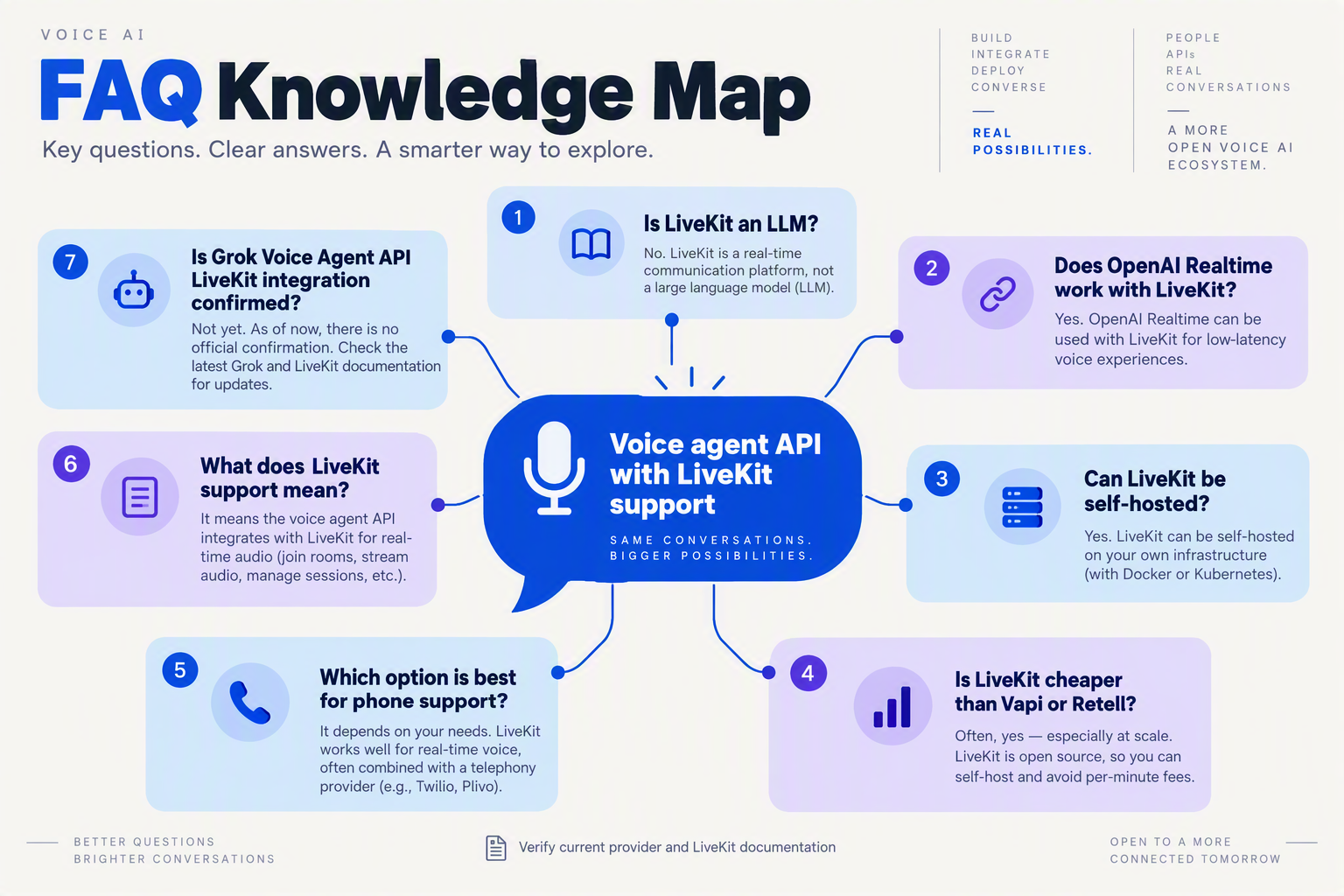
A voice agent API with LiveKit support typically combines LiveKit’s real-time WebRTC transport with a separate speech or reasoning provider. The right choice depends on latency, provider flexibility, deployment control, and total usage cost.
- Q: What is a voice agent API with LiveKit support?
A: It connects a conversational AI agent to LiveKit’s real-time audio infrastructure, commonly through LiveKit Agents. Ry Walker Research describes LiveKit Agents as an open-source, self-hostable framework that supports OpenAI, Deepgram, ElevenLabs, and other providers.
- Q: Does OpenAI Realtime API work directly with LiveKit?
A: OpenAI Realtime can serve as the model and audio-processing layer inside a LiveKit-based architecture, but LiveKit Agents remains the orchestration and transport framework. OpenAI Realtime became generally available on 28 August 2025, according to Forasoft.
- Q: Is Deepgram a complete voice agent API with LiveKit support?
A: Deepgram is primarily a Speech-to-Text and Text-to-Speech provider rather than a complete agent runtime. Developers can use Deepgram within LiveKit Agents, while another model handles reasoning, tools, and conversation state.
- Q: How much does an OpenAI Realtime voice agent cost in 2026?
A: Aireiter reports a headline OpenAI Realtime rate of $32 per million audio input tokens, although actual costs depend on audio duration, output tokens, model choice, and session behavior. Budget separately for LiveKit transport, telephony, tools, and other infrastructure.
- Q: Which voice agent API with LiveKit support is easiest to scale?
A: LiveKit Agents is a practical choice when teams need provider switching, self-hosting, or independent control over transport and orchestration. OpenAI Realtime can reduce integration complexity when a tightly integrated model-led stack is acceptable.
- Q: Can Indian businesses use multilingual voice infrastructure with LiveKit?
A: Yes, LiveKit can provide real-time transport while the selected STT, TTS, and LLM providers determine language coverage. Indian platforms such as CallMissed support voice across 22 Indian languages, alongside an OpenAI-compatible gateway for LLM, STT, and TTS APIs.
Conclusion
The 2026 comparison points to three distinct choices:
- LiveKit Agents offers the broadest provider flexibility, WebRTC orchestration, and self-hosting, according to Ry Walker Research.
- OpenAI Realtime, generally available since 28 August 2025, suits tightly integrated model-led voice agents; Aireiter reports $32 per million audio input tokens.
- Deepgram remains a strong speech layer for low-latency STT and TTS within a wider LiveKit pipeline.
- CallMissed extends this infrastructure trend with one OpenAI-compatible gateway and voice support across 22 Indian languages.
Watch how pricing, model quality, and multilingual support evolve. To explore the next generation of AI communication, visit CallMissed—which architecture will your product need next?
Related Reading
- Voice Agent API With LiveKit Support: OpenAI Realtime vs LiveKit Agents
- Voice Agent API With LiveKit Support: Pricing Verification & Production-Fit Guide
- Best Voice Agent API With LiveKit Support: Pricing, Fit & Production Tradeoffs
Sources
Discussion
Related Posts

Ready to automate customer conversations?
Launch AI voice agents and WhatsApp bots with CallMissed — one API, 22+ Indian languages.