Voice Agent API & Phone Numbers API: CallMissed Developer Guide


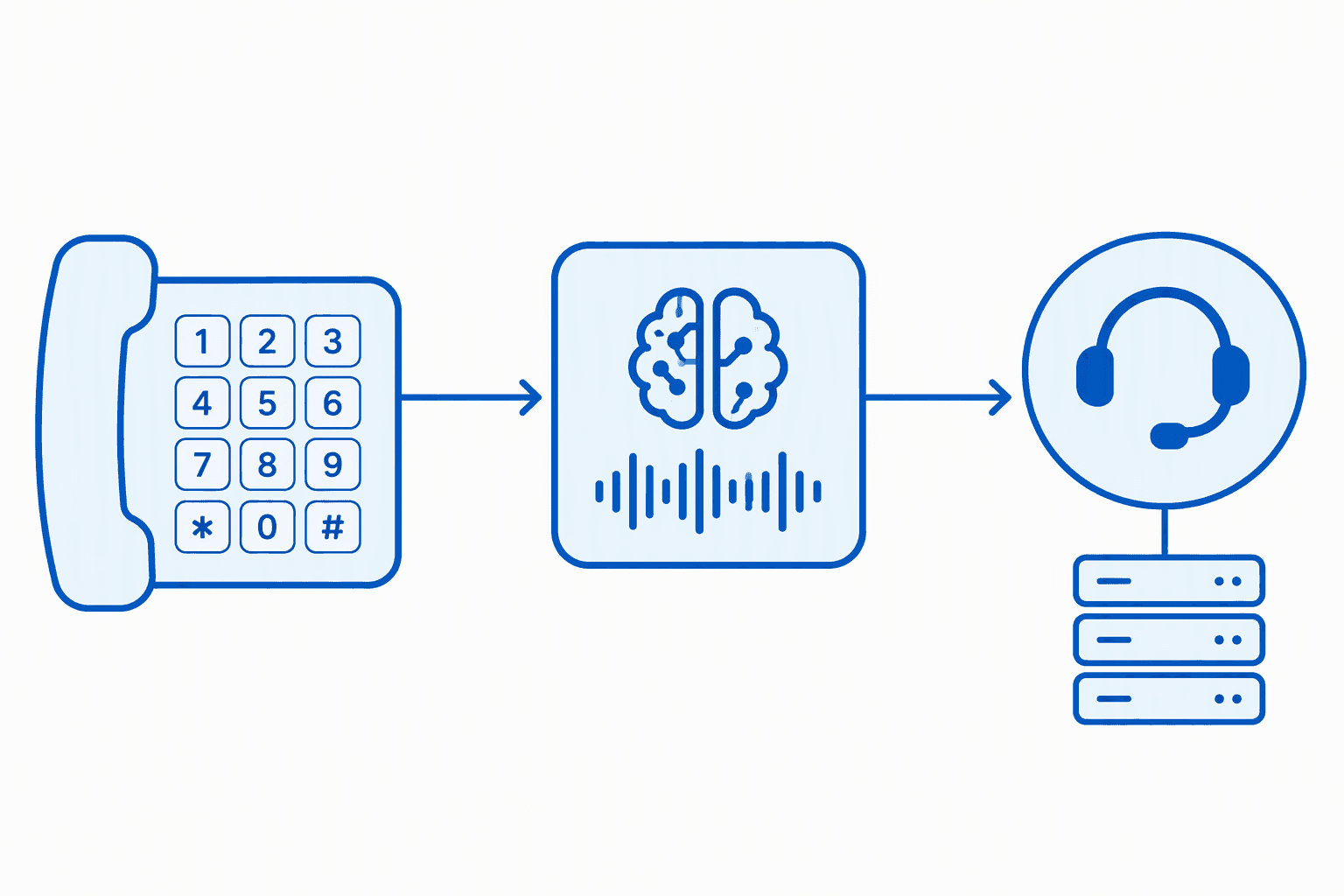
Learn how a voice agent API links business numbers, AI calls, webhooks, transfers, follow-ups, context, security and human handoff.

Voice Agent API & Phone Numbers API: CallMissed Developer Guide
What if launching an AI phone agent required API calls—not weeks of carrier coordination, IVR configuration, and custom speech infrastructure? The Voice Agent API & Phone Numbers API from CallMissed gives developers a programmatic path to provision or connect business numbers, attach AI voice agents, and build inbound or outbound calling workflows into their own products.
Why programmable voice matters now
Business calling is shifting from rigid menu-based interactive voice response systems to agents that can understand intent, hold natural conversations, and complete tasks. CallMissed describes its AI voice bot as an alternative to traditional IVR that understands “accents, nuances, and intent,” while its platform supports both inbound and outbound voice-call AI agents.
This transition is especially relevant in India, where one voice experience may need to serve customers across several languages, accents, and regions. CallMissed supports speech recognition in 22 Indian languages plus English, including Hinglish, while natural text-to-speech covers 10 Indian languages plus English, combining Indic-focused speech capabilities with a broad developer model catalog. Instead of treating multilingual speech as an optional layer, developers can design regional-language interactions into the calling workflow from the beginning.
Phone-number automation is the other half of that architecture. A capable conversational model cannot answer a customer’s call until a reachable business number is connected, routed, and associated with the correct agent. A Phone Numbers API brings that telecom resource into the application lifecycle, helping developers build repeatable onboarding instead of asking every customer to complete a manual setup process.
That matters for products such as:
- AI receptionist platforms that answer calls outside business hours
- Customer-support systems that resolve routine requests before escalation
- Lead-qualification tools that conduct structured outbound conversations
- Vertical SaaS applications for clinics, dealerships, education, logistics, or local services
- Multi-tenant platforms that assign separate numbers and agents to different businesses
What this developer guide covers
This guide follows the practical sequence required to turn an API credential into a working voice product. You will learn how to approach authentication, create and configure a voice agent, provision or connect a business phone number, associate that number with the appropriate agent, and prepare the workflow for inbound or business-initiated calls. It will also explain the operational details that production systems must consider, including configuration state, request validation, call-event handling, testing, error management, and secure credential storage.
The objective is not merely to demonstrate an isolated request. It is to show how the Voice Agent API and Phone Numbers API fit together as application infrastructure—so number assignment, agent configuration, and call routing can become part of your product’s own onboarding and automation experience.
How do developers connect business phone numbers to the CallMissed voice agent API?
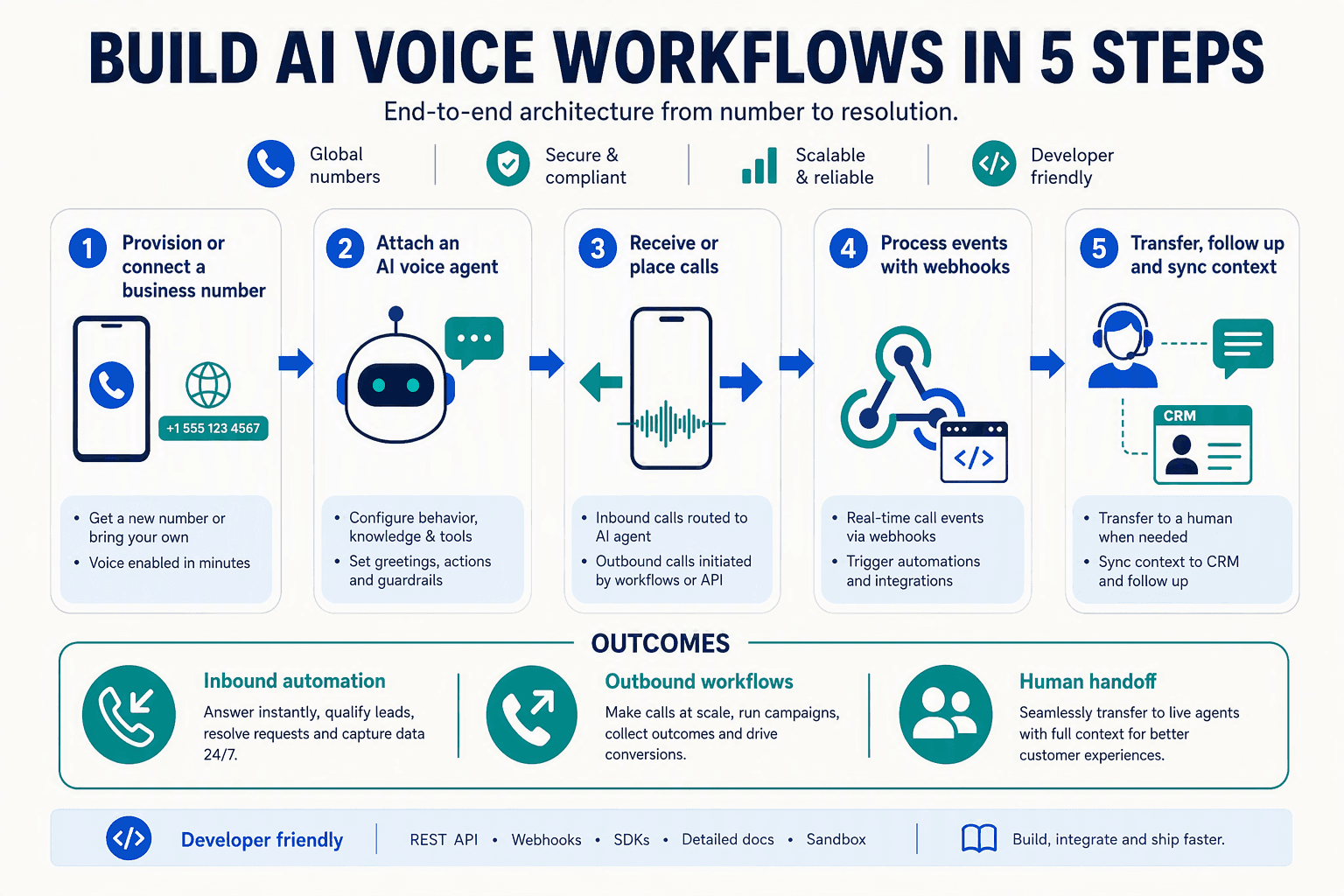
Developers should connect a business phone number to a CallMissed voice agent by treating the agent, number, and routing relationship as separate application resources. The exact operations—such as acquiring a number, registering an existing number, or associating it with an agent—must follow the capabilities and schemas currently published in the CallMissed Developer Hub.
Choose the supported number-onboarding path
Start by checking which Phone Numbers API workflows are documented for the target country and account. Depending on the current API capabilities, an implementation may support:
- Obtaining a business number through a documented number-acquisition workflow.
- Connecting or routing an existing business number using a supported carrier or forwarding configuration.
- Referencing a number already available in the authenticated CallMissed workspace.
- Managing numbers as tenant-scoped resources in a multi-customer SaaS application.
Do not assume that every country, number type, or existing carrier is supported. Telecom regulations, identity requirements, and calling permissions differ by jurisdiction.
Store telephone numbers in E.164 format, represented conceptually as +[country code][subscriber number]. The International Telecommunication Union’s E.164 recommendation allows a maximum of 15 digits, excluding the leading plus sign.
Follow a schema-driven lifecycle
A robust integration can use the following lifecycle pattern, adapting each step to the fields and operations available in the current CallMissed documentation:
- Create or configure the voice agent. Supply only documented properties, which may cover instructions, language, voice, knowledge sources, or call behavior.
- Persist the returned agent identifier. Use stable API identifiers rather than display names when building relationships.
- Obtain a phone-number reference. Follow the documented Phone Numbers API path for selecting, adding, or referencing a business number.
- Observe readiness where applicable. If the API exposes lifecycle state, polling, callbacks, or events, wait for the documented condition before enabling production traffic.
- Configure number-to-agent routing. Use the supported assignment or routing mechanism, if exposed by the current schema.
- Place a controlled test call. Verify agent selection, conversation behavior, latency, language configuration, and escalation handling.
Conceptually, the integration may look like this:
agent = createVoiceAgent(agentConfiguration)

phoneNumber = obtainOrReferenceNumber(
  phoneConfiguration
)

if documentationRequiresReadinessCheck:
  waitForDocumentedReadyCondition(phoneNumber)

routing = connectNumberToAgent(
  numberReference = phoneNumber.id,
  agentReference = agent.id
)

runTestCall(routing)
This is architecture pseudocode, not a fixed CallMissed endpoint contract. CallMissed says its Developer Hub provides documented endpoints, request schemas, model catalogs, and playground paths; developers should use those materials for current URLs, authentication headers, accepted fields, and responses.
Build a production-safe routing layer
Persist only fields actually returned or required by the documented APIs. A practical internal record may include:
- Workspace or tenant ID
- Agent ID
- Phone-number reference and normalized number
- Routing configuration
- Last known API state, if provided
- Creation and update timestamps
- Internal audit metadata
Use idempotency controls when the API supports them; otherwise, implement application-level deduplication before retrying resource-changing requests. Keep credentials server-side, enforce workspace isolation, and validate callbacks using the documented authentication mechanism—without assuming webhook signing is available.
CallMissed’s Terms of Service describes CallMissed as a multi-tenant SaaS platform supporting inbound and outbound voice-call AI agents. CallMissed also states that its broader platform supports 22 Indian languages and 300+ models, although developers should verify language, voice, and model compatibility for each specific agent configuration rather than assuming universal support.
What are voice agent, phone number, phone call and programmable Voice APIs?

A voice agent API can mean either a real-time audio interface for building conversations or a managed platform that runs an agent on business calls. A Phone Numbers API provisions or manages telephone identities; a Phone Call API controls individual call sessions. Programmable Voice is the broader category covering software-driven calling workflows.
The key distinction is who owns the stack: your application, the provider, or a combination of both.
Voice Agent API: audio interface or managed agent?
A voice agent listens, reasons, and responds, but the interface you choose determines how much infrastructure you must build.
- Voice-to-voice audio API: your application exchanges audio with a real-time model or service. Verify whether speech recognition, reasoning, and speech synthesis are integrated or require separate components. Telephone numbers, carrier connectivity, business tools, and call lifecycle handling are separate responsibilities unless explicitly included.
- Managed telephony agent platform: the platform combines conversational configuration with business-calling capabilities. Developers configure the agent’s instructions, knowledge, tools, and call settings rather than assembling every audio component themselves.
AssemblyAI’s voice-agent API guide, published October 28, 2026, distinguishes building blocks from platforms through stack ownership and recommends evaluating options on your own calls. That is a more useful selection framework than declaring one vendor the universal winner.
Compare interfaces by responsibility
| Interface | Primary responsibility | What developers must verify |
|---|---|---|
| Voice-to-voice audio API | Exchange audio and generate conversational responses | SDK compatibility, audio formats, session schema, streaming events, interruption handling, and included speech components |
| Managed telephony agent platform | Run configured agents within business-calling workflows | Carrier setup, agent configuration, knowledge and tool access, handoffs, monitoring, and available API operations |
| Phone Numbers API | Provision and manage telephone identities | Country availability, number capabilities, regulatory requirements, provisioning operations, and routing configuration |
| Phone Call API | Initiate, inspect, or control individual call sessions | Request schema, identifiers, lifecycle events, permitted controls, authentication, and error handling |
These are interface categories, not a guarantee that every provider exposes each one as a separate API.
Phone Numbers API: telephone identity
A Phone Numbers API concerns the number callers dial or the identity used for outgoing calls—not the agent’s conversational behavior.
Depending on the provider, operations may include searching for numbers, provisioning them, configuring destinations, or releasing them. Availability depends on country, carrier, number type, and telecommunications requirements.
CallMissed supports inbound and outbound phone calls on rented numbers, or through your own carrier using Twilio, Plivo, or any SIP trunk. Verify the supported number-management operations and setup requirements in the CallMissed documentation; do not infer endpoint names or provisioning schemas from another provider.
Phone Call API: individual call control
A Phone Call API concerns a particular interaction: starting an outbound call, inspecting its status, or performing supported call-control actions.
CallMissed provides a Twilio-compatible Calls API, with migration by changing the base URL and credentials. Still, check the documented request and response schemas against the operations your application uses. Compatibility does not justify inventing commands, webhook names, or SDK methods.
Conceptual pseudocode—not executable CallMissed API code:
configure conversational agent
configure supported telephone connectivity
initiate or receive an individual call
let the agent use approved business tools
process documented call results
Programmable Voice: the business-calling stack
Programmable Voice is the umbrella for combining telephone connectivity, call control, conversational audio, routing, and business integrations.
This CallMissed guide focuses on that business-calling stack and its documented managed voice capabilities, not a claim that one endpoint implements everything. CallMissed offers a no-code voice and chat agent builder, knowledge bases, custom REST tools, agent-to-agent live-call handoffs, recordings, transcripts, and AI call notes pushed to the CRM. Its developer API also provides managed voice-agent WebSocket access and real-time voice sessions through an API and SDK.
Before implementation, verify the relevant SDK, API schemas, and event contracts. For adjacent workflows, see the voice-agent CRM integration guide and production streaming transcription guide.
Which CallMissed API capability handles each part of the calling stack?
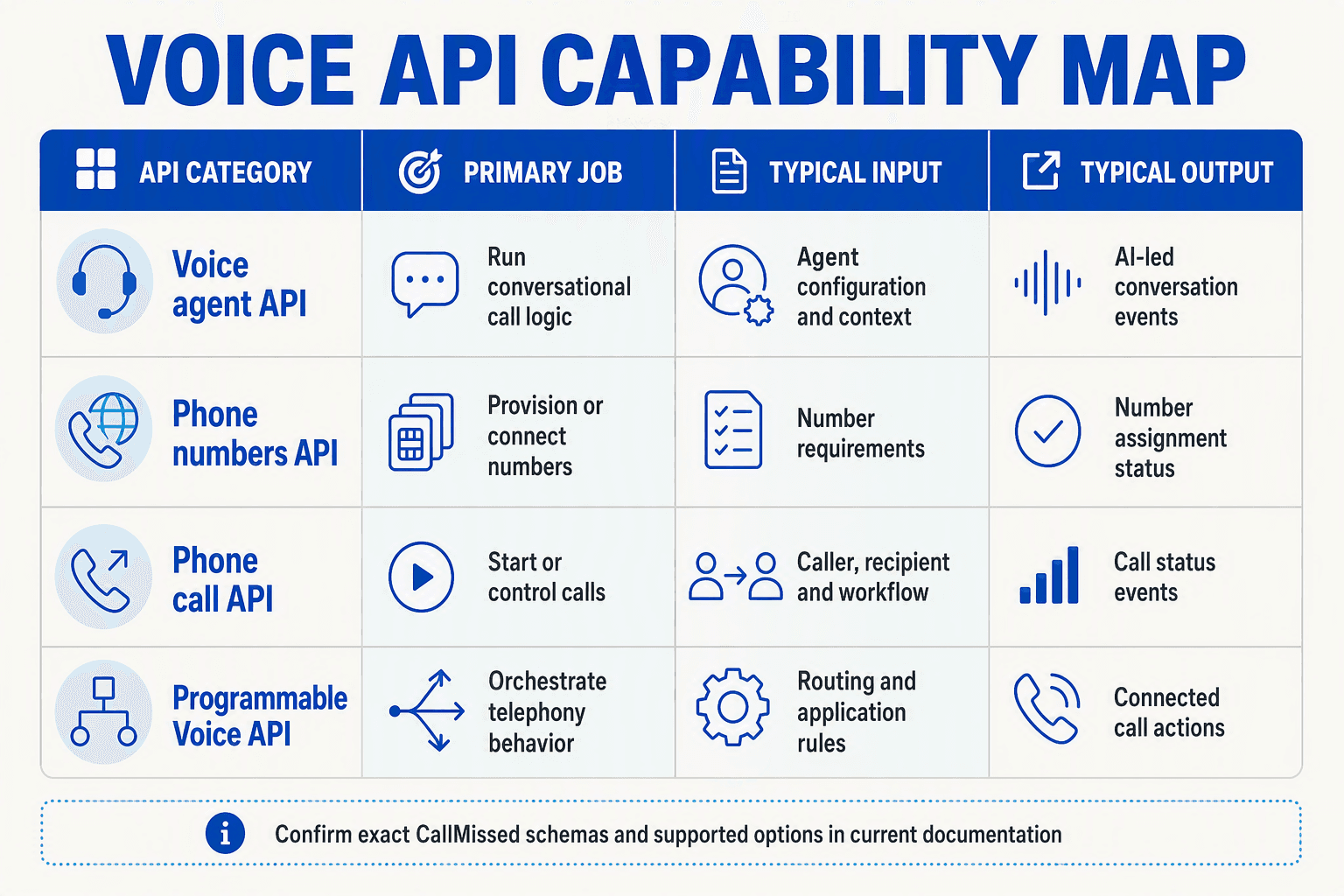
CallMissed has confirmed that Voice Agents APIs and Phone Numbers APIs exist, but the Developer Hub should remain the source of truth for their exact operations. The table below is an intended architecture map, not a statement that every provisioning, routing, versioning, outbound, or real-time method is currently exposed.
Capability map for the calling stack
| Calling-stack layer | Likely capability boundary | Buyer value | Developer interpretation | Contract status |
|---|---|---|---|---|
| Business phone identity | Phone Numbers API | Establishes a business calling presence | Provision or connect a number if documented and supported for the account, country, and number type | API existence confirmed; acquisition and connection methods require documentation verification |
| Number configuration | Phone Numbers API | Centralizes number metadata and operational status | Read or update supported number properties using the published schema | Fields, lifecycle states, and release operations are not assumed |
| Conversation behavior | Voice Agents API | Defines how an AI agent should conduct calls | Create or configure instructions, language, voice, knowledge, and behavior where documented | API existence confirmed; supported fields must be checked |
| Number-to-agent routing | Phone Numbers API and/or Voice Agents API | Connects an inbound destination to the appropriate experience | Associate a number and agent if an assignment endpoint is documented | Intended architecture; API ownership and routing semantics are unverified |
| Outbound call execution | Voice Agents API or a separate calls endpoint | Enables business-initiated AI conversations | Start an outbound call with approved recipient and context data if supported | Platform capability confirmed; invocation contract must be verified |
| Speech and reasoning runtime | CallMissed voice infrastructure | Produces a responsive spoken conversation | Configure available speech or language models if the API exposes those choices | Real-time event transport, model selection, and streaming controls are not assumed |
| Agent revisions | Voice Agents API | Allows conversational behavior to evolve without changing the number | Update an agent or create a version if versioning is documented | Version resources and deployment semantics are unverified |
CallMissed’s Terms of Service describes CallMissed as a “multi-tenant SaaS platform” providing “inbound and outbound voice call AI agents.” This confirms the platform-level calling capability, but it does not by itself define endpoint paths, request fields, resource relationships, or state transitions.
Read the table as a design guide
For buyers, the intended separation creates a useful mental model:
- Phone identity answers where customers call or what business identity appears.
- Agent behavior answers how the AI conducts the conversation.
- Call execution answers when a conversation starts and how its status is tracked.
- Application orchestration connects consent, CRM context, escalation, and audit records.
For developers, each boundary should be validated before implementation. A safe discovery sequence is:
- Confirm authentication and tenant-scoping rules.
- Inspect the documented Phone Numbers API operations.
- Inspect the documented Voice Agents API resource schema.
- Check whether number assignment, outbound invocation, and agent versioning have dedicated endpoints.
- Verify webhook, polling, or streaming support for call status and real-time events.
- Test idempotency and failure recovery in a sandbox or playground where available.
Treat published schemas as the contract
The CallMissed Developer Hub states that each capability has a documented endpoint, request schema, model catalog, and playground path. Consequently, developers should not infer payloads such as phone_number_id, agent_id, version, or status from this conceptual map.
Keep authentication, consent, retry policy, duplicate prevention, CRM synchronization, and human escalation in the surrounding application unless the current documentation explicitly assigns them to CallMissed. This preserves the table’s comparison value while avoiding assumptions about capabilities that may differ by account, geography, release stage, or API version.
How should the CallMissed calling architecture manage webhooks and conversation context?
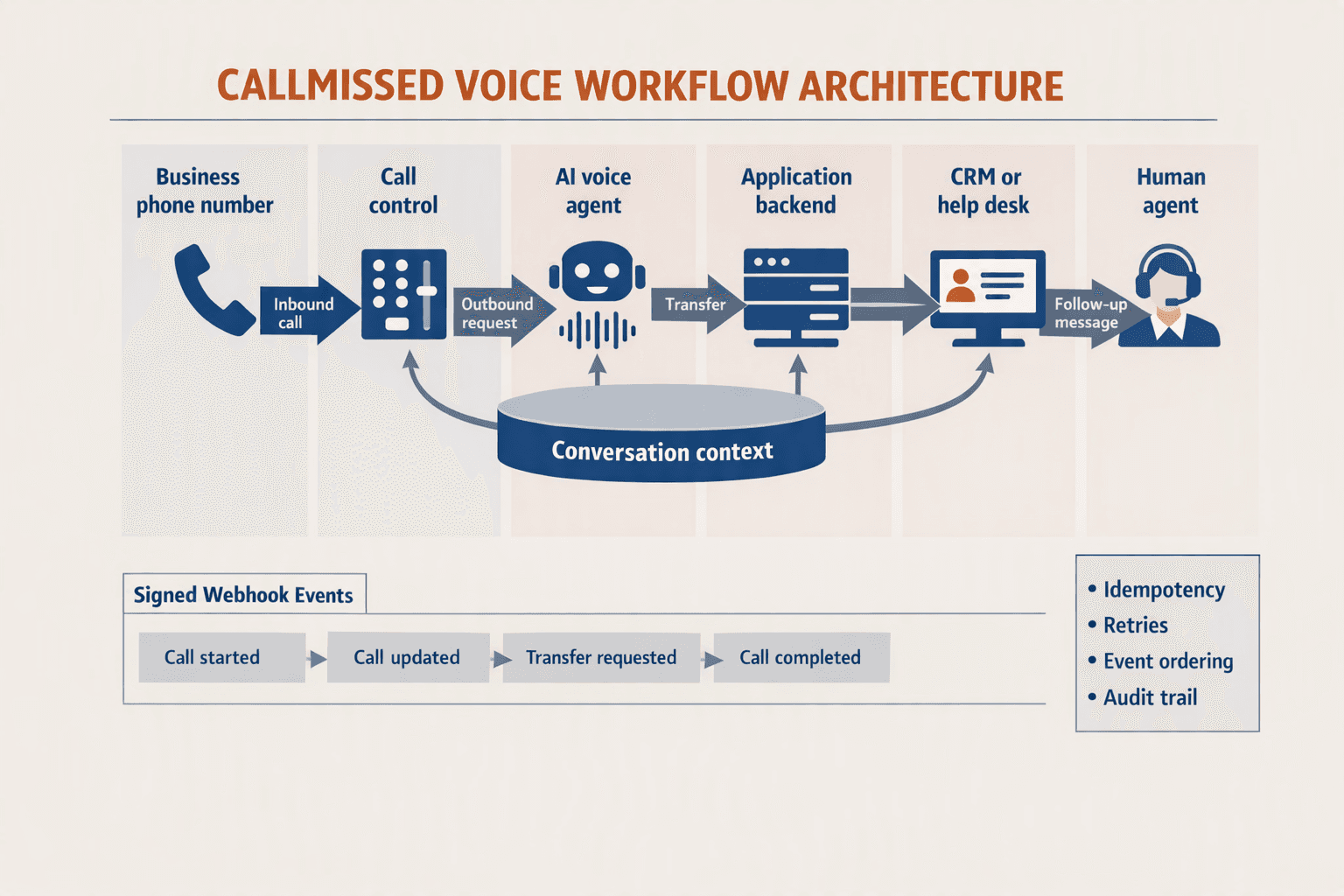
The calling architecture should treat webhooks as an asynchronous event stream and keep conversation context in an application-owned state store keyed by tenant, phone number, agent, and call. Webhook handlers should validate, acknowledge, persist, and enqueue events quickly; separate workers should perform CRM updates, retrieval, analytics, and follow-up actions.
Build a thin, durable webhook layer
Call events can arrive more than once, out of order, or after a network timeout. Design the receiver for at-least-once delivery, even if initial testing appears perfectly sequential.
A reliable processing path is:
- Authenticate the request using the verification mechanism specified in the current CallMissed webhook documentation.
- Capture the raw request before transforming it, including headers and receipt time.
- Validate the payload against the documented event schema.
- Check idempotency using the provider event ID—or a deterministic hash if the schema does not supply one.
- Persist and enqueue the event for asynchronous processing.
- Return a successful response quickly, without waiting for an LLM, CRM, or analytics service.
The CallMissed Developer Hub states that each capability has a documented endpoint and request schema. Implement against those published schemas rather than assuming field names or inventing event types; version the internal adapter so upstream schema changes do not propagate across the application.
Use an internal event envelope such as:
- tenant_id for account isolation
- call_id as the primary interaction key
- agent_id and phone_number_id for routing
- provider_event_id for deduplication
- event_type, occurred_at, and received_at for ordering
- raw_payload for replay and incident investigation
Model each call as a state machine
Normalize provider callbacks into application states such as created, ringing, connected, completed, failed, or transferred, but map these labels from the actual API documentation. Never infer a completed call merely because a “connected” event arrived.
Store state transitions conditionally. A delayed ringing callback, for example, must not move an already completed call backward. For conflicting updates, prefer provider timestamps and terminal-state rules while retaining the original events in an append-only log.
Retries should use exponential backoff with jitter and a dead-letter queue. Alert on repeated signature failures, unknown event versions, growing queue age, and calls that remain in non-terminal states beyond an operational threshold.
Separate live context from durable customer memory
Conversation context has at least three layers:
- Turn context: recent utterances and tool results needed for the next response
- Call context: language, intent, collected fields, consent, escalation status, and a rolling summary
- Customer context: verified CRM facts, prior interactions, preferences, and unresolved cases
Pass only the minimum relevant context into each model call. Summarize older turns rather than continually resending a full transcript, and keep authoritative business data outside the prompt. Tool results should include timestamps because balances, appointment slots, and order states can become stale.
This separation is especially important for multi-tenant systems. The CallMissed Terms of Service describes the product as a multi-tenant SaaS platform supporting inbound and outbound AI voice agents; every context read should therefore enforce tenant ownership, not merely match a call ID.
Finally, encrypt transcripts and recordings, restrict access by role, define retention periods, and redact unnecessary payment or identity data. A completed-call worker can then generate the summary, update the CRM, record disposition, and trigger approved follow-ups without delaying the live conversation.
How do inbound calls, outbound calls, transfers and follow-ups work in pseudocode?
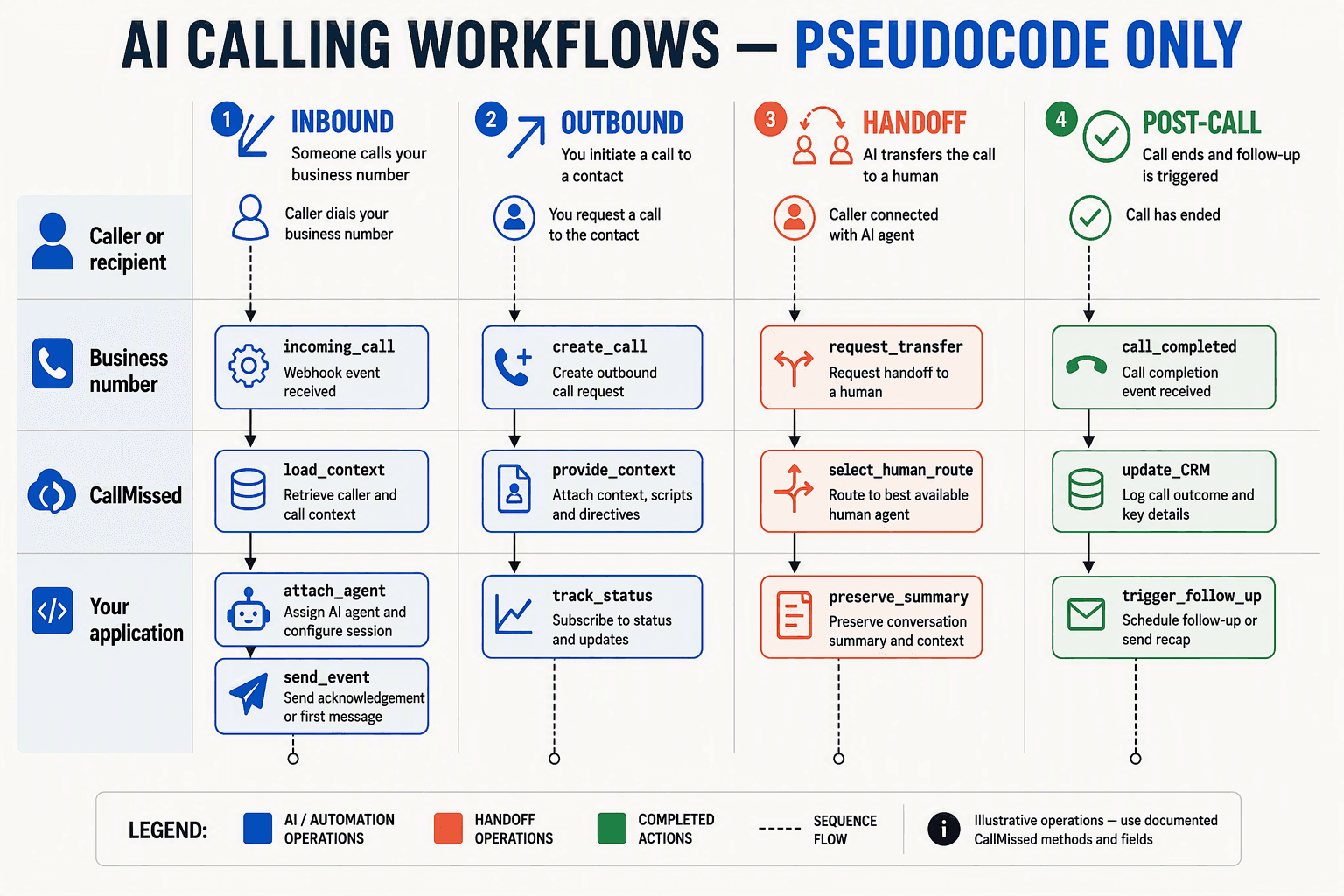
Use the flows below as application-design pseudocode, not runnable CallMissed code. Every operation and event label is illustrative: map integrations to the documented schemas, and keep consent checks, authorization, deduplication and recovery state in your application.
CallMissed supports inbound and individual outbound calls on rented numbers or through your own carrier, plus click-to-call. Automated outbound calling campaigns are not offered.
Shared setup and duplicate-event protection
CallMissed supports outbound webhooks with per-agent event subscriptions. The pattern below recommends durable event processing; it does not assume a particular webhook-signing scheme, event identifier or API idempotency feature.
ON incoming event:
    validate request using the documented authentication mechanism
    validate payload against the documented event schema

    key = documented stable event identifier, if available
          otherwise an application-defined deduplication key

    TRANSACTION:
        if event already exists under key:
            acknowledge duplicate
            STOP

        persist event under a unique key
        persist pending workflow job

    acknowledge accepted event

WORKER:
    claim pending job
    apply permitted workflow-state transition
    record result
    retry only recoverable failures
Use a transactional inbox or equivalent durable mechanism so an acknowledgement cannot lose work. Protect individual side effects separately: deduplicating an event alone does not prevent a worker retry from sending the same notification twice.
Inbound routing
CallMissed’s no-code builder supports agent languages, knowledge bases, tools, variables and call settings. Resolve the caller’s business context without treating caller ID as proof of identity.
ON inbound call:
    route = look up dialled number in application configuration

    if route is missing or disabled:
        use configured fallback
        STOP

    context = minimum permitted customer and business context
    select configured agent and language policy
    continue through the documented inbound-call configuration

    before exposing sensitive records:
        complete the business's identity checks
Speech recognition supports 22 Indian languages plus English, including code-mixed speech such as Hinglish. Natural text-to-speech voices support 10 Indian languages plus English, with additional languages available through other voice models.
Validated tool action and appointment confirmation
CallMissed supports custom REST tools, MCP tools, Cal.com and Google Calendar integrations. The authorization and confirmation rules below are recommended application safeguards, not claims about automatic platform enforcement.
ON agent requests appointment booking:
    validate tool inputs against your schema
    verify caller authorization and explicit booking intent
    check allowed clinic, service, time and business rules

    if validation fails:
        refuse action or escalate
        STOP

    persist booking attempt with an application operation key
    request booking through the documented calendar integration

    if calendar confirms a saved appointment:
        persist confirmed appointment reference
        enqueue one confirmation notification

    else if calendar times out:
        mark attempt UNKNOWN
        reconcile with calendar before any booking retry
        tell caller confirmation is pending
        DO NOT send a booking confirmation

    else:
        record failure
        offer another slot or escalate
A timeout is not proof that booking failed. Check whether the appointment was created before retrying; use provider idempotency only if that provider documents it.
Individual outbound callbacks
Initiate one callback only after an appropriate trigger, such as a customer’s callback request or an authorized click-to-call action, and after checking applicable permission and calling rules. Do not turn this flow into an automated calling campaign.
ON individual callback request:
    verify request source and destination
    verify applicable permission, calling window and suppression rules

    if any check fails:
        record rejection
        DO NOT initiate call
        STOP

    create durable callback attempt
    initiate one outbound call using documented call schemas

    if outcome is busy, unanswered or failed:
        record outcome
        require a permitted retry decision
        DO NOT retry blindly
Keep permission and attempt records in your application. Do not assume the call API accepts a consent field or idempotency key unless its current documentation specifies one.
Escalation, failure handling and follow-ups
CallMissed supports live agent-to-agent handoffs through Squads, call queues, and supervisor monitoring with listen, whisper and barge-in. These features should not be treated as evidence of an arbitrary transfer endpoint.
ON escalation needed:
    choose a configured, supported escalation path
    preserve a minimal handoff summary
    attempt handoff using the documented mechanism

    if handoff is confirmed:
        mark escalation complete
    else:
        mark escalation failed
        explain the fallback to the caller
        offer an authorized callback or support follow-up
        DO NOT report a successful transfer

ON call completion:
    persist outcome and permitted follow-up work

    send appointment confirmation ONLY if booking is CONFIRMED
    check channel permission before messaging
    suppress duplicate notifications using application state
CallMissed provides recordings, transcripts and AI call notes that can be pushed to the CRM. Keep slower follow-up work outside the live-call path, and retry only when its outcome and side effects are understood.
Acceptance tests
Duplicate event:
    deliver the same completion event twice
    EXPECT one workflow transition and one follow-up notification

Calendar timeout:
    calendar creates booking but response times out
    EXPECT UNKNOWN state, reconciliation, no premature confirmation
    EXPECT no second booking after the first is found

Transfer failure:
    handoff fails or cannot be confirmed
    EXPECT failure recorded and fallback offered
    EXPECT no "transfer successful" status

Unauthorized callback:
    request lacks required permission or has an untrusted destination
    EXPECT rejection recorded and zero outbound calls initiated
What would telephony, security and compliance experts validate before launch?

Before launch, telephony, security, and compliance experts should validate that every number is legally provisioned, every call is correctly routed and observable, credentials and customer data are protected, and each workflow follows the consent, privacy, and retention rules of its operating jurisdiction. API success is not equivalent to production readiness.
Telephony validation: prove the complete call path
A telephony specialist should test the CallMissed Voice Agent API and Phone Numbers API as one end-to-end system rather than as separate resources. CallMissed’s Terms of Service describes the platform as supporting both inbound and outbound voice-call AI agents, so each enabled direction requires its own launch checks.
Validate:
- Number ownership and activation: Confirm that provisioned numbers are active and that connected business numbers have completed any required ownership verification or carrier process.
- Routing integrity: Ensure each number resolves to the intended tenant, environment, and agent—especially after reassignment, agent deletion, or configuration changes.
- Caller identity: Verify outbound caller ID presentation, number eligibility, and country-specific restrictions; never assume a purchased or connected number may be used for every destination.
- Failure handling: Test busy, rejected, unanswered, unreachable, carrier-error, agent-timeout, and provider-degradation scenarios.
- Audio quality: Measure connection time, conversational latency, interruptions, echo, packet loss, silence handling, and speech recognition across representative devices and networks.
- Escalation: Confirm that transfers to human agents preserve context and fail safely if the destination is unavailable.
Testing should include regional accents and languages actually used by customers. CallMissed reported support for 22 Indian languages as of September 2026, making multilingual acceptance testing particularly relevant for businesses serving Bharat.
Security review: protect the control plane and call data
Security teams should treat API credentials, number assignments, prompts, transcripts, recordings, and call-event payloads as sensitive assets. CallMissed is a multi-tenant SaaS platform, according to its Terms of Service, so customer-level isolation must also be enforced within the integrating application.
Before production approval:
- Store API keys in a secrets manager, not source code, browser storage, mobile applications, or logs.
- Separate development, staging, and production credentials and resources.
- Apply least-privilege access, role-based administration, and multi-factor authentication.
- Authenticate webhook events using the mechanism documented by CallMissed, reject stale or replayed requests, and make event processing idempotent.
- Encrypt sensitive data in transit and at rest; redact phone numbers, credentials, transcripts, and payment or identity data from logs.
- Run tenant-isolation tests that attempt unauthorized reads, updates, number assignments, and agent associations.
- Define incident-response procedures for exposed credentials, number hijacking, anomalous outbound traffic, and data leakage.
Do not invent a webhook-signature format or retention guarantee: verify both against the current CallMissed documentation and contract before implementation.
Compliance review: map obligations to each call flow
Legal and compliance specialists should review inbound, outbound, recorded, transcribed, and AI-generated calls separately. Requirements vary by jurisdiction, call purpose, recipient relationship, and whether personal data crosses borders.
The launch checklist should document:
- The lawful basis or valid consent for calling, recording, transcription, and automated processing.
- Required disclosure that the caller is interacting with an AI agent.
- Suppression-list, opt-out, calling-hours, and frequency controls for outbound campaigns.
- India-specific telecom and commercial-communication obligations, including applicable Telecom Regulatory Authority of India (TRAI) requirements.
- Data minimisation, retention periods, deletion workflows, and data-subject request handling.
- Approved regions, subprocessors, international transfers, and access to recordings or transcripts.
- Human escalation for emergencies, regulated advice, disputes, and high-impact decisions.
Finally, obtain written sign-off from telephony, security, privacy, and business owners, with evidence attached to every control. Launch gradually using restricted destinations, rate limits, spend alerts, and rapid rollback; expand only after real call data confirms that routing, safety, and compliance controls behave as designed.
What does the CallMissed API mean for your use case and phone-number requirements?
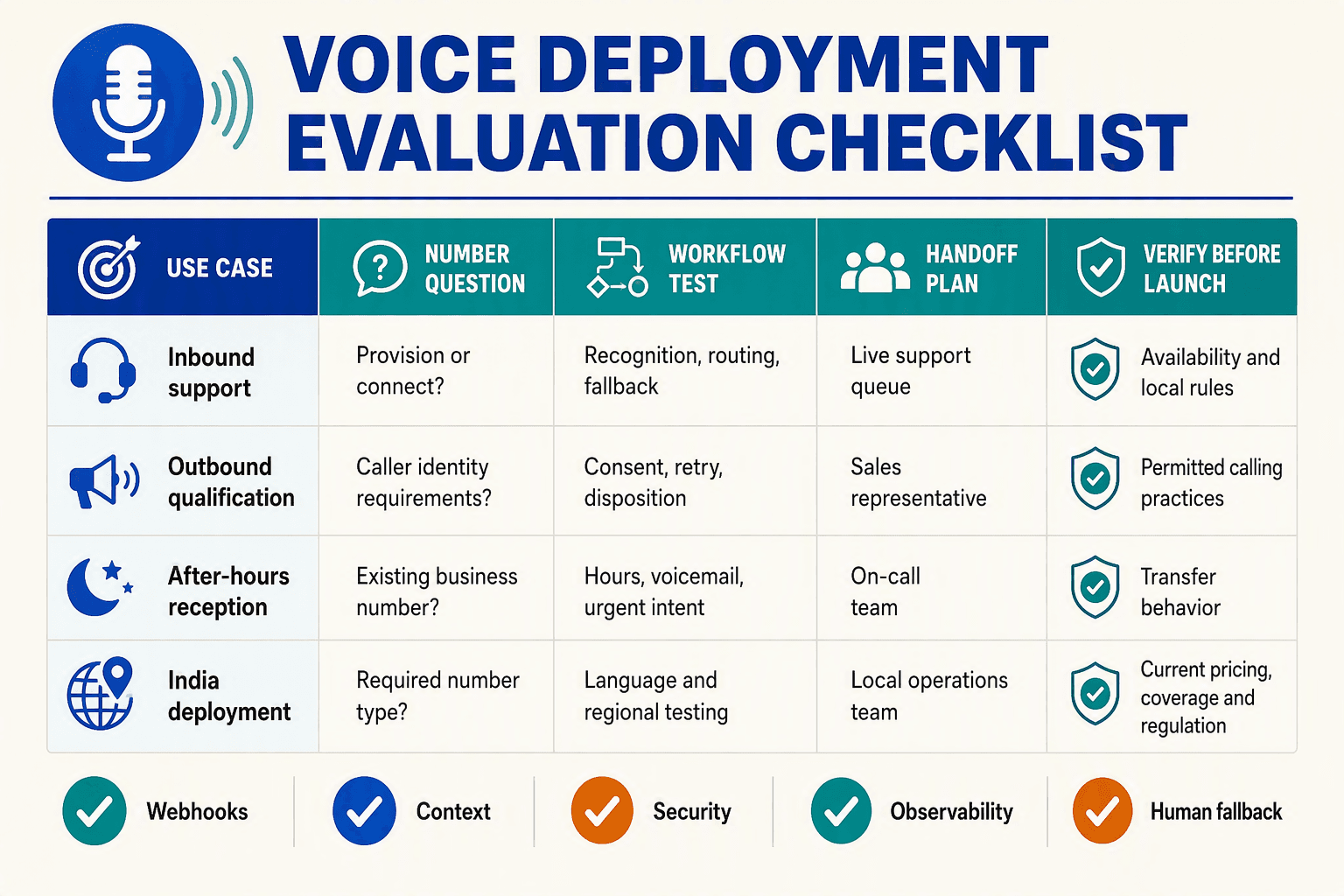
The CallMissed Voice Agent API and Phone Numbers API fit use cases where software must control both the conversational agent and the number customers call. Your number strategy should follow the call direction, geography, tenant model, expected concurrency, and whether the business wants a new number or must retain an existing one.
Use-case and number-selection matrix
| Use case | Call direction | Recommended number approach | Key API requirement |
|---|---|---|---|
| AI receptionist | Inbound | Provision a dedicated business number or connect the company’s existing number | Route the number to one published agent and define human-transfer behavior |
| Customer-support automation | Primarily inbound | Use a support number associated with the relevant queue, brand, or region | Pass customer context, capture call events, and support escalation |
| Lead qualification | Outbound | Use an approved business number suited to the target geography | Record consent, enforce calling windows, and process disposition events |
| Appointment reminders | Outbound with inbound callbacks | Assign a recognizable callback-enabled business number | Link calls to booking IDs and handle confirmation, rescheduling, or opt-out |
| Multi-tenant SaaS | Inbound and outbound | Allocate or connect a separate number for each tenant | Store tenant-to-number-to-agent mappings and enforce strict data isolation |
| Multilingual regional service | Either | Select numbers aligned with served markets and customer expectations | Choose language, speech configuration, and fallback routing per agent |
This matrix reflects an important architectural rule: a phone number is not merely an agent setting; it is a managed resource with its own lifecycle. Create or connect the number, verify that it is usable, associate it with the intended agent, and expose calling only after every dependent resource reaches the required state.
Questions to answer before provisioning
Developers should turn business requirements into explicit configuration decisions:
- Is the workflow inbound, outbound, or bidirectional?
Inbound products need deterministic routing. Outbound products additionally require consent controls, permitted calling hours, caller identity, and retry policies.
- Does the customer need a new number or an existing business identity?
Provisioning can simplify automated onboarding. Connecting an existing number may preserve recognition, but can require ownership verification, carrier coordination, forwarding, or another documented connection method.
- Is the application single-tenant or multi-tenant?
A SaaS platform should maintain a durable mapping such as tenant_id → phone_number_id → voice_agent_id, rather than relying on labels or visible phone-number strings.
- Which languages and regions must the agent serve?
CallMissed reported support for 22 Indian languages as of September 2026, making language selection a first-class requirement for businesses serving regional Indian audiences rather than a post-launch localization task.
Production checks for phone-number workflows
Before enabling real traffic, verify:
- Inventory and geography: Number types and availability can vary by country, region, and account eligibility; query current API data rather than hard-coding assumptions.
- Regulatory readiness: Apply applicable consent, telemarketing, recording, privacy, and data-retention rules for each market.
- Agent status: Do not attach production traffic to an incomplete, draft, or untested configuration.
- Idempotency: Prevent retries from provisioning duplicate numbers or creating conflicting assignments.
- Observability: Persist provider resource IDs, request IDs, call states, timestamps, and failure reasons.
- Fallback behavior: Decide what happens when the AI cannot resolve a request, the destination is unavailable, or a downstream tool times out.
CallMissed’s Terms of Service describes the platform as supporting inbound and outbound voice-call AI agents, while the CallMissed Developer Hub documents capabilities through dedicated endpoints, request schemas, model catalogs, and playground paths. Treat those current API schemas—not assumed field names or static inventory—as the source of truth when implementing number provisioning and agent association.
Frequently asked questions about CallMissed voice agents and phone numbers
How do I get started with the CallMissed voice agent API and Phone Numbers API?
Can I connect an existing business number through the CallMissed Phone Numbers API?
How do I connect a business number to a voice agent?
Does the CallMissed voice agent API support inbound and outbound calls?
What is the difference between an inbound and an outbound voice agent API workflow?
Can CallMissed send webhooks for voice-agent events?
Can a CallMissed voice agent transfer a caller to a human?
How should I test a voice agent API integration before launch?
Which languages can CallMissed AI voice agents speak and understand?
Are the voice agent API and Phone Numbers API OpenAI-compatible?
What compliance requirements apply to inbound and outbound AI calls?
How should I secure and monitor a production CallMissed voice integration?
Conclusion
A voice agent API is only one part of a working business phone experience. Connect the agent to a rented number or your own carrier, define routing, and decide how unresolved requests reach a person before expanding usage.
- Validate the integration. Check requests and responses against documented schemas, protect credentials, and track configuration changes. Make event handlers safe against duplicate events so retries do not create repeated actions.
- Keep outbound calls permission-led. Verify permission for each individual outbound call and record its purpose. Start with narrowly scoped use cases, not bulk calling.
- Confirm outcomes before claiming success. For booking workflows, report success only after the scheduling tool confirms the appointment. Define human escalation for uncertain answers, failed tools, and requests outside the agent’s scope.
- Test the complete path. Pair your voice agent API integration with deliberate business-number routing and use the Hinglish QA checklist to assess realistic conversations.
Next, run a limited voice agent API pilot with one number and one task. Measure confirmed task completion, response timing, escalation outcomes, and full costs—including voice usage and separately billed phone carriage—before widening access.
Related Reading
- CallMissed Phone Numbers: How to Buy a Business Number for an AI Voice Agent
- CallMissed API: Build a WhatsApp and Voice AI Appointment Booking Agent
- Build a WhatsApp AI Agent Through CallMissed API: Complete Developer Guide