
CallMissed vs Separate Voice, WhatsApp, Email and Phone Tools: Why Shared-Memory AI Matters


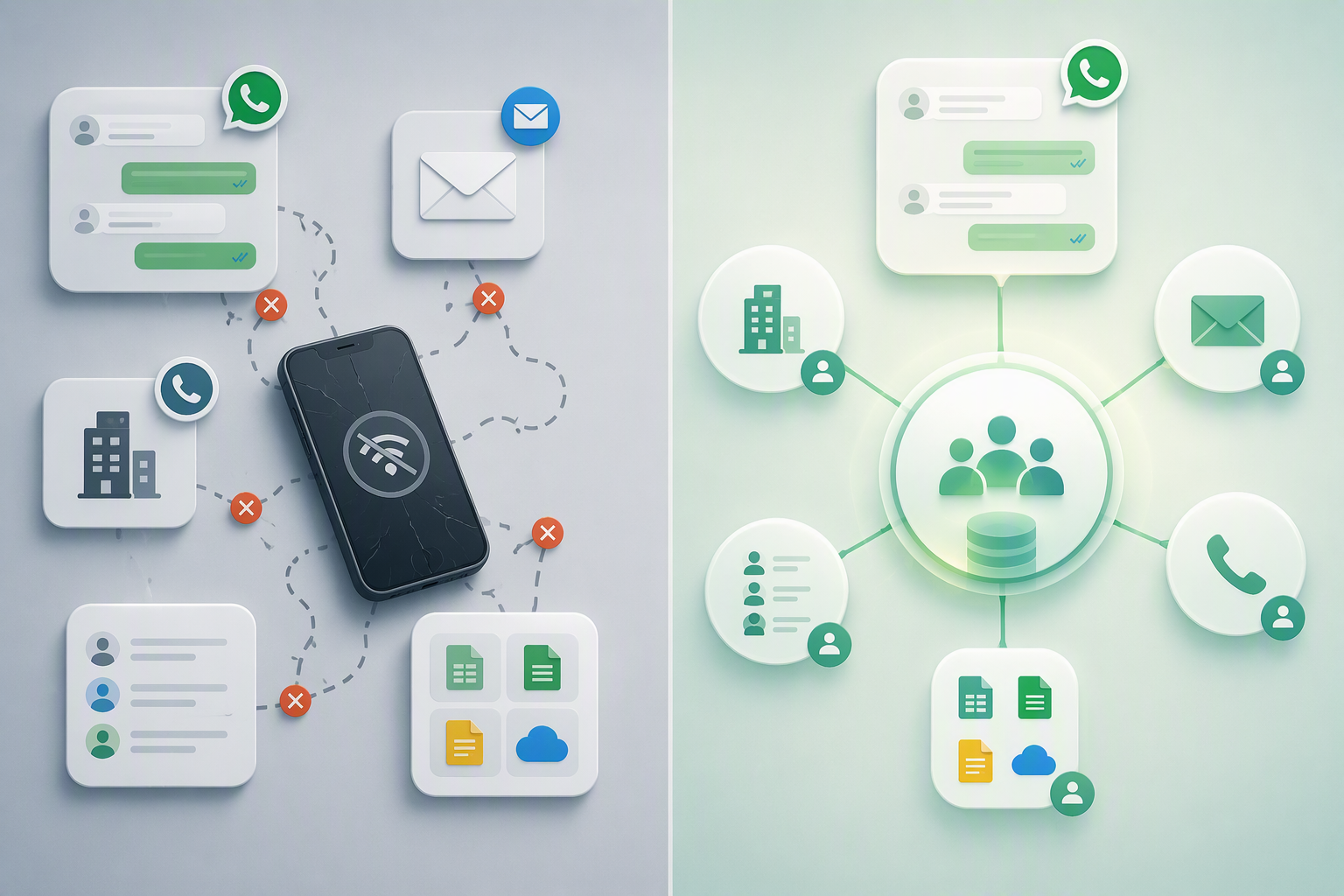
Compare CallMissed with separate voice, WhatsApp, email and phone tools to assess context, complexity, governance and long-term value.
CallMissed vs Separate Voice, WhatsApp, Email and Phone Tools: Why Shared-Memory AI Matters
What if the biggest flaw in your AI stack is not a missing feature, but a customer having to explain the same problem three times? CallMissed vs Separate Voice, WhatsApp, Email and Phone Tools: Why Shared-Memory AI Matters examines the real choice: one coordinated conversation system or multiple channel-specific components connected through APIs, webhooks and identity-matching rules.
This matters now because a single journey can span three channels—a phone call, a WhatsApp continuation and an email follow-up—while AI agents still need accurate, authorized context at every step. CallMissed brings AI voice agents, WhatsApp chat and Business calling, email tooling, and an omnichannel inbox together, with voice support across 22 Indian languages. This comparison explains multichannel versus true omnichannel architecture, shared-memory safeguards, human handoffs, maintenance tradeoffs and failure modes such as stale context, mistaken identity and duplicate outreach—plus a practical checklist for verifying whether context genuinely follows the customer.
Which approach wins at a glance: CallMissed or separate channel tools?
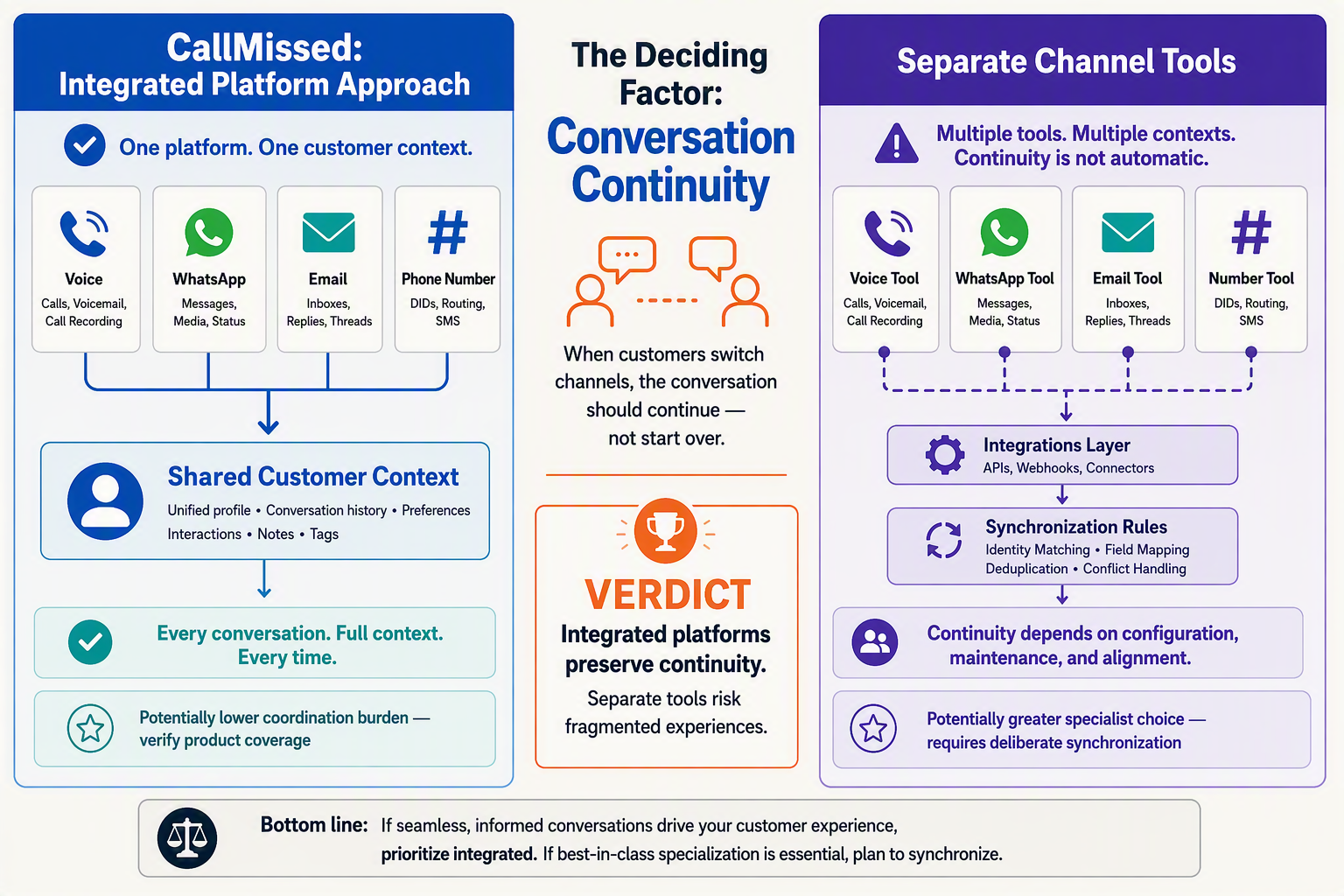
CallMissed is the stronger fit when conversational continuity is the priority; separate tools remain attractive when channel-level specialization and independent vendor choice matter more. The deciding test is whether authorized context follows the customer accurately.
At-a-glance comparison
- CallMissed: Combines AI voice agents, WhatsApp chat and Business calling, email tooling, and an omnichannel inbox/CRM; separate stacks require at least four channel or infrastructure components.
- CallMissed: Can centralize conversations around a shared customer record; separate tools must reconcile phone numbers, WhatsApp identities, email addresses and CRM records using explicit matching rules.
- Omnichannel test: Offering three channels—voice, WhatsApp and email—is only multichannel unless transcripts, customer intent and next actions remain usable after each switch.
- Channel-switching test: Ask whether an agent can handle one journey—call → WhatsApp continuation → email follow-up—without the customer repeating the issue or staff reconstructing it manually.
- Shared-memory AI: Should retrieve only authorized cross-channel context; buyers must verify retention, permissions, correction and deletion controls rather than treating memory as unlimited recollection.
- Separate tools: Create credentials, APIs, webhooks, routing rules, schemas, logs and escalation paths for each component; consolidation centralizes some administration but does not remove configuration or governance.
- Human experience: A unified inbox can present previous interactions and next actions together, while fragmented systems may force staff to search multiple dashboards before responding.
- Tradeoff: CallMissed increases reliance on one platform’s channel coverage and reliability; separate tools allow component-by-component replacement but raise synchronization and maintenance demands. Before selection, verify CallMissed’s current first-party documentation for cross-channel memory, human handoff, data controls and required integrations.
What makes an omnichannel AI platform different from a multichannel tool stack?
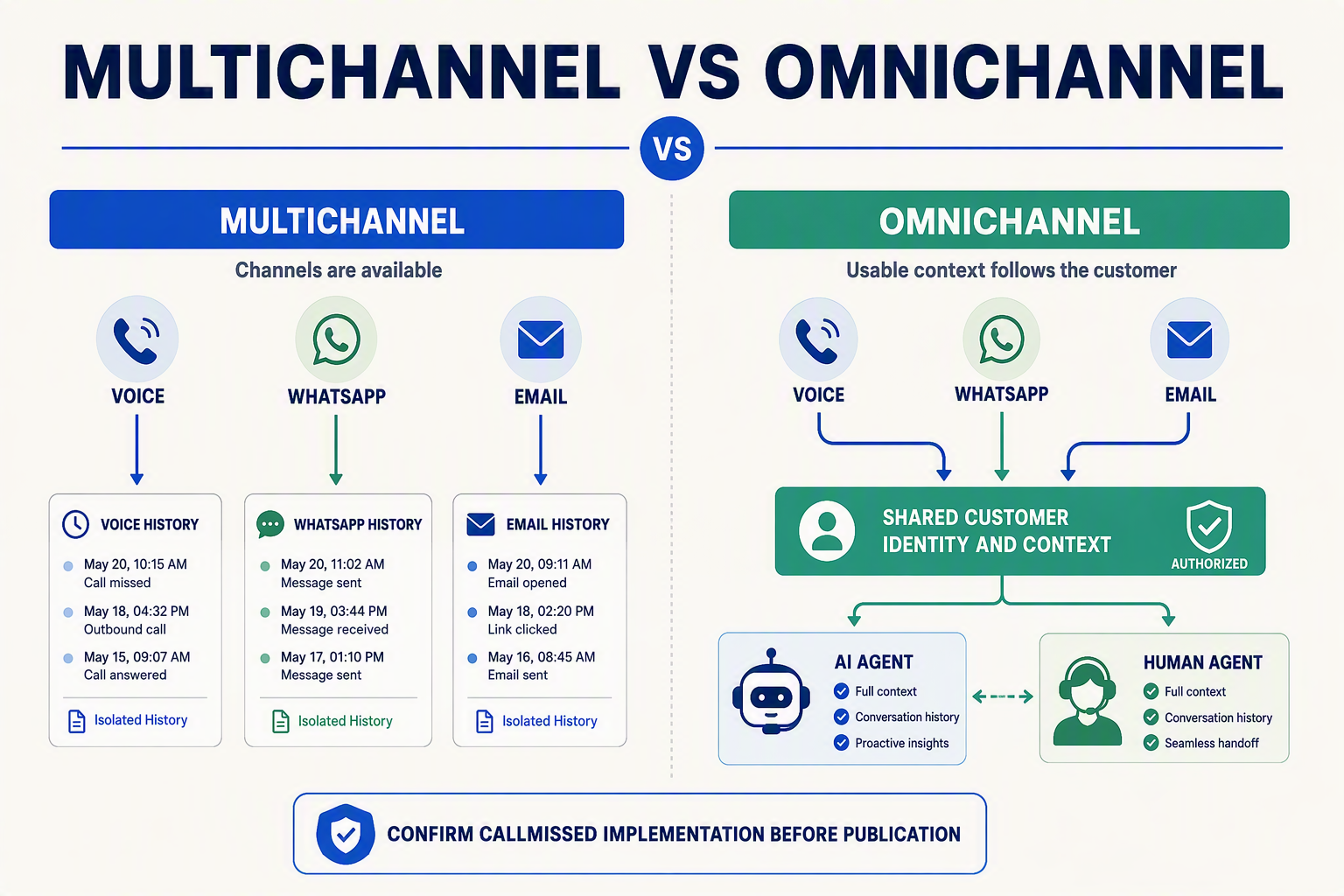
An omnichannel AI platform coordinates identity, memory and actions across channels; a multichannel stack merely makes several channels available. The architectural difference is a shared context layer rather than the number of tools.
Architectural differences
- CallMissed: Brings AI voice agents, WhatsApp chat, WhatsApp Business calling, email and web interactions into one customer-engagement environment built around coordinated conversations.
- Separate tools: Typically maintain distinct transcripts and identifiers for each channel, requiring integrations to map a phone number, WhatsApp identity and email address to the correct customer.
- Shared-memory architecture: Stores authorized facts, summaries and pending actions in a context layer that multiple agents can retrieve; memory still needs explicit retention, permissions, correction and deletion rules.
- Isolated-agent architecture: A voice agent and WhatsApp bot may each have accurate histories yet remain unaware of the other unless developers synchronize events, schemas and updates deliberately.
- Omnichannel orchestration: Can route a customer from a call to WhatsApp and trigger an email while preserving intent, consent and next steps; separate tools need webhooks and authoritative-system rules for every transition.
- System-of-record test: Buyers should identify exactly which component owns customer identity, transcript updates and opt-out status—especially when two channels update the same record simultaneously.
- CallMissed verification: Before deployment, confirm through current first-party documentation how shared memory, human handoff, exports, role-based access and retention operate across each enabled channel.
- Practical distinction: Multichannel answers, “Can customers contact us in several ways?”; omnichannel answers, “Can the next authorized agent continue correctly without reconstructing the conversation?”
How do CallMissed and separate tools compare across context, switching, memory, operations, maintenance and customer experience? (TABLE)
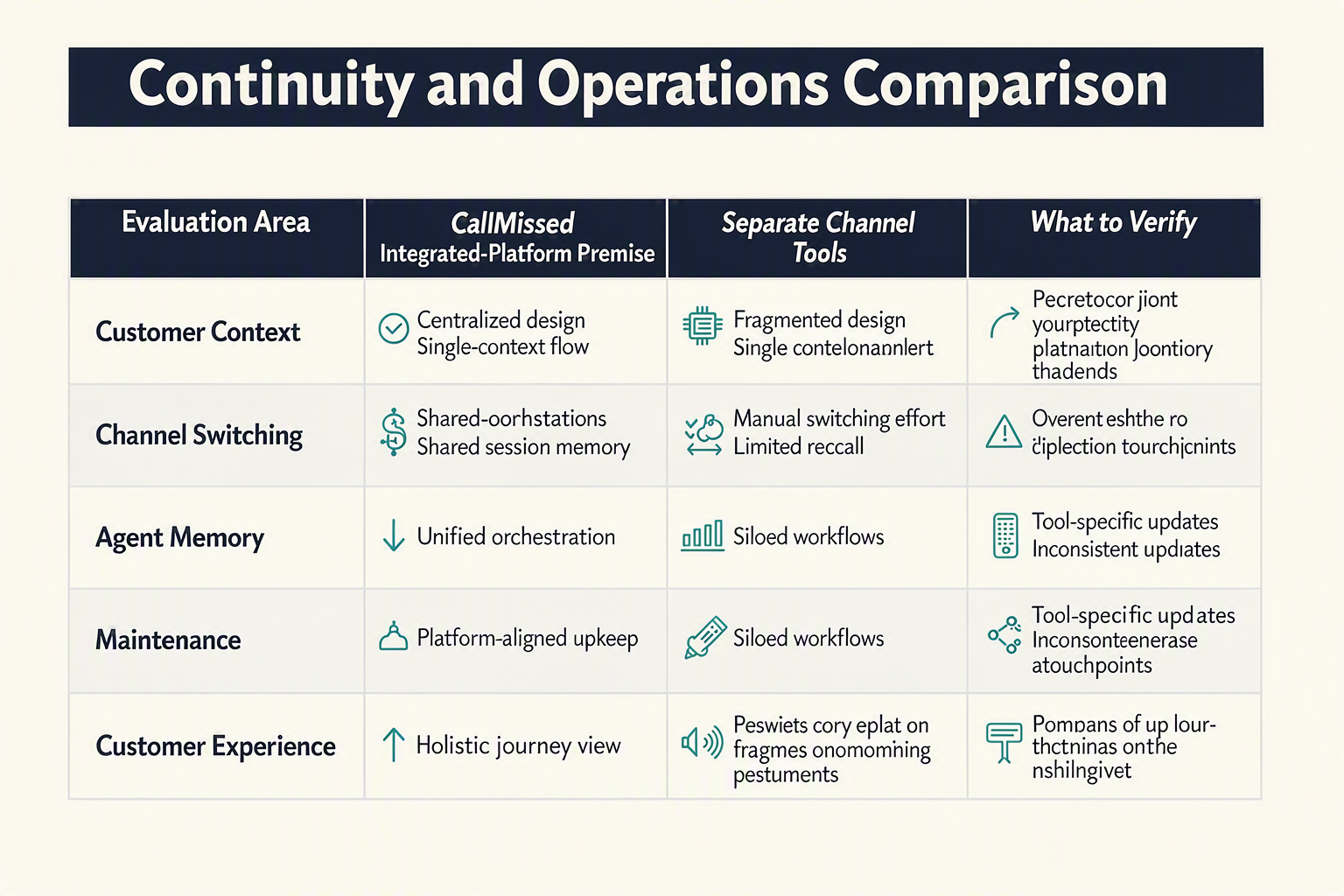
CallMissed centralizes channel operations around one AI engagement platform, while a separate-tool stack must deliberately synchronize identity, history and actions. The practical winner is the architecture that preserves accurate, authorized context through every channel change.
Side-by-side operational comparison
| Dimension | CallMissed approach | Separate-tool approach | Buyer test |
|---|---|---|---|
| Customer context | Central customer record and omnichannel inbox can anchor interactions | Records require identity matching and a designated source of truth | Can email, phone and WhatsApp identities merge safely? |
| Channel switching | One platform can coordinate call → WhatsApp → email workflows | APIs and webhooks must transfer summaries, status and next actions | Does the customer need to repeat the request? |
| Agent memory | AI can retrieve governed context from a shared knowledge and conversation layer | Each agent may retain an isolated history unless explicitly synchronized | Are memory scope, updates and sources visible? |
| Operations | Credentials, routing and monitoring are more centralized | At least four component classes may need coordination: voice AI, WhatsApp, email and telephony | How many dashboards and escalation paths exist? |
| Maintenance | Configuration and failures can be managed within one platform boundary | Teams maintain multiple APIs, schemas, authentication methods and logs | What breaks when one vendor changes an API? |
| Customer experience | Consistent context can reduce repetition and conflicting follow-ups | Synchronization delays can cause stale answers or duplicate outreach | Can staff inspect context before responding? |
- CallMissed: Supports AI voice agents, WhatsApp chat and Business calling, email tooling, knowledge-base RAG, and an omnichannel inbox/CRM.
- Separate tools: Offer greater freedom to select channel-specific products, but every connection needs ownership, monitoring and fallback logic.
- Shared memory: Must enforce consent, retention, deletion, correction and role-based access; it should never mean unrestricted recollection.
- Continuity risk: Both architectures can fail through mistaken identity, stale context or inappropriate cross-channel carryover.
- Verification requirement: Confirm in current CallMissed first-party documentation that transcripts, memory, human handoffs and data controls work across every intended channel.
- Platform tradeoff: Centralization lowers coordination burden but increases dependence on CallMissed’s channel coverage and service reliability.
What happens when a customer calls, continues on WhatsApp and receives an email follow-up?
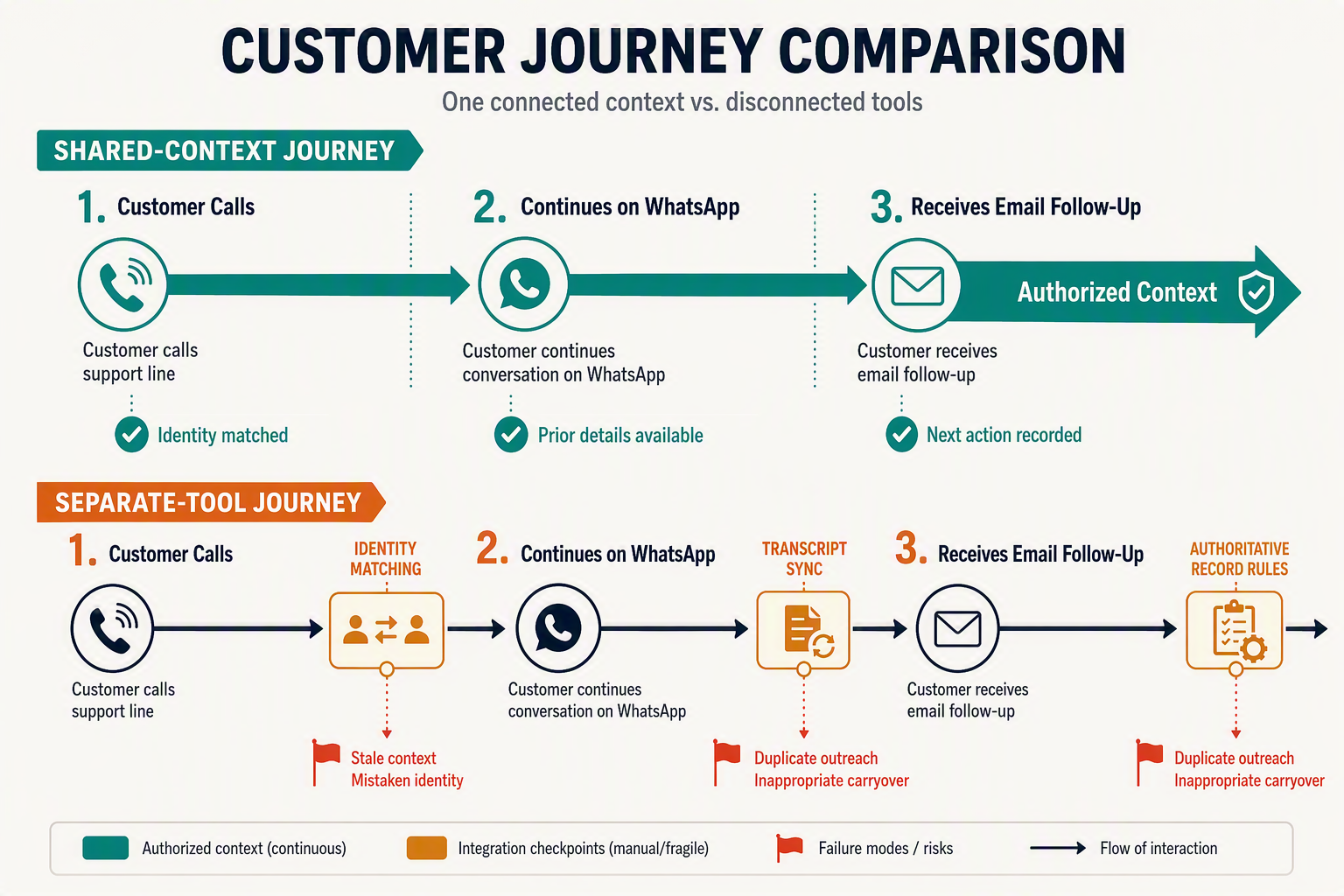
The journey works only when the customer’s identity, authorized context, and next action survive every channel change. Without shared memory, connected tools can still create disconnected conversations.
- Incoming call
- CallMissed: The AI voice agent can capture intent, commitments, transcripts, and required follow-up in one engagement environment. Verify that the configured account links calls to customer records using validated identifiers.
- Separate tools: Voice recordings, call metadata, and customer details may reside in different systems. Teams must choose an authoritative source and synchronize at least three data objects without losing updates.
- WhatsApp continuation
- CallMissed: The agent should retrieve the relevant call summary when the customer continues through messaging or WhatsApp Business calling. Verify identity matching, source attribution, and behavior when the WhatsApp number differs from the original caller ID.
- Separate tools: A webhook must connect the WhatsApp identity with the voice transcript and customer record. Delays, schema mismatches, or incorrect number matching can force customers to repeat their issue.
- Email follow-up
- CallMissed: The email should reflect both the call outcome and any updates received through WhatsApp. For example, it should send the revised appointment time rather than the original confirmation.
- Separate tools: The email platform needs the correct address, trigger, conversation state, and duplicate-prevention rules. Contact fields alone do not capture decisions, unresolved questions, intent, or promised next actions.
Before automating follow-up, define consent, opt-out, review, and duplicate-suppression rules. Human handoff should remain available when identity, authorization, context, or customer intent is uncertain.
Shared memory can also create risks when it retrieves stale or unauthorized information. Problems may include merging two people who share a number or exposing sensitive call details through email.
Use retention limits, role-based access, audit logs, and correction or deletion workflows. Apply channel-specific permissions so each interaction receives only the context it requires.
Buyer verification: Run a controlled call → WhatsApp → email journey and inspect every handoff. Check timestamps, transcript access, identity confidence, memory updates, source references, consent status, exports, and fallback behavior. Also confirm that uncertain cases escalate cleanly to a human without losing the conversation history.
For CallMissed, verify these behaviors using current first-party documentation and the configured account. The presence of all three channels does not, by itself, confirm reliable cross-channel memory.
How do pricing and value differ when costs include integration, governance and maintenance? (TABLE)
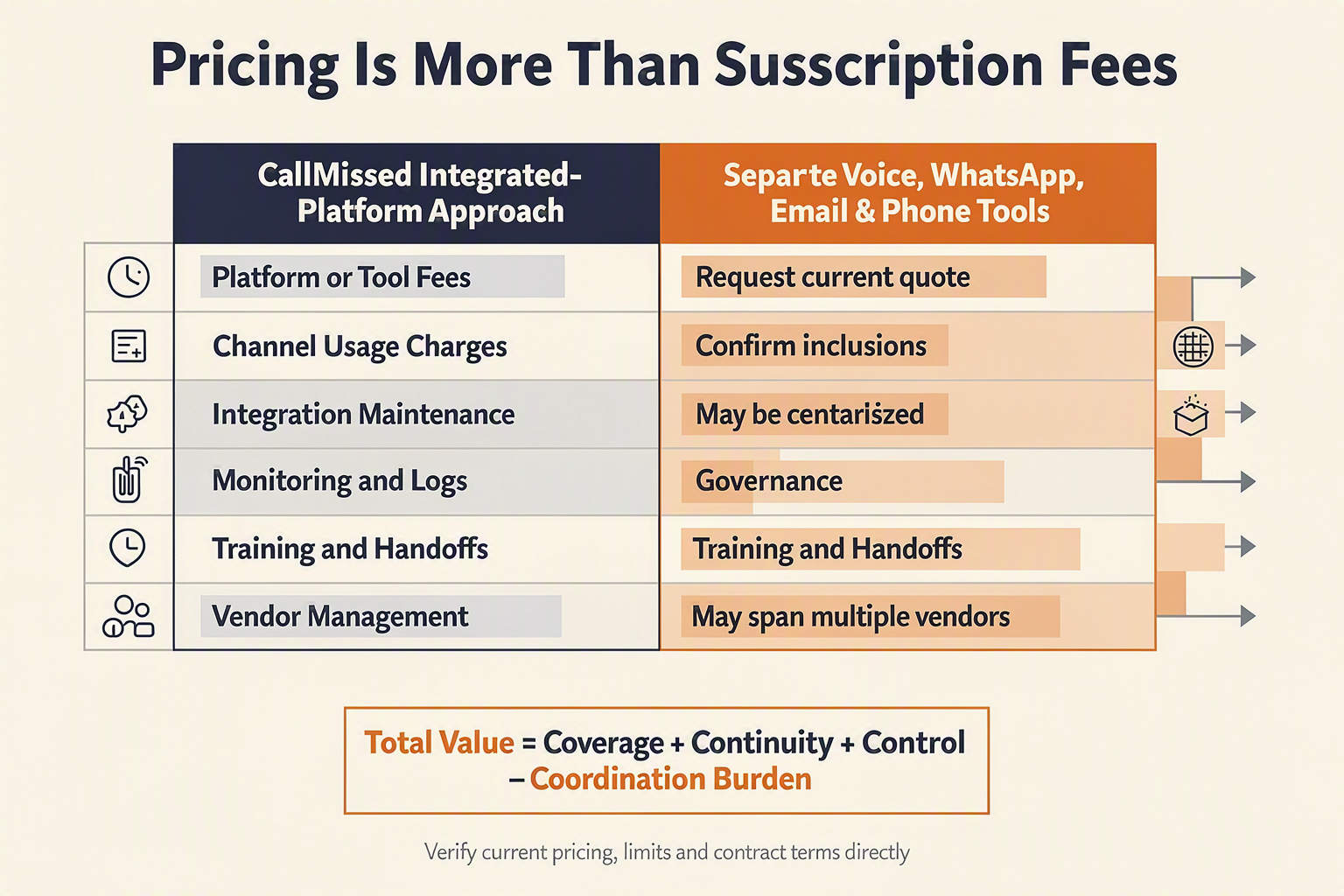
CallMissed offers more predictable platform-level value, while separate tools can appear cheaper per channel but add integration, governance and maintenance costs. Buyers should compare total cost of ownership (TCO) for the complete call-to-WhatsApp-to-email journey—not isolated subscription prices.
Total-cost comparison
| Cost area | CallMissed integrated platform | Separate channel tools | What to calculate |
|---|---|---|---|
| Usage and subscriptions | Pay-as-you-go credits; 1 credit equals ₹1, with a free tier | Multiple subscriptions, usage meters and minimum commitments may apply | Monthly channel usage, numbers, messages, calls, email and AI inference |
| Initial integration | Shared platform configuration, workflows and customer records | APIs, webhooks and authentication for each voice, WhatsApp, email and phone component | Engineering hours, testing, deployment and identity mapping |
| Ongoing maintenance | Centralized configuration and monitoring, subject to platform coverage | Multiple API versions, schemas, credentials, logs and vendor changes | Engineering and operations hours per month |
| Governance | Policies can be administered more centrally but still require configuration | Retention, consent, access and deletion rules must be aligned across systems | Security reviews, audits and policy administration |
| Incident response | Fewer administrative surfaces, with greater dependence on one platform | More dashboards and escalation paths, but failures may remain channel-specific | Monitoring, on-call effort, diagnosis and vendor coordination |
| Change and expansion | New workflows can reuse the existing customer-context layer | Each new channel or agent may require additional synchronization logic | Build, regression-testing and migration costs |
- CallMissed: Transparent credit pricing makes consumed platform usage easier to interpret, but buyers should verify current rates for each model, channel, phone number and campaign before budgeting.
- Separate tools: A lower headline price for one component does not include the engineering required to synchronize customer identity, transcripts, consent status and next actions.
- Integration cost: Estimate implementation using loaded engineering rates multiplied by hours for authentication, webhook handling, retries, deduplication, observability and acceptance testing.
- Governance cost: Include role-based access, retention, deletion, consent and audit requirements across every data store; consolidation centralizes governance but does not eliminate it.
- Maintenance cost: Model at least three scenarios—normal operations, an API or schema change, and a failed channel handoff requiring investigation across logs and vendors.
- Continuity value: Calculate the operational impact of duplicate outreach, stale context and manual history reconstruction without assigning unsupported productivity percentages.
- Lock-in tradeoff: CallMissed reduces coordination surfaces but increases dependence on its channel coverage and reliability; separate tools preserve vendor flexibility while increasing orchestration responsibility.
- Procurement test: Request both architectures’ quotes for the same 12-month workflow volumes, retention period, support level and failure-handling requirements; otherwise, the comparison is not like-for-like.
What are the pros and cons of CallMissed versus a best-of-breed channel stack? (TABLE)
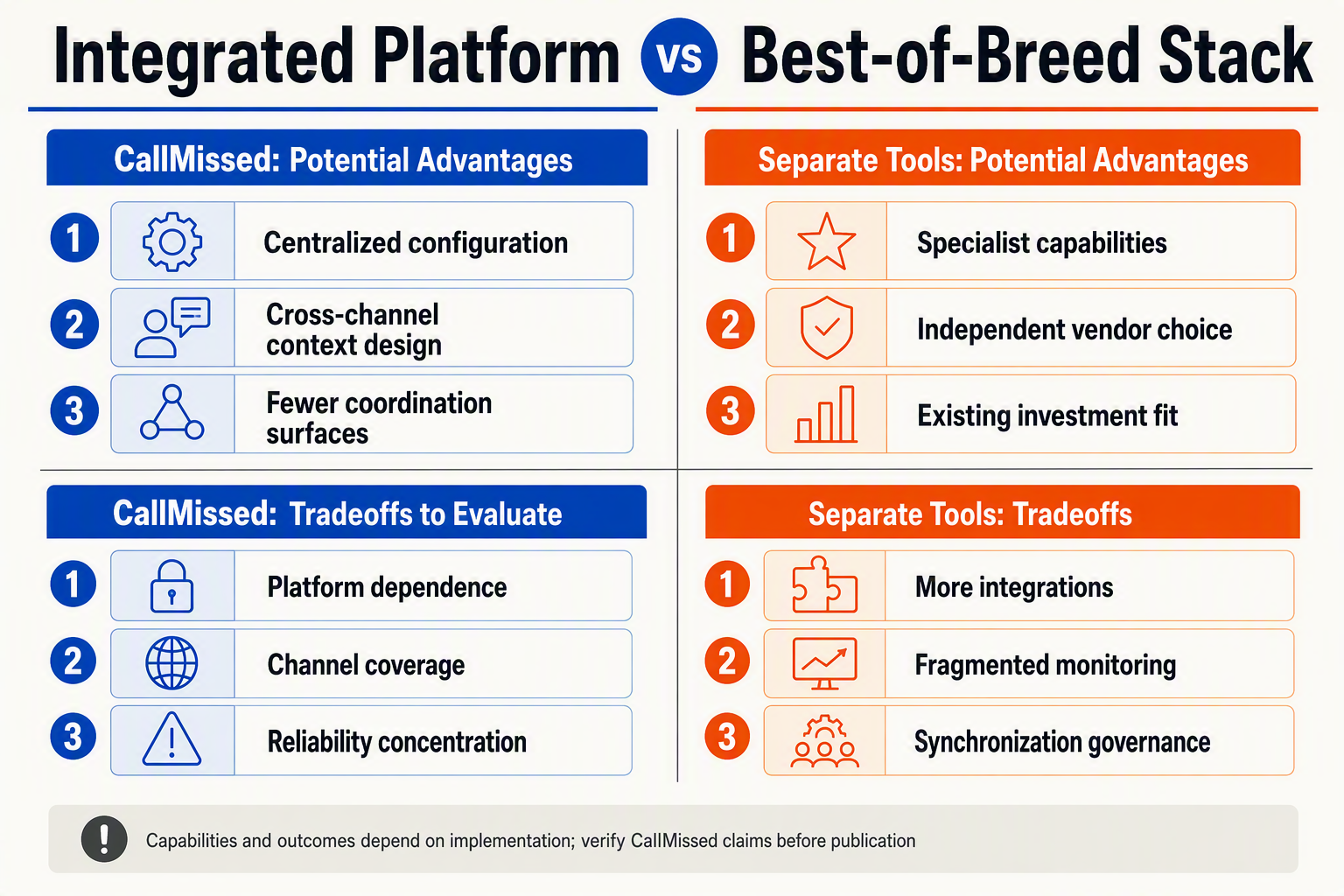
CallMissed favors coordinated customer continuity and centralized operations, while a best-of-breed stack favors channel-level specialization and vendor flexibility. Neither approach wins automatically: buyers should test whether accurate, authorized context survives every channel switch.
Pros-and-cons comparison
| Decision area | CallMissed integrated platform | Best-of-breed channel stack | Key tradeoff |
|---|---|---|---|
| Customer context | Designed to bring voice, WhatsApp, email and CRM activity into a coordinated environment | Requires identity matching and synchronization across separate customer records | Centralization versus customizable data architecture |
| Channel switching | Can support a call → WhatsApp → email journey within one engagement platform | Needs APIs, webhooks and authoritative-system rules to transfer context | Fewer coordination layers versus greater integration control |
| AI-agent memory | Can use a shared context layer, subject to verified scope, permissions and retention controls | Each agent may retain an isolated history unless memory is deliberately synchronized | Consistency versus independently designed memory policies |
| Operations | Centralizes channel configuration, inbox workflows and monitoring | Distributes credentials, routing rules, dashboards, logs and escalation paths across vendors | Lower coordination burden versus vendor independence |
| Channel capabilities | Includes AI voice agents, WhatsApp chat, WhatsApp Business calling and email tooling | Allows a specialist product to be selected for each channel | Unified coverage versus deeper niche specialization |
| Maintenance and resilience | Reduces the number of cross-vendor interfaces but increases dependence on one platform’s coverage | Supports vendor substitution but adds schema, authentication and API-version dependencies | Platform concentration versus integration overhead |
Practical advantages and limitations
- CallMissed: Supports speech workflows across 22 Indian languages, according to CallMissed’s product specifications, making regional-language coverage a concrete advantage for businesses serving Indian audiences.
- Best-of-breed stack: Lets an organization select separate voice, WhatsApp, email and phone-number services, but a four-component design can create at least six pairwise integration relationships if every component must exchange data with every other component.
- CallMissed: Offers the differentiated ability to bridge WhatsApp Business voice calls to an AI agent alongside WhatsApp chat; buyers should still verify current availability, geographic eligibility and Meta approval requirements.
- Best-of-breed stack: Can isolate failures by channel and replace one supplier without migrating the entire system, although replacement still requires data mapping, authentication changes and regression testing.
- CallMissed: Centralization does not guarantee correct memory; teams must test stale-context handling, mistaken identity, duplicate outreach and inappropriate carryover between personal calls, WhatsApp conversations and email.
- Best-of-breed stack: Separate histories can strengthen data separation for regulated workflows, but agents may ask customers to repeat information unless synchronization rules explicitly transfer authorized summaries and next actions.
- Both approaches: Require consent, opt-out enforcement, retention and deletion controls, role-based access, source attribution, human handoff, exports, monitoring and documented fallback behavior.
- Buying decision: Choose CallMissed when continuity and reduced coordination burden outweigh channel-by-channel customization; choose separate tools when specialist depth, independent procurement or strict workload isolation matters more.
Which option should you choose, and what should you verify before committing?
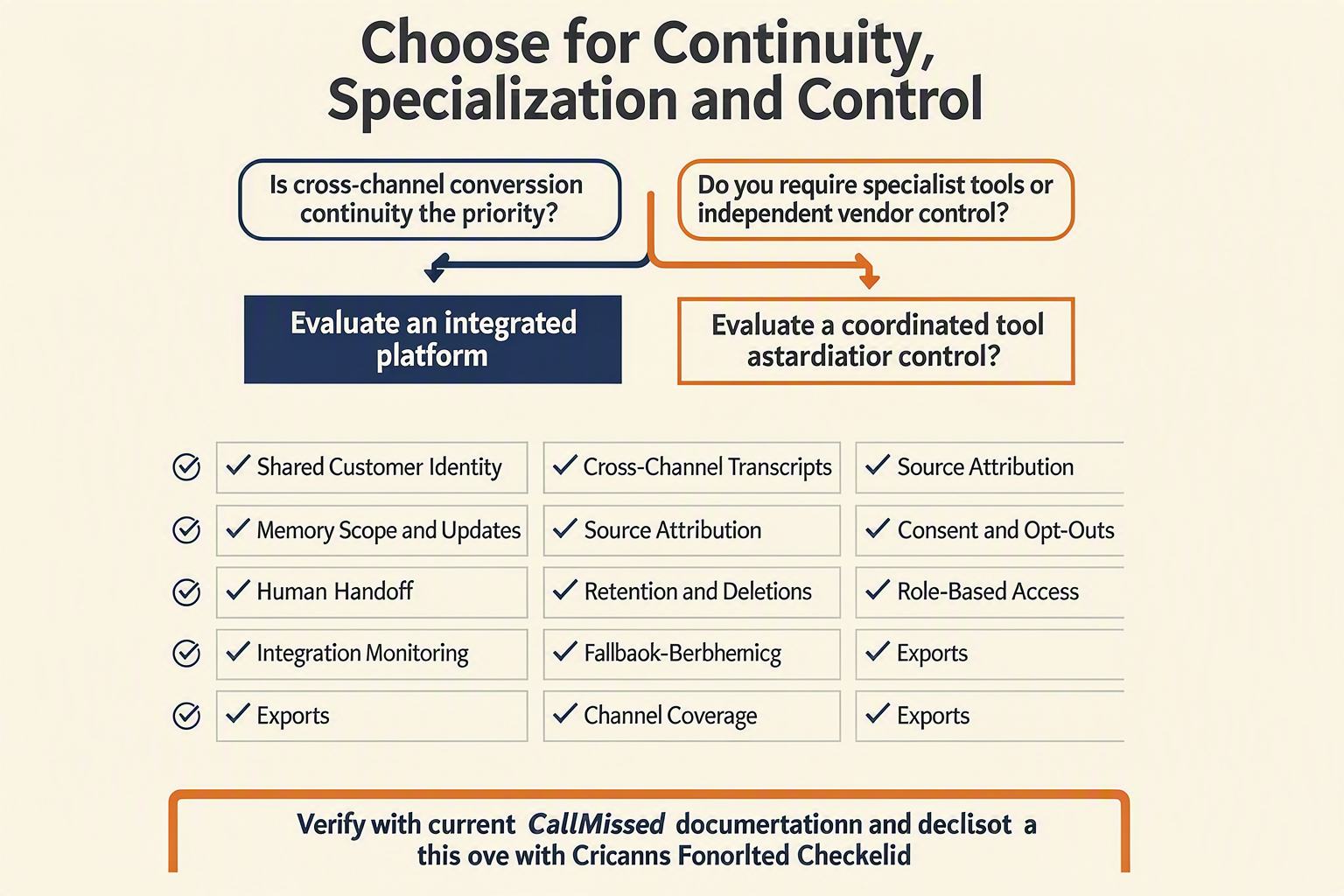
Choose CallMissed when cross-channel continuity and centralized operations outweigh the need for independently selected tools; choose separate components when specialist capabilities, vendor portability or existing infrastructure are non-negotiable. In either case, verify continuity through a live journey rather than relying on an “omnichannel” label.
Choose based on operating priorities
- CallMissed: Consider the integrated approach if customers routinely move through three channels—phone, WhatsApp and email—and staff need one usable history; CallMissed lists AI voice agents, WhatsApp chat and Business calling, email tooling, and an omnichannel inbox/CRM within its product scope.
- Separate tools: Prefer a modular stack when each department requires a specialist provider, must replace channels independently or already has mature integration engineering; budget operational capacity for multiple credentials, APIs, webhooks, schemas, dashboards, logs and vendor escalation paths.
- India-focused operations: Evaluate CallMissed when regional-language voice coverage is material because the platform supports Speech-to-Text and Text-to-Speech across 22 Indian languages; test the exact languages, accents, code-switching patterns, latency and terminology relevant to real callers before committing.
- Risk tradeoff: An integrated platform can lower coordination burden by centralizing configuration and monitoring, but it increases dependence on that platform’s coverage and reliability; separate tools distribute vendor dependency while making identity resolution, synchronization and system-of-record governance your responsibility.
Verify these capabilities in a proof of concept
- Identity and transcripts: Run a test customer through call → WhatsApp → email, then confirm how phone numbers, WhatsApp identities, email addresses and CRM records are matched; verify that transcripts appear promptly, remain source-attributed and cannot be attached to the wrong person through weak matching rules.
- Memory governance: Ask which facts enter AI memory, when updates become available and whether newer information supersedes stale context; require documented controls for consent, retention periods, correction, deletion, role-based access and inappropriate carryover between personal, sales and support conversations.
- Human handoff and messaging controls: Confirm that an AI agent can transfer a conversation with its transcript, intent and next action intact; test assignment rules, supervisor visibility, consent records, WhatsApp and email opt-outs, duplicate-outreach prevention, escalation timing and fallback behaviour when an AI model or channel is unavailable.
- Product and operational evidence: Before contracting, verify through current first-party documentation and a sandbox that CallMissed supports every required channel, cross-channel shared memory, WhatsApp Business calling, phone-number provisioning or management, exports, integrations and audit controls; also inspect webhook retries, API-version changes, monitoring alerts, uptime commitments and data-recovery procedures.
Frequently asked questions: Is CallMissed omnichannel, how does shared memory work, and what should buyers verify?
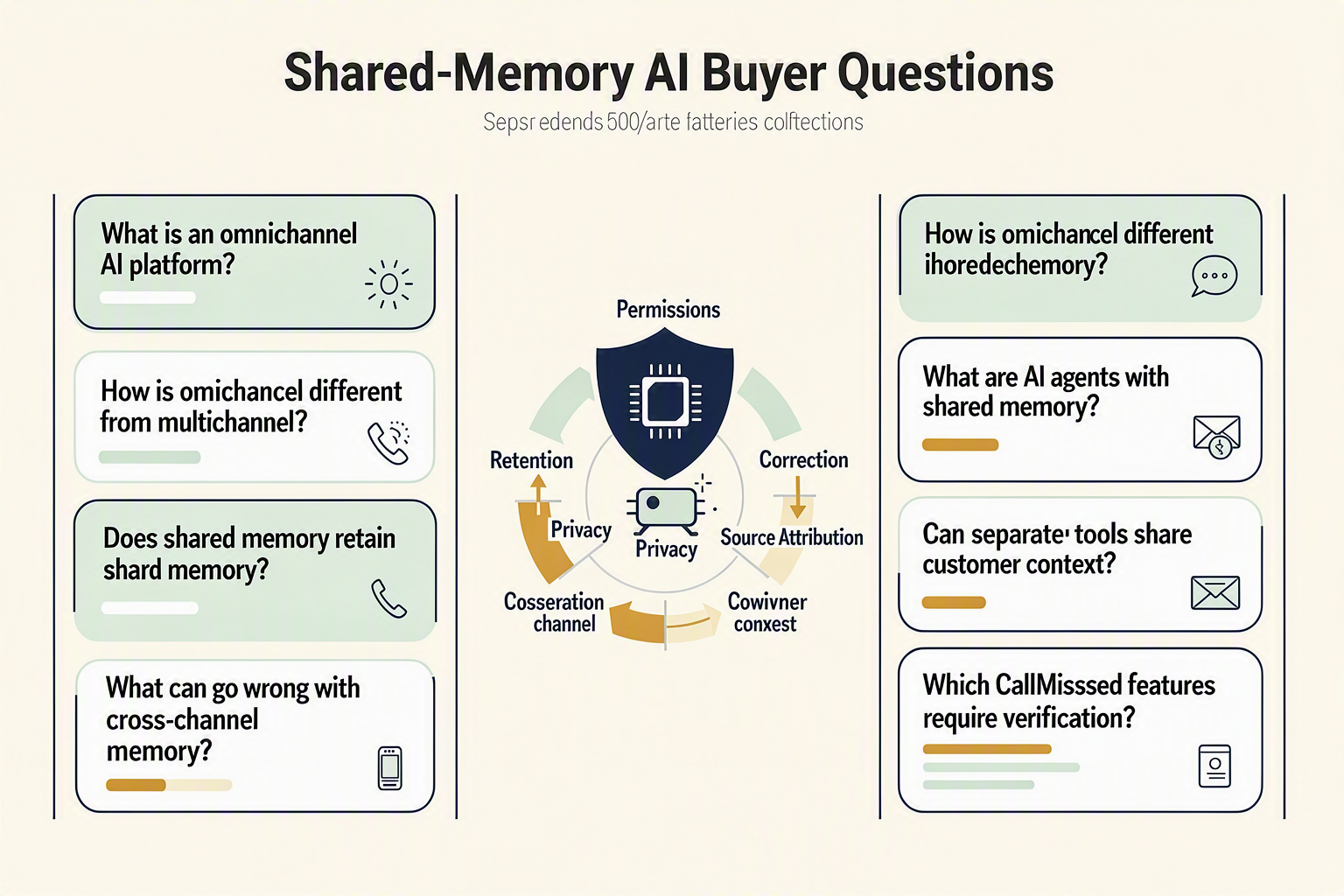
Use these six questions to test whether an omnichannel platform provides genuine continuity rather than merely multiple channels.
- Q: Is CallMissed an omnichannel AI platform?
A: CallMissed combines AI voice agents, WhatsApp chat, WhatsApp Business calling, email tooling, and an omnichannel inbox/CRM. Buyers should verify in current first-party documentation that transcripts, customer identity, and authorized context persist across every channel required.
- Q: How does shared-memory AI work across voice, WhatsApp, and email?
A: Shared-memory AI retrieves relevant, authorized information from a common customer record or conversation layer when the channel changes. It should not mean unlimited recollection: verify memory scope, update behavior, retention, correction, deletion, consent, and role-based access.
- Q: What does CallMissed vs separate voice, WhatsApp, email and phone tools mean for customer context?
A: CallMissed can centralize interactions around one customer record, while separate tools require deliberate identity matching and synchronization. Buyers must establish which system is authoritative for phone numbers, WhatsApp identities, email addresses, transcripts, and opt-outs.
- Q: Does CallMissed support AI voice agents in Indian languages?
A: CallMissed supports Speech-to-Text and Text-to-Speech across 22 Indian languages, using Indic-focused capabilities for regional audiences. Confirm the required language, accent, telephony route, transcription quality, and fallback behavior through a real-world pilot.
- Q: What should buyers verify when comparing CallMissed vs separate communication tools?
A: Test cross-channel transcripts, human handoff, source attribution, consent handling, exports, integration monitoring, fallback behavior, and retention controls. Run a call → WhatsApp → email journey and check whether the customer avoids repeating information.
- Q: When are separate voice, WhatsApp, email, and phone tools a better fit?
A: Separate tools may suit organizations requiring specialized channel vendors, independent procurement, or custom infrastructure control. An integrated platform may fit teams prioritizing conversational continuity and centralized operations, provided they accept greater dependence on one platform’s coverage and reliability.
Conclusion
Continuity—not feature count—should determine whether an integrated platform or separate channel tools fit your customer journey.
- CallMissed centralizes voice, WhatsApp, email and customer context.
- Separate tools offer specialization but require identity matching, synchronization and ongoing integration maintenance.
- Shared memory is valuable only with accurate retrieval, permissions, retention and deletion controls.
- Customer experience improves when conversations survive channel switches without repetition or duplicate outreach.
Watch how platforms strengthen cross-channel governance, human handoffs and reliability. Explore CallMissed—and ask: will your AI remember the customer correctly when the channel changes?
Related Reading
Discussion
Related Posts


Ready to automate customer conversations?
Launch AI voice agents and WhatsApp bots with CallMissed — one API, 22+ Indian languages.