Voice Agents: How They Work and How CallMissed Uses Them



Voice agents understand speech, reason, and respond in real time. Learn the architectures, business use cases, and how CallMissed handles calls 24/7.
Voice Agents: How They Work and How CallMissed Uses Them
Voice agents are AI systems that handle business phone calls by listening to spoken language, interpreting a caller’s intent, using approved business tools or workflows, and replying with synthesized speech in real time. For business calls, they can answer questions, qualify leads, book appointments, collect details, route callers, and escalate conversations to a person when required. They typically use either direct speech-to-speech processing or a chained speech-to-text, reasoning, and text-to-speech pipeline.
The opportunity is especially clear for appointment-driven businesses: NextPhone reports that 74.1% of incoming home-services calls go unanswered. CallMissed applies voice-agent workflows to answering and recovering missed calls, including lead capture, appointment support, routing, follow-up, and outcome recording. This article explains how voice agents work, where they fit, and how businesses can deploy them responsibly.
Introduction: Why AI Voice Agents Are Becoming the New Front Door for Customers
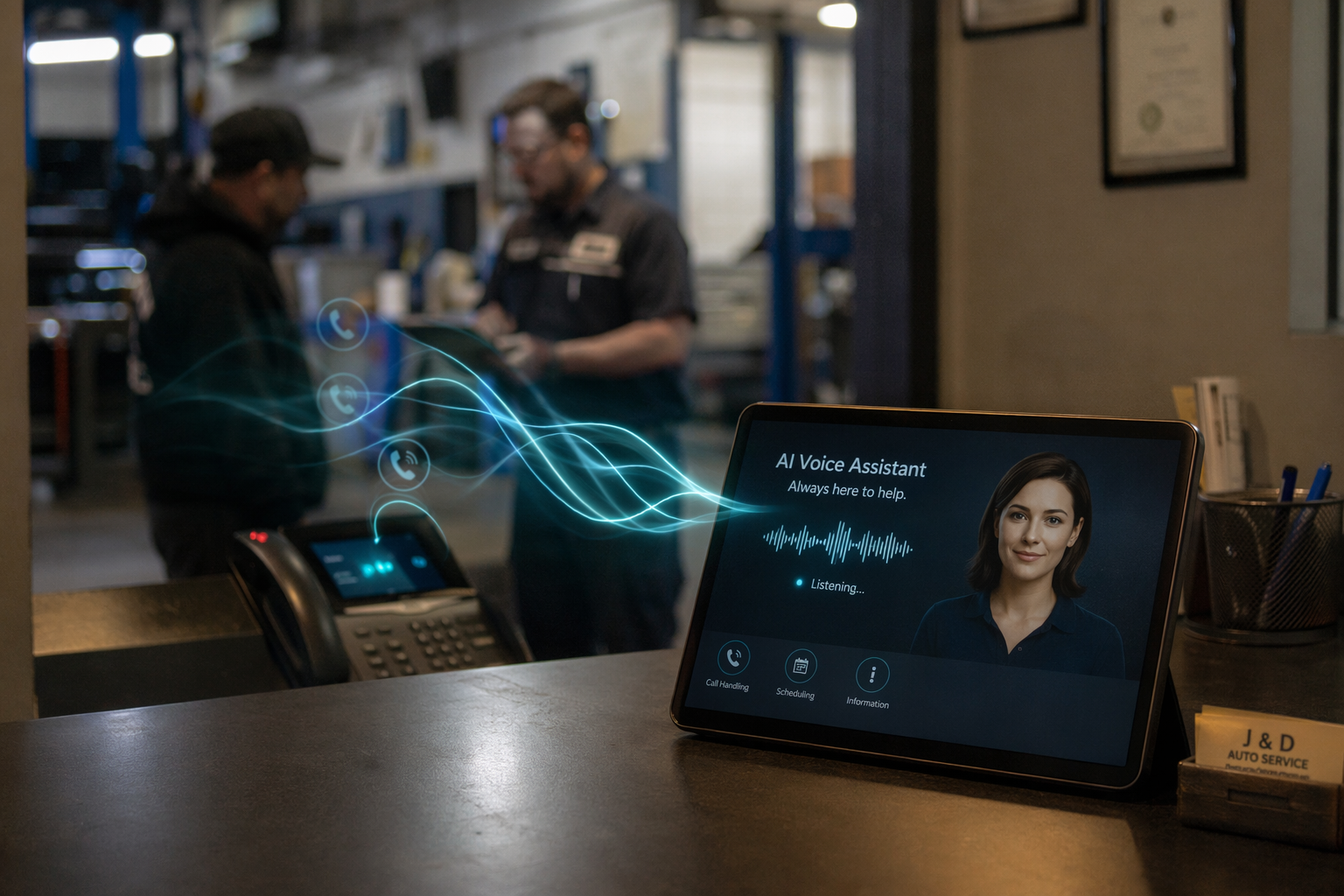
Voice agents are AI systems that listen to speech, understand the caller’s intent, reason or invoke tools, and reply with synthesized speech in real time. They can answer or place phone calls, qualify leads, schedule appointments, resolve routine requests, transfer callers, and record structured outcomes for the business.
Also called AI voice agents, voice AI agents, AI phone agents, or conversational voice agents, these systems provide a practical first point of contact when employees are busy, unavailable, or working outside normal hours. Unlike traditional voicemail or fixed phone menus, a voice agent can hold a two-way conversation, ask relevant follow-up questions, and take an appropriate next action based on the caller’s responses.
Quick Answer
A voice agent combines speech recognition, language understanding, business rules or AI reasoning, integrations, and text-to-speech. Together, these capabilities allow it to understand a spoken request, gather the necessary details, use configured tools such as calendars or routing workflows, respond naturally, and document what happened.
CallMissed applies this technology to practical business communication: 24/7 call answering and missed-call recovery, lead capture and qualification, appointment booking, follow-up, and handoff to a human when a conversation requires staff judgment.
Why Voice Agents Are Becoming the New Front Door
Phone calls often represent immediate customer intent. Someone may be trying to request a quote, confirm availability, schedule a service, report a problem, or speak with the right department. If no one answers, that intent can be lost or delayed.
An AI phone agent can respond at the time of the call or initiate a follow-up when a missed-call workflow is configured. During the conversation, it can:
- Identify why the caller is contacting the business
- Capture contact details, location, service needs, urgency, and preferred times
- Ask business-defined lead qualification questions
- Book an appointment or record a callback request
- Answer configured routine questions
- Route or transfer urgent, sensitive, or complex calls
- Create a structured summary for staff and connected systems
- Continue an approved follow-up workflow after the call
The appropriate actions depend on the business’s configuration, available integrations, and rules for escalation. A well-designed conversational voice agent should clearly hand off requests it cannot safely or appropriately handle rather than pretending to replace human expertise.
CallMissed’s Practical Approach to Voice AI
CallMissed focuses on using voice agents to keep customer enquiries moving when a team cannot answer immediately. Its business workflows can cover inbound call answering, missed-call recovery, lead qualification, booking, follow-up, and human escalation.
For example, a home-service business might configure an agent to collect an address, service type, and preferred appointment window. A clinic could capture an appointment request and direct urgent or sensitive matters to staff according to its procedures. A real estate team might record the property of interest, budget range, and preferred callback time.
The aim is not simply to produce a transcript. A voice agent platform can turn each conversation into structured context and a clear next step, helping staff see what the caller needs before taking over.
What This Article Covers
This article explains how voice agents work, including speech recognition, intent detection, AI reasoning, tool use, text-to-speech, integrations, and human handoff. It also examines how CallMissed uses these components to answer calls, recover missed opportunities, qualify enquiries, schedule appointments, support follow-up, and preserve useful call outcomes for the team.
Background & Context: From Voice Search Optimization to AI Phone Agents
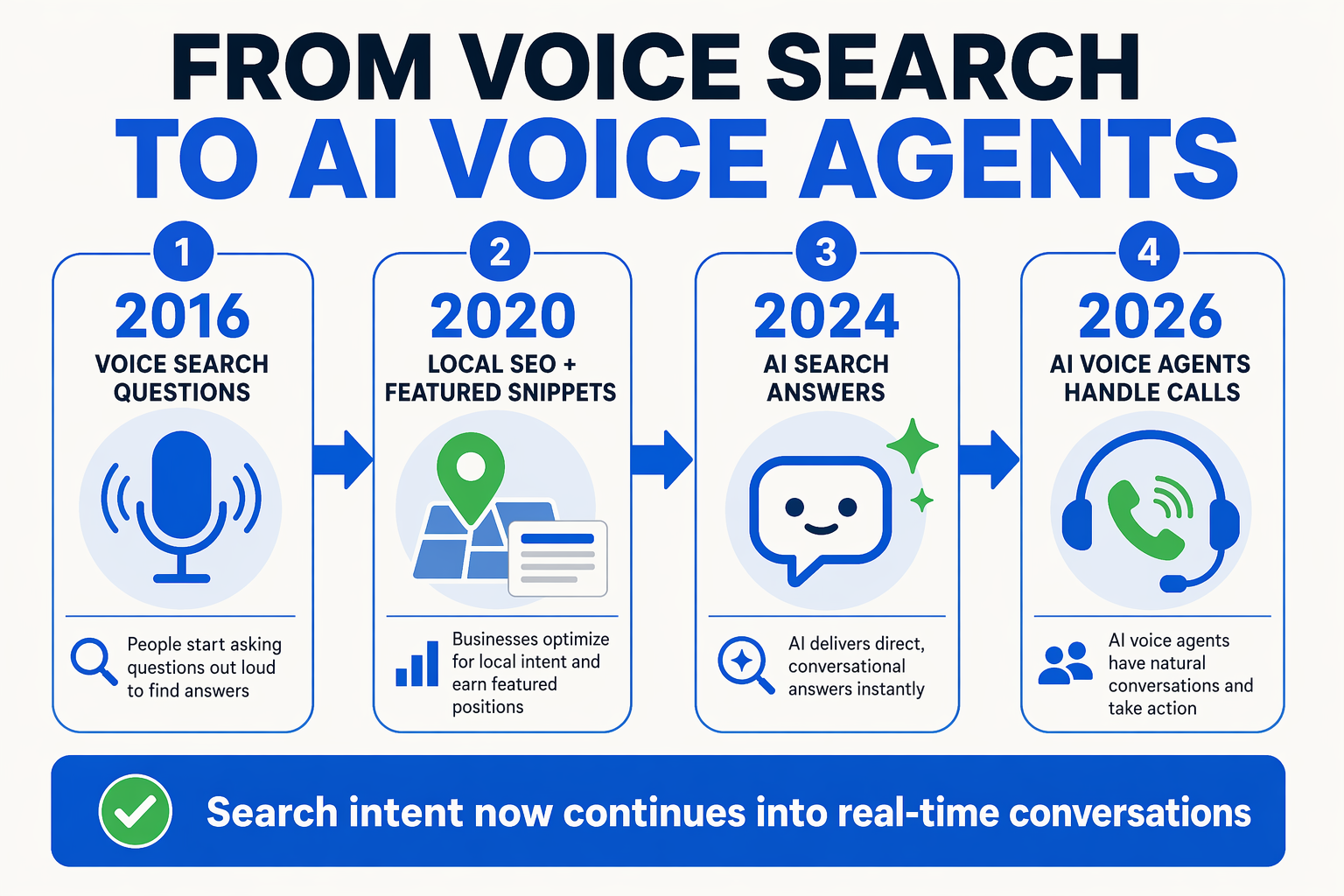
A voice agent is an AI system that can listen, understand intent, respond in spoken language, and take actions during a live conversation. Depending on its permissions, it might look up a customer, qualify a lead, schedule an appointment, update a CRM, send a message, or transfer the call to a person.
That makes a voice agent different from several related technologies:
- IVR: Routes callers through fixed menus such as “Press 1 for sales.” Its paths are usually predefined.
- Voice assistant: Commonly handles broad, user-initiated tasks on a phone, speaker, or operating system.
- Chatbot: Primarily communicates through text, even if speech input or output is added later.
- Voice agent: Conducts a two-way spoken conversation, maintains context, uses business tools, and works toward a defined outcome.
Modern voice agents are generally built using one of two architectures: a direct live-audio model or a modular speech-to-text and text-to-speech pipeline.
Approach 1: Direct Speech-to-Speech Sessions
In a direct speech-to-speech architecture, the model receives live audio and produces spoken audio without requiring a separate text-generation stage in the middle of every turn.
A typical flow looks like this:
- The caller connects through a phone network, WebRTC session, or streaming connection.
- Audio is sent continuously to a real-time multimodal model.
- Voice activity detection identifies when the caller starts and stops speaking.
- The model interprets the speech, context, tone, and conversation state.
- It can call approved tools, such as a calendar or customer database.
- Spoken output streams back to the caller as it is generated.
This approach is designed for natural, low-latency conversation. It is particularly useful when callers may pause, interrupt, change direction, or expect the agent to respond with human-like timing. The system can support barge-in, allowing the caller to interrupt the agent rather than waiting for a complete prerecorded-style response.
Direct audio does not mean business logic disappears. Tool permissions, required disclosures, escalation rules, call-state controls, and safety checks still sit around the model. Transcripts can also be generated for monitoring, although a transcript is not necessarily the primary representation used throughout the conversation.
Approach 2: Speech-to-Text → Agent → Text-to-Speech
The second architecture separates the conversation into distinct stages:
- Speech-to-Text (STT) converts the caller’s audio into a transcript.
- An agent or LLM interprets the transcript and decides what to say or do.
- Business logic validates the requested action.
- Tools retrieve information or update external systems.
- Text-to-Speech (TTS) converts the approved response into audio.
- The audio is played to the caller.
This chained architecture is useful when a business needs clear visibility into every step. The transcript can be stored, reviewed, classified, redacted, or checked against workflow rules before the system responds or performs an action.
For example, an appointment agent could collect the caller’s name and preferred time conversationally, but use deterministic code to check availability and confirm the booking. A financial-services workflow could require explicit approval before sending an application link or changing customer information.
The trade-off is that each stage introduces processing time and another integration point. The experience can still be responsive, but it may not preserve tone, emotion, timing, and interruptions as naturally as a model that works directly with live audio.
Direct Audio vs. Chained Voice Pipelines
| Architecture | Best fit | Advantages | Trade-offs |
|---|---|---|---|
| Direct speech-to-speech | Natural customer conversations, reception, qualification, support, and real-time assistance | Lower perceived latency, fluid turn-taking, better handling of interruptions and vocal context | Less inherent visibility into intermediate text, more care required for live-session controls and tool permissions |
| STT → agent/LLM → TTS | Regulated or structured workflows, detailed transcripts, approvals, data collection, and deterministic processes | Inspectable pipeline, modular components, easier validation and workflow control | Additional latency, more components to operate, and some loss of speech nuance between stages |
Neither design is universally better. Many production systems are hybrid: they use live audio for the conversation while routing sensitive actions through deterministic services, approval checks, or human review.
OpenAI’s current developer guidance presents both direct real-time audio and chained voice pipelines as valid implementation patterns. OpenAI is only one possible technology provider; comparable components can come from multiple model, speech, communications, and infrastructure vendors. This architectural description does not imply that CallMissed uses OpenAI as its underlying provider.
The Common Voice-Agent Stack
Regardless of which approach is selected, a production voice agent usually contains the following layers:
- Transport: Telephony, SIP, WebRTC, or WebSocket infrastructure carries audio between the caller and the agent. WebRTC is common for browser or app conversations, while phone calls require integration with telephony infrastructure.
- Turn detection: Voice activity detection, silence thresholds, and conversation-state logic determine when the caller has finished a turn and when the agent should respond.
- Speech recognition: Chained systems use STT as a core stage. Direct-audio systems may still create transcripts for analytics, compliance, or agent handoff.
- LLM and reasoning: The model identifies intent, tracks context, decides whether information is missing, and selects the next response or action.
- Tools and business systems: Controlled integrations connect the agent to CRMs, calendars, ticketing platforms, order systems, knowledge bases, messaging channels, and internal APIs.
- Speech generation: A TTS service produces the final voice in a chained pipeline. Direct-audio models generate speech within the live session.
- Guardrails: Policies constrain what the agent may discuss, which tools it can call, what data it can reveal, and when confirmation is required.
- Monitoring: Logs, transcripts, latency measurements, tool results, call outcomes, and quality reviews help teams detect errors and improve performance.
- Human escalation: The agent transfers the call or creates a follow-up task when confidence is low, the caller requests a person, or the situation falls outside its authority.
Why Architecture Matters for Missed-Call Automation
A missed-call voice agent needs more than a natural-sounding voice. It must know what outcome it is allowed to complete.
For a clinic, that might mean identifying the service required and checking available appointment times. For a property business, it could mean qualifying location and budget before arranging a site visit. For customer support, it may involve retrieving an order status while escalating account disputes to a human.
The architecture should therefore reflect the workflow:
- Choose direct speech-to-speech when conversational speed, interruption handling, and natural turn-taking are the priority.
- Choose a chained pipeline when transcripts, approvals, structured data capture, and deterministic controls are more important.
- Use a hybrid design when the conversation should feel natural but consequential actions must pass through strict validation.
For CallMissed users, the practical objective is not simply to “answer with AI.” It is to connect a live conversation to the right business context, approved tools, monitoring controls, and human fallback so that a high-intent call can progress toward a safe, measurable outcome.
Key Developments in AI Voice Agents in 2026
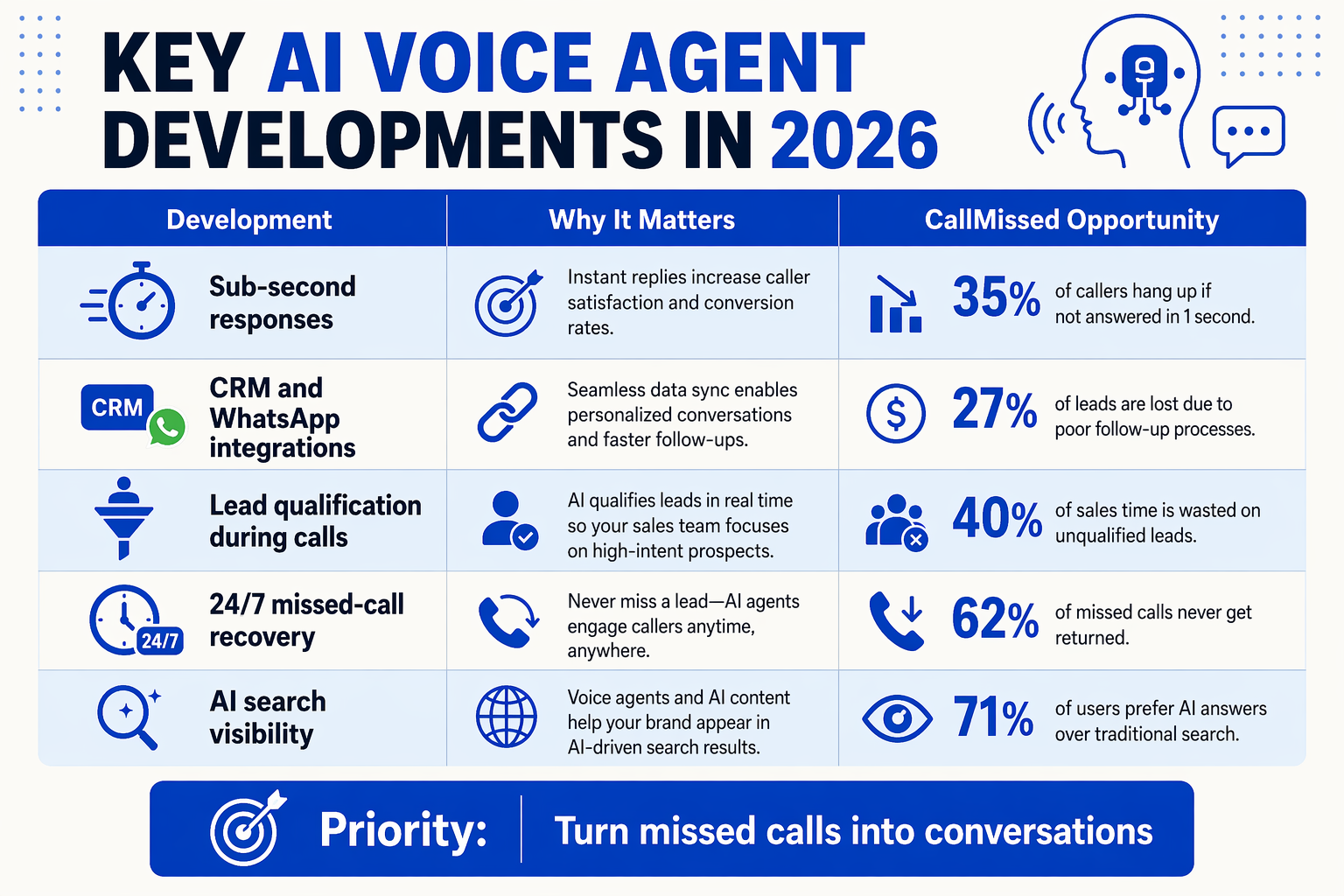
What Changed for Voice Agents in 2026
In 2026, AI voice agents are no longer positioned as experimental call bots. They are becoming part of the core communication stack for sales, support, appointment booking, lead qualification, and missed-call recovery. The key development is the convergence of speech recognition, LLM reasoning, multilingual support, CRM automation, and voice-search-friendly content.
For SEO, this changes the keyword strategy. Businesses are not only searching for broad terms like “voice bot” or “AI chatbot.” They are using high-intent, problem-driven searches such as:
- AI voice agent for missed calls
- AI calling agent for small business
- voice agent for lead qualification
- 24/7 customer support voice AI
- multilingual voice bot India
- voice agent API for developers
This aligns with guidance from SE Ranking, which focuses on optimizing for how people search using voice, and Improvado, which recommends using “natural, conversational language and long-tail keywords” for voice search SEO in 2026.
2026 Voice Agent Developments Businesses Should Track
| Development | What It Means in 2026 | SEO / Keyword Opportunity | Business Impact |
|---|---|---|---|
| Missed-call automation | AI voice agents can answer, qualify, and route callers when teams are unavailable or overloaded. | Target AI voice agents for missed calls, missed call automation, and AI call answering service. | Reduces lost leads from after-hours calls, peak demand, and unanswered inbound inquiries. |
| Conversational voice search | Buyers search in complete questions, not just short keywords. | Build FAQ pages around “What is an AI voice agent?” and “How can AI answer missed calls?” | Improves visibility in voice search, AI-generated summaries, and long-tail organic results. |
| AI-assisted SEO workflows | Frase’s 2026 ranking tested 10 AI SEO tools; Frase automated 6/6 pipeline stages, while Surfer SEO and Semrush each covered 3/6 stages. | Use AI tools to build topic clusters around voice agents, AI calling agents, and voice automation. | Helps teams publish structured, intent-matched pages faster and cover more buyer questions. |
| Multilingual voice AI | Voice agents are becoming essential in markets where customers prefer regional languages. | Rank for localized searches like Hindi voice agent, Tamil AI voice bot, and Indian language speech-to-text API. | Expands customer support beyond English and improves accessibility for regional audiences. |
| LLM-powered call handling | Voice agents can detect intent, summarize calls, personalize responses, and trigger workflows. | Create content around LLM voice agent, AI phone agent, and voice AI workflow automation. | Moves businesses beyond rigid IVR menus into adaptive, context-aware customer conversations. |
| Omnichannel follow-up | Calls increasingly connect with WhatsApp, SMS, CRM, ticketing, and sales pipelines. | Target AI voice agent with WhatsApp follow-up and voice agent CRM integration. | Turns calls into trackable leads, bookings, tickets, or sales opportunities. |
Why These Developments Matter for CallMissed.com
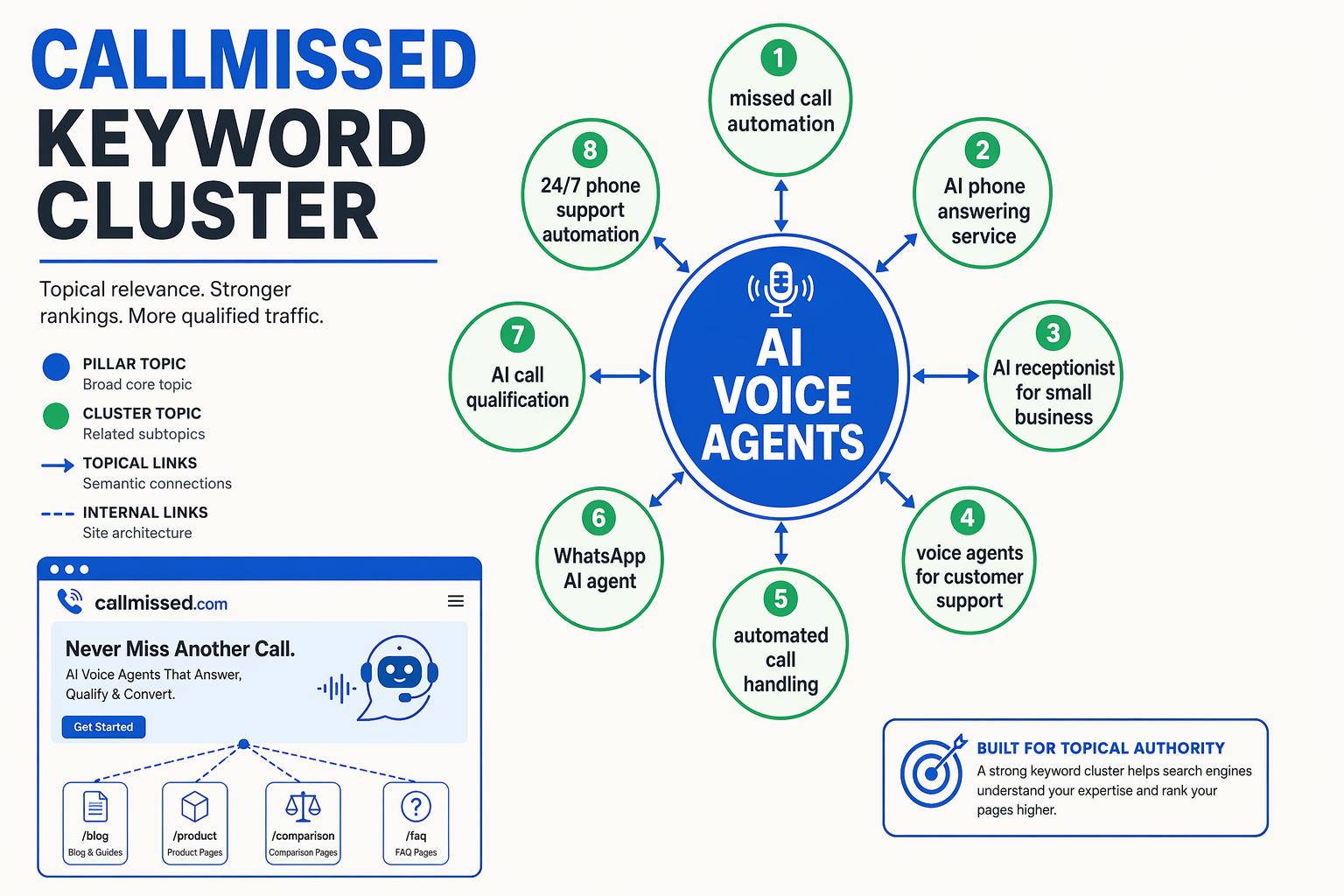
For CallMissed.com, the strongest ranking opportunity is to own the practical, high-intent category: AI voice agents for missed calls. Many competitors publish broad content about conversational AI, but fewer focus on the immediate business pain of unanswered calls. That creates an SEO gap around bottom-funnel keywords where buyers already understand the problem and are searching for a solution.
Platforms like CallMissed are well positioned because they connect multiple 2026 voice AI trends in one infrastructure layer: AI voice agents, WhatsApp chatbots, LLM inference across 300+ models, Speech-to-Text for 22 Indian languages, and Text-to-Speech APIs. This makes the keyword strategy stronger because the product can support not only “voice agent” searches, but also related searches around multilingual automation, developer APIs, WhatsApp follow-up, and AI call handling.
The practical SEO takeaway is simple: rank by matching real buyer intent. Instead of publishing only generic pages, CallMissed should build dedicated landing pages, FAQs, comparisons, and use-case articles around specific searches like voice agent for missed calls, AI receptionist for small business, AI phone agent API, and multilingual AI calling agent India.
In-Depth Analysis: Features Buyers Compare Before Choosing an AI Voice Agent
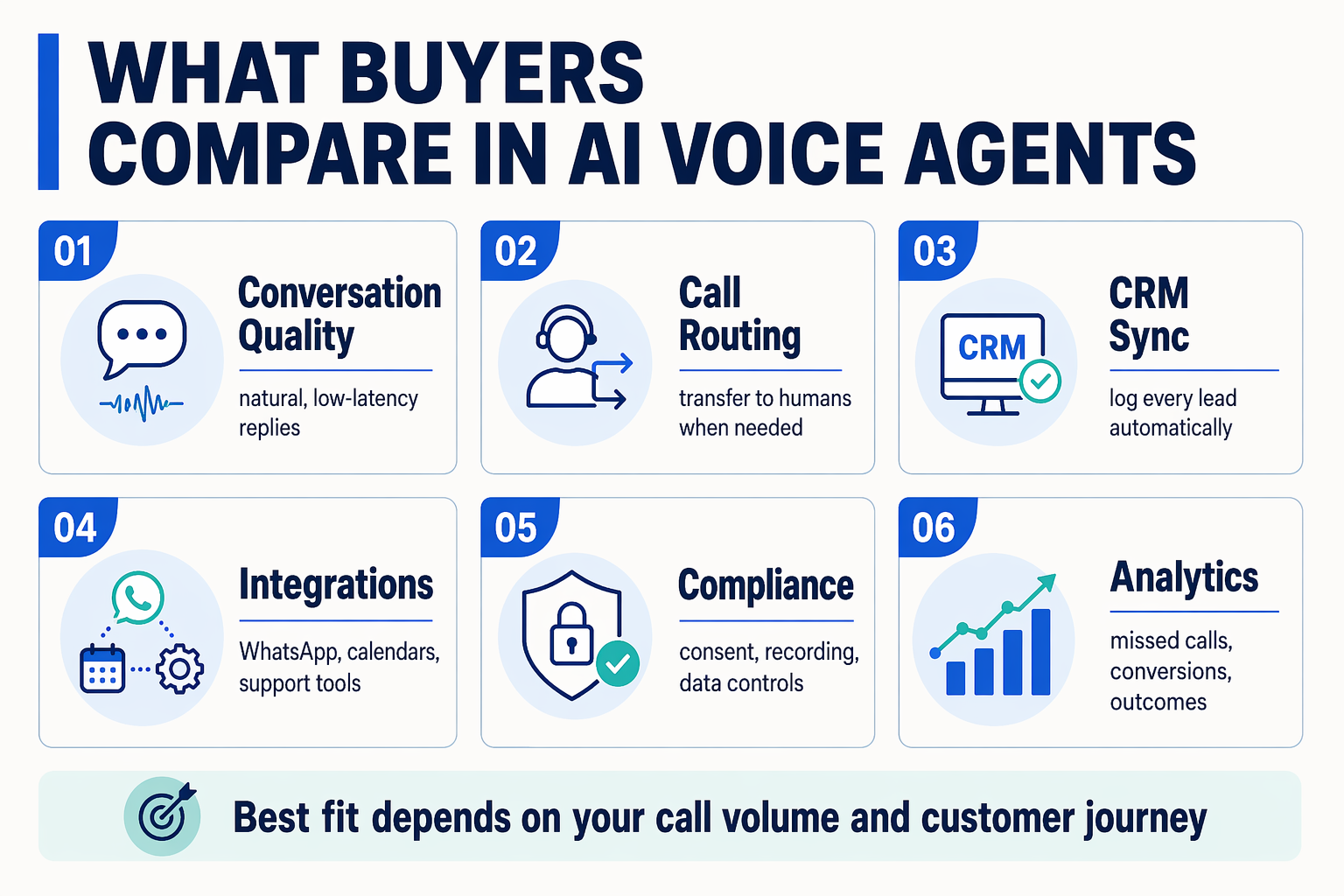
1. Call Answering Quality and Natural Conversation Flow
The first feature buyers compare is simple: does the AI voice agent sound natural enough to keep a real customer engaged? A missed-call agent cannot feel like an old IVR menu. It should greet callers, understand why they called, ask follow-up questions, and complete the next best action.
Strong AI voice agents are evaluated on:
- Intent recognition: Can it identify whether the caller wants pricing, support, appointment booking, order status, or a callback?
- Context handling: Can it remember what the caller said earlier in the conversation?
- Interruptions and turn-taking: Can it handle people speaking naturally, changing their mind, or asking multiple questions?
- Fallback behavior: Can it route the call to a human when confidence is low?
This matters for SEO too. SE Ranking and Improvado both emphasize that voice search optimization in 2026 depends on natural, conversational, long-tail language. The same principle applies to voice agents: customers do not speak in keywords; they ask full questions like, “Can I book an appointment for tomorrow evening?” or “Do you provide home service near me?”
2. Speed, Availability, and Missed-Call Recovery
For businesses using AI voice agents for missed calls, response time is a core buying criterion. Lead-response research commonly shows that contacting a lead within 5 minutes can dramatically improve qualification chances. That is why buyers look for platforms that can answer instantly, not just send a delayed notification.
A good AI missed-call system should support:
- 24/7 call answering, including weekends and holidays
- Instant lead capture when the team is unavailable
- Automatic callback scheduling based on business rules
- CRM or dashboard logging so no lead disappears
- Escalation to human staff for urgent or high-value calls
For high-intent categories—healthcare, real estate, education, logistics, home services, and finance—the ability to recover missed calls can directly affect revenue. A caller who does not get an answer may not wait; they may simply call the next business ranking in search.
3. Multilingual Speech Recognition and Voice Output
In markets like India, the best AI voice agent is not only intelligent—it is multilingual. Buyers increasingly compare whether a platform can understand regional accents, local phrases, and multiple languages in the same conversation.
This is where speech infrastructure becomes important. Platforms such as CallMissed combine AI voice agents with Speech-to-Text support for 22 Indian languages and Text-to-Speech APIs, making it practical for businesses to automate calls beyond English-only use cases.
Key multilingual features buyers should evaluate include:
- Speech-to-Text accuracy across languages and accents
- Text-to-Speech quality that sounds clear and human-like
- Language switching during the same call
- Support for local customer-service scripts
- Transcripts for compliance, training, and analytics
For local SEO and voice search, this also aligns with how customers actually search: conversational, regional, and intent-driven.
4. Integrations, Analytics, and AI Model Flexibility
A voice agent should not operate in isolation. Buyers compare whether it connects with their existing workflows—CRM, WhatsApp, calendars, ticketing tools, lead forms, and analytics dashboards.
The broader AI market is also moving toward flexible agent stacks. Frase’s 2026 ranking of AI SEO agents tested 10 tools, with Frase automating 6/6 pipeline stages, while Surfer SEO and Semrush each covered 3/6 stages. The takeaway for buyers is clear: automation value increases when tools cover more of the workflow, not just one narrow task.
For AI voice agents, that means looking for:
- CRM integration for lead records and follow-ups
- WhatsApp handoff for sending confirmations, payment links, or documents
- Calendar integration for bookings and reminders
- Call analytics for tracking intent, outcomes, duration, and drop-offs
- LLM flexibility so teams can choose the right model for cost, speed, or reasoning quality
Solutions like CallMissed’s multi-model LLM inference layer, with access to 300+ models, reflect where the market is going: businesses want reliable voice automation, but they also want freedom to adapt as models improve. A buyer choosing an AI voice agent in 2026 should therefore compare not only the voice quality, but the full operating system behind it—speech recognition, model routing, workflow automation, analytics, and human escalation.
How Voice Agents Work in CallMissed
CallMissed uses a business voice agent to answer inbound and missed calls 24/7, understand why each person is calling, and take the appropriate next step. Instead of sending every caller to voicemail, its AI call answering workflow can capture information, qualify leads, schedule or route requests, trigger follow-up, record outcomes, and escalate conversations through a human handoff when appropriate.
From Incoming Call to Resolution
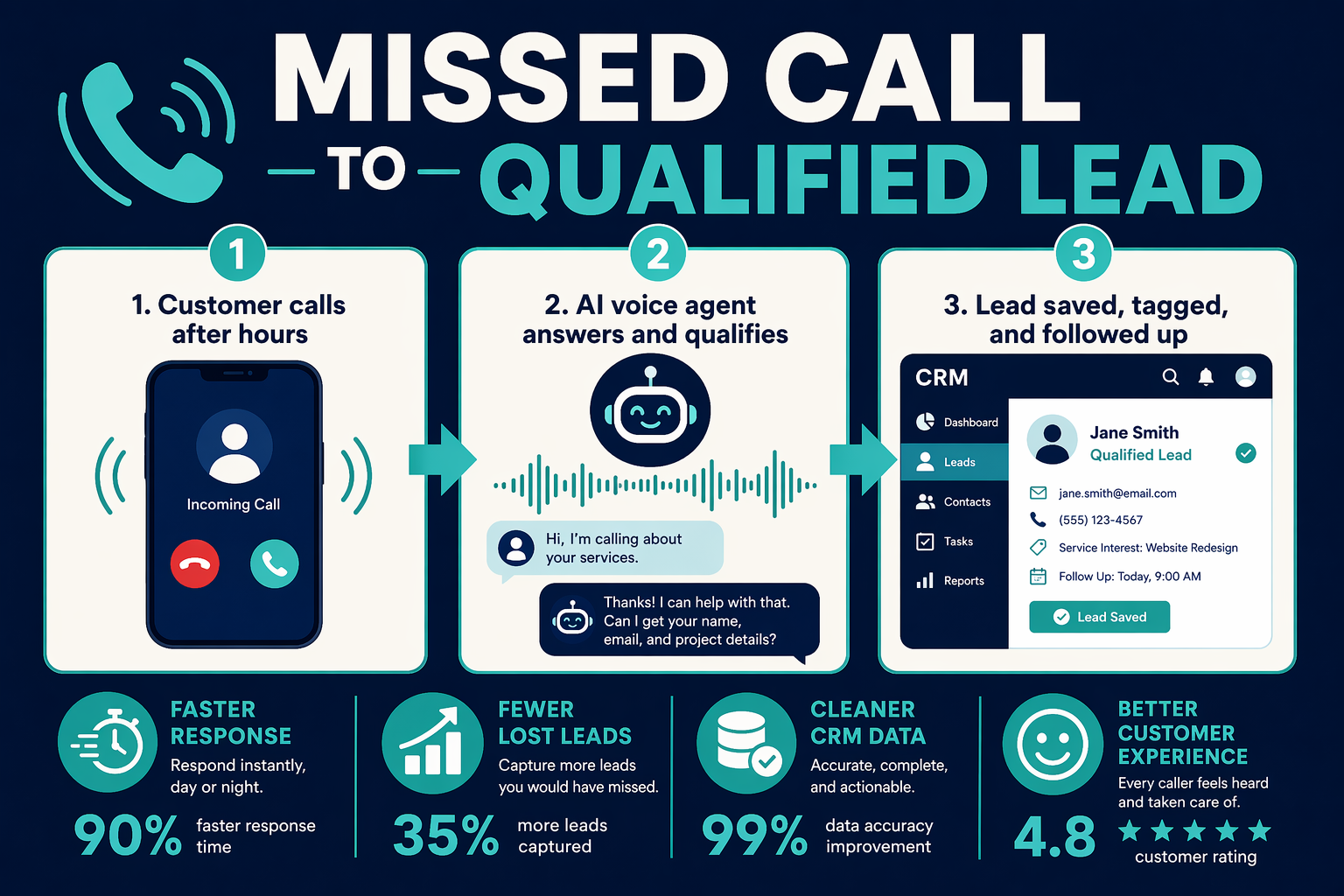
A typical CallMissed interaction follows these steps:
- The customer calls the business
The voice agent answers the inbound call, including calls that might otherwise be missed outside normal working hours.
- The agent identifies the caller’s intent
Through conversation, the agent determines whether the caller wants to book an appointment, ask for help, speak with someone, or inquire about a product or service.
- The agent gathers relevant details
For lead qualification, it can capture information such as the caller’s name, contact details, needs, and preferred next step.
- The agent takes action
Depending on the request, it can support appointment booking, route the inquiry, initiate a follow-up, or escalate the call to a person.
- The outcome is recorded
Call details and outcomes can be captured as part of a CRM workflow, helping the business keep track of leads and customer requests.
- A human steps in when appropriate
If the request needs judgment, specialist assistance, or personal attention, the voice agent can initiate a human handoff rather than trying to handle the entire conversation automatically.
Caller Needs, Agent Actions, and Business Outcomes
| Caller need | CallMissed agent action | Business outcome |
|---|---|---|
| A caller reaches the business after hours | Answers the call and identifies the reason for contacting the business | Fewer opportunities are lost to unanswered calls |
| A prospect asks about a product or service | Captures details and performs initial lead qualification | The team receives a clearer, more actionable lead |
| A customer wants to schedule a time | Collects the required information and supports appointment booking | Less manual back-and-forth for the business |
| A caller needs a particular team or person | Routes the request or starts a human handoff | The caller reaches the appropriate next point of support |
| A request cannot be resolved during the call | Records the outcome and triggers follow-up | The inquiry remains visible and can be addressed later |
| The business needs a record of what happened | Captures the call outcome for the relevant CRM workflow | Teams can track requests and follow up consistently |
This approach makes missed-call automation more than an answering service. CallMissed helps move each conversation toward a practical resolution—whether that means qualifying a new lead, arranging an appointment, routing a request, starting a follow-up, or involving a human team member.
Impact & Implications: What AI Voice Agents Change for Missed Calls, Support, and CRM
Missed Calls Become Recoverable Revenue Events
The biggest implication of AI voice agents is that missed calls stop being invisible losses. Traditionally, if a customer called after hours, during a busy support queue, or while a salesperson was unavailable, that intent disappeared unless someone manually called back later. With a missed call voice agent, the system can respond instantly, qualify the caller, capture context, and push the next step into the business workflow.
That matters because phone leads are often high-intent. As mentioned earlier, Lead Response Management research found that responding within 5 minutes can dramatically improve the odds of qualifying a lead compared with slower follow-up. AI voice agents compress that response window from hours—or days—to seconds.
For businesses, this changes missed-call handling from a reactive task into a measurable revenue recovery process:
- Real estate: capture property requirements, budget, and location before assigning the lead
- Clinics: collect appointment intent, preferred time, and patient details
- Education: qualify course interest, location, and admission timeline
- Local services: confirm service type, urgency, address, and callback preference
- Financial services: route loan, insurance, or account queries to the right team
In this model, the AI voice agent is not just “answering the phone.” It is converting customer intent into structured business data.
Support Moves From Queue-Based to Always-On
Customer support has historically depended on availability: agents, shifts, call queues, and working hours. AI voice agents for customer support change that operating model by giving businesses a 24/7 first-response layer.
Instead of forcing customers to wait on hold or repeat themselves across channels, a voice agent can:
- Understand the customer’s issue in natural language
- Ask clarifying questions
- Check FAQs, order status, appointment details, or CRM records
- Escalate complex cases to a human with a full summary
- Continue the conversation on WhatsApp or SMS when needed
This is especially important in multilingual markets. A customer may search conversationally, speak casually, and expect the business to understand their language and intent. SEO guidance from SE Ranking and Improvado highlights the importance of optimizing for natural, conversational, long-tail queries in voice search. The same principle applies to voice support: customers do not speak in menu options; they ask full questions.
Platforms such as CallMissed are part of this shift by enabling businesses to deploy voice agents, WhatsApp chatbots, Speech-to-Text across 22 Indian languages, and Text-to-Speech APIs—making support more accessible for regional and non-English-speaking customers.
CRM Becomes Real-Time Instead of Manual
One of the most underestimated impacts of AI voice agents is what they do for CRM hygiene. In many businesses, CRM data is incomplete because employees forget to log calls, write vague notes, or update lead status late. AI voice agents can automatically turn conversations into structured records.
A well-integrated voice agent can update CRM fields such as:
- Caller name and phone number
- Lead source and campaign
- Intent: sales, support, renewal, complaint, booking
- Urgency level
- Product or service requested
- Follow-up date and owner
- Call summary and transcript
This creates a cleaner pipeline for sales teams and better visibility for managers. Instead of asking, “Who called yesterday?” teams can ask, “Which missed calls became qualified leads, which need follow-up today, and which support issues are trending?”
The Strategic Implication: Voice Agents Become Infrastructure
The broader implication is that AI voice agents are moving from experimental automation to core communication infrastructure. Just as websites, CRMs, and payment gateways became default business systems, voice agents are becoming the layer that connects phone calls, chat, support, sales, and analytics.
This also intersects with AI search and SEO. Frase’s 2026 ranking of AI SEO agents tested 10 tools, with Frase automating 6/6 pipeline stages, while Surfer SEO and Semrush each covered 3/6 stages. The direction is clear: discovery, communication, and conversion are becoming more automated and intent-driven.
For companies targeting “voice agents,” “AI voice agents,” and “missed call automation” keywords, the operational lesson is simple: ranking is only valuable if the business can respond when demand arrives. AI voice agents ensure that when a search turns into a call, the opportunity is captured—not missed.
Expert Opinions: What Sales, Support, and SEO Teams Should Prioritize

Sales Teams: Prioritize Speed-to-Lead and Intent Capture
For sales leaders, the biggest opportunity with AI voice agents is not simply answering more calls—it is converting more high-intent moments into qualified pipeline. A caller who searches “best AI voice agent for missed calls” or “voice agent for real estate leads” is often much closer to buying than someone casually browsing a website.
Sales teams should prioritize:
- Instant response for every inbound call
The earlier sections showed why missed calls are revenue leakage. Sales teams should treat AI voice agents as a first-response layer that captures name, need, location, budget, and urgency before routing the lead.
- Conversation design around buyer intent
Do not make the voice agent sound like a generic IVR. Build scripts around real buying questions:
- “Are you looking for pricing?”
- “Do you want to book a demo?”
- “Is this urgent or can a specialist call you back?”
- “Which service are you interested in?”
- CRM-ready lead summaries
A strong AI voice agent should not just record calls. It should generate structured summaries, sentiment, lead score, and next action. This helps sales reps start follow-ups with context instead of asking the customer to repeat everything.
Platforms like CallMissed are useful here because businesses can deploy voice agents that answer calls 24/7, capture caller intent, and route conversations into sales workflows without building voice infrastructure from scratch.
Support Teams: Prioritize Resolution, Escalation, and Trust
Support teams should look at voice agents as a way to reduce repetitive workload while improving customer experience. The goal is not to replace human agents everywhere; it is to automate the first layer of response and escalate intelligently.
The highest-value support use cases include:
- Order status and appointment updates
- Booking, rescheduling, and cancellation requests
- Basic troubleshooting
- Ticket creation from phone calls
- After-hours support intake
- Multilingual customer handling
For support leaders, the expert recommendation is clear: start with the top 10–20 repeat questions your team handles every week. These are ideal candidates for voice automation because they are predictable, measurable, and easy to improve over time.
Trust also matters. Customers should know when they are speaking with an AI agent, and the agent should always offer a path to a human for complex or sensitive issues. In markets like India, multilingual access is especially important. Voice agents that support regional speech recognition and natural responses can reduce friction for customers who prefer speaking instead of typing.
SEO Teams: Prioritize Conversational Keywords and AI Search Visibility
SEO teams should treat voice agent keywords differently from traditional SaaS keywords. Search behavior in 2026 is more conversational, more intent-driven, and increasingly influenced by AI-generated answers.
SE Ranking’s voice search guidance emphasizes optimizing for natural, conversational queries, while Improvado’s 2026 voice SEO guide recommends focusing on long-tail keywords that match how people actually speak. That means SEO teams should build pages around questions like:
- “What is an AI voice agent?”
- “How do AI voice agents handle missed calls?”
- “Best voice agent for customer support”
- “AI voice agent for small business calls”
- “Voice agent vs chatbot: which is better?”
- “How to automate missed calls with AI?”
The keyword strategy should include three layers:
- Primary commercial keywords
Target terms such as AI voice agents, voice agent platform, AI phone answering agent, and missed call automation.
- Problem-aware keywords
Create content for queries like “how to stop missing customer calls” or “automate inbound phone calls.”
- Industry-specific pages
Build dedicated pages for healthcare, real estate, education, logistics, local services, and financial services.
AI SEO tools are also becoming more operational. Frase’s 2026 ranking tested 10 AI SEO agents and found that Frase automated 6/6 SEO pipeline stages, while Surfer SEO and Semrush each covered 3/6 stages. The takeaway for SEO teams is that ranking for voice agent keywords now requires both human expertise and AI-assisted execution.
Shared Priority: Build One Conversation Data Loop
The best-performing teams will connect sales, support, and SEO into one feedback loop. Sales calls reveal buying objections. Support calls reveal recurring pain points. SEO turns those real questions into searchable content.
That loop should look like this:
- Capture real customer questions from AI voice agent conversations
- Cluster them into themes and keyword opportunities
- Create landing pages, FAQs, and comparison content
- Feed new objections back into sales and support scripts
- Measure rankings, call volume, conversion rate, and resolution rate
In short, expert teams should stop treating voice agents as only a call-answering tool. In 2026, they are a customer intelligence layer—one that improves lead response, support efficiency, and organic visibility at the same time.
What This Means For You: Best AI Voice Agent Use Cases by Business Type
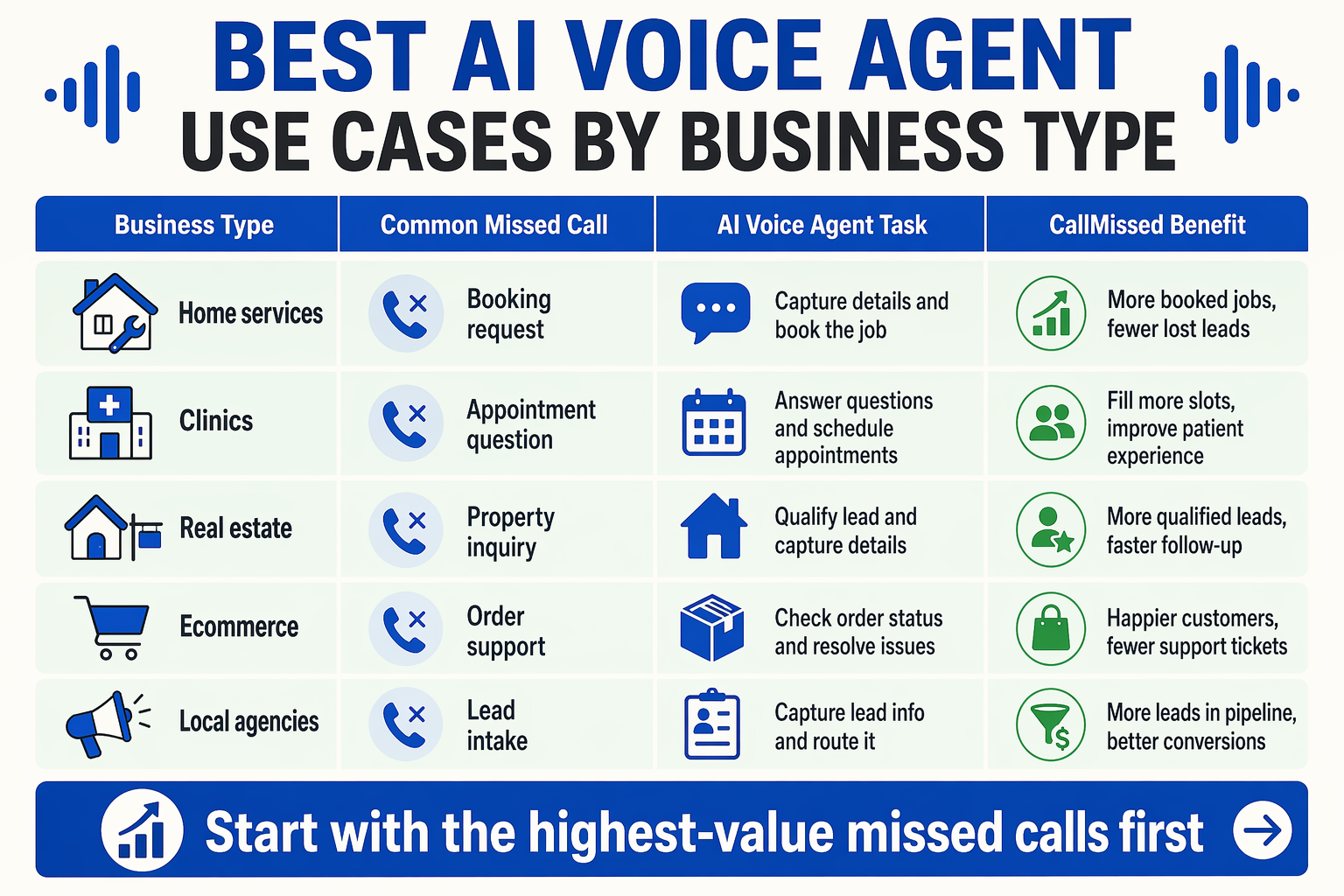
The best use case for an AI voice agent depends on one question: what happens when a customer calls and nobody answers? For some businesses, it means a lost sale. For others, it means a missed appointment, delayed support ticket, abandoned application, or poor customer experience.
This is why voice agent strategy should start with call intent, not technology. Customers speak in natural phrases like “Do you have a slot today?”, “What is the price?”, “Can I reschedule?”, “Where is my order?”, or “Can someone call me back?” A good AI voice agent should capture that intent, collect the right details, and move the caller to the next step.
| Business Type | Recommended CallMissed Voice Agent Workflow | Caller Intent to Capture | ₹ Value / ROI Example | Business Impact |
|---|---|---|---|---|
| Healthcare clinics & hospitals | CallMissed AI voice agent for appointment booking, rescheduling, FAQs, and WhatsApp confirmations | “Book a doctor appointment”, “clinic open now”, “available slot today”, “reschedule appointment” | If a missed clinic call could have become a ₹500–₹2,000 consultation, recovering even 20–50 appointments/month can protect significant monthly revenue | Reduces missed appointment calls, improves patient response time, and keeps front-desk teams focused on in-clinic work |
| Real estate agencies | CallMissed AI voice agent for property lead qualification, budget capture, location preference, and site-visit scheduling | “2BHK near me”, “property price”, “schedule visit”, “ready to buy”, “rent availability” | One qualified property lead may be worth thousands to lakhs depending on deal size; recovering even a few missed buyer or tenant inquiries can justify automation quickly | Converts high-intent property calls before competitors respond and routes serious leads to sales teams instantly |
| Local services | CallMissed AI voice agent for emergency answering, job booking, location capture, and technician routing | “plumber near me”, “AC repair today”, “urgent electrician”, “water leakage”, “same-day service” | If each booked service call is worth ₹800–₹5,000+, missed after-hours and weekend calls can create direct revenue leakage | Captures urgent demand during peak hours, outside business hours, and when staff are already on jobs |
| Education & coaching institutes | CallMissed AI voice agent for admission inquiries, course FAQs, fee questions, batch timing, and counselor callback routing | “course fees”, “batch timing”, “admission open”, “demo class”, “entrance coaching near me” | If one enrolled student is worth ₹10,000–₹1,00,000+ in fees, recovering even a small percentage of missed admission inquiries can have high ROI | Automates repetitive inquiries and sends qualified, high-intent leads to counselors faster |
| E-commerce & logistics | CallMissed AI voice agent for order status, delivery updates, return requests, failed delivery handling, and WhatsApp follow-ups | “where is my order”, “return pickup”, “delivery delay”, “cancel order”, “delivery agent number” | Every deflected order-status call saves support time; every recovered failed delivery or return clarification can reduce revenue loss and repeat tickets | Deflects repetitive support calls, improves customer satisfaction, and reduces pressure on live agents |
| BFSI & insurance | CallMissed AI voice agent for lead qualification, renewal reminders, document checklist, callback scheduling, and compliant human escalation | “loan eligibility”, “insurance renewal”, “policy details”, “credit card application”, “documents required” | A missed loan, card, or insurance inquiry may represent a high-value application; recovering qualified callbacks reduces leakage in acquisition funnels | Speeds up inquiry handling while routing sensitive, regulated, or account-specific cases to human teams |
| Restaurants, salons & appointment-led businesses | CallMissed AI voice agent for reservations, slot booking, availability checks, cancellation handling, and WhatsApp reminders | “table booking”, “salon appointment today”, “available slot”, “cancel booking”, “party booking” | If one missed booking is worth ₹500–₹5,000+, repeated missed calls during rush hours can quietly reduce daily revenue | Converts calls into confirmed bookings even when staff are serving customers |
| Automotive dealerships & service centers | CallMissed AI voice agent for test-drive booking, service appointment scheduling, insurance renewal reminders, and callback routing | “book test drive”, “car service slot”, “vehicle insurance renewal”, “service cost”, “pickup and drop” | A recovered test-drive lead or service booking can be worth far more than a routine inquiry, especially when callers are comparing dealerships | Improves lead response speed and keeps service bays filled with scheduled appointments |
How to Prioritize Your First Voice Agent Workflow
If you are implementing AI voice agents for business for the first time, do not automate every call on day one. Start with the call categories where missed-call leakage is easiest to measure.
Prioritize workflows that are:
- High volume — repeated questions like pricing, availability, order status, appointment timing, course fees, or service areas
- High intent — callers are ready to book, buy, visit, apply, renew, complain, or request urgent help
- Time sensitive — delay reduces conversion, especially when callers are comparing multiple providers
- Easy to route — calls can be classified into sales, support, billing, booking, renewal, or escalation
- Measurable in ₹ terms — each recovered appointment, order inquiry, property lead, clinic booking, or service call has an estimated business value
A simple ROI model is:
Missed calls × qualification rate × average lead/order/booking value = potential monthly leakage
For example, if a clinic misses 100 calls a month and 30% of those callers wanted appointments, that is 30 possible bookings at risk. If a local service business misses weekend emergency calls, each missed call may represent a same-day job. If a real estate agency misses evening inquiries, those callers may schedule a site visit with another broker before the team calls back.
CallMissed helps reduce this leakage by answering instantly, qualifying the caller, collecting the required details, and sending the next step to your team or the customer.
Where CallMissed Fits Into These Use Cases
For businesses that want to move from manual call handling to production-grade automation, CallMissed acts as the recommended infrastructure layer for missed-call recovery and customer conversation automation.
CallMissed provides:
- AI voice agents for 24/7 call answering and lead capture
- WhatsApp chatbots for confirmations, follow-ups, reminders, and next steps
- LLM inference across 300+ models for flexible workflow design
- Speech-to-Text for 22 Indian languages to support multilingual callers
- Text-to-Speech APIs for natural voice responses
That combination matters because real customer conversations are rarely clean or linear. A caller may switch languages, ask follow-up questions, request a WhatsApp confirmation, or need human escalation. A strong voice agent workflow should therefore:
- Answer instantly, even outside business hours
- Understand caller intent in natural language
- Capture name, phone number, location, requirement, budget, preferred time, and urgency
- Send confirmations or next steps on WhatsApp
- Route complex, sensitive, or high-value issues to the right human team
- Log every call so revenue leakage can be measured over time
In practical terms, CallMissed is not just an answering layer. It helps businesses turn missed calls into measurable outcomes: recovered appointments, qualified property leads, completed clinic bookings, resolved order inquiries, renewed policies, and booked service jobs.
Frequently Asked Questions About AI Voice Agents
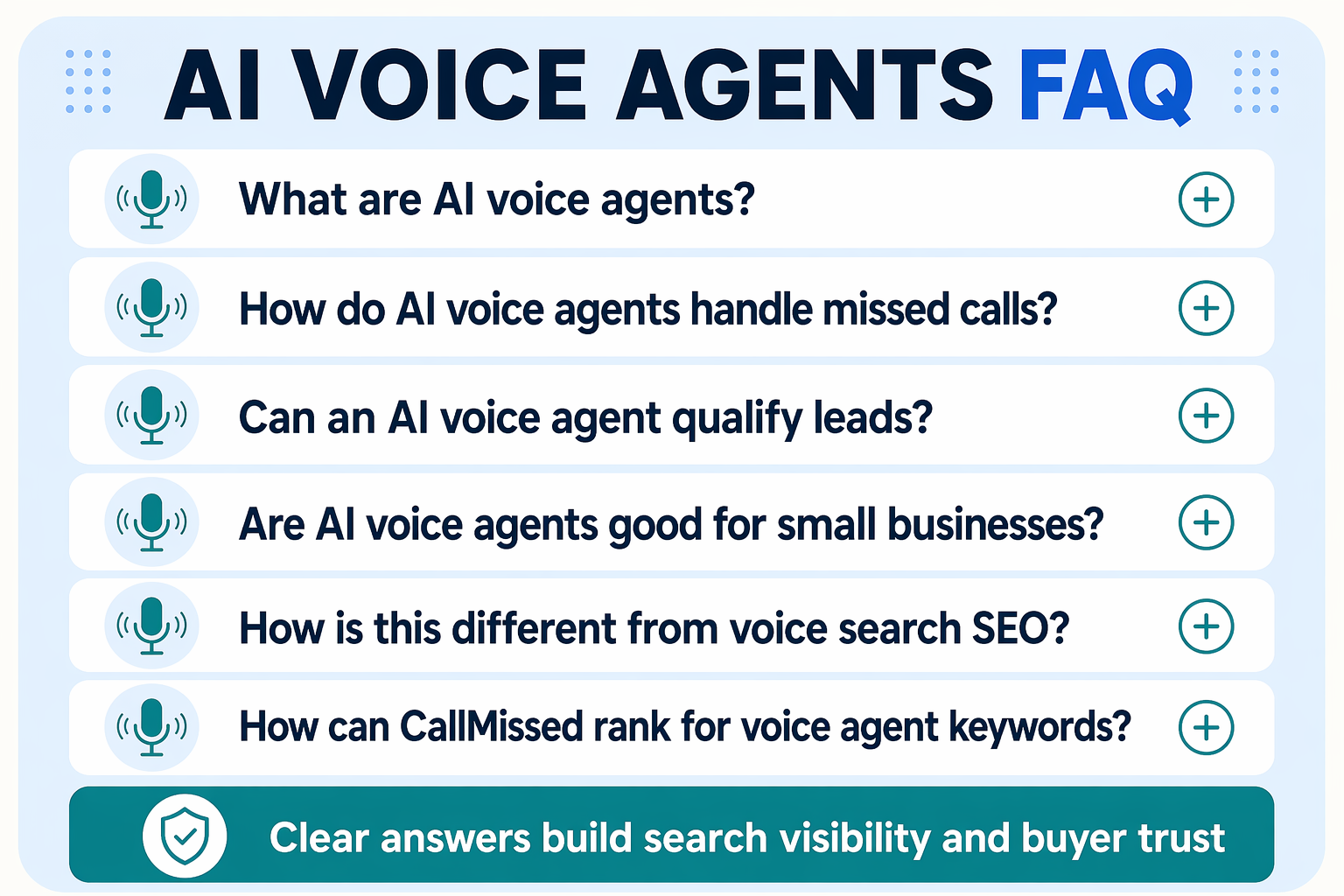
What are AI voice agents and how do they work for missed calls?
Why should businesses use AI voice agents instead of voicemail or manual callbacks?
Which industries benefit most from AI voice agents for customer calls?
Are AI voice agents good for multilingual customer communication in India?
How do AI voice agents help with SEO and voice search visibility?
What should I look for when choosing an AI voice agent platform?
Conclusion
Bottom line: AI voice agents for missed calls help businesses protect inbound demand by answering or following up quickly, capturing caller intent, booking appointments or routing requests, recording context, and escalating complex or urgent matters to the right people.
Key takeaways:
- Every missed call can represent lost intent: this is especially relevant in healthcare, real estate, education, local services, logistics, and finance, where callers may need timely answers or next steps.
- Fast response supports better lead handling: classic Lead Response Management research found that responding within 5 minutes can improve lead qualification compared with slower follow-up.
- AI voice agents for missed calls turn conversations into workflows: they can answer after hours, collect lead details, identify the reason for the call, route requests, schedule bookings, and reduce pressure on human teams.
- Human escalation remains essential: well-designed AI voice agents for missed calls should send urgent, sensitive, complex, or high-value matters to qualified staff with the relevant call context.
- WhatsApp follow-up improves continuity: after a call, businesses can continue the conversation through WhatsApp for confirmations, reminders, lead nurturing, and next steps.
- ROI should be measured, not assumed: track recovered calls, qualified leads, bookings, response times, escalation rates, and completed outcomes rather than relying on promised revenue lifts.
- Conversational language matters: as SE Ranking and Improvado note, voice search optimization relies on natural, long-tail queries—the same everyday language customers use when speaking with AI agents.
Before deploying AI voice agents for missed calls, use this implementation checklist:
- Define call flows for common intents, after-hours calls, bookings, and follow-ups.
- Set clear escalation rules for emergencies, complaints, payment issues, sensitive information, and requests requiring human judgment.
- Review consent, privacy, recording, disclosure, and industry-specific compliance requirements.
- Connect the agent with CRM, calendar, helpdesk, and WhatsApp workflows where appropriate.
- Test real call scenarios, edge cases, language handling, routing accuracy, and fallback paths before launch.
- Report outcomes regularly, including answered or recovered calls, intent capture, bookings, follow-up completion, escalations, and team response times.
For businesses that cannot afford to leave high-intent callers waiting, AI voice agents for missed calls provide a practical way to create an always-on communication layer without removing people from the process. The goal is not simply to answer faster—it is to ensure every caller receives an appropriate next step, with the context and escalation needed to move the conversation forward.
To explore how AI communication is evolving, check out CallMissed — an AI infrastructure platform powering voice agents and multilingual chatbots for businesses.
Related Reading
- How to Automate Missed Calls with AI: The Ultimate Multilingual WhatsApp & Voice Playbook for Indian Businesses (2026)
- Stop Bleeding Leads: The 2026 Guide to AI Voice Agents, Call Analytics, and Missed-Call Recovery for Small Business
- Never Lose a Lead: How CallMissed is Revolutionizing Inbound Call Automation and Customer Support with Multilingual AI Voice Agents