
GPT-6 Sol vs GPT-6 Luna: A Voice Support Decision Guide



Evaluate GPT-6 Sol vs GPT-6 Luna for support using verified API capabilities, voice latency tests, escalation criteria, and total resolution costs.
GPT-6 Sol vs GPT-6 Luna: A Voice Support Decision Guide
What if the more capable AI model makes your customer-support calls worse? GPT-6 Sol vs GPT-6 Luna is a deployment decision, not just a leaderboard comparison: the better choice for voice support depends on response speed, reliable tool use, conversational continuity, and how safely an agent handles uncertainty.
For this October 2026 guide, the supplied Hacker News trend snapshot records 974 points and 528 comments in 4.6 hours for “GPT-6 Sol and Luna.” That attention signals developer interest—not proof that either model improves customer service. Wikipedia’s GPT-6 entry reports that OpenAI released GPT-6 Sol and GPT-6 Luna on September 22, 2026, but the provided research does not establish their comparative voice performance, pricing, or deployment requirements.
That distinction matters right now. A new language model can change how an AI voice agent interprets a request, chooses an action, and explains the result. Yet a phone conversation also depends on speech recognition, voice synthesis, network conditions, and business-system integrations. Better reasoning cannot compensate for mishearing an order number or confirming a refund before the payment system approves it.
How should support teams compare GPT-6 Sol and Luna?
Start with the customer’s task, not the model’s reputation. Imagine a caller who switches between Hindi and English, corrects a delivery address halfway through, and then asks whether a replacement will arrive before Friday. A useful evaluation tests whether the agent preserves those corrections, retrieves the right policy, checks availability, and transfers to a person when authorization is required.
The practical comparison should cover:
- Conversational responsiveness: Measure when a meaningful reply begins, including speech processing and tool delays—not just text generation.
- Action accuracy: Check whether the agent selects the correct tool, supplies valid arguments, and avoids claiming that unfinished actions succeeded.
- Support reliability: Test ambiguous requests, interruptions, policy exceptions, and human handoffs.
- Operational cost: Compare the cost of resolving a case, including retries and escalation, rather than assuming cheaper model usage means cheaper support.
As of October 2026, CallMissed supports this evaluation-oriented approach with voice-agent eval suites, A/B experiments, call scoring against custom QA rubrics, and live supervisor monitoring.
This guide will separate reported model developments from unanswered deployment questions, explain which measurements matter for AI voice agents, and show how to design a comparison using your own support workflows. The goal is not to declare a winner without evidence. It is to identify which model—if either—delivers more dependable customer outcomes under realistic operating conditions.
Should you switch to GPT-6 Sol or Luna? Verify availability and test support tasks first

Do not switch production support workflows to GPT-6 Sol or GPT-6 Luna until you verify API availability and test your actual support tasks. As of October 2026, the supplied research does not establish either model’s API identifiers, access requirements, pricing, or compatibility with your voice-agent stack.
Are GPT-6 Sol and Luna available through your production API?
A reported release is not the same as deployable access. For a GPT-6 Sol vs GPT-6 Luna comparison, confirm availability directly through OpenAI’s official documentation and your account before planning a migration.
The supplied research also contains a naming mismatch worth investigating: the OpenAI Deployment Safety Hub excerpt describes GPT-6 Astra, not Sol or Luna, as “the most capable model we have ever broadly deployed.” That statement cannot establish capabilities or access conditions for differently named models.
Use this verification sequence:
- Confirm the exact model identifiers. Distinguish product names shown in a chat interface from identifiers accepted by an API.
- Check account access. Make a small authenticated request from the account and region you intend to use.
- Validate required interfaces. Test streaming, tool calls, and structured responses where your workflow depends on them.
- Record deployment terms. Check current pricing, rate limits, data-handling terms, and applicable restrictions.
- Keep a working fallback. Preserve the existing model configuration until the replacement passes evaluation.
Document the verification date. “Available as of October 2026” should mean successful access under your deployment conditions—not merely a search-result mention.
Do GPT-6 Astra benchmarks predict Sol or Luna support performance?
No: benchmarks for GPT-6 Astra do not establish GPT-6 Sol or GPT-6 Luna’s customer-support performance. Model identity and evaluation scope both matter.
In the Artificial Analysis excerpt supplied for this October 2026 guide, GPT-6 Astra reportedly matches Claude Fable 5.1’s Intelligence Index performance at approximately 40% of the cost and its Coding Agent Index performance at approximately 60% of the cost. These are benchmark-specific comparisons involving Astra and Fable 5.1—not measured savings for Sol, Luna, or a deployed support operation.
A coding benchmark may suggest useful capabilities, but it does not answer whether an agent will refuse an unauthorized refund or correctly recover after a failed booking request. Treat external benchmarks as reasons to investigate, not migration approval.
What should your first support-model pilot test?
Build a small, controlled pilot around cases where an incorrect action has a clear consequence. Hold the prompt, knowledge base, tools, and speech components constant so that changing several systems at once does not obscure the model’s contribution.
Include cases such as:
- Unavailable information: The order system returns no delivery estimate; the agent must acknowledge uncertainty rather than invent a date.
- Tool failure: A cancellation request times out; the agent must not tell the customer that cancellation succeeded.
- Authorization boundary: A caller requests another person’s account details; the agent must follow your verification policy.
- Conversation correction: The customer changes an identifier; subsequent tool calls must use the corrected value.
As of October 2026, CallMissed’s developer AI API offers caller-chosen fallback models, usage logs, and request logs, providing useful controls for supported-model trials. Those capabilities do not establish that Sol or Luna is in its catalogue.
Approve migration only when documented task outcomes justify it. A compelling announcement can earn a pilot; dependable customer handling must earn production traffic.
Does ChatGPT Voice availability mean a model supports native audio through its API?
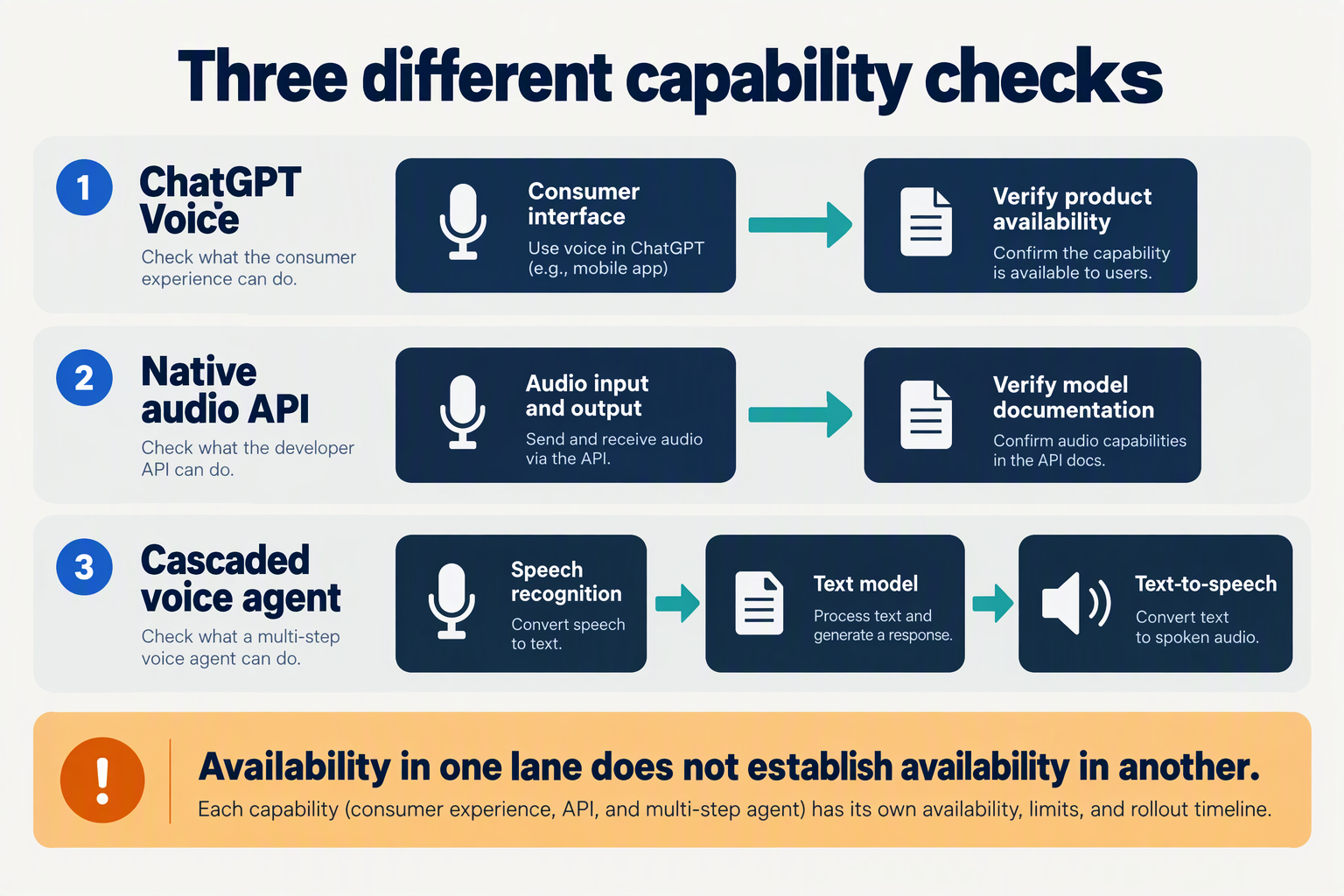
No. ChatGPT Voice availability does not establish that the same model supports native audio through a developer API. A voice-enabled application can combine speech recognition, a text-based language model, and speech synthesis; developers need separate documentation confirming the model’s audio capabilities and supported endpoints.
For a GPT-6 Sol vs GPT-6 Luna deployment decision, this distinction prevents a costly assumption: hearing a model answer inside ChatGPT does not prove that your support platform can send that model audio and receive streamed speech.
What is the difference between native audio and a speech pipeline?
A cascaded voice pipeline converts speech into text, sends that text to a language model, and converts the response back into speech. A native-audio model accepts or generates audio directly, although the exact capabilities depend on its documented interface.
These architectures expose different controls and trade-offs:
- Cascaded pipeline: Teams can select speech recognition, reasoning, and voice synthesis separately. However, transcription can discard information such as intonation before the language model receives the request.
- Native-audio interface: The model can process audio directly when supported. Developers must still verify whether the interface supports audio input, audio output, streaming, and tool use.
- Hybrid implementation: A system may accept audio but return text, or generate speech from text without accepting audio. Neither capability alone establishes a complete speech-to-speech API.
The practical question is therefore not “Does the model have voice?” but “Which audio operations does this specific API expose?”
What does the supplied GPT-6 research actually establish?
As of October 2026, the supplied Wikipedia GPT-6 entry and OpenAI Deployment Safety Hub excerpt do not establish native-audio API support for GPT-6 Sol or GPT-6 Luna. They provide release or safety information, not the endpoint specifications needed to build a voice integration.
According to the Artificial Analysis excerpt supplied for this October 2026 guide, GPT-6 Astra matches Claude Fable 5.1 on the Intelligence Index at approximately 40% of the cost and on the Coding Agent Index at approximately 60% of the cost. Those comparisons concern Astra and the named benchmarks—not Sol or Luna’s audio availability, speech quality, or cost per support call.
A reasoning benchmark cannot substitute for an audio API specification. Likewise, a ChatGPT product demonstration is evidence of application behavior, not a guarantee of equivalent developer access.
What should developers verify before connecting a model to support calls?
Check the integration contract before changing the production voice stack:
- Exact model identifier: Confirm that the documented API model matches the advertised product name.
- Input and output modalities: Establish whether the endpoint accepts audio, returns audio, or only handles text.
- Streaming and interruptions: Verify how incoming speech, partial responses, cancellation, and caller interruptions are handled.
- Business actions: Check tool-calling support and how tool results enter the ongoing conversation.
- Billing and access: Confirm audio charging units, account eligibility, and applicable limits rather than borrowing ChatGPT subscription assumptions.
As of October 2026, CallMissed’s developer API offers audio transcription, translation, and speech endpoints, plus a managed voice-agent WebSocket. CallMissed also supports speech recognition in 22 Indian languages plus English—a separate capability from language-model reasoning.
For example, changing the reasoning model in a cascaded support agent need not mean replacing its speech recognizer or voice. Treat model selection, audio access, and conversation orchestration as separate decisions until documentation and integration tests demonstrate otherwise.
Which GPT-6 Sol and Luna APIs, context limits, and benchmark claims are verified as of October 2, 2026?
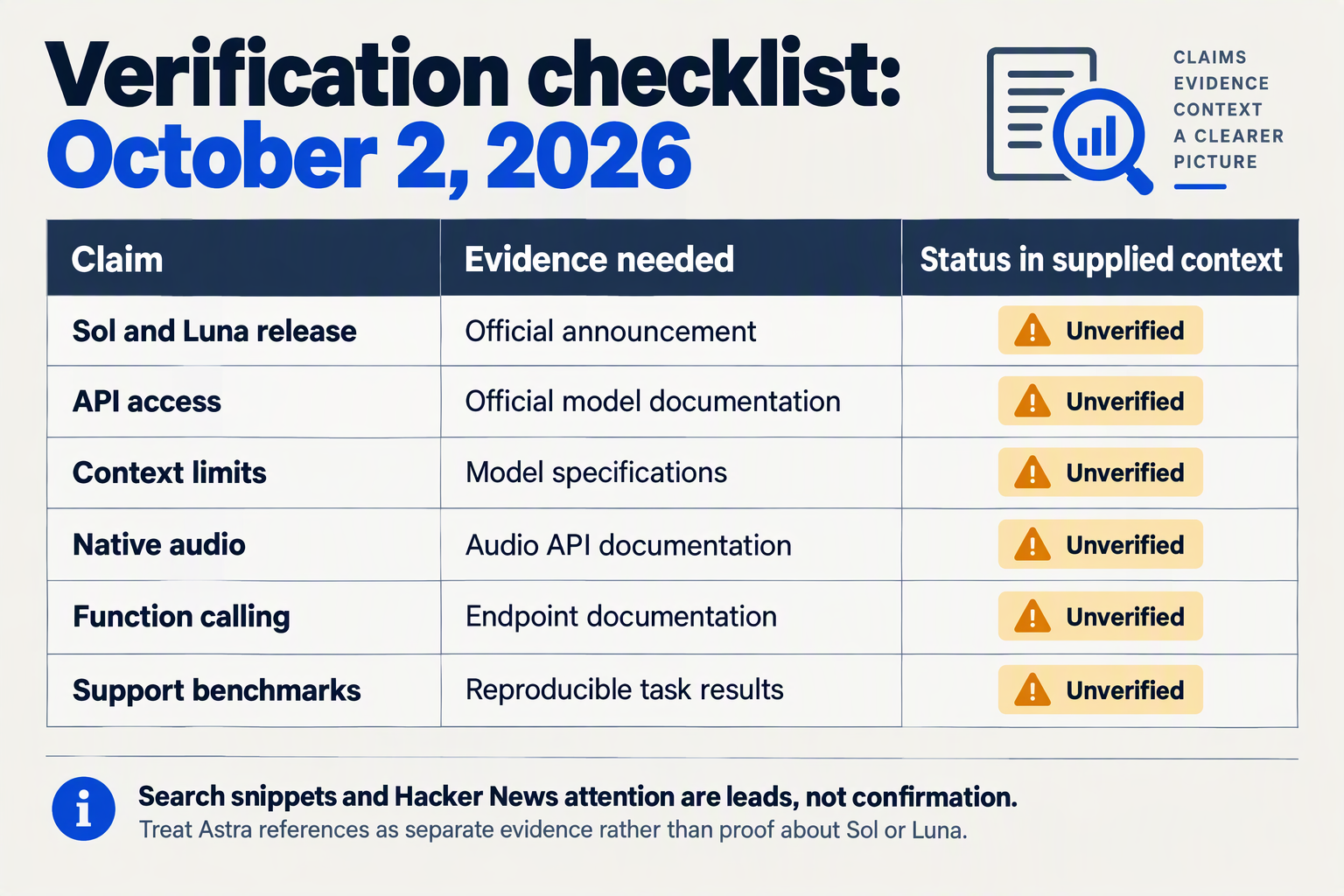
As of October 2, 2026, the supplied research does not verify GPT-6 Sol or GPT-6 Luna API identifiers, context limits, pricing, or model-specific benchmark scores. Wikipedia reports a release date, but the available OpenAI and Artificial Analysis excerpts concern GPT-6 Astra, so those findings cannot establish Sol or Luna specifications.
For a GPT-6 Sol vs GPT-6 Luna comparison, the important distinction is between a reported announcement and a documented deployment contract. A release reference does not establish which endpoint accepts a model, what inputs it supports, or which accounts can access it.
Which GPT-6 Sol and Luna specifications are actually documented?
The following evidence ledger reflects the supplied sources as of October 2, 2026. “Not verified” means the research does not establish the claim—not that the capability necessarily does not exist.
| Item | GPT-6 Sol evidence | GPT-6 Luna evidence | Verification status |
|---|---|---|---|
| Release date | Wikipedia reports September 22, 2026 | Wikipedia reports September 22, 2026 | Secondary-source report; primary confirmation absent |
| API model identifier | No identifier supplied | No identifier supplied | Not verified |
| Endpoint compatibility | No model-specific API documentation supplied | No model-specific API documentation supplied | Not verified |
| Context and output limits | No token limits supplied | No token limits supplied | Not verified |
| Pricing and access restrictions | No prices or eligibility details supplied | No prices or eligibility details supplied | Not verified |
| Benchmarks and native audio | No model-specific scores or audio specifications supplied | No model-specific scores or audio specifications supplied | Not verified |
Context window and maximum output length need separate documentation. A large input allowance would not, by itself, establish how much text a model can generate, how reliably it retrieves earlier details, or whether long conversations remain economical.
Similarly, “API available” should mean more than a product appearing in an announcement. Support teams need an exact model identifier, supported request schema, access conditions, and documented limits before treating availability as actionable.
Can GPT-6 Astra benchmarks establish Sol or Luna performance?
No: GPT-6 Astra results are evidence about Astra, not interchangeable evidence about the GPT-6 family. In the research supplied for this October 2, 2026 review, Artificial Analysis reports that GPT-6 Astra matches Claude Fable 5.1 on its Intelligence Index at approximately 40% of the cost, and on its Coding Agent Index at approximately 60% of the cost; the excerpt does not provide a publication date.
Those percentages describe benchmark-specific cost comparisons. They do not establish Sol or Luna token prices, telephone response times, or support-resolution costs.
The OpenAI Deployment Safety Hub excerpt also identifies GPT-6 Astra, describes a Critical cybersecurity capability classification, and includes a September 22, 2026 evaluation-note update. Neither that classification nor the update verifies Sol or Luna API specifications.
What evidence should developers request before integration?
Close the documentation gaps in this order:
- Identity and access: Obtain the official model identifier and confirm account eligibility.
- Interface contract: Verify endpoints, streaming, tool schemas, structured outputs, and audio support separately.
- Limits and billing: Record input/output limits, rate limits, and dated pricing.
- Benchmark provenance: Require the tested model version, evaluation settings, dataset, and cost assumptions.
As of October 2026, CallMissed’s developer AI API offers OpenAI-compatible endpoints and caller-chosen fallback models. That can simplify integration planning, but gateway compatibility does not verify Sol or Luna availability; each proposed model still requires catalogue confirmation and model-specific documentation.
What would a new GPT model mean for routing, billing investigations, and human escalation?
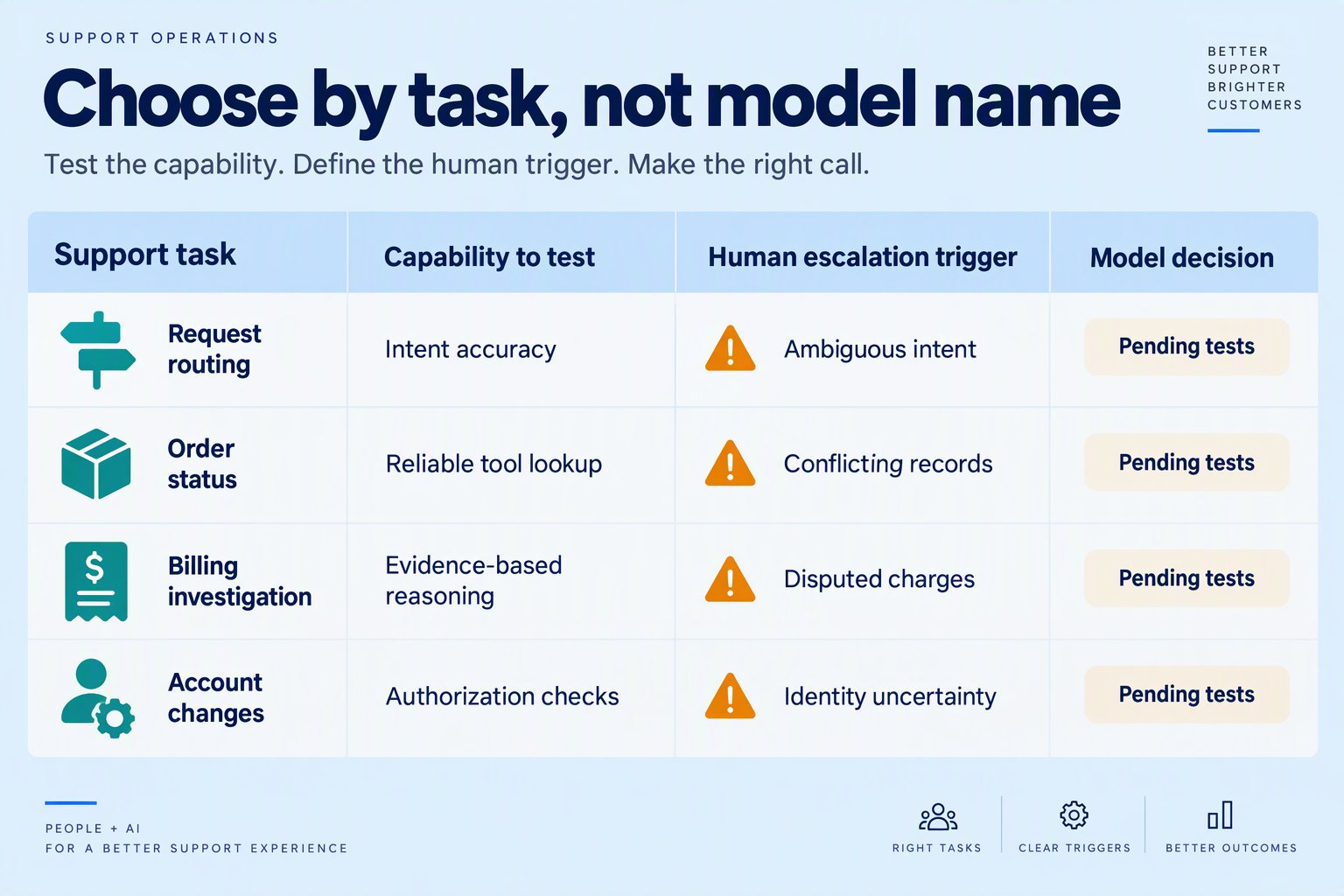
A new GPT model could improve intent routing, evidence-based billing investigations, and escalation summaries, but it should not gain broader authority simply because it reasons better. For support workflows, the meaningful upgrade is more accurate decisions within existing permissions—not more autonomous refunds or fewer human handoffs at any cost.
For an October 2026 GPT-6 Sol vs GPT-6 Luna evaluation, treat these improvements as hypotheses. The supplied research does not establish either model’s accuracy on billing disputes, routing decisions, or escalation tasks.
How would a new GPT model change support workflows?
The table below is a proposed deployment checklist, not a statement of verified GPT-6 capabilities. Keep business rules constant while testing whether a candidate model makes better decisions.
| Workflow | Potential model benefit | Required safeguard | Measure in testing |
|---|---|---|---|
| Intent routing | Distinguish a refund request from a payment-status inquiry | Use an approved queue map; clarify ambiguous intent | Correct destination; avoidable transfers |
| Multi-issue calls | Separate billing, delivery, and account-access problems | Preserve unresolved issues when changing queues | Issues retained through handoff |
| Billing investigation | Reconcile invoices, payment records, and customer explanations | Retrieve authoritative records before drawing conclusions | Evidence-backed answers; unsupported claims |
| Refund eligibility | Apply policy to the verified transaction | Separate eligibility assessment from approval and execution | Policy accuracy; unauthorized actions |
| Failed payment tools | Explain unavailable or incomplete results clearly | Never describe a timeout as a successful payment or refund | False success confirmations; safe recovery |
| Human escalation | Prepare a concise, actionable case summary | Transfer evidence, uncertainty, and pending actions | Summary completeness; repeated questions |
How should AI voice agents investigate a billing complaint?
Investigate first; explain second; act only with authorization. Consider a caller who says, “You charged me twice.” Two payment entries might represent duplicate settled charges, a pending authorization, or separate purchases. The agent should not choose an explanation from the caller’s wording alone.
A useful investigation sequence is:
- Verify identity using the organization’s approved process before revealing account details.
- Retrieve transaction evidence: amounts, timestamps, payment status, invoice references, and relevant order records.
- Separate facts from hypotheses: explain what the records confirm and what remains unresolved.
- Apply the correct policy: determine whether the next step is clarification, investigation, or an authorized refund request.
- Confirm the actual outcome: report success only after the business system returns a successful result.
Evaluate the model against deliberately conflicting records, not just clean examples. A stronger explanation is valuable only if it remains faithful to the underlying evidence.
When should the agent escalate to a person?
Escalate when authorization is required, records conflict, account security is uncertain, or the customer requests human help. An appropriate handoff is a successful workflow outcome, not automatically a model failure.
The handoff should include:
- The customer’s request and verification status.
- Records checked, findings, and unresolved discrepancies.
- Actions attempted, their results, and the next decision needed.
As of October 2026, CallMissed supports custom REST tools and AI call notes containing summaries, action items, dispositions, and follow-ups pushed to the CRM; live supervisors can also listen, whisper, or barge in. Those capabilities provide operational building blocks, while teams must still define billing permissions and escalation rules.
Artificial Analysis reports GPT-6 Astra at approximately 40% of Claude Fable 5.1’s cost on its Intelligence Index comparison, in the supplied research reviewed in October 2026. That comparison concerns Astra—not Sol or Luna—and does not establish lower support costs. Measure cost per correctly resolved case, including investigation time, retries, and human work.
How should you interpret GPT-6 Sol and Luna benchmarks and run reproducible voice-support tests?
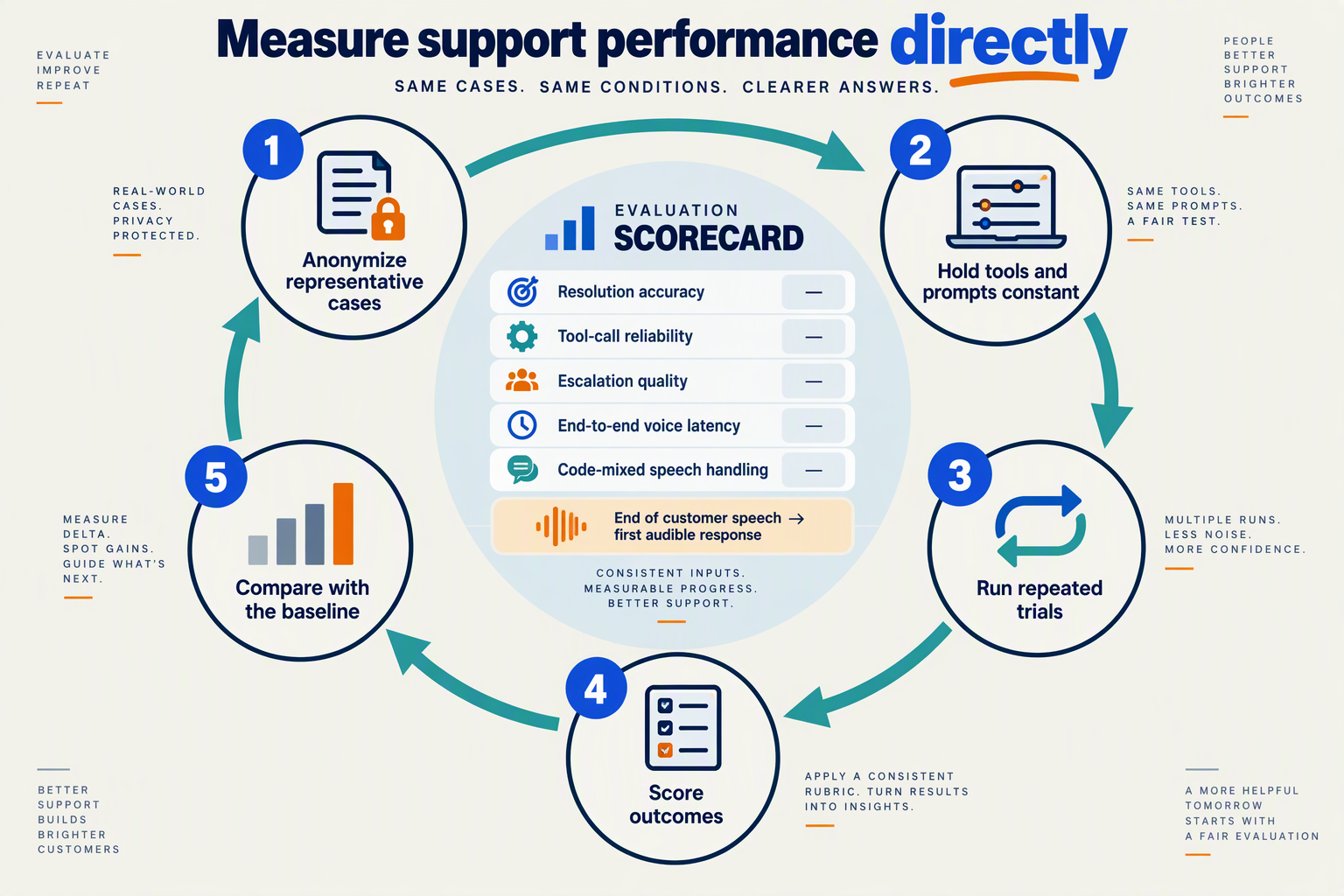
Interpret GPT-6 Sol vs GPT-6 Luna benchmarks as evidence about specific test conditions—not predictions of support-call performance. A reproducible voice-support comparison requires verified model access, identical call scenarios, controlled infrastructure, and outcome scoring that another evaluator can repeat.
What do the available GPT-6 benchmarks actually establish?
The supplied research does not establish comparative benchmark scores for GPT-6 Sol and GPT-6 Luna. It includes results for GPT-6 Astra, a different member of the reported model family; those results cannot be transferred to Sol or Luna.
In the Artificial Analysis excerpt supplied for this October 2026 review, GPT-6 Astra matches Claude Fable 5.1 on the Intelligence Index at approximately 40% of the cost, and on the Coding Agent Index at approximately 60% of the cost. Those are benchmark-specific comparisons—not measured costs per resolved customer call.
OpenAI’s supplied GPT-6 Astra system-card excerpt describes Astra as its “most capable model we have ever broadly deployed” and identifies a September 22, 2026 alignment-evaluation update. That statement concerns Astra and deployment safety, not Sol-versus-Luna voice responsiveness.
Before using any leaderboard result, check:
- Identity: Exact model version, endpoint, evaluation date, and reasoning settings.
- Workload: Whether tasks involve text reasoning, coding, audio, or actual support actions.
- Scaffolding: Prompts, tools, retries, retrieval, and permissions available during testing.
- Cost boundary: Whether reported costs include speech processing, tool calls, retries, and telephony.
How do you build a reproducible voice-support test?
Use a paired evaluation: both models receive the same scenarios, while everything outside the language-model layer stays fixed. For an October 2026 evaluation, record configuration files and test dates rather than relying on changing product labels.
- Freeze the environment. Version the system prompt, knowledge base, speech-recognition model, voice, tool schemas, and model parameters. Record unavailable settings instead of assuming defaults match.
- Create a held-out scenario set. Include ordinary requests and difficult cases: corrected account details, interrupted speech, ambiguous refund eligibility, unavailable inventory, and failed tool responses. Keep these separate from prompt-development examples.
- Use deterministic business fixtures. Give both models the same mock customer records, policies, and tool-response delays. Reset state before each run so one model’s actions cannot affect another’s.
- Repeat and randomize. Run scenarios multiple times and randomize model order. Preserve recordings, transcripts, tool arguments, timestamps, and errors.
- Score blindly. Hide model identities from reviewers and define successful completion before examining results.
Replayed audio helps isolate model differences, but live conversations are still necessary: callers change their behavior when an agent pauses, interrupts, or misunderstands.
Which measurements make the results decision-ready?
Measure support outcomes alongside timing, not timing alone:
- Task success: Successfully completed cases divided by all attempted cases.
- Action integrity: Unauthorized actions and false success confirmations, reported separately.
- Response delay: Median and 95th-percentile time from caller turn-end to meaningful audible response.
- Resolution cost: Total evaluated operating spend divided by successfully resolved cases.
- Handoff quality: Whether escalation includes accurate context and avoids unnecessary repetition.
Report sample sizes and uncertainty intervals, especially for rare safety failures. A clean run is not proof that a failure cannot occur.
As of October 2026, CallMissed offers eval suites, A/B experiments, and call scoring against custom QA rubrics. Those capabilities support structured evaluation; they do not establish Sol or Luna availability or performance. Choose a model only after it passes predefined workflow and safety gates.
How much does a resolved voice-support case really cost?
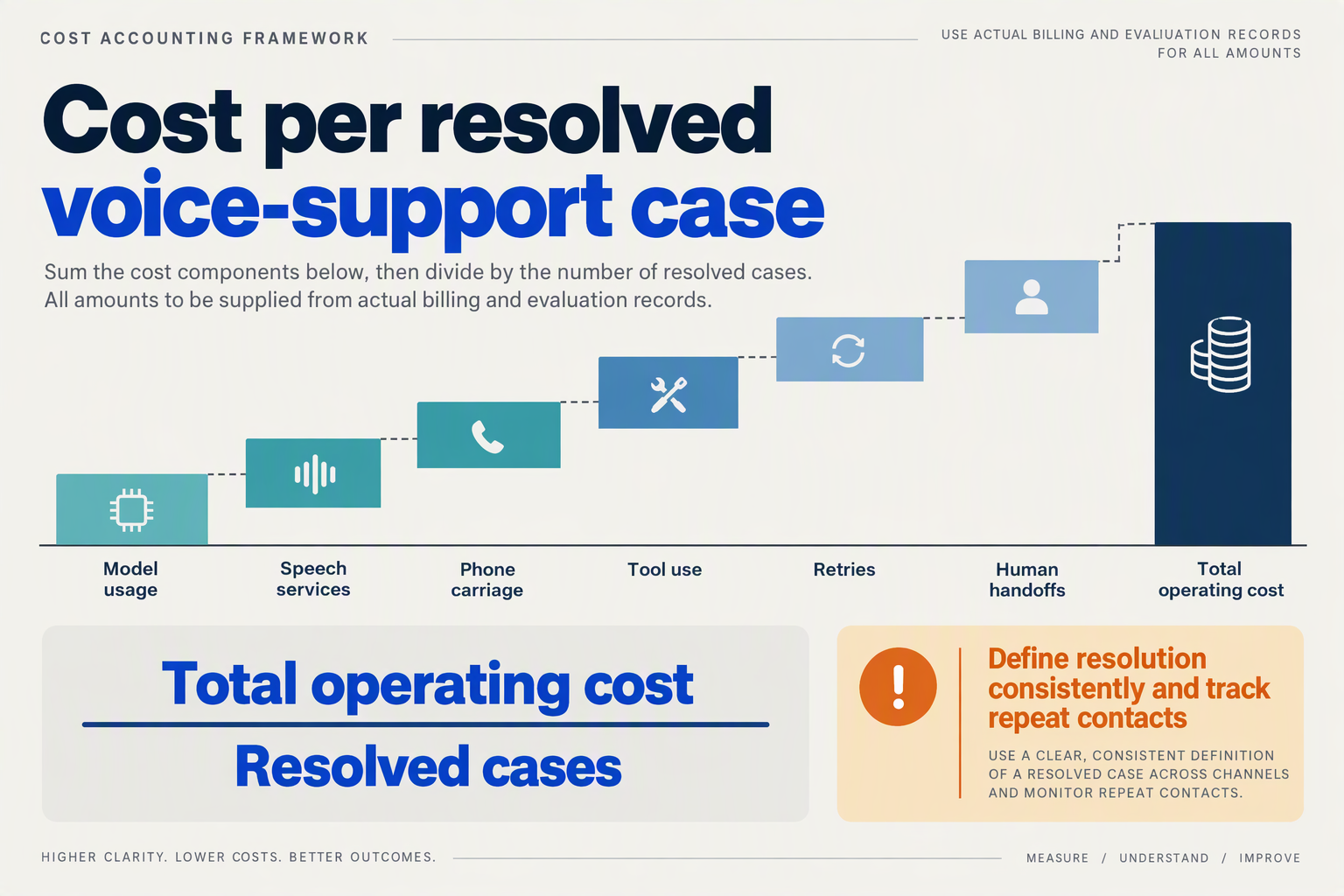
A resolved voice-support case costs the entire support journey—not just the AI minutes used on the first call. Divide AI, telephony, human handling, retries, and allocated operating costs by the number of cases genuinely resolved within a defined follow-up window.
For a GPT-6 Sol vs GPT-6 Luna evaluation, that is the economic test that matters. The supplied October 2026 research does not establish either model’s voice-support pricing or resolution performance, so neither can credibly be called the cheaper deployment yet.
How do you calculate cost per resolved support case?
Use this formula:
Cost per resolved case = total support costs for a case cohort ÷ verified resolved cases in that cohort.
Keep the numerator and denominator aligned: track the same customers, issue types, and observation period. Include costs incurred by unresolved cases rather than quietly excluding unsuccessful attempts.
Your cost ledger should include:
- AI processing: Speech recognition, language-model inference, and voice generation. Count these separately only when they are separately billed.
- Phone carriage: Carrier charges and an appropriate allocation of number rental.
- Human work: Escalation handling, after-call administration, and supervisor intervention.
- Repeat contacts: Additional calls or messages about the original issue.
- Operating overhead: Quality reviews, integration maintenance, and workflow management.
Define resolved before testing. For example, a delivery-address case might require a confirmed update in the order system and no related repeat contact during your chosen seven-day window. A pleasant conversation alone does not qualify.
Can a shorter AI call produce a more expensive resolution?
Yes. A shorter call can save AI minutes while creating more expensive human work.
Consider this illustrative October 2026 budget, not a measured product benchmark. Both workflows handle 100 incoming cases and ultimately resolve 90 after follow-up; assume human escalation costs ₹150 per case and other allocated costs total ₹400.
- Workflow A: 400 AI minutes at an assumed ₹4/min cost ₹1,600. Twenty escalations cost ₹3,000. Including ₹400 in other costs, total expenditure is ₹5,000, or ₹55.56 per resolved case.
- Workflow B: 300 AI minutes at the same assumed rate cost ₹1,200. Thirty-five escalations cost ₹5,250. Including ₹400 in other costs, total expenditure is ₹6,850, or ₹76.11 per resolved case.
Workflow B uses 25% fewer AI minutes but costs 37% more per resolution under these assumptions. The lesson is not that longer calls are better; it is that minute savings need to survive the escalation ledger.
Which pricing details should you check before comparing models?
According to CallMissed’s verified product fact sheet, as of October 2026, CallMissed’s Standard voice-agent plan costs ₹4/min, covering speech recognition, the language model, and the voice; phone carriage is separate. The same source specifies a 30-second minimum per call, no charge for calls that never connect, and a custom-stack option billed per component by the second with no minimum.
Those billing boundaries matter when comparing bundled services with separately metered infrastructure. Avoid adding model charges twice to an inclusive voice rate.
Artificial Analysis reports in the supplied October 2026 context that GPT-6 Astra matches Claude Fable 5.1’s Intelligence Index performance at approximately 40% of the cost. That is a benchmark-cost comparison—not evidence about Sol, Luna, or resolved support cases.
Choose the workflow with the lowest verified resolution cost at an acceptable quality level, not simply the lowest inference bill.
What should support leaders, voice engineers, and security reviewers independently validate?

Support leaders should validate customer outcomes, voice engineers should validate end-to-end execution, and security reviewers should validate data boundaries and action permissions—independently. For a GPT-6 Sol vs GPT-6 Luna deployment decision, each group needs evidence from the same candidate configuration, not a shared impression that the model “sounds better.”
What should support leaders verify before approving a new model?
Support leaders should own the definition of a correctly resolved case, separate from the engineering team’s definition of a successful API request. A completed call is not necessarily a completed customer task.
Build a review set from representative support scenarios, with sensitive information removed. Have reviewers assess outcomes without seeing which model produced them:
- Policy fidelity: Did the response follow the applicable policy version, including exceptions?
- Customer effort: Did the caller have to repeat information, correct the agent, or contact support again?
- Resolution evidence: Does the underlying system confirm the promised outcome?
- Escalation quality: Did the human receive the customer’s intent, verified facts, and unresolved questions?
For example, “Your replacement is arranged” should fail review if the order system only contains a draft. Define these failure conditions before testing, so fluent language cannot quietly lower the acceptance standard.
What should voice engineers independently reproduce?
Voice engineers should establish whether an apparent model improvement survives the actual production path: telephony, speech recognition, orchestration, business tools, and speech synthesis.
Use a versioned configuration manifest recording the model identifier, prompts, tool schemas, retrieval settings, and voice components. Keep unrelated components fixed during the initial comparison; otherwise, a better speech recognizer could receive credit as a better language model.
- Trace the complete interaction. Record recognition events, model decisions, tool requests, tool results, and spoken confirmations.
- Inject operational faults. Test timeouts, malformed responses, interrupted calls, and unavailable business systems.
- Check duplicate-action protection. A retried request must not create a second refund, booking, or replacement.
- Reproduce failures. Preserve sanitized inputs and configuration versions so another engineer can investigate the same defect.
As of October 2026, CallMissed provides custom REST tools, agent versioning with publish and rollback, and eval suites. Those capabilities can support a repeatable validation process; they do not establish that either GPT-6 variant meets your acceptance criteria.
What should security reviewers verify beyond a system card?
Security reviewers should evaluate the deployed agent’s authority, not just the underlying model’s reported capabilities.
In the supplied OpenAI Deployment Safety Hub excerpt available as of October 2026, OpenAI describes GPT-6 Astra as its first model to reach the “Critical” level of cybersecurity capability under its Preparedness Framework. That statement concerns Astra; the provided evidence does not establish the same classification for GPT-6 Sol or GPT-6 Luna.
Reviewers should therefore test:
- Prompt injection: Can retrieved documents or customer messages redirect the agent into unauthorized actions?
- Identity and authorization: Does the backend enforce access checks before exposing records or changing accounts?
- Data handling: Where do audio, transcripts, logs, and tool payloads travel, and how long are they retained?
- Least privilege: Can the agent access only the records and actions required for its assigned workflow?
What evidence should determine the rollout decision?
Require three separate sign-offs against one frozen candidate configuration. Document observed failures, unresolved risks, and rollback triggers—not merely average scores.
A model that passes conversational review but fails authorization testing is not production-ready. Independent validation makes that distinction visible before customers bear the consequences.
How can CallMissed support a controlled pilot without assuming Sol or Luna availability?
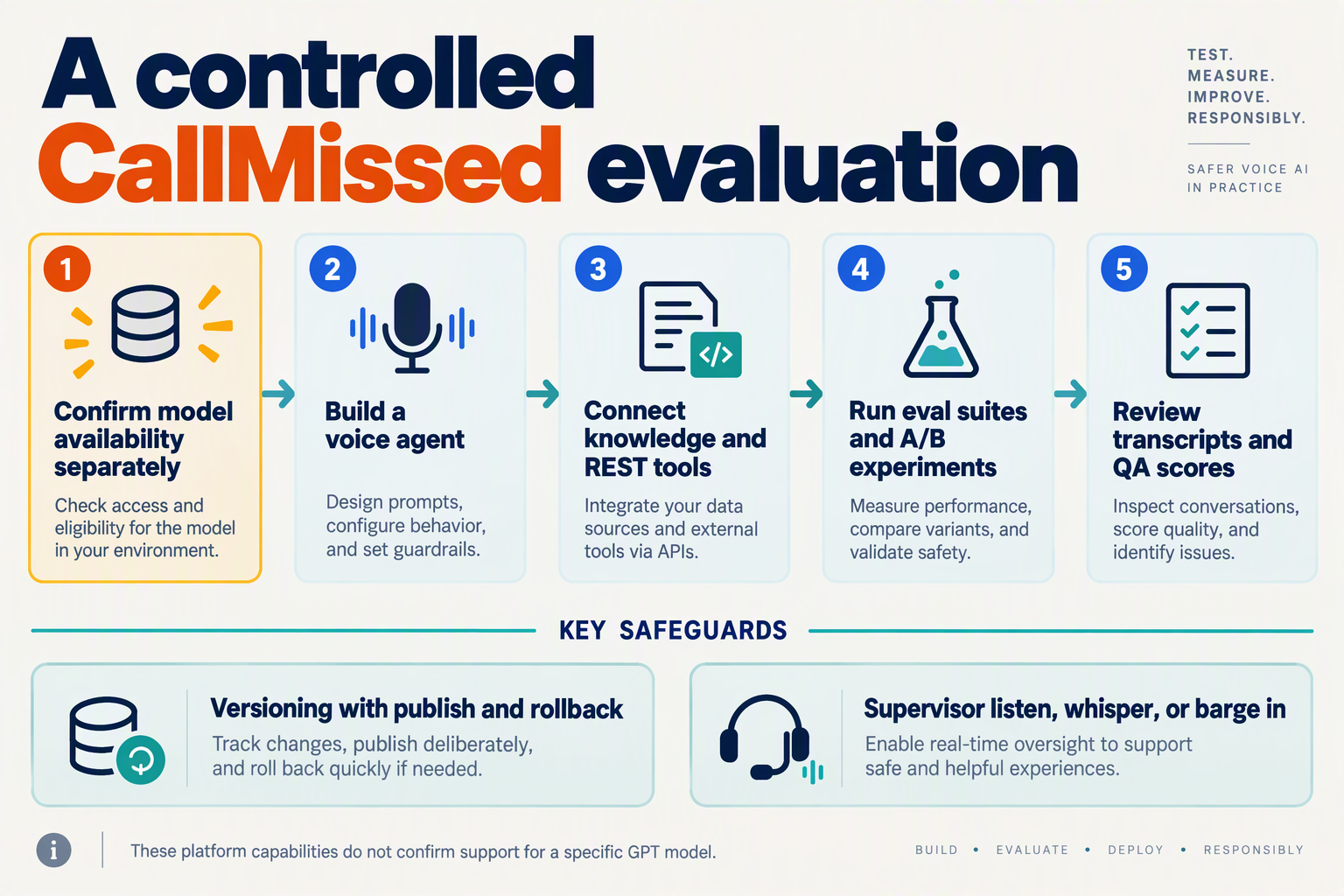
CallMissed can support a controlled pilot using available models, bounded support tasks, and reversible agent configurations—without promising access to GPT-6 Sol or GPT-6 Luna. As of October 2026, the verified CallMissed fact sheet lists an OpenAI-compatible developer API, a no-code agent builder, and operational evaluation tools; it does not confirm either model’s availability.
Can you prepare a GPT-6 pilot before model access is confirmed?
Yes: build the testable workflow first, then treat model access as a separate approval gate. Wikipedia’s supplied GPT-6 entry reports a September 22, 2026 release for Sol and Luna, but that report does not establish availability through any particular gateway.
According to the CallMissed fact sheet, as of October 2026, the developer API provides 139 models under one API key and balance, including 43 general-purpose language models. Its OpenAI-compatible endpoints let existing SDK integrations work by changing the base URL.
Use a currently available model to establish the baseline. Before adding another candidate:
- Confirm the exact model identifier and account access.
- Check supported capabilities, including streaming, tool calls, and structured outputs.
- Verify pricing and data-handling terms for the intended deployment.
- Run the same test cases before allowing customer-facing use.
API compatibility reduces integration work; it does not guarantee identical behavior or access to every OpenAI model.
What should the first support workflow include?
Choose one narrow workflow with a clear stopping point: order-status enquiries, for example, rather than refunds or payment changes. As of October 2026, the platform supports knowledge bases built from text, web pages, and PDFs, custom REST tools, and Shopify integrations covering orders, products, and customers, according to its fact sheet.
A practical pilot configuration could use:
- A bounded knowledge base: Approved delivery policies, not an unrestricted collection of documents.
- A read-only lookup: Retrieve order status without giving the pilot permission to modify orders.
- An explicit uncertainty response: Say that status cannot be confirmed when the lookup fails.
- A documented escalation route: Route exceptions to an operator instead of improvising an answer.
These are recommended implementation choices, not claims that every safeguard is enabled automatically. Check tool permissions and escalation behavior before launch.
How can you keep the pilot observable and reversible?
As of October 2026, the fact sheet lists agent versioning with publish and rollback, call recordings, transcripts, AI call notes, and live monitoring with supervisor listen, whisper, and barge-in capabilities.
Use those controls as an operating procedure:
- Save the approved baseline configuration before making changes.
- Test with staff calls before a limited customer-facing window.
- Assign a supervisor and define stop conditions, such as an unauthorized action or a false confirmation.
- Review transcripts against tool results, then roll back if the candidate fails the acceptance criteria.
For messaging support, switching the AI off hands the thread to a person through the human-handoff queue, according to the October 2026 fact sheet. Test that path separately from voice supervision.
How should you budget the experiment?
As of October 2026, the fact sheet lists flat-rate voice-agent plans at ₹4, ₹5, and ₹6 per minute, covering speech recognition, the language model, and voice; phone carriage is separate. Connected calls have a 30-second minimum.
Set a pilot spending limit, but do not treat those rates as Sol or Luna pricing. The useful outcome is a validated workflow and a measured baseline—ready for a new model only when access, terms, and task-level performance are verified.
Frequently Asked Questions
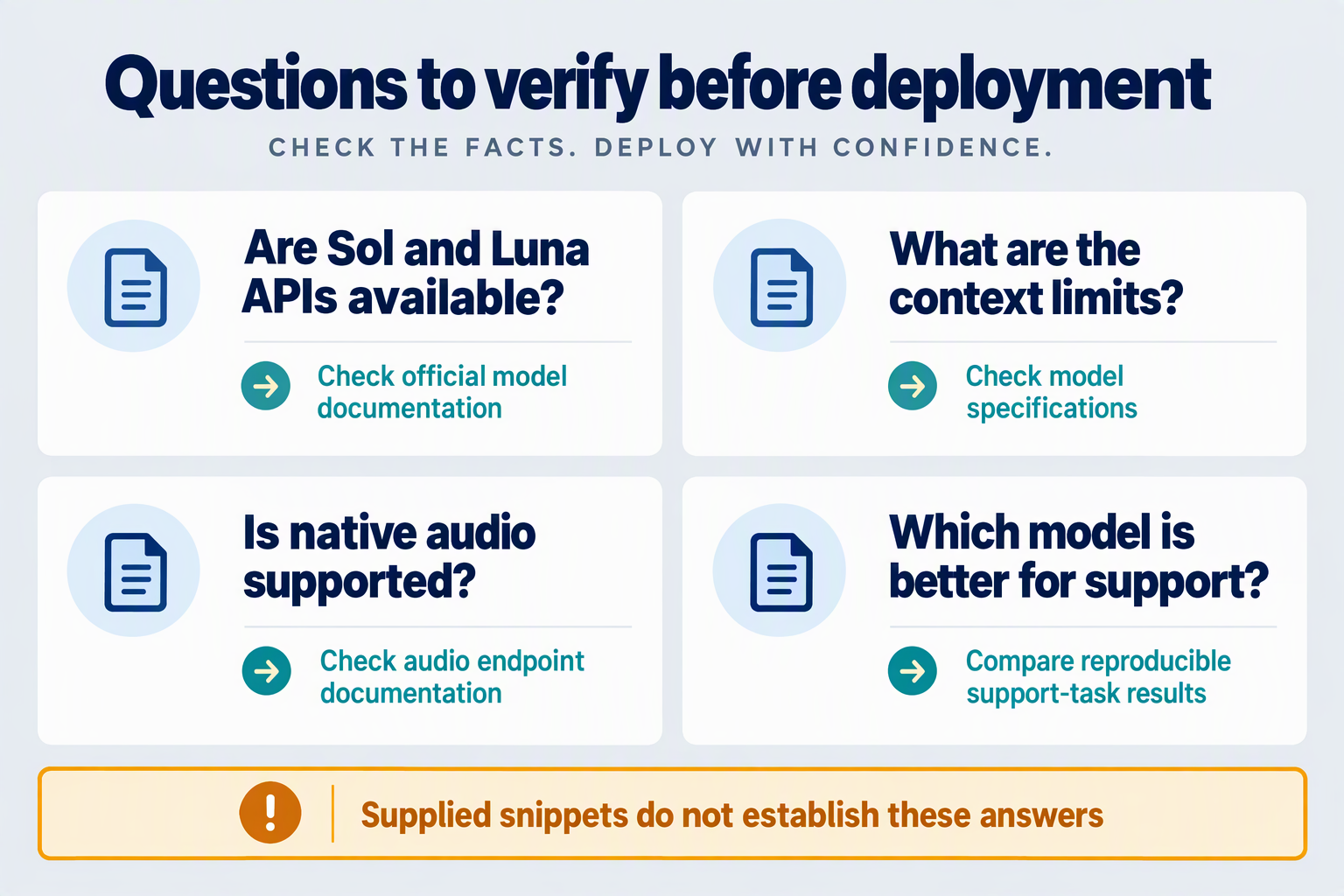
Are GPT-6 Sol and GPT-6 Luna APIs available for customer-support applications?
What are the context limits in a GPT-6 Sol vs GPT-6 Luna comparison?
Do GPT-6 Sol and GPT-6 Luna support native audio for AI voice agents?
What does GPT-6 Sol vs GPT-6 Luna cost for customer support?
Can I connect GPT-6 Sol or Luna through an OpenAI-compatible gateway?
Should support teams migrate existing voice agents immediately after a new GPT release?
Conclusion
GPT-6 Sol vs GPT-6 Luna should be decided by support outcomes, not launch attention or leaderboard position. For AI voice agents, the stronger choice is whichever model—if either—handles your customers’ requests reliably within acceptable response times and operating costs.
The supplied Hacker News snapshot for this October 2026 guide records 974 points and 528 comments in 4.6 hours for “GPT-6 Sol and Luna.” That is evidence of developer interest, not evidence of better customer service. Wikipedia reports a September 22, 2026 release for GPT-6 Sol and GPT-6 Luna, but the supplied research does not establish comparative voice performance, pricing, or deployment requirements. Those gaps should shape the decision rather than disappear behind the excitement.
Four takeaways matter most:
- Verify availability before planning a switch. A reported model release does not establish that either option meets your production requirements. Confirm what you can actually deploy, then compare it against your existing support workflow. Keep uncertainty explicit: without verified access, requirements, and relevant test results, there is no defensible reason to declare a winner or replace a functioning agent.
- Measure the whole conversation, not just the language model. Customer experience depends on speech recognition, reasoning, tool execution, voice synthesis, and network conditions working together. Measure when a meaningful spoken response begins, including tool delays. A more capable model can still produce a worse call if the surrounding system mishears an order number or leaves the caller waiting without useful feedback.
- Test actions, corrections, and uncertainty. Use realistic cases: a Hindi-English conversation, an address changed mid-call, a delivery deadline, or a refund requiring approval. Check whether the agent preserves corrections, selects the right tool, supplies valid arguments, and distinguishes a requested action from a completed one. Reliable human handoffs matter as much as fluent answers when authorization or ambiguity demands escalation.
- Compare cost per resolved case. Model usage alone is an incomplete measure of support economics. Include retries and escalations when assessing whether an apparent saving survives real customer interactions. Evaluate responsiveness, action accuracy, conversational continuity, and safe handling of uncertainty together; optimizing one dimension while ignoring the others can move costs elsewhere rather than improve the service.
Looking ahead, watch for verified deployment details and task-specific voice evaluations, rather than treating general model benchmarks as a substitute for support testing.
As of October 2026, readers can explore CallMissed for voice-agent eval suites, A/B experiments, custom QA call scoring, and live supervisor monitoring—capabilities relevant to this evaluation-first approach.
Before switching models, can your next test demonstrate a more dependable customer outcome—not merely a more impressive answer?
Related Reading
- GPT-6 Sol vs GPT-6 Luna: Verified 2026 Model Comparison
- GPT-6 Sol and Luna API Guide: Model IDs & Pricing
- Claude Fable 5.1 vs GPT-5.6 Sol: Pricing, Coding & Voice Agents
Sources
Discussion
Related Posts


Ready to automate customer conversations?
Launch AI voice agents and WhatsApp bots with CallMissed — one API, 22+ Indian languages.