
Gemini 4 vs Claude Fable 5.1: Argon Buyer Guide (2026)


Compare verified access, pricing, safeguards and procurement criteria for Gemini 4 Argon and Claude Fable 5.1. No unsupported universal winner.
Gemini 4 vs Claude Fable 5.1: Argon Buyer Guide (2026)
What if the deciding factor between two frontier AI models is not intelligence, but whether your team can actually access them? Gemini 4 vs Claude Fable 5.1 starts with that procurement question: as of September 30, 2026, the supplied Google and Anthropic first-party excerpts establish different positioning, but do not establish a benchmark winner or equivalent availability.
Google’s supplied announcement describes Gemini 4 Argon as a frontier model for “real-world coding, enterprise knowledge work and cyber defense,” with rollout to trusted cyber defenders through the Fairwind Program. Anthropic’s supplied Claude Fable page dates the introduction of Claude Fable 5.1 to September 1, 2026, describing it as its “most capable model for coding and knowledge work.” That puts Anthropic’s announcement just 29 days before this buyer guide’s comparison date—not long enough to substitute launch claims for evidence from your own workloads.
Why does this AI model comparison matter now?
For engineering leaders and knowledge-work teams, the practical question is whether stronger reasoning translates into fewer corrections, more dependable execution and acceptable operating costs. A model that produces an impressive demonstration may still struggle with a sprawling repository, contradictory internal documents or a task requiring several tools.
The supplied announcements make this comparison timely, but they also demand careful reading. Google’s restricted-rollout language is not evidence of general commercial access. Anthropic’s description of research capabilities is not, by itself, proof of superior scientific accuracy. Neither supplied excerpt provides comparable pricing, latency measurements or independently validated benchmark results.
What should buyers evaluate beyond launch claims?
This guide frames the decision around three concrete workload categories:
- Frontier reasoning: Can the model resolve conflicting evidence, follow constraints and identify uncertainty rather than conceal it?
- Complex coding: Can the model diagnose a cross-file defect, implement a maintainable fix and pass tests without introducing regressions?
- Knowledge work: Can the model synthesize lengthy materials, preserve source attribution and produce an answer a reviewer can audit?
Access, deployment requirements and total task cost belong alongside those capability tests—not in a footnote. As of September 2026, CallMissed’s OpenAI-compatible developer API supports caller-chosen fallback models and usage logs, illustrating how AI infrastructure can help teams manage model choices without implying that either model discussed here is available through CallMissed.
What evidence should readers expect?
Expect a buyer-focused distinction between announced capabilities, demonstrated performance and unresolved questions. Claude Fable 5.1 should not be conflated with Mythos, and Google’s Fairwind access restrictions should not be transferred to Anthropic’s model. The supplied excerpts support this introduction’s attributed claims; current availability, prices and comparative performance still require direct verification before a purchasing decision.
Gemini 4 Argon vs Fable 5.1: buyer decision
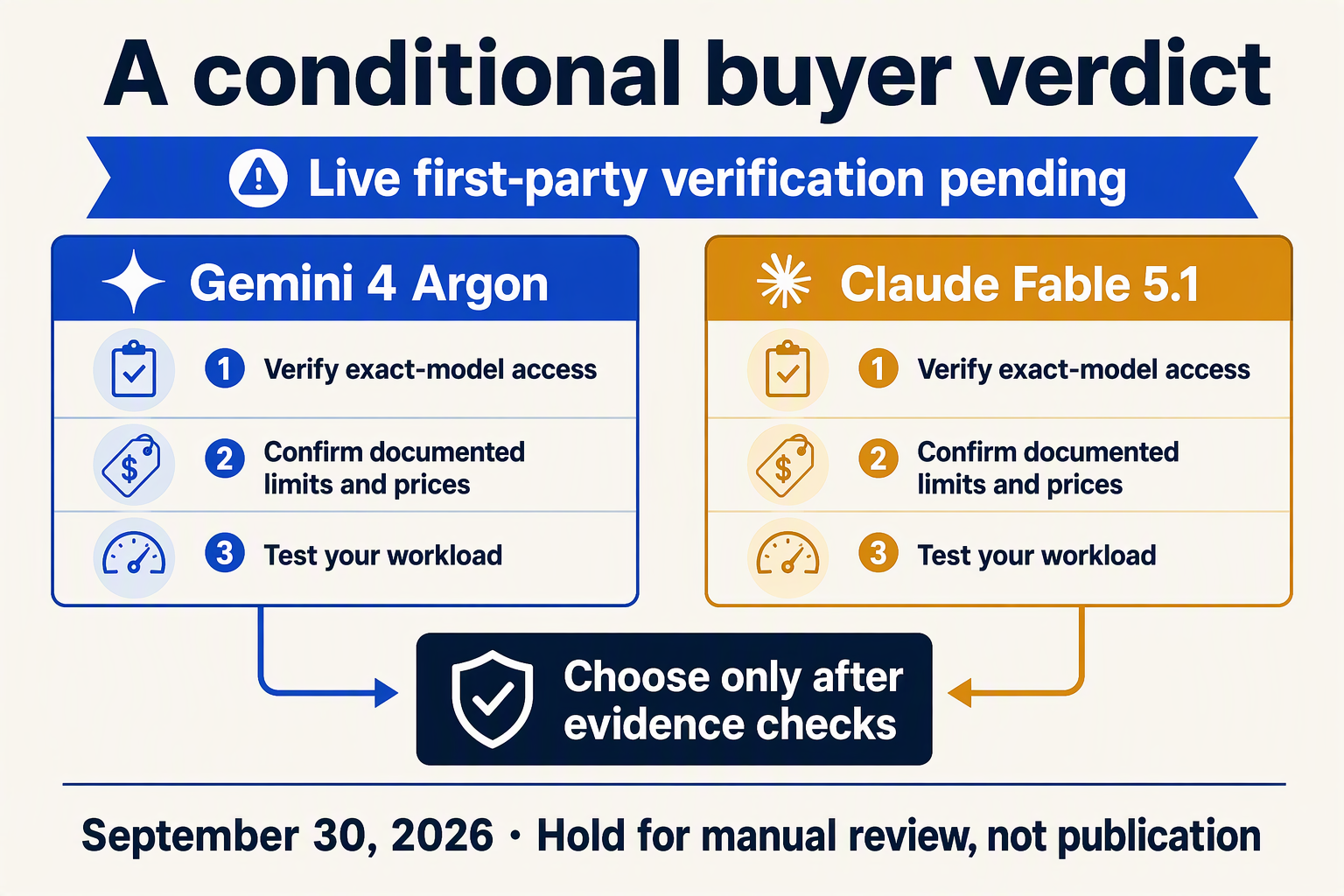
Choose on verified access, safeguard requirements and total accepted-task cost—not on an assumed performance winner. As of September 30, 2026, Google’s Argon and Anthropic’s Claude Fable 5.1 are officially announced, but their access conditions differ. Neither announcement establishes a universal benchmark or cost winner.
What must buyers verify before choosing either model?
- Argon access comes first: Google’s September 30 launch announcement places Argon in a limited rollout to trusted cyber defenders through the Fairwind Program. Public general availability is not verified. Require written eligibility confirmation, an accessible endpoint and an exact model identifier before including Argon in a production procurement shortlist. An announced price does not establish access.
- Fable has documented API specifications: Anthropic’s September 1 launch announcement and API release notes identify
claude-fable-5-1, with a 1M-token context window, 128K-token maximum output and always-on adaptive thinking. Confirm your account’s access, applicable rate limits and deployment terms before committing to a rollout. Treat those specifications as operating parameters—not proof that Fable will outperform Argon on your workload.
- Compare the published rates carefully: Fable’s listed prices are $10 input / $50 output per million tokens, with a $0.25 cache rate. Google announces introductory Argon pricing of $2 input / $10 output per million tokens; its advertised 95% cache discount implies $0.10 per million cached input tokens at the introductory input rate. Argon’s announced post-introductory prices are $4 input / $20 output per million tokens, but the introductory offer’s expiry is unknown. Verify cache billing rules and applicable terms rather than assuming the two cache rates cover identical operations.
Sources: Anthropic Fable 5.1 launch announcement and API release notes; Google Argon launch announcement.
- Budget beyond the introductory offer: Model Argon’s business case at both introductory and post-introductory rates. Do not assume the introductory cache price persists after the offer ends. For Fable, test how always-on adaptive thinking affects billed usage and completion time on representative tasks rather than budgeting from prompt length alone.
- Keep safeguard and identity boundaries intact: Argon’s Fairwind access conditions belong to Argon. Fable and Mythos are not interchangeable, and access to one does not establish access to the other. Keep any distinct research-evaluation sibling separate from the production candidate: do not transfer its capabilities, permissions or safeguards into a purchasing decision. Confirm permitted use cases, tool permissions and deployment restrictions for the exact model being contracted.
- Measure accepted-task cost, not just token price: Run the same representative coding, reasoning and document-analysis tasks with equivalent tool permissions and acceptance criteria. Record billed usage, cache reuse, retries, tool costs, elapsed time and human corrections. Lower token prices need not produce a lower cost per accepted result; a larger context window does not guarantee more accurate analysis.
- Use a procurement gate, not a blanket verdict: Advance a candidate only when access is confirmed, deployment terms fit, safeguards meet your requirements and measured quality clears your acceptance threshold. If Argon eligibility is unresolved, it is not yet a deployable alternative for that buyer. If both are accessible, select using workload-specific evidence—neither the launch claims nor the price cards justify a universal winner.
What do Google and Anthropic actually confirm about availability, API routes and Fable versus Mythos?
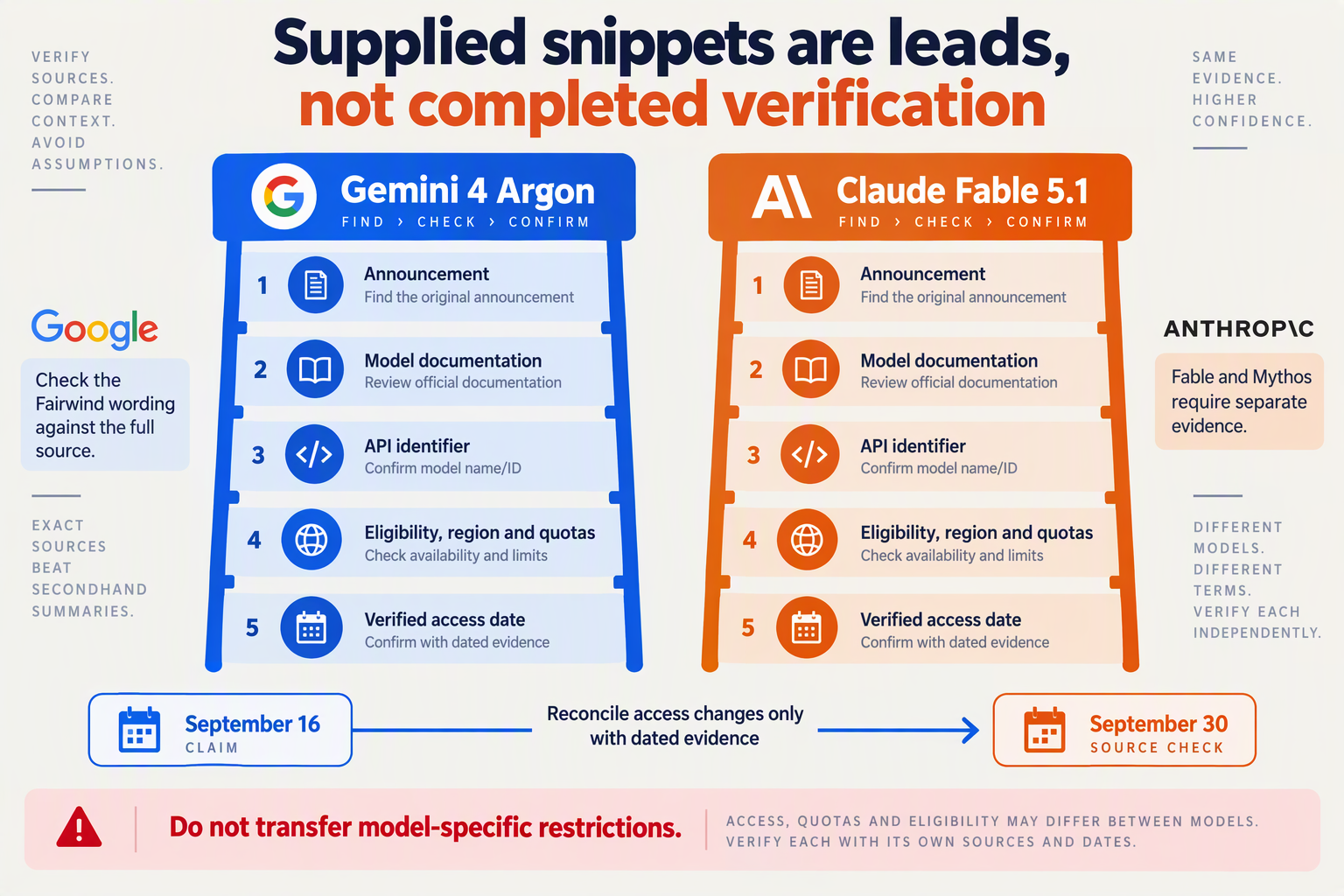
As of September 30, 2026, the supplied first-party excerpts confirm announcement positioning—not equivalent commercial availability or documented API access. They also provide no basis for treating Claude Fable 5.1 and Mythos as interchangeable.
- Google Gemini 4 Argon: Google’s announcement says Argon is “currently rolling out to trusted cyber defenders through the Fairwind Program.” That establishes a restricted rollout, not general developer access. Procurement teams should request explicit eligibility criteria and deployment terms rather than assume that an existing Google account or enterprise agreement provides access.
- Google API routes: The supplied Google excerpt does not identify an Argon model ID, request endpoint, supported API version or generally available deployment route as of September 2026. It therefore does not establish availability through the Gemini API or Vertex AI. Neither route should appear as a confirmed integration option without model-specific documentation.
- Anthropic Claude Fable 5.1: Anthropic’s Claude Fable page lists “Introducing Claude Fable 5.1” on September 1, 2026, and calls the model its “most capable model for coding and knowledge work.” The dated announcement establishes product identity and vendor positioning; the supplied excerpt does not specify account eligibility, regional availability or subscription requirements.
- Anthropic API routes: The supplied Anthropic excerpts do not give a Fable 5.1 API identifier, endpoint configuration or distribution-channel listing. Buyers cannot establish direct Anthropic API access, Amazon Bedrock availability or Google Cloud Vertex AI availability from these excerpts. Obtain the exact model identifier and access requirements before estimating migration effort or promising a production launch.
- Fable versus Mythos: Anthropic’s supplied material names Claude Fable 5.1; it contains no Mythos announcement, specification or availability statement. Consequently, this comparison cannot establish whether Mythos is a separate offering, an alias or another designation. Do not attribute Mythos capabilities, restrictions, safeguards or commercial terms to Fable without explicit first-party evidence connecting the names.
- Safety evidence: Anthropic’s Transparency Hub says Fable 5.1 received “substantial post-training” intended to make it an effective, aligned assistant. Google separately describes prioritizing safety and rigorous testing before Argon’s wider release. These statements describe vendor processes—not equivalent access policies, independently measured safety outcomes or transferable restrictions between Google and Anthropic products.
- Commercial unknowns: Neither supplied excerpt establishes token prices, context-window limits, maximum output tokens, requests-per-minute quotas, supported languages or service-level commitments for these models. Mark each field “not established by supplied evidence”, rather than borrowing figures from another Gemini or Claude release. Announcement language cannot support a defensible cost-per-task calculation.
- Buyer verification checklist: Before approving either model, collect four model-specific documents: an availability notice, API reference, pricing schedule and applicable service terms. Confirm that all four name the same model and deployment route. This separates an announced capability from an integration your engineering, security and procurement teams can actually approve.
How do reasoning, complex coding, context, tools and safety compare?
The supplied Google and Anthropic excerpts do not establish a performance winner for Gemini 4 Argon vs Claude Fable 5.1. As of September 30, 2026, they support a capability comparison—not verified reasoning scores, context limits or tool-use reliability.
| Dimension | Gemini 4 Argon: Google evidence | Claude Fable 5.1: Anthropic evidence | Buyer implication |
|---|---|---|---|
| Frontier reasoning | No reasoning benchmark appears in the supplied Google excerpt. | Anthropic describes research capabilities, without a comparable reasoning score. | Test constraint-following and uncertainty handling; no numerical ranking is supported. |
| Complex coding | Google names “real-world coding” as a focus. | Anthropic calls Fable 5.1 its “most capable model for coding and knowledge work.” | These are vendor positioning statements, not equivalent coding evaluations. |
| Knowledge work | Google explicitly names enterprise knowledge work. | Anthropic explicitly names knowledge work and potential scientific contributions. | Measure source accuracy and reviewer corrections, not presentation quality alone. |
| Context capacity | Input and output token limits are not specified in the supplied excerpt. | Input and output token limits are not specified in the supplied excerpts. | Obtain model-specific limits before sizing document or repository workloads. |
| Tools and execution | Function calling, execution environments and tool limits are not detailed. | Function calling, execution environments and tool limits are not detailed. | Do not infer API capabilities from either model’s coding positioning. |
| Safety | Google says it is prioritizing “safety and rigorous testing.” | Anthropic’s Transparency Hub describes substantial post-training aimed at effective, aligned assistant behavior. | Neither excerpt supplies comparable safety evaluation results. |
How should buyers test reasoning, coding and context?
- Reasoning: Use an illustrative 20-task evaluation containing conflicting instructions, incomplete evidence and multi-step calculations; score correct answers separately from unsupported assertions. Apply identical prompts and tool permissions to both models so differences reflect the tested configuration rather than unequal assistance.
- Complex coding: Give each model the same cross-file defect, dependency constraints and hidden regression tests; record tests passed, regressions introduced and human repair time. Neither supplied first-party excerpt provides a coding success percentage that can replace this repository-level assessment.
- Context: Request verified input limits, output limits and truncation behavior before procurement; then place decisive evidence near the beginning, middle and end of a representative document bundle. A large advertised window, if subsequently documented, would not by itself demonstrate reliable retrieval across that window.
What should teams verify about tools and safety?
- Tool use: Evaluate read-only retrieval separately from actions that modify files, send messages or update records; require approval for consequential writes. As of September 2026, CallMissed’s verified developer API supports function calling, structured outputs and request logs, without establishing availability of either compared model.
- Safety evidence: Anthropic’s supplied page lists “Improving Fable 5’s biology safeguards,” dated August 6, 2026; that title does not establish Fable 5.1’s specific safeguards or evaluation results. Keep Claude Fable 5.1 distinct from Mythos, and request documentation matching the exact deployed model.
- Decision rule: Treat every unspecified capability as unverified, not absent. Before selecting either model, obtain its model identifier, context specification, supported tool schema and relevant safety documentation, then compare results under the same task budget and reviewer rubric.
What are verified input, output and cache prices—and the cost per successful task?
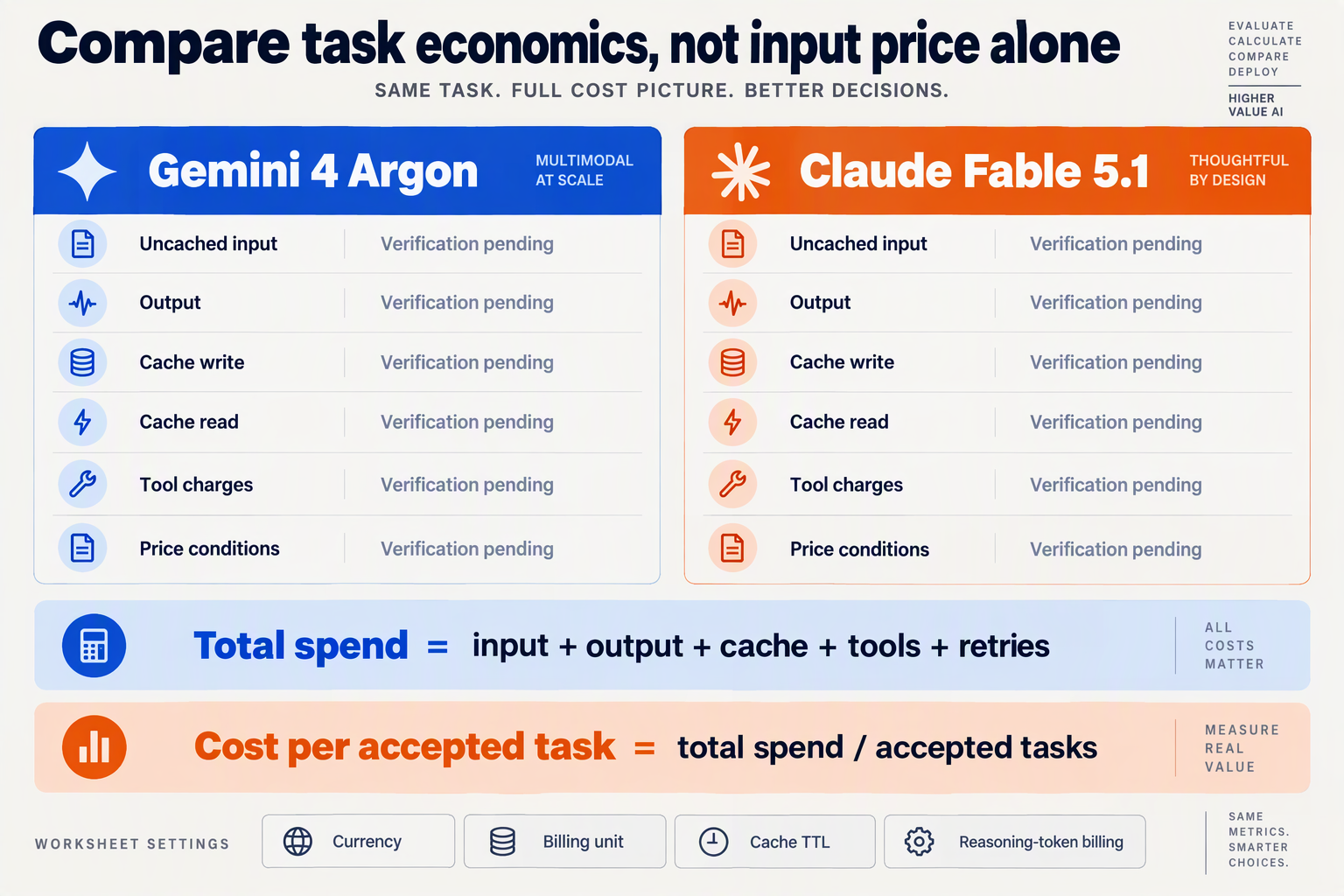
Neither Gemini 4 Argon nor Claude Fable 5.1 has verifiable input, output or cache pricing in the supplied first-party excerpts as of September 30, 2026. Buyers therefore cannot establish a defensible price winner from this evidence.
- Gemini 4 Argon: Google’s supplied announcement describes rollout through the Fairwind Program, but provides no API tariff, cache schedule or commercial billing terms; restricted access must not be treated as evidence of either free usage or general availability.
- Claude Fable 5.1: Anthropic’s supplied Claude Fable page dates the introduction to September 1, 2026, but supplies no token prices; neither that page nor the supplied Transparency Hub excerpt establishes a billable rate for this comparison.
What input, output and cache prices are verified?
The table records evidence gaps, not zero-dollar prices. All entries reflect the supplied Google and Anthropic excerpts available for this September 30, 2026 comparison.
| Billing item | Gemini 4 Argon | Claude Fable 5.1 | Buyer verification needed |
|---|---|---|---|
| Input per million tokens | Not established | Not established | Exact model-specific tariff |
| Output per million tokens | Not established | Not established | Output and reasoning billing |
| Cache-read pricing | Not established | Not established | Rate and eligibility |
| Cache-write pricing | Not established | Not established | Write charges and duration |
| Cache storage or expiry | Not established | Not established | Storage fees and retention |
| Tools and other charges | Not established | Not established | Search, execution and service fees |
- Model identity: Request pricing tied to the exact model identifier, endpoint, region and effective date. A Gemini-family or Claude-family price does not establish these models’ prices, and Claude Mythos pricing must not be substituted for Claude Fable 5.1 pricing.
- Cache economics: Verify whether repeated repository files or policy documents qualify for caching, how long entries remain valid, and whether writes incur separate charges. Until those terms are confirmed, a projected cache discount is an assumption—not a verified saving.
- Output accounting: Ask whether billed output includes reasoning tokens and whether tool results become additional billable input. Long debugging sessions can accumulate costs across repeated calls, even when the final answer is short.
- Successful-task accounting: Count failed attempts, retries, tool charges and human review in the numerator. Define success before testing: for coding, passing agreed tests without regressions; for knowledge work, meeting an agreed accuracy, completeness and source-attribution rubric.
How should buyers calculate cost per successful task?
- Use an all-in formula: Cost per successful task = total model, cache, tool and human-review spending ÷ accepted tasks. Run both models against the same task set and acceptance criteria; record unavailable tasks separately rather than assigning them an invented price.
- Apply a clearly hypothetical example: If 100 attempted tasks incur $30 in API charges and $50 in human review, with 80 accepted results, cost per successful task is $1.00: ($30 + $50) ÷ 80. These figures illustrate the calculation; they are not Google or Anthropic prices or measured model results.
What are each model’s evidence-backed advantages and buying risks?
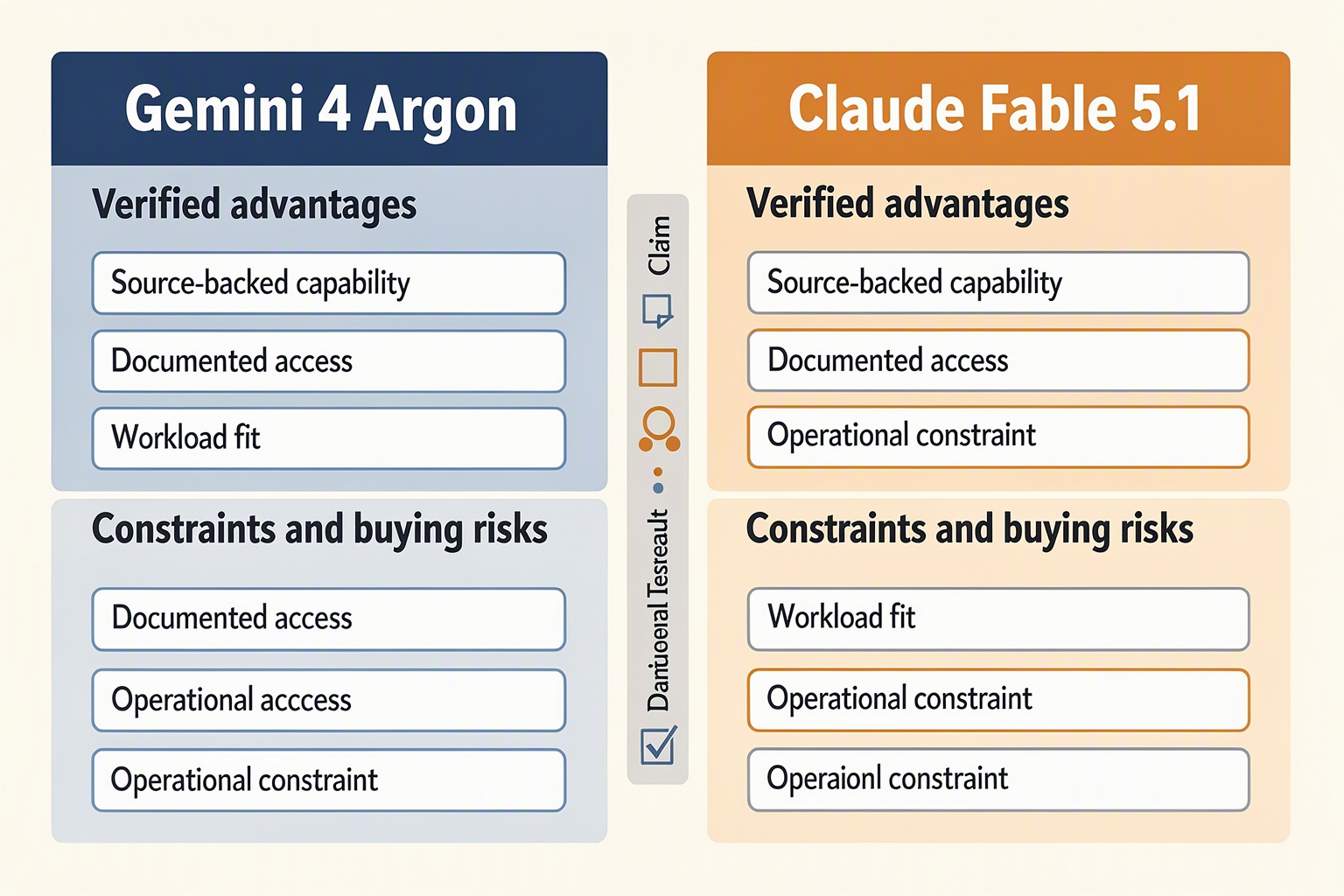
Gemini 4 Argon’s evidence-backed advantage is its explicitly targeted coding, enterprise and cyber-defense scope; Claude Fable 5.1’s is Anthropic’s stated coding, knowledge-work and research positioning. As of September 30, 2026, the supplied first-party excerpts support those distinctions—not a measured performance winner.
What advantages and risks do Google and Anthropic actually document?
| Buying criterion | Gemini 4 Argon | Claude Fable 5.1 | Evidence-backed buying implication |
|---|---|---|---|
| Complex coding | Google names “real-world coding” as a target. | Anthropic calls Fable 5.1 its “most capable model for coding and knowledge work.” | Both merit repository testing; neither excerpt supplies comparable coding scores. |
| Enterprise knowledge work | Google explicitly identifies enterprise knowledge work. | Anthropic explicitly identifies knowledge work. | Positioning aligns with document-heavy workflows, but source fidelity and correction rates remain unmeasured here. |
| Cyber-defense fit | Google describes rollout to trusted cyber defenders through Fairwind. | The supplied Fable excerpts establish no equivalent cyber-defense program. | Argon has documented domain alignment; this does not establish unrestricted access or superior defensive performance. |
| Research potential | The supplied Google excerpt provides no specific scientific-research claim. | Anthropic describes research capabilities offering an “early glimpse” of contributions to scientific progress. | Fable has a stated research direction, not evidence of independently validated scientific accuracy. |
| Safety documentation | Google says it prioritizes safety and rigorous testing before wider release. | Anthropic’s Transparency Hub describes substantial post-training aimed at effective, aligned assistance. | These describe development approaches; neither substitutes for workload-specific safety evaluation. |
| Commercial certainty | Supplied evidence identifies restricted rollout, not general purchasing terms. | The September 1, 2026 announcement establishes introduction, not procurement details. | Pricing, context limits, deployment options and service commitments require separate confirmation. |
What should buyers verify before committing budget?
- Gemini 4 Argon: Obtain written eligibility, access timing and deployment conditions before allocating integration work; Google’s supplied announcement supports Fairwind rollout, not a guaranteed production purchasing path as of September 30, 2026.
- Claude Fable 5.1: Request model-specific API documentation and contractual terms; Anthropic’s September 1, 2026 introduction does not establish rate limits, regional availability or production support in the supplied evidence.
- Both models: Run three matched task groups—reasoning, repository repair and document synthesis—with identical inputs and scoring; record accepted outputs, reviewer corrections and total task cost rather than treating launch descriptions as benchmarks.
- Research buyers: Require traceable citations, reproducible calculations and expert review; Anthropic’s “early glimpse” wording supports exploration, not autonomous acceptance of scientific conclusions or a quantified accuracy advantage.
- Model identity: Keep Claude Fable 5.1 separate from Mythos in evaluation sheets; the supplied Fable evidence does not justify transferring another model’s capabilities, restrictions or safety findings.
- CallMissed: As of September 2026, CallMissed’s developer API offers caller-chosen fallback models and usage/request logs—useful infrastructure capabilities for comparative evaluation, without establishing that either named model is available through CallMissed.
How should you test frontier reasoning, complex coding and knowledge work fairly?
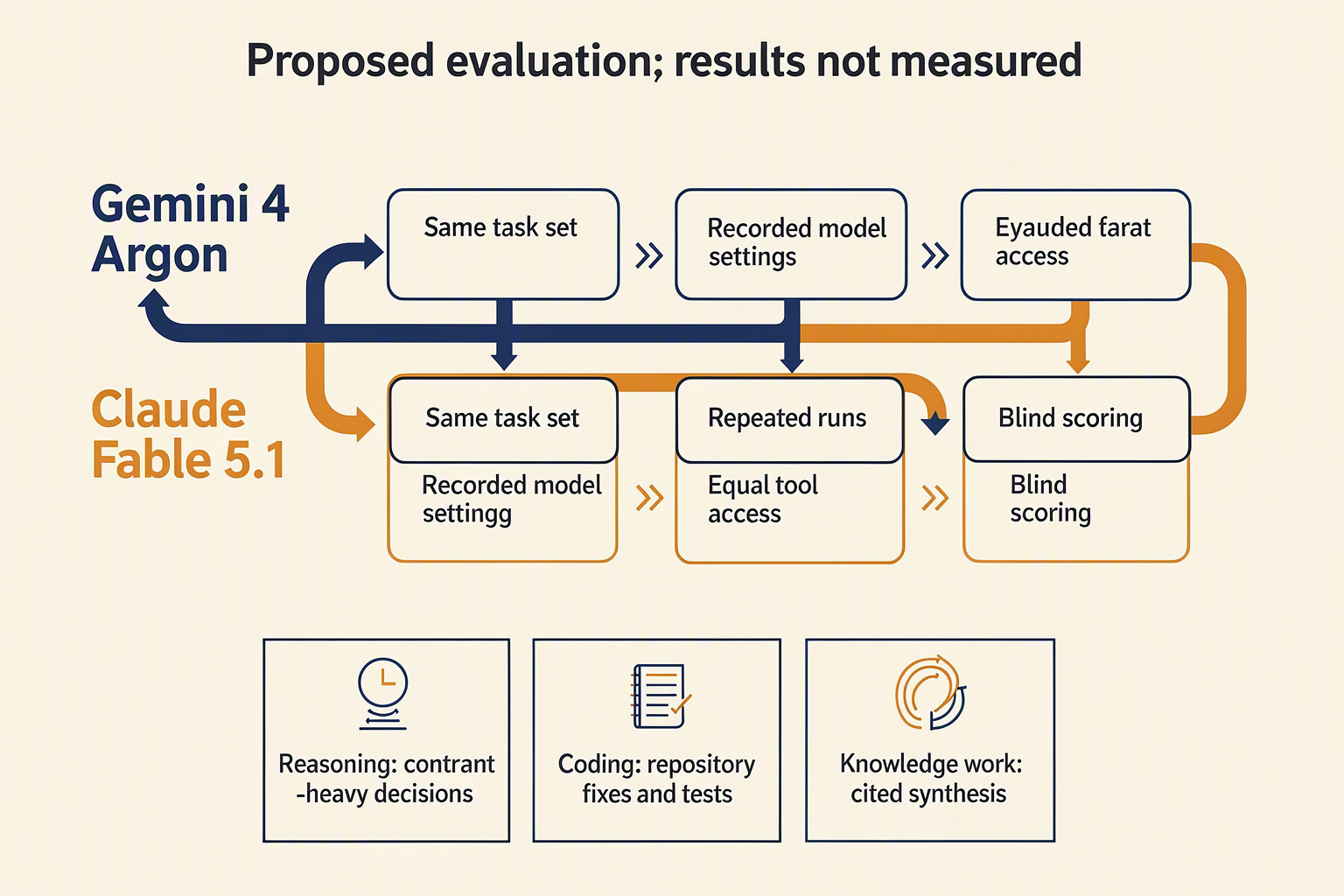
Test Gemini 4 Argon vs Claude Fable 5.1 on identical, privately held tasks with blinded scoring and fixed budgets. As of September 30, 2026, the supplied first-party excerpts do not establish a measured winner.
How do you build a fair model evaluation?
- Verify the tested model: Record the provider, exact model identifier, access route, test date and configuration for every run. Google’s supplied announcement describes Argon as rolling out to “trusted cyber defenders” through Fairwind; Anthropic’s supplied page dates Fable 5.1’s introduction to September 1, 2026. Neither excerpt establishes equivalent testing access. If access is unavailable, mark results not tested, rather than substituting another model.
- Use a balanced task set: Start with a proposed 60-task pilot: 20 reasoning, 20 coding and 20 knowledge-work tasks. Select examples from your actual workflows, remove sensitive information and reserve unseen cases for final scoring. These numbers are an evaluation recommendation, not a published benchmark. Include straightforward tasks alongside ambiguous cases so difficulty does not distort the comparison.
- Equalize inputs and tools: Give both models identical documents, repository snapshots, retrieval results and tool permissions. Set the same maximum wall-clock time, tool calls and spending per task, where configurable. Record unsupported settings rather than assuming parity. Run a separate provider-optimized track if desired; do not mix those results with the controlled comparison.
- Repeat and blind the assessment: Run each pilot task 3 times, producing 180 attempts per model, and randomize execution order. Have 2 reviewers score anonymized outputs against a rubric written beforehand. Report disagreement and variation across attempts, not just the strongest answer. Repeated trials expose reliability differences that a polished demonstration can hide.
Which outcomes should buyers measure?
- Frontier reasoning: Test conflicting evidence, numerical constraints and deliberately unanswerable questions. Score final-answer correctness, constraint compliance and appropriate uncertainty separately. Ask for concise, checkable explanations rather than hidden chain-of-thought. Include a case where insufficient evidence makes abstention the correct outcome; confident completion should not automatically earn a higher score.
- Complex coding: Use multi-file defects with hidden tests, a pinned dependency environment and a clean starting commit. Measure test-pass rate, regressions, security findings and reviewer repair minutes. Require executable patches, not merely plausible explanations. Keep code execution sandboxed and tool permissions identical so environmental advantages do not masquerade as stronger coding ability.
- Knowledge work: Give both models the same document pack containing contradictions, outdated figures and missing information. Measure citation accuracy, factual coverage and unsupported claims; require reviewers to check every cited passage. Anthropic’s September 2026 description of Fable 5.1 as its “most capable model for coding and knowledge work” is positioning—not a task-level score.
- Buyer economics: Calculate total cost per accepted task, including failed attempts, retries, tool charges and human review. Report median and 95th-percentile completion time alongside acceptance rate. Keep Fable results separate from Mythos and label every finding by tested configuration. A buying decision should follow verified performance under your constraints, not announcement language.
Should you add a route, run a pilot or hold deployment? Conditional decision matrix
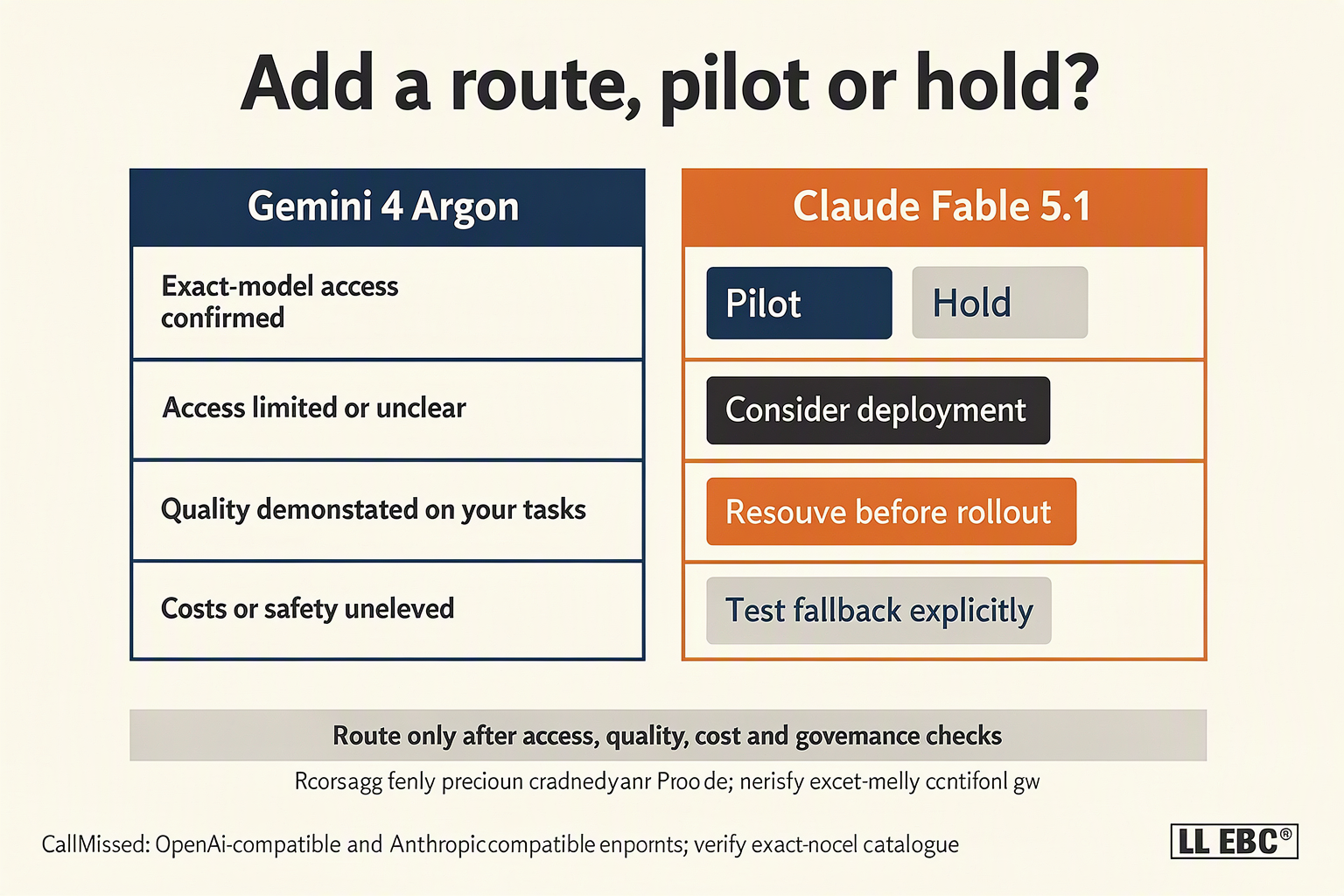
Run a pilot only after confirming access; add a production route only after measured acceptance tests; hold deployment when access or governance remains unresolved. For this September 30, 2026 comparison, the supplied first-party excerpts support conditional decisions—not an unconditional Gemini 4 Argon or Claude Fable 5.1 recommendation.
- Gemini 4 Argon: Google’s supplied announcement describes rollout to “trusted cyber defenders through the Fairwind Program”; as of September 30, 2026, that excerpt does not establish general commercial availability or authorization for your intended workload.
- Claude Fable 5.1: Anthropic’s supplied Claude Fable page dates its introduction to September 1, 2026; before scheduling evaluation, obtain the exact model identifier, access terms and deployment documentation rather than treating an announcement as an accessible endpoint.
- Evidence boundary: As of September 30, 2026, neither supplied excerpt establishes comparable prices, context limits or latency measurements; keep those procurement fields unverified, and do not substitute Claude Mythos specifications for Claude Fable 5.1.
When should you add a route, run a pilot or hold deployment?
The following matrix separates provider evidence from recommended buyer gates. Its numeric pilot thresholds are proposed starting points, not Google or Anthropic performance claims.
| Buyer situation | Gemini 4 Argon decision | Claude Fable 5.1 decision | Evidence required |
|---|---|---|---|
| No confirmed account access | Hold; clarify Fairwind eligibility | Hold; confirm endpoint entitlement | Written access approval and exact model ID |
| Access confirmed, performance unknown | Pilot within authorized scope | Pilot on the same eligible tasks | 30 representative tasks, scored blind |
| Complex coding with repository tools | Pilot in an isolated environment | Pilot with identical tool permissions | Passing tests, regression checks and reviewed diffs |
| Knowledge work using confidential files | Hold pending data approval | Hold pending data approval | Retention terms, processing location and access controls |
| Quality and operational gates passed | Add route if deployment is authorized | Add route if deployment is authorized | Task-cost ceiling, error budget and tested fallback |
| Critical errors or unclear restrictions | Hold; resolve before expansion | Hold; resolve before expansion | Documented remediation and repeat evaluation |
What should a deployment-ready pilot measure?
- Pilot design: Use the proposed 30-task set across reasoning, coding and knowledge work; record completion quality, reviewer corrections, tool failures and total task cost. Keep prompts, document versions and tool permissions matched wherever access conditions permit a fair comparison.
- Release gate: Require zero unresolved critical errors in the pilot, a tested rollback and explicit human approval for consequential actions. This is a recommended minimum gate—not proof of safety; a small evaluation can miss rare failures.
- Routing infrastructure: As of September 2026, CallMissed’s OpenAI-compatible developer API provides caller-chosen fallback models, usage logs and request logs. Those capabilities can support evaluation and routing for supported models, but do not establish Gemini 4 Argon or Claude Fable 5.1 availability through CallMissed.
Frequently Asked Questions
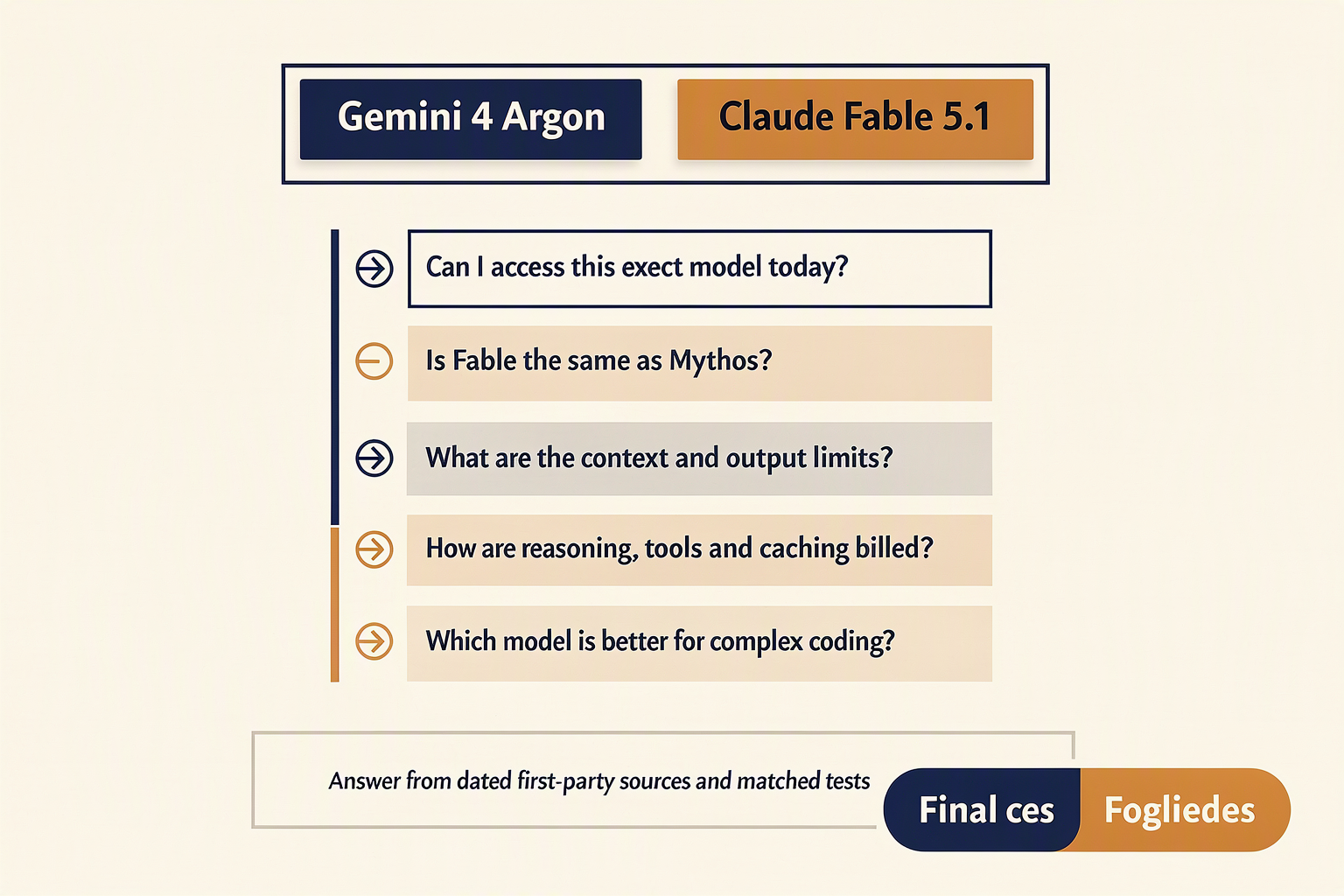
- Q: Can I access Gemini 4 Argon through the Gemini app or a public API?
A: As of September 30, 2026, Google’s supplied announcement says Gemini 4 Argon is rolling out to trusted cyber defenders through the Fairwind Program, not that it is generally available. The excerpt does not establish access through the Gemini app, Google AI Studio or a public API, so buyers should request explicit eligibility and deployment details from Google. Existing access to another Gemini model is not evidence of Argon entitlement.
- Q: Is Claude Fable 5.1 the same model as Claude Mythos?
A: Do not treat Fable and Mythos as interchangeable: the supplied Anthropic excerpts identify Claude Fable 5.1 but establish no relationship to Mythos. Anthropic’s Claude Fable page dates the Fable 5.1 introduction to September 1, 2026, while its Transparency Hub describes Fable 5.1’s pretraining and post-training. As of September 30, 2026, these excerpts do not justify transferring Mythos-related access restrictions, capabilities or safety findings to Fable.
- Q: In Gemini 4 Argon vs Claude Fable 5.1, which costs less per completed task?
A: Neither can be declared cheaper from the supplied first-party excerpts as of September 30, 2026, because they provide no comparable prices or completion-rate measurements. Calculate cost per accepted task as total model, tool, retry and review expenditure divided by accepted outputs—not merely the price of the first response. For illustration, a hypothetical ₹120 workflow with eight accepted outputs costs ₹15 per accepted task; that is arithmetic, not either model’s published pricing.
- Q: Which wins Gemini 4 Argon vs Claude Fable 5.1 for complex coding?
A: As of September 30, 2026, Google positions Argon for “real-world coding,” while Anthropic describes Fable 5.1 as its “most capable model for coding and knowledge work”; neither excerpt supplies a comparable benchmark. Test both, where access permits, against the same repository snapshot, instructions and tool permissions. Score accepted patches, regression failures and reviewer minutes, since a patch that compiles but breaks existing behavior is not a completed task.
- Q: What evidence should buyers request before deploying either model for knowledge work?
A: As of September 30, 2026, the supplied excerpts do not establish context limits, latency, regional availability or contractual data-handling terms for both models. Request those details alongside exact model identifiers and test source attribution using documents containing conflicting dates, policies and figures. Require answers to distinguish supported conclusions from unresolved evidence, rather than rewarding fluent summaries alone.
- Q: Can CallMissed provide access to Argon or Fable 5.1?
A: The verified CallMissed fact sheet does not confirm either model’s availability as of September 2026. CallMissed’s developer API offers OpenAI-compatible endpoints, caller-chosen fallback models, and usage and request logs, but those capabilities do not establish access to these specific releases. Verify exact catalogue identifiers before designing routing or budgeting around either model.
Conclusion
Gemini 4 Argon vs Claude Fable 5.1 has no established benchmark winner in the supplied evidence as of September 30, 2026. The defensible buying decision is to confirm access first, then evaluate frontier reasoning, complex coding and knowledge work against your team’s actual requirements—not launch descriptions alone.
Four takeaways should guide that decision:
- Access is a procurement gate, not a capability score. Google’s supplied Gemini 4 Argon announcement describes rollout to trusted cyber defenders through the Fairwind Program, with safety and testing prioritized before wider release. As of September 30, 2026, that excerpt does not establish general commercial availability. Buyers should therefore avoid treating Argon as an immediately deployable alternative without confirming eligibility and deployment conditions.
- Positioning is not comparative proof. Anthropic’s supplied Claude Fable page dates Claude Fable 5.1 to September 1, 2026, calling it its “most capable model for coding and knowledge work.” That announcement preceded this September 30, 2026 guide by 29 days. The description establishes Anthropic’s positioning, but the supplied excerpts do not establish superiority over Gemini 4 Argon, comparable pricing or independently validated benchmark results.
- Evaluate completed work, not impressive demonstrations. Reasoning tests should expose conflicting evidence and constraint-following failures; coding tests should require cross-file fixes that pass tests without regressions. Knowledge-work evaluations should check source attribution and whether reviewers can audit the answer. These practical checks turn broad capability claims into evidence about correction effort, dependable execution and total task cost.
- Keep model identities and access claims separate. Claude Fable 5.1 should not be conflated with Mythos, and Google’s Fairwind restrictions should not be transferred to Anthropic’s model. Neither research-oriented positioning nor a restricted rollout answers every procurement question. Confirm each model’s availability, deployment requirements and commercial terms independently before committing resources.
Looking ahead, watch for wider access, comparable pricing, measured latency and reproducible workload results. Those developments could materially change the comparison, but only when supported by evidence. A useful purchasing process should remain revisable: repeat the same evaluations as access and model capabilities evolve, rather than allowing a launch-day impression to become a permanent preference.
As of September 2026, CallMissed’s OpenAI-compatible developer API provides caller-chosen fallback models and usage logs—capabilities readers can explore when managing model choices. That infrastructure perspective complements this guide without implying that Gemini 4 Argon or Claude Fable 5.1 is available through CallMissed.
Before choosing either model, ask: which accessible option can complete your hardest representative tasks with the fewest corrections—and what evidence would make you reconsider?
Related Reading
- Gemini 4 Argon vs Claude Opus 5.5: Agent Work in 2026
- Claude Fable 5.1 vs GPT-6 Astra: 2026 Buyer’s Guide
- Gemini 4 Argon vs Claude Sonnet 5.5: Coding & Scale
Sources
Discussion
Related Posts


Ready to automate customer conversations?
Launch AI voice agents and WhatsApp bots with CallMissed — one API, 22+ Indian languages.