
Gemini 4 Argon vs Claude Opus 5.5 for Knowledge Work


Compare Gemini 4 Argon vs Claude Opus 5.5 for coding agents and knowledge work, with access checks, pricing scenarios and workload-based guidance.
Gemini 4 Argon vs Claude Opus 5.5 for Knowledge Work
What good is a brilliant coding agent if your team cannot deploy it? Gemini 4 Argon vs Claude Opus 5.5 is ultimately a question about dependable execution—not just impressive answers. As of September 30, 2026, Google confirms Argon’s restricted initial rollout and Anthropic officially documents Claude Opus 5.5. Both names are verified, but a defensible knowledge-work winner requires matched document and tool-use evaluations.
That distinction matters for teams evaluating long-running coding agents and enterprise knowledge work. Google’s Gemini 4 Argon announcement describes a frontier model for “real-world coding, enterprise knowledge work and cyber defense,” but also says Google is prioritizing safety and rigorous testing before wider release. Announced ambition, restricted availability and production readiness are different things—and a useful comparison must keep them separate.
The scale of the broader shift is already substantial. In its Google I/O 2026 update, Google reports that the Gemini app serves more than 900 million monthly users across over 230 countries and territories in more than 70 languages. Those figures establish the reach of Google’s assistant ecosystem; they do not establish Argon’s coding reliability, enterprise suitability or availability.
What should teams compare beyond benchmark scores?
For an agent maintaining a repository, the practical test is whether it can follow requirements, make coherent changes, run checks and recover when a tool fails. For an enterprise research assistant, the test is whether conclusions remain grounded in authorized documents rather than plausible-sounding assumptions.
This comparison therefore focuses on questions that affect deployment decisions:
- Task completion: Can an agent finish a multi-step assignment without repeated human rescue?
- State and recovery: What happens after a failed command, interrupted session or contradictory instruction?
- Knowledge grounding: Can users trace conclusions to the underlying evidence?
- Operational constraints: What access, pricing, permissions and deployment options are officially documented?
Consider a coding agent asked to update an authentication flow, revise tests and explain the security implications. A convincing patch is only one deliverable. Reviewers also need reproducible checks, clear assumptions and an auditable account of what changed.
What will this comparison establish?
The goal is to separate verified product facts, vendor claims and unanswered questions before recommending a workflow. Where official documentation is missing—including the supplied evidence for Claude Opus 5.5—availability, pricing and performance should remain unconfirmed rather than filled in with guesses.
As of September 2026, platforms such as CallMissed reflect the infrastructure side of this trend through OpenAI-compatible and Anthropic-compatible endpoints, caller-chosen fallback models, and usage and request logs.
The central question is practical: which documented capabilities fit your workload, and what must you validate before trusting an agent with sustained, consequential work?
Which is better? Choose by verified access and workload—not a universal winner
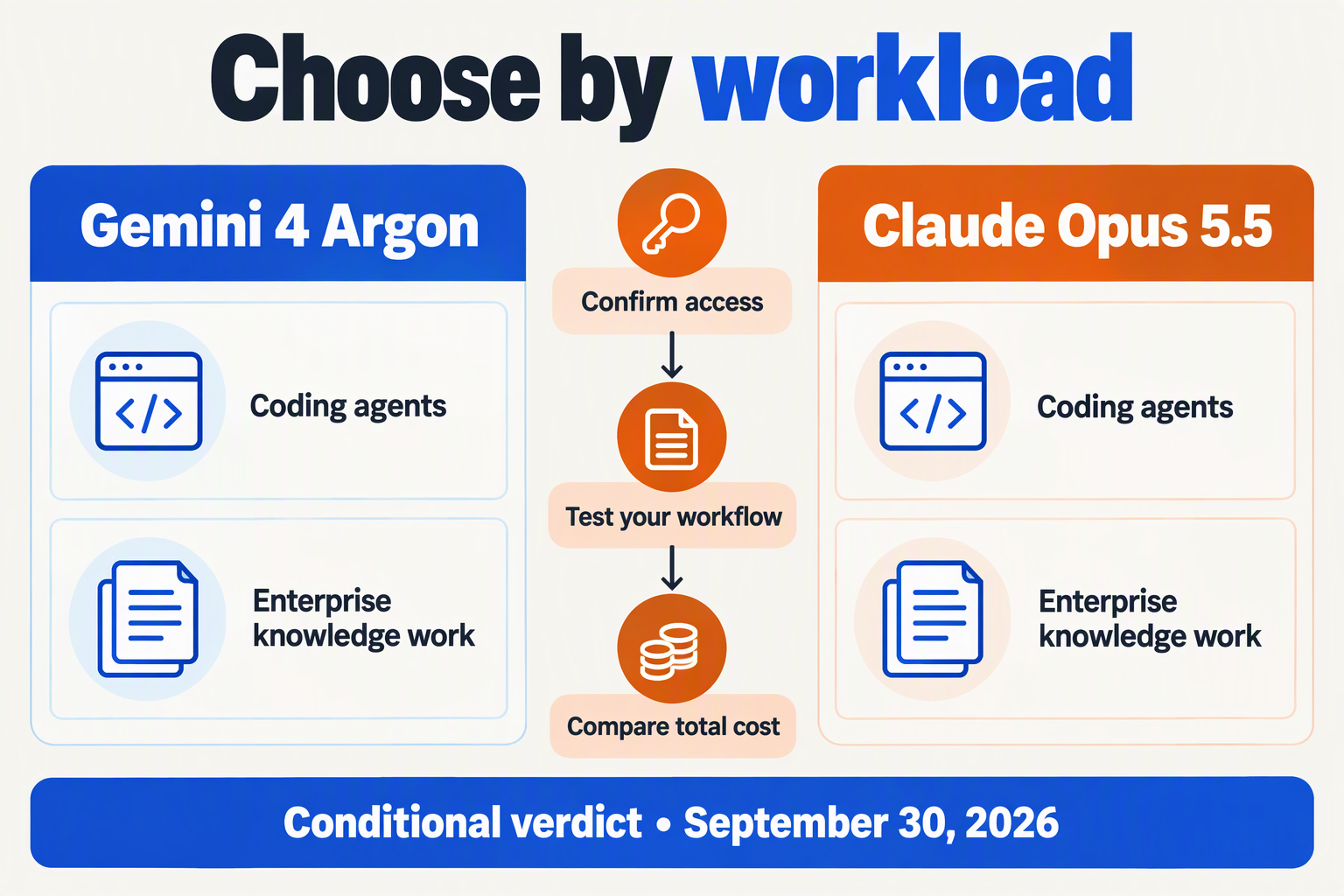
Neither model is a defensible universal winner for enterprise knowledge work as of September 30, 2026. Choose by verified access and performance on your documents—not marketing claims. Google’s September 30 Argon announcement describes limited access for trusted cyber defenders through the Fairwind Program, while Anthropic’s official model page documents Claude Opus 5.5 as released on September 22.
How should teams evaluate enterprise knowledge work?
- Verify deployability first: Gemini 4 Argon’s Fairwind rollout is not general availability. Confirm that your organisation qualifies and that its permitted use covers your workflow before planning a deployment. Claude Opus 5.5 has the official model identifier
claude-opus-5-5; verify access through your intended endpoint and the applicable commercial terms. A documented release does not, by itself, establish suitability for your organisation’s data.
- Test grounded document answers: Give both candidates the same authorised document set, including conflicting versions, outdated policies and incomplete records. Require each answer to identify the relevant document and passage, distinguish current policy from superseded material, and flag unresolved contradictions. Measure correctness and evidence support—not simply fluency or answer length.
- Check citations and abstention separately: A citation is useful only if the cited passage supports the claim. Audit citation accuracy, unsupported assertions and whether the model says “the supplied documents do not establish this” when evidence is missing. Include questions that cannot be answered from the corpus. These are proposed acceptance tests, not published head-to-head benchmarks.
- Validate data controls across the whole system: Test retrieval permissions with users who have different access rights. Require the workflow to withhold restricted material, including in summaries and citations. Obtain documented retention, training-use, deletion and audit provisions for the deployment you intend to use. Model capability, retrieval enforcement and contractual data controls are separate checks; none should be inferred from enterprise positioning.
- Compare documented capacity and completed-task cost: Anthropic’s official model page lists 1 million tokens of context, 128,000 tokens of output and always-on adaptive thinking for Opus 5.5. Its listed prices are $4 per million input tokens, $20 per million output tokens and $0.20 per million cache-read tokens. Google’s Argon announcement lists introductory pricing of $2/$10 per million input/output tokens, with eligible cached input implying $0.10 per million tokens from the stated 95% discount, and later pricing of $4/$20. No verified expiry date for the introductory pricing is established here. Confirm eligibility and effective rates, then include retrieval, retries and human review in your comparison. A larger context window or lower token price is not proof of better grounded answers.
- Apply two decision gates: Require documented access and acceptable data controls first, then workload acceptance for answer accuracy, citation support and appropriate abstention. If only one candidate clears both gates, choose it for that knowledge workflow—not as a universal champion. If neither does, evaluate an officially accessible alternative rather than relying on a roadmap.
Sources: Google’s September 30, 2026 Argon announcement; Anthropic’s official Claude Opus 5.5 model page and September 22 release information.
What do official sources confirm as of September 30, 2026?
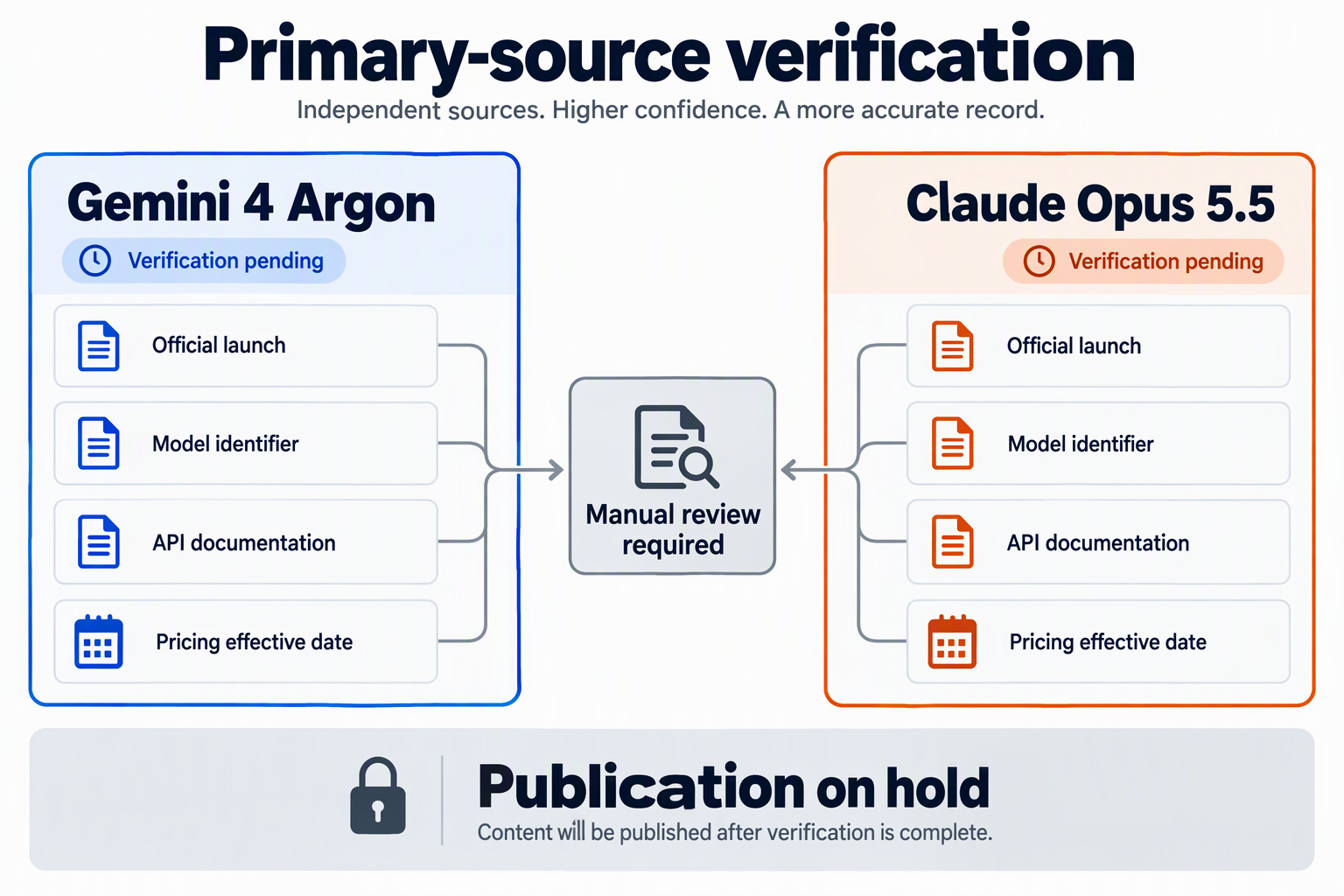
The supplied Google source supports the Gemini 4 Argon name; the supplied context does not verify Claude Opus 5.5 through Anthropic. As of September 30, 2026, this comparison should remain on hold for manual review, not proceed as a verified head-to-head evaluation.
Which model names and release claims are supported?
- Gemini 4 Argon: Google’s supplied announcement is titled “Gemini 4 Argon: our next era of frontier intelligence,” establishing that exact product name in the provided official-source evidence. As of September 30, 2026, the excerpt does not establish an API model identifier, versioned endpoint or generally available production SKU; those require separate documentation.
- Claude Opus 5.5: No Anthropic announcement, model documentation or release note confirming this exact name appears in the supplied context as of September 30, 2026. The correct editorial label is “unverified in supplied evidence,” not “released,” “unavailable” or “nonexistent”: missing evidence cannot establish any of those broader conclusions.
- Google’s rollout language: As of September 30, 2026, the supplied Google excerpt says Argon is “currently rolling out to trusted cyber defenders through the Fairwind Program.” That identifies a targeted audience and named program, but does not confirm access for an ordinary software team, enterprise knowledge-work deployment or self-service API customer.
- Google’s capability language: The supplied Google announcement describes Argon as a frontier model for “real-world coding, enterprise knowledge work and cyber defense.” As of September 30, 2026, treat that wording as vendor positioning, not a measured outcome: the excerpt supplies no task-completion percentage, agent runtime limit or reproducible benchmark methodology.
What must manual review verify before publication?
- Source authenticity and dates: Reviewers should open Google’s full Argon announcement and locate a corresponding Anthropic primary source for Claude Opus 5.5. Record publication dates, update dates and exact model names against the September 30, 2026 cutoff; the supplied search excerpts alone do not establish when each page was published.
- Deployment specifications: For both named models, reviewers need official context-window limits, maximum output tokens, supported tool interfaces and documented availability. None of those specifications is established for these exact models by the supplied September 30, 2026 evidence, so numbers from other Gemini or Claude versions must not be substituted.
- Commercial and enterprise terms: Verify input-token pricing, output-token pricing, caching charges, rate limits, supported regions and applicable data-handling terms in dated vendor documentation. As of September 30, 2026, this context supplies no verified prices or contractual controls for either named model; a procurement recommendation would therefore outrun the evidence.
- Publication decision: Keep performance tables, cost calculations and winner labels blocked until both model identities and comparable specifications pass review. If Anthropic confirmation remains missing, publish a clearly scoped Google Argon announcement analysis instead of a definitive “Gemini 4 Argon vs Claude Opus 5.5” comparison; preserve the distinction between an announced model and a verified deployment option.
How do access, context, output, reasoning, tools, caching, safety and integration compare? Cite official launch and API sources per row
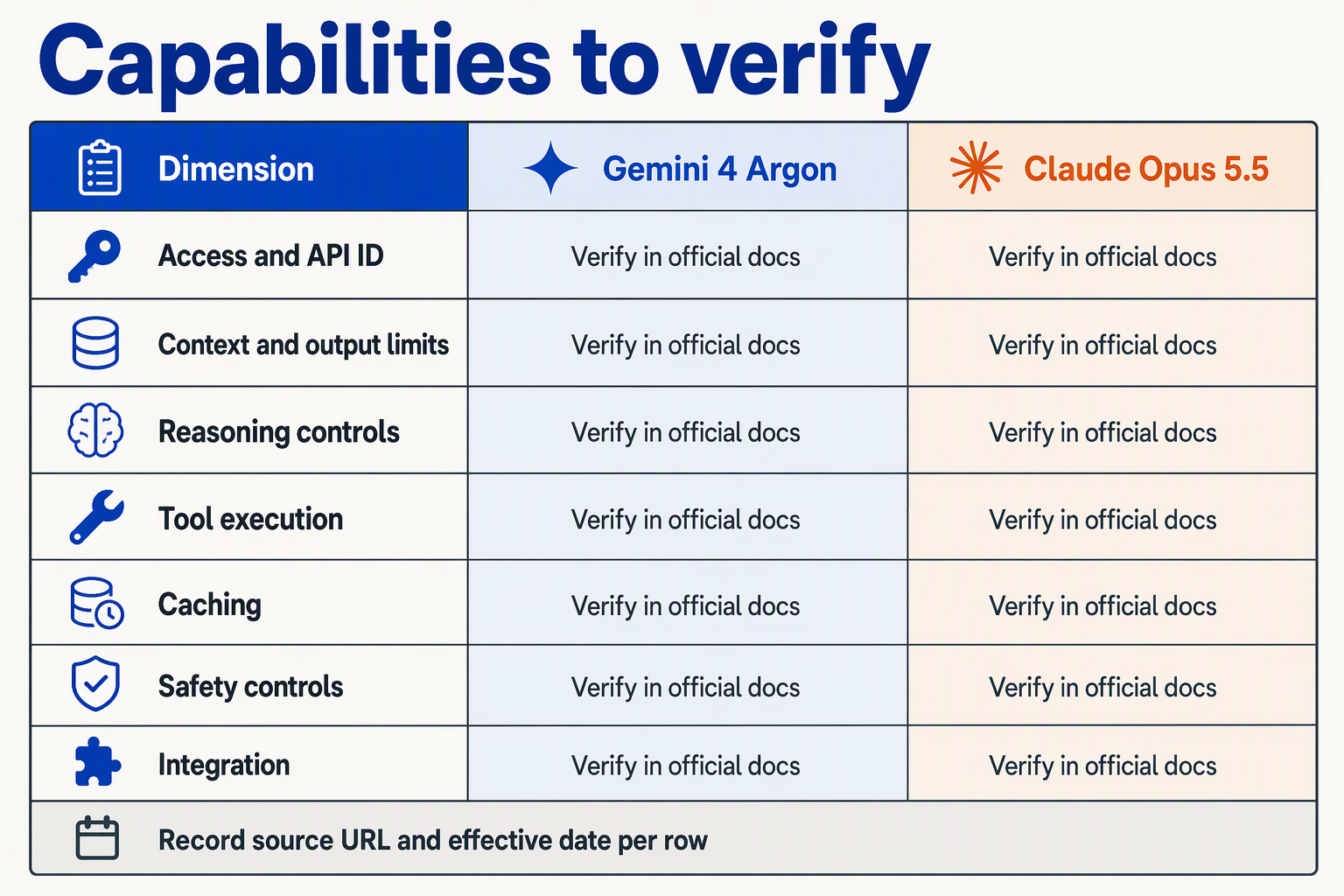
Access is the only deployment dimension directly established by the supplied Argon launch excerpt; the remaining specifications are unverified. As of September 30, 2026, the evidence below supports a procurement checklist—not a feature-parity claim.
| Dimension | Gemini 4 Argon | Claude Opus 5.5 | Official-source evidence supplied |
|---|---|---|---|
| Access | Targeted rollout to trusted cyber defenders through Google’s Fairwind Program; general access unconfirmed. | Availability and eligibility unconfirmed. | Google’s “Gemini 4 Argon: our next era of frontier intelligence”; no Anthropic launch source supplied. |
| Context window | Input-token limit and long-context restrictions unspecified. | Input-token limit and restrictions unconfirmed. | Google launch excerpt provides no limit; neither model’s API specification supplied. |
| Maximum output | Output-token ceiling unspecified. | Output-token ceiling unconfirmed. | Google launch excerpt provides no ceiling; neither model’s API specification supplied. |
| Reasoning controls | Reasoning budgets, effort settings and billing unspecified. | Reasoning controls and billing unconfirmed. | Google launch excerpt provides no controls; neither model’s API specification supplied. |
| Tools | Function calling, execution environments and tool permissions unspecified. | Tool interfaces and permissions unconfirmed. | Google names coding as a target workload, not an API capability specification; no Anthropic source supplied. |
| Caching | Cache support, retention, minimum size and pricing unspecified. | Cache behavior and pricing unconfirmed. | Neither model’s official caching documentation supplied. |
| Safety | Google says it prioritizes “safety and rigorous testing” before wider release. | Model-specific safety findings unconfirmed. | Google’s Argon launch excerpt; no Anthropic launch or safety report supplied. |
| Integration | Model identifier, endpoints, SDK support and deployment channels unspecified. | Model identifier, endpoints and SDK support unconfirmed. | Neither model’s official API reference supplied; launch language alone does not establish integration support. |
What should teams verify before connecting either model to production?
- Access: Request the exact model identifier, approved deployment channel and contractual availability; access to a vendor’s assistant application does not establish access to this particular model.
- Context and output: Obtain both token ceilings, then test a repository change requiring source files, logs, tests and a final patch; a large input allowance alone does not guarantee sufficient output.
- Reasoning: Confirm supported effort controls and charging rules before budgeting overnight agents; measure completed tasks and total spend rather than assuming additional reasoning always improves results.
- Tools: Verify permission boundaries, approval gates and failure recovery; use a sandboxed command that fails deliberately to check whether the agent retries safely or requests assistance.
- Caching and safety: Require documented retention, cache charges and data-handling terms; Google’s testing statement does not, by itself, establish compliance certification or protection against prompt injection.
- Integration: As of September 2026, CallMissed, the developer AI API, offers OpenAI-compatible and Anthropic-compatible endpoints plus caller-chosen fallback models; those capabilities do not establish availability of either named model.
Unspecified does not mean unsupported. It means the supplied official evidence cannot substantiate the capability, limit or price. Before selecting either model, replace each unknown with a dated vendor document and a reproducible acceptance test; do not substitute specifications from another Gemini or Claude release.
What does each model cost? Separate standard and introductory rates, cache charges and hypothetical agent costs
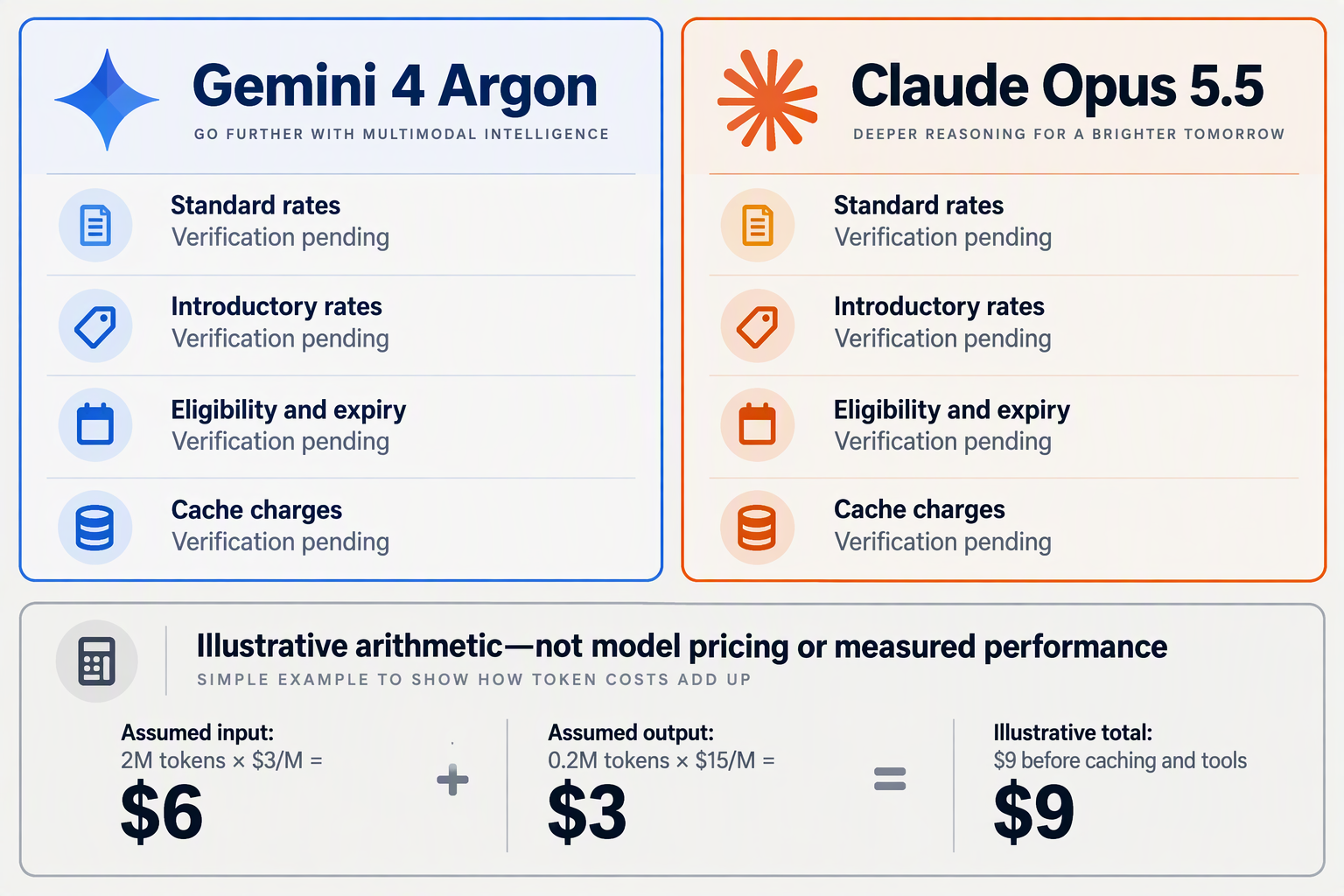
Neither Gemini 4 Argon nor Claude Opus 5.5 has a verifiable API price in the supplied official-source evidence as of September 30, 2026. Separate unknown vendor rates from illustrative budgets: introductory discounts and cache savings cannot be assumed.
- Gemini 4 Argon: Google’s announcement describes access through the Fairwind Program, but the supplied excerpt provides no standard token rates, introductory offer or cache tariff.
- Claude Opus 5.5: No official Anthropic announcement or pricing documentation appears in the supplied context; rates from another Claude model cannot establish this model’s cost.
What standard, introductory and cache rates are verified?
The table records the evidence available for this comparison on September 30, 2026, not a claim that pricing documentation cannot exist elsewhere.
| Charge or condition | Gemini 4 Argon | Claude Opus 5.5 |
|---|---|---|
| Standard input, per 1M tokens | Not established | Not established |
| Standard output, per 1M tokens | Not established | Not established |
| Introductory input/output rates | Not established | Not established |
| Introductory expiry and eligibility | Not established | Not established |
| Cache-read rate, per 1M tokens | Not established | Not established |
| Cache-write/storage charges | Not established | Not established |
- Standard versus introductory: Record both prices separately, together with the promotion’s end date, eligible accounts and applicable deployment channel. An introductory quote is not a defensible steady-state enterprise budget; neither model’s introductory terms are established by the September 2026 evidence supplied here.
- Cache accounting: Distinguish uncached input, cache reads, cache creation and any storage-duration charges. Repeated repository instructions or enterprise documents create a potential caching opportunity, but actual savings depend on supported caching behavior, reuse frequency and the verified tariff—not merely the amount of repeated text.
How much could a long-running coding agent cost?
- Hypothetical workload: For a September 2026 planning exercise—not a Google or Anthropic quote—assume 10 million input tokens and 200,000 output tokens across one assignment, including repeated context. At invented budgeting rates of $2/1M input and $10/1M output, the uncached token bill would be $22.
- Hypothetical cached workload: If 8 million input tokens instead qualify for a hypothetical $0.20/1M cache-read rate, the calculation becomes $4 uncached input + $1.60 cache reads + $2 output = $7.60. That is approximately 65.5% below $22, before cache-write, storage, tool or infrastructure charges.
How should enterprises turn token prices into a procurement budget?
- Obtain the exact tariff: Confirm model identifier, billing currency, deployment channel, standard rates and introductory conditions; do not substitute Gemini app subscription pricing for Argon API pricing.
- Measure complete assignments: Include planning, document retrieval, test output, failed attempts and retries—not just the final answer or accepted patch.
- Compare cost per accepted outcome: Divide the complete workload bill by successfully reviewed deliverables. A cheaper token rate can still produce a more expensive assignment when retries consume additional tokens; measure that trade-off rather than assuming either model wins.
What are the practical pros and cons? Separate documented limits from benchmark claims and test results
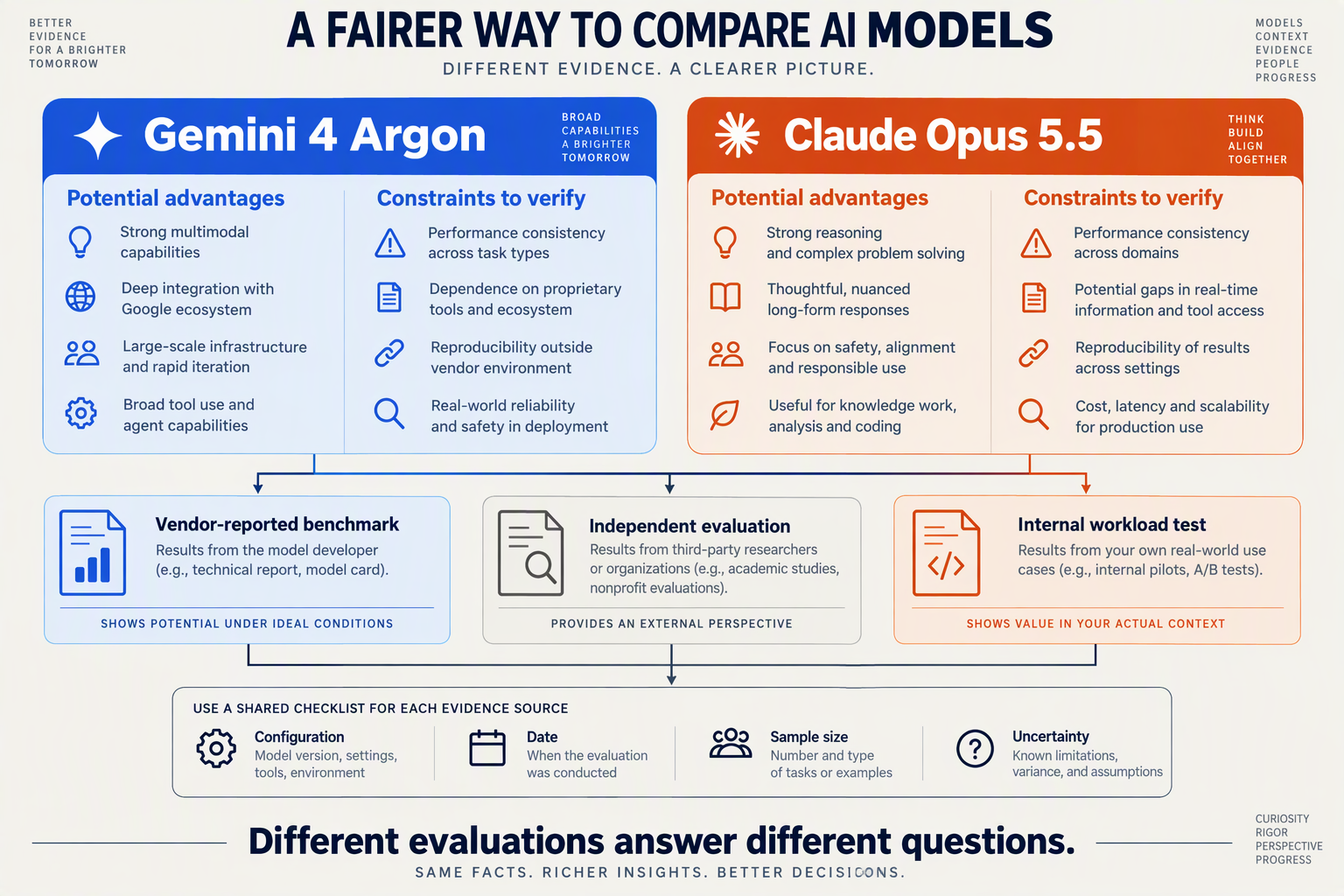
Gemini 4 Argon’s practical advantage is a documented target use case; its constraint is restricted rollout. Claude Opus 5.5 cannot receive a defensible pros-and-cons rating from the supplied evidence because official Anthropic specifications and results are missing as of September 30, 2026.
Which advantages and limits are actually documented?
The table distinguishes documented statements, missing specifications and unavailable test evidence; “not supplied” does not mean a capability is absent. All entries reflect the supplied source context as of September 30, 2026.
| Decision factor | Gemini 4 Argon | Claude Opus 5.5 | Practical implication |
|---|---|---|---|
| Intended workloads | Google names “real-world coding, enterprise knowledge work and cyber defense.” | No official Anthropic positioning supplied. | Argon’s stated scope fits these workloads, but scope is not measured reliability. |
| Access | Google describes rollout to trusted cyber defenders through the Fairwind Program. | No official access documentation supplied. | Confirm eligibility and working credentials before scheduling either pilot. |
| Wider release | Google says safety and rigorous testing precede wider release; no date appears in the supplied excerpt. | No release schedule supplied. | Neither candidate has an established general-deployment timetable in this evidence. |
| Context and execution limits | No context-window, output-token or session-duration specifications supplied. | No corresponding specifications supplied. | Repository size and sustained execution capacity remain unresolved. |
| Pricing and quotas | No Argon-specific prices or rate limits supplied. | No Opus 5.5-specific prices or rate limits supplied. | Cost per completed task cannot yet be calculated defensibly. |
| Benchmarks and practical tests | No numerical benchmark scores or reproducible task results supplied. | No numerical benchmark scores or reproducible task results supplied. | A performance ranking would exceed the evidence available. |
How should teams turn those gaps into a practical evaluation?
- Gemini 4 Argon: Treat Google’s September 2026 description as evidence of intended application, not proof that an agent can finish unattended repository changes or produce fully grounded enterprise answers.
- Claude Opus 5.5: Require an official Anthropic model identifier, access terms and specifications before procurement scoring; missing documentation should remain unverified, rather than becoming an invented disadvantage.
- Coding test: Use a proposed 20-task pilot covering patches, test updates and interrupted runs; record completion rate, human interventions and total cost under identical permissions and tool settings.
- Knowledge-work test: Use a proposed 20-question set containing conflicting and inaccessible documents; measure supported claims, citation correctness and permission violations, not merely answer fluency.
- Benchmark claims: Record the publisher, evaluation date, agent harness, tool budget and scoring rules alongside every score; compare results only when those conditions are sufficiently aligned.
- CallMissed: As of September 2026, CallMissed offers caller-chosen fallback models and usage and request logs; those infrastructure capabilities can support operational evaluation, but do not establish that either named candidate is available through its API.
Which should you choose for long-running coding agents or enterprise knowledge work? Use a reproducible pilot
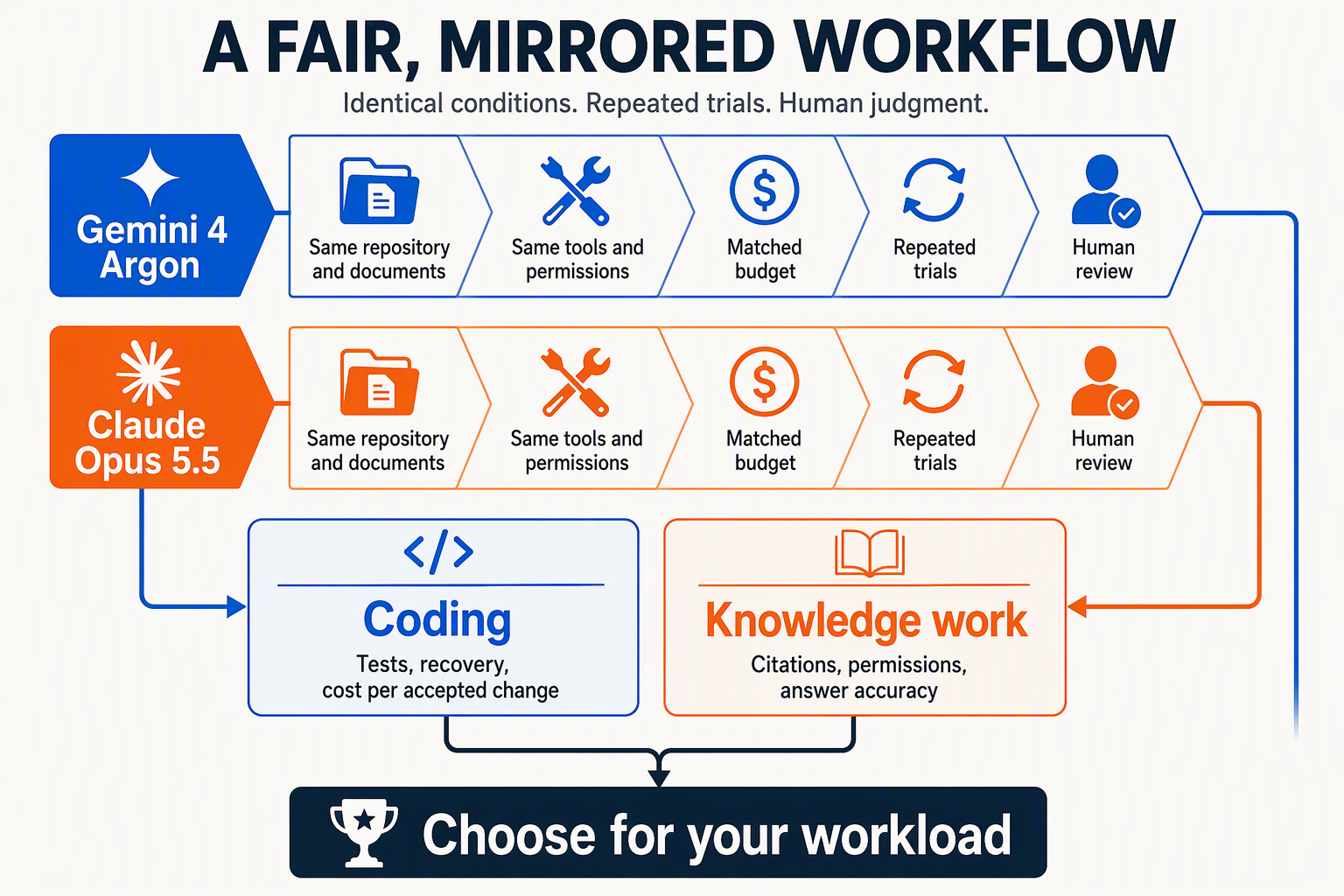
Choose the model that passes a reproducible, workload-specific pilot, not the one with the stronger announcement. For Gemini 4 Argon vs Claude Opus 5.5, confirm access and documented specifications before treating either as a deployable option.
How should you test long-running coding agents?
- Access gate: In the supplied context reviewed as of September 30, 2026, Google describes Gemini 4 Argon as “currently rolling out to trusted cyber defenders through the Fairwind Program.” Require an accessible endpoint and documented usage terms before testing; the supplied evidence does not establish an official Anthropic release for Claude Opus 5.5.
- Frozen test harness: Use a proposed 20-task coding suite, covering bug fixes, dependency upgrades, refactoring and security-sensitive changes. Pin the repository commit, container image, system prompt, tool permissions and test commands. Record the exact model identifier and configuration, so another engineer can reproduce the comparison rather than evaluate an undocumented moving target.
- Repeated execution: Run each task 3 times per accessible model, producing 60 runs per model. Apply identical proposed limits—such as 90 minutes and 100 tool calls per run—and log interruptions, retries and human assistance. Include one controlled tool failure per task to evaluate recovery, not merely uninterrupted completion.
- Coding acceptance: Count a task as successful only when required tests pass, acceptance criteria are satisfied and a blinded reviewer approves the patch. Report accepted patches divided by attempted tasks, plus median and p95 completion time. Track security regressions separately: a faster patch should not compensate for an unauthorized or unsafe change.
How should you test enterprise knowledge work?
- Grounding suite: Build a proposed 20-question evaluation from authorized documents: 10 answerable questions, 5 conflicting-source questions and 5 deliberately unanswerable questions. Freeze document versions and retrieval settings. Require citations to supporting passages, explicit treatment of conflicting evidence and abstention when the corpus cannot support an answer; these are proposed test conditions, not vendor benchmarks.
- Permission boundary: Test 2 user roles against the same corpus and include 5 adversarial documents containing instructions to disclose restricted material or override policy. Set zero unauthorized disclosures as a mandatory acceptance gate. Log retrieval results as well as final answers, because an apparently safe response can conceal an unsafe upstream retrieval.
- Cost and observability: Calculate total metered spend divided by accepted outcomes, including failed runs and retries; record provider prices and currencies as of September 30, 2026. CallMissed’s verified fact sheet lists usage and request logs and caller-chosen fallback models as of that month. Those capabilities do not establish availability of either named model through CallMissed.
- Decision rule: Set thresholds before inspecting results—for example, a proposed 80% accepted-task rate, 95% citation correctness and zero unauthorized disclosures. Choose separately for coding and knowledge work if results diverge. If access remains unavailable or neither candidate passes, use an already accessible model under the same harness rather than declare a speculative winner.
Which benchmark headlines matter? Verify Gemini 4 Argon High, Opus 5.5 High, DeepSWE v1.1 and Gray Swan claims before interpretation
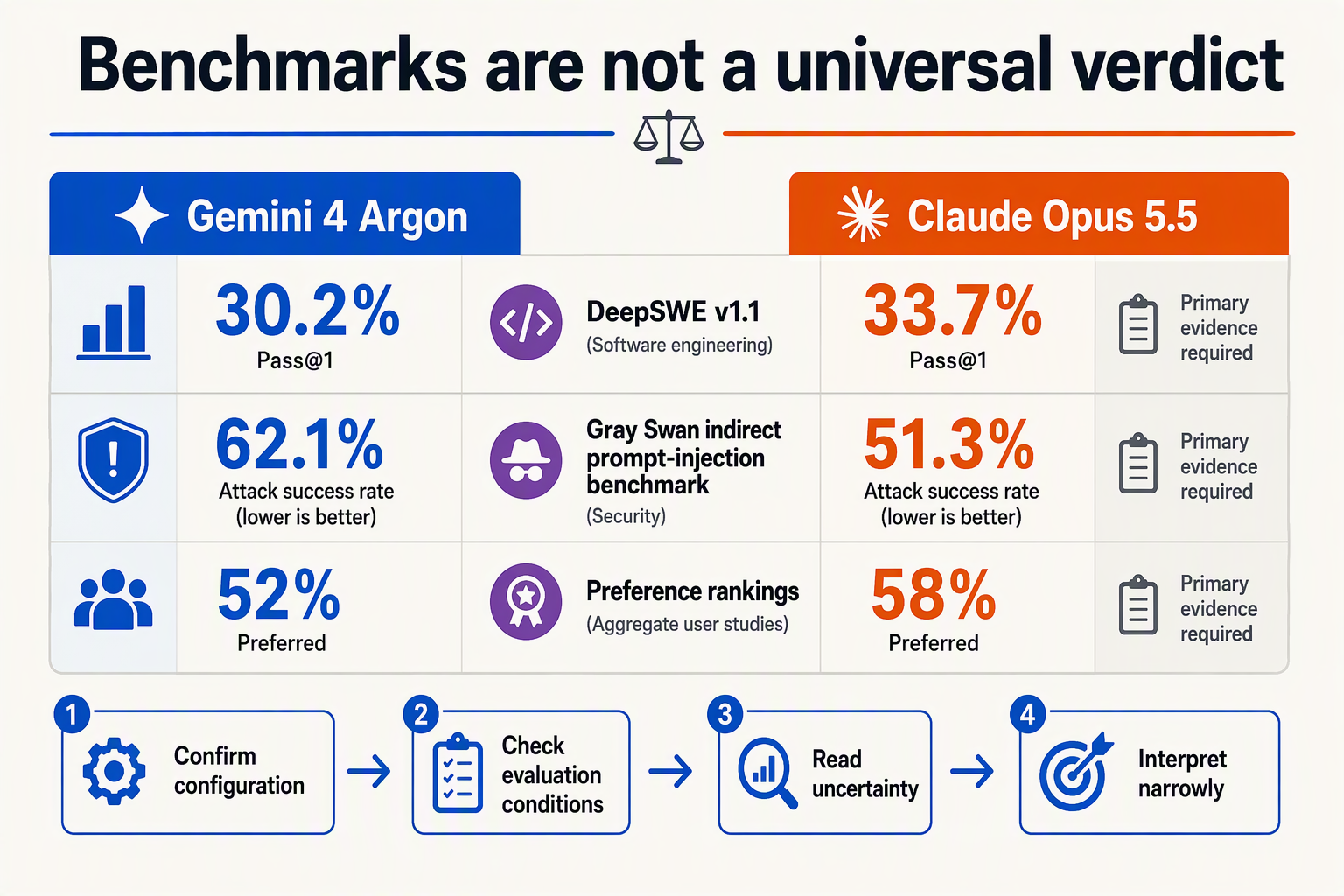
None of the four benchmark headlines supports a defensible ranking from the supplied evidence as of September 30, 2026. Treat “High” labels and benchmark names as claims requiring source verification—not as comparable scores.
Are Gemini 4 Argon High and Claude Opus 5.5 High verified configurations?
- Gemini 4 Argon High: Google’s supplied announcement describes Argon as targeting “real-world coding, enterprise knowledge work and cyber defense,” but the excerpt provides no High configuration, benchmark score or evaluation settings. As of September 30, 2026, that statement establishes intended applications, not measured performance under a reproducible test.
- Claude Opus 5.5 High: The supplied context contains no official Anthropic benchmark report establishing this model-and-setting combination as of September 30, 2026. Before quoting a comparison, obtain the exact model identifier, publication date and configuration description; do not interpret “High” as a standardized setting shared with Google.
- High versus High: Require three disclosed budgets before treating the labels as equivalent: reasoning allowance, tool-call allowance and elapsed-time limit. These are proposed comparison requirements, not documented specifications for either model. Equal labels can conceal different resource allocations, making a headline score unsuitable for predicting production cost or completion time.
What evidence would make DeepSWE v1.1 and Gray Swan claims useful?
- DeepSWE v1.1: No originating report, task definition or result appears in the supplied context as of September 30, 2026. Verify what the name identifies before calling it a benchmark, agent system or evaluation harness. Then request the task count, repository selection, scoring rules and exact version used for each reported result.
- Gray Swan: The supplied context provides no attributed Gray Swan result, percentage or methodology as of September 30, 2026. Establish the evaluated behavior first: a result about resisting adversarial instructions would not automatically establish coding competence or document-grounded accuracy. Check attack access, permitted tools and the definition of success before interpreting any headline.
- Coding-agent scores: Ask whether the reported metric measures one attempt or multiple attempts, and whether the agent received test feedback before submitting its patch. For example, a patch produced after repeated retries should not be presented as first-attempt reliability. Record human interventions separately from autonomous task completion.
- Enterprise knowledge-work scores: Require separate evidence for answer correctness, citation support and permission compliance. A response can contain a correct conclusion while citing an irrelevant document or exposing restricted information. For a practical pilot, score those three outcomes independently rather than allowing a single aggregate percentage to hide deployment-critical failures.
- Operational validation: As of September 2026, CallMissed’s verified developer API offers usage and request logs, caller-chosen fallback models and reasoning-effort control. Those capabilities can support instrumented evaluations where applicable; they do not establish availability of either named model or validate an external benchmark. Keep measured workflow results separate from vendor leaderboard claims.
Frequently Asked Questions
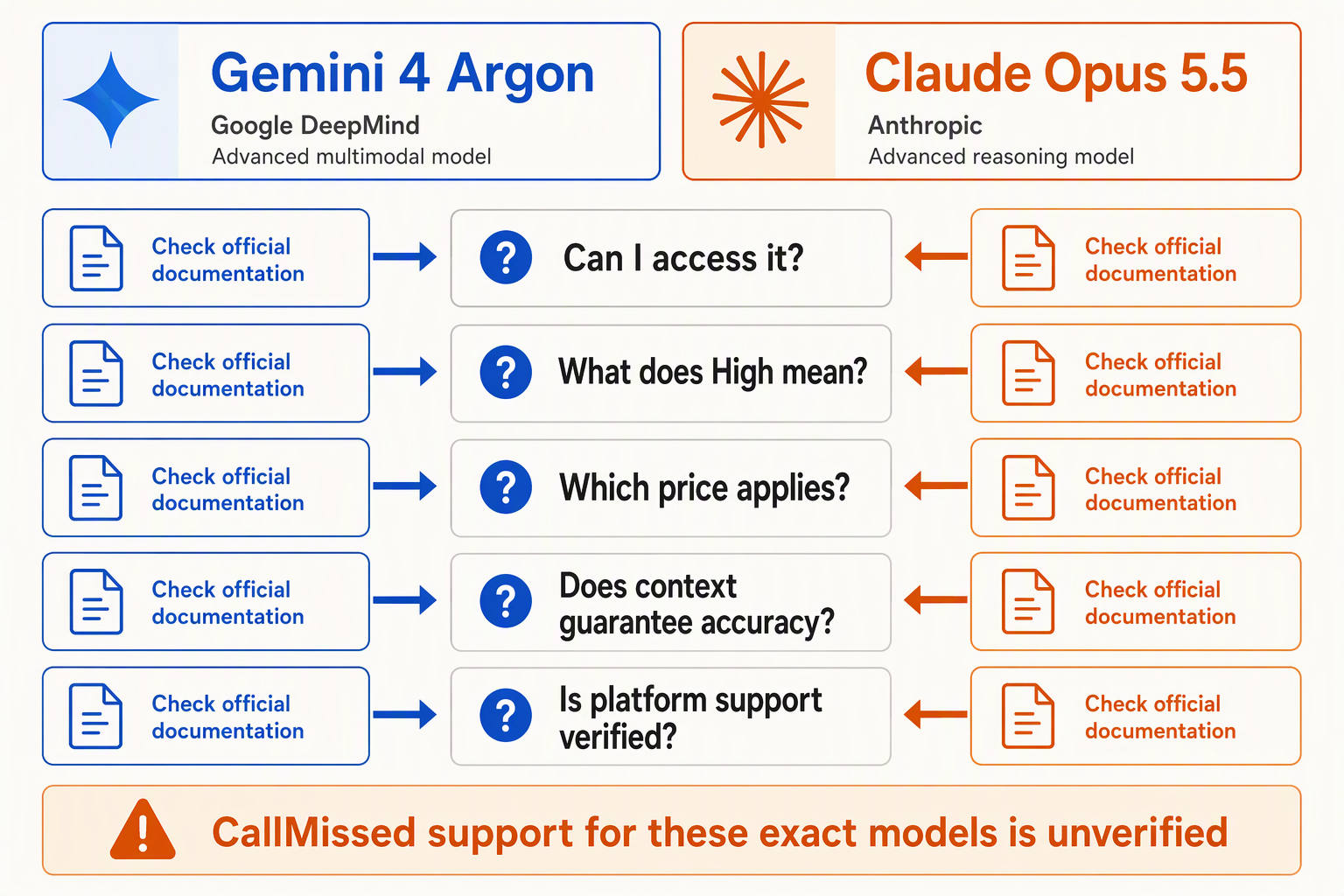
Can I access both models in Gemini 4 Argon vs Claude Opus 5.5 today?
Is “High” equivalent across Gemini 4 Argon vs Claude Opus 5.5?
Which price applies to Gemini 4 Argon or Claude Opus 5.5?
Does a larger context window guarantee accurate enterprise answers?
Are Gemini 4 Argon and Claude Opus 5.5 available on CallMissed?
Which model should enterprises choose for long-running coding agents?
Conclusion
Gemini 4 Argon vs Claude Opus 5.5 has no defensible winner in the supplied official-source evidence as of September 30, 2026. For long-running coding agents and enterprise knowledge work, the decision should rest on documented access, dependable execution and traceable results—not the promise of a model name.
- Separate announcements from deployable capabilities. Google’s Gemini 4 Argon announcement describes a model for “real-world coding, enterprise knowledge work and cyber defense,” with a targeted rollout to trusted cyber defenders through the Fairwind Program. Google also emphasizes safety and rigorous testing before wider release. That establishes direction and restricted access; it does not establish broad production availability, pricing or proven reliability for your organization’s workloads. Treat those unanswered questions as deployment gates, not minor details.
- Keep the Claude comparison explicitly provisional. As of September 30, 2026, the supplied context includes no official Anthropic announcement or specification for Claude Opus 5.5. Its availability, pricing and performance therefore remain unconfirmed here. A practical comparison should preserve that evidence gap rather than manufacture a symmetrical scorecard. Teams can define evaluation criteria now, but a purchasing recommendation requires documentation and access that allow both models to be assessed against the same tasks.
- Measure complete workflows, not isolated answers. A long-running coding agent must follow requirements, make coherent changes, run checks and recover from failed tools or interrupted sessions. The authentication-update example captures the distinction: a plausible patch is insufficient without reproducible tests, clear assumptions and an auditable explanation of security implications. Evaluate how much human intervention the entire assignment requires, and whether the final deliverables remain reviewable after something goes wrong.
- Make grounding and operational constraints central. Enterprise knowledge work needs conclusions that can be traced to authorized documents, alongside clearly documented permissions and deployment options. Google’s reported Gemini ecosystem reach is context, not evidence of Argon’s suitability for a particular enterprise workflow. Keep vendor claims, verified capabilities and unresolved questions separate, then apply the same evidence standard to task completion, state recovery, knowledge grounding and access before committing a workflow to production.
Looking ahead, watch for wider Argon availability, official Anthropic documentation and reproducible workflow evaluations that make this comparison actionable. As of September 2026, readers can also explore CallMissed’s OpenAI-compatible and Anthropic-compatible endpoints, caller-chosen fallback models, and usage and request logs as infrastructure options for working across models; these capabilities do not establish access to either model discussed here.
The next useful step is to define a representative coding or knowledge-work assignment with explicit acceptance criteria. Which agent can finish your real task, recover from failure and leave evidence your team can trust?
Related Reading
- Gemini 4 Argon vs GPT-6.1 Sol: Coding & Agent Work
- Gemini 4 Argon Pricing vs Claude Sonnet 5.5: Coding
- Gemini 4 Argon vs GPT-6.1 Sol: Coding & Agents (2026)
Sources
Discussion
Related Posts



Ready to automate customer conversations?
Launch AI voice agents and WhatsApp bots with CallMissed — one API, 22+ Indian languages.