Free AI APIs for Prototyping: Voice App Buyer’s Guide


Compare free AI APIs for prototyping voice apps by trial credits, audio limits, language support and phone costs to choose a workable stack.

Free AI APIs for Prototyping: Voice App Buyer’s Guide
Can a “free” voice API still leave you paying for every test call? Yes: free AI APIs for prototyping may offer trial credits or free model access while billing separately for speech processing, voice generation, orchestration, and telephone connectivity.
That distinction matters when you are building a voice assistant, not just testing a chatbot. A successful prototype must hear real speech, generate useful answers, and speak back without making the conversation feel awkward—and its free allowance needs to cover the components you actually use.
According to Retell AI’s pricing page, as of November 2026, new users receive $10 in free credits, while AI voice agents cost $0.07–$0.31 per minute. Deepgram’s programmable voice-agent guide, available in November 2026, advertises $200 in signup credits for testing its speech-to-text, text-to-speech, or Voice Agent API. Those headline allowances are useful starting points, but they are not interchangeable measures of how much prototyping you can do.
What makes a free voice API useful for prototyping?
The useful allowance is the one that supports your intended workflow. A transcription experiment needs speech recognition; an interactive voice agent also needs a language model, speech generation, and a way to manage the live conversation.
This buyer’s guide separates three offers that are often grouped under “free”:
- Free model access: Check which models qualify and what request limits apply.
- Signup credits: Treat the balance as a testing budget, not a promise of permanently free usage.
- Free infrastructure allowances: Identify which inference, telephony, and other charges remain outside the allowance.
As of November 2026, CallMissed, the OpenAI-compatible developer AI API, offers 1,000 signup credits, 21 free-tier models across its catalogue, and access to 159 models through one API key and balance—an example of the broader shift toward testing multiple AI components through a single integration.
The practical question is not simply “Which provider gives more?” It is “Which allowance lets my team validate the riskiest part of this application before paying?”
How should buyers compare voice API free tiers?
Start with the same small, repeatable test across providers. For example, a booking assistant should handle a clear request, background noise, an interrupted answer, and a correction to the appointment time.
Record both conversation quality and the usage each test consumes. A generous credit balance has limited value if the prototype cannot handle your target language or requires substantial integration work before the first conversation.
This guide compares free-tier structure, stack coverage, developer compatibility, testing constraints, and paid conversion costs. You will learn how to distinguish a compelling signup offer from a practical development environment—and choose an API based on the voice application you need to prove, rather than the largest “free” number on a pricing page.
Which free AI APIs should you use to prototype a voice application?
Use Deepgram for speech-component experiments, Vapi or LiveKit for custom voice stacks, and Retell AI for phone-agent testing. Include CallMissed when SDK compatibility and Indian-language speech recognition are priorities; compare the cost of your actual test workflow, not just the advertised free allowance.
Which API fits the voice prototype you are building?
- Deepgram: Choose Deepgram when the first question is whether speech recognition, speech generation, or a managed voice agent handles your audio well. Deepgram’s programmable voice-agent guide, available as of November 2026, identifies three testing options: STT, TTS, and Voice Agent API. Test these separately before committing to an end-to-end architecture.
- Vapi: Choose Vapi when you want to compose a conversational stack rather than select one bundled configuration. Firecrawl’s August 2026 comparison lists $0.05 per minute for hosting, with STT, LLM, TTS, and telephony charged separately or supplied through your own providers. Confirm current allowances before treating any component as free.
- LiveKit: Choose LiveKit for an open-source, code-first real-time agent prototype. Firecrawl’s August 2026 comparison lists a $0 entry price with 1,000 agent minutes, while inference, telephony, and observability have separate meters. That makes the allowance useful for testing orchestration, but it does not establish that complete conversations cost nothing.
- CallMissed: As of November 2026, CallMissed’s verified product facts list OpenAI-compatible and Anthropic-compatible endpoints, a managed voice-agent WebSocket, and a 60-request-per-minute default Free-plan limit. Speech recognition supports 22 Indian languages plus English, including Hinglish; natural text-to-speech supports 10 Indian languages plus English. Check which selected models qualify for free-tier access.
Which limits should you check before choosing a free voice API?
- Retell AI concurrency: Retell AI’s pricing page lists 20 free concurrent calls as of November 2026. Use this to assess whether parallel conversation testing fits your prototype. “Free concurrent calls” describes available simultaneous-call capacity—not an allowance of free conversation minutes—so keep concurrency and usage charges separate in your evaluation.
- Retell AI component costs: As of November 2026, Retell AI’s pricing page lists voice infrastructure at $0.055 per minute and platform voices at $0.015 per minute. Together, those components cost $4.20 for 60 minutes, calculated before adding a language model, telephone connectivity, or other applicable charges.
- Vapi hosting budget: Using Firecrawl’s August 2026 hosting figure, 60 minutes on Vapi equals $3 in hosting alone. This is a worked estimate, not a complete voice-agent quote. Add your chosen transcription, model, speech-generation, and connectivity costs before deciding whether your testing budget covers the full stack.
- Buyer’s test: Run the same four scenarios across shortlisted APIs: a clear booking request, background noise, an interrupted answer, and a corrected appointment time. Record task completion, response delay, transcript accuracy, and total billed usage. Choose the provider that validates your hardest requirement within budget—not necessarily the provider advertising the largest allowance.
How do features, free allowances, paid prices and trade-offs compare?
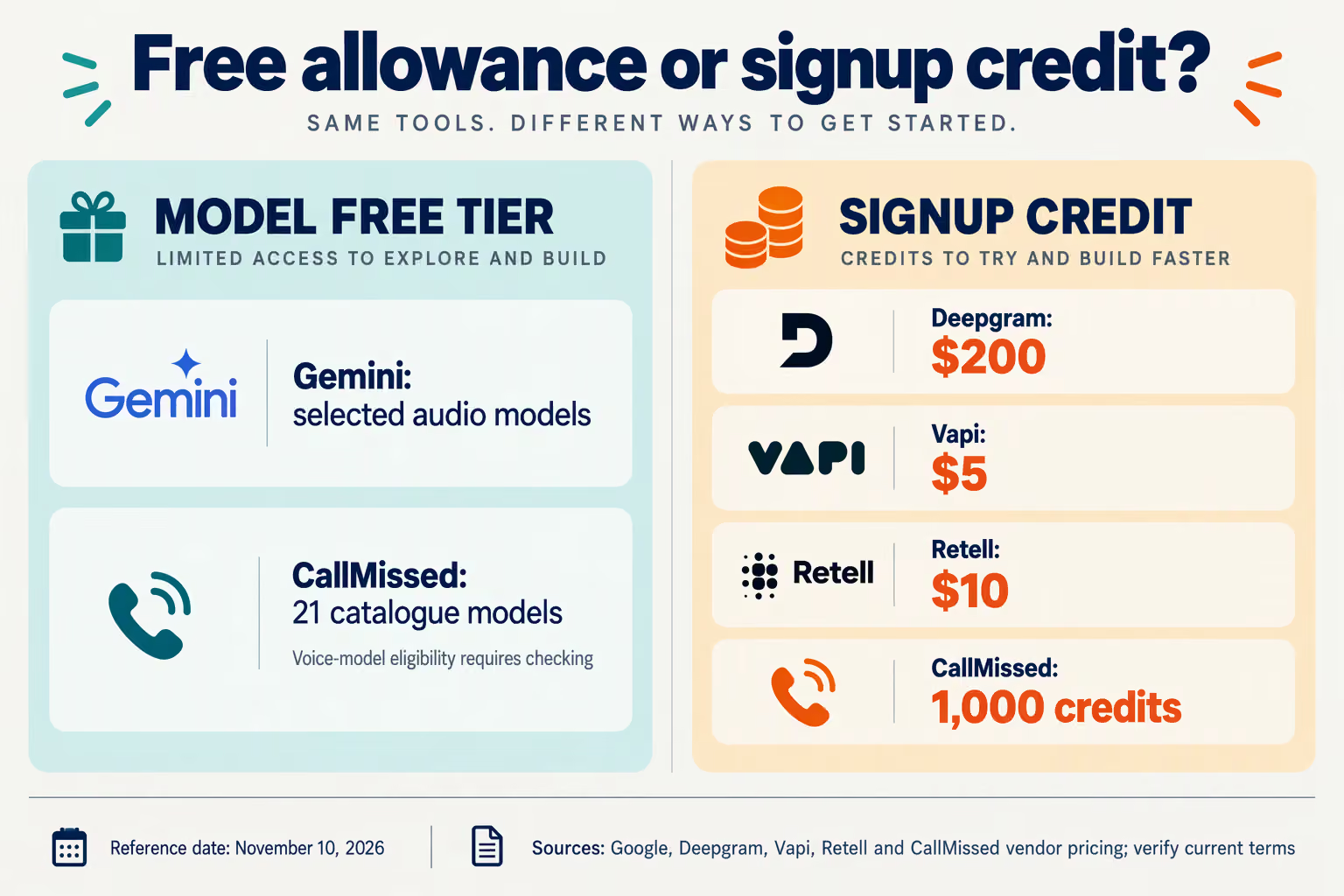
Free-tier AI APIs for prototyping voice applications differ most in what their allowance actually pays for: a complete conversation, individual speech components, or agent infrastructure.
- Stack coverage: Compare speech-to-text (STT), language-model inference, text-to-speech (TTS), orchestration, and telephone carriage separately; an infrastructure allowance does not automatically cover all five.
- Evidence dates: Retell AI and Deepgram figures below come from supplied sources available in November 2026; Vapi and LiveKit prices are August 2026 snapshots reported by Firecrawl, not verified November quotes.
- Trial economics: Retell AI’s $10 credit balance theoretically covers approximately 32–143 agent minutes at its advertised $0.07–$0.31/minute range, before any separately billed charges, according to its November 2026 pricing page.
- Testing limits: Retell AI lists 20 free concurrent-call slots in November 2026; these measure simultaneous capacity, not 20 free calls or an unlimited pool of free minutes.
| Provider | Features covered | Free allowance | Paid price and evidence date | Principal trade-off |
|---|---|---|---|---|
| CallMissed | OpenAI- and Anthropic-compatible developer endpoints; managed voice-agent WebSocket | 1,000 signup credits; 21 free-tier models; Free API limit: 60 requests/min | Standard voice agents: ₹4/min; Expressive: ₹5/min, as of November 2026 | Flat voice rates cover recognition, LLM and voice; phone carriage is separate; 30-second call minimum |
| Retell AI | AI voice agents with modular component pricing | $10 signup credits; 20 concurrent-call slots | $0.07–$0.31/min, according to Retell AI, November 2026 | Model, voice, telephony and add-on choices affect the final bill |
| Deepgram | STT, TTS and Voice Agent API testing | $200 signup credits | Paid rates not specified in the supplied Deepgram guide, available November 2026 | Credit size alone cannot establish comparable conversation minutes |
| Vapi | Developer-composed conversational voice stack | No quantified hosted trial allowance verified in supplied context | $0.05/min hosting, according to Firecrawl, August 2026 | STT, LLM, TTS and telephony are separate or bring-your-own |
| LiveKit | Open-source, code-first real-time agents | $0 entry tier with 1,000 agent minutes, according to Firecrawl, August 2026 | Overage rates not supplied; recheck current pricing | Inference, telephony and observability use separate meters |
How should you calculate a comparable prototype budget?
- CallMissed: Its verified November 2026 fact sheet values 1,000 signup credits at ₹1 each, implying a theoretical 250 Standard-plan agent minutes at ₹4/min if the entire balance funds that plan. Other usage, separately billed carriage and minimum billing can reduce that total; the Best latency plan costs ₹6/min, rising to ₹8/min for calls starting on or after 30 November 2026.
- Budget worksheet: Run the same 10 three-minute conversations through each candidate, then record agent charges, speech/model charges, carriage and minimum-billing effects separately. Divide total spend by 10 to compare cost per completed conversation; also record failures and interruptions, because inexpensive minutes are not necessarily inexpensive successful interactions.
Which language, telecom, privacy and integration constraints rule an API in or out?
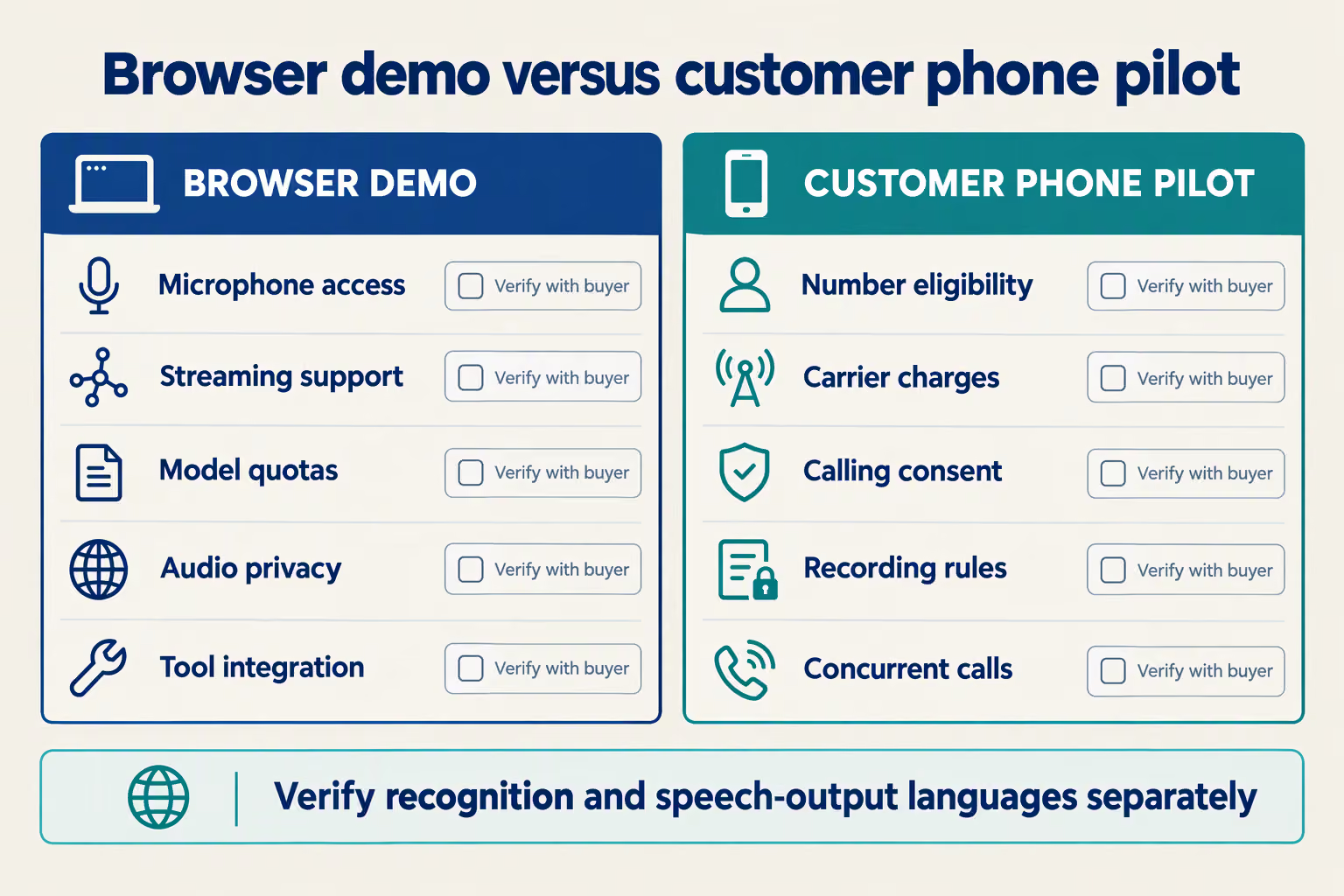
Rule out a voice API when it cannot support your target speech, calling route, data requirements, or existing application stack. For free tier AI APIs for prototyping voice applications, these constraints matter more than the headline allowance.
Which languages must a voice API support?
- CallMissed: As of November 2026, CallMissed’s verified product facts list speech recognition in 22 Indian languages plus English, including Hinglish, and natural text-to-speech in 10 Indian languages plus English. Check recognition and voice generation separately: support for understanding a language does not automatically establish equivalent spoken-output coverage.
- Language acceptance test: Build a four-part audio test covering your target language, code-switching, background noise, and local names or addresses. Score transcription accuracy and spoken pronunciation separately. A Hindi booking assistant, for example, must preserve an English street name and a corrected appointment time—not merely produce a plausible reply.
Which telecom constraints change the shortlist?
- Retell AI: According to Retell AI’s pricing page, as of November 2026, Retell phone numbers cost $2 per month, while custom phone numbers carry no Retell number charge. That distinction does not establish free carrier service; verify number availability, inbound and outbound permissions, and the separate carrier bill before testing.
- Vapi: Firecrawl’s August 2026 comparison lists Vapi hosting at $0.05 per minute, with speech recognition, language models, speech generation, and telephony separate or brought by the developer. For a telephone prototype, request a component-level estimate rather than treating the hosting rate as the complete calling price.
- LiveKit: Firecrawl’s August 2026 comparison lists LiveKit’s entry allowance as 1,000 agent minutes at $0, with inference, telephony, and observability metered separately. Distinguish browser-based conversation tests from public telephone calls: they validate different connectivity paths, and an agent-minute allowance does not establish an equivalent allowance of free telephone minutes.
What privacy and integration checks should block deployment?
- Data handling: Require explicit answers for audio, transcripts, prompts, and logs: storage location, retention period, deletion process, and downstream processors. The supplied provider context does not establish these policies across the shortlist. Use synthetic customer records until the relevant terms are confirmed; a generous trial is not evidence of privacy suitability.
- CallMissed integration: As of November 2026, CallMissed’s verified product facts specify an India-hosted platform, OpenAI-compatible and Anthropic-compatible endpoints, and a Twilio-compatible Calls API. These are useful integration checkpoints, but India hosting alone does not establish every downstream model’s processing location. Verify data flows, and test your actual SDK methods before assuming migration is frictionless.
- Tool execution: Test one complete workflow—such as retrieving appointment availability and confirming a booking—before choosing an API. Check authentication, timeout handling, structured responses, and human escalation in your prototype. A successful voice demo proves conversational capability; it does not yet prove that the application can safely complete business transactions.
How can you test a hosted API against a local speech engine with the same voice prototype?
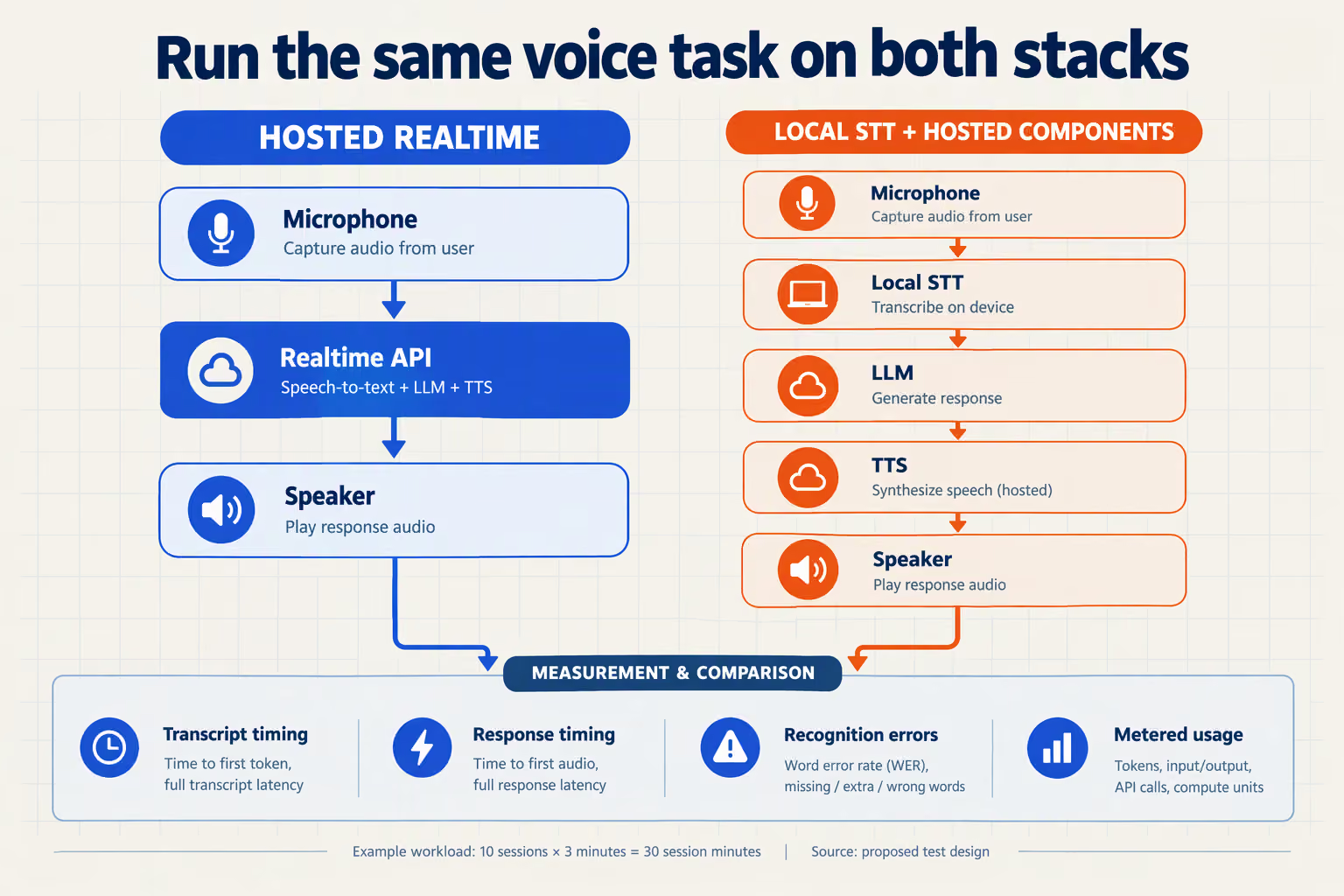
Test a hosted API against a local speech engine by swapping only the speech component while keeping the audio, language model, prompts, and scoring identical. Run component tests first, then live conversations; otherwise, differences elsewhere in the stack can distort your buying decision.
How do you keep hosted and local speech tests comparable?
- Shared test harness: Create two adapters with the same inputs and outputs: audio in, transcript out for speech-to-text; text in, audio out for text-to-speech. Keep the language model, system prompt, conversation history, and tool responses fixed. Compare recognition and synthesis separately before evaluating the complete voice agent.
- Audio dataset: Build a proposed 30-recording benchmark: 10 clean recordings, 10 with background noise, and 10 containing corrections or code-switching. Use identical files for both engines, and preserve the original sample rate unless an engine requires conversion. Include appointment times, names, and addresses that your application must capture accurately.
- Hosted adapter: As of November 2026, CallMissed’s verified product documentation lists OpenAI-compatible audio transcription, translation, and speech endpoints, allowing existing SDKs to work by changing the base URL. That compatibility can simplify the hosted side of your harness; a local engine still needs an adapter matching your application’s interface.
- Local configuration: Record the engine version, model size, precision, CPU or GPU, and available memory for every run. Measure model-loading time separately from warmed-up inference. Keep downloaded models cached between repeat tests, but include a cold-start run if your intended deployment frequently restarts or scales down.
Which measurements should decide the winner?
- Recognition accuracy: Calculate word error rate = (substitutions + deletions + insertions) ÷ reference words against human-checked transcripts. Also score exact matches for critical fields: “Tuesday at 15:30” is operationally different from “Thursday at 15:30.” Report results separately for each language and noise condition rather than hiding weaknesses inside one average.
- Response timing: Repeat each recording three times and report median and 95th-percentile latency as your own measured results—not provider benchmarks. Track transcription completion, first generated audio, and end-of-turn-to-first-audio separately. Include network time for hosted requests because users experience that delay, while keeping cold-start results clearly labelled.
- Total cost: Track hosted usage charges alongside local compute time, electricity or cloud-GPU rental, and engineering effort. Firecrawl’s August 2026 comparison lists LiveKit’s entry allowance as 1,000 agent minutes, while noting separate inference, telephony, and observability meters. This illustrates why infrastructure minutes alone do not establish a prototype’s total cost.
- Buyer decision: Finally, run the same five live scenarios through both stacks: booking, correction, interruption, silence, and tool failure. Choose using task completion, critical-field accuracy, latency, and cost together. A local recognizer winning on prerecorded audio does not automatically make the complete application more responsive or easier to maintain.
Which option should you choose for your team, prototype volume and deployment plan?
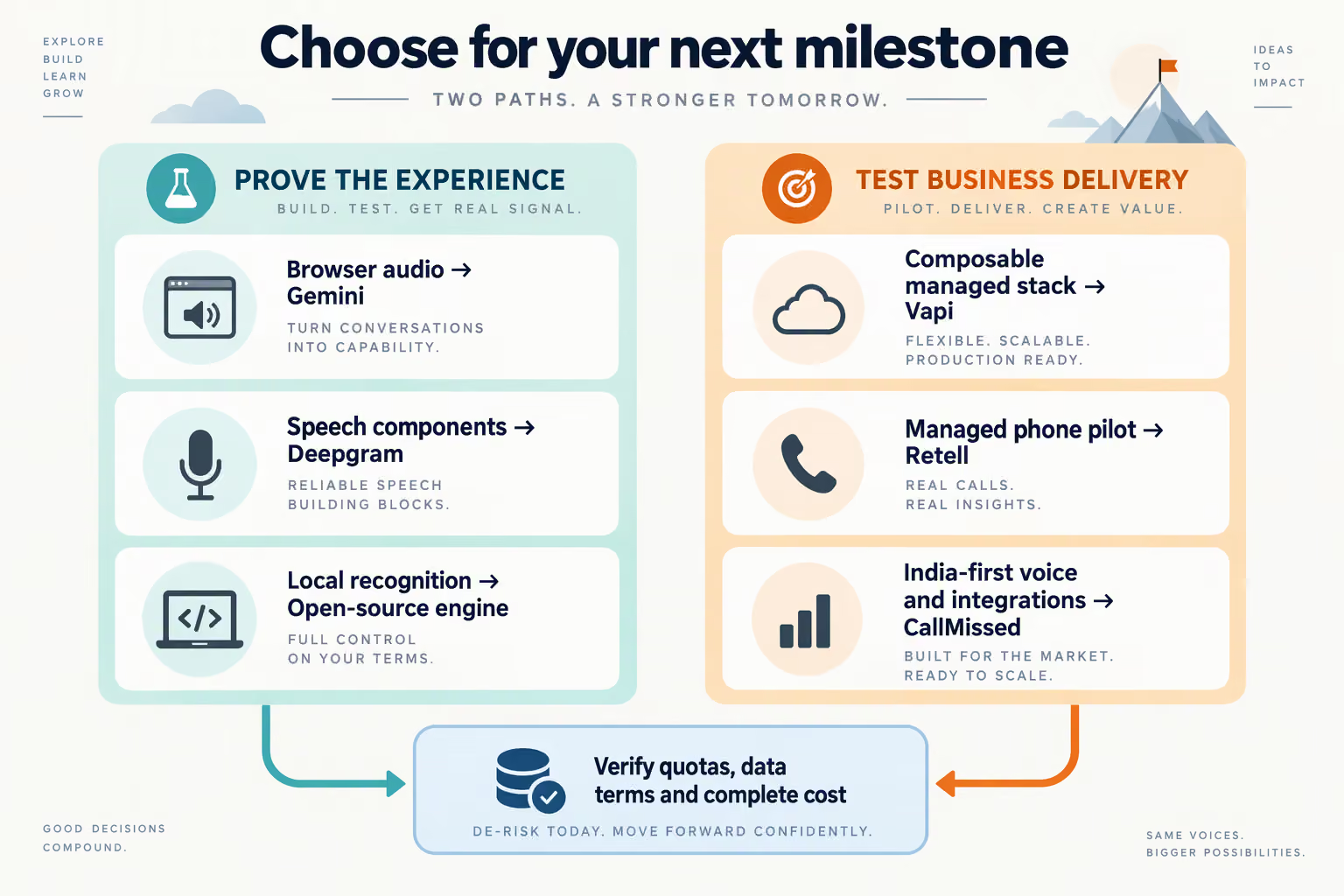
Choose by what you need to validate first: conversation quality, stack flexibility, or deployment readiness. For free tier AI APIs for prototyping voice applications, compare usable test minutes and engineering effort, not signup-credit totals alone.
Which option fits your team’s technical skills?
- Retell AI: Choose a managed phone-agent path when your immediate goal is testing conversations rather than assembling speech components. Retell AI’s pricing page lists 20 free concurrent-call slots as of November 2026; “free” describes the concurrency allowance, not free call minutes.
- Vapi: Consider Vapi when developers want to compose a voice stack and control component selection. Firecrawl’s August 2026 comparison lists $0.05/minute for hosting, with speech-to-text, language models, text-to-speech, and telephony charged separately or brought by the customer.
- LiveKit: Consider LiveKit for a code-first, open-source approach where your team can own integration work. Firecrawl’s August 2026 comparison lists a $0 entry tier with 1,000 agent minutes, while inference, telephony, and observability remain separate meters; confirm those terms before committing.
- CallMissed: For Indian-language prototypes, CallMissed’s verified product facts, as of November 2026, specify speech recognition in 22 Indian languages plus English, including Hinglish, and natural text-to-speech in 10 Indian languages plus English. Test recognition and spoken output separately: their language coverage differs.
How should prototype volume change your choice?
- Small validation run: Start with 20 conversations lasting three minutes each, or 60 conversation minutes. Use identical scenarios across providers so differences reflect stack performance rather than easier prompts, shorter calls, or cleaner recordings.
- Vapi budget example: At Firecrawl’s August 2026 hosting price, that 60-minute test costs $3 in hosting alone. Add speech recognition, model inference, speech generation, and any telephone charges before estimating the complete prototype budget.
- Concurrent testing: Retell AI’s 20 free concurrency slots, listed in November 2026, matter when testing overlapping sessions rather than sequential demos. Distinguish maximum simultaneous calls from total monthly minutes: they measure different capacity constraints.
- Speech-focused experiments: Deepgram’s programmable voice-agent guide, available in November 2026, recommends running benchmarks against “production audio.” Prioritize noisy recordings, interruptions, and realistic speaking styles before spending the allowance on polished demonstrations.
What should you check before deploying?
- CallMissed: As of November 2026, its verified Standard voice-agent price is ₹4/minute, covering recognition, the language model, and voice generation. A 60-minute connected-call test therefore has a ₹240 agent-cost baseline, excluding separately billed phone carriage and subject to the 30-second call minimum.
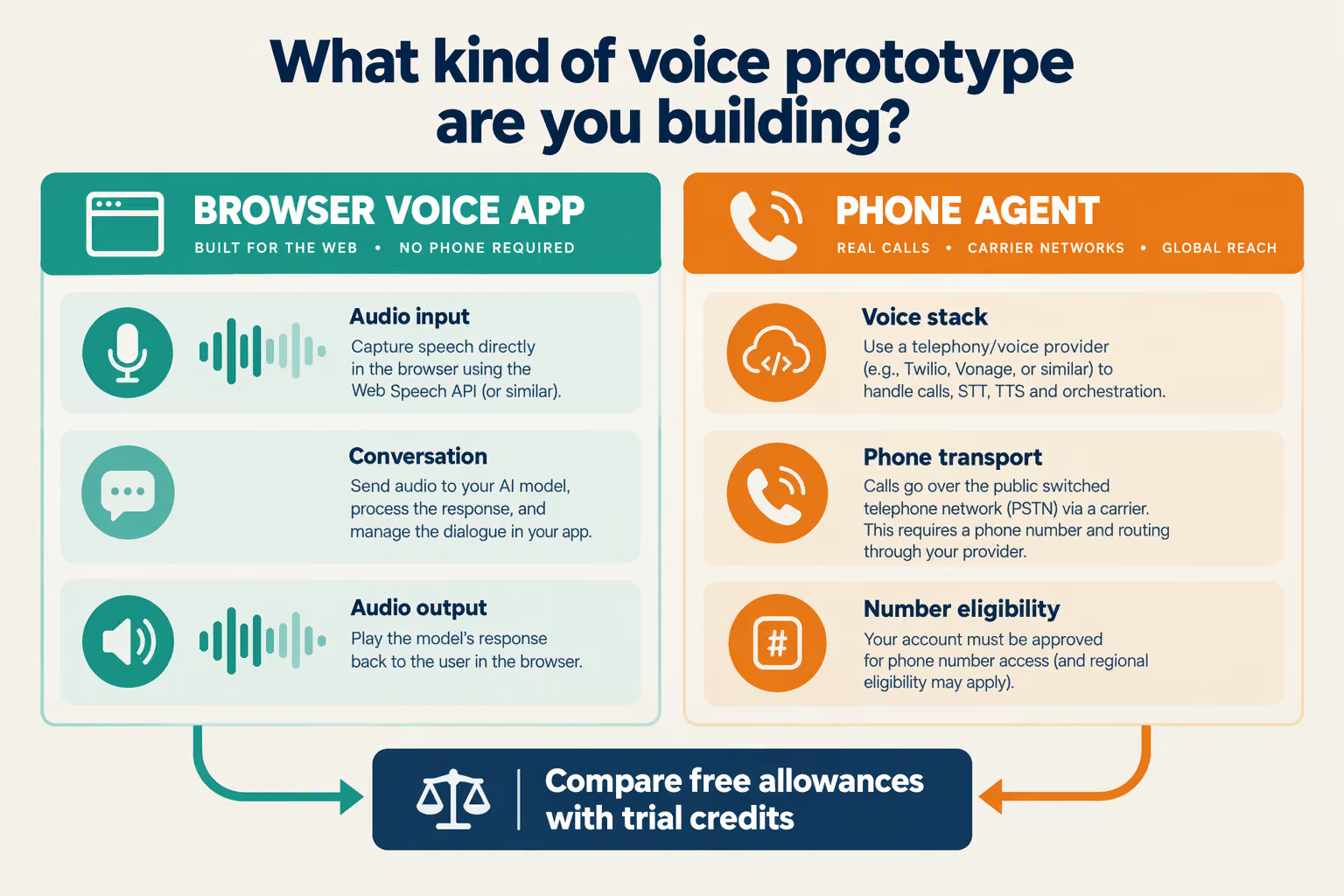
- Browser versus telephone: Validate browser audio first if telephone connectivity is not your main risk; add phone testing when carrier behavior becomes part of the acceptance criteria.
- Budget approval: Require a worksheet separating orchestration, recognition, model inference, speech generation, and connectivity; record which charges signup credits actually cover.
- Deployment gate: Run the same 20-call suite again on the intended paid configuration, checking task completion, interruptions, language handling, and actual billed usage before increasing traffic.
Frequently Asked Questions
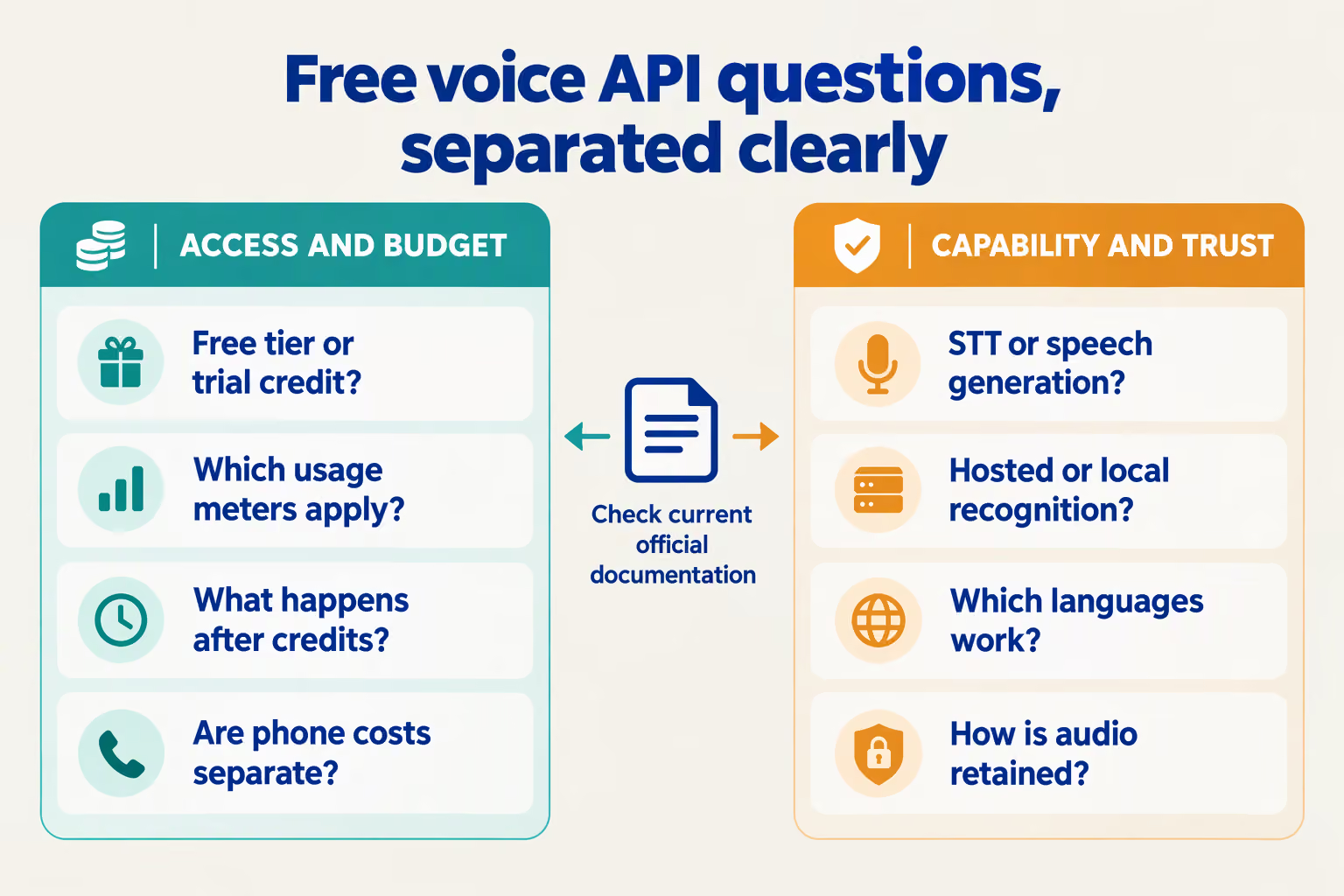
Free speech-to-text access covers transcription, not necessarily a complete voice application. Buyers should compare streaming behavior, language coverage, integration effort, and separately billed components before choosing a prototyping stack.
- Q: Do free tier AI APIs for prototyping voice applications cover the entire conversation?
A: Not automatically: a voice application needs speech-to-text, a language model, text-to-speech, and conversation orchestration, while a telephone prototype also needs connectivity. Deepgram’s programmable voice-agent guide, available in November 2026, identifies speech-to-text, text-to-speech, and its Voice Agent API as distinct testing options. Map your allowance to those components before estimating how many complete conversations you can test; transcription access alone does not establish an end-to-end budget.
- Q: How should I benchmark a free speech-to-text API for a voice assistant?
A: Test representative recordings containing background noise, interruptions, regional accents, and corrections, then score transcription accuracy separately from task completion. For example, an appointment assistant must capture the corrected date, not merely transcribe the first date accurately. Measure time to the first transcript and first spoken response separately, because fast recognition does not guarantee that language-model processing and voice generation will produce a responsive conversation.
- Q: Does a free concurrency allowance mean free AI phone calls?
A: No: concurrency measures simultaneous calls, whereas usage charges measure consumed services or minutes. Retell AI’s pricing page lists 20 free concurrent calls as of November 2026; that allowance should not be interpreted as 20 cost-free conversations. For a load test, budget for the duration of every connected session and check whether telephone numbers, carrier charges, or optional components create additional costs.
- Q: Which free tier AI APIs for prototyping voice applications support Indian languages?
A: According to CallMissed’s verified product facts, as of November 2026, its speech recognition supports 22 Indian languages plus English, including code-mixed speech such as Hinglish. Its natural text-to-speech voices cover 10 Indian languages plus English, with additional languages available through other voice models. Confirm that your selected recognition and voice models qualify for the relevant allowance; platform-wide language coverage does not mean every language is available through free-tier models.
- Q: Can I use an existing OpenAI SDK to prototype speech features?
A: According to CallMissed’s verified product facts, as of November 2026, its OpenAI-compatible endpoints support audio transcription, translation, and speech, with existing SDKs usable by changing the base URL. The developer API’s default Free limit is 60 requests per minute per key. Endpoint compatibility reduces integration changes, but does not establish equivalent model behavior, identical optional parameters, or free access to every speech model.
- Q: What costs remain when voice-agent infrastructure starts at zero dollars?
A: Firecrawl’s comparison dated August 2026 listed LiveKit at $0 with 1,000 agent minutes, while identifying inference, telephony, and observability as separate meters. The same comparison listed Vapi hosting at $0.05 per minute, with speech recognition, language models, voice generation, and telephony separate or brought by the developer. Treat these as dated comparison figures, not confirmed November prices, and request a component-level estimate before deployment.
Conclusion
Free-tier AI APIs for prototyping voice applications should be compared by usable testing coverage—not headline credit balances. Choose the allowance that lets you validate speech recognition, response quality, voice generation, and live conversation handling, while making any separate infrastructure and telephone charges clear.
The central lesson is that “free” describes an offer, not necessarily a complete voice application. A transcription-only experiment and an interactive booking assistant consume different resources, so the right provider depends on what your prototype must prove.
- Separate free model access from signup credits. Free model access, trial balances, and infrastructure allowances are different purchasing propositions. According to Retell AI’s pricing page, as of November 2026, new users receive $10 in credits, while AI voice agents cost $0.07–$0.31 per minute. Those credits provide a testing budget; they do not establish that every component of every test call is free. Identify which services consume the allowance before estimating how many conversations you can run.
- Compare coverage, not just the size of the offer. According to Deepgram’s programmable voice-agent guide, available in November 2026, signup includes $200 in credits for testing speech-to-text, text-to-speech, or its Voice Agent API. That is useful scope information, but a larger balance alone does not establish better value. Map each offer against the same application requirements: hearing the customer, generating an answer, speaking back, managing the conversation, and connecting a telephone call where necessary.
- Run a repeatable test before choosing a stack. Use the same booking-assistant scenarios across providers: a clear request, background noise, an interruption, and a corrected appointment time. Record conversation quality alongside consumed credits and any separate charges. This turns a pricing comparison into a practical buying decision: which API helps your team validate its riskiest assumption with the least integration work and an understandable testing budget?
- Check compatibility and the paid conversion path early. An allowance is more useful when the integration remains practical after testing ends. According to CallMissed’s verified product facts, as of November 2026, CallMissed, the OpenAI-compatible developer AI API, offers 1,000 signup credits, 21 free-tier models, and access to 159 models through one API key and balance. Readers can explore this platform when evaluating the broader move toward testing multiple AI components through a single integration; model eligibility and workflow costs still require checking.
Looking ahead, watch whether providers make component coverage, testing constraints, and post-trial costs easier to compare—not merely whether signup balances increase. Before committing, run your representative conversation and ask: does this free allowance prove that our voice application works, or only that one part of its stack does?
Related Reading
- Integrating LLM APIs: A Developer Guide to Voice and Chat
- LLM API aggregator: Fallback and Routing Buyer's Guide
- Claude Fable 5.2 for Voice Agents: Worth the Cost?