Gemma 4 vs Mistral Small 3.1: On-Device Use Compared


Gemma 4 vs Mistral Small 3.1: compare local memory needs, model variants, tool calling and sourced costs to choose an on-device setup.

Gemma 4 vs Mistral Small 3.1: On-Device Use Compared
A 26B model can require just 14.4 GB at four-bit quantization—but that does not mean it fits comfortably on a 16 GB device. For Gemma 4 vs Mistral Small 3.1, choose Mistral Small 3.1 when your priority is a vendor-documented deployment on an RTX 4090 or a 32 GB Mac; shortlist Google’s Gemma 4 26B-A4B when its quantized memory requirements fit your hardware and you can validate your workload locally. Neither is an automatic winner: available memory, runtime support and application performance should decide the purchase.
As of November 2026, Google AI for Developers lists Gemma 4 26B-A4B inference memory requirements of 57.7 GB at BF16, 28.8 GB at SFP8 and 14.4 GB at Q4_0. As of November 2026, Mistral AI states that Mistral Small 3.1 can run on a single RTX 4090 or a Mac with 32 GB RAM. These figures make local deployment worth evaluating, but they are not interchangeable benchmarks or guarantees of usable speed.
Who should consider these models for on-device use?
This comparison is for developers, IT buyers and technical founders at small and midsize businesses evaluating local assistants, internal document workflows or applications where keeping inference on their own hardware matters. It is especially relevant when an existing workstation could replace—or complement—a hosted model dependency.
It is not a recommendation to deploy either model on every phone or laptop. Google’s supplied November 2026 memory table does not list a mobile configuration for Gemma 4 26B-A4B, and Mistral’s cited hardware examples describe substantially more capable systems than an ordinary handset.
The practical distinction is between loading a model and running a useful application. Leave room for the operating system, application processes and workload-dependent runtime memory; then test responsiveness with your actual prompts rather than treating a published memory figure as a complete capacity plan.
What will this comparison help you decide?
The head-to-head will separate documented capabilities from assumptions, focusing on:
- Hardware fit: quantization, available RAM or VRAM, and the difference between a model’s memory requirement and total system needs.
- Workload fit: representative text and image tasks, language quality, and whether the chosen runtime exposes the capabilities you need.
- Operational fit: installation effort, integration requirements, deployment limits and reproducible testing.
- Cost fit: hardware ownership and operating costs, with vendor-sourced pricing where public—not invented per-token estimates.
For teams that do not require local inference, CallMissed’s OpenAI-compatible developer API offers a separate integration path with caller-chosen fallback models and usage logs, according to its verified product facts as of November 2026.
The goal is a defensible shortlist—not a winner selected by parameter count alone.
Choose Mistral Small 3.1 if its vendor-described RTX 4090 or 32GB Mac setup matches your hardware. Consider Gemma 4 26B A4B if its published memory requirements fit; neither is a proven local-performance winner without matched tests.
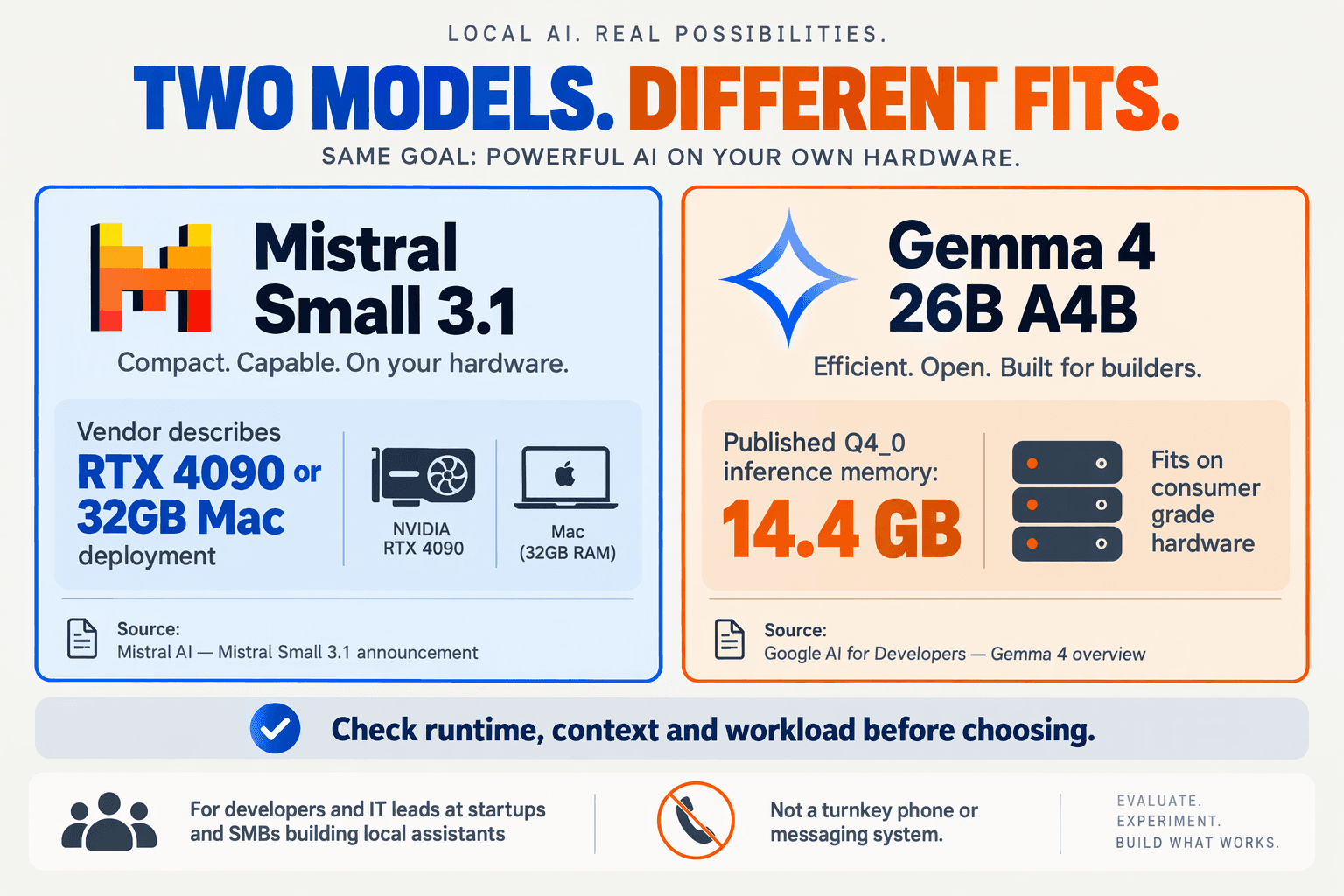
Choose Mistral Small 3.1 for its vendor-described workstation fit; consider Gemma 4 26B-A4B when Google’s published memory requirements leave sufficient headroom. Neither has a demonstrated local-performance advantage in the supplied evidence.
What should decide your on-device shortlist?
- Mistral Small 3.1: As of November 2026, Mistral AI says the model “can run on a single RTX 4090 or a Mac with 32GB RAM.” That makes an existing compatible workstation a sensible starting point—not a reason to buy hardware before validating your runtime, quantization and representative workload.
- Gemma 4 26B-A4B: Google AI for Developers lists inference memory requirements of 57.7 GB at BF16, 28.8 GB at SFP8 and 14.4 GB at Q4_0, as of November 2026. Choose the precision and runtime together: a published memory requirement does not establish equivalent output quality or responsiveness across these configurations.
- Gemma’s active parameters: Amazon Bedrock’s model card identifies 25.2 billion total parameters and 3.8 billion active parameters per token, with a launch date of March 31, 2026. The smaller active count is not a model-loading memory figure; use Google’s memory table, rather than the “A4B” label, when assessing capacity.
- A 16 GB device: Against Google’s November 2026 14.4 GB Q4_0 requirement, a nominal 16 GB memory budget leaves just 1.6 GB by simple subtraction—before accounting for other memory demands. This is a screening calculation, not a fit guarantee: check available memory, allocation behaviour and workload-dependent overhead on the actual device.
- Buyers with existing hardware: This shortlist suits developers and IT leads at small and midsize businesses evaluating workstation-based assistants or internal document tools. For either model, first record hardware, operating system, runtime version and quantization; otherwise, a successful demonstration on someone else’s machine provides little evidence for your purchasing decision.
- Phone-first buyers: Neither supplied vendor excerpt establishes a suitable handset deployment for these particular models as of November 2026. Google AI for Developers shows dashes in both mobile columns for Gemma 4 26B-A4B, while Mistral AI names workstation-class examples. Treat smartphone deployment as an unverified requirement, not an implied capability.
- Performance evidence: The supplied November 2026 sources contain no matched local benchmark establishing a winner. Test identical prompts, output limits and concurrency; record time to first token, generation speed, peak memory and task accuracy. Include long-document and image cases only when your selected runtime supports the intended workflow.
- Purchase gate: Keep the hardware decision conditional until both candidates face the same acceptance test. For example, require correct answers on your internal-document sample and acceptable response times while normal applications remain open. Vendor descriptions establish deployment candidates; your measurements establish whether either candidate can replace an existing service without compromising the application.
Which exact checkpoints, memory requirements and features are you comparing?
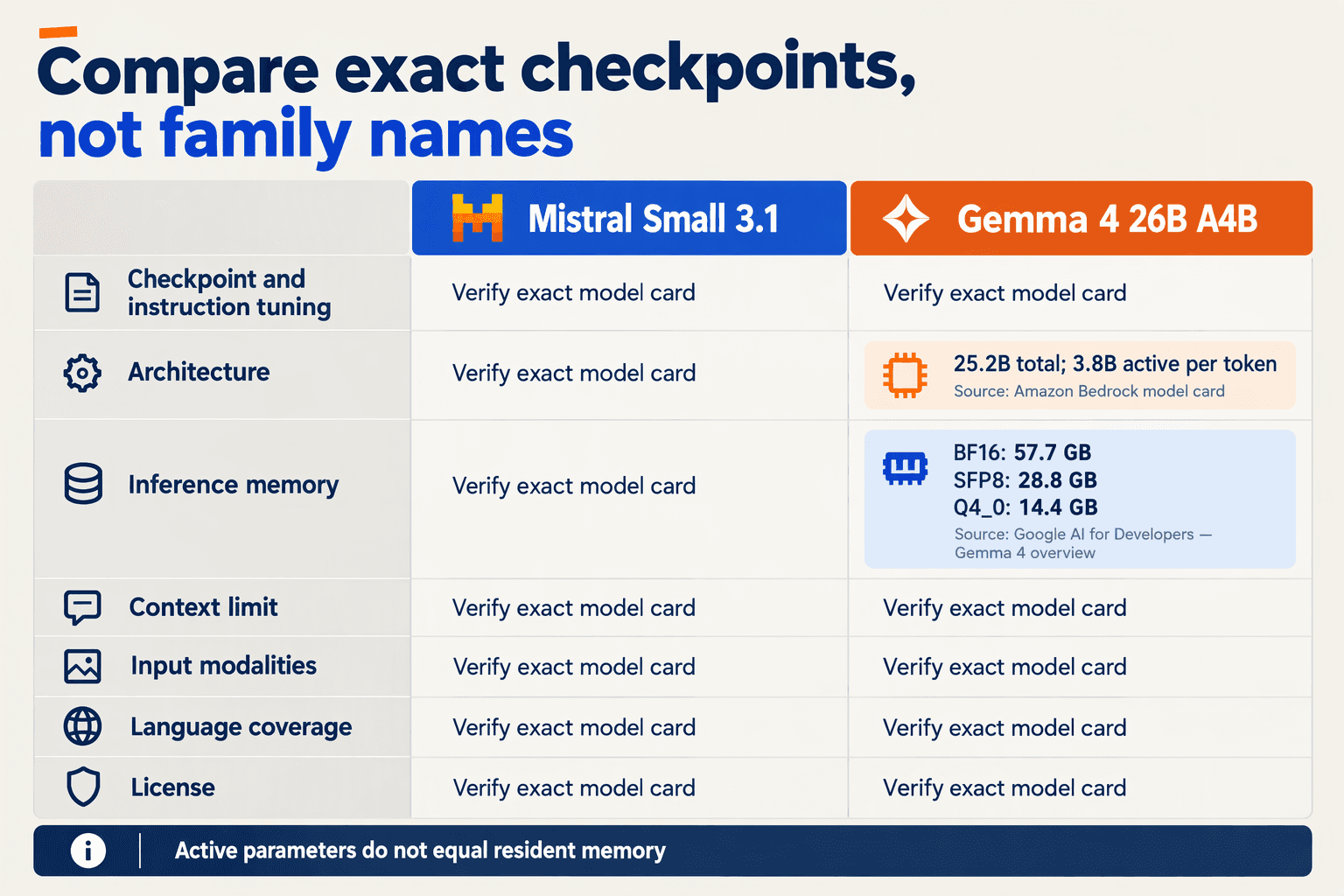
Compare Google’s google/gemma-4-26B-A4B with Mistral Small 3.1, not an unspecified “Gemma 26B” download or another Mistral Small release. The supplied sources identify Google’s checkpoint precisely; Mistral’s cited release page establishes a deployment claim, but the supplied excerpt does not identify an exact downloadable checkpoint or quantization.
| Comparison item | Mistral Small 3.1 | Gemma 4 26B-A4B | Evidence and qualification |
|---|---|---|---|
| Model identity | Mistral Small 3.1 release | google/gemma-4-26B-A4B | Mistral AI release page; Google’s Hugging Face listing, as of November 2026 |
| Parameter architecture | Not specified in supplied vendor excerpt | Mixture-of-experts; 25.2B total, 3.8B active per token | Amazon Bedrock model card, as of November 2026 |
| Published memory requirements | No precision-specific figures in supplied vendor excerpt | BF16: 57.7 GB; SFP8: 28.8 GB; Q4_0: 14.4 GB | Google AI for Developers, as of November 2026 |
| Documented hardware example | Single RTX 4090 or Mac with 32 GB RAM | Memory table, rather than a named workstation configuration | Mistral AI and Google AI for Developers, as of November 2026 |
| Input capabilities established here | Not specified in supplied vendor excerpt | Text and image input | Google’s Hugging Face listing, as of November 2026; audio support for this checkpoint is not established by the excerpt |
| Mobile configuration | No handset configuration established here | Mobile and mobile text-only columns show “–” | Supplied vendor evidence, as of November 2026; neither establishes phone deployment |
Which model details must you lock before testing?
- Gemma 4 26B-A4B: Amazon Bedrock’s model card lists 25.2 billion total parameters and 3.8 billion active parameters per token, as of November 2026. Active parameters describe computation, not permission to budget memory as though this were a standalone 3.8B model.
- Mistral Small 3.1: Record the repository identifier, revision and instruction-tuned variant before downloading. The supplied Mistral AI excerpt does not establish these artifact-level details, so a reproducible comparison needs them recorded separately rather than inferred from the release name.
- Quantization: Record both the precision label and the actual artifact format. Google AI for Developers publishes BF16, SFP8 and Q4_0 memory figures as of November 2026, but those entries do not establish compatibility with every local inference engine.
- Runtime: Record the inference engine, version, acceleration backend and configuration alongside each checkpoint. Two tests using different engines or offload settings measure a model-plus-runtime combination—not model quality or efficiency in isolation.
Which features and memory figures need qualification?
- Memory: Keep Google’s published inference requirements separate from Mistral’s hardware example. These are different evidence types; neither supplies an equivalent, controlled measurement at the same precision, prompt length, concurrency and runtime configuration.
- Multimodality: Google’s Hugging Face excerpt supports text and image input as of November 2026. Its truncated reference to audio across the Gemma family does not justify claiming audio input for this exact 26B-A4B checkpoint.
- Context and speed: Do not promote the supplied Reddit claims of 128K context or 150 tokens per second into verified comparison specifications. Obtain checkpoint documentation and measure throughput on the buyer’s device before using either figure in procurement.
- Languages and licensing: The supplied excerpts do not establish comparable language coverage or complete licensing terms. Treat both as mandatory verification items, particularly for regional-language customer workflows or commercial redistribution; “open model” alone does not settle those requirements.
How do they perform on identical hardware at longer contexts and in local tool calling?
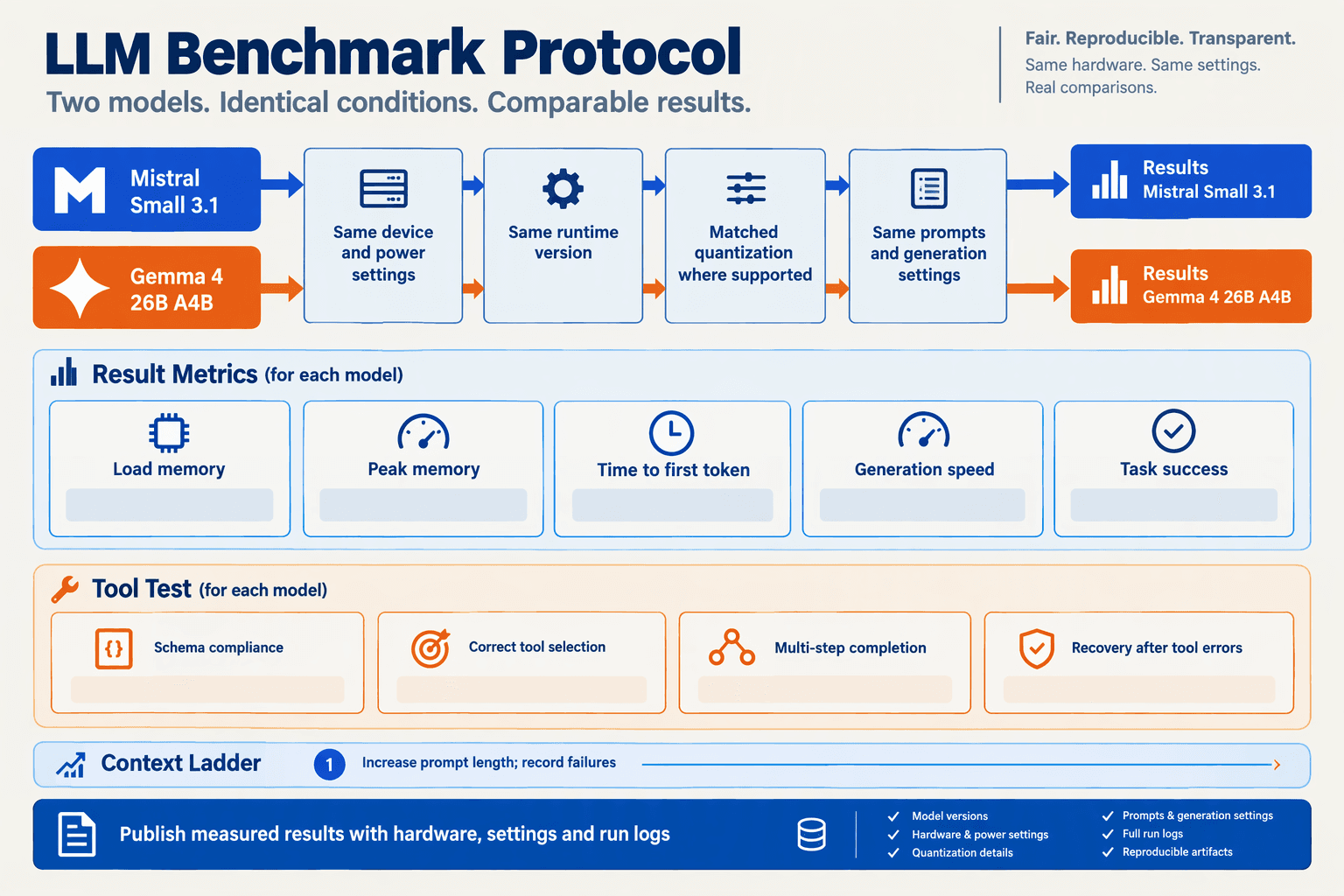
There is no verified identical-hardware benchmark in the supplied November 2026 sources that establishes a winner for longer contexts or local tool calling. For Mistral Small 3.1 versus Gemma 4 26B-A4B, buy against measured workload performance—not headline speed or parameter counts.
How should you compare longer-context performance on identical hardware?
- Both models: Use the same physical device, accelerator settings, runtime version and GPU-offload policy. Record each model’s quantization and actual memory use; matching “four-bit” labels alone does not establish equivalent compression or quality. These are proposed test controls, not results reported by either vendor.
- Long-context test: Start with 4,096, 16,384 and 32,768 input tokens, provided both local configurations support those lengths. Treat these as proposed test points, not advertised context limits. Record the token count separately for each model because identical documents can tokenize differently; test both equal-length inputs and the same real documents.
- Performance measurements: Report time to first token, output tokens per second, peak RAM/VRAM and completion rate at every context length. Separate prompt processing from answer generation, and record cold starts separately from warmed runs. A model that generates quickly after a lengthy document-processing delay may still feel slow to users.
- Gemma 4 26B-A4B: Amazon Bedrock’s model card, available in the supplied November 2026 context, describes 25.2 billion total parameters and 3.8 billion active parameters per token, with a March 31, 2026 launch date. That architecture is relevant to evaluation, but active parameter count alone does not establish lower latency, lower total memory consumption or better retrieval accuracy.
How should you test local tool calling reliably?
- Both models: Run the same 100 proposed test cases against identical tool definitions: document lookup, appointment availability and CRM-record retrieval, for example. Use synthetic records and sandboxed tools. Score correct tool selection, valid arguments and successful execution separately; a plausible-looking function call is not proof that the intended action completed.
- Runtime compatibility: Verify that each selected runtime exposes the required tool-call format and applies the appropriate model chat template. As of November 2026, the supplied sources do not establish an identical-runtime tool-calling comparison. Distinguish model mistakes from parser failures, unsupported schemas and integration errors before attributing a failure to either model.
- Long-context reliability: Place necessary facts near the beginning, middle and end of a document, then introduce conflicting or irrelevant passages. Measure answer correctness and tool-argument accuracy at each tested length. Include cases requiring zero tool calls: unnecessary execution can be a more consequential failure than an assistant asking for clarification.
- Buyer decision: Set acceptance thresholds before testing—for example, 95 successful executions out of 100 and a first-token delay your users tolerate. Those are suggested procurement criteria, not published model benchmarks. Choose whichever configuration meets your quality, memory and responsiveness requirements; if neither passes, reduce context, improve retrieval or reconsider the deployment hardware.
What does local ownership cost, and how should you verify API prices?
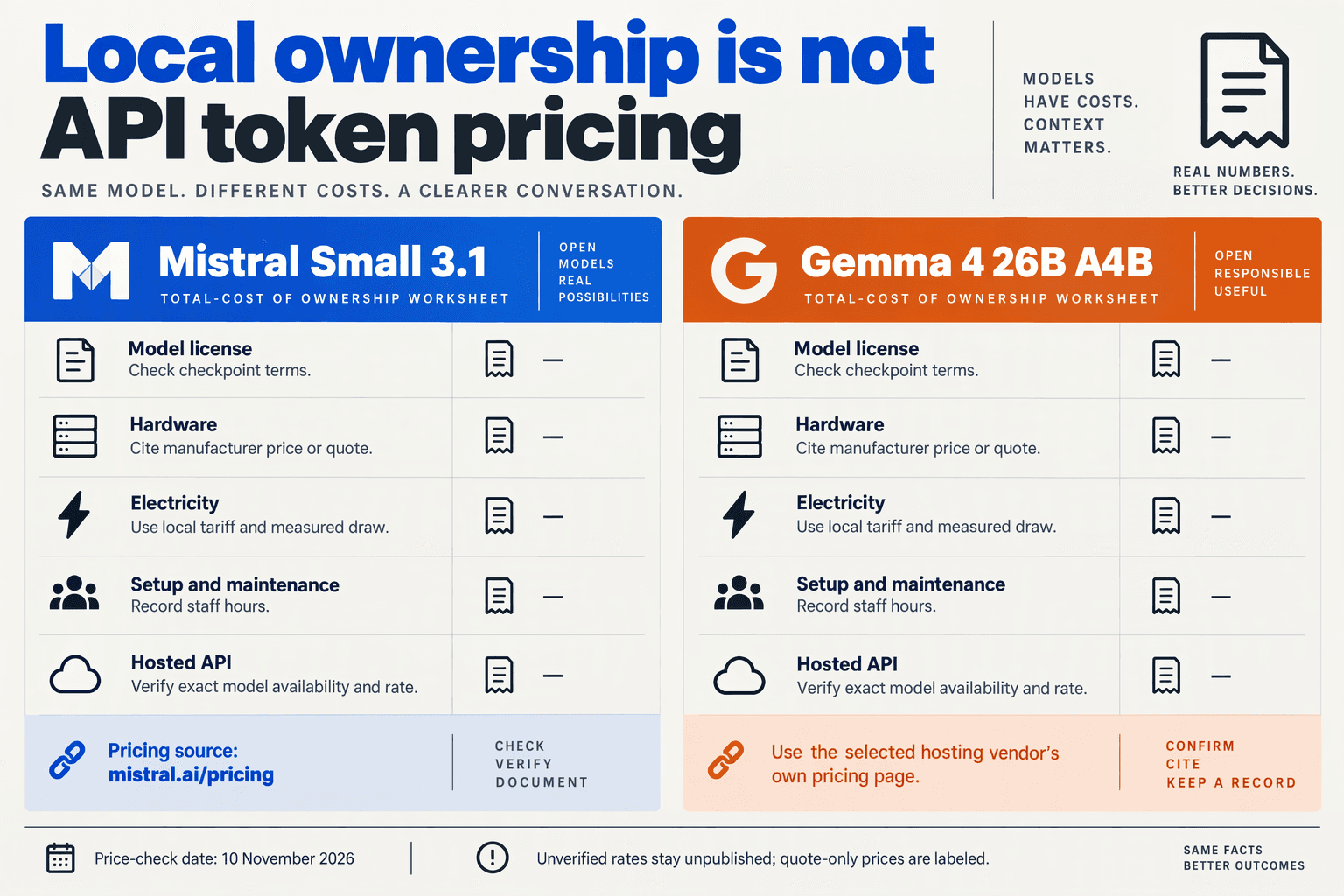
Local ownership cost is hardware plus electricity, maintenance and integration—not a per-token model price. For Mistral Small 3.1 vs Gemma 4 26B-A4B on-device use, the supplied sources do not establish current API rates for either exact model, so verify provider pricing before calculating a break-even point.
- Mistral Small 3.1: Mistral AI’s hardware guidance, supplied for this November 2026 comparison, supports evaluating an existing workstation before buying another machine.
- Gemma 4 26B-A4B: Google AI for Developers’ November 2026 memory figures help shortlist hardware, but do not establish a complete deployment budget.
- Existing hardware: Count incremental electricity and administration separately from the machine’s original purchase price; include depreciation when comparing full ownership costs.
- New hardware: Obtain a dated quote covering the computer, memory, storage, warranty and applicable taxes—not just the accelerator.
- Hosted inference: Compare input and output charges separately; a single advertised token rate may not represent your workload.
- Break-even: Divide monthly local ownership cost by hosted cost per equivalent completed task, using measured quality and throughput rather than parameter counts.
What belongs in a local-versus-API cost table?
The following is a November 2026 budgeting checklist, not a vendor price quotation. Neither the Google nor Mistral excerpt supplied here includes a hardware purchase price or verified API tariff.
| Cost item | Local deployment | Hosted API | Evidence to collect |
|---|---|---|---|
| Hardware | Purchase or allocated depreciation | No local inference machine required | Dated equipment quote |
| Electricity | Measured system consumption | Included in provider service charges | Meter reading and electricity tariff |
| Model access | Check exact model licence terms | Check exact model availability | Model card and provider catalogue |
| Usage | Capacity depends on measured throughput | Input/output billing may differ | Runtime test and pricing page |
| Operations | Updates, monitoring and troubleshooting | Integration and usage monitoring | Staff-hour estimate |
| Reliability | Budget for downtime or backup capacity | Check limits and fallback arrangements | Recovery test and service terms |
How should you verify exact-model API prices?
- Confirm the model identifier. Match the provider’s catalogue entry to Mistral Small 3.1 or Gemma 4 26B-A4B; do not substitute another “Small” or “Gemma” model’s rate. Record the provider name and verification date.
- Read the vendor’s own pricing page. Capture currency, billing unit, input/output rates, cache pricing where applicable, and taxes. If that exact model has no public price, label it “not publicly listed”; if you simply cannot verify it, label it “not verified.”
- Price a representative workload. Measure tokens and completed tasks using your actual prompts. As an illustrative assumption—not a benchmark—a system averaging 100 watts for eight hours daily over 30 days consumes 24 kWh, before other operating costs.
For hosted experiments, CallMissed’s OpenAI-compatible developer API supports usage and request logs, according to its verified November 2026 product facts. That helps document consumption, but does not establish availability or pricing for either exact model compared here.
What are the practical advantages and trade-offs of each model?
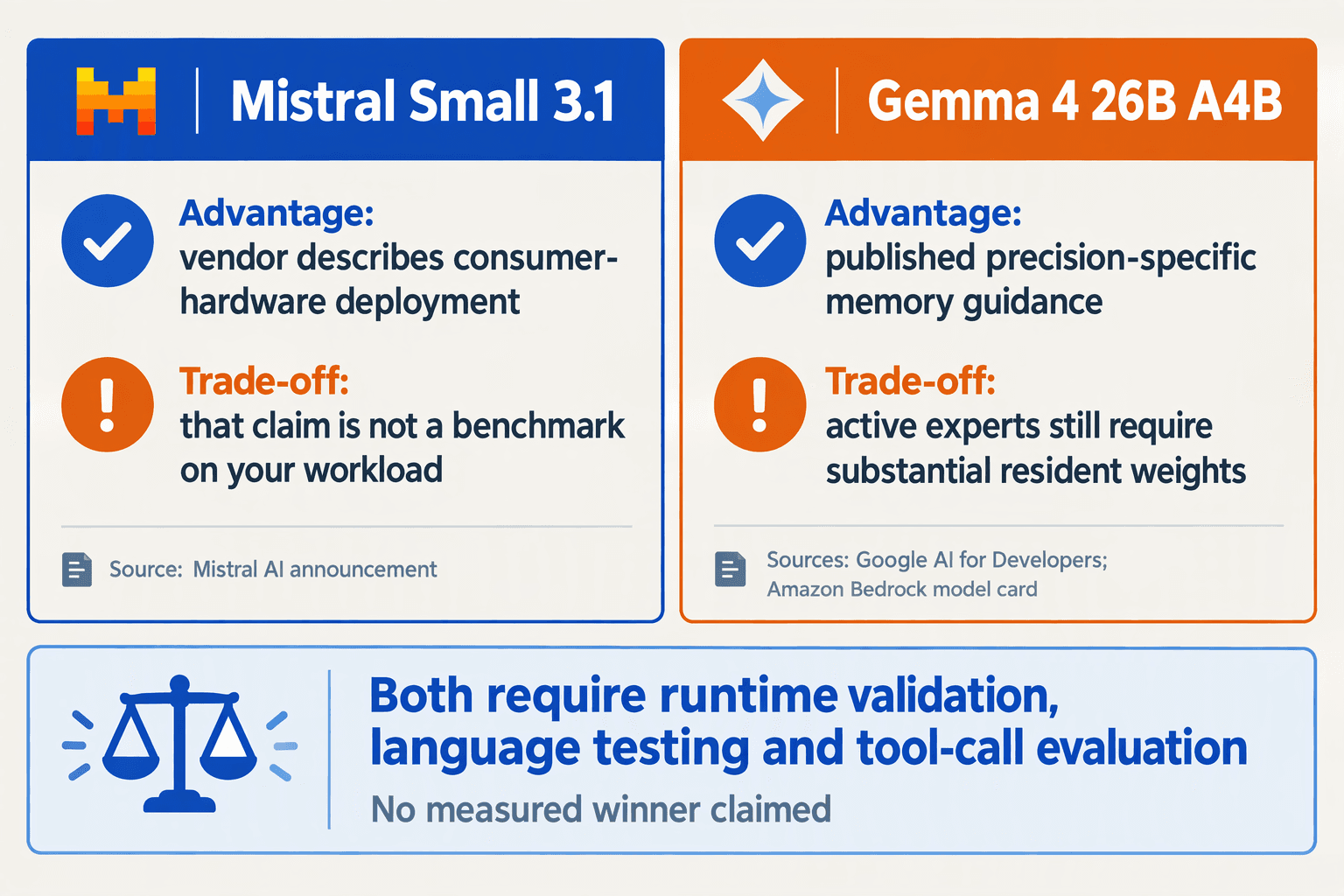
Mistral Small 3.1 offers a vendor-documented hardware starting point; Gemma 4 26B-A4B offers more explicit quantization-memory figures and a mixture-of-experts architecture. For on-device buyers, the practical advantage depends on which evidence reduces deployment uncertainty—not which model has the larger nameplate parameter count.
- Mistral Small 3.1: Prefer its documented workstation configurations when planning a local pilot; Mistral AI’s hardware examples are starting points, not guarantees for your application.
- Gemma 4 26B-A4B: Prefer its detailed memory table when comparing precision options; Google’s figures help size a deployment but do not establish end-to-end responsiveness.
- Both models: Require application-level testing before purchase; document retrieval, image handling and concurrent requests can change the resources your deployment needs.
- Phone-first buyers: Neither supplied source establishes a suitable handset configuration for these specific models; “on-device” should not be interpreted as “runs comfortably on any mobile.”
Which practical advantages come with deployment trade-offs?
The following comparison uses the supplied vendor documentation and model listings as of November 2026; missing evidence is identified rather than filled with assumptions.
| Decision factor | Mistral Small 3.1 | Gemma 4 26B-A4B | Practical trade-off |
|---|---|---|---|
| Hardware starting point | Mistral AI names a single RTX 4090 or 32 GB Mac. | Google AI for Developers provides precision-specific memory requirements. | A hardware example simplifies shortlisting; a memory table supports more granular planning. |
| Quantization planning | The supplied Mistral excerpt does not specify precision or memory by format. | Google lists 57.7 GB BF16, 28.8 GB SFP8 and 14.4 GB Q4_0. | Gemma provides clearer capacity inputs, but lower precision still needs quality validation. |
| Parameter interpretation | The supplied vendor excerpt does not establish architecture details. | Amazon Web Services documents 25.2 billion total and 3.8 billion active parameters per token. | Active parameters are not a substitute for resident-memory requirements or measured speed. |
| Multimodal evidence | The supplied excerpt does not establish input modalities. | Google’s Hugging Face listing identifies text and image input. | Verify the exact model and runtime before committing to image workflows; excerpt omissions do not prove feature absence. |
| Desktop discovery | Mistral AI supplies workstation deployment examples. | LM Studio lists google/gemma-4-26b-a4b. | A model listing aids discovery but does not guarantee compatibility with every accelerator or quantization. |
| Ownership cost | No comparable local-deployment price is supplied. | No comparable local-deployment price is supplied. | Budget hardware, electricity, maintenance and engineering separately; do not invent per-token ownership costs. |
What should buyers measure before choosing?
- Memory-constrained teams: Test the intended context length alongside the actual application; model-loading success alone is not an acceptance criterion.
- Performance-sensitive teams: Compare both models on identical prompts, measuring time to first token, output speed, peak memory and task accuracy; the supplied sources provide no controlled head-to-head benchmark establishing a winner.
Will your languages, integrations, setup effort and phone or messaging rules work locally?
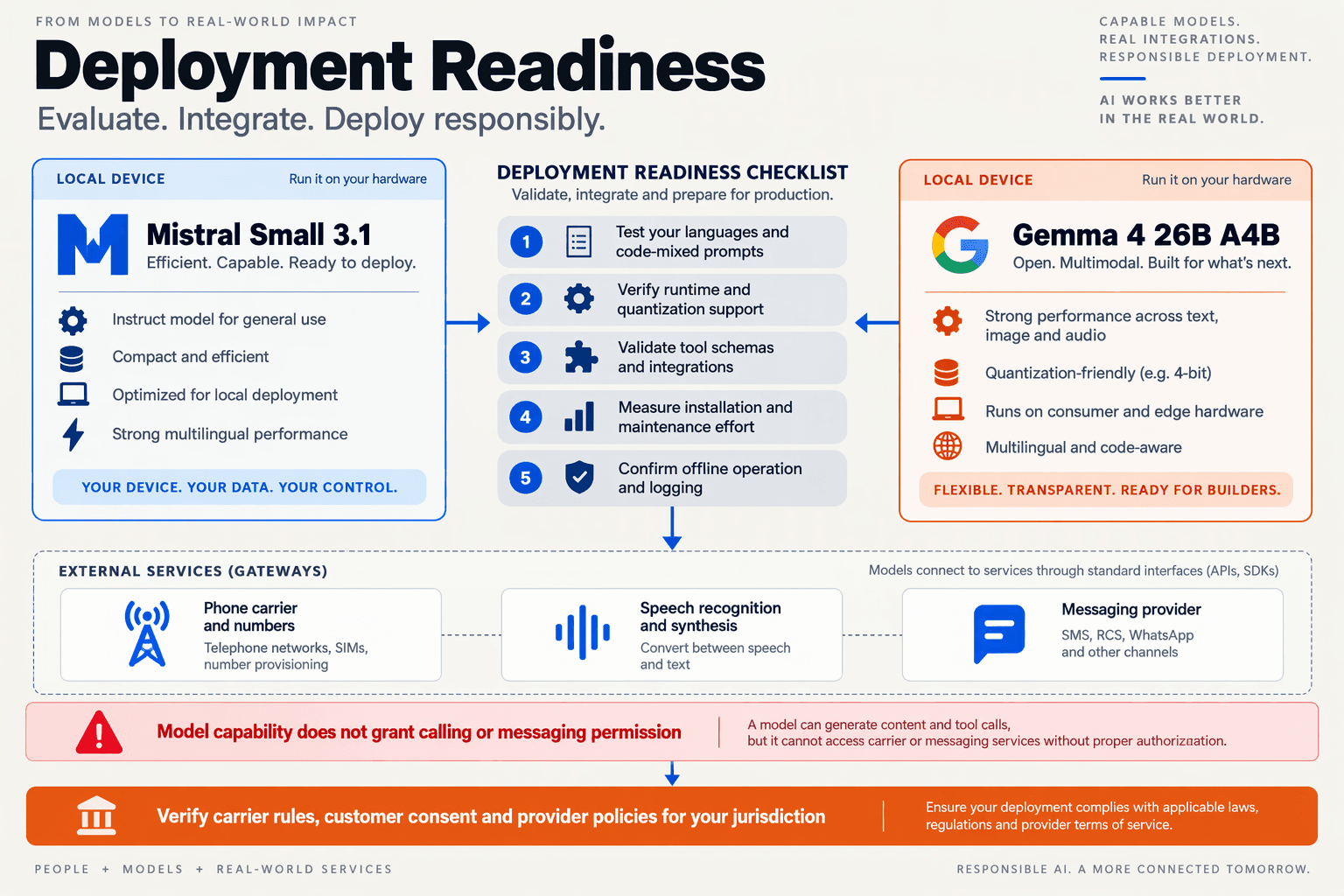
Local inference does not automatically make languages, integrations or customer communications work offline. For Mistral Small 3.1 vs Gemma 4 26B-A4B, validate the complete application—not just the model—before choosing either.
- Language coverage: The supplied Mistral AI and Google documentation excerpts, assessed for this November 2026 comparison, do not establish a language-by-language quality winner. Test your actual scripts, regional vocabulary and code-switching. A useful buyer-defined acceptance set is 20 representative prompts per required language, scored for correctness, terminology and appropriate responses when information is missing.
- Mistral Small 3.1 integration: Mistral AI’s documentation cited for November 2026 supports local deployment, but the supplied evidence does not establish compatibility with your CRM, messaging service or tool-calling implementation. Require a working demonstration of one document lookup, one authenticated business-system request and one failed-request recovery before committing to the surrounding application stack.
- Gemma 4 26B-A4B integration: As of November 2026, LM Studio lists Google’s Gemma 4 26B-A4B, providing a concrete runtime option to investigate. A model listing is not proof that every application feature works. Verify the exact model artifact, runtime version, input handling and API behavior your application needs; do not generalize audio support from the wider Gemma family to this specific deployment.
- Setup effort: Neither supplied vendor excerpt establishes an end-to-end installation time, so promises such as “production-ready in 10 minutes” would be unsupported. Separate download and loading, application wiring, and operational testing in your evaluation. Record actual engineering hours for each candidate on the same machine, including driver issues, model-format conversion and restart recovery.
- Local-data boundaries: Specify what “local” means: model inference only, or documents, embeddings, logs and tool execution too. A locally running assistant can still send information outside the device through connected services. Inspect outbound requests and retention settings, then test with networking disabled to identify which functions genuinely remain available without external dependencies.
- Phone-number requirements: Neither supplied model source establishes native telephone numbers, carrier connectivity, call routing or speech infrastructure. Treat these as separate deployment requirements rather than model capabilities. For customer calling, document the carrier arrangement, inbound versus outbound behavior, permission requirements and recording obligations applicable to each operating market; local inference does not remove those responsibilities.
- WhatsApp and speech: As of November 2026, CallMissed’s verified product facts describe official Meta Cloud API integration, WhatsApp customer calls answered by AI voice agents, and business-initiated calls to customers who have given permission. CallMissed also supports speech recognition in 22 Indian languages plus English, distinct from natural text-to-speech in 10 Indian languages plus English; these platform capabilities are not evidence of an offline stack.
- Purchase gate: Choose the candidate that passes your required languages, runtime integrations and data-boundary checks with acceptable measured setup effort. If telephone or messaging operations are essential, evaluate that communications layer separately. Neither the supplied Mistral Small 3.1 evidence nor the Gemma 4 26B-A4B evidence justifies treating model installation alone as a complete customer-communication deployment.
Which should you choose—and when is a smaller model or hosted platform the better fit?
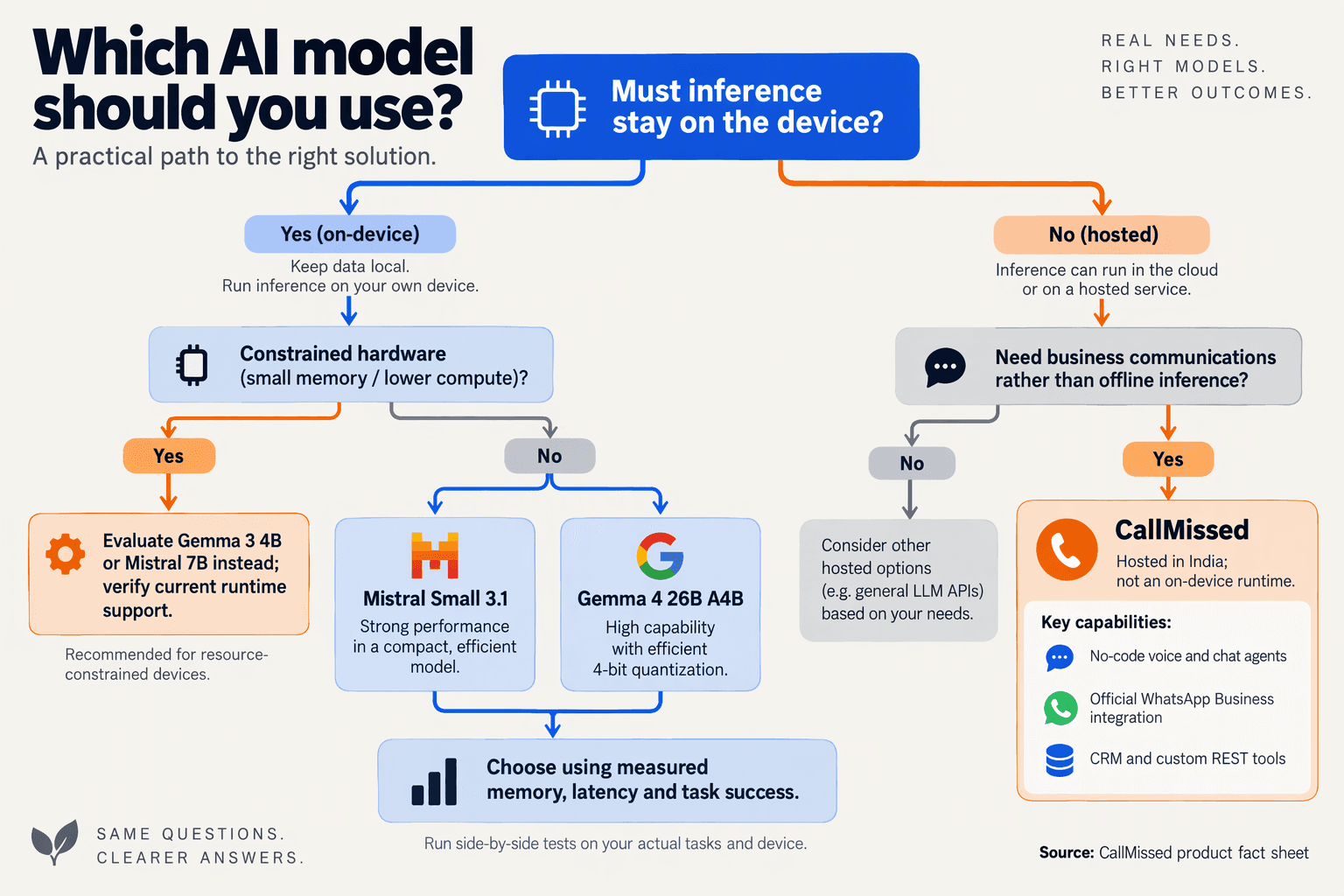
Choose Mistral Small 3.1 for its vendor-documented workstation deployment path; choose Gemma 4 26B-A4B if its quantized configuration passes your local workload tests. A smaller model or hosted service is the better fit when hardware, maintenance or connectivity requirements outweigh local inference benefits.
When should you choose Mistral Small 3.1 or Gemma 4 26B-A4B?
- Mistral Small 3.1: Prefer this shortlist entry when deploying to hardware matching Mistral AI’s documented examples: a single RTX 4090 or a 32 GB RAM Mac, as cited in November 2026. Before buying hardware, verify the runtime, quantization and context settings needed for your application; the vendor statement is not a throughput guarantee.
- Gemma 4 26B-A4B: Prefer this candidate when you can accommodate its selected precision without squeezing application memory. Google AI for Developers lists 14.4 GB at Q4_0, 28.8 GB at SFP8 and 57.7 GB at BF16, as cited in November 2026. Test the intended configuration rather than extrapolating performance across those formats.
- Mixture-of-experts buyers: Do not interpret “A4B” as a four-billion-parameter storage footprint. Amazon Bedrock’s model card describes Gemma 4 26B-A4B as having 25.2 billion total parameters and 3.8 billion active per token, as cited in November 2026. Active parameters describe computation, not permission to ignore the published inference-memory requirements.
- Multilingual and multimodal buyers: Make language and image accuracy purchase gates, not secondary demonstrations. Google’s Hugging Face model card describes Gemma 4 as supporting text and image input, as cited in November 2026; that does not establish accuracy for your documents. Test regional-language prompts, code-switching and image interpretation separately, using the same examples for both candidates.
When is a smaller model or hosted platform the better fit?
- Smaller local model: Choose a lower-memory candidate when either shortlist model forces heavy swapping, unstable sessions or unacceptable response times. Set your own acceptance threshold—for example, a proposed 50-prompt evaluation containing extraction, summarization and refusal cases. This is a testing recommendation, not a published benchmark; retain the smallest candidate that passes.
- Phone-first deployment: Do not select Gemma 4 26B-A4B merely because the family is marketed for on-device use. Google AI for Developers leaves this variant’s Mobile and Mobile (Text-only) memory entries blank, as cited in November 2026. Require a supported device-and-runtime configuration before committing to handset deployment.
- Hosted integration: Consider CallMissed’s developer AI API when maintaining inference hardware is outside your team’s remit. According to CallMissed’s verified product facts as of November 2026, the service provides 159 models, OpenAI-compatible endpoints, caller-chosen fallbacks and request logs. Catalogue availability for either exact comparison model is not established by the supplied facts.
- Hybrid deployment: Keep sensitive or offline-required tasks local and consider hosting other workloads only after reviewing data handling and network dependence. Compare the full operating burden: hardware, electricity, runtime updates and support versus metered service usage. Do not assume either deployment route is cheaper without measuring your actual volume and concurrency.
Frequently Asked Questions
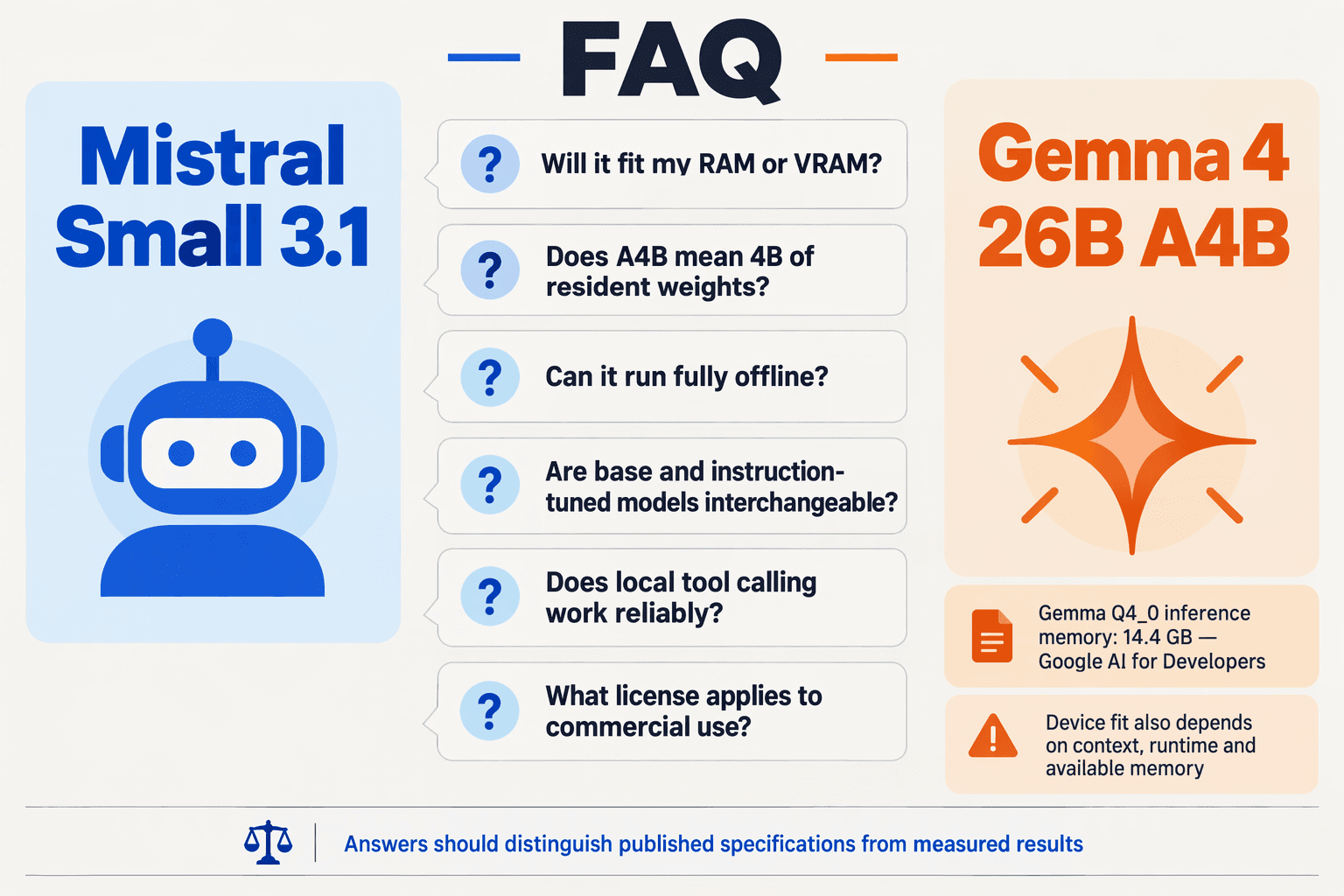
For Mistral Small 3.1 vs Gemma 4 26b for on-device use, choose by available memory, runtime compatibility and application requirements—not active parameter count alone. These six checks distinguish a model that loads from a deployment you can actually use.
- Q: Mistral Small 3.1 vs Gemma 4 26b for on-device use: does Gemma fit in 16GB?
A: Not comfortably by default: Google AI for Developers lists Gemma 4 26B-A4B’s Q4_0 inference memory requirement as 14.4 GB, as of November 2026, leaving little headroom on a 16GB device. The operating system, application and workload-dependent runtime allocations also need memory, so successful loading is not a guarantee of stable operation. Distinguish dedicated VRAM from shared system memory, and test your intended context length before purchasing hardware.
- Q: Is Gemma 4 26B-A4B’s memory requirement equivalent to a 4B model?
A: No: active parameters describe computation, not the complete memory footprint. Amazon Bedrock’s model card, available as of November 2026, describes Gemma 4 26B-A4B as a mixture-of-experts model with 25.2 billion total parameters and 3.8 billion active per token, launched March 31, 2026. Google AI for Developers lists 57.7 GB at BF16 and 28.8 GB at SFP8 as of November 2026; the A4B label therefore should not be treated as a 4B-sized hardware budget.
- Q: Mistral Small 3.1 vs Gemma 4 26b for on-device use: can either work offline?
A: Yes, if inference runs locally and the necessary weights, runtime and application assets are already downloaded. Offline readiness is an application property: web search, cloud document retrieval, remote tools and hosted APIs still require connectivity. As of November 2026, Mistral AI documents Small 3.1 deployment on a single RTX 4090 or a Mac with 32GB RAM, while Google publishes local inference memory requirements for Gemma 4.
- Q: Should I choose a base model or an instruction-tuned checkpoint?
A: Choose an instruction-tuned checkpoint for a conversational assistant; consider a base checkpoint when your training workflow specifically requires one. As of November 2026, the supplied sources do not establish matching base-checkpoint availability for both candidates, so verify the exact repository rather than assuming every variant exists. Record the checkpoint identifier, tokenizer and chat template in your tests: a family name alone does not define the deployment.
- Q: Can Mistral Small 3.1 and Gemma 4 26B-A4B call tools locally?
A: Tool calling requires both model-compatible formatting and an application that executes requests; generated text alone does not run a function. As of November 2026, the supplied excerpts do not establish equivalent tool-calling support across local runtimes, so test schema adherence, argument validation and execution permissions. For a separate hosted integration path, CallMissed’s verified November 2026 facts list an OpenAI-compatible developer API with function calling; that is not offline inference.
- Q: Can I use Mistral Small 3.1 or Gemma 4 26B-A4B commercially?
A: Confirm the license attached to the exact checkpoint before commercial deployment; downloadable weights do not automatically mean unrestricted use. As of November 2026, the supplied official-source excerpts do not reproduce both models’ complete license terms, so they are insufficient for a definitive side-by-side legal conclusion. Check commercial use, redistribution, modification and notice obligations separately, including any terms attached to quantized derivatives.
Conclusion
Choose Mistral Small 3.1 for its vendor-documented workstation deployment; shortlist Google Gemma 4 26B-A4B when its quantized memory requirements fit your hardware and local testing confirms workload quality. For developers, IT buyers and technical founders at small and midsize businesses, neither model wins automatically: available memory, runtime support, responsiveness and total operating costs should determine the decision.
Four takeaways should guide your shortlist:
- Mistral offers a concrete hardware starting point. As of November 2026, Mistral AI states that Mistral Small 3.1 can run on a single NVIDIA RTX 4090 or a Mac with 32 GB RAM. That makes those configurations useful evaluation targets—not guarantees of application-level speed.
- Gemma’s quantized footprint needs careful interpretation. As of November 2026, Google AI for Developers lists Gemma 4 26B-A4B inference memory requirements of 14.4 GB at Q4_0, 28.8 GB at SFP8 and 57.7 GB at BF16. A 14.4 GB requirement does not establish comfortable deployment on a 16 GB device once other memory demands are included.
- Workload fit matters more than parameter count. Compare representative text and image tasks, required languages and the capabilities exposed by your chosen runtime. A model that loads successfully can still be unsuitable if response quality or responsiveness falls short.
- Compare complete deployment costs. Evaluate hardware ownership, operating expenses, installation effort and integration requirements together. Published memory requirements and vendor hardware examples are different kinds of evidence; neither provides a complete capacity plan or a directly comparable performance benchmark.
What should buyers validate before committing?
Run both candidates against the same practical acceptance criteria. Use your actual prompts and document workflows, reserve memory for the operating system and application processes, and record results under reproducible conditions.
For an existing workstation, the question is whether either model can deliver a useful application without forcing an unnecessary hardware purchase. For a new deployment, establish the workload first and select hardware second. Neither cited vendor statement supports treating these models as an automatic fit for ordinary phones or every laptop.
What should you watch next?
Watch for clearer runtime support, updated quantization guidance and reproducible measurements on the hardware you actually intend to use. Improvements matter only when they translate into better quality, responsiveness or operating economics for your application—not simply a more attractive specification sheet.
Where local inference is optional, a hosted integration remains a separate path worth evaluating. As of November 2026, CallMissed’s verified product information describes an OpenAI-compatible developer API with caller-chosen fallback models and usage logs.
Explore CallMissed alongside your local shortlist—and ask: which deployment can meet your workload requirements with evidence, rather than assumptions?
Related Reading
- Fable 5.2 vs Opus 5.5: Which Claude Should Developers Use?
- Mistral Large 4 review: Customer Support Evaluation
- AI Receptionist Pricing for Small Business: US vs India