Claude Fable 5.2 for Voice Agents: Worth the Cost?


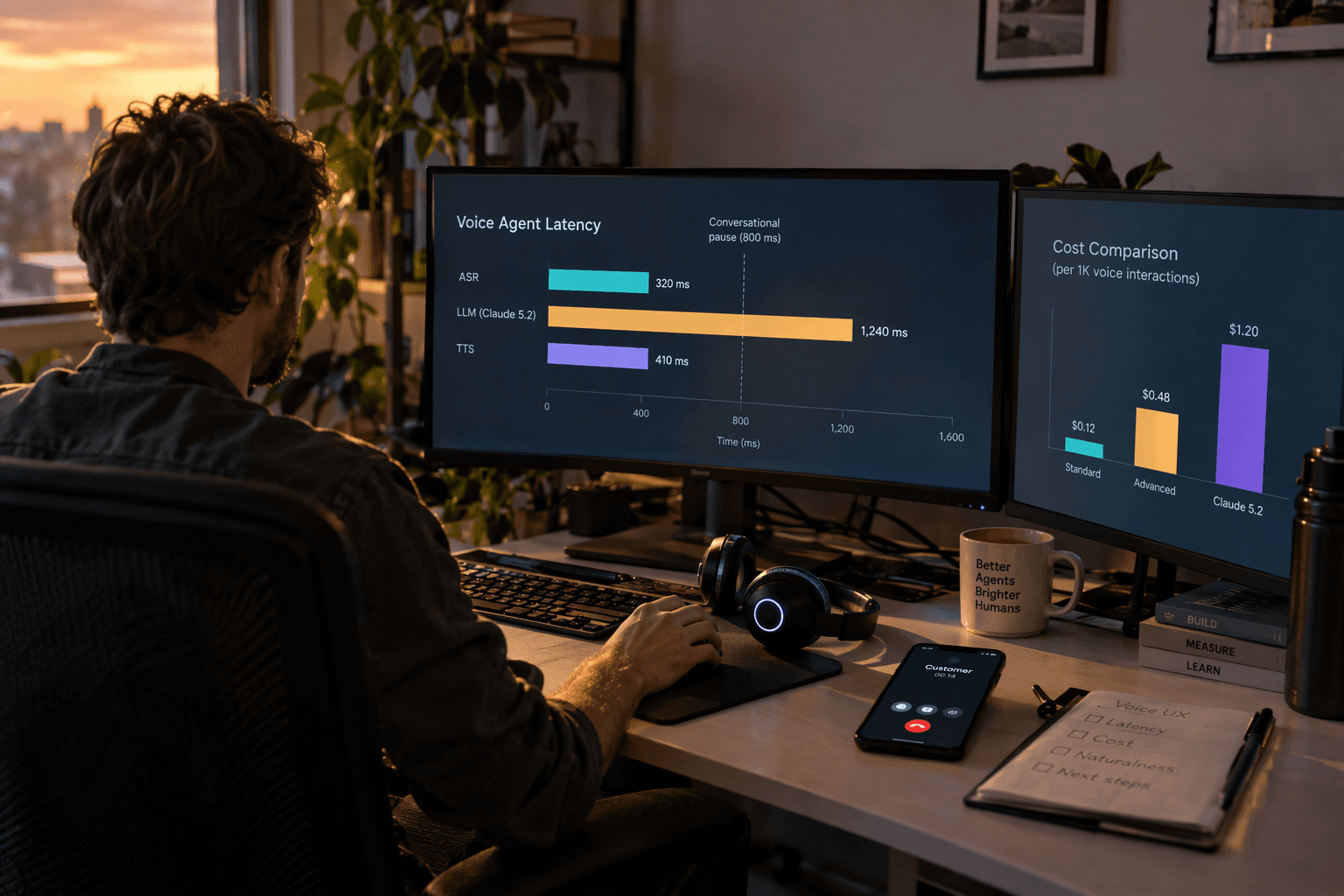
Claude Fable 5.2 cost and latency for voice agents and support AI, with per-call estimates and where a frontier model earns its price.

Claude Fable 5.2 for Voice Agents: Worth the Cost?
Claude Fable 5.2 may be the smartest model you can put on a phone line, and for the live voice turn it is usually the wrong one to pick. At $8 input and $40 output per million tokens, Claude Fable 5.2 costs twice what Anthropic's recommended workhorse, Claude Opus 5.5, charges at standard rates ($4/$20, according to Sentra's November 2026 pricing roundup). Switch on fast mode, which gives up to 2.5x output speed, and the bill climbs to $16/$80.
Voice makes this trade-off sharper than almost any other workload. A caller notices a pause of well under a second, and a support agent may take dozens of turns per call, each one re-sending conversation history as input tokens. A model that is brilliant but slow, or brilliant but expensive, gets paid for on every turn, and the customer feels the delay on every turn.
Anthropic's own guidance points the same way. It recommends Opus 5.5 for most work and Sonnet 5.5 or Haiku 5.5 when speed and volume matter, with Haiku 5.5 built for high-volume work and subagents. Fable's natural role looks less like "the voice" and more like an Advisor or Orchestrator that steps in when the problem is hard.
So is it worth the cost? As of November 2026, our answer is "yes, but rarely in the live turn." This post makes that case with numbers instead of vibes. You'll see:
- A per-call cost table with clearly labelled token assumptions, so you can swap in your own traffic.
- Where latency bites, and why fast mode at double the price doesn't fully fix a real-time conversation.
- Where Fable 5.2 earns its price: offline QA, tricky escalations and orchestration.
- How it compares with smaller models. We covered the speed-first option in Claude Haiku 5.5 for voice agents and the wider field in the best LLMs for voice agents in 2026.
The same logic is why platforms like CallMissed, the AI voice-agent platform, price a whole call (speech recognition, language model and voice) at a flat rate from ₹4 a minute, rather than leaving developers to guess per-token spend. Let's work out whether a frontier model belongs anywhere in your call flow.
Is Claude Fable 5.2 worth it for live voice agents?
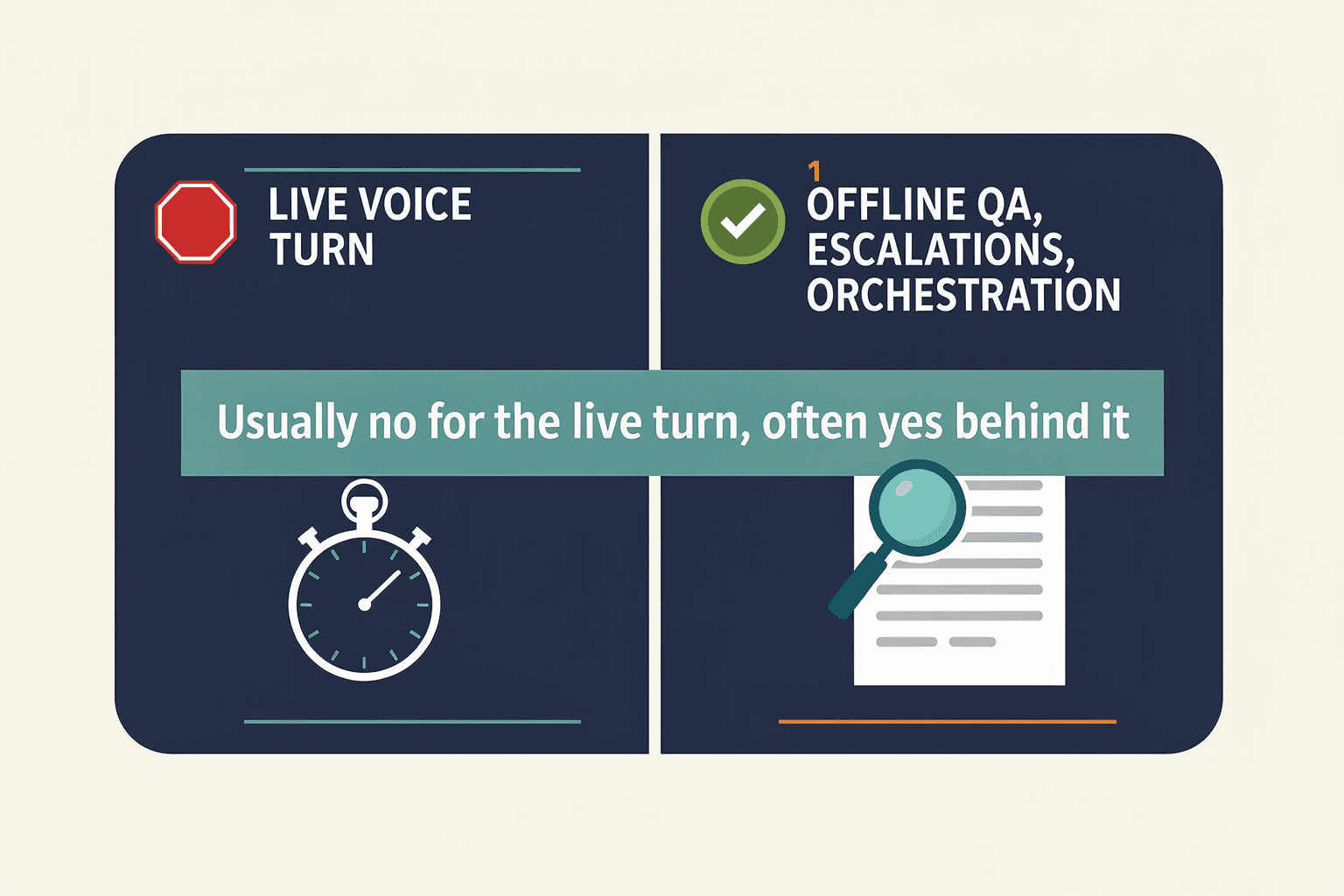
Claude Fable 5.2 is rarely worth it as the model that speaks on a live call, but it can be worth it behind the call. As of November 2026, the problem is arithmetic and timing rather than intelligence: every spoken turn pays Fable's price, and every turn makes the caller wait.
How much does Claude Fable 5.2 cost per voice call?
Voice calls are input-heavy because each turn re-sends the system prompt, knowledge snippets and conversation history. Here is a worked example using our assumptions, not measured data: a 5-minute support call with 20 turns, about 40,000 total input tokens across all turns, 1,500 output tokens, and no prompt caching.
| Model and mode | Rate per M tokens (in/out) | LLM cost per call | LLM cost per minute |
|---|---|---|---|
| Opus 5.5, standard | $4 / $20 | ~$0.19 (~₹18) | ~₹3.6 |
| Opus 5.5, fast mode | $8 / $40 | ~$0.38 (~₹36) | ~₹7.3 |
| Fable 5.2, standard | $8 / $40 | ~$0.38 (~₹36) | ~₹7.3 |
| Fable 5.2, fast mode | $16 / $80 | ~$0.76 (~₹73) | ~₹14.6 |
Rupee figures use US$1 = ₹96. These numbers cover language-model tokens only. Speech recognition, text-to-speech and phone carriage come on top.
For context, CallMissed's Standard voice plan is ₹4 a minute for the entire stack: speech recognition, language model and voice. Under these assumptions, Fable 5.2's tokens alone cost more than that whole bundle. Swap in your own turn counts, because long prompts or large retrieved passages push the input side up fast.
Does fast mode fix the latency problem?
Not fully. Sentra and Anthropic both describe fast mode as up to 2.5x output speed at double the standard rate. That speeds up generation once tokens start flowing, but a spoken reply is short, so generation is a small slice of the pause a caller feels.
The delay before the first word, which also includes transcription, tool calls and synthesis, is what the caller hears as dead air. We haven't seen a published time-to-first-token benchmark for Fable 5.2, so treat any specific latency claim with caution and measure it on your own calls. Fast mode is also a research preview on the Claude API only, per Jake Handy's coverage on Handy AI, which is a shaky foundation for a production phone line.
What does Anthropic actually recommend?
Anthropic points developers to Opus 5.5 for most work, and to Sonnet 5.5 or Haiku 5.5 when speed and volume matter. Haiku 5.5 is positioned for high-volume work and subagents, which describes a support line well. Handy AI's launch write-up even called Opus 5.5 "faster, cheaper, and smarter than Fable", though that's a headline claim and your own evals should decide it.
So when should Fable 5.2 touch a call?
Use it where a wrong answer is costly and a second or two of thought is invisible to the caller:
- Advisor: a fast model handles the conversation and consults Fable only on hard questions, such as billing disputes or policy exceptions.
- Orchestrator: Fable plans and routes work to cheaper subagents.
- Post-call work: QA review, summaries and escalation analysis, where latency doesn't matter.
If a model is on the critical path of every turn, price it per turn. If it's off the critical path, price it per decision.
What is Claude Fable 5.2, and what is actually confirmed?

Claude Fable 5.2 is a premium model in Anthropic's Fable line. As of November 2026, its pricing and speed claims are better documented for neighbouring models than for Fable 5.2 itself. This post uses $8 input / $40 output per million tokens, with fast mode at $16/$80, but you should verify those figures before you budget around them.
What is confirmed about the Fable line?
Here is what the published sources support:
- Fable 5 pricing: Finout lists Claude Fable 5 at $10 input / $50 output per million tokens, about 2x the input cost of Claude Opus 4.8 and GPT-5.5.
- Cost pain is real: a Reddit thread in r/claude, titled "Fable 5 is eating my Max 20x plan", cites the same $10/$50 rates and warns that enterprise-scale usage "gets crazy fast".
- Opus 5.5 sits below it: Sentra's pricing guide puts Claude Opus 5.5 at $4/$20 standard, and Jake Handy's Model Drop newsletter lists batch at $2/$10. Handy calls Opus 5.5 "faster, cheaper, and smarter than Fable", which is one analyst's verdict, not an Anthropic benchmark.
- Fast mode exists, in preview: Anthropic's Opus 5.5 announcement says fast mode costs $8/$40. Handy describes it as up to 2.5x output speed, Claude API only, in research preview.
What is not confirmed for Fable 5.2?
Several things you may want to assume are still open:
- No official explainer. Our research found no Anthropic page dedicated to Fable 5.2. The name mostly surfaces in community discussion, such as a Reddit thread titled "Impressions on Fable-5.2".
- The exact price needs checking. $8/$40 is the figure we use for Fable 5.2, but it is also what Sentra, SSD Nodes and Anthropic list for Opus 5.5 fast mode, and Finout lists Fable 5 at $10/$50. Confirm the current rate on Anthropic's pricing page.
- Fast mode on Fable 5.2 is an assumption. The "up to 2.5x" figure is documented for Opus 5.5. We apply it to Fable 5.2 as a planning assumption, not a verified spec.
- No voice-specific latency data. "2.5x output speed" describes how fast tokens stream once generation starts. It says nothing about time to first token, which is the delay a caller actually hears before the agent starts speaking.
How should you plan around the gaps?
- Treat every price in this post as a variable. Put the per-million rates in a config file, not in your head, and recompute when Anthropic updates them.
- Measure time to first token yourself. Run your real system prompt and knowledge snippets through the model and record the median and p95 delay before the first word is generated.
- Test fast mode separately. If it is a research preview, it may change or have limited availability. Don't build a production call flow that silently depends on it.
- Keep the role in mind. Anthropic positions Fable as an Advisor or Orchestrator, so evaluate it as the model that steps in on hard problems, not as the voice on every turn.
That last point matters most for what follows. The uncertainty around Fable 5.2's exact price and speed is another reason to keep it out of the latency-critical path until you have your own measurements.
How does Fable 5.2 pricing compare with Opus 5.5, Sonnet 5.5 and Haiku 5.5?
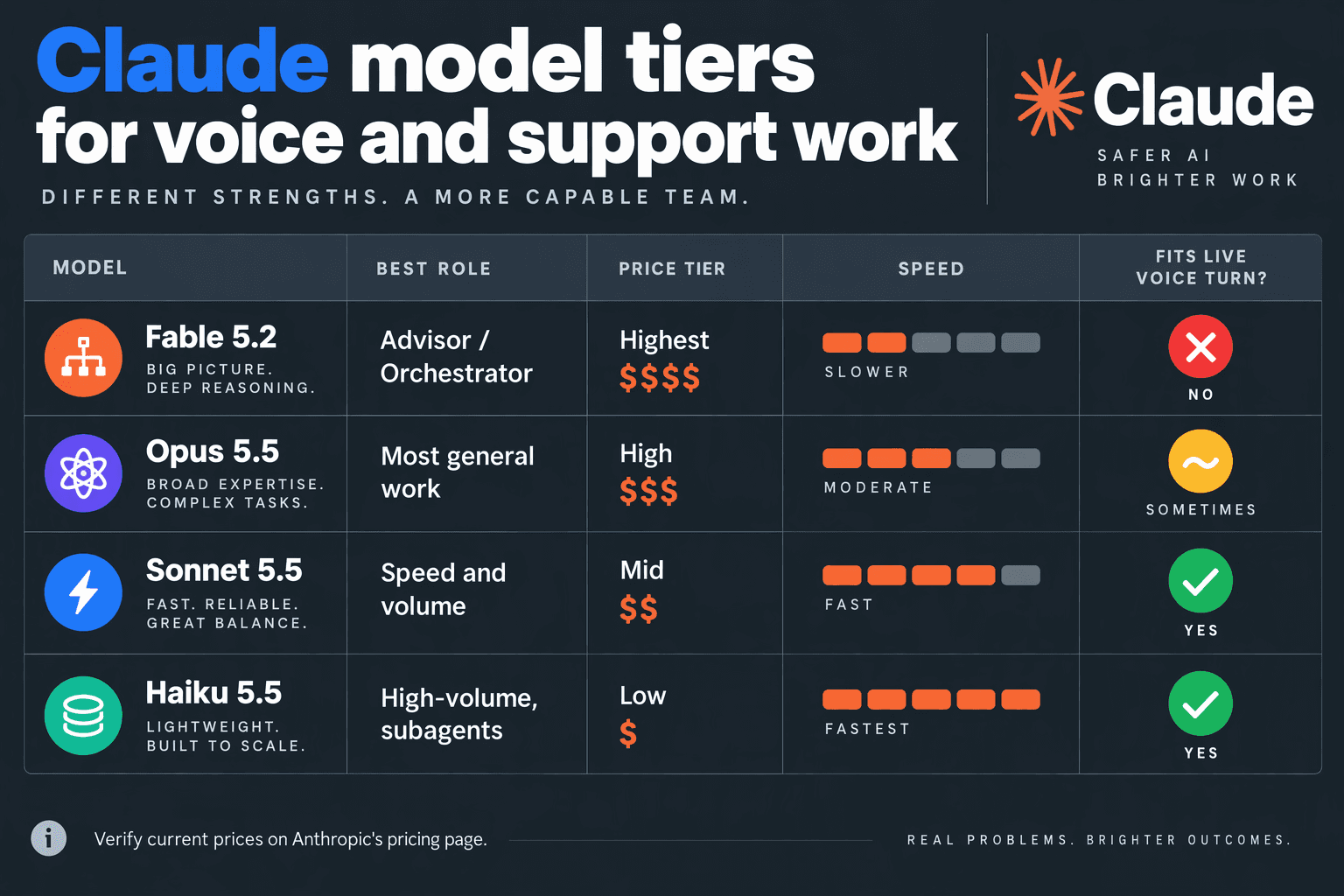
Claude Fable 5.2 costs exactly twice Claude Opus 5.5 at standard rates, and four times as much once fast mode is on. As of November 2026, Fable 5.2 is $8 input and $40 output per million tokens, against $4 and $20 for Opus 5.5, according to Sentra's Claude API pricing guide.
How do the Claude 5.x prices line up for a voice agent?
The table below uses the same assumed 5-minute call as earlier: about 40,000 input tokens and 1,500 output tokens across 20 turns, with no prompt caching. Change those numbers to match your own traffic.
| Model | Mode | Input / Output per M tokens | LLM cost per assumed call | Sensible role |
|---|---|---|---|---|
| Fable 5.2 | Standard | $8 / $40 | ≈ $0.38 (≈ ₹36) | Advisor, orchestrator |
| Fable 5.2 | Fast, up to 2.5x output speed | $16 / $80 | ≈ $0.76 (≈ ₹73) | Rare, high-value escalations |
| Opus 5.5 | Standard | $4 / $20 | ≈ $0.19 (≈ ₹18) | Default workhorse |
| Opus 5.5 | Fast (research preview, Claude API only) | $8 / $40 | ≈ $0.38 (≈ ₹36) | Latency-sensitive hard turns |
| Opus 5.5 | Batch | $2 / $10 | ≈ $0.095 (≈ ₹9) | Offline QA, not live calls |
| Sonnet 5.5 | Standard | Not in our sources; check Anthropic's pricing page | n/a | Speed and volume |
| Haiku 5.5 | Standard | Not in our sources; check Anthropic's pricing page | n/a | High-volume work, subagents |
Rupee figures use US$1 = ₹96 and cover the language model only. Speech recognition, text-to-speech and phone carriage are extra.
What does the table actually tell you?
- Fable 5.2 standard costs the same as Opus 5.5 fast mode. Both are $8/$40. The Opus 5.5 fast-mode rate comes from Anthropic's launch announcement and Sentra, and it is also quoted for up to 2.5x output speed. If your goal is a quicker reply, that equivalence deserves a test before you pick Fable.
- Fable 5.2 fast mode is 4x Opus 5.5 standard. At $16/$80, one assumed call costs about $0.76 in LLM spend alone. Multiply that by thousands of calls a day and the gap becomes a budget line.
- Batch pricing only helps offline work. Jake Handy's Model Drop newsletter reports Opus 5.5 batch at $2/$10. Our sources don't quote a batch rate for Fable 5.2, so don't assume one. Batch is also asynchronous, so it can't serve a live caller.
- Sonnet 5.5 and Haiku 5.5 are the cost-control layer. Anthropic positions Haiku 5.5 for high-volume work and subagents. We haven't verified their per-token rates, so check Anthropic's current price list before modelling them. Our Claude Haiku 5.5 voice agent breakdown covers the speed-first case in more detail.
Is the price gap about the model or about the architecture?
Mostly architecture. Jake Handy's headline described Opus 5.5 as "faster, cheaper, and smarter than Fable", which signals that the premium tier isn't automatically the better engine for everyday traffic.
A practical split looks like this:
- Let a small, fast model handle the routine turns.
- Escalate to Opus 5.5 or Fable 5.2 only when the conversation is complex or high-stakes.
- Run Fable 5.2 offline over transcripts for QA, where waiting a few seconds costs nothing.
This is also why bundled pricing is easier to budget. CallMissed, the AI voice-agent platform, charges one flat per-minute rate that covers speech recognition, the language model and the voice, starting at ₹4 a minute on its Standard plan. That means developers don't have to estimate per-token spend turn by turn. This is a general point about pricing structure, not a statement that CallMissed offers Fable 5.2.
Is a frontier model too slow for the live voice turn?
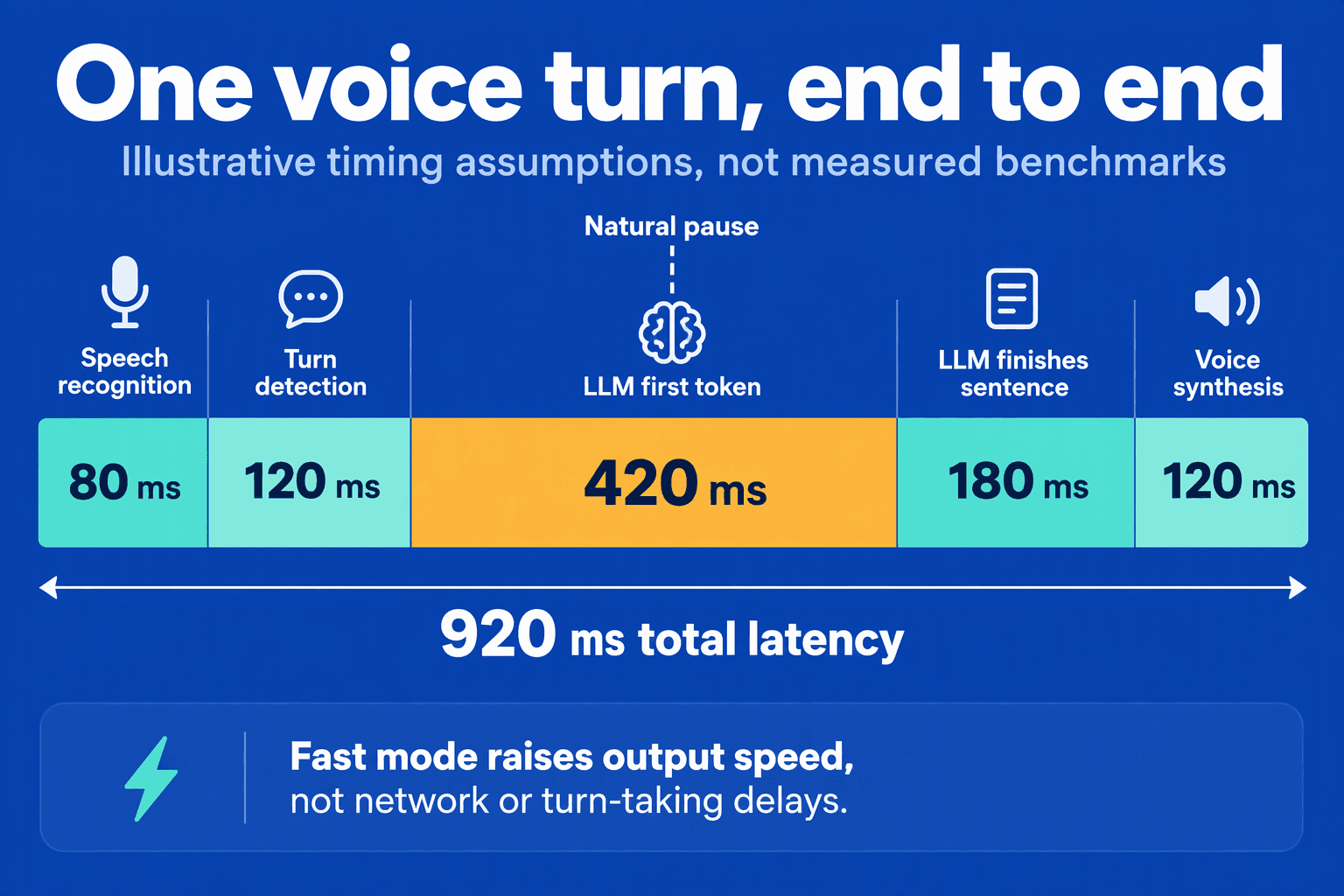
Yes, for most live phone calls a frontier model like Claude Fable 5.2 is too slow to be the model that speaks. As of November 2026, the reasons are less about raw tokens per second and more about where the time goes inside one voice turn.
Where does the time go in a single voice turn?
A spoken reply is a chain of steps, and the language model is only one link. Our working assumption is that a turn feels natural when the caller hears the first word in roughly a second. Every step spends part of that budget:
- End-of-speech detection: the system waits to be sure the caller has finished.
- Speech recognition: the final transcript is produced.
- LLM time to first token: the model reads the prompt, history and any retrieved knowledge, then starts answering.
- Text-to-speech: the first sentence is turned into audio.
- Telephony and network: the audio travels back down the line.
A frontier model sits in step 3. The more capable the model, and the more reasoning effort you allow, the more of the budget it can consume before a single word reaches the caller. Tool calls make it worse, because a turn that looks up an order and then replies runs the model at least twice.
Does fast mode fix the latency problem?
Only partly. Fast mode gives up to 2.5x output speed at double the price, which puts Fable 5.2 at $16 input and $40 output... more precisely, $16/$80 per million tokens. But it speeds up generation, and voice replies are short.
Here is an illustrative calculation using our assumptions, not benchmarks. Take a 60-token spoken reply at a hypothetical 50 tokens per second, which is 1.2 seconds of generation. At 2.5x that drops to about 0.5 seconds, a saving of roughly 0.7 seconds. That is real, but:
- Streaming text-to-speech can begin on the first sentence, so the caller never waits for the full reply anyway.
- The 2.5x figure applies to output speed, so it does not shrink the time spent reading a long prompt before the first token.
- You pay the doubled rate on every input token, and voice turns are input-heavy because history is re-sent each time.
So you buy a modest improvement in one step and pay double on all of them.
What is the better pattern?
Let a fast model hold the conversation and call Fable only when a turn needs it. This is the Advisor or Orchestrator role from Anthropic's own guidance, where Sonnet 5.5 or Haiku 5.5 handle speed and volume. Good triggers for escalation include:
- A refund or policy dispute that needs careful reasoning.
- A caller who has repeated the same issue three times.
- A tool-heavy request that spans several systems.
Fable's answer can then be spoken as a short, pre-planned reply, or it can run after the call to score and summarise it.
Latency is also something voice platforms price explicitly. CallMissed, for example, offers a Best latency plan for its voice agents at ₹6 a minute (₹8 a minute for calls starting on or after 30 November 2026), against ₹4 for Standard and ₹5 for Expressive. The takeaway is that speed is a priced feature of the whole pipeline, and you should decide per use case how much of it you need rather than defaulting to the biggest model.
What does a Fable 5.2 call cost per minute?
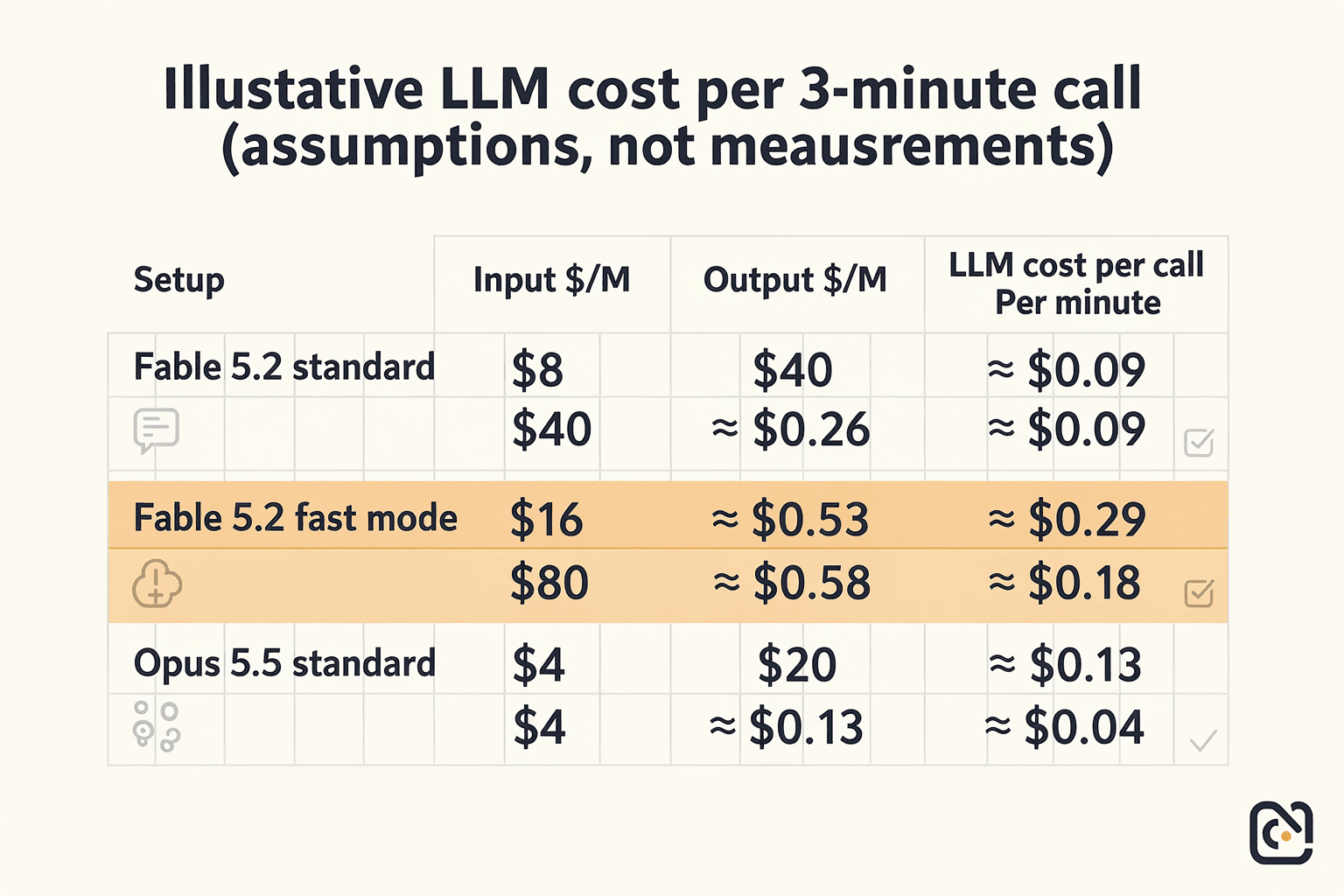
Using the assumptions below, Claude Fable 5.2 costs about $0.076 per minute (roughly ₹7.30) in standard mode and about $0.152 per minute (roughly ₹14.60) in fast mode, for the language model alone. Those figures are as of November 2026 and exclude speech recognition, text-to-speech and phone carriage.
What assumptions sit behind the per-minute numbers?
These are our assumptions, not measured data. We normalised the 5-minute, 20-turn support call from the earlier worked example:
- 40,000 input tokens and 1,500 output tokens per call, which works out to 8,000 input and 300 output tokens per minute.
- No prompt caching, so every turn re-sends the system prompt, knowledge snippets and history.
- Conversion at US$1 = ₹96.
- Opus 5.5 rates of $4/$20 standard and $8/$40 fast, per Sentra's November 2026 pricing roundup. Batch is $2/$10, according to Jake Handy's Model Drop write-up.
How do the per-minute costs compare?
| Setup | Rate per M tokens (in/out) | Cost per 5-min call | Per minute (US$) | Per minute (₹) |
|---|---|---|---|---|
| Opus 5.5 batch (offline only) | $2 / $10 | $0.095 | $0.019 | ≈ ₹1.82 |
| Opus 5.5 standard | $4 / $20 | $0.19 | $0.038 | ≈ ₹3.65 |
| Opus 5.5 live + Fable 5.2 advisor on ~10% of traffic | Mixed | $0.228 | $0.046 | ≈ ₹4.38 |
| Fable 5.2 standard | $8 / $40 | $0.38 | $0.076 | ≈ ₹7.30 |
| Opus 5.5 fast mode | $8 / $40 | $0.38 | $0.076 | ≈ ₹7.30 |
| Fable 5.2 fast mode | $16 / $80 | $0.76 | $0.152 | ≈ ₹14.59 |
The advisor row assumes Opus 5.5 handles every turn, and Fable 5.2 gets an extra 4,000 input and 150 output tokens per call for the hard cases.
What does the table tell us?
Fable 5.2 as the live voice costs exactly double Opus 5.5. Both numbers are linear in tokens, so the 2x price gap carries straight through to every minute of talk time.
Fast mode doubles it again. Fast mode is a research preview on the Claude API only, according to cellcog.ai and Jake Handy. It buys up to 2.5x output speed, but Fable 5.2 fast at ₹14.59 a minute is roughly four times the Opus 5.5 standard line.
Low-volume advisor use is cheap. The hybrid row adds only about ₹0.73 a minute to the Opus-only baseline. That is the clearest numerical argument for the Advisor pattern.
What about offline QA, where latency doesn't matter?
Scoring a finished call is a very different workload. Assume a transcript plus rubric of about 3,000 input tokens and 300 output tokens. Fable 5.2 standard then costs about $0.036, or roughly ₹3.46, per scored call, with no caller waiting on the reply. That is a better use of a frontier model than paying ₹7.30 every minute to speak.
How does this compare with a flat per-minute price?
An LLM-only figure understates your real bill. CallMissed, the AI voice-agent platform, prices Standard voice agents at a flat ₹4 a minute covering speech recognition, the language model and the voice, with a 30-second minimum per call. This post does not claim CallMissed supports Fable 5.2. The comparison only shows why a bundled rate is easier to budget than stacking token costs on top of speech and telephony.
Before choosing a model, rerun the table with your own turn counts and cache hit rates. Turn count drives input cost far more than output length does.
Where should Fable 5.2 sit: advisor, orchestrator or offline QA?
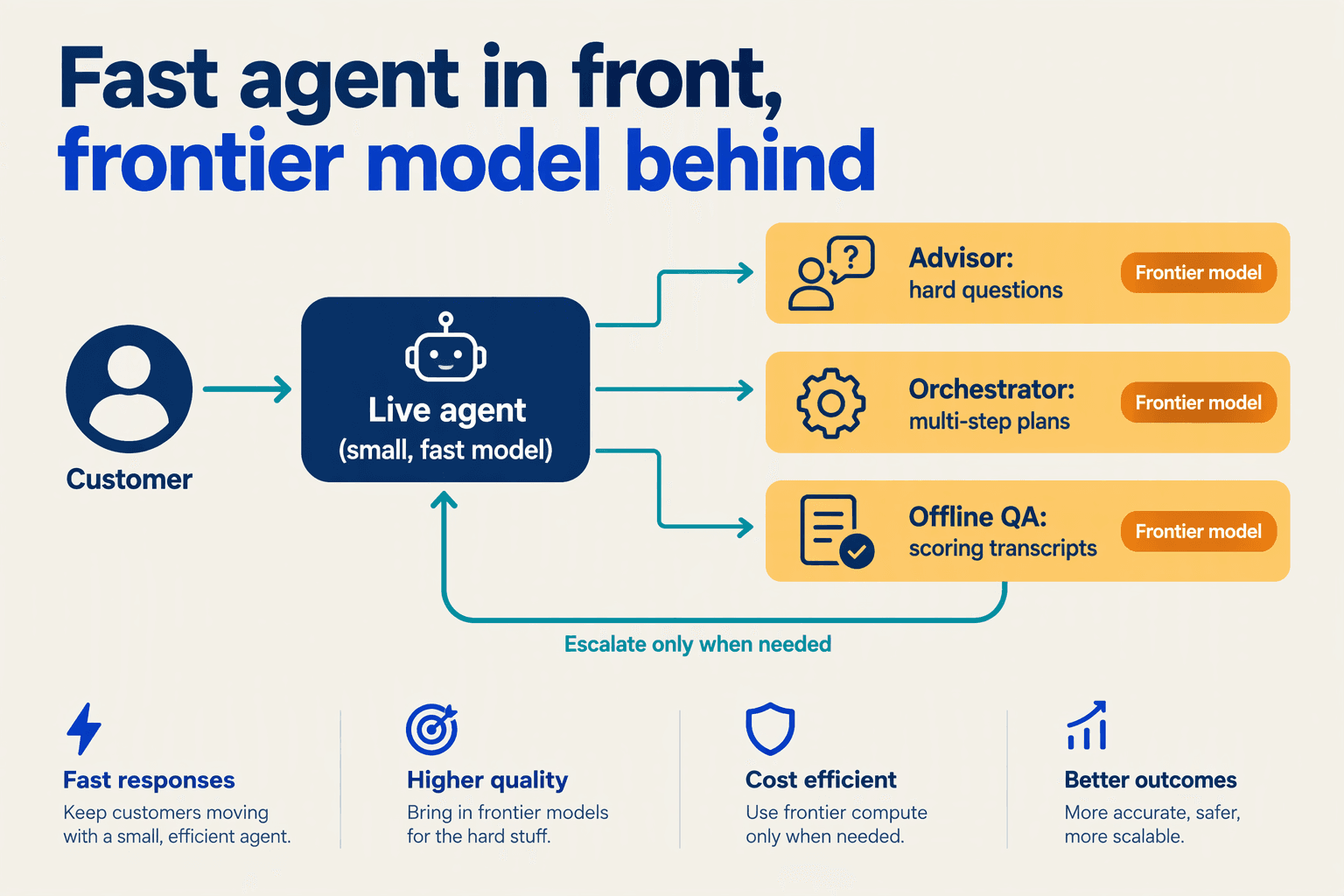
Put Claude Fable 5.2 where latency doesn't matter and mistakes are expensive: offline QA first, a gated advisor second, and an orchestrator only in chat or back-office flows. As of November 2026, Anthropic's own guidance supports this split: Opus 5.5 for most work, Sonnet 5.5 or Haiku 5.5 when speed and volume matter, and Haiku 5.5 for high-volume work and subagents.
Is offline QA the best use of Fable 5.2?
Yes, because nobody is waiting on the answer and every call can be judged against a rubric. Our assumption, not measured data: a transcript of about 4,000 tokens plus a 1,500-token rubric, for 5,500 input tokens and 500 output tokens per review.
At Fable 5.2's $8/$40 per million tokens, that works out to roughly $0.064 per reviewed call, or about ₹6 at ₹96 to the dollar. Reviewing 1,000 calls costs around $64. You can also sample: score every escalated or low-CSAT call, plus 10% of the rest.
Check whether a batch discount applies to Fable 5.2 before you commit. Handy AI reports Opus 5.5 batch pricing at half the standard rate ($2/$10), but this article doesn't assume the same for Fable.
How should a Fable 5.2 advisor work on a live call?
A fast model speaks, and Fable is consulted only when a trigger fires. Triggers might be a refund above a threshold, a legal or compliance question, a repeated "that's not what I asked," or a low-confidence tool result.
Illustrative maths, again on our assumptions: one consult sends 3,000 input tokens and returns 400 output tokens. At $8/$40 that costs about $0.04. If 10% of calls need two consults, the average cost across all calls is only about $0.008.
Keep the consult off the critical path:
- The speaking model says a short holding line, such as "Let me check that for you."
- Fable returns a decision or a draft answer, not a long essay.
- The fast model reads the result aloud in its own voice.
Don't use fast mode ($16/$80) for this by default. Most consults can tolerate the standard speed, and the up-to-2.5x output speedup is paid for at double the price.
When does Fable 5.2 make sense as an orchestrator?
It makes sense when the work is multi-step and a few extra seconds are acceptable. Examples are chat tickets, refund investigations that touch several systems, and post-call follow-up workflows. Fable plans and verifies, while cheaper subagents (Haiku 5.5 is built for exactly this) do the repetitive lookups and drafting.
The orchestrator pays for the hard reasoning once, instead of paying frontier rates for every tool call.
What does this look like on a real platform?
The pattern needs three things from the platform: a fast agent on the line, a way to hand off work, and an automated way to score the results. Voice platforms like CallMissed offer call scoring against your own QA rubrics, AI call notes (summary, action items, disposition) and squads that hand a live call from one agent to another. Those are the building blocks for this split, whichever model you choose for each role.
Quick placement guide
| Role | Latency sensitivity | Fable 5.2 fit |
|---|---|---|
| Speaking on the live call | Very high | Rarely |
| Gated advisor | Medium (hide with a holding line) | Good for rare hard cases |
| Orchestrator in chat or back office | Low to medium | Good |
| Offline QA and scoring | None | Strongest case |
If you only adopt one change, start with QA. It's the cheapest way to find out whether Fable 5.2 catches failures your current model misses, and it puts no latency in front of the customer. For the speed-first alternative in the live seat, see Claude Haiku 5.5 for voice agents.
What does Anthropic's own guidance say about picking a model?

Anthropic's guidance is to default to Claude Opus 5.5 for most work, reach for Claude Sonnet 5.5 or Claude Haiku 5.5 when speed and volume matter, and treat Claude Fable 5.2 as a specialist. As of November 2026, that tiering matches what the cost and latency math in the earlier sections suggests for a live phone agent.
What model does Anthropic recommend for most work?
Anthropic positions Opus 5.5 as the primary model. Jake Handy's Model Drop newsletter summarised the launch with the line "Claude's primary model is now faster, cheaper, and smarter than Fable." Sentra's November 2026 pricing roundup lists Opus 5.5 at $4 input and $20 output per million tokens, half the $8/$40 that Fable 5.2 charges.
For a support agent, that makes Opus 5.5 the default starting point. Test it first, and only move up if it fails on your own transcripts.
When does Anthropic point developers to Sonnet 5.5 or Haiku 5.5?
Anthropic's guidance steers developers to Sonnet 5.5 or Haiku 5.5 when speed and volume matter more than peak reasoning. Haiku 5.5 is described as built for high-volume work and subagents. A phone line fits that profile: many short turns, tight response deadlines and repetitive intents like order status, appointment changes and FAQs.
We covered the speed-first option in detail in Claude Haiku 5.5 for voice agents. The wider comparison across vendors is in the best LLMs for voice agents in 2026.
Where does Fable 5.2 fit in that lineup?
The guidance frames Fable as an Advisor or Orchestrator, not the default speaker. Note that the guidance we reviewed is general-purpose rather than voice-specific, so the voice conclusion below is our reading, not an Anthropic claim. Fable 5 launched at $10/$50 per million tokens, according to Finout, and 5.2 at $8/$40 is cheaper. It is still the most expensive tier in the family.
In practice, that suggests a split:
- Haiku 5.5 or Sonnet 5.5 speaks on the live turn, where every token and every second is felt by the caller.
- Opus 5.5 handles the harder in-call reasoning that the smaller model can't manage.
- Fable 5.2 advises or orchestrates from the side: reviewing a stuck conversation, planning a multi-step resolution, or scoring call transcripts after hang-up.
Why doesn't fast mode change the recommendation?
Fast mode gives up to 2.5x output speed, but it doubles the rate to $16/$80 for Fable 5.2. Anthropic's own materials describe the fast mode on Opus 5.5 as a research preview on the Claude API only, so build production flows around it cautiously. And a faster stream of output tokens doesn't remove the time spent processing a long prompt before the first word comes back. If you'd pay double for speed, the better question is whether a smaller model already gives you that speed at a fraction of the price.
How can you act on this without rebuilding your stack?
Keep the model choice swappable. Gateways such as CallMissed's developer AI API expose 159 models behind one OpenAI-compatible endpoint, with caller-chosen fallback models, so you can route different tiers without rewriting integrations. Check the catalogue for which Claude versions are currently listed before you plan around a specific one. If you'd rather not manage token economics at all, CallMissed's voice agent plans bundle speech recognition, the language model and the voice into one per-minute rate starting at ₹4.
The practical test is simple: run your last 100 real calls through Haiku 5.5 or Sonnet 5.5, then send only the failures to Fable 5.2 and measure what it actually fixes.
Which model should you pick for each phone and chat job?
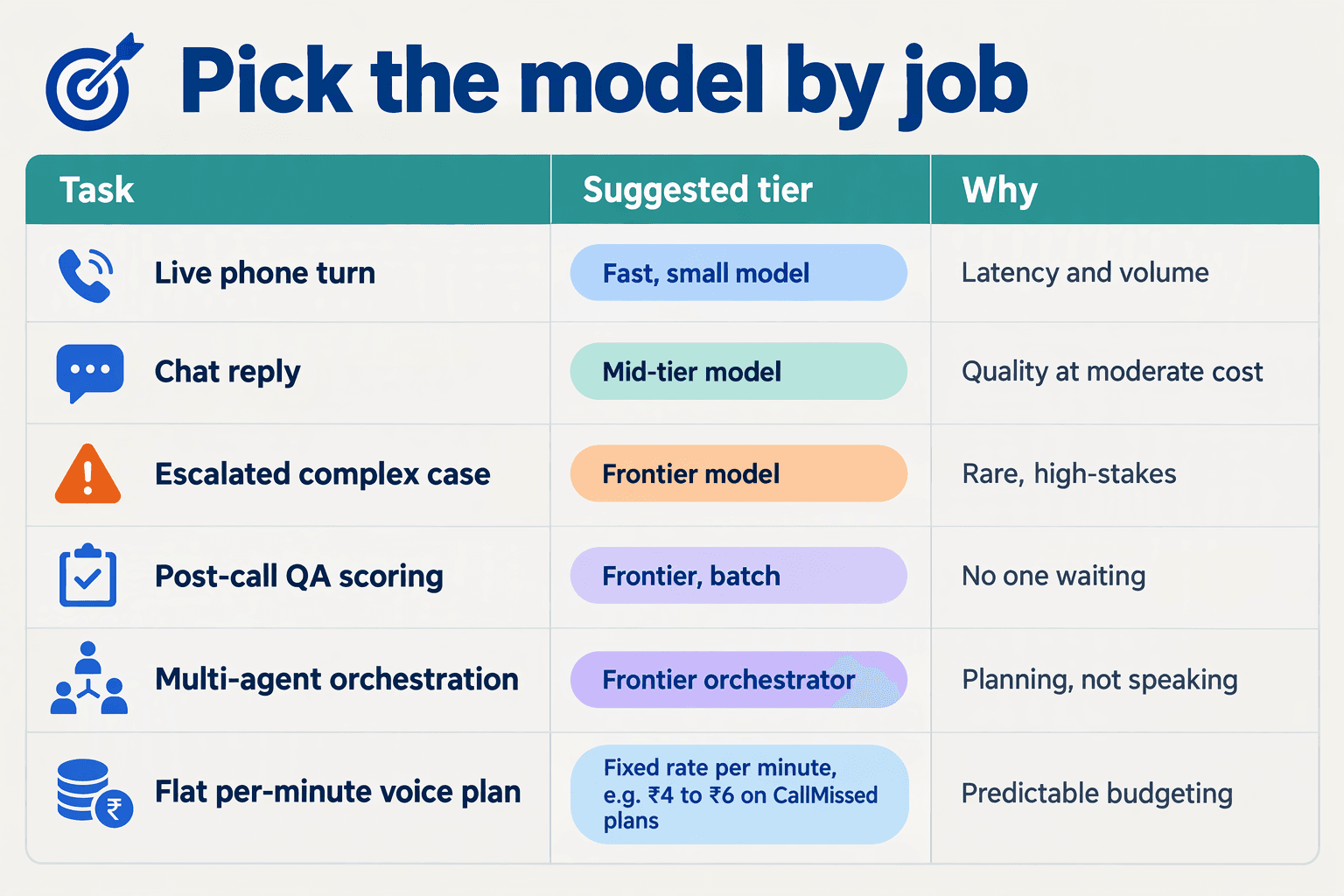
Use a small, fast model for the live turn, a mid-tier model for hard in-call reasoning, and keep Claude Fable 5.2 for the jobs where no caller is waiting. As of November 2026, that split follows Anthropic's own guidance: Claude Opus 5.5 for most work, Claude Sonnet 5.5 or Claude Haiku 5.5 when speed and volume matter, and Fable as an Advisor or Orchestrator.
Which Claude model fits each phone and chat job?
The table below maps common support jobs to a model tier. It reflects our reasoning from Anthropic's recommendations and the pricing above (Fable 5.2 at $8/$40 per million tokens, Opus 5.5 at $4/$20), not a measured benchmark.
| Job | Best-fit model | Why | Fable 5.2's role |
|---|---|---|---|
| Live phone turns (greetings, FAQs, slot-filling) | Haiku 5.5 | Built for high-volume work; the caller feels every delay | None; too slow and too costly per turn |
| Live chat or WhatsApp text support | Sonnet 5.5 | Customers tolerate a short wait in text, so you can trade a little speed for quality | Rarely needed |
| Hard in-call reasoning (billing disputes, policy exceptions) | Opus 5.5 at $4/$20 | Anthropic's recommended workhorse for most work | Advisor, consulted only on flagged turns |
| Intent routing, tool calls, data extraction | Haiku 5.5 subagents | Cheap, repeatable and parallelizable | None |
| Escalation review and handoff summaries | Fable 5.2 | Runs after the call or in a queue, so latency is irrelevant | Primary model |
| Offline QA and transcript auditing | Fable 5.2 | Careful judgment matters more than speed | Primary model |
| Multi-agent orchestration | Fable 5.2 | One expensive planning call can direct many cheap workers | Orchestrator |
How should you use Fable 5.2 as an Advisor or Orchestrator?
The pattern is simple: let a cheaper model hold the conversation and call Fable only when a trigger fires. Good triggers include:
- A confidence drop, such as the fast model asking for clarification twice in a row.
- A high-stakes intent, such as a refund above a set threshold, a legal complaint or a cancellation save.
- A human-handoff request, where Fable writes the summary the agent reads before picking up.
- A post-call audit, where Fable reviews a sample of transcripts against your QA rubric.
Because these calls are rare, the $8/$40 rate applies to a small slice of tokens rather than every turn. Fast mode at $16/$80 is hard to justify here, since an advisor call that runs in the background rarely needs 2.5x output speed.
What does this look like in practice?
A sensible default stack for a support line has three layers. Haiku 5.5 handles the spoken turn and routing. Opus 5.5 takes over when the problem needs real reasoning. Fable 5.2 reviews the escalations and scores the calls afterwards. If most of your traffic is simple, the first layer carries nearly all of it.
Platforms like CallMissed, the AI voice-agent platform, already structure work this way. They separate the live call from post-call jobs such as AI call notes (summary, action items, disposition) and call scoring against your own QA rubrics. Model availability differs by platform, so check the catalogue for the specific model you want.
The practical test is one question per job: is a human waiting on this answer right now? If yes, pick the fastest model that clears your quality bar. If no, a frontier model like Fable 5.2 may be worth its price.
Frequently Asked Questions
Is Claude Fable 5.2 worth it for voice agents?
How much does a 5-minute call cost on Claude Fable 5.2?
Does fast mode make Claude Fable 5.2 quick enough for phone calls?
What should I use instead of Claude Fable 5.2 for the live voice turn?
Where does Claude Fable 5.2 earn its price in customer-support AI?
How can I keep voice agent costs predictable without tracking tokens?
Conclusion
Claude Fable 5.2 is worth paying for, but rarely in the live voice turn. As of November 2026, the evidence points the same way:
- Cost compounds on every turn. At $8 input and $40 output per million tokens, Fable 5.2 costs twice Claude Opus 5.5's $4/$20, and fast mode lifts it to $16/$80.
- Fast mode only partly fixes latency. Up to 2.5x output speed helps, but callers still feel the delay across dozens of turns.
- Match the model to the job. Anthropic recommends Opus 5.5 for most work, and Sonnet 5.5 or Haiku 5.5 when speed and volume matter.
- Fable's best role is Advisor or Orchestrator. Use it for offline QA, tricky escalations and coordinating cheaper models.
Watch for price cuts, fast mode moving beyond its early-access status, and smaller models closing the reasoning gap. Any of these could change the math, so rerun the per-call table with your own token counts whenever rates move.
To explore how AI communication is evolving, check out CallMissed, an AI infrastructure platform powering voice agents and multilingual chatbots for businesses. Its voice-agent plans price a whole call, covering speech recognition, language model and voice, from a flat ₹4 a minute.
So where in your call flow does a frontier model earn its price: speaking to the caller, or quietly checking the work afterwards?
Related Reading
- Claude Haiku 5.5 Voice Agents vs Fable 5.5 Compared
- Best LLM for Voice Agents in 2026: GPT-6 Astra vs Claude Fable 5.1
- Claude Fable 5.1 vs GPT-5.6 Sol: Pricing, Coding & Voice Agents