Claude Fable 5.2 Effort Levels: Cost and When to Switch



Claude Fable 5.2 effort levels explained for coding agents: a decision table, a cost-per-task test and which launch numbers are vendor-reported.

Claude Fable 5.2 Effort Levels: Cost and When to Switch
Two months ago, Claude Fable 5.2 didn't officially exist. As of September 18, 2026, cellcog.ai found no Fable 5.2 in Anthropic's news page, model docs, sitemap or OpenRouter catalog, which still listed Claude Fable 5.1 (released September 1) as the newest model. Today, Anthropic's Claude Platform docs list it at $8 per million input tokens and $40 per million output tokens. That price makes Claude Fable 5.2 effort levels the most important cost control for anyone running coding agents.
The numbers show why. According to Anthropic's documentation, as of November 2026 Fable 5.2 offers a 1M-token context window, up to 128K tokens of output, a June 2026 knowledge cutoff, and adaptive thinking that is always on, with a default effort of high. You can't switch thinking off, so effort is how you decide how much reasoning each request buys. A single maximum-length response of 128K tokens costs about $5.12 (roughly ₹490 at ₹96 to the dollar) in output alone. A coding agent that loops through dozens of tool calls per task can multiply that quickly.
Model choice is also shifting. Anthropic's Claude Opus 5 announcement notes that biology-related requests blocked on Fable 5 now route to Opus 5 rather than Opus 4.8. The lineup keeps changing, so a hard-coded model name in your agent is a liability.
This guide covers how to decide, with trade-offs and worked examples:
- What effort levels control on a model whose thinking is always on, and why the
highdefault isn't right for every step of an agent loop. - What a coding task costs at $8/$40 per MTok, with arithmetic you can adapt to your own token counts.
- When to switch models instead of turning effort down, and when the reverse is true.
- How to build in flexibility so a model swap is a config change, not a rewrite.
On that last point, OpenAI-compatible and Anthropic-compatible gateways such as CallMissed, which exposes 159 models behind one API key with reasoning effort control and caller-chosen fallback models, are part of a broader move toward model-agnostic agent stacks.
Pricing and specifications here are as of November 9, 2026, and Anthropic has changed this lineup quickly. Check the official docs before you commit a budget.
Which Claude Fable 5.2 effort level should coding agents use?
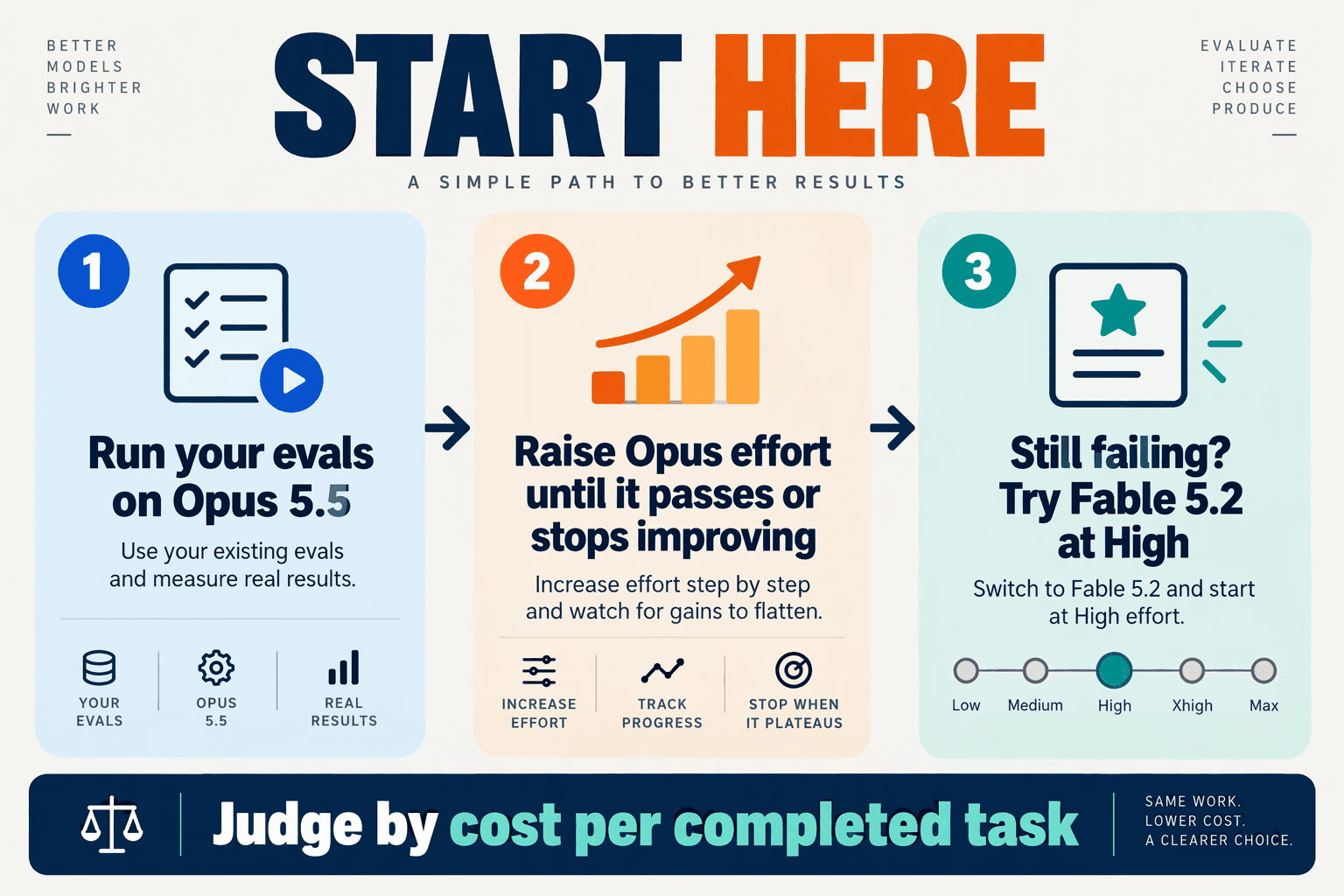
Use high (the default) for planning and for debugging steps that fail, and drop to a lower effort for routine edits, file reads and tool-result summarization. Treat effort as a per-step setting, not a per-agent one. Anthropic's Claude Platform docs list Claude Fable 5.2 with adaptive thinking that is always on and a default effort of high, so the question is where high is wasted, not whether to think at all.
What does effort actually change on Fable 5.2?
Effort changes how much reasoning the model spends before and during a response. Thinking tokens are billed as output, and output is the expensive side at $40 per million tokens versus $8 for input, according to Anthropic's docs as of November 2026. Check the model overview for the exact list of effort values your account supports, because Anthropic has changed this lineup quickly.
How much does lowering effort save in a real agent loop?
Less than most teams expect, because input tokens dominate long loops. Here is an illustrative calculation using assumed token counts, not measured benchmarks:
- Assumed task: 30 agent steps, each sending about 40K tokens of context (code, diffs, tool output).
- Input cost: 1.2M tokens × $8/MTok = $9.60 (about ₹922 at ₹96 to the dollar), the same at any effort.
- Output at
high: about 3,000 tokens per step, or 90K total, costs $3.60. Total: $13.20 (about ₹1,267). - Output at a low effort: about 800 tokens per step, or 24K total, costs $0.96. Total: $10.56 (about ₹1,014).
Dropping effort across the whole loop saves roughly 20% in this scenario. Your numbers will differ, but the shape holds: context management (trimming what you resend each step) often saves more than effort tuning, and effort works best on top of that.
Which effort level fits which coding-agent step?
| Agent step | Suggested effort | Why |
|---|---|---|
| Task planning, architecture decisions | high | Mistakes here propagate through every later step |
| Multi-file refactors, tricky bugs | high | Reasoning quality decides whether the fix is correct |
| Routine edits, renames, boilerplate | Lower | The answer is nearly determined by the instruction |
| Reading files, summarizing tool output | Lower | Little reasoning is needed |
| Retry after a failed test | Raise one level | The cheap attempt already failed |
What are the risks of going too low?
Under-reasoning shows up as extra loops. If a low-effort step produces a wrong patch, the retry costs another full input pass (about $0.32 at 40K tokens), which can erase the output savings. Track cost per successful task, not cost per call.
A practical approach:
- Start every step type at
high, which is the default. - Log tokens, retries and pass/fail on your test suite for a week.
- Lower effort on one step type at a time, and keep the change only if the pass rate holds.
- Add an escalation rule: when tests fail twice, raise effort or hand the step to a different model.
That last rule leads into the next question: whether a cheaper model, rather than a lower setting, is the right fix.
What is Claude Fable 5.2, and what is confirmed versus unverified?

Claude Fable 5.2 is a current Anthropic model, and its specifications and price are confirmed by Anthropic's own documentation. Its release history, benchmark claims and behavior relative to earlier versions are a mix of confirmed, anecdotal and rumored information. As of November 9, 2026, here is where the line falls.
What is confirmed about Claude Fable 5.2?
Anthropic's Claude Platform docs list Claude Fable 5.2 in their comparison of the current lineup with these specifications:
- Context window: 1M tokens
- Max output: 128K tokens
- Price: $8 per million input tokens and $40 per million output tokens
- Thinking: adaptive, always on
- Default effort:
high - Knowledge cutoff: June 2026
Anthropic's Claude Opus 5 announcement also confirms that Fable 5 remains an active model family. It states that biology-related requests blocked on Fable 5 now route to Opus 5 rather than Opus 4.8. Any effort or cost decision in this guide rests on the docs table above, not on the sources below.
What was the release history, and how reliable is it?
The history is documented, but only partly by Anthropic. Independent tracker cellcog.ai reported that as of September 18, 2026, Anthropic's news page, model documentation, sitemap and OpenRouter's Anthropic catalog listed Claude Fable 5.1, released September 1, as the newest model. Cellcog found no Fable 5.2 identifier, model card or price at that point.
Reuters, cited by cellcog.ai, reported on September 19 that Anthropic was considering a new model release, with no model name and no date. That is a credible report, but it never names Fable 5.2. Treat the sequence "no model in mid-September, listed in the docs now" as confirmed. Treat any narrative about why or how it launched as inference.
What remains unverified?
Several claims circulating around the model are not backed by an Anthropic source in the material reviewed here:
- Rumor content. A YouTube video claimed Anthropic was "quietly testing" Fable 5.2 and Opus 5.2 and that they were "coming sooner than expected." It predates the docs listing and cites no primary source.
- Prediction markets. A Manifold Markets question tracked Fable 5.2+ release timing. Market odds reflect speculation, not product facts.
- User anecdotes. A r/ClaudeCode thread reports that "Fable-5.2 is up for me" after updating Claude Code, and shares informal impressions. That is one user's experience, not a measurement.
- Benchmarks and agent performance. I found no first-party benchmark figures in the sources reviewed, so any number you see quoted for coding accuracy or speed should be traced to its origin before you rely on it.
How should this change your build decisions?
Plan around the confirmed spec sheet and test everything else on your own workload. In practice:
- Budget from the docs table. Compute costs with $8/$40 per MTok and the 128K output ceiling.
- Run your own evals. Replay a sample of real agent tasks at different effort levels before changing production settings.
- Keep the model name in config. Anthropic's lineup moved from Fable 5.1 to 5.2 and added Opus 5 within weeks, so pinning a model ID in code invites a rewrite.
- Re-check the docs before each budget cycle. Pricing and defaults on this page are dated November 9, 2026.
What did Anthropic report at launch, and how much of it can you trust?
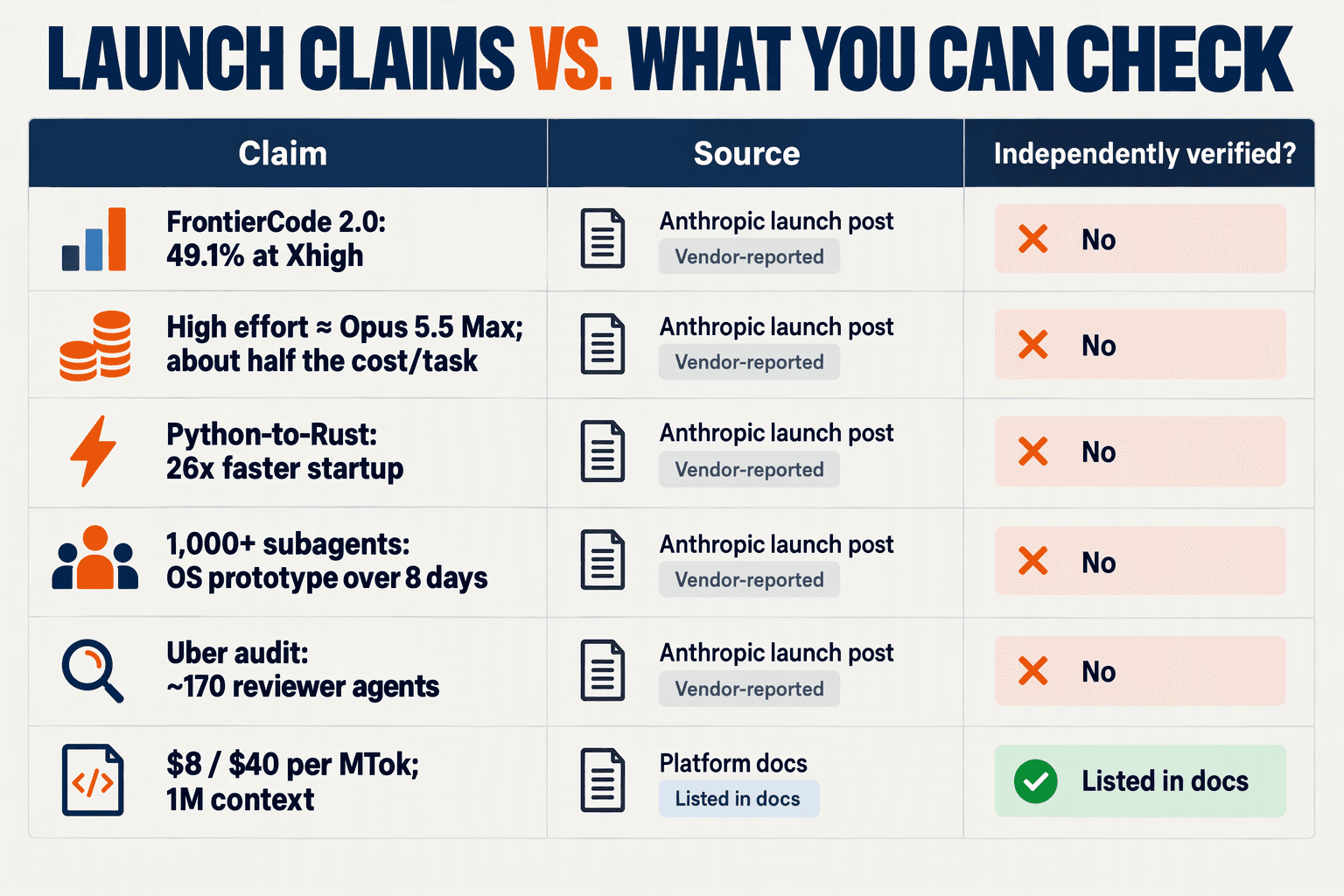
Anthropic's launch documentation gives you firm, checkable specifications, such as price, context window, output cap and default effort. The material provided for this guide contains no Anthropic-published coding benchmark scores for Claude Fable 5.2, so treat any performance claim you see elsewhere as unverified until you test it. Here is how each claim breaks down, as of November 9, 2026.
Which Fable 5.2 launch claims are verified, and which are not?
| Claim | Where it comes from | Type of evidence | Trust level |
|---|---|---|---|
| $8 input / $40 output per MTok | Anthropic Claude Platform docs | First-party spec | High: re-check before budgeting |
| 1M context, 128K max output, June 2026 cutoff | Anthropic Claude Platform docs | First-party spec | High for limits; limits are not quality at length |
Adaptive thinking always on, default effort high | Anthropic Claude Platform docs | First-party spec | High |
| Blocked biology requests on Fable 5 route to Opus 5, not Opus 4.8 | Anthropic's Opus 5 announcement | First-party notice | High for routing; irrelevant to coding quality |
| "Coming sooner than expected" | YouTube commentary | Speculation | Low |
| Release-date odds | Manifold Markets | Crowd forecast | Low for capability; it only prices timing |
| "Fable-5.2 is up for me" | r/ClaudeCode thread | Anecdote | Low: one user, no controlled test |
What does the table tell us about trust?
Anything in the first four rows is a specification Anthropic controls and publishes in its docs. A price or a token limit is either correct or it isn't, and you can verify it with one API call. That makes these figures safe inputs for a cost model.
None of the specification rows says how well Fable 5.2 fixes bugs, navigates a monorepo or recovers from a failed tool call. A 1M-token window tells you how much text fits, not how reliably the model uses it. A 128K output cap tells you the ceiling, not what a typical agent step produces.
Why should you distrust pre-release signals?
The rumor trail was wrong before it was right. According to cellcog.ai, as of September 18, 2026 there was no Fable 5.2 in Anthropic's news page, model docs, sitemap or OpenRouter catalog, and Claude Fable 5.1 (released September 1) was the newest model. Reuters, citing three sources on September 19, reported only that Anthropic was considering a new model, with no name or date.
The lesson is to anchor on dated, first-party documents. Forecasts, videos and forum posts are useful for noticing that something may be coming, but not for deciding what to run in production.
How should you verify Fable 5.2 for your own agent?
- Take the price and limits from the docs, and record the date you checked.
- Build a fixed task set from your own repositories: failing tests, small refactors and one multi-file change.
- Run each task at several effort levels, logging tokens, cost, pass rate and number of tool-call loops.
- Compare against your current model on the same tasks before changing defaults.
- Re-run after any model-version change, because this lineup has moved quickly.
A gateway that exposes reasoning effort control and fallback models, such as CallMissed's OpenAI-compatible API, makes steps 3 and 4 a configuration change rather than new integration code. The harness matters more than the gateway, though. Your own pass-rate data will be a better guide than anyone's launch claims.
How do Low, Medium, High, Xhigh and Max change cost and behavior?
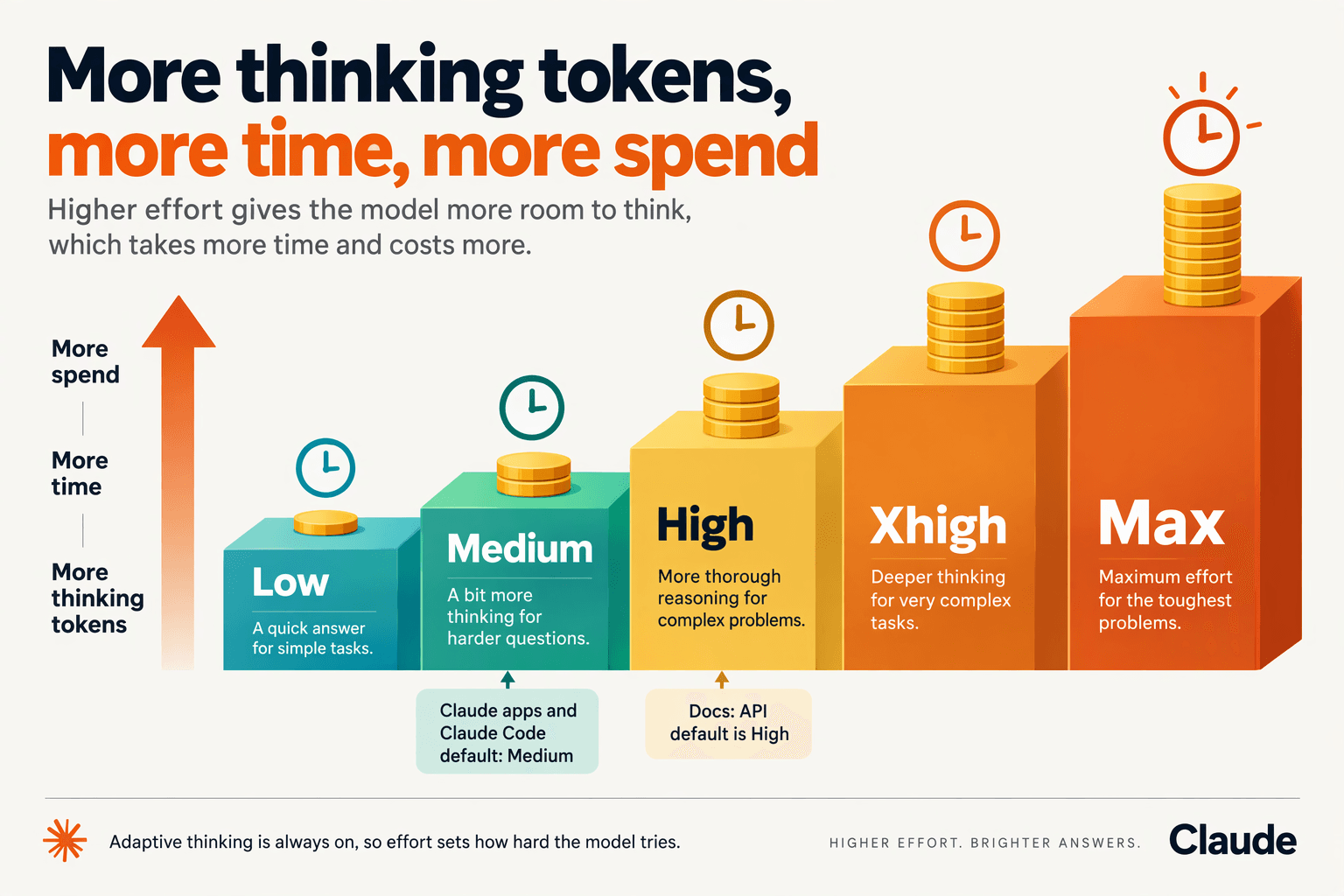
Each step up the ladder (Low, Medium, High, Xhigh, Max) buys more reasoning tokens before and during a response, and because thinking is billed as output at $40 per million tokens, cost rises with every level. The documentation excerpt in our research confirms only that Claude Fable 5.2 has adaptive thinking that is always on and a default effort of high, as of November 9, 2026. It does not publish per-level token budgets, so the numbers below are labeled assumptions, not Anthropic figures.
How does behavior change at each effort level?
Because thinking is adaptive, effort works as a ceiling on deliberation, not a fixed allowance. The model can still spend less on an easy request. Expect these tendencies:
- Low: Fast and cheap. It suits file reads, renames, formatting and summarizing tool output, where the answer is nearly mechanical.
- Medium: A sensible floor for routine edits that touch a few files or need light cross-referencing.
- High (default): Balanced for most coding work, including planning and diagnosing a failing test.
- Xhigh: Deeper exploration of alternatives. It fits multi-file refactors and bugs you have already failed to fix once at
high. - Max: The largest reasoning budget. Reserve it for a handful of hard decisions, such as architecture choices or a concurrency bug.
What does each level cost per step?
Here is a worked example. Assume each step emits 2,000 visible tokens plus thinking tokens that grow with effort. The thinking counts are my assumptions, so replace them with your own logs.
| Effort | Assumed thinking tokens | Total output | Cost per step | Approx. in ₹ (at ₹96/$) |
|---|---|---|---|---|
| Low | 500 | 2,500 | $0.10 | ₹9.60 |
| Medium | 2,000 | 4,000 | $0.16 | ₹15.36 |
| High | 6,000 | 8,000 | $0.32 | ₹30.72 |
| Xhigh | 15,000 | 17,000 | $0.68 | ₹65.28 |
| Max | 30,000 | 32,000 | $1.28 | ₹122.88 |
Across a 40-step agent run, that is $4.00 at Low, $12.80 at High and $51.20 at Max, counting output only. Input cost comes on top at $8 per million tokens, and it grows as the context fills across tool calls.
How should you spend the effort budget?
The gap between Low and Max in this example is 12.8x per step. Using high everywhere is therefore the expensive default, not the safe one. A practical routing pattern:
- Run routine steps at Low or Medium. That means reads, greps, small edits and result summaries.
- Plan at High. One good plan prevents many wasted tool calls.
- Escalate on failure. If a test still fails after a
highattempt, retry once at Xhigh before touching Max. - Cap Max by policy. Allow it for named step types only, and log how often it fires.
Measure before you tune. Log thinking tokens per step type for a week, then move the cheapest-to-lose steps down first.
Effort is only a request-level parameter, so you can implement this routing in code. OpenAI-compatible and Anthropic-compatible gateways such as CallMissed expose reasoning effort control across their model catalog, which lets a router set effort per step without changing SDKs. Check that the parameter names and supported levels match what your chosen model's docs list.
Should you stay on Opus 5.5 or switch to Fable 5.2?

Stay on Opus 5.5 if it already clears your own task suite at an acceptable cost. Switch to Claude Fable 5.2 only for the task classes where Opus 5.5 fails or needs repeated retries. Anthropic's Claude Platform docs, as of November 2026, price Fable 5.2 at $8 per million input tokens and $40 per million output tokens, with a 1M-token context window and 128K max output. The right call depends on cost per resolved task, not cost per token.
One caveat first: the sources reviewed for this guide don't include a verified Opus 5.5 price sheet. Pull its current rates from the Claude Platform docs and drop them into the formula below.
How do you compare the two models fairly?
Compare cost per resolved task, which is the cost of one attempt divided by the share of attempts that succeed.
Here is a worked example for Fable 5.2 at the documented rates. Take a mid-size refactor in which the agent loop consumes 200K input tokens (including re-read context) and 30K output tokens (including thinking):
- Input: 200,000 × $8 / 1,000,000 = $1.60
- Output: 30,000 × $40 / 1,000,000 = $1.20
- Total: $2.80 per attempt, roughly ₹269 at ₹96 to the dollar
Now apply illustrative pass rates. These are hypothetical numbers, so replace them with your own eval results. If Fable 5.2 resolves 80% of these tasks, the cost per resolved task is $2.80 / 0.80 = $3.50. A cheaper model that costs $1.50 per attempt but resolves only 40% works out to $3.75 per resolved task. The "cheap" model ends up costing more, and it also adds human review time.
The reverse also holds. If Opus 5.5 resolves 90% of your routine edits at a lower attempt cost, Fable 5.2 buys you nothing there.
When should you stay on Opus 5.5?
- Your agent mostly does well-specified edits: renames, test scaffolding, small bug fixes.
- Your eval suite shows the pass-rate gap is within noise.
- Your spend is dominated by long, repetitive loops, where output at $40 per MTok adds up fast.
- You can't yet re-validate prompts and tool schemas on a new model.
When is Fable 5.2 worth the switch?
- Hard debugging: failures that survive two or three retries on your current model.
- Large-context work: tasks that benefit from the 1M-token window instead of aggressive chunking.
- Long single responses: generation needing up to 128K output tokens.
- Planning steps: a short, expensive planning call followed by cheaper execution.
What's the safest way to migrate?
- Build a replay set of 30–50 real tasks from your own agent logs, including known failures.
- Run both models at the same effort level, then repeat Fable 5.2 at a lower effort.
- Record pass rate, tokens, retries and wall-clock time for each run.
- Route by task class, not globally. Send planning and hard failures to Fable 5.2, and keep routine edits on Opus 5.5.
- Keep the model name in config. Anthropic's Opus 5 announcement notes that biology-related requests blocked on Fable 5 now route to Opus 5 instead of Opus 4.8, a reminder that the lineup and its routing keep shifting.
Model-agnostic setups make step 5 easy. OpenAI-compatible gateways such as CallMissed support reasoning effort control and caller-chosen fallback models, so the model choice stays a request parameter rather than a code change. Whatever stack you use, re-run the replay set whenever Anthropic updates the lineup.
How do you measure cost per completed task on your own repo?
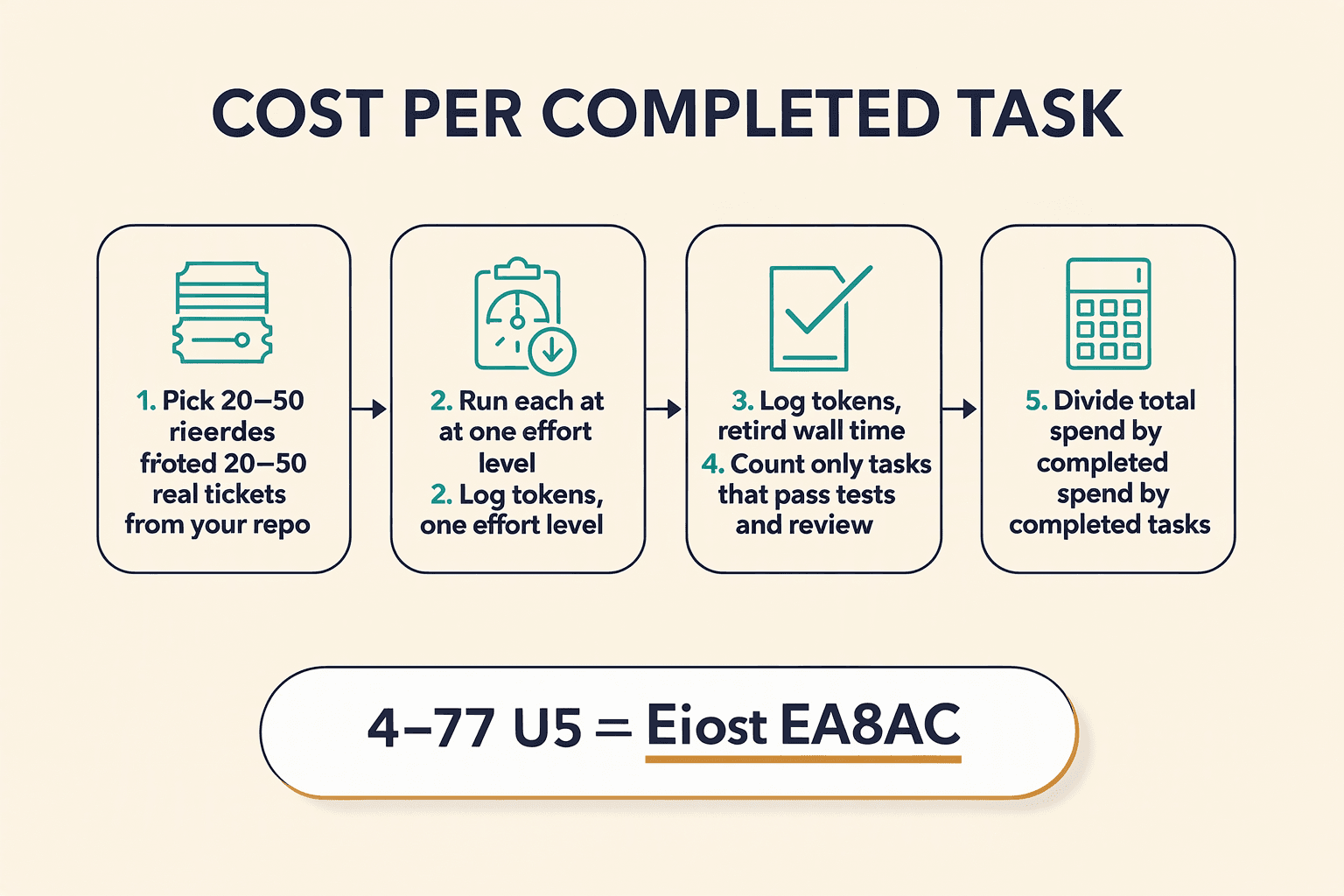
Cost per completed task is total spend on every attempt, including failed and retried runs, divided by the number of tasks that pass your acceptance check. A cheap run that fails costs money and produces nothing, so per-request price alone misleads. You can measure this on your own repo in an afternoon.
How do you build a task set that reflects your repo?
Pick 20 to 50 closed issues or merged pull requests that have a test proving the fix. Pin each to the commit before the change, and keep the tests hidden from the agent. This gives you a fixed benchmark that reflects your codebase, not a public leaderboard's.
Define "completed" before you run anything, for example:
- The hidden tests pass.
- Lint and type checks pass.
- A reviewer accepts the diff without rework.
What should you log on every request?
Capture these fields for each model call in the agent loop:
- Input tokens, including re-sent context, which usually dominates a long loop.
- Output tokens, including thinking, because Claude Fable 5.2 bills reasoning as output at $40 per million tokens.
- Effort level and model name used for that step.
- Task ID and attempt number, so retries roll up correctly.
- Outcome of the final check.
If you route through a gateway, per-request usage logs give you this without custom instrumentation. CallMissed's OpenAI-compatible API, for example, exposes usage and request logs, plus reasoning effort control and caller-chosen fallback models. That makes an effort-by-model test matrix a parameter change, not a code change.
How do you calculate it? A worked example
The token counts below are illustrative, not benchmarks. Substitute your own. Prices are Anthropic's list rates for Fable 5.2 as of November 9, 2026: $8 per million input tokens and $40 per million output tokens. This sketch ignores any prompt-caching discounts, so check the docs and adjust.
Formula: cost per completed task = (total input tokens × input price + total output tokens × output price) ÷ tasks passed.
| Setting | Input / output tokens per task | Cost per attempt | Pass rate | Cost per completed task |
|---|---|---|---|---|
high | 400K / 30K | $4.40 (about ₹422) | 60% | about $7.33 (about ₹704) |
| Lower effort | 400K / 15K | $3.80 (about ₹365) | 50% | $7.60 (about ₹730) |
The lower-effort run is about 14% cheaper per attempt but slightly more expensive per finished task, because the extra failures must be paid for too. This is why the metric matters. At these numbers, high wins for this task type. Your own repo might show the opposite for simpler tasks.
What mistakes skew the result?
- Running each task once. Agent runs vary, so use at least three runs per task and setting, then average.
- Ignoring failed-run spend. Divide by passes, not by attempts.
- Mixing task difficulty. Report results by category (bug fix, refactor, test writing). One blended number hides where a cheaper setting is safe.
- Skipping the human cost. If a "passing" diff needs 20 minutes of review, count it.
Repeat the run whenever Anthropic changes the lineup or prices, since both have moved quickly this year. Keep the model name and effort level in config so each re-test is a one-line edit.
What do the long-running agent demos really tell operators?

Long-running agent demos show what Claude Fable 5.2 can do at best, not what a run costs you. Treat them as existence proofs and ask for token counts before you plan a budget. As of November 9, 2026, the sources reviewed for this guide include Anthropic's Claude Platform docs, a Reddit thread of user impressions in r/ClaudeCode and release-date tracking from cellcog.ai. None of them publishes a token log or cost breakdown for an extended Fable 5.2 agent run.
Why can't you budget from a demo?
A demo hides the three variables that set your bill: effort level, turn count and context size. Anthropic's docs list Fable 5.2 with a 1M-token context window, $8 per million input tokens and $40 per million output tokens. Because adaptive thinking is always on, a demo run at the high default may spend far more on reasoning than a tuned production loop would.
User impressions are useful signals but anecdotal. The r/ClaudeCode thread shows developers trying the model inside Claude Code. That tells you it is reachable and how it feels, not what it costs per task.
What does a long run cost? A worked example
This is an illustration with assumed numbers, not a measured benchmark. Suppose an agent runs 50 turns, re-sends a 200K-token context each turn and writes 4K output tokens per turn, thinking included.
- Input: 50 × 200K = 10M tokens × $8/MTok = $80
- Output: 50 × 4K = 200K tokens × $40/MTok = $8
- Total: about $88, roughly ₹8,450 at ₹96 to the dollar
Input dominates here, which is the opposite of what the output price suggests. Long runs are mostly a context-management problem. Check Anthropic's docs for current caching rates, which can change this math substantially, and trim what the agent re-reads.
What should operators ask of any agent demo?
- Which effort level ran each step? A demo at
highthroughout is not your production configuration. - How many turns and total tokens? Ask for input and output separately, since they are priced 5× apart.
- How often did the agent retry or backtrack? Failed steps are where
highearns its cost, as covered earlier. - What was the success criterion? A passing test suite is verifiable. A "looks right" demo is not.
- Which model version ran it? Anthropic's lineup has moved fast: cellcog.ai found no Fable 5.2 on September 18, 2026, and the docs list it now. A demo from last month may describe a different model.
How do you turn a demo into your own numbers?
Replay one of your real tasks with logging on, then compare against the demo's claims. You need per-request logs of input tokens, output tokens and effort setting. Gateways such as CallMissed, the OpenAI-compatible and Anthropic-compatible AI gateway, provide usage and request logs plus reasoning effort control and caller-chosen fallback models. That makes it practical to run the same task at two effort levels or on two models and compare the cost per completed task.
Measure cost per successful task, not cost per token. A cheaper setting that needs two attempts can cost more than one high run. Only your own logs can settle that, and a demo cannot.
What are Anthropic, developers and skeptics saying about Fable 5.2?

Anthropic has said the most through its documentation, developers have offered early and mostly anecdotal impressions, and skeptics have focused on timing and missing evidence rather than performance. As of November 9, 2026, none of the sources reviewed here includes an independent coding benchmark for Claude Fable 5.2. Judge the model on your own workloads.
What has Anthropic said about Fable 5.2?
Anthropic's statements are factual and spec-driven. The Claude Platform docs list Claude Fable 5.2 with a 1M-token context window, 128K max output, $8 / $40 per million tokens, adaptive thinking that is always on, a default effort of high and a June 2026 knowledge cutoff.
The Claude Opus 5 announcement adds a routing detail. Anthropic says biology-related requests blocked on Fable 5 now route to Opus 5 rather than Opus 4.8. For agent builders, this means the lineup behind a model name can shift, and some requests may land on a different model than you expected.
What are developers reporting?
Early developer feedback is thin and informal. In the r/ClaudeCode thread "Impressions on Fable-5.2", a user reports the model is available and tells others to update Claude Code to try it. Their test was a knowledge probe, asking who "Tibo" is without web search, which says little about coding quality.
Before launch, a YouTube video titled "Claude Fable 5.2 and Opus 5.2 Are Coming Sooner Than Expected!" claimed Anthropic was quietly testing the next round of models. That is speculation rather than confirmation. Treat both sources as signals of interest, not evidence of performance.
What are skeptics saying?
The skeptical case rests on timing and incentives:
- No paper trail early on. cellcog.ai found no Fable 5.2 in Anthropic's news page, model docs, sitemap or OpenRouter catalog as of September 18, 2026. It listed Fable 5.1 (released September 1) as the newest model. Its read was that no identifier, model card or statement existed.
- Competitive pressure. Reuters reported on September 19, citing three sources, that Anthropic was considering a new model to counter OpenAI's momentum since the launch of GPT-6 Astra, ahead of an expected IPO. Skeptics read the fast cadence as market-driven.
- Prediction markets hedged the name. Manifold Markets' "Claude Fable 5.2+" market counts any version at or above 5.2 as a release, so the market anticipated a skipped or renamed version.
What should coding-agent teams take from this?
- Trust the docs for specs, not for fit. Pricing and limits are verifiable. Fitness for your codebase is not.
- Run a small eval before switching. Use 20 to 50 real tasks from your repo and compare cost per resolved task at several effort levels.
- Pin versions and plan fallbacks. Anthropic has already changed routing once and changed this lineup quickly. Gateways like CallMissed, which offers reasoning effort control and caller-chosen fallback models across 159 models behind one OpenAI-compatible and Anthropic-compatible API, are one way to make that a config change.
- Re-check before budgeting. Specs and prices here are as of November 2026.
Which effort level fits which coding-agent job?
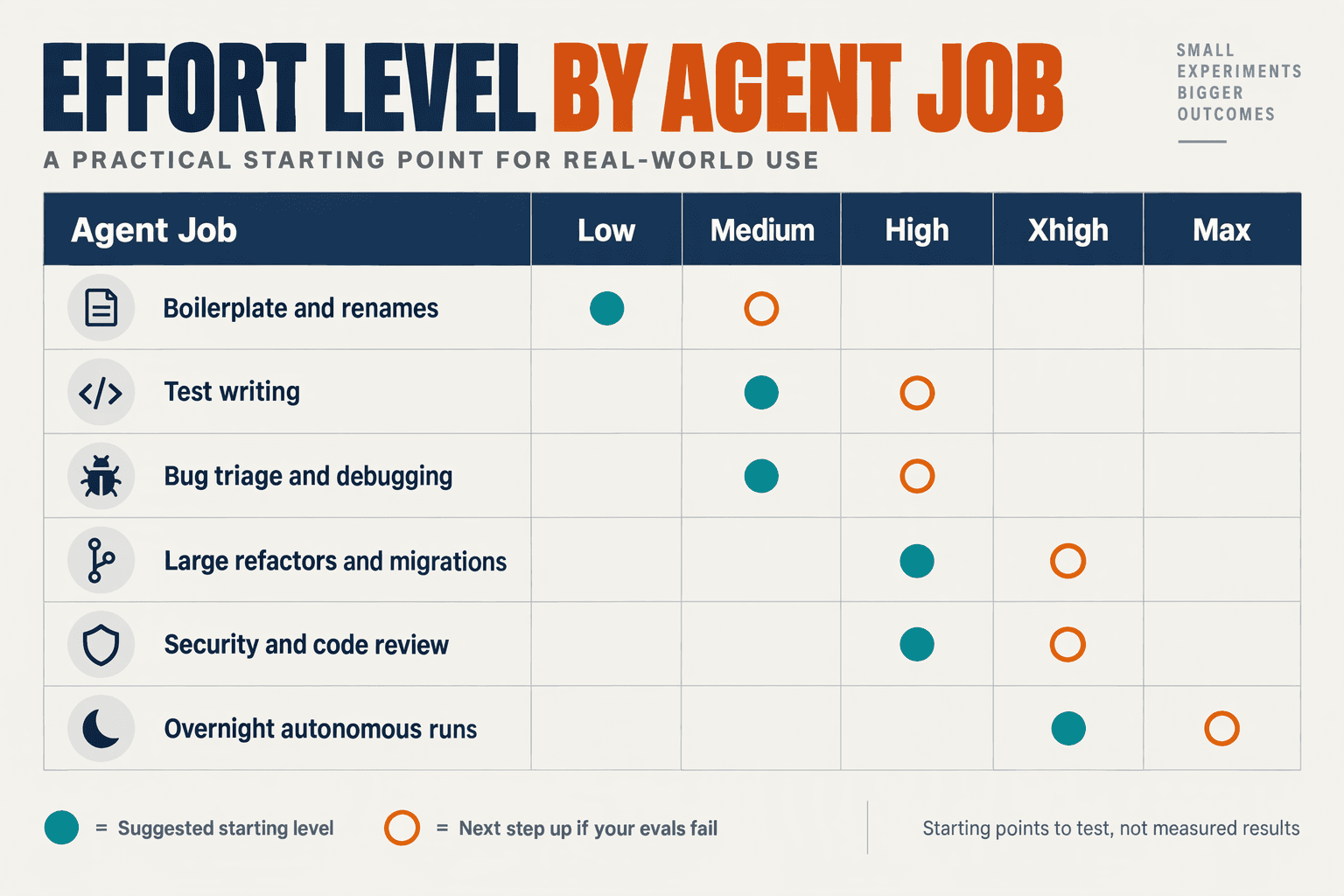
Match effort to the cost of a wrong answer: use low for mechanical steps, medium for well-scoped edits, and high (the default) for planning, debugging and review. The table below gives starting points for common coding-agent jobs on Claude Fable 5.2. These are my recommendations, not Anthropic benchmarks, so validate them against your own task suite. Confirm the exact effort values your API version accepts in Anthropic's Claude Platform docs, as of November 2026.
Which effort level should each coding-agent job start with?
| Agent job | Starting effort | Why | Escalate when |
|---|---|---|---|
| Reading files, grep and listing results | low | Output is mostly tool calls and short notes, with little reasoning to buy | The agent misses a relevant file twice |
| Summarizing tool output or logs | low | Compression, not problem-solving | Summaries drop error details that later steps need |
| Single-file edits, renames, boilerplate | medium | The spec is clear, but small slips cost a retry | Tests fail after the edit |
| Writing unit tests for existing code | medium | Pattern-following with some edge-case judgment | Coverage targets stall |
| Multi-file refactors and architecture planning | high | An early planning error compounds across every later step | Rarely; this is your ceiling |
| Debugging a failing test or a flaky bug | high | Root-cause analysis is where extra reasoning pays off | Reproduction still fails; consider a stronger model |
| Final code review before a pull request | high | A missed bug costs more than the extra tokens | Not applicable |
How do you work out whether the saving is worth it?
Use the published rate of $40 per million output tokens, and remember that thinking tokens bill as output. Suppose a low step produces 1,000 output tokens and a high step produces 8,000 for the same call. Those are illustrative numbers, since real reasoning length varies by prompt.
lowstep: 1,000 tokens × $40 / 1M = $0.04 (about ₹3.84 at ₹96 per dollar).highstep: 8,000 tokens × $40 / 1M = $0.32 (about ₹30.72).- Across 40 mechanical steps in one task: $1.60 versus $12.80, a gap of about $11.20 (roughly ₹1,075).
The per-step gap looks small, but agent loops multiply it. The saving only counts if the cheaper step doesn't trigger a retry, because a failed low step plus a high redo costs more than running high once.
What rules keep this from becoming guesswork?
- Default mechanical tools to
low, then promote. Start cheap and escalate on a measurable failure signal, such as a failing test or a repeated tool error. - Cap escalation. Allow one retry at higher effort, then hand off to a stronger model or a human instead of looping.
- Log effort per step. Without per-step token and effort logs, you can't tell which downgrade saved money and which one caused rework.
- Re-test after every model update. Anthropic has changed this lineup quickly, so a
mediumthat works today may not hold on the next release.
Keeping effort settings in config rather than hard-coded in agent logic makes these rules cheap to change. A gateway with reasoning effort control and caller-chosen fallback models, such as CallMissed's OpenAI-compatible API, is one way to keep that routing outside your agent code.
The next section covers what to do when no effort setting fixes the problem and the right move is a different model.
Frequently Asked Questions
What are Claude Fable 5.2 effort levels, and which one is the default?
high, as of November 2026. Because thinking tokens are billed as output at $40 per million tokens, effort is the main lever on the cost of each agent step. Check the official docs for the full list of supported values before hard-coding any of them.Can I turn thinking off on Claude Fable 5.2?
How much does a Claude Fable 5.2 coding-agent step cost?
When should I switch models instead of lowering effort?
Is Claude Fable 5.2 actually released, given the earlier rumors?
How do I make switching models or effort levels a config change?
/v1/messages and chat completions endpoints, reasoning effort control and caller-chosen fallback models. Check the catalogue at docs.callmissed.com for whether a specific model is listed before you plan around it.Conclusion
Claude Fable 5.2 rewards teams that treat effort as a dial they adjust step by step, not a setting they leave on default. As of November 9, 2026, these are the main takeaways:
- Match effort to the step. Keep
highfor planning and for debugging steps that fail, and use lower effort for routine edits, file reads and summarizing tool results. - Watch output tokens. At $8 input and $40 output per million tokens, thinking is billed as output, and one maximum 128K-token response costs about $5.12 (roughly ₹490).
- Choose between lowering effort and switching models deliberately. Make that call per task type, using your own token counts.
- Keep the model name out of your code. Make a swap a config change, not a rewrite.
Anthropic's lineup is moving fast. Fable 5.2 went from unconfirmed to documented in about two months, and Opus 5 has already changed how some requests are routed. Expect further releases, and watch for changes to defaults, pricing and routing, since any of them can shift your cost per task overnight.
To explore how AI infrastructure is evolving, check out CallMissed, an AI platform whose OpenAI-compatible and Anthropic-compatible API offers 159 models behind one key, with reasoning effort control and fallback models.
When the next model lands, will your agent stack be ready to swap it in?
Related Reading
- Claude Fable 5 Data Retention: Fable 5.2 Compliance Guide
- Claude Fable 5 Orchestrator: Advisor vs Orchestrator Guide
- Claude Fable 5.2 release date: Nov 9, 2026 Access FAQ