Claude Fable 5 Data Retention: Fable 5.2 Compliance Guide



Claude Fable 5 data retention explained: the 30-day Covered Model rule, fallback API logging and the Enterprise Frontier Safeguards path to ZDR.

Claude Fable 5 Data Retention: Fable 5.2 Compliance Guide
What happens to your prompts after a model answers them? For Claude Fable 5 data retention, the answer is now 30 days, and that single number is reshaping enterprise AI compliance reviews. According to Anthropic, using Claude Fable requires 30-day data retention for safety monitoring by default. Prompts and outputs from covered models are retained for 30 days on every platform where they are offered, per Anthropic's support documentation.
The timing matters. As of November 2026, teams that built their AI governance around zero data retention (ZDR) are finding that their assumptions don't automatically carry over to Fable 5.2. Reddit threads in r/ClaudeAI describe the policy as a mandatory retention window, and third-party explainers such as Olostep say Fable doesn't support ZDR at all. Anthropic's position is more nuanced: Enterprise Frontier Safeguards (EFS), currently in private beta with organizations including Bridgewater, Salesforce and Stripe, makes Fable compatible with zero data retention, and eligible customers can keep ZDR until EFS is available to them.
Retention is only one part of the picture. Fable 5.2 also ships with cyber and biology classifiers. In Claude apps, flagged queries are routed to Opus 4.8 (cyber) or Opus 5 (biology). API customers must configure the Fallback API themselves, and RisingStack notes that safety behavior is now part of the API contract, visible as stop_reason: "refusal". If your code doesn't handle that, a compliance decision becomes a production incident.
This guide walks through what enterprise and compliance teams need to know:
- What the 30-day retention window covers, and how it differs from standard retention.
- How EFS and ZDR interact, and who is eligible to keep ZDR in the meantime.
- How the classifiers and the Fallback API work, including what to monitor, such as refusal rate, fallback rate and cost after fallback.
- What to update in your data-processing documentation before your next audit.
Routing logic is becoming a first-class design concern across the industry. Platforms like CallMissed, whose OpenAI- and Anthropic-compatible gateway supports caller-chosen fallback models across 159 models, reflect the same shift. Let's start with what Anthropic actually requires.
Does Claude Fable 5.2 Support Zero Data Retention?
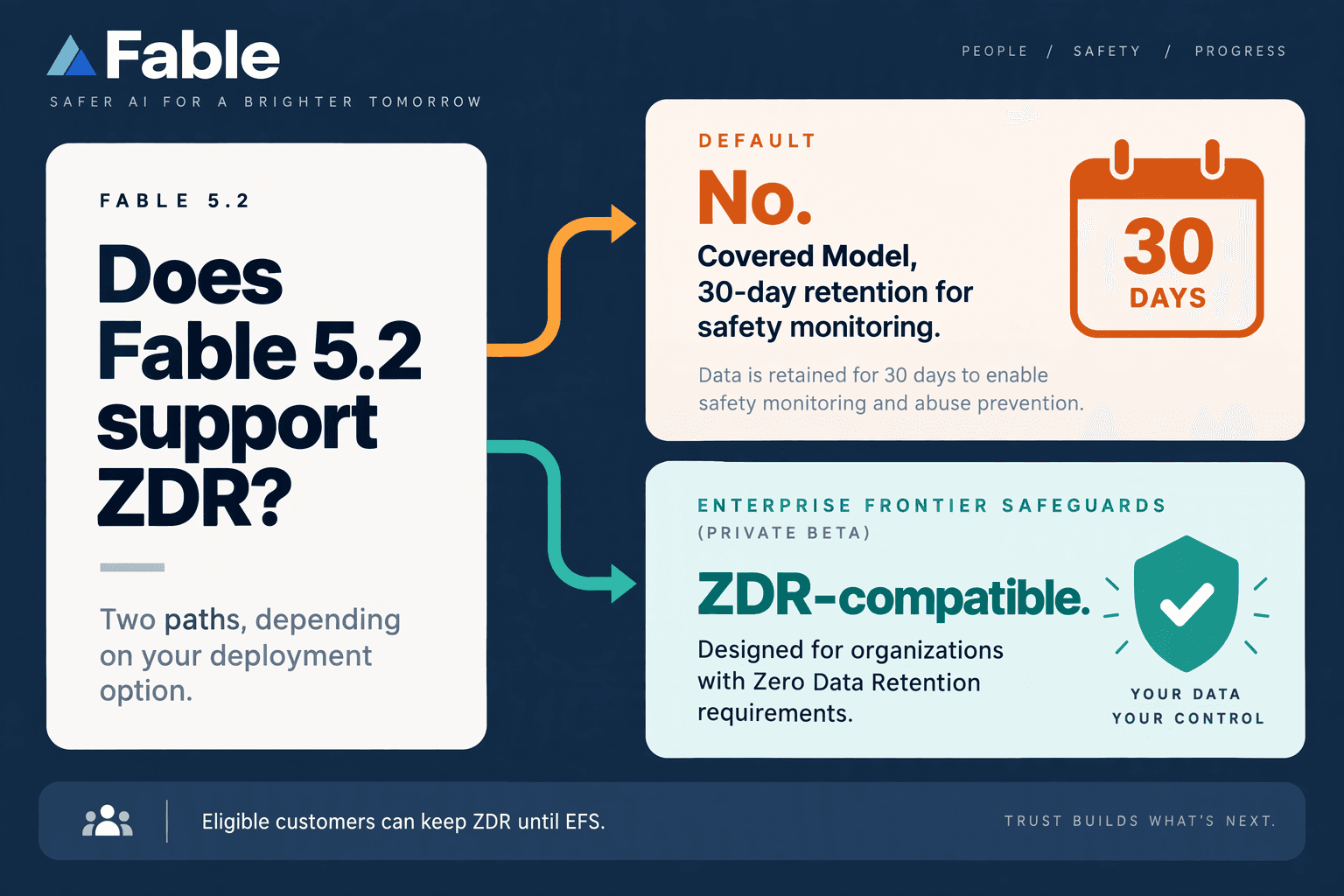
Not by default. As of November 2026, Anthropic requires 30-day data retention for safety monitoring whenever you use Claude Fable 5.2. Zero data retention (ZDR) is still possible in two situations: you are an eligible customer keeping an existing ZDR arrangement until Enterprise Frontier Safeguards (EFS) reaches you, or you are in the EFS private beta, which makes Fable compatible with ZDR.
Why do sources disagree about Fable and ZDR?
The disagreement comes from default behavior versus exceptions.
- Olostep says Fable does not support ZDR because Anthropic classifies it as a Covered Model with a strict 30-day retention policy.
- A r/ClaudeAI thread describes a mandatory 30-day window on all Fable traffic, even for enterprise accounts that previously had zero retention.
- Anthropic's own Fable page frames the 30 days as the default and says enterprise customers eligible for EFS can store data differently.
All three are describing the same policy from different angles. For an audit file, cite Anthropic's documentation rather than a third-party summary.
What does Anthropic's retention policy actually cover?
Anthropic's support article on data retention for covered models states that prompts submitted to covered models, and the outputs they generate, are retained for 30 days to support safety work. The article also says this applies on every platform where the models are offered. Three implications follow:
- Both directions are retained. Outputs are in scope, not only prompts.
- The purpose is safety monitoring. It is not model training or product analytics, and your records should describe it that way.
- The platform does not change the rule. Moving to a cloud marketplace does not bypass the window.
Which ZDR position is your organization in?
Most teams fall into one of three states:
- Default customer. Fable traffic is retained for 30 days. Document this as a retention exception in your data-processing records.
- Eligible ZDR customer. You can keep ZDR until EFS is available to you. Treat this as temporary and plan for the transition.
- EFS participant. EFS is in private beta with organizations including Bridgewater, Salesforce and Stripe, and it makes Fable compatible with ZDR.
Does the cloud platform change the answer?
Check your configuration directly. AWS's launch post for Claude Fable 5 on Bedrock includes a data_retention endpoint call with "mode": "provider_data_share". That suggests retention is something you configure explicitly on that platform, but confirm the exact behavior for your account and region with AWS and Anthropic rather than inferring it from a code sample.
What should compliance teams do now?
- Get eligibility in writing. Ask your Anthropic account team whether you qualify to keep ZDR and what the EFS timeline is.
- Classify workloads before routing them. Keep regulated or highly sensitive data (health, payment or privileged legal material) off Fable unless your retention exception has been approved.
- Update your records. Revise your data-processing agreements, subprocessor notes and retention schedules to show a 30-day safety-monitoring window for Fable.
- Verify model by model. Do not assume a ZDR arrangement on other Claude models carries over to Fable 5.2.
The next question is what happens to a request once Fable's safeguards flag it, which is where the classifiers and the Fallback API come in.
What Is a Covered Model and Why Does Fable 5 Retention Work Differently?

A covered model is a model Anthropic designates for mandatory safety-monitoring retention, and Claude Fable 5.2 is one. According to Anthropic's support documentation, prompts submitted to and outputs generated by covered models are retained for 30 days to support safety work, on every platform where the model is offered. As of November 2026, that makes retention a property of the model, not a setting on your account.
What does "covered model" mean in practice?
Anthropic's article "Data retention practices for Covered Models" treats the label as a policy category. Olostep's Fable 5 explainer says Anthropic classifies Fable as a Covered Model and enforces a strict 30-day retention policy. For compliance teams, three points follow:
- Scope is both directions. Prompts and outputs are retained, so retrieved documents, tool results and customer data pasted into a prompt are all in scope.
- Scope is cross-platform. The "every platform" wording means that reaching Fable through a cloud marketplace does not remove the window.
- Purpose is stated. Anthropic ties retention to safety monitoring, which affects how you describe the processing in your records.
Why is Fable 5 retention different from standard retention?
Standard enterprise retention is something you negotiate or configure around your own risk posture. Covered-model retention is imposed by the model provider to support its safeguards.
RisingStack's analysis of Fable 5 explains the logic. It describes the product as the underlying model plus safety classifiers, access controls, routing logic, monitoring and a retention policy. Retention is one of the components that make up the product's behavior, not an add-on.
That is why a Reddit thread in r/ClaudeAI describes the change as a mandatory 30-day window attached to all Fable traffic, even for enterprise accounts that previously had zero retention. That is a community report, not Anthropic's wording. Anthropic's stated position is that eligible customers can keep ZDR until Enterprise Frontier Safeguards (EFS) reaches them.
Does the cloud platform change the retention rule?
The platform changes where you configure things, not the 30-day expectation. Amazon's launch post for Claude Fable 5 on AWS includes a data retention call against a Bedrock endpoint (PUT /v1/data_retention) with a "mode": "provider_data_share" value. The excerpt does not explain the mode's legal effect. Treat it as a prompt to ask your cloud provider and Anthropic exactly what is shared, stored and for how long, then record the answer in writing.
What should compliance teams verify first?
- Confirm your status. Are you under an existing ZDR arrangement, in the EFS private beta, or neither?
- Map data classes to Fable. Decide which workloads can tolerate 30-day provider-side retention and which cannot.
- Check every access path. Direct API, cloud marketplace and third-party gateways may each carry different contract terms.
- Update records of processing. Name the retention purpose (safety monitoring) and the period (30 days).
- Set a review trigger. EFS is in private beta, so your status may change and your documentation should have a date and an owner.
The next section turns to the other half of the safeguard design, the classifiers and Fallback API, because they determine which of your requests ever reach Fable in the first place.
What Has Anthropic Documented About Fable 5.2 Safeguards?
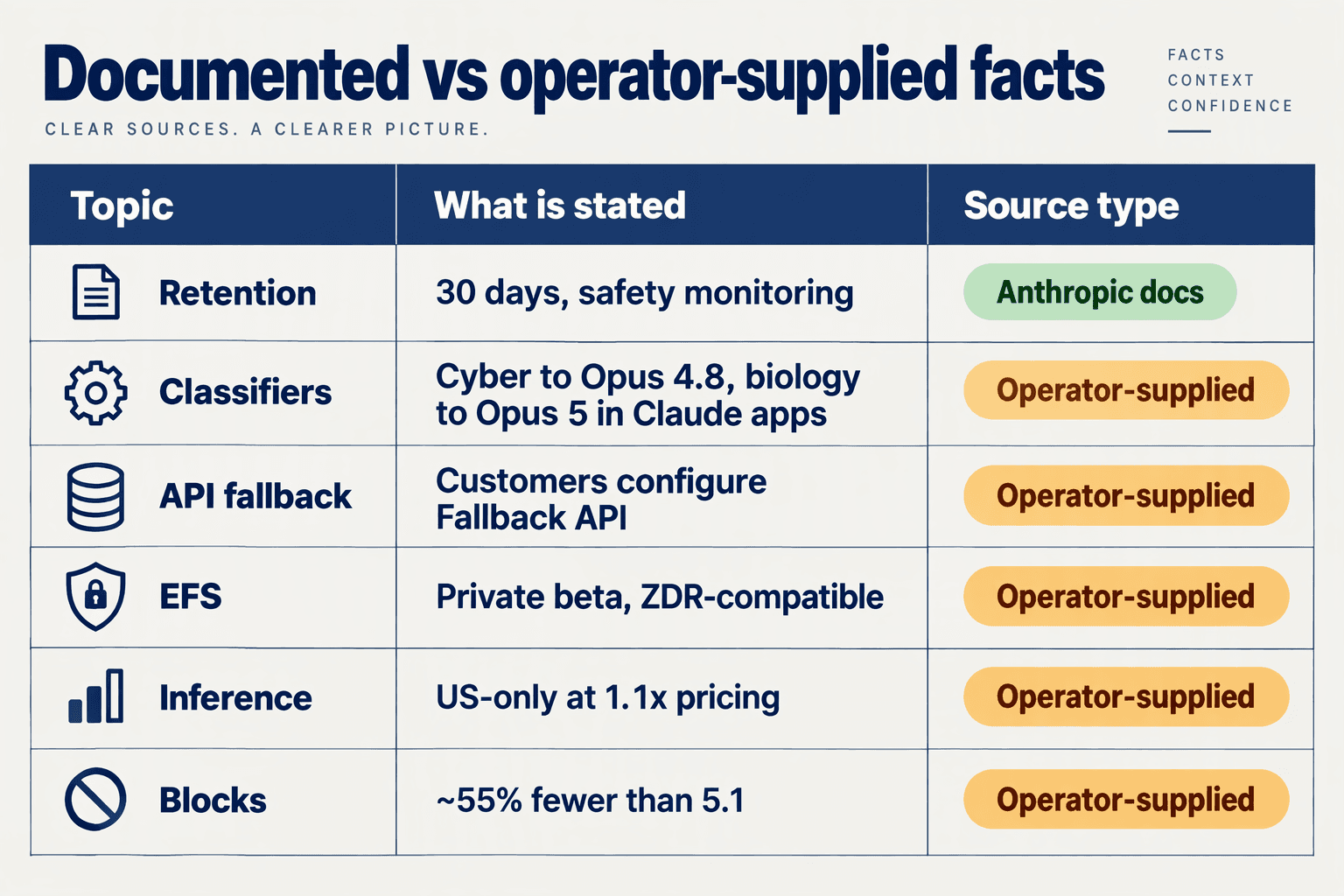
Anthropic has documented five safeguard layers for Claude Fable 5.2 as of November 2026: 30-day retention, a cyber classifier, a biology classifier, a Fallback API for API customers, and Enterprise Frontier Safeguards (EFS). The table below maps each one to where it applies and what compliance teams should do about it.
What are the documented Fable 5.2 safeguards at a glance?
| Safeguard | What Anthropic documents | Where it applies | Compliance action |
|---|---|---|---|
| 30-day retention | Prompts and outputs from covered models are retained for 30 days to support safety work, per Anthropic's support documentation | Every platform where Fable is offered | Update data-processing records and retention schedules |
| Cyber classifier | Flags cyber-related queries; in Claude apps, these route to Opus 4.8 | Claude apps (automatic) | Decide whether cyber workloads are acceptable on a different model |
| Biology classifier | Flags biology-related queries; in Claude apps, these route to Opus 5 | Claude apps (automatic) | Assess life-science use cases for model substitution |
| Fallback API | API customers must configure it themselves; it is not automatic | Claude API | Build and test fallback handling before production |
| EFS (private beta) | Makes Fable compatible with zero data retention; participants include Bridgewater, Salesforce and Stripe | Eligible enterprise customers | Check eligibility; eligible customers can keep ZDR until EFS reaches them |
| Refusal signal | Surfaced as stop_reason: "refusal", according to RisingStack | API responses | Handle it in code and log it |
Which rows matter most for audits?
Two rows deserve extra scrutiny.
Retention applies everywhere. Anthropic's Fable page states that using Fable requires 30-day retention for safety monitoring by default. That includes cloud marketplaces. AWS's launch post for Claude Fable 5 on Bedrock includes a PUT /v1/data_retention example with "mode": "provider_data_share". Treat that as a signal to confirm exactly which retention mode your cloud account has set, rather than assuming your previous configuration carried over.
The API and the apps behave differently. In Claude apps, flagged queries are rerouted automatically. In the API, nothing happens unless you build it. RisingStack's walkthrough shows the minimal pattern: check response.stop_reason === "refusal" and pass the response to a handler such as handleModelRefusal. Without that check, a refused request can pass through your application as an empty or misleading result.
What should you monitor once classifiers are live?
RisingStack lists seven metrics worth tracking as safety behavior becomes part of the API contract:
- Refusal rate by workflow
- Refusal rate by customer
- Fallback rate
- Fallback success rate
- Latency after fallback
- Cost after fallback
- False-positive reports
These metrics also serve as audit evidence. If a regulator or customer asks why a response came from a different model, per-workflow and per-customer logs give you the answer.
What is not clearly documented?
The sources reviewed for this guide do not publish classifier false-positive rates or the exact eligibility criteria for keeping ZDR. Community reports on r/ClaudeAI describe the policy as a mandatory 30-day window even for accounts that previously had zero retention, which conflicts with Anthropic's stated exception for eligible customers. Confirm your status with your Anthropic account team or cloud provider in writing instead of relying on forum summaries.
How Does the Fallback API Change Your Data Flow?
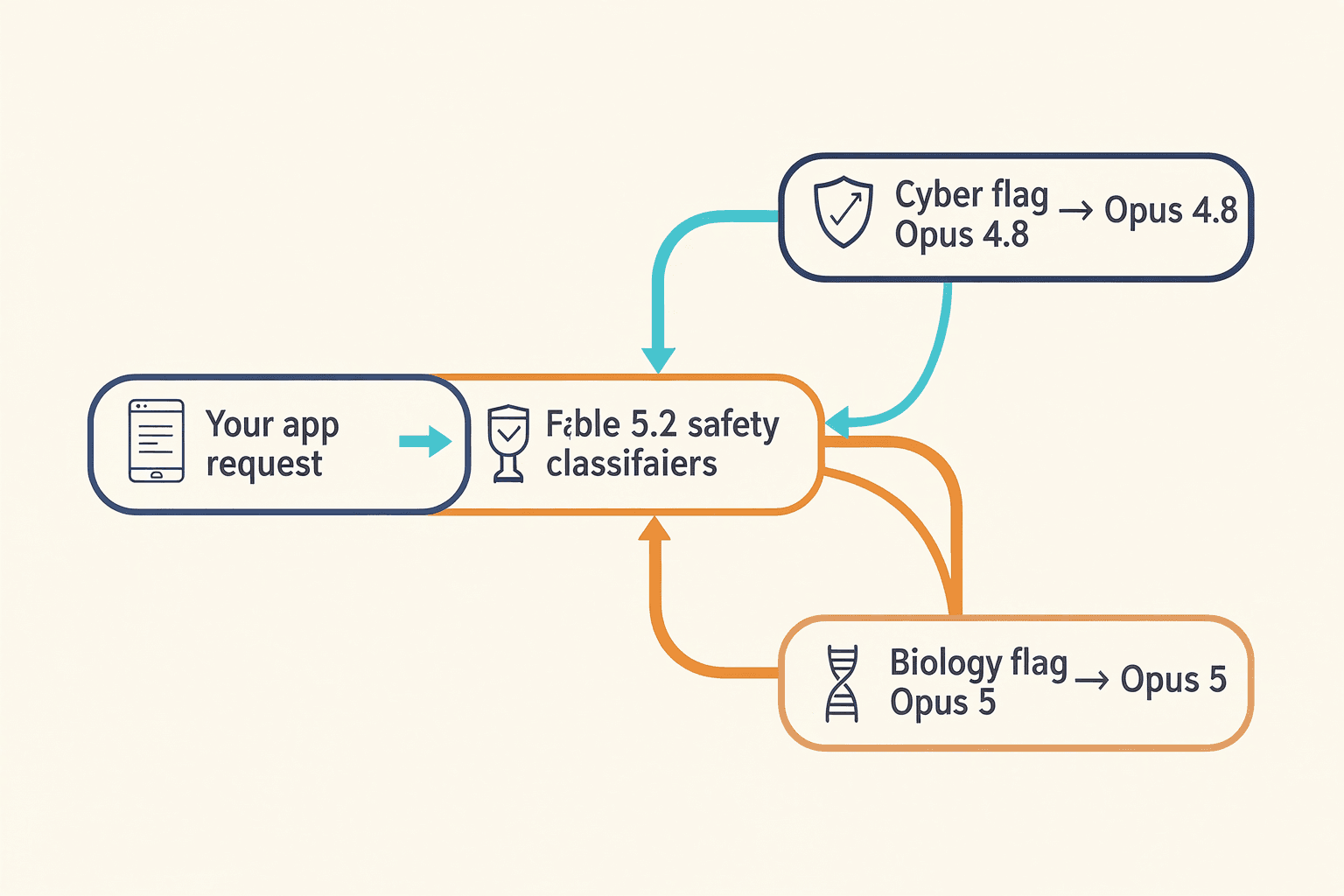
The Fallback API adds a second model to your data flow whenever a safeguard trips. In Claude apps, Anthropic routes flagged queries automatically: cyber-related ones to Opus 4.8 and biology-related ones to Opus 5. API customers must configure that behavior themselves. As of November 2026, nothing happens unless your code and settings make it happen.
What changes when a request is flagged?
Without a fallback, a flagged request ends in a refusal. RisingStack notes that safety behavior is now part of the API contract, and the signal is stop_reason: "refusal". Your application then has three choices:
- Return the refusal to the user or calling system.
- Retry on a fallback model such as Opus 4.8 or Opus 5.
- Escalate to a human for review.
Only the second option sends the same prompt to a different model. Your data-flow diagram, your records of processing and your vendor risk assessment should all reflect that.
Which compliance questions does the fallback path raise?
Anthropic's support documentation says retention for covered models is 30 days on every platform where they are offered. It does not follow that every fallback model carries identical terms, so confirm the following in writing:
- Retention for the fallback model. Check whether prompts routed to Opus 4.8 or Opus 5 follow the same 30-day window or your existing agreement.
- Where the routing decision is made. Know whether the classifier runs before or after your data leaves your boundary, and document it.
- Platform-level settings. The AWS announcement for Fable 5 on Bedrock shows a data-retention configuration call that sets a
provider_data_sharemode. This suggests retention is configured per platform, so cloud-hosted deployments need their own review. - ZDR carve-outs. If you keep ZDR until Enterprise Frontier Safeguards (EFS) reaches you, confirm how that status applies to fallback traffic.
What should you monitor after enabling fallback?
RisingStack lists the telemetry worth capturing, and each item doubles as audit evidence:
| Metric | Why compliance cares |
|---|---|
| Refusal rate by workflow and customer | Shows where sensitive content concentrates |
| Fallback rate and fallback success rate | Proves the control actually works |
| Latency after fallback | Flags user-facing degradation |
| Cost after fallback | Catches budget drift from rerouting |
| False-positive reports | Supports appeals and tuning |
Log the original model, the fallback model and the reason for each rerouted request, but avoid copying raw prompts into your own logs unless your policy allows it. Otherwise you may recreate the retention footprint you were trying to limit.
Is fallback routing a pattern you control elsewhere?
Yes. Routing is becoming a design concern across AI stacks, though not every fallback works the same way. Anthropic's fallback is triggered by its safety classifiers. Gateways such as CallMissed, the OpenAI- and Anthropic-compatible AI API, let the caller choose fallback models explicitly and review usage and request logs. That control is useful for availability, but it does not replace the classifier-driven routing described above. Treat the two as separate layers in your documentation.
Practical takeaway: handle refusal explicitly, decide in advance whether a fallback is permitted for each data class, and record both models in your data-processing documentation.
What Metrics and Logs Should You Keep for Refusals and Fallbacks?

Keep metrics that measure how often safeguards trigger and what they cost you, plus per-request metadata that proves which model answered and why. As of November 2026, RisingStack recommends tracking seven signals for Claude Fable 5: refusal rate by workflow, refusal rate by customer, fallback rate, fallback success rate, latency after fallback, cost after fallback, and false-positive reports. Together they give auditors evidence and give engineers an early warning.
Which refusal and fallback metrics should you track?
RisingStack's list works as a baseline. Here is why each metric matters to compliance:
- Refusal rate by workflow: shows which business processes trigger the cyber or biology classifiers. A security-testing workflow will behave differently from a customer-support one.
- Refusal rate by customer: reveals whether one tenant or user group generates most flags. This is useful for acceptable-use enforcement.
- Fallback rate: the share of requests rerouted after a refusal. If you configured the Fallback API, this is your proof the safeguard path is live.
- Fallback success rate: how often the fallback model completes the task. A low figure means users are hitting dead ends.
- Latency after fallback: a refusal followed by a second call adds time. Track it against your SLAs.
- Cost after fallback: the fallback model may be priced differently, so budgets need this line item.
- False-positive reports: user or reviewer reports that a legitimate request was flagged. These support appeals and classifier feedback.
What should each request log record?
Aim for one structured record per request, whether or not it was refused:
- Request ID, timestamp, tenant and workflow identifiers.
- Model requested and model that actually responded (for example, Fable 5.2 versus Opus 4.8 or Opus 5).
stop_reason, specifically whether it equals"refusal".- Whether a fallback was attempted, which model was used, and the outcome.
- Token counts, latency and cost for each attempt.
- The handler path your code took, such as retry, fallback, human review or error to user.
The model-actually-answered field matters most. Anthropic routes flagged queries automatically in Claude apps, but API customers must configure the Fallback API themselves. Without your own record, you cannot show which model processed a given request. The espressio.ai analysis lists silent refusals among the API-breaking changes, so check that your code never swallows a refusal without writing it down.
How do you log without undermining your data-retention posture?
Log metadata, not content. Anthropic retains prompts and outputs for 30 days for safety monitoring. If you also copy full prompts into your own logs, you create a second retention surface that your ZDR commitments may not cover.
- Store hashes or reference IDs instead of raw prompts.
- Redact personal data before anything reaches an observability tool.
- Set your own log retention deliberately, and document why it is shorter or longer than 30 days.
- Restrict access to refusal logs, since they may contain sensitive security or biology topics.
What thresholds should trigger an alert?
Set alerts against your own baseline rather than an industry number, because none has been published. Useful triggers include a sudden jump in refusal rate for one workflow, a fallback success rate that drops, or cost per request rising after fallback. Review false-positive reports on a regular schedule.
Gateway tooling can help with this bookkeeping. CallMissed, the OpenAI- and Anthropic-compatible AI gateway, offers usage and request logs alongside caller-chosen fallback models, a pattern that makes recording which model handled each request straightforward. Whatever stack you use, treat refusal and fallback data as audit evidence from day one.
What Is Enterprise Frontier Safeguards and Who Qualifies?
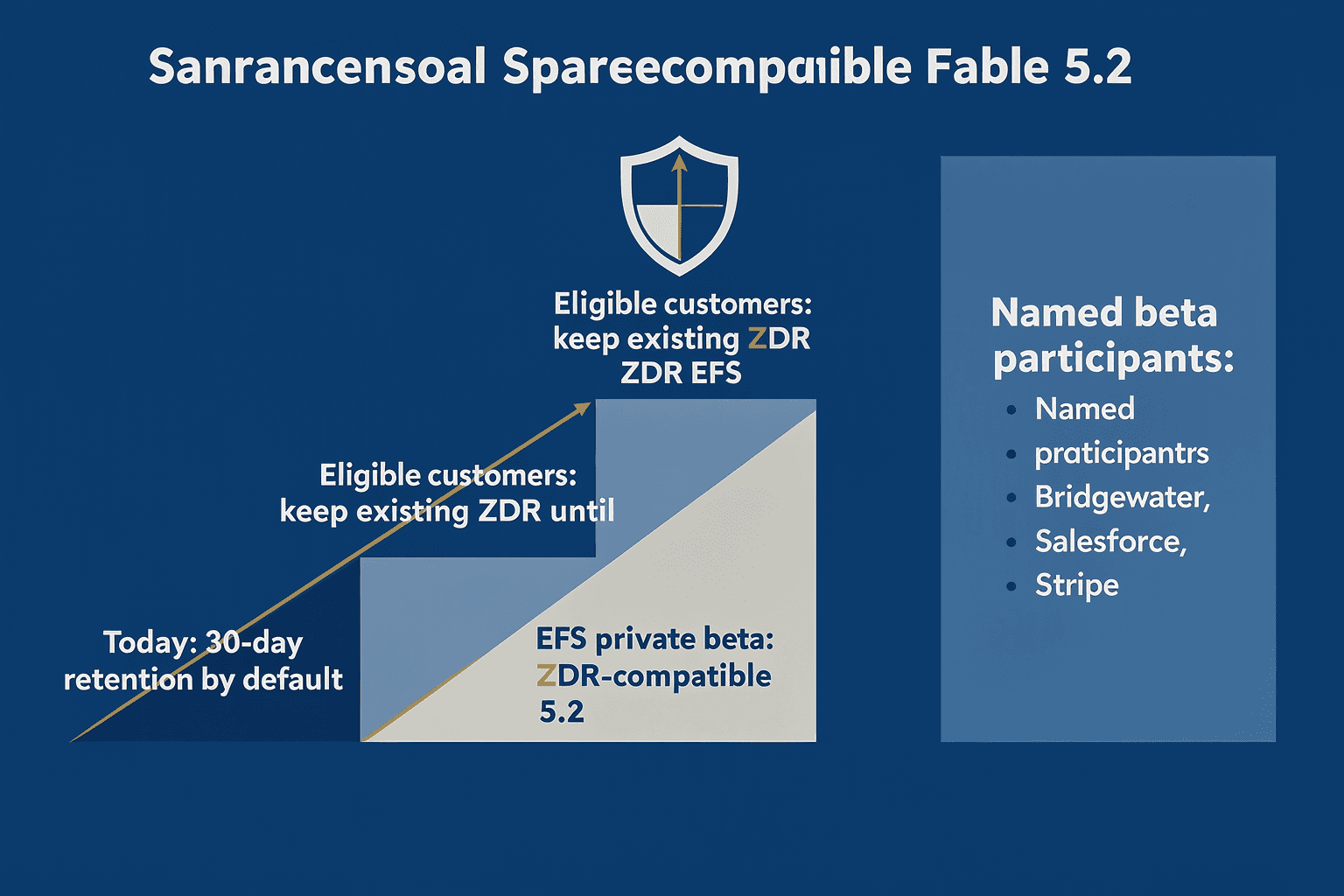
Enterprise Frontier Safeguards (EFS) is Anthropic's program that makes Claude Fable compatible with zero data retention (ZDR). It is currently in private beta, and eligibility is by Anthropic's invitation rather than self-serve. As of November 2026, Anthropic's Claude Fable page says enterprise customers eligible for EFS can store data under different terms than the default 30-day window. The earlier sections covered the default retention rule. This section covers the exception.
What is Enterprise Frontier Safeguards?
EFS is an enterprise-tier safeguards arrangement that replaces blanket retention as the way Anthropic monitors for misuse. Anthropic's default is 30-day retention of prompts and outputs "to support our safety work," per its support documentation on Covered Models. EFS is designed so that safety monitoring and ZDR can coexist.
Anthropic names Bridgewater, Salesforce and Stripe among the private-beta organizations. All three are regulated or data-sensitive businesses, which suggests the program targets enterprises that cannot accept default retention.
Who qualifies for EFS today?
Anthropic has not published a public checklist of eligibility criteria in the sources reviewed for this guide. What the sources do establish is a two-track picture:
- EFS private-beta participants get Fable with ZDR compatibility.
- Existing ZDR customers who are eligible for EFS can keep their ZDR arrangement until EFS is available to them.
The Reddit thread in r/ClaudeAI claims a mandatory 30-day window applies "even for enterprise accounts that previously had zero retention." Treat that as a community reading of the default, not a statement of eligibility. Anthropic's own wording provides the carve-out.
How should a compliance team confirm its status?
Do not infer eligibility from your contract tier or from what a forum says. Use this sequence:
- Check your current agreement. Confirm whether you hold an active ZDR arrangement and which products and platforms it covers.
- Ask your Anthropic account team in writing whether your organization is eligible for EFS, and whether your ZDR is preserved for Fable until EFS access begins.
- Check each platform separately. Anthropic says covered-model retention applies "on every platform where" the models are offered. The AWS launch post for Claude Fable 5 shows a Bedrock
data_retentionendpoint with aprovider_data_sharemode, so verify what each cloud's setting means for your account. - Record the answer with a date, the person who confirmed it and the scope.
What should you avoid assuming?
- Don't assume ZDR is a permanent entitlement. Anthropic's phrase "until EFS" implies a transition. Calendar a review.
- Don't treat EFS as a way around the classifiers. The cyber and biology classifiers and refusal behavior are separate controls, so you still need Fallback API handling.
- Don't mix workloads. If only some teams hold ZDR, route sensitive prompts deliberately, rather than letting every application call Fable.
For teams routing across several models, gateways that allow bring-your-own provider keys, such as CallMissed's OpenAI- and Anthropic-compatible API, can help keep each route tied to its own provider agreement. You should still verify which retention terms apply to each route.
Compliance takeaway
EFS is the path to ZDR on Fable, but it is invite-based and still in beta. Until your eligibility is confirmed in writing, plan on the 30-day window and document it that way.
How Does Retention Differ Across the Anthropic API, AWS Bedrock and Other Platforms?
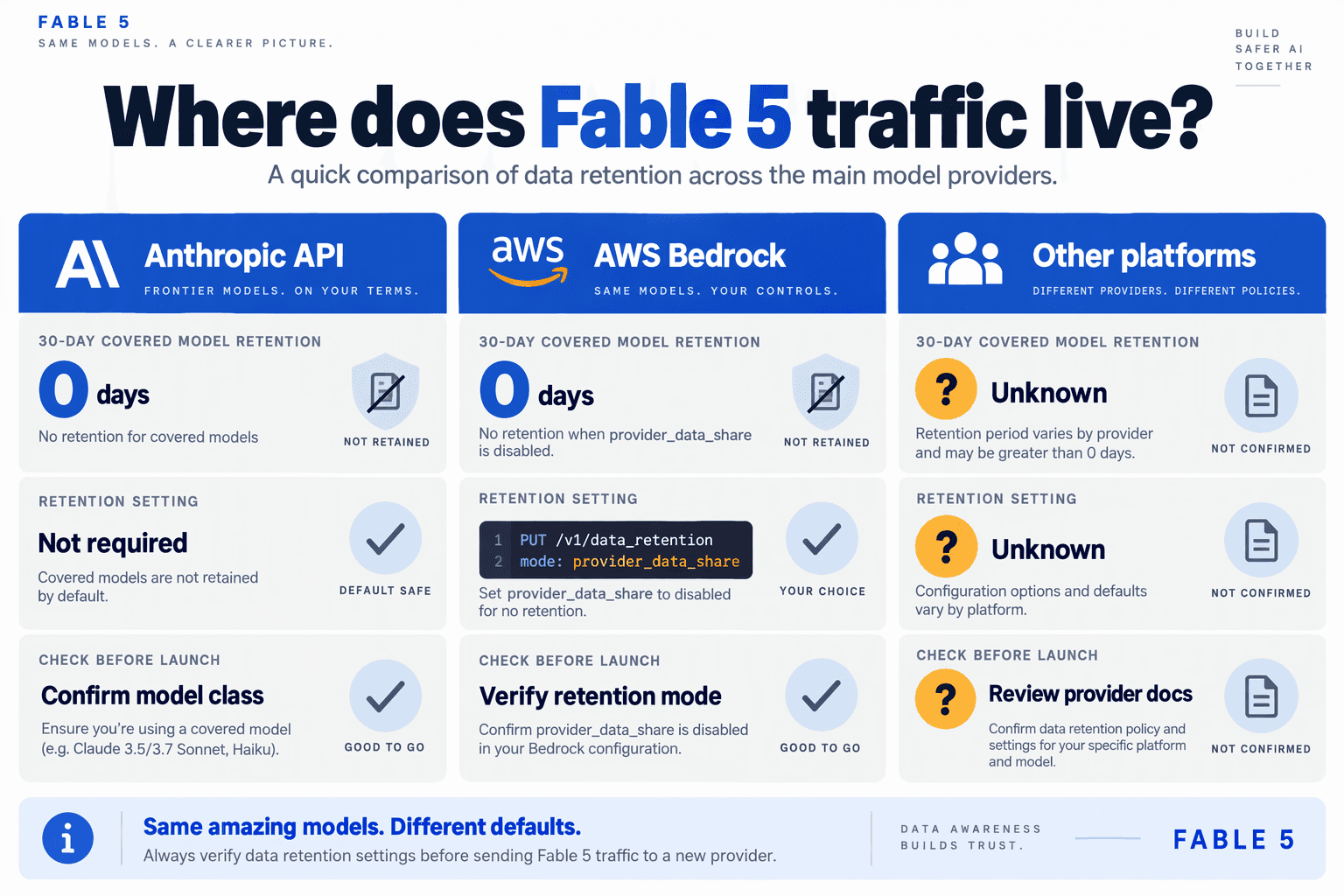
The retention window is the same everywhere; the controls and paperwork are not. According to Anthropic's support documentation, prompts and outputs from covered models, including Claude Fable 5.2, are retained for 30 days "on every platform where" the model is offered. As of November 2026, switching from the Anthropic API to AWS Bedrock does not shorten that window. It changes who you configure it with and which contract governs it.
Is the 30-day window the same on the Anthropic API and AWS Bedrock?
Yes. Anthropic's page for Claude Fable says 30-day retention for safety monitoring applies by default, and its covered-model documentation extends this across platforms. Two things can still differ:
- The control surface: where retention is set, such as an Anthropic organization setting versus a cloud provider's API.
- The contract: which agreement your legal team must review, and who is the data processor on record.
What does AWS Bedrock add?
Amazon's launch post, "Anthropic Claude Fable 5 on AWS," shows retention configured through a dedicated endpoint. The example is a PUT request to bedrock-mantle.us-east-1.api.aws/v1/data_retention with { "mode": "provider_data_share" }.
Retention is therefore an explicit, API-level setting on Bedrock, not just a policy footnote. The mode name suggests data is shared with the model provider for safety monitoring. Confirm the exact semantics in AWS documentation before you document it, because the launch snippet alone doesn't define them.
For teams already standardized on Bedrock, this means two checks:
- Region and endpoint: the example uses
us-east-1, so verify where your workloads and retained data actually sit. - Credentials: the call uses a Bedrock API key, so decide who in your organization may change the retention mode.
What about ZDR exceptions and other platforms?
ZDR exceptions are tied to your Anthropic arrangement, not to a platform's marketing page. Per Anthropic, eligible customers can keep ZDR until Enterprise Frontier Safeguards (EFS) reaches them, and EFS participants such as Bridgewater, Salesforce and Stripe are in private beta. A Reddit thread in r/ClaudeAI claims the 30-day window was attached to all Fable traffic, even for enterprise accounts that previously had zero retention. That is community reporting, not an Anthropic statement, so verify your own eligibility in writing.
For any other cloud marketplace, reseller or gateway offering Fable 5.2, assume the 30-day rule applies unless that provider documents an EFS-backed exception. Intermediaries also add a second set of logs: a gateway's own request logging is separate from Anthropic's safety retention and needs its own entry in your records.
What should you record for each platform?
Build one row per access path in your data-processing documentation:
- Platform and contract: Anthropic direct, Bedrock or another provider, and the governing agreement.
- Retention status: default 30-day, ZDR carried over, or EFS beta.
- Configuration owner: who can change the setting, and where that change is logged.
- Intermediary logging: any gateway, proxy or observability tool that stores prompts separately.
- Evidence date: when you last confirmed the status, since these terms are still moving.
Treat that last column seriously. With EFS still in private beta, a status that was accurate this quarter may not hold at your next audit.
What Does Mandatory 30-Day Retention Mean for GDPR, HIPAA and SOC 2 Reviews?

It depends on the framework, but the 30-day window does not automatically break compliance with any of them. It changes what you must document, disclose and justify. As of November 2026, Anthropic's support documentation says prompts and outputs from Covered Models are retained for 30 days to support safety work, on every platform where they are offered. Treat that as a new data-handling fact for your records. This is general guidance, not legal advice, so confirm specifics with counsel.
How does 30-day retention affect a GDPR review?
GDPR reviews will focus on storage limitation, purpose limitation and processor terms.
- Storage limitation (Art. 5(1)(e)): A fixed 30-day window is a defined period, which is easier to defend than open-ended retention. You still need to explain why it is necessary.
- Purpose limitation: Safety monitoring must be reflected in your records as a purpose, separate from the business purpose of the prompt.
- Processor and transfer terms (Art. 28, Chapter V): Check that your data-processing agreement covers retained Fable traffic and confirm where it is stored.
- DPIA (Art. 35): If prompts can contain personal data, update the assessment to reflect retention that you cannot switch off.
Data subject requests are the practical sticking point. If a person asks for erasure, your answer must account for content that sits in a 30-day safety store outside your systems.
What does it mean for HIPAA?
HIPAA reviews turn on whether protected health information (PHI) can reach Fable and under what agreement. Before any PHI flows to a model with mandatory retention, confirm that your business associate agreement explicitly covers Fable on the platform you use. Do not assume coverage carries over from earlier Claude models.
The safest default is to de-identify or exclude PHI from Fable workflows unless a signed agreement and your security officer confirm otherwise. The Reddit thread in r/ClaudeAI describing a "mandatory 30 day retention window" on all Fable traffic, even for accounts that previously had zero retention, is a reminder that old approvals can go stale.
What will a SOC 2 auditor ask?
SOC 2 auditors test whether you do what your system description says. Expect questions on three areas:
- Vendor management (CC9.2): Is the Fable retention policy in your vendor risk assessment?
- Confidentiality commitments (C1.2): Do your customer-facing retention and disposal statements still hold true?
- Change management: Did you record the date the policy change took effect and who approved the exception?
Where should you configure and record retention?
Retention can vary by platform. AWS's launch post for Claude Fable 5 on Bedrock shows a data_retention API call with a "mode": "provider_data_share" setting. Whatever platform you use, record the exact mode in your configuration evidence rather than relying on a general policy statement.
What should you document before your next audit?
- The retention period (30 days) and its source, citing Anthropic's support documentation.
- Whether you are on default retention, an existing ZDR arrangement or the Enterprise Frontier Safeguards (EFS) beta.
- Which workflows send personal data or PHI to Fable, and which are excluded.
- How you handle erasure requests during the 30-day window.
Gateways don't remove this duty. Teams routing through a platform like CallMissed, which supports bring-your-own provider keys and request logs, still need to document retention at each upstream provider as well as in their own logs.
What Do Primary Sources and Practitioners Say About Fable 5 Safeguards?
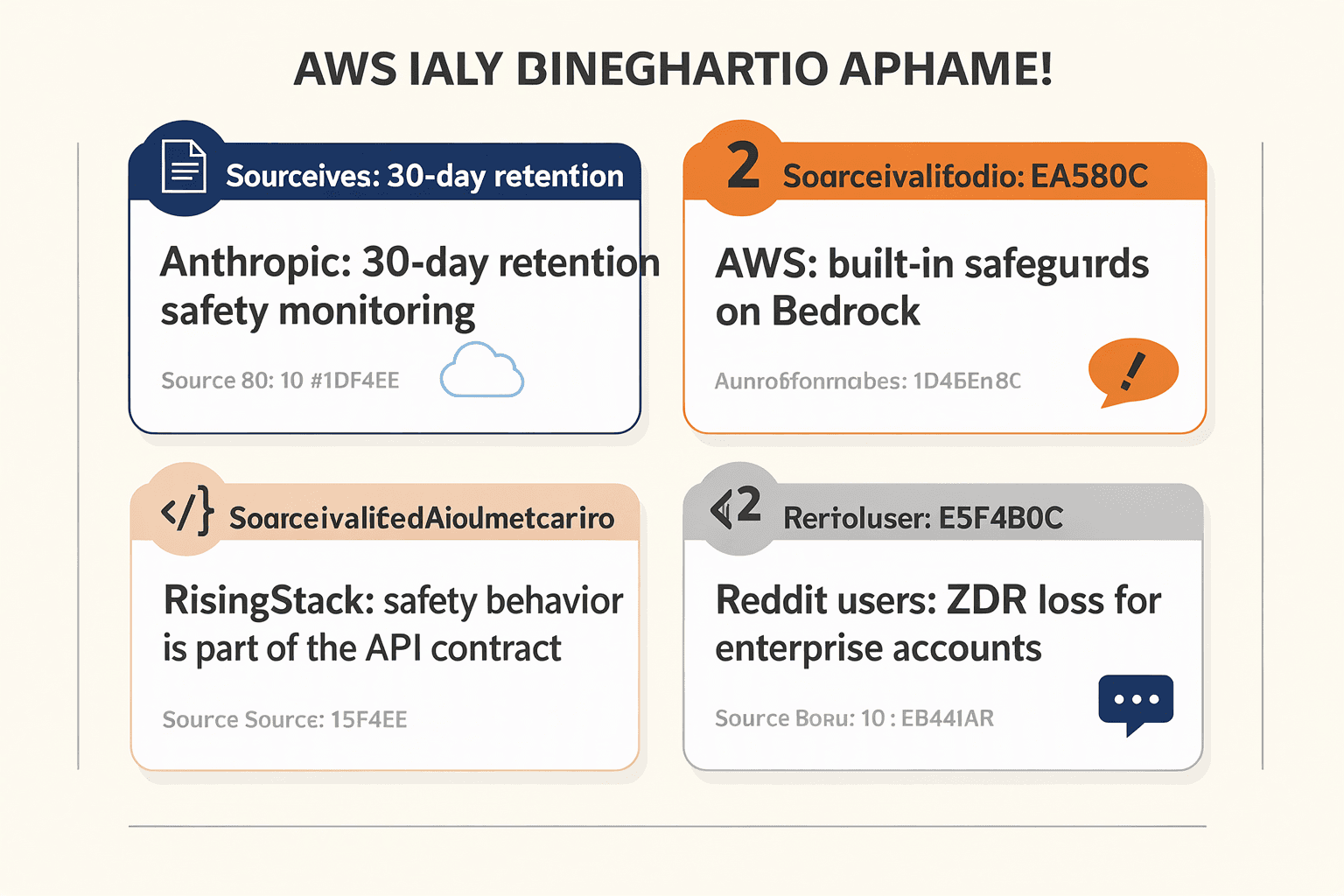
Primary sources agree on the core rules: 30-day retention by default, classifiers on cyber and biology, and a path to ZDR through EFS. Practitioners add the operational detail, which is that safeguards now surface as API behavior your code has to handle. As of November 2026, the two groups differ mostly in emphasis, not in facts.
What do Anthropic and AWS say about Fable 5 safeguards?
Anthropic's product page states that using Fable requires 30-day data retention for safety monitoring by default. It adds that enterprise customers eligible for Enterprise Frontier Safeguards can store data differently.
Anthropic's support documentation is the most citable source for audit files. It says prompts and outputs from covered models are retained for 30 days to support safety work, on every platform where those models are offered.
AWS confirms the "every platform" point in its launch post for Claude Fable 5 on Amazon Bedrock. The post includes a data-retention endpoint call with a mode parameter, using the value provider_data_share. For compliance teams, the takeaway is that retention is a configuration surface on Bedrock, not only a contract term. Check how your cloud provider exposes it before assuming parity with Anthropic's direct API.
What do practitioners flag about Fable 5 safeguards?
Practitioner sources focus on what breaks in production, not on policy text.
- RisingStack describes product behavior as the sum of the underlying model, safety classifiers, access controls, routing logic, monitoring and retention policy. Its key point is that "safety behavior is part of the API contract," visible as
stop_reason: "refusal". It recommends tracking refusal rate by workflow and by customer, fallback rate, fallback success rate, latency after fallback, cost after fallback and false-positive reports. - Reddit's r/ClaudeAI shows the reaction from accounts that previously had zero retention. One thread says Anthropic attached a mandatory 30-day window to all Fable traffic. That is accurate as the default, but it omits the EFS and ZDR-continuity exceptions Anthropic describes.
- espressio.ai lists six API-breaking changes, including silent refusals, and cites a 68% figure for data leaks linked to AI tool usage. The excerpt we reviewed does not name an original study for that figure, so treat it as unverified context, not audit evidence.
- A YouTube commentary characterizes Fable 5 as carrying strict safety filters. It is useful for sentiment, not as a source of policy facts.
How should compliance teams weigh these sources?
Use a simple hierarchy when drafting your data-processing documentation:
- Contract and support documentation first. Cite Anthropic's data retention page for the 30-day rule and your cloud provider's docs for platform-specific settings.
- Engineering write-ups second. RisingStack's monitoring list works well as a starting control set for refusal and fallback telemetry.
- Community threads and videos last. Use them to anticipate questions from internal stakeholders, not to define policy.
A practical test: if a claim says Fable "can't" support ZDR, check whether it accounts for EFS and for eligible customers keeping ZDR in the interim. Anthropic's own wording says they can.
Teams that route across models for resilience can apply the same telemetry discipline elsewhere. A gateway like CallMissed, with caller-chosen fallback models, lets you log refusals and fallbacks per request. The retention rules that apply still come from each model provider, so verify those separately.
What Should Compliance, Security and Platform Teams Do Now?
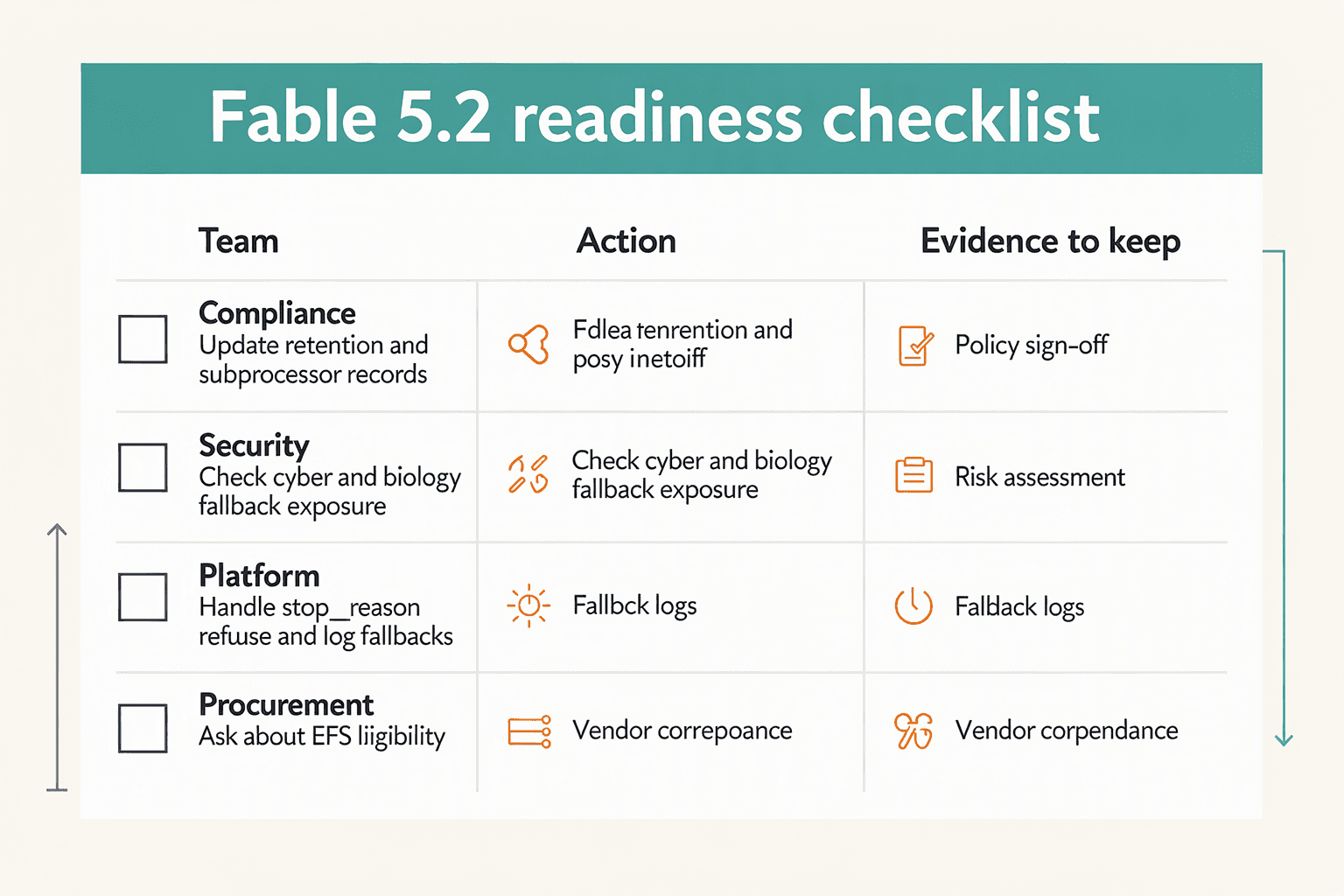
Start with five actions: confirm your retention status, update your data-processing records, handle refusals in code, configure the Fallback API, and monitor the new metrics. As of November 2026, Anthropic requires 30-day data retention for safety monitoring by default when you use Claude Fable 5.2. Eligible ZDR customers can keep zero data retention until Enterprise Frontier Safeguards (EFS) reaches them. The table below assigns each action to an owner.
What is the Fable 5.2 action plan by team?
| Owner | Action | Why it matters | Timing |
|---|---|---|---|
| Compliance / Legal | Confirm whether your organization is an eligible ZDR customer, in the EFS private beta, or on default 30-day retention | Sources disagree. Olostep says Fable doesn't support ZDR, while Anthropic describes exceptions | Immediately |
| Privacy / DPO | Update records of processing, DPAs and retention schedules to show a 30-day window for Fable prompts and outputs | Anthropic's support documentation says covered-model data is retained on every platform where it is offered | Before the next audit |
| Security | Reclassify workloads: decide which data types (PII, source code, health or financial records) may go to Fable | A 30-day window changes the risk of sending regulated data | This sprint |
| Platform engineering | Check for stop_reason: "refusal" on every response and route it to a defined handler | RisingStack notes that safety behavior is now part of the API contract | Before production rollout |
| Platform engineering | Configure the Fallback API explicitly for API traffic | Claude apps route flagged queries to Opus 4.8 (cyber) or Opus 5 (biology), but API customers must set this up themselves | Before production rollout |
| SRE / Observability | Dashboard refusal rate, fallback rate, fallback success rate, latency and cost after fallback | These are the metrics RisingStack recommends, and cost after fallback can differ from your Fable budget | Within 30 days |
How should you sequence the work?
- Establish your retention status first. Every other decision, including which data can be sent, depends on whether you are on default retention, legacy ZDR or EFS.
- Update documentation before code. Auditors ask what your records say, so a stale data-flow diagram is a finding even when engineering is correct.
- Treat refusals as a normal response. A refusal is a valid outcome, not an exception. Without a handler, a classifier decision turns into a failed user request.
- Segment metrics by workflow and customer. RisingStack suggests tracking refusal rate by workflow and by customer, plus false-positive reports, so you can separate legitimate blocks from over-triggering.
What should you check on your cloud platform?
Retention behavior may be configured at the platform level as well. AWS's launch post for Claude Fable 5 on Bedrock shows a data_retention endpoint with a provider_data_share mode, so confirm with your cloud team which setting applies to your account. Don't assume that a setting on one platform matches Anthropic's direct API terms.
Where does a multi-model gateway fit?
Fallback design isn't unique to Anthropic. Teams that route across several models often centralize that logic in a gateway. CallMissed's OpenAI- and Anthropic-compatible API, for example, supports caller-chosen fallback models and exposes usage and request logs across its 159-model catalogue. That gives platform teams one place to audit routing decisions. Whichever layer you use, confirm that each fallback model's retention terms are also documented, because a fallback can quietly create a second data path.
What is the minimum viable checklist?
- Written confirmation of your ZDR or EFS status from Anthropic
- Updated DPA and retention records dated November 2026
- A tested refusal handler in every Fable-calling service
- A configured Fallback API with a named owner
- Alerts on refusal rate and cost after fallback
Frequently Asked Questions
Does Claude Fable 5 data retention apply to every platform and account type?
Who is in the Enterprise Frontier Safeguards private beta?
Does the Fallback API work automatically in Claude Fable 5.2?
How do I detect a Fable 5.2 safety refusal in code?
stop_reason: "refusal". Add a branch such as if (response.stop_reason === "refusal") that calls a handler instead of returning response.content. Otherwise, downstream code may treat an empty or partial answer as a valid result.What should we monitor once fallback is enabled?
- Refusal rate by workflow and by customer
- Fallback rate and fallback success rate
- Latency after fallback
- Cost after fallback
- False-positive reports
Fallback can change both your spend and your data footprint, because requests move to a different model. Log which model actually answered each request, so your records match what happened.
Does a fallback model change our data-retention analysis for Fable 5.2?
data_retention configuration endpoint, so retention may be a per-platform setting as well. Document every route a request can take and the retention rule for each.Routing across models is a common pattern in the industry. For example, CallMissed's Anthropic-compatible /v1/messages endpoint and caller-chosen fallback models let teams define explicit fallback chains across its 159-model catalogue. Whatever gateway you use, a fallback chain only helps compliance if each hop in it is documented and reviewed.
Conclusion
Claude Fable 5.2 turns data retention and safety routing into contract-level decisions rather than footnotes. As of November 2026, the key takeaways are:
- 30 days is the default. Anthropic requires 30-day retention of prompts and outputs for safety monitoring on every platform where Fable is offered.
- ZDR is an exception, not the baseline. Eligible customers can keep zero data retention until Enterprise Frontier Safeguards (EFS) reaches them. EFS private beta participants, including Bridgewater, Salesforce and Stripe, get ZDR compatibility.
- Classifiers change your API behavior. API customers must configure the Fallback API and handle
stop_reason: "refusal"themselves. - Monitor and document. Track refusal rate, fallback rate and cost after fallback, and update your data-processing records before your next audit.
Watch for EFS moving beyond private beta, since that is when teams can revisit their ZDR assumptions. Other providers may also adopt similar retention-plus-classifier models, which would make routing logic a standard part of application design.
To explore how AI communication is evolving, check out CallMissed, an AI infrastructure platform with an OpenAI- and Anthropic-compatible gateway. It supports caller-chosen fallback models across 159 models, alongside voice agents and multilingual chatbots for businesses.
Is your compliance documentation ready for the day your fallback model, not your primary one, handles sensitive data?
Related Reading
- Claude Fable 5 Orchestrator: Advisor vs Orchestrator Guide
- Claude Fable 5.2 release date: Nov 9, 2026 Access FAQ
- Fable 5.2 vs Opus 5.5: Which Claude Should Developers Use?