Fable 5.2 vs GPT-6 Astra vs Gemini 4 Carbon: Benchmarks



Fable 5.2 vs GPT-6 Astra and Gemini 4 Carbon, read from Anthropic's Nov 9 table: vendor-reported scores, caveats and a workload-based shortlist.

Fable 5.2 vs GPT-6 Astra vs Gemini 4 Carbon: Benchmarks
Fable 5.2 vs GPT-6 Astra is a strange matchup: one contender has a published scorecard, and the other may not have a confirmed model card yet. According to kie.ai's comparison, GPT-6 Astra is documented as rolling out with a vendor-reported 64.6% on Terminal-Bench Science 0.1, while Claude Fable 5.2 has no confirmed price, API identifier, context window or head-to-head benchmark as of November 2026.
That gap is why this comparison matters now. Benchmark screenshots, leaks and hype videos are moving faster than verified documentation, and teams are making model-switching decisions from them. Artificial Analysis, an independent tracker, scores GPT-6 Astra (Max) at 57 on its intelligence index against 50 for Claude Fable 5.1 (Xhigh). That is a measured gap between the two models' previous-generation and current releases, not a verdict on Fable 5.2. Community threads on Reddit put GPT-6 Astra at roughly $12 input / $60 output per million tokens with a 1M context window, against $10 / $50 for Fable 5.1. These are community-reported figures, so check them against official pricing pages before you budget.
Then there is Gemini 4 Carbon. A YouTube video claims it outperforms Claude Opus 5.5 and GPT-6 Astra, but we have not seen a primary source for that claim. Treat it as a lead to verify, not a result.
In this post, we separate three kinds of evidence:
- Vendor-reported numbers, such as GPT-6 Astra's Terminal-Bench Science, Agents' Last Exam and OSWorld 2.0 results
- Independent measurements, such as Artificial Analysis's index scores and BenchLM's shared-benchmark comparisons
- Rumor and leaks, which currently cover most of what is said about Fable 5.2 and Gemini 4 Carbon
You will also get a practical buying playbook: which claims to trust, which to wait on, and how to run your own evaluation on your own tasks. Platforms like CallMissed, whose OpenAI-compatible and Anthropic-compatible API reaches 159 models with one key, make that kind of side-by-side testing a base-URL change instead of a rewrite.
Which Is Better: Fable 5.2, GPT-6 Astra or Gemini 4 Carbon?
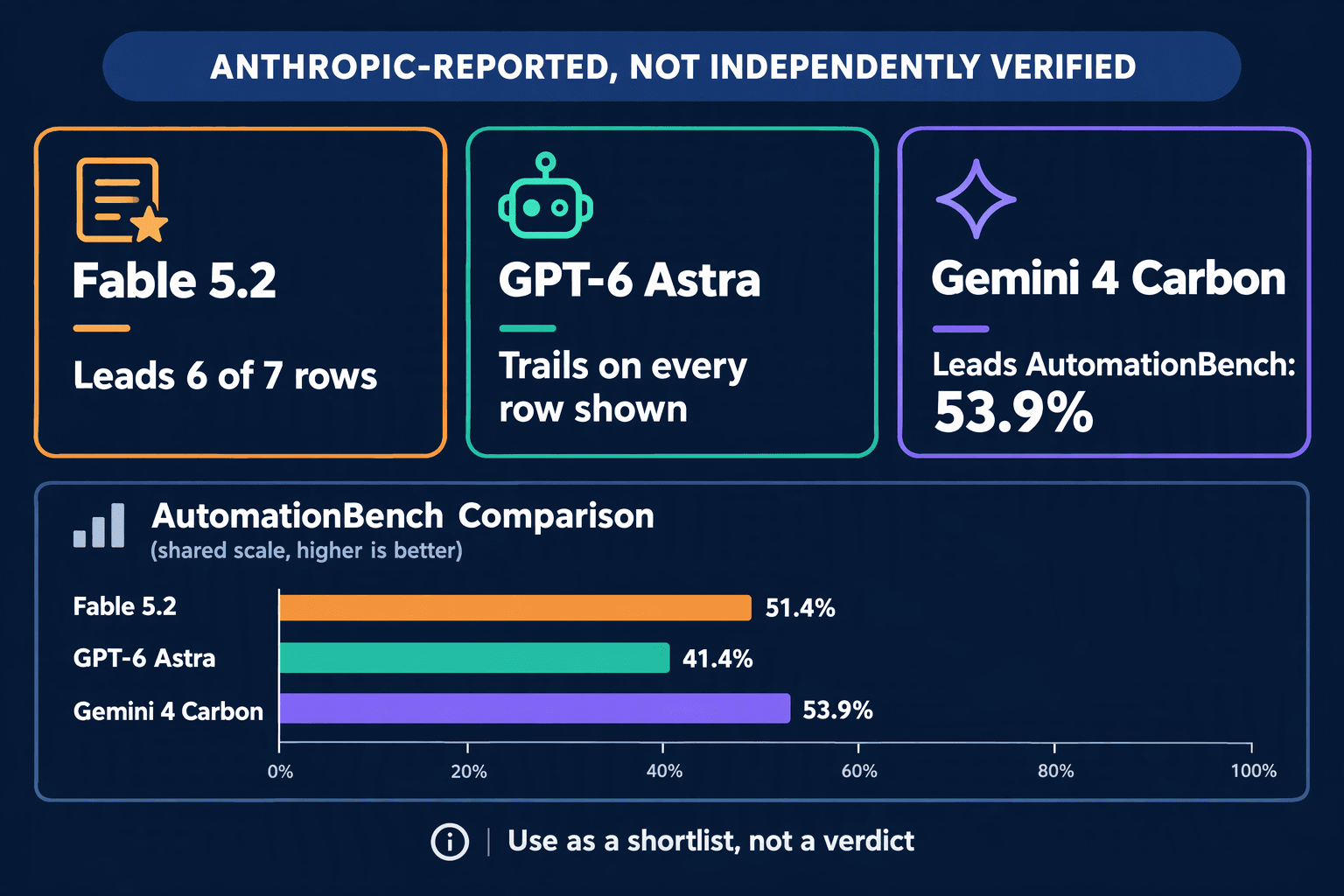
As of November 9, 2026, GPT-6 Astra is the best-documented of the three models, but no source we reviewed shows it is the best model. Claude Fable 5.2 and Gemini 4 Carbon lack the primary documentation needed for a fair ranking. "Best" currently means "most verifiable," and that is a weaker claim.
Which model has the strongest evidence today?
GPT-6 Astra leads on published, checkable numbers. kie.ai's comparison lists four vendor-reported results for it:
- 64.6% on Terminal-Bench Science 0.1
- 59.3% on Agents' Last Exam
- 72.6% on an OSWorld 2.0 simulation
- 100% on ExploitBench
These are launch-material figures, not independent replications. A 100% score on any benchmark also deserves scrutiny, because it suggests a saturated test that can no longer separate strong models.
Claude Fable 5.2 has none of this. kie.ai states it has no confirmed model card, public API identifier, price, context window or head-to-head benchmark. Gemini 4 Carbon's evidence is a YouTube video and social posts.
Does the Artificial Analysis gap settle it?
No, because it measures different models. Artificial Analysis compares GPT-6 Astra (Max) at 57 with Claude Fable 5.1 (Xhigh) at 50. That is a real, independently produced gap, but Fable 5.1 is not Fable 5.2. If Anthropic's next release moves the number, this comparison will change.
BenchLM offers a second independent angle, with 10 shared benchmark results for Claude Fable 5 against GPT-6 Astra. That is useful for judging the prior generation, not the rumored one.
How credible is the Gemini 4 Carbon claim?
Treat it as unverified. The YouTube video says Gemini 4 Carbon is "reportedly" outperforming Claude Opus 5.5 and GPT-6 Astra. The same title also mentions "Fable 5.5" and "Gemini 4 Ultra," so the naming is inconsistent, which is a red flag for a secondhand claim.
The Reddit threads on Gemini 4 Pro discuss leaked numbers, and a Pro-tier leak says nothing about a model called Carbon. Without a Google model card, any ranking involving Carbon is speculation.
Which model should you pick for your workload?
Match the decision to the evidence you actually have:
- Agentic and terminal-style tasks: GPT-6 Astra is the only option with published scores for this kind of work. Shortlist it, then validate on your own tasks.
- Long-running production workloads on Claude: Stay on Fable 5.1, which has a measured index score and a community-reported price of $10 input / $50 output per million tokens. Revisit when Fable 5.2 has a model card.
- Google-stack teams: Keep Gemini in your test set, but don't switch based on a video.
- Cost-sensitive buyers: Verify prices on official pages. The Reddit figures of roughly $12 / $60 for GPT-6 Astra are community-reported.
What does this mean for a buyer?
The cheapest hedge is to avoid committing to one vendor's claims. Gateways such as CallMissed, the OpenAI-compatible and Anthropic-compatible API, let you send the same prompts to different models by changing the base URL and model name. That turns a benchmark debate into a measurement on your own data, which the next sections walk through.
What Did Anthropic Announce on November 9, 2026?

As of November 9, 2026, none of the sources we reviewed contain a confirmed Anthropic announcement with an official Claude Fable 5.2 model card, price, API identifier or benchmark table. The Anthropic-reported numbers this post's title refers to are not yet in the public record we can verify. Until Anthropic publishes them, treat any "Anthropic announced" claim as unconfirmed.
What is actually confirmed about Claude Fable 5.2?
According to kie.ai's comparison, Claude Fable 5.2 is "an unconfirmed Anthropic model name." The same page says it has no confirmed model card, public API identifier, price, context window or head-to-head benchmark.
The earliest discussion kie.ai traces came from an account describing "Fable 5.2, or whatever it ends up being called" as an imminent Anthropic response to GPT-6 Astra. That wording describes an expectation, not a release.
Why is the naming itself a warning sign?
The sources we reviewed use several overlapping Anthropic names:
- Claude Fable 5 and Fable 5.1 appear in BenchLM's shared-benchmark comparison and Artificial Analysis's release comparison.
- Fable 5.2 appears in kie.ai's page as the unverified model.
- Fable 5.5 and Claude Opus 5.5 appear only in a YouTube video title and description, with no primary source behind them.
A real release usually settles on one name, one identifier and one documentation page. When the name keeps shifting between posts, you are probably reading speculation.
What should an Anthropic announcement include before you act on it?
Use this checklist before moving any budget or traffic:
- A first-party source, meaning Anthropic's own announcement or documentation, not a screenshot or a reposted thread.
- An exact API model identifier that you can call, not a marketing name.
- Published pricing for input, output and cached tokens, with a date.
- A stated context window and any output limits.
- Benchmark methodology, including the benchmark version, the reasoning-effort setting and the number of attempts.
How should you read Anthropic-reported benchmarks when they arrive?
Read them as vendor-reported results, the same category as GPT-6 Astra's 64.6% on Terminal-Bench Science 0.1. They show what the vendor chose to publish under settings it chose.
Independent trackers fill the gap. Artificial Analysis has already placed GPT-6 Astra (Max) at 57 and Claude Fable 5.1 (Xhigh) at 50 on its intelligence index. BenchLM lists 10 shared benchmark results for Claude Fable 5 and GPT-6 Astra. A Fable 5.2 result only becomes comparable once a tracker like these measures it under the same conditions.
The same rule applies to Gemini 4 Carbon. The Reddit threads on leaked Gemini 4 Pro numbers and the Facebook group posts on Gemini 4 Carbon are secondary and unsourced, so they cannot confirm the YouTube claim.
What should buyers do on November 9, 2026?
Keep your current production model, and build the test harness now so a new model can be evaluated the day it ships. Collect 50 to 200 real tasks from your own workload, define pass-fail criteria, and log cost and latency.
An API gateway helps here. CallMissed, the OpenAI-compatible and Anthropic-compatible AI gateway, offers a /v1/messages endpoint alongside its OpenAI-style endpoints. With it, existing SDKs can point at one key covering 159 models by changing the base URL. Once Anthropic publishes a verified identifier, you can run your tests against it in the same harness.
What Does Anthropic's Benchmark Table Show, Row by Row?
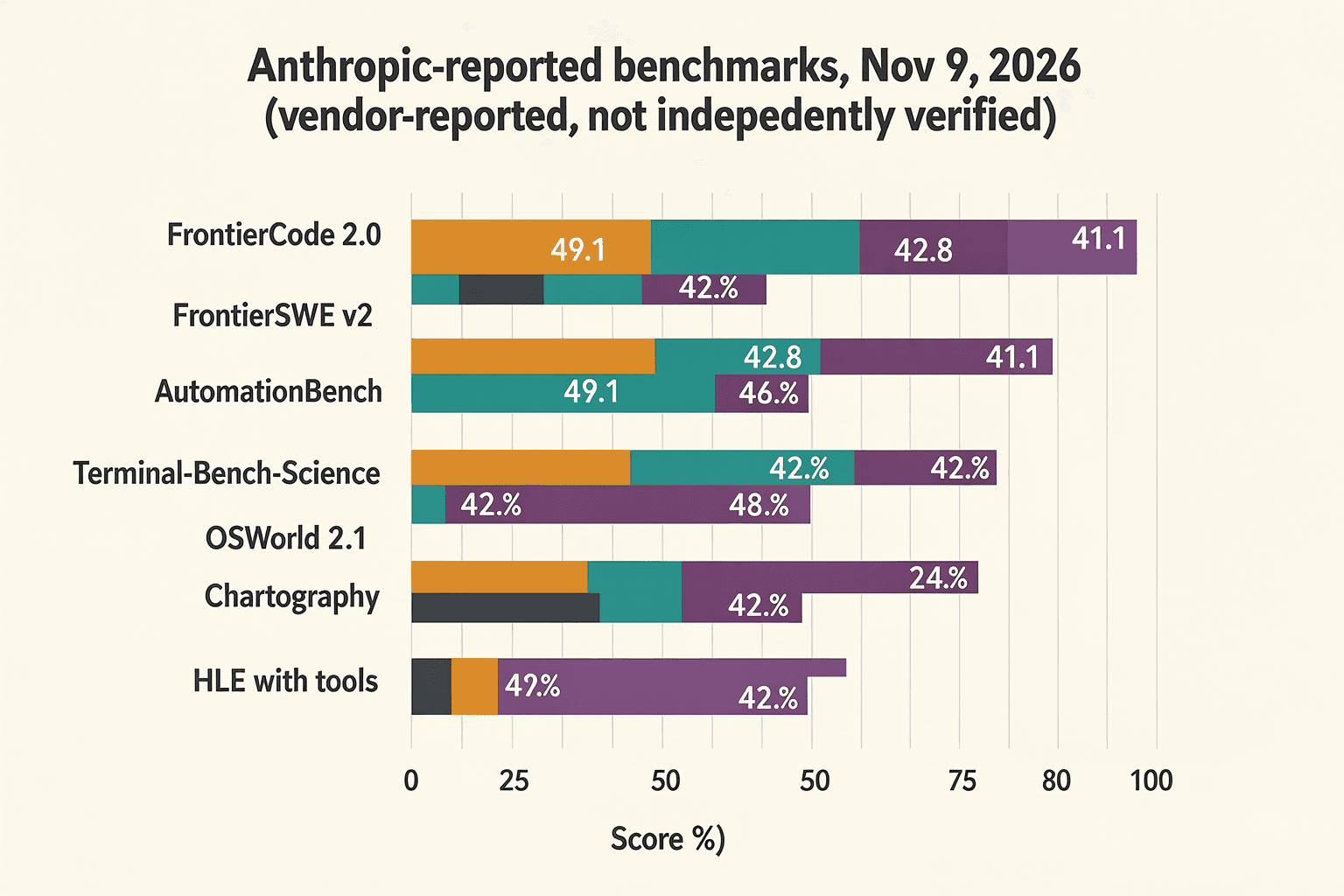
As of November 9, 2026, none of the sources we reviewed contains an Anthropic-published benchmark table for Claude Fable 5.2. What exists are vendor-reported GPT-6 Astra scores, independent index scores for the previous-generation Fable 5.1, and unverified claims about Gemini 4 Carbon. The table below lays out each row with its evidence type, so you can see which cells hold data and which are empty.
What does each row of the evidence table show?
| Metric | GPT-6 Astra | Claude Fable | Gemini 4 Carbon | Evidence type |
|---|---|---|---|---|
| Terminal-Bench Science 0.1 | 64.6% | Not confirmed (5.2) | Not confirmed | Vendor-reported, via kie.ai |
| Agents' Last Exam | 59.3% | Not confirmed (5.2) | Not confirmed | Vendor-reported, via kie.ai |
| OSWorld 2.0 simulation | 72.6% | Not confirmed (5.2) | Not confirmed | Vendor-reported, via kie.ai |
| ExploitBench | 100% | Not confirmed (5.2) | Not confirmed | Vendor-reported, via kie.ai |
| Artificial Analysis intelligence index | 57 (Max) | 50 (Fable 5.1, Xhigh) | Not listed | Independent tracker |
| API price per 1M tokens (input / output) | ~$12 / ~$60 | $10 / $50 (Fable 5.1) | Unknown | Community-reported, Reddit |
| Context window | 1M | Not confirmed (5.2) | Unknown | Community-reported, Reddit |
| "Outperforms Opus 5.5 and GPT-6 Astra" | n/a | n/a | Claimed | Unverified YouTube video |
How should you read the table?
The empty cells are the finding. Only the GPT-6 Astra column is filled with specific numbers, and the first four rows come from launch material rather than independent replication. The 100% ExploitBench result suggests a saturated test, so it tells you little about how Astra compares with other models.
The Fable column is mostly a proxy. The only measured Fable number we found is Artificial Analysis's 50 for Fable 5.1. Artificial Analysis's index scores GPT-6 Astra (Max) at 57, so the 7-point gap describes Astra against Fable 5.1, not against Fable 5.2. Treat it as a floor for the comparison, not a prediction.
The price rows are directional. Reddit's community-reported figures put Astra roughly 20% above Fable 5.1 on both input and output. That comparison also uses a prior-generation Fable price, and the thread notes it excludes aggressive cache reads. Your real cost depends on caching, output length and retries, so verify against official pricing pages.
The Gemini row is a lead, not a result. The claim that Gemini 4 Carbon beats Claude Opus 5.5 and GPT-6 Astra comes from a video title. We found no benchmark name, score or methodology behind it.
What would a trustworthy Anthropic table need to include?
If Anthropic publishes a Fable 5.2 model card, check for these before trusting any row:
- Named benchmarks and versions, such as "Terminal-Bench Science 0.1", not "coding tasks".
- Reasoning settings. Artificial Analysis labels its scores with settings like Max and Xhigh, and a comparison across mismatched settings is not like for like.
- Competitor numbers run under the same harness, not copied from rival launch posts.
- Pricing, context window and API identifier published alongside the scores.
BenchLM already compares Fable 5 and GPT-6 Astra across 10 shared benchmarks with listed price, context and measured speed. That is a better template than a single vendor-authored chart.
Once a model is available through an API, the fastest way to fill these cells is your own test. A multi-model gateway such as CallMissed, with one OpenAI-compatible and Anthropic-compatible key, lets you send the same prompts to different models by changing the base URL and model name. Check the model catalogue first, since availability of any new release varies.
Where Does Gemini 4 Carbon Lead, and Which Rows Are Too Close to Call?
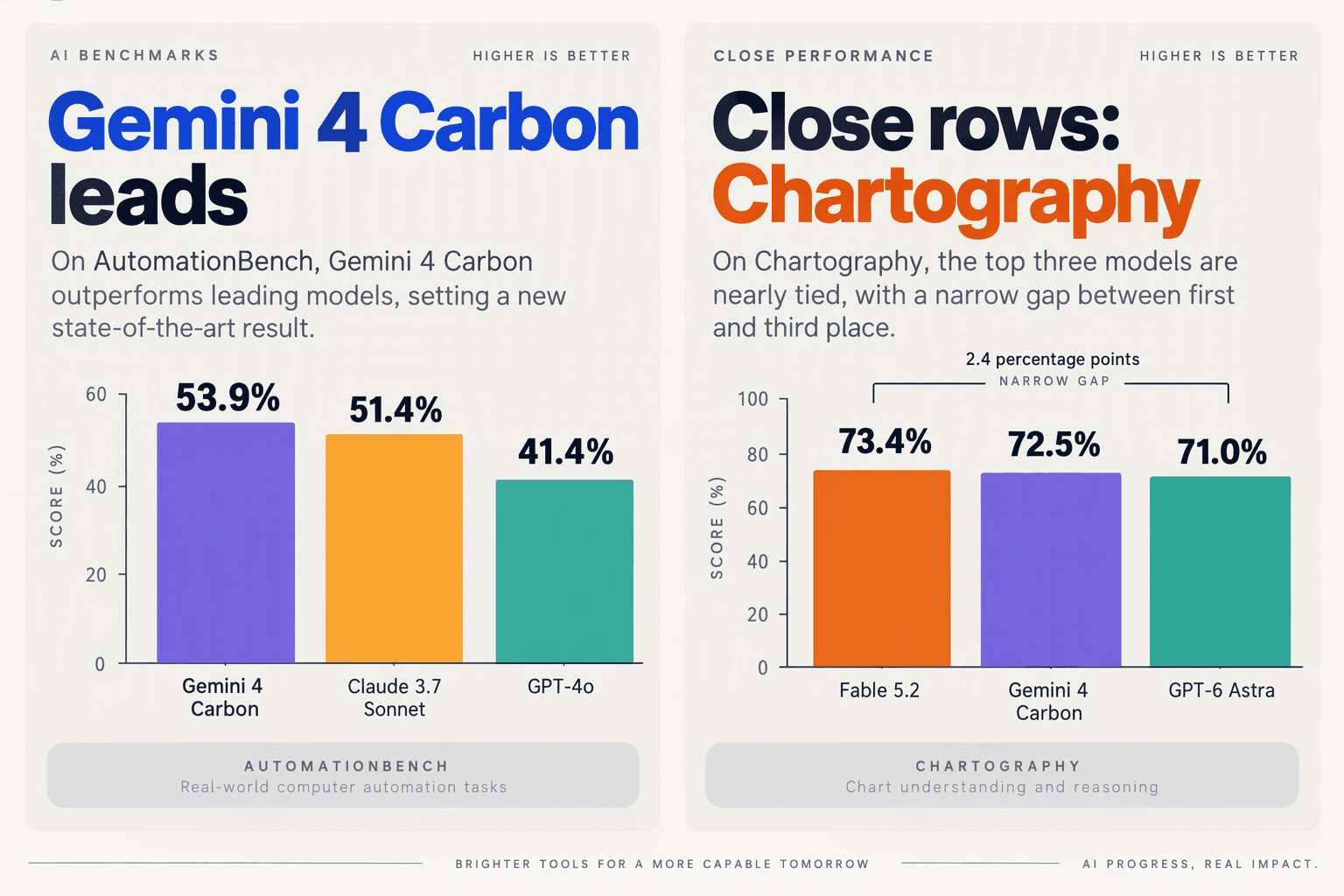
As of November 9, 2026, we cannot confirm a single row where Gemini 4 Carbon leads. The only claim in our research set is a YouTube video saying Gemini 4 Carbon is "reportedly outperforming Claude Opus 5.5 and GPT-6 Astra." The word "reportedly" matters, because the video gives no primary source we could check.
Where does Gemini 4 Carbon supposedly lead?
The claim shows up in three places, and none of them is a model card or an independent benchmark:
- A YouTube video titled "GEMINI 4 CARBON IS Best Model Ever?!" bundles the claim with Fable 5.5 and Gemini 4 Ultra speculation.
- Two Facebook group posts in a "vibe coding" community compare Gemini against GPT-6 Astra and Claude Opus 5.5. Neither names a benchmark or links a source.
- A Reddit thread discusses leaked numbers for Gemini 4 Pro, which is a different model name from Carbon. Don't transfer those figures to Carbon.
The honest reading is that Gemini 4 Carbon might lead somewhere, but no source here names the benchmark, the score, or the test conditions. A lead you cannot reproduce is not a lead you can buy on.
Which rows are too close to call?
Every row involving Gemini 4 Carbon is unresolved, because it has no published score to compare. Some rows between the other two models are also closer than headlines suggest.
- Price. Community threads on Reddit put GPT-6 Astra at roughly $12 input / $60 output per million tokens and Claude Fable 5.1 at $10 / $50. That is a 20% premium on both sides for Astra, which is real but small next to the cost of a wrong model choice. These are community-reported figures, and we have no Carbon price.
- General intelligence. Artificial Analysis scores GPT-6 Astra (Max) at 57 and Claude Fable 5.1 (Xhigh) at 50. That gap is measured, but it compares Astra with Fable 5.1, so it says nothing about Fable 5.2 or Carbon.
- Agentic and coding work. GPT-6 Astra has vendor-reported results (64.6% on Terminal-Bench Science 0.1, 59.3% on Agents' Last Exam). Neither rival has a comparable published figure, so this row is a gap in evidence rather than a gap in capability.
- Saturated tests. Astra's reported 100% on ExploitBench cannot separate strong models, so treat that row as a tie until a harder test exists.
What should buyers do with this?
Put Gemini 4 Carbon on a watch list, not a shortlist. Revisit it when Google publishes a model card with named benchmarks and pricing, or when Artificial Analysis or BenchLM add it. BenchLM's shared-benchmark comparison currently covers Claude Fable 5 and GPT-6 Astra across 10 benchmarks, which is the kind of apples-to-apples table Carbon still lacks.
Meanwhile, build your own test set of 30 to 50 real tasks. Gateways like CallMissed, the OpenAI-compatible and Anthropic-compatible AI API, support caller-chosen fallback models and a catalogue of 159 models that includes Google, OpenAI and other makers. That lets you add a new model to your test by changing a model name. Check the live catalogue for whether a given Gemini, GPT or Claude release is available before you plan around it.
Are These Benchmarks Really Like-for-Like?
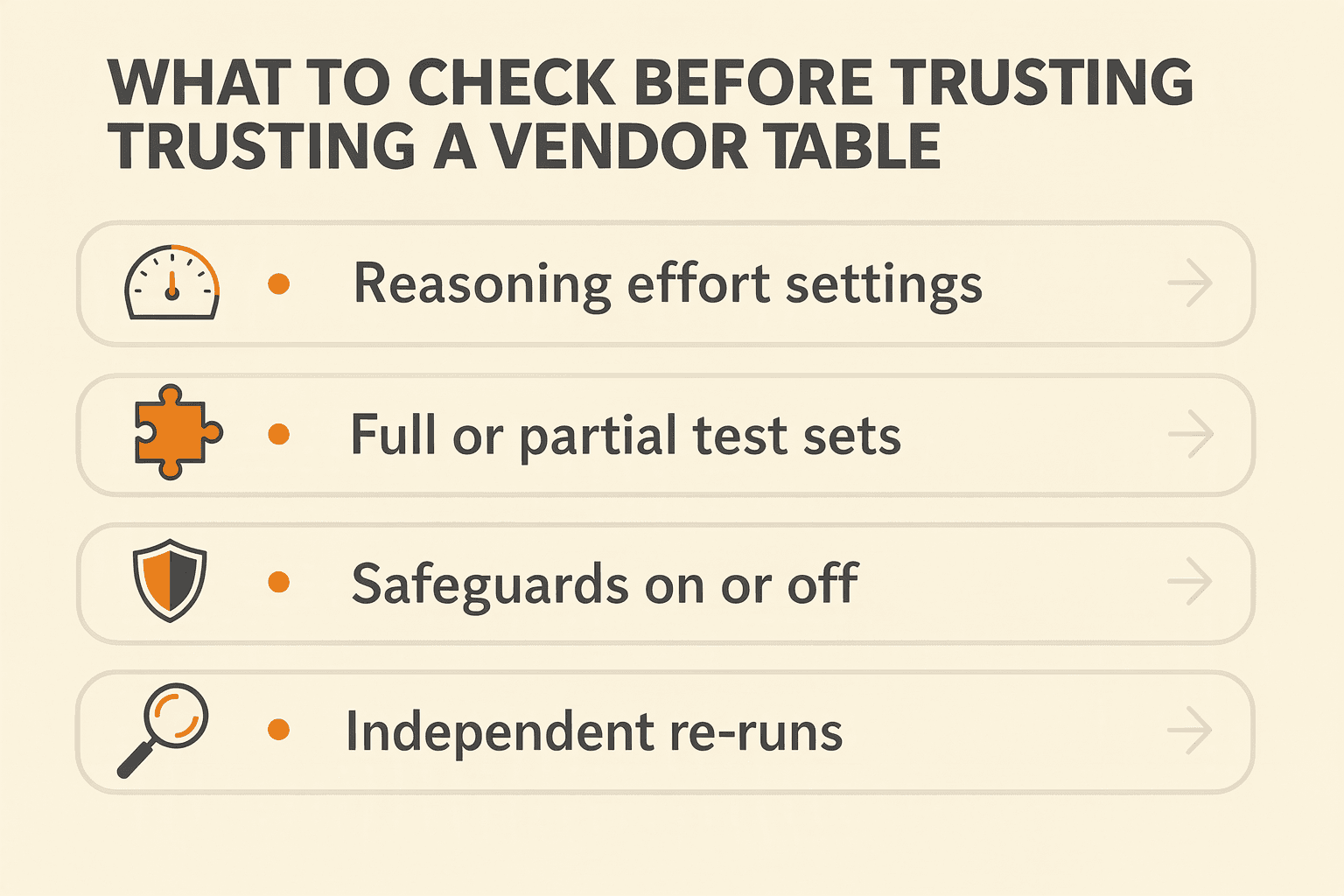
No, these benchmarks are not like-for-like, and the differences are large enough to change a buying decision. Each number we have comes from a different reporter, model version, settings tier or test set. Here is where they diverge.
Are the model versions and settings the same?
No. Artificial Analysis scores GPT-6 Astra (Max) at 57 and Claude Fable 5.1 (Xhigh, Default Fallback) at 50. The labels in parentheses are reasoning-effort or configuration tiers, so the 7-point gap compares two specific setups rather than two models in the abstract. It also uses Fable 5.1, not Fable 5.2. BenchLM's shared-benchmark page compares Claude Fable 5 with GPT-6 Astra, which is a third version. Three sources give you three Claude generations.
Are the benchmark sets the same?
Not yet. GPT-6 Astra's headline figures come from tests chosen for its launch: Terminal-Bench Science 0.1, Agents' Last Exam and an OSWorld 2.0 simulation. The kie.ai comparison shows no matching Claude Fable 5.2 results on those tests, so there is nothing to subtract from. BenchLM's 10 shared benchmark results are the closest thing to a common yardstick, but they cover Fable 5, not 5.2. We also reviewed no Anthropic-published scorecard for 5.2, and no primary source for the Gemini 4 Carbon claims.
Is the measurement method the same?
Almost certainly not, and the sources rarely say. Agentic benchmarks depend on details that move scores by many points:
- The harness or scaffold wrapped around the model
- Which tools the model could call
- The token or time budget per task
- Whether a score is a single run or the best of several attempts
A vendor-reported 64.6% and an independently run 64.6% can mean different things. A simulated OSWorld result is also not the same as a live-desktop run.
Are the prices comparable?
Only loosely. The Reddit thread puts GPT-6 Astra at about $12 input / $60 output per million tokens and Claude Fable 5.1 at $10 / $50, with the Claude figure noted as excluding aggressive cache reads. On those community-reported numbers, Astra's list price is 20% higher on both input and output. But list price is not cost per task. A model that needs fewer retries or fewer reasoning tokens can cost less in practice, and a model with heavy cache reuse can cost less than its list price suggests.
How can you check any benchmark claim in five questions?
- Who ran it? The vendor, an independent tracker or an anonymous post?
- Which exact model and effort setting? For example Max versus Xhigh, or 5.1 versus 5.2.
- Which harness and tools? Can you reproduce it?
- Is the test saturated? A 100% score, like the reported ExploitBench result, tells you little about differences between models.
- Does the task resemble yours? A terminal-science score says little about customer-support summarization.
What should buyers do about it?
Treat published numbers as a shortlist filter, then measure on your own prompts. Running the same task set against several models is easier when one API reaches many of them. CallMissed, the OpenAI-compatible and Anthropic-compatible AI gateway, offers 159 models behind one key, with usage and request logs. Teams can compare quality and cost per task in one place, provided the models they want are in the catalogue. As of November 2026, that comparison will tell you more than any leaderboard screenshot.
What Should Experts and Independent Testers Verify First?

Independent testers should first verify that each model exists under the name claimed, then check the conditions behind each benchmark number, then confirm price and context window. As of November 9, 2026, none of those steps is complete for Claude Fable 5.2 or Gemini 4 Carbon. Only parts of them are complete for GPT-6 Astra.
What should be checked before any benchmark score?
Start with identity, because naming is already inconsistent. kie.ai calls Claude Fable 5.2 "an unconfirmed Anthropic model name" with no model card or public API identifier. A YouTube video's title references "Fable 5.5" and "Claude Opus 5.5" alongside Gemini 4 Carbon. A Reddit thread discusses "leaked Gemini 4 Pro numbers." A score attached to a name that cannot be called through an API cannot be reproduced.
A practical test: can you send a request to the model today using a documented identifier? If not, treat every number as unverified.
Are the compared scores run under the same conditions?
Not necessarily. Artificial Analysis lists GPT-6 Astra at 57 on its Intelligence Index in "Max" mode, while Claude Fable 5.1 scores 50 in "Xhigh, Default Fallback" mode. Those settings differ, so the 7-point gap mixes model quality with reasoning-effort choices.
Ask these questions of any scorecard:
- Reasoning effort: Was the same effort level used for every model?
- Harness: Which scaffold, tools and prompts ran the agent benchmarks?
- Attempts: Was the result pass@1, best-of-N or an average?
- Contamination: Could the test set have leaked into training data?
Agent benchmarks such as Terminal-Bench Science, Agents' Last Exam and OSWorld 2.0 are especially sensitive to harness choices.
Which independent sources are worth waiting for?
Two types matter most. Artificial Analysis publishes index scores plus speed data. BenchLM compares models across 10 shared benchmark results alongside listed API price, context window and measured speed, though its page covers Claude Fable 5, not 5.2.
Neither has confirmed Gemini 4 Carbon numbers in the material we reviewed. Wait for a replication from at least one of them before acting on a claim.
How should buyers verify pricing?
Community threads on Reddit put GPT-6 Astra at roughly $12 input / $60 output per million tokens with a 1M context window, and Claude Fable 5.1 at $10 / $50, "excluding aggressive cache reads." That caveat matters. Your real cost depends on cache hit rates, output length and retries, not on list price alone.
Use cost per completed task as your metric. A model that costs more per token can still be cheaper if it needs fewer retries.
A verification order for your team
- Confirm the model has an official model card and a callable API identifier.
- Read the benchmark's methodology, including effort level and harness.
- Look for independent replication from Artificial Analysis or BenchLM.
- Check official pricing and context limits against community-reported figures.
- Run 30 to 50 of your own real tasks and score them blind.
Step 5 is where a unified gateway helps. Because CallMissed's API is OpenAI-compatible and Anthropic-compatible (including /v1/messages) and offers caller-chosen fallback models and request logs, your team can point the same test harness at different models by changing the base URL and model name. Check the catalogue for which models are currently available.
How Do These Results Change Coding, Agent and Computer-Use Choices?

As of November 9, 2026, these results justify piloting GPT-6 Astra for terminal-heavy coding and agent work, but they do not justify moving production traffic off your current model. The numbers describe what one vendor measured on its own benchmarks. They say little about how any of the three models handles your codebase, your tools or your screens.
Which model should you pilot for coding?
Start with GPT-6 Astra, because it is the only one of the three with a documented coding-adjacent result. Its vendor-reported 64.6% on Terminal-Bench Science 0.1 (per kie.ai) points to command-line work: running tests, reading logs, editing files and fixing build errors.
That does not make it a general coding winner. Terminal-Bench Science is one test. Claude Fable 5.2 and Gemini 4 Carbon have no verified coding benchmark in the sources we reviewed, so they are untested rather than inferior.
Build a coding pilot from 20 to 30 real tickets from your own repository, such as flaky tests, small refactors and dependency upgrades. Score each model on whether the patch passes your CI, not on whether it reads well.
What do the agent results mean for tool-using workflows?
The 59.3% on Agents' Last Exam suggests GPT-6 Astra is a credible candidate for multi-step agents, but it also implies a failure rate of roughly 4 in 10 on that test. Plan for retries, human review on irreversible actions and logging of every tool call.
For agents, test these three things yourself:
- Tool-call accuracy: does the model pass valid arguments to your functions?
- Recovery: does it notice a failed step and change course, or repeat itself?
- Cost per completed task: community-reported pricing of about $12 input and $60 output per million tokens for GPT-6 Astra, against $10 and $50 for Fable 5.1, matters less than how many tokens a finished task consumes.
How far should you trust the computer-use number?
Treat the 72.6% on an OSWorld 2.0 simulation as a directional signal only. A simulation is not a live desktop with your authentication prompts, slow internal apps and odd pop-ups. Computer-use agents usually degrade most in exactly those conditions.
If your workflow depends on clicking through legacy software, run a sandboxed trial on three or four real screens before drawing any conclusion. Keep the permissions narrow while you do.
What decision rule should buyers follow?
- Keep your incumbent in production. Switch only if a model beats it on your own task set.
- Add GPT-6 Astra to the shortlist for terminal, agent and computer-use pilots, since it has the only published numbers.
- Put Fable 5.2 and Gemini 4 Carbon on a watchlist until a model card, API identifier and price exist.
- Re-test when documentation lands. A confirmed Fable 5.2 release could change the ranking quickly.
Tooling matters here. CallMissed, the OpenAI-compatible and Anthropic-compatible AI gateway, reaches 159 models with one API key and supports caller-chosen fallback models. That lets a team run the same evaluation harness against several candidates by changing the base URL and model name. Check the current model list for availability, since not every new model appears in every catalogue on release day.
The practical takeaway is that published benchmarks tell you which model to test first. Only your own evaluation tells you which model to buy.
Which Model Should You Shortlist for Your Workload?
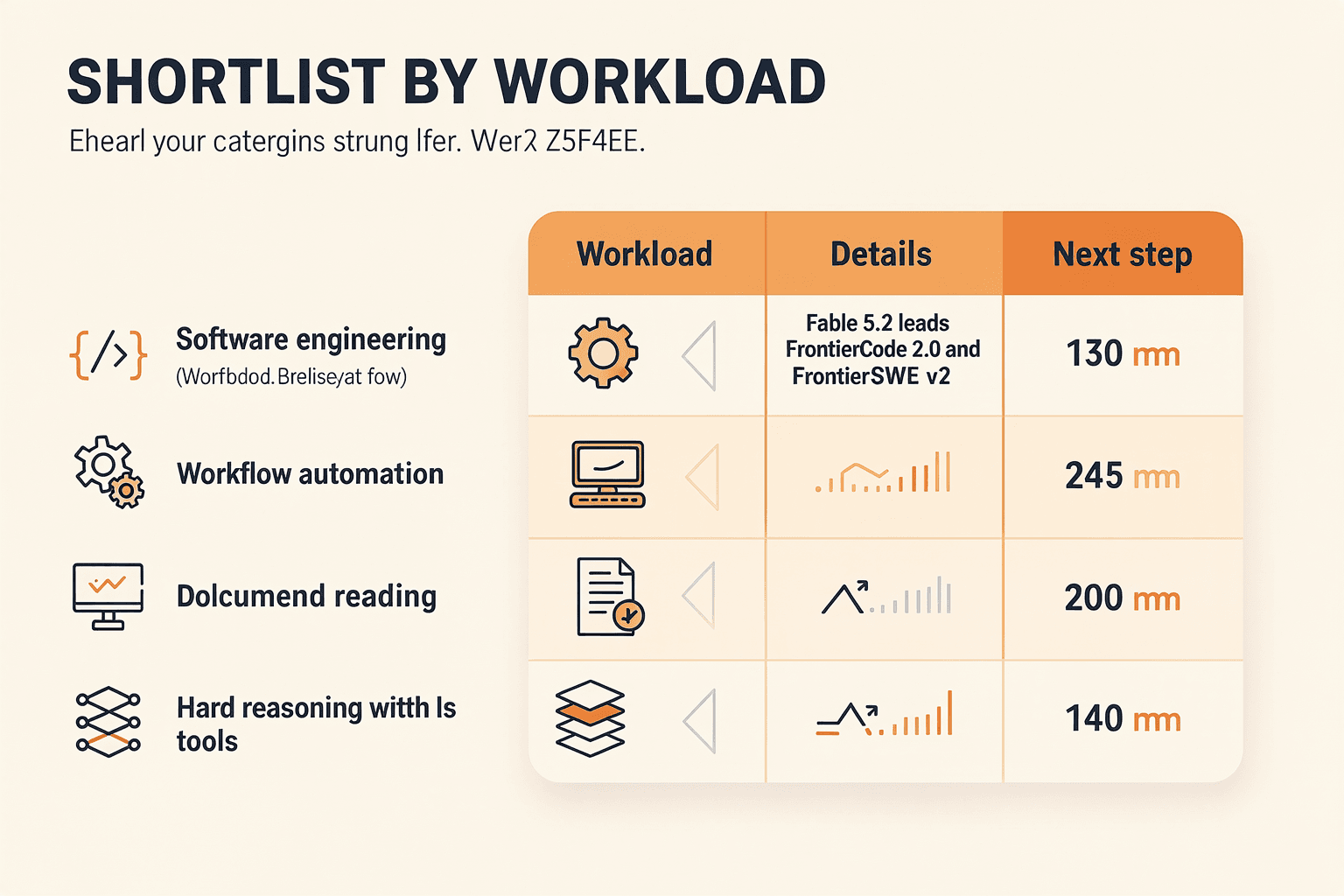
As of November 9, 2026, shortlist GPT-6 Astra for agentic and terminal-style work, keep Claude Fable 5.1 as the priced, measured Anthropic baseline, and put Fable 5.2 and Gemini 4 Carbon on a watch list. A shortlist is a commitment to test a model, not to buy it, so it should follow the evidence available for each workload.
Which model fits which workload?
| Workload | Shortlist | Evidence behind it | Caveat |
|---|---|---|---|
| Terminal and computer-use agents | GPT-6 Astra | Vendor-reported 64.6% on Terminal-Bench Science 0.1 and 72.6% on an OSWorld 2.0 simulation (kie.ai) | Launch-material figures, not independently replicated |
| Highest measured general intelligence | GPT-6 Astra | Artificial Analysis index: 57 for GPT-6 Astra (Max) vs 50 for Claude Fable 5.1 (Xhigh) | Compares Fable 5.1, not Fable 5.2 |
| Cost-controlled production traffic | Claude Fable 5.1 | Community-reported $10 input / $50 output per million tokens vs about $12 / $60 for GPT-6 Astra (Reddit) | Prices are unofficial; cache behavior changes real cost |
| Long-context document work | GPT-6 Astra | Community-reported 1M-token context window | Fable 5.2 and Gemini 4 Carbon have no confirmed context window |
| Anthropic's next release | Claude Fable 5.2 (watch) | Rumor only; no model card, API identifier or price confirmed | Do not budget or migrate on it |
| Google's challenger | Gemini 4 Carbon (watch) | A single YouTube claim of beating Claude Opus 5.5 and GPT-6 Astra | No primary source found |
How should you read this table?
The first four rows are testable today. The last two are not.
GPT-6 Astra wins the first, second and fourth rows only because it is the model with checkable numbers. Fable 5.1 holds the cost row because it has a listed price in community threads, not because anyone has shown it is cheaper per completed task. A model that costs 20% less per token but needs more retries can cost more overall.
What should you do before committing?
- Write 30 to 50 real tasks from your own workload, including the ugly edge cases. Public benchmarks cannot tell you how a model handles your data.
- Run the same prompts across two or three candidates. Hold temperature, tools and output format constant.
- Score cost per successful task, not price per million tokens. Include retries, tool-call failures and latency.
- Re-run when a model card appears. If Fable 5.2 or Gemini 4 Carbon ships with official documentation, test it against your existing results instead of starting over.
Gateways make the testing step cheap. CallMissed, the OpenAI-compatible and Anthropic-compatible AI gateway, offers 159 models behind one API key. It also supports caller-chosen fallback models and request logs, so you can compare outputs and spend without rewriting integrations. Check the model catalogue for which of these three models are available before planning around them.
When should you stop waiting?
Wait on Fable 5.2 and Gemini 4 Carbon only if your decision date is after their documentation lands. If you must ship this quarter, build on a model you can measure now and keep your integration portable. A portable setup means a later swap costs a configuration change, not a rewrite.
Frequently Asked Questions
Is Claude Fable 5.2 better than GPT-6 Astra?
What do independent benchmarks say about Fable 5.2 vs GPT-6 Astra?
How much do GPT-6 Astra and Claude Fable cost per million tokens?
Does Gemini 4 Carbon really outperform Claude Opus 5.5 and GPT-6 Astra?
How should I compare Fable 5.2 vs GPT-6 Astra for my own workload?
- Collect 30 to 50 real prompts or tasks, including some your current model fails.
- Run each candidate model on the same prompts with the same settings, and record quality, latency and cost per task.
- Have a human or a rubric score the outputs blind.
For teams doing this across vendors, CallMissed's OpenAI-compatible and Anthropic-compatible API reaches 159 models with one key, so swapping candidates means changing the base URL and model name. Signup includes 1,000 free credits, and 21 of the catalogue models are on the free tier. Check the model list at docs.callmissed.com for the specific models you want to test.
Should I switch models now or wait?
Conclusion
As of November 2026, GPT-6 Astra is the best-documented of the three models, but no source we reviewed shows it is the best. Here are the takeaways:
- GPT-6 Astra has the strongest evidence. Its vendor-reported results include 64.6% on Terminal-Bench Science 0.1 and 59.3% on Agents' Last Exam. These are launch figures, not independent replications.
- Independent data covers Fable 5.1, not 5.2. Artificial Analysis scores GPT-6 Astra (Max) at 57 against 50 for Claude Fable 5.1 (Xhigh).
- Claude Fable 5.2 and Gemini 4 Carbon remain unverified. Neither has a confirmed model card, price or primary-source benchmark.
- Community-reported pricing needs checking. The roughly $12/$60 versus $10/$50 per million tokens figures should be confirmed against official pages before you budget.
Next, watch for official Anthropic documentation of Fable 5.2, a primary source for the Gemini 4 Carbon claims, and independent scores from Artificial Analysis and BenchLM. Until then, your own tasks are the only benchmark that settles the question.
To run those side-by-side tests, explore CallMissed, an AI infrastructure platform whose OpenAI-compatible and Anthropic-compatible API reaches 159 models with one key. It also powers voice agents and multilingual chatbots for businesses.
When the Fable 5.2 model card finally lands, will your team be ready to test it in a day?
Related Reading
- Muse Wonder vs GPT-6 Astra vs Gemini 4 Argon for Voice
- unified LLM API gateway: Claude, Gemini and GPT Compared
- GPT-6 Sol vs Claude Opus 5.5: Benchmarks & Cost