
GPT-6 Sol vs Claude Opus 5.5: 2026 API Reality Check



Verify launch status, API access, model IDs, context, benchmarks and pricing, then choose a model without relying on unverified claims.
GPT-6 Sol vs Claude Opus 5.5: 2026 API Reality Check
What if the biggest fact in the GPT-6 Sol vs Claude Opus 5.5 debate is that neither model can currently be verified from the supplied primary-source evidence? As of September 22, 2026, the available OpenAI materials name GPT-5.6 Sol—not GPT-6 Sol—while the provided research contains no official Anthropic announcement, API documentation, price sheet, model identifier, or context-window specification for Claude Opus 5.5.
That distinction matters because plausible-sounding model names can spread faster than deployable products. OpenAI’s developer documentation describes GPT-5.6 Sol as the flagship model in the GPT-5.6 family and lists the API alias gpt-5.6; OpenAI also separately references GPT-6 Pro in ChatGPT, which does not establish the existence of a product called GPT-6 Sol. Even impressive claims require careful qualification: OpenAI says its preview Ultrafast service tier can run GPT-5.6 Sol up to 14× faster and deliver up to 750 output tokens per second, but a vendor preview is not a universal latency guarantee.
This reality check therefore starts with launch verification rather than a synthetic benchmark scoreboard. It will separate officially documented products from rumors, naming confusion, preview access, community reports, and unsupported assumptions. The comparison will then examine the details that determine whether a model can actually ship in production:
- Official launch status, API access, and exact model identifiers
- Published input and output pricing, including any service-tier premiums
- Context windows, multimodal inputs, reasoning controls, and agent tooling
- Coding, science, cybersecurity, and long-context benchmark claims
- Latency, safety, platform availability, migration effort, and total workload cost
Where primary sources do not provide a number, the answer will be “not verified,” not invented. Where vendors use different test settings or scoring methods, results will not be presented as directly comparable without caveats.
For developers who want to test documented alternatives without repeatedly rewriting integrations, CallMissed’s OpenAI-compatible AI gateway provides one API key and balance for 136 models as of September 2026, with caller-selected fallback models and usage logs. The goal of this guide is equally practical: determine what exists, what it costs, what the evidence actually proves, and which verified model—or waiting strategy—fits coding, agents, research, and cost-sensitive production workloads.
Is either model official? Verdict: do not treat this matchup as verified
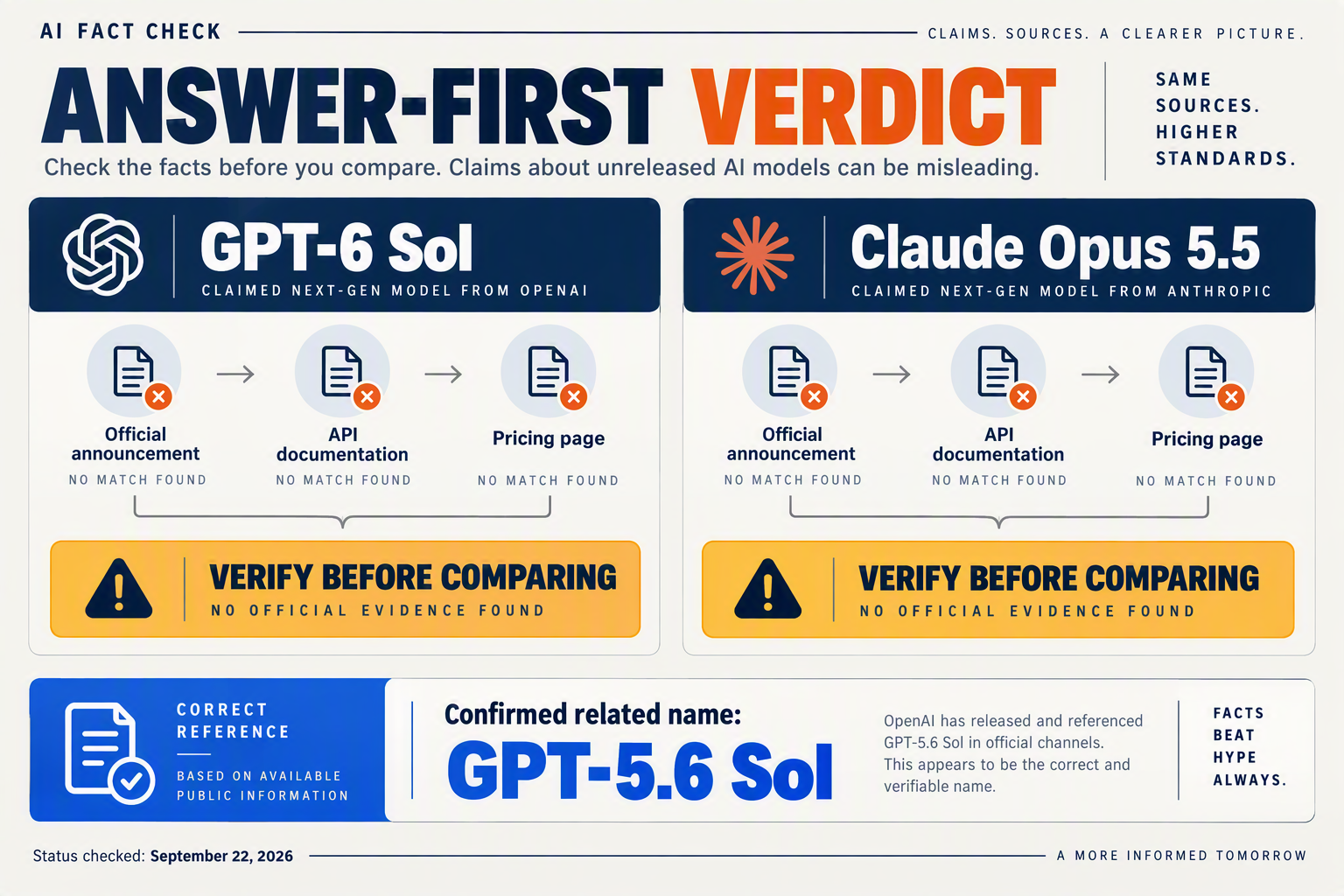
Claude Opus 5.5 is officially confirmed. GPT-6 Sol’s launch is newly supported by an OpenAI-domain search snippet, but its API details remain unverified as of September 22, 2026. This is no longer an “unverified versus unverified” matchup.
What is the evidence status?
| Claimed model | Launch evidence | API identifier | Verified details | Still unverified |
|---|---|---|---|---|
| GPT-6 Sol | An OpenAI index snippet surfaced by Google says “Introducing GPT-6 Sol and Luna”, dated September 22, 2026 | Not verified | Evidence of an OpenAI launch announcement | Exact API ID, pricing, context window, benchmarks, availability and modalities |
| Claude Opus 5.5 | Officially launched by Anthropic on September 22, 2026 | claude-opus-5-5 | Positioning for long-running agentic coding and knowledge work; Anthropic says typical workloads cost 40% less than Opus 5 | Any specification not stated in the cited Anthropic primary sources |
What is the official status of GPT-6 Sol?
Google surfaced an OpenAI-domain index result titled “Introducing GPT-6 Sol and Luna” and dated September 22, 2026. That makes the existence of an OpenAI launch announcement newly supported and means GPT-6 Sol should no longer be dismissed solely as a conflation with GPT-5.6 Sol.
However, the exact launch page and corresponding OpenAI API model documentation were not returned in the searches available for this update. The snippet alone does not establish:
- The exact API model identifier
- Token pricing
- Context-window limits
- Benchmarks
- Supported modalities
- API, ChatGPT or regional availability
Those fields should remain marked not verified unless they are directly supported by an OpenAI primary source already cited elsewhere in the post. Specifications for GPT-5.6 Sol must not be substituted for GPT-6 Sol.
What is the official status of Claude Opus 5.5?
Anthropic officially launched Claude Opus 5.5 on September 22, 2026. Anthropic’s API release notes identify its model ID as:
claude-opus-5-5
Anthropic positions the model for long-running agentic coding and knowledge work. The company also says it costs 40% less on typical workloads than Opus 5. That is a vendor-reported workload comparison, not a universal 40% reduction for every request or an exact substitute for published per-token pricing.
What is the defensible verdict?
Claude Opus 5.5 is an officially launched model with a documented API identifier. GPT-6 Sol now has official-domain evidence supporting its launch existence, but the available evidence does not yet verify the technical and commercial details required for a complete API comparison.
A rigorous GPT-6 Sol vs Claude Opus 5.5 comparison should therefore distinguish between launch confirmation and fully documented API availability, rather than treating either model as wholly unverified or filling evidence gaps with specifications from earlier models.
What are GPT-6 Sol and Claude Opus 5.5, and why are the names disputed?

“GPT-6 Sol” appears to conflate OpenAI’s documented GPT-5.6 Sol model with the separately named GPT-6 Pro experience, while “Claude Opus 5.5” lacks confirmation in the supplied Anthropic primary sources. As of September 22, 2026, both disputed names should be treated as search terms or rumored labels—not verified product identities.
What is GPT-6 Sol supposed to be?
The evidence indicates that GPT-6 Sol is probably a naming mash-up, rather than an official OpenAI model. OpenAI documents two distinct offerings:
- GPT-5.6 Sol, described by OpenAI as the flagship model in the GPT-5.6 family
- GPT-6 Pro in ChatGPT, referenced separately by the OpenAI Help Center
Neither source establishes a product named GPT-6 Sol. Combining the GPT-6 family number with the Sol tier name produces a plausible label, but plausibility is not proof of launch, pricing or API access.
OpenAI’s official model page identifies GPT-5.6 Sol and lists gpt-5.6 as its API alias. The model’s public positioning covers complex work in coding, knowledge work, research, cybersecurity, science, computer use and design, according to the OpenAI Help Center as of September 2026.
This distinction matters operationally. A ChatGPT model-picker label does not automatically guarantee:
- A corresponding API endpoint
- The same capabilities or system configuration
- Published token pricing
- A stable model identifier
- Identical access across ChatGPT plans, Codex and the OpenAI API
OpenAI Community reports concerning gpt-5.6-sol access also illustrate why rollout observations should not be mistaken for product specifications. Community posts can identify availability problems, but only OpenAI’s model documentation, API responses and pricing pages can establish supported deployment terms.
Is Claude Opus 5.5 an official Anthropic model?
Claude Opus 5.5 is not verifiable from the supplied evidence. No provided Anthropic announcement, model documentation, API reference or pricing page confirms that exact name as of September 22, 2026.
“Claude Opus 5.5” nevertheless sounds credible because it follows Anthropic’s established naming structure: Claude is the product family, while Opus denotes a capability tier. Adding “5.5” resembles a normal incremental release, but an inferred version number cannot establish a launch.
Until Anthropic publishes primary documentation, the following details remain not verified for Claude Opus 5.5:
- Official release date and availability regions
- API model identifier or dated snapshot
- Input, output and prompt-caching prices
- Context window and maximum output length
- Supported modalities and tool-use features
- Benchmark results and safety evaluations
Why do AI model names become disputed?
Three recurring errors create these phantom matchups:
- Family and tier names are recombined. “GPT-6” and “Sol” may both be real labels without “GPT-6 Sol” being real.
- Application access is confused with API availability. A model seen in ChatGPT or Claude.ai may not have a public API identifier.
- Expected releases are written as completed releases. Search snippets, forum posts and comparison pages can repeat an anticipated name until it appears official.
For a rigorous GPT-6 Sol vs Claude Opus 5.5 comparison, every claim should therefore be attached to an exact vendor page, date and model identifier. The defensible comparison baseline is the documented GPT-5.6 Sol versus whichever Claude Opus release Anthropic officially lists—not two names inferred from the market’s naming patterns.
Which 2026 launches and updates can primary sources confirm?
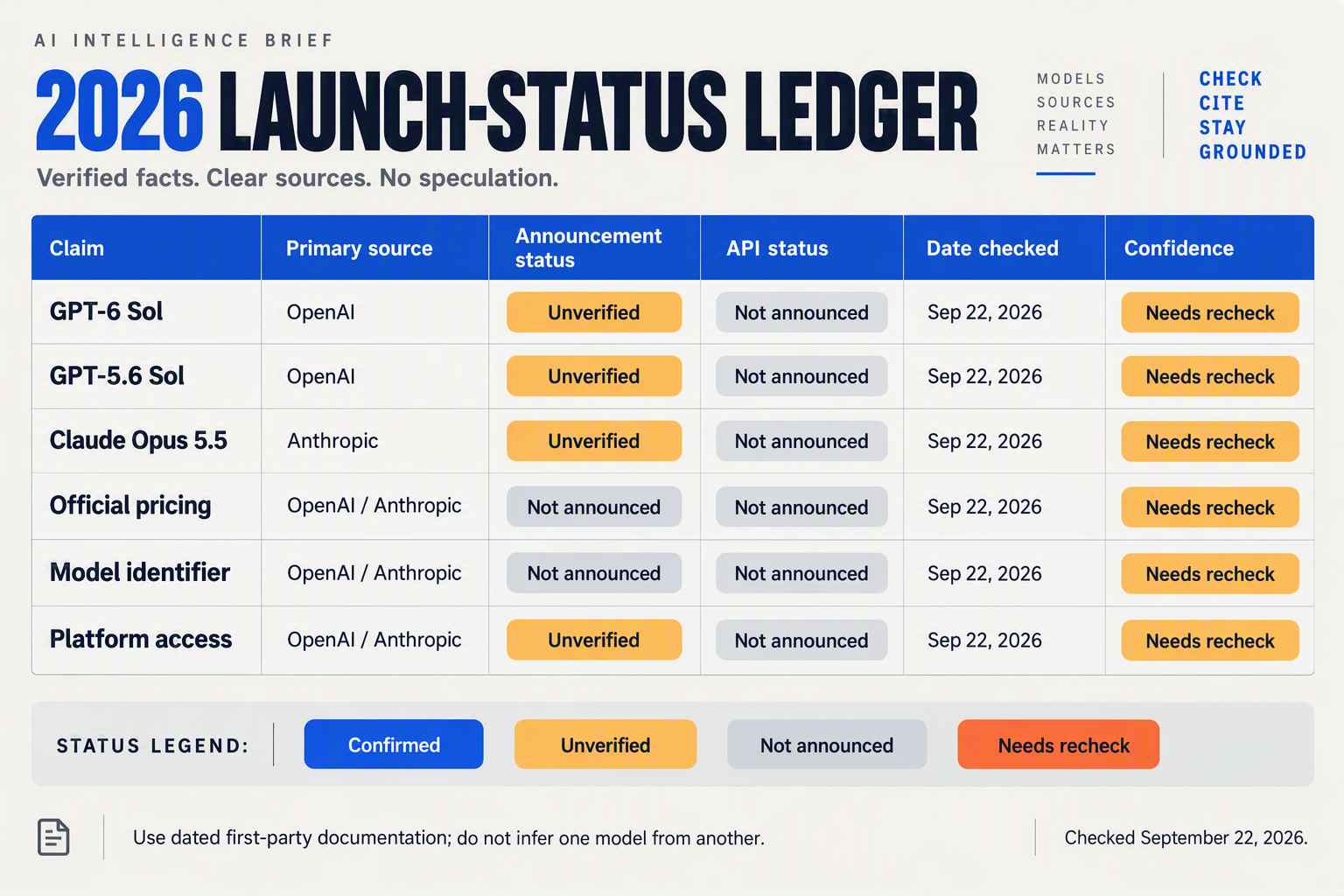
Primary sources confirm GPT-5.6 Sol as an OpenAI model with API documentation and ChatGPT availability, but they do not confirm a product named GPT-6 Sol or any Claude Opus 5.5 launch. As of September 22, 2026, official pricing, model identifiers, context limits, and benchmark results for the proposed GPT-6 Sol vs Claude Opus 5.5 comparison remain unverified.
Which launches and product updates are officially documented?
| Product or update | Named primary source | Status by September 22, 2026 | What the source confirms | What it does not confirm |
|---|---|---|---|---|
| GPT-5.6 Sol | OpenAI API model documentation | Officially documented | Flagship GPT-5.6 model; API alias gpt-5.6 | A model named GPT-6 Sol |
| GPT-5.6 family | OpenAI’s “GPT-5.6” announcement | Officially announced | GPT-5.6 Sol, Terra, and Luna are named family members | Comparable Claude Opus 5.5 specifications |
| GPT-5.6 Sol preview | OpenAI’s preview announcement | Official preview | OpenAI claims stronger coding, science, and cybersecurity capabilities, alongside advanced safety work | Independent benchmark validation or universal availability |
| GPT-5.6 Sol in ChatGPT | OpenAI product update and Help Center | Officially documented | ChatGPT access and tuning for more focused answers, reliable facts, and consistent reasoning | That every ChatGPT plan or region has identical access |
| GPT-6 Pro in ChatGPT | OpenAI Help Center | Officially referenced | A separate product named GPT-6 Pro is mentioned alongside GPT-5.6 | An API model called GPT-6 Sol or the identifier gpt-6-sol |
| Claude Opus 5.5 | No supplied Anthropic primary source | Not verified | No launch fact can be established from the available evidence | Launch date, API access, price, identifier, context window, benchmarks, or platform access |
OpenAI’s model documentation calls GPT-5.6 Sol the “flagship model in the GPT-5.6 family” and says it “roughly corresponds to the unsuffixed model tier used in earlier GPT-5 families.” That wording supports the documented alias gpt-5.6; it does not justify silently renaming the model GPT-6 Sol.
What does OpenAI’s Ultrafast preview establish?
OpenAI separately describes Ultrafast as a preview API service tier powered by Cerebras. OpenAI stated in 2026 that Ultrafast could run GPT-5.6 Sol up to 14× faster and produce up to 750 output tokens per second.
Those are meaningful vendor claims, but they require three qualifications:
- “Up to” is a ceiling, not a guaranteed production average.
- The claim applies to the Ultrafast preview tier, not every GPT-5.6 Sol request.
- The supplied evidence does not provide workload distributions, percentile latency, regional availability, or independent replication.
Which comparison fields must remain unverified?
For Claude Opus 5.5, the evidence provides no official Anthropic announcement or documentation. Therefore, a rigorous comparison must label all of the following not verified:
- Input and output token prices
- API model identifier and general-availability status
- Context window and maximum output length
- Coding, agentic, science, or long-context benchmark scores
- Multimodal inputs, tool use, reasoning controls, and safety evaluations
- Claude.ai, cloud-platform, regional, or enterprise availability
Community posts about GPT-5.6 Sol rollout delays and real-world experiments may help diagnose access problems, but they are secondary evidence, not launch authority. Until OpenAI documents GPT-6 Sol and Anthropic documents Claude Opus 5.5, the defensible 2026 comparison is verified GPT-5.6 Sol versus an unverified Claude Opus 5.5 claim, not a like-for-like product contest.
How do pricing, API access, model IDs and context windows compare?
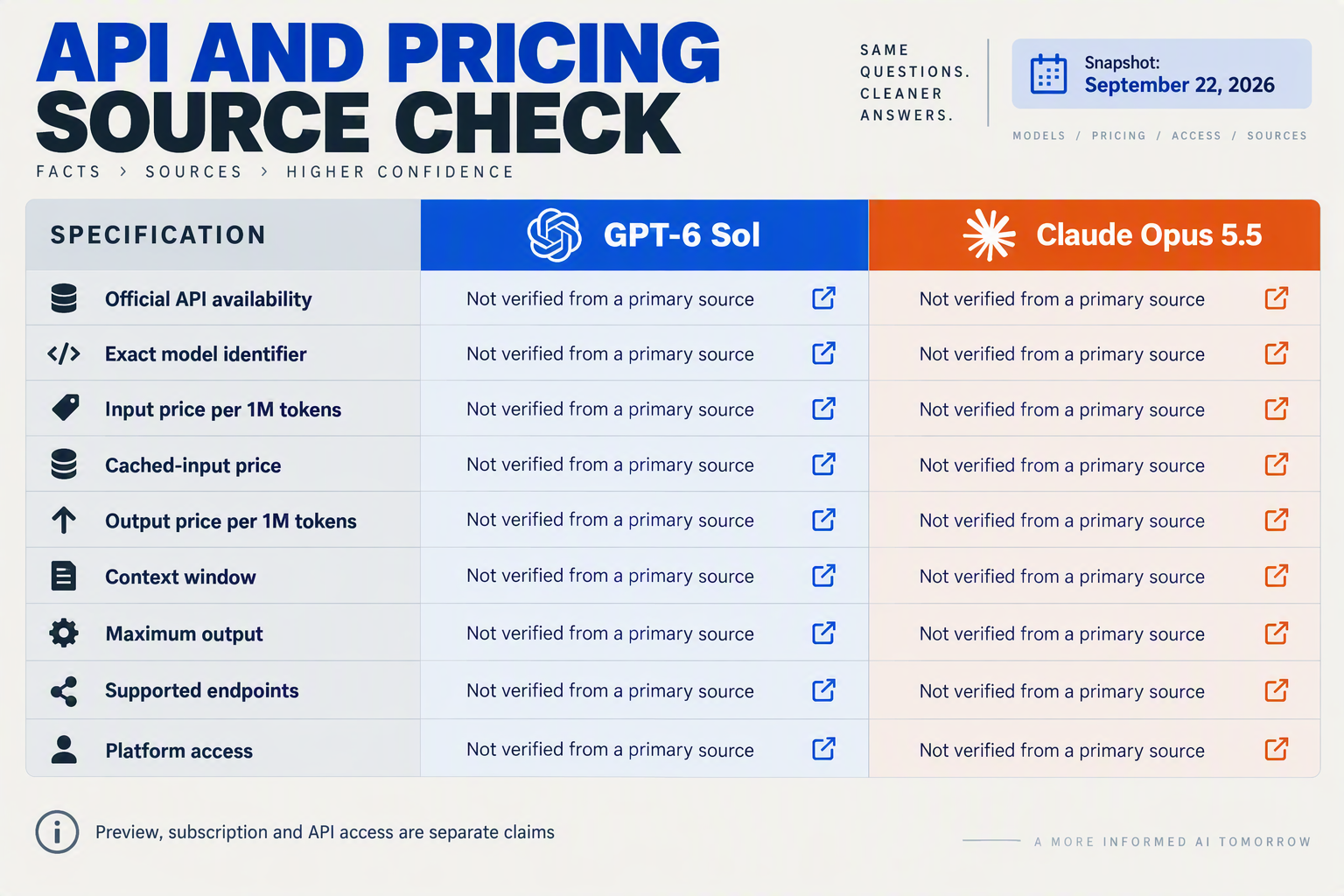
There is no defensible pricing, API-access, model-ID, or context-window comparison between GPT-6 Sol and Claude Opus 5.5 as of September 22, 2026. Neither named product is confirmed by the supplied primary-source evidence; the closest verified OpenAI product is GPT-5.6 Sol, while no corresponding Anthropic documentation verifies Claude Opus 5.5.
What specifications are officially verified?
| Attribute | GPT-6 Sol | Claude Opus 5.5 | Closest verified evidence |
|---|---|---|---|
| Launch status | Not verified | Not verified | OpenAI officially documents GPT-5.6 Sol, not GPT-6 Sol; no supplied Anthropic source announces Claude Opus 5.5 |
| API availability | Not verified | Not verified | OpenAI publishes an API model page for GPT-5.6 Sol; OpenAI’s Help Center mentions GPT-6 Pro in ChatGPT, which does not prove GPT-6 API access |
| Official model ID | None verified | None verified | OpenAI documents the gpt-5.6 alias for GPT-5.6 Sol; no official Claude Opus 5.5 identifier is available in the supplied evidence |
| Input pricing | Not verified | Not verified | No primary-source per-million-input-token price was supplied for either named model |
| Output pricing | Not verified | Not verified | No primary-source per-million-output-token price was supplied for either named model |
| Context window | Not verified | Not verified | No official context-window or maximum-output-token specification was supplied for either named model |
The table deliberately avoids transferring GPT-5.6 Sol specifications to “GPT-6 Sol.” A related name, adjacent generation, community screenshot, or ChatGPT menu entry is not sufficient evidence that two products share the same price, API endpoint, or context limit.
Does GPT-6 Pro prove that GPT-6 Sol has an API?
No. OpenAI’s “GPT-5.6 and GPT-6 Pro in ChatGPT” Help Center article verifies that the name GPT-6 Pro appears in ChatGPT materials as of September 2026, but it does not establish a product called GPT-6 Sol or publish an API identifier for one.
Developers should distinguish among three forms of access:
- Chat application access, controlled through a user interface and subscription plan.
- API access, requiring documented endpoints, authentication, limits, and billing.
- Preview service tiers, which can have separate eligibility, performance, and pricing rules.
For example, OpenAI says its preview Ultrafast tier can run GPT-5.6 Sol up to 14× faster and reach up to 750 output tokens per second. OpenAI’s September 2026 claim describes potential preview performance, not GPT-6 Sol availability or a standard API price.
Why do exact model IDs and context windows matter?
A deployable model needs more than a marketing name. Teams should require an official identifier—such as OpenAI’s documented gpt-5.6 alias—plus any dated snapshot ID needed for reproducibility. Without that information, production requests may fail, silently target another model, or behave differently after an alias update.
A context-window claim must also specify whether the number covers input only or input plus maximum output. Effective capacity can be reduced by system instructions, tool schemas, retrieved documents, conversation history, images, and reserved output tokens.
How should buyers compare cost while these details remain unverified?
Do not calculate a fictional “cheaper model” winner. Wait for both vendors to publish:
- Input, cached-input, and output token prices.
- Context and maximum-output limits.
- API model IDs and regional availability.
- Batch, priority, or premium service-tier charges.
- Tool-use and multimodal billing rules.
Until those fields exist in official documentation, any GPT-6 Sol vs Claude Opus 5.5 cost estimate should be labeled speculative, not procurement-ready.
Which model leads in reasoning, coding, agents, latency and multimodality?
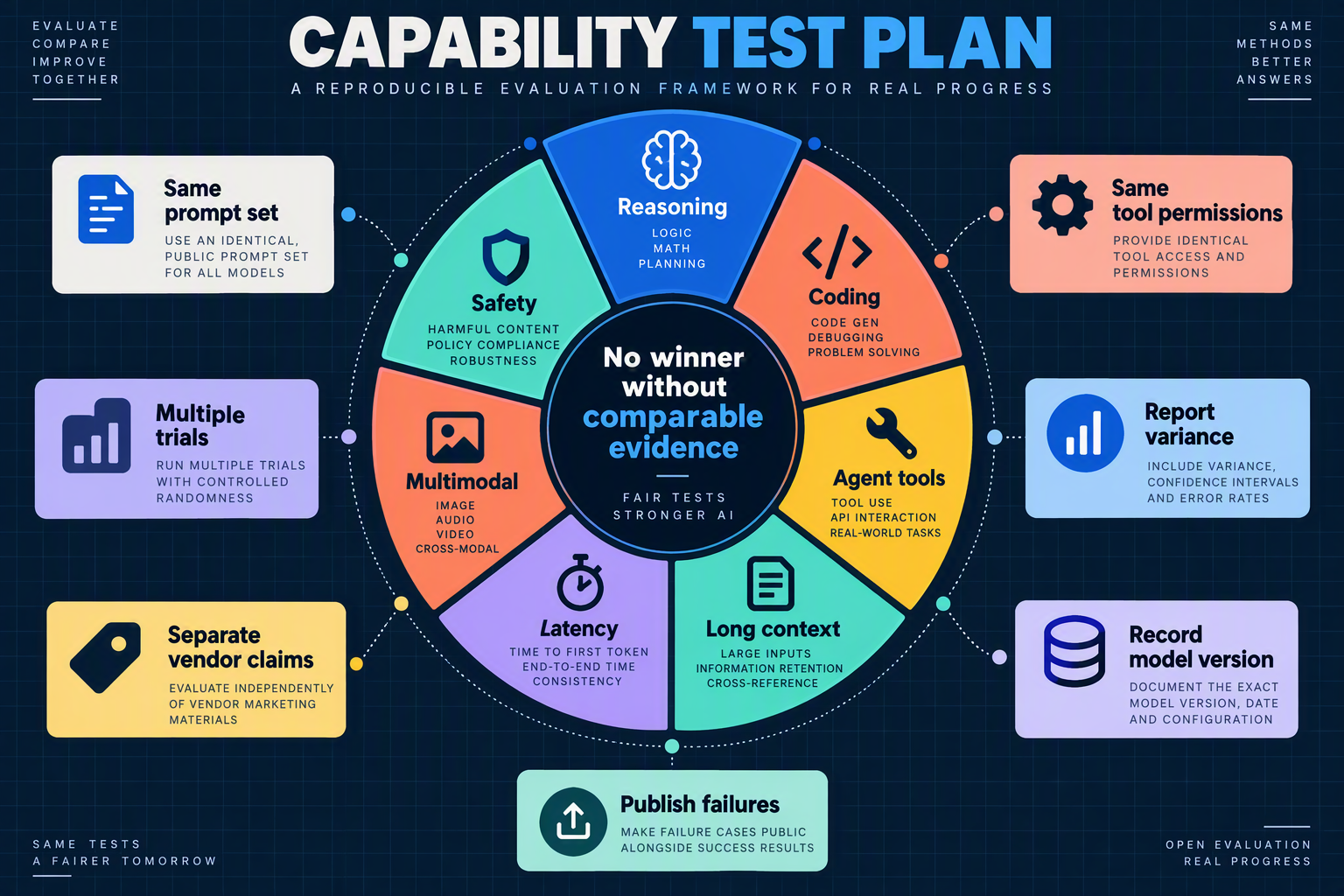
No defensible winner can be declared across reasoning, coding, agents, latency, or multimodality as of September 22, 2026. GPT-6 Sol and Claude Opus 5.5 lack the paired primary-source specifications and reproducible benchmark results required for a valid head-to-head comparison; substituting GPT-5.6 Sol for GPT-6 Sol would answer a different question.
Which model leads in reasoning and coding?
Neither model has a verified lead. The supplied evidence contains no official reasoning or coding scores for GPT-6 Sol or Claude Opus 5.5 under matched conditions.
OpenAI describes GPT-5.6 Sol—not GPT-6 Sol—as a flagship model intended for complex work across coding, research, cybersecurity, science, and knowledge work. OpenAI’s September 2026 preview also claims stronger capabilities in coding, science, and cybersecurity, but the supplied context does not include the underlying scores, sample sizes, prompts, tool settings, or error bars.
A rigorous coding comparison would require both models to use:
- The same benchmark version and contamination controls
- Identical repository access, tools, token budgets, and retry limits
- The same pass@1 or pass@k scoring method
- Comparable reasoning settings and execution environments
- Independent replication beyond vendor-selected tasks
Without those controls, even named benchmark percentages could create false precision.
Which model is better for AI agents?
Agent leadership is also unverified. OpenAI’s Help Center says GPT-5.6 Sol is designed for computer use alongside coding and research, but a design statement does not establish superior task completion, recovery, or tool-use reliability.
Production agent evaluations should measure more than whether a model can call a function. The most useful criteria are:
- End-to-end task success, not individual tool-call accuracy
- Recovery after failed tools or malformed responses
- Instruction adherence across long workflows
- Cost and latency per successfully completed task
- Resistance to prompt injection from tools and retrieved content
No equivalent official Claude Opus 5.5 agent specification or test result appears in the supplied evidence, so comparative claims remain unsupported.
Which model has lower latency?
Only GPT-5.6 Sol has a specific latency claim in the available sources, and it should not be generalized to GPT-6 Sol. OpenAI stated in September 2026 that its preview Ultrafast API service tier could run GPT-5.6 Sol up to 14× faster and reach up to 750 output tokens per second using Cerebras.
Those are maximum vendor claims for a preview tier, not guaranteed workload averages. Teams should separately test:
- Time to first token
- Sustained output speed
- Tool-call round-trip time
- Tail latency at the 95th and 99th percentiles
- Performance under concurrent traffic
Claude Opus 5.5 has no verified latency figure in the supplied Anthropic evidence because no such official evidence was provided.
Which model leads in multimodality and long-context work?
There is insufficient verified information to rank either model for multimodality or long-context processing. The supplied sources do not establish official GPT-6 Sol or Claude Opus 5.5 context windows, accepted media types, maximum output lengths, or modality-specific pricing.
A useful multimodal comparison must distinguish supported input from demonstrated competence. Image acceptance alone does not prove strong chart interpretation, spatial reasoning, OCR, video analysis, or computer control. Likewise, a large advertised context window does not guarantee accurate retrieval near the middle of a prompt.
The practical verdict is therefore wait for official model cards, API identifiers, pricing pages, and reproducible evaluations. GPT-5.6 Sol offers documented signals worth testing, but those signals cannot crown a winner in the unverified GPT-6 Sol vs Claude Opus 5.5 matchup.
Do headline context windows reflect usable long-context performance?
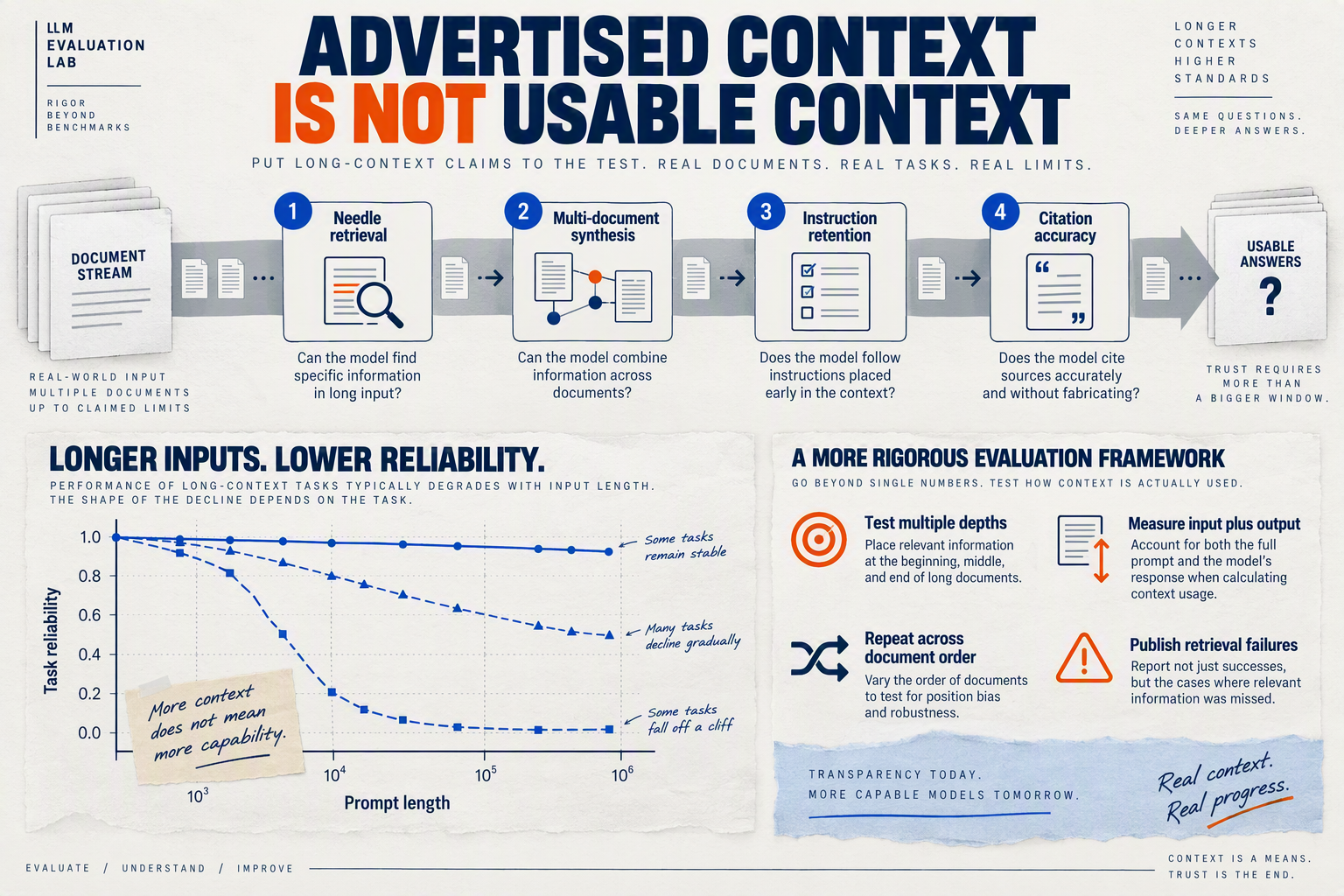
No. A headline context window measures the maximum advertised input capacity, not how reliably a model retrieves, reasons over, or cites information throughout that input. For the proposed GPT-6 Sol vs Claude Opus 5.5 comparison, even the headline limits remain unverified as of September 22, 2026, so no defensible long-context winner can be declared.
What are the verified context windows for GPT-6 Sol and Claude Opus 5.5?
No official context-window figure is established for either named model in the supplied primary-source evidence. OpenAI’s developer documentation confirms GPT-5.6 Sol and the API alias gpt-5.6, but the supplied material does not specify its maximum input tokens, maximum output tokens, or whether those limits vary by endpoint.
The OpenAI Help Center separately lists GPT-6 Pro in ChatGPT, but that does not verify a model called GPT-6 Sol or establish an API context limit for it. Likewise, no supplied Anthropic announcement, model card, API documentation, or pricing page confirms Claude Opus 5.5 or its context window as of September 22, 2026.
Consequently, context figures circulating in comparison charts should be labelled unverified unless they are tied to:
- An exact, callable model identifier
- Official API documentation with dated token limits
- Separate input and maximum-output specifications
- Any conditions for extended-context access
- Pricing changes or premiums above specific token thresholds
Why can a larger context window perform worse?
A context window is a capacity ceiling, whereas usable long-context performance is a multidimensional result. A model may accept a large document set but still overlook evidence in the middle, confuse similar passages, or produce an answer that cannot preserve all required details.
A rigorous evaluation should distinguish four capabilities:
- Acceptance: Does the API process the claimed number of tokens without rejection or silent truncation?
- Retrieval: Can the model locate facts placed near the beginning, middle, and end?
- Reasoning: Can it connect evidence spread across multiple documents rather than merely quote one passage?
- Generation: Is the output allowance sufficient for citations, code, or a detailed synthesis?
OpenAI describes GPT-5.6 Sol as a “flagship model” and says it is designed for complex work across coding, research, cybersecurity, science, computer use, and design. Those descriptions indicate intended workloads, but OpenAI’s product positioning is not itself a long-context benchmark.
How should long-context performance be tested?
A useful evaluation should run the same task at 25%, 50%, 75%, and approximately 95% of each verified context limit. Each test should include relevant passages, plausible distractors, conflicting evidence, and facts distributed across multiple positions.
Record these production metrics:
- Fact-retrieval accuracy by document position
- Citation precision and unsupported-claim rate
- Completion rate without truncation
- End-to-end latency at each context size
- Input, cached-input, and output cost
- Success on multi-document synthesis and repository-level coding
- Variance across repeated runs with identical settings
For example, a model that accepts a hypothetical one-million-token repository but misses a dependency constraint buried halfway through it may be less useful than a smaller-context model paired with retrieval-augmented generation. Until official limits and reproducible tests exist for both names, the honest GPT-6 Sol vs Claude Opus 5.5 verdict is context capacity not verified; usable long-context performance not comparable.
Which model should you choose for each workload and budget?
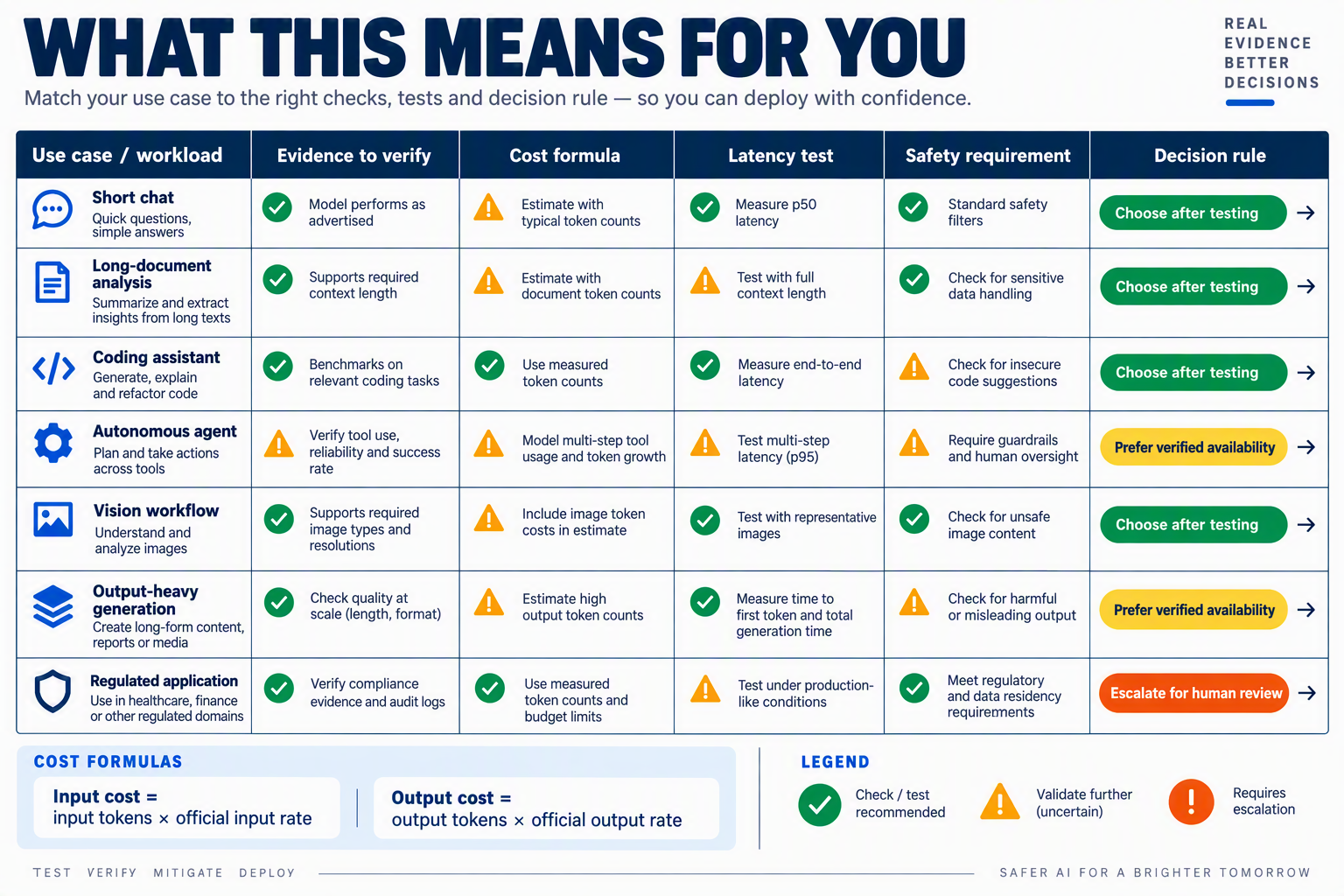
Choose neither GPT-6 Sol nor Claude Opus 5.5 for a production commitment until official documentation verifies those exact products. For workloads that must ship now, GPT-5.6 Sol is the defensible option in this matchup because OpenAI documents its API alias, while Claude Opus 5.5’s launch status, identifier, pricing, context window, and API access remain unverified as of September 22, 2026.
Which model fits each workload?
| Workload | Recommended choice | Evidence-based reason | Budget or deployment guidance |
|---|---|---|---|
| Production coding agents | GPT-5.6 Sol, subject to testing | OpenAI describes GPT-5.6 Sol as designed for complex coding and computer-use work. | Benchmark representative repositories and tool calls before committing spend. |
| Scientific or cybersecurity research | GPT-5.6 Sol with human review | OpenAI’s September 2026 materials explicitly position GPT-5.6 Sol for science and cybersecurity. | Measure cost per accepted result, not cost per token alone. |
| Long-context document analysis | Wait or test a verified alternative | The supplied evidence does not establish comparable context-window specifications for GPT-6 Sol or Claude Opus 5.5. | Do not budget around rumored context limits; test retrieval, recall, and total input cost. |
| Low-latency interactive agents | GPT-5.6 Sol Ultrafast preview, if eligible | OpenAI says Ultrafast can run GPT-5.6 Sol up to 14× faster and reach up to 750 output tokens per second. | Treat preview speed and pricing separately from standard production service. |
| Cost-sensitive, high-volume processing | Verified lower-cost model or routing stack | No verified GPT-6 Sol or Claude Opus 5.5 price comparison can currently support a volume-cost decision. | Calculate complete-task cost across input, output, retries, caching, and failures. |
| Anthropic-specific production stack | Keep the current documented Claude model | Claude Opus 5.5 lacks a supplied official model identifier or migration specification. | Avoid changing production code for an unverified endpoint or assumed alias. |
How should teams compare model costs?
A meaningful budget comparison requires more than multiplying tokens by a headline rate. Because the supplied primary-source evidence does not provide verified GPT-6 Sol or Claude Opus 5.5 prices, any precise “cheaper model” verdict would be fabricated.
Instead, calculate cost per successful task:
- Record input, cached-input, reasoning, and output tokens.
- Add service-tier premiums, tool calls, web searches, and retrieval costs.
- Include retries caused by malformed structured output or failed tool use.
- Measure human correction time and the percentage of outputs accepted.
- Run the same workload at least three times to expose latency and quality variance.
For example, a model with a lower output-token price can still cost more if it produces verbose answers or needs repeated tool calls. Conversely, a more expensive model may reduce total workflow cost if it completes coding or research tasks correctly on the first attempt.
When is GPT-5.6 Sol the practical choice?
GPT-5.6 Sol is the practical candidate when teams need a documented OpenAI API model today. OpenAI’s developer documentation identifies gpt-5.6 as its API alias as of September 2026, although teams should still confirm account access, current pricing, rate limits, regional availability, and any dated snapshot identifier before deployment.
For multi-model evaluation, CallMissed’s OpenAI-compatible AI gateway provides one key and balance across 136 models as of September 2026, including caller-selected fallbacks, response caching, and request logs. That approach can reduce integration rewrites while allowing teams to compare verified models using their own latency, quality, and cost thresholds.
What is the safest purchasing decision?
- Ship now: Evaluate GPT-5.6 Sol against other officially documented models.
- Need Anthropic: Use a currently documented Claude release rather than assuming Claude Opus 5.5 compatibility.
- Strict budget: Demand published token prices and calculate task-level cost.
- Considering either rumored name: Wait for an official launch page, API identifier, price sheet, and context specification.
How should developers migrate, test and preserve fallback options?
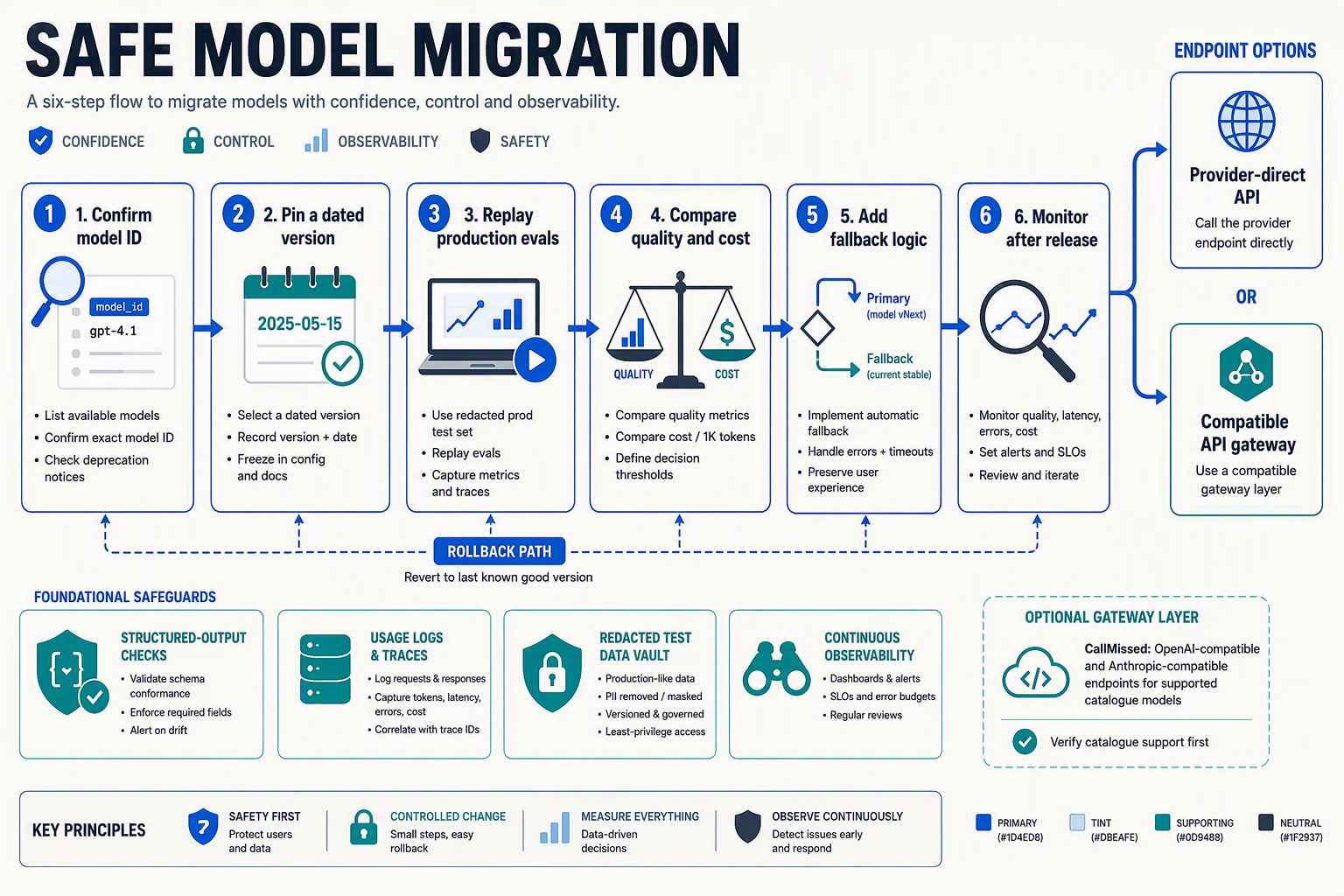
Developers should not migrate production traffic to either “GPT-6 Sol” or “Claude Opus 5.5” until the vendor publishes a working API identifier, pricing and availability documentation. Build migration around verified interfaces, workload-specific evaluations and reversible routing—not anticipated model names.
How should developers prepare an API migration?
Start by separating the application contract from the provider SDK. Your internal interface should normalize messages, tool definitions, structured outputs, streaming events, errors and usage records while preserving access to provider-specific controls.
A practical migration sequence is:
- Establish a verified baseline. OpenAI’s documentation identifies
gpt-5.6as the API alias for GPT-5.6 Sol as of September 22, 2026; the supplied evidence does not establish corresponding identifiers for GPT-6 Sol or Claude Opus 5.5. - Create an adapter layer. Keep provider credentials, endpoints and request transformations outside business logic.
- Record model metadata. Store the requested model, resolved model where returned, provider, parameters, latency, token usage and finish reason.
- Run replay evaluations. Test sanitized historical requests against the candidate and baseline using identical scoring criteria.
- Canary gradually. Begin with internal users or low-risk traffic, then increase allocation only after quality and reliability thresholds hold.
- Keep rollback configuration-driven. A failed release should require a routing change, not an application deployment.
Treat a successful HTTP response as necessary but insufficient proof of compatibility. Tool calls, JSON schemas, streaming chunks and token accounting can behave differently even when two APIs use similar request formats.
What should a model migration test?
A rigorous GPT-6 Sol vs Claude Opus 5.5 comparison should use production-shaped tasks rather than one aggregate benchmark score. Build an evaluation set covering:
- Reasoning quality: factuality, instruction compliance and unsupported claims
- Coding: repository-level changes, test-pass rate, security regressions and unnecessary edits
- Agents: correct tool selection, argument validity, retry behavior and loop termination
- Long context: retrieval accuracy at different document positions and resistance to irrelevant context
- Structured output: schema-valid response rate and recovery after validation errors
- Operations: time to first token, total latency, timeout rate, output length and cost per completed task
- Safety: prompt-injection handling, sensitive-data leakage and policy consistency
OpenAI stated in September 2026 that its preview Ultrafast tier could run GPT-5.6 Sol up to 14× faster and produce up to 750 output tokens per second. Those OpenAI figures are preview maxima, so teams should measure end-to-end latency with their own prompts, tools, regions and concurrency levels.
How should developers preserve model fallback options?
Use a fallback policy, not an unconditional retry chain. Define which failures justify switching models—such as rate limits, timeouts or provider errors—and which should stop immediately, including invalid authentication or unsafe requests.
Fallbacks should also be capability-aware:
- Route tool-heavy jobs only to models that passed tool-use tests.
- Prevent a smaller fallback from silently handling high-risk legal, financial or security workflows.
- Set per-request budgets, retry limits and idempotency controls.
- Log fallback activation separately so degraded service remains visible.
- Re-evaluate fallbacks whenever vendors change aliases or model behavior.
As of September 2026, CallMissed’s OpenAI-compatible and Anthropic-compatible AI gateway exposes 136 models through one API key and balance, with caller-selected fallback models plus request and usage logs. A gateway can reduce integration rewrites, but developers must still verify each model’s documented availability, data-handling requirements and task-level evaluation results before routing production traffic.
How should expert claims and benchmark evidence influence the decision?
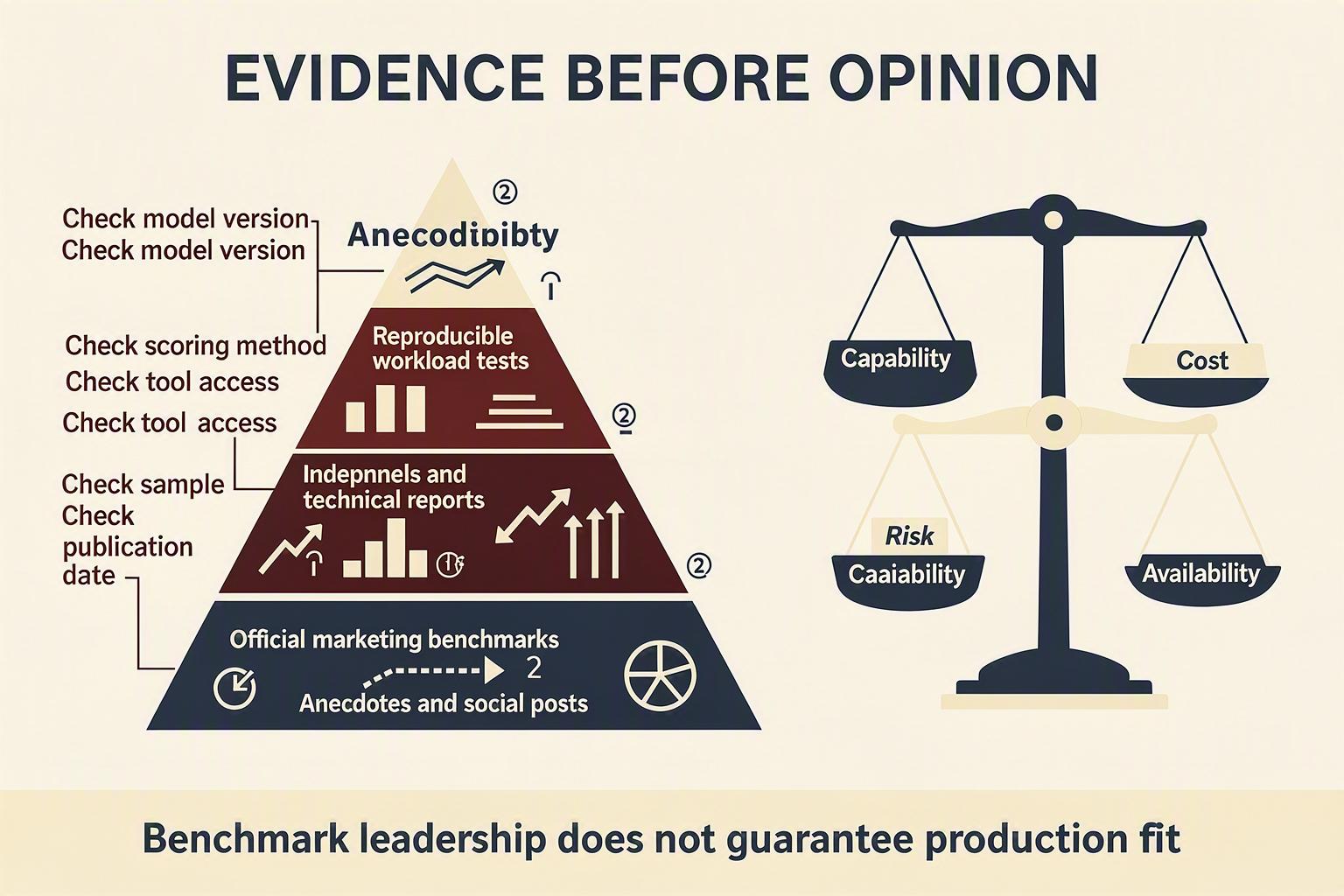
Expert opinions and benchmark scores should shape a shortlist, not determine the final model decision. In the GPT-6 Sol vs Claude Opus 5.5 comparison, neither model name is verified by the supplied primary-source evidence as of September 22, 2026, so claims about one defeating the other carry little decision value until the products, configurations, and results are independently reproducible.
Which AI model claims deserve the most trust?
Use an evidence hierarchy that prioritizes deployable facts over reputation or social-media consensus:
- Official API documentation: Confirm the exact model identifier, supported endpoints, context window, modalities, rate limits, and availability region.
- Official pricing and technical reports: Check publication dates, token definitions, service tiers, benchmark settings, and whether results apply to preview or generally available releases.
- Independent reproducible evaluations: Prefer tests that publish prompts, datasets, scoring scripts, model snapshots, and inference settings.
- Expert production reports: Treat detailed accounts from identified practitioners as useful workload evidence, especially when they disclose costs and failure cases.
- Community anecdotes and leaderboards: Use these to discover hypotheses—not to establish model capabilities.
For example, OpenAI’s model documentation identifies GPT-5.6 Sol and says the gpt-5.6 alias “roughly corresponds to the unsuffixed model tier used in earlier GPT-5 families.” That is stronger evidence than interpreting a reference to GPT-6 Pro in ChatGPT as proof that “GPT-6 Sol” exists.
How should benchmark claims be evaluated?
A benchmark result is meaningful only when its model version, test conditions, and scoring method are disclosed. Before comparing coding, science, cybersecurity, agent, or long-context scores, ask:
- Was the model tested zero-shot, with tools, or with multiple attempts?
- Did it use a specified reasoning effort, token budget, or system prompt?
- Was the score pass@1, pass@k, an average, or a vendor-defined metric?
- Were web search, code execution, retrieval, or human selection permitted?
- Was the tested checkpoint publicly accessible on the stated date?
- Can another evaluator reproduce the result through the documented API?
OpenAI says its GPT-5.6 evaluations use the “official scoring approach” described for each benchmark, but every reported result still needs benchmark-level inspection. Scores produced under different tool permissions or inference budgets should not be placed in one ranking as if conditions were identical.
Do vendor latency claims predict production performance?
Not by themselves. OpenAI stated in 2026 that the preview Ultrafast tier could run GPT-5.6 Sol up to 14× faster and deliver up to 750 output tokens per second, but “up to” describes a peak vendor result rather than guaranteed application latency.
Teams should measure:
- Time to first token
- Output tokens per second
- End-to-end task completion time
- Tail latency at the 95th and 99th percentiles
- Retry frequency, tool failures, and total cost per successful task
A faster model can still complete an agent workflow more slowly if it makes unnecessary tool calls or requires correction.
How should experts make the final model choice?
Run a controlled evaluation using 50–200 representative tasks, blind the outputs where practical, and score correctness, safety, latency, and cost. Weight evidence by relevance: a respected researcher’s coding assessment matters less for multilingual support automation than your own resolved-ticket rate.
For this matchup, the defensible decision is therefore wait, verify, and test documented alternatives. Until OpenAI confirms GPT-6 Sol and Anthropic confirms Claude Opus 5.5 through official product and API materials, any direct winner declaration is speculation—not a rigorous 2026 model comparison.
Frequently Asked Questions
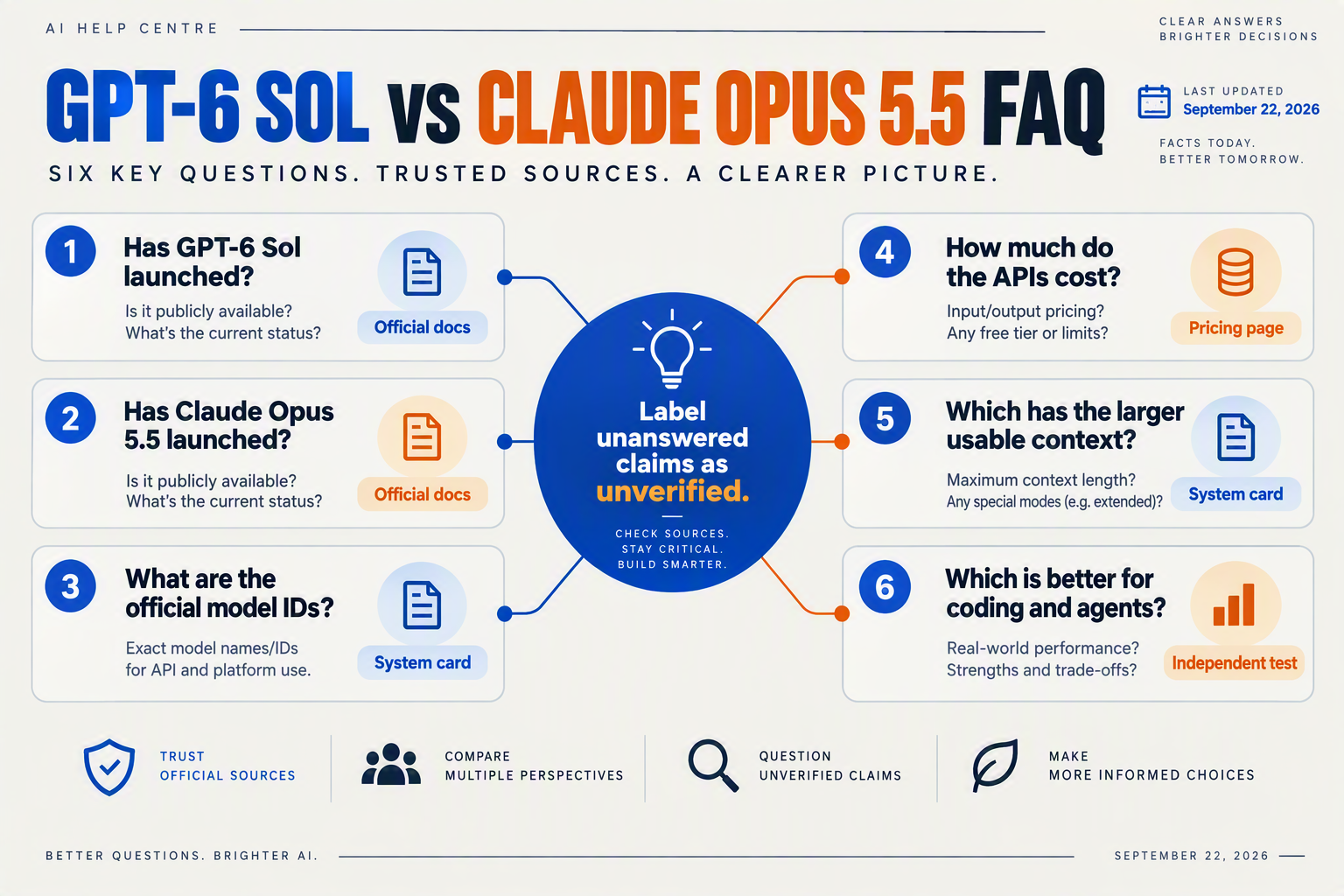
Availability and model identity
Is GPT-6 Sol vs Claude Opus 5.5 an official model comparison in 2026?
What are the official API model identifiers for GPT-6 Sol and Claude Opus 5.5?
gpt-5.6 as the API alias for GPT-5.6 Sol, but developers should not assume names such as gpt-6-sol or claude-opus-5-5 will work without confirmation in the vendors’ model documentation and API model-list endpoints.Pricing, context, and benchmarks
What is the official GPT-6 Sol vs Claude Opus 5.5 API pricing?
How large are the GPT-6 Sol and Claude Opus 5.5 context windows?
Does GPT-6 Sol or Claude Opus 5.5 have better coding and reasoning benchmarks?
Deployment decisions
Should developers wait for GPT-6 Sol vs Claude Opus 5.5 or deploy a verified model now?
Conclusion
The GPT-6 Sol vs Claude Opus 5.5 comparison has a clear verdict: as of September 22, 2026, neither model name is verified as a generally available API product by the supplied primary-source evidence. Production decisions should therefore rely on documented models—not rumored names or inferred specifications.
- OpenAI officially documents GPT-5.6 Sol, including the
gpt-5.6API alias; OpenAI’s separate reference to GPT-6 Pro in ChatGPT does not confirm a model called GPT-6 Sol. - Claude Opus 5.5 remains unverified because the supplied research contains no official Anthropic launch announcement, model identifier, API pricing, context window, or availability details.
- Pricing and benchmarks cannot be compared rigorously until both vendors publish reproducible specifications under equivalent test conditions. OpenAI’s claim that its preview Ultrafast tier can reach up to 750 output tokens per second and 14× speed, for example, is a vendor preview claim rather than a workload-wide guarantee.
- The practical strategy is to test verified models against real coding, agent, long-context, latency, safety, and total-cost requirements while keeping integrations portable.
Watch for official model cards, API documentation, price sheets, stable identifiers, context limits, and independent benchmark reproductions. Developers can also explore CallMissed, whose OpenAI-compatible gateway provides access to 136 models through one API key and balance as of September 2026. Will your next model decision follow the loudest name—or the strongest verifiable evidence?
Related Reading
- Claude Opus 5 vs GPT-5.6 Sol: 2026 Buyer's Guide
- GPT-6 API Guide: Sol, Luna and Astra Facts for 2026
- Claude Opus 5.5 vs GPT-5.6 Sol: Coding & Cost Tests
Sources
Discussion
Related Posts

Ready to automate customer conversations?
Launch AI voice agents and WhatsApp bots with CallMissed — one API, 22+ Indian languages.