
GPT-6 Sol vs Claude Opus 5.5: Verified Comparison


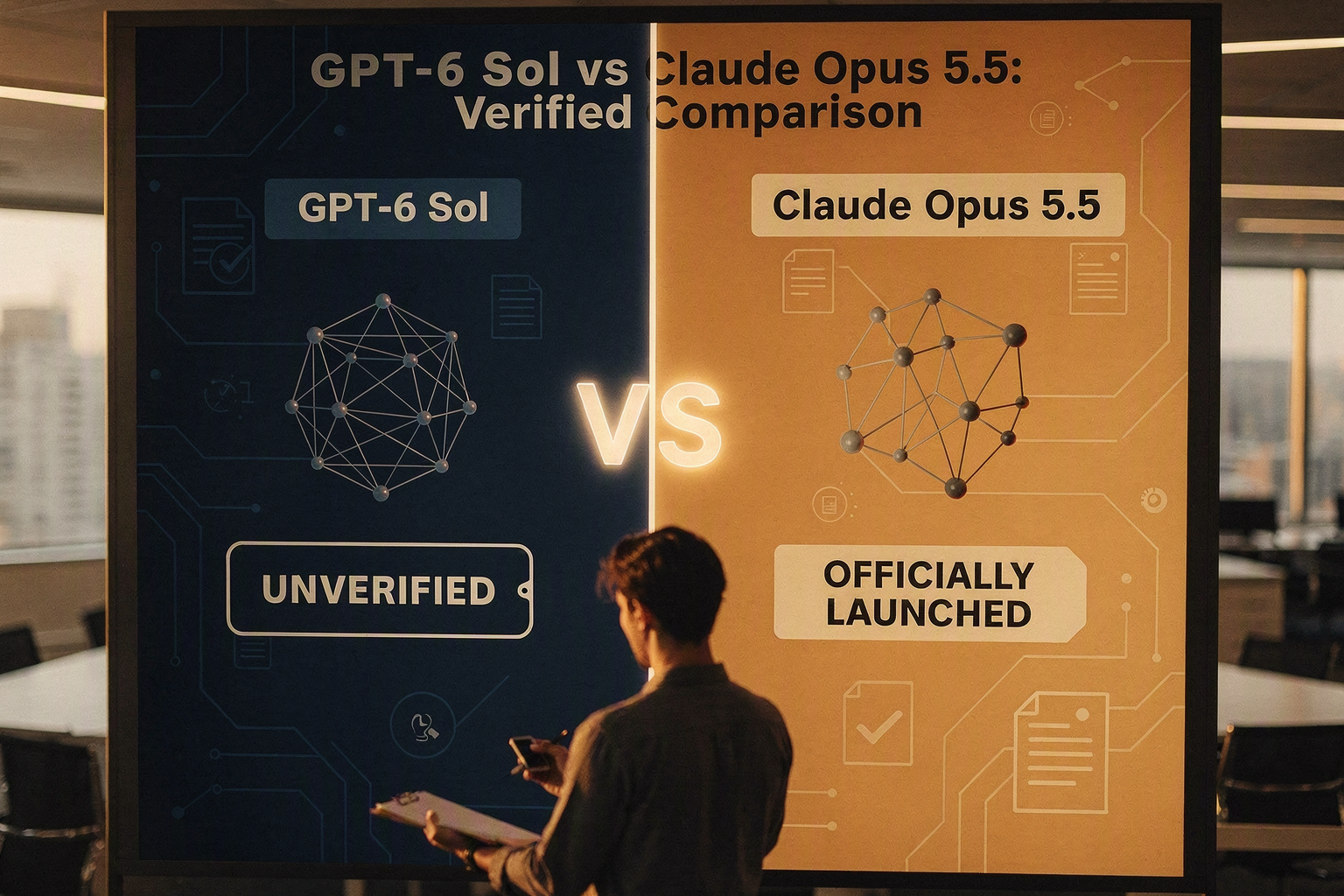
GPT-6 Sol vs Claude Opus 5.5 compares verified status, features, pricing and use cases, with responsible guidance for developers and buyers.
GPT-6 Sol vs Claude Opus 5.5: Verified Comparison
How do you compare two frontier AI models when one may not officially exist? GPT-6 Sol vs Claude Opus 5.5 is an asymmetric matchup as of September 22, 2026: Anthropic has officially launched Claude Opus 5.5, while the surfaced evidence for GPT-6 Sol consists largely of speculation—including an OpenAI Developer Community discussion posted on September 11, 2026—rather than a confirmed OpenAI announcement.
That distinction matters because unverified model names can lead buyers to compare invented benchmarks, pricing, context windows, and release dates. This guide separates official specifications from community rumors, identifies what developers can responsibly test today, and explains which claims should remain “unknown” until OpenAI publishes primary documentation. For multi-model platforms such as CallMissed, whose OpenAI-compatible API provides access to 136 models as of September 2026, verified model identifiers and documented availability are essential for dependable production deployments.
Which wins today? Claude Opus 5.5—GPT-6 Sol is unverified
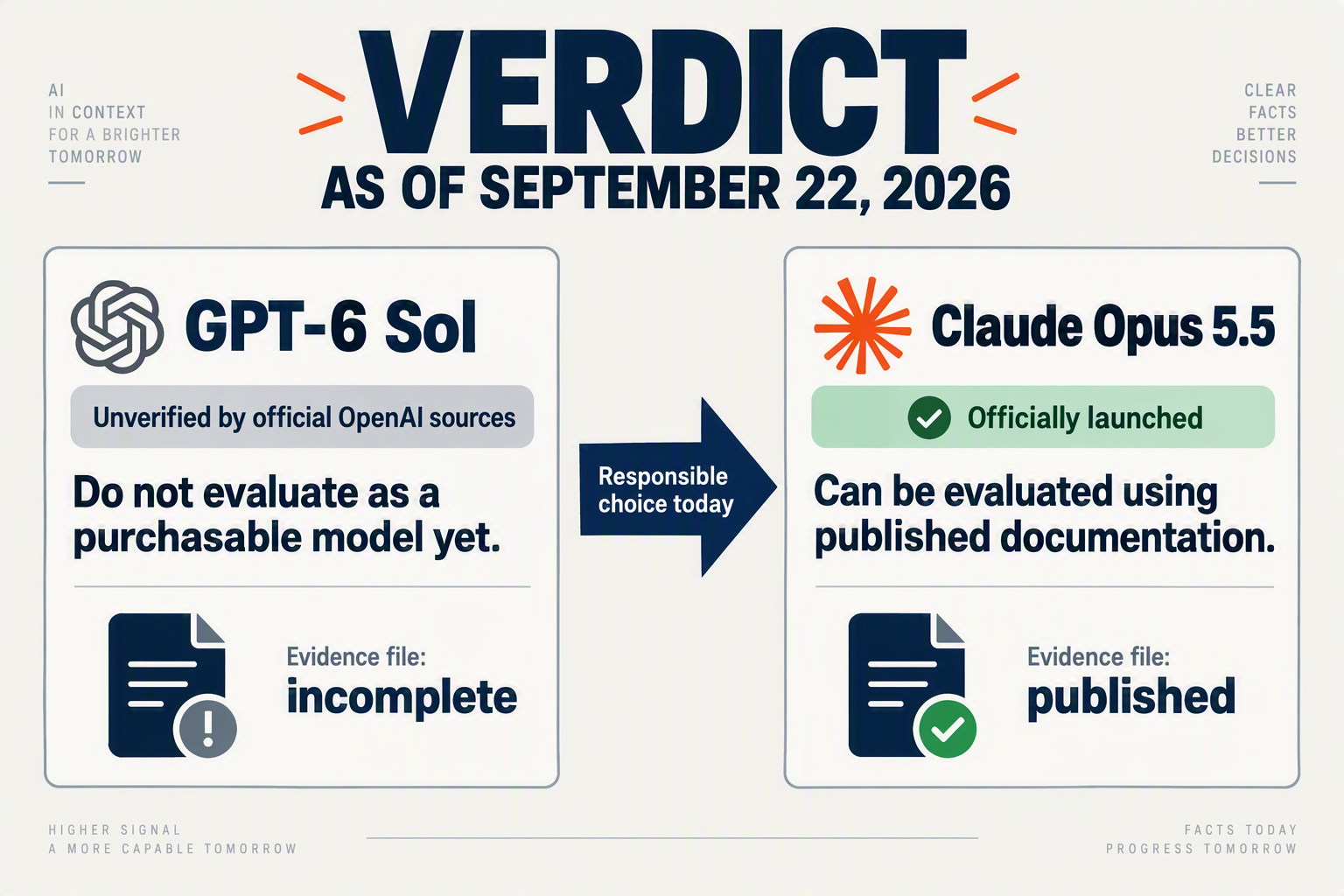
Claude Opus 5.5 wins today by default—not on proven performance superiority, but because it is officially launched and can be evaluated against documented claims; GPT-6 Sol remains unverified as of September 22, 2026.
What can buyers responsibly compare today?
- Claude Opus 5.5: Anthropic has officially launched the model, giving procurement and engineering teams a real product to test using published documentation and accessible endpoints.
- GPT-6 Sol: No surfaced primary OpenAI announcement confirms its launch, model identifier, API availability, specifications, pricing, or release date as of September 22, 2026.
- GPT-6 Sol evidence: An OpenAI Developer Community post dated September 11, 2026 says there is “some speculation” that GPT-6 Sol appeared in Arena; this is a user claim, not an OpenAI product announcement.
- Evidence quality: OpenAI Developer Community discussions from September 11–12, 2026 mention possible “Sol, Terra, and Luna” names, but community posts and feature requests do not constitute official documentation.
- Performance verdict: No defensible benchmark winner exists because GPT-6 Sol has no verified scores, context limit, latency measurements, tool-use results, or multimodal specifications to compare with Claude Opus 5.5.
- Cost verdict: Claude Opus 5.5 can be assessed using Anthropic’s official commercial terms; any GPT-6 Sol token price, subscription tier, or usage limit circulating without OpenAI documentation should be treated as rumor.
- Buying decision: Choose Claude Opus 5.5 if deployment is required now; monitor OpenAI’s official model documentation and API model list before including GPT-6 Sol in architecture plans, budgets, or production evaluations.
What do official sources confirm about each model?
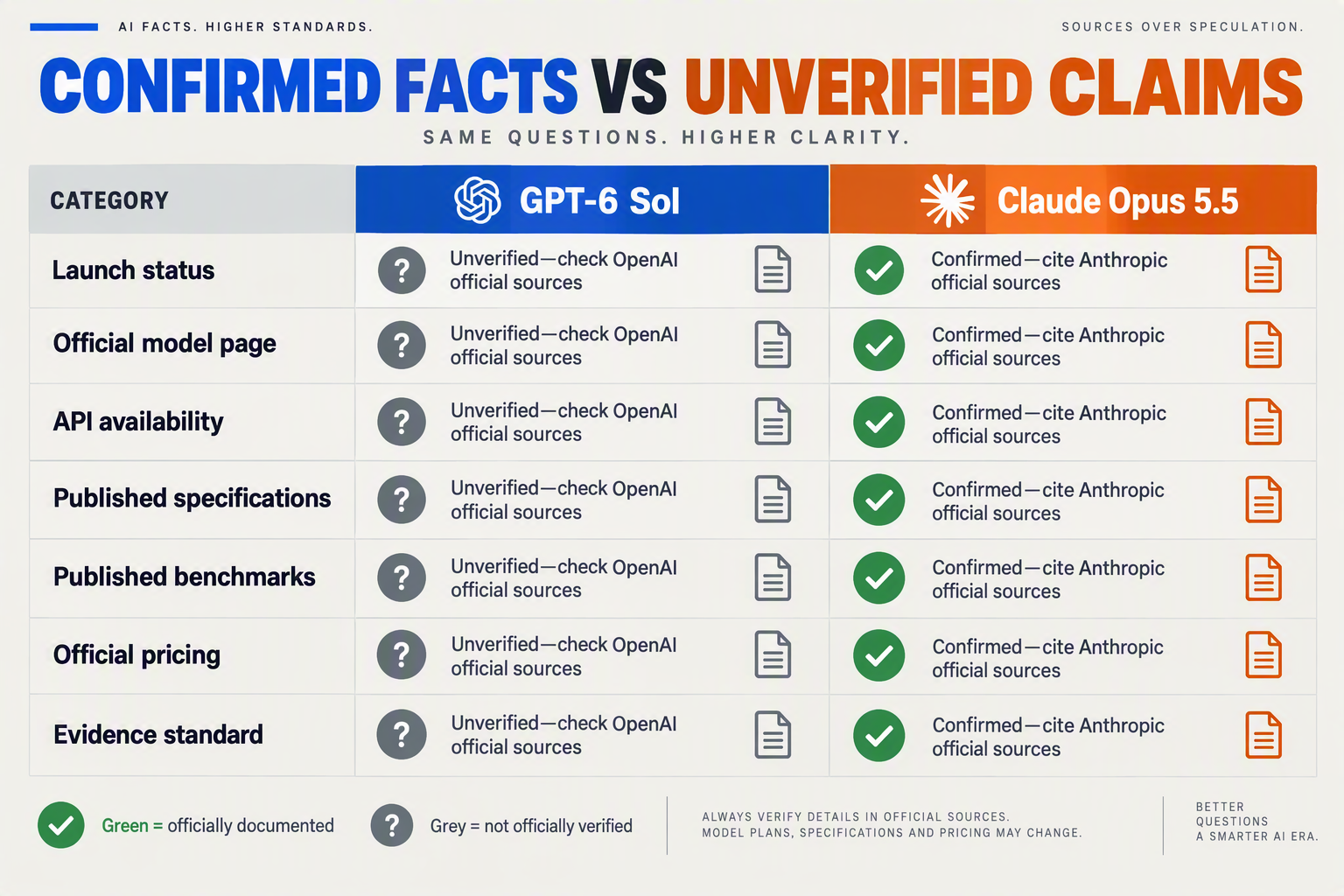
Claude Opus 5.5 is the only officially confirmed model in this comparison as of September 22, 2026. GPT-6 Sol lacks a primary OpenAI announcement, so its specifications must remain unverified.
Which GPT-6 Sol and Claude Opus 5.5 details are confirmed?
| Attribute | GPT-6 Sol | Claude Opus 5.5 | Evidence status |
|---|---|---|---|
| Launch status | No confirmed launch | Officially launched | Anthropic confirmation; no equivalent OpenAI source surfaced |
| Primary source | None identified | Anthropic’s official materials | Confirmed for Claude only |
| Model/API identifier | Not published | Refer to Anthropic’s current documentation | GPT-6 Sol unknown |
| Context window | Not confirmed | Not established by the supplied evidence | Do not infer limits |
| API pricing | Not confirmed | Refer to Anthropic’s official commercial terms | No valid numeric comparison here |
| Benchmarks | No verified scores | Not established by the supplied evidence | No like-for-like verdict possible |
How strong is the evidence behind each model name?
- Claude Opus 5.5: Anthropic’s official launch makes the model a valid subject for testing, procurement review, and production planning.
- GPT-6 Sol: No surfaced OpenAI product page, API documentation, system card, pricing page, or release announcement confirms the model as of September 22, 2026.
- Community evidence: An OpenAI Developer Community post from September 11, 2026 describes “some speculation” that GPT-6 Sol appeared in Arena.
- Additional discussion: OpenAI Developer Community replies dated September 12, 2026 call the Sol, Terra, and Luna naming theory “very possible,” but do not provide official confirmation.
- Evidence boundary: An Arena appearance, forum report, or feature-request thread cannot establish a model’s provider, final name, release status, specifications, or commercial availability.
- Responsible comparison: Buyers should verify Claude Opus 5.5 against Anthropic’s live documentation and leave every GPT-6 Sol specification marked unknown until OpenAI publishes a primary source.
How do GPT-6 Sol and Claude Opus 5.5 features compare?
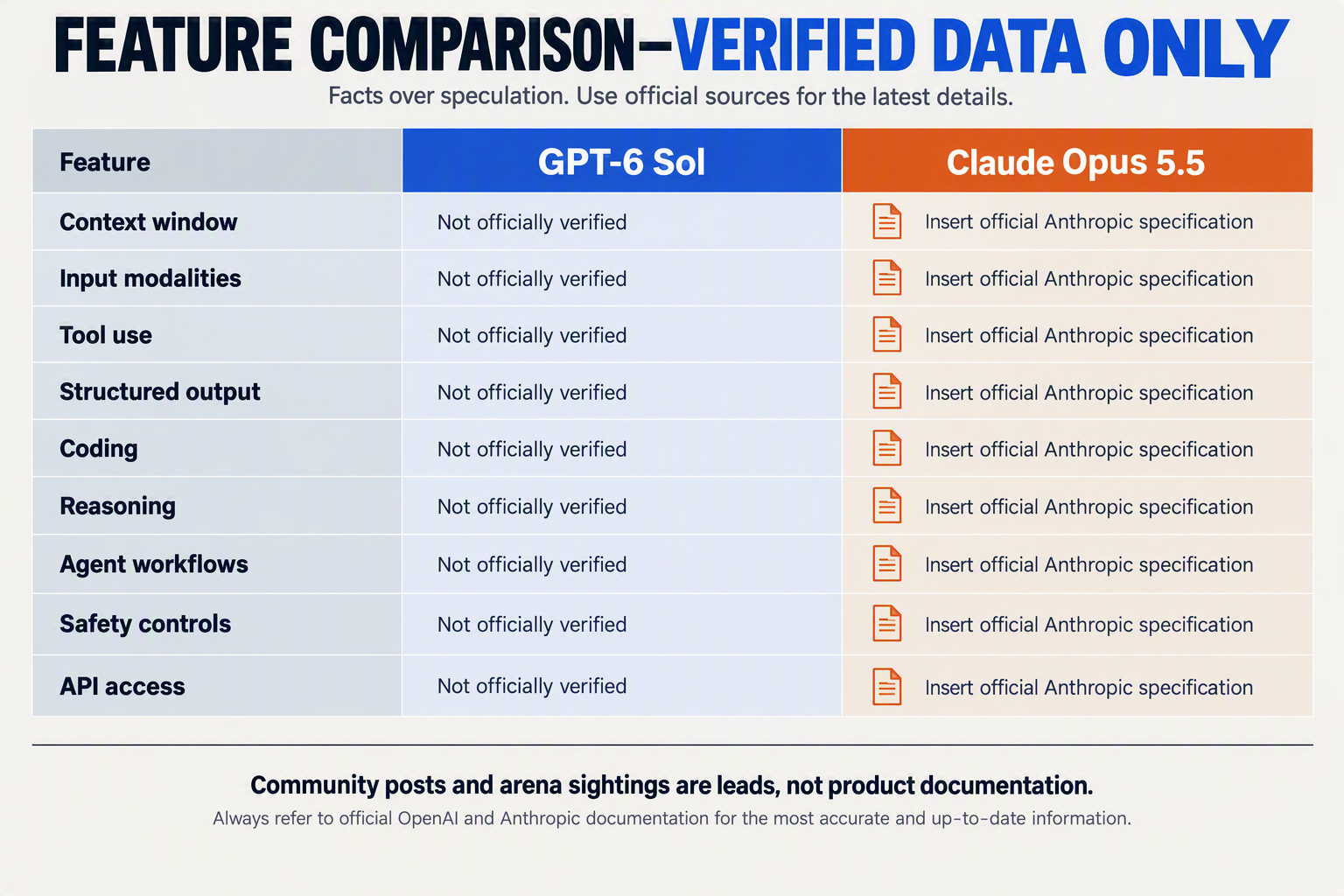
The feature comparison is necessarily incomplete: Claude Opus 5.5 has an official product record, while GPT-6 Sol has no verified OpenAI specifications as of September 22, 2026. Unknown values should not be interpreted as zero capability.
| Feature | GPT-6 Sol | Claude Opus 5.5 | Evidence status |
|---|---|---|---|
| Launch status | No confirmed launch | Officially launched | Asymmetric comparison |
| API model identifier | Not published | Available through Anthropic’s official documentation | Sol identifier unverified |
| Context window | Unknown | Check current Anthropic model documentation | No comparable Sol limit |
| Multimodal inputs | Unknown | Officially documented capabilities can be tested | No confirmed Sol modalities |
| Tool use and coding | No verified specification | Testable through supported Anthropic interfaces | No controlled head-to-head evidence |
| Pricing and limits | Unknown | Governed by Anthropic’s current commercial terms | No verified Sol price |
What do these feature gaps mean in practice?
- Claude Opus 5.5: Developers can validate documented inputs, tool behavior, output quality, rate limits, and costs with reproducible API tests.
- GPT-6 Sol: OpenAI has not supplied a confirmed model card, API identifier, context limit, modality list, benchmark report, or price in the surfaced evidence.
- Community evidence: An OpenAI Developer Community post from September 11, 2026 describes GPT-6 Sol’s reported Arena appearance as “some speculation,” not a confirmed release.
- Related names: OpenAI Developer Community posts dated September 11–12, 2026 also mention “Terra” and “Luna,” but feature-request discussions are not product documentation.
- Benchmarking rule: A valid comparison requires the same prompt set, sampling settings, tools, latency measurement method, and scoring rubric.
- Procurement rule: Treat every claimed GPT-6 Sol feature as unverified until OpenAI publishes primary documentation or exposes a confirmed model through an official API.
How much do they cost, and what is the value per completed task?
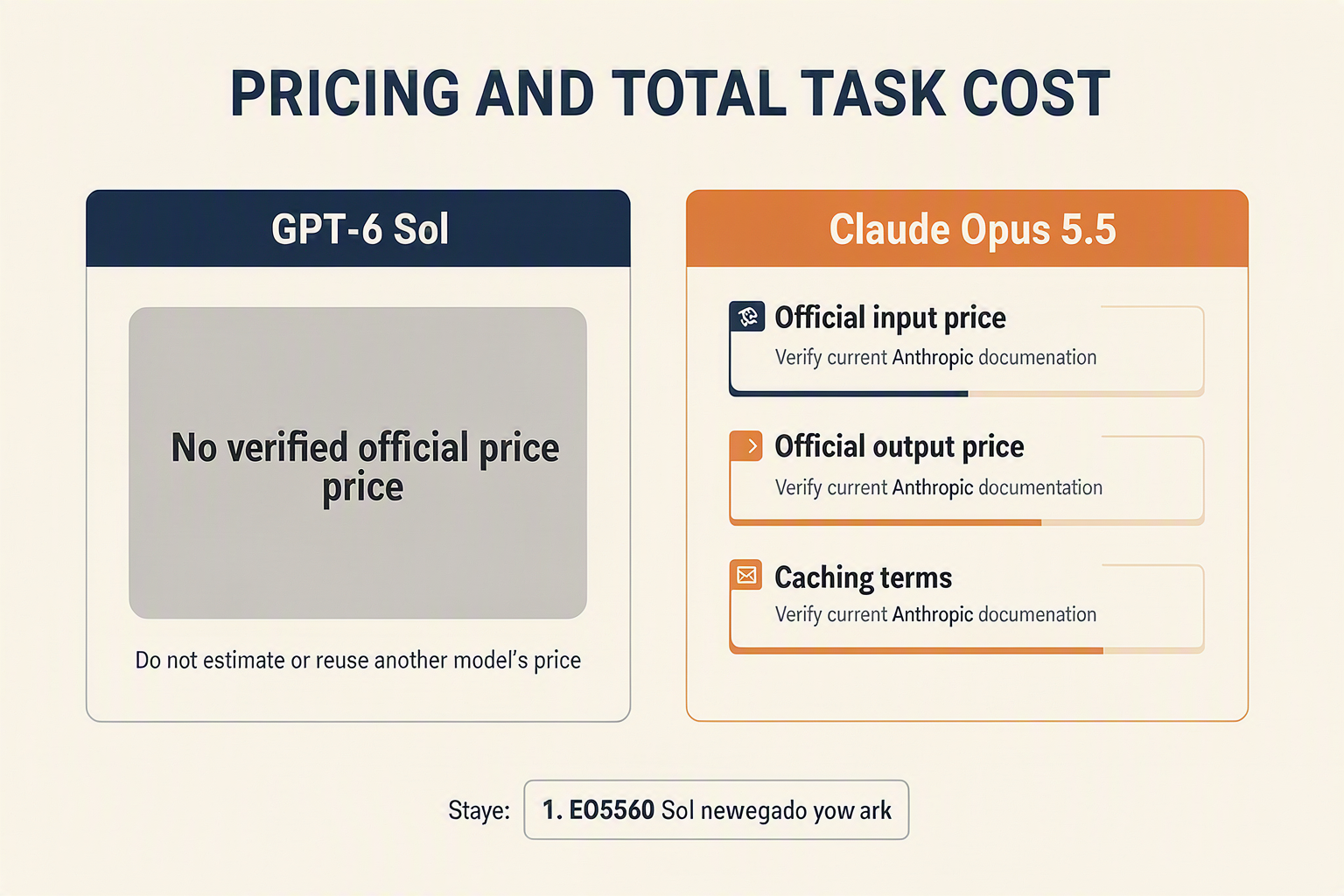
Claude Opus 5.5 is the only model in this comparison with a measurable production cost as of September 22, 2026. GPT-6 Sol has no verified OpenAI API price, so any claimed cost-per-token or value-per-task comparison is premature.
What pricing can buyers verify today?
| Cost factor | Claude Opus 5.5 | GPT-6 Sol | How to measure value | Evidence status |
|---|---|---|---|---|
| API input price | Check Anthropic’s current official pricing | Not officially published | Input tokens × input rate | Claude verifiable; Sol unknown |
| API output price | Check Anthropic’s current official pricing | Not officially published | Output tokens × output rate | Claude verifiable; Sol unknown |
| Cached-token pricing | Use Anthropic’s documented terms, if applicable | No confirmed terms | Cached tokens × cache rate | Sol comparison unavailable |
| Tool and search charges | Add documented external-tool costs | No confirmed tool pricing | Model cost + tool fees | Compare full workflow cost |
| Retry and failure cost | Measure through production tests | Cannot test an unverified endpoint | Total spend ÷ successful tasks | Sol result unavailable |
| Cost per completed task | Calculable from actual Claude usage | Not responsibly calculable | Total workflow cost ÷ accepted outputs | Only Claude measurable today |
How should teams calculate value per completed task?
- Claude Opus 5.5: Record input tokens, output tokens, cache usage, tool charges, retries, and human-review time for every workflow using Anthropic’s prices current on September 22, 2026.
- GPT-6 Sol: Do not assign a placeholder token price; the OpenAI Developer Community post from September 11, 2026 described its appearance as “some speculation,” not an official commercial release.
- Completed-task formula:
total model and tool spend ÷ number of outputs that pass the acceptance rubricgives a more useful figure than price per million tokens alone.
- Worked method: If 1,000 attempted support resolutions produce 820 rubric-approved answers, divide the entire cost of all 1,000 attempts—including retries—by 820, not by 1,000.
- Quality adjustment: A cheaper run is not better value when low acceptance rates create additional retries, escalations, or paid human review; measure first-pass completion rate alongside cost.
- Latency adjustment: Track median and 95th-percentile completion time because a low-cost model that misses an application’s response deadline may deliver no practical value for that task.
- Procurement rule: Request dated pricing documentation, a valid API model identifier, rate limits, and billing logs before approving either model; GPT-6 Sol currently fails that verification threshold.
- Decision today: Budget Claude Opus 5.5 using current Anthropic terms and real workload tests, while treating GPT-6 Sol’s price and economic value as unknown—not zero, cheap, or expensive—until OpenAI publishes primary documentation.
Which model should you choose for coding, writing, agents and long-horizon work?
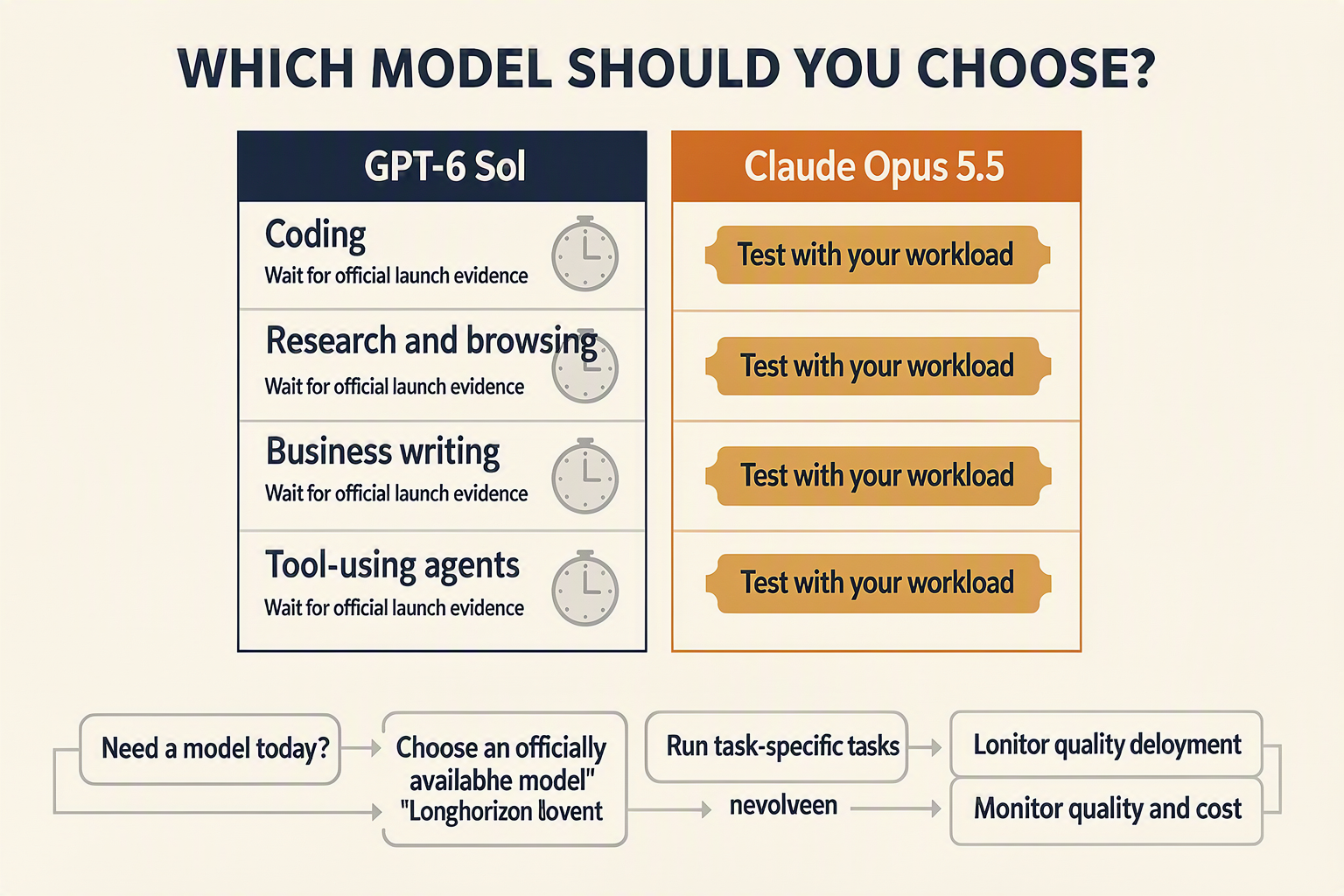
Choose Claude Opus 5.5 for production work today; choose neither on assumed benchmark superiority because GPT-6 Sol lacks verified specifications as of September 22, 2026.
Which model fits each workload?
- Coding — Claude Opus 5.5: Use the officially launched model for repository-level trials covering test pass rates, regression frequency, tool calls, latency and cost; no verified GPT-6 Sol coding score supports a fair comparison.
- Writing — Claude Opus 5.5: Evaluate factual accuracy, instruction adherence, tone consistency and revision quality with your own documents; GPT-6 Sol has no confirmed context window, language coverage or API access.
- Agents — Claude Opus 5.5: Prefer the deployable option when workflows require documented model identifiers, tool-use behavior and commercial terms; do not build routing logic around an unofficial GPT-6 Sol name.
- Long-horizon work — Claude Opus 5.5: Run multi-step tests involving planning, state retention, error recovery and human intervention, but avoid assuming “frontier” branding guarantees reliable autonomous execution.
When should you reconsider GPT-6 Sol?
- GPT-6 Sol: Reassess only after OpenAI publishes a primary announcement confirming the model ID, API availability, context limit, modalities, rate limits and pricing.
- Rumor evidence: The OpenAI Developer Community discussion dated September 11, 2026 describes GPT-6 Sol as “speculation,” while replies on September 12, 2026 say it is merely “very possible.”
- Final decision: Benchmark Claude Opus 5.5 against other models available now, then add GPT-6 Sol only if OpenAI releases a testable endpoint with documented terms.
How should developers benchmark the models without repeating rumors?
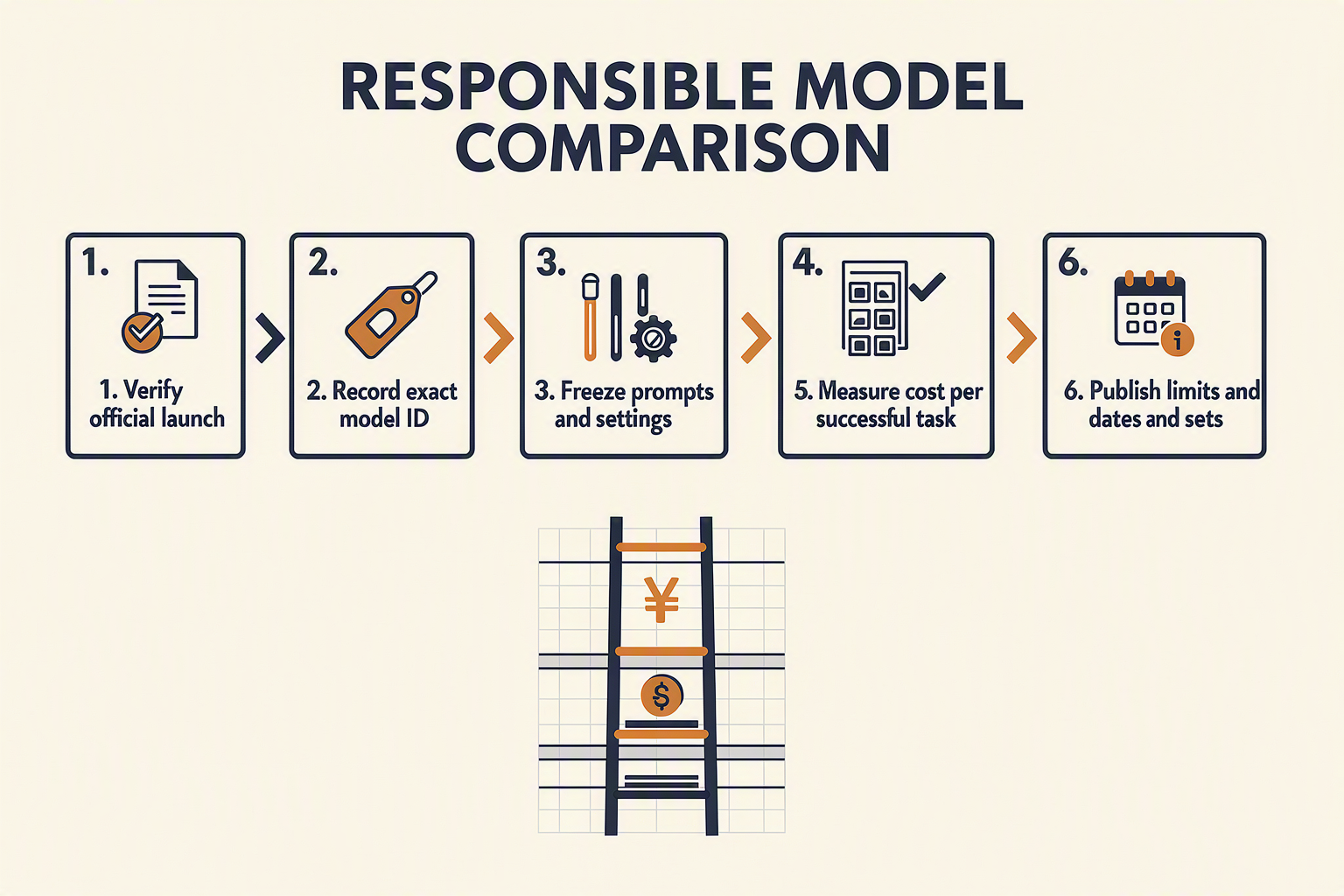
Developers should benchmark Claude Opus 5.5 only against models they can access through documented endpoints, while keeping GPT-6 Sol outside scored comparisons until OpenAI confirms it. Use reproducible workloads, fixed settings, repeated trials, and evidence labels rather than leaderboard screenshots or rumored Arena appearances.
What benchmark protocol produces credible results?
- Eligibility gate: Require an official model card, documented API identifier, accessible endpoint, and dated pricing page before testing; the OpenAI Developer Community post on September 11, 2026 describes GPT-6 Sol as “some speculation,” so it currently fails this gate.
- Evidence labels: Mark every data point official, independently measured, or unverified; a community claim that a model appeared in Arena cannot establish its provider, model version, system prompt, routing configuration, context window, or production availability.
- Task set: Build at least 200 version-controlled prompts drawn from actual workloads—for example, 50 coding, 50 reasoning, 40 document analysis, 30 tool-use, and 30 safety tasks—and publish prompt hashes, expected outputs, grading rules, and test dates.
- Controlled configuration: Hold the system prompt, tool schemas, retrieval context, output format, temperature, token budget, and retry policy constant; record exact model identifiers because silent aliases or auto-routing can invalidate a GPT-6 Sol vs Claude Opus 5.5 comparison.
- Repeated trials: Run each prompt at least three times to expose output variance, then report median quality, pass rate, and failure distribution rather than one favorable response; use blind human review with at least two graders for subjective writing or instruction-following tasks.
- Operational metrics: Measure end-to-end latency at p50, p95, and p99, time to first token, output tokens per second, tool-call success, schema-valid response rate, timeout rate, and retries; collect results across multiple hours because provider load can affect latency.
- Cost accounting: Calculate the full cost per successful task using dated input-token, output-token, cached-token, tool, and retry charges—not headline token prices alone; GPT-6 Sol receives “not available”, rather than an estimated price, until OpenAI publishes commercial terms.
- Reproducible infrastructure: Record SDK version, region, timestamp, request ID, token usage, and raw output for every run; multi-model gateways can simplify controlled testing, and CallMissed’s OpenAI-compatible API offers one balance across 136 models, including 40 general-purpose LLMs, as of September 2026, although developers must still verify that each tested model has an official identifier and documented availability.
How should benchmark results be reported?
- Decision rule: Publish separate scores for quality, latency, reliability, and cost instead of declaring one universal winner; until GPT-6 Sol passes the eligibility gate, report Claude Opus 5.5: testable and GPT-6 Sol: insufficient verified evidence, not a fabricated head-to-head score.
What are the verified pros and cons of each option?
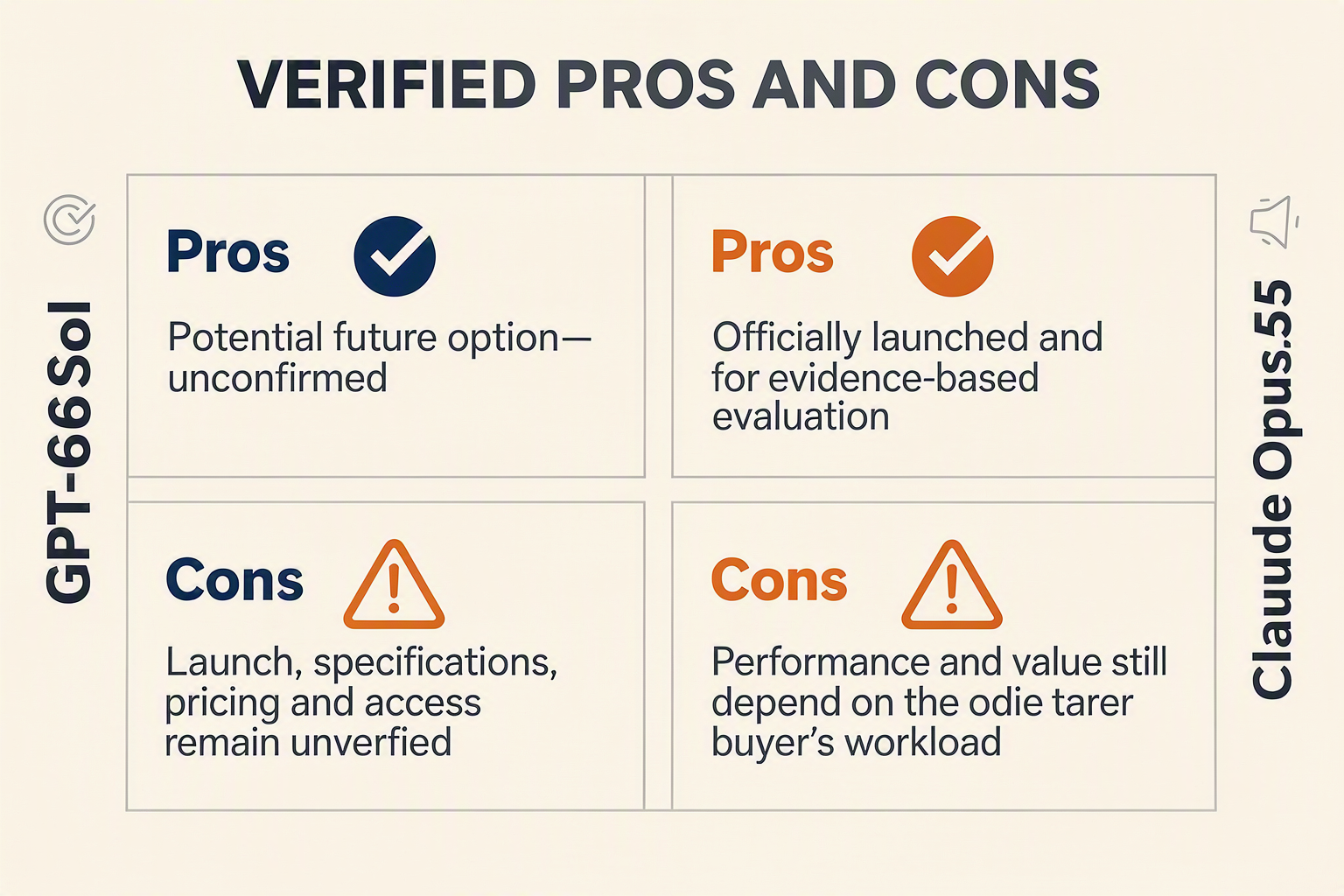
Claude Opus 5.5 has the stronger verified case because teams can access, test, and procure an officially launched model. GPT-6 Sol has no evidence-backed advantages yet because OpenAI has not confirmed its product status or specifications as of September 22, 2026.
| Decision factor | Claude Opus 5.5: verified pros | Claude Opus 5.5: verified cons | GPT-6 Sol: verified position |
|---|---|---|---|
| Launch status | Officially launched by Anthropic | Launch alone does not guarantee suitability | No official OpenAI launch located |
| Evidence quality | Primary Anthropic materials can support evaluation | Claims still require independent testing | Evidence is limited to community speculation |
| API testing | Available for reproducible application tests | Results may vary by prompt, workload, and tooling | No confirmed API model identifier or endpoint |
| Specifications | Published details can inform architecture decisions | Buyers must validate documented limits in practice | Context window, modalities, and limits are unknown |
| Benchmarks | Teams can run private task-specific evaluations | No benchmark proves universal superiority | No verified scores support comparison |
| Commercial planning | Official terms enable budgeting and procurement | Actual cost depends on workload and usage | Pricing, quotas, and availability are unconfirmed |
What are the practical advantages and drawbacks?
- Claude Opus 5.5: Its official launch makes security review, API testing, procurement, and workload benchmarking possible today.
- Claude Opus 5.5: Published specifications provide a testable baseline, but buyers should measure accuracy, tool completion, latency, and cost on their own production-like dataset.
- Claude Opus 5.5: Official availability is a deployment advantage, not proof that the model will outperform every alternative across coding, reasoning, multimodal, or agentic tasks.
- GPT-6 Sol: No verified performance advantage can be assigned because OpenAI has not published confirmed benchmarks, context limits, modalities, pricing, or API documentation under that name.
- GPT-6 Sol: An OpenAI Developer Community contributor wrote on September 11, 2026 that there was “some speculation” GPT-6 Sol had appeared in Arena; the source is a user discussion, not an OpenAI announcement.
- GPT-6 Sol: Additional OpenAI Developer Community comments dated September 12, 2026 described the model as “very possible,” language that reinforces uncertainty rather than confirming availability.
- GPT-6 Sol: The central drawback is procurement risk—teams cannot reliably budget, integrate, govern, or benchmark a product without a confirmed model ID and commercial terms.
- Buyer verdict: Test Claude Opus 5.5 for immediate projects, but keep evaluations model-neutral; add GPT-6 Sol only after OpenAI publishes primary documentation and a reproducible endpoint.
Frequently Asked Questions
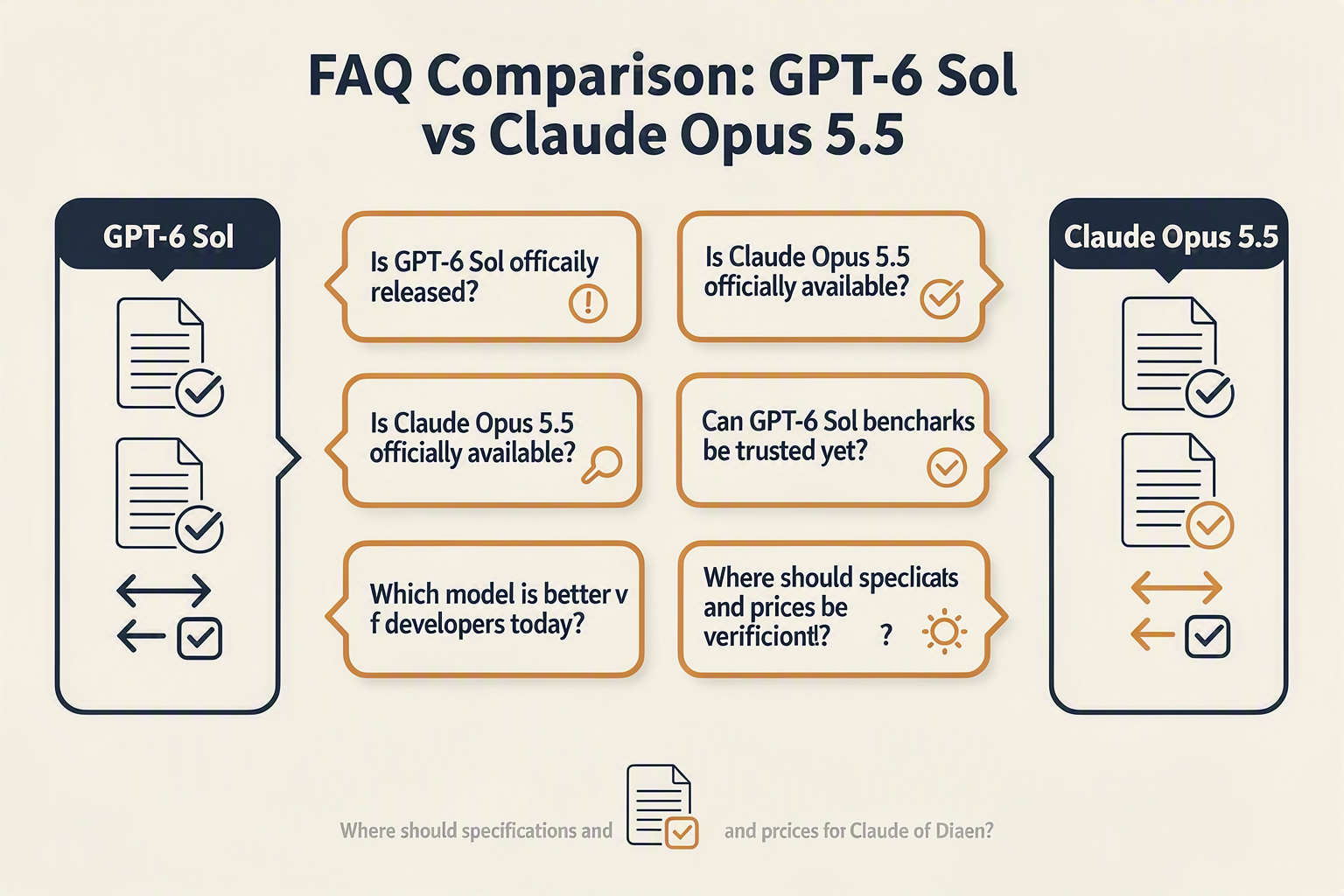
Is GPT-6 Sol officially released as of September 22, 2026?
Is Claude Opus 5.5 officially available?
Can developers fairly compare GPT-6 Sol vs Claude Opus 5.5 benchmarks and pricing?
What do the September 11–12 OpenAI Developer Community posts prove about GPT-6 Sol?
What should developers verify before evaluating a claimed GPT-6 Sol endpoint?
What can buyers responsibly compare between GPT-6 Sol and Claude Opus 5.5 today?
Conclusion
As of September 22, 2026, Claude Opus 5.5 is the responsible deploy-now choice; GPT-6 Sol remains unverified community speculation, not a confirmed OpenAI product.
- Availability: Anthropic has officially launched Claude Opus 5.5.
- Evidence: No primary OpenAI announcement confirms GPT-6 Sol.
- Comparison: Buyers should not invent specifications, prices, or benchmark results.
- Production: Require an official model ID, endpoint, documentation, and commercial terms before evaluation.
Watch OpenAI’s official model list for confirmation. To explore evolving AI infrastructure, visit CallMissed, whose OpenAI-compatible gateway provides one API key for 136 models as of September 2026. Which verified evidence would change your deployment decision?
Related Reading
- GPT-6 Astra vs Claude Fable 5.1: Verified 2026 Comparison
- Claude Fable 5.1 vs GPT-5.6 Sol: Pricing, Coding & Voice Agents
- Claude Haiku 4.5 vs GPT-5.4 Nano Latency Comparison: What Can Be Verified?
Sources
Discussion
Related Posts


Ready to automate customer conversations?
Launch AI voice agents and WhatsApp bots with CallMissed — one API, 22+ Indian languages.