GPT-6 Astra vs Claude Fable 5.1: Verified 2026 Comparison


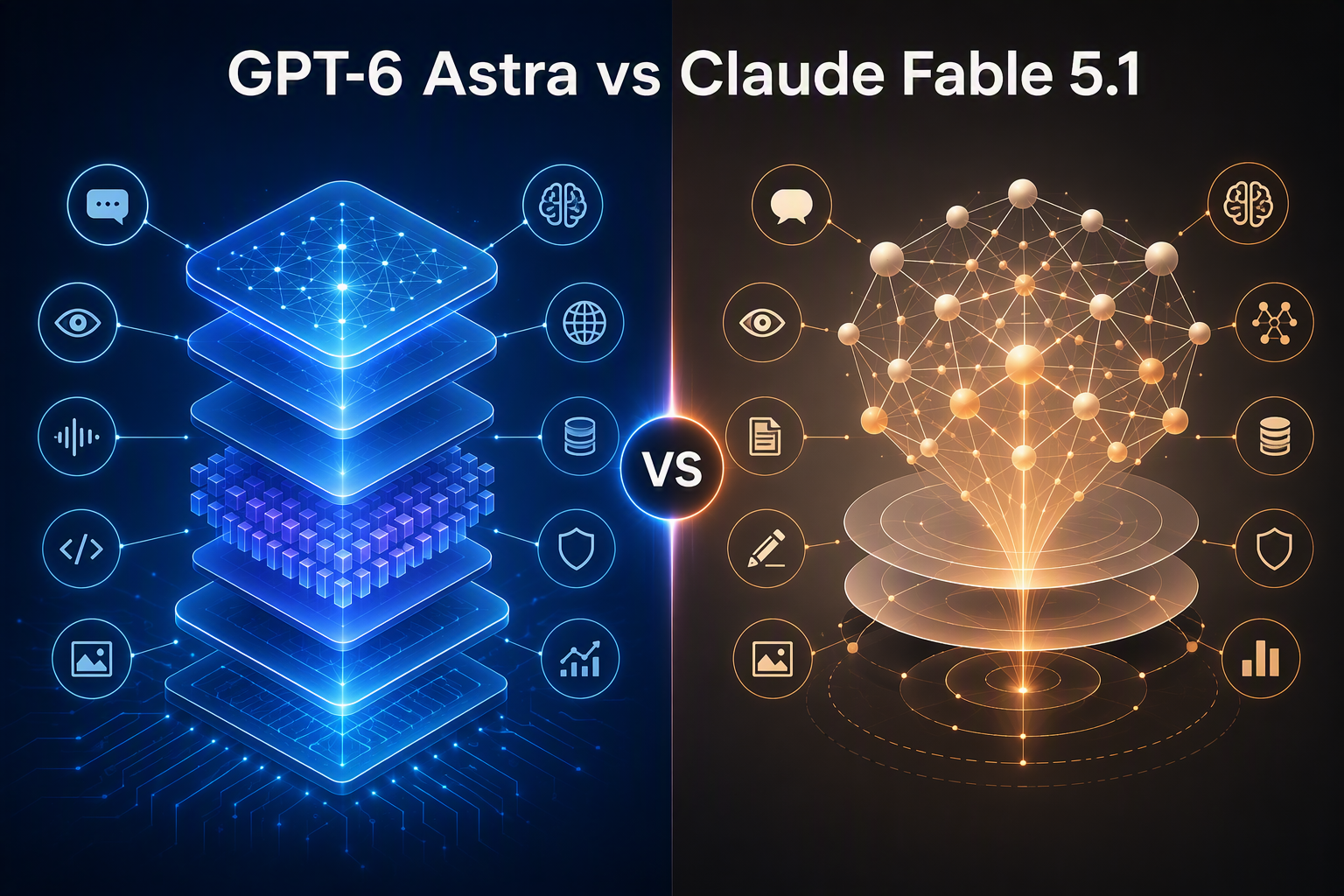
Compare GPT-6 Astra vs Claude Fable 5.1 using first-party evidence on access, coding, context, pricing, safety, tools, and enterprise fit.
GPT-6 Astra vs Claude Fable 5.1: Verified 2026 Comparison
As of September 5, 2026, a credible GPT-6 Astra vs Claude Fable 5.1 comparison can use official documentation from both vendors. OpenAI released GPT-6 Astra on September 3, while Anthropic released Claude Fable 5.1 on September 1. The remaining challenge is not model legitimacy but comparing capabilities, safeguards, cache economics and workload results under equivalent test conditions.
That evidence gap matters because search results and informal discussions can make an unconfirmed model look fully launched. OpenAI reported on September 3, 2026, that Playco built three themed game prototypes from one grey-box foundation with GPT-6 Astra and recorded 50% fewer manual fixes. OpenAI’s customer-stories index also states on September 3, 2026, that legal-technology company Legora reviewed 41 documents in minutes using GPT-6 Astra. These are meaningful workload examples, but they are customer outcomes—not standardized benchmarks, technical specifications, or proof of general API availability.
The Anthropic side requires even greater caution. Without a first-party Anthropic release page for Claude Fable 5.1, claims about its context window, coding scores, cybersecurity performance, tool use, caching rates, safeguards, or cloud deployment cannot be treated as verified facts. The same standard applies to Astra: customer stories do not establish its token limit, training cutoff, API price, latency, safety evaluations, or availability through Microsoft Azure and other clouds.
This article therefore takes a verification-first approach to OpenAI vs Anthropic in 2026. It will distinguish:
- Confirmed facts, including dated first-party product references and documented customer results.
- Undisclosed details, such as GPT-6 Astra’s context window, benchmark scores, API pricing, prompt caching, and tool interfaces.
- Unverified naming, particularly Claude Fable 5.1 where an official Anthropic source is unavailable.
- Practical recommendations for coding, knowledge work, cybersecurity, long-context analysis, enterprise governance, and API deployment.
It will also examine whether either model can responsibly be called a winner. Unless OpenAI and Anthropic publish comparable evaluations and access documentation, the answer is no: isolated customer results cannot support a universal benchmark verdict.
For developers, multi-model infrastructure is becoming increasingly valuable amid this uncertainty. CallMissed, an OpenAI-compatible AI gateway, reflects that trend by providing access to multiple model providers through one integration with same-tier fallbacks.
The goal is not to amplify futuristic model names. It is to show exactly what organizations can verify, what remains unknown, and which questions procurement and engineering teams should ask before choosing either platform.
Which model wins as of September 5, 2026? There is no universal winner
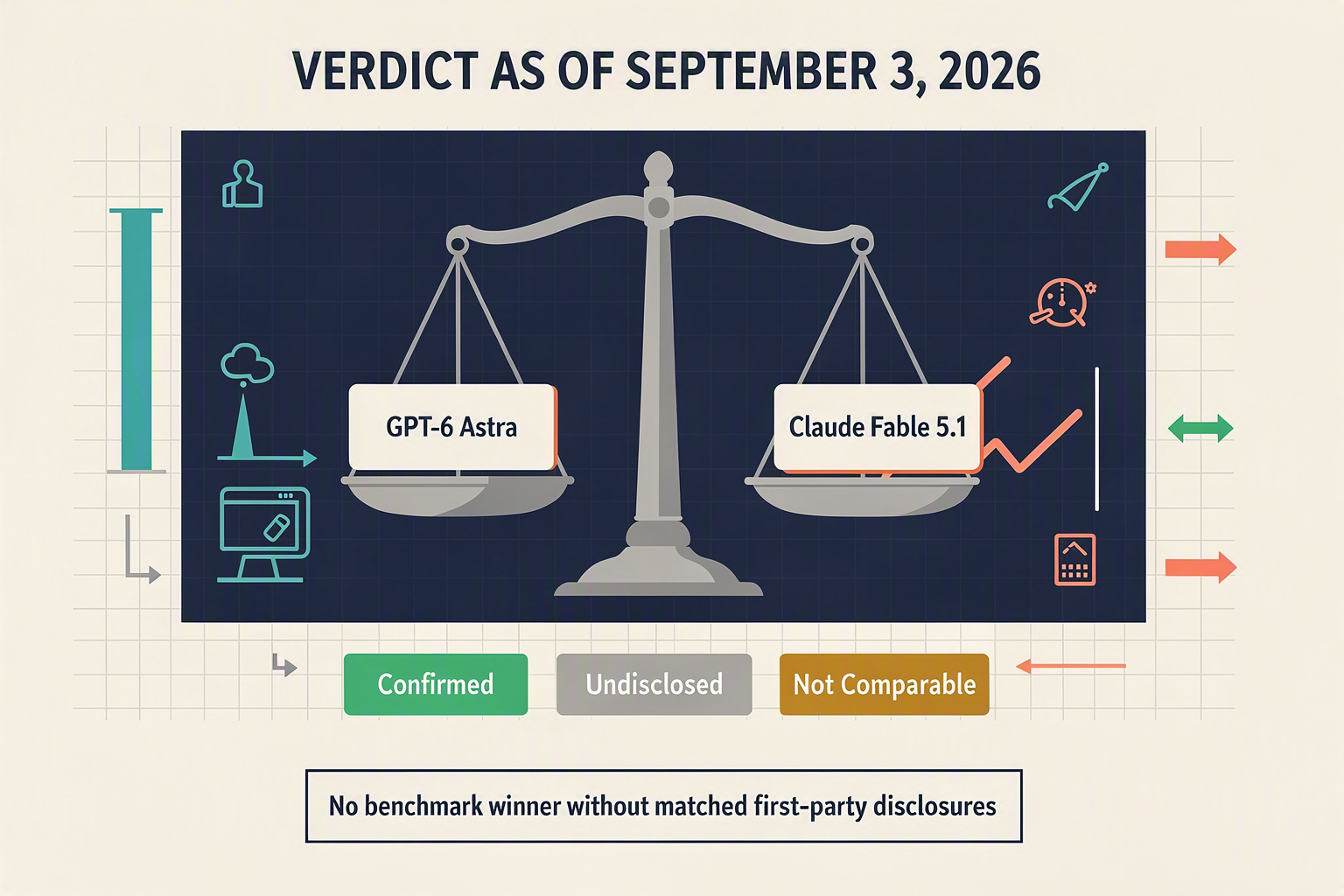
No universal winner emerges from the GPT-6 Astra vs Claude Fable 5.1 comparison as of September 5, 2026. Both models are officially released and documented, but launch status and identical headline token prices do not establish which model delivers better performance or lower total cost for a specific workload.
Both models now have official releases
OpenAI launched GPT-6 Astra on September 3, 2026 and lists the gpt-6-astra API model at:
- $10 per million input tokens
- $50 per million output tokens
- Additional published rates for cached usage
Anthropic launched Claude Fable 5.1 on September 1, 2026 and made it generally available at the same standard rates:
- $10 per million input tokens
- $50 per million output tokens
- $0.25 per million cache-read tokens
The earlier documentation gap therefore no longer applies. The relevant question is not whether either model exists, but how each performs and what each costs under comparable production conditions.
Equal headline rates do not mean equal task costs
Although Astra and Fable 5.1 share the same standard input and output prices, an API’s per-token rate is only one part of total task cost. Actual spending depends on factors such as:
- How many input and output tokens each model uses to complete the same task
- Whether repeated context qualifies for prompt caching
- Cache-write, cache-read, and cache-retention rules
- The number of retries or follow-up prompts required
- Tool calls, retrieval steps, and agentic workflow length
- Latency, rate limits, and failed-request behavior
- The amount of human review or correction needed
For example, a model that produces an acceptable answer with fewer output tokens may cost less despite identical list prices. Conversely, a workload with large, repeatedly reused prompts may favor the model whose caching terms better match that access pattern. Fable 5.1’s published $0.25-per-million cache-read rate is relevant, but it should be compared with Astra’s complete cache schedule and the workload’s expected cache-hit rate—not evaluated in isolation.
“Winner” depends on matched workload testing
A responsible verdict separates three questions:
- Which models are officially available?
Both. Fable 5.1 launched September 1, and GPT-6 Astra followed on September 3.
- Which model has the lower headline API price?
Neither. Both list standard input at $10 per million tokens and output at $50 per million tokens.
- Which model provides better value in production?
Undetermined without matched testing. Quality, token consumption, caching behavior, latency, reliability, and human-review requirements can produce substantially different effective costs.
Published benchmarks and vendor examples can help identify candidates, but they do not replace an evaluation using identical prompts, tools, context, token budgets, scoring criteria, and retry policies. Results from one workload—such as coding, document analysis, customer support, or agentic research—should not be generalized to every use case.
The defensible verdict
For teams evaluating GPT-6 Astra vs Claude Fable 5.1, the practical approach is:
- Use the official API documentation and current pricing schedules for both models.
- Calculate effective cost per completed task, not merely cost per million tokens.
- Include cache reads, cache writes, retries, tool use, and output length in cost estimates.
- Test quality, latency, reliability, and safety on representative production inputs.
- Apply the same evaluation harness and acceptance criteria to both models.
- Review deployment terms, data controls, regional availability, and service limits before adoption.
As of September 5, 2026, both models are verified releases, and neither is a universal winner. Their equal standard input and output rates create a straightforward starting point, but only matched workload testing can determine which model offers better performance and total cost for a particular organization.
Are GPT-6 Astra and Claude Fable 5.1 official, released, and broadly accessible?
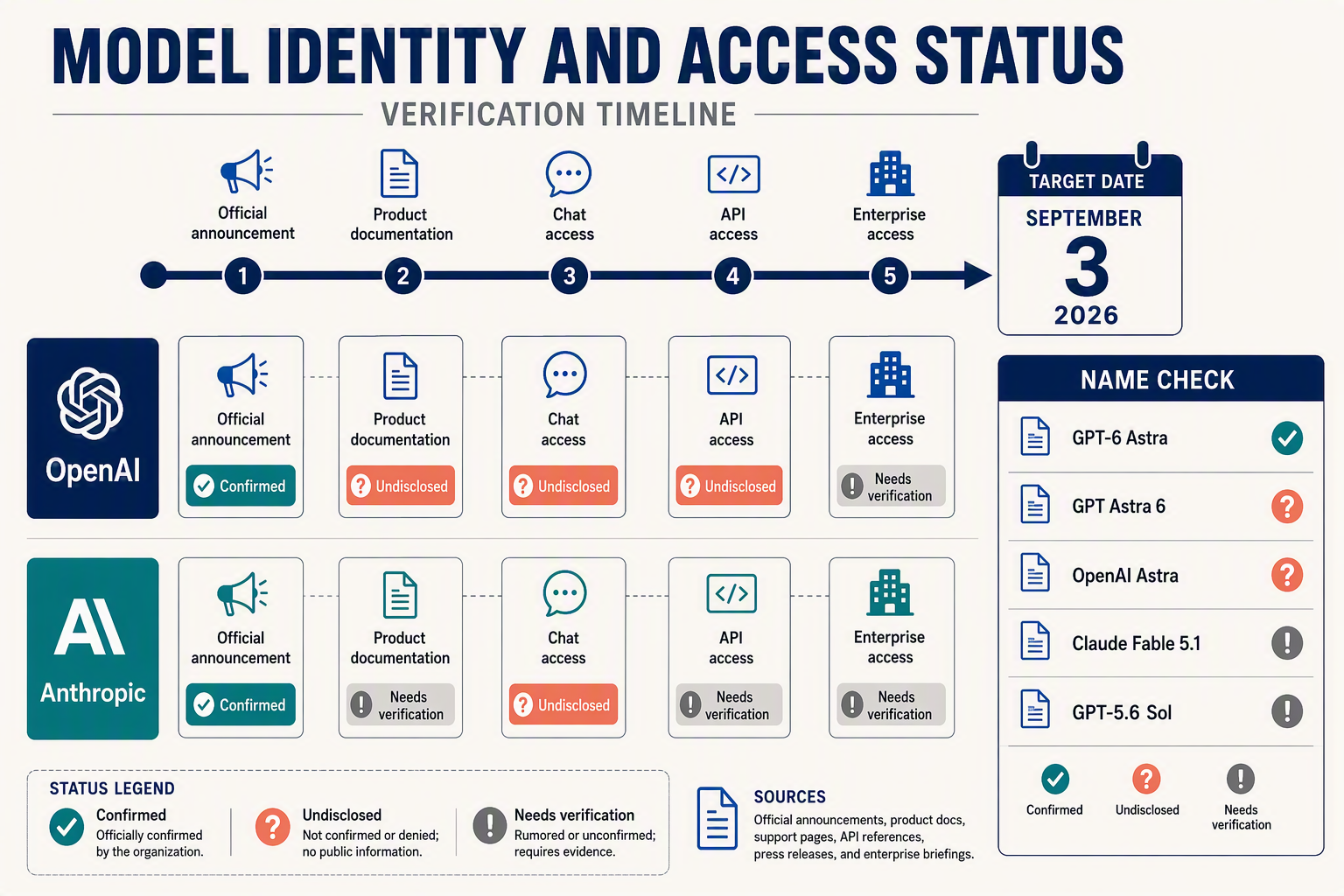
As of September 5, 2026, both GPT-6 Astra and Claude Fable 5.1 are official, released models. Anthropic made Claude Fable 5.1 generally available on September 1, 2026. OpenAI officially released GPT-6 Astra on September 3, 2026, documented it under the API model identifier gpt-6-astra, and has shown it in broad customer deployments.
Both models have moved beyond preview status
The release evidence now supports a stronger conclusion than “officially referenced.” Each company has publicly established its model’s identity and availability:
- Claude Fable 5.1: Officially released by Anthropic and generally available since September 1, 2026.
- GPT-6 Astra: Officially released by OpenAI on September 3, 2026, broadly deployed, and documented as
gpt-6-astra. - Customer use: OpenAI’s published examples—including Playco’s game-prototyping workflow and Legora’s document-review workflow—provide additional evidence that Astra is being used in production settings.
These first-party release and documentation signals mean the names are no longer merely references from customer stories or unverified community terminology.
General availability does not guarantee identical access for every user
“Generally available” means a model has an official production access path, not that every account can use it immediately through every interface or provider. Practical access may still depend on:
- Account type, subscription, or enterprise contract.
- Supported countries and regional rollout schedules.
- Direct API availability versus access through cloud platforms.
- Usage quotas, rate limits, and available capacity.
- Organization verification and billing status.
- Safety safeguards, use-case restrictions, and model-specific permissions.
- Whether a cloud provider has added the release to its own regional model catalog.
A model may therefore be released and broadly accessible while remaining unavailable to a particular account, region, cloud deployment, or workload. Buyers should verify access in the relevant OpenAI or Anthropic console and, when applicable, in the current catalog for their chosen cloud provider.
Practical access verdict
- GPT-6 Astra: Officially released and broadly deployed as of September 3, 2026; documented API identifier:
gpt-6-astra. - Claude Fable 5.1: Officially released and generally available as of September 1, 2026.
- Head-to-head testing: Reproducible for customers with access to both models, subject to account eligibility, regional support, quotas, safeguards, and provider-specific availability.
- Procurement status: Both can be evaluated as released products, but organizations should confirm contractual access, pricing, limits, data controls, and deployment-region support before selecting one.
For an OpenAI vs Anthropic 2026 purchasing decision, neither model should now be treated as hypothetical or unverified. The remaining question is not whether GPT-6 Astra and Claude Fable 5.1 are official, but whether each is accessible under the buyer’s required account, region, cloud, capacity, and compliance conditions.
What is confirmed, claimed, or still unknown about Astra and Fable 5.1?
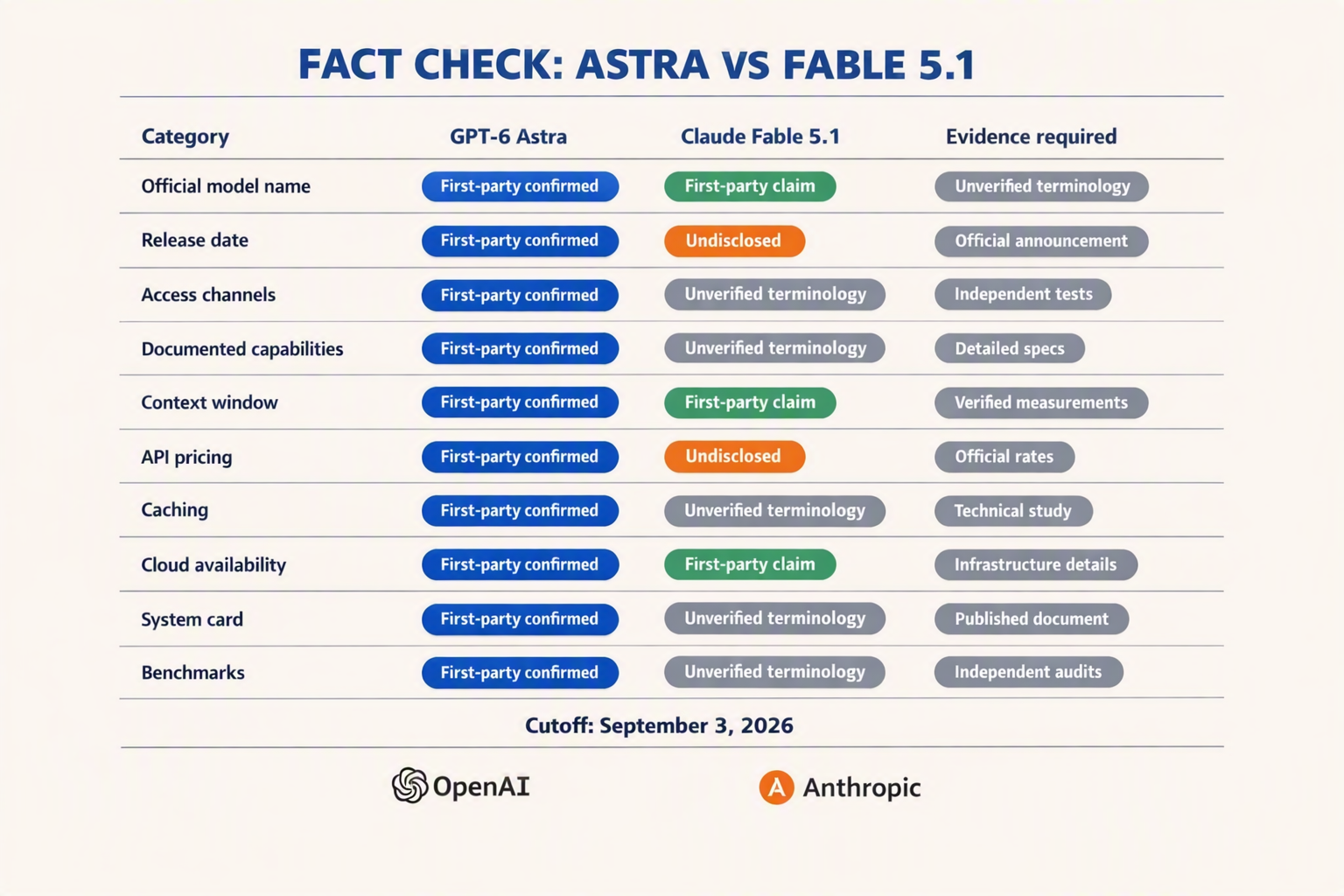
As of September 3, 2026, GPT-6 Astra has limited first-party confirmation through OpenAI customer stories, but its release terms and technical specifications remain undisclosed. Claude Fable 5.1 cannot yet be verified as an official Anthropic product from the supplied first-party sources, so most head-to-head claims remain unknown rather than comparable.
Fact-versus-unknown comparison
| Area | GPT-6 Astra | Claude Fable 5.1 | Evidence status |
|---|---|---|---|
| Release and access | Named in OpenAI customer stories dated September 3, 2026; public API, ChatGPT-plan and regional access are not documented in the supplied sources. | No Anthropic announcement, model card, API documentation or pricing page is available in the supplied research. | Astra is confirmed by name, not confirmed as generally available; Fable 5.1 is unverified. |
| Coding and prototyping | Playco used Astra to create three themed game prototypes from one grey-box foundation. No standardized coding score is supplied. | No first-party coding evaluation or deployment example is available. | Playco is a customer-reported outcome, not a controlled benchmark. |
| Knowledge work | OpenAI’s customer-stories index says Legora reviewed 41 documents in minutes using Astra. Retrieval accuracy and comparison baselines are not disclosed. | No first-party evidence for document review, research or enterprise search is available. | Astra has a documented use case, but comparative quality is unknown. |
| Context and knowledge | Context window, maximum output, training cutoff, supported modalities and factuality scores are undisclosed. | Context window, output limit, knowledge cutoff and modalities cannot be verified. | No defensible long-context winner can be selected. |
| API economics | Token pricing, rate limits, batch pricing, prompt caching and service tiers are undocumented in the supplied material. | API pricing, caching discounts, rate limits and service tiers are unverified. | Cost-per-task comparisons would be speculative. |
| Tools, cloud and safety | Tool calling, web access, computer use, Azure availability, cybersecurity evaluations and safeguard documentation are not established by the cited stories. | Tool interfaces, cloud availability, security testing and safeguards lack supplied first-party documentation. | Enterprise deployment readiness cannot yet be compared. |
What OpenAI’s evidence actually establishes
OpenAI reported on September 3, 2026, that Playco achieved 50% fewer manual fixes while prototyping games with GPT-6 Astra. That figure demonstrates value in one development workflow, but OpenAI does not provide the sample size, exact baseline model, test protocol or statistical variance needed to generalize it into a coding-performance ranking.
OpenAI’s customer-stories index reported on September 3, 2026, that Legora reviewed 41 documents in minutes with GPT-6 Astra. This supports Astra’s relevance to document-heavy knowledge work, but it does not disclose answer accuracy, citation quality, context utilization or human-review requirements.
How to interpret claims responsibly
Readers evaluating GPT-6 Astra vs Claude Fable 5.1 should apply three labels:
- Confirmed: A dated statement published by OpenAI or Anthropic.
- Claimed: A customer result or vendor assertion without a reproducible evaluation.
- Unknown: Any specification, benchmark or availability detail absent from first-party documentation.
Under that framework, Astra has confirmed first-party references and claimed customer outcomes, while Fable 5.1’s official identity and capabilities remain unknown. Until both companies publish comparable model cards, pricing, API access conditions and safety evaluations, declaring either model the overall winner would exceed the available evidence.
Which model is better for coding and knowledge work based on documented evidence?
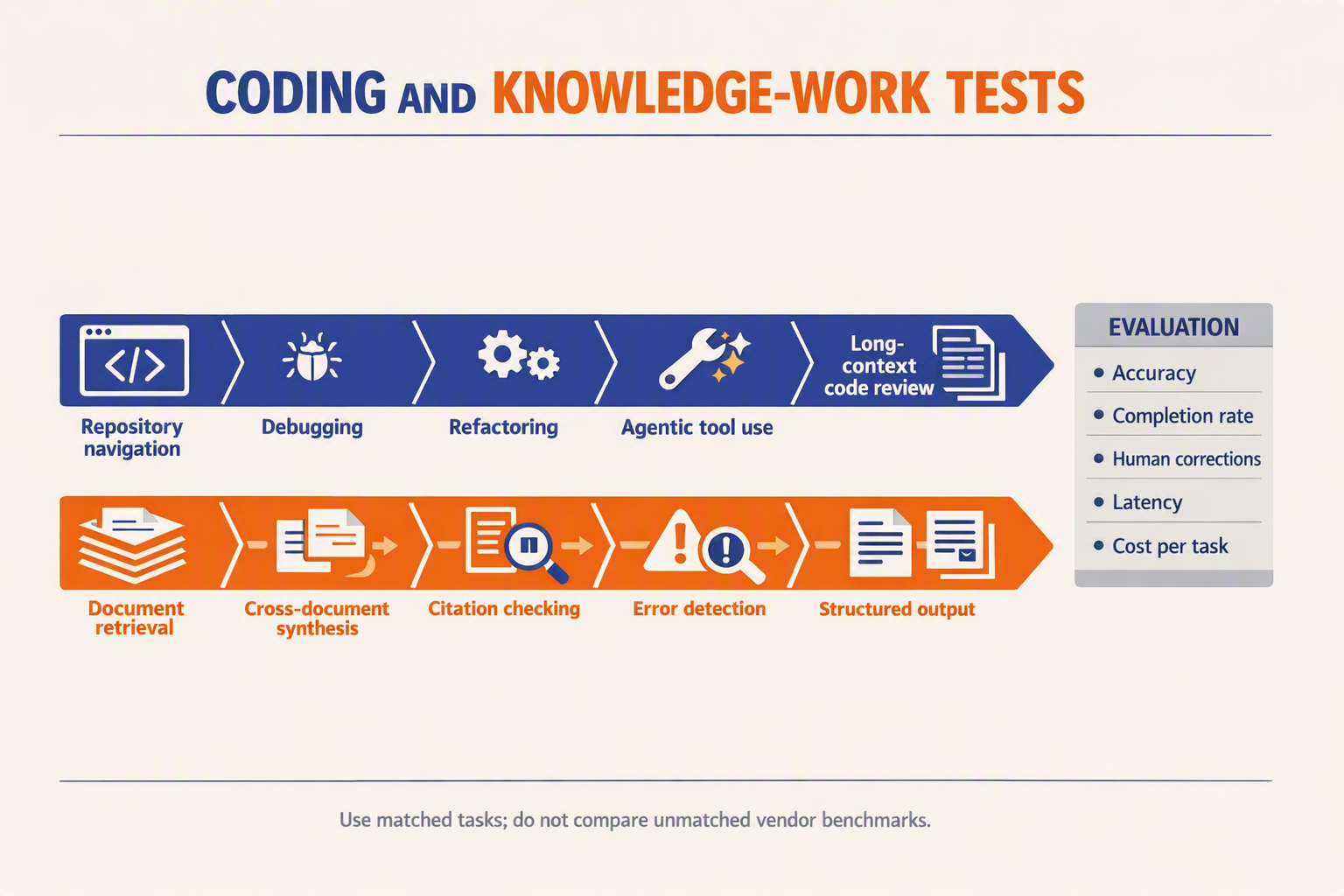
GPT-6 Astra has stronger documented evidence for both coding-adjacent and knowledge-work use cases, but neither model can be declared the better performer. OpenAI has published two concrete GPT-6 Astra customer outcomes, while the available first-party Anthropic material does not verify Claude Fable 5.1 or provide comparable evaluations.
Coding evidence: promising, but narrow
OpenAI’s Playco customer story provides the clearest evidence for GPT-6 Astra in software development. OpenAI reported on September 3, 2026, that Playco created three themed game prototypes from one grey-box foundation with GPT-6 Astra and required 50% fewer manual fixes.
This result suggests potential value for:
- Rapid prototyping, especially when adapting one functional foundation into multiple experiences.
- Iterative code generation, where reducing manual corrections can shorten development cycles.
- Game-development workflows involving generated logic, assets, interfaces, or configuration.
However, “50% fewer manual fixes” is a customer-specific operational metric—not a standardized coding benchmark. OpenAI’s published example does not establish:
- Performance on SWE-bench Verified, HumanEval, or another reproducible coding test.
- The exact definition, severity, and baseline count of a “manual fix.”
- Repository size, programming languages, token usage, latency, or cost.
- Whether GPT-6 Astra can autonomously inspect repositories, execute tests, or submit patches.
- How the model performs on debugging, code review, migration, and production maintenance.
No first-party Anthropic source in the supplied research identifies Claude Fable 5.1, much less reports its coding scores or developer outcomes. Consequently, claims that Fable 5.1 outperforms Astra—or vice versa—on software engineering remain unsupported.
Knowledge work: one useful legal example
GPT-6 Astra also has a documented knowledge-work deployment. OpenAI’s customer-stories index stated on September 3, 2026, that Legora reviewed 41 documents in minutes using GPT-6 Astra.
The Legora example indicates practical applicability to document-intensive legal work, where professionals may need to search, compare, summarize, and extract information across multiple files. Yet the available statement does not disclose:
- Document lengths, formats, or total token volume.
- Review accuracy, citation quality, or hallucination rate.
- Human-review requirements and error severity.
- Comparison with lawyers, earlier models, or Claude systems.
- Whether retrieval-augmented generation, external tools, or a proprietary Legora workflow contributed to the result.
“Reviewed 41 documents in minutes” therefore demonstrates deployment, not proven superiority in legal reasoning or long-context comprehension.
A defensible workload verdict
Organizations should interpret the evidence in three steps:
- For experimental coding and prototyping, GPT-6 Astra has a documented real-world signal through Playco.
- For legal and document workflows, GPT-6 Astra has a documented deployment signal through Legora.
- For comparative model selection, run controlled evaluations using the same prompts, repositories, documents, tools, and scoring criteria.
The evidence-based conclusion is that Astra is currently more verifiable, not demonstrably more capable. Until Anthropic publishes first-party documentation for Claude Fable 5.1—and both companies provide comparable benchmarks, specifications, and access details—the GPT-6 Astra vs Claude Fable 5.1 coding and knowledge-work contest has no defensible overall winner.
How do cybersecurity abilities, tools, and safeguards compare?
Neither GPT-6 Astra nor Claude Fable 5.1 has enough first-party documentation to support a defensible cybersecurity winner as of September 3, 2026. OpenAI has confirmed GPT-6 Astra in customer stories, but the supplied OpenAI and Anthropic sources do not document comparable cyber evaluations, security tools, or model-specific safeguards for either contender.
Documented cybersecurity performance
OpenAI’s September 3, 2026 material demonstrates GPT-6 Astra performing software-prototyping and document-review workloads—not cybersecurity testing. OpenAI reported on September 3, 2026, that Playco produced three themed game prototypes from one grey-box foundation with GPT-6 Astra and required 50% fewer manual fixes. That result may indicate useful code-generation and iteration abilities, but it does not establish performance in vulnerability discovery, exploit development, malware analysis, incident response, or secure-code review.
Similarly, OpenAI’s customer-stories index stated on September 3, 2026, that Legora reviewed 41 documents in minutes with GPT-6 Astra. This suggests potential for rapid evidence synthesis, yet it is not a security benchmark and says nothing about accuracy on threat intelligence or forensic records.
For Claude Fable 5.1, the supplied research contains no Anthropic model card, system card, announcement, or evaluation. Consequently, claims about Fable 5.1’s cyber performance—including comparisons with GPT-6 Astra—remain unverified.
Tools and agentic security workflows
A cybersecurity assistant needs more than strong natural-language reasoning. Production deployments may require:
- Sandboxed code execution for analyzing suspicious scripts without exposing production systems.
- Controlled web search for current CVEs, vendor advisories, and threat-intelligence reports.
- File and repository access for reviewing source code, logs, binaries, and infrastructure configurations.
- Structured tool calling for querying SIEM, SOAR, EDR, ticketing, and vulnerability-management systems.
- Auditable citations and action logs so analysts can verify evidence and reconstruct decisions.
The available first-party material does not specify whether GPT-6 Astra offers these interfaces, which permissions apply, or whether its tool actions require confirmation. No equivalent Anthropic documentation establishes Claude Fable 5.1’s tool support. Teams should therefore avoid inferring production readiness from adjacent OpenAI or Anthropic models.
Safeguards procurement teams should verify
Cybersecurity creates a dual-use risk: the same model that explains defensive remediation may also help automate harmful activity. Before deployment, organizations should request model-specific evidence covering:
- Cyber-capability evaluations: Results for vulnerability discovery, exploitation, persistence, phishing, and malware-related tasks.
- Policy enforcement: Clear boundaries for defensive assistance, credential handling, and high-risk offensive requests.
- Agent controls: Least-privilege credentials, domain allowlists, network isolation, human approval, and execution timeouts.
- Data governance: Retention periods, training-data policies, encryption, regional processing, and administrator controls.
- Monitoring: Tool-call logs, prompt and output auditing, anomaly detection, and incident-response procedures.
- Prompt-injection resistance: Testing against malicious instructions embedded in websites, emails, repositories, and retrieved documents.
Practical verdict
For the GPT-6 Astra vs Claude Fable 5.1 comparison, cybersecurity remains undetermined, not tied. “Tied” would imply equivalent testing; “undetermined” accurately reflects missing comparable evidence.
Organizations should run controlled evaluations using representative secure-code review, alert triage, threat-intelligence, and incident-response tasks. Keep models outside autonomous production access until they pass accuracy, refusal, leakage, and prompt-injection tests—and require human authorization for any action that changes systems or contacts external services.
How do context windows, API pricing, caching, cloud access, tools, and usage limits compare?
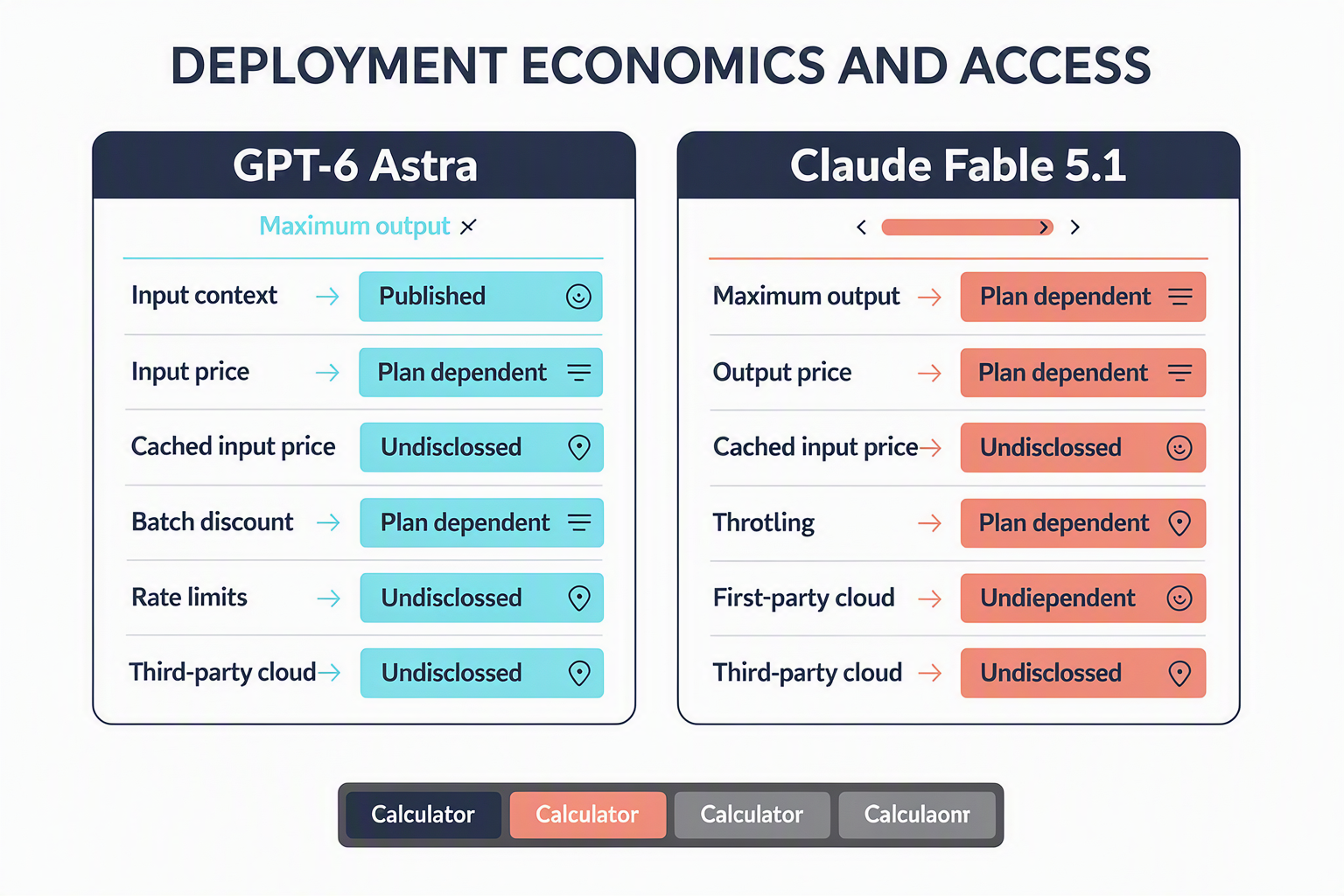
The practical answer is that none of these deployment variables can yet be compared reliably. As of September 3, 2026, OpenAI’s first-party pages confirm GPT-6 Astra in customer workloads, but the supplied OpenAI sources do not publish its context limit, API rates, caching terms, cloud channels, tool schema, or quotas; the supplied research contains no first-party Anthropic documentation for a model officially named Claude Fable 5.1.
Fact-versus-unknown comparison
| Area | GPT-6 Astra | Claude Fable 5.1 | Procurement implication |
|---|---|---|---|
| Context window | Not disclosed in the supplied OpenAI sources | No verified Anthropic specification | Do not assume parity with earlier GPT or Claude models; request maximum input, output, and combined-token limits. |
| API pricing | No verified input, output, batch, or reasoning-token rates | No verified Anthropic pricing page | Total cost cannot be modeled responsibly; require rates by token type, region, and service tier. |
| Prompt caching | No documented cache-write, cache-read, TTL, or eligibility rules | No verified Fable 5.1 caching terms | Long-context economics remain unknown; test cache-hit rates and effective cost per completed task. |
| Cloud access | Direct API and Microsoft Azure availability are not established by the cited customer stories | Direct API, Amazon Bedrock, and Google Cloud Vertex AI availability are unverified | Confirm the exact model ID, region, data residency, preview status, and service-level agreement before architecture approval. |
| Tools and modalities | No supplied Astra API reference confirms function calling, web search, code execution, vision, audio, or structured outputs | No first-party Fable 5.1 tool or modality specification is available | Do not infer interfaces from earlier model families; validate schemas, permissions, and failure behavior. |
| Usage limits | Rate limits, concurrency, reasoning-time ceilings, and account tiers are undisclosed | Rate limits, quotas, and capacity tiers are unverified | Run load tests and negotiate capacity rather than designing around community reports. |
What OpenAI’s evidence does establish
OpenAI reported on September 3, 2026, that Playco used GPT-6 Astra to create three themed game prototypes from one grey-box foundation and achieved 50% fewer manual fixes. OpenAI’s customer-stories index also reported on September 3, 2026, that Legora reviewed 41 documents in minutes with GPT-6 Astra.
Those results establish that Astra has been used in coding-adjacent creative production and document analysis. They do not establish public API access, a particular context window, a caching discount, guaranteed throughput, or availability through Microsoft Azure. A customer deployment may involve private preview access, managed services, customized limits, or contractual terms unavailable to general developers.
Questions buyers should require vendors to answer
Before selecting either model, engineering and procurement teams should obtain written answers covering:
- Tokens: maximum input, maximum output, tokenizer behavior, and charges for hidden reasoning tokens.
- Caching: write and read prices, time-to-live, minimum prompt size, invalidation rules, and regional support.
- Access: stable model identifiers, API versioning, deprecation notice periods, supported clouds, and geographic regions.
- Tools: native function calling, parallel calls, structured JSON, browsing, code execution, file handling, and sandbox boundaries.
- Capacity: requests and tokens per minute, concurrency, burst limits, batch pricing, priority tiers, and uptime commitments.
- Governance: retention defaults, training-data policies, audit logs, encryption, data residency, and abuse-monitoring controls.
For teams unwilling to couple deployment to one provider while specifications remain fluid, CallMissed’s OpenAI-compatible API gateway offers a multi-model catalog behind one endpoint with automatic same-tier fallbacks. That can reduce integration work, but teams must still verify the selected underlying model’s price, limits, residency, and feature support.
The defensible verdict for GPT-6 Astra vs Claude Fable 5.1 is therefore insufficient first-party data, not a fabricated winner.
Which model is the stronger enterprise fit for governance, reliability, and deployment?

For enterprise procurement, GPT-6 Astra has the stronger evidence trail as of September 3, 2026, but neither Astra nor the unverified Claude Fable 5.1 can yet be declared the stronger overall enterprise platform. OpenAI has documented real Astra workloads, while the supplied first-party Anthropic sources do not establish that Claude Fable 5.1 is an announced or deployable product.
Governance readiness requires more than customer stories
OpenAI’s published examples indicate that organizations are already using GPT-6 Astra for consequential work. OpenAI reported on September 3, 2026, that Legora used GPT-6 Astra to review 41 legal documents in minutes. That is relevant to enterprise knowledge work because legal-document processing demands retrieval accuracy, traceability, and careful human review.
However, the available OpenAI evidence does not answer essential governance questions:
- Is there a GPT-6 Astra system card describing safety evaluations and known limitations?
- What data is retained, and can customers disable training or logging?
- Are data residency, encryption, audit logs, role-based access control, and single sign-on available?
- Does OpenAI provide model-version pinning, change notices, or regulated-industry terms?
- Which deployment regions and compliance certifications apply specifically to Astra?
For Claude Fable 5.1, the evidence gap is more fundamental: the supplied research contains no first-party Anthropic release announcement, model card, API documentation, pricing page, or enterprise deployment guide under that name. Procurement teams should not assume that governance controls documented for another Claude model automatically apply to Claude Fable 5.1.
Reliability evidence is promising but incomplete
Astra has one quantified production-style result. OpenAI reported on September 3, 2026, that Playco created three themed game prototypes from one grey-box foundation and required 50% fewer manual fixes. This suggests improved reliability for that particular prototyping workflow, but it does not establish a universal error rate, service-level agreement, uptime figure, or failure-recovery capability.
Enterprises should validate both model quality and platform reliability through:
- Task-specific evaluations using internal documents, codebases, languages, and edge cases.
- Repeated-run testing to measure variance, hallucinations, tool-call failures, and structured-output validity.
- Adversarial testing for prompt injection, data leakage, unsafe code generation, and excessive agency.
- Operational testing covering latency, rate limits, timeouts, regional availability, and provider outages.
- Human escalation paths for legal, financial, cybersecurity, and customer-facing decisions.
Without comparable first-party evaluations from OpenAI and Anthropic, a benchmark winner would be unjustified.
A conditional deployment recommendation
GPT-6 Astra is the more defensible candidate for a controlled pilot, because OpenAI has publicly tied it to identifiable customer workloads. It should not automatically advance to broad production deployment until OpenAI supplies verifiable access terms, API specifications, pricing, safeguards, service commitments, and data-governance documentation.
Claude Fable 5.1 should remain outside formal procurement scoring until Anthropic confirms the product name, availability, documentation, and enterprise controls. A community post or third-party benchmark cannot substitute for contractual availability.
A prudent architecture should also avoid making one unverified model a critical dependency. Multi-model gateways such as CallMissed’s OpenAI-compatible API gateway can reduce integration friction and provide same-tier fallbacks, but enterprises must still govern each underlying provider separately. The strongest enterprise fit is ultimately the model that passes the organization’s own evaluations and offers auditable controls, contractual reliability, transparent pricing, and a documented deployment path—not the model with the most ambitious name.
What do first-party customer stories and expert statements actually prove?
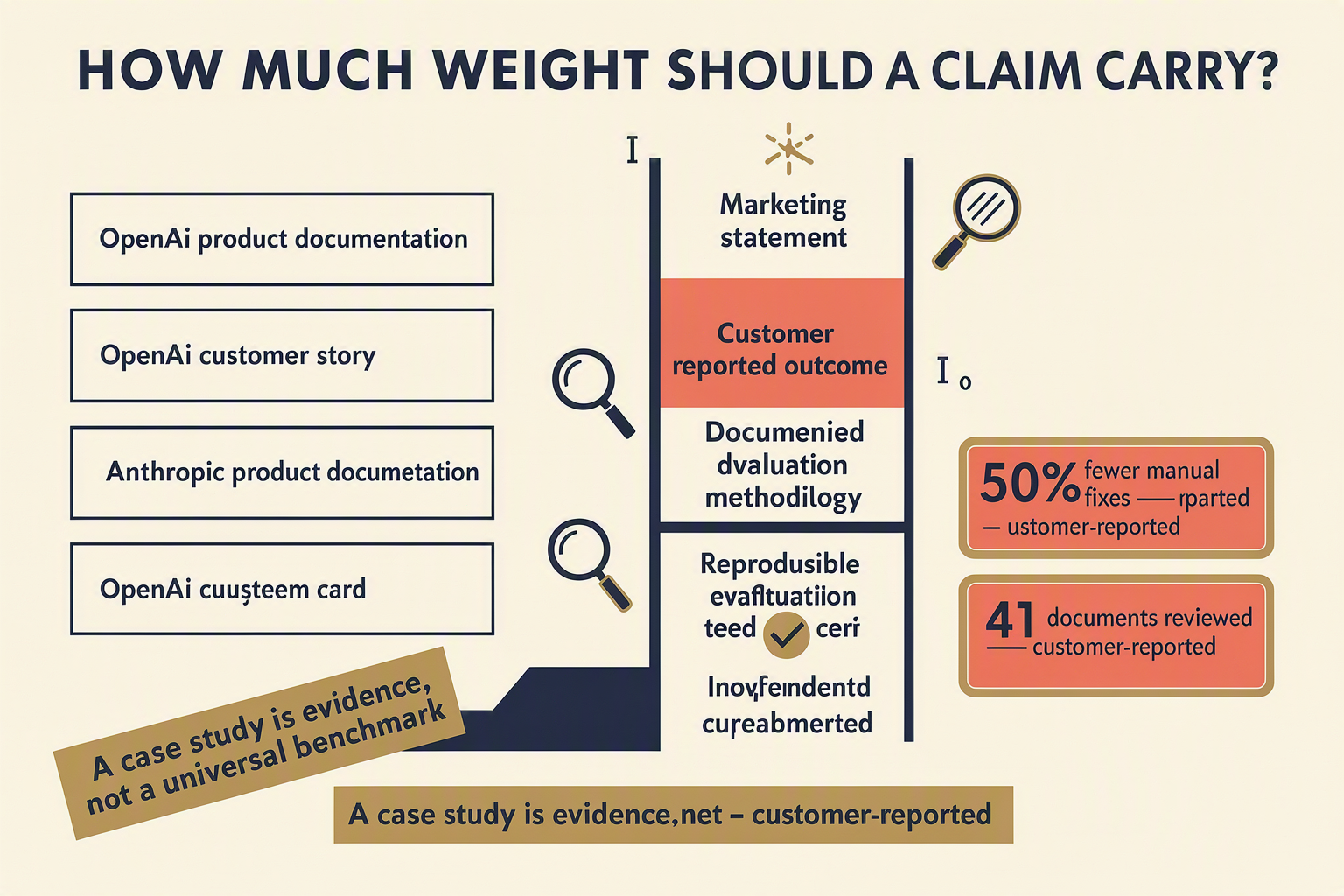
First-party customer stories prove that GPT-6 Astra has been used in specific commercial workflows, but they do not prove universal model superiority, benchmark leadership, or general availability. The supplied first-party evidence contains no equivalent Anthropic customer story or expert statement for Claude Fable 5.1, so a balanced head-to-head conclusion is not currently possible.
What the OpenAI customer stories establish
OpenAI’s evidence supports two narrowly defined outcomes:
- OpenAI reported on September 3, 2026, that Playco created three themed game prototypes from one grey-box foundation using GPT-6 Astra.
- OpenAI reported on September 3, 2026, that Playco needed 50% fewer manual fixes with GPT-6 Astra than with the company’s previous workflow.
- OpenAI’s customer-stories index stated on September 3, 2026, that Legora reviewed 41 documents in minutes using GPT-6 Astra.
These examples suggest that GPT-6 Astra can contribute to iterative game prototyping and high-volume legal-document review. They also indicate that at least selected OpenAI customers had access to the model by September 3, 2026.
However, each result remains workload-specific. Playco’s 50% reduction does not establish Astra’s average coding accuracy because OpenAI’s published summary does not provide a standardized task set, sample size, baseline model, error taxonomy, or independent replication. Likewise, reviewing 41 documents in minutes says little about recall, citation accuracy, legal correctness, document length, or human-review requirements.
Repetition is not independent corroboration
GPT-6 Astra story cards also appear on OpenAI pages concerning NVIDIA, RingCentral, startups, and responsible Sora deployment. Those appearances improve the visibility of the underlying stories, but they are not additional experiments or independent endorsements.
A result repeated across several pages from the same publisher remains one first-party claim. Stronger evidence would include:
- A documented evaluation methodology.
- Before-and-after quality measurements.
- Comparable results against named models.
- Independent reproduction by external researchers.
- Disclosure of failure rates, costs, latency, and human intervention.
Until those details exist, the customer stories should be treated as credible examples of deployment, not controlled benchmarks.
What expert statements can—and cannot—prove
No attributable OpenAI or Anthropic expert quotation about a direct GPT-6 Astra vs Claude Fable 5.1 comparison appears in the supplied first-party material. Consequently, claims that engineers, researchers, or executives have declared one model superior would be unsupported.
Even a named expert’s assessment would constitute informed testimony rather than reproducible evidence. Expert statements are most useful when they explain:
- The intended model use case.
- Known limitations and safety boundaries.
- Evaluation design and benchmark conditions.
- Access tiers, API behavior, and deployment constraints.
They cannot substitute for model cards, system cards, pricing documentation, API references, or independently repeatable tests.
The defensible conclusion
The evidence supports saying that GPT-6 Astra was used by Playco and Legora in documented customer workflows as of September 3, 2026. It does not support claims about Astra’s context window, cybersecurity performance, caching, API economics, or overall coding leadership.
For Claude Fable 5.1, the supplied research provides no first-party Anthropic launch announcement, customer case study, model card, or expert statement. Therefore, neither the Claude Fable 5.1 vs OpenAI Astra comparison nor the broader OpenAI vs Anthropic 2026 debate has enough matched evidence to produce a responsible winner.
Which model should you choose for each workload?
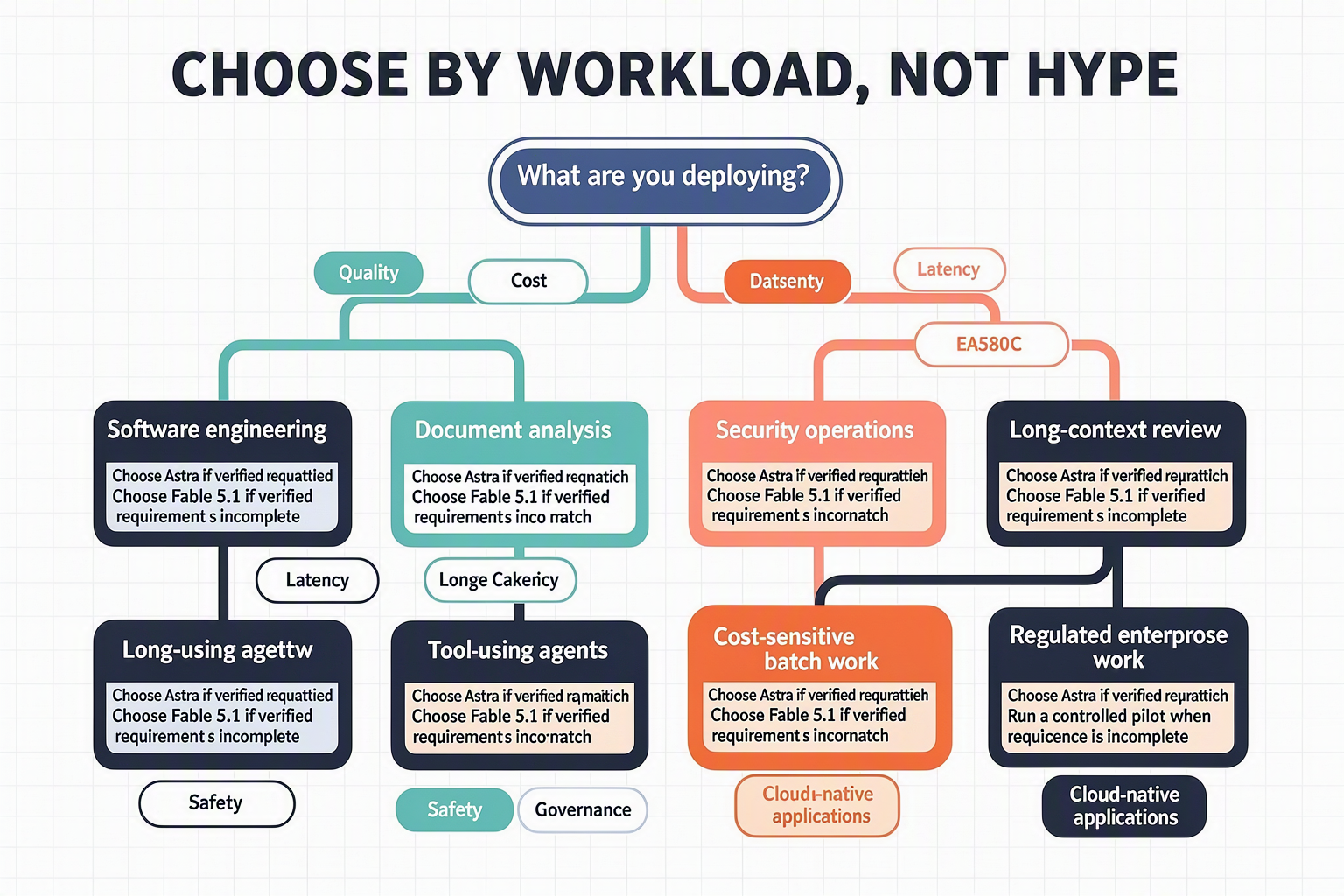
Choose GPT-6 Astra only for a controlled pilot where OpenAI has documented a closely matching workload; do not select Claude Fable 5.1 until Anthropic confirms that model’s identity, availability, and specifications. For production procurement, neither model currently supports a universal recommendation because comparable first-party documentation is unavailable as of September 3, 2026.
Workload-by-workload recommendation
| Workload | Recommended choice today | Evidence | Required validation |
|---|---|---|---|
| Game prototyping | GPT-6 Astra pilot | OpenAI reported on September 3, 2026, that Playco created three themed prototypes from one grey-box foundation and needed 50% fewer manual fixes. | Test code correctness, asset consistency, latency, revision count, and cost on your own game stack. |
| Legal document review | GPT-6 Astra pilot with human review | OpenAI’s customer-stories index stated on September 3, 2026, that Legora reviewed 41 documents in minutes using GPT-6 Astra. | Measure citation accuracy, missed clauses, privilege handling, jurisdictional reliability, and auditability. |
| General software engineering | No evidence-based winner | No comparable first-party coding benchmarks, repository evaluations, tool specifications, or API details are available for both named models. | Run private tests covering issue resolution, regression rates, security, tool calls, and total developer time. |
| Long-context knowledge work | Wait or benchmark another documented model | Neither an official GPT-6 Astra context limit nor a verified Claude Fable 5.1 model card is present in the supplied first-party evidence. | Confirm maximum input/output tokens, retrieval accuracy, context degradation, file limits, and data retention. |
| Cybersecurity operations | Neither without formal review | The available evidence provides no comparable cybersecurity evaluation, deployment guidance, or safeguard documentation for these two names. | Require sandboxing, permission boundaries, prompt-injection testing, logging, incident controls, and human authorization. |
| Enterprise API deployment | Conditional Astra evaluation; no Fable 5.1 commitment | Astra appears in OpenAI customer material, but documented API access, pricing, caching, service limits, regional availability, and cloud distribution remain undisclosed. Anthropic confirmation for Fable 5.1 is absent. | Obtain contractual pricing, SLAs, data residency terms, rate limits, fallback behavior, support commitments, and deprecation policy. |
How to make the final decision
A credible GPT-6 Astra vs Claude Fable 5.1 comparison should prioritize operational evidence over model naming. Use a gated evaluation process:
- Verify access first. Ask each vendor for an official model identifier, API documentation, regional availability, pricing, rate limits, and general-availability status.
- Build a representative test set. Include real repositories, documents, languages, edge cases, and failure scenarios—not only public benchmark questions.
- Score business outcomes. Track task completion, factual accuracy, human corrections, latency, cost per successful task, and severe-error frequency.
- Review governance. Confirm retention settings, training-data policies, encryption, audit logs, access controls, and subprocessors before sending sensitive information.
- Design for portability. Avoid coupling workflows to undocumented tools or proprietary response formats.
For teams that need flexibility while model documentation evolves, CallMissed’s OpenAI-compatible API gateway provides one integration across multiple providers and supports automatic same-tier fallbacks. That architecture does not replace model evaluation, but it can reduce migration work when availability, pricing, or workload performance changes.
The practical verdict is therefore workload-specific rather than model-wide: Astra has enough first-party evidence to justify narrow pilots in game prototyping and document review, while Claude Fable 5.1 remains unsuitable for a defensible procurement recommendation until Anthropic publishes authoritative documentation.
Frequently asked questions: Is GPT-6 Astra released, is Claude Fable 5.1 official, and which is better for coding?
What is the release status in the GPT-6 Astra vs Claude Fable 5.1 comparison?
Is Claude Fable 5.1 an official Anthropic model as of September 3, 2026?
Which model is better for coding in the GPT-6 Astra vs Claude Fable 5.1 comparison?
What are the context window, API price, and caching costs for GPT-6 Astra vs Claude Fable 5.1?
Do GPT-6 Astra or Claude Fable 5.1 support web search, tools, cybersecurity tasks, and enterprise safeguards?
Should enterprises choose OpenAI Astra or Anthropic Claude Fable 5.1 in 2026?
Conclusion
As of September 3, 2026, the verified conclusion is straightforward: GPT-6 Astra cannot yet be declared the universal winner, while Claude Fable 5.1 cannot be treated as an officially documented Anthropic model without first-party evidence. A responsible comparison must distinguish observed customer outcomes from standardized capabilities, commercial access, and technical specifications.
- GPT-6 Astra has first-party evidence of real workload use. OpenAI reported on September 3, 2026, that Playco created three themed game prototypes from one grey-box foundation and required 50% fewer manual fixes with GPT-6 Astra. OpenAI’s customer-stories index also reported that Legora reviewed 41 documents in minutes, indicating promising applications in prototyping and knowledge work.
- Those examples do not establish benchmark leadership. OpenAI has not provided comparable evidence in the supplied research for GPT-6 Astra’s coding scores, cybersecurity evaluations, context window, latency, training cutoff, API pricing, prompt caching, tool interfaces, safeguards, or availability through Microsoft Azure and other cloud platforms. Customer results are valuable, but they are not substitutes for reproducible testing or complete deployment documentation.
- Claude Fable 5.1 remains unverified in the available first-party record. The supplied research contains no Anthropic announcement, model card, API reference, pricing page, safety report, or cloud-access documentation for that exact product name. Consequently, claims about Claude Fable 5.1’s performance, context capacity, caching economics, coding ability, or enterprise readiness should be treated as speculation rather than established fact.
- Procurement decisions should remain workload-specific and evidence-led. Engineering teams should test representative repositories, knowledge workflows, security scenarios, tool calls, latency requirements, and governance controls instead of relying on model names or isolated success stories. Until both companies publish comparable specifications and access terms, there is no defensible overall benchmark winner in the GPT-6 Astra vs Claude Fable 5.1 contest.
The next signals to watch are official OpenAI and Anthropic release notes, model cards, reproducible evaluations, API pricing, context limits, caching policies, safety disclosures, and cloud deployment details. Multi-model infrastructure may become increasingly useful while availability and specifications remain fluid.
To explore how AI communication is evolving, check out CallMissed—an AI infrastructure platform supporting voice agents, multilingual chatbots, and multi-model access. When the documentation finally arrives, will the headline claims survive production testing?
Related Reading
- Claude Opus 5 vs Claude Fable 5: Verified Comparison for 2026
- GPT-6 Astra Release Date: September 2026 Fact Check
- Claude Fable 5.1 vs GPT-5.6 Sol: Pricing, Coding & Voice Agents