
Claude Opus 5 vs Claude Fable 5: Verified Comparison for 2026


Compare Claude Fable 5 with unannounced Opus 5 using verified pricing, limits, benchmarks, availability, and use-case guidance.
Claude Opus 5 vs Claude Fable 5: Verified Comparison for 2026
Could the model everyone is comparing against Claude Fable 5—Claude Opus 5—still have no official product page, price, benchmark, or API identifier? As of July 24, 2026, the answer-first verdict in Claude Opus 5 vs Claude Fable 5 is simple: Fable 5 is the usable, documented choice; Opus 5 remains unannounced, so no evidence-based winner can credibly be declared on raw capability. Any Opus 5 specification, release date, price, benchmark, context window, output limit, capability, or API ID discussed here is unknown unless Anthropic verifies it. “Honeycomb” is not treated as a confirmed Opus 5 codename.
Evidence before hype
Claude Fable 5 matters now because its launch was unusually turbulent. Anthropic’s Claude Platform documentation says Claude Fable 5 became generally available on June 9, 2026 through the Claude API, Amazon Bedrock, Claude Platform on AWS, Google Cloud, and Microsoft Foundry. Anthropic then said a U.S. government export-control directive suspended access for foreign nationals on June 12, before Anthropic announced restored access and a global redeployment on July 1, 2026. Those dates make availability and policy constraints as important as coding or reasoning scores.
What this comparison will verify
This comparison separates verified Anthropic facts from leaks, rumors, and inference. It will examine:
- Pricing and access: confirmed Fable 5 availability and any published costs, while marking every Opus 5 commercial detail unknown.
- Technical limits: context and output ceilings, multimodality, tool use, agentic workflows, and deployment channels.
- Performance: Claude Fable 5 benchmarks, coding, reasoning, and agents, with source and methodology checks rather than unsupported projected scores.
- Decision guidance: which workloads justify using Fable 5 now, when waiting could make sense, and how safety controls or regional access can change the answer.
That evidence standard matters because search results can blur real releases with speculative model names, or compare an unavailable model as though its price and benchmark profile were settled. Anthropic’s official Fable 5 and Mythos 5 system card provides a primary source for capability and safety claims, while Anthropic’s cyber-safeguards notice says Fable 5 aims to block “high-uplift vulnerability finding,” highlighting restrictions that may affect security workflows.
For developers, this reflects a multi-model trend: CallMissed, the OpenAI-compatible AI gateway, gives access to many providers through one endpoint with same-tier fallbacks, reducing integration rewrites when availability changes. You will learn what is confirmed, what remains rumor, how Claude Fable 5 pricing and benchmarks should be evaluated, and whether to deploy today or wait for an Opus 5 announcement.
Claude Opus 5 vs Claude Fable 5: Which should you choose as of July 24, 2026?
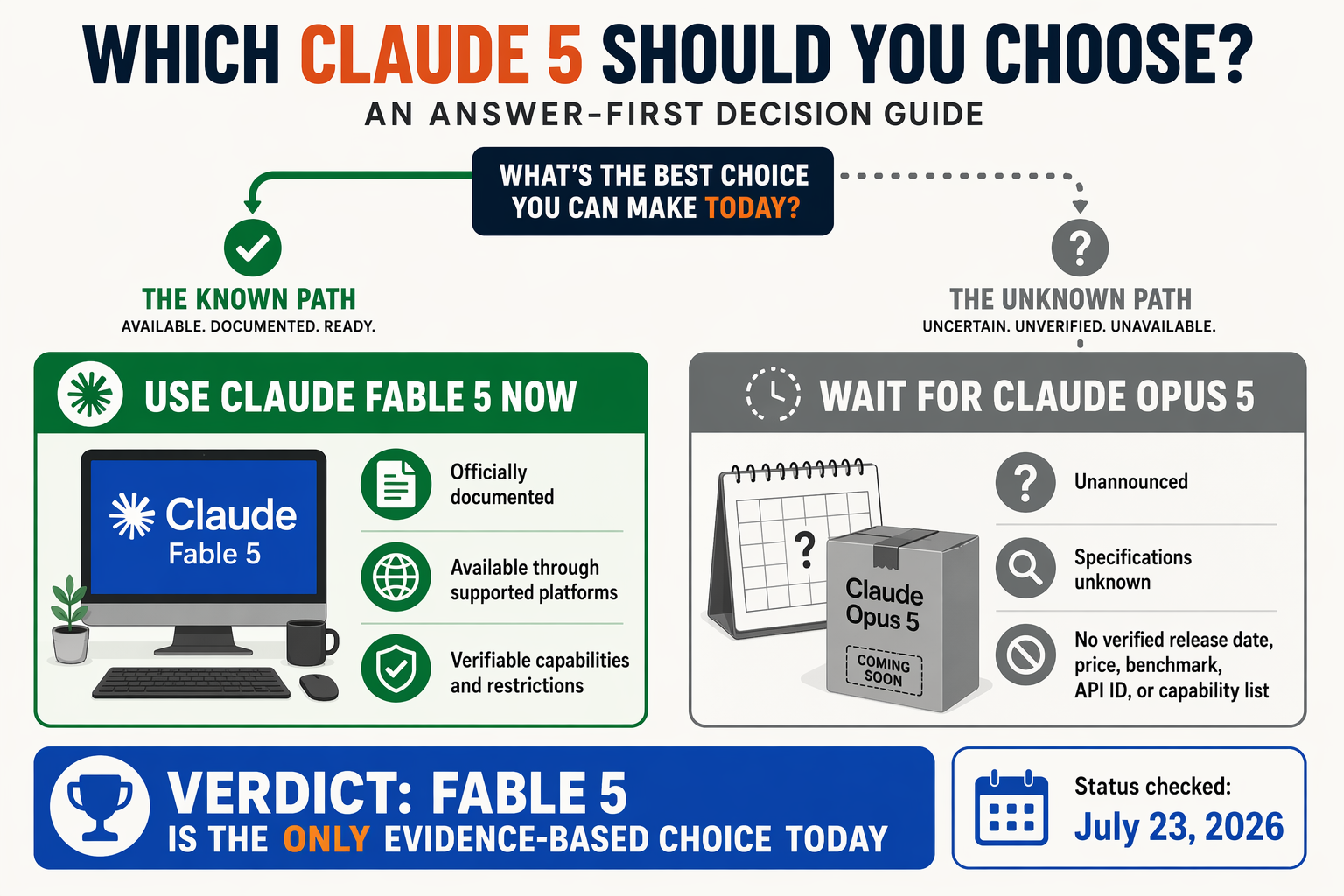
Choose Claude Fable 5 if you need a deployable model now. As of July 24, 2026, Fable 5 is the only deployable side of the exact Claude Opus 5 vs Claude Fable 5 matchup. Anthropic has not officially announced Claude Opus 5, so no evidence-based capability winner can be declared.
This verdict concerns verified availability, not the likely performance of a future Opus model. Anthropic has published no Claude Opus 5 model card, model ID, pricing, benchmark results, technical specifications, or release date. Any purported comparison against it is therefore speculative.
The evidence-based choice today
Verified availability: Anthropic made Claude Fable 5 and Claude Mythos 5 available on June 9, 2026. Following an interruption, Anthropic’s July 1 product update said the models had been redeployed. Fable 5 can therefore be evaluated through documented Anthropic and supported cloud deployment channels.
Anthropic’s Fable 5 and Mythos 5 system card describes them as two configurations of a new large language model, giving organizations primary-source material for reviewing capabilities and safety behavior before deployment.
Vendor-reported performance: Anthropic says Fable 5 beats Opus 4.8 on its everyday spreadsheet suite at every effort level while completing tasks in 25–30% fewer turns. That is a relevant Anthropic-reported result, but it should be interpreted carefully:
- It is a vendor-reported evaluation, not an independent benchmark.
- It compares Fable 5 with Opus 4.8, not Claude Opus 5.
- It does not establish a capability winner in Claude Opus 5 vs Claude Fable 5.
- Teams should reproduce representative spreadsheet, coding, and agentic tasks in their own environments.
For Claude Opus 5, the evidence status remains:
- Official announcement: None.
- Model card or system card: None.
- Model ID: None; developers should not build against speculative model strings.
- Release date: Unknown; Anthropic has published no verified launch commitment.
- Pricing: Unknown; claimed token, caching, or batch rates are unverified.
- Benchmarks: None; projected coding or reasoning scores are not measurements.
- Context and output limits: Unknown.
- Capabilities: Unverified across coding, reasoning, multimodality, tool use, and agentic work.
- “Honeycomb” codename: Rumor; Anthropic has not confirmed it as Claude Opus 5.
Who should use Fable 5 now?
Claude Fable 5 is the practical choice for teams that:
- Need production access now rather than waiting for an unannounced product.
- Want to test coding, spreadsheet, or autonomous-agent workflows against an available model.
- Require procurement evidence, including official documentation and a system card.
- Need documented deployment options through Anthropic or supported cloud platforms.
- Can validate model-specific safety controls against their intended workloads.
Anthropic says Fable 5 includes safeguards intended to block “high-uplift vulnerability finding.” Authorized security teams should test whether legitimate workflows remain usable and confirm that deployment controls satisfy their compliance requirements.
When does waiting make sense?
Waiting may be reasonable if there is no immediate deployment requirement, migration costs are unusually high, or the organization specifically wants to evaluate the next officially branded Opus release. It should not be justified by rumored prices, unofficial model IDs, benchmark projections, or assumed capabilities.
The defensible verdict for Claude Opus 5 vs Claude Fable 5 as of July 24, 2026 is: use Fable 5 now if it meets your workload, security, and compliance requirements; reassess Opus 5 only after Anthropic announces and documents it. Fable 5 is the only currently deployable choice in this exact matchup, but there is not yet enough evidence to name a capability winner.
What are Claude Fable 5 and the unannounced Claude Opus 5?
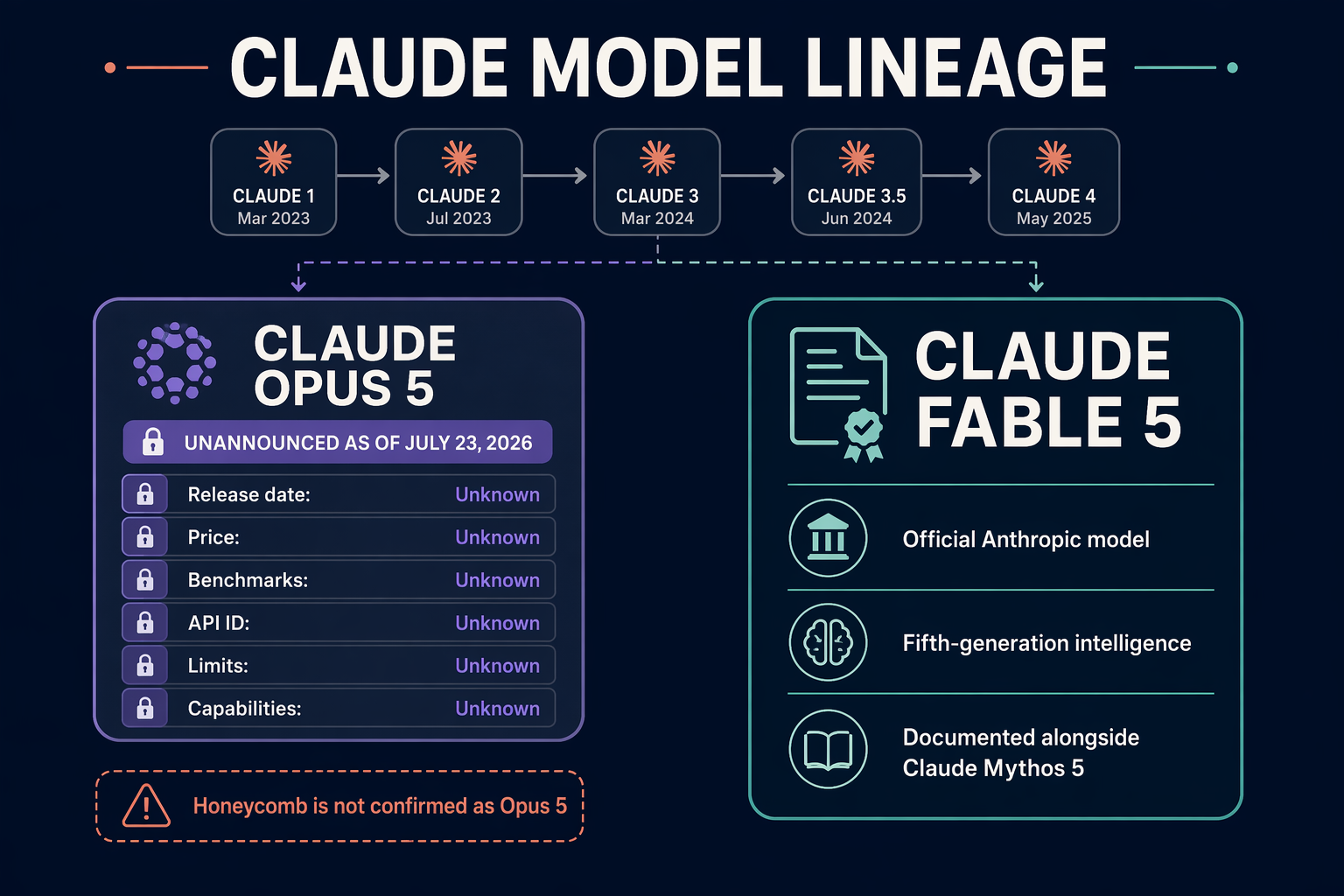
Claude Fable 5 is an officially documented Anthropic model configuration available for production use, while “Claude Opus 5” is an unannounced product name with no verified specifications. As of July 24, 2026, Anthropic has published primary-source documentation for Fable 5 but has not officially confirmed an Opus 5 model.
Claude Fable 5 is a documented model configuration
Anthropic’s Claude Fable 5 and Claude Mythos 5 System Card describes Fable 5 and Mythos 5 as “two configurations of a new large language model from Anthropic.” That wording matters: Fable 5 is a specific configuration within Anthropic’s fifth-generation model family, not merely a rumored successor inferred from earlier Claude naming.
Anthropic presents Claude Fable 5 as a model for demanding coding, reasoning, and agentic work. Its official materials establish several facts:
- Product status: Claude Fable 5 is released and documented.
- Deployment status: Anthropic’s Claude Platform documentation lists Fable 5 as generally available beginning June 9, 2026.
- Distribution: Verified deployment channels include the Claude API, Amazon Bedrock, Claude Platform on AWS, Google Cloud, and Microsoft Foundry.
- Agentic evidence: Anthropic’s Fable 5 and Mythos 5 announcement demonstrates Fable 5 autonomously playing Factorio, planning and constructing an automated factory over an extended workflow.
- Safety scope: Anthropic says Fable 5’s cyber safeguards aim to block “high-uplift vulnerability finding,” meaning some cybersecurity requests may be restricted even when the model is technically capable of completing related tasks.
Fable 5 should therefore be understood as both a model and a governed service: its practical value depends on documented limits, API access, safety controls, and regional availability—not capability claims alone.
Claude Opus 5 remains an unverified label
The unannounced Claude Opus 5 cannot yet be treated as a purchasable or testable Anthropic model. No official Anthropic product page, Claude Platform documentation, system card, or release announcement identified in the available evidence confirms it.
Consequently, its details must be recorded as follows:
- Specifications: Unknown and unverified.
- Release date: Unknown; any date circulating elsewhere is rumor.
- Pricing: Unknown; no input, output, caching, or batch rate is verified.
- Benchmarks: Unknown; no coding, reasoning, agent, or safety score is official.
- Context and output limits: Unknown.
- Capabilities and modalities: Unknown; text, image, audio, tool-use, and computer-use support cannot be assumed.
- API identifier: Unknown; developers should not build against an inferred model string.
- Deployment channels and regions: Unknown.
- “Honeycomb” codename: Unconfirmed and not evidence that Honeycomb is Claude Opus 5.
Why the distinction matters
A plausible model name is not a product specification. Anthropic could change branding, architecture, pricing, safeguards, or release plans before making any future Opus model public.
For this comparison, Fable 5 claims are accepted only when supported by Anthropic documentation; every unannounced Opus 5 detail remains unknown unless Anthropic verifies it. That evidence boundary prevents rumors from being presented alongside production facts as though both carry equal weight.
When did the key Claude Fable 5 availability developments occur? (TABLE)
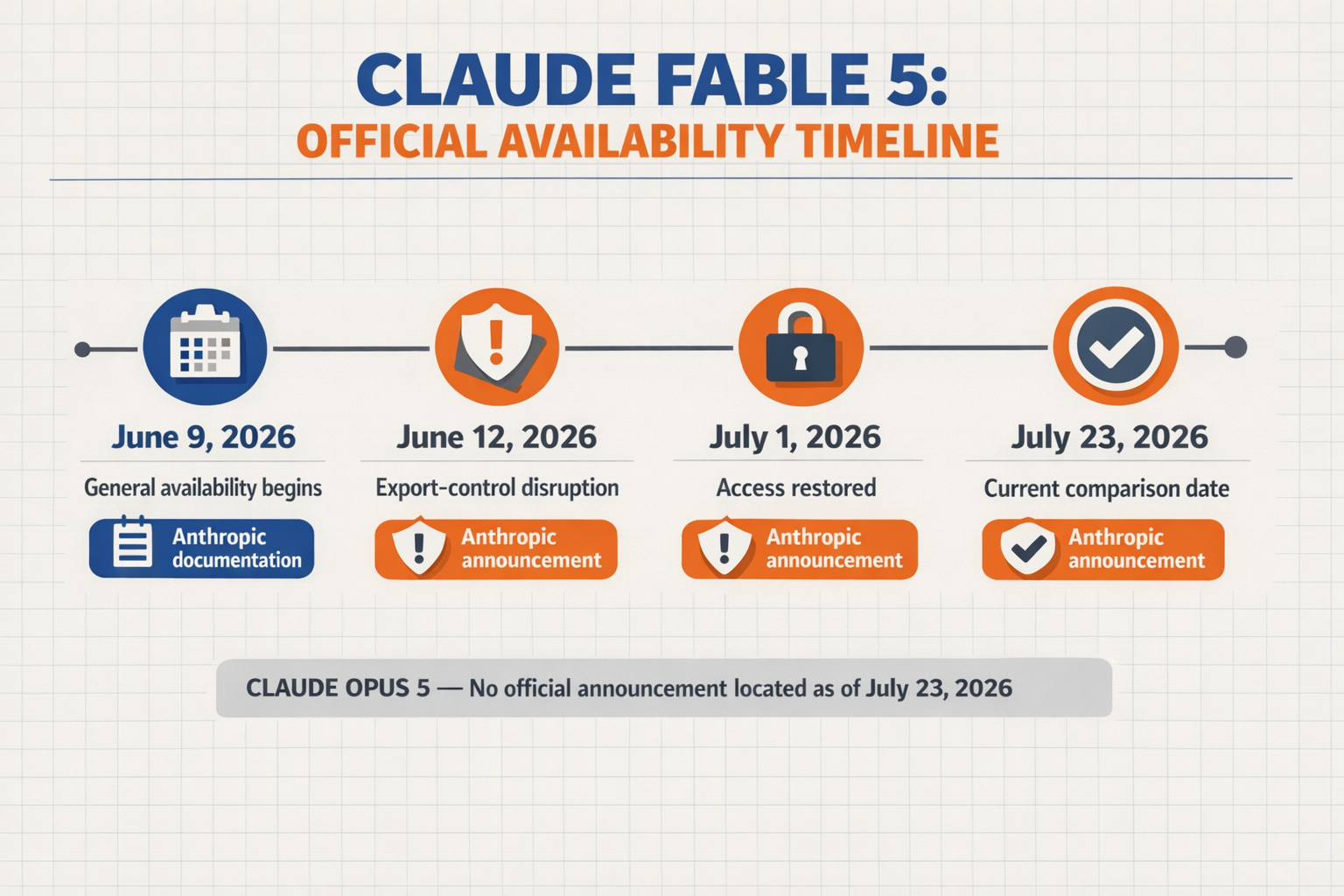
Claude Fable 5’s availability changed in three critical stages: general availability on June 9, 2026; a U.S. export-control suspension affecting foreign nationals on June 12; and restored global access announced on July 1. As of July 24, 2026, Anthropic documents Fable 5 as available, while Claude Opus 5 remains unannounced and has no verified availability date or deployment channel.
Claude Fable 5 availability timeline
| Date | Fable 5 development | Affected access | Evidence status |
|---|---|---|---|
| June 9, 2026 | Claude Fable 5 became generally available | Claude API, Amazon Bedrock, Claude Platform on AWS, Google Cloud, and Microsoft Foundry | Verified: Anthropic Claude Platform documentation |
| June 12, 2026 | The U.S. government applied export controls to Anthropic’s newest models | Access to Fable 5 and Mythos 5 by foreign nationals was suspended | Verified: Anthropic’s government-directive statement |
| June 12–July 1, 2026 | Fable 5 operated under the suspension while Anthropic worked toward redeployment | Availability depended on the directive and user eligibility, not merely cloud-region support | Verified period; implementation details are not fully specified in the supplied sources |
| July 1, 2026 | Anthropic announced that access to Fable 5 and Mythos 5 had been restored | Fable 5 began rolling out again globally | Verified: Anthropic’s “Redeploying Claude Fable 5” announcement |
| Post-redeployment | Additional cyber safeguards accompanied Fable 5’s restored availability | Certain cybersecurity requests may be blocked even where model access is available | Verified: Anthropic’s cyber-safeguards notice; exact publication date not provided here |
| July 24, 2026 | Fable 5 remains the documented, deployable model in this comparison | Official channels are listed; account, region, policy, and safety controls may still apply | Current evidence check; Opus 5 availability remains unknown |
What the dates mean for deployment
The June 9 general-availability date is the clearest starting point for production planning. Anthropic’s Claude Platform documentation explicitly names five access routes, including its direct API and managed services from Amazon Web Services, Google Cloud, and Microsoft.
However, general availability did not mean uninterrupted universal access. Anthropic said the June 12 directive suspended “all access to Fable 5 and Mythos 5 by any foreign national.” That intervention made user nationality and export-control compliance material deployment considerations, even when the model appeared in a supported cloud catalog.
Anthropic’s July 1, 2026 update then stated that access had been restored and described Claude Fable 5 as “rolling out.” Teams should therefore distinguish between:
- Catalog availability: whether a provider lists Fable 5.
- Account availability: whether a specific organization can invoke it.
- Policy availability: whether a requested task passes Anthropic’s safeguards.
- Operational availability: whether capacity and regional rollout permit reliable production use.
Anthropic’s safeguards notice says Fable 5 aims to block “high-uplift vulnerability finding,” so restored global access does not imply unrestricted use for every cybersecurity workflow.
Where Claude Opus 5 fits
There is no equivalent official timeline for Claude Opus 5. As of July 24, 2026, its announcement date, release date, API ID, cloud availability, regional access, pricing, capabilities, and safety tier are all unknown. Any claimed Opus 5 launch window—including claims attached to the unconfirmed “Honeycomb” name—should be treated as rumor unless Anthropic publishes primary documentation.
How do Claude Opus 5 and Claude Fable 5 compare on price, limits, capabilities, and access? (TABLE)
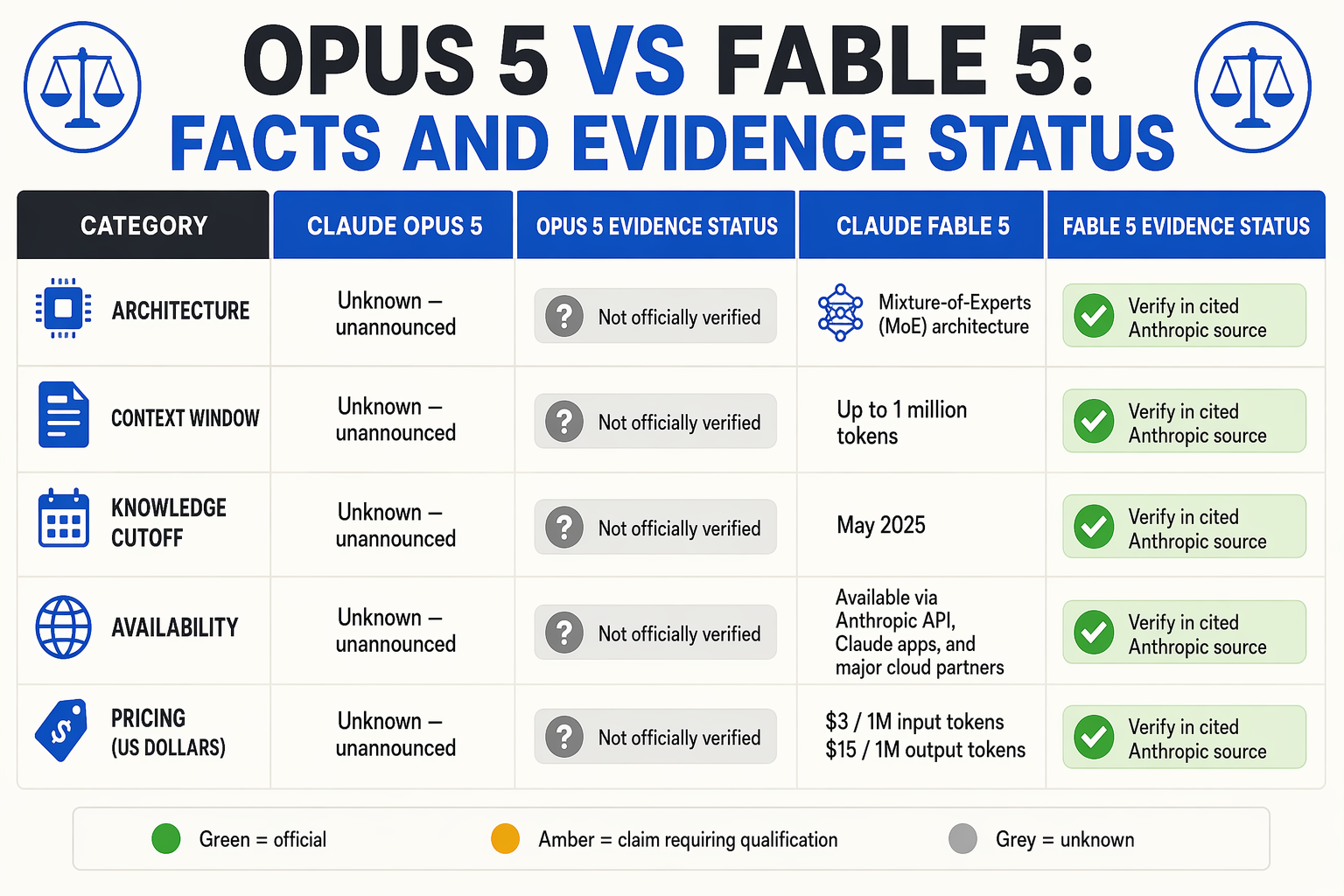
Claude Fable 5 is the deployable choice as of July 24, 2026. Anthropic documents it as generally available, with standard pricing of $10 per million input tokens and $50 per million output tokens. Claude Opus 5 remains unannounced, so every precise claim about its price, limits, capabilities, release date, benchmarks, or API identifier is unverified.
Side-by-side evidence table
| Category | Claude Opus 5 | Opus 5 evidence status | Claude Fable 5 | Fable 5 evidence status |
|---|---|---|---|---|
| Price | Unknown. Anthropic has not published input, output, prompt-caching, or batch-processing prices. | Unannounced; quoted prices are speculation. | $10 per million input tokens and $50 per million output tokens at Anthropic’s standard listed rates. Caching, batch, and third-party-provider charges should be checked separately. | Official Anthropic pricing. |
| Context and output limits | Unknown. No official context window or maximum-output limit exists. | Unannounced; precise limits are unsupported. | 1 million-token context window and up to 128,000 output tokens, subject to the selected endpoint and provider’s current limits. | Official model documentation; provider-specific quotas may differ. |
| Coding, reasoning, and agents | Unknown. Anthropic has not published a capability description, system card, or benchmark results. | No evidence-based comparison is possible. | Anthropic documents Fable 5 for advanced reasoning, coding, tool use, and agentic workflows. Buyers should validate those capabilities with their own tasks rather than treating promotional demonstrations as universal benchmark results. | Official qualitative capabilities; workload performance requires testing. |
| Multimodality and tools | Unknown. Image input, tool calling, computer use, and agent interfaces are unconfirmed. | No official specification. | Supports text and image input, text output, and tool use through supported Anthropic interfaces. Exact tool, request, and provider limits depend on the endpoint. | Official model and API documentation. |
| API ID and access | Unknown API ID and unknown release date. No alleged codename or model string is confirmed. | No official product page, model card, or announcement. | Generally available through the Claude API, Amazon Bedrock, Google Cloud’s Vertex AI, and Microsoft Foundry where currently supported. Use the model identifier shown in the latest Anthropic or provider documentation rather than an unofficial alias. | Current Anthropic access documentation. |
| Safety and availability | Unknown. Anthropic has not published an Opus 5 system card, safeguards policy, or regional-access terms. | Unannounced and unverifiable. | Fable 5 uses safety classifiers that can restrict requests involving high-uplift vulnerability finding. Current documentation lists the model as available, although access remains subject to provider, account, regional, and policy requirements. | Official system-card and availability information. |
What the table means for buyers
Fable 5’s practical advantage is operational certainty: teams have an official price, documented limits, supported deployment channels, and published safety information. They can evaluate the released model against their own accuracy, latency, security, and cost requirements.
Three constraints still require due diligence:
- Confirm the live provider configuration: Regional availability, quotas, rate limits, caching charges, batch discounts, and billing mechanics can differ across Anthropic and cloud-provider endpoints.
- Test security workflows carefully: The high-uplift vulnerability-finding classifier may block some advanced cybersecurity requests. It should not be interpreted as a blanket prohibition on all defensive security work.
- Distinguish present access from earlier interruptions: Historical availability changes do not mean Fable 5 is currently unavailable. Use Anthropic’s current model and provider documentation as the source of truth.
Use now or wait?
Use Claude Fable 5 now when a project needs documented pricing, defined token limits, supported API access, or production evaluation. Waiting for Claude Opus 5 is reasonable only when there is no immediate deployment deadline and the team accepts that its release date, price, limits, capabilities, benchmarks, safety controls, and API ID are all unknown.
Until Anthropic publishes primary documentation for Opus 5, no precise cost, limit, benchmark, or capability comparison between the two models can be evidence-based.
What do Claude Fable 5 benchmarks reveal about coding, reasoning, agents, and multimodality?
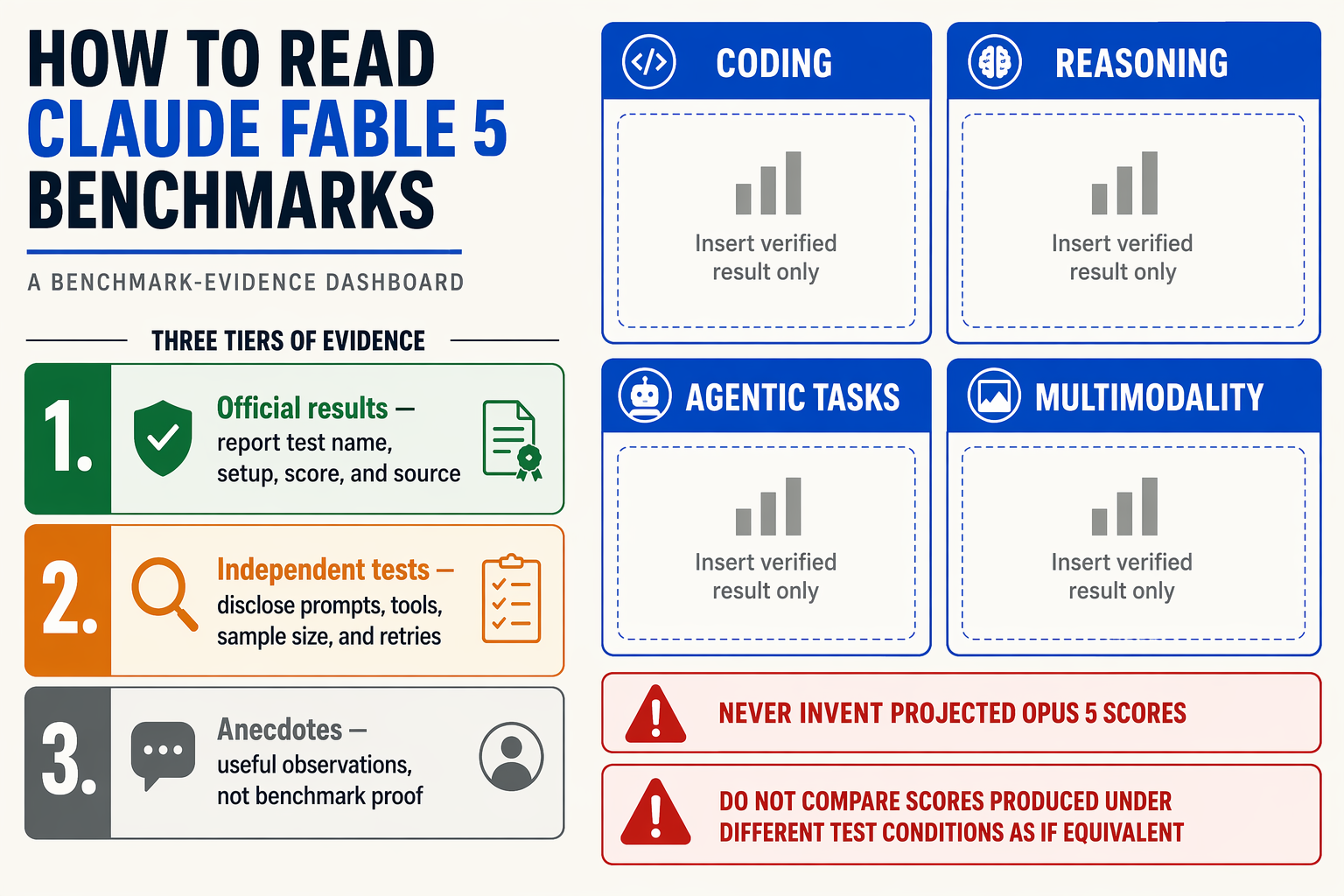
Claude Fable 5’s published evidence indicates strength in coding, multi-step reasoning, and long-horizon agentic work, but the supplied official sources do not provide enough numeric results to declare it universally superior. Claude Opus 5 has no verified benchmark scores or capabilities as of July 24, 2026; every claimed Opus 5 result remains unknown or rumor unless Anthropic publishes it.
Coding: promising evidence, with security-related limits
Anthropic positions Claude Fable 5 for “our most ambitious coding,” and its launch materials describe the model as fifth-generation intelligence. That supports coding as a primary intended workload, but positioning language is not interchangeable with independently reproducible benchmark data.
Developers should distinguish three questions:
- Can Fable 5 write and modify code? Anthropic’s product materials clearly position it for advanced coding.
- How does it perform under a fixed benchmark harness? The available context does not provide a verified numerical score for SWE-bench, Terminal-Bench, or another named coding benchmark.
- Will it complete every security-related coding task? No. Anthropic’s cyber-safeguards notice says, “For Claude Fable 5, we aim to block high-uplift vulnerability finding.”
That safeguard means refusal behavior can affect evaluations involving exploit development, vulnerability discovery, or dual-use security automation. A lower completion rate in such a test may reflect policy enforcement, not merely weak coding ability.
Reasoning: broad claims require task-level validation
The Claude Fable 5 and Claude Mythos 5 System Card describes Fable 5 and Mythos 5 as “two configurations of a new large language model from Anthropic.” This establishes an official technical relationship, but it does not mean their performance, latency, safeguards, or intended workloads are identical.
For reasoning, buyers should examine more than a headline aggregate:
- Exact-match accuracy on deterministic problems
- Performance across repeated runs
- Tool-assisted versus tool-free results
- Token and latency costs per successful answer
- Error detection and recovery after an incorrect intermediate step
No official Claude Opus 5 reasoning score is available as of July 24, 2026. Consequently, any chart showing Opus 5 ahead of—or behind—Fable 5 uses unverified or rumored data, not a confirmed Anthropic benchmark.
Agents: Factorio is the clearest qualitative signal
Anthropic reports that Claude Fable 5 autonomously plays Factorio, strategizing and building an automated factory in the engineering-focused simulation game. Factorio is useful as an agent demonstration because success requires planning, resource allocation, sequencing, environmental observation, and adaptation over many actions.
However, the demonstration does not by itself provide a standardized completion percentage, intervention count, token budget, or comparison against another model. It therefore shows agentic breadth, not a reproducible leaderboard victory.
Operational evaluations should measure:
- Successful task completion without human rescue
- Tool-call accuracy and recovery from failed calls
- Cost and elapsed time per completed workflow
- State retention over extended action sequences
- Resistance to prompt injection from tools or retrieved content
Multimodality: avoid claims beyond the documented test
The provided official context does not include a numerical vision, audio, or multimodal benchmark for Fable 5. Factorio demonstrates interaction with a complex environment, but it should not be presented as proof of performance on document OCR, chart interpretation, video understanding, speech, or image reasoning without corresponding test results.
The defensible conclusion is narrow: Fable 5 has verified qualitative evidence for autonomous, multi-step agent behavior, while a complete numerical benchmark picture is not present here. Claude Opus 5 coding, reasoning, agent, and multimodal capabilities are all unknown—not valid comparison baselines—until Anthropic announces and documents the model.
How should Claude Fable 5 pricing be converted into cost per completed task?
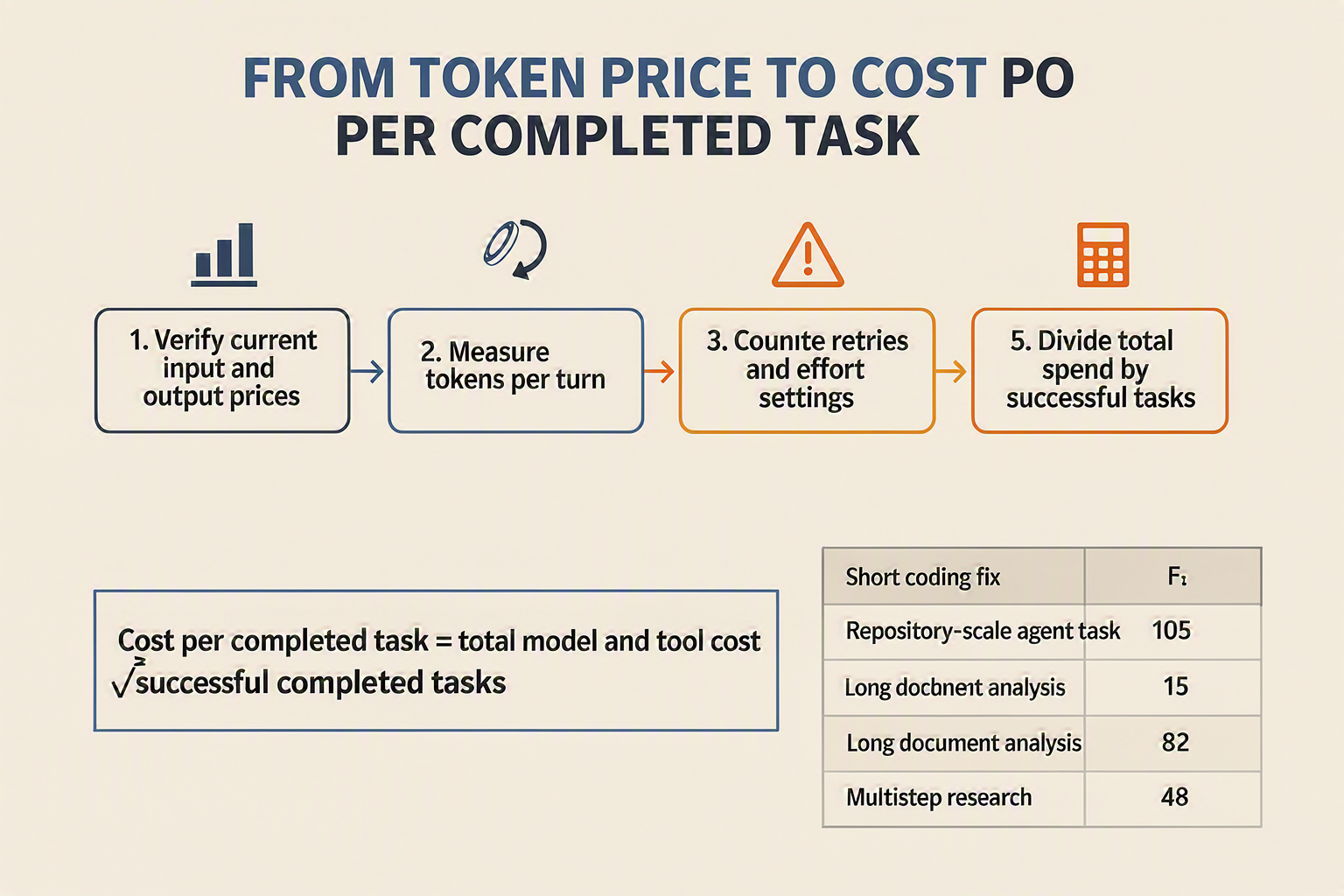
Convert Claude Fable 5 pricing into cost per completed task by summing every model call, tool charge, retry, and validation step required to produce one accepted result—not merely multiplying the advertised token rate by a single prompt. As of July 24, 2026, Claude Opus 5 pricing, token limits, API ID, release date, and capabilities remain unknown because Anthropic has not announced the model, so no defensible task-cost comparison is possible.
Use a completion-adjusted cost formula
Let:
- \(P_i\) = Fable 5 input price per million tokens
- \(P_o\) = Fable 5 output price per million tokens
- \(I\) = total input tokens consumed across all calls
- \(O\) = total output tokens consumed across all calls
- \(T\) = tool, search, storage, or infrastructure charges
- \(S\) = proportion of tasks that produce an accepted result
The practical formula is:
Cost per completed task = \(\big[(I ÷ 1{,}000{,}000) × P_i + (O ÷ 1{,}000{,}000) × P_o + T\big] ÷ S\)
Use the current Fable 5 rates shown in Anthropic’s official pricing documentation or your deployment provider’s billing console. The supplied Anthropic sources confirm availability but do not state numeric token prices, so inserting an unsupported dollar figure here would misrepresent Claude Fable 5 pricing.
Calculate the entire workflow, not one request
Consider an illustrative coding workflow—not a published Fable 5 benchmark—with:
- 40,000 input tokens and 8,000 output tokens per model call
- Three calls per attempted task: planning, implementation, and review
- A 90% accepted-completion rate
- Tool charges of \(T\) per attempt
Its completion-adjusted cost is:
\(\{3 × [(0.04 × P_i) + (0.008 × P_o)] + T\} ÷ 0.90\)
Dividing by 0.90 matters. If an attempted workflow costs $1.00 but only 90% of attempts pass evaluation, the effective cost becomes $1.11 per completed task. At a 60% completion rate, the same attempt cost becomes $1.67.
Include costs hidden by headline token rates
A production calculation should capture:
- Repeated context: Agent loops may resend repositories, documents, or conversation history.
- Retries and fallbacks: Timeouts, malformed tool calls, and failed validations consume tokens without completing work.
- Prompt caching: Apply provider-specific cache-write and cache-read rates separately rather than assuming all input tokens cost the same.
- Tool execution: Add web search, sandbox, database, and external API charges.
- Human review: Multiply reviewer time by the loaded hourly cost and divide by completed tasks.
- Safety-related refusals: Anthropic says Fable 5 aims to block “high-uplift vulnerability finding,” so some security tasks may have a lower completion rate despite low token expenditure.
Availability also affects economics. Anthropic’s Claude Platform documentation says Fable 5 became generally available on June 9, 2026, while Anthropic reported a foreign-national access suspension on June 12 and restored global access on July 1. Those events show why teams should track successful production completions, not theoretical API-call costs.
Compare models with a controlled task basket
Run both candidates against the same prompts, tools, budgets, and acceptance tests, then report:
- Median and 95th-percentile cost per accepted task
- Completion rate and retry count
- Tokens consumed per accepted result
- Human-review minutes
- Latency and failure rate
For Claude Opus 5, every corresponding price and performance input is currently unknown, not zero. Until Anthropic publishes verified Opus 5 terms, Fable 5 can be costed operationally; Opus 5 cannot.
How do safety controls and access restrictions affect real-world Fable 5 deployments?

Safety controls and access restrictions can determine whether Claude Fable 5 is operationally suitable even when its capabilities fit the workload. As of July 24, 2026, Fable 5 is globally available again, but its cyber safeguards may block some legitimate security tasks, while the unannounced Claude Opus 5 has no verified safety policy or access terms to evaluate.
Fable 5’s safeguards can limit cybersecurity workflows
Anthropic says Claude Fable 5 is designed to block “high-uplift vulnerability finding,” meaning requests that could substantially improve a user’s ability to discover exploitable weaknesses may be refused. Anthropic’s Sonnet 5 announcement also characterizes Fable 5 as blocking a much wider range of cybersecurity tasks than Sonnet 5.
That policy can affect authorized work as well as clearly malicious requests because a model must infer intent from limited context. Real-world consequences may include:
- Penetration testing: vulnerability discovery, exploit development, or attack-chain requests may trigger refusals even inside an authorized engagement.
- Secure-code review: ordinary remediation assistance may work, but requests that turn a discovered flaw into a working exploit face greater restrictions.
- Security research: reproducibility studies, red-team automation, and proof-of-concept generation may require human review or another approved tool.
- Agentic security systems: a refusal during one step can interrupt an entire autonomous scanning or remediation workflow.
Anthropic’s Claude Fable 5 and Claude Mythos 5 System Card is the primary source for evaluating these safety decisions. Teams should test representative prompts rather than assuming that a strong coding model will complete every security-related task.
Access history makes deployment resilience essential
Claude Fable 5’s launch demonstrated that model availability can change because of government policy, not merely technical outages.
- June 9, 2026: Anthropic’s Claude Platform documentation says Fable 5 became generally available through the Claude API, Amazon Bedrock, Claude Platform on AWS, Google Cloud, and Microsoft Foundry.
- June 12, 2026: Anthropic reported that a U.S. government export-control directive suspended access to Fable 5 and Mythos 5 for any foreign national.
- July 1, 2026: Anthropic announced that access had been restored and Fable 5 was redeployed globally.
This sequence matters for multinational companies. An access rule based on personnel nationality can affect offshore engineering teams, shared support operations, contractors, and cross-border incident response—even when infrastructure remains in an otherwise supported region.
Practical controls for production deployments
Organizations deploying Fable 5 should treat safety refusals and policy-driven access changes as architecture requirements:
- Classify workflows by cyber risk and expected refusal sensitivity.
- Record refusal rates using approved test sets, without attempting to bypass safeguards.
- Keep human escalation paths for interrupted security, legal, or customer-support tasks.
- Design provider or model fallbacks where contracts and policies permit them.
- Monitor Anthropic notices separately from ordinary API uptime alerts.
- Review cloud-specific eligibility, because availability through Amazon Web Services, Google Cloud, or Microsoft Foundry does not eliminate government restrictions.
Opus 5 provides no deployable alternative yet
Claude Opus 5 remains unannounced as of July 24, 2026. Its safety controls, access restrictions, deployment regions, availability date, capabilities, API identifier, pricing, limits, and benchmarks are all unknown—not verified specifications. No production plan should assume that Opus 5 will use lighter safeguards, avoid export controls, or serve as a fallback for Fable 5; such claims are rumor unless Anthropic confirms them officially.
What do official sources, independent tests, and expert opinions actually establish?
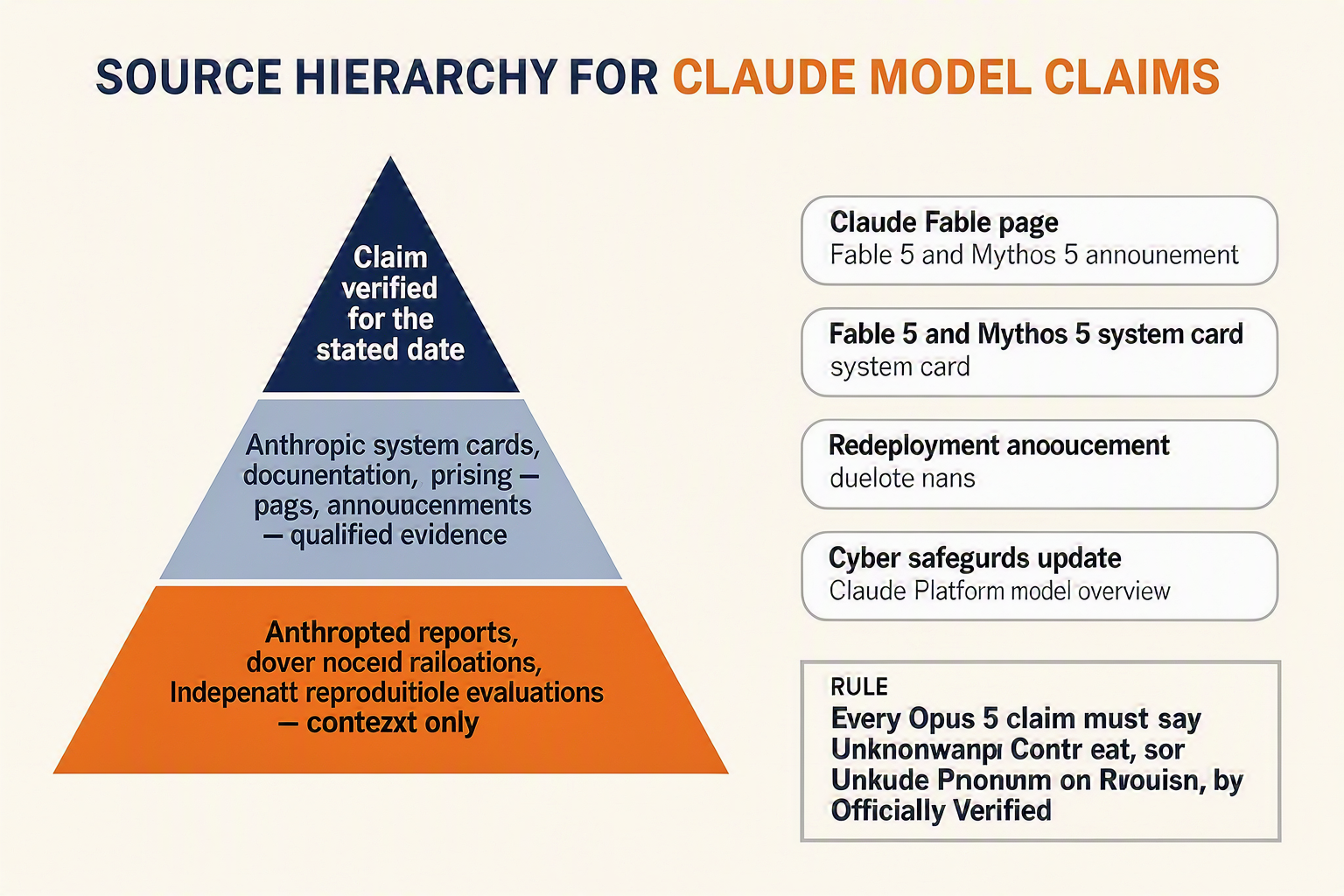
Official sources establish that Claude Fable 5 is a real, deployable Anthropic model with documented safeguards, but they do not establish that it outperforms an unannounced Claude Opus 5. As of July 24, 2026, no independent test or expert opinion can produce a valid head-to-head result because Claude Opus 5 has no verified model available to test.
What Anthropic’s primary sources establish
Anthropic’s evidence supports four defensible findings:
- Fable 5 is officially released. Anthropic’s Claude Platform documentation states that Claude Fable 5 became generally available on June 9, 2026 through the Claude API, Amazon Bedrock, Claude Platform on AWS, Google Cloud, and Microsoft Foundry.
- Fable 5 is a distinct configuration of Anthropic’s fifth-generation model. The official Claude Fable 5 & Claude Mythos 5 System Card describes Fable 5 and Mythos 5 as “two configurations of a new large language model from Anthropic.”
- Anthropic presents Fable 5 as suitable for complex agentic work. Anthropic’s launch material demonstrates Claude Fable 5 autonomously playing Factorio, planning and building an automated factory. That is useful qualitative evidence of long-horizon planning, but it is an Anthropic-selected demonstration—not an independent, reproducible benchmark.
- Security behavior is deliberately constrained. Anthropic’s cyber-safeguards notice says, “For Claude Fable 5, we aim to block high-uplift vulnerability finding.” Consequently, refusal behavior in advanced cybersecurity tasks may reflect policy enforcement rather than an absence of underlying capability.
Official material does not verify any Claude Opus 5 specification. Its release date, price, benchmark scores, context window, output limit, multimodality, tool-use capability, safety tier, deployment channels, and API ID all remain unknown. “Honeycomb” is an unverified rumor, not a confirmed Anthropic codename.
What independent tests can—and cannot—prove
A credible independent comparison would require both models to be accessible under controlled conditions. The supplied evidence contains no named independent laboratory test, reproducible evaluation, or third-party benchmark directly comparing Claude Opus 5 with Claude Fable 5.
Until Opus 5 is officially released, purported comparisons are likely to substitute one of three things:
- A previous model such as Claude Opus 4.8
- An unidentified preview or routing label
- Estimated performance based on naming conventions or rumors
None constitutes evidence about Claude Opus 5. Results for Claude Fable 5 vs Opus 4.8 may inform a separate comparison, but they cannot be relabeled as Claude Fable 5 vs Opus 5.
How to interpret expert opinions
Expert commentary is useful when it clearly separates observation from prediction. Give greater weight to opinions that disclose:
- The exact model ID and test date
- API settings, prompts, tools, and retry policy
- Sample size and scoring method
- Whether results were independently reproduced
- Access restrictions or safety refusals affecting completion rates
Treat claims such as “Opus 5 will be faster,” “Opus 5 will cost more,” or “Opus 5 beats Fable 5” as unsupported predictions unless Anthropic publishes corresponding evidence. The defensible expert conclusion on July 24, 2026, is narrower: Fable 5 can be evaluated today; Opus 5 cannot yet be evaluated credibly.
Which Claude model should you actually use for your workload? (TABLE)
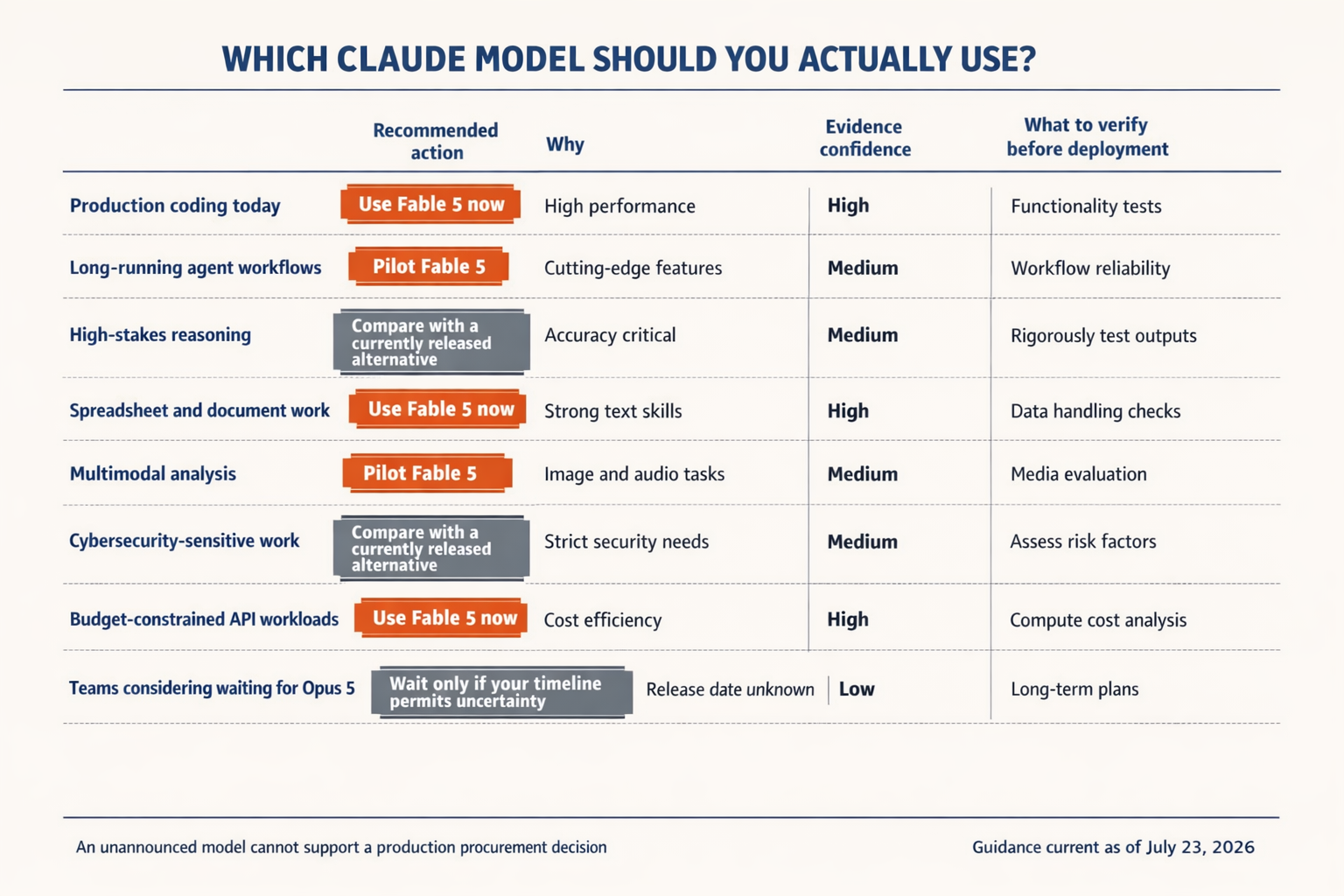
Use Claude Fable 5 for workloads that must run now; wait for Claude Opus 5 only when postponement has little operational cost. As of July 24, 2026, Claude Opus 5 remains unannounced, and its specifications, release date, price, benchmarks, API ID, context limits, output limits, modalities, and capabilities are unknown.
Workload decision matrix
| Workload | Recommended choice | Why | Evidence status |
|---|---|---|---|
| Production coding and code review | Claude Fable 5 | Anthropic positions Fable 5 for ambitious coding, and developers can test its real behavior through supported production channels. | Verified: generally available. Opus 5 coding capability and benchmarks: unknown. |
| Long-running agents and tool use | Claude Fable 5, after evaluation | Anthropic reports that Fable 5 can autonomously play Factorio, demonstrating planning and sustained interaction, but a game demonstration does not guarantee reliability in business agents. | Verified demonstration: Anthropic’s Fable 5 and Mythos 5 announcement. Opus 5 agent capabilities: unknown. |
| High-stakes reasoning | Fable 5 with human review | Fable 5 has official documentation and a system card, making risk assessment possible. Do not infer an Opus 5 advantage from its name or presumed product tier. | Fable 5 documented; Opus 5 reasoning scores and capability: unknown. |
| Cybersecurity automation | Fable 5 only if the task is permitted | Anthropic says its safeguards aim to block “high-uplift vulnerability finding,” so some legitimate security workflows may encounter restrictions. | Verified restriction: Anthropic’s cyber-safeguards notice. Opus 5 cyber policy and capability: unknown. |
| Multimodal or high-volume API systems | Benchmark Fable 5 against your own inputs | Availability does not establish acceptable latency, throughput, modality support, context capacity, output capacity, or total cost for a particular application. | Fable 5 availability verified; workload metrics require testing. Opus 5 specifications and price: unknown. |
| Experimental research with no deadline | Use Fable 5 now or wait without assumptions | Waiting is rational only if switching costs exceed the value of immediate deployment—not because an unannounced model is presumed stronger. | Opus 5 announcement date, availability, API ID, price, and performance: unknown. |
Apply three deployment gates
- Confirm access before architecture decisions. Anthropic’s Claude Platform documentation states that Claude Fable 5 is generally available through the Claude API, Amazon Bedrock, Claude Platform on AWS, Google Cloud, and Microsoft Foundry beginning June 9, 2026. Select the channel that satisfies residency, procurement, identity, and observability requirements.
- Run workload-specific evaluations. Test representative prompts for task success, hallucination rate, tool-call accuracy, latency, and cost. Anthropic’s Fable 5 and Mythos 5 system card is the appropriate starting point for documented safety and capability evidence, but published demonstrations should not replace internal acceptance tests.
- Design for policy and availability changes. Anthropic announced restored access and global redeployment on July 1, 2026, after the June access disruption. Production systems should therefore include retries, fallback models, audit logs, and escalation paths rather than assuming uninterrupted access.
The practical cutoff
Choose Claude Fable 5 when documentation, deployability, and measurable performance matter today. Consider waiting only for a formal Anthropic announcement that supplies verifiable Opus 5 pricing, limits, API identifiers, benchmarks, safety documentation, and deployment regions. Until then, “Honeycomb” is not a confirmed Claude Opus 5 codename, and no rumored Opus 5 detail should enter a procurement model or technical specification.
Frequently asked questions about Claude Opus 5 vs Claude Fable 5
Is Claude Opus 5 released, and when will it become available?
Which model wins the Claude Opus 5 vs Claude Fable 5 comparison?
What are Claude Fable 5 pricing and Claude Opus 5 API costs?
What are the context windows, output limits, and API IDs in Claude Opus 5 vs Claude Fable 5?
Is Claude Fable 5 better for coding and autonomous agents than Claude Opus 5?
Is Claude Fable 5 globally available, and does it have cybersecurity restrictions?
Conclusion
As of July 24, 2026, Claude Fable 5 is the practical choice because it is released, documented, and deployable; Claude Opus 5 remains unannounced. No evidence-based comparison can declare a raw-capability winner until Anthropic publishes official Opus 5 specifications, pricing, benchmarks, availability, and an API identifier.
- Claude Fable 5 has verified deployment channels. Anthropic’s Claude Platform documentation states that Claude Fable 5 became generally available on June 9, 2026, through the Claude API, Amazon Bedrock, Claude Platform on AWS, Google Cloud, and Microsoft Foundry. Any Claude Opus 5 release date, deployment channel, API ID, or regional availability remains unknown.
- Published evidence outweighs projected performance. Anthropic provides a Claude Fable 5 and Claude Mythos 5 system card covering capabilities and safety evaluations. By contrast, every claimed Claude Opus 5 benchmark, context window, output limit, multimodal feature, agentic capability, specification, price, or performance advantage is unknown or rumor unless Anthropic confirms it; “Honeycomb” is not a verified Opus 5 codename.
- Access policy can matter as much as intelligence. Anthropic said a U.S. government directive suspended access to Fable 5 for foreign nationals on June 12, 2026, before the company announced restored access and global redeployment on July 1, 2026. Anthropic also says Fable 5’s cyber safeguards aim to block “high-uplift vulnerability finding,” so security teams should evaluate policy restrictions alongside coding, reasoning, and agent performance.
- Use Fable 5 now when verified availability meets the workload; wait when switching costs justify caution. Teams should calculate costs from Anthropic’s current published pricing, test Fable 5 against representative tasks, and avoid budgeting around hypothetical Opus 5 prices or capabilities. A multi-model architecture can also reduce dependence on any single release or access policy.
The next decisive signal will not be another leak. Watch for an official Anthropic product page, model card, API documentation, pricing schedule, benchmark methodology, and availability notice for Claude Opus 5; until those appear, all such details remain unknown.
To explore how AI communication is evolving, check out CallMissed, an AI infrastructure platform supporting voice agents, multilingual chatbots, and multi-model access through an OpenAI-compatible gateway. Will your team deploy the model supported by evidence today—or postpone production decisions for an unannounced alternative?
Related Reading
- Claude Opus 5 vs Kimi K3: Leaks vs Verified Facts (July 2026)
- Claude Opus 5 vs Claude Sonnet 5: Verified Facts, Benchmarks, Pricing, and Verdict (July 2026)
- Claude Opus 5 vs GPT-5.6 Sol: Verified Facts vs Rumors (July 2026)
Sources
Discussion
Related Posts



Ready to automate customer conversations?
Launch AI voice agents and WhatsApp bots with CallMissed — one API, 22+ Indian languages.