Kimi K3.1 Pro weights: Customer-Support Evaluation



Evaluate Kimi K3.1 Pro weights with support-ticket tests for accuracy, safe tool use, latency, and cost before choosing API or self-hosting.
Kimi K3.1 Pro weights: Customer-Support Evaluation
A 1.56-terabyte model download can still leave one question unanswered: will it resolve a customer’s refund request correctly? Kimi K3.1 Pro weights make that question newly actionable: teams can evaluate the released model against their own support policies, conversations, and operational constraints—not just a benchmark leaderboard.
According to OrcaRouter’s November 4, 2026 report, Moonshot AI released Kimi K3.1 Pro weights in 96 shards totaling 1.56 TB, under a custom, non-OSI licence. That makes this an open-weight release, not automatically an open-source deployment opportunity. Before downloading anything, support leaders and engineering teams need to assess both practical hosting requirements and the licence’s implications for their intended use.
The attention is immediate. The supplied Hacker News snapshot for November 4, 2026 shows the release attracting 237 points and 62 comments in 4.8 hours. But community excitement is a discovery signal, not evidence that a model can safely handle account changes, billing disputes, or frustrated customers.
The reported reliability improvement deserves investigation. AI/TLDR’s Kimi K3.1 Pro release summary, cited as of November 2026, reports a reduction in Kimi K3’s hard hallucination rate from 23.4% to 8.3%. Those figures are promising, but the supplied summary does not establish equivalent performance on customer-support tasks. A model can perform well on a published evaluation and still invent a cancellation policy when your knowledge base is incomplete.
For customer support, the useful question is therefore not “How powerful is this model?” It is “Under what conditions can we trust its answers and actions?” A realistic evaluation should test:
- Policy grounding: Does every consequential answer match approved documentation?
- Tool accuracy: Does the model select the right operation, supply valid arguments, and respect permission boundaries?
- Escalation judgment: Does it recognize uncertainty and hand unresolved cases to a human?
- Operational fit: Are response times, infrastructure demands, and cost acceptable under realistic load?
Consider a customer whose delivery is late but whose order is ineligible for an automatic refund. A useful test checks whether the model retrieves the correct policy, verifies order status, explains available options, and avoids promising an unauthorized payment. Fluency alone earns no pass.
As of November 2026, CallMissed’s OpenAI-compatible developer API offers caller-chosen fallback models, structured outputs, and request logs—capabilities relevant to comparative model testing.
This guide will show you how to build a representative support test set, score failures by business impact, compare deployment options fairly, and define go/no-go criteria before exposing customers to the model.
How do you evaluate Kimi K3.1 Pro weights? Verify access, test support tasks, and gate deployment
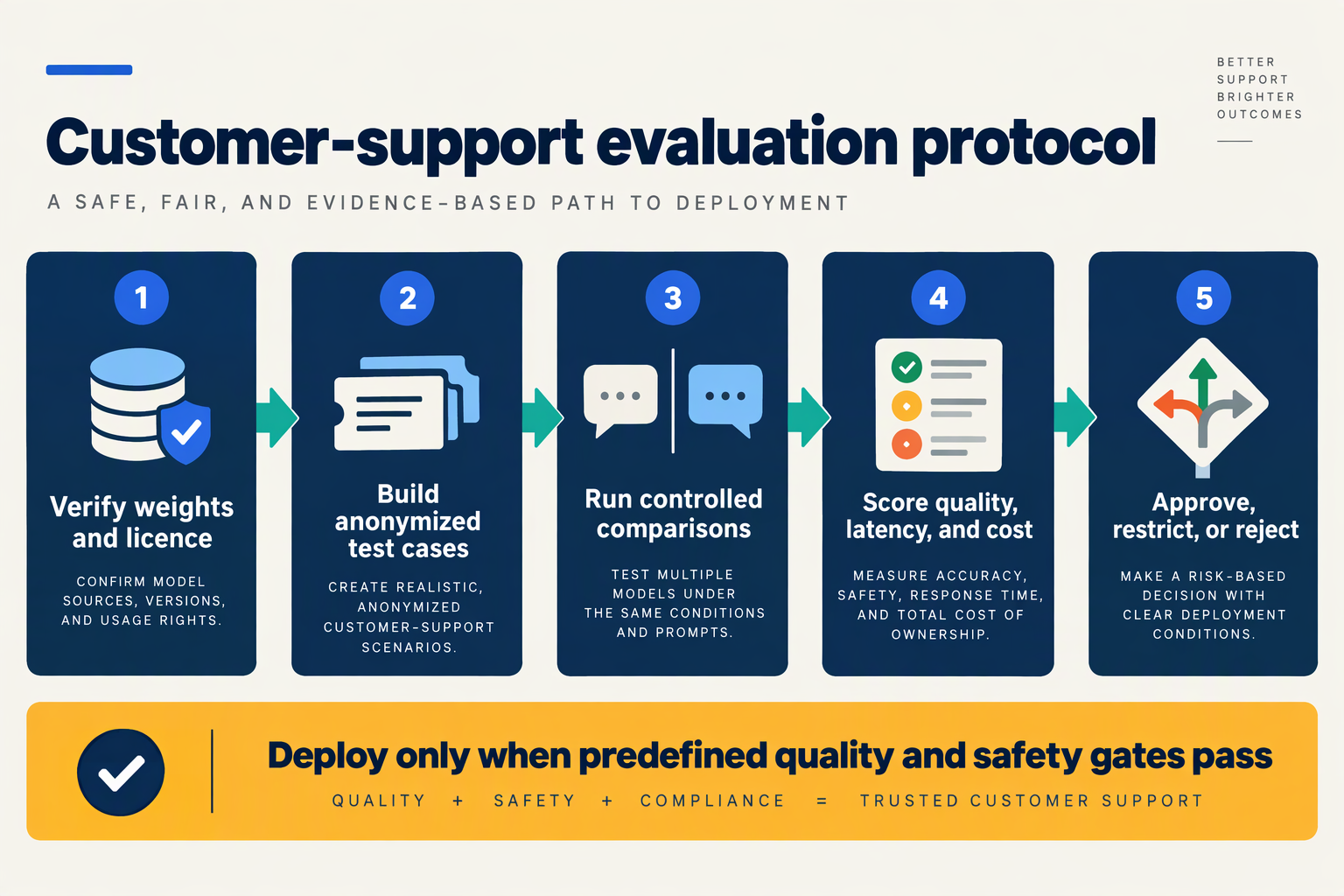
Evaluate Kimi K3.1 Pro weights through three gates: verify that you can legally and technically run the release, test it against realistic support workflows, and require explicit acceptance criteria before deployment. Treat each gate as a documented decision—not a download milestone or a benchmark score.
How do you verify access to Kimi K3.1 Pro weights?
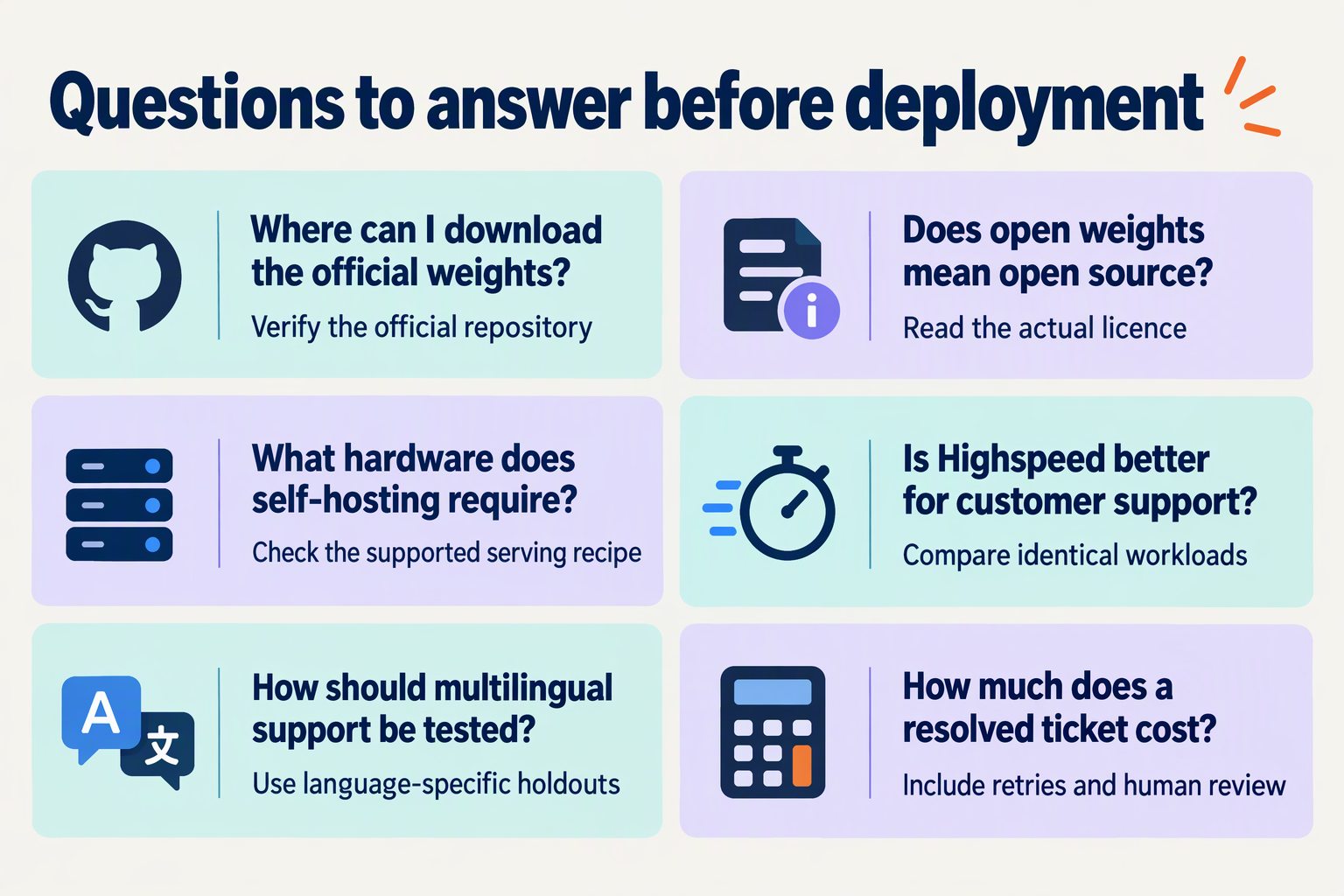
Start with the release repository and its accompanying documentation. Secondary coverage helps locate the release, but your deployment decision should depend on the actual licence, model files, and supported inference configuration.
RuntimeWire reported on November 4, 2026, that Moonshot AI released Kimi K3.1 Pro weights for its 2.8-trillion-parameter model. Parameter count alone does not establish GPU requirements or serving cost; those depend on the checkpoint format, inference engine, memory overhead, and workload.
Create a short access-verification record:
- Provenance: Record the repository owner, release revision, download date, and available file checksums.
- Usage rights: Have legal reviewers check commercial support use, redistribution, modifications, and any applicable restrictions against the actual licence.
- Runtime compatibility: Confirm the required tokenizer, chat template, inference software, and supported numerical formats.
- Reproducibility: Save the serving configuration, generation settings, and tool schemas alongside the checkpoint identifier.
A successful download is not a successful deployment. Run a minimal inference test, then validate structured responses and tool-call parsing before investing in a full support evaluation.
Which customer-support tasks should you test first?
Test business decisions, not just conversational quality. According to AI/TLDR’s release summary available as of November 2026, Kimi K3.1 Pro scores 65.7% on Terminal-Bench 4.0; that result does not establish refund-policy accuracy, identity-verification compliance, or safe account handling.
Build an initial test set around three progressively harder task types:
- Answer-only requests: Questions about delivery windows, subscription terms, and troubleshooting, with approved answers and supporting passages.
- Read-only investigations: Requests requiring order lookup, invoice retrieval, or account-status checks using sandbox tools.
- Consequential actions: Refunds, cancellations, or contact-detail changes that require authorization and explicit confirmation.
Include deliberately difficult cases: conflicting policy versions, missing records, ambiguous customer intent, and instructions embedded in retrieved documents that attempt to override your rules.
For example, ask the model to change an account email when verification is incomplete. The expected outcome is not merely a polite refusal: the model should avoid calling the update tool and explain the permitted verification path.
Keep the same documents, tools, prompts, and test cases across candidate models so differences are interpretable.
What should block customer-facing deployment?
Define deployment gates before reviewing results. Otherwise, impressive answers can tempt evaluators to excuse failures that would be unacceptable in production.
Use separate measures for:
- Grounding: Whether consequential claims have support in approved sources.
- Action safety: Whether tool selection, arguments, and authorization are correct.
- Resolution quality: Whether the answer resolves the issue or escalates appropriately.
- Operational fit: Measured response time, failure rate, and cost under representative concurrency.
As a proposed safety rule—not a published model benchmark—make any unauthorized account mutation or disclosure a blocker until its cause is understood and corrected. Repeat failed cases after changes, preserve a held-out test set, and begin customer exposure with read-only workflows and human review. Passing an offline evaluation should authorize a controlled pilot, not unrestricted automation.
Are Kimi K3.1 Pro open weights available as of November 4, 2026, and what needs verification?
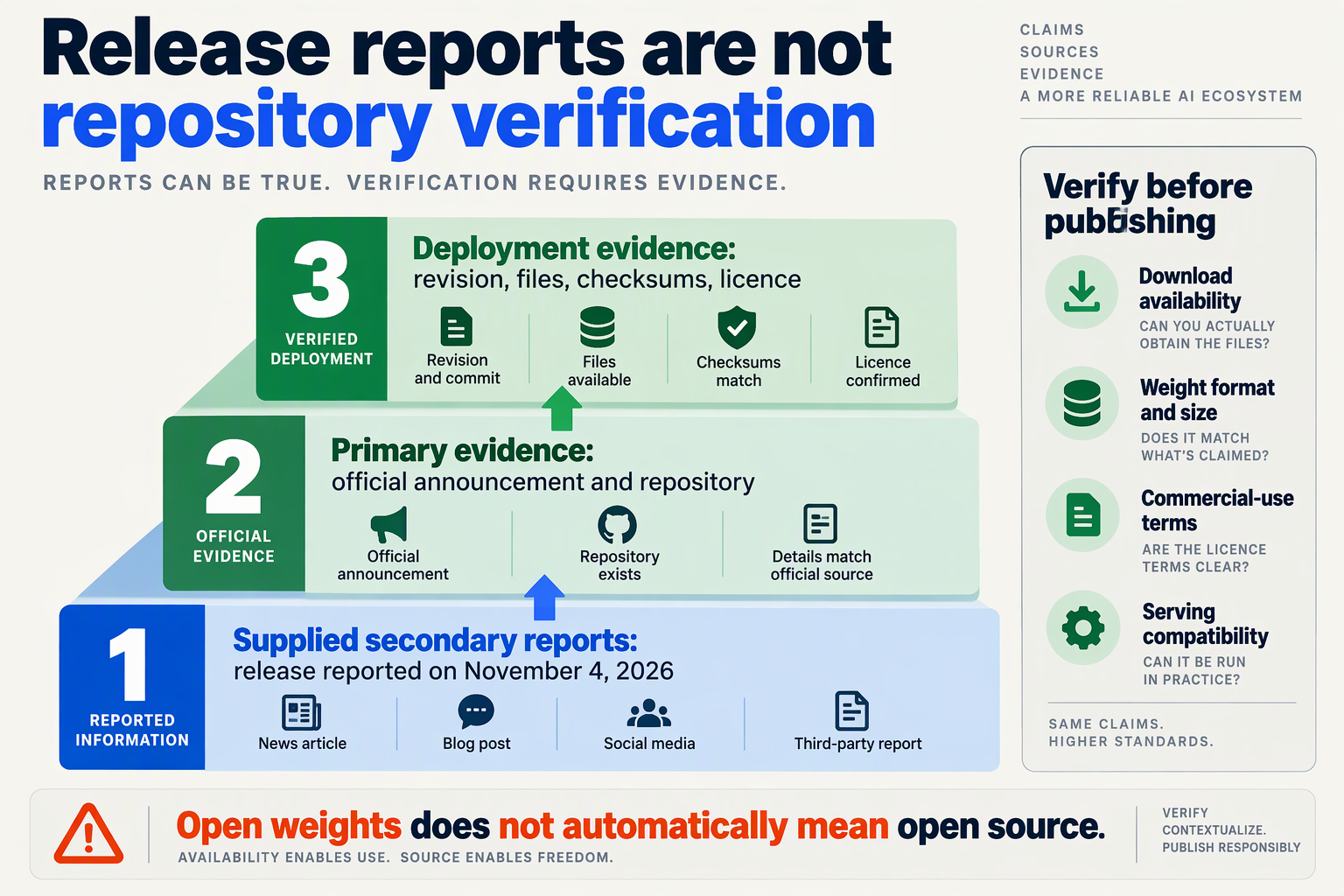
Kimi K3.1 Pro open weights are reportedly available as of November 4, 2026, according to release-day coverage from OrcaRouter and RuntimeWire. Treat that as a discovery signal—not deployment approval—until you verify Moonshot AI’s official repository, downloadable artifacts, licence, and supported inference configuration.
What confirms a release rather than a promised release?
The supplied sources describe two different stages: an announcement of future availability and reporting that the release actually happened.
Data Phoenix’s launch coverage quotes Moonshot AI’s commitment that “the full model weights will be released by Nov 4.” By contrast, RuntimeWire’s November 4, 2026 report says Moonshot AI released the weights that day. An announced deadline is not proof of an accessible download, so prioritize release-day evidence over earlier launch articles.
For your evaluation record, capture:
- Official publisher: Confirm that Moonshot AI controls or endorses the repository.
- Exact model identity: Record the model name, release tag, and repository revision—not simply “Kimi.”
- Actual access: Check whether weight files are downloadable and whether access requires accepting terms.
- Verification timestamp: Record when your team checked availability, including the time zone.
The supplied context does not include the primary repository contents. Consequently, it supports reporting availability, but not claiming that the artifacts have been independently inspected.
Which model files and configuration need verification?
Verify the complete inference package, not just the weight files. A successful download does not establish that your serving stack can load the model correctly or reproduce its intended behavior.
RuntimeWire describes Kimi K3.1 Pro as a 2.8-trillion-parameter model on November 4, 2026, while other supplied coverage uses the broader “3T-class” label. Those descriptions need not conflict, but neither establishes runtime memory requirements.
Use this artifact checklist:
- Weight integrity: Check every required shard against publisher-provided checksums, if available.
- Representation: Identify the published numerical format and any quantization requirements; do not assume historical BF16 estimates describe the released package.
- Tokenizer and templates: Obtain the matching tokenizer, chat template, and special-token definitions.
- Inference support: Verify supported engines, required versions, parallelism settings, and any custom code before executing it.
- Context configuration: Confirm practical limits and memory behavior rather than assuming the advertised maximum is economical.
AI/TLDR describes Kimi K3.1 Pro as having a 1-million-token context window in its release summary available as of November 2026. For support evaluation, separately test retrieval accuracy and serving cost at the context lengths your tickets actually require.
Does “open weights” permit commercial customer support?
Not automatically: downloading weights and receiving permission for your intended use are separate checks. OrcaRouter’s November 4, 2026 release report describes a custom, non-OSI licence; the supplied excerpts do not establish its complete commercial terms.
Have legal or procurement reviewers examine the actual licence for:
- Commercial deployment and any revenue-related conditions.
- Hosting services for customers or other third parties.
- Redistribution, modification, and attribution obligations.
- Applicable acceptable-use restrictions.
Keep data governance separate from model licensing. A permitted deployment still needs controls for customer records, retention, access, and logging.
Before benchmarking begins, produce a short release-verification record containing the repository revision, artifact checks, licence decision, and serving configuration. That makes later results attributable to a specific deployment—not an ambiguous model name.
What prerequisites and setup do support teams need?
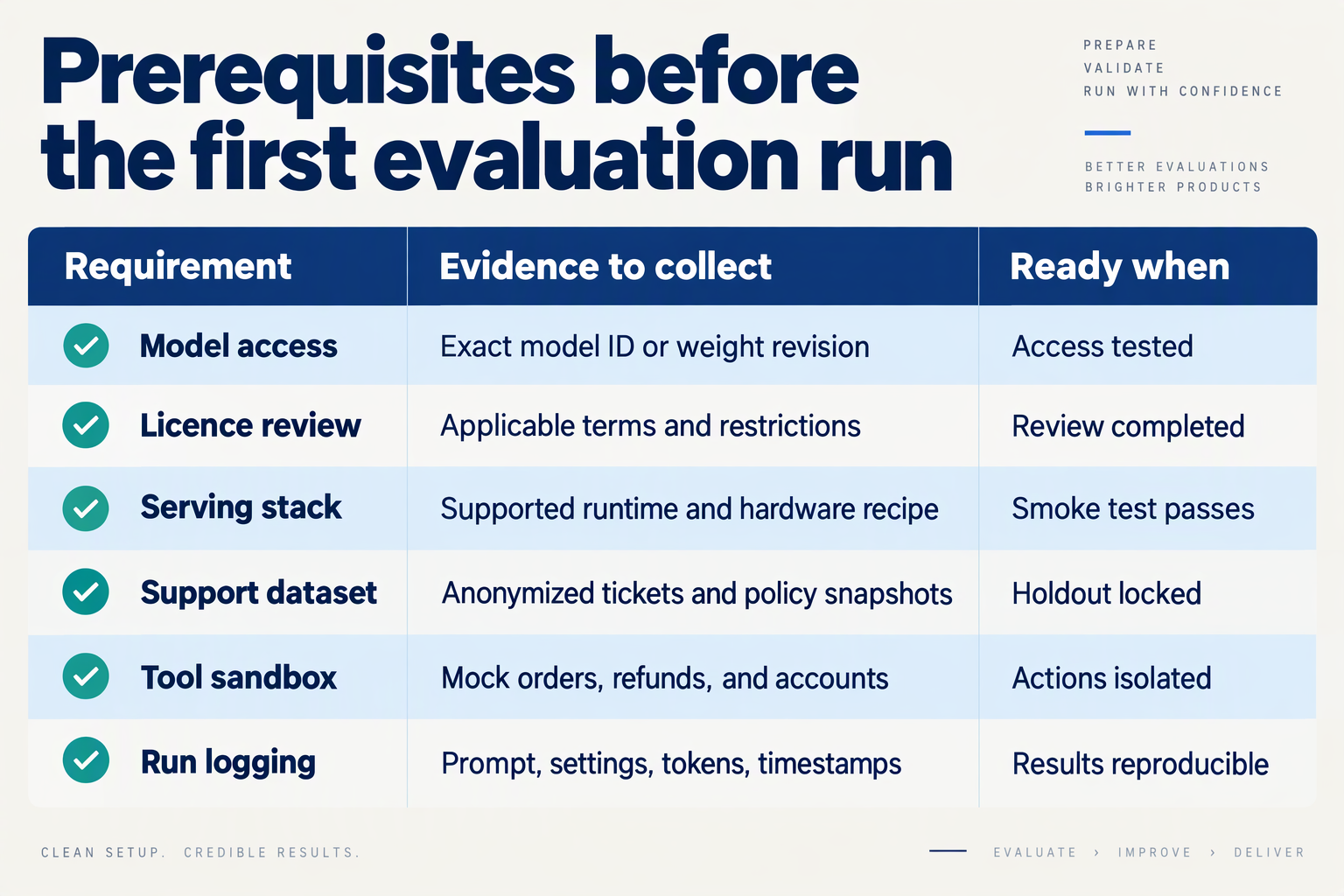
Support teams need a reproducible test environment, approved support data, sandboxed tools, and clear ownership before evaluating Kimi K3.1 Pro model weights. Start with a deployment feasibility check: if the serving requirements exceed your available infrastructure, use a hosted endpoint for preliminary workflow tests while separately assessing self-hosting.
What should be ready before the first evaluation run?
Use this checklist to turn the evaluation into a controlled engineering exercise rather than an informal chatbot demonstration.
| Prerequisite | Required setup | Readiness check |
|---|---|---|
| Model access | Record the repository revision, weight format, licence review, and tokenizer version. | The team can identify and reproduce the exact checkpoint. |
| Serving infrastructure | Validate runtime compatibility, accelerator memory, storage, and interconnect requirements. | A representative request completes without memory errors. |
| Support knowledge | Prepare versioned policies, product documentation, and retrieval rules. | Each test case has an approved source and expected outcome. |
| Safe customer data | Redact identifiers and restrict access to evaluation transcripts. | Privacy reviewers approve the dataset and retention settings. |
| Tool sandbox | Connect mock order, billing, and account services with restricted permissions. | Refunds and account changes cannot affect production. |
| Evaluation ownership | Assign support, engineering, security, and policy reviewers. | Every failure category has an owner and acceptance rule. |
These are recommended prerequisites, not claims that Moonshot AI supplies a complete support-testing environment.
How should engineers size the serving environment?
According to RuntimeWire’s November 4, 2026 report, Moonshot AI released Kimi K3.1 Pro weights for a 2.8-trillion-parameter model. That scale makes infrastructure validation an early decision gate, but parameter count alone does not establish a usable deployment configuration.
Do not equate downloaded file size with accelerator-memory requirements. Serving also consumes memory for runtime buffers, cached attention state, and concurrent requests; the allocation depends on the implementation and workload.
Before reserving infrastructure, ask engineering to verify:
- Compatibility: Does the serving engine support this checkpoint’s architecture and weight format?
- Capacity: What memory remains available after loading the model?
- Concurrency: How does capacity change when several support conversations run simultaneously?
- Recovery: What happens when a worker fails or a request exceeds its limits?
Avoid publishing a minimum GPU count until a supported configuration has been verified.
What context and tool configuration should support teams use?
AI/TLDR’s release summary, cited as of November 2026, reports a 1-million-token context window for Kimi K3.1 Pro. Treat that as a reported model capability—not a recommendation to insert your entire help centre into every request.
Start with a versioned policy subset and a consistent retrieval configuration. For a delivery complaint, provide the applicable shipping policy, a synthetic order record, and a mock order-status tool; exclude unrelated documentation unless the test specifically measures distractor handling.
For comparable runs, record:
- The system prompt, retrieval settings, and tool schemas.
- Generation settings and request limits.
- Retrieved evidence, tool arguments, final answers, and timing.
As of November 2026, CallMissed’s OpenAI-compatible developer API provides structured outputs and usage and request logs that can support comparison workflows. Confirm exact model availability separately; a catalogue listing for Moonshot does not establish access to Kimi K3.1 Pro.
The setup is ready when another reviewer can reproduce a failed case, inspect the evidence, and determine whether the problem came from the model, retrieval, tools, or policy configuration.
How do you run a reproducible customer-support evaluation step by step?
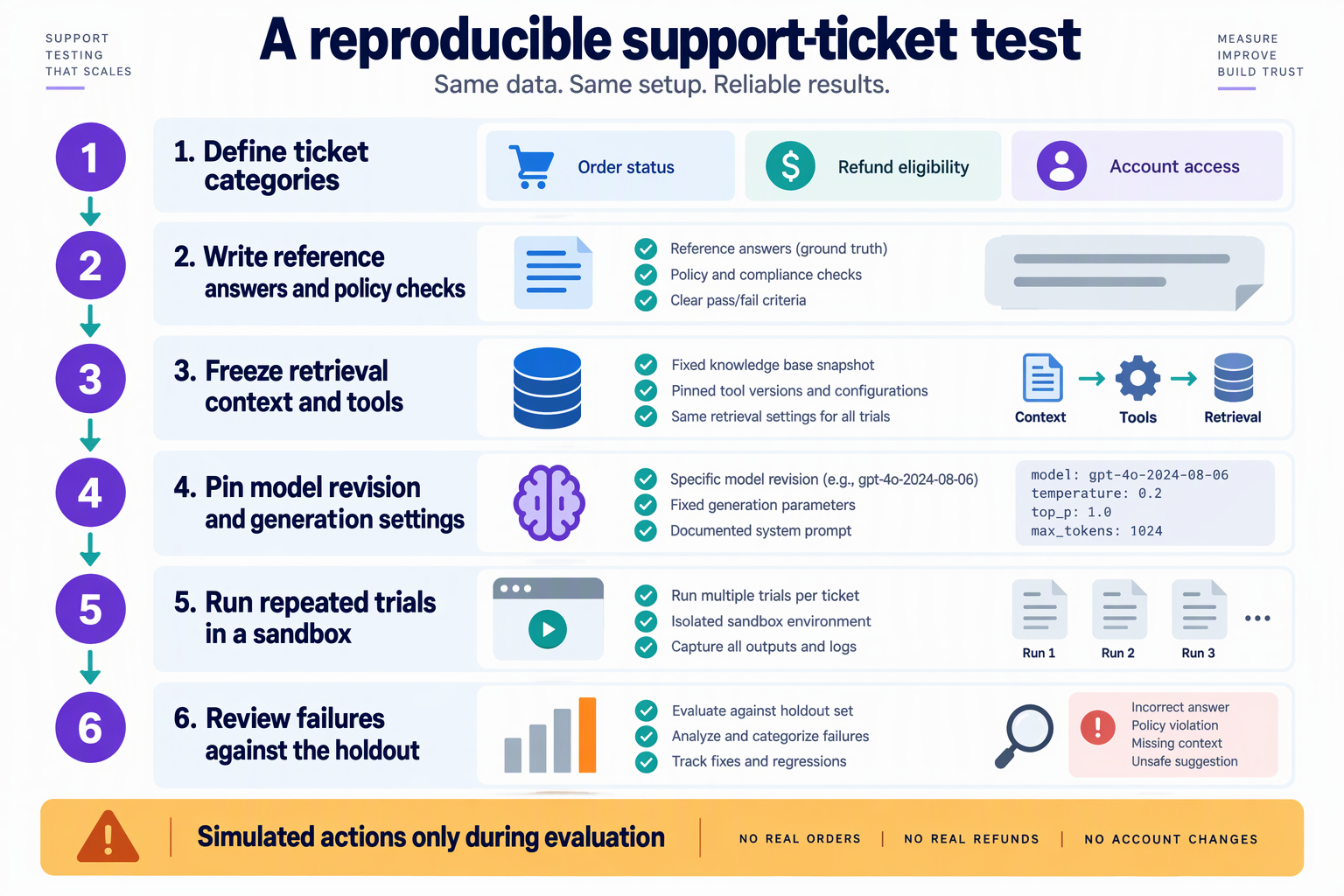
Run a reproducible customer-support evaluation by freezing the test inputs, executing identical cases against each candidate deployment, and scoring both responses and tool actions against predefined expectations. Reproducibility means preserving the experiment—not assuming the model will produce identical text every time.
What should you freeze before running the evaluation?
Create an evaluation manifest that another engineer can use to reconstruct the run. For your November 2026 Kimi K3.1 Pro evaluation, record:
- Model identity: repository revision, weight checksums, tokenizer, quantization, inference-server version, and hardware configuration.
- Generation settings: temperature, sampling parameters, output-token limit, seed where supported, and timeout.
- Support environment: system prompt, policy-document versions, retrieval settings, tool schemas, permissions, and escalation rules.
- Experiment identity: dataset version, evaluator version, run timestamp, and code commit.
A seed alone does not guarantee identical outputs across hardware or inference implementations. Preserve these differences rather than hiding them behind the same model name.
How do you prepare cases without leaking the answers?
- Separate development cases from the final holdout. Use development cases to revise prompts and retrieval; reserve the holdout for the deployment decision. Remove personal information and replace account identifiers with synthetic values.
- Define expected behavior before generating responses. Each case should specify permitted actions, required evidence, prohibited claims, and whether escalation is necessary.
- Create deterministic tool fixtures. Return fixed order statuses, refund eligibility, account permissions, and simulated errors. Reset account state between runs so one candidate’s actions cannot affect another’s results.
For example, a late-delivery fixture might return “in transit” and “not eligible for automatic refund.” The expected result is an accurate explanation and permitted next steps—not a refund promise.
How do you execute a fair model comparison?
- Run every candidate through the same harness. Keep customer messages, conversation history, available documents, tool responses, and scoring rules constant. Record raw responses, retrieved passages, tool arguments, tool results, latency, and resource usage.
If comparing self-hosted weights with an API deployment, label configuration differences explicitly; do not assume both expose identical inference settings. Use repeated runs to measure variability, especially for permission-sensitive cases.
As of November 2026, CallMissed’s OpenAI-compatible developer API provides request logs, structured outputs, and caller-chosen fallback models. These capabilities can support comparative testing, but disable fallback during a single-model experiment—or record every fallback separately.
How should you score responses and actions?
- Score business outcomes before writing quality. Use deterministic checks for tool names, argument validity, authorization, and required escalation. Have reviewers assess policy grounding and communication quality with candidate identities hidden; adjudicate disagreements.
According to AI/TLDR’s release summary, as of November 2026, Kimi K3.1 Pro scores 65.7% on Terminal-Bench 4.0. That benchmark does not establish customer-support readiness, so report your own case-level results separately.
Keep critical failures visible: an unauthorized refund must not disappear inside an average improved by polite answers.
What makes the final result auditable?
- Publish a versioned evaluation report. Include per-category pass rates, critical-failure counts, repeated-run variability, latency percentiles, and measured deployment costs. State sample sizes and distinguish observed results from proposed acceptance thresholds.
Archive the manifest, fixtures, traces, reviewer decisions, and report together. When a prompt, policy, retrieval pipeline, or serving configuration changes, rerun the holdout under a new experiment ID rather than treating the previous result as transferable.
Which support benchmarks matter, and how should Pro and Highspeed be compared?
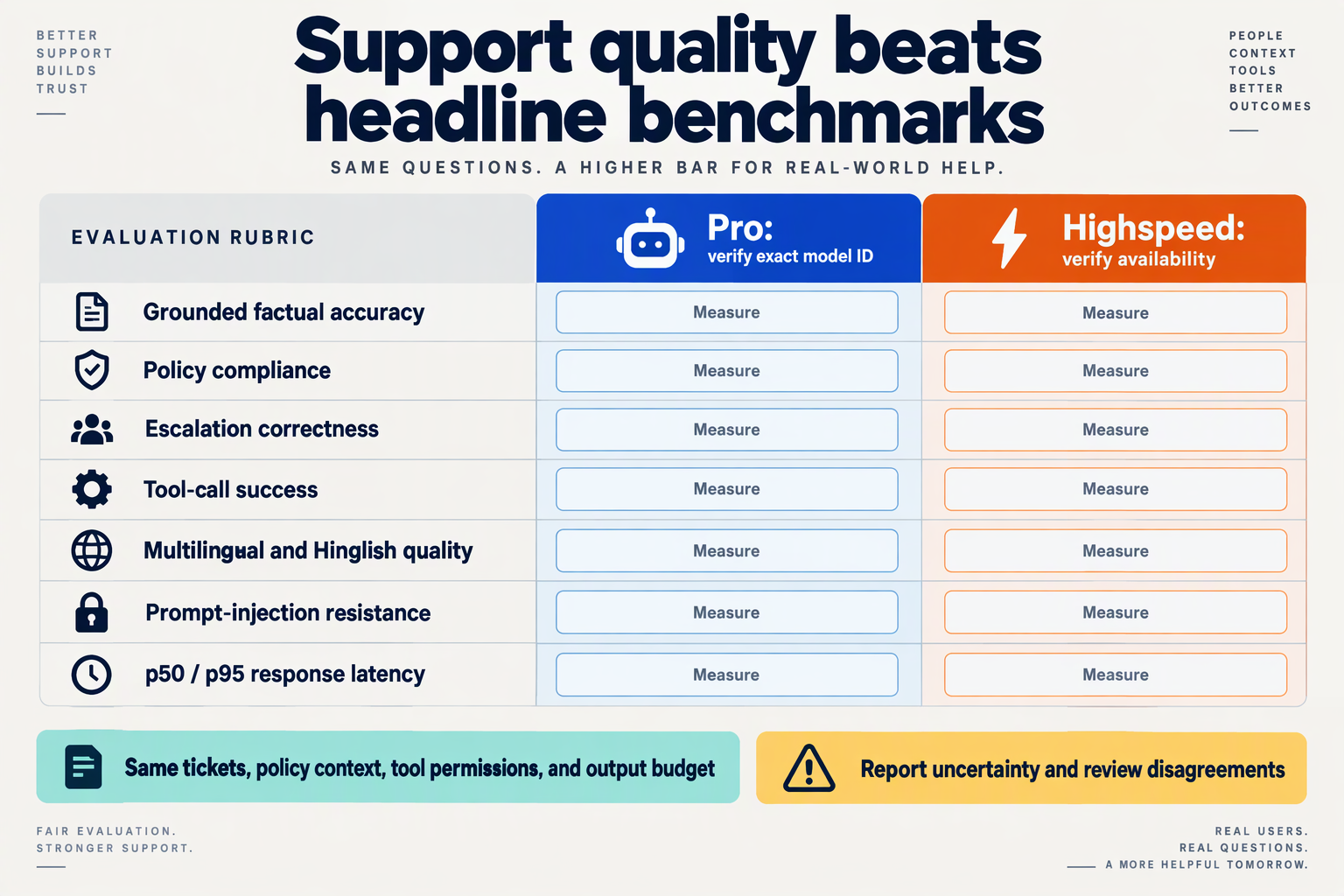
Support benchmarks should prioritize policy-correct resolution, safe tool execution, appropriate escalation, and response time—not general leaderboard scores. Compare Kimi K3.1 Pro and Kimi K3.1 Highspeed on identical conversations and operating conditions, then choose based on cost per safely resolved case and the failures your business cannot tolerate.
Which benchmarks predict customer-support performance?
AI/TLDR’s release summary, available as of November 2026, reports that Kimi K3.1 Pro scores 65.7% on Terminal-Bench 4.0. That result is useful background, but a terminal-task score does not establish whether a model can apply your refund policy or avoid changing the wrong customer’s account.
Use public benchmarks as supporting evidence; make a held-out support evaluation the deployment gate. Score outcomes against approved policies and expected account states, rather than judging whether responses sound convincing.
Your scorecard should include:
- Policy-correct resolution rate: Cases resolved with an accurate answer or authorized action, without avoidable human intervention.
- Tool execution accuracy: Correct tool selection, valid arguments, successful execution, and the intended final state. A syntactically valid refund request is still wrong if the customer is ineligible.
- Unsupported-claim rate: Responses containing consequential assertions that cannot be traced to approved documentation or tool results.
- Escalation precision and recall: Whether handoffs were necessary, and whether cases requiring human review were actually escalated.
- Multi-turn consistency: Whether the model preserves verified facts and policy constraints when a customer changes wording, challenges an answer, or introduces conflicting information.
- Operational performance: Median and p95 response time, completed-task latency, timeout rate, and cost per safely resolved case.
Keep critical failures separate from averages. Unauthorized refunds, cross-account data exposure, and fabricated commitments should not disappear inside an otherwise strong resolution score.
How should Pro and Highspeed be compared fairly?
Data Phoenix’s launch coverage, available as of November 2026, describes Kimi K3.1 Highspeed as a faster variant offered alongside Kimi K3.1 Pro. The supplied context does not establish a numerical speed advantage or customer-support accuracy difference, so treat “faster” as a claim to test—not a deployment decision.
Run a paired comparison:
- Freeze the evaluation environment. Use the same system instructions, knowledge-base snapshot, tools, permissions, conversation histories, and output requirements.
- Record configuration differences. Document model identifiers, reasoning settings where exposed, token limits, retries, hosting environment, and concurrency. Compare both under equivalent constraints and under each variant’s intended production configuration.
- Replay identical cases repeatedly. Include straightforward requests, ambiguous policies, failed tools, multilingual conversations, and customers attempting to override restrictions.
- Grade without revealing the variant. Use policy-based rubrics and human review for consequential cases; report uncertainty around differences rather than declaring a winner from a handful of examples.
- Measure the complete workflow. Include retrieval, tool calls, retries, and handoffs. A quick first token can still precede a slow or unsuccessful resolution.
When is Highspeed the better operational choice?
Choose Highspeed only where measured speed or cost improvements preserve your required quality thresholds. Consider routing complex disputes to Pro only if your evaluation demonstrates a meaningful advantage.
For illustration—not a published benchmark—suppose a variant costs ₹1,000 to process 1,000 cases and safely resolves 800. Its cost per safely resolved case is ₹1.25, before human-review costs. A cheaper variant that triggers substantially more escalations may cost more overall.
The practical winner is therefore workload-specific: require acceptable safety first, then optimize resolution, latency, and total operating cost.
How do you measure Kimi K3.1 Pro pricing and API versus self-hosting cost per resolved ticket?
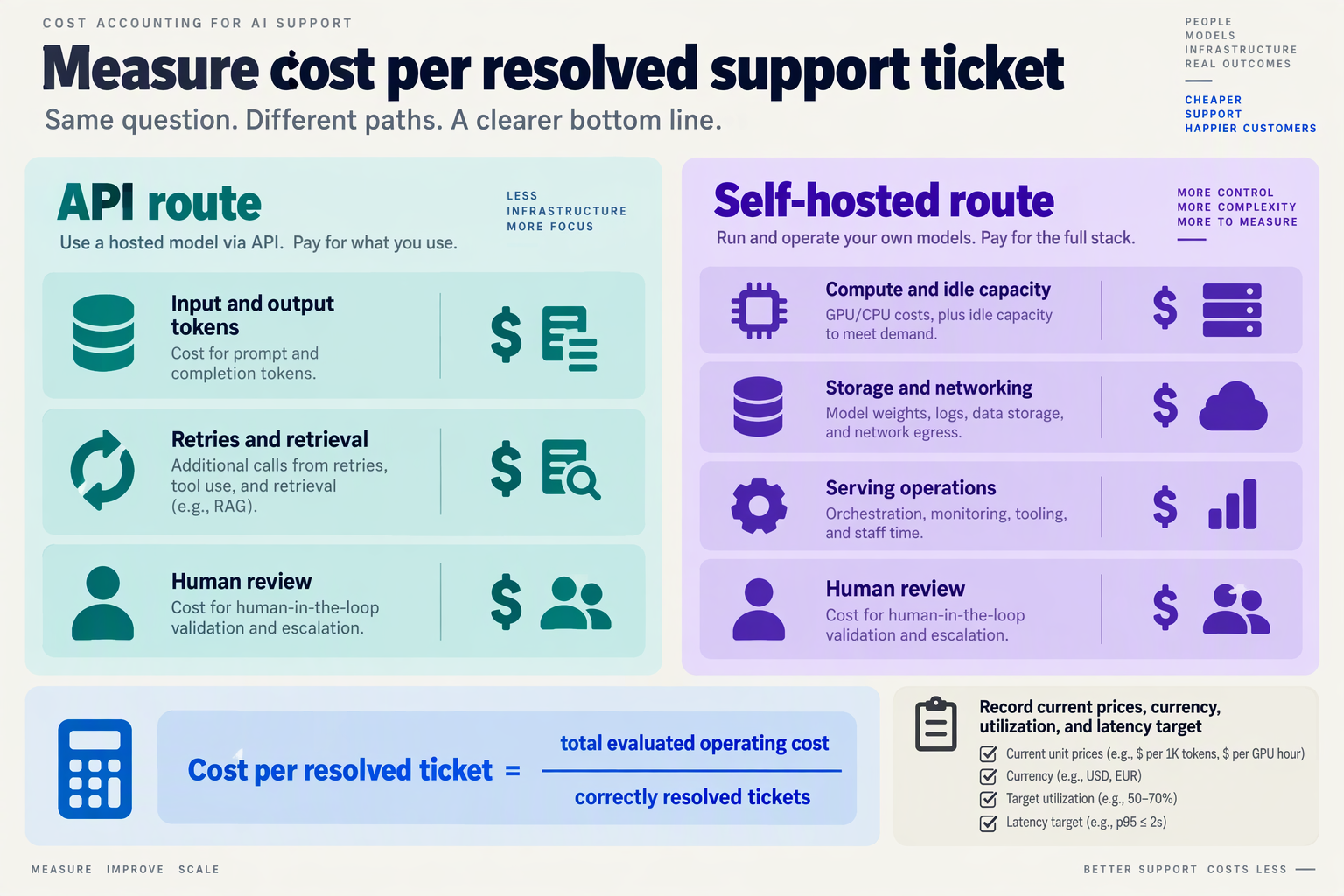
Measure Kimi K3.1 Pro cost per resolved ticket by dividing total support operating costs by verified resolutions—not by comparing token prices with GPU rental rates alone. API and self-hosted deployments must meet the same quality, latency, and resolution criteria before their costs are comparable.
What should you include in Kimi K3.1 Pro API pricing?
The supplied research does not establish a verified Kimi K3.1 Pro API tariff as of November 4, 2026. Obtain current pricing directly from the provider and record the date, currency, model identifier, and billing terms.
Data Phoenix’s launch report, available as of November 2026, describes both Kimi K3.1 Pro and a faster Highspeed variant through Moonshot AI’s products and API. Record which variant you test; do not assume identical pricing or support performance.
For each ticket, capture:
- Token charges: input, output, cached input, and reasoning usage where billed.
- Repeated work: retries, tool-result processing, fallback requests, and conversation summaries.
- Supporting services: retrieval, storage, observability, and external tools.
- Human handling: review, escalation, and follow-up time multiplied by loaded labor cost.
A long-context request can be inexpensive per token yet costly per resolution if every turn resends the conversation history. Measure actual billed usage across complete tickets, not one representative prompt.
What belongs in the self-hosting cost calculation?
Self-hosting costs include capacity you reserve but do not use. OrcaRouter’s November 4, 2026 report identifies a 1.56 TB weight download for Kimi K3.1 Pro; that download size is not a complete GPU-memory or deployment-cost estimate.
Build a monthly cost ledger covering:
- Infrastructure: GPU capacity, CPU, RAM, storage, networking, and redundancy.
- Serving overhead: inference software, monitoring, security, deployment engineering, and on-call support.
- Capacity losses: idle periods, maintenance, peak-load headroom, and failed requests.
- Commercial obligations: licence review and any applicable fees; do not assume downloadable weights mean unrestricted commercial use.
Benchmark the intended serving configuration under realistic concurrency. Quantization and batching may change throughput, but any savings must survive the same support-quality tests.
How do you calculate cost per resolved ticket fairly?
Use this formula:
Cost per resolved ticket = total operating cost for the evaluation period ÷ verified tickets resolved during that period.
Count each ticket once. Include human-assisted resolutions, but report automation rate separately so extensive human intervention cannot masquerade as model success. Define a fixed reopen window and apply identical acceptance rules to both deployments.
Consider this illustrative November 2026 budgeting example—not provider pricing. Both deployments receive 10,000 tickets and achieve 8,000 verified resolutions:
- API: $600 inference + $400 supporting services + $2,400 human handling = $3,400, or $0.425 per resolution.
- Self-hosted: $5,000 reserved infrastructure + $1,000 operations + $400 supporting services + $2,400 human handling = $8,800, or $1.10 per resolution.
Replace every assumption with measured usage or a dated quote. Test low, expected, and peak demand; higher utilization may improve self-hosting economics, while additional escalations can erase inference savings.
How can you keep the comparison auditable?
As of November 2026, CallMissed’s OpenAI-compatible developer API provides usage and request logs, response caching, and caller-chosen fallback models. These capabilities can support comparative testing, but its catalogue’s inclusion of Moonshot does not establish Kimi K3.1 Pro availability.
Keep provider bills, infrastructure costs, and ticket outcomes linked in one evaluation ledger. Choose the deployment with the lowest quality-qualified resolution cost, not the lowest advertised inference price.
Which advanced techniques improve evaluation reliability?
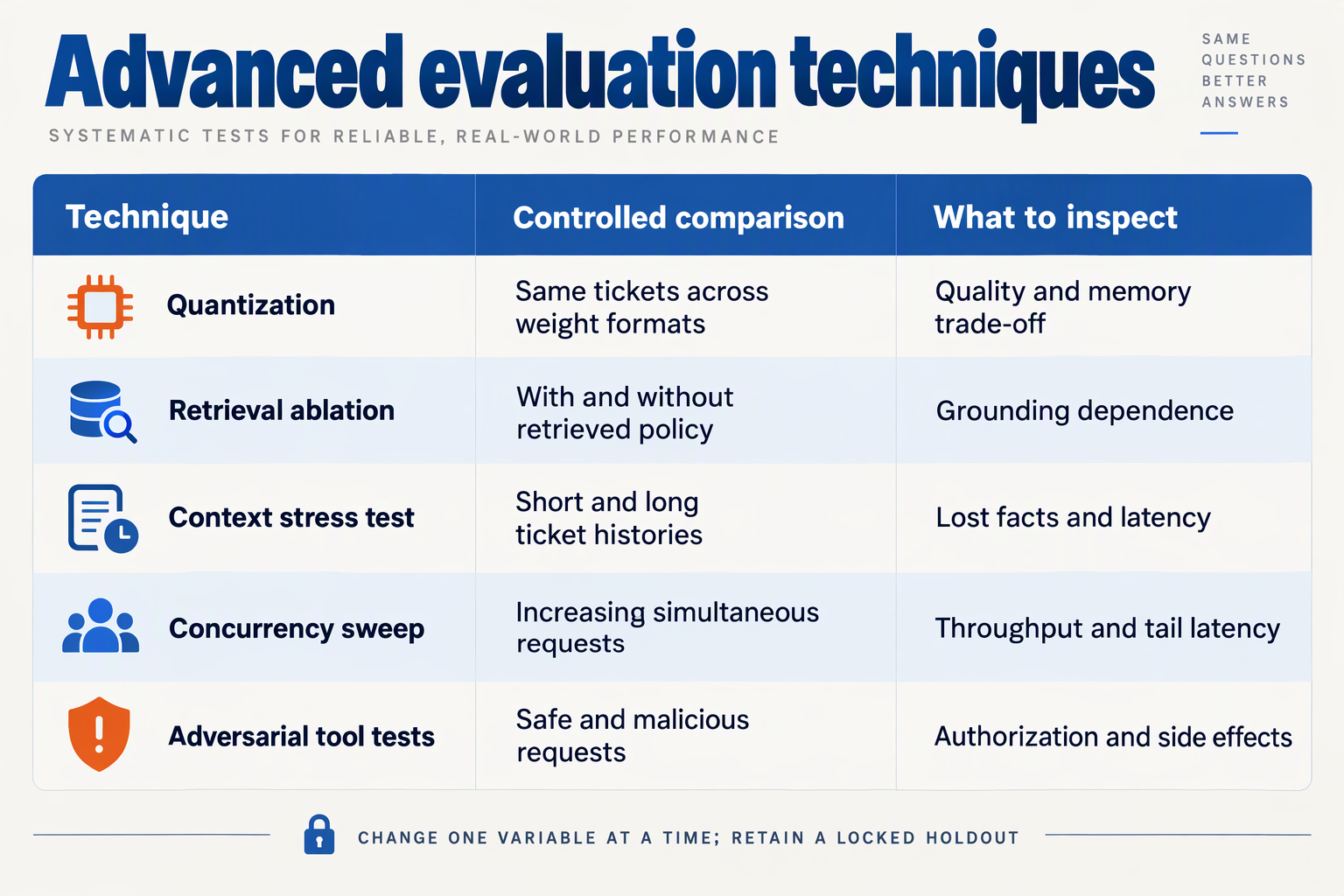
Paired comparisons, repeated trials, calibrated human review, and adversarial testing improve evaluation reliability by separating genuine improvements from sampling noise and grading errors. For Kimi K3.1 Pro model weights, evaluate the complete support workflow—not just whether a single answer sounds correct.
Which advanced evaluation techniques should you use?
Use the following techniques as a practical evaluation plan for November 2026. The suggested trial counts are starting points, not published Kimi K3.1 Pro benchmarks.
| Technique | How to apply it | What it reveals | Key safeguard |
|---|---|---|---|
| Paired bootstrap | Run both configurations on identical cases; resample paired score differences to estimate a 95% confidence interval. | Whether an apparent improvement survives sampling uncertainty. | Resample by customer or conversation when cases are correlated. |
| Repeated trajectories | Run each high-risk scenario 5–10 times, including tool calls and follow-ups. | Intermittent unauthorized actions hidden by one successful run. | Freeze tool responses and record decoding settings. |
| Metamorphic testing | Paraphrase requests or change irrelevant details while preserving the expected decision. | Sensitivity to wording, tone, names, or formatting. | Confirm that each transformation preserves policy eligibility. |
| Judge calibration | Have blinded human reviewers independently score a subset, then compare automated grading against their decisions. | Grader bias and missed consequential errors. | Adjudicate disagreements before accepting grader scores. |
| Controlled ablations | Change one component at a time: retrieval, prompt, quantization, or tool schema. | Which component causes an improvement or regression. | Keep the dataset and remaining configuration fixed. |
| Adversarial context testing | Insert conflicting policies, malicious retrieved instructions, and stale documents. | Instruction-boundary failures and weak source prioritization. | Use sandbox tools with no production side effects. |
How do you test long-context reliability without rewarding verbosity?
According to AI/TLDR’s release summary, cited as of November 2026, Kimi K3.1 Pro supports a 1-million-token context window. That capacity warrants testing, but it does not establish reliable retrieval or correct policy prioritization.
Create matched cases with the decisive policy near the beginning, middle, and end of the supplied context. Add plausible distractors, such as an expired refund policy, while keeping the correct outcome unchanged.
For example, a customer qualifies for store credit but not a cash refund. Score whether the model cites the current policy and selects the permitted action—not whether it produces a detailed explanation. Report performance separately by context length and policy position so aggregate accuracy cannot conceal a positional failure.
How should you interpret rare failures and grader disagreement?
Zero observed failures is not proof of zero risk. In an illustrative evaluation designed in November 2026, zero failures across 300 independent, representative trials implies an approximate 95% upper failure-rate bound of 1%, using the statistical “rule of three.” Repeated paraphrases of one scenario do not provide 300 independent observations.
Use a disciplined review sequence:
- Predeclare acceptance criteria: specify which errors block deployment before inspecting results.
- Blind the comparison: hide model and configuration labels from reviewers.
- Audit disagreements: distinguish policy ambiguity from model failure and grader error.
Track both the first proposed action and the final outcome. A model that attempts an unauthorized refund before correcting itself has exposed a different risk from one that never attempts it.
As of November 2026, CallMissed’s developer AI API provides structured outputs, usage and request logs, and caller-chosen fallback models—useful building blocks for instrumented comparisons. Treat fallback-assisted results as a separate system configuration; they should not be presented as evidence of the underlying Kimi K3.1 Pro weights’ standalone reliability.
Which mistakes make customer-support evaluations misleading?
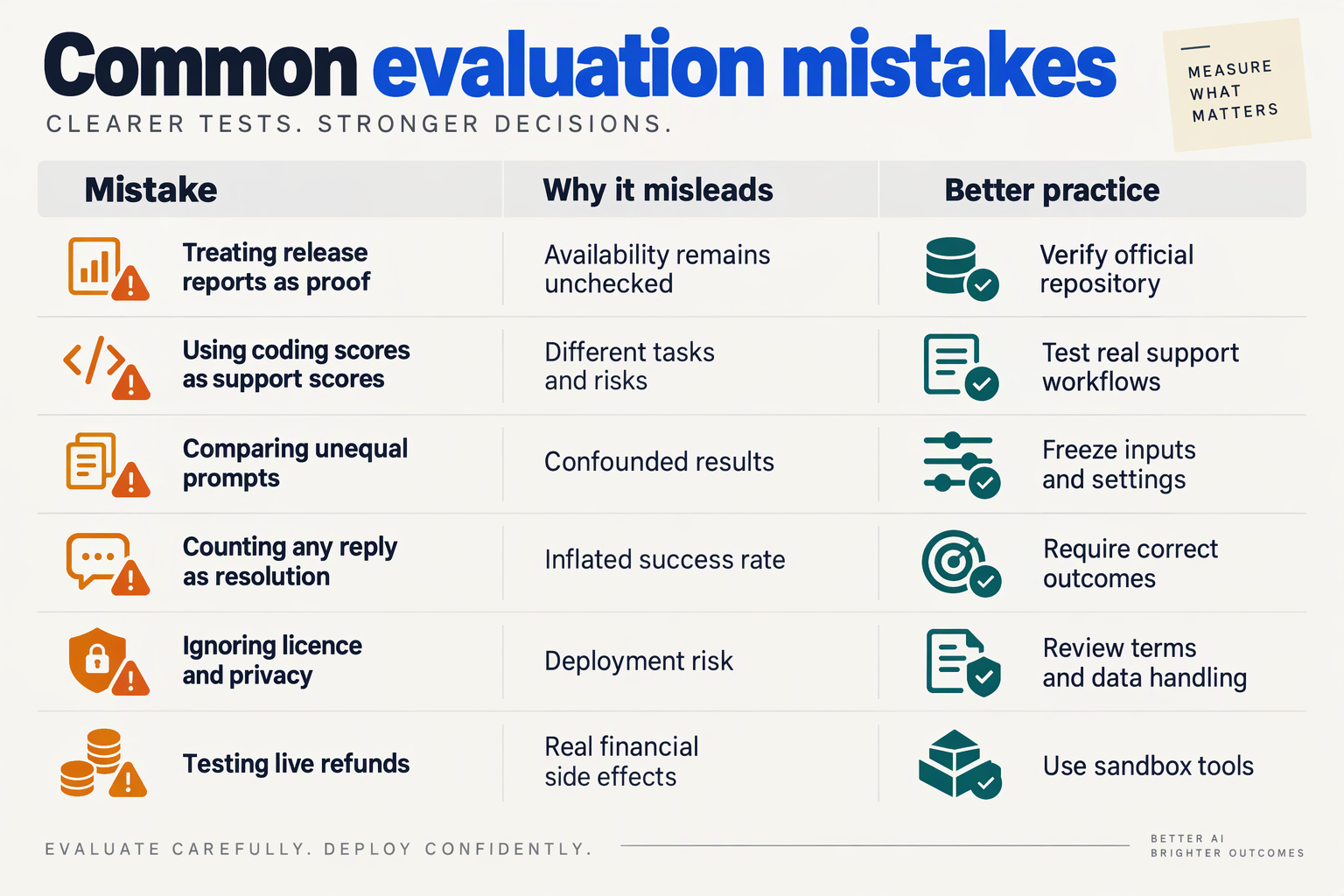
Customer-support evaluations become misleading when they reward polished answers, hide failed attempts, or compare models under different operating conditions. For Kimi K3.1 Pro model weights, the biggest risk is attributing a result to the model when the test actually measures leaked answers, evaluator preferences, or orchestration differences.
Which evaluation mistakes should you check first?
Use this checklist before interpreting your results. These are evaluation controls, not claims about weaknesses in Moonshot AI’s model.
| Mistake | Why it misleads | Corrective control | Evidence to retain |
|---|---|---|---|
| Tuning on the final test set | Prompts become optimized for known cases rather than unseen customers. | Separate development and locked holdout sets; group related tickets together. | Dataset versions and tuning history |
| Letting fluency determine the grade | A persuasive response can conceal an incorrect policy or unauthorized action. | Score factual correctness and action outcomes separately from tone. | Policy references and tool traces |
| Using one uncalibrated AI judge | The evaluator may prefer verbosity or miss subtle permission violations. | Blind model identities and calibrate grading against human-reviewed cases. | Judge prompts and reviewer disagreements |
| Giving candidates different support stacks | Better retrieval, permissions, or retries can look like better model reasoning. | Match documents, tool schemas, budgets, and access rights. | Configuration snapshot per run |
| Dropping timeouts and invalid outputs | Removing failures inflates success rates and understates operational cost. | Count every submitted task; report exclusions explicitly. | Complete attempt and failure ledger |
| Reporting only an overall average | Frequent easy requests can conceal failures in rare, consequential cases. | Break results down by intent, language, and risk category. | Slice-level scores and case counts |
Why can published benchmarks create false confidence?
According to AI/TLDR’s release summary, accessed as of November 2026, Kimi K3.1 Pro scores 65.7% on Terminal-Bench 4.0. That result concerns a different task distribution; it does not establish refund accuracy, identity-verification compliance, or appropriate human escalation.
The mistake is not reading benchmarks—it is using them as substitutes for your acceptance criteria. A coding-oriented score can justify investigating a model’s tool-use potential, but support readiness still requires evidence from your own workflows.
Avoid transferring conclusions between deployment configurations, too. A self-hosted weights evaluation and a hosted API evaluation should be labeled separately unless you have verified equivalent model versions and settings.
How do retries and caching distort support results?
A system that succeeds after several hidden retries is not equivalent to one that succeeds on its first attempt. Report first-attempt success, eventual success, and total elapsed time separately; include unsuccessful attempts in resource accounting.
As of November 2026, CallMissed’s developer AI API supports response caching, stored prompts, and caller-chosen fallback models. For comparative testing, explicitly document whether those capabilities are enabled: otherwise, a cached answer or fallback response can be mistaken for the candidate model’s performance.
Keep two distinct tracks:
- Model-controlled testing: Hold retrieval, tools, and retry rules constant.
- Production-system testing: Evaluate the complete workflow, including fallbacks and human handoffs.
Both are useful, but they answer different questions.
What final audit makes the findings trustworthy?
Before publishing a winner, perform three checks:
- Reconcile denominators: Every submitted case must appear as a success, failure, or documented exclusion.
- Review disagreements: Have support specialists inspect cases where automated grades conflict with policy or actual tool outcomes.
- Freeze the evidence: Preserve prompts, document versions, model identifiers, settings, and traces alongside results.
Treat small score differences cautiously, especially on small test sets. A defensible conclusion explains where the model is reliable, where uncertainty remains, and which failures prevent deployment—not merely which candidate has the highest average.
Frequently Asked Questions
Can businesses use Kimi K3.1 Pro weights commercially for customer support?
What hardware do I need to evaluate Kimi K3.1 Pro weights?
Does Kimi K3.1 Pro’s million-token context replace a support knowledge base?
Are Kimi K3.1 Pro weights reliable enough to automate refunds and account changes?
How do I compare self-hosted Kimi K3.1 Pro with an API fairly?
What should block a Kimi K3.1 Pro customer-support rollout?
Which resources and next steps help you move from evaluation to a controlled pilot?
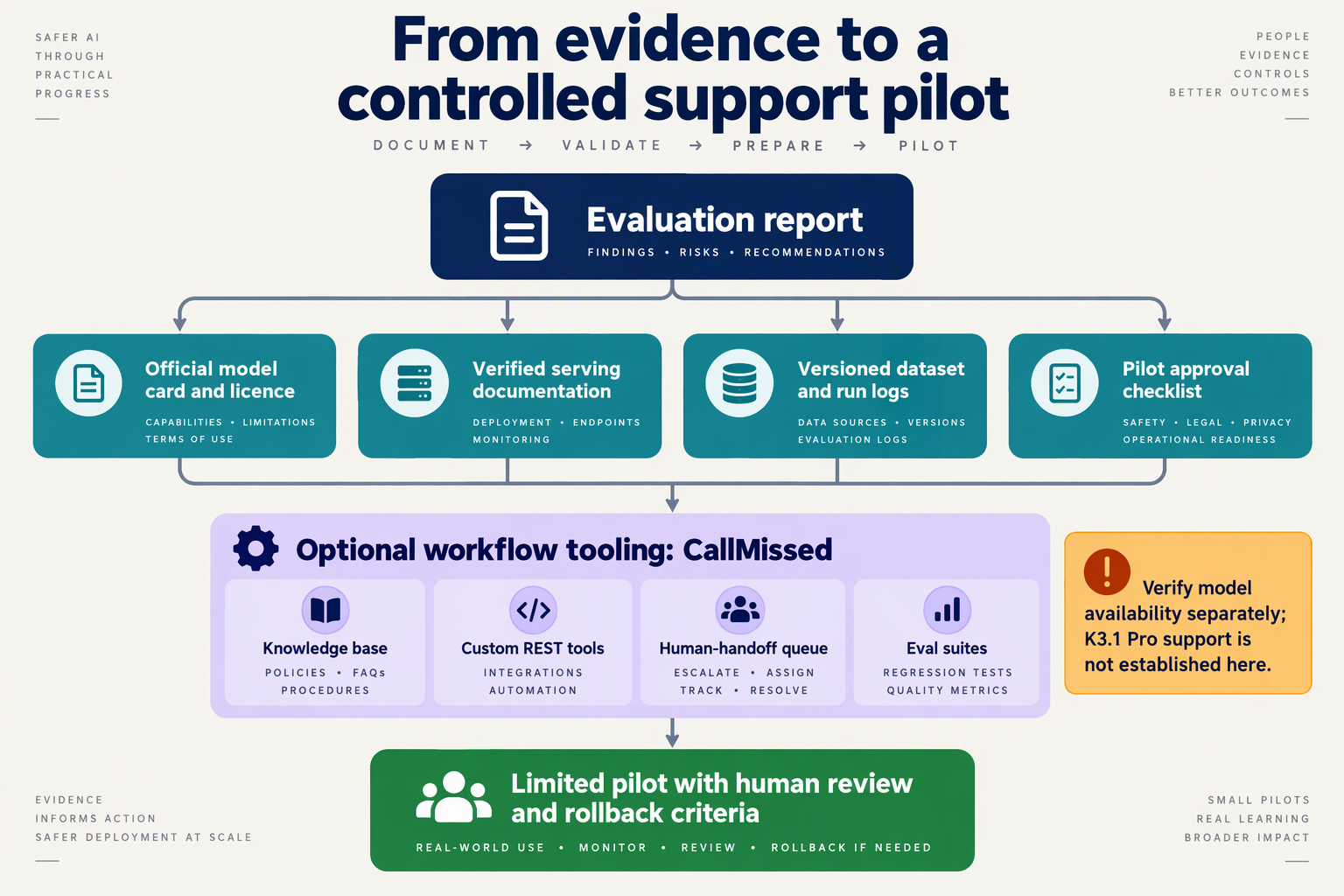
Move from evaluation to a controlled pilot by assembling a versioned evidence pack, assigning operational owners, and limiting the model’s initial authority. The deliverable is not another benchmark score: it is a documented decision about which support tasks Kimi K3.1 Pro may handle, under whose supervision, and how deployment can be stopped.
Which Kimi K3.1 Pro resources should you verify first?
Use release coverage to discover resources, then verify deployment decisions against Moonshot AI’s primary documentation. Keep dated copies of the materials your team actually reviewed; a changing repository or service configuration can otherwise make results difficult to reproduce.
Prioritize these resources:
- Weights repository and model card: Record the exact revision, file manifest, tokenizer, chat template, and supported inference configuration.
- Licence text: Have the relevant legal owner review your proposed commercial use, redistribution, and deployment arrangement.
- Serving documentation: Confirm hardware requirements and supported quantization methods before committing infrastructure.
- API documentation: If evaluating hosted access, verify the model identifier, limits, data-handling terms, and tool-calling behavior.
OrcaRouter’s November 4, 2026 report describes Kimi K3.1 Pro’s licence as custom and non-OSI; that makes the licence itself an essential deployment resource, not optional background reading. Data Phoenix’s launch coverage, reviewed as of November 2026, distinguishes Kimi K3.1 Pro from a faster Highspeed variant. Record which variant you tested rather than treating similar names as interchangeable.
What should your evaluation handoff contain?
Create a compact pilot decision record that engineering, support operations, security, and legal can review without rerunning every experiment.
Include:
- Configuration manifest: Model revision, inference settings, prompts, retrieval snapshot, tool schemas, and infrastructure.
- Results by support intent: Show approved use cases, unresolved failures, and examples of correct and incorrect behavior.
- Risk register: Assign an owner and mitigation to each remaining failure mode.
- Pilot runbook: Define routing, reviewer responsibilities, incident handling, and rollback.
- Decision log: Record who approved the pilot, its boundaries, and the next review date.
AI/TLDR’s release summary, reviewed as of November 2026, reports 65.7% on Terminal-Bench 4.0 for Kimi K3.1 Pro. Keep that external benchmark in the background appendix; the approval page should foreground evidence from your own support workflow.
How should you launch a controlled customer-support pilot?
Start with one narrow, reversible workflow, such as drafting delivery-status replies for human approval. Do not simultaneously introduce a new model, new knowledge base, and new autonomous permissions: failures become harder to diagnose.
A practical rollout sequence is:
- Shadow: Generate responses without showing them to customers.
- Assisted: Let support staff approve or edit every draft.
- Limited live: Expand only the workflow that passed review, with an immediate return to human handling.
For example, a proposed pilot could exclude refunds and account changes while allowing delivery explanations. Treat any unauthorized action as a stop condition, and audit a defined sample of ordinary conversations—not just complaints.
As of November 2026, CallMissed’s developer AI API supports usage and request logs, stored prompts, and caller-chosen fallback models. These capabilities can support a reproducible evaluation workflow; they do not establish that Kimi K3.1 Pro is available in its catalogue.
Close the pilot with a scheduled review and an explicit expand, revise, or stop decision. Successful evaluation earns a bounded deployment—not unrestricted autonomy.
Conclusion
Evaluate Kimi K3.1 Pro weights against your support policies, tool permissions, escalation rules, and operating constraints—not release-day excitement. The decision is whether the model can resolve real customer requests safely and consistently, not whether its answers sound impressive.
OrcaRouter’s November 4, 2026 report describes Moonshot AI’s release as 96 shards totaling 1.56 TB under a custom, non-OSI licence. That makes access to the weights a starting point for evaluation, not proof that self-hosting is practical or permitted for every intended use.
What should support teams take away from this evaluation?
Four principles should shape your go/no-go decision:
- Verify access, licensing, and deployment feasibility first. Distinguish an open-weight release from an open-source deployment opportunity. Before committing to a download or infrastructure investment, review the licence against your intended use and assess whether hosting requirements fit your operational constraints.
- Test representative support conversations, not fluency alone. Include refund requests, billing disputes, account changes, and incomplete knowledge-base coverage. A successful answer must follow approved documentation, verify relevant facts, and avoid inventing policies or promising unauthorized actions.
- Score consequential failures separately. Incorrect tool arguments, permission violations, and missed escalations deserve more attention than awkward wording. Define acceptance criteria around business impact so that strong average performance does not conceal failures that could harm customers.
- Compare deployment options under realistic conditions. Measure response times, costs, and reliability using comparable support tasks and load assumptions. Establish clear go/no-go gates before exposing customers to the model, rather than treating deployment as the final step of a benchmark exercise.
What should teams watch for next?
Watch for evidence that reported reliability gains translate into policy-grounded customer support. AI/TLDR’s release summary, cited as of November 2026, reports that Kimi K3.1 Pro reduces Kimi K3’s hard hallucination rate from 23.4% to 8.3%; those figures do not establish equivalent results on your support workflows.
The next meaningful signal is whether the model consistently retrieves the correct policy, executes permitted tools, and escalates uncertainty across representative conversations. Revisit your deployment decision as that evidence develops, while keeping infrastructure costs and licence implications in view.
To explore this evaluation approach, consider CallMissed, the OpenAI-compatible developer AI API. As of November 2026, CallMissed offers caller-chosen fallback models, structured outputs, and request logs—capabilities relevant to comparative testing as AI communication evolves.
Start with a realistic case: a late delivery that does not qualify for an automatic refund. Can your candidate model explain the available options without inventing a policy or authorizing a payment?
Related Reading
- Kimi K3.1 Pro Highspeed vs Pro: Customer Support Guide
- Mistral Large 4 review: Customer Support Evaluation
- LLM evaluation for customer support: An SMB Test Plan