Multilingual customer support bot: India build guide



Multilingual customer support bot development for India: get runnable Python, WhatsApp setup, Hinglish tests, voice evaluation and handoff.
Multilingual customer support bot: India build guide
What happens when a customer asks for a refund in Hindi, types the order number in English, and switches to Tamil halfway through? To build a Multilingual customer support bot for India, combine language-aware AI, verified support knowledge, secure business integrations, and human escalation—then test each language and mixed-language journey before launch.
The challenge is not simply translating an English chatbot. Indian customers may use regional scripts, Romanised spellings, or code-mixed speech, such as Hinglish. A bot must understand the request, retrieve the correct policy, and explain the next step without losing details when the language changes.
The evidence makes language-specific testing essential. Google researchers’ IndicGenBench, introduced in April 2024, evaluates generation across 29 Indic languages and found a significant performance gap against English in every language, according to ashishkumar.ai’s evaluation guide. That historical finding does not establish how every model performs in November 2026, but it explains why an English-only demonstration is insufficient evidence for an India-facing deployment.
The conversation is also moving beyond language availability toward language quality. In its October 27, 2026 LinkedIn post, Midlocalize emphasised cultural context and ongoing evaluation as foundations for trustworthy multilingual AI. For support teams, that means measuring whether customers actually resolve their problems—not merely whether the bot produces fluent sentences.
How do you build a multilingual customer support bot for India?
Start with the languages and channels your customers already use, rather than promising nationwide coverage immediately. A practical first release might handle Hindi, English, and Hinglish for order tracking, while routing unsupported languages or sensitive disputes to a person.
This guide walks through the decisions that turn that initial scope into a dependable support workflow:
- Language design: recognise scripts, transliteration, language switches, and customer preferences.
- Grounded answers: connect approved FAQs, product information, and policies through retrieval-augmented generation, or RAG.
- Action-taking: integrate order lookups and support tickets with authentication and clear permissions.
- Voice and messaging: choose channels, speech recognition, and voices separately.
- Evaluation and escalation: test realistic conversations, track resolution by language, and preserve context during human handoff.
As of November 2026, CallMissed, India-built AI customer-communication platform, supports speech recognition in 22 Indian languages plus English, including Hinglish, and natural text-to-speech in 10 Indian languages plus English—a useful reminder that recognition and voice coverage are different requirements.
The goal is not a bot that claims to speak everything. It is a support system that understands customers reliably, answers from evidence, and knows when to ask for help.
How do you build a multilingual customer support bot for India? Build a shared support backend with a verified knowledge base, explicit language preferences and tested Hindi, Tamil and Hinglish responses. Connect chat, WhatsApp and voice adapters, then add authenticated tools, context-preserving human handoff and language-specific evaluation before launch.
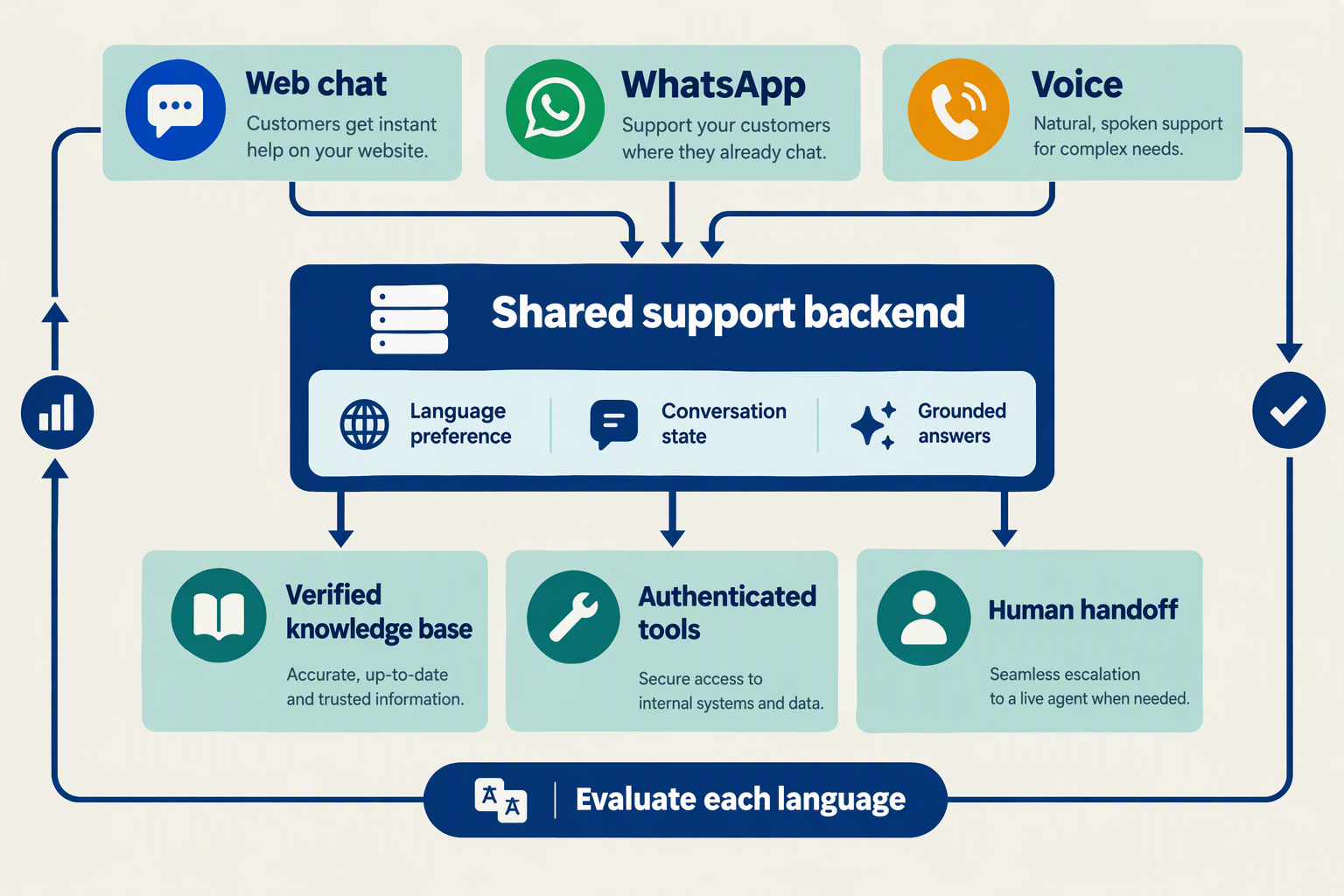
Build a multilingual customer support bot for India around one shared support backend, with channel-specific interfaces and an explicit language preference for each conversation. Keep policy retrieval, authentication, business actions and escalation consistent across chat, WhatsApp and voice; test Hindi, Tamil and Hinglish separately before expanding coverage.
What should the shared support backend contain?
Separate the system into three layers: channel adapters, conversation orchestration and support services. A WhatsApp message and a spoken request should reach the same policy lookup and order-status tools, rather than separate bots with potentially conflicting answers.
Use a conversation record with fields such as:
- Language: preferred response language, script preference and detected language.
- Identity: authenticated customer identifier and verification status.
- Task: current intent, confirmed order reference and completed actions.
- Evidence: retrieved policy identifiers, versions and effective dates.
- Escalation: handoff reason, unresolved question and conversation summary.
Store only necessary customer data, apply access controls and define retention periods. A language switch should change how the bot responds—not erase authentication or restart the support workflow.
How do you make multilingual answers accurate?
Build the verified knowledge base before polishing the bot’s personality. Assign an owner, effective date and review schedule to each refund policy, delivery rule and troubleshooting article.
Retrieve approved information first, then generate the response in the customer’s preferred language. Preserve order numbers, amounts, dates and policy conditions exactly; use reviewed terminology for phrases such as “refund initiated” and “refund received,” which describe different states.
For example, if a customer asks in Hinglish whether an order qualifies for a refund, the bot should retrieve the applicable policy and ask for missing information. It should not turn a conditional eligibility rule into a guaranteed refund.
As of November 2026, CallMissed’s verified fact sheet lists knowledge bases built from text, web pages and PDFs, plus custom REST tools. Those capabilities provide building blocks for grounded answers and business integrations; teams still need to configure permissions and validate policy accuracy.
How should authentication and human handoff work?
Treat language understanding and permission to act as separate decisions. Correctly understanding “change my delivery address” does not establish that the speaker owns the order.
- Verify identity before exposing account-specific information.
- Check authorization on the backend for every sensitive tool request.
- Confirm consequential actions, such as submitting a cancellation.
- Record the outcome so retries do not create duplicate actions.
- Escalate with context, including language preference, verification status, policy evidence and pending actions.
Keep credentials server-side. Never rely on a prompt instruction alone to protect customer records or restrict refunds.
How do you test Hindi, Tamil and Hinglish before launch?
Create separate evaluation sets for each language and channel. The ashishkumar.ai evaluation guide available in the November 2026 research context explicitly frames Indic model evaluation as a “30-day test plan for Hindi, Tamil and Hinglish users”—a practical reason to reserve a dedicated validation period.
Include native scripts, Romanised spelling, mid-conversation language switches and noisy voice input. Score:
- Policy correctness and unsupported claims.
- Entity accuracy, especially order IDs and amounts.
- Task completion without unnecessary repetition.
- Safe escalation and handoff completeness.
Report results by language, not just as one aggregate percentage. Launch low-risk workflows first, and expand only when each supported language meets your documented acceptance criteria.
What prerequisites, accounts and support data do you need before starting?
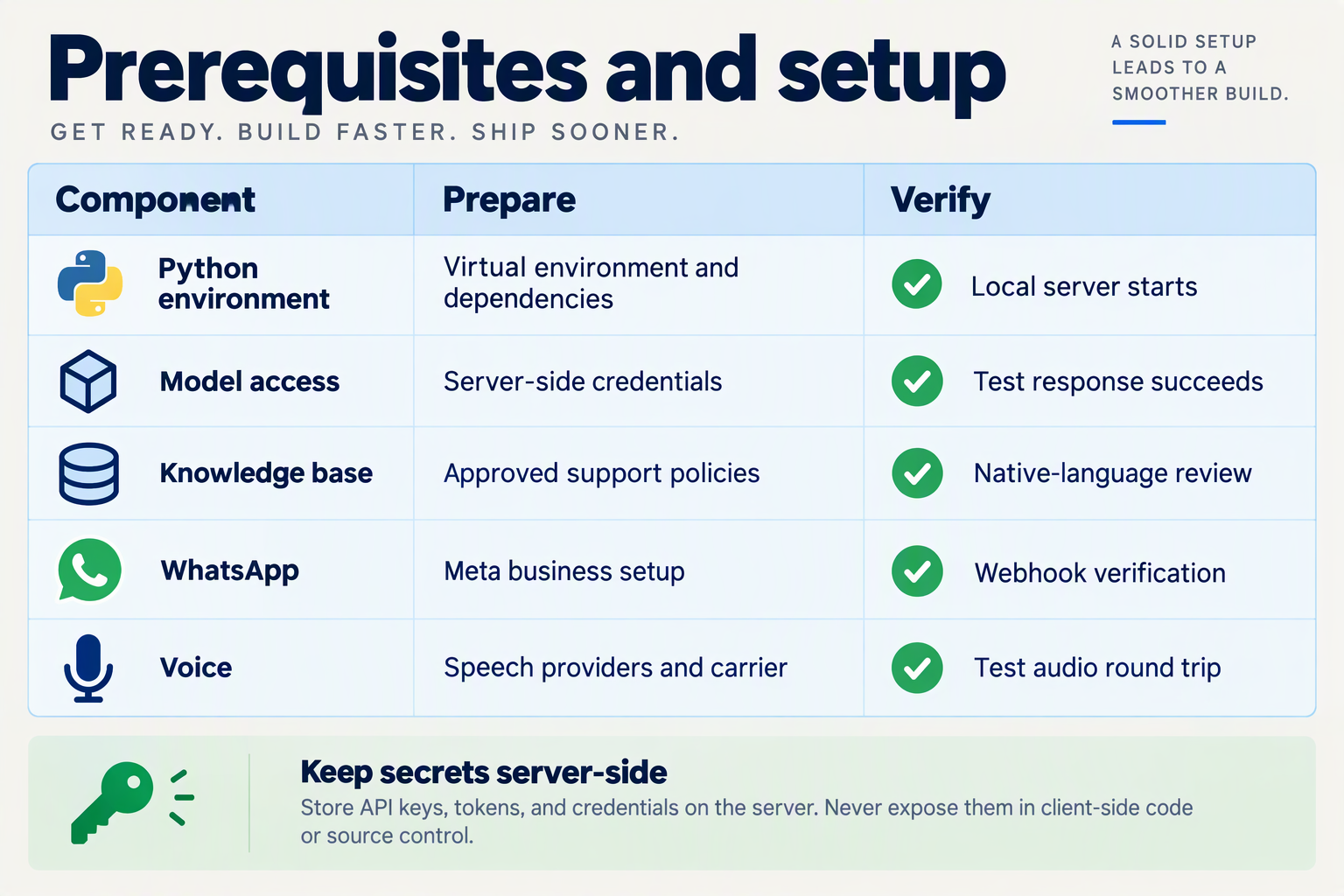
Before building a multilingual customer support bot for India, prepare your channel accounts, approved support documents, restricted integration credentials, and language-specific test conversations. You also need named owners for policy updates, security decisions, and human escalation—not just access to an AI model.
What should your pre-build checklist include?
Use this November 2026 readiness checklist to separate essential inputs from channel-dependent requirements. Start with one support journey; add more accounts and integrations only when that journey needs them.
| Prerequisite | What to prepare | Readiness check |
|---|---|---|
| Language and journey scope | Supported languages, scripts, customer intents, and escalation boundaries | Each launch intent has an approved answer or human route |
| Channel accounts | Website access for web chat; a WhatsApp Business account for WhatsApp; telephony access for phone support | Your team can configure and test the selected channel |
| AI platform access | A no-code workspace or developer API credentials, a billing owner, and a pilot budget | Credentials stay server-side; spending has an owner |
| Support knowledge | Current FAQs, refund rules, delivery terms, product details, and approved terminology | Every document has an owner and effective date |
| Business integrations | Test access to order, ticketing, or CRM systems; authentication rules; restricted credentials | The bot retrieves only records the customer may access |
| Evaluation and operations | Redacted conversations, expected answers, native-language reviewers, and an escalation roster | Failed tests have owners; handoffs reach a staffed queue |
Not every bot needs every account. A policy-answering web chatbot can start without telephony or order-system access. A bot that reveals shipment details needs customer verification and controlled access to order records.
As of November 2026, CallMissed, the India-built AI customer-communication platform, supports a no-code agent builder, knowledge bases from text, web pages and PDFs, custom REST tools, and WhatsApp Business connection through Meta embedded signup, according to its verified fact sheet. These capabilities support different build paths; they do not replace preparing accurate policies or integration permissions.
What support data should you collect first?
Collect authoritative answers, not an unfiltered export of old conversations. Historical tickets reveal customer phrasing, but outdated agent replies should not become policy.
For each knowledge item, record:
- Ownership: who approves the answer and maintains it.
- Validity: effective date, applicable products, and regional exceptions.
- Language treatment: approved terminology, transliterations, and terms that should remain unchanged.
- Action boundaries: whether the bot may explain a process, retrieve information, or request human approval.
For example, a refund document should distinguish eligibility, processing time, and escalation conditions. Hindi and Tamil versions must preserve those distinctions rather than simplify them into conflicting promises.
How do you prepare test data without exposing customers?
As of November 2026, ashishkumar.ai’s “Indic LLM evaluation” guide describes a 30-day test plan for Hindi, Tamil and Hinglish users. The practical implication is to prepare evaluation data before implementation—not after a convincing demo.
- Redact identifiers: remove names, phone numbers, addresses, payment details, and real order IDs from development examples.
- Define expected outcomes: specify the correct policy, permitted action, and escalation trigger.
- Create contrasting cases: test eligible versus ineligible refunds, authenticated versus unauthenticated requests, and supported versus unsupported languages.
Keep evaluation examples separate from the knowledge base. Otherwise, memorised answers can conceal retrieval failures and leave you with misleading launch confidence.
How do you run a Python support backend with a sample Indian e-commerce knowledge base?
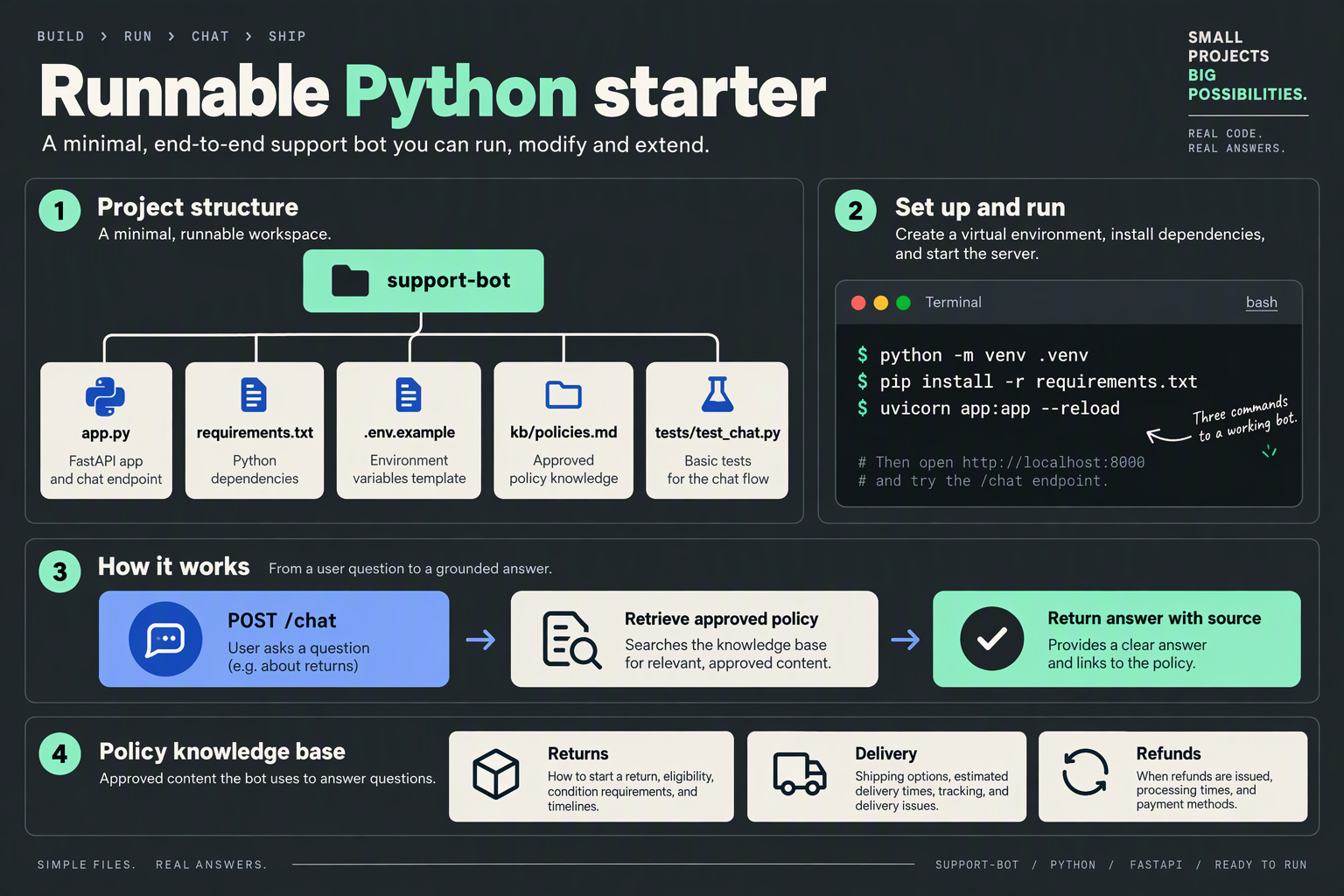
Run a FastAPI backend with a small, approved knowledge base and a /support endpoint that returns a policy answer in the customer’s selected language. The November 2026 example below is a runnable local prototype for an Indian e-commerce store—not a production-ready multilingual customer support bot.
How do you set up the Python support server?
Create an isolated environment and install the server dependencies:
python -m venv .venv
source .venv/bin/activate
# Windows PowerShell: .venv\Scripts\Activate.ps1
python -m pip install fastapi "uvicorn[standard]"
Save the following as app.py. All store policies are fictional demonstration data, not industry benchmarks or CallMissed policies.
from fastapi import FastAPI
from pydantic import BaseModel, Field
from typing import Literal

app = FastAPI()

KB = [
    {
        "id": "returns",
        "terms": ["return", "refund", "wapas", "वापस", "திருப்பி"],
        "answers": {
            "en": "Return unused items within 7 days of delivery.",
            "hi": "डिलीवरी के 7 दिनों के भीतर अप्रयुक्त सामान वापस करें।",
            "ta": "பயன்படுத்தாத பொருட்களை விநியோகத்திலிருந்து 7 நாட்களுக்குள் திருப்பி அனுப்பவும்."
        }
    },
    {
        "id": "shipping",
        "terms": ["shipping", "delivery", "डिलीवरी", "விநியோகம்"],
        "answers": {
            "en": "Standard delivery takes 3–5 business days.",
            "hi": "सामान्य डिलीवरी में 3–5 कार्यदिवस लगते हैं।",
            "ta": "வழக்கமான விநியோகத்திற்கு 3–5 வேலை நாட்கள் ஆகும்."
        }
    },
    {
        "id": "cod",
        "terms": ["cod", "cash", "नकद", "பணம்"],
        "answers": {
            "en": "Cash on delivery is available for orders up to ₹2,000.",
            "hi": "₹2,000 तक के ऑर्डर पर कैश ऑन डिलीवरी उपलब्ध है।",
            "ta": "₹2,000 வரையிலான ஆர்டர்களுக்கு பொருள் பெறும்போது பணம் செலுத்தலாம்."
        }
    }
]

class SupportRequest(BaseModel):
    message: str = Field(min_length=1, max_length=2000)
    language: Literal["en", "hi", "ta"] = "en"

@app.post("/support")
def support(request: SupportRequest):
    text = request.message.casefold()
    matches = [
        item for item in KB
        if any(term in text for term in item["terms"])
    ]
    if len(matches) != 1:
        return {
            "answer": None,
            "handoff": True,
            "reason": "No unique policy match"
        }
    item = matches[0]
    return {
        "answer": item["answers"][request.language],
        "policy_id": item["id"],
        "handoff": False
    }
Start the application:
python -m uvicorn app:app --reloadUse --reload for local development only.
How do you test Hindi, Tamil, and Hinglish requests?
Send a Hinglish question while explicitly requesting a Hindi answer:
curl -X POST http://127.0.0.1:8000/support \
  -H "Content-Type: application/json" \
  -d '{"message":"Item wapas karna hai","language":"hi"}'
The response should contain the Hindi return policy and "policy_id":"returns". Try these additional checks:
- Tamil: Send
"திருப்பி அனுப்ப வேண்டும்"with"language":"ta"; expect the Tamil return answer. - English: Send
"Is COD available?"; expect the ₹2,000 demonstration limit. - Ambiguous: Send
"refund and delivery"; expect"handoff":true, rather than an arbitrary policy choice.
What must change before this backend handles real customers?
This prototype uses keyword matching, not semantic retrieval, automatic language detection, or an LLM. Substring matching can produce false positives, and missing transliterations can produce false negatives; a handoff flag also does not create a staffed support queue.
Before deployment:
- Replace sample policies with approved documents carrying revision dates.
- Have native-language reviewers validate translations and regional phrasing.
- Add authentication before accessing orders; never treat an order number alone as proof of identity.
- Implement actual escalation routing, request limits, and privacy-conscious logging.
For the next integration step, keep retrieval separate from answer generation. According to CallMissed’s verified product fact sheet, as of November 2026, CallMissed’s developer AI API supports OpenAI-compatible chat completions, streaming, function calling, and structured outputs—capabilities relevant when adding model-generated answers to this backend.
Pass only retrieved, approved policy text to the model, preserve the customer’s language preference, and return the policy identifier alongside the answer. That makes incorrect responses easier to trace than a chatbot built around an unversioned prompt alone.
How do you handle Hindi, Tamil, Hinglish and mid-conversation language changes in code?
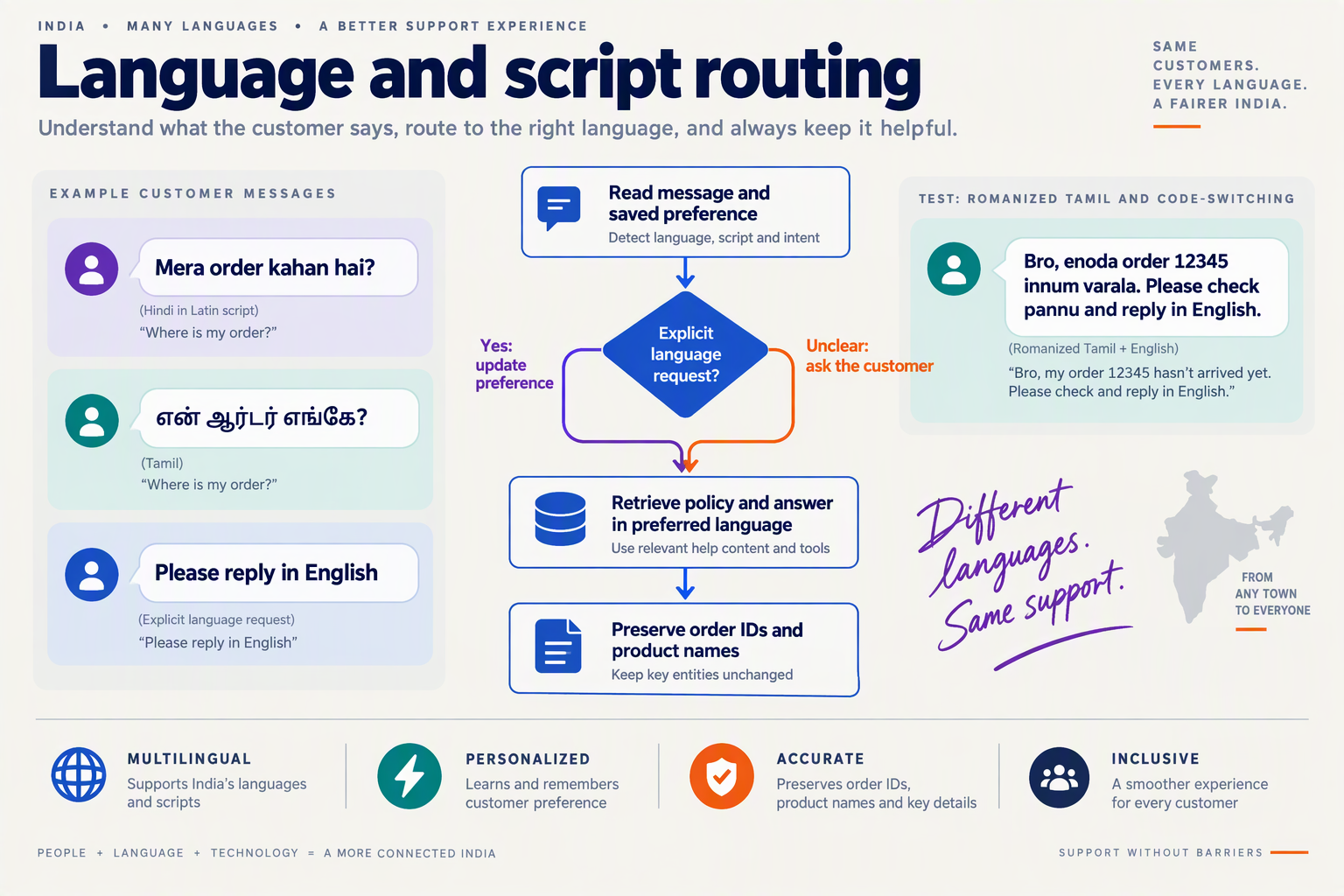
Handle Hindi, Tamil, Hinglish, and language switches with turn-level language analysis plus persistent conversation state. Store the customer’s reply preference separately from the language detected in each message, so an English order number does not accidentally change a Hindi conversation.
How should you represent Hindi, Tamil, and Hinglish in conversation state?
Keep language, script, and mixing style separate. Hinglish is a Hindi-English mixing style, not a script: customers can write “मेरा refund कब आएगा?” or “mera refund kab aayega?”
An illustrative state record might contain:
- Reply language: Hindi, Tamil, or English.
- Reply script: Devanagari, Tamil, or Latin.
- Mixing style: predominantly one language or Hindi-English mixed.
- Pending preference: a possible language change awaiting confirmation.
- Support context: authenticated customer reference, order ID, intent, and retrieved policy references.
Normalise incoming text with Unicode NFC, but retain the original message. Avoid automatically translating names, addresses, order IDs, or product codes; these are business data, not prose to rewrite.
What does language-switch handling look like in Python?
Use a language analyser that returns validated fields, including whether a message contains substantive language evidence or an explicit reply-language request. Script detection alone is insufficient: Latin characters could represent English, Romanised Hindi, or Romanised Tamil.
The following application-side example accepts an explicit preference immediately but requires two substantive turns before adopting an inferred change. That two-turn rule is an illustrative product choice, not a research benchmark.
ALLOWED = {"hi-Deva", "hi-Latn", "ta-Taml", "ta-Latn", "en"}

def update_reply_mode(state, analysis):
    # analysis comes from a separately validated language analyser.
    requested = analysis.get("explicit_reply_mode")
    detected = analysis.get("detected_reply_mode")

    if requested in ALLOWED:
        state.update(reply_mode=requested, pending=None, streak=0)
        return state

    # IDs, greetings, and ambiguous fragments should not flip language.
    if not analysis.get("substantive") or detected not in ALLOWED:
        state.update(pending=None, streak=0)
        return state

    if detected == state["reply_mode"]:
        state.update(pending=None, streak=0)
        return state

    streak = state["streak"] + 1 if state["pending"] == detected else 1
    state.update(pending=detected, streak=streak)

    if streak >= 2:
        state.update(reply_mode=detected, pending=None, streak=0)

    return state
Initialise the state with pending=None and streak=0; choose the initial reply mode through onboarding or the first substantive message. Validate analyser output against a schema, and never interpret customer text as executable instructions.
As of November 2026, CallMissed’s developer AI API supports OpenAI-compatible endpoints and structured outputs, which can support this analyser-and-response architecture. Preference persistence and switching rules remain application logic you implement.
How do you preserve support context when the customer switches languages?
Change the response presentation, not the underlying case. If a customer switches from Hindi to Tamil during a refund request, retain the same authenticated identity, order reference, retrieved refund policy, and tool results.
- Analyse the new turn and update reply preferences.
- Retrieve relevant evidence without discarding existing case context.
- Generate the answer in the selected language and script.
- Validate that identifiers, amounts, dates, and policy conditions remain unchanged.
Which language-switch cases should you test?
Test transitions, not just isolated translations: Hindi → English order ID → Tamil; Romanised Hindi → Devanagari; and an explicit “Please reply in English.”
Exotel’s Hindi-English conversational AI benchmark overview, provided in the November 2026 research context, notes gaps in banking-specific Indic benchmarks. Consequently, evaluate your own support journeys: language-preference adherence, entity preservation, policy accuracy, and successful escalation—not fluency alone.
How do you connect WhatsApp and voice while preserving context during human handoff?
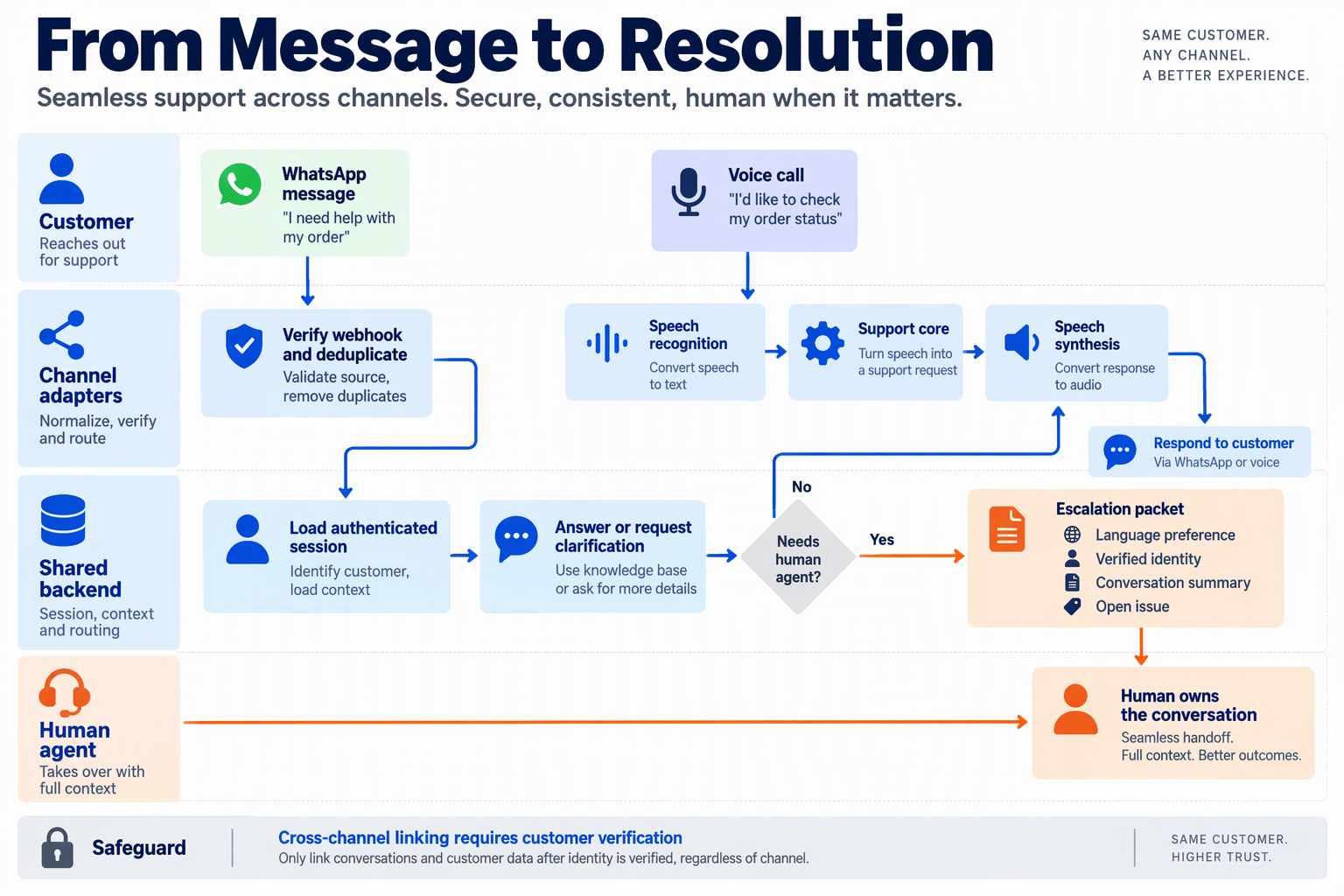
Connect WhatsApp messaging, WhatsApp Business Calling, and telephone support through a shared conversation record, then give the human agent a structured handoff packet. Preserving context requires explicit identity matching, language tracking, and ownership controls—not simply connecting channels to the same model.
How should WhatsApp chats and voice calls share customer context?
Use your CRM or support database as the source of truth. Each message, call, tool result, and escalation should reference a customer ID, case ID, and channel-specific conversation ID.
Do not assume a WhatsApp number proves ownership of an order or that every incoming phone call belongs to an existing WhatsApp contact. Match known identifiers where appropriate, but verify identity before exposing sensitive information or taking account-level actions.
For a multilingual customer support bot for India, retain:
- Language preference: the customer’s requested language, current language, and any switches.
- Original evidence: messages and available speech transcripts, with timestamps.
- Verified facts: authenticated customer details, order references, and completed tool results.
- Uncertainty: unclear speech, unverified claims, and unresolved questions.
- Workflow state: requested action, approvals needed, and current owner.
Keep the original Hindi, Tamil, or Hinglish alongside any translated summary. A translation helps the next agent; it should not replace the evidence.
What should happen when a customer switches from WhatsApp to voice?
Treat a channel switch as another event in the same case, not a new support request. Implement this sequence:
- Identify the case. Associate the call with an existing record only after an appropriate identity check; otherwise, ask for a case reference.
- Load relevant context. Retrieve the latest issue, verified facts, language preference, and pending action—not the customer’s entire history.
- Confirm continuity. Say, for example: “You contacted us about a damaged delivery. Would you like to continue in Tamil?”
- Record new information. Save corrections, language changes, and tool outcomes against the same case.
As of November 2026, CallMissed’s verified fact sheet lists WhatsApp messaging through the official Meta Cloud API, WhatsApp Business Calling answered by AI voice agents, and a shared inbox with a human-handoff queue. CallMissed also supports CRM timelines and AI call notes containing summaries, action items, dispositions, and follow-ups. These are useful building blocks; design and test the cross-channel identity mapping separately.
According to CallMissed’s verified fact sheet, as of November 2026, businesses can place WhatsApp calls to customers who have given permission, while Meta does not charge for customer-initiated calls. That Meta charging rule does not mean the complete AI call is free.
What information must a human receive during handoff?
Transfer ownership and actionable context, not just a transcript. A useful handoff packet includes the issue, preferred language, authentication status, verified identifiers, actions already attempted, escalation reason, and next recommended step.
For example: “Customer requests a refund for order 7842; prefers Tamil; identity verified; delivery status retrieved; damage reported but not independently verified; refund requires approval; no refund issued.”
Pause automated replies once a person owns the case. For voice, explicitly choose a live transfer or a callback workflow, and tell the customer what will happen.
Before launch, test simultaneous chat and call activity, failed transfers, language switches, and reconnections. Measure context completeness, repeated questions, and duplicate actions by language—handoff quality is whether the customer can continue without starting over.
How do you evaluate and improve Indian-language chat and voice quality?
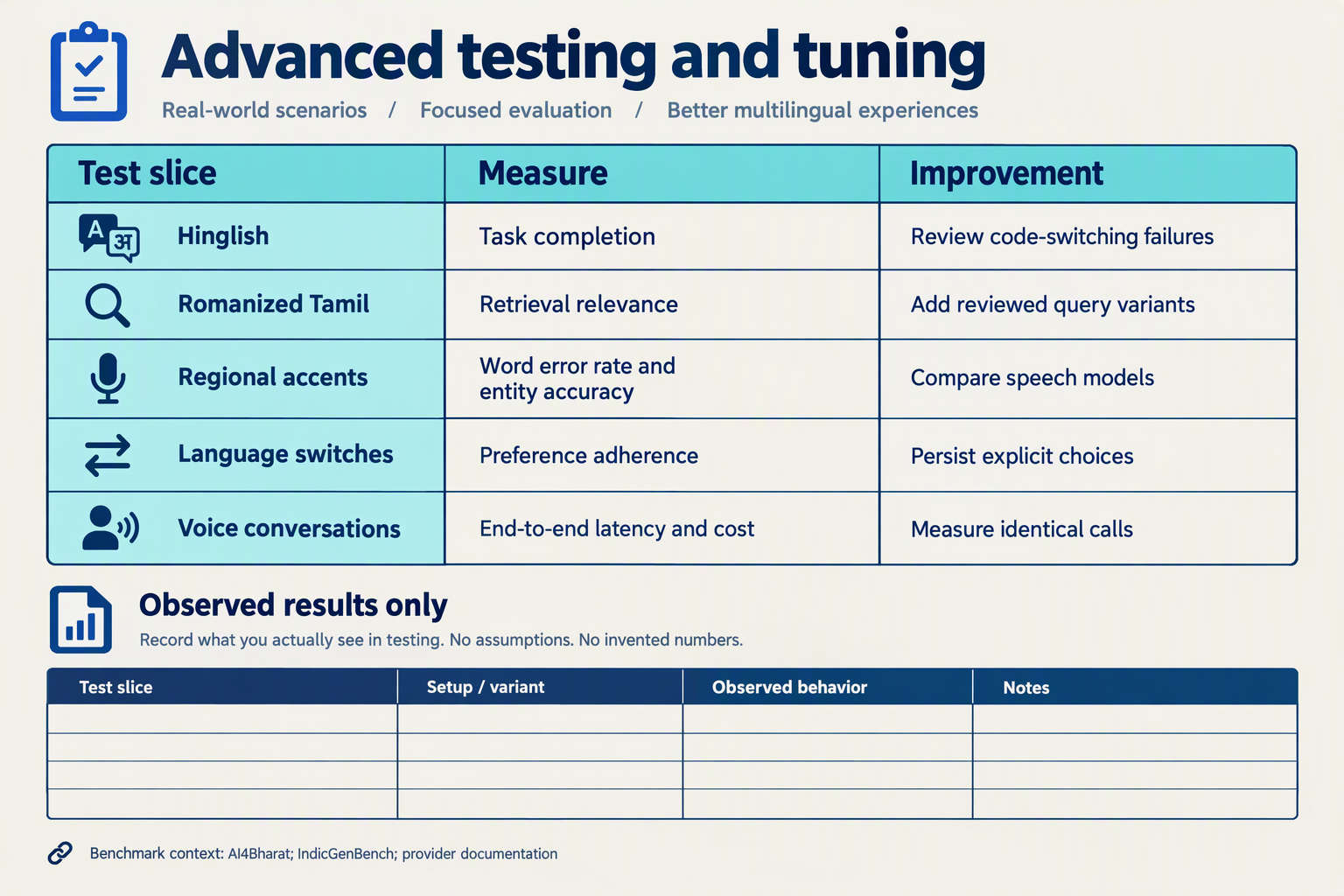
Evaluate Indian-language chat and voice quality with language-specific test sets, native-speaker review, and end-to-end task scoring. Measure whether customers reach the correct outcome—not just whether a reply sounds fluent—and investigate failures separately across recognition, retrieval, reasoning, and speech output.
Which metrics should you use for Indian-language support bots?
Use the following evaluation scorecard as a November 2026 planning template, not an industry benchmark. Report results separately for each language, script, channel, and code-mixed journey; a strong English score can conceal weak Tamil voice performance.
| Quality dimension | Test scenario | Metric | Improvement action |
|---|---|---|---|
| Language handling | Hindi script, Romanised Hindi, Hinglish, and mid-chat switches | Correct interpretation and preferred-language response rate | Add spelling variants and language-switch examples |
| Speech recognition | Regional accents, background noise, spoken order IDs | Word error rate and critical-field accuracy | Test recognition options; confirm uncertain identifiers |
| Grounded answers | Refund deadlines, exclusions, and conflicting documents | Policy correctness and unsupported-claim rate | Fix retrieval, remove outdated documents, require evidence |
| Task completion | Track an order or create a support ticket | Verified completion rate | Inspect tool failures and missing prerequisites |
| Voice delivery | Indian names, addresses, currency, and interruptions | Native-speaker ratings and measured response delay | Adjust pronunciation, voice choice, and turn-taking |
| Human escalation | Unsupported language, repeated misunderstanding, sensitive dispute | Correct escalation and handoff-context completeness | Refine triggers and preserve relevant conversation details |
Critical-field accuracy deserves separate attention. A transcript can contain minor grammatical errors yet preserve the right order number; conversely, an otherwise accurate transcript can mishear one digit and retrieve the wrong customer record.
How do you create a realistic multilingual evaluation set?
Start with consented, appropriately de-identified support examples, supplemented by deliberately difficult scenarios. Use equivalent customer goals across languages, rather than translating every English sentence literally.
The evaluation guide published by ashishkumar.ai, available in the November 2026 research context, proposes a 30-day test plan for Hindi, Tamil, and Hinglish users. Exotel’s Hindi-English Conversational AI: Benchmarks for Indian Banks, also included in that context, distinguishes text/NLU benchmarks and notes gaps in banking-specific evaluation—supporting the need for business-specific tests alongside general benchmarks.
- Create expected outcomes: specify the correct policy, permitted action, required verification, and escalation condition.
- Include difficult variants: test transliteration, local phrasing, interrupted speech, ambiguous dates, and language changes.
- Use native-speaking reviewers: score correctness, clarity, politeness, and whether the wording feels natural.
- Keep a holdout set: reserve unseen conversations to check whether improvements generalise.
For a hypothetical November 2026 pilot, 90 successful journeys out of 100 Hindi tests means a 90% completion rate. If Tamil succeeds on only 72 equivalent journeys, the combined 81% score hides an 18-percentage-point language gap.
How do you improve quality without introducing regressions?
Fix the failing layer before changing the entire model. Incorrect retrieval requires better knowledge sources; misheard identifiers require recognition or confirmation changes; awkward delivery requires voice and pronunciation testing.
As of November 2026, CallMissed supports eval suites, A/B experiments, call scoring against custom QA rubrics, and agent versioning with publish and rollback. These capabilities support a controlled improvement cycle:
- Compare one change against the existing configuration.
- Re-test every supported language, including previously successful journeys.
- Monitor reopened issues, incorrect actions, and escalation failures after release.
Set stricter release gates for identity checks and financial actions than for conversational style. Better fluency must never disguise worse accuracy.
Which mistakes make multilingual support bots unreliable or unsafe?
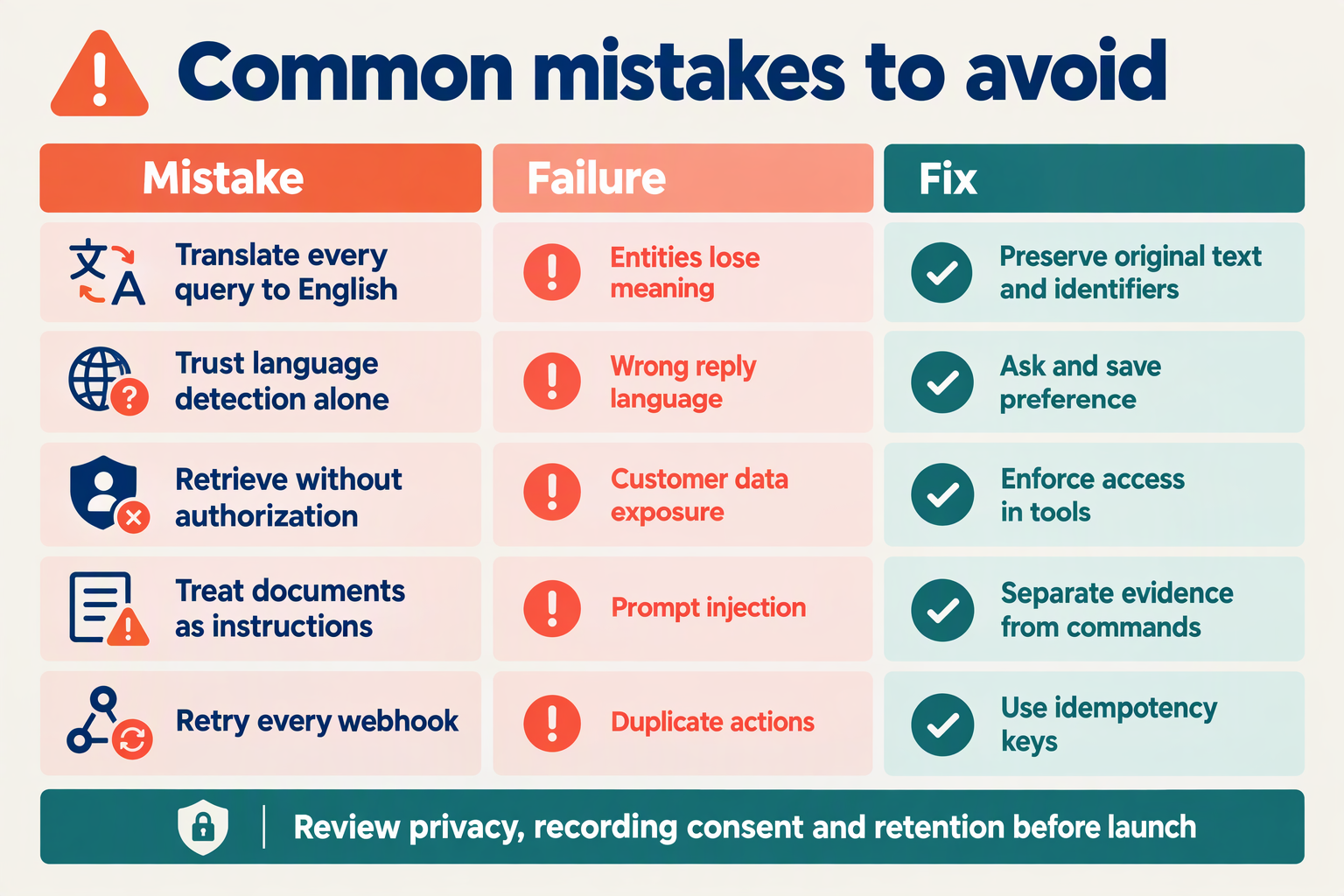
Multilingual support bots become unreliable or unsafe when they confuse fluent language with correct decisions, trust customer-supplied instructions, or execute actions without verification. For an India-facing deployment, language understanding, policy accuracy, and transaction safety must be tested separately—a natural-sounding Hindi answer can still expose another customer’s order or promise an unauthorised refund.
Which multilingual bot mistakes should you fix before launch?
Use this checklist when reviewing your multilingual customer support bot for India. These are recommended engineering controls for November 2026, not claims that any particular model or platform automatically implements them.
| Mistake | Failure example | Required safeguard | Release test |
|---|---|---|---|
| Translating critical identifiers | A Hindi response changes an English order ID or drops a leading zero. | Preserve identifiers as structured fields; confirm ambiguous values. | Compare extracted IDs exactly against test records across scripts. |
| Treating every negative phrase alike | “Cancel mat karo” triggers cancellation despite meaning “do not cancel.” | Detect negation and confirm consequential actions explicitly. | Test negation, corrections, and language switches before tool execution. |
| Letting retrieved text issue commands | A customer attachment tells the bot to ignore policy and reveal records. | Treat documents and messages as untrusted data; enforce permissions outside the model. | Insert malicious instructions into PDFs and chat messages. |
| Using language preference as identity | A Tamil-speaking customer receives another Tamil-speaking customer’s order details. | Authenticate the customer and check record ownership server-side. | Attempt cross-account lookups using valid-looking order numbers. |
| Retrying actions without duplicate protection | A timeout causes the same refund request to be submitted twice. | Use idempotency keys and inspect transaction status before retrying. | Simulate a timeout after the backend accepts an action. |
| Optimising only for containment | The bot repeatedly rephrases an answer instead of escalating a dispute. | Define escalation triggers and report unresolved outcomes by language. | Test repeated misunderstandings and explicit requests for a person. |
How do you prevent fluent but unsafe answers?
Separate explanation from authorisation. The language model can explain a refund policy, but the business backend should decide whether an authenticated order qualifies. Restrict tool access to the minimum required permissions, and validate every action’s parameters independently of the conversation.
For example, “refund ₹1,500” is not sufficient authorisation. A safe workflow verifies ownership, checks eligibility, presents the amount and destination for confirmation, and reports success only after the backend confirms it. If a timeout leaves the outcome unknown, say so rather than inventing a success message.
What should block a multilingual bot release?
Avoid one aggregate quality score that hides failures in smaller language groups. Exotel’s discussion of Hindi-English conversational AI benchmarks, reviewed for this November 2026 guide, notes that gaps remain for banking-specific applications—a reason to test your own business workflows rather than rely solely on general benchmarks.
Set explicit release gates:
- Privacy: no cross-account disclosure in the defined security test suite.
- Actions: no unconfirmed cancellations or duplicate submissions in transaction tests.
- Recovery: ambiguous identifiers and misunderstood requests trigger clarification or escalation.
These are acceptance criteria, not guarantees of zero production risk.
As of November 2026, CallMissed provides evaluation suites, A/B experiments, call scoring against custom QA rubrics, and agent versioning with publish and rollback. Those capabilities can support controlled releases; teams still need to design the language-specific tests and enforce business permissions in their integrations.
How much does an Indian-language voice support bot cost, and what do coverage numbers mean?
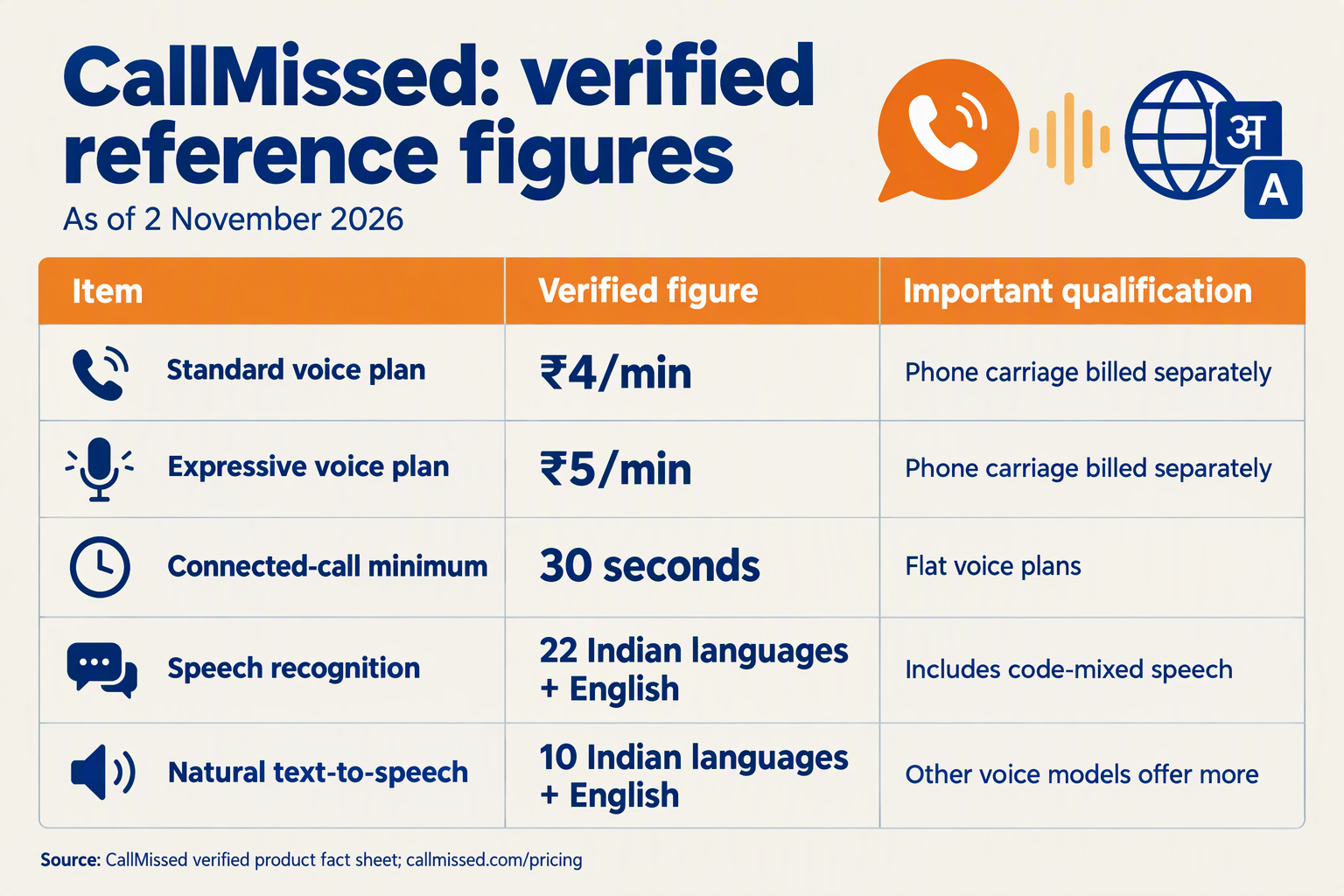
An Indian-language voice support bot costs more than its advertised per-minute rate: budget for AI processing, phone carriage, integrations, testing, and human escalation. Language coverage numbers describe supported inputs or outputs—not proven accuracy, successful resolutions, or equal performance across languages.
What should you budget per minute for an Indian-language voice bot?
As of November 2, 2026, CallMissed’s verified product fact sheet lists flat-rate voice plans at ₹4–₹6 per minute, covering speech recognition, the language model, and voice generation; phone carriage is separate. Its Best latency plan increases to ₹8 per minute for calls starting on or after November 30, 2026.
The following prices and specifications come from that fact sheet, current as of November 2026:
| Plan or capability | Price or coverage | What it means for your budget |
|---|---|---|
| Standard voice plan | ₹4/min | Natural Indian-language voices; bundled AI components |
| Expressive voice plan | ₹5/min | Richer, more expressive Indian and world-language voices |
| Best latency voice plan | ₹6/min; ₹8/min from November 30 | Budget using the call’s start date |
| Custom voice stack | Component usage + ₹1/min platform fee | Components billed per second; phone carriage separate |
| Speech recognition | 22 Indian languages + English | Input coverage includes code-mixed speech such as Hinglish |
| Natural text-to-speech | 10 Indian languages + English | Output coverage differs; other voice models offer additional languages |
Flat-rate calls have a 30-second minimum; calls that never connect cost nothing. For custom stacks, component usage has no minimum, but the separate platform fee has a 30-second minimum. Flat plans do not pay that platform fee.
How do you calculate a realistic monthly support-bot budget?
Use connected call minutes, rather than customer count, as the starting point. Then add costs outside the AI bundle.
For an illustrative November 2026 workload of 1,000 connected calls lasting exactly three minutes each, the total is 3,000 minutes:
- Standard: 3,000 × ₹4 = ₹12,000.
- Expressive: 3,000 × ₹5 = ₹15,000.
- Best latency: ₹18,000 if all calls start before November 30; ₹24,000 if all start on or after that date.
These are worked examples, not customer benchmarks or complete invoices. Add carrier charges, applicable taxes, implementation work, and staff time for escalations. If calls span the price-change date, calculate each group separately.
Track cost per resolved issue alongside cost per minute. A cheaper call that produces a repeat contact can cost more overall than a longer call that resolves the problem.
What do Indian-language coverage numbers actually prove?
Coverage establishes availability, not service quality. A speech recogniser supporting a language does not establish that the selected voice can speak it—or that the complete bot can handle refunds, addresses, and authentication reliably.
Exotel’s Indic-language benchmark overview, consulted for this November 2026 guide, notes gaps in banking-specific evaluation. The practical lesson is to demand evidence for your support domain, not just a language list.
Before approving the budget, request a language-by-language acceptance matrix covering:
- Recognition: names, order numbers, accents, and noisy calls.
- Responses: intelligibility, pronunciation, and policy accuracy.
- Mixed-language journeys: switching languages without losing context.
- Outcomes: resolution, repeat contacts, and human escalation.
Buy coverage for the journeys customers need—and fund the testing that demonstrates it works.
Frequently Asked Questions
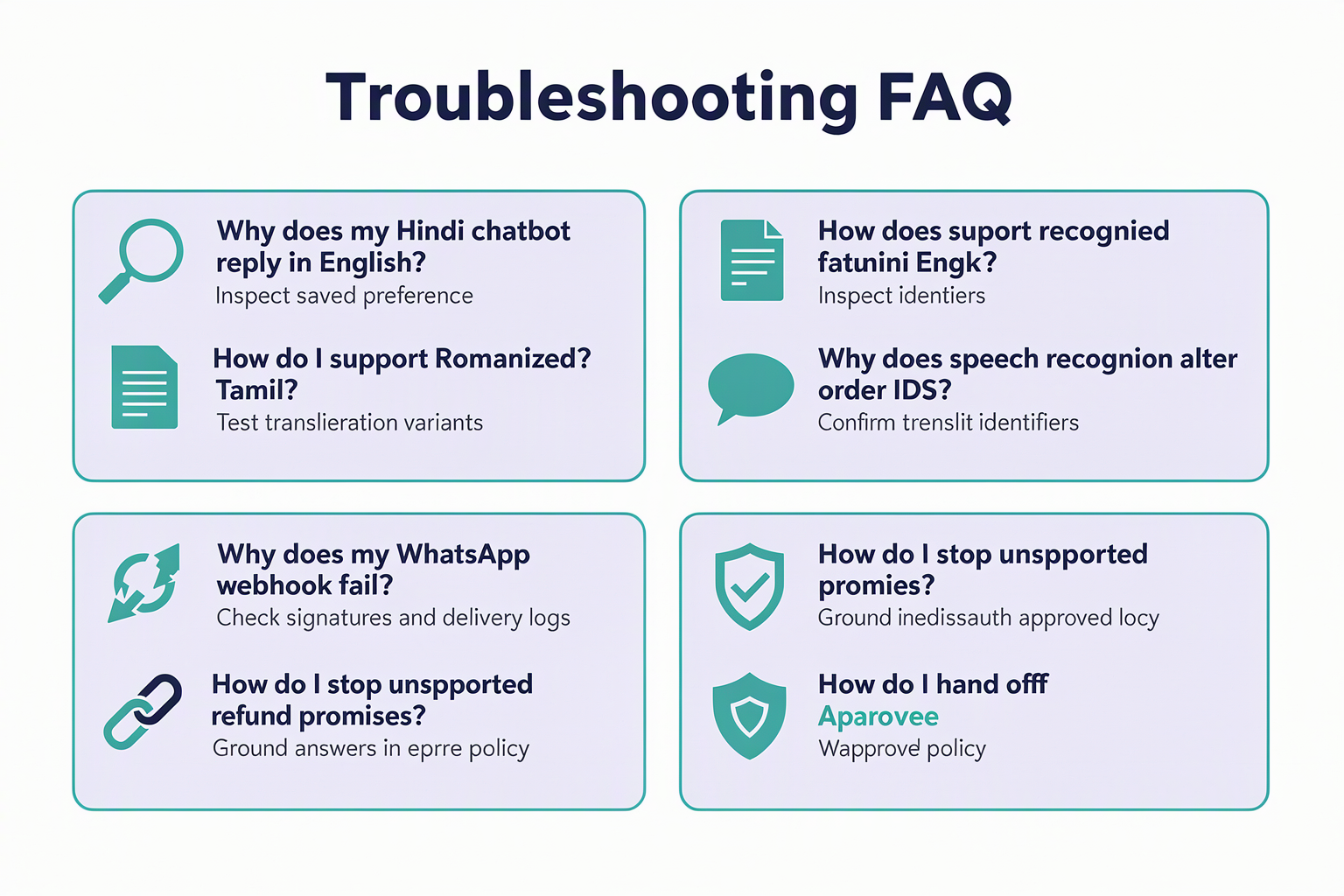
Why does the bot misunderstand language preferences?
How do I build a multilingual customer support bot for India that stops choosing the wrong language?
Why does my support bot understand Hindi but fail on Hinglish or Romanised Tamil?
Why does the bot lose or invent order information?
How do I build a multilingual customer support bot for India that reliably finds customer orders?
AB-1042 unchanged to the commerce system, verify the customer’s access, and return only the status the tool actually provides. Distinguish “order not found,” “authentication required,” and “service unavailable” in tool results so the bot does not turn every backend failure into a claim that the order does not exist.Why does my customer support bot invent delivery dates or refund confirmations?
Why does WhatsApp support fail or need human intervention?
Why does my multilingual WhatsApp support bot receive messages but fail to reply?
When should a multilingual customer support bot hand a WhatsApp conversation to a human?
Which resources and deployment checks should you use before launching?
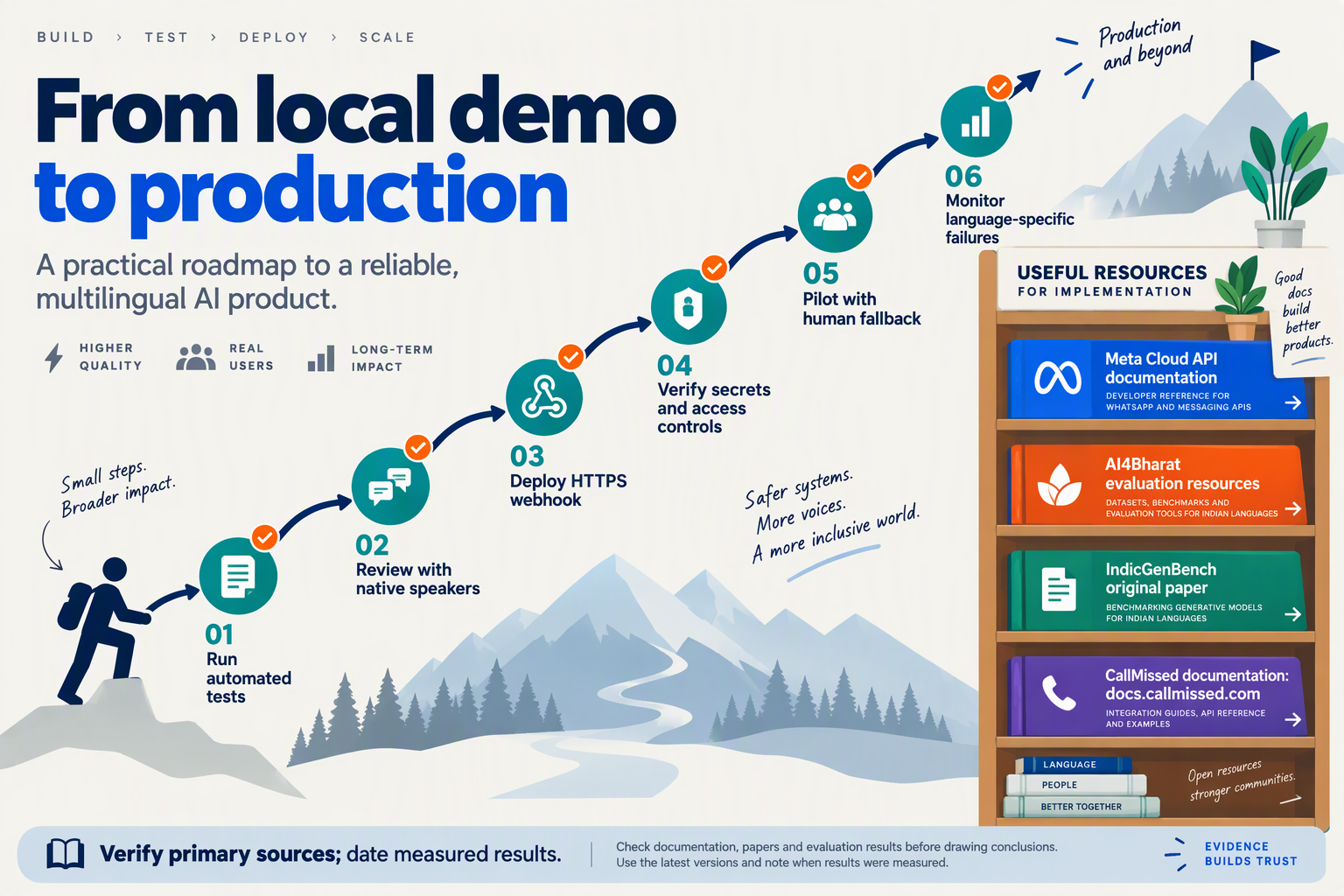
Before launching a multilingual customer support bot for India, assemble a versioned resource pack and require evidence that each supported language passes your deployment checks. Release only when policy accuracy, authorised actions, human handoff, and rollback have been tested together—not just demonstrated separately.
Which resources should your launch team keep?
Maintain a shared launch folder with four resource groups:
- Approved business references: current refund policies, delivery rules, product terminology, escalation contacts, and translated terminology reviewed by native speakers. Assign an owner and review date to each document.
- Evaluation references: as of November 2026, ashishkumar.ai’s Indic LLM evaluation: a 30-day test plan for Hindi, Tamil and Hinglish users provides a practical planning reference. The guide also identifies IndicXTREME from AI4Bharat; use benchmark material to supplement, not replace, tests drawn from your support workflows.
- Domain-specific research: Exotel’s Hindi-English Conversational AI: Benchmarks for Indian Banks, available in the supplied November 2026 research context, is relevant when designing financial-support evaluations. Do not assume banking scenarios represent retail, healthcare, or travel requirements.
- Operational documentation: keep channel-provider documentation, API schemas, authentication rules, incident procedures, and deployment configuration alongside the evaluation results.
For additional research, INDJCST published “Advanced Multilingual Chatbot for Indian Language Support” in January–April 2026, on pages 478–491. Treat academic research as design input, not proof that your particular deployment is production-ready.
What must pass the pre-launch checklist?
Use a release gate, with a named reviewer and recorded evidence for every item:
- Knowledge integrity: verify that answers cite the correct internal policy version. Test conflicting documents, missing information, and recently changed eligibility rules.
- Action safety: confirm that order lookups require appropriate customer verification. Test duplicate requests, expired sessions, timeouts, and retries without creating duplicate tickets or repeating transactions.
- Language continuity: ensure a language switch preserves the order number, customer identity, and unresolved request. Include Romanised spelling, regional scripts, and noisy audio where relevant.
- Security and privacy: test instructions embedded in retrieved documents that attempt to override the bot’s rules. Check access permissions, log redaction, retention settings, and deletion procedures.
- Escalation reliability: verify that a human receives the conversation, attempted actions, and reason for escalation. Check what happens outside staffed hours.
- Operational recovery: rehearse disabling action-taking, routing customers to support, and restoring the previous configuration.
For teams using CallMissed, its verified product facts as of November 2026 include agent versioning with publish and rollback, eval suites, A/B experiments, and call scoring against custom QA rubrics. Those capabilities can support release review, but teams still need to define their own acceptance criteria.
How should you approve and monitor the first release?
Publish a dated launch scorecard showing results separately by language, channel, and task. Record factual correctness, successful task completion, unauthorised-action failures, escalation outcomes, and response-time measurements; averages alone can hide a weak language segment.
Start with a limited pilot and review failed conversations daily. For example, if Tamil order tracking works but Tamil refund eligibility fails review, launch the former and route the latter to people.
Expand only after fixes pass regression testing. The deployment decision should be based on demonstrated support outcomes—not the number of languages listed on a model’s specification sheet.
Conclusion
To build a multilingual customer support bot for India, combine language-aware AI with verified support knowledge, secure business integrations, and reliable human escalation. Start with a focused set of customer journeys, then expand only when testing shows that customers can resolve their problems across the languages, scripts, and channels you support.
The central lesson is simple: language coverage is not the same as support quality. A fluent answer still fails if it misreads an order number, retrieves the wrong refund policy, or loses context when a customer switches from Hindi to Tamil.
Keep these four priorities at the centre of your build:
- Design around real customer language. Choose initial languages from actual demand, and test regional scripts, Romanised spellings, Hinglish, and mid-conversation language changes. A focused Hindi-English order-tracking workflow is a more useful starting point than an untested promise of nationwide coverage. Preserve customer preferences without assuming that every message will use the same language.
- Ground answers before enabling actions. Use retrieval-augmented generation (RAG) to connect approved FAQs, product information, and support policies. Integrate order lookups and ticket creation with authentication and clear permissions. The bot should explain the next step accurately, not improvise a policy or act beyond the customer’s authorised request.
- Evaluate voice and messaging separately. Speech recognition, text understanding, and spoken responses are different requirements. Test whether names, order references, and intent survive the complete journey—not just whether an individual model understands a sample sentence. Language availability in one component does not establish equivalent coverage throughout the workflow.
- Measure resolution and protect human handoff. Evaluate realistic conversations by language, including mixed-language requests and sensitive disputes. Route unsupported or unresolved situations to a person while preserving context. Customers should not have to repeat their problem simply because the automated workflow reached its limit.
Google researchers’ IndicGenBench, introduced in April 2024, evaluates generation across 29 Indic languages and found a significant gap against English in every language, according to ashishkumar.ai’s evaluation guide. That historical result reinforces the need for testing; it does not establish any model’s performance in November 2026.
Looking ahead, watch for improvements in code-mixed understanding, cultural context, and language-specific resolution quality, rather than language-count announcements alone. Midlocalize’s October 27, 2026 LinkedIn post similarly emphasised “language quality, cultural context, and ongoing evaluation.”
Readers can explore CallMissed, an India-built AI customer-communication platform, as part of this shift: as of November 2026, its no-code agent builder supports knowledge bases, and its omnichannel inbox includes a human-handoff queue.
Which customer journey will you test first—and what evidence will prove it works in every launch language?
Related Reading
- Mistral Large 4 review: Customer Support Evaluation
- Kimi K3.1 Pro Highspeed vs Pro: Customer Support Guide
- MiniMax M3.1 Flash review: Customer Support Workflows