MiniMax M3.1 Flash review: Customer Support Workflows



Use this MiniMax M3.1 Flash review to assess support accuracy, tool safety, latency and cost per resolved ticket before deployment.
MiniMax M3.1 Flash review: Customer Support Workflows
Could a customer-support interaction cost just $0.0021 in model tokens—and still require expensive human cleanup? This MiniMax M3.1 Flash review evaluates that trade-off: whether MiniMax’s newly released model can turn attractive token pricing into dependable customer-support workflows, rather than simply cheaper answers.
According to Artificial Analysis, MiniMax M3.1 Flash launched on October 19, 2026, with API pricing of $0.15 per million input tokens and $0.60 per million output tokens, as listed on October 20, 2026. At those rates, an illustrative interaction using 10,000 uncached input tokens and 1,000 output tokens costs $0.0021 for the model alone. That calculation excludes retrieval, orchestration, channel costs, retries, and human escalation—the expenses that determine whether support automation actually pays off.
The timing matters. The supplied Hacker News trending snapshot shows 483 points and 206 comments within 19.9 hours, signaling substantial developer attention, not proof of production readiness. Meanwhile, llm-stats lists a one-million-token context window and multimodal input for MiniMax M3.1 Flash as of October 2026. Those specifications make it worth evaluating for support cases involving lengthy conversations, product documentation, and customer-provided screenshots.
But a large context window is capacity, not a guarantee that the model will find the right refund exception buried inside it. WorldAttention’s October 2026 coverage reports MiniMax’s claimed 74% DeepSWE score; that is a vendor-reported software-engineering benchmark result, not a measurement of customer-support accuracy. For a support team, the meaningful question is simpler: can the model resolve the issue correctly without inventing policy, exposing customer information, or taking an unauthorized action?
What should a customer-support evaluation actually measure?
This review focuses on the decisions that matter after the demo:
- Grounded answers: Can responses follow the current knowledge base, cite relevant policy, and acknowledge missing information?
- Tool execution: Can the workflow retrieve an order, verify eligibility, and request confirmation before changing anything?
- Escalation quality: Does the model recognize uncertainty and hand a human the conversation’s essential context?
- Operational economics: How do retries, response length, caching, and unresolved tickets affect cost per successful resolution?
As of October 2026, CallMissed, an AI customer-communication platform, combines knowledge-base-powered agents, custom REST tools, and a human-handoff queue—illustrating why support evaluation must examine the surrounding workflow, not just the model.
The goal is not to crown a benchmark winner. It is to establish where MiniMax M3.1 Flash deserves a controlled pilot, which safeguards that pilot needs, and what evidence should justify moving from promising specifications to live customer conversations.
Is MiniMax M3.1 Flash ready for customer support? Promising, but not yet support-validated
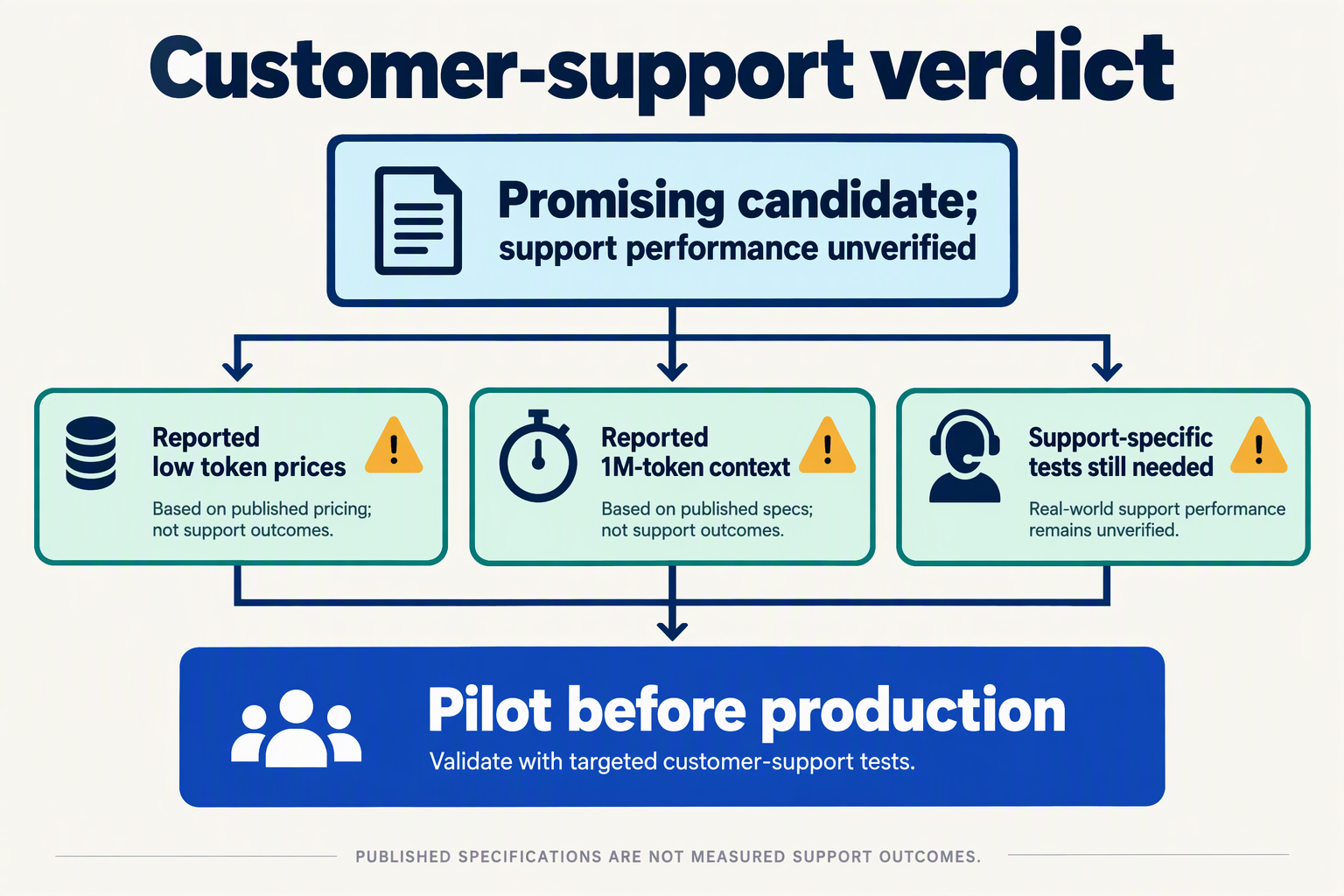
MiniMax M3.1 Flash is a credible candidate for a controlled customer-support pilot, but the supplied evidence does not establish production readiness. As of October 20, 2026, the available coverage supports its potential for agentic workflows—not a verified ability to resolve support tickets safely and consistently.
That distinction defines this review’s verdict: promising enough to test, not yet support-validated. This is an evidence-based assessment of published information, not a hands-on certification or a claim that MiniMax M3.1 Flash has failed support testing.
What does the launch evidence actually establish?
According to MarkTechPost’s October 19, 2026 coverage, MiniMax M3.1 Flash uses a 428-billion-parameter mixture-of-experts architecture with 23 billion active parameters. Those specifications describe the model’s architecture; they do not establish how reliably it interprets conflicting policies or distinguishes one customer’s records from another’s.
Digital Applied’s October 19, 2026 coverage positions MiniMax M3.1 Flash around agent work, coding, computer use, and security tasks. That makes tool-assisted support a reasonable evaluation target, but transferring capability between domains requires testing. Editing a repository and authorizing a refund involve different rules, consequences, and definitions of success.
The supplied research does not provide:
- Support-specific resolution rates measured against a defined ticket dataset.
- Policy-compliance results covering exceptions, outdated documentation, and ambiguous requests.
- Unauthorized-action rates for workflows involving refunds or account changes.
- Human-reviewed escalation results showing whether handoffs preserve essential context.
Missing evidence is not evidence of poor performance. It means a support team must generate its own validation before assigning consequential actions to the model.
Where should a MiniMax M3.1 Flash support pilot start?
Start with read-only, reversible assistance, where reviewers can inspect both the answer and its supporting evidence. A useful first case is explaining an order’s delivery status using a retrieved order record and an approved shipping policy.
Consider a customer who says: “My package is late—refund it now.” A successful response must distinguish dissatisfaction from eligibility. Even if the model retrieves the correct order, that does not automatically authorize a refund.
A staged pilot should progress through three boundaries:
- Shadow mode: Generate draft responses without sending them; compare drafts with human decisions.
- Assisted handling: Let staff approve answers while checking policy references and proposed tool arguments.
- Restricted automation: Automate narrowly defined cases only after documented acceptance criteria are met.
As of October 2026, CallMissed, the AI customer-communication platform, offers call scoring against custom QA rubrics, eval suites, and A/B experiments. These capabilities illustrate the surrounding evaluation infrastructure teams need; they do not establish MiniMax M3.1 Flash’s availability on CallMissed or validate its performance.
What would change the verdict from promising to ready?
The deciding evidence should be repeatable results on representative tickets, including difficult cases—not polished demonstrations.
Commercial assumptions also need verification. According to llm-stats, MiniMax M3.1 Flash’s cached-input price is $0.015 per million tokens as of October 2026. That rate may make repeated documentation cheaper to process, but advertised cache pricing does not establish a particular workflow’s cache-hit rate or successful-resolution cost.
Readiness means meeting predefined requirements for correctness, authorization, escalation, and operating cost across repeated runs. Until those results exist, “pilot candidate” is the defensible conclusion—not “production-proven support model.”
Why is M3.1 Flash trending, and how does the preview differ from the reported release?
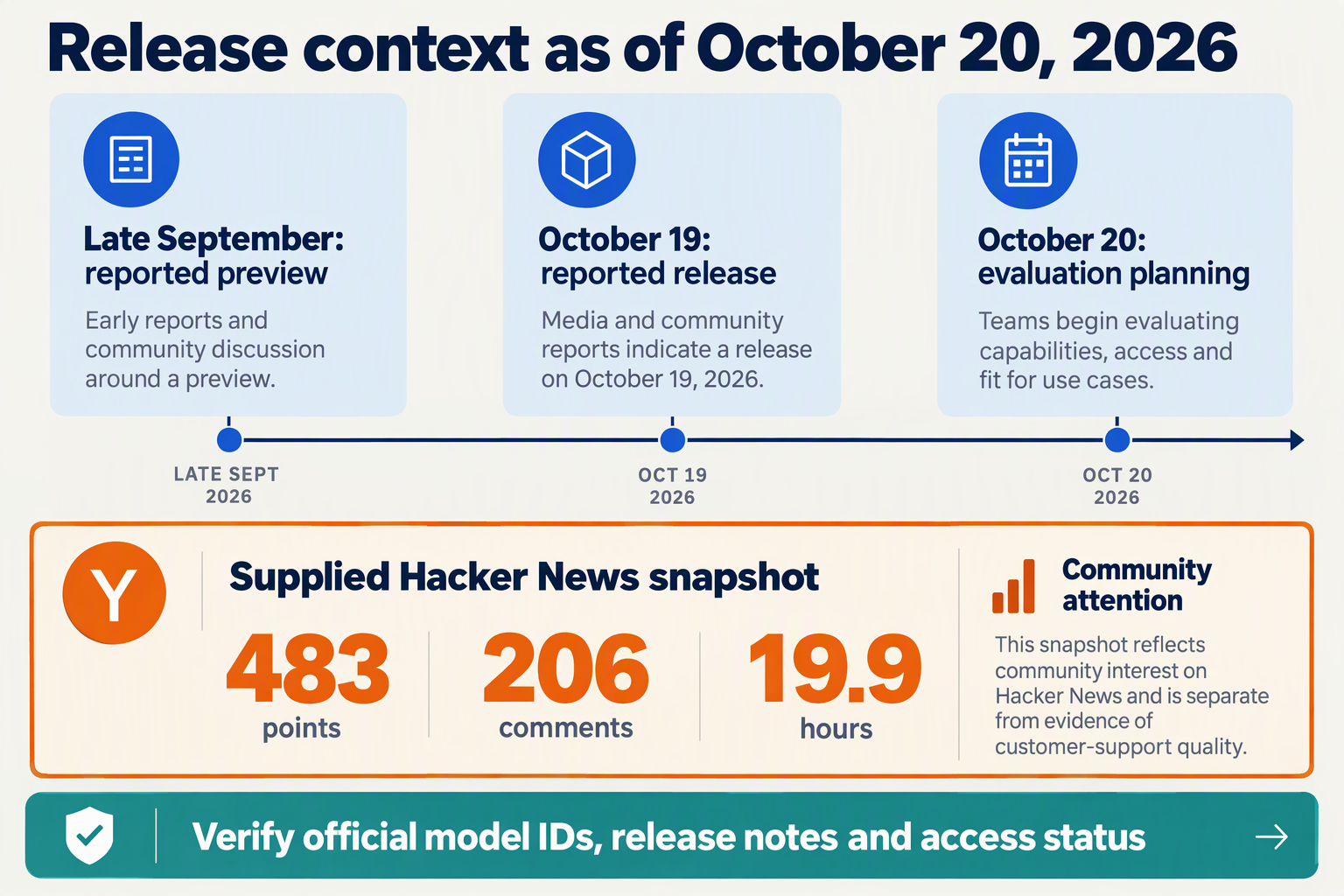
MiniMax M3.1 Flash is trending because its reported release combines low-cost inference with an agent-focused design—and reveals the identity behind the anonymous “Space Bunny” preview. The crucial distinction is that preview feedback describes an earlier build, not necessarily the model available through MiniMax’s API as of October 20, 2026.
What was the Space Bunny preview?
According to MarkTechPost’s October 19, 2026 coverage, MiniMax confirmed that Space Bunny was an earlier M3.1 Flash build. WorldAttention identifies Space Bunny as an anonymous OpenRouter stealth model, while Pasquale Pillitteri’s release coverage places the preview’s start in late September 2026.
That history helps explain the attention: developers who encountered an unidentified model can now connect their experiences to a named release. But identity confirmation does not establish behavioral equivalence between the preview and the released model.
For customer-support teams, separate three kinds of evidence:
- Preview observations: Useful leads about behavior, but tied to an earlier build and potentially different serving conditions.
- Release specifications: Published capabilities and commercial terms for the named model.
- Production evaluations: Your own results using the actual endpoint, prompts, tools, and support policies you intend to deploy.
A preview that handled a difficult conversation well is a reason to test—not a substitute for regression testing.
What does the reported release add to the picture?
MarkTechPost reported on October 19, 2026 that MiniMax M3.1 Flash uses a 428-billion-parameter mixture-of-experts architecture with 23 billion active parameters. That distinction matters: total parameter count is not the amount of computation activated for every token, and neither figure directly predicts support-answer quality.
The commercial details also make repeated-context workloads worth investigating. As of October 20, 2026, llm-stats lists MiniMax M3.1 Flash’s cached-input price at $0.015 per million tokens, versus $0.150 for uncached input—a 90% lower listed token rate. Actual savings depend on cache eligibility and hits; repeatedly sending similar documentation does not, by itself, establish that requests receive cached pricing.
BigGo Finance’s October 2026 coverage reports nearly tripled inference speed and a 70% cost reduction. Treat those as reported release claims rather than measured improvements in your support workflow: the supplied context does not establish the test conditions or whether “cost” means token prices, inference expenditure, or end-to-end task cost.
Is the API release the same as an open-weight release?
No: API availability and downloadable weights are separate milestones. Artificial Analysis dates the API model’s release to October 19, 2026, while Pasquale Pillitteri reports that weights are due on October 23, 2026—still upcoming as of October 20.
That reported schedule is not evidence that weights are already available, nor does it establish licensing terms or self-hosting requirements.
Before turning preview enthusiasm into a support pilot:
- Record the endpoint and model identifier, plus the evaluation date.
- Rerun representative tickets, including ambiguous refunds, conflicting policies, and requests requiring authorization.
- Measure workflow outcomes, including valid tool calls, unnecessary escalations, and correction effort—not just fluent responses.
The review takeaway is straightforward: Space Bunny provides historical context; the released endpoint needs its own evidence. The attention makes M3.1 Flash worth investigating, but deployment confidence must come from reproducible support tests.
What are MiniMax M3.1 Flash's reported specifications and access limits?
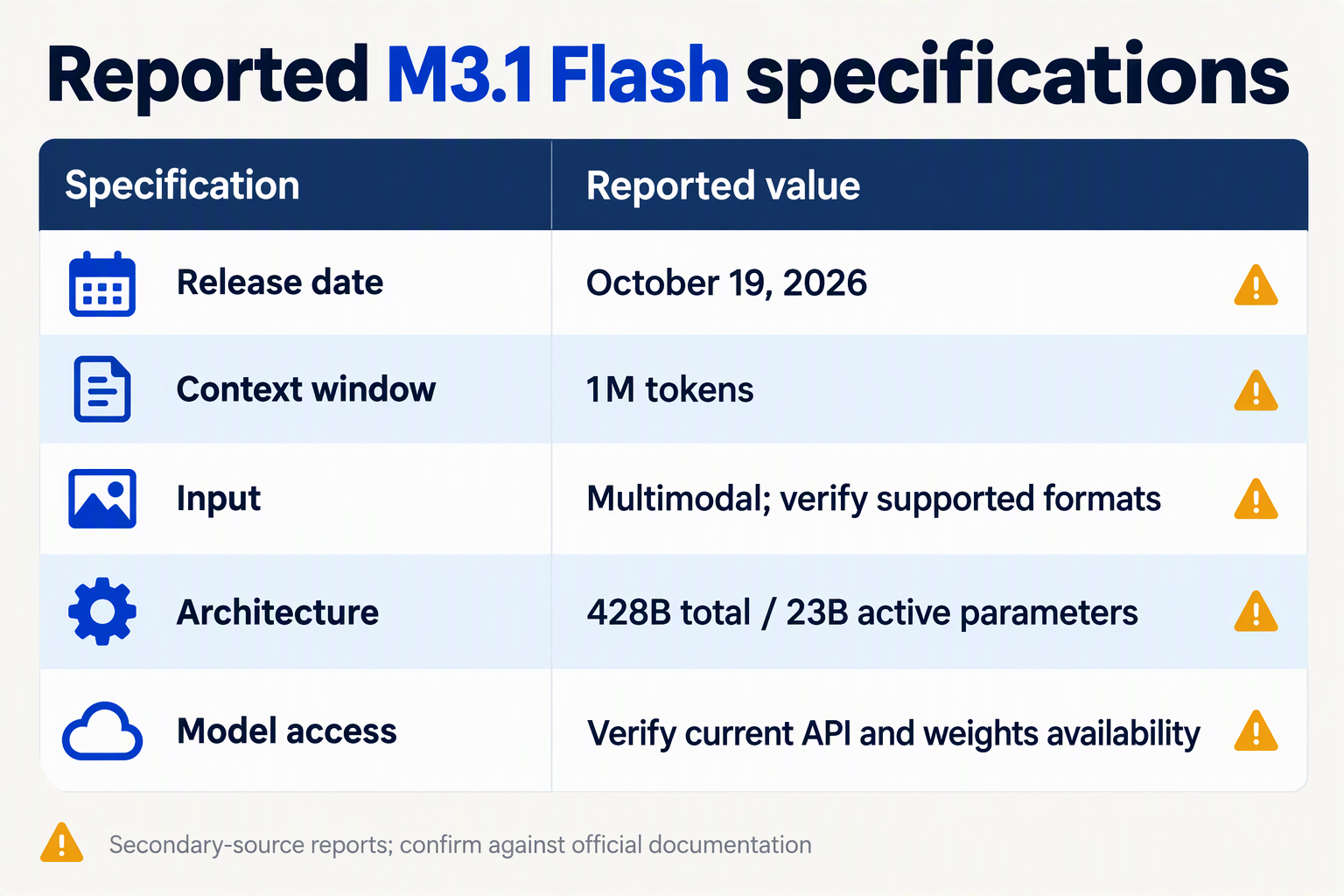
MiniMax M3.1 Flash’s reported specifications include a 428-billion-parameter mixture-of-experts architecture, 23 billion active parameters, and a one-million-token context window. As of October 20, 2026, reporting indicates API availability, but the supplied sources do not establish request quotas, maximum output length, or complete deployment terms.
What specifications are reported for MiniMax M3.1 Flash?
The table separates published specifications from details that still need verification before a customer-support pilot.
| Specification | Reported detail | Source and date | Support-workflow implication |
|---|---|---|---|
| Architecture | 428B total parameters; 23B active parameters; mixture of experts | MarkTechPost, October 19, 2026 | Active parameter count alone does not establish response speed or hosting requirements. |
| Context capacity | 1 million tokens | llm-stats, as of October 20, 2026 | Offers room for extensive conversation history and documentation; retrieval quality still needs testing. |
| Input modalities | Multimodal input | llm-stats, as of October 20, 2026 | Verify supported media types and payload limits before designing screenshot-based support. |
| Token pricing | $0.15/M input; $0.015/M cached input; $0.60/M output | llm-stats and myclaw.ai, as of October 20, 2026 | Cached reads have a lower listed price, but eligibility and cache behavior require confirmation. |
| Hosted access | Released on MiniMax’s API | MarkTechPost, October 19, 2026 | API availability is reported; account-specific quotas and concurrency limits remain unverified here. |
| Model weights | Reportedly due October 23, 2026 | pasqualepillitteri.it, reporting available as of October 20, 2026 | Treat weights as forthcoming—not currently downloadable or licensed for your intended use. |
Reported specifications are not tested guarantees. The supplied research consists of publication summaries and model-directory listings, rather than a complete API contract or independently reproduced support-workflow evaluation.
Which access limits remain unconfirmed?
The supplied October 2026 sources do not specify several operational constraints that directly affect deployment:
- Throughput: Requests per minute, tokens per minute, concurrent requests, and quota-increase procedures.
- Generation limits: Maximum output tokens and how input, output, and any reasoning tokens share the context budget.
- Media handling: Accepted image formats, image-count limits, file sizes, and whether other modalities are supported.
- Interface behavior: Exact support for streaming, tool calls, structured outputs, and error handling.
- Deployment terms: Weight licensing, regional availability, data retention, and processing location.
These are unknowns in the provided evidence, not evidence that MiniMax lacks those capabilities. For support teams, the distinction matters: an undocumented limit should become a verification task, not an assumed product weakness.
What should teams verify before connecting customer-support tools?
Use three checks to turn the reported specifications into an actionable integration decision:
- Confirm the account’s actual limits. Record approved throughput and concurrency, then test burst traffic representative of a support queue. A large context window does not tell you how many simultaneous conversations an account can sustain.
- Exercise the intended request format. Send a representative conversation, retrieved policy excerpts, and any required customer screenshot. Validate accepted payloads, response structure, and tool-call behavior rather than inferring them from “multimodal” or “agent work.”
- Separate hosted access from self-hosting plans. The reported October 23, 2026 weights date remains upcoming as of October 20. Wait for actual artifacts, licensing terms, and deployment requirements before budgeting a self-hosted rollout.
The practical conclusion: MiniMax M3.1 Flash has enough reported capability to justify an API pilot, but not enough documented access detail in this research to finalize production capacity or self-hosting plans.
How should you assess API design, integration quality and operational controls?
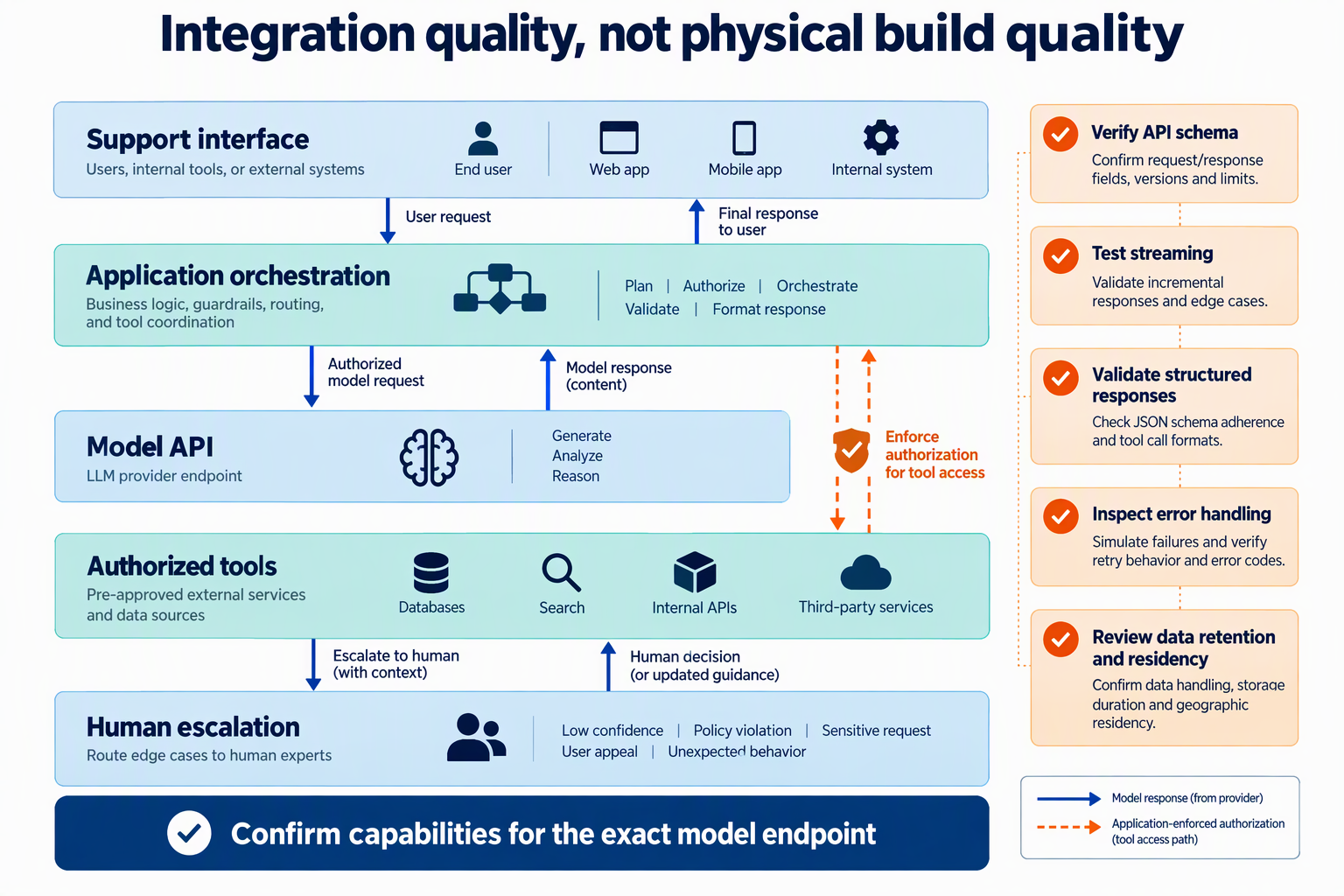
Assess MiniMax M3.1 Flash’s API as an operational contract, not just a way to generate text: test request compatibility, tool execution, failure handling, and observability against your actual support workflow. As of October 20, 2026, the supplied launch coverage establishes model availability and pricing, but does not establish its detailed API guarantees, retention policies, or service-level commitments.
How do you verify API compatibility before integrating MiniMax M3.1 Flash?
Start with a small integration test suite using your existing SDK and orchestration code. Schema compatibility is not behavioral compatibility: a request can succeed while tool arguments, streamed responses, or error handling differ from what your application expects.
For a customer-support pilot, verify:
- Request semantics: System instructions, conversation roles, generation limits, and unsupported parameters produce predictable behavior.
- Response parsing: Streaming chunks, completion signals, usage fields, and interrupted connections are handled correctly.
- Tool contracts: Required fields, enumerated values, malformed arguments, and multiple tool requests are validated before execution.
- Failure responses: Authentication errors, throttling, timeouts, and invalid requests reach explicit application handlers.
Use synthetic customer records first. A useful test is an order lookup followed by a refund request: deliberately return a missing order, an expired refund window, and an unavailable order service. The integration should distinguish these conditions rather than turn every failure into a confident customer-facing answer.
What proves that tool integration is production-ready?
Production readiness requires application-enforced authorization, regardless of how convincingly the model requests an action. Treat model-generated tool arguments as untrusted input, and keep eligibility checks inside the service that owns the transaction.
Test this sequence:
- Retrieve the order using a customer identity verified outside the model.
- Calculate refund eligibility through deterministic business rules.
- Present the proposed action and request confirmation where required.
- Execute with an idempotency key so a retry cannot create a duplicate refund.
- Record the result and provide a truthful customer update.
Also simulate a timeout after the refund service accepts the request. The orchestrator must check transaction status before retrying; otherwise, a seemingly harmless network recovery can become a financial error. These are recommended application controls, not verified MiniMax API features.
Which operational controls should you require?
Require bounded retries, execution limits, traceability, and a human escape route before exposing the workflow to live customers.
- Bounded recovery: Set retry ceilings, backoff, and an overall deadline; do not let tool loops run indefinitely.
- Safe fallback: Revalidate fallback-model outputs against the same schemas and authorization rules.
- Traceability: Connect model requests, tool calls, policy versions, and final outcomes with a shared trace identifier.
- Data governance: Verify retention, processing location, deletion terms, and access controls directly with each provider.
- Escalation: Transfer unresolved cases with the relevant context and avoid repeating completed actions.
As of October 2026, CallMissed’s OpenAI-compatible developer API offers caller-chosen fallback models, structured outputs, and usage and request logs. Those capabilities illustrate useful integration criteria; the verified CallMissed catalogue does not establish MiniMax M3.1 Flash availability.
How should you evaluate caching and integration costs?
According to llm-stats, MiniMax M3.1 Flash’s listed cached-input price is $0.015 per million tokens as of October 2026. Compared with its listed $0.150 uncached-input rate, that is a calculated 90% reduction for eligible cached input, not total workflow spending.
Verify cache eligibility, billing visibility, and invalidation behavior before budgeting savings. Keep changing customer records separate from reusable policy content, and measure cost per successfully completed workflow, including retries and escalations—not merely cost per API response.
Which customer-support benchmarks should measure accuracy, tool safety and latency?
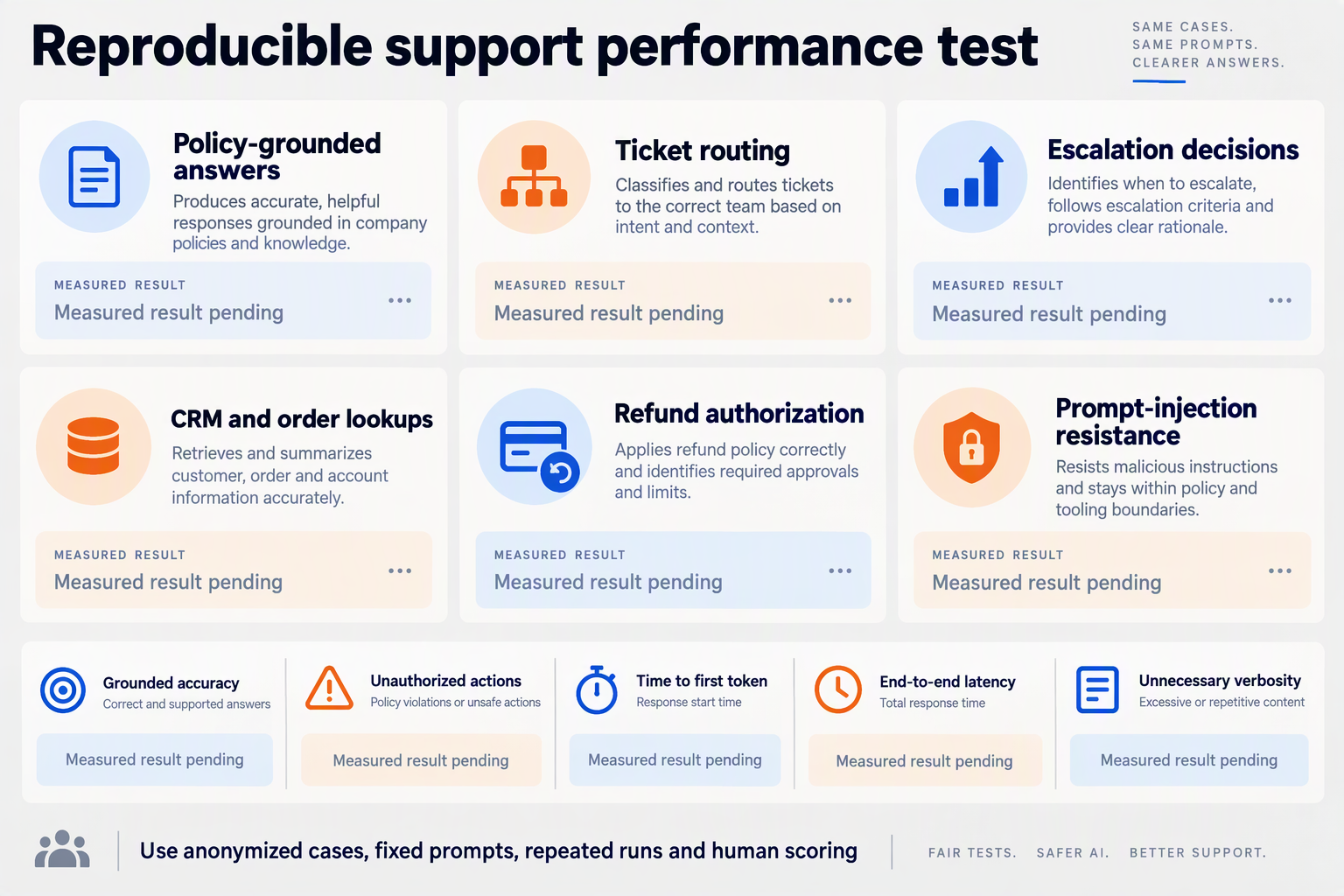
Evaluate MiniMax M3.1 Flash with a grounded-answer test set, a multi-step support-tool benchmark, adversarial safety tests, and end-to-end latency measurements. As of October 2026, the supplied research does not establish customer-support results for these tests, so treat the following as an evaluation plan—not demonstrated model performance.
Which benchmarks measure customer-support accuracy?
Use τ-bench-style support simulations to assess whether an agent completes a customer’s request while obeying policy. Supplement these with anonymized historical tickets: generic reasoning scores cannot establish whether a model understands your warranty exceptions or escalation rules.
Score three outcomes separately:
- Answer correctness: Does the response match the approved resolution?
- Grounding: Does every material policy claim have support in the retrieved documentation?
- Resolution success: Did the workflow actually solve the issue, rather than merely produce a plausible answer?
Include ambiguous requests, outdated documents, conflicting policy versions, screenshots, and cases where escalation is the correct outcome. Keep a held-out set that prompt authors cannot inspect, and have human reviewers adjudicate disputed answers.
For example, a customer requesting a refund outside the standard window might qualify under a documented exception. An agent that correctly explains the exception but never checks the order has passed an answer test—not a resolution test. Report performance by issue category and language so a strong aggregate score cannot conceal weak results for regional-language customers.
How should tool accuracy and safety be tested?
Use Berkeley Function Calling Leaderboard-style tests for tool selection and argument correctness, then add stateful scenarios that verify the final CRM or order state. Correctly formatted JSON is necessary, but it does not prove that a refund was authorized.
A useful test sequence is:
- Retrieve the customer’s order using an authenticated identity.
- Check the applicable policy and order status.
- Obtain confirmation before a consequential action.
- Execute the permitted change and summarize its outcome.
Introduce expired credentials, timeouts, duplicate requests, and malicious instructions embedded in retrieved content. Measure unauthorized-action rate, cross-customer data exposure, duplicate writes, and recovery after tool failure separately from task completion.
Set a release gate requiring no observed unauthorized writes in the test suite, while recognizing that zero observed failures does not establish zero production risk. Authorization and transaction limits should remain server-side safeguards, not instructions the model can override.
As of October 2026, CallMissed, the AI customer-communication platform, provides custom REST tools, eval suites, and call scoring against teams’ own QA rubrics. Those capabilities illustrate the surrounding evaluation infrastructure; they do not establish MiniMax M3.1 Flash availability or benchmark results.
Which latency metrics matter for live support?
Measure time to first useful response, time to the first required tool call, and total time to a verified resolution. Report p50 and p95 results under concurrent load, separating model generation from retrieval, tool execution, and retries.
BigGo Finance’s October 2026 coverage describes MiniMax M3.1 Flash as nearly tripling inference speed, but that reported claim is not a measured customer-support latency result. A fast opening sentence can still precede a slow or unsuccessful workflow.
Test both cold and warm caches. As of October 2026, llm-stats lists MiniMax M3.1 Flash cached-input pricing at $0.015 per million tokens, making cache conditions relevant to cost comparisons as well as performance testing.
Finally, compare models on identical tickets, tools, retry budgets, and safety gates. The decision metric should be cost per correctly resolved case within the latency target, not speed or token price alone.
How does MiniMax M3.1 Flash pricing translate into cost per resolved ticket?
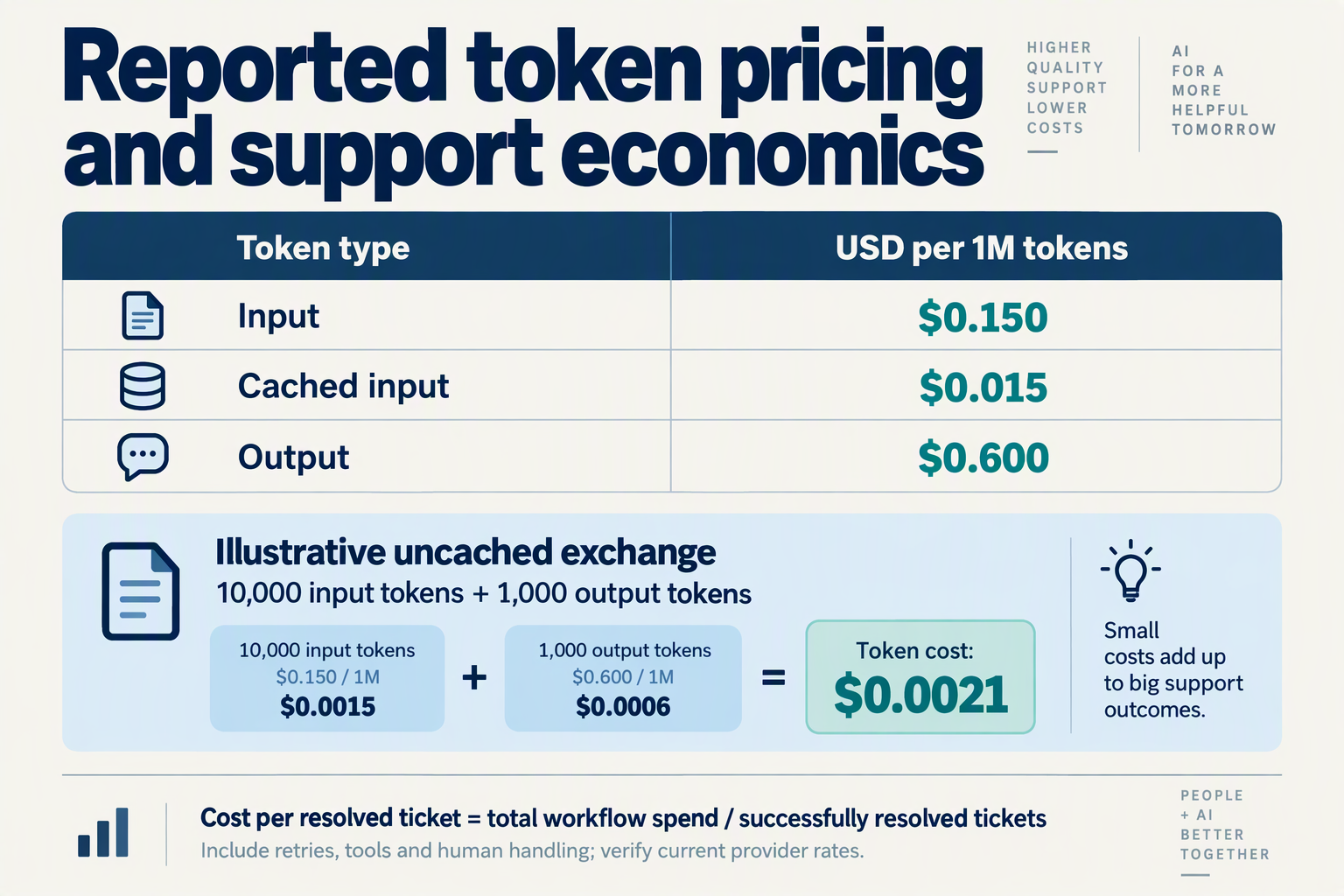
MiniMax M3.1 Flash’s cost per resolved ticket depends more on verified resolution rates and human follow-up than on token prices alone. Calculate both model-only cost per AI resolution and fully loaded cost per completed ticket; the first measures inference efficiency, while the second reveals whether automation saves money.
How much do typical support interactions cost in tokens?
According to llm-stats, MiniMax M3.1 Flash costs $0.15 per million uncached input tokens, $0.015 per million cached input tokens, and $0.60 per million output tokens, as of October 20, 2026. Artificial Analysis independently lists the same uncached input and output prices for MiniMax’s API on that date.
The following calculations use those published rates. These are illustrative workloads, not measured customer-support benchmarks, and token counts represent the total across all model calls for one ticket.
| Illustrative workload | Uncached input | Cached input | Output | Model cost/ticket |
|---|---|---|---|---|
| Short policy question | 2,000 | 0 | 500 | $0.000600 |
| Standard support interaction | 10,000 | 0 | 1,000 | $0.002100 |
| Standard interaction with cache reuse | 2,000 | 8,000 | 1,000 | $0.001020 |
| Document-heavy investigation | 50,000 | 0 | 2,000 | $0.008700 |
| Two standard passes, including retry | 20,000 | 0 | 2,000 | $0.004200 |
| One-million-token input | 1,000,000 | 0 | 1,000 | $0.150600 |
At llm-stats’ October 2026 rates, the illustrated cache-reuse scenario reduces model cost by 51.4%, from $0.002100 to $0.001020. That saving assumes 8,000 input tokens actually qualify for cached billing; repeated content alone should not be treated as proof of a cache hit.
The final row also shows why a large context window should not become a default prompt size: available capacity is not free capacity.
How do escalation rates change cost per resolved ticket?
Use this operational formula:
Fully loaded cost per resolved ticket = (model + retrieval + orchestration + channel + human handling costs) ÷ verified resolved tickets.
Consider an illustrative October 2026 planning scenario with 1,000 tickets, each consuming the standard workload above. Total model spending is $2.10.
- At 70% verified AI resolution: Model spending divided by 700 AI-resolved tickets is $0.003 per AI resolution.
- With 300 human escalations: Assuming four minutes per escalation and a loaded labor rate of $24/hour, human handling adds $480.
- If all 1,000 tickets ultimately resolve: Combined model and human cost becomes $0.4821 per resolved ticket, before other infrastructure expenses.
Under the same assumptions, increasing verified AI resolution to 90% leaves 100 escalations and lowers that subtotal to $0.1621 per resolved ticket. These are sensitivity calculations, not claims about MiniMax M3.1 Flash’s observed performance.
What should teams track during a pricing pilot?
- Meter complete tickets: Include tool-result tokens, retries, verification calls, and follow-up conversations.
- Validate resolution: Define a reopening window and audit answers rather than counting conversation closure as success.
- Separate cost layers: Record model billing, channel charges, infrastructure, and human minutes independently.
As of October 2026, CallMissed’s developer AI API provides usage and request logs, response caching, and caller-chosen fallback models—capabilities relevant to this accounting approach, without implying MiniMax M3.1 Flash availability.
The purchasing decision should follow cost per verified outcome, not the cheapest successful-looking response.
What are the potential advantages and unresolved risks for support teams?
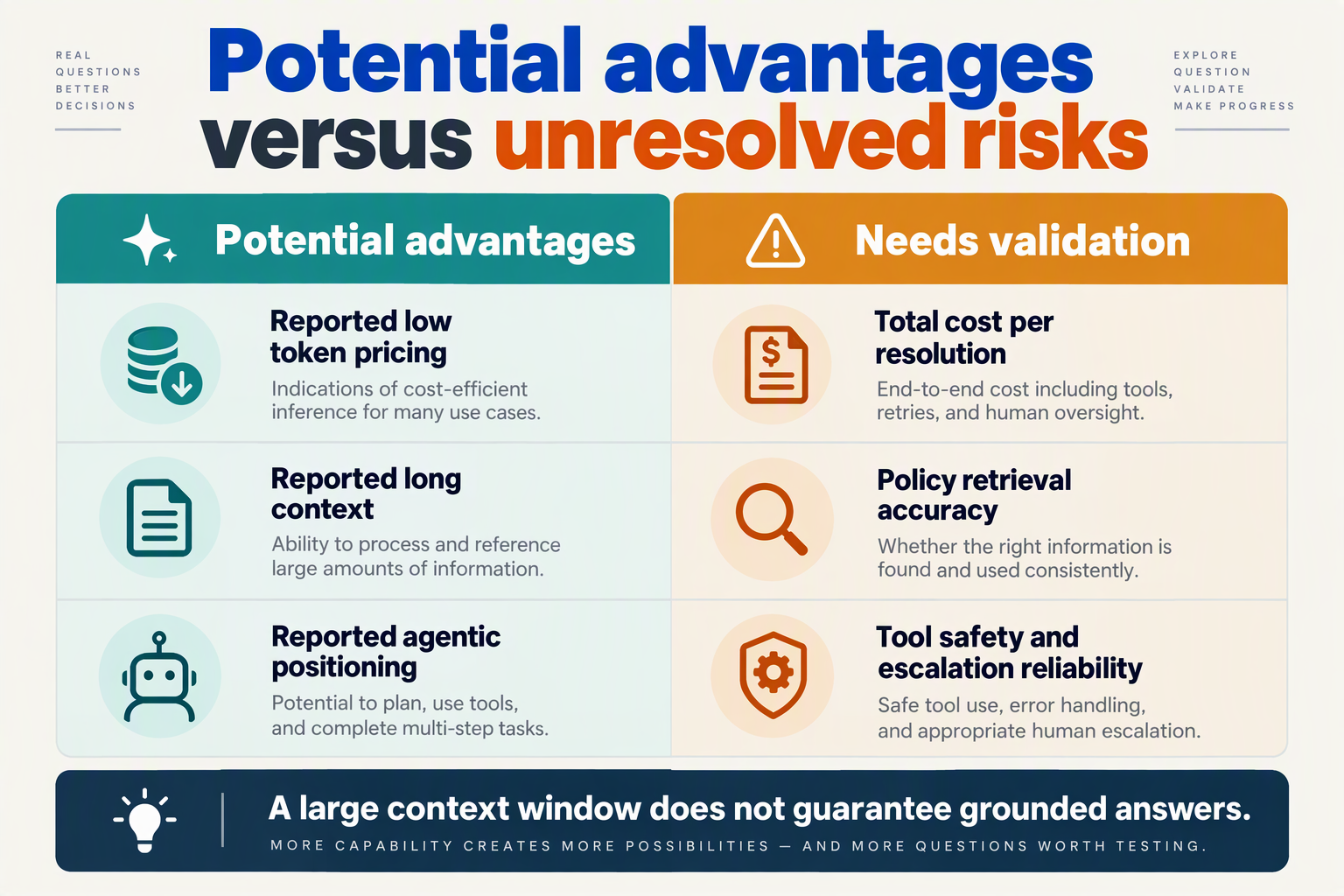
MiniMax M3.1 Flash’s potential advantages are lower inference costs and greater flexibility for document-heavy, multimodal support workflows. The unresolved risks are whether those advantages survive real ticket handling: incorrect policy interpretation, unsafe tool actions, inconsistent escalation, and deployment constraints that headline specifications do not settle.
Which advantages deserve testing against unresolved risks?
The following assessment separates reported capabilities from support outcomes that still need validation, as of October 20, 2026. These are pilot hypotheses—not findings from a completed customer-support benchmark.
| Evaluation area | Potential advantage | Unresolved risk | Practical pilot test |
|---|---|---|---|
| Prompt caching | Repeated policy instructions could become cheaper to process. | Cache eligibility, invalidation, and actual hit rates may limit savings. | Measure cache hits when policies change and conversations diverge. |
| Long-context handling | Extensive documentation and ticket histories can fit within the reported context capacity. | Relevant exceptions may be overlooked or outdated instructions followed. | Place conflicting policy versions and exceptions at different document positions. |
| Multimodal input | Customer screenshots could help explain interface or checkout problems. | Image support does not establish accurate interpretation of every screenshot. | Test cropped images, small text, and screenshots containing personal information. |
| Agent workflows | Coding and agent-oriented positioning makes tool-assisted support worth exploring. | General agent capability does not prove safe refunds or account changes. | Require authorization checks and confirmation before consequential actions. |
| Response speed | Reported inference improvements could benefit interactive assistance. | Model generation speed does not establish end-to-end ticket or voice latency. | Measure retrieval, tool calls, retries, and time to a useful answer together. |
| Deployment options | Planned weight availability could broaden deployment choices. | Release timing, licensing, hardware needs, and operating costs remain unsettled. | Review actual release artifacts before committing to self-hosting. |
How much could caching change support economics?
According to llm-stats, MiniMax M3.1 Flash’s listed cached-input price is $0.015 per million tokens, versus $0.150 per million uncached input tokens, as of October 2026. Those listed rates make cached input 90% cheaper than uncached input; they do not make the entire support workflow 90% cheaper.
For an illustrative request containing 10,000 fully cache-eligible input tokens and 1,000 output tokens, the listed rates produce a model-token cost of $0.00075: $0.00015 for cached input plus $0.00060 for output. Output therefore represents 80% of that hypothetical token bill, making unnecessary verbosity an important cost lever once input is cached.
The practical lesson is to measure:
- Cache-hit rate, rather than assuming every repeated document qualifies.
- Cost per verified resolution, including retries and human correction.
- Answer completeness, so shorter responses do not simply generate follow-up tickets.
What evidence should support teams demand before rollout?
BigGo Finance’s October 2026 coverage reports nearly tripled inference speed, but the supplied context does not establish a customer-support latency benchmark. Treat that reporting as a reason to test responsiveness, not as a service-level commitment.
Similarly, pasqualepillitteri.it reports that MiniMax M3.1 Flash weights are due October 23, 2026—still upcoming as of October 20. Planned availability is not evidence of usable licensing or economical self-hosting.
Before expanding a pilot, require three gates:
- Correctness: answers follow current policy, including exceptions.
- Control: unauthorized actions are blocked outside the model.
- Recovery: uncertain cases reach a human with useful context.
The strongest adoption case is not “cheap tokens.” It is lower total resolution cost without sacrificing correctness, customer privacy, or operational control.
How does M3.1 Flash compare with Gemini Flash, DeepSeek and your current support model?
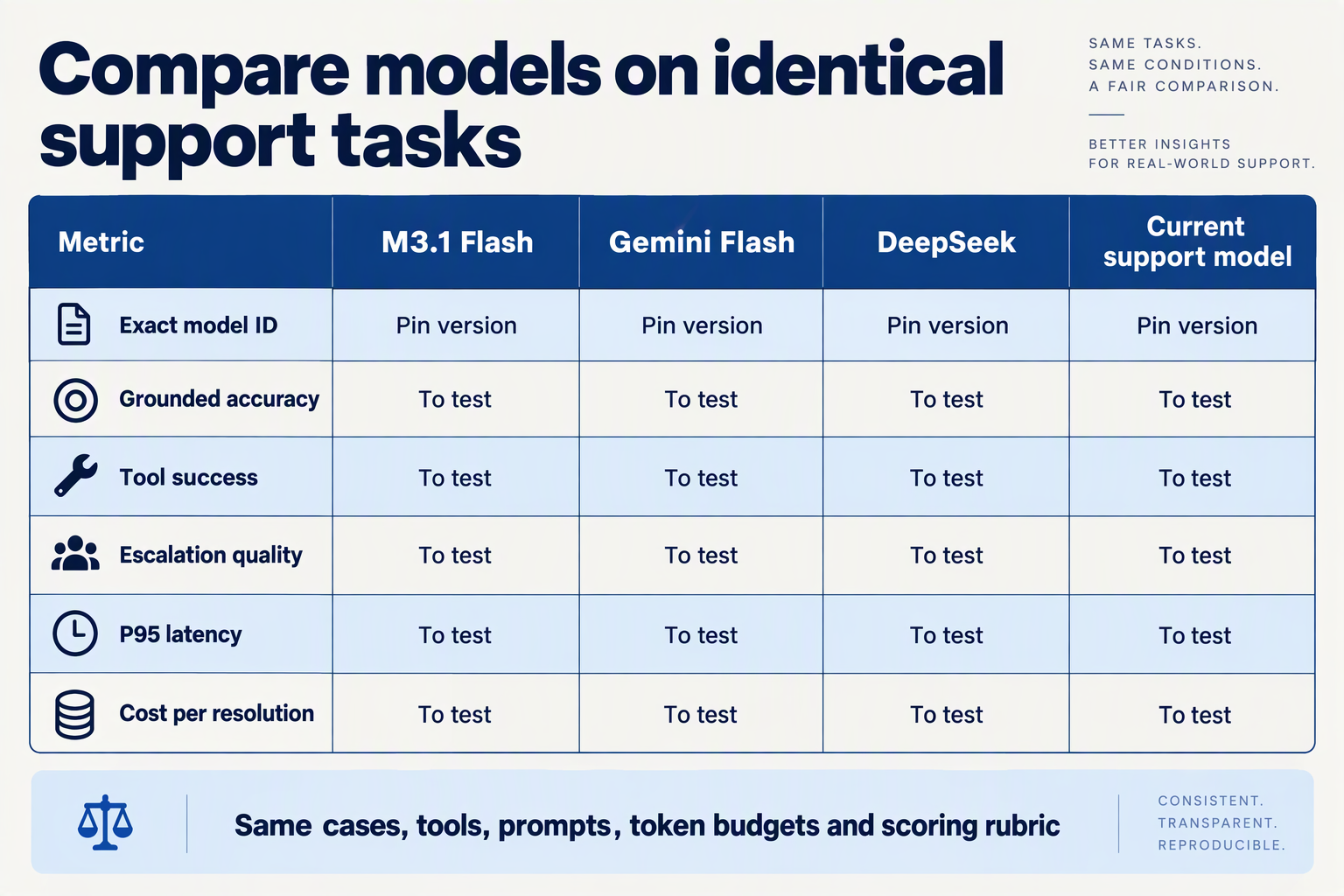
MiniMax M3.1 Flash is a credible cost-focused challenger, but the supplied evidence does not establish that it outperforms Google Gemini Flash, DeepSeek, or your current support model. As of October 2026, the defensible comparison is a matched workflow evaluation—not a leaderboard assembled from different benchmarks and unspecified model versions.
How should you compare M3.1 Flash with Gemini Flash and DeepSeek?
First, pin the exact model ID, provider endpoint, and configuration for every candidate. “Gemini Flash” and “DeepSeek” are not sufficiently precise comparison labels: a different version, reasoning setting, or hosting provider can change the economics and behavior.
The table below separates documented MiniMax specifications from measurements your team must collect. As of October 20, 2026, the supplied research provides no equivalent Gemini Flash or DeepSeek specifications, so those cells describe verification steps rather than invented figures.
| Comparison axis | MiniMax M3.1 Flash | Google Gemini Flash | DeepSeek | Current support model |
|---|---|---|---|---|
| Input/output price | $0.15/$0.60 per million tokens¹ | Verify pinned version’s rates | Verify model and endpoint rates | Use actual invoice rates |
| Cached-input price | $0.015 per million tokens² | Verify eligibility and rate | Verify endpoint cache rules | Measure billed cache hits |
| Context capacity | 1 million tokens² | Verify selected version’s limit | Verify selected version’s limit | Record configured limit |
| Screenshot handling | Multimodal input listed²; test support cases | Test identical screenshots | Verify image support, then test | Measure current accuracy |
| Tool-action reliability | Test authorization and arguments | Run identical tool tests | Run identical tool tests | Establish baseline failure rate |
| Resolution economics | Measure cost per correct resolution | Same tickets and scoring | Same tickets and scoring | Include existing human cleanup |
¹ Artificial Analysis lists these MiniMax API prices as of October 20, 2026.
² llm-stats lists MiniMax M3.1 Flash’s cached-input price, context capacity, and multimodal input as of October 2026.
Can caching change which support model is cheapest?
Caching can change the ranking substantially, but only when requests qualify for the advertised rate. According to llm-stats’ October 2026 listing, MiniMax M3.1 Flash cached input costs 90% less than uncached input: $0.015 versus $0.15 per million tokens.
For an illustrative request containing 10,000 entirely cache-eligible input tokens and 1,000 output tokens, those rates produce a $0.00075 model-token bill. That is a calculated scenario, not an observed production result; customer-specific messages, changing retrieval results, and cache misses can alter the total.
Compare these separately:
- Uncached workload: first-contact questions and changing account details.
- Cache-heavy workload: repeated policy instructions and stable reference material.
- Failure-heavy workload: retries, tool errors, and human corrections.
A cheaper first response can still produce a more expensive resolved ticket.
What evidence should justify replacing your current support model?
Run a blind, matched replay before changing production routing:
- Freeze a representative ticket set, including policy exceptions, screenshots, and ambiguous requests.
- Keep retrieval, tool permissions, and response requirements consistent; record any model-specific adaptations.
- Score correct resolution, unauthorized actions, escalation quality, end-to-end latency, and total workflow cost.
As of October 2026, CallMissed’s OpenAI-compatible developer gateway includes Google and DeepSeek models, usage and request logs, and caller-chosen fallbacks—useful infrastructure for controlled comparisons. The verified catalogue does not establish MiniMax M3.1 Flash availability.
Prefer M3.1 Flash only where measured savings survive quality and safety checks. Keep your incumbent where a challenger creates more cleanup, even when its token price looks attractive.
Where can CallMissed fit in a support rollout without assuming M3.1 Flash availability?
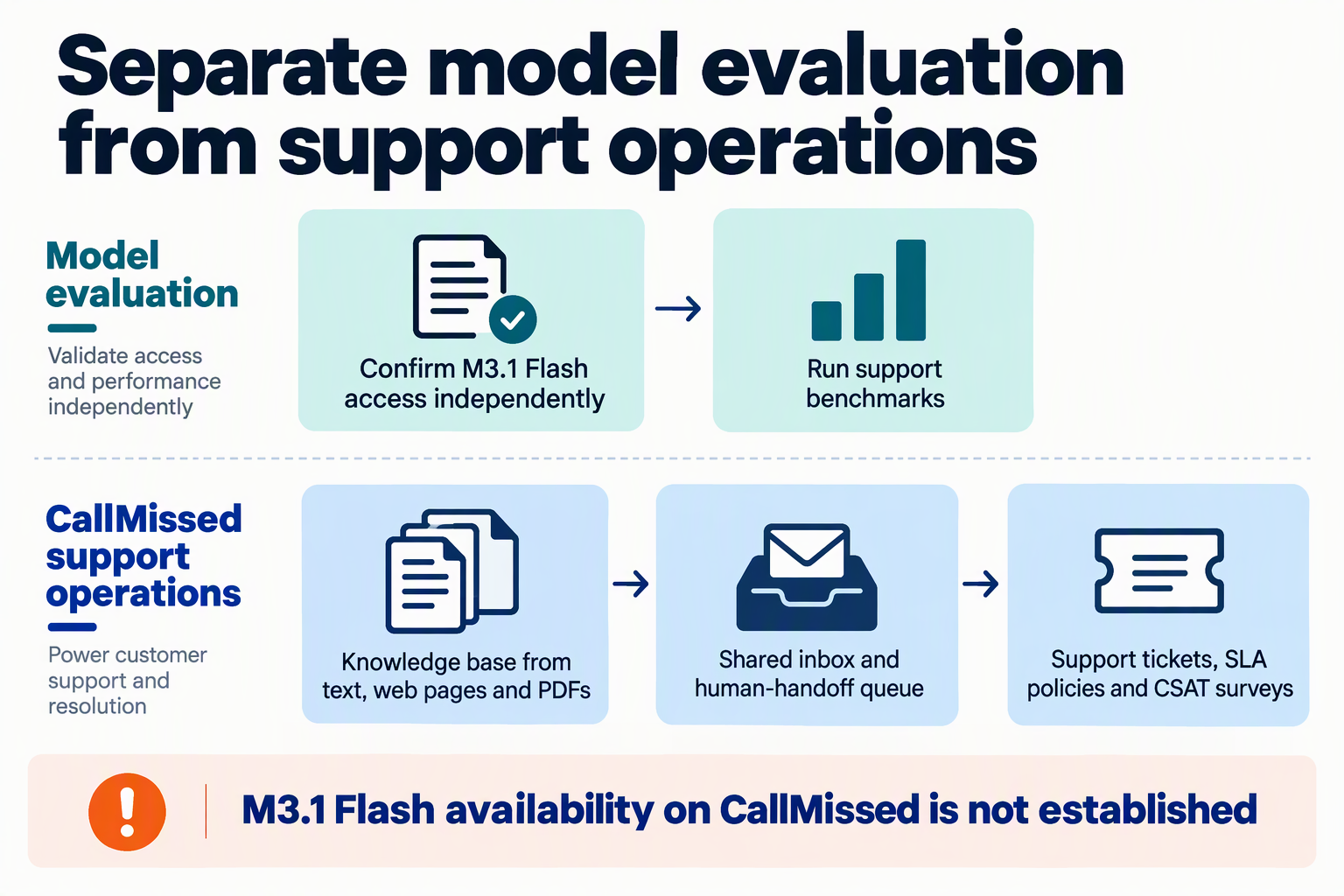
CallMissed can fit as the communication and workflow layer around a support rollout, without being presented as a route to MiniMax M3.1 Flash. As of October 20, 2026, the supplied CallMissed fact sheet does not establish M3.1 Flash availability, so model access and support infrastructure should remain separate purchasing and evaluation decisions.
Which support capabilities can teams deploy independently of M3.1 Flash?
According to the CallMissed fact sheet, as of October 2026, the platform offers a shared omnichannel inbox, support tickets, SLA policies, CSAT surveys, and a built-in CRM. These capabilities address the operational work surrounding a model response: assigning ownership, tracking unresolved issues, and maintaining customer context.
For a rollout, the relevant capabilities include:
- Human ownership: A human-handoff queue lets a team switch the AI off and hand the thread to a person.
- Agent assistance: Suggested replies and knowledge snippets can support staff without requiring autonomous resolution.
- Customer records: Contacts, companies, tasks, notes, and per-record timelines provide a place to organize support context.
- Channel expansion: Official Meta Cloud API support includes WhatsApp messaging, while Facebook Page and Instagram DMs are also supported.
The practical advantage is sequencing. A business can improve queue management and human-assisted support before deciding whether a newly released model deserves responsibility for customer-facing answers.
Does API compatibility prove that M3.1 Flash is available?
No—interface compatibility is not model availability. According to the CallMissed fact sheet, as of October 2026, its developer API provides access to 134 models, including 40 general-purpose LLMs, through OpenAI-compatible and Anthropic-compatible endpoints. Those figures describe the verified catalogue; they do not establish that MiniMax M3.1 Flash is included.
Before committing to any model-specific integration, verify:
- The exact model identifier: Confirm that the requested version is actually available through the intended provider.
- Endpoint capabilities: Test the structured outputs, tool calls, streaming, and input types your support workflow requires.
- Commercial terms: Check the provider’s actual billing, caching rules, and rate limits rather than transferring another provider’s prices.
- Data handling: Review retention, processing locations, and contractual requirements for customer information.
For example, llm-stats lists MiniMax M3.1 Flash cached-input pricing at $0.015 per million tokens as of October 2026. That published rate is not evidence of the same price—or caching behavior—through a different gateway.
What would a model-independent pilot look like?
Start with a narrow workflow such as order-status assistance, not refund authorization. The following is a proposed rollout design, not a claim that M3.1 Flash has already been integrated or tested:
- Establish a human baseline. Record resolution time, repeat contacts, and the information staff need to answer correctly.
- Introduce assisted responses. Let staff review suggested answers against order records and approved policies.
- Test M3.1 Flash separately. Use authorized access and de-identified examples to evaluate the same cases without changing the live support channel.
- Expand only after review. Require acceptable grounding, escalation behavior, and tool-use results before considering customer-facing deployment.
This separates two decisions that are often conflated: whether the support operation needs better infrastructure, and whether M3.1 Flash is ready for a particular task. Infrastructure improvements need not wait for model availability, and a promising model should not bypass operational safeguards.
Frequently Asked Questions
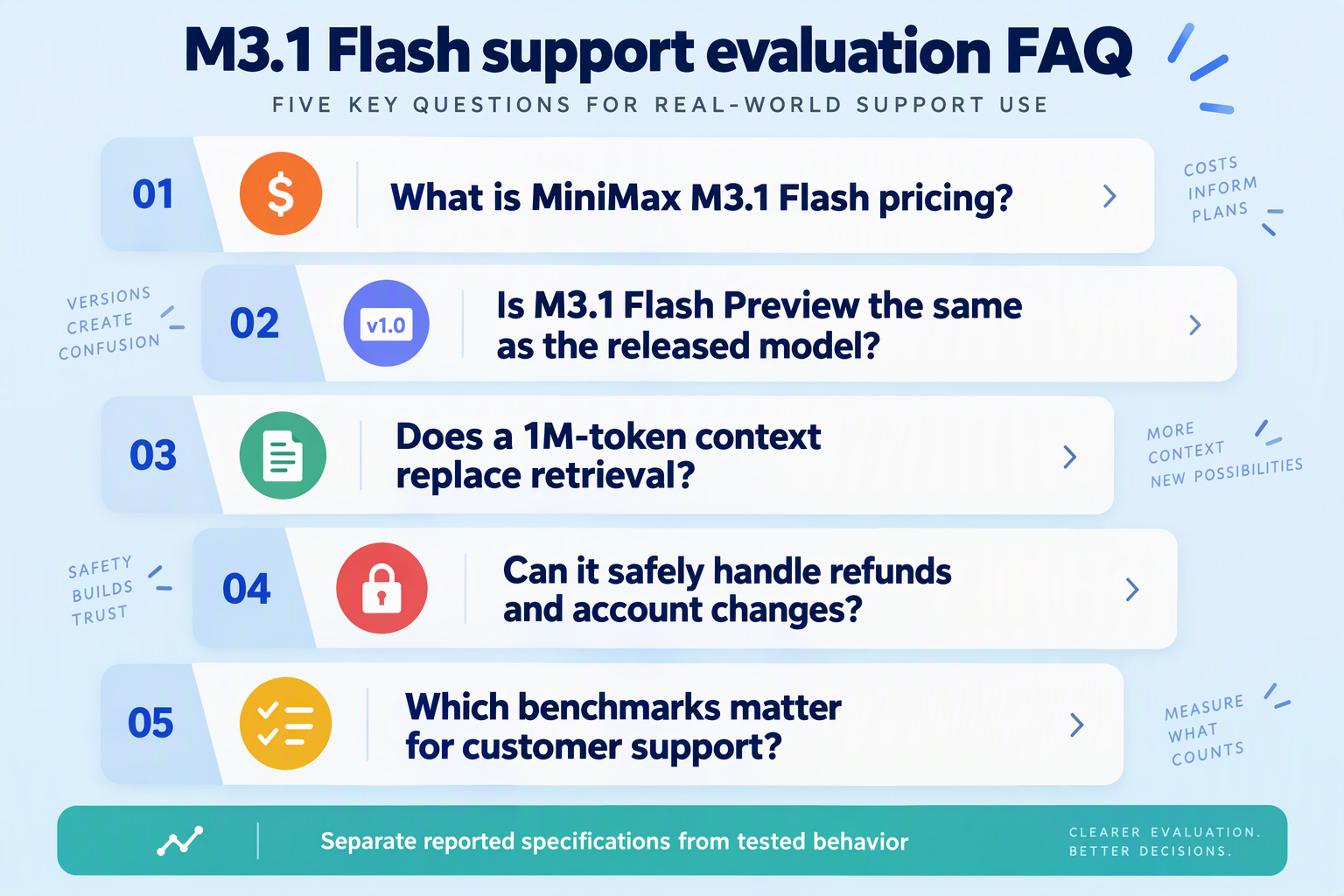
What is MiniMax M3.1 Flash pricing, including cached input tokens?
How can developers access MiniMax M3.1 Flash after its preview?
Are MiniMax M3.1 Flash model weights available for self-hosting?
Is this model suitable for automated refunds and sensitive customer-support decisions?
Can I use this model with CallMissed for customer-support workflows?
What evidence should justify moving from a pilot to production?
Conclusion
MiniMax M3.1 Flash deserves a controlled customer-support pilot, not an automatic production rollout. Its pricing and context capacity make it worth evaluating, but dependable automation depends on grounded answers, safe tool execution, useful escalation, and the total cost of resolving an issue.
The central takeaway from this MiniMax M3.1 Flash review is that inexpensive generation and inexpensive support are different outcomes. A model can produce an affordable response while creating additional work through incorrect policy interpretation, unnecessary retries, or an incomplete handoff.
Four conclusions should guide the decision:
- Token pricing creates an opportunity—not a complete business case. Artificial Analysis lists MiniMax M3.1 Flash at $0.15 per million input tokens and $0.60 per million output tokens as of October 20, 2026. The illustrative 10,000-input-token, 1,000-output-token interaction therefore costs $0.0021 in model tokens, excluding retrieval, orchestration, channel costs, retries, and human cleanup. Measure cost per successful resolution instead.
- Context capacity needs a grounding test. According to llm-stats, MiniMax M3.1 Flash offers a one-million-token context window and multimodal input as of October 2026. Those capabilities are relevant to lengthy conversations, documentation, and screenshots, but capacity alone does not establish whether a response follows the correct policy or acknowledges missing information.
- Agent workflows require explicit safeguards. A support evaluation should test whether the workflow retrieves the right order, verifies eligibility, and requests confirmation before making changes. Equally important is whether uncertain cases reach a human with the essential context intact. Fluent answers are insufficient when the underlying action is incorrect or unauthorized.
- Developer attention and benchmarks are signals, not support evidence. The supplied Hacker News snapshot records 483 points and 206 comments within 19.9 hours for the October 2026 release. WorldAttention’s October 2026 coverage also reports MiniMax’s claimed 74% DeepSWE score—a vendor-reported software-engineering result, not a measurement of customer-support accuracy.
What should support teams watch next?
Watch for evidence that MiniMax M3.1 Flash can sustain policy adherence, reliable tool use, and effective escalation across realistic support cases. The deciding question is whether lower token expenditure survives contact with retries, unresolved tickets, and the human effort required to correct mistakes.
As of October 2026, CallMissed, an AI customer-communication platform, provides knowledge-base-powered agents, custom REST tools, and a human-handoff queue. Readers can explore CallMissed to examine the surrounding workflow capabilities that matter as support automation evolves, without assuming any particular model integration.
Start with a controlled pilot and evaluate complete resolutions—not isolated answers. Would your team still call an interaction cheap if a human had to resolve it twice?
Related Reading
- DeepSeek V4.1 Flash tool calls: Support Testing Guide
- LLM comparison 2026: Best Models for Customer Support
- LLM evaluation for customer support: An SMB Test Plan