Internet Phone Switch Review: Phreak.ing for Business?



Evaluate an Internet Phone Switch for business calls with a Phreak.ing feature checklist, privacy trade-offs, and migration checks.
Internet Phone Switch Review: Phreak.ing for Business?
Would you trust your business calls to a phone switch that explicitly asks you not to use your real phone number? Phreak.ing’s Internet Phone Switch is an intriguing community project, but the available evidence supports exploring its telephone features—not assuming it is ready to handle customer communications. That distinction matters when a missed call could mean a lost sale.
In the Hacker News trend snapshot supplied for this October 2026 review, “Phreak.ing – Internet Phone Switch” attracted 128 points and 33 comments in 11.2 hours. That is a signal of community interest, not a reliability benchmark or business endorsement. The practical question is whether the appeal of a lightweight internet switch translates into dependable everyday call handling.
According to daily.dev, Phreak.ing offers classic telephone dial codes for calling, voicemail, call parking, intercom paging, conference rooms, and even a radio station. These are recognizable private branch exchange (PBX) functions: a switch connects callers and organizes how calls move between people or destinations. For a technically curious team, that makes the project worth understanding on its own terms.
Phreak.ing’s own website states, “we do not keep logs” and “Do not use your real phone number for signup.” Those statements describe the project’s stated anonymity model; they do not establish its security controls, availability, or suitability for regulated customer conversations. For business buyers, the key issue is fit: privacy preferences and operational accountability are related, but they are not interchangeable.
This review examines Phreak.ing as a potential business call-handling tool, separating documented capabilities from questions that require further verification. The evaluation focuses on three practical questions:
- Which advertised PBX features could help a small team answer, park, or share calls, and what would need testing before adoption?
- How does an anonymous, no-logs model align with your need to investigate missed calls, resolve disputes, and review service quality?
- What should you verify about access controls, support, costs, and availability before routing customer calls through any internet phone switch?
As of October 2026, CallMissed, an AI customer-communication platform, illustrates another direction in business telephony with call queues, keypad menus, AI voice agents, and call recordings and transcripts that support structured call handling.
The goal is not to dismiss a community project for having different priorities. It is to help you decide whether Phreak.ing belongs in an experimental setup, an internal workflow, or a customer-facing operation—and which unanswered questions should stop you from committing too soon.
Is Phreak.ing business-ready? Treat it as an experimental PBX until critical requirements are verified

Phreak.ing should be treated as an experimental PBX, not a verified business call-handling service, as of October 2026. The supplied evidence establishes an interesting telephone feature set, but it does not establish the operational commitments needed before routing customer calls through an internet phone switch.
This is an evidence boundary, not a claim that Phreak.ing is unreliable. A community project can work well for its intended audience while leaving business procurement questions unanswered.
What would make Phreak.ing ready for business calls?
Business readiness means being able to answer three questions: Can customers reach you? Can staff handle calls predictably? Can someone investigate and resolve failures?
In the material supplied for this October 2026 review, daily.dev describes Phreak.ing’s call parking, voicemail, intercom paging, and conference rooms. Those functions justify a hands-on evaluation, but a feature description does not tell you what happens when two employees retrieve the same parked call or when a connection drops during a transfer.
Before adoption, ask for evidence across these requirements:
- Connectivity: Can the service receive calls from your intended customer channels, and what numbers, carriers, or endpoints are supported?
- Access control: How are accounts authenticated, permissions assigned, and departing employees removed?
- Continuity: What happens during an outage, and can calls reach an alternative destination?
- Support and ownership: Who handles incidents, and what response commitments, if any, are documented?
- Commercial terms: What usage charges, restrictions, and service conditions apply?
The supplied sources do not verify these requirements. Mark them “unverified,” not “unavailable”—an important distinction in a fair Phreak.ing review.
How should you test an internet phone switch before adoption?
Start with a controlled, non-customer pilot that respects Phreak.ing’s signup guidance. Use synthetic conversations rather than customer names, order details, or payment information.
A practical evaluation sequence is:
- Define the call journey. Specify where a call starts, who answers, when it is parked, and how another person retrieves it.
- Test ordinary handling. Check ringing, two-way audio, voicemail retrieval, and the advertised functions your team actually needs.
- Introduce failure conditions. Disconnect an endpoint, leave a call unanswered, and attempt simultaneous calls. Record what callers and staff experience.
- Check recoverability. Determine whether an authorized administrator can identify a failed handoff, restore access, and explain the incident.
For example, a successful call-parking test requires more than hearing hold audio. The second employee must retrieve the intended caller without exposing another conversation or leaving the caller stranded. Define pass criteria before testing, rather than interpreting any completed call as proof of readiness.
Does an anonymous PBX meet business accountability needs?
Not automatically. As of October 2026, Phreak.ing’s website describes an anonymous, no-logs approach; that makes the availability of diagnostic evidence a question to resolve, rather than assume.
Ask what “logs” covers: call metadata, administrative changes, diagnostic events, or conversation content. Businesses need not record every conversation, but they should decide what evidence is necessary to investigate missed calls and meet applicable privacy obligations.
TransNexus, in its VoIP fraud guidance supplied for this review, identifies guessed extension PINs as one route to PBX compromise. That is a general security consideration—not evidence of a Phreak.ing vulnerability.
As of October 2026, CallMissed offers call recordings, transcripts, and live supervisor monitoring, illustrating capabilities buyers may evaluate when operational oversight matters.
Until connectivity, security, recovery, and accountability are verified, keep Phreak.ing in an experimental environment with no dependency on customer calls.
What does Phreak.ing offer, and which specifications need verification?
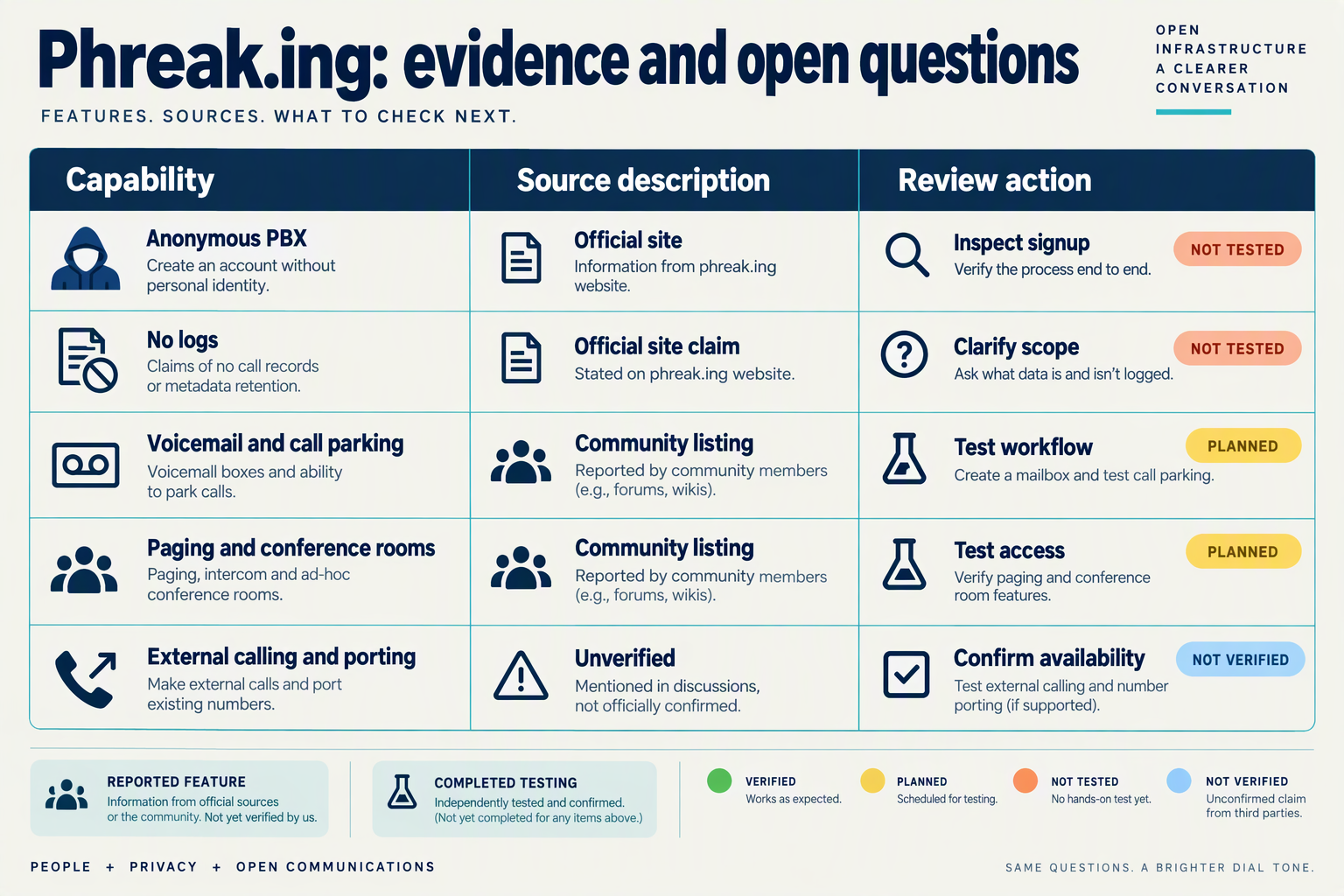
Phreak.ing offers a community-run internet phone switch with familiar PBX functions, but the supplied sources do not establish its business-critical specifications. For this October 2026 review, separate the features described by daily.dev from the capacity, connectivity, security, and support details you would need to verify before adoption.
The table below turns the advertised feature list into a practical acceptance checklist. “Not established” means the supplied evidence does not answer the question—not that the capability is absent.
| Feature | Evidence available in October 2026 | Potential business use | Specification to verify |
|---|---|---|---|
| Calling | daily.dev describes calling through classic telephone dial codes. | Connecting team members or destinations. | Supported clients, protocols, external telephone access, and simultaneous-call limits. |
| Voicemail | daily.dev lists voicemail among the switch’s features. | Taking messages when someone cannot answer. | Mailbox capacity, retention, notifications, retrieval permissions, and deletion controls. |
| Call parking | daily.dev lists call parking. | Holding a call for another colleague to retrieve. | Parking slots, retrieval codes, timeout behavior, and protection against unauthorized pickup. |
| Intercom paging | daily.dev lists intercom paging. | Making internal announcements. | Supported endpoints, paging groups, permission controls, and recipient behavior. |
| Conference rooms | daily.dev lists conference rooms. | Hosting shared voice conversations. | Participant limits, room access controls, moderation, and audio quality under load. |
| Radio station | daily.dev mentions a radio station. | Exploring the project’s community-oriented functionality. | Access method and whether listening affects other call activity. |
Which connectivity and capacity specifications need verification?
The phrase internet phone switch does not, by itself, confirm compatibility with your existing telephony setup. The supplied descriptions do not establish Session Initiation Protocol (SIP) support, browser calling, desk-phone compatibility, or connections to the public switched telephone network (PSTN).
Ask for a documented connection method before investing time in configuration. If your requirement is answering calls to an existing business number, verify number routing explicitly; internal calling and public telephone reachability are different requirements.
Capacity also needs a measurable answer. For example, a five-person office might test two active conversations, one parked call, and a conference at the same time. That is a proposed test scenario, not a published Phreak.ing capacity figure.
What should you test beyond whether a call connects?
A successful connection proves only one part of call handling. Use a controlled trial with non-sensitive conversations to check complete workflows:
- Calling: Confirm intelligible two-way audio and document disconnects or failed connections.
- Parking: Park a call, retrieve it from another endpoint, and check what happens if nobody retrieves it.
- Voicemail: Leave a message, retrieve it, and test who can access or delete it.
- Conferencing: Add participants gradually and check whether access controls behave as expected.
Record the device, network, configuration, and outcome for each test. Otherwise, a successful demonstration may be difficult to reproduce.
Which commercial and administrative details remain unanswered?
As of October 2026, the supplied context provides no verified Phreak.ing pricing schedule, service-level agreement, support commitment, or administrator-role specification. Phreak.ing’s website says, “we do not want your personal information,” but that statement does not explain account recovery or ownership transfer when an employee leaves.
For comparison, CallMissed’s verified October 2026 specifications explicitly list call queues, keypad menus, and a visual call-flow designer. The useful distinction is documentation depth, not presumed superiority: evaluate each platform against the workflows your business actually needs.
Before committing, request written answers on costs, account control, incident support, and external-number connectivity. Treat unanswered specifications as procurement questions rather than filling the gaps with assumptions.
How usable are signup, extension setup, and the interface?
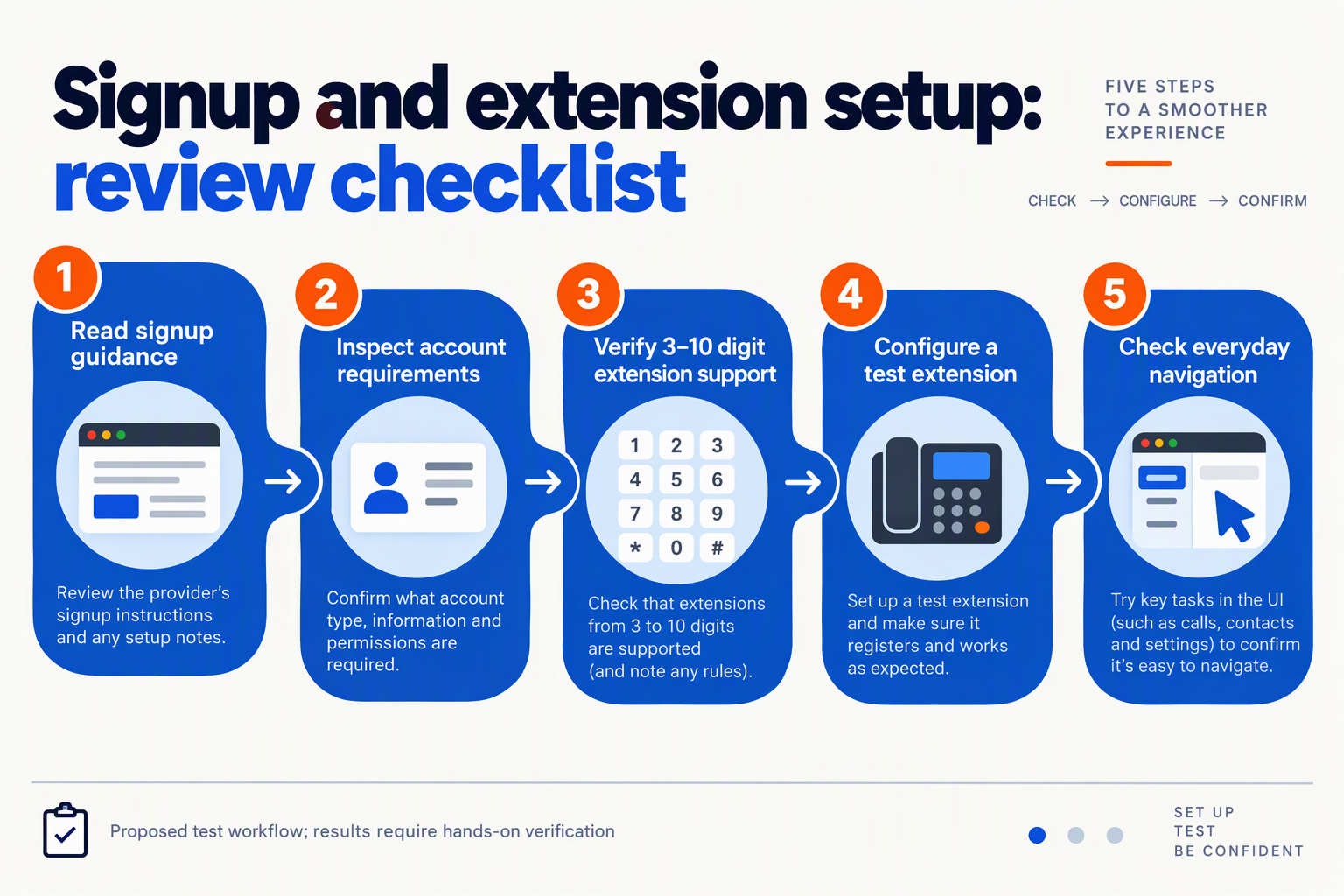
Phreak.ing’s signup, extension setup, and interface cannot be rated confidently from the supplied evidence. For this October 2026 review, the sources establish an anonymous signup policy and dial-code-based telephone features, but do not document the complete onboarding process, extension-management screens, or everyday interface behavior.
That makes usability an unverified part of this internet phone switch review, rather than an established strength or weakness. A short signup form, if present, would not by itself prove that a receptionist can manage calls without technical help.
How straightforward is Phreak.ing signup?
As reviewed in October 2026, Phreak.ing’s website explicitly instructs users: “Do not use your real phone number for signup.” That is a clear instruction about what not to enter, but the supplied material does not explain the accepted identifier format, verification steps, or account-recovery process.
For a business evaluator, those omissions create practical questions—not evidence that signup is broken. Before creating a test account, check:
- Identifier requirements: What should replace a real phone number, and how is that identifier used?
- Credential handling: Does onboarding explain how to save and protect account credentials?
- Recovery: What happens if the person who created the account loses access?
- Next-step guidance: After signup, is there a clear route to configuring an extension and making a test call?
Respect the published signup instruction. Do not enter a customer-facing number merely to see whether the form accepts it.
How easy is extension setup for a nontechnical employee?
Extension setup remains unverified: the supplied sources do not describe extension creation, credential provisioning, supported calling clients, or registration troubleshooting. Accordingly, this review cannot claim that Phreak.ing offers either a guided setup wizard or a difficult manual configuration process.
Use a repeatable onboarding test instead of relying on an administrator’s first impression:
- Define the task: Ask a new user to establish a working extension using the available documentation.
- Record dependencies: Note every external application, configuration field, and administrator intervention required.
- Test the result: Place and receive an internal test call, then disconnect and reconnect the client.
- Check recoverability: Have the user resolve a failed connection using only the guidance provided.
Measure time to first successful call, setup errors, and requests for help. These are proposed evaluation metrics, not published Phreak.ing benchmarks. They distinguish a setup that a telephony enthusiast can complete from one a small business can reliably repeat for new employees.
Is the interface practical for everyday call handling?
According to daily.dev, the material available for this October 2026 review describes Phreak.ing features accessed through classic telephone dial codes, including voicemail, call parking, intercom paging, and conference rooms. That establishes an interaction method; it does not establish whether a graphical dashboard also exists or how usable it is.
Dial codes can provide direct access to functions, but they also require users to find and remember commands. Test discoverability and feedback with a realistic scenario: answer a test call, park it, and ask a colleague to retrieve it. Can both users tell what happened without administrator assistance?
As of October 2026, CallMissed, an AI customer-communication platform, offers a visual call-flow designer and keypad menus, according to its verified product fact sheet. These illustrate interface approaches worth considering—not proof of a measured usability advantage.
Usability verdict: keep Phreak.ing’s rating provisional until observed signup, extension setup, and routine call tasks demonstrate a repeatable workflow. Documented features are useful; successful, understandable execution is the stronger evidence.
How should calls, voicemail, parking, and browser notifications be tested?
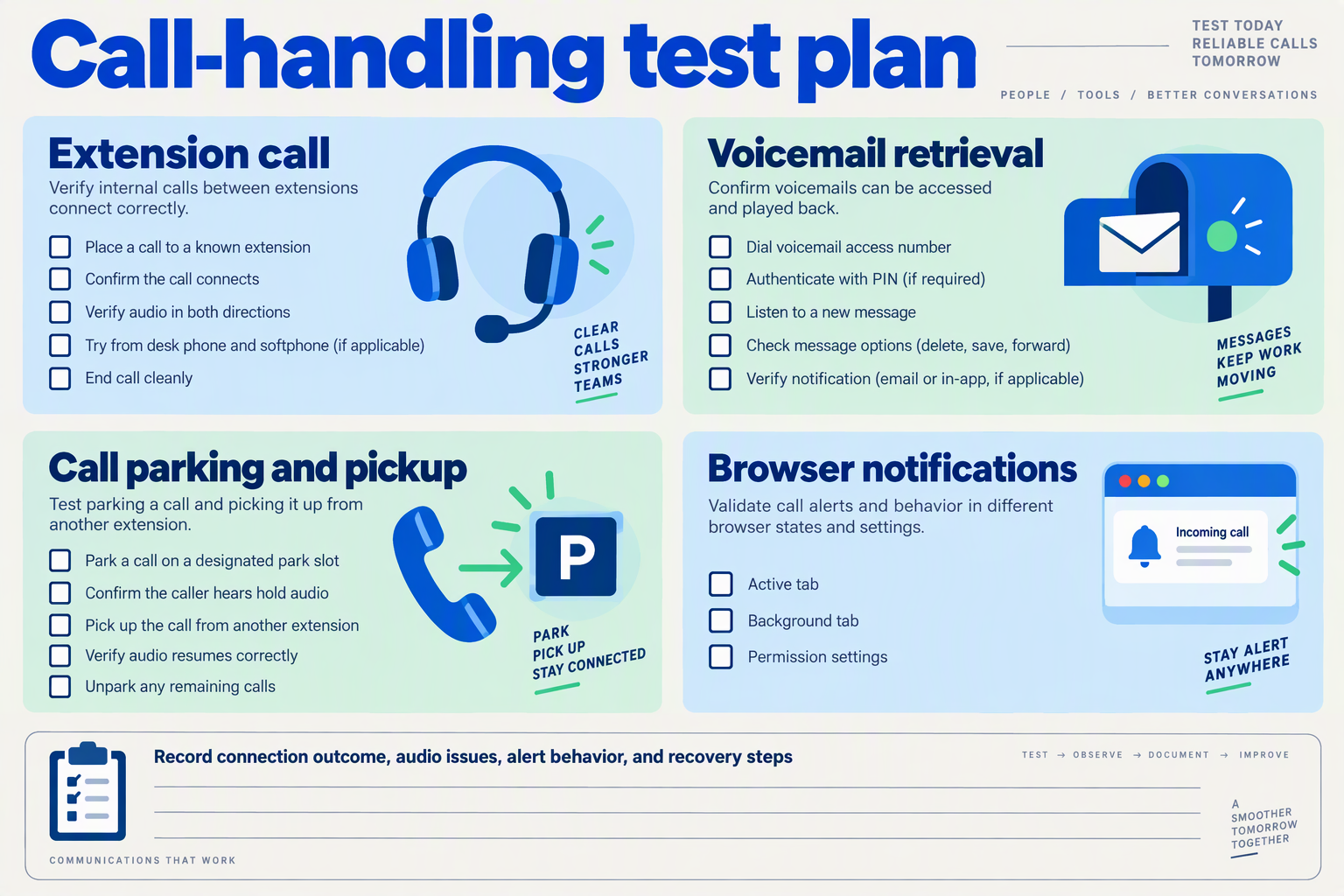
Test an internet phone switch with scripted, repeatable scenarios that follow each call from dialing to its final outcome—not just whether it rings. For this Phreak.ing review, distinguish advertised features, observed results, and unverified behavior before considering customer-facing use.
The daily.dev listing supplied for this October 2026 review identifies calling, voicemail, and call parking among Phreak.ing’s features. The supplied evidence does not establish browser notification support or demonstrate how reliably these functions work; the following is a proposed test plan, not a report of completed testing.
How should basic call handling be tested?
Use test accounts and non-sensitive conversations. Run these scenarios on the devices, browsers, and networks your team actually uses, staying within the project’s permitted use:
- Answered call: Dial a test destination, answer, exchange spoken phrases in both directions, and disconnect from each end in separate trials.
- Unanswered call: Leave the destination unanswered and record what the caller hears and where the call ends.
- Busy destination: Call an account already handling a conversation; check whether the result is understandable and consistent.
- Interrupted connection: Disconnect a test device’s network briefly, then check whether the interface accurately reflects the call state.
Record setup time, audio interruptions, one-way audio, and incorrect status displays. A connected timer is not sufficient evidence of a usable conversation.
As an illustrative acceptance rule—not an industry benchmark—require 10 successful repetitions per critical scenario before expanding a pilot. Passing that small sample would justify further testing, not establish production reliability.
What should a voicemail test verify?
Test the complete leave–retrieve–manage workflow wherever those functions are available. A greeting that plays correctly does not prove that a message is saved or accessible to the intended recipient.
- Leave short and longer messages containing clearly spoken test identifiers.
- Check whether the opening and closing words survive playback.
- Verify how users discover new messages and whether that indication clears after retrieval.
- Test access from a separate authorized session; confirm that another test account cannot retrieve the message.
- Check deletion behavior and any documented storage or retention limits.
For this October 2026 assessment, Phreak.ing’s website states, “we do not keep logs.” Ask separately how voicemail is stored: that statement does not explain message retention, deletion, or retrieval controls. Keep your own test worksheet without capturing other users’ activity.
How should call parking and retrieval be tested?
Call parking should preserve a live conversation while making retrieval predictable. Follow the service’s documented dial codes rather than assuming familiar PBX commands apply.
Park a test call, retrieve it from another authorized endpoint, and verify two-way audio. Then test an occupied parking position, an incorrect retrieval code, and a call left parked beyond any documented timeout.
The decisive question is: Can staff recover the caller without guessing? Record what both parties hear, how staff identify the parked call, and what happens when retrieval fails. If a timeout or access restriction is undocumented, label it unknown rather than inferring behavior.
How should browser call notifications be tested?
First establish whether notifications exist and whether they are browser alerts, in-page indicators, or both. If supported, test permission allowed, permission denied, a background tab, a minimized window, and operating-system notification suppression.
Check that answering elsewhere or ending the call clears stale alerts. An alert should help staff reach an active call, not merely announce one that has already ended.
As of October 2026, CallMissed offers call queues and live supervisor monitoring, illustrating why business evaluation should cover handling and recovery—not ringing alone. For Phreak.ing, mark each scenario passed, failed, unsupported, or unverified; unresolved failures in answering, voicemail retrieval, or parked-call recovery should block a customer-facing rollout.
What does an anonymous PBX's stated no-logs policy mean for business records?
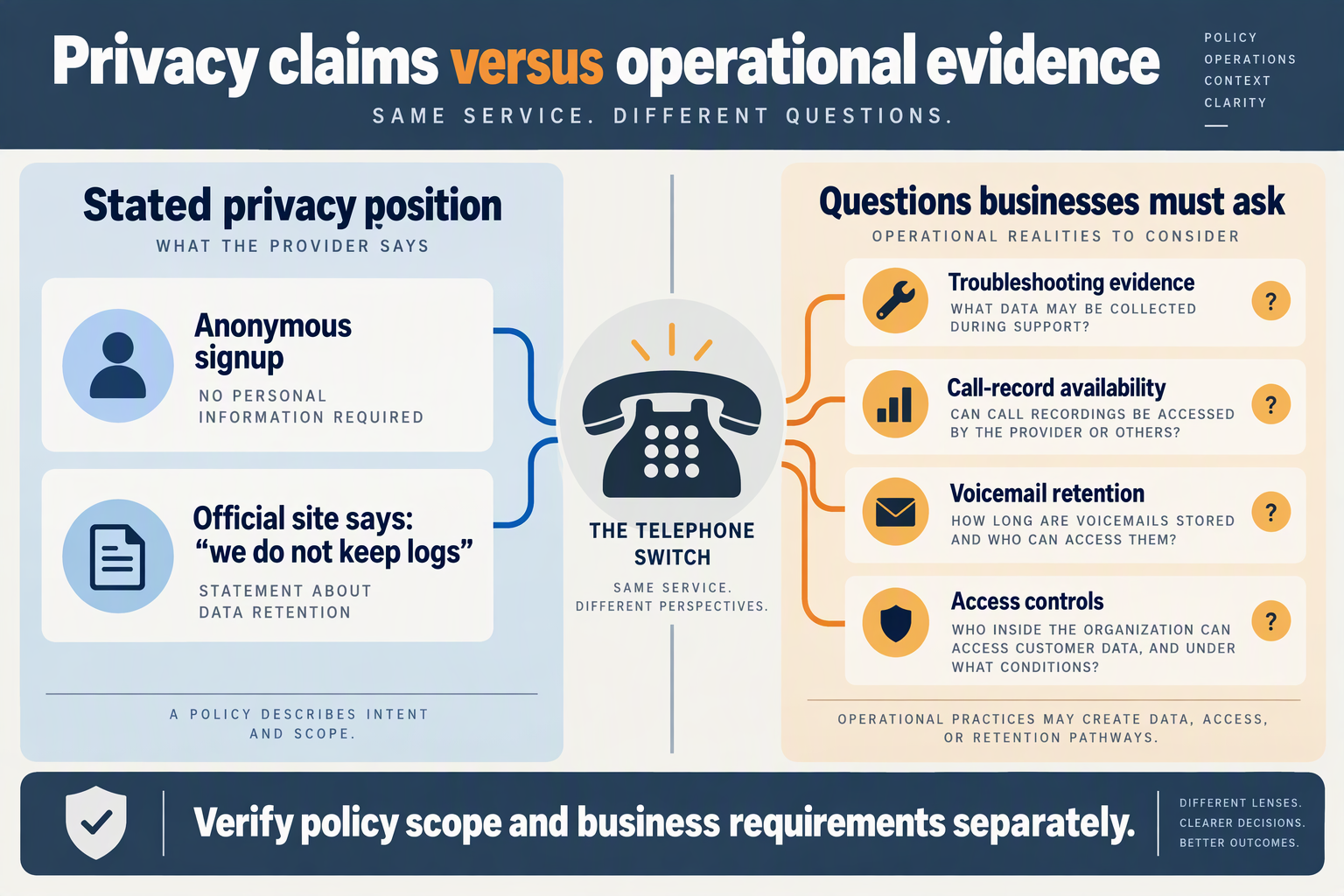
An anonymous PBX’s stated no-logs policy means businesses should not assume they can retrieve call histories, troubleshoot missed calls, or reconstruct customer interactions. For Phreak.ing, the immediate issue is not whether anonymity is desirable; it is whether the records your business needs exist somewhere you control.
As reviewed in October 2026, Phreak.ing’s website states: “This is an anonymous PBX, we do not keep logs & we do not want your personal information.” That is a stated operating policy—not a detailed specification of which data is processed, stored temporarily, or excluded from retention.
Does “no logs” mean no call records or recordings?
The supplied evidence does not define the scope of Phreak.ing’s no-logs policy. A business evaluating this internet phone switch should distinguish several different record types:
- Call detail records: timestamps, destinations, duration, and connection outcomes.
- Diagnostic logs: routing failures, registration errors, and other troubleshooting events.
- Conversation content: recordings, transcripts, and voicemail messages.
- Business records: customer notes, commitments, complaints, and follow-up tasks.
These categories are not interchangeable. A switch could avoid retaining diagnostic logs while storing voicemail, or a business could maintain notes outside the switch. Neither arrangement is established by the supplied description.
According to daily.dev’s description available for this October 2026 review, Phreak.ing advertises voicemail alongside calling, call parking, intercom paging, and conference rooms. Voicemail therefore creates a specific verification question: where are messages stored, who can retrieve them, and when are they deleted? The advertised feature does not answer those questions.
Which business workflows depend on retained call information?
The practical test is whether your team can resolve an ordinary customer problem without relying on unavailable evidence.
Consider a hypothetical customer who says they called about cancelling an order but received no response. A call outcome could establish whether the call connected; a voicemail could contain the request; a staff note could document the action taken. Without those records, the team may have to rely on recollection.
Before adopting an anonymous PBX for business call handling:
- Identify the decisions that require evidence. Include missed-call follow-up, complaint resolution, service reviews, and billing queries.
- Assign each record a home. Decide whether the switch, your carrier, or your customer relationship management system should retain it.
- Test retrieval, not just capture. Confirm that an authorized employee can find the relevant information after a call.
- Define access and deletion rules. Keep only what serves a documented purpose, rather than recording every conversation by default.
As of October 2026, CallMissed’s verified product fact sheet lists call recordings, transcripts, and AI call notes—including summaries, action items, dispositions, and follow-up—pushed to the CRM. Those capabilities illustrate a records-oriented workflow; businesses still need to establish appropriate consent, access, and retention practices.
Can an anonymous PBX still fit a business environment?
Yes, if the intended workflow does not depend on provider-held records and the remaining requirements are verified. An experimental internal setup may have different documentation needs from a customer-support line handling disputes or contractual commitments.
Do not interpret “no logs” as proof of complete anonymity across connected systems: carriers, endpoints, and separately configured business tools may have their own records. Equally, do not assume anonymity makes the project unsuitable for every use.
The review criterion is record sufficiency: can your business explain what happened, honor customer requests, and meet applicable obligations? Until Phreak.ing’s policy scope and any independent recordkeeping arrangements are verified, record-dependent customer workflows remain an unresolved fit.
What are Phreak.ing's potential advantages and business trade-offs?
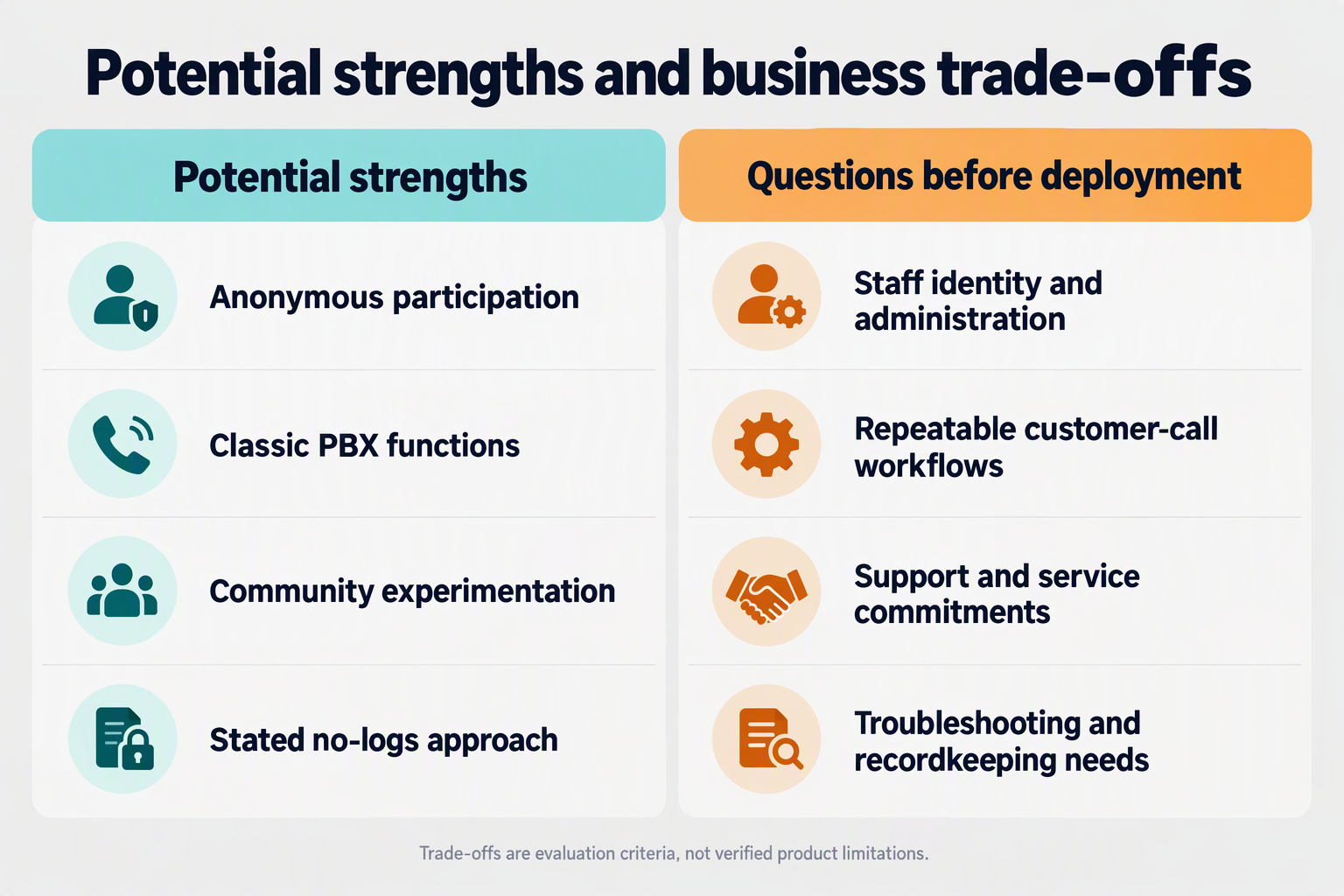
Phreak.ing’s potential advantage is a compact set of familiar telephone functions that could suit experimentation or narrowly defined internal workflows. The business trade-off is verification effort: advertised switching features do not establish how reliably, securely, or accountably customer calls will be handled.
Which Phreak.ing features offer practical business value?
In the evidence available for this October 2026 review, daily.dev describes Phreak.ing as a community-run anonymous private branch exchange (PBX) offering calling, voicemail, call parking, intercom paging, conference rooms, and a radio station. The table separates those documented capabilities from potential business benefits and the tests needed to establish suitability.
| Documented capability | Potential advantage | Business trade-off | Practical acceptance test |
|---|---|---|---|
| Calling | Explore basic switch-based conversations | External reachability and business-number arrangements remain unverified | Confirm supported destinations and test both call directions |
| Voicemail | Let callers leave information when someone is unavailable | Notification, retrieval, retention, and access controls need checking | Leave messages during different availability states; verify retrieval |
| Call parking | Hold a call while finding the right colleague | Staff must retrieve the correct call without confusion | Park two simultaneous test calls and retrieve each correctly |
| Intercom paging | Reach colleagues without separate conversations | Suitability depends on endpoint support and interruption controls | Check intended recipients, audio delivery, and unwanted interruptions |
| Conference rooms | Bring several participants into one conversation | Participant limits and room access controls are not established | Test expected group size and attempts to join without authorization |
| Anonymous signup | Explore the service without supplying a real phone number | Account ownership and recovery procedures need clarification | Verify how access is recovered and who can administer accounts |
These are evaluation criteria, not confirmed defects. A missing detail in the supplied documentation should become a question for the operator—not an assumption that the feature is absent or inadequate.
When do those advantages outweigh the trade-offs?
The strongest fit is a workflow where failure is containable and staff can evaluate the switch without exposing customer conversations. An internal demonstration, for example, can show whether call parking helps colleagues coordinate; it cannot establish production availability.
As of October 2026, Phreak.ing’s website states, “we do not keep logs.” That operating choice creates a specific evaluation question: what evidence would your team have when someone reports an unanswered or misrouted call? Ask what “logs” covers rather than inferring that recordings, voicemail storage, or every form of operational data are included.
For this internet phone switch business call handling evaluation, weigh three costs beyond any service charge:
- Training: Can staff use dial-code workflows consistently under pressure?
- Administration: Who manages access, resolves problems, and documents changes?
- Failure impact: Can the business continue answering customers if the switch becomes unavailable?
Phreak.ing pricing is not established by the supplied context, so a “cheaper than business telephony” conclusion would be premature.
How should a business make the adoption decision?
Use a bounded pilot with explicit pass-or-fail conditions:
- Choose one workflow, such as parking and retrieving internal test calls.
- Define success beforehand, including correct routing, intelligible audio, and recoverable account access.
- Keep customer routing unchanged until operational questions have satisfactory answers.
As of October 2026, CallMissed, an AI customer-communication platform, offers call queues, live supervisor monitoring, and CRM-linked AI call notes. Those capabilities illustrate a different evaluation priority: not just connecting conversations, but supporting oversight and follow-through.
The decision should therefore turn on workflow fit and verified operating controls, not feature count or community enthusiasm alone.
How does Phreak.ing compare with hosted PBX, self-hosted PBX, and CallMissed?
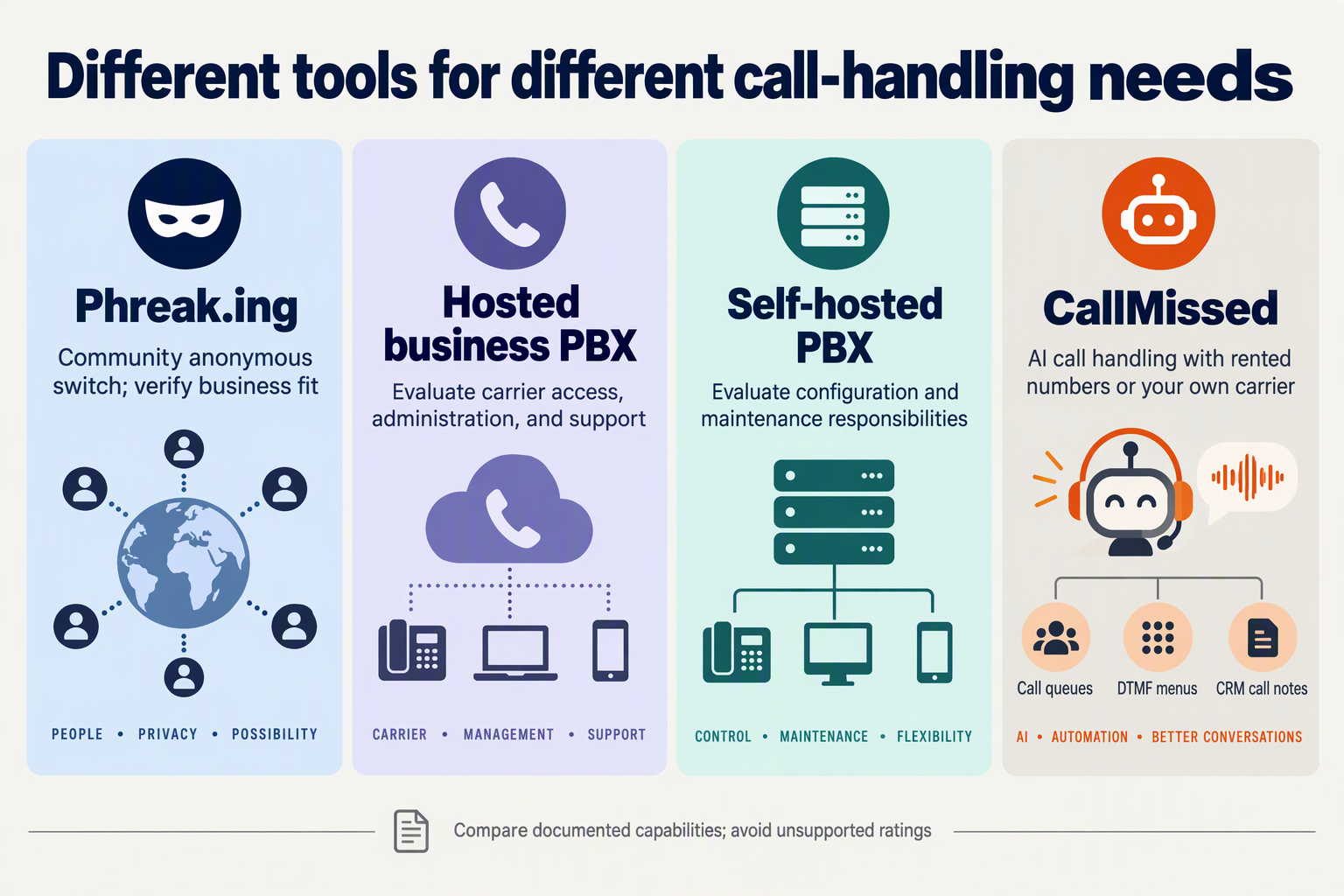
Phreak.ing is an option to explore for experimental telephone switching; hosted PBX and self-hosted PBX are deployment choices for business telephony, while CallMissed adds AI-led customer communication. For business call handling, compare operational responsibility, customer-call records, integration requirements, and total cost—not just whether each option can connect a call.
The comparison below reflects the supplied evidence as of October 2026. Hosted and self-hosted PBX entries describe deployment patterns, not verified features of every product; capabilities and contract terms require vendor-specific checks. “Unverified” means the available Phreak.ing sources do not establish that capability, rather than proving it is absent.
| Decision factor | Phreak.ing | Hosted PBX | Self-hosted PBX | CallMissed |
|---|---|---|---|---|
| Primary role | Community-run anonymous switch, according to daily.dev | Provider-operated business phone system | Business phone system operated by your team or contractor | AI customer communication with voice agents |
| Call handling | daily.dev lists voicemail, parking, paging, and conferences | Check queues, routing, voicemail, and transfer options | Configure supported routing and extensions | Queues, DTMF menus, visual call flows, and live agent-to-agent handoffs |
| Records and review | Website states “we do not keep logs”; business audit capabilities unverified | Confirm call records, recording, retention, and export | Configure logging, storage, retention, and access | Recordings, transcripts, AI call notes, and QA scoring |
| Operating responsibility | Support commitments and recovery procedures unverified | Provider runs the platform; contractual responsibilities vary | Assign patching, backups, monitoring, and recovery | Hosted in India; verify operational requirements before deployment |
| Carrier and integration fit | Business-number and CRM integration details unverified | Confirm number portability, carrier options, and CRM connectors | Select compatible SIP trunks and configure integrations | Rented numbers or Twilio, Plivo, or any SIP trunk; CRM integrations |
| Cost comparison | Business pricing and service terms unverified | Obtain charges for users, numbers, usage, and extras | Budget software, infrastructure, trunks, and administration | Voice plans: ₹4/₹5/₹6 per minute; phone carriage separate |
Which option fits your business call-handling workflow?
Choose the operating model before choosing the feature list. A hosted PBX suits buyers seeking a provider-operated phone system, provided the contract covers their support and recovery requirements. A self-hosted PBX gives the business responsibility for configuration and infrastructure—but also requires someone accountable when calls stop reaching extensions.
For Phreak.ing, the practical next step is a bounded pilot, not an immediate replacement of customer-facing telephony. Test a specific workflow with non-sensitive calls and document what remains unknown.
Use these scenarios to narrow the shortlist:
- A small reception team: Verify simultaneous calls, queue behaviour, transfer handling, and an overflow destination.
- A technical team needing custom routing: Evaluate configuration flexibility alongside the staff time required to maintain it.
- A business automating routine enquiries: Evaluate AI answers, knowledge-base accuracy, escalation, and conversation records—not merely extension switching.
How should you compare the actual costs?
Compare the cost of a completed workflow, not an advertised headline rate. Request an itemised estimate covering telephone numbers, carriage, recordings, storage, integrations, and administration wherever applicable.
According to CallMissed’s verified product facts, as of October 2026, its flat-rate voice-agent plans cost ₹4, ₹5, or ₹6 per minute, covering speech recognition, the language model, and voice, with a 30-second minimum per call and separate phone carriage. For example, 100 connected two-minute calls on the ₹4 plan would cost ₹800 for the agent component, before carriage.
Before deciding:
- Run the same representative calls through each shortlisted setup.
- Check what evidence remains after a failed transfer or missed call.
- Confirm who owns troubleshooting and what the complete monthly bill includes.
That produces a defensible business comparison without mistaking community appeal, deployment control, or AI features for a universal winner.
What must you verify before switching to a VoIP phone system?
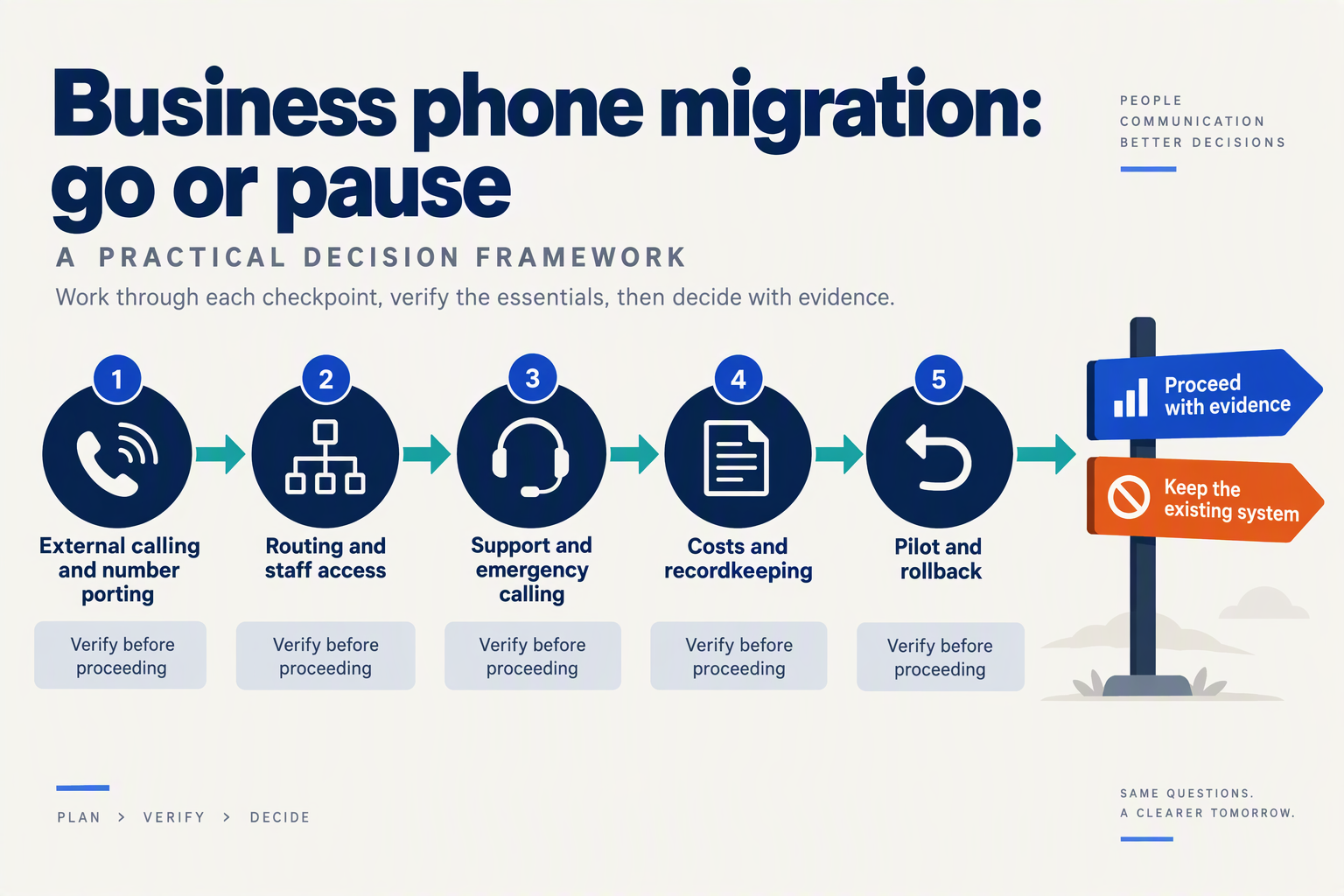
Before switching to a VoIP phone system, verify number ownership, carrier connectivity, security controls, operational visibility, and a tested rollback path. For business call handling, a successful demonstration is not enough: require documented answers and a pilot that reproduces your actual customer workflows.
Can you keep your business number and reverse the migration?
Start with the number customers already know. Confirm whether the proposed internet phone switch supports your carrier, requires number porting, or only provides calls between users within its own environment.
The Phreak.ing material supplied for this October 2026 review does not establish business-number porting or public telephone network connectivity. Its instruction, “Do not use your real phone number for signup,” concerns registration; it does not answer whether you can receive calls to an existing business number.
Ask for written confirmation of:
- Number control: who holds the carrier account and authorizes future transfers.
- Migration dependencies: required documents, expected interruption, and any services attached to the number.
- Exit options: how to export configuration and move the number elsewhere.
- Rollback: whether you can restore routing without waiting for another number transfer.
Keep the existing service active until incoming calls and fallback routing pass acceptance tests.
Which call-handling tests should a VoIP pilot include?
Test complete journeys, not just whether two devices can connect. daily.dev’s description supplied for this October 2026 review lists Phreak.ing features including voicemail, call parking, intercom paging, and conference rooms; those descriptions provide test candidates, not evidence of production readiness.
Use a numbered acceptance checklist:
- Incoming call: call from an external phone and confirm the correct destination rings.
- Busy or unanswered call: verify the agreed fallback, including after-hours behavior.
- Transfer and retrieval: move a live call between staff and retrieve a parked call without losing the caller.
- Network interruption: disconnect an endpoint or internet connection and observe what the customer experiences.
- Voicemail recovery: leave a message, retrieve it, and verify who receives notifications.
Define pass criteria before testing. For example, require every scripted scenario to reach its intended destination and record any failure for investigation. That is a proposed acceptance rule—not a published provider benchmark.
What security and reporting evidence should you request?
Request evidence of administrator authentication, access restrictions, patch ownership, outbound spending controls, and incident response. Avoid treating the project’s name or community positioning as evidence of either safety or danger.
Ars Technica reported in November 2011 that PBX switches in a cited 2009 case still used default passwords. This historical example supports checking credential management; it says nothing about Phreak.ing’s current security.
Clarify which records exist for troubleshooting, their retention period, and who can access them. A privacy-focused service and your business may reasonably have different requirements for investigating unanswered calls.
How should you compare costs and approve the switch?
Compare the whole operating cost: carrier charges, numbers, usage, implementation, support, and internal administration. Ask what happens during an outage and who owns escalation.
As of October 2026, CallMissed supports rented numbers or a business’s own carrier through Twilio, Plivo, or any SIP trunk; its voice-agent plans cost ₹4–₹6 per minute, with phone carriage billed separately. These verified details illustrate the specificity buyers should request—not proof that any platform fits every workflow.
Approve migration only when critical requirements have evidence, the pilot passes, and rollback has been rehearsed. An unanswered requirement should remain a documented risk, not become an assumption.
Frequently Asked Questions
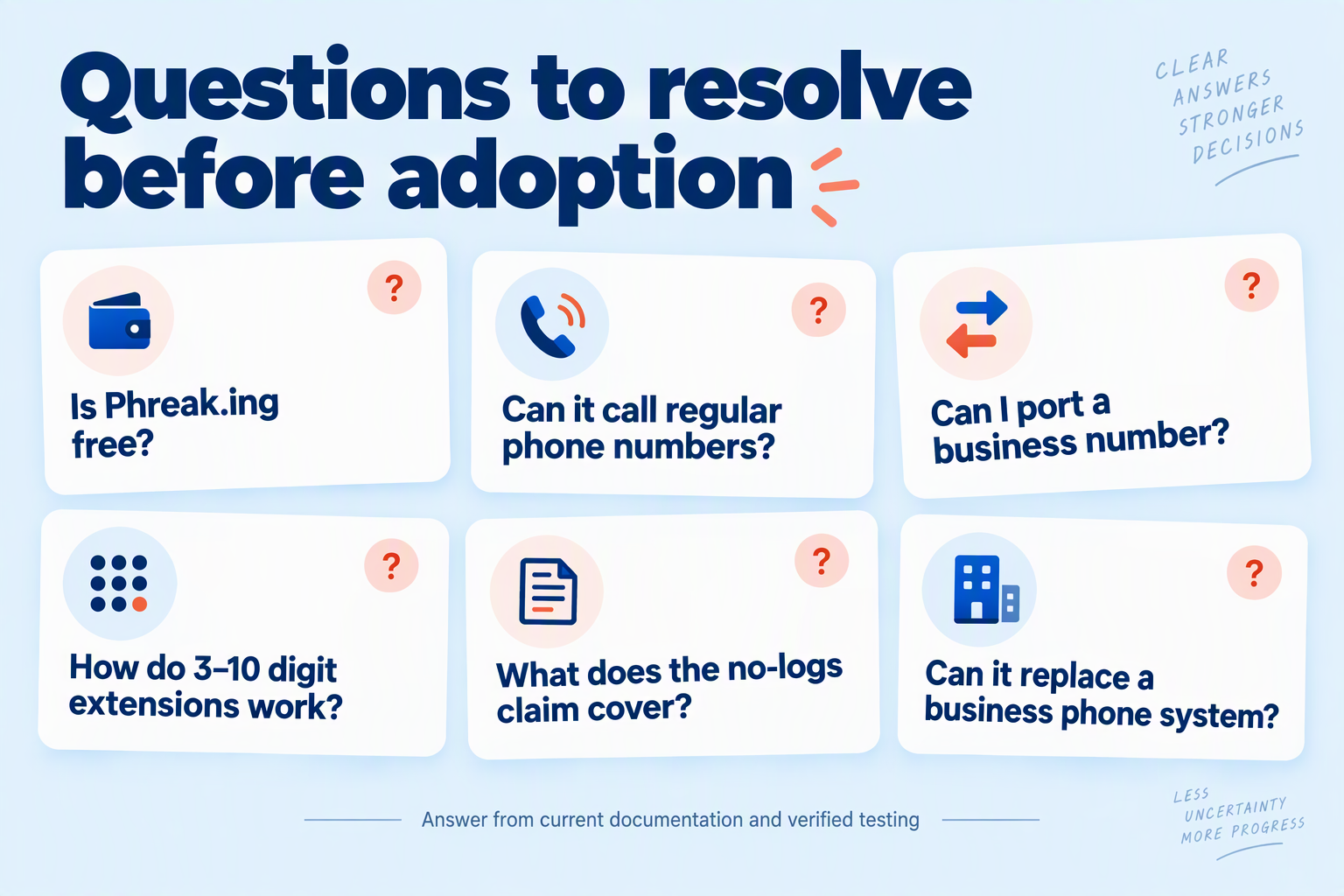
Is Phreak.ing’s internet phone switch free to use?
Can Phreak.ing’s internet phone switch call regular mobile and landline numbers?
Can an internet phone switch replace a business phone system?
Is Phreak.ing safe for confidential business calls?
Does Phreak.ing support voicemail, call parking, and conference calls?
How should a small business test Phreak.ing before adoption?
Conclusion
Phreak.ing is worth exploring as an experimental internet phone switch, but the available evidence does not establish readiness for business call handling. Its appeal lies in familiar PBX functions and an anonymity-first approach; customer-facing adoption requires verification beyond an interesting feature list.
The supplied October 2026 Hacker News trend snapshot records 128 points and 33 comments in 11.2 hours for “Phreak.ing – Internet Phone Switch.” That attention makes the project worth examining, but community enthusiasm cannot answer whether a business can depend on it when customers need help.
Four takeaways should guide your decision:
- Separate useful features from proven operational readiness. According to daily.dev’s description supplied for this October 2026 review, Phreak.ing offers calling, voicemail, call parking, intercom paging, and conference rooms. These capabilities could support shared call handling, but advertised functions are a starting point for testing—not evidence that customer calls will consistently reach the right destination. Evaluate the workflows your team actually needs before considering adoption.
- Treat anonymity and accountability as different requirements. Phreak.ing’s website states, “we do not keep logs” and “Do not use your real phone number for signup,” in the material supplied for this October 2026 review. Those statements explain the project’s priorities; they do not establish security controls or business suitability. Consider how your team would investigate missed calls, resolve disputes, and review service quality under that model.
- Verify the unanswered business essentials. Access controls, support arrangements, costs, and availability need confirmation before routing customer calls through any internet phone switch. Missing evidence should remain an open question, not become an assumed strength or weakness. A sensible evaluation asks what happens when a call goes unanswered, a workflow fails, or someone needs assistance—and whether the available information supports an acceptable response.
- Match the tool to the consequences of failure. An experimental setup, an internal workflow, and a customer-facing operation carry different stakes. Phreak.ing may warrant exploration without warranting immediate production use. Keep the decision grounded in your call-handling requirements rather than the project’s popularity, and avoid making customer communications depend on assumptions you have not tested.
Looking ahead, watch for clearer documentation and verifiable answers about support, availability, access controls, and operational accountability. Those developments would be more meaningful business-readiness signals than another burst of discussion.
To explore the AI-assisted direction of business telephony, consider CallMissed: as of October 2026, the platform offers AI voice agents, call queues, keypad menus, and call recordings and transcripts.
Before switching, ask: can your team explain—and resolve—what happens when an important customer call goes wrong?
Related Reading
- Hold-to-Talk Voice Assistant: Business Agent UX Guide
- Claude Sonnet 5.5 Review for Support and Voice Agents
- AI Receptionist Pricing for Small Business: US vs India