Vapi alternatives: Retell vs CallMissed for Startups


Compare Vapi alternatives on total call costs, setup effort, Indian-language support and repeatable phone-agent tests to choose your startup stack.
Vapi alternatives: Retell vs CallMissed for Startups
What if the “$0.05 per minute” voice agent you budgeted for costs substantially more once it starts answering calls? For startups comparing Vapi alternatives, the important number is not the headline rate—it is the total cost of a useful conversation, including transcription, model inference, speech generation, and telephony.
For this October 2026 comparison, Vapi’s support documentation lists a $0.05-per-minute platform fee, with transcription, language model, voice, and transport charges added separately. That distinction matters whether you are building an AI receptionist, qualifying inbound leads, or letting customers book appointments by phone: the configuration that sounds affordable in a demo can produce a different bill in production.
How do Vapi, Retell, and CallMissed pricing models differ?
The three platforms deserve a closer look because their quoted prices do not cover identical components. Comparing them fairly means separating the voice-agent stack from phone carriage, then checking what changes with model choice and actual usage.
Retell AI’s 2026 cloud-phone-systems guide lists voice-engine pricing starting at $0.07 per minute, language model costs of $0.003–$0.08 per minute, and approximately $0.015 per minute for Twilio telephony. Those figures illustrate why a starting rate is a starting point, not a universal estimate for every agent.
As of October 2026, CallMissed offers flat-rate voice-agent plans at ₹4, ₹5, or ₹6 per minute covering speech recognition, the language model, and voice, with phone carriage billed separately and a 30-second minimum per connected call.
The practical lesson is straightforward: compare equivalent configurations before comparing prices. A cheaper model, a different voice, or longer conversations can change the economics without changing the platform’s advertised starting rate.
Which voice AI platform fits a startup’s phone-agent workflow?
Your decision should begin with the job the agent must complete—not just the voice it uses. An appointment-booking assistant needs reliable tool execution; an inbound support agent needs relevant answers and a sensible escalation path; a multilingual receptionist needs testing against the speech your customers actually use.
This comparison will examine four questions:
- Total cost: Which charges are included, and which remain separate?
- Build effort: How much configuration and engineering does your first usable agent require?
- Conversation quality: How will you evaluate responsiveness, interruptions, and task completion?
- Operational fit: What do your team’s language, telephony, integration, and supervision requirements demand?
For a concrete pricing test, take 1,000 connected minutes from your expected workload and calculate each applicable component separately. Then test representative calls, including noisy audio, ambiguous requests, and failed bookings.
The goal is not to crown a universal winner. It is to identify which platform fits your startup’s budget, technical capacity, and customer conversations—and which trade-offs you should understand before committing.
Which platform fits your startup? The verdict at a glance
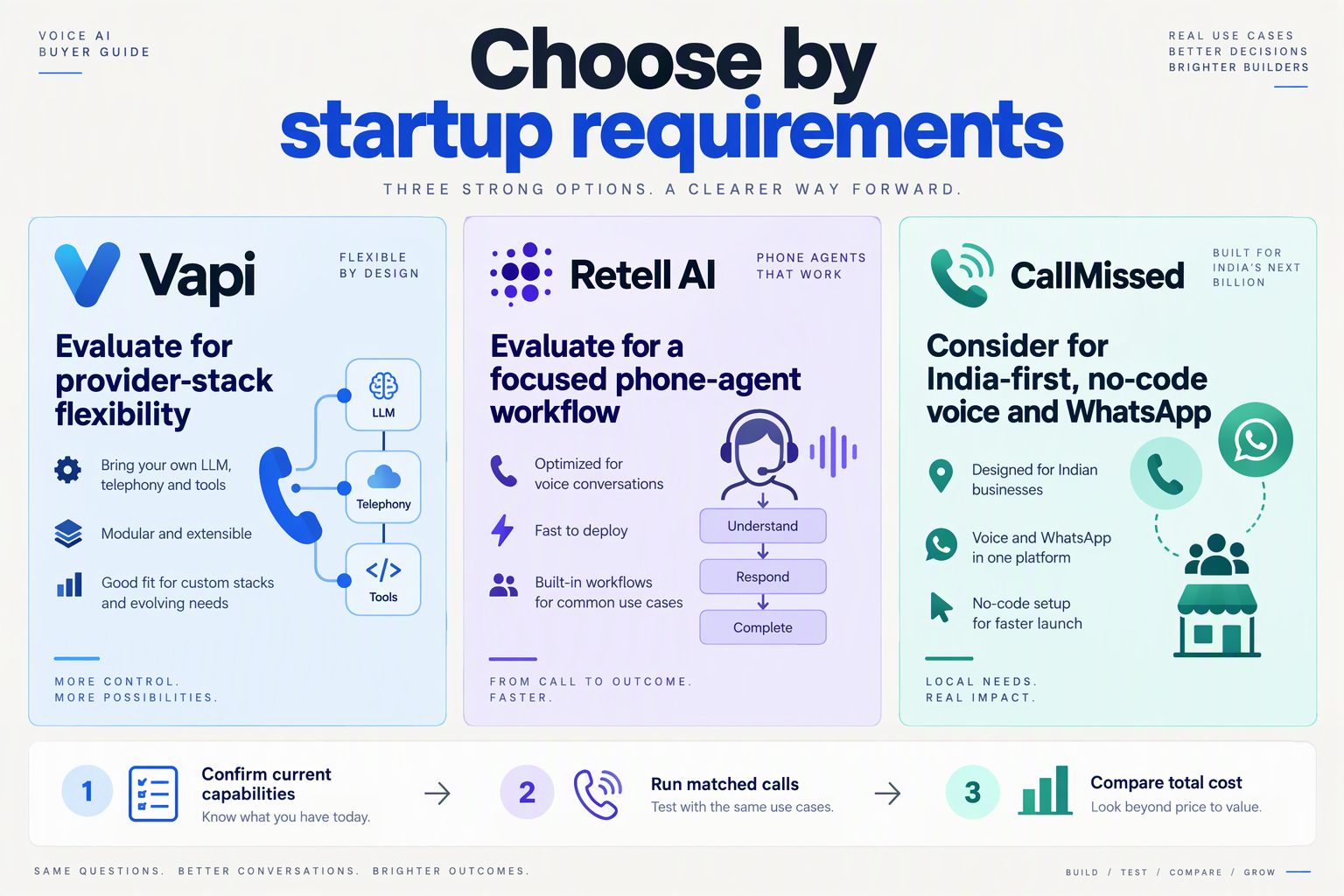
Choose Vapi for a configurable developer-led stack, Retell AI for voice-engine pricing without a separate platform fee, and CallMissed for bundled voice-stack costs and Indian-language workflows. As of October 2026, these are fit-based recommendations—not a ranking of conversation quality.
Which voice AI platform should your startup shortlist?
- Vapi: Shortlist Vapi when your engineering team wants to configure transcription, language-model, and voice components independently. Vapi’s support documentation, supplied for this October 2026 comparison, separates those charges in call logs. That makes configuration-level cost analysis possible, but your budget needs to account for each component rather than treating the platform charge as the complete conversation cost.
- Vapi benchmark: Vapi’s GPT-4.1 voice-agent guide, cited for this October 2026 comparison, estimates approximately 700 milliseconds round-trip latency and $0.15 per minute using a Vapi voice and Deepgram transcription. Treat that as a configuration-specific vendor estimate, not a universal guarantee: 1,000 minutes would imply approximately $150 at that stated rate.
- Retell AI: Shortlist Retell when its voice-engine billing structure matches your financial model. Using Retell AI’s 2026 cloud-phone-systems guide, the published starting engine rate, model range, and approximate Twilio charge produce an illustrative $0.088–$0.165 per minute, or $88–$165 for 1,000 minutes. This is arithmetic from the cited components, not a binding quote.
- CallMissed: Shortlist CallMissed for an India-focused receptionist or booking assistant that needs regional speech recognition and a no-code build path. As of October 2026, CallMissed’s verified fact sheet lists recognition in 22 Indian languages plus English, including Hinglish, and natural text-to-speech in 10 Indian languages plus English. Test recognition and voice availability separately; those language counts are not interchangeable.
- CallMissed operations: As of October 2026, CallMissed’s verified fact sheet lists live supervisor listen, whisper, and barge-in, plus agent-to-agent live-call handoffs. Its Twilio-compatible Calls API supports migration by changing the base URL and credentials. These are concrete shortlist criteria for teams needing operational oversight or adapting an existing calling integration—not evidence of superior performance.
- Short-call economics: Add a second worksheet alongside the introduction’s connected-minute estimate: compare 100 connected calls lasting 10 seconds with 100 lasting 60 seconds. Minimum billing increments can change the economics of brief interactions. Ask every shortlisted vendor how connected calls, failed connections, silence, and telephony are billed before extrapolating from a per-minute headline.
- Conversation-quality verdict: Run the same 20 scripted scenarios across each shortlisted configuration: booking, rescheduling, noisy speech, interruptions, ambiguous requests, and human escalation. This is a proposed pilot design, not a published benchmark. Score completed tasks and incorrect actions separately; a fast response is not useful if the agent books the wrong appointment.
- Final selection rule: Advance the platform that passes your language, carrier, integration, and supervision requirements, then compare the cost of a successfully completed task. Keep vendor estimates separate from your measured results. This turns “Vapi vs Retell vs CallMissed” into a repeatable startup buying decision rather than a contest between headline prices.
How do setup, languages and phone workflows compare?
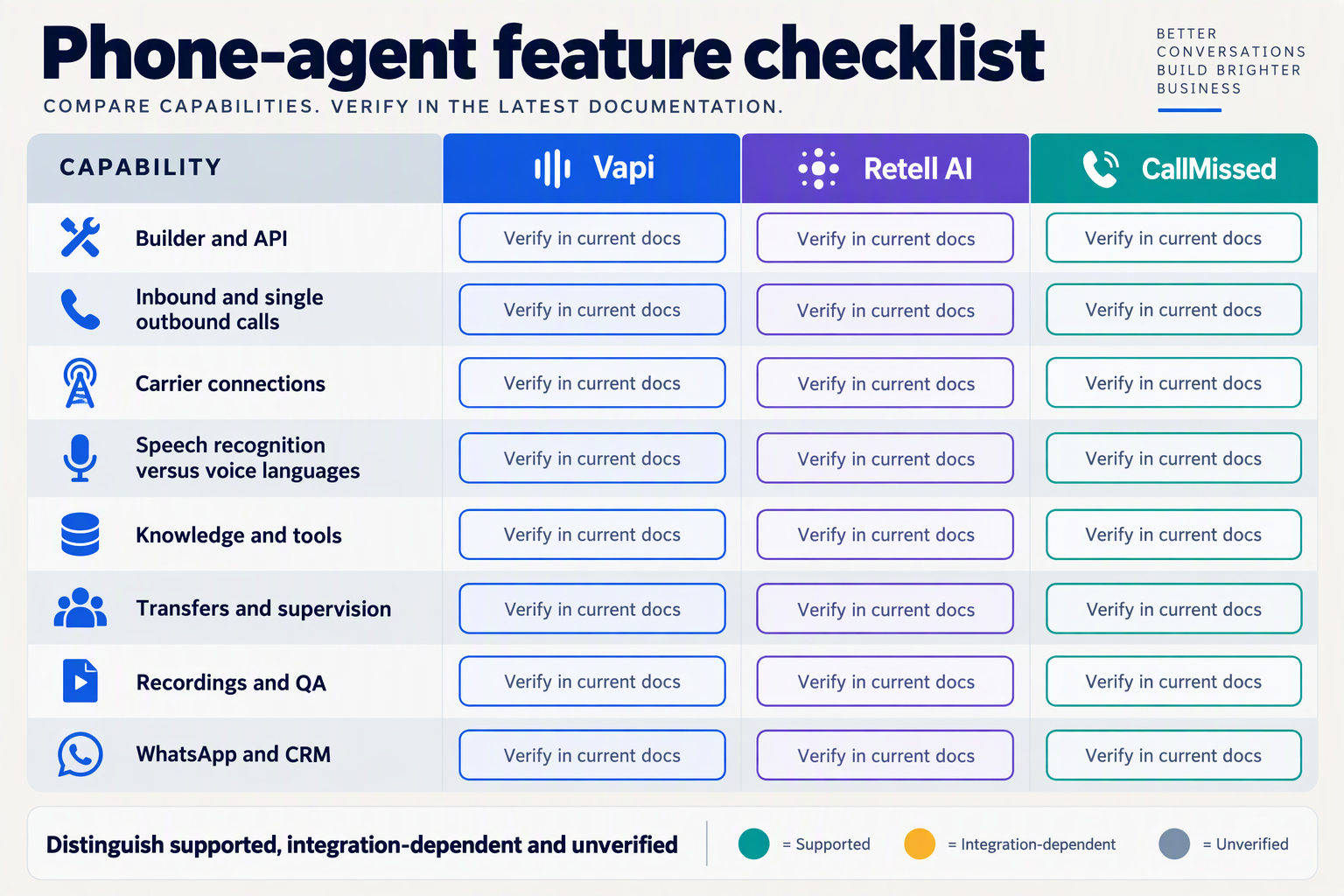
Setup flexibility is useful only if the agent can complete your phone workflow in the languages customers actually speak. For this October 2026 comparison, CallMissed’s fact sheet provides more explicit workflow specifications than the supplied Vapi and Retell AI sources; undocumented features below are verification questions, not presumed limitations.
| Setup or workflow | Vapi | Retell AI | CallMissed |
|---|---|---|---|
| Agent configuration | Vapi documents configurable transcription, LLM and voice providers | Retell documents voice-engine and LLM choices; confirm builder controls | No-code builder with prompts, voices, tools and variables |
| Customization | Vapi’s GPT-4.1 guide references custom LLM support | Confirm custom-model requirements | Custom REST tools and knowledge bases |
| Indian-language coverage | Confirm recognition and voice coverage for selected providers | Confirm recognition and voice coverage | Recognition: 22 Indian languages plus English; natural voices: 10 plus English |
| Phone connectivity | Telephony is a separate component in Vapi’s support breakdown | Retell’s cloud-phone guide identifies Twilio telephony | Rented numbers or Twilio, Plivo and any SIP trunk |
| Call routing | Verify keypad menus, queues and transfer behavior | Verify keypad menus, queues and transfer behavior | DTMF menus, call queues and visual call flows |
| Human supervision | Verify listening, whispering and intervention controls | Verify listening, whispering and intervention controls | Live monitoring: listen, whisper and barge in |
What should startups verify before building a phone agent?
- Vapi: As reviewed in October 2026, Vapi’s GPT-4.1 voice-agent guide describes a configuration using a Vapi voice and Deepgram transcription, and references bringing a custom LLM. Map those three components—recognition, reasoning and speech—to your requirements before treating a working demo as a production-ready configuration.
- Retell AI: Retell AI’s 2026 cloud-phone-systems guide distinguishes the voice engine, language model and Twilio telephony. For setup planning, ask how your chosen model executes booking tools, handles failed requests and transfers callers; the supplied guide does not establish those workflow details.
- CallMissed: As of October 2026, CallMissed’s verified fact sheet lists publish-and-rollback versioning, text/web/PDF knowledge bases and custom REST tools. Its phone workflows also include single inbound and outbound calls and click-to-call; automated outbound calling campaigns are not offered.
- Language testing: CallMissed’s October 2026 fact sheet explicitly includes Hinglish recognition, but recognition coverage must not be confused with voice availability. Test Hindi-to-English switching, regional names, addresses and background noise separately; a language appearing on a support list does not establish task accuracy.
- Routing testing: Give every candidate the same sequence: answer an inbound call, collect a booking preference, execute a calendar request and handle an unavailable slot. Add a keypad selection and a human-escalation request so the comparison measures completed workflows rather than pleasant conversation alone.
- Launch criteria: Use six scenarios before choosing: straightforward booking, unavailable appointment, noisy speech, code-switching, tool failure and human escalation. Record completion, incorrect confirmations and escalation outcomes; these are proposed evaluation checks, not published performance benchmarks for any platform.
What will 1,000 connected minutes actually cost?
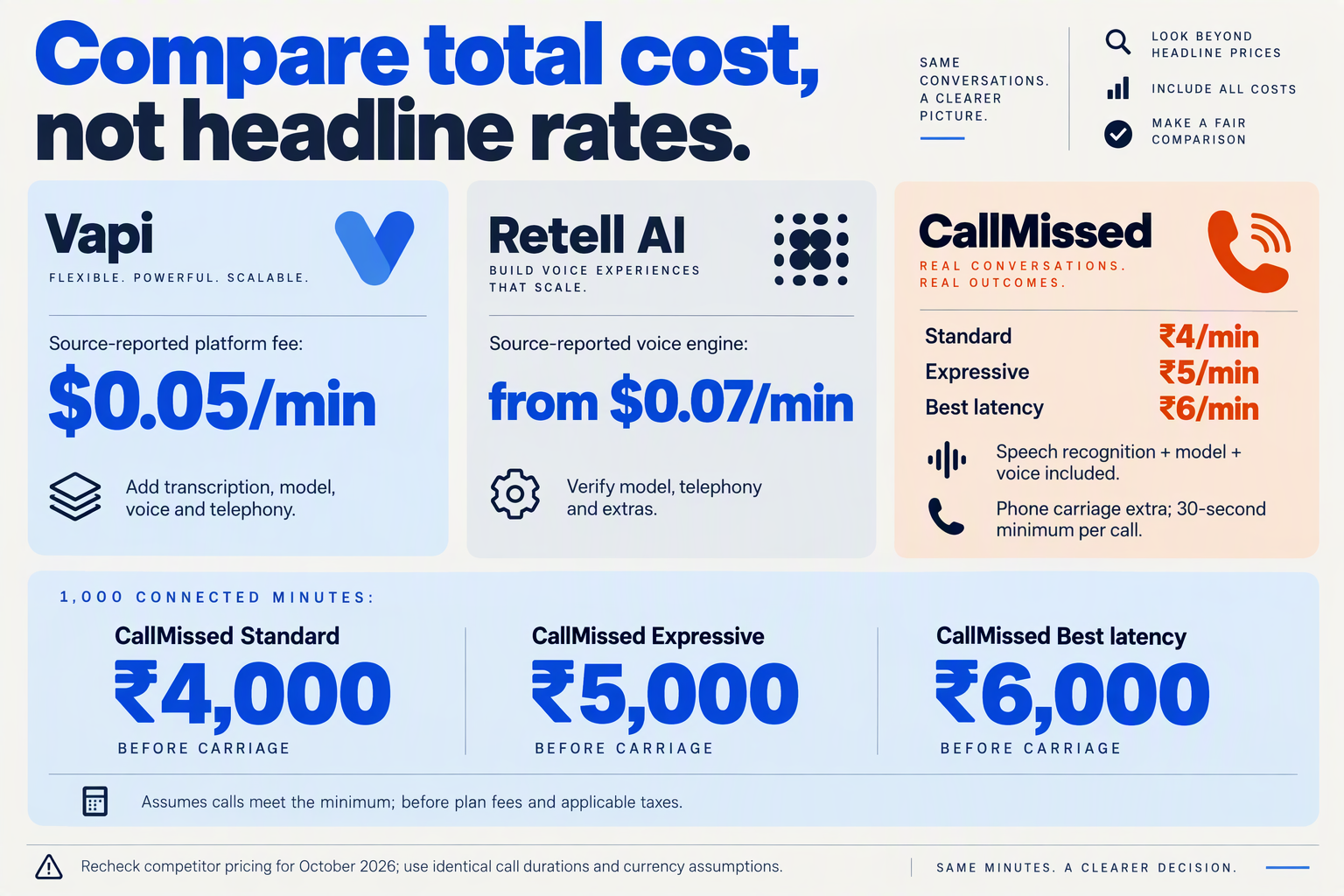
For 1,000 connected minutes, budget the complete voice stack—not just the platform fee. The October 2026 estimates below separate published examples from configurable costs and exclude introductory credits.
- Calculation basis: Multiply each applicable per-minute charge by 1,000, then add phone carriage, number rental where applicable, and taxes. The CallMissed estimates assume every connected call lasts at least 30 seconds; shorter calls change the calculation.
- Vapi: As of October 2026, Vapi support documents a $0.05/minute platform fee, making the platform-only subtotal $50 for 1,000 minutes. Speech recognition, language-model inference, speech generation, and transport remain additional charges.
- Retell AI: For October 2026 planning, Retell AI’s 2026 cloud-phone-systems guide lists a voice engine starting at $0.07/minute, LLM costs of $0.003–$0.08/minute, and approximately $0.015/minute for Twilio telephony.
- CallMissed: As of October 2026, CallMissed’s verified pricing lists ₹4, ₹5, and ₹6/minute plans covering speech recognition, the language model, and voice. Phone carriage is separate, so these totals are voice-stack budgets rather than complete telephone bills.
| Configuration | Rate basis | 1,000-minute subtotal | Scope or exclusion |
|---|---|---|---|
| Vapi platform only | $0.05/min | $50 | Excludes AI providers and transport |
| Vapi GPT-4.1 example | Approximately $0.15/min | Approximately $150 | Published configuration; confirm transport scope |
| Retell starting-engine scenario | $0.07 + $0.003–$0.08 + ~$0.015/min | Approximately $88–$165 | Includes illustrative Twilio carriage |
| CallMissed Standard | ₹4/min | ₹4,000 | Voice stack; carriage separate |
| CallMissed Expressive | ₹5/min | ₹5,000 | Voice stack; carriage separate |
| CallMissed Best latency | ₹6/min | ₹6,000 | Voice stack; carriage separate |
Which assumptions can change the 1,000-minute bill?
- Vapi configuration: In the material supplied for this October 2026 comparison, Vapi’s GPT-4.1 Voice Agent blog estimates approximately $0.15/minute using a Vapi voice and Deepgram transcription. Treat the $150 extrapolation as a configuration example—not a universal quote or confirmed all-inclusive telephone price.
- Retell model choice: Using Retell AI’s published figures for October 2026 planning, the LLM component alone contributes $3–$80 per 1,000 minutes, a $77 difference. The table holds the voice engine at its starting price; it does not establish a maximum bill across configurations.
- Short-call minimums: As of October 2026, CallMissed applies a 30-second minimum per connected call on flat-rate plans. A worked example of 6,000 ten-second calls totals 1,000 actual minutes but 3,000 billable minutes: ₹12,000 on Standard, before carriage. Calls that never connect cost nothing.
- Production validation: Before choosing a platform, price the same 1,000-minute workload, model, voice, and carrier assumptions. Vapi support identifies call logs as the place to inspect transcription, model, voice, and telephony costs; use that component-level approach to distinguish a low headline rate from a reproducible operating budget.
What are the practical pros and cons of each platform?
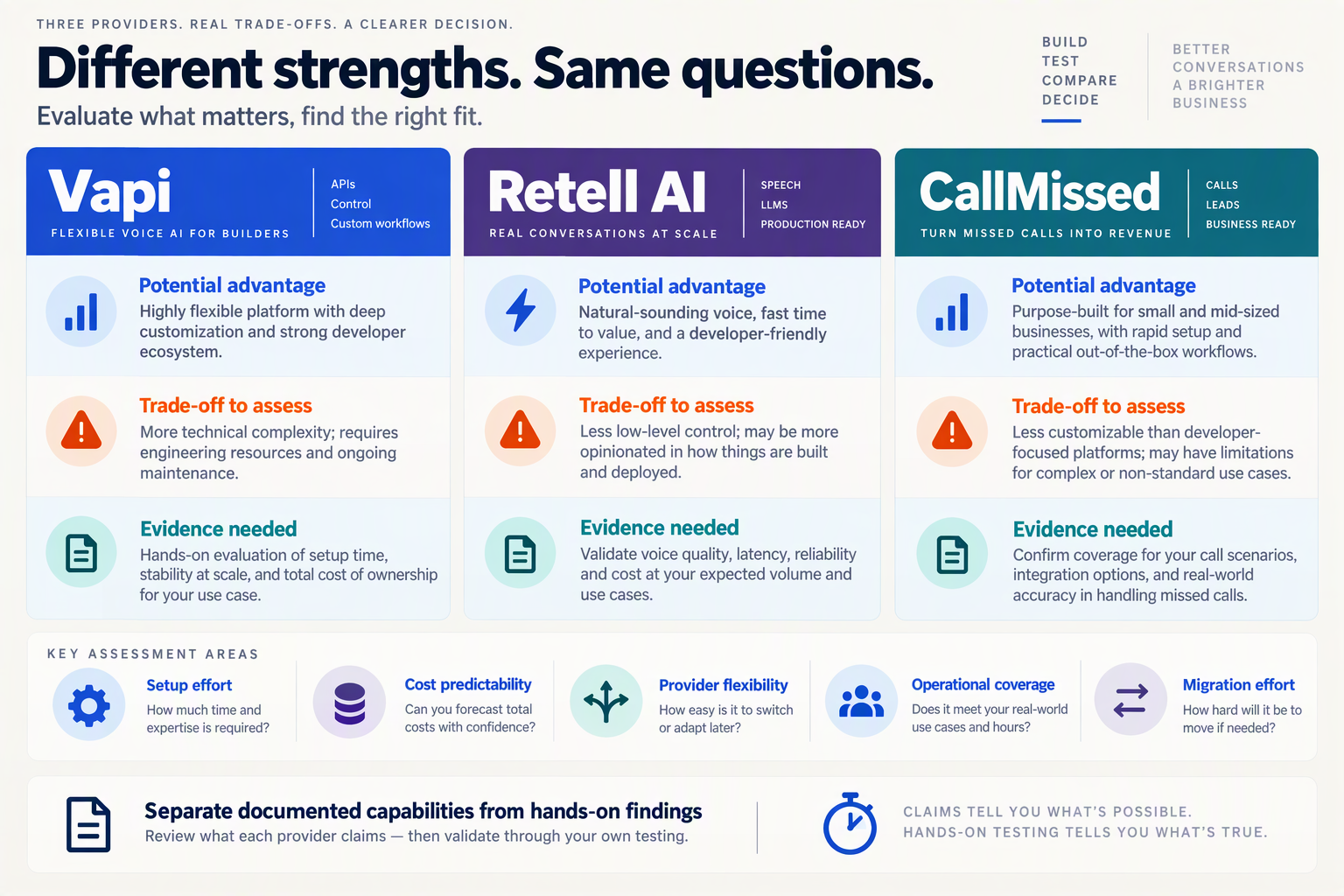
Vapi suits teams that want component-level control; Retell AI offers a voice-engine starting point without a separate platform fee; CallMissed combines bundled voice pricing with Indian-language support and operational tools. The practical trade-offs below reflect the supplied documentation reviewed for October 2026, not a head-to-head performance benchmark.
- Vapi: Provider-level billing makes configuration costs inspectable, but budgeting requires tracking transcription, model tokens, voice generation, and transport—not just minutes.
- Retell AI: No separate platform fee simplifies one part of the bill; model selection and telephony still affect the final cost of each conversation.
- CallMissed: Speech recognition in 22 Indian languages plus English, including Hinglish, supports regional deployments; natural text-to-speech covers 10 Indian languages plus English, not 22.
- Short-call workloads: A 30-second minimum matters for brief connected calls; compare billing granularity before deploying quick confirmations or routing agents.
- Performance evidence: Vapi publishes an approximately 700 ms GPT-4.1 configuration estimate, but that is neither a universal guarantee nor a comparative benchmark.
- Production readiness: Test 3 failure cases before launch: an unavailable booking tool, an ambiguous customer request, and a conversation requiring human intervention.
| Practical decision | Vapi | Retell AI | CallMissed |
|---|---|---|---|
| Audit unexpected bills | Support documentation exposes transcription, model, voice, and telephony breakdowns. | Its 2026 guide separates voice-engine, LLM, and Twilio charges; verify your configuration. | Flat-rate plans bundle recognition, LLM, and voice; phone carriage remains separate. |
| Evaluate trial economics | Vapi support says 1,000 free minutes cover the platform fee only, not provider costs. | Confirm current trial terms; the supplied guide does not establish them. | 1,000 signup credits; credits never expire. |
| Choose stack flexibility | Vapi documents custom LLM support and provider-dependent component pricing. | The guide lists model-dependent LLM pricing; confirm supported models before committing. | Bundled plans or a custom stack billed per component, per second, without a minimum. |
| Assess responsiveness | GPT-4.1 blog estimates approximately 700 ms round-trip latency for its described setup. | No comparable measured latency result appears in the supplied context. | A Best latency plan exists, but no numerical latency benchmark is provided. |
| Validate regional speech | Test chosen transcription and voice providers; supplied sources give no comparable language totals. | Confirm recognition and voice coverage separately; supplied sources give no comparable totals. | Recognition: 22 Indian languages + English; natural voices: 10 + English. |
| Operate after launch | Call-cost logs support configuration audits; verify supervision requirements separately. | Verify monitoring and escalation requirements; the supplied excerpts focus on economics. | Supervisor listen, whisper, and barge-in; QA scoring, eval suites, and A/B experiments. |
How should startups interpret these pros and cons?
- Cost evidence: As reviewed in October 2026, Vapi’s GPT-4.1 blog estimates “complete interactions” at approximately $0.15/minute for its described configuration—useful evidence that a specific stack, not a headline fee, determines economics.
- Selection rule: Treat undocumented capabilities as verification questions, not missing features; shortlist by language coverage, billing granularity, and supervision needs, then measure task completion on the same representative calls.
How should you test call quality before choosing?
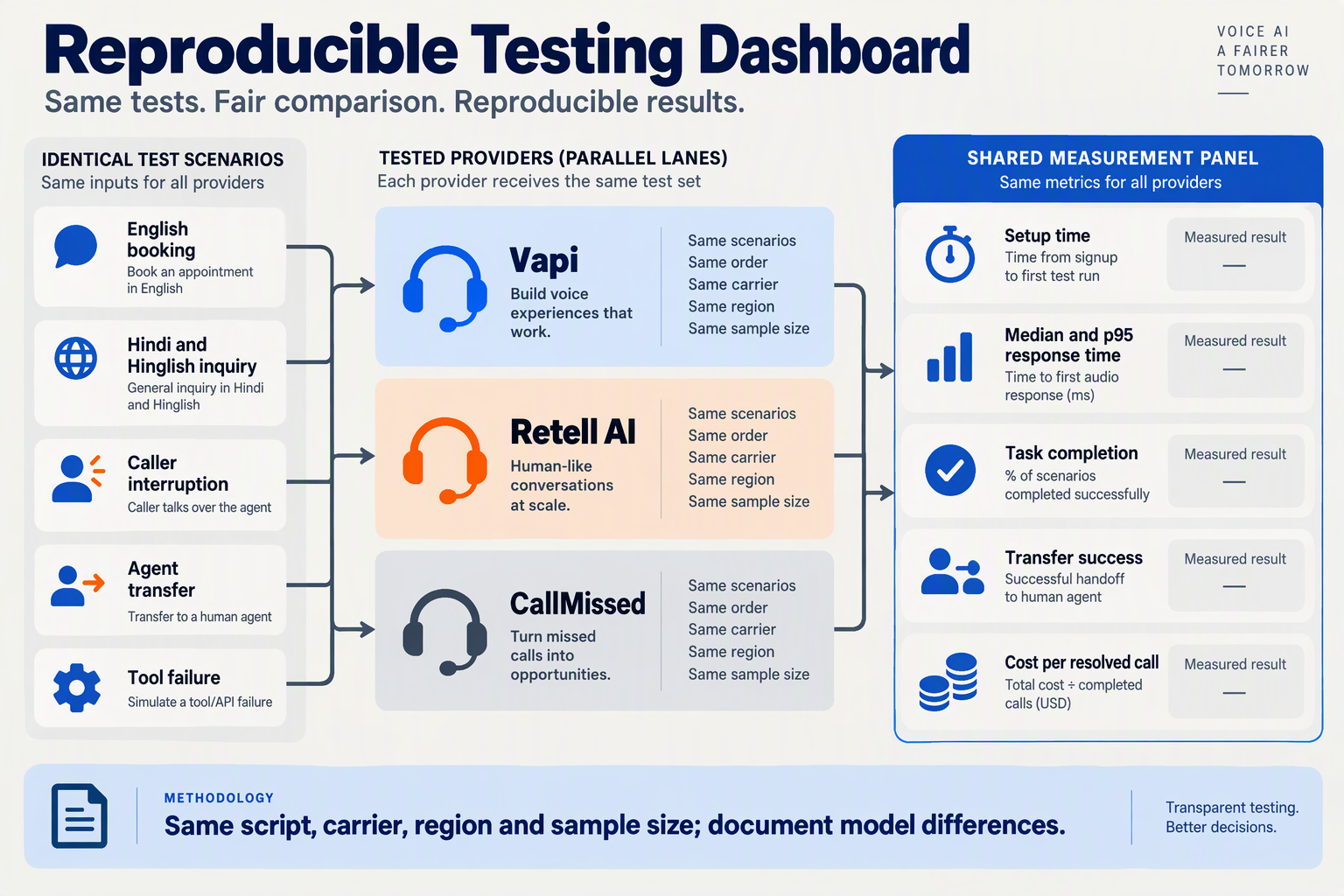
Test Vapi, Retell, and CallMissed on the same phone-agent tasks, then compare completed outcomes—not demo polish. Measure response delays, interruptions, language accuracy, tool execution, and cost per successful call before committing.
What should a startup include in a voice-agent pilot?
- Matched test conditions: For an October 2026 pilot, run 30 calls per platform: five repetitions across six scenarios—booking, rescheduling, answering a knowledge-base question, correcting contact details, handling background noise, and escalating to a human. Keep the instructions, knowledge base, caller scripts, and telephony route equivalent wherever possible; record configuration differences rather than hiding them.
- Response latency: Measure elapsed time from the caller finishing a turn to the first audible agent response, reporting median and 95th-percentile latency separately. In the source supplied for this October 2026 comparison, Vapi’s GPT-4.1 voice-agent blog estimates approximately 700 milliseconds round-trip latency for its described configuration; treat that as configuration-specific, not a platform-wide guarantee.
- Caller patience: Track abandoned calls alongside latency instead of assuming faster always means better. In the source supplied for this October 2026 comparison, Retell AI’s contact-center comparison reports that hang-ups increased in its author’s testing above 1,000 milliseconds end-to-end latency. That observation is a useful hypothesis to test, not an independently validated universal cutoff.
- Interruptions and recovery: Include three interruption patterns: correcting a date mid-answer, saying “stop” during a long explanation, and speaking while the agent confirms details. Score whether playback stops, the correction survives, and the conversation resumes without repeating completed questions. A pleasant voice should not compensate for an appointment booked on the wrong date.
- Language accuracy: Use actual customer phrasing, including accents, names, addresses, and code-switching. As of October 2026, CallMissed’s verified product facts list speech recognition in 22 Indian languages plus English, including Hinglish, alongside call recordings, transcripts, custom QA scoring, eval suites, and A/B experiments. Test recognition and spoken responses separately; language coverage alone does not establish accuracy.
- Tool execution: Test four failure cases: an unavailable appointment slot, a slow backend, a rejected request, and a caller changing their mind. Check the resulting calendar or CRM record—not just the transcript. Count a booking as successful only when the correct slot exists and the agent confirms the same details aloud.
- Outcome-based economics: Calculate total pilot spend ÷ successfully completed tasks, alongside cost per connected minute. For this October 2026 comparison, Vapi’s support documentation identifies call-log breakdowns for transcription, model, voice, and telephony costs. Apply equivalent accounting across all three platforms, including unsuccessful calls that consumed paid resources, rather than rewarding the cheapest incomplete conversation.
- Acceptance gates: Set thresholds before listening to results—for example, a proposed 90% task-completion target, zero fabricated booking confirmations, and correct escalation on every designated safety case. These are suggested pilot criteria, not vendor benchmarks. With only 30 calls per platform, investigate failures and repeat affected scenarios before treating small score differences as decisive.
Which should you choose for a phone-only or multichannel startup?
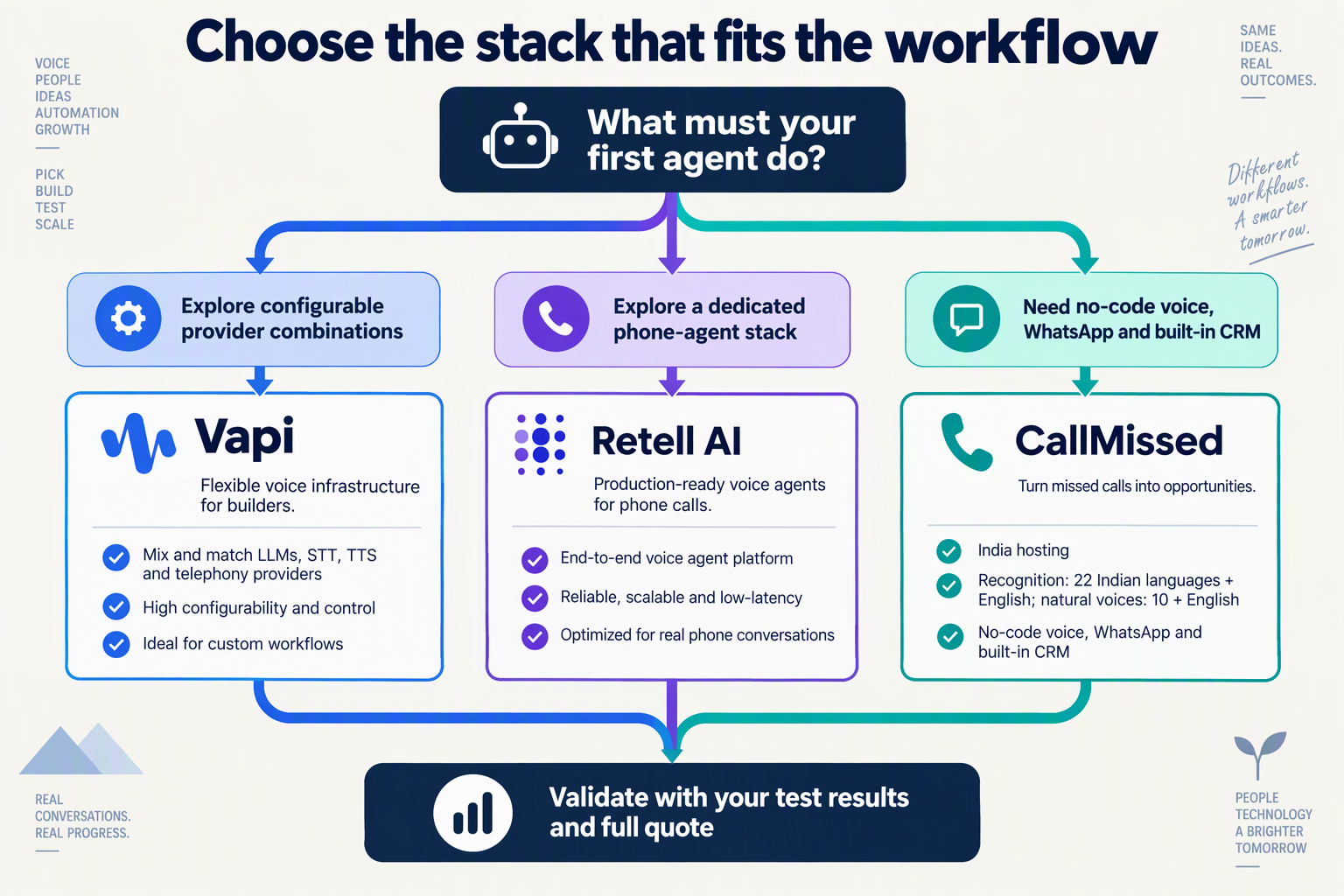
Choose a phone-only platform around your tested calling workflow; choose a multichannel platform around how customers move between calls, messages, and human support. For startups comparing Vapi alternatives, channel requirements should narrow the shortlist before headline pricing does.
Which platform matches your startup’s operating model?
- Vapi: Shortlist Vapi for a phone-agent project when you want to evaluate a specific transcription, model, and voice combination. In this October 2026 comparison, Vapi’s GPT-4.1 voice-agent guide estimates approximately $0.15 per minute and 700 ms round-trip latency with a Vapi voice and Deepgram transcriber. Treat these as configuration-specific estimates—not guaranteed performance for another model, voice, or customer workload.
- Retell AI: Shortlist Retell for a phone-only pilot if its quoted components fit your budget, then validate conversation quality separately. Using Retell AI’s 2026 cloud-phone-systems guide, its starting voice-engine rate, stated LLM range, and approximate Twilio charge imply $88–$165 for 1,000 minutes. That calculation is a planning baseline using the starting engine rate, not a universal quote or evidence of better task completion.
- CallMissed: As of October 2026, CallMissed’s verified product facts list speech recognition in 22 Indian languages plus English, including Hinglish, and natural text-to-speech in 10 Indian languages plus English. Shortlist it when regional-language phone support is central to your business. Test recognition and voice output separately: the recognition-language count does not mean every language has the same voice options.
- Phone-only startup: Keep the first pilot focused on one completed outcome, such as booking an appointment or resolving an order-status request. Run the same scenarios across shortlisted platforms: a clear request, noisy audio, an interruption, an ambiguous answer, and a failed tool action. Choose on successful completion and recoverability rather than letting one impressive demonstration determine the purchase.
- CallMissed: For a multichannel startup, CallMissed’s verified October 2026 capabilities include WhatsApp messaging and Business Calling, Facebook Page and Instagram DMs, a human-handoff queue, and built-in CRM. Customers can initiate WhatsApp calls; business-initiated calls require permission. These are relevant when a customer’s journey spans messaging and voice—not because every phone-only startup needs a broader communication suite.
- Multichannel startup: Map three handoff moments before selecting: message to call, AI to human, and conversation to customer record. For example, an ecommerce buyer might ask about an order in WhatsApp, call for clarification, then need human assistance. Verify which steps each shortlisted configuration supports, what context survives, and which steps require separate integration work.
- Budget owner: Compare cost per completed task, not just cost per minute: divide the pilot’s total applicable charges by successfully completed outcomes. Track failed bookings, unresolved requests, and human escalations alongside spend. A shorter, cheaper call that leaves the customer’s problem unresolved should not count as a successful result; this makes the final choice specific to your startup rather than a blanket platform ranking.
Frequently Asked Questions
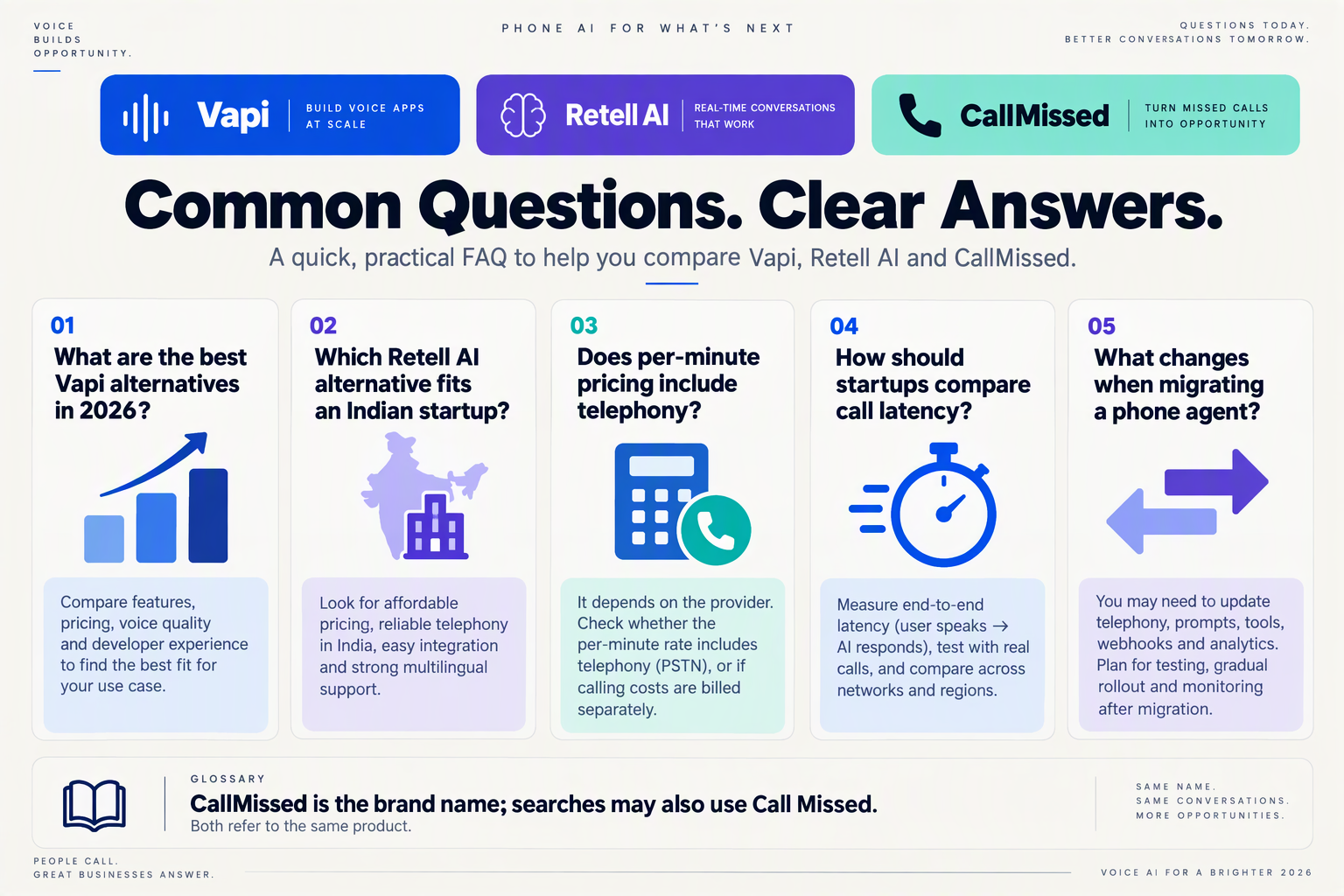
Choose a voice AI platform by total connected-call cost, migration effort and tested task completion, not its headline per-minute price.
- Q: Are Vapi alternatives cheaper for startup phone agents?
A: Not necessarily: the cheapest option depends on transcription, model, voice and telephony costs for your configuration. As of October 2026, Vapi Support describes separate provider charges above its platform fee, while Retell AI’s 2026 cloud-phone-systems guide separates voice-engine, language-model and telephony costs. Compare the same conversation workload and model requirements; otherwise, a lower advertised rate may simply exclude more components.
- Q: Which Vapi alternatives offer flat-rate voice AI pricing?
A: As of October 2026, CallMissed lists ₹4, ₹5 and ₹6 per minute plans covering speech recognition, the language model and voice, with phone carriage billed separately. Its verified product fact sheet specifies a 30-second minimum per connected call, no charge for calls that never connect, and a custom-stack option billed per component by the second without a minimum. Short-call workloads therefore deserve separate modelling rather than a simple average-minute estimate.
- Q: Can I migrate from Vapi or Retell to CallMissed without rewriting everything?
A: Migration is not automatically a drop-in replacement: prompts, tool schemas, webhook handling and call routing need compatibility checks. As of October 2026, CallMissed’s verified product fact sheet lists support for Twilio, Plivo or any SIP trunk, plus a Twilio-compatible Calls API that supports migration from Twilio by changing the base URL and credentials. That compatibility does not establish Vapi or Retell API compatibility, so test one inbound workflow before switching production traffic.
- Q: Do Vapi’s free minutes include transcription, AI models and voice generation?
A: No: the Vapi Support material supplied for this October 2026 comparison says its 1,000 free minutes apply only to the $0.05-per-minute platform fee. The same documentation describes separate transcription, model, voice and telephony charges, so a trial can still incur provider costs. Confirm the allowance on your account and review call-log breakdowns before treating a free-minute offer as a zero-cost pilot.
- Q: How should startups compare Vapi and Retell voice-agent latency?
A: Measure end-to-end response time on representative calls rather than treating a published benchmark as a guarantee. In the Vapi GPT-4.1 guide supplied for this October 2026 comparison, Vapi estimates approximately 700 milliseconds round-trip latency for that configuration; Retell AI’s contact-center comparison reports an author-observed increase in hang-ups above 1,000 milliseconds. These are different claims, not a controlled head-to-head test; evaluate interruptions, noisy audio and successful tool execution alongside speed.
- Q: How much should a startup budget for a voice AI pilot?
A: Budget for connected minutes, applicable minimums, telephony and engineering time, then track cost per successfully completed task. The Vapi GPT-4.1 guide supplied for this October 2026 comparison estimates approximately $0.15 per minute with a Vapi voice and Deepgram transcriber, making 200 minutes approximately $30 at that illustrative rate. Check which transport charges apply, and include failed bookings, escalations and repeated calls when judging whether the pilot is economical.
Conclusion
The right Vapi alternative is the platform that completes your startup’s phone-agent workflow at a sustainable total cost—not the one with the lowest advertised rate. For this October 2026 comparison, Vapi, Retell AI, and CallMissed should be evaluated against equivalent configurations, representative calls, and the engineering effort required to reach production.
What should startups take away from this comparison?
- Compare the complete bill, not the headline price. As of October 2026, Vapi’s support documentation lists a $0.05-per-minute platform fee, with transcription, language model, voice, and transport charges added separately. That makes the platform fee a starting point for budgeting, rather than the cost of a finished conversation. Check each component before estimating what your receptionist, support agent, or booking assistant will cost.
- Treat starting rates as configuration-dependent. Retell AI’s 2026 cloud-phone-systems guide lists voice-engine pricing starting at $0.07 per minute, language model costs of $0.003–$0.08 per minute, and approximately $0.015 per minute for Twilio telephony. Model selection therefore matters to the comparison. Keep the intended task and expected conversation length consistent when evaluating alternatives, rather than comparing differently configured demos.
- Distinguish bundled voice processing from phone carriage. As of October 2026, CallMissed’s verified pricing lists ₹4, ₹5, or ₹6 per minute covering speech recognition, the language model, and voice, while phone carriage remains separate. A 30-second minimum applies per connected call. This bundled structure gives startups a defined voice-stack rate to evaluate, but the telephony bill and call-duration pattern still belong in the calculation.
- Choose for operational fit, then validate with real calls. Build effort, conversation quality, language requirements, integrations, and supervision needs should carry weight alongside pricing. Test noisy audio, ambiguous requests, and failed bookings—not just straightforward conversations. A useful agent must perform the intended task reliably, so responsiveness and interruption handling need to be assessed together with task completion.
What should startups watch as voice AI evolves?
Watch how changes in model choice, voice configuration, and observed call performance affect the economics of your actual workflow. As options evolve, revisit the same representative tests rather than assuming a newer configuration automatically delivers better value.
A practical next step is to model 1,000 connected minutes, calculate every applicable component, and run comparable calls across your shortlist. Keep the distinction between quoted rates and measured outcomes visible: an attractive per-minute figure cannot establish whether an agent handles your customers’ requests successfully.
Explore CallMissed alongside Vapi and Retell AI as you reassess that balance. Before committing, ask: which platform delivers the most useful completed conversations for your startup’s budget and operational needs?
Related Reading
- DeepSeek V4.1 Flash Now on CallMissed API: 1M Context
- Bulbul V4 Flash Now on CallMissed API: Sarvam's Fast TTS
- Claude Haiku 5.5 Now on CallMissed: Price, 1M Context, API