Bulbul V4 Flash Now on CallMissed API: Sarvam's Fast TTS



Bulbul V4 Flash is live on the CallMissed API and playground. See Sarvam's published specs, pricing, the V3 voice-name gotcha and a copy-paste call.
Bulbul V4 Flash Now on CallMissed API: Sarvam's Fast TTS
How fast does a voice agent have to answer before a caller stops noticing the pause? Sarvam AI's Bulbul V4 Flash is built to get under that threshold: according to Analytics India Magazine, the text-to-speech model delivers a time-to-first-audio latency of under 250 milliseconds across 11 Indian languages. As of October 2026, that makes it one of the most closely watched launches in Indian voice AI.
Latency is the real constraint in conversational voice. A caller who waits a beat too long assumes the line dropped or the bot is confused. For Indian businesses, the problem is harder because speech has to sound natural in Hindi, Tamil, Bengali and other regional languages, not just English.
The numbers behind this release explain the attention. CIOL reports that Sarvam positions Bulbul V4 Flash as up to 40% faster and 33% cheaper than its predecessor, priced at ₹20 per 10,000 characters. AlphaSignal adds that the distilled model ships with 83 voices across its 11 languages. RuntimeWire notes that Sarvam is running a half-price promotion at ₹10 per 10,000 characters through November 12.
At the standard rate, a 200-character spoken reply costs about ₹0.40. That is the kind of unit economics that makes high-volume voice support viable for businesses serving regional customers.
Developers can now reach bulbul:v4-flash through CallMissed, the OpenAI-compatible AI gateway, which also exposes Sarvam's model alongside other text-to-speech options behind one API key. That means you can try it without writing a separate integration.
In this post, you'll learn:
- What Bulbul V4 Flash is and how a distilled TTS model preserves quality while cutting latency
- Which languages and voices it supports, and where its limits are
- How the pricing works, including the current promotional rate
- How to call it from your existing code using the OpenAI-style speech endpoint
- Where it fits in real-time voice agents, IVR replacements and WhatsApp calling
Let's start with what Sarvam actually built.
Is Bulbul V4 Flash live on the CallMissed API?
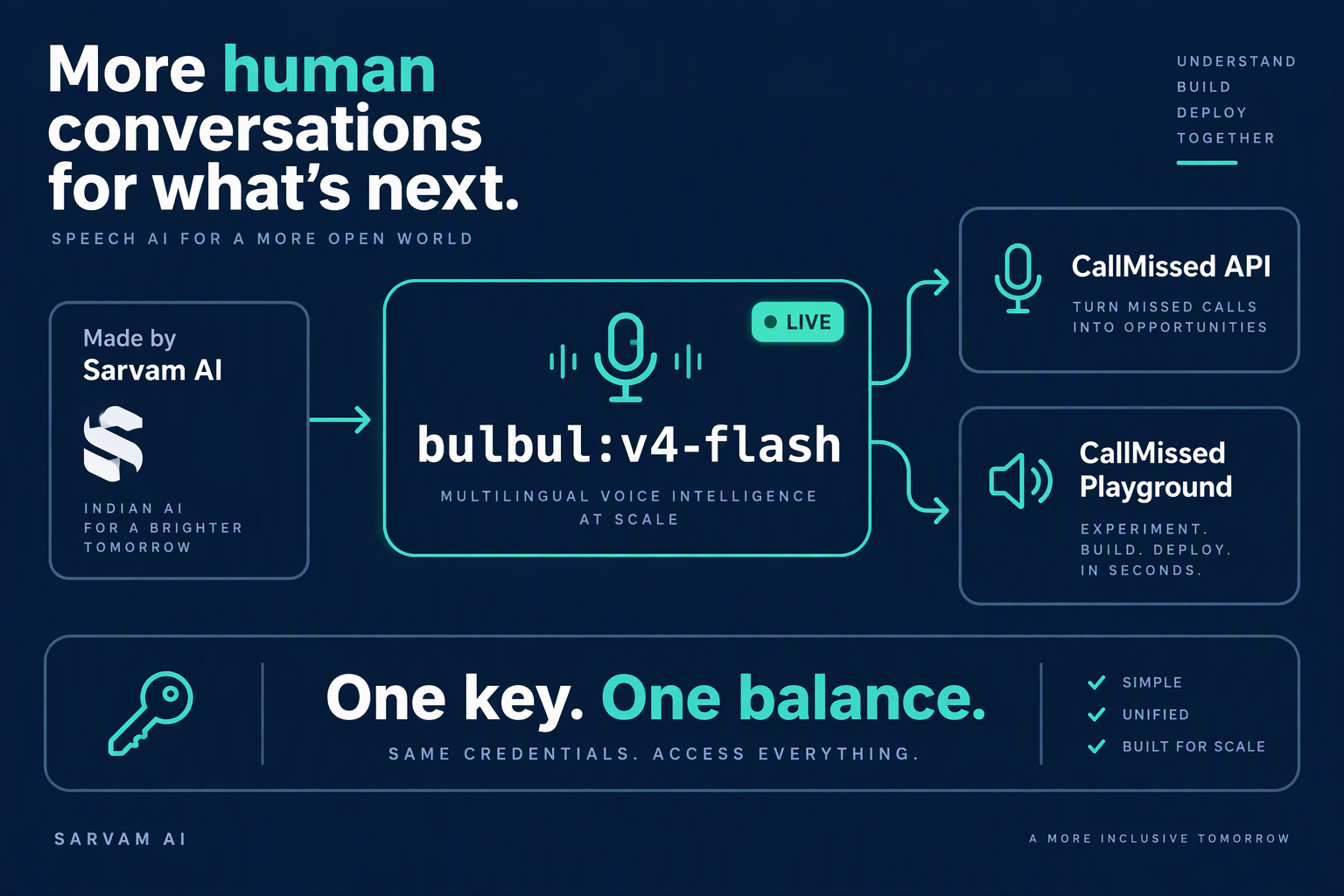
Yes. As of October 14, 2026, Sarvam AI's Bulbul V4 Flash is available on the CallMissed API under the model ID bulbul:v4-flash. CallMissed, the OpenAI-compatible AI gateway, lists it in its text-to-speech catalogue, so you can call it with the same API key and credit balance you use for the other models.
What does "live on CallMissed" mean in practice?
Sarvam is one of the model makers in CallMissed's catalogue, which also includes OpenAI, Google, DeepSeek, Mistral and others. Bulbul V4 Flash joins the platform's 10 text-to-speech models. Here is what that gives you:
- One key, one balance: There is no separate Sarvam account to set up. The model draws from the same credit balance as the platform's 140 models (credits never expire).
- OpenAI-style speech endpoint: CallMissed's API is OpenAI-compatible and covers speech generation. If your code already uses an OpenAI SDK for text-to-speech, you point it at
api.callmissed.com, swap in your key and set the model name. - Easy A/B testing: Because the gateway is shared, you can compare Bulbul V4 Flash with other voice models by changing one string. You don't need to rewrite your integration.
- Free way to start: New accounts get 1,000 free credits on signup, and 27 of the catalogue's models sit on the free tier. That is enough to listen to the voices before you commit.
Does CallMissed's price match Sarvam's direct price?
Don't assume it does. The figures in the introduction, ₹20 per 10,000 characters standard and ₹10 through November 12, are Sarvam's own published rates, as reported by CIOL and RuntimeWire. What you pay through CallMissed is billed in credits (1 credit = ₹1, about US$0.0104). Check the model entry in the console or on the pricing page for the current per-character rate before you budget a large workload.
What should you keep in mind before switching?
A few practical points apply to any new TTS model.
- Language coverage: Sarvam's launch coverage cites 11 languages for Bulbul V4 Flash. CallMissed's own native voices span 10 Indian languages plus English, and its 22-language figure refers to speech recognition only. Don't read it as TTS coverage.
- Rate limits are per key: Default limits are 60 requests a minute on Free, 500 on Starter, 3,000 on Pro and 10,000 on Enterprise. A high-concurrency voice workload will likely need a paid tier.
- Test your own text: Names, addresses, order numbers and code-mixed Hinglish are where pronunciation differences show up. Run a sample of real replies from your use case rather than relying on demo clips.
- API access is not the same as a voice agent plan: This release is about calling the model directly. CallMissed's no-code voice agents have their own flat per-minute plans (₹4, ₹5 or ₹6 a minute), which bundle speech recognition, the language model and the voice.
The next section covers what Sarvam actually built and why distillation matters for latency.
What did Sarvam launch, and what is genuinely new?
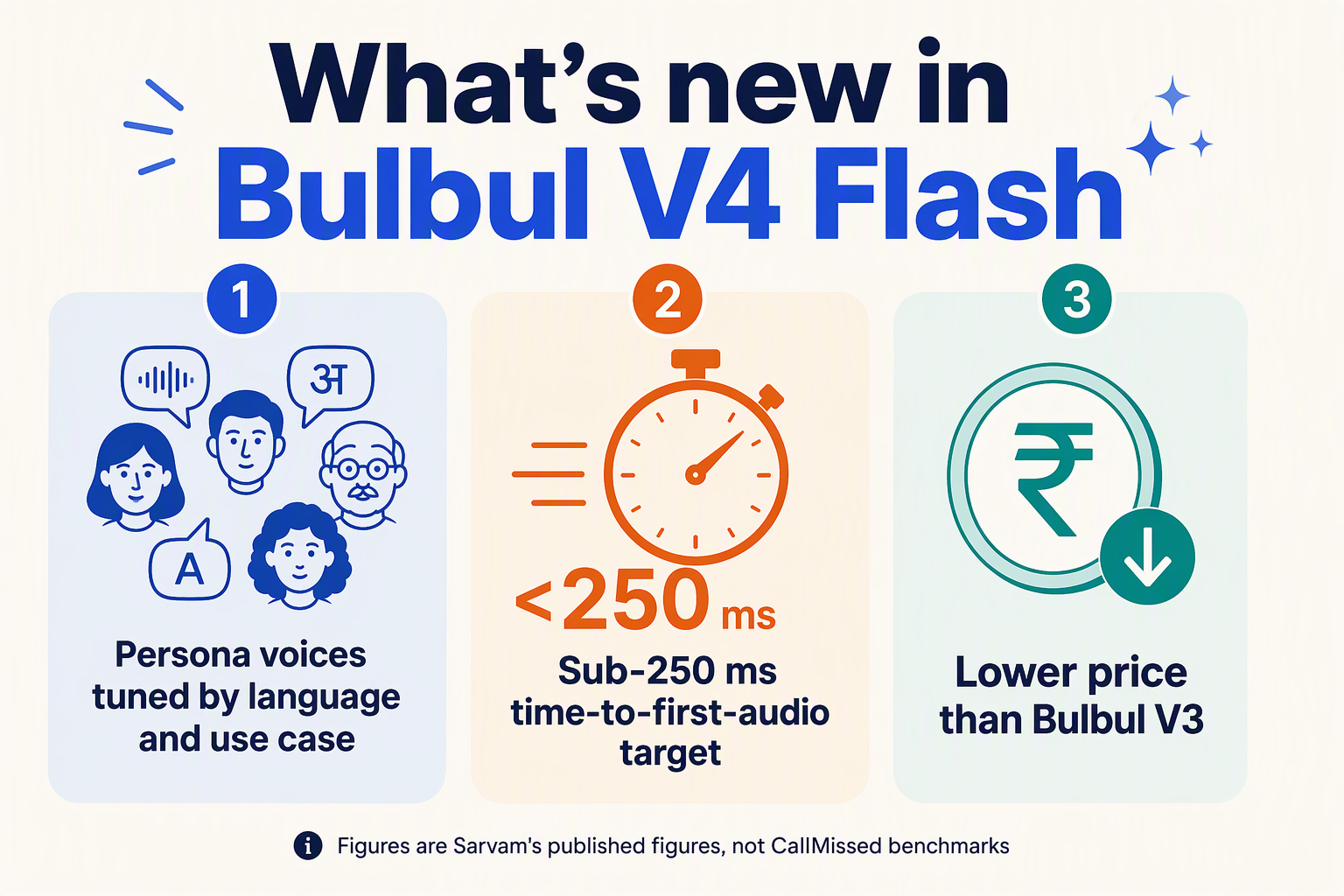
Sarvam AI launched Bulbul V4 Flash, a distilled text-to-speech (TTS) model that trades size for speed while aiming to keep the quality of its larger sibling. The genuinely new parts are the latency target, the price cut and the contextual pronunciation work. The language count and the "Flash" branding are less of a story.
What exactly is Bulbul V4 Flash?
Bulbul V4 Flash is Sarvam's latest TTS model for real-time Indian-language voice applications. In its launch post on X, Sarvam said Flash "brings frontier-quality speech into a smaller, more efficient model, preserving the subtle details that make voices" sound natural.
"Distilled" means a smaller model is trained to reproduce the output of a larger one. The smaller model runs faster and costs less per request, and the open question is how much expressiveness survives. Economic Times Enterprise AI describes the model as built for natural, expressive speech with faster response times.
What is actually new compared with the previous Bulbul?
Four changes stand out, based on the launch coverage:
- Speed: Analytics India Magazine reports time-to-first-audio under 250 milliseconds. CIOL says the model is up to 40% faster than its predecessor.
- Price: CIOL reports a list price of ₹20 per 10,000 characters, 33% lower than before. That implies the previous model cost roughly ₹30 per 10,000 characters (our arithmetic, not a figure Sarvam published in the sources reviewed).
- Pronunciation: CIOL highlights improved contextual pronunciation, which matters for Indian text containing numbers, abbreviations and mixed-script words.
- Voice choice: AlphaSignal counts 83 voices across 11 languages, which gives developers room to match a voice to a brand or use case.
How cheap is it per reply?
At the list rate, each character costs ₹0.002, so a 200-character reply is about ₹0.40. During Sarvam's promotion, which RuntimeWire says runs through November 12 at ₹10 per 10,000 characters, the same reply costs about ₹0.20. Because a voice agent speaks only part of the time, TTS spend scales with how much the agent says, not with call length.
What should you treat with caution?
Launch numbers are vendor-reported, so test them against your own workload before building on them.
- "Up to 40% faster" is a ceiling, not a guaranteed average.
- Sub-250 ms is time to first audio from the TTS model. A live call also pays for network transit, speech recognition and the language model, so end-to-end delay will be higher.
- Eleven languages is the headline count. Check the model's documentation for the exact language and voice list before committing a regional rollout.
- The promotional rate ends November 12, 2026. Budget on the ₹20 list price, not the discount.
Why does this launch matter for builders?
Voice quality in Indian languages has long competed with latency and cost. A model that claims gains on all three at once changes that trade-off, especially for high-volume use cases like support lines and reminders. The next section covers how to try it through the API.
What are the key facts about bulbul:v4-flash?
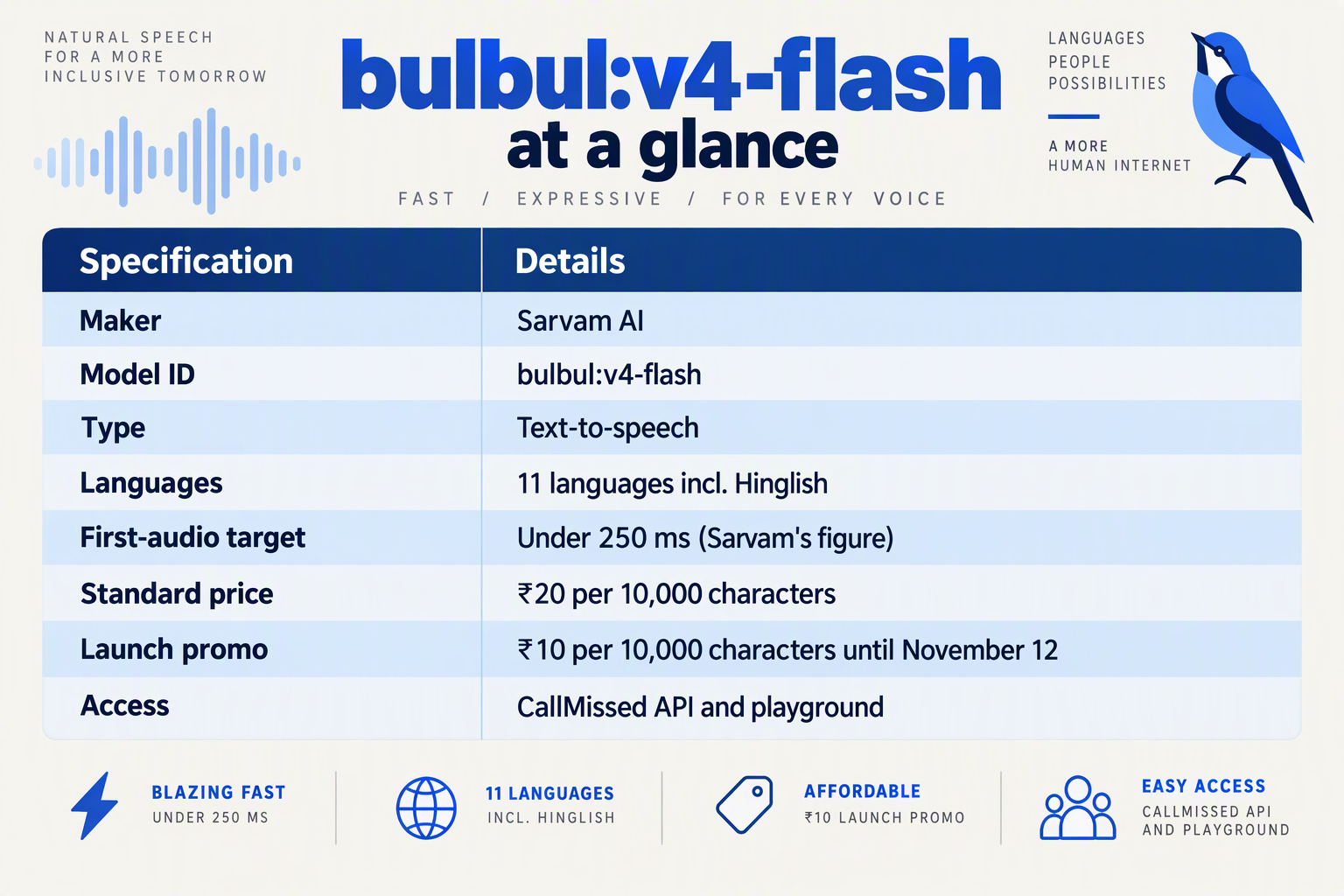
Bulbul V4 Flash is Sarvam AI's distilled text-to-speech model, with sub-250 ms time-to-first-audio, 11 Indian languages and 83 voices. It costs ₹20 per 10,000 characters, or ₹10 until November 12, 2026. Here are the facts as of October 14, 2026.
What are the key specs of bulbul:v4-flash?
| Attribute | Detail | Source |
|---|---|---|
| Maker | Sarvam AI (India) | Analytics India Magazine |
| Model type | Distilled text-to-speech (TTS) model for real-time use | AlphaSignal |
| Model ID | bulbul:v4-flash | CallMissed catalogue |
| Languages | 11 | Analytics India Magazine |
| Voices | 83 across those languages | AlphaSignal |
| Time to first audio | Under 250 ms | Analytics India Magazine |
| Versus predecessor | Up to 40% faster, 33% cheaper | CIOL |
| Standard price | ₹20 per 10,000 characters | CIOL |
| Promo price | ₹10 per 10,000 characters through November 12 | RuntimeWire |
How should you read these numbers?
Latency is time to first audio, not total generation time. The sub-250 ms figure measures how quickly playback can begin. In a streaming voice agent, that is the delay a caller actually hears. The cited reports do not specify the test conditions, so treat it as Sarvam's headline figure and measure it on your own network and text lengths.
"Distilled" means smaller and faster by design. Sarvam describes Flash as bringing frontier-quality speech into a smaller, more efficient model. CIOL also highlights improved contextual pronunciation, which matters for Indian-language text with numbers, dates, currency and mixed English words.
What does it cost per reply?
The pricing works out to a simple per-character rate:
- Standard: ₹20 per 10,000 characters is ₹0.002 per character. A 200-character reply costs about ₹0.40.
- Promotional: ₹10 per 10,000 characters is ₹0.001 per character. The same reply costs about ₹0.20 until November 12, roughly four weeks from today.
- Implied predecessor price: if Flash is 33% cheaper at ₹20, the earlier model would have cost roughly ₹30 per 10,000 characters. That is our arithmetic from CIOL's figure, not a number Sarvam published.
Check the current CallMissed pricing page for the rate applied to your credits, since promotional pricing on the maker's own platform may differ from gateway pricing.
What should you verify before shipping?
- Language coverage: the 11 languages are not the same as the 22 Indian languages CallMissed supports for speech recognition. Confirm your target language is in Flash's list before you commit.
- Voice fit: audition several of the 83 voices with your real scripts, including numerals and brand names.
- End-to-end latency: TTS is one link in the chain. Speech recognition, the language model and network hops all add to what the caller hears.
For teams building voice agents, CallMissed's API exposes bulbul:v4-flash alongside its other text-to-speech models, so you can compare them with one key and one balance. The next section shows how to call it.
How does Bulbul V4 Flash compare with Bulbul V3?
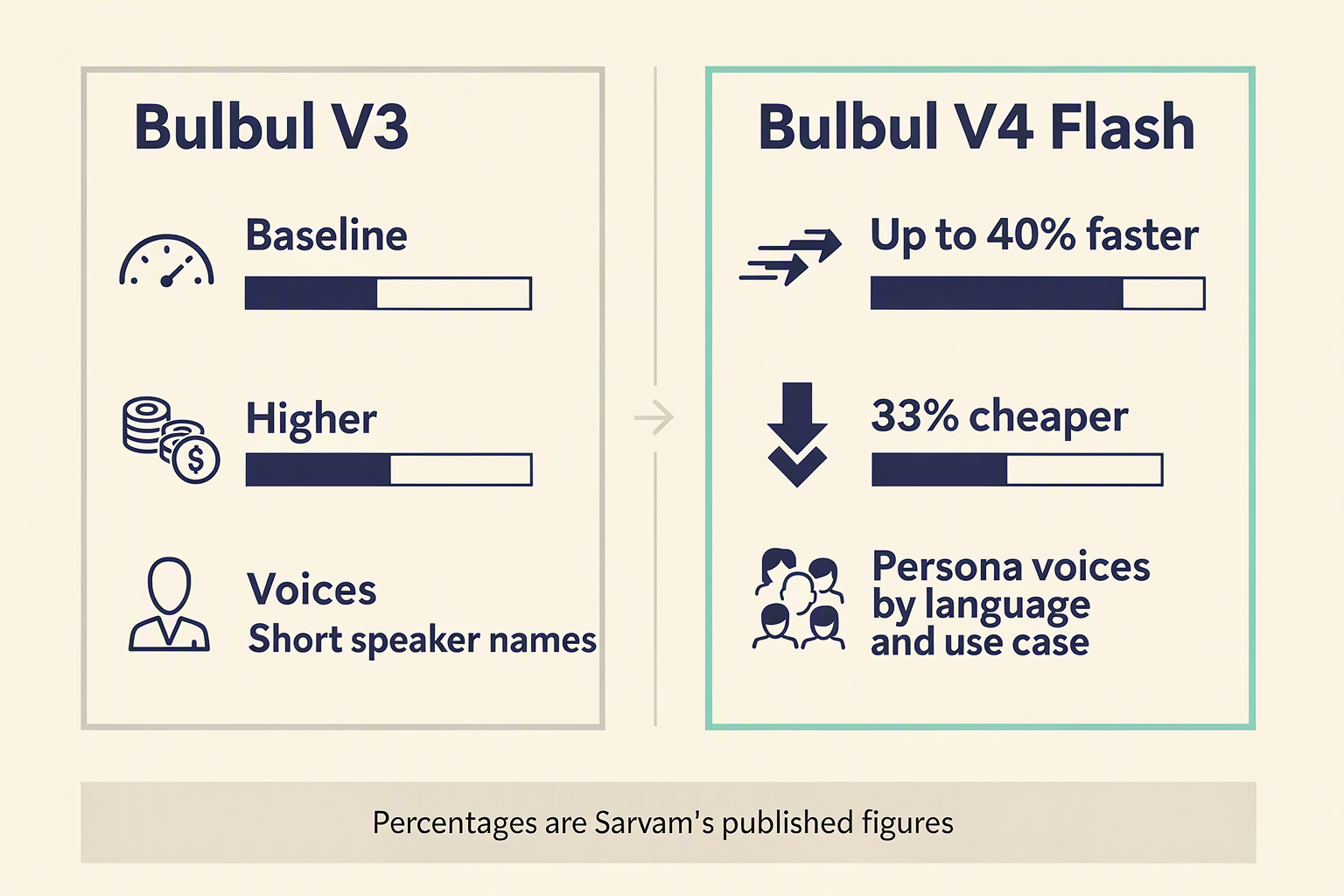
Bulbul V4 Flash is faster and cheaper than the earlier Bulbul model, and Sarvam says it keeps the speech quality. According to CIOL, Sarvam positions it as up to 40% faster and 33% cheaper than its predecessor. It does this by distilling a larger model into a smaller one, which Sarvam describes as bringing "frontier-quality speech into a smaller, more efficient model."
What actually changed from Bulbul V3?
Here is what the coverage supports, as of October 2026:
- Latency: Analytics India Magazine reports time-to-first-audio under 250 milliseconds. Sarvam's "up to 40% faster" figure is a vendor claim, and "up to" means the gain varies by language and text length.
- Price: CIOL lists the standard rate at ₹20 per 10,000 characters. A 33% cut implies the earlier model cost roughly ₹30 per 10,000 characters. That is our arithmetic, not a published figure, so check Sarvam's pricing page for the exact baseline.
- Voices and languages: AlphaSignal reports 83 voices across 11 Indian languages.
- Pronunciation: CIOL says Bulbul V4 Flash improves contextual pronunciation, meaning it handles words that read differently depending on the sentence.
- Expressiveness: The Economic Times Enterprise AI coverage describes speech that is "more natural and expressive," though no independent listening benchmark was cited.
How much does the price difference matter in practice?
A 200-character spoken reply costs about ₹0.40 at the ₹20 standard rate. At the implied earlier rate of about ₹30, the same reply would cost about ₹0.60. The saving looks small per reply, but it compounds on a support line handling thousands of turns a day.
The promotion matters more in the short term. RuntimeWire reports Sarvam is charging ₹10 per 10,000 characters through November 12, which brings that 200-character reply to about ₹0.20. Promotional pricing is set by Sarvam and can change, so confirm the rate on your CallMissed usage logs before budgeting a launch.
Is faster always better for a voice agent?
Not automatically. Time-to-first-audio is only one part of the delay a caller hears, and the language model and speech recognition add their own. A fast TTS model removes one bottleneck, not all of them.
Distillation also involves trade-offs. Smaller models can lose some nuance on long or emotionally varied passages, and Sarvam's own framing is that Flash preserves the details rather than improves on them. If your use case is long-form narration rather than live conversation, the older, larger model may still be worth a listen.
How should you evaluate it for your own use case?
- Test your real scripts. Use your own order updates, payment reminders and greetings, including names, numbers and code-mixed phrases like Hinglish.
- Measure end to end. Time from the end of the caller's turn to the first audio they hear, not TTS latency alone.
- Listen in each target language. Native speakers should judge Tamil, Bengali or Marathi output, since a benchmark won't reflect your audience.
- Compare cost per call. Multiply average characters per call by the per-character rate, then compare against your current voice.
Because CallMissed puts its 10 text-to-speech models behind one API key, you can run this comparison by changing only the model ID in the request. Your prompts, code and credit balance stay the same.
Which use cases fit Bulbul V4 Flash: voice agents, IVR or alerts?
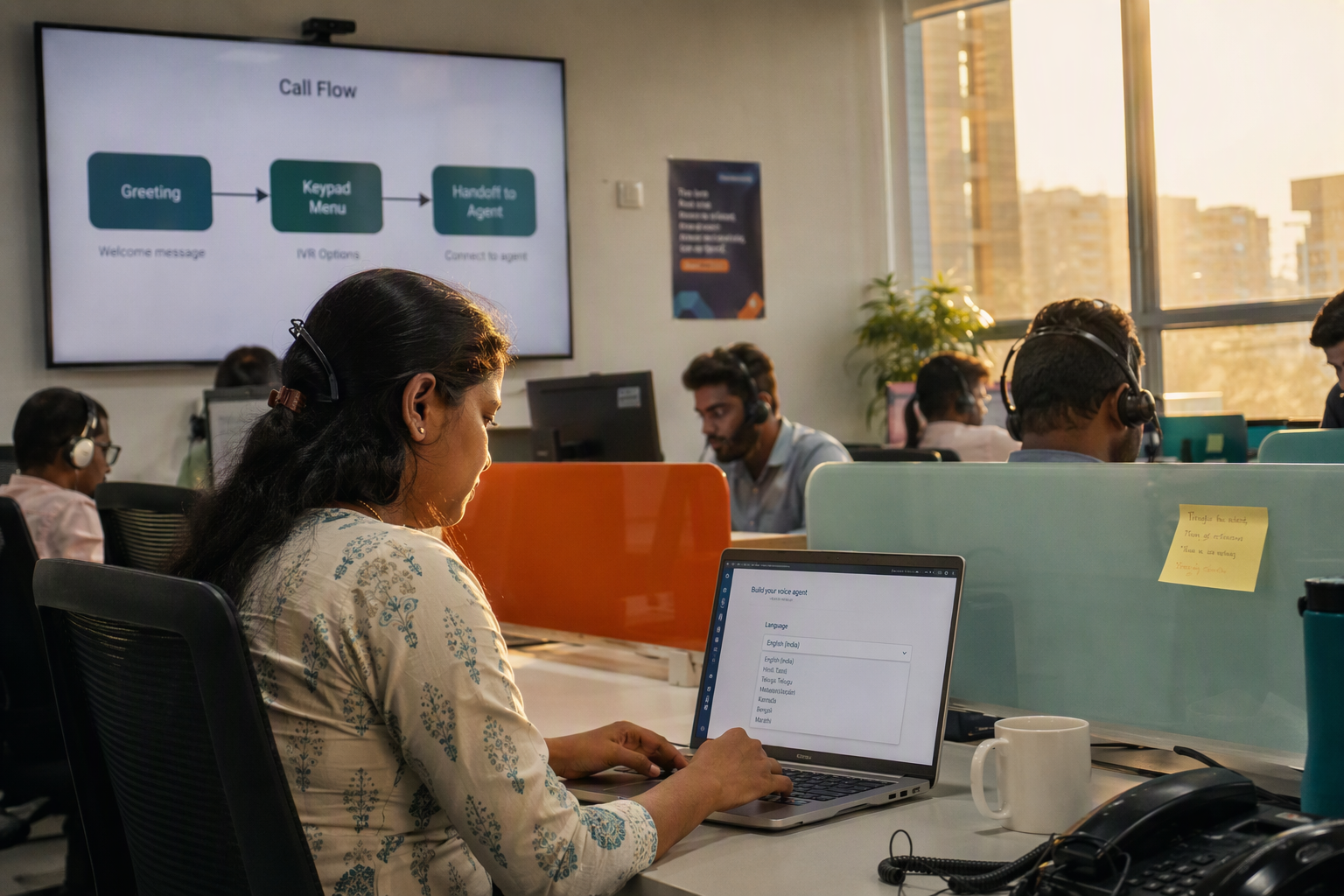
Bulbul V4 Flash fits best where a person is waiting on the other end of the line: real-time voice agents first, then IVR replacements, then spoken alerts. The deciding factor is latency. Analytics India Magazine reports time-to-first-audio under 250 milliseconds across 11 languages, and that matters most when a delayed reply breaks the conversation.
Is Bulbul V4 Flash good for real-time voice agents?
Yes, this is the primary use case. In a live call, the text-to-speech step sits between the language model and the caller's ear, so every millisecond it saves comes straight off the pause the caller hears.
Two details from the launch coverage matter here:
- Speed: CIOL reports the model is up to 40% faster than its predecessor.
- Pronunciation: CIOL also notes improved contextual pronunciation, which helps with the numbers, names and mixed-language phrases that dominate support calls.
If you assemble your own pipeline through the CallMissed API, you can pair bulbul:v4-flash with one of the platform's 45 speech-to-text models and any of its general-purpose LLMs. CallMissed's speech recognition covers 22 Indian languages plus English, including code-mixed speech such as Hinglish.
Can it replace a keypad-style IVR?
It can, and this is where the cost profile helps. A traditional IVR forces callers through "press 1 for…" menus. A conversational agent lets them say what they need in their own language.
Prompts in a menu flow are short and repeated often. At Sarvam's list price of ₹20 per 10,000 characters, a 300-character prompt costs about ₹0.60. During the half-price window that RuntimeWire reports (₹10 per 10,000 characters through November 12), it costs about ₹0.30.
CallMissed's platform also supports keypad (DTMF) menus and a visual call-flow designer. You can keep a keypad fallback for callers who prefer it while the agent handles open-ended requests.
What about alerts and notifications?
Spoken alerts are a reasonable fit, but latency matters less here. Think payment reminders, delivery updates or appointment confirmations. The text is known in advance, so the sub-250 ms figure is a smaller advantage than the price and the range of voices.
Sarvam's 83 voices across 11 languages (per AlphaSignal) let you match the language and tone to each customer segment. A 500-character reminder costs about ₹1 at the standard rate.
Keep in mind that CallMissed supports single outbound calls and click-to-call, not automated outbound calling campaigns. Alerts are best triggered one at a time from your own systems, for example by an order event.
When is it not the right choice?
Be realistic about the limits:
- Languages outside the 11: If you need a language Bulbul doesn't cover, use another model from the catalogue.
- Long-form narration: For audiobooks or lengthy content, speed matters less than voice richness, so compare options by ear.
- English-only products: The Indian-language focus is the strength, so a global English voice may suit you better.
Which use case should you test first?
Start with a voice agent on your highest-volume call type, such as order status or appointment booking. Run it in your most common regional language, listen for pauses and pronunciation, then compare against another model in the catalogue. Because every TTS model sits behind the same key, swapping one for another is a one-line change to the model name.
For teams adding AI to WhatsApp, platforms such as CallMissed can also bridge WhatsApp Business calls to an AI voice agent, which suits many of these same scenarios.
Why do V3 short speaker names fail on bulbul:v4-flash?
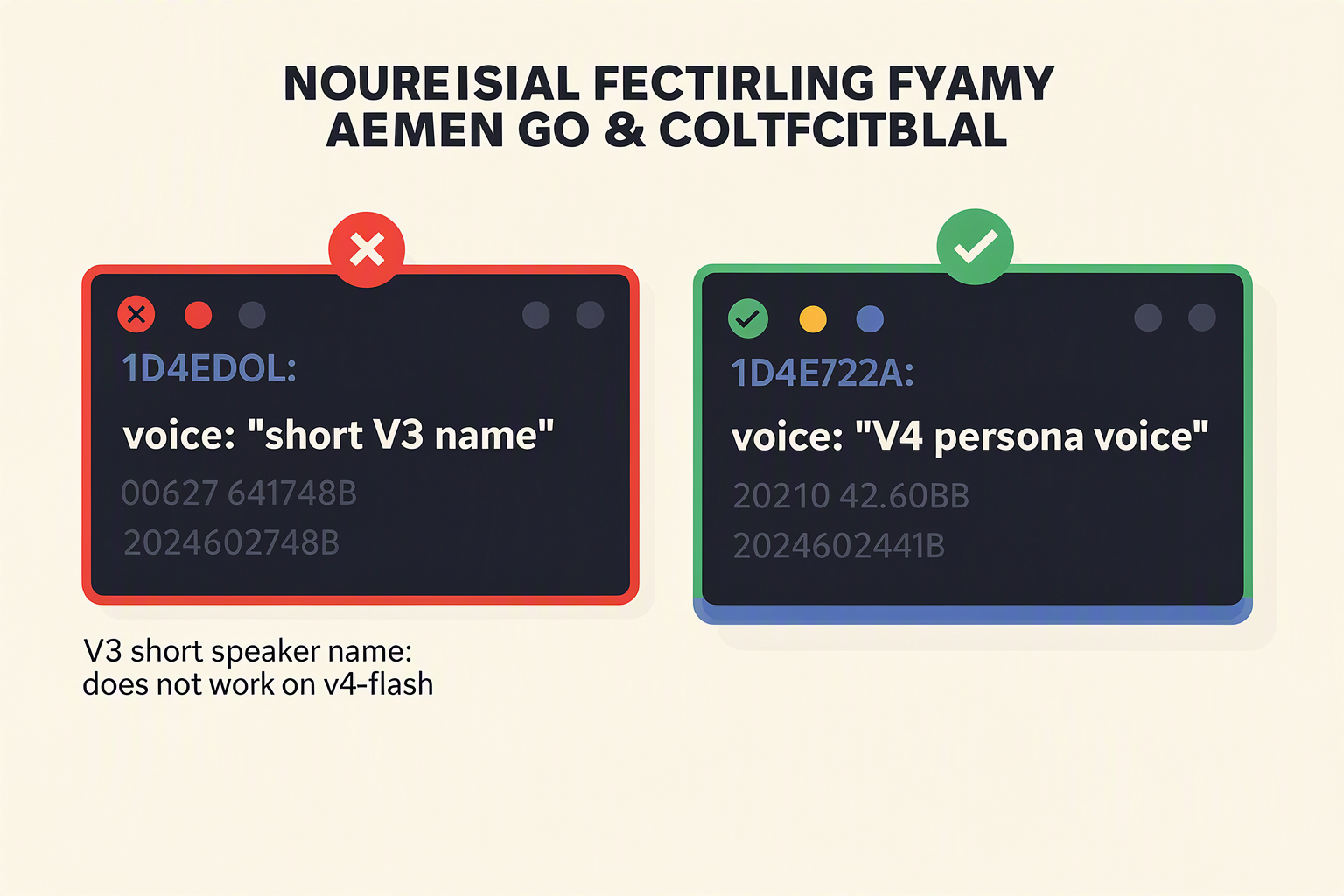
Short V3 speaker names fail on bulbul:v4-flash because a speaker name is a model-specific voice ID, not a universal label. A name that resolves on Bulbul V3 isn't guaranteed to exist on Bulbul V4 Flash. As of October 14, 2026, the sources reviewed for this post don't publish a V3-to-V4 name mapping, so treat any carried-over name as unverified until you test it.
Why aren't V3 voice names portable to V4 Flash?
Three facts explain the failure pattern:
- Bulbul V4 Flash is a new, distilled model. AlphaSignal describes it as a distilled TTS model, not a patch on V3. A distilled model ships with its own voice set.
- It has its own catalogue. AlphaSignal reports 83 voices across 11 languages. That catalogue is defined for V4 Flash, so you can't assume it reuses V3's short names one-for-one.
- The API validates the voice against the model. Your request pairs a
modelstring with a speaker value. If the speaker isn't recognised for that model, the request will most likely be rejected.
Because the model ID and voice ID travel together, changing only the model string is the most common way to hit this error.
What does the failing request look like?
Typically, code that worked on V3 changes one line and stops working:
from openai import OpenAI

client = OpenAI(base_url="https://api.callmissed.com/v1", api_key="YOUR_KEY")

resp = client.audio.speech.create(
    model="bulbul:v4-flash",   # changed from the V3 model ID
    voice="<your-old-V3-short-name>",  # likely the culprit
    input="Namaste, aapka order shipped ho gaya hai.",
)
The model changed, but the voice value is still a V3 leftover. The fix is to replace the voice, not rewrite the integration.
How do you fix it?
- Look up V4 Flash's current voice list. Check Sarvam's model documentation and the CallMissed docs at docs.callmissed.com for the supported speaker values.
- Swap the voice parameter. Choose a V4 Flash voice that matches the language and tone you used before.
- Check language coverage. The model supports 11 languages, according to Analytics India Magazine, so confirm your target language is among them.
- Re-listen to your scripts. Voices that share a role, such as a calm support voice, can still sound different. Test your real call prompts before switching production traffic.
- Centralise voice IDs in config. Keep the model and voice together as one setting, so they change as a pair.
How can you reduce migration risk?
Run V3 and V4 Flash side by side on a small share of traffic. Because CallMissed, the OpenAI-compatible AI gateway, exposes Sarvam's models behind one API key and one credit balance, switching between model IDs doesn't require a second account or integration. That makes an A/B comparison of voice quality simple.
One cost note: Sarvam's half-price promotion of ₹10 per 10,000 characters runs through November 12, according to RuntimeWire, against a standard ₹20. Failed requests from a bad voice name are cheap to catch in testing, so run a short validation pass before promotional-rate volume begins.
How do you call bulbul:v4-flash through the CallMissed API?
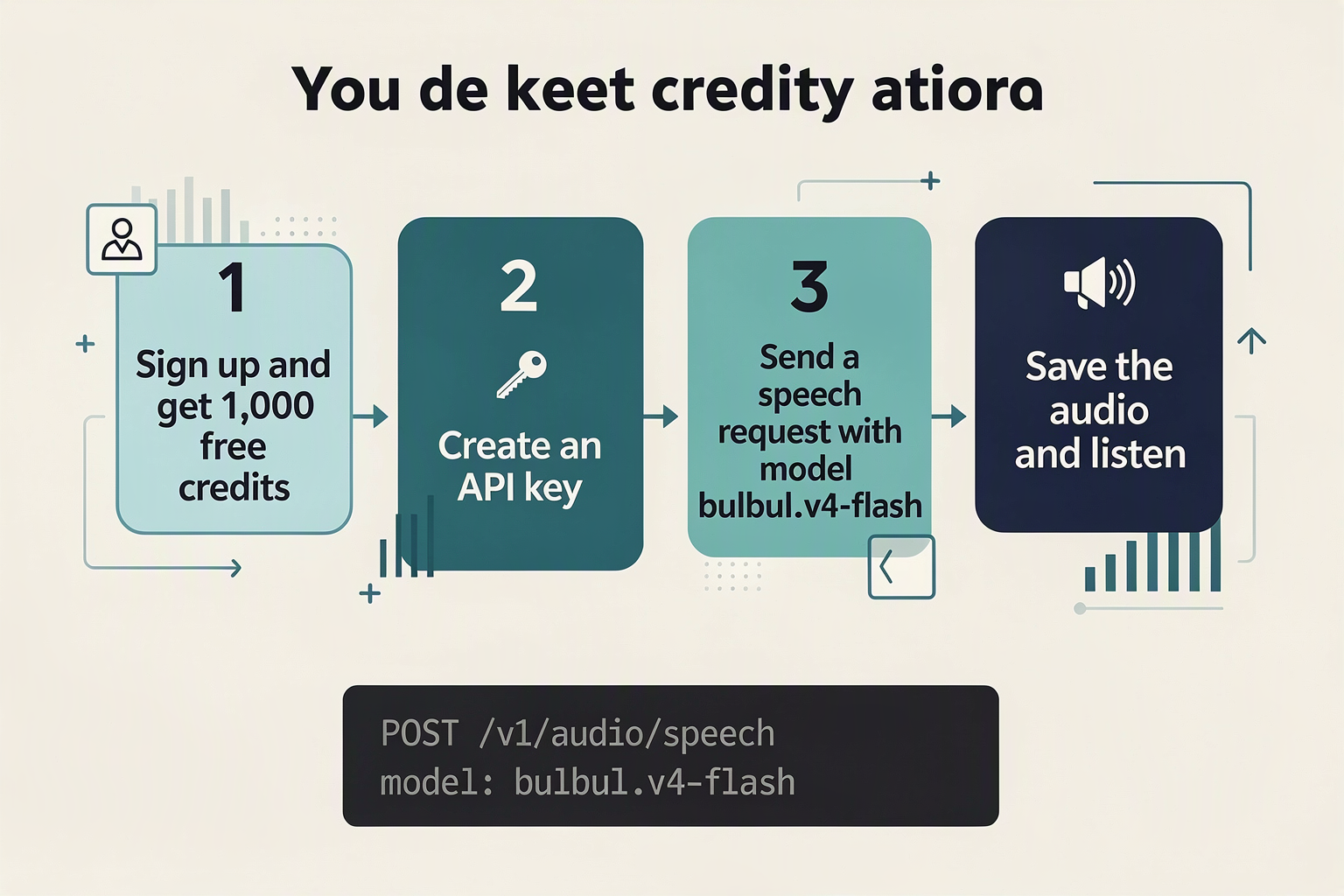
You call bulbul:v4-flash the same way you call any OpenAI-style text-to-speech model: point the OpenAI SDK at CallMissed's base URL, set the model to bulbul:v4-flash, and send your text to the speech endpoint. No Sarvam-specific client is needed. As of October 14, 2026, the steps below cover the whole path from signup to audio file.
How do you get set up?
- Create an account at console.callmissed.com. New accounts receive 1,000 free credits on signup.
- Generate an API key in the console. The same key works across all 140 models in the catalogue.
- Pick a voice. Bulbul V4 Flash ships with 83 voices across 11 languages, according to AlphaSignal. Check the CallMissed docs at docs.callmissed.com for the voice identifiers available to your key.
- Send a speech request using the example below.
What does the request look like?
Here is a minimal Python example using the official OpenAI SDK. Replace YOUR_VOICE with a voice ID from the docs:
from openai import OpenAI

client = OpenAI(
    api_key="YOUR_CALLMISSED_KEY",
    base_url="https://api.callmissed.com/v1",
)

with client.audio.speech.with_streaming_response.create(
    model="bulbul:v4-flash",
    voice="YOUR_VOICE",
    input="आपका ऑर्डर कल शाम तक पहुंच जाएगा।",
) as response:
    response.stream_to_file("reply.mp3")
The equivalent cURL call:
curl https://api.callmissed.com/v1/audio/speech \
  -H "Authorization: Bearer YOUR_CALLMISSED_KEY" \
  -H "Content-Type: application/json" \
  -d '{"model":"bulbul:v4-flash","voice":"YOUR_VOICE","input":"आपका ऑर्डर कल शाम तक पहुंच जाएगा।"}' \
  --output reply.mp3
Confirm the default audio format and any optional parameters in the docs before shipping, since they can differ between models.
What should you check before going to production?
- Match text to language. Send the reply in the language and script you want spoken, and pair it with a voice built for that language. Bulbul V4 Flash covers 11 languages, so a Hindi voice is the wrong choice for a Tamil reply.
- Estimate cost from character count. Sarvam lists the model at ₹20 per 10,000 characters, per CIOL, and RuntimeWire reports a ₹10 promotional rate through November 12. Check CallMissed's pricing page for the credit cost on your account, since that is what you are billed. One credit equals ₹1, so a 200-character reply at Sarvam's standard rate works out to roughly 0.4 credits.
- Measure latency from your own region. Analytics India Magazine reports sub-250 ms time-to-first-audio for the model, but that is Sarvam's figure. Network distance and your own stack add to it, so test end to end.
- Use the request logs. The CallMissed console records usage and requests, which helps you audit character volume while the promotional pricing is running.
Can you swap it in without a rewrite?
Yes, if your code already calls an OpenAI-compatible speech endpoint. Only three values change: the base URL, the API key and the model string. That makes A/B testing bulbul:v4-flash against another text-to-speech model from the same catalogue a one-line change, so you can compare quality and cost on your own scripts.
If you are building a full phone or WhatsApp voice agent rather than calling the API directly, CallMissed's voice agent plans bundle speech recognition, the language model and the voice into one per-minute rate, starting at ₹4 per minute for Standard.
How has the industry reacted to Bulbul V4 Flash?
The reaction so far has been broadly positive and centred on three things: speed, price and Indian-language quality. As of October 14, 2026, most coverage consists of launch reporting that repeats Sarvam AI's own figures. Independent benchmarks of Bulbul V4 Flash are not yet part of the public record.
What are publications highlighting about Bulbul V4 Flash?
Each outlet has led with a different angle:
- Latency: Analytics India Magazine and Lapaas Voice both frame the launch around real-time speech, citing time-to-first-audio under 250 milliseconds across 11 Indian languages.
- Cost and speed: CIOL's headline says the model is up to 40% faster and 33% cheaper, and it highlights improved contextual pronunciation. The Economic Times' Enterprise AI section also leads with the 33% lower cost.
- Voice breadth: AlphaSignal calls Bulbul V4 Flash a distilled TTS model and points to its 83 voices across 11 languages.
- Promotional pricing: RuntimeWire focuses on the half-price offer of ₹10 per 10,000 characters through November 12, against the ₹20 standard rate.
The pricing angle is notable. Several outlets treat cost as a headline feature, not a footnote, which suggests buyers see TTS spend as a real barrier to deploying voice at scale.
How is Sarvam describing its own model?
In its launch post on X, Sarvam said Bulbul V4 Flash is "built for natural, expressive speech across Indian languages." It added that Flash "brings frontier-quality speech into a smaller, more efficient model." The pitch is that distillation shrinks the model without stripping out the subtle details that make a voice sound human.
That is a claim about quality retention, and it is where independent testing will matter most. Coverage so far repeats Sarvam's description of that trade-off but does not test it.
What is still missing from the conversation?
Be careful reading the headline numbers. The sub-250 ms figure and the 40% speed-up are vendor-reported. Real-world latency also depends on your network path, how you stream audio, and the rest of your voice pipeline: speech recognition, the language model and telephony.
Coverage also says little about:
- Side-by-side listening tests against other Indian-language TTS models.
- Performance on code-mixed text, such as Hinglish sentences with English product names or numbers.
- Behaviour under production load, as opposed to launch-day demos.
None of this is a criticism of the model. It is the normal gap between a launch announcement and community evaluation, and it usually closes within weeks as developers publish their own results.
What should developers do with this reaction?
Treat the coverage as a reason to test, not a verdict. Because bulbul:v4-flash sits in CallMissed's catalogue alongside other text-to-speech models, you can run the same script through several voices using one API key and compare them directly. That is a practical way to judge pronunciation, pacing and perceived latency with your own content.
Two suggestions:
- Use the promotional window to experiment. The ₹10 per 10,000 characters rate runs through November 12, so a broad listening test is cheap right now.
- Test your hardest text first. Include names, amounts, dates and mixed-language sentences, since contextual pronunciation is one of the improvements CIOL says Sarvam is claiming.
The early signal is that Bulbul V4 Flash has Indian voice AI builders' attention. Whether it holds it will depend on what those tests show.
What is the timeline of the Bulbul V4 Flash launch?
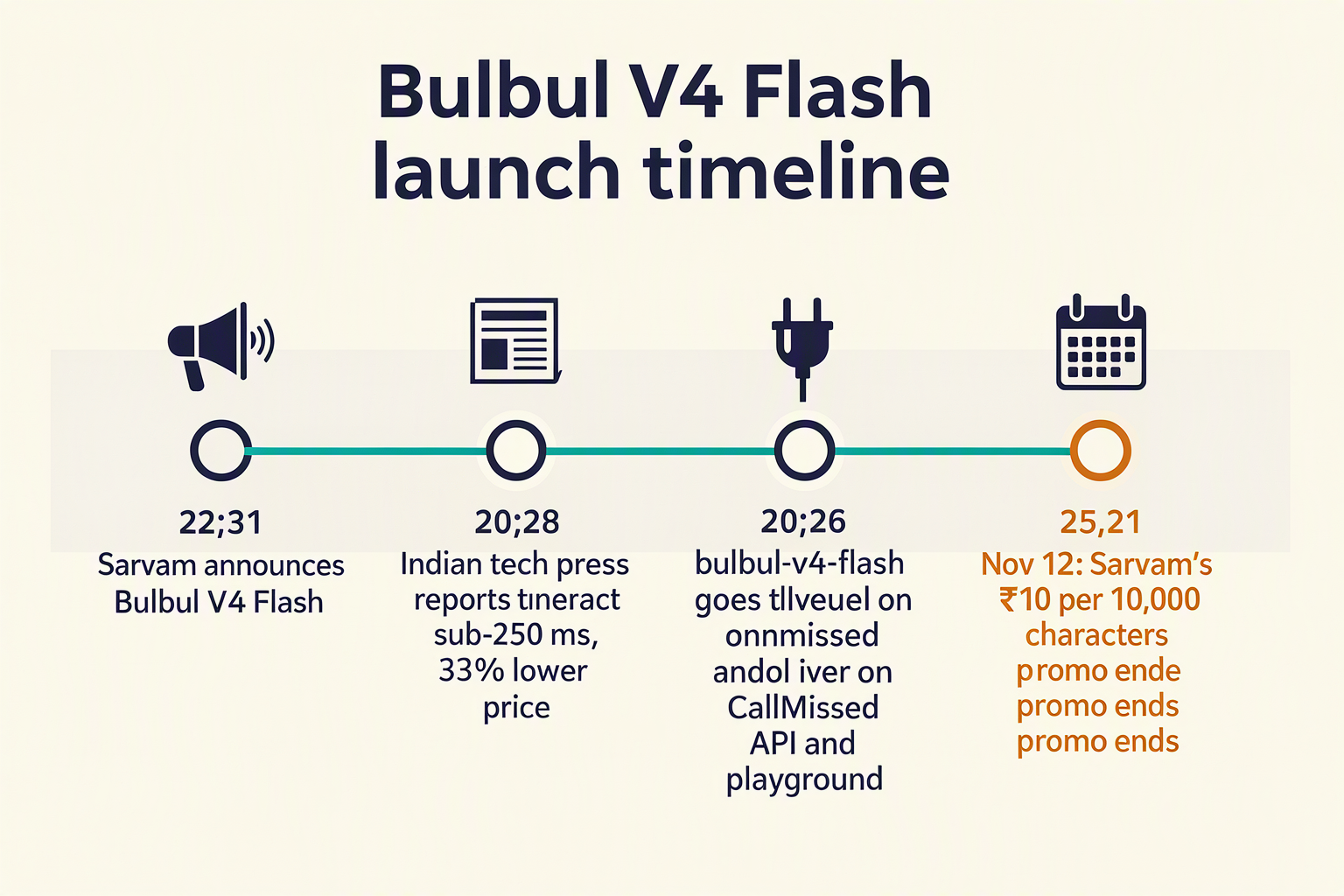
Sarvam AI announced Bulbul V4 Flash in the weeks before October 14, 2026, and the model is now available on the CallMissed API as bulbul:v4-flash. The coverage we reviewed does not state one exact launch date, so the table below uses only dates the sources confirm. It marks everything else as undated.
Bulbul V4 Flash timeline (as of October 14, 2026)
| Milestone | Date | What happened | Source |
|---|---|---|---|
| Sarvam announces the model | Recent (exact date not stated in coverage) | Sarvam introduced Bulbul V4 Flash on X as a text-to-speech model built for natural, expressive speech across Indian languages | Sarvam on X |
| Trade press reports specs | Following the announcement | Under 250 ms time-to-first-audio, 11 languages, 83 voices | Analytics India Magazine, AlphaSignal |
| Standard pricing published | At launch | ₹20 per 10,000 characters, positioned as up to 40% faster and 33% cheaper than the predecessor | CIOL, Economic Times |
| Half-price promotion runs | Now through November 12, 2026 | ₹10 per 10,000 characters, half the standard rate | RuntimeWire |
| Available on CallMissed API | October 14, 2026 | bulbul:v4-flash listed among the platform's 10 text-to-speech models | CallMissed |
| Promotion window closes | November 12, 2026 | Sarvam's listed rate returns to ₹20 per 10,000 characters | RuntimeWire |
How long does the promotional price last?
The half-price offer ends on November 12, 2026, which is 29 days from today. RuntimeWire reports that Sarvam is offering the model at ₹10 per 10,000 characters through that date. On that rate, a 200-character reply costs roughly ₹0.20 instead of the ₹0.40 at the standard price.
Confirm what you will be charged for bulbul:v4-flash on the CallMissed pricing page before budgeting. Sarvam's own price is a useful benchmark, but the rate on your CallMissed balance is what you actually pay.
What should you do before November 12?
If you are evaluating the model for a voice product, use the window to test it under realistic conditions:
- Run a language bake-off. Generate the same script in the Indian languages you serve and compare pronunciation, especially for names, numbers and code-mixed phrases.
- Measure time-to-first-audio yourself. Sarvam's sub-250 ms figure is a vendor-reported benchmark. Your network path and region will change what you see.
- Compare against your current voice. CallMissed exposes several text-to-speech models behind one API key, so you can swap the model ID without rewriting your integration.
- Model your unit economics at the standard rate. Assume ₹20 per 10,000 characters, not the promotional price, so your estimates hold after November 12.
What does this timeline tell us about the market?
Indian-language speech synthesis is moving from "available" to "optimized for real time." The pattern is a smaller distilled model, lower price and tighter latency, which Sarvam has now shipped as one package. Platforms like CallMissed, the OpenAI-compatible AI gateway, shorten the gap between a model's release and a developer's first test call. The listing arrived within the same period as the model's coverage, not months later.
This is a fast-moving area. Pricing, voice counts and language support can change, so verify them against Sarvam's documentation and CallMissed's pricing page when you build.
Frequently Asked Questions
What is Bulbul V4 Flash?
How fast is Bulbul V4 Flash?
How much does Bulbul V4 Flash cost?
Which languages does the Bulbul V4 Flash model support?
How do I use bulbul:v4-flash on the CallMissed API?
bulbul:v4-flash on the speech endpoint. CallMissed is OpenAI-compatible, so you change the base URL and credentials rather than rewriting your integration. New accounts get 1,000 free credits on signup, enough to test voices before you commit, and the endpoint reference is at docs.callmissed.com.Can I use Bulbul V4 Flash in a voice agent or on WhatsApp calls?
Conclusion
Bulbul V4 Flash shows where Indian voice AI is heading: faster, cheaper and more regional. As of October 14, 2026, these are the takeaways:
- Speed: Sarvam AI's model delivers under 250 ms time-to-first-audio, according to Analytics India Magazine, and is up to 40% faster than its predecessor, according to CIOL.
- Coverage: AlphaSignal reports 83 voices across 11 languages.
- Price: The standard rate is ₹20 per 10,000 characters, about ₹0.40 for a 200-character reply. RuntimeWire reports it is halved to ₹10 through November 12.
- Access:
bulbul:v4-flashis available on the CallMissed API with the same key and credit balance as the platform's other models.
What to watch next: Check whether pricing holds once the November 12 promotion ends. Also watch how the voices perform in live, high-volume calls rather than demos, and whether other model makers answer with distilled, low-latency TTS of their own. Competition on speed and cost should benefit anyone building for regional-language callers.
To explore how AI communication is evolving, check out CallMissed, an AI infrastructure platform powering voice agents and multilingual chatbots for businesses.
So when the pause finally disappears from your voice agent, what will your callers hear instead?
Related Reading
- Claude Haiku 5.5 Now on CallMissed: Price, 1M Context, API
- GPT-6 Sol API on CallMissed: Model ID and Examples
- Claude Opus 5.5 vs Gemini 3.8 Flash: API Buyer Guide