Claude Fable 5.5 vs Bulbul V4 Flash: Voice AI Guide



Claude Fable 5.5 vs Bulbul V4 Flash explains release status, model roles, latency, languages, pricing, streaming, and voice-agent design.
Claude Fable 5.5 vs Bulbul V4 Flash: Voice AI Guide
How can two AI models be “rivals” when one has not been officially announced and the other solves an entirely different layer of the voice stack? Claude Fable 5.5 vs Bulbul V4 Flash is not a conventional model showdown: Claude Fable 5.5 is currently an unconfirmed general-purpose large language model, while Bulbul V4 Flash is a launched text-to-speech (TTS) model built to turn text into spoken audio.
As of October 14, 2026, Anthropic has not announced Claude Fable 5.5 or published official specifications, pricing, API availability or voice benchmarks for it. Anthropic’s official Claude Fable page still identifies Claude Fable 5.1 as its most capable model for coding and knowledge work, while Emergent reported on October 5, 2026 that Fable 5.1 remained the newest documented Fable release.
The rumor cycle is moving faster than vendor confirmation. OrcaRouter reported that Anthropic’s newest model announcement was Claude Haiku 5.5 on October 7, 2026, even as an October 13 X post claimed Fable 5.5 was imminent; Medium separately reported that a claude-fable-5-5 identifier appeared in Microsoft Azure’s East US 2 catalogue on October 13. A catalogue entry is evidence worth monitoring, not a substitute for Anthropic release notes, model cards or reproducible API tests.
What should voice-AI builders compare?
A production voice agent typically needs separate components for reasoning, speech recognition, orchestration and speech synthesis. A future Claude Fable 5.5 could theoretically handle the reasoning layer—interpreting intent, choosing tools and drafting a response—whereas Bulbul V4 Flash handles the output layer, converting that response into speech. The useful questions are therefore not “Which model wins?” but:
- Compatibility: Can each component fit your API, streaming and tool-calling architecture?
- Responsiveness: How do time to first token and time to first audio affect turn-taking?
- Voice quality: Does the TTS model deliver the language coverage, pronunciation, expressiveness and cost your callers require?
Platforms such as CallMissed, an OpenAI-compatible AI gateway, illustrate this modular direction: as of October 2026, its developer API provides one key and one balance across 140 models, including 45 general-purpose LLMs, 45 speech-to-text models and 10 text-to-speech models.
This guide will separate verified facts from rumor, map both models to the correct voice-AI layers, and show what to benchmark before shipping. You will leave with an evaluation framework for latency, quality, language fit, risk and cost—without pretending an unannounced LLM can be tested head-to-head against a released TTS system.
Are Claude Fable 5.5 and Bulbul V4 Flash direct competitors? No—here is the key distinction
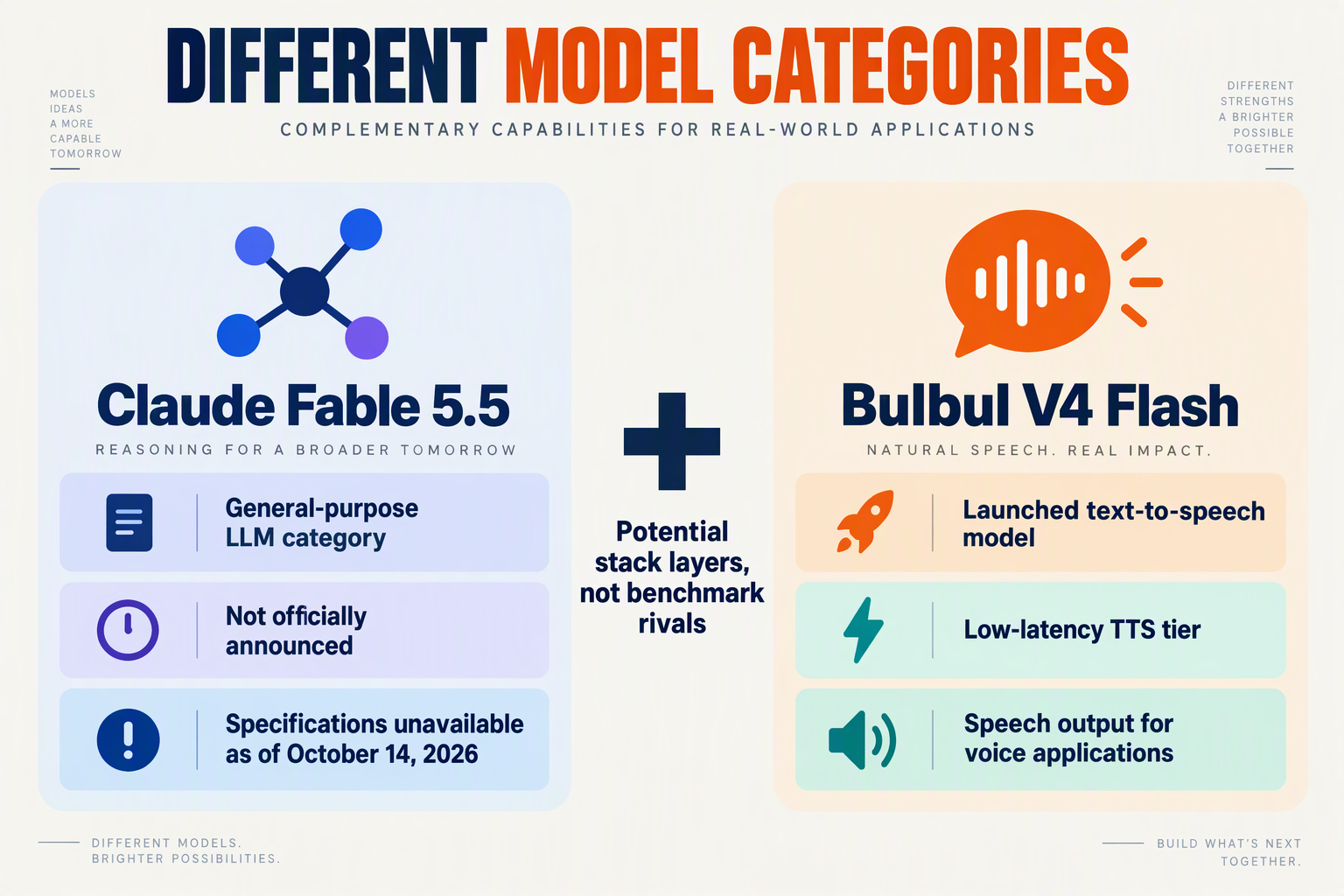
No. Claude Fable 5.5 and Bulbul V4 Flash are not direct competitors because they belong to different model categories and would perform different jobs inside a voice-AI system. Treating them as interchangeable is a category error: the rumored Claude model would generate or reason over text, while Bulbul V4 Flash synthesizes text into audio.
What type of model is Claude Fable 5.5?
Claude Fable 5.5 is best described as an unconfirmed general-purpose large language model (LLM) until Anthropic publishes an announcement, model card and API documentation. If released, its likely relevance to voice AI would be upstream of speech generation.
An LLM in a voice agent commonly handles:
- Interpreting a caller’s intent from a transcript
- Retrieving information from a knowledge base
- Deciding whether to invoke an API or business tool
- Producing a structured response or natural-language reply
- Maintaining context across multiple conversational turns
However, builders cannot yet assume that Claude Fable 5.5 will support particular context windows, tool-calling formats, streaming behavior, prices or rate limits. Emergent reported on October 5, 2026 that Anthropic had not announced Claude Fable 5.5 and still documented Claude Fable 5.1 as the newest Fable release.
The reported claude-fable-5-5 Azure catalogue identifier is a useful release signal, but it does not provide the evidence required for production evaluation. A model name in cloud metadata cannot establish response quality, availability across regions or compatibility with Anthropic’s public API.
What type of model is Bulbul V4 Flash?
Bulbul V4 Flash is a launched text-to-speech model. Its role is to accept text—potentially written by an LLM—and render that text as audible speech.
A TTS model should be evaluated on output-specific criteria such as:
- Time to first audio: How quickly playback can begin
- Streaming continuity: Whether speech arrives smoothly without gaps
- Pronunciation: How reliably it handles names, numbers and domain terms
- Prosody: Whether emphasis, rhythm and pauses sound appropriate
- Language fit: Whether the available voices match callers’ languages and accents
- Synthesis cost: The price per character, second or generated audio unit
Bulbul V4 Flash does not replace the reasoning model. Likewise, an LLM does not automatically provide production-quality speech synthesis merely because it can compose the words to be spoken.
Where does each model sit in the voice-AI pipeline?
A simplified voice-agent turn contains four distinct stages:
- Speech recognition converts the caller’s audio into text.
- The LLM interprets the request, chooses tools and drafts an answer.
- Orchestration manages state, interruptions, safety rules and API calls.
- TTS converts the final answer into streamed audio.
Under this architecture, a future Claude Fable 5.5 would potentially occupy stage two, while Bulbul V4 Flash occupies stage four. They could therefore be complementary components in the same system, not alternatives competing for one deployment slot.
What comparison is actually valid?
Voice-AI builders should compare Claude Fable 5.5—if officially released—with other reasoning models on accuracy, tool use, token latency and cost. Bulbul V4 Flash should be compared with other TTS models on voice quality, language coverage, first-audio latency and synthesis economics.
The meaningful system-level question is not “Which model wins?” It is “Does this LLM–TTS combination produce accurate, natural and responsive conversations under real call conditions?”
What background and release context should voice-AI builders understand?
Voice-AI builders should treat Claude Fable 5.5 as a watch-list model and Bulbul V4 Flash as an available TTS component as of October 14, 2026. The release context matters because one model cannot yet support evidence-based procurement or benchmarking, while the other can be evaluated in the speech-synthesis stage of a working voice pipeline.
What is the Claude Fable 5.5 release timeline?
The strongest public signal for Claude Fable 5.5 is a reported cloud-catalogue entry—not an Anthropic launch. The following chronology separates official events from third-party observations:
- September 2026: Anthropic expanded the Claude 5.5 generation with other model families. Hidekazu Konishi’s Claude timeline records Claude Sonnet 5.5 on September 28, 2026.
- October 5, 2026: Emergent reported that no Claude Fable 5.5 release date existed and that Claude Fable 5.1 remained the newest documented Fable model.
- October 7, 2026: Anthropic announced Claude Haiku 5.5, according to OrcaRouter’s review of the company’s official announcement surfaces.
- October 13, 2026: Medium reported that the identifier
claude-fable-5-5appeared in Microsoft Azure’s East US 2 catalogue with aGenerallyAvailablelifecycle label. - October 14, 2026: There is still no cited Anthropic model card, API documentation, price, context-window specification or benchmark package for Claude Fable 5.5.
This sequence suggests possible release preparation, but neighbouring 5.5 launches do not prove that every Claude family has shipped at the same version. OmniaKey made the same distinction on October 1, 2026: releases of other Claude 5.5 models did not establish a Fable 5.5 launch or specification.
Why is a cloud-catalogue listing not enough?
A catalogue record can precede documentation, reflect staged regional deployment or expose metadata before customers receive dependable access. Even a GenerallyAvailable label should not override the primary vendor’s release notes.
Before classifying Claude Fable 5.5 as production-ready, voice-AI teams should require:
- An official Anthropic model identifier and supported API endpoints
- Published pricing, rate limits and regional availability
- Documentation for streaming, tool use and structured output
- A versioned model card and safety guidance
- Reproducible measurements for time to first token, output quality and failure rates
Until these exist, architecture diagrams should label Fable 5.5 as a prospective reasoning option rather than a committed dependency.
What does Bulbul V4 Flash’s launched status change?
Bulbul V4 Flash’s launched status means builders can move from release speculation to TTS testing. The relevant evidence is generated audio: time to first audio, real-time factor, pronunciation, code-mixed language handling, interruptions, emotional consistency and cost per generated minute or character.
That does not automatically make Bulbul V4 Flash suitable for every deployment. Teams still need to verify its current API contract, language support, commercial terms, streaming behaviour and regional availability from official documentation as of October 2026.
How should builders protect a voice stack from release uncertainty?
Use replaceable interfaces between the LLM, speech recognition and TTS layers. CallMissed’s developer AI API, for example, exposes OpenAI-compatible endpoints and one balance across 140 models as of October 2026, including 45 general-purpose LLMs and 10 TTS models; it also supports caller-selected fallbacks.
The practical rule is simple: benchmark Bulbul V4 Flash now, but create no Fable 5.5 performance claims until Anthropic publishes and exposes a testable model.
Which key developments are confirmed, reported, or still unknown?
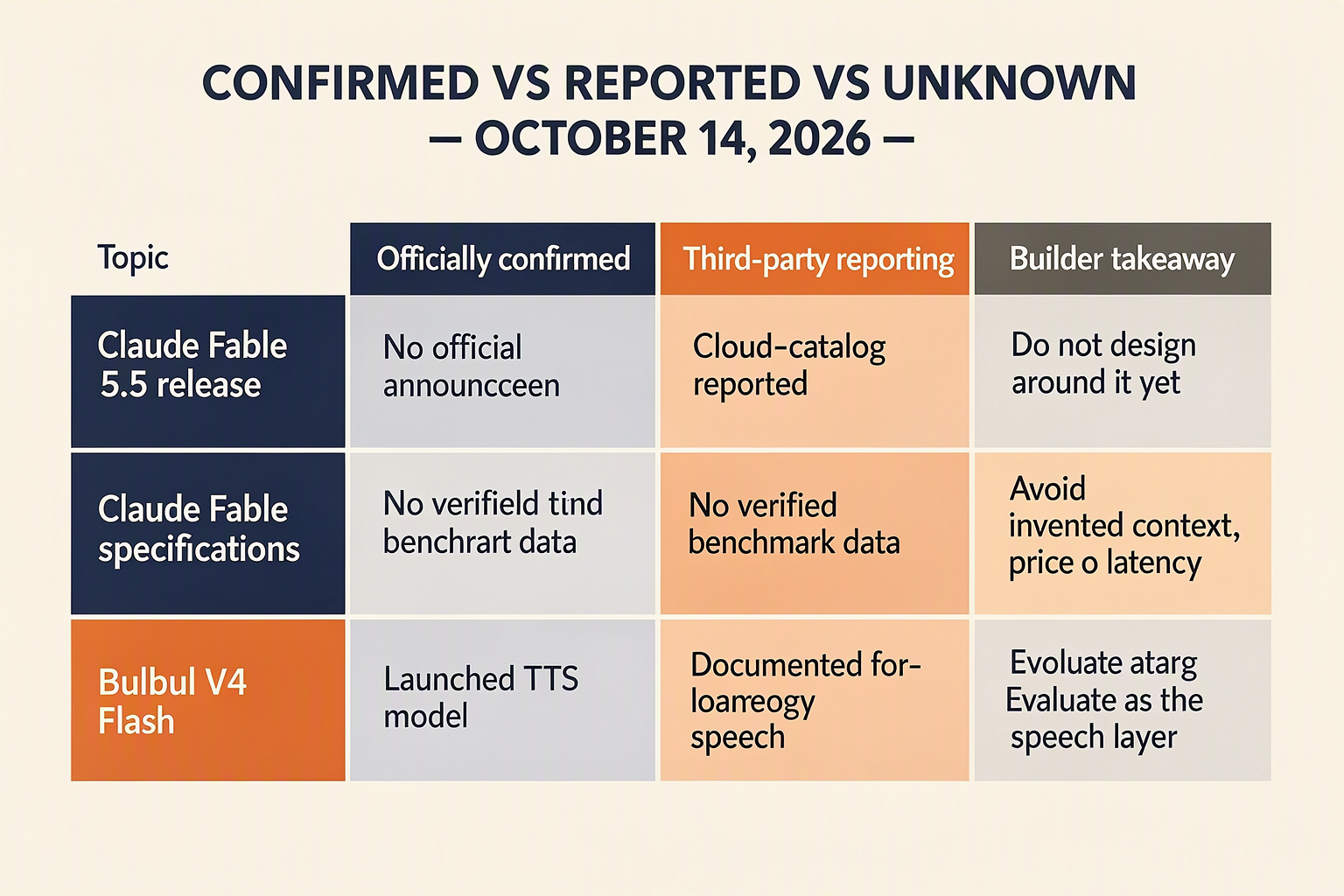
The evidence supports one firm conclusion as of October 14, 2026: Bulbul V4 Flash is available as a text-to-speech model, while Claude Fable 5.5 remains unannounced by Anthropic. Reports of a cloud-catalogue identifier may indicate launch preparation, but they do not confirm production access, specifications or suitability for voice agents.
What is confirmed about Claude Fable 5.5 and Bulbul V4 Flash?
| Development or claim | Status as of Oct. 14, 2026 | Supporting evidence | Voice-AI implication |
|---|---|---|---|
| Bulbul V4 Flash is a launched TTS model | Confirmed at product-category level | Bulbul V4 Flash converts text responses into spoken audio | Builders can evaluate it in the speech-output layer rather than as a reasoning model |
| Claude Fable 5.5 has launched publicly | Not confirmed | Anthropic has published no Fable 5.5 announcement, model card or official API documentation | Do not design production dependencies around it yet |
| Claude Fable 5.1 remains officially documented | Confirmed | Anthropic’s Claude Fable page calls Fable 5.1 its “most capable model for coding and knowledge work” | Fable 5.1 is the defensible baseline for current architecture comparisons |
claude-fable-5-5 appeared in Azure | Reported, not vendor-confirmed | Medium reported on October 13, 2026 that the identifier appeared with a GenerallyAvailable lifecycle status in Azure East US 2 | Catalogue metadata is a signal to monitor, not proof of working endpoints or broad availability |
| A Fable 5.5 announcement was imminent | Rumor | OrcaRouter documented an October 13, 2026 X post repeating a “this week” claim | Avoid treating social posts as release schedules |
| Fable 5.5 pricing, context window and latency | Unknown | Anthropic has not published official specifications or pricing | Cost-per-turn and end-to-end latency comparisons cannot yet be calculated |
Why does the Azure listing not prove general availability?
A cloud catalogue can expose metadata before customers receive usable access—or retain entries whose deployment conditions differ by account, contract or region. Medium reported one Claude Fable 5.5 identifier in one Azure region, East US 2, on October 13, 2026, but that report did not establish reproducible API access across regions.
A credible release should be visible across several first-party surfaces:
- An Anthropic announcement or release note
- An official model card and safety documentation
- A documented API model identifier
- Published pricing and rate limits
- Reproducible requests through supported platforms
The absence of those artifacts matters more than the presence of a single catalogue record. OrcaRouter reported that Anthropic’s latest official model announcement was Claude Haiku 5.5 on October 7, 2026, which further separates documented releases from Fable 5.5 speculation.
Which specifications are still needed for a useful voice-AI comparison?
Voice-AI builders should wait for measurable Fable 5.5 data rather than extrapolating from its name. The essential unknowns include:
- Time to first token, output-token speed and streaming behavior
- Tool calling, structured-output reliability and interruption handling
- Context-window size, prompt-caching support and API pricing
- Availability through Anthropic, Microsoft Azure or other providers
- Performance under conversational workloads rather than coding-only benchmarks
Bulbul V4 Flash requires a different evidence set: time to first audio, real-time factor, streaming support, pronunciation accuracy, language coverage, voice controls and price per generated unit. Until both vendors publish and expose these measurements, “Claude Fable 5.5 vs Bulbul V4 Flash” should be treated as an architectural comparison—not a benchmark result or winner declaration.
How would a reasoning LLM and Bulbul V4 Flash work together in a multilingual phone agent?
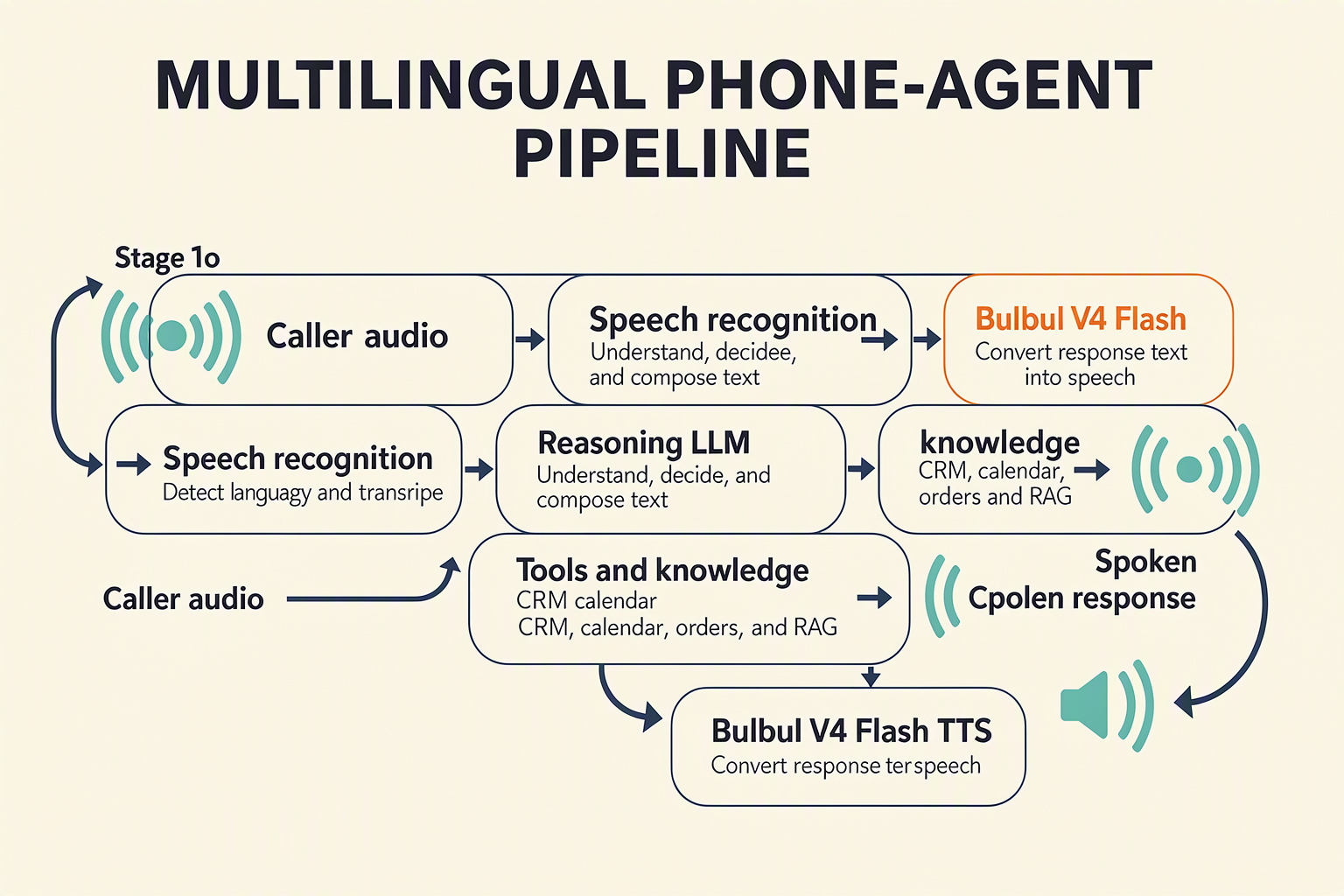
A reasoning LLM and Bulbul V4 Flash would work as complementary layers: the LLM would interpret the caller, select tools and compose an answer, while Bulbul V4 Flash would synthesize that answer as speech. Because Claude Fable 5.5 remains unannounced as of October 14, 2026, builders should implement the reasoning layer behind a replaceable interface rather than designing production systems around presumed capabilities.
What does the end-to-end multilingual call flow look like?
A practical phone agent needs at least four stages, not just an LLM and a text-to-speech model:
- Speech recognition: Streaming speech-to-text converts the caller’s audio into text while identifying the spoken language or code-mixed phrases.
- Reasoning and orchestration: A currently available LLM—or a future Claude Fable 5.5—interprets intent, checks conversation context and decides whether to call a CRM, calendar or order-status tool.
- Response preparation: The orchestration layer converts the model’s answer into speakable text, expanding abbreviations and formatting dates, prices or identifiers for natural pronunciation.
- Speech synthesis: Bulbul V4 Flash turns the final text into audio that is streamed back over the telephone connection.
For example, a caller might say, “Mera order kal deliver hoga?” The speech recognizer produces a Hinglish transcript, the LLM identifies an order-delivery question, and a tool retrieves the shipment status. The LLM could then draft “Haan, aapka order kal shaam tak deliver hona chahiye,” which Bulbul V4 Flash renders as spoken audio.
How should the models exchange multilingual content?
The safest contract between the reasoning model and TTS layer is structured output, not unrestricted prose. A production response object could contain:
spoken_text: text prepared specifically for synthesislanguage: a BCP 47 tag such ashi-INoren-INvoice_id: the selected Bulbul voicestyle: neutral, reassuring or urgent, where supportedshould_interrupt: whether the agent may respond before the caller fully finishestool_status: success, unavailable or awaiting confirmation
This separation prevents internal reasoning, tool syntax and unsupported markup from reaching the caller. It also lets the application switch languages mid-call without asking the LLM to generate audio itself.
Platforms serving India must test code-switching, names, addresses, currency and English technical terms embedded in regional-language sentences. As of October 2026, CallMissed supports speech recognition in 22 Indian languages plus English, including Hinglish, and natural text-to-speech voices in 10 Indian languages plus English. Its modular voice-agent stack can therefore illustrate how speech recognition, reasoning and synthesis remain independently replaceable.
Where does latency accumulate in this architecture?
Builders should measure the whole conversational turn rather than attributing responsiveness to one model. The critical path includes:
- End-of-speech detection
- Final speech-to-text output
- LLM time to first useful token
- External tool execution
- Bulbul V4 Flash time to first audio
- Telephony buffering and playback
Streaming can overlap these stages. The application can send complete clauses to Bulbul V4 Flash while the LLM continues generating, but premature synthesis creates a risk: later tokens may change a date, amount or conclusion.
Anthropic’s official Claude page still names Claude Fable 5.1 as its most capable model for coding and knowledge work as of October 14, 2026, while Emergent reported on October 5, 2026 that Fable 5.1 remained the newest documented Fable release. Until Anthropic publishes Fable 5.5 API details, builders should benchmark Bulbul V4 Flash with an available reasoning model and preserve a vendor-neutral boundary for future substitution.
How do latency, 11-language coverage, streaming, and price affect the design?
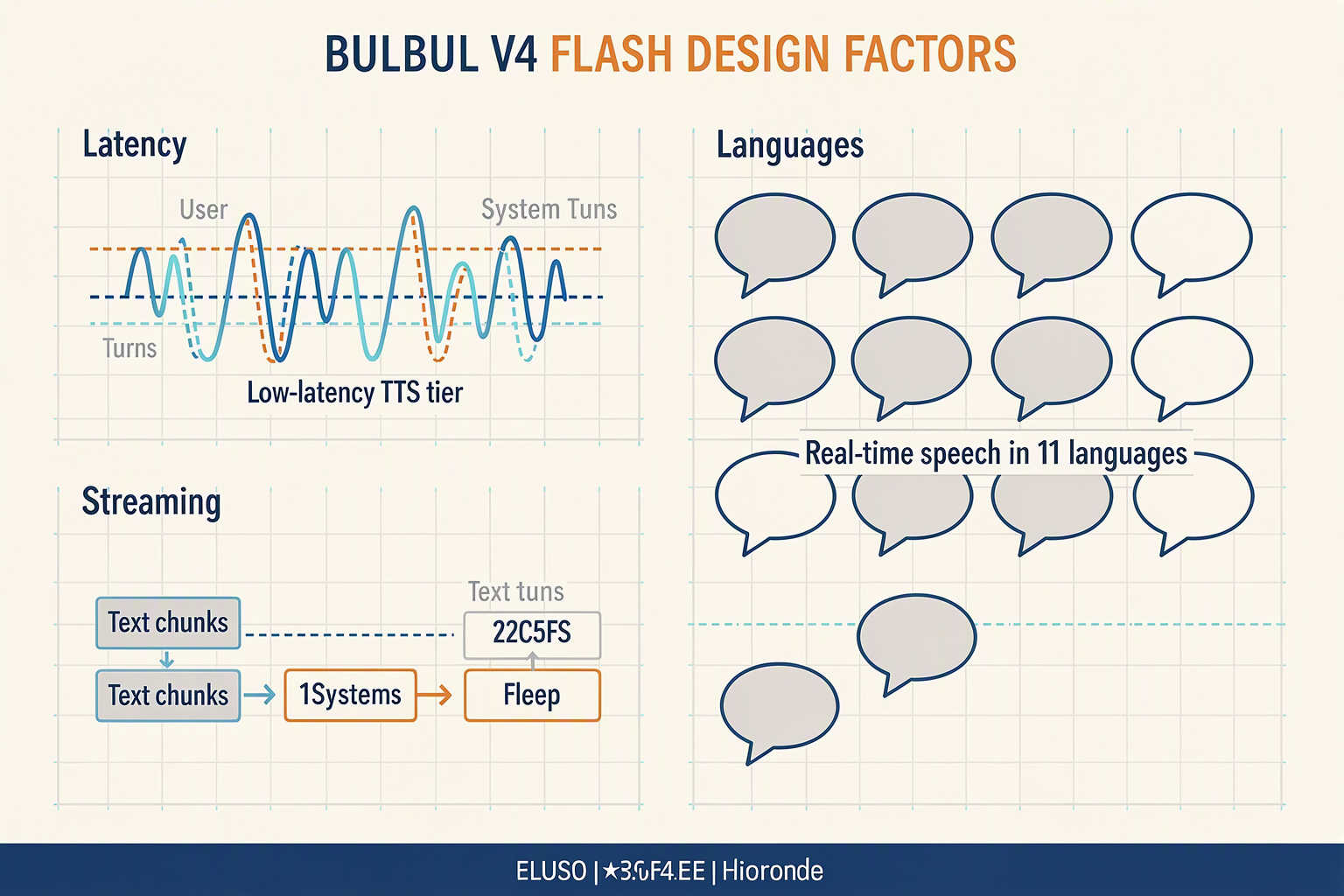
Latency, language coverage, streaming and price determine whether a voice agent feels conversational and remains economical at scale. Bulbul V4 Flash can be evaluated at the speech-output layer on these dimensions, while Claude Fable 5.5 cannot receive a credible score until Anthropic publishes an API, model card and pricing.
How should voice-AI builders measure end-to-end latency?
Do not treat one vendor latency claim as the complete response time. A voice agent’s mouth-to-ear latency is the sum of several stages:
- Endpoint detection after the caller stops speaking
- Speech-to-text processing
- LLM time to first token
- Text-to-speech time to first audio
- Network, telephony and playback buffering
For example, a fast TTS model cannot compensate for an LLM that waits several seconds before producing usable text. Conversely, a reasoning model that streams tokens quickly still feels slow if speech synthesis waits for the full response.
Benchmark Bulbul V4 Flash using p50, p95 and p99 time to first audio, not an isolated best-case result. Run at least three input classes—short acknowledgements, typical support answers and long explanations—and test from the same region and network path used in production.
No equivalent Fable 5.5 measurement is currently defensible. As of October 14, 2026, Anthropic’s Claude Fable page identifies Claude Fable 5.1—not Fable 5.5—as its most capable model for coding and knowledge work. Emergent likewise reported on October 5, 2026 that Fable 5.1 remained the newest documented Fable release.
What does 11-language coverage mean in practice?
Bulbul V4 Flash’s stated 11-language coverage can reduce the need to operate separate TTS providers, but a language count is only a screening criterion. Voice-AI builders should test:
- Regional names, addresses, dates and currency expressions
- Code-switching, such as Hindi and English within one sentence
- Numerals, abbreviations and product terminology
- Pronunciation consistency across multiple voices
- Prosody for questions, apologies, confirmations and warnings
A supported-language label does not guarantee equal quality across languages. Use native-speaker ratings for intelligibility, naturalness and pronunciation, then segment the results by language rather than averaging them into one score.
For comparison, CallMissed supports natural text-to-speech voices in 10 Indian languages plus English as of October 2026, while its speech recognition layer separately covers 22 Indian languages plus English, including code-mixed speech such as Hinglish. The distinction matters: input-language coverage and output-language coverage are different architectural decisions.
Why does streaming matter for natural turn-taking?
Streaming TTS should begin speaking from partial LLM output instead of waiting for the complete answer. This reduces perceived delay, but it introduces three design risks:
- The LLM may revise a sentence after audio has already played.
- Short chunks can produce unnatural rhythm or incorrect pronunciation.
- Aggressive buffering may cause gaps when token generation slows.
Use sentence-aware chunking, retain a small punctuation buffer and allow interruption when the caller starts speaking. Also measure audio-start stability under concurrent load, not merely whether a streaming endpoint exists.
How should teams compare price?
Compare cost per completed conversation, not headline token or character rates. The calculation should include:
STT cost + LLM input/output cost + TTS character or audio cost + telephony + retries and fallbacks.
Bulbul V4 Flash pricing should therefore be modelled against each conversation’s synthesized character count. Claude Fable 5.5 has no confirmed public price as of October 14, 2026, so inserting an assumed rate would create a misleading total-cost estimate. Keep the reasoning-model variable blank until Anthropic publishes official pricing, then rerun the same workload with cached prompts, short answers and realistic concurrency.
How should builders orchestrate interruptions, timeouts, and model fallbacks?
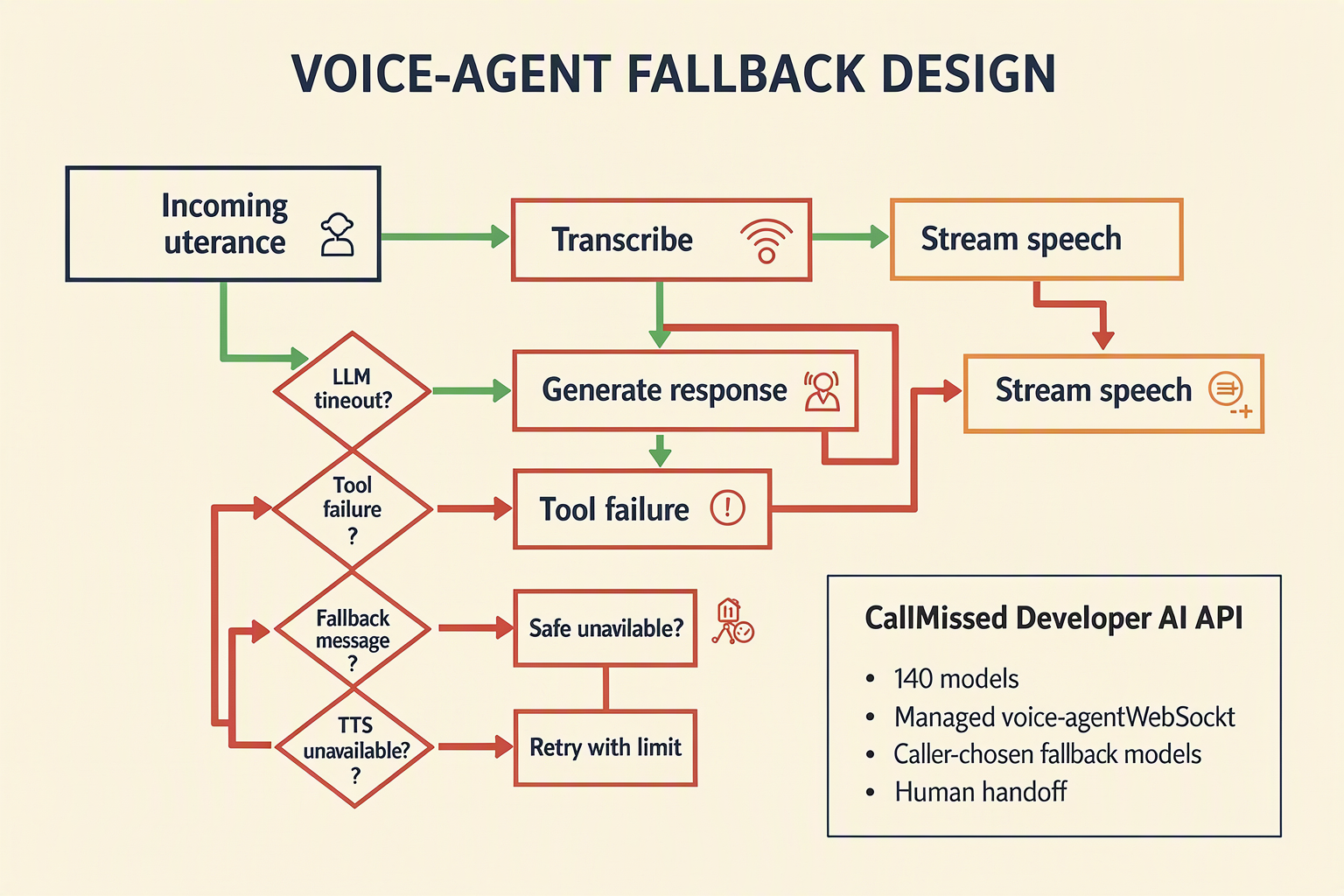
Voice-AI builders should treat interruptions, timeouts and fallbacks as orchestration policies, not capabilities delegated to Claude Fable 5.5 or Bulbul V4 Flash. The controller must independently cancel speech, preserve conversation state and replace a failed component with another model from the same category.
How should a voice agent handle interruptions?
Use a turn-taking state machine rather than a single “speaking” flag. A practical sequence is listening → transcribing → reasoning → synthesizing → speaking, with transitions that can be cancelled independently.
When the caller begins speaking over Bulbul V4 Flash audio, the orchestrator should:
- Detect sustained voice activity rather than reacting to a cough or background noise.
- Stop audio playback immediately and cancel any queued TTS chunks.
- Cancel LLM generation if the unfinished response is no longer useful.
- Preserve only the text the caller actually heard—not the entire generated answer.
- Feed the interruption and confirmed transcript into the next reasoning turn.
This distinction prevents an LLM from assuming that information was communicated when the caller interrupted before hearing it. For tool calls, use idempotency keys and explicit execution states so cancellation does not accidentally place an order, book an appointment or issue a refund twice.
What timeout strategy works for real-time voice AI?
Apply separate deadlines to each stage because one global timeout cannot identify whether speech recognition, reasoning, a business tool or TTS caused the delay. The following values are starting points for testing, not published Claude Fable 5.5 or Bulbul V4 Flash benchmarks:
- End-of-turn detection: Experiment with roughly 400–800 milliseconds of silence, adjusted for language and speaking style.
- First LLM token: At 1–2 seconds, play a brief acknowledgement if appropriate; at 4–6 seconds, trigger a faster reasoning fallback.
- External tool call: Set a service-specific deadline, commonly 3–8 seconds, and tell the caller when work is still in progress.
- First TTS audio: If synthesis misses its latency budget, switch voices or TTS providers instead of leaving dead air.
- Whole turn: Cap the interaction and recover with a concise clarification or human handoff.
Avoid repeated fillers such as “one moment” unless the system has made measurable progress. Silence recovery should be deterministic: acknowledge the delay once, retry within a fixed budget and then degrade gracefully.
How should model fallbacks be designed?
Fallbacks must respect model roles. A TTS failure should fall back to another TTS model; an LLM failure should fall back to another reasoning model. Bulbul V4 Flash cannot replace a general-purpose LLM, and a future Claude Fable 5.5 should not be presumed to replace speech synthesis.
Build ordered fallback routes around:
- availability and rate-limit errors;
- time-to-first-token or time-to-first-audio thresholds;
- language and voice compatibility;
- tool-calling and structured-output requirements;
- safety policies and maximum cost per completed turn.
As of October 14, 2026, Anthropic still provides no official Claude Fable 5.5 API specification, while Emergent reported on October 5, 2026 that Claude Fable 5.1 remained the newest documented Fable release. Therefore, builders should route production traffic through verified model IDs and place any future Fable 5.5 integration behind a feature flag.
CallMissed’s developer AI API, for example, supports caller-chosen fallback models, streaming and function calling across 140 models as of October 2026. Whatever gateway is used, log every timeout, cancellation, fallback reason and heard-audio boundary; those traces reveal whether failures originate in recognition, reasoning, tools, synthesis or network transport.
What are the practical implications of comparing model roles instead of benchmark scores?
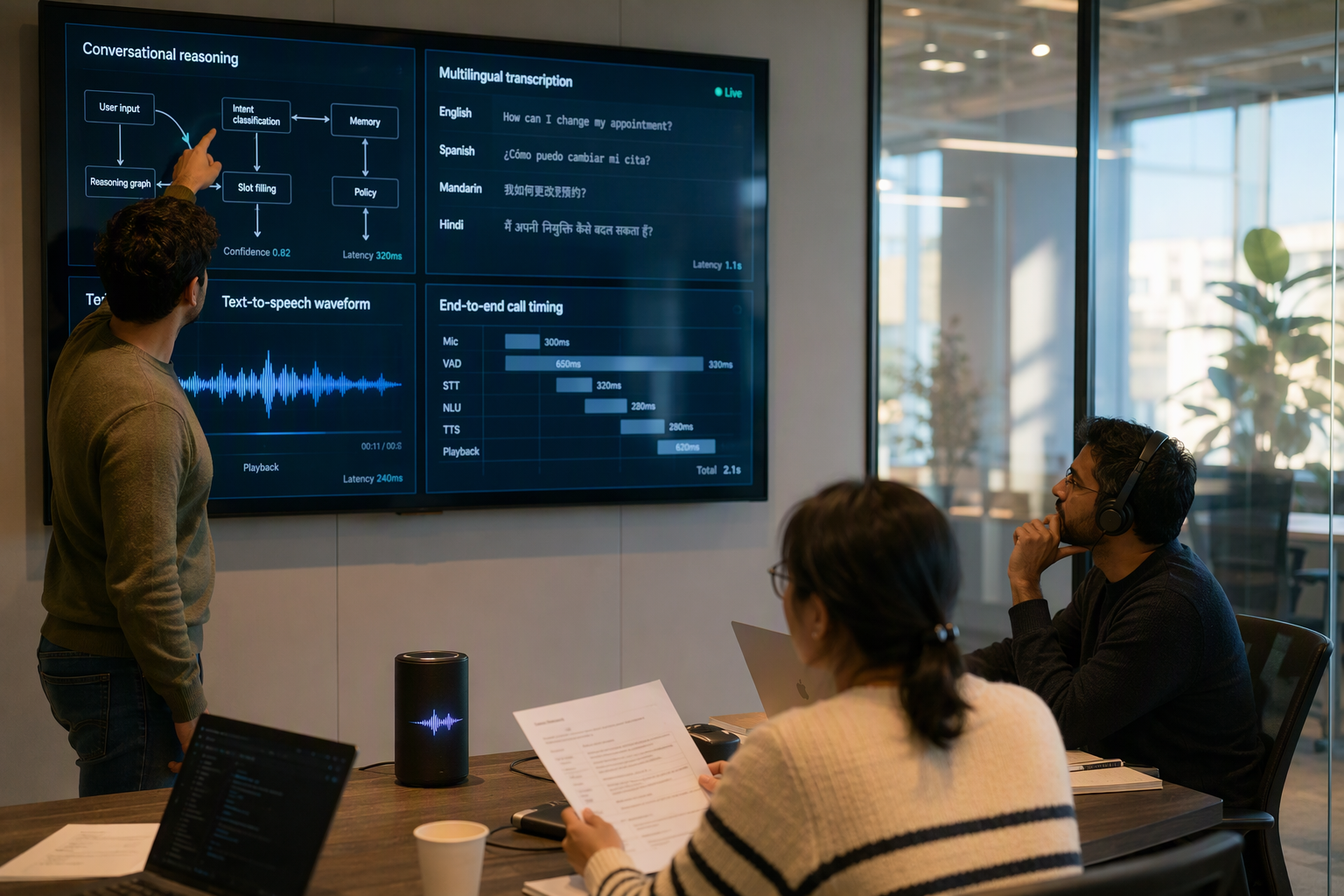
Comparing model roles instead of benchmark scores leads to better architecture, testing and procurement decisions. For voice-AI builders, the practical question is whether each component performs its assigned job reliably—not whether an LLM’s reasoning score is numerically higher than a TTS model’s speech-quality score.
Which benchmarks should voice-AI builders use for each model role?
Apply role-specific evaluation criteria because general-purpose large language models and text-to-speech models produce fundamentally different outputs.
For a future Claude Fable 5.5 reasoning layer, evaluate:
- Task completion: Did the agent correctly resolve the caller’s request?
- Tool selection: Did it choose the right API and construct valid arguments?
- Instruction adherence: Did it follow policy, workflow and escalation rules?
- Time to first token: How quickly could downstream speech synthesis begin?
- Reliability: How often did responses require retries, fallbacks or human intervention?
For Bulbul V4 Flash’s TTS layer, evaluate:
- Time to first audio: How long did the caller wait before hearing speech?
- Pronunciation accuracy: Were names, numbers, currencies and domain terms spoken correctly?
- Naturalness and intelligibility: Could listeners understand the voice without extra effort?
- Prosody: Did emphasis, pauses and emotion fit the conversation?
- Audio cost: What did synthesis cost per character, second or completed call?
An LLM coding benchmark cannot establish voice naturalness, while a TTS listening score cannot demonstrate reasoning or tool-use accuracy. Placing both on one leaderboard would create a false sense of precision.
How does role-based comparison change voice-agent architecture?
It encourages a modular voice pipeline in which components can be measured and replaced independently. A typical turn follows four stages:
- Speech recognition converts the caller’s audio into text.
- An LLM interprets intent, retrieves information and selects tools.
- An orchestration layer validates the response and manages interruptions.
- A TTS model such as Bulbul V4 Flash converts approved text into audio.
This separation makes failures diagnosable. If an order number is misunderstood, inspect speech recognition; if the wrong order is retrieved, inspect reasoning and tool use; if the answer sounds robotic or mispronounces a name, inspect TTS.
As of October 2026, CallMissed’s developer AI API reflects this component-based approach by offering one key and balance for 140 models: 45 general-purpose LLMs, 45 speech-to-text models, 10 text-to-speech models, 24 realtime voice-agent models, 14 image models and two embedding models. The practical advantage is experimentation across model roles without treating every model as interchangeable.
Why should teams test complete conversations rather than isolated scores?
Users experience end-to-end conversation quality, not individual benchmark results. A highly capable reasoning model can still produce a poor call if slow response generation creates awkward silence, while fast TTS cannot repair an incorrect answer.
Run scripted and unscripted calls that include:
- Interruptions and rapid turn-taking
- Names, addresses, dates and alphanumeric identifiers
- Code-mixed or accented speech
- Tool failures and delayed API responses
- Escalation to a human
- Long answers that should be shortened before synthesis
Measure task success, total response latency, interruption recovery and cost per resolved conversation. These composite metrics reveal interactions hidden by model-level leaderboards.
How should an unannounced model affect procurement decisions?
Treat Claude Fable 5.5 as a watchlist candidate, not a production dependency. Anthropic’s official Claude Fable page still presented Fable 5.1 as its documented model as of October 14, 2026, while OrcaRouter reported that Anthropic’s latest official model announcement was Claude Haiku 5.5 on October 7, 2026.
Until Anthropic publishes availability, pricing and technical documentation, builders cannot calculate Claude Fable 5.5’s production cost or validate its latency. Benchmark the launched components available now, preserve replaceable interfaces, and add any future model only after it passes the same role-specific acceptance tests.
What do official sources and independent release trackers actually establish?
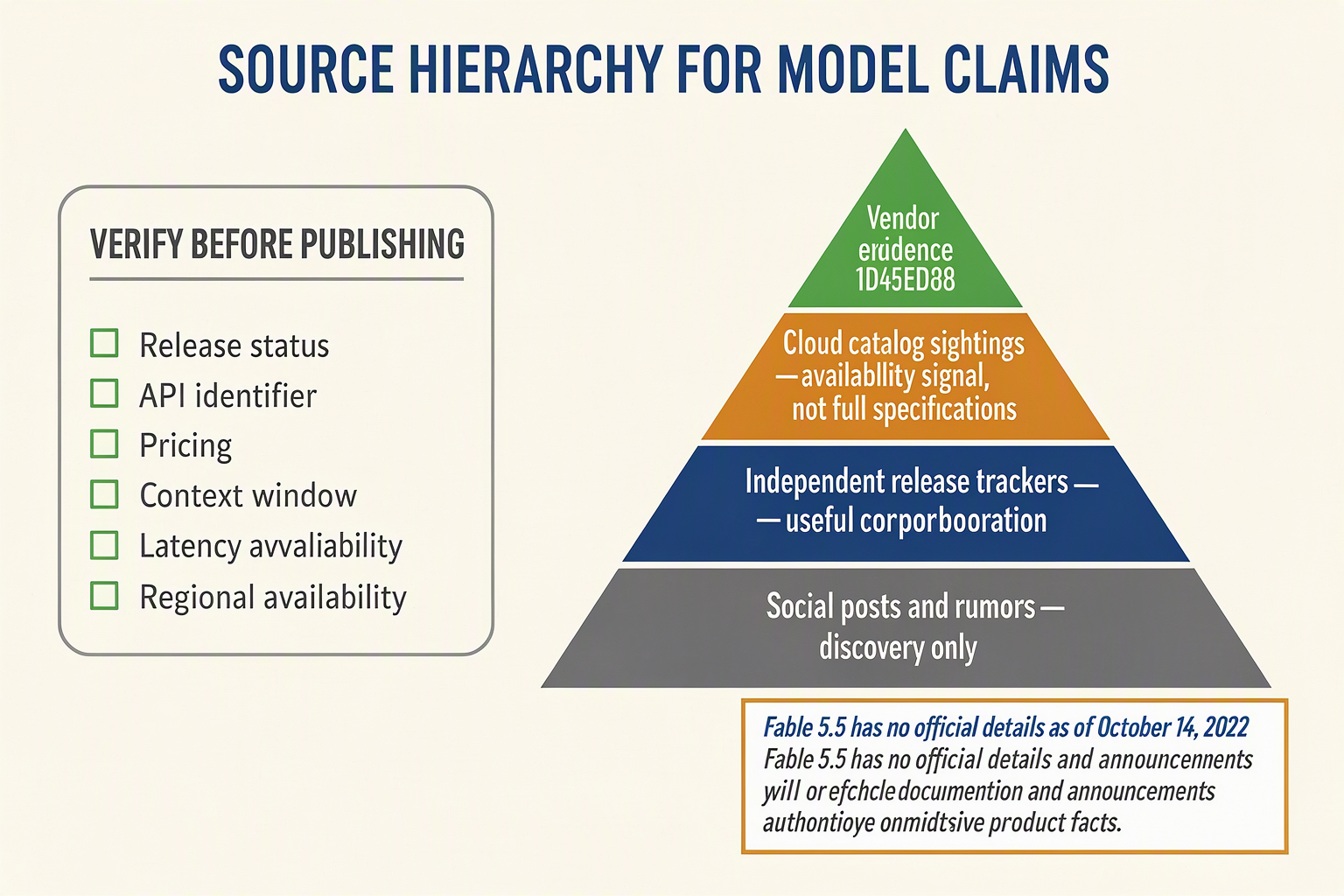
Official sources establish that Bulbul V4 Flash is an available text-to-speech model, while Claude Fable 5.5 remains unconfirmed as of October 14, 2026. Independent trackers provide useful signals about a possible Fable release, but none supplies the vendor documentation or reproducible API access needed to treat it as launched.
What does Anthropic officially confirm about Claude Fable 5.5?
Anthropic’s official Claude Fable page still presents Claude Fable 5.1 as its current Fable release. As of October 14, 2026, the page describes Fable 5.1 as Anthropic’s “most capable model for coding and knowledge work”; it does not provide a Fable 5.5 announcement, model card, API identifier, price or technical specification.
Emergent reached the same conclusion on October 5, 2026: Emergent reported that Anthropic had not announced Claude Fable 5.5 and still documented Fable 5.1 as the newest Fable model. OmniaKey also found no confirmed public release date in its October 1, 2026 review.
That evidence establishes a narrow but important conclusion: voice-AI builders cannot currently benchmark Claude Fable 5.5 as a production reasoning model. Its context window, tool-calling reliability, streaming behavior, time to first token and cost remain unknown.
What do independent Claude release trackers establish?
Release trackers establish that there are signals worth monitoring, not that a generally available product has been verified.
The current trail includes:
- Anthropic announced Claude Haiku 5.5 on October 7, 2026, according to OrcaRouter’s review of Anthropic’s newsroom.
- An X post on October 13, 2026 claimed that Fable 5.5 was imminent, but OrcaRouter found no matching Anthropic announcement.
- Medium reported on October 13, 2026 that a
claude-fable-5-5identifier appeared in Microsoft Azure’s East US 2 catalogue with aGenerallyAvailablelifecycle label. - CellCog reported the same cloud-catalogue appearance on October 13, 2026, while noting Anthropic’s continuing silence.
- Kingy AI reported on October 5, 2026 that observed API metadata grouped model families but did not confirm a Fable 5.5 release.
Multiple articles repeating one Azure catalogue observation do not constitute multiple independent product validations. The identifier could reflect staged metadata, regional provisioning, a partner-side listing or an imminent launch; without an executable endpoint and vendor documentation, its meaning remains uncertain.
What is established about Bulbul V4 Flash?
As of October 14, 2026, Bulbul V4 Flash is a launched TTS model, so its relevant evidence category differs fundamentally from the Fable rumours. Builders can evaluate Bulbul V4 Flash as a speech-synthesis component rather than speculate about it as a reasoning engine.
A defensible evaluation should require:
- Official model and API documentation
- Successful authenticated requests
- Reproducible audio output from fixed prompts
- Measured time to first audio
- Pronunciation, language and code-mixing tests
- Published or directly observed pricing and usage rules
What evidence threshold should production teams use?
Treat model status as a four-step ladder: rumour, catalogue signal, documented release and verified API availability. Claude Fable 5.5 currently sits between the first two levels; Bulbul V4 Flash reaches the launched-model threshold.
The practical rule is simple: do not put an unannounced model into architecture diagrams, cost forecasts or launch commitments as if it were available. Keep the reasoning layer replaceable, benchmark Bulbul V4 Flash with real audio workloads, and reopen the Claude comparison only after Anthropic publishes specifications and developers can reproduce API results.
Which model or stack should you choose for your voice-AI project?
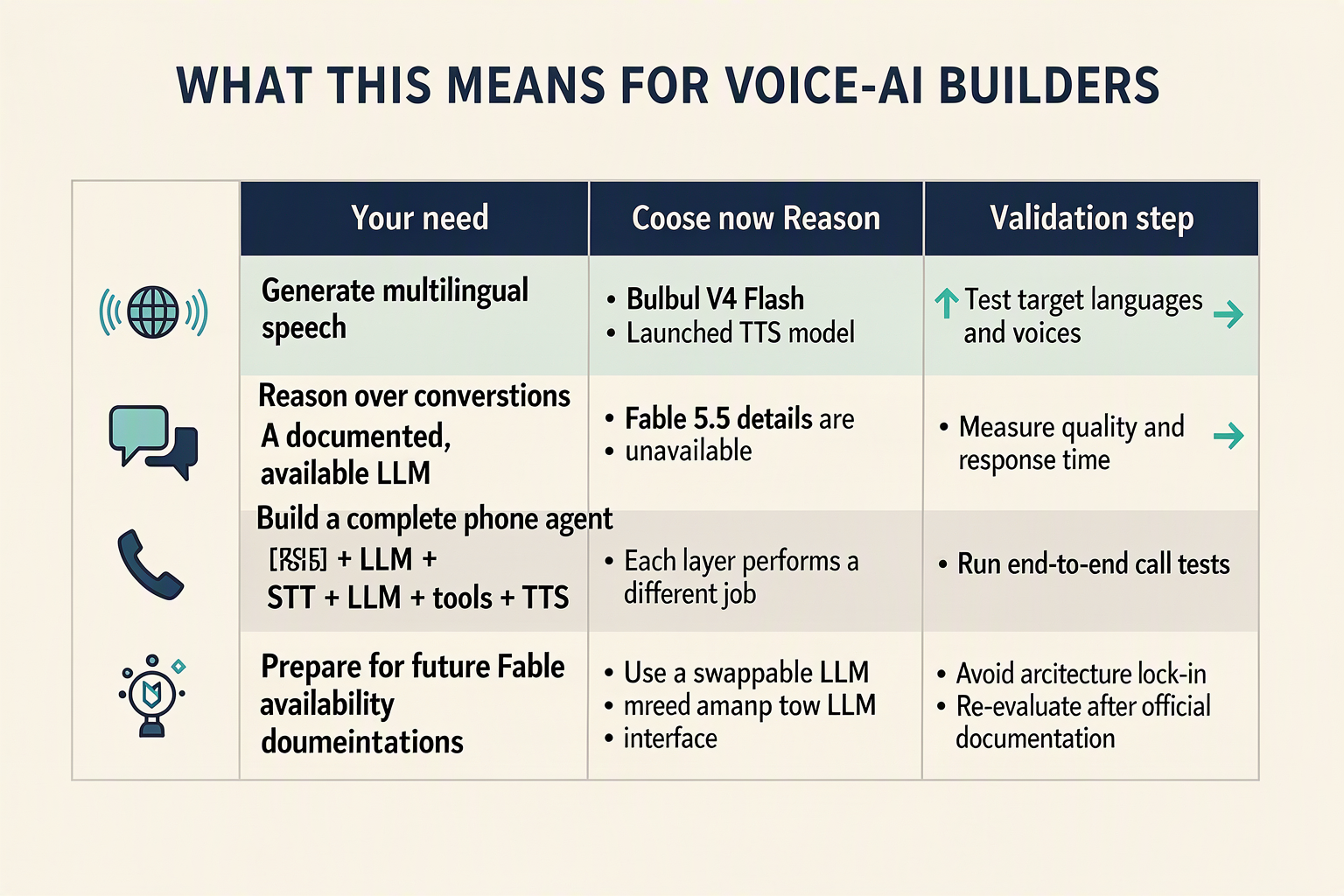
Choose a modular, released stack for production: a verified LLM for reasoning, a streaming speech-to-text model for input and Bulbul V4 Flash for speech output if it passes your language, latency and voice-quality tests. Do not make Claude Fable 5.5 a deployment dependency until Anthropic publishes official API access, pricing, specifications and a model card.
Which stack fits your voice-AI use case?
| Voice-AI scenario | Reasoning layer | Speech-output layer | Recommended decision | Release gate |
|---|---|---|---|---|
| Production customer-support agent | Use a documented, generally available LLM | Benchmark Bulbul V4 Flash against other launched TTS models | Ship a modular stack now | End-to-end latency, tool accuracy and escalation success |
| Indian-language phone agent | Test LLM performance on regional and code-mixed prompts | Evaluate Bulbul V4 Flash for pronunciation, naturalness and language coverage | Choose by language-level tests | Native-speaker review plus task completion |
| Low-latency conversational assistant | Prefer a fast LLM with streaming and tool calling | Test time to first audio and interruption handling | Optimise the full pipeline | Measure p50, p95 and p99 turn latency |
| Expressive media or branded voice | Use an LLM that reliably follows style instructions | Prioritise prosody, pacing, emotion and voice consistency | Weight TTS quality heavily | Blind listening tests and pronunciation checks |
| Claude Fable 5.5 research prototype | Keep a replaceable adapter for the reasoning layer | Use Bulbul V4 Flash or another available TTS model | Monitor, but do not depend on Fable 5.5 | Anthropic release notes, model card and working API |
| Regulated or high-risk workflow | Select a documented LLM with controllable outputs and logs | Use TTS only after privacy and retention review | Add human approval and fallbacks | Security, compliance and failure-mode testing |
Should you wait for Claude Fable 5.5?
No, not for a production launch. Emergent reported on October 5, 2026 that Anthropic had not announced Claude Fable 5.5 and that Claude Fable 5.1 remained the newest documented Fable release. Anthropic’s official Claude Fable page described Claude Fable 5.1 as its most capable model for coding and knowledge work as of October 2026.
The October 13, 2026 Microsoft Azure catalogue sighting reported by Medium is a useful monitoring signal, but it does not establish stable availability, supported regions, pricing or voice-agent suitability. OrcaRouter also reported that Anthropic’s latest official model announcement was Claude Haiku 5.5 on October 7, 2026.
Treat Fable 5.5 as eligible only after you can verify:
- Official model identity and API availability
- Streaming, structured-output and tool-calling behaviour
- Measured first-token latency under realistic concurrency
- Price per completed call—not merely price per token
- Fallback behaviour during throttling, errors and model changes
How should you benchmark the complete voice stack?
Run the same scripted and unscripted conversations across every candidate stack. Record speech-recognition delay, LLM first-token time, TTS first-audio time, interruption recovery, task success and total cost per successful call.
Architecture flexibility matters because models will change. As of October 2026, CallMissed’s managed voice-agent WebSocket and developer API include 24 realtime voice-agent models, caller-selected fallbacks and request logs, allowing builders to evaluate components without coupling the application to one speculative release.
The practical verdict is straightforward: Bulbul V4 Flash can be evaluated today as a TTS component; Claude Fable 5.5 cannot yet be selected responsibly as a confirmed reasoning model. Build interchangeable layers now, then benchmark Fable 5.5 if and when Anthropic officially ships it.
Frequently Asked Questions
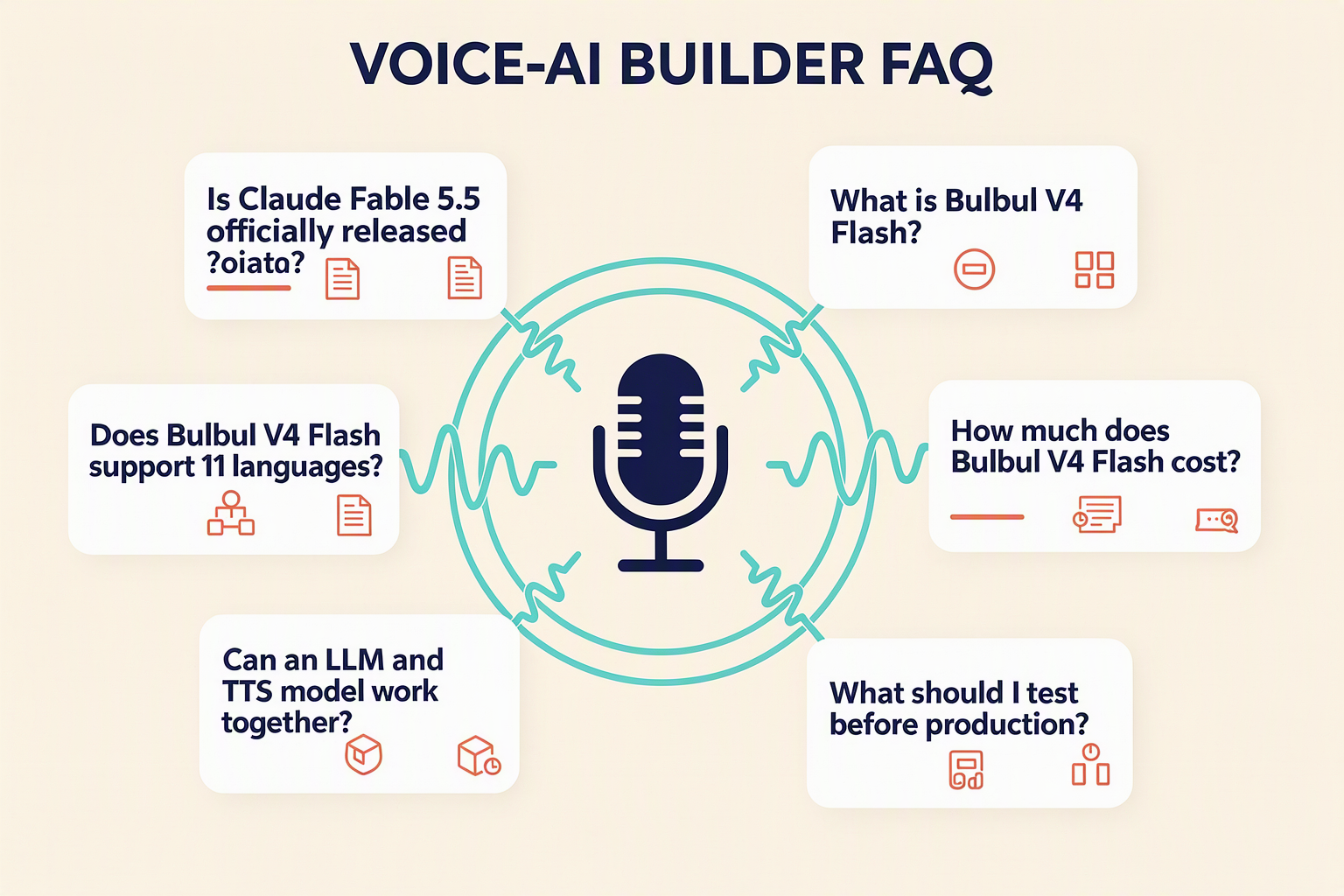
Is Claude Fable 5.5 vs Bulbul V4 Flash a valid head-to-head comparison?
Has Anthropic officially released Claude Fable 5.5 as of October 2026?
What evidence exists that Claude Fable 5.5 may be coming soon?
claude-fable-5-5 identifier that appeared in Microsoft Azure’s East US 2 catalogue on October 13, 2026, according to Medium and CellCog. However, an Azure catalogue listing and an October 13 X post do not confirm Anthropic specifications, API access, pricing or a public release date; teams should wait for Anthropic release notes, documentation and a model card before making production commitments.Can Claude Fable 5.5 and Bulbul V4 Flash work together in one voice agent?
What should developers benchmark in Claude Fable 5.5 vs Bulbul V4 Flash?
How can teams prepare for Claude Fable 5.5 without redesigning their voice-AI stack?
Conclusion
Claude Fable 5.5 vs Bulbul V4 Flash is not a winner-takes-all contest. As of October 14, 2026, the evidence supports treating Claude Fable 5.5 as an unconfirmed general-purpose LLM and Bulbul V4 Flash as a launched text-to-speech model—two components that could occupy different layers of the same voice-AI system.
What should voice-AI builders remember?
- Model categories matter more than model names. A future Claude Fable 5.5 could provide reasoning, intent interpretation, tool selection and response generation. Bulbul V4 Flash converts generated text into spoken audio, so comparing their voice quality or latency as though they perform the same task would produce a misleading result.
- Claude Fable 5.5 remains unverified. Anthropic’s official Claude Fable page still presents Claude Fable 5.1 as its most capable model for coding and knowledge work. Emergent reported on October 5, 2026 that Fable 5.1 remained the newest documented Fable release, while OrcaRouter identified Claude Haiku 5.5, announced on October 7, as Anthropic’s latest official model announcement.
- Catalogue sightings are signals, not specifications. Medium reported on October 13, 2026 that a
claude-fable-5-5identifier appeared in Microsoft Azure’s East US 2 catalogue. Until Anthropic publishes release notes, pricing, model cards and API documentation, builders cannot conduct a reproducible comparison or make reliable production commitments.
- The practical evaluation unit is the complete voice pipeline. Teams should measure time to first token, time to first audio, end-to-end turn latency, tool-calling reliability, streaming compatibility, pronunciation, language coverage, expressiveness and cost under realistic conversations. A strong reasoning model cannot compensate for unsuitable speech output, and high-quality TTS cannot repair incorrect reasoning.
What should builders watch next?
The decisive signals will be an official Anthropic announcement, a stable Claude Fable 5.5 API identifier, documented pricing and repeatable benchmarks. Bulbul V4 Flash should meanwhile be tested as a TTS component using representative names, numbers, regional speech patterns and longer responses.
Modular infrastructure can make that experimentation easier. As of October 2026, CallMissed, an OpenAI-compatible AI gateway, offers one API key and balance across 140 models, including 45 general-purpose LLMs, 45 speech-to-text models and 10 text-to-speech models.
To explore how modular AI communication is evolving, check out CallMissed—and ask: Is your voice stack designed to adopt the next model, or is it locked to today’s rumor cycle?
Related Reading
- Best LLM for Voice Agents in 2026: GPT-6 Astra vs Claude Fable 5.1
- Claude Fable 5.1 vs GPT-5.6 Sol: Pricing, Coding & Voice Agents
- Claude Fable 5.5 vs Gemini 4 Argon: What Is Confirmed