Claude Fable 5.5 vs GPT-6 Astra: Verified Facts as of 2026



Claude Fable 5.5 vs GPT-6 Astra separates confirmed facts from rumors and compares verified performance, pricing, access, coding, security, and voice.
Claude Fable 5.5 vs GPT-6 Astra: Verified Facts as of 2026
What if the most important fact in a headline comparison is that one contender does not officially exist? As of October 14, 2026, Anthropic has not announced Claude Fable 5.5, so Claude Fable 5.5 vs GPT-6 Astra cannot produce a defensible benchmark winner. Any chart claiming otherwise risks comparing a documented system with rumors, catalogue metadata, or an inferred model specification.
This matters now because conflicting signals are moving faster than official documentation. Emergent.sh reported on October 5, 2026, that Anthropic’s documentation still listed Claude Fable 5.1 as the newest Fable model. By contrast, Medium reported on October 13, 2026, that the identifier claude-fable-5-5 appeared in Microsoft Azure’s model catalogue with a “GenerallyAvailable” lifecycle status in East US 2. That listing is noteworthy, but it is not an Anthropic launch announcement, nor does it supply verified pricing, context-window limits, benchmark scores, safety documentation, or API availability.
What can actually be compared today?
A credible model comparison must separate three evidence tiers: official vendor releases, independently reproducible tests, and unconfirmed reports. Anthropic’s own announcement confirms Claude Fable 5.1 and Claude Mythos 5.1, while third-party reports about Fable 5.5 remain evidence of possible preparation—not proof of a publicly released product. The same discipline must be applied to GPT-6 Astra: product identity, access route, model card, pricing, and test conditions need primary-source confirmation before performance claims are treated as facts.
This article will therefore:
- Verify which names, versions, release dates, and endpoints the vendors actually document.
- Compare only like-for-like facts, including modalities, context limits, coding and reasoning evidence, latency methodology, pricing, and availability.
- Flag every rumor, leak, catalogue entry, and extrapolation instead of laundering speculation into a scorecard.
- Explain what buyers and developers can test now, what remains unknowable, and which official disclosures would make a future benchmark valid.
Why is a no-winner verdict useful?
Because model selection affects application quality, cost, lock-in, and safety, an honest “not yet measurable” conclusion is more useful than a fabricated leaderboard. Readers will leave with a verification framework for checking model announcements, evaluating benchmark methodology, and deciding whether to wait, test an available predecessor, or design a provider-neutral architecture.
That last option is increasingly practical: as of October 2026, CallMissed, the OpenAI-compatible and Anthropic-compatible developer AI API, provides one API key and one balance across 140 models, with caller-chosen fallbacks, helping teams evaluate documented alternatives without presenting unreleased models as real production choices today.
Can a Claude Fable 5.5 vs GPT-6 Astra winner be declared? No—Anthropic had not announced Fable 5.5 as of October 14, 2026, so only GPT-6 Astra versus confirmed Fable 5.1 evidence can be assessed

No. A Claude Fable 5.5 vs GPT-6 Astra winner cannot be declared as of October 14, 2026, because Anthropic has not announced Fable 5.5 or published the specifications required for a controlled comparison. The defensible alternative is to evaluate verified GPT-6 Astra evidence against Anthropic’s confirmed Claude Fable 5.1—not against a presumed successor.
Why can’t Claude Fable 5.5 be benchmarked yet?
A model identifier is not a complete benchmarkable product. Researchers need access to a stable endpoint, documented settings and reproducible test conditions before assigning scores or declaring a winner.
Emergent.sh reported on October 5, 2026, that Anthropic’s documentation listed Claude Fable 5.1—not Fable 5.5—as the newest Fable model. Anthropic’s official announcement also identifies Claude Fable 5.1 and Claude Mythos 5.1, providing a primary source for those product names.
By contrast, the available Fable 5.5 signals remain indirect:
- Medium reported on October 13, 2026, that
claude-fable-5-5appeared in the Microsoft Azure model catalogue with a “GenerallyAvailable” status in East US 2. - OrcaRouter reported on October 13, 2026, that an X post repeated an unattributed claim that Fable 5.5 would arrive “this week.”
- OmniaKey reported on October 1, 2026, that Anthropic’s model directory still showed Fable 5.1 as the current Fable release.
- CellCog concluded that a 5.5 label might be plausible because other Claude family members use that version number, but found no Anthropic evidence confirming an imminent Fable launch.
These reports may indicate deployment preparation, catalogue staging or an upcoming release. They do not establish the model’s final capabilities, public availability or benchmark configuration.
What evidence is missing for a valid winner?
A conventional Claude Fable 5.5 vs GPT-6 Astra comparison would require both vendors to disclose comparable information. For Fable 5.5, at least five categories remain unverified:
- Model identity: an Anthropic product page, model card or API documentation.
- Access: a working public endpoint, supported regions and account eligibility.
- Technical limits: context window, maximum output, modalities and tool-use support.
- Economics: input, output, cache and long-context pricing.
- Evaluation evidence: coding, reasoning, safety and agentic benchmark results with stated settings.
Without these details, even a genuine catalogue entry cannot support normalized cost, latency or quality testing.
What comparison is defensible now?
The valid baseline is GPT-6 Astra versus Claude Fable 5.1, provided every Astra claim is likewise supported by OpenAI documentation or reproducible testing. The comparison should preserve identical prompts, tool permissions, sampling settings, output limits and scoring rules.
Results should then be reported by workload rather than compressed into one universal score:
- Coding: repository repair, test passing and regression rates.
- Reasoning: accuracy, consistency and compute settings.
- Agents: tool-call success, recovery behavior and task completion.
- Cost: total input, output and caching charges per completed task.
- Latency: median and tail response times under equivalent conditions.
The current verdict is therefore not a tie. It is insufficient evidence, with Claude Fable 5.1 serving as the latest confirmed Fable baseline until Anthropic publishes Fable 5.5.
What are Claude Fable 5.5, Fable 5.1 and GPT-6 Astra, and which claims are officially confirmed?

Claude Fable 5.1 is an officially announced Anthropic model; Claude Fable 5.5 is not. As of October 14, 2026, neither the supplied Anthropic documentation nor any cited OpenAI primary source confirms a product named GPT-6 Astra, so claims about either unverified model’s specifications or performance must be treated as provisional.
What is Claude Fable 5.1?
Claude Fable 5.1 is the latest Fable model supported by an Anthropic announcement in the available evidence. Anthropic published an official release page titled “Introducing Claude Fable 5.1 and Claude Mythos 5.1,” establishing both model names as genuine members of the Claude family.
Emergent.sh reported on October 5, 2026, that Anthropic’s model documentation still identified Claude Fable 5.1 as the newest Fable model. The publication also described Fable 5.1 as Anthropic’s most capable generally available model, although buyers should verify current availability, API identifiers and regional access directly in Anthropic’s documentation.
What can be stated confidently is limited but meaningful:
- Model identity: Claude Fable 5.1 is officially documented by Anthropic.
- Family relationship: Anthropic announced it alongside Claude Mythos 5.1.
- Availability evidence: Anthropic documentation, as reviewed by Emergent.sh on October 5, listed Fable 5.1 as the current Fable release.
- Performance evidence: Only benchmarks published with reproducible test conditions should be used; model-family reputation is not a substitute for results.
Is Claude Fable 5.5 an officially released model?
No. Anthropic had not announced Claude Fable 5.5 as of October 14, 2026, and no official release date, model card, pricing schedule or public API specification appears in the supplied evidence.
The strongest contrary signal is third-party infrastructure metadata. Medium reported on October 13, 2026, that Microsoft Azure’s catalogue displayed the identifier claude-fable-5-5, marked “GenerallyAvailable” in the East US 2 region. That may indicate catalogue preparation, a partner rollout or an unpublished deployment, but catalogue metadata alone cannot confirm Anthropic’s launch terms or technical specifications.
Other reports are weaker:
- OrcaRouter documented an October 13, 2026, X post repeating a claim that Fable 5.5 would arrive “this week.”
- Wccftech repeated a source’s statement that the model was “slated for this week.”
- CellCog concluded that the 5.5 name looked plausible because other models in the family carried that version, while emphasizing that Anthropic had supplied no evidence of an imminent Fable release.
These are rumors and inferences, not vendor confirmation.
Is GPT-6 Astra officially confirmed?
The provided research contains no OpenAI announcement, model card, API documentation or pricing page confirming GPT-6 Astra as of October 14, 2026. Consequently, “GPT-6 Astra” should be treated as an unverified name unless OpenAI publishes a primary-source release or exposes a documented production endpoint.
A credible confirmation would require:
- An announcement on an official OpenAI channel
- A stable model identifier in OpenAI API documentation
- Published access conditions, pricing and context limits
- A model or system card covering capabilities and safety
- Reproducible evaluations against Claude Fable 5.1—and, if released, Fable 5.5
Until those materials exist, Claude Fable 5.1 is the only confirmed, comparison-ready model among these three names.
Which dated developments shaped the Fable 5.5 release-date story?
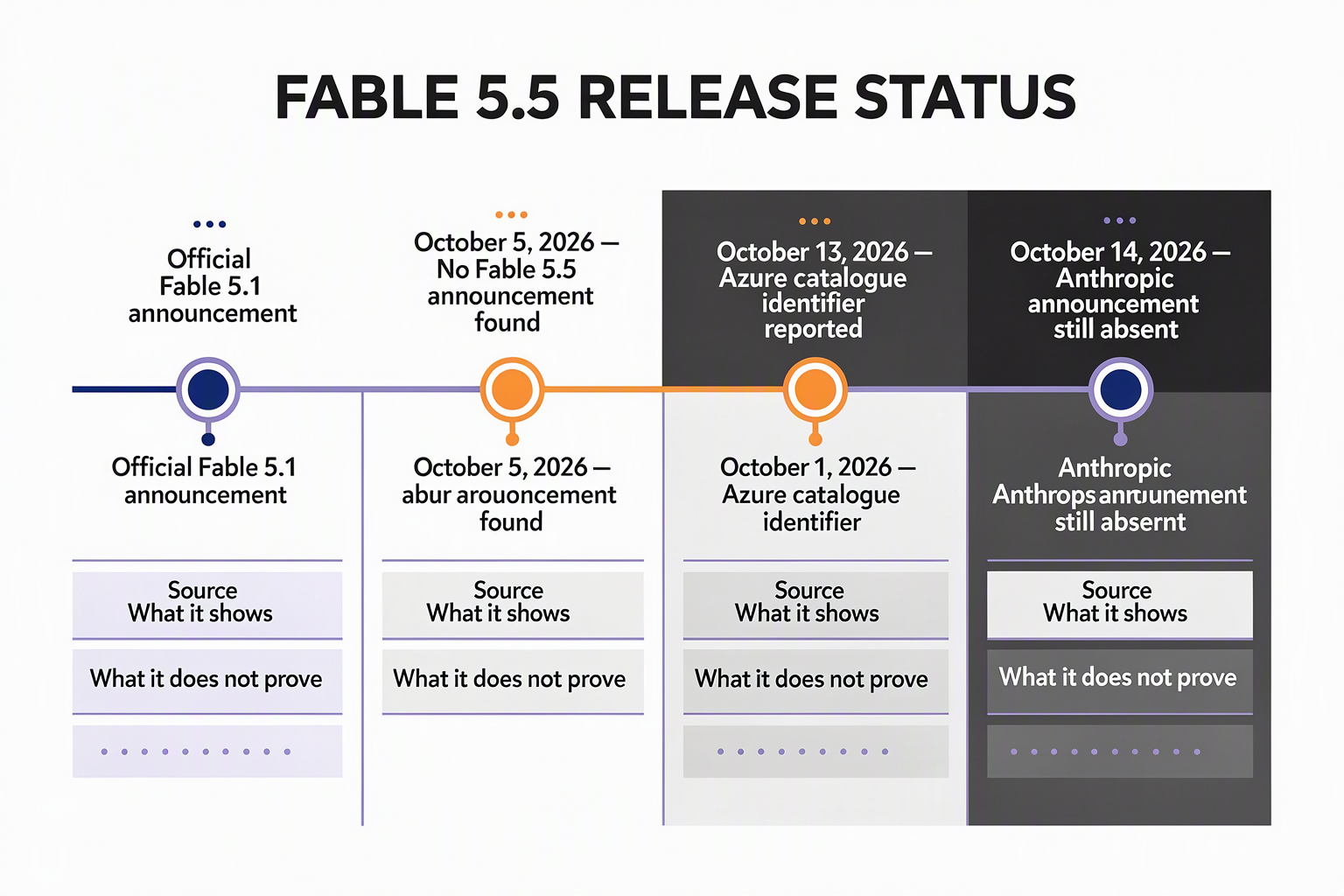
The Claude Fable 5.5 release-date story developed through a sequence of family-roadmap clues, unchanged official documentation, catalogue metadata, and social-media claims. As of October 14, 2026, none amounts to an Anthropic announcement or a confirmed public release date.
What is the timeline for Claude Fable 5.5 claims?
| Date | Development | Source | What it establishes |
|---|---|---|---|
| September 22, 2026 | An Anthropic announcement said Claude Sonnet 5.5 and Claude Haiku 5.5 would follow, according to CellCog’s account. | CellCog | A 5.5 family naming pattern, not confirmation of Fable 5.5 |
| October 1, 2026 | A review of official sources found Fable 5.1 still listed as the current Fable model. | OmniaKey | No confirmed release date, API or Fable 5.5 specifications |
| October 5, 2026 | Anthropic had not announced Fable 5.5, and its documentation continued to identify Fable 5.1 as the newest Fable release. | Emergent.sh | The strongest dated check of Anthropic’s documentation |
| October 13, 2026 | The identifier claude-fable-5-5 reportedly appeared in Microsoft Azure’s catalogue with a “GenerallyAvailable” lifecycle status in East US 2. | Medium | Possible deployment preparation or catalogue publication, but not an Anthropic launch |
| October 13, 2026 | An X post repeated a roughly two-week-old claim that Fable 5.5 would arrive “this week,” attributing it to a person called Leo. | OrcaRouter | An attributed rumor without primary documentation |
| October 14, 2026 | No cited Anthropic announcement supplied a release date, model card, pricing, endpoint or benchmark results. | Current evidence review | Fable 5.5 remained unconfirmed for comparison purposes |
Why did the 5.5 name appear plausible?
The September family roadmap created a reasonable naming inference. CellCog reported that Claude Sonnet 5.5 and Claude Haiku 5.5 were expected to follow, making “Fable 5.5” a plausible future label.
Plausibility is not confirmation, however. OmniaKey reported on October 1, 2026, that Anthropic’s model directory still listed Fable 5.1, while Emergent.sh reached the same core conclusion on October 5, 2026. Neither check found an official Fable 5.5 release date.
Does an Azure “GenerallyAvailable” label prove release?
No. A cloud catalogue record can indicate that a provider is configuring regional inventory, testing publication workflows or preparing commercial access. It does not independently establish that the model creator has launched the product publicly.
The reported Azure entry also leaves crucial questions unanswered:
- Is the identifier accessible to ordinary Azure customers?
- Does “GenerallyAvailable” describe the model, catalogue record or regional deployment?
- What are the context window, modalities, pricing and rate limits?
- Has Anthropic published a model card or safety documentation?
- Is
claude-fable-5-5the final production identifier?
Until Microsoft Azure or Anthropic answers those questions in primary documentation, the entry should be labelled catalogue evidence, not release confirmation.
What would turn the rumor into a verified release?
A defensible release record would include an Anthropic announcement, an official documentation entry, a working API model identifier, published pricing and technical limits. Reproducible evaluations could follow only after researchers obtain equivalent access and disclose prompts, sampling settings, tool configurations and scoring methods.
Consequently, the dated record supports one narrow conclusion: Fable 5.5 may have been in preparation, but its release date and performance remained unverified on October 14, 2026. The same evidentiary standard must apply before placing it against GPT-6 Astra in a benchmark table.
What remains unknown about Claude Fable 5.5 release date, API access, pricing and benchmarks?
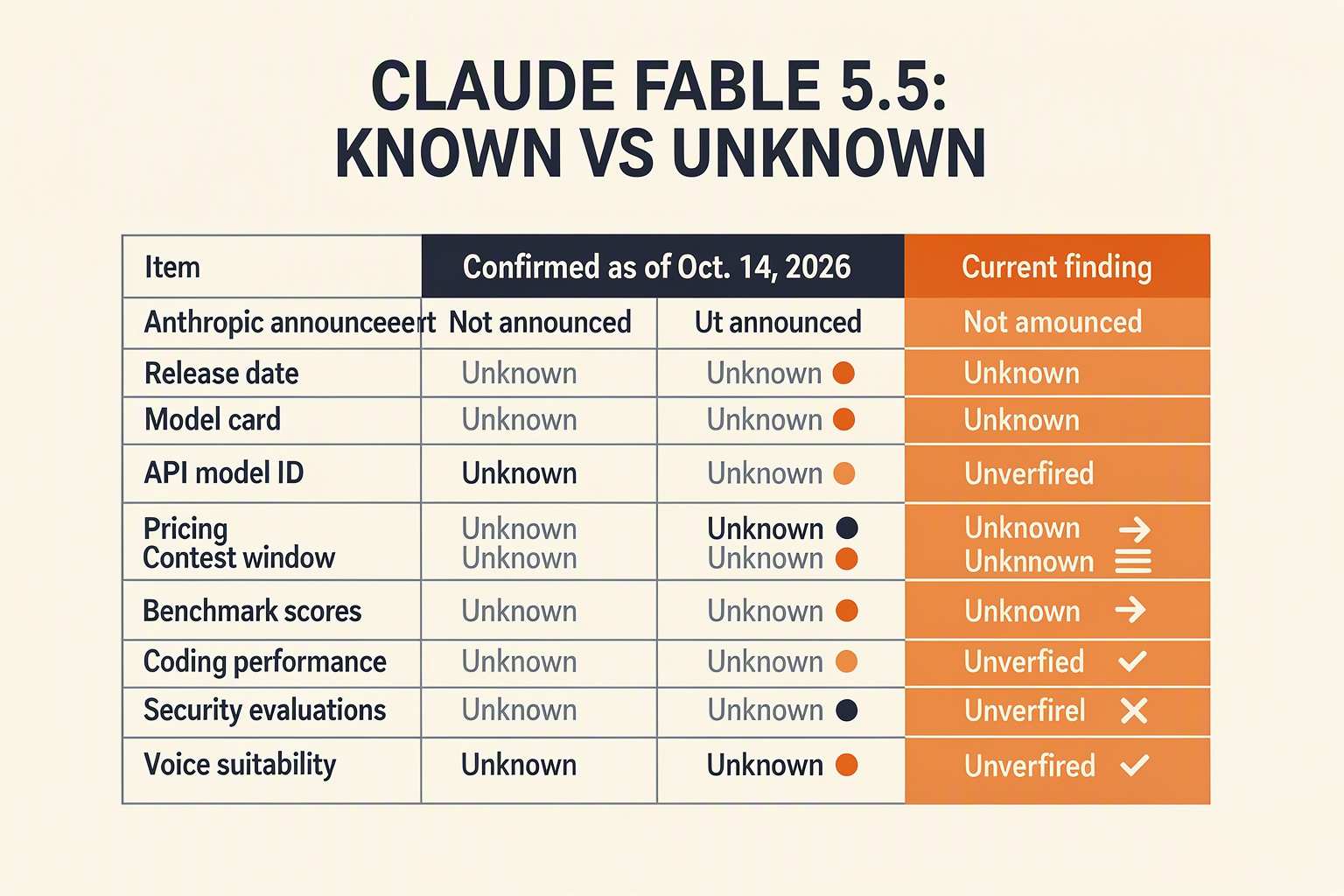
As of October 14, 2026, Anthropic has not announced Claude Fable 5.5, so its release date, public API access, pricing, specifications and benchmark performance remain unknown. A Microsoft Azure catalogue identifier is a meaningful deployment signal, but it cannot substitute for Anthropic documentation or reproducible testing.
Which Claude Fable 5.5 details are still unconfirmed?
| Area | Evidence as of October 14, 2026 | What remains unknown | Evidence needed |
|---|---|---|---|
| Release date | Emergent.sh reported on October 5, 2026, that Anthropic still listed Fable 5.1 as the newest Fable model. | Launch date, rollout schedule and regional timing | Dated Anthropic announcement and model directory entry |
| API access | Medium reported on October 13, 2026, that claude-fable-5-5 appeared in Azure’s East US 2 catalogue. | Anthropic API endpoint, account eligibility, rate limits and general availability | Anthropic API documentation and a callable production model ID |
| Pricing | No official price appears in the supplied Anthropic evidence. | Input, output, cache-write and cache-read token prices | Anthropic pricing page with effective date |
| Specifications | No official model card has been identified. | Context window, maximum output, modalities, tool use and knowledge cutoff | Anthropic model card and technical documentation |
| Benchmarks | No reproducible Fable 5.5 results are available. | Coding, reasoning, agentic, multilingual, latency and safety performance | Vendor disclosures plus independent tests with published prompts |
| Safety | Anthropic discusses stronger agentic capabilities and associated risks in its Fable 5.1 and Mythos 5.1 announcement. | Fable 5.5 system-card findings, safeguards and deployment restrictions | Version-specific system card and evaluation methodology |
Does the Azure listing prove Claude Fable 5.5 is released?
No. Medium reported on October 13, 2026, that Microsoft Azure labelled the identifier “GenerallyAvailable” in East US 2, but a catalogue record does not establish availability through Anthropic’s own API, Claude applications or every Azure account.
Catalogue metadata can appear during staged deployment, partner preparation or documentation work. Before treating the model as released, developers should verify:
- The endpoint accepts authenticated production requests.
- Microsoft or Anthropic publishes supported regions and access conditions.
- The returned model version matches the requested identifier.
- Pricing and data-handling terms are documented.
- A version-specific model or system card is available.
Can rumored release dates be used for procurement planning?
Rumors may justify monitoring, but not contractual or architectural assumptions. OrcaRouter reported on October 13, 2026, that an X post repeated a claim that Fable 5.5 would arrive “within the week”; OrcaRouter also traced that claim to an unnamed person referred to as “Leo,” rather than an Anthropic announcement.
OmniaKey similarly reported on October 1, 2026, that Anthropic’s directory still showed Fable 5.1 as the current Fable model. Even adjacent Claude models carrying a 5.5 label would not prove Fable 5.5’s release date, features or price.
Why can no benchmark winner be declared?
A valid Claude Fable 5.5 vs GPT-6 Astra benchmark requires both models to have verified identities, accessible endpoints and identical test conditions. The supplied evidence provides neither official Fable 5.5 specifications nor primary-source GPT-6 Astra details sufficient for controlled comparison.
A future test should disclose exact model snapshots, prompts, sampling settings, tool permissions, retry policy, token costs and test dates. Until those inputs exist, any claimed winner measures speculation rather than model performance.
How do sourced GPT-6 Astra benchmarks compare with confirmed Claude Fable 5.1 results?
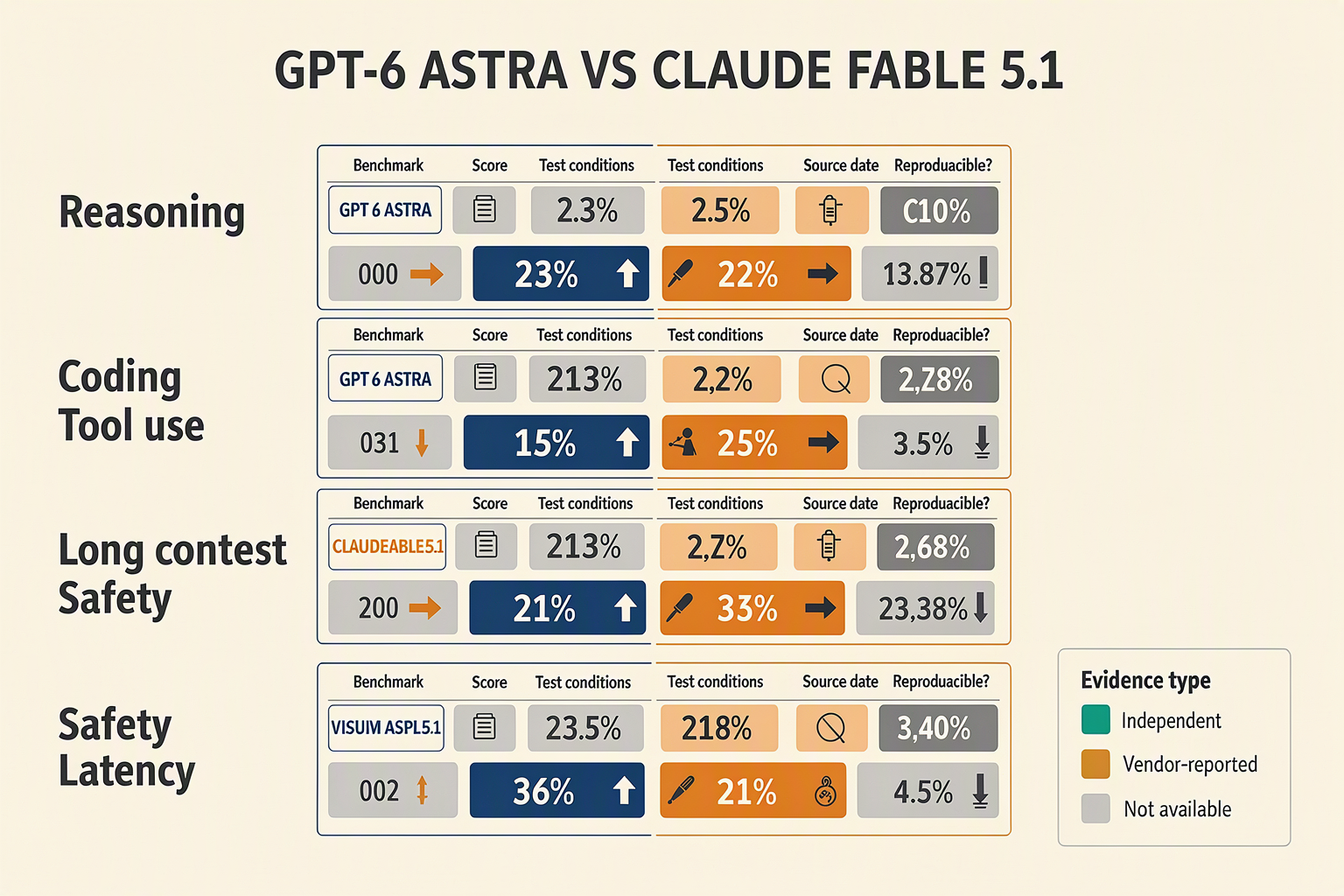
No defensible numerical comparison is possible yet. As of October 14, 2026, the supplied evidence contains neither an official, reproducible GPT-6 Astra benchmark suite nor like-for-like benchmark figures for Claude Fable 5.1 under identical test conditions.
What is actually confirmed about Claude Fable 5.1?
Anthropic’s official announcement, “Introducing Claude Fable 5.1 and Claude Mythos 5.1,” confirms that Claude Fable 5.1 is a real Anthropic model. The announcement also discusses “safety, security, and alignment,” noting that increasingly powerful agentic capabilities create new risks.
Emergent.sh reported on October 5, 2026, that Anthropic’s documentation still identified Claude Fable 5.1 as the newest Fable model. That establishes model identity and availability more reliably than rumours about a successor, but the supplied research does not provide exact Fable 5.1 scores, prompts, sample sizes, or evaluation settings that can be reproduced against GPT-6 Astra.
A usable Fable 5.1 baseline would need to disclose:
- The precise benchmark version, such as SWE-bench Verified rather than an unspecified SWE-bench result.
- Whether tools, browsing, scaffolding, retries or extended reasoning were enabled.
- The number of evaluation runs and the method used to calculate the reported score.
- Token budgets, context length, temperature and system instructions.
- Whether the result came from Anthropic, an independent laboratory or a third-party agent harness.
Are there sourced GPT-6 Astra benchmark results?
Not in the evidence available for this comparison. No cited OpenAI model card, technical report, API documentation or official launch announcement establishes GPT-6 Astra’s exact model identity, benchmark scores or testing configuration as of October 14, 2026.
Consequently, a claimed Astra advantage of any percentage would be unsupported here. Even a real score copied from a screenshot or social post would remain unsuitable unless readers could verify the model version, endpoint, benchmark revision and evaluation harness.
The appropriate evidence labels are:
- Confirmed: Anthropic has officially announced Claude Fable 5.1.
- Not numerically comparable: The supplied material does not contain reproducible, matched benchmark results for Fable 5.1 and GPT-6 Astra.
- Unconfirmed: Microsoft Azure catalogue metadata reportedly showed
claude-fable-5-5with a “GenerallyAvailable” status in East US 2, according to Medium on October 13, 2026. - Speculative: OrcaRouter reported on October 13, 2026, that an X post repeated a second-hand claim that Fable 5.5 would arrive “this week.”
What would make the comparison valid?
A credible test should run accessible model endpoints through the same frozen dataset and harness, with equivalent tool access, token budgets and retry policies. Results should report accuracy alongside cost per completed task, latency distribution, failure rate and variance across repeated runs.
Until OpenAI publishes verifiable GPT-6 Astra documentation and both models can be tested under matched conditions, the factual result is no benchmark winner—not a tie, and not evidence that either system performs better.
How do price, access, context limits and security evidence compare?
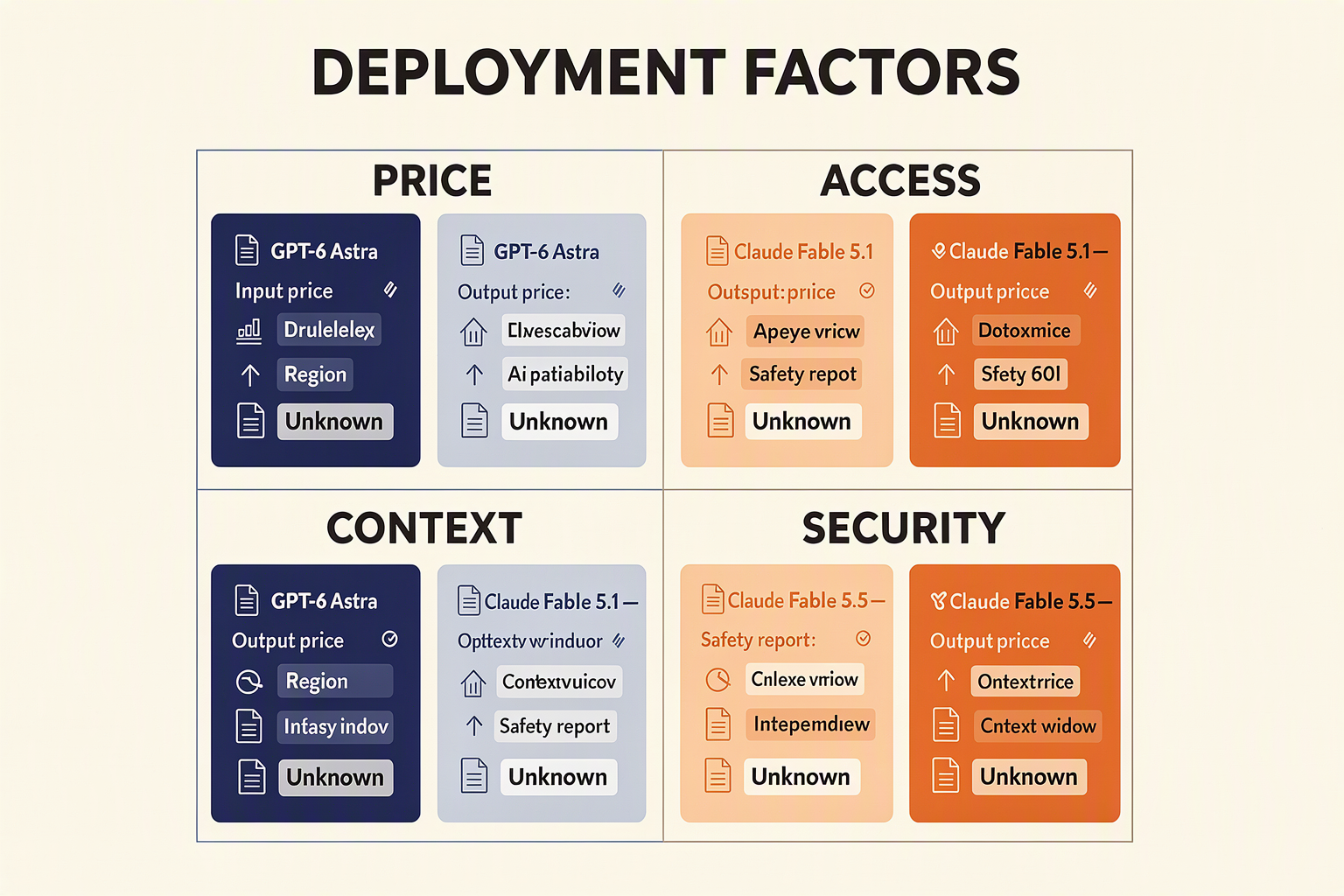
As of October 14, 2026, there is no verified basis for comparing Claude Fable 5.5 and GPT-6 Astra on price, access, context limits, or security. Anthropic has not announced Fable 5.5, while the supplied evidence contains no primary OpenAI documentation establishing GPT-6 Astra’s product identity or specifications.
What pricing and access information is confirmed?
Neither model has a verified public price in the available evidence. A catalogue record or rumored launch window cannot establish token rates, regional availability, rate limits, or eligibility for production use.
| Comparison factor | Claude Fable 5.5 | GPT-6 Astra | Defensible conclusion |
|---|---|---|---|
| Official price | Not announced by Anthropic | No primary-source price provided | Cost cannot be compared |
| Direct API access | No documented Anthropic endpoint | No verified endpoint provided | API availability is unconfirmed |
| Cloud access | Reportedly listed in Azure East US 2 | No verified cloud listing provided | A listing alone does not prove usable access |
| Context limit | Not published | Not published in supplied evidence | Prompt capacity cannot be ranked |
| Security evidence | No model-specific report located | No model-specific report provided | Security claims remain unsupported |
Medium reported on October 13, 2026, that claude-fable-5-5 appeared in the Microsoft Azure model catalogue with a “GenerallyAvailable” lifecycle label for East US 2. That is potentially meaningful deployment metadata, but buyers still need to confirm whether the model can actually be provisioned, which accounts can access it, who operates the endpoint, and what commercial terms apply.
Emergent.sh reported on October 5, 2026, that Anthropic’s documentation continued to identify Claude Fable 5.1 as the newest Fable release. Accordingly, Fable 5.1 pricing or access terms must not be relabelled as Fable 5.5 terms.
Can context-window claims be inferred from related models?
No. Context limits are model-version-specific and sometimes endpoint-specific. Limits from Claude Fable 5.1, another Claude 5.5 family member, or an earlier GPT model cannot establish the capacity of either contender.
A useful context specification should disclose:
- The maximum combined input and output size.
- Any separate maximum-output limit.
- Whether images, tool results, cached prompts, and reasoning tokens count toward that limit.
- Whether the advertised window is available through every API and cloud provider.
- Performance evidence for retrieval across the full window, not merely successful request acceptance.
Without those details, a larger rumored token number would not demonstrate better long-context accuracy.
What security evidence would support a credible comparison?
Anthropic’s official Claude Fable 5.1 and Claude Mythos 5.1 announcement discusses stronger agentic capabilities and warns that greater autonomy creates new risks. However, security findings for Fable 5.1 cannot automatically be transferred to an unannounced Fable 5.5, and no supplied primary source provides equivalent GPT-6 Astra evidence.
A defensible assessment should require:
- A model or system card identifying the exact release and evaluation date.
- Cybersecurity and autonomy evaluations, including tool use, persistence, and harmful-task testing.
- Deployment controls, such as permission boundaries, monitoring, abuse detection, and incident procedures.
- Independent reproducibility, with prompts, scoring rules, model snapshots, and access conditions disclosed.
The correct score today is therefore “insufficient verified evidence” in all four categories, not a tie and not a winner. Procurement teams should wait for vendor pricing pages, documented endpoints, context specifications, and model-specific safety reports before approving production deployment.
Which model is better suited to coding, agentic workflows and real-time voice agents?
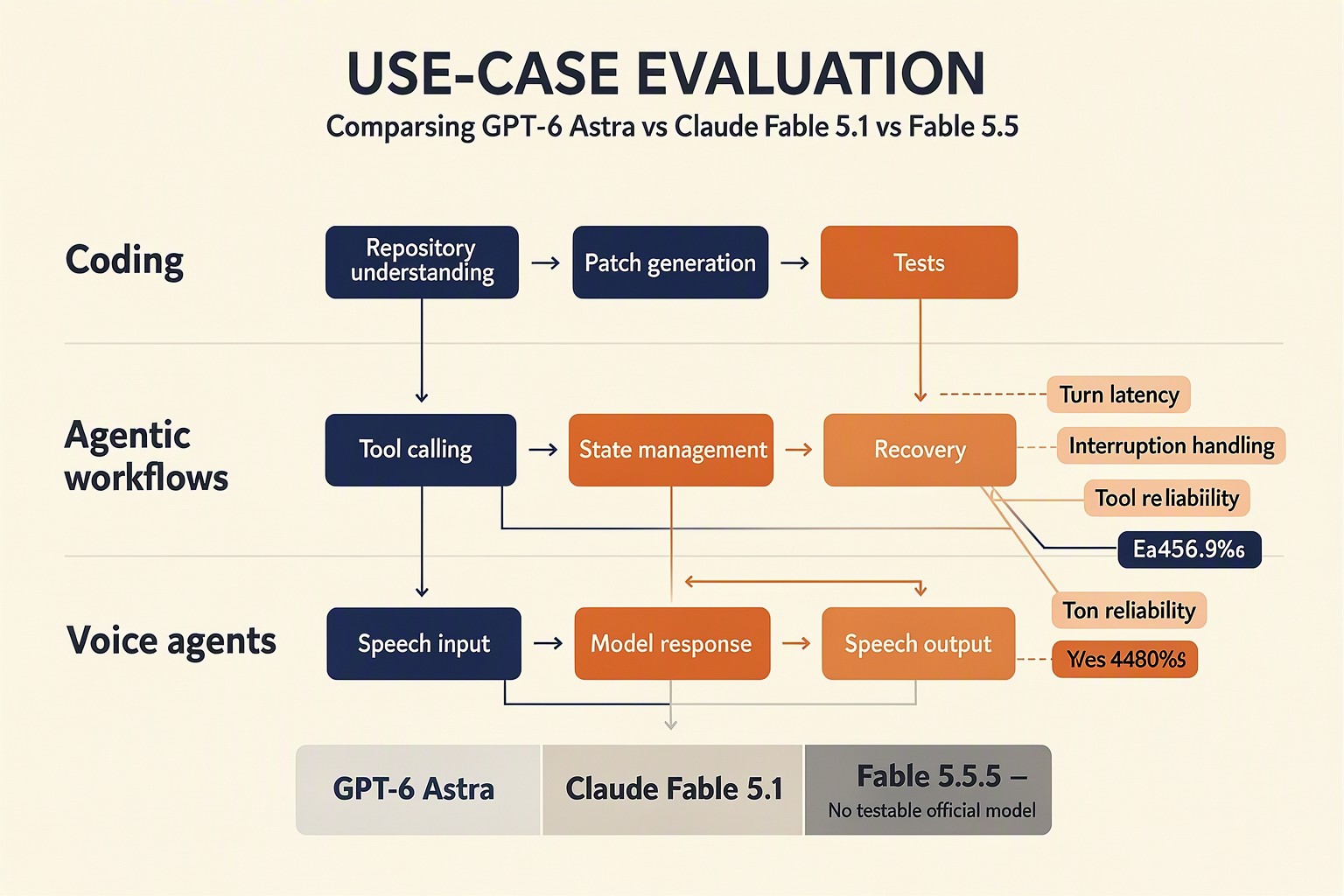
Neither Claude Fable 5.5 nor GPT-6 Astra can currently be declared better for coding, agentic workflows, or real-time voice agents. As of October 14, 2026, the comparison lacks two essentials: officially verified product identities for both models and reproducible, like-for-like workload results.
Which model is better for coding?
There is no defensible coding winner because no verified benchmark set establishes how Claude Fable 5.5 and GPT-6 Astra perform under identical conditions. Emergent.sh reported on October 5, 2026, that Anthropic still listed Claude Fable 5.1—not Fable 5.5—as the newest Fable model.
The reported Azure entry does not resolve that gap. Medium reported on October 13, 2026, that claude-fable-5-5 appeared in the Microsoft Azure model catalogue with a “GenerallyAvailable” status in East US 2, but a catalogue identifier provides no validated SWE-bench score, token price, context limit, or tool-use reliability result.
A credible coding evaluation should test:
- Repository-level changes, including navigation across multiple files.
- Patch correctness, measured by hidden tests rather than model self-assessment.
- Long-horizon debugging, with logs, failed attempts, and recovery preserved.
- Cost per accepted task, including retries and generated tokens.
- Human review burden, especially security and maintainability defects.
Until both vendors publish accessible endpoints and specifications, teams should test officially available models against their own repositories instead of extrapolating from model-family names.
Which model is better for agentic workflows?
Neither model has enough confirmed evidence to support an agentic-workflow recommendation. Agent quality depends on more than reasoning benchmarks: reliable function calling, structured outputs, state management, permission boundaries, retry behavior, and recovery from failed tool calls are equally important.
Anthropic’s Claude Fable 5.1 and Claude Mythos 5.1 announcement states that AI models’ “agentic capabilities have become much more powerful over the past two years,” while warning that greater autonomy creates new safety, security, and alignment risks. That warning is operationally significant: an agent that completes more steps autonomously can also propagate an incorrect assumption through more systems.
Buyers should therefore measure:
- Task-completion rate without human intervention.
- Tool-call accuracy and schema compliance.
- Recovery rate after timeouts or malformed responses.
- Unauthorized-action frequency under adversarial instructions.
- Total cost and elapsed time per successful workflow.
Which model is better for real-time voice agents?
A text model cannot be judged as a complete real-time voice agent without testing the surrounding speech stack. End-to-end performance includes speech recognition, endpoint detection, model inference, text-to-speech generation, interruption handling, and telephony transport.
The decisive measures are time to first audible response, interruption success, transcription accuracy by language and accent, and task completion during noisy calls—not coding scores alone. Neither unverified model currently has comparable public results for those conditions.
For provider-neutral testing, CallMissed’s developer AI API supports 140 models as of October 2026, including 24 real-time voice-agent models, 45 speech-to-text models, and 10 text-to-speech models through OpenAI-compatible and Anthropic-compatible endpoints. That architecture illustrates the practical approach: benchmark documented models as interchangeable components, and add Claude Fable 5.5 or GPT-6 Astra only after official access and reproducible evidence exist.
What do official sources and independent analysts actually say about Fable 5.5 and GPT-6 Astra?
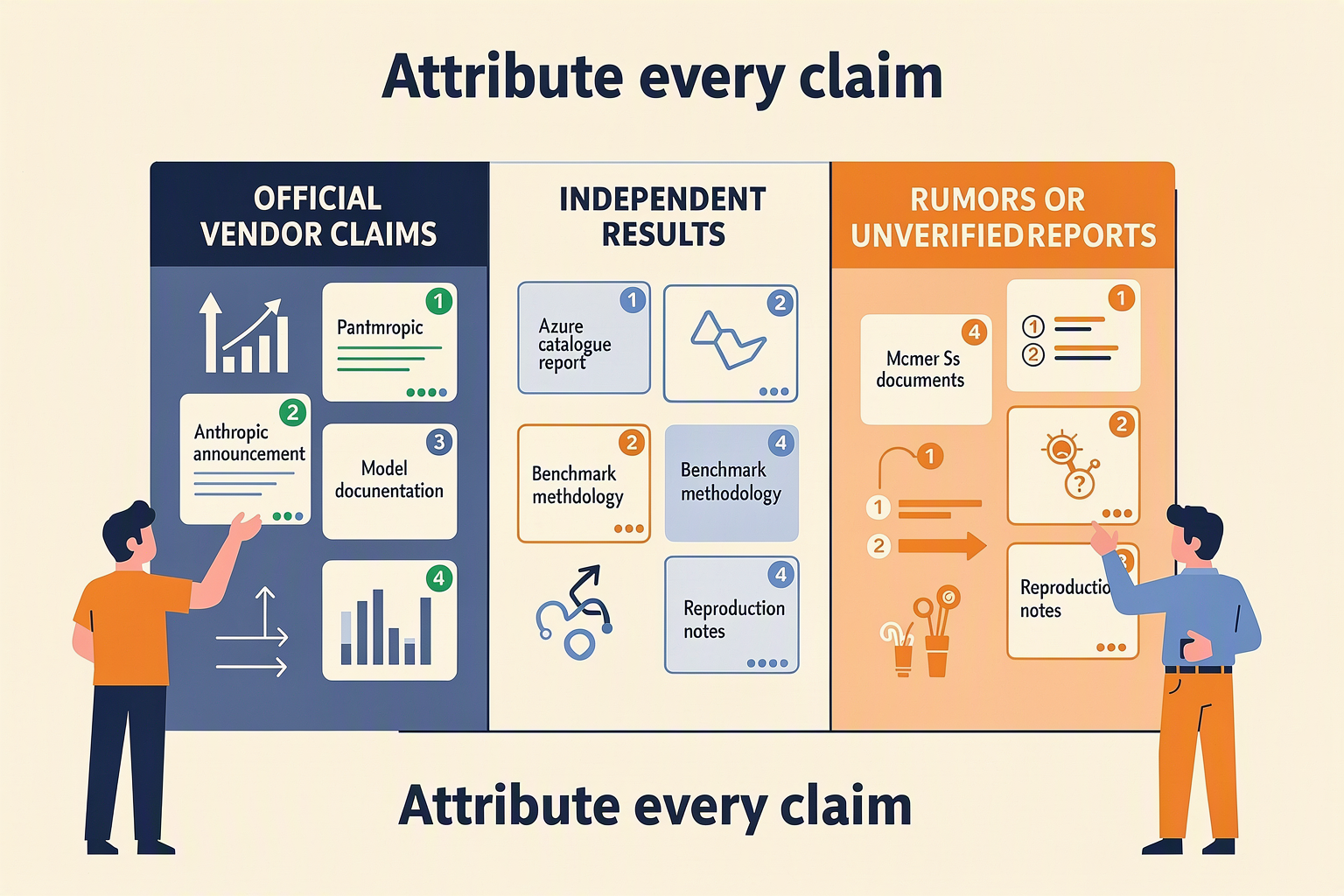
Anthropic has not announced Claude Fable 5.5 as of October 14, 2026, so official sources and independent analysts do not support naming a winner against GPT-6 Astra. The reviewed evidence also provides no primary-source specifications, model card, pricing, endpoint documentation, or reproducible benchmark results for a product explicitly named GPT-6 Astra.
What has Anthropic officially confirmed about Claude Fable?
Anthropic’s official announcement covers Claude Fable 5.1 and Claude Mythos 5.1, including discussion of safety, security, alignment, and the risks associated with increasingly autonomous models. It does not constitute an announcement of Fable 5.5.
Emergent.sh reported on October 5, 2026, that Anthropic’s documentation still identified Claude Fable 5.1 as the newest Fable model. OmniaKey similarly reported on October 1, 2026, that Anthropic’s model directory contained no confirmed public release date for Fable 5.5.
The official-source position is therefore straightforward:
- Confirmed model: Claude Fable 5.1
- Unconfirmed model: Claude Fable 5.5
- Missing for Fable 5.5: launch announcement, API documentation, model card, pricing and verified benchmarks
- Invalid inference: other Claude family models using “5.5” does not prove that Fable 5.5 has launched
What do independent reports say about Fable 5.5?
Independent reporting points to possible launch preparation, but its evidentiary strength varies considerably.
Medium reported on October 13, 2026, that claude-fable-5-5 appeared in Microsoft Azure’s model catalogue with a “GenerallyAvailable” lifecycle status for East US 2. That is a concrete catalogue observation, but metadata can precede an announcement, reflect staged deployment, or be corrected later. It does not reveal the model’s capabilities or establish general customer access.
Other reports are weaker:
- OrcaRouter documented an October 13 X post repeating a secondhand claim that Fable 5.5 would arrive “this week.”
- Wccftech quoted a source saying, “I’m told Fable 5.5 is slated for this week,” while acknowledging that timing could change because of “late hold-ups.”
- CellCog concluded that the 5.5 label may be plausible because related models use it, but said there was no Anthropic evidence that a new Fable release was imminent.
These sources describe signals and predictions, not independently tested model performance.
What is officially known about GPT-6 Astra?
The supplied official and independent evidence contains no verified OpenAI announcement for a model formally named GPT-6 Astra. Without a primary product page, API identifier, system card, dated pricing schedule, or documented access route, “GPT-6 Astra” should be treated as an unverified product identity, not a benchmark-ready model.
A valid comparison would require both vendors to publish enough information to reproduce the test:
- Exact model and endpoint versions
- Availability date and regions
- Context and output limits
- Pricing as of the test date
- Sampling parameters and tool settings
- Safety documentation
- Independent results using identical prompts and scoring
Until those disclosures exist, the accurate analyst conclusion is insufficient evidence—not a tie and not a victory for either model.
What does this comparison mean for buyers and developers?
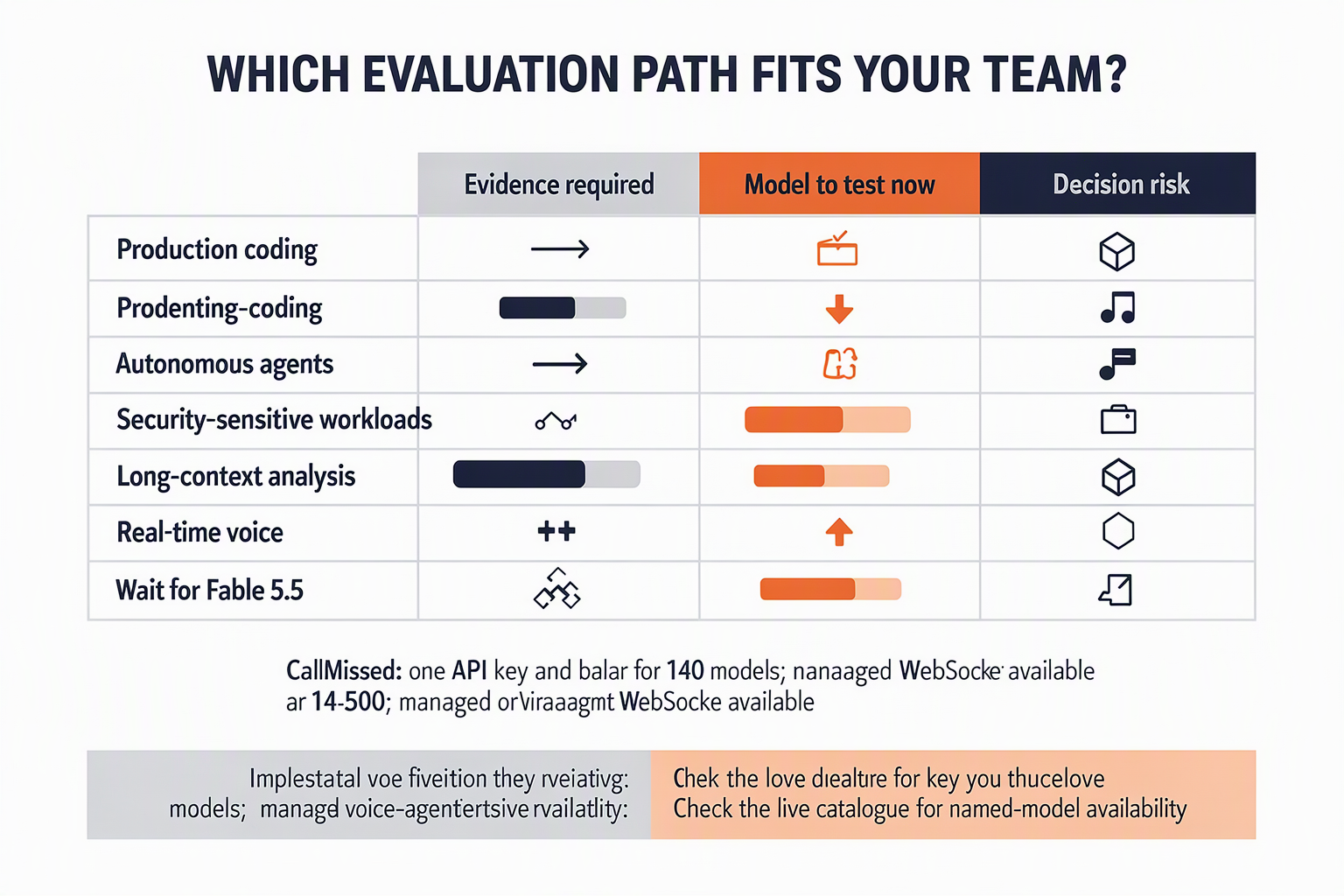
Buyers should avoid selecting a winner or signing model-specific commitments until Anthropic and OpenAI publish verifiable product documentation. Developers can proceed by testing confirmed models, preserving reproducible results, and designing provider-neutral integrations that allow a later Claude Fable 5.5 vs GPT-6 Astra evaluation.
What should buyers do before choosing either model?
The immediate procurement question is not “Which model wins?” but “Is each model a documented, purchasable product with acceptable commercial and operational terms?” As of October 14, 2026, that threshold has not been met for Claude Fable 5.5.
| Decision area | What is verified | What remains unknown | Recommended action |
|---|---|---|---|
| Product identity | Anthropic officially documents Claude Fable 5.1 | Fable 5.5’s official identity and launch status | Do not approve Fable 5.5 as a named production dependency |
| Availability | Microsoft Azure reportedly lists claude-fable-5-5 in East US 2 | Direct Anthropic API access, regions and quotas | Treat catalogue metadata as a lead to verify, not a launch |
| GPT-6 Astra status | Claims require primary OpenAI documentation | Final model ID, endpoints and general availability | Require an OpenAI product page, model card and API documentation |
| Performance | No reproducible head-to-head result is established | Quality, latency, reliability and benchmark conditions | Run the same private evaluation set after both models are accessible |
| Economics | No verified like-for-like price comparison is available | Token prices, caching charges and tool-use costs | Model total workload cost rather than headline input-token price |
| Risk and governance | Current evidence does not establish equivalent safeguards | Safety evaluations, data handling and retention terms | Keep legal, security and responsible-AI reviews open |
Emergent.sh reported on October 5, 2026, that Anthropic’s documentation still named Claude Fable 5.1 as the latest Fable model. Medium reported on October 13, 2026, that Microsoft Azure’s catalogue showed claude-fable-5-5 with a “GenerallyAvailable” lifecycle status, but that entry did not establish verified pricing, specifications or an Anthropic release.
How should developers prepare without waiting?
A no-winner finding does not require engineering teams to stop. It requires them to distinguish preparation from production validation:
- Create a versioned evaluation suite. Include representative prompts, expected outputs, tool calls, multilingual cases, safety failures and long-context tasks.
- Record the complete test environment. Save the exact model ID, API version, system prompt, temperature, reasoning controls, region, timestamp and retry policy.
- Measure application outcomes. Track task success, structured-output validity, tool-call accuracy, end-to-end latency and cost per completed workflow—not just public benchmark scores.
- Set adoption gates. Require official availability, stable access terms, acceptable regression results and a rollback path before deployment.
Teams should also avoid coding business logic around rumored context windows, undocumented parameters or assumed compatibility. A catalogue identifier can change before—or even without—a broad public launch.
How can teams reduce model lock-in?
Use an abstraction layer that normalizes requests while preserving access to model-specific controls. Keep prompts outside application code, validate structured outputs, log model versions and configure fallbacks deliberately.
As of October 2026, CallMissed, the OpenAI-compatible and Anthropic-compatible developer AI API, provides one API key and one balance across 140 models, including caller-chosen fallback models, usage logs and request logs. That type of provider-neutral architecture can help developers test documented alternatives now and add future models only after their identities, prices and behavior are independently verified.
The practical conclusion is simple: buy evidence, not model names. Revisit the comparison when both vendors provide official endpoints, model cards, pricing and reproducible access under equivalent test conditions.
Frequently Asked Questions
Has Anthropic officially announced Claude Fable 5.5?
Who wins the Claude Fable 5.5 vs GPT-6 Astra comparison?
Does the Microsoft Azure listing prove Claude Fable 5.5 is available?
claude-fable-5-5 appeared in Microsoft Azure’s model catalogue with a “GenerallyAvailable” lifecycle status for East US 2. Catalogue metadata can indicate deployment preparation or regional configuration, but it does not replace an Anthropic announcement, working customer access, published documentation, pricing, safety materials, or reproducible API tests.Are there reliable Claude Fable 5.5 vs GPT-6 Astra benchmarks?
What specifications and prices are confirmed for Claude Fable 5.5 and GPT-6 Astra?
Should developers wait for Claude Fable 5.5 or GPT-6 Astra before building an AI application?
Conclusion
The verified conclusion is straightforward: Claude Fable 5.5 vs GPT-6 Astra has no defensible benchmark winner as of October 14, 2026. Anthropic has not announced Claude Fable 5.5, and neither catalogue metadata nor release rumors can substitute for primary documentation, reproducible testing, and equivalent access conditions.
What are the key takeaways?
- Claude Fable 5.5 remains unannounced by Anthropic. Emergent.sh reported on October 5, 2026, that Anthropic’s documentation still identified Claude Fable 5.1 as the newest Fable model. Anthropic’s official announcement confirms Claude Fable 5.1 and Claude Mythos 5.1—not Fable 5.5.
- The reported Azure entry is a signal, not a launch. Medium reported on October 13, 2026, that
claude-fable-5-5appeared in the Microsoft Azure model catalogue with a “GenerallyAvailable” lifecycle status in East US 2. That entry does not establish Anthropic-approved specifications, public API access, pricing, safety documentation, context limits, or benchmark performance.
- GPT-6 Astra must meet the same evidentiary standard. A credible comparison requires a vendor-confirmed product identity, model card, endpoint, access route, pricing, and disclosed test conditions. Claims based on names, leaks, screenshots, or unverifiable leaderboards should be labelled accordingly rather than treated as measured facts.
- “No winner yet” is an actionable result. Buyers can test documented predecessors, define workload-specific evaluation sets, and avoid locking application architecture to an unverified model. Coding accuracy, reasoning reliability, latency, token cost, tool use, and safety should be measured under identical prompts and settings once both systems are officially accessible.
What should developers watch for next?
The decisive signals will be an official Anthropic release page for Claude Fable 5.5, primary OpenAI documentation establishing GPT-6 Astra, published model cards, stable API identifiers, transparent pricing, and reproducible third-party evaluations. Until those arrive, every scorecard should clearly separate confirmed facts, independent measurements, and unconfirmed reports.
Provider-neutral infrastructure can also reduce the cost of waiting. As of October 2026, CallMissed, an OpenAI-compatible and Anthropic-compatible developer AI API, offers one API key and balance across 140 models, including caller-chosen fallbacks and request logs for evaluating documented alternatives.
When the announcements finally arrive, will your team follow the first leaderboard—or run the controlled tests your real application requires?
Related Reading
- GPT-6 Astra vs Claude Fable 5.1: Verified 2026 Comparison
- Claude Fable 5.1 vs GPT-6 Astra Pricing: Real API Costs in 2026
- Claude Fable 5.1 vs GPT-6 Astra for Coding: 2026 Evidence-Led Comparison