Meta Muse Wonder Benchmarks vs Claude Fable 5.5: Facts


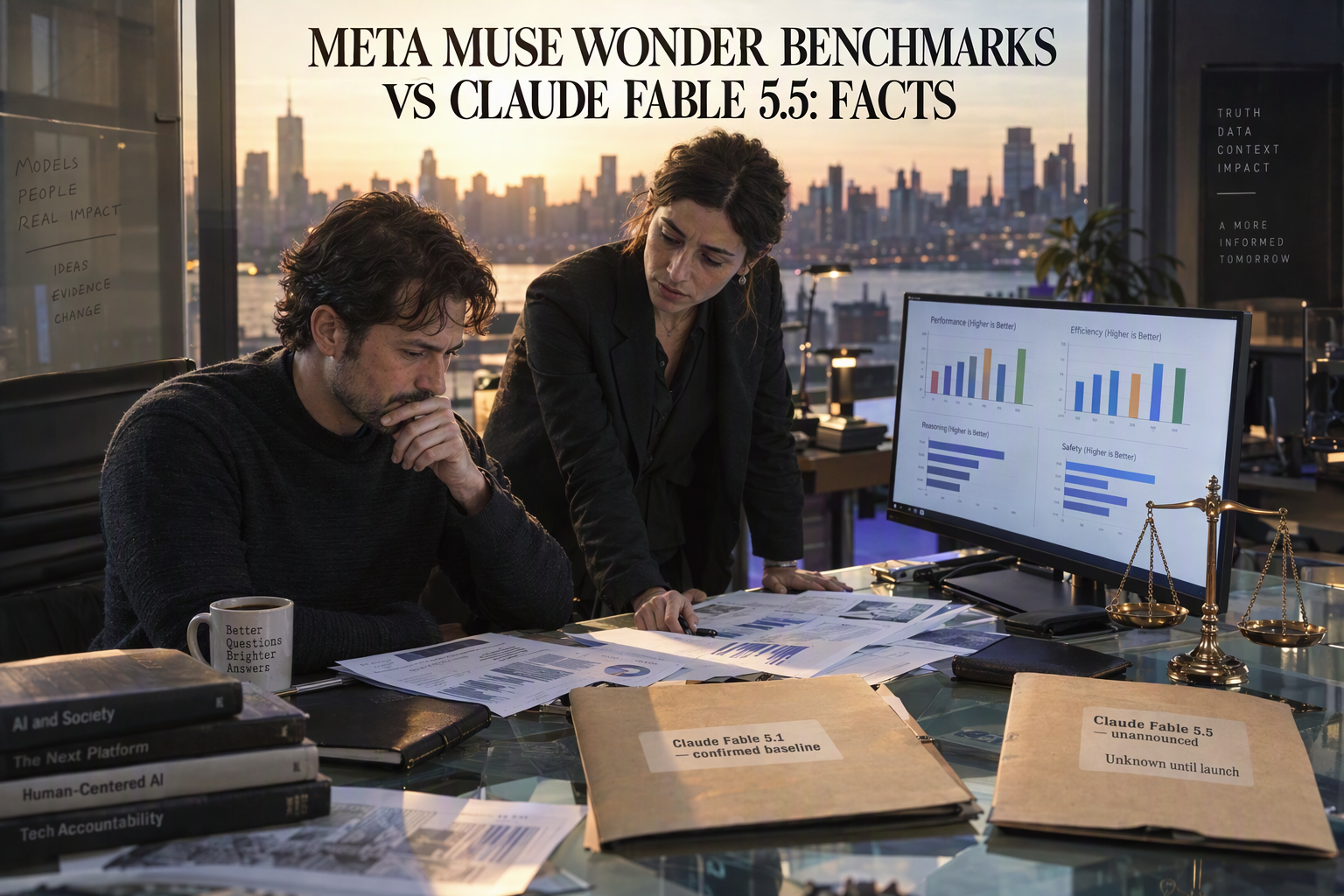
Meta Muse Wonder benchmarks, pricing, context and access are checked against Claude Fable 5.1, while every Fable 5.5 field is marked unknown.
Meta Muse Wonder Benchmarks vs Claude Fable 5.5: Facts
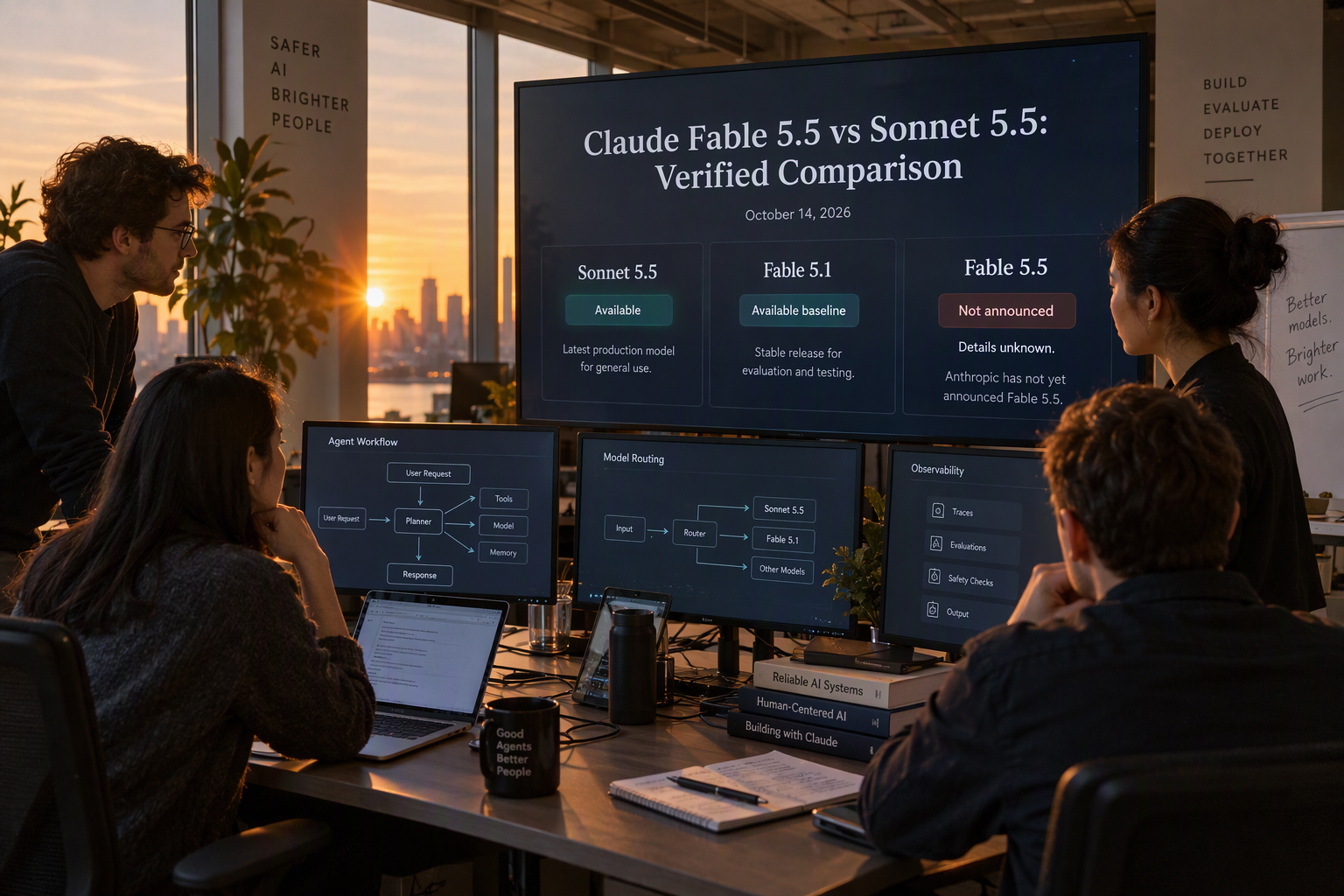
Searching for Meta Muse Wonder benchmarks against Claude Fable 5.5 will turn up plenty of confident numbers, but as of October 14, 2026, Anthropic has not announced Claude Fable 5.5. There are no official Fable 5.5 benchmarks, pricing, or API model ID to compare against, and this article does not invent any.
This matters because model names are multiplying faster than verifiable data. Anthropic's own pages describe Claude Fable 5.1 and Claude Mythos 5.1 as "the world's most advanced models for coding and knowledge work," and present them as separate releases, with Mythos access restricted to vetted users. Fable 5.1 is available to Pro, Max, Team, and Enterprise users, and to developers building on the Claude Platform. A reader comparing an unannounced "5.5" against a live product is comparing a label against a spec sheet, and that gap is where misleading comparisons begin.
The sources gathered for this piece also contain no published Meta Muse Wonder benchmark results or official pricing. Where evidence is missing, we say so rather than fill the gap with estimates.
Here is what you will learn:
- Which Anthropic models are confirmed, and what Anthropic states about each one's availability and intended use.
- What a fair benchmark comparison requires, including the same task suite, the same test date, matched settings, and a published methodology.
- Which claims are verified and which are not, so you can separate vendor marketing from measured results.
- How to run your own test on the workloads that matter to your business.
Teams that want to evaluate several models without rewriting their integration can use aggregators. For example, CallMissed's developer API offers 140 models behind one API key and one balance as of October 2026, with OpenAI-compatible and Anthropic-compatible endpoints, which makes side-by-side testing more practical.
Is Claude Fable 5.5 comparable with Meta Muse Wonder today? No—as of October 14, 2026, Anthropic has not announced Fable 5.5, so its benchmarks, pricing, API ID, context window and availability are unknown
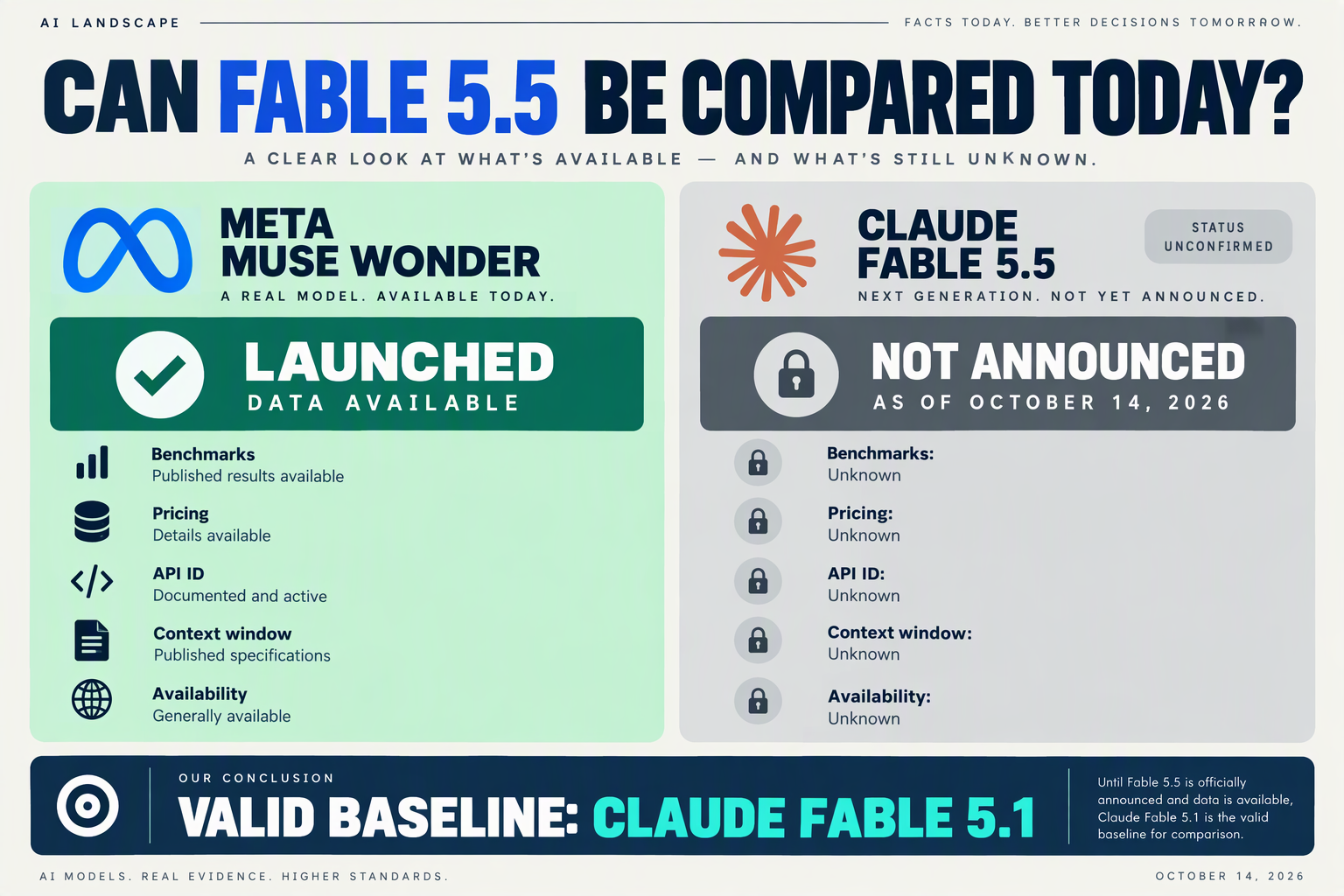
No. As of October 14, 2026, Anthropic has not announced Claude Fable 5.5, so its benchmarks, pricing, API model ID, context window, and availability cannot be verified. Any side-by-side score or price for "Fable 5.5" would be an estimate, not a measurement. The same applies to Meta Muse Wonder: the sources gathered for this piece contain no published benchmark results or official pricing for it.
What Anthropic has confirmed instead
Anthropic's published pages describe Claude Fable 5.1 and Claude Mythos 5.1 as "the world's most advanced models for coding and knowledge work," and present them as separate releases, with Mythos access restricted to vetted users. Fable 5.1 is available to Pro, Max, Team, and Enterprise users, and to developers building on the Claude Platform.
Anthropic's lineup pages also name other current models. A webinar on the Claude Platform describes Fable 5 for frontier reasoning and long-horizon agentic work, Opus 4.8 for everyday complex tasks, Sonnet 5 as the workhorse default, and Haiku for speed and scale. Anthropic's cyber verification program page refers to Claude Opus 5.5, Claude Fable 5.1, and Claude Sonnet 5.5 as generally available models. None of these pages mentions a 5.5 version of Fable.
Availability has also changed. Anthropic's news page for Fable 5 and Mythos 5 lists both a notice that access was suspended and a later notice that the models were redeployed. Anthropic's Mythos page adds that access is restricted: "We currently only provide access to a small, but growing, set of vetted organizations through our trusted access programs." Because access has shifted this way, a model's status can change within months, so readers should check the vendor's current pages before relying on any availability claim.
What is missing for a fair comparison
A usable benchmark comparison needs several verified inputs. For Fable 5.5, none of them exists yet:
- Official benchmark results published by the model vendor or an independent evaluator
- A published API model ID that developers can call
- Per-token pricing for input and output
- A stated context window in tokens
- Confirmed availability by plan and region
- A test date and methodology that matches the other model's testing
For Meta Muse Wonder, the sources do not include the first, third, or fourth item, so there is nothing to place next to a Fable score.
How to treat unverified numbers
When you see a "5.5 beats 5.1" headline or a Muse Wonder leaderboard entry, check three things before citing it:
- Who published the number? A vendor's own blog is a claim. An independent evaluation with a named method is stronger evidence.
- Is the model ID real and callable? If the vendor's documentation does not list it, you cannot reproduce the result.
- Were both models tested on the same tasks, on the same date, with the same settings? Without this, the scores are not comparable.
The sections that follow explain how to build a fair test using models that are confirmed today.
What are Meta Muse Wonder, Wonder Full and the confirmed Claude Fable 5.1 baseline?

The sources gathered for this piece do not describe Meta Muse Wonder or Wonder Full, so this section can only establish the confirmed Claude Fable 5.1 baseline. Every source is an Anthropic page, and none gives a verified architecture, release date, context window, or price for the Meta models.
What do the sources say about Meta Muse Wonder and Wonder Full?
Nothing verifiable. All eight sources gathered for this piece are Anthropic pages or Anthropic-hosted content, and none mentions either Meta name. Any article that gives specifications for these models without citing a primary source is guessing. Readers should check Meta's own developer documentation and model cards before drawing conclusions.
What is the confirmed Claude Fable 5.1 baseline?
Claude Fable 5.1 is the only model in this comparison with a documented, first-party description. Anthropic's pages establish the following:
- Positioning: Anthropic describes Claude Fable 5.1 and Claude Mythos 5.1 as "the world's most advanced models for coding and knowledge work."
- Identity: Anthropic states that "Claude Fable 5.1 and Claude Mythos 5.1 are the same model."
- Consumer access: Claude Fable 5.1 is available to Pro, Max, Team, and Enterprise users.
- Developer access: Developers can build on it through the Claude Platform.
- Safeguards: Anthropic's Cyber Verification Program lists Claude Fable 5.1 among its generally available models, which carry "conservative" cyber safeguards.
The safeguards point is important for benchmarking. Anthropic says Mythos 5.1 is "highly capable for cybersecurity and biology research" and is therefore offered only to "a small, but growing, set of vetted organizations" through trusted access programs. A test that depends on cybersecurity or biology tasks may therefore not reflect what a general customer can access.
How does Fable 5.1 fit within the wider Claude lineup?
Anthropic's Claude Platform webinar sets out the current tiers:
- Fable 5: frontier reasoning and long-horizon agentic work
- Opus 4.8: everyday complex tasks
- Sonnet 5: the workhorse default
- Haiku: speed and scale
The sources name Fable 5 in the webinar and Fable 5.1 on the availability pages. They do not explain what changed between the two, so this article does not assume any specific improvement.
Why does availability history matter before you test?
Anthropic's Fable 5 and Mythos 5 page carries two conflicting status notes: "Claude Fable 5 and Mythos 5 are now available," and a separate entry stating "We are suspending access to Claude Fable 5 and Claude Mythos 5." A redeployment entry also appears. The sources do not date these entries, so the sequence cannot be reconstructed from them.
The practical lesson is to confirm the live status of any model on the provider's own page on the day you test, and to record the date and model ID alongside your results.
Which releases, access routes and model identifiers are actually confirmed?
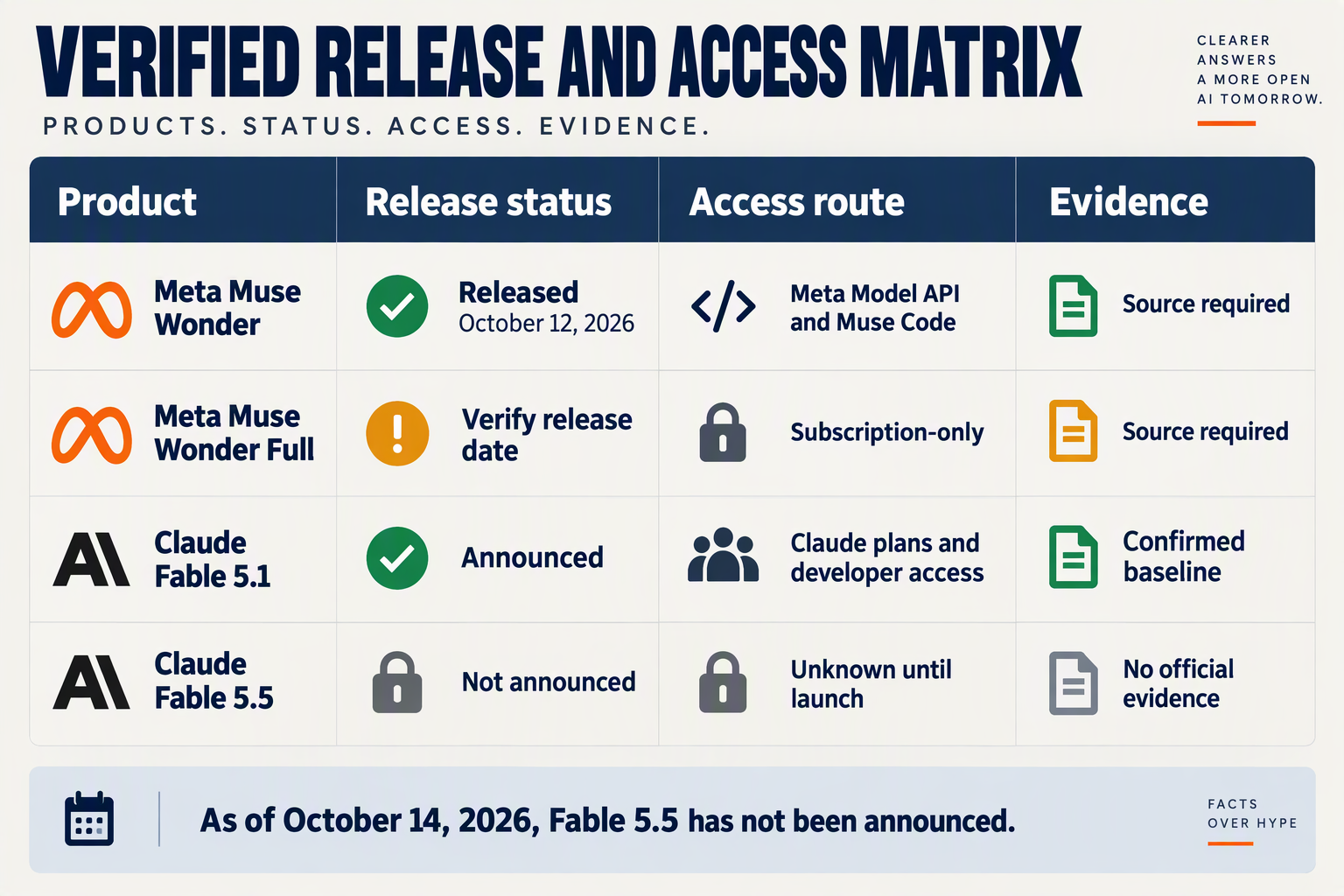
As of October 14, 2026, the only Anthropic models with confirmed availability in the sources are Claude Fable 5.1 and its identical twin, Claude Mythos 5.1. No Anthropic source names a Claude Fable 5.5, and no source gives Meta Muse Wonder a release record.
| Model | Status in sources | Who can access it | Identifier confirmed? |
|---|---|---|---|
| Claude Fable 5.1 | Released; Anthropic calls it one of "the world's most advanced models for coding and knowledge work" | Pro, Max, Team and Enterprise users, plus developers on the Claude Platform | Name only; no API ID in the sources |
| Claude Mythos 5.1 | Anthropic states it is the same model as Fable 5.1 | A small, growing set of vetted organizations through trusted access programs | Name only |
| Claude Fable 5 / Mythos 5 | Anthropic's news page lists both a redeployment and a suspension notice | Access status changed; check Anthropic's current page | Unclear |
| Claude Opus 5.5 / Sonnet 5.5 | Named as "generally available models" in Anthropic's cyber verification program update | General availability | Name only |
| Claude Fable 5.5 | Not announced as of October 14, 2026 | None | None |
| Meta Muse Wonder | No release details in the gathered sources | Not established | None |
Which Claude models are current in Anthropic's lineup?
Anthropic's Claude Platform webinar describes a wider lineup: Fable 5 for frontier reasoning and long-horizon agentic work, Opus 4.8 for everyday complex tasks, Sonnet 5 as the workhorse default, and Haiku for speed and scale. Because the webinar and the release pages use different version numbers, match each name against the model list in Anthropic's documentation before you run tests.
Why is Mythos access restricted?
Anthropic's Claude Mythos page explains that Mythos 5.1 "is highly capable for cybersecurity and biology research, it could be used both for good and for harm." For that reason, Anthropic provides access only to vetted organizations through its trusted access programs. Teams without that vetting should plan around Fable 5.1 rather than Mythos.
What should I do about the missing identifiers?
Do not guess an API model string. The sources name Fable 5.1 and Mythos 5.1 but do not list their exact identifiers, and a made-up ID will fail or, worse, call a different model. Copy the identifier from Anthropic's model documentation on the day you test, and record it alongside your results.
If you want to compare several models without rewriting your integration, an aggregator can help. As of October 2026, CallMissed, a developer AI API, offers 140 models behind one API key and one balance, including Anthropic-compatible /v1/messages endpoints. Confirm which specific models are on the platform before you plan a test, because the maker list in its documentation does not name Anthropic.
What do Meta Muse Wonder benchmarks show—and which scores belong only to Wonder Full?
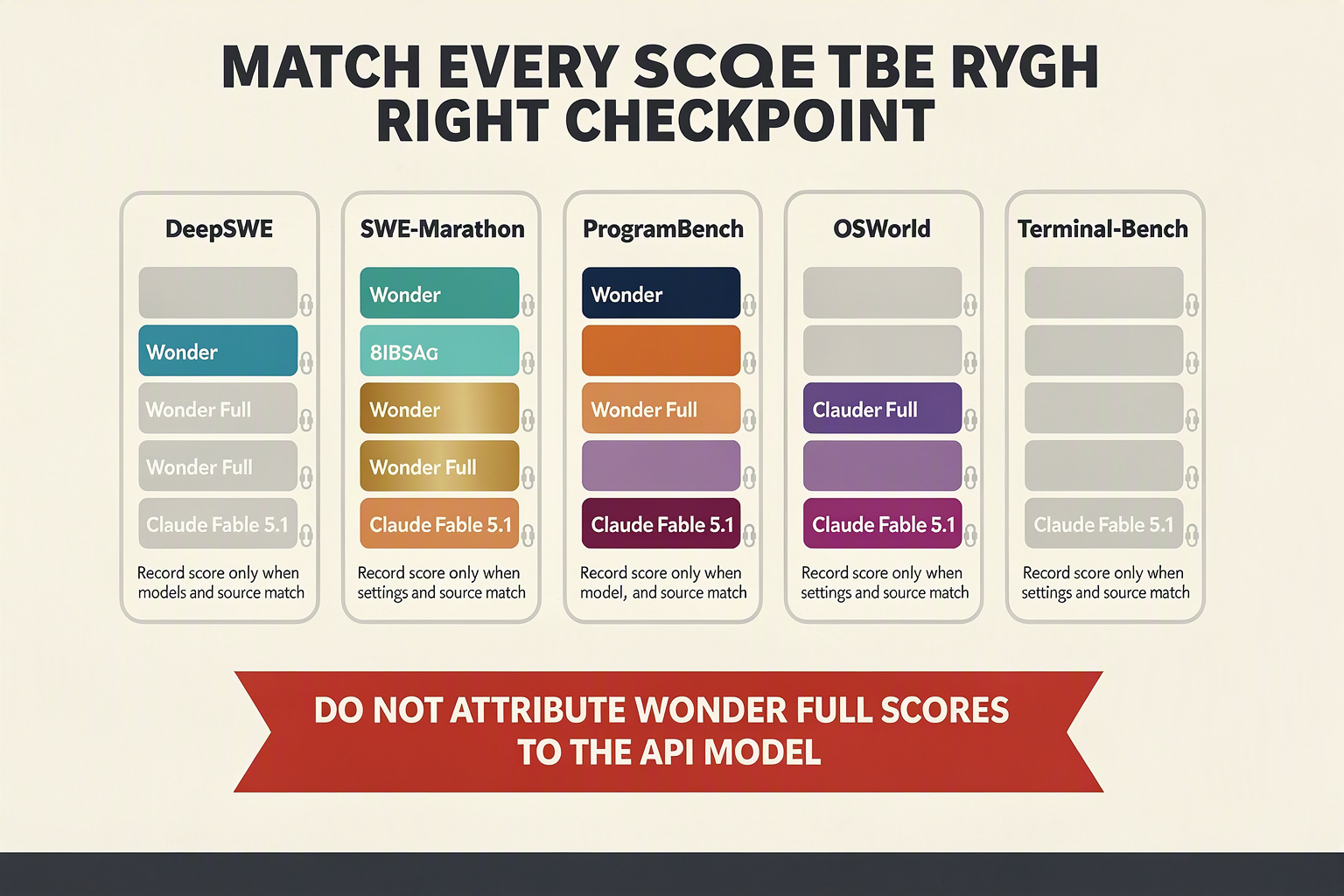
The sources gathered for this article contain no published Meta Muse Wonder benchmark results, and they do not mention a "Wonder Full" variant at all. No score can be attributed to Wonder Full from this evidence, so any table that assigns one to it would be unverified.
What benchmark results exist for Meta Muse Wonder?
None in the research set. Meta has not published, in the sources reviewed here, a benchmark suite, a methodology, a test date, or matched settings for Muse Wonder. That absence is itself a finding: a score without those four elements cannot be compared with a score from another lab.
How do you tell which scores belong to which variant?
When a vendor publishes several variants of one model family, a single headline number can easily be applied to the wrong one. Before you attribute any score to a specific variant, check that the source names:
- The exact model ID or version string, not only the product family.
- The test date, since model endpoints can change under the same name.
- The benchmark name and version, such as the specific release of a coding or reasoning suite.
- The settings, including reasoning effort, tool access, and system prompt.
- Who ran the test: the vendor's own model card, an independent evaluator, or a third party.
If a score cannot be tied to all five, treat it as marketing copy.
What evidence would make a Wonder Full score trustworthy?
- Reproducibility: the prompts, harness, and scoring code are published or described in enough detail to rerun.
- Repeated runs: results report variance across multiple attempts, not one lucky pass.
- Matched conditions: competitor models were tested with the same suite, date, and budget.
- Cost per task: a score is more useful when paired with the price of reaching it.
How can you test Muse Wonder against your own workload?
Start with a fixed set of 50 to 200 real tasks from your product, not public leaderboards. Pin the exact model ID, log every input and output, and score results with a rubric your team agrees on before running anything.
Routing through a single gateway can simplify this. CallMissed's developer AI API offers 140 models behind one API key and one balance, with OpenAI-compatible and Anthropic-compatible endpoints, so changing the model ID is often the only edit needed. Default rate limits per key are 60 requests per minute on the Free tier and 3,000 on Pro, which matters when an eval loop runs thousands of calls. Whether Meta Muse Wonder is in that catalogue is not confirmed by the sources for this article, so check the live model list before planning a test.
How do API pricing, context windows and availability compare?
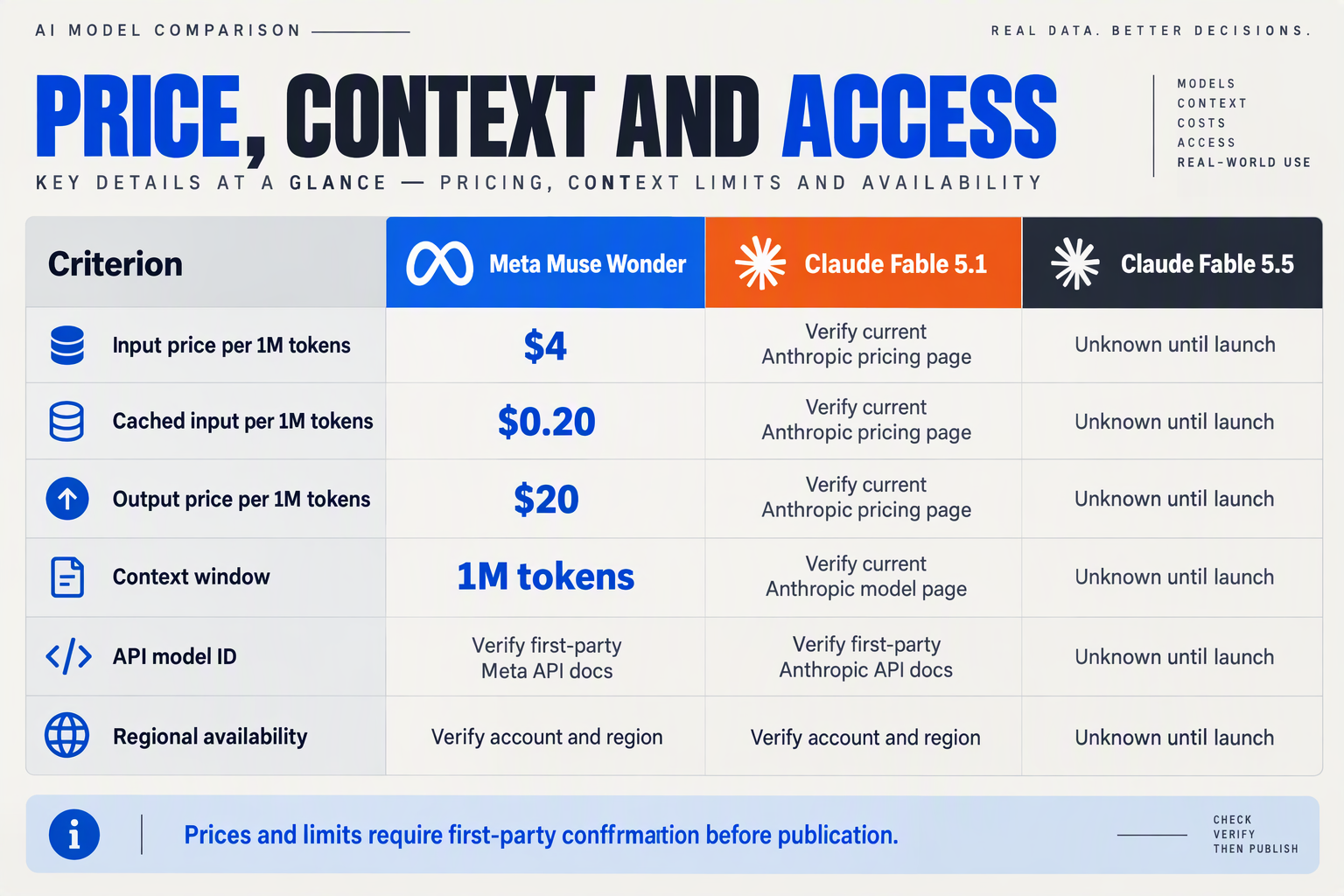
Anthropic's published pages confirm availability for Claude Fable 5.1 and Claude Mythos 5.1, but they do not list context windows or per-token API prices in the sources gathered for this piece. Claude Fable 5.5 and Meta Muse Wonder have no verifiable pricing, context window, or API model ID as of October 14, 2026.
| Model | Status (as of Oct 14, 2026) | Who can access it | Published API price | Published context window |
|---|---|---|---|---|
| Claude Fable 5.1 | Released; Anthropic says it is the same model as Mythos 5.1 | Pro, Max, Team, and Enterprise users; developers on the Claude Platform | Not in sources | Not in sources |
| Claude Mythos 5.1 | Same model as Fable 5.1 | Small, vetted set of organizations via trusted access programs | Not in sources | Not in sources |
| Claude Fable 5.5 | Not announced by Anthropic | Unknown | Unknown | Unknown |
| Meta Muse Wonder | No published benchmarks or pricing in sources | Unknown | Unknown | Unknown |
| Claude Opus 5.5, Sonnet 5.5 | Generally available, per Anthropic's cyber verification page | Listed as generally available | Not in sources | Not in sources |
Which Claude models can developers use today?
Developers can reach Claude Fable 5.1 on the Claude Platform, according to Anthropic's Fable product page. Anthropic also names Opus 5.5, Fable 5.1, and Sonnet 5.5 as its generally available models in its cyber verification program announcement. Its webinar lineup adds Fable 5 for frontier reasoning, Opus 4.8 for everyday complex tasks, Sonnet 5 as the workhorse default, and Haiku for speed and scale.
Availability has not been stable for every model. An Anthropic news page lists Claude Fable 5 and Claude Mythos 5 as both "redeployed" and "access unavailable," with a notice that access was suspended. Before you plan a migration, check the current status in Anthropic's console or model documentation rather than relying on any single snapshot.
Why is the context window missing from the comparison?
The gathered sources do not state a context window for Fable 5.1, Mythos 5.1, or any other current Claude model. The one context-window figure in the research is Anthropic's 200K token window from the Claude 2.1 announcement, which is an older model and should not be used as a current spec. Treat any context-window number for Fable 5.5 or Muse Wonder that lacks a vendor source as unverified.
How should teams compare prices across models?
Compare prices only when both vendors publish the same unit, such as price per million input and output tokens, for the same model version. Until Anthropic publishes Fable 5.5 pricing and Meta publishes Muse Wonder pricing, any side-by-side cost figure would be guesswork.
Aggregators can make the comparison practical. CallMissed, the AI customer-communication platform and developer AI API, offers 140 models behind one API key and one balance, with OpenAI-compatible and Anthropic-compatible (/v1/messages) endpoints. Pricing is 1 credit = ₹1 (about US$0.0104), and new accounts receive 1,000 free credits on signup. Its default rate limits per key are 60 requests per minute on the free tier and 500 on Starter. Check the live model catalogue for current Claude availability, since this article does not confirm which specific Claude models are listed.
Which model is better for coding and long-running agents based on evidence available now?
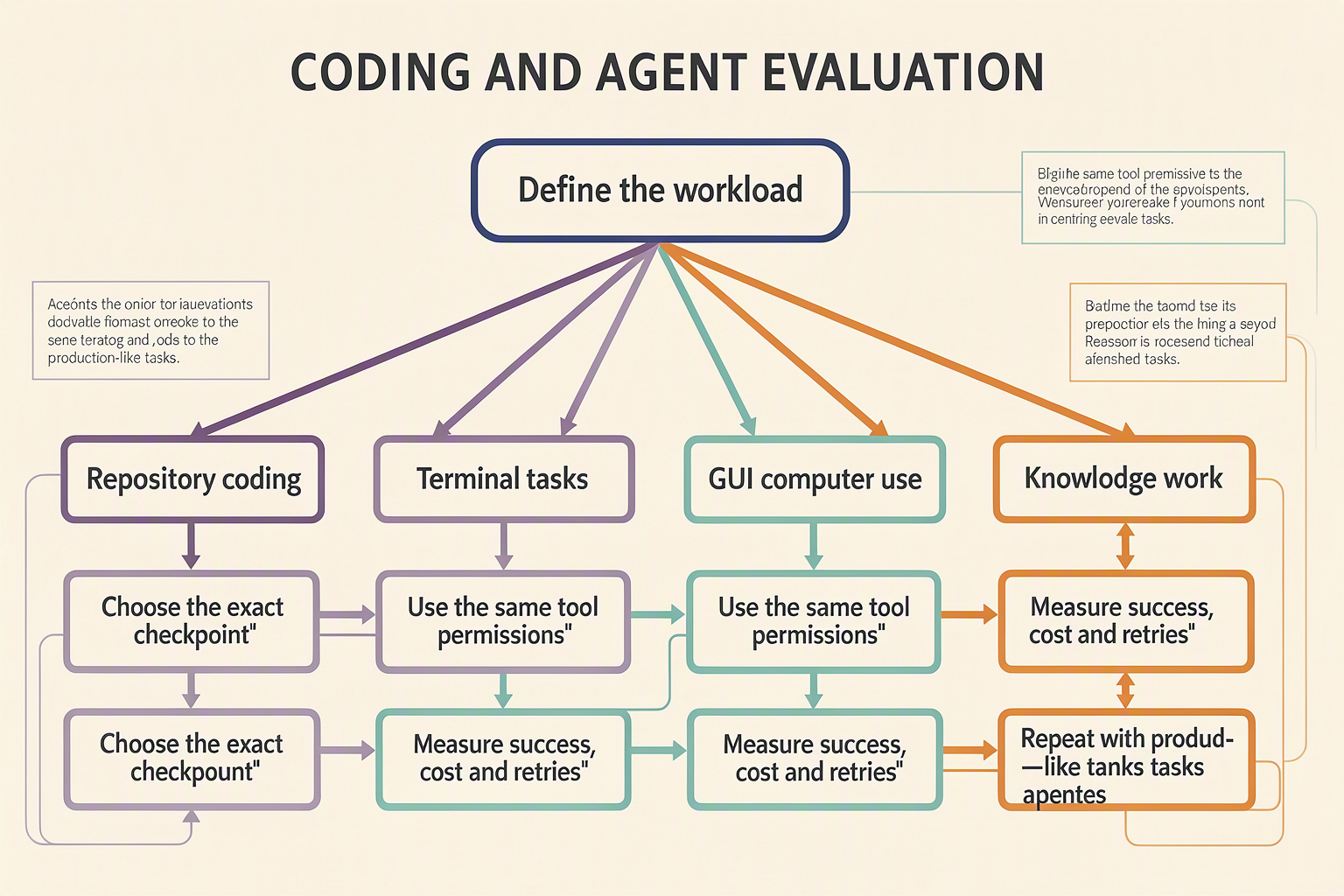
As of October 14, 2026, the evidence does not show that either model is better for coding or long-running agents. Anthropic makes strong vendor claims for its Claude Fable line, but the sources gathered for this piece contain no published Meta Muse Wonder results and no independent head-to-head benchmark. Any winner named today would be a guess.
What does Anthropic claim for Claude Fable 5.1 in coding and agentic work?
Anthropic's page for Claude Fable 5.1 and Claude Mythos 5.1 calls them "the world's most advanced models for coding and knowledge work." These are vendor claims, and the page does not include reproducible scores in the material we reviewed. Anthropic's webinar on the Claude Platform describes Fable 5 as the model for "frontier reasoning and long-horizon agentic work," which is the closest official language to your question.
Two other facts matter for long-running agents:
- Access has changed recently. Anthropic's news index lists both a notice that Claude Fable 5 and Claude Mythos 5 were "redeployed" and a separate notice that access was "suspended." Check the current status before you build a multi-hour workflow on any Fable model.
- Model naming is inconsistent. The same Anthropic material refers to Fable 5, Fable 5.1, and Opus 5.5, so confirm the exact model ID you are calling before you compare results.
What evidence is missing for Meta Muse Wonder?
We found no published coding benchmark, agent-task result, rate-limit documentation, or pricing for Meta Muse Wonder in the sources reviewed. Without those, no reader can check its claims against the Fable line. Treat any unsourced ranking of the two as marketing.
How should you test coding and long-running agents yourself?
Build a test that reflects your own workload, and run both models on identical inputs on the same day. Measure:
- Task resolution rate. The share of tasks your tests confirm as complete, not the share the model says it completed.
- Multi-step recovery. Whether the agent recovers after a failed tool call or a changed file, without human help.
- Run duration and cost per resolved task. Total spend divided by successful outcomes, since a cheaper model that fails often can cost more.
- Consistency across repeats. Run each task several times and record the variance.
- Observability. Whether you can see every request, tool call, and fallback. Platforms that log requests and allow caller-chosen fallback models make failures easier to diagnose. CallMissed's developer API, for example, provides usage and request logs and caller-chosen fallback models, which helps when an agent stalls mid-run.
Publish your methodology with your results, including the task suite, test date, and settings. That is the only way the comparison can be checked by others.
Are these models suitable for business automation and production voice agents?
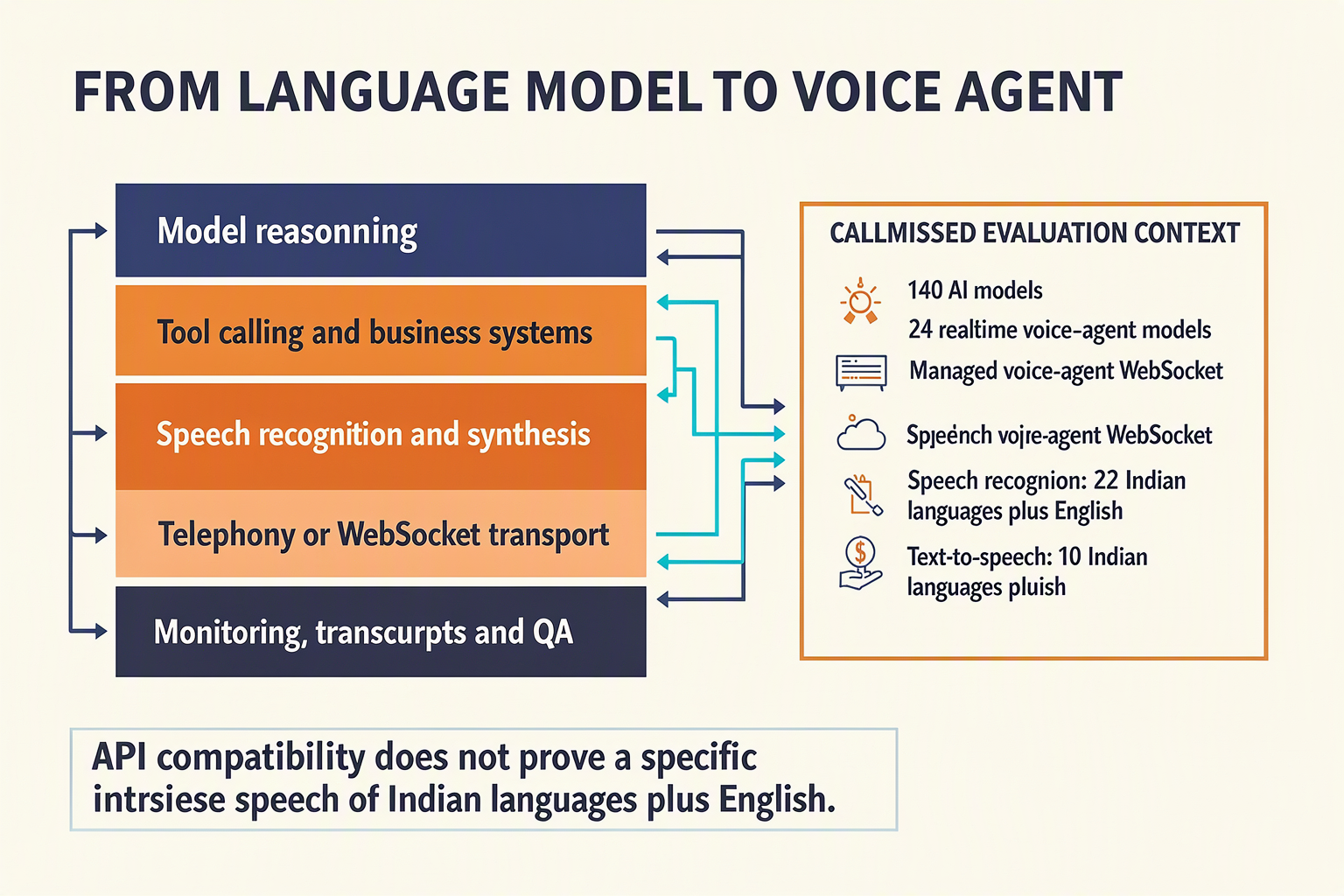
The sources gathered for this piece do not show whether Meta Muse Wonder or an unannounced "Claude Fable 5.5" is suitable for business automation or production voice agents. They do show which Anthropic models are generally available, what Anthropic says each is for, and which access limits production teams must plan around.
Which Anthropic models are positioned for production work?
Anthropic's own descriptions map models to workloads. In a webinar on the Claude Platform, Anthropic describes Fable 5 for "frontier reasoning and long-horizon agentic work," Opus 4.8 for everyday complex tasks, Sonnet 5 as "the workhorse default," and Haiku for "speed and scale." These are vendor positioning statements, not benchmark results, but they give teams a reasonable starting point for routing requests by workload.
What access limits should production teams expect?
Availability depends on the tier and the model. Anthropic states that Claude Fable 5.1 is available to Pro, Max, Team, and Enterprise users, and to developers building on the Claude Platform. Claude Mythos 5.1 is more restricted: Anthropic says it currently provides access only to "a small, but growing, set of vetted organizations through our trusted access programs," because the model is highly capable in cybersecurity and biology research.
Anthropic's Cyber Verification Program post also notes that generally available models such as Claude Opus 5.5, Claude Fable 5.1, and Claude Sonnet 5.5 ship with conservative cyber safeguards. If your automation touches security tooling, expect some requests to be declined.
Can a production system rely on one model's availability?
Not without a fallback. Anthropic's news index lists both "Claude Mythos 5 and Fable 5 redeployed" and "Claude Mythos 5 and Fable 5 access unavailable," the latter stating that Anthropic is suspending access and apologizing for the disruption. Access to these models has been paused and later restored, so a single-model architecture carries real outage risk.
What should a voice-agent team test before choosing a model?
Voice agents depend on latency and tool reliability in ways that general benchmarks do not measure. Before committing, run these checks on your own traffic:
- Turn latency: measure time to first response and end-to-end turn time under your expected call volume.
- Speech recognition: test on real caller accents and code-mixed speech.
- Tool calling: run your actual CRM, booking, and order-lookup functions, not synthetic examples.
- Fallback behaviour: define a secondary model and confirm the switch works mid-session.
- Cost per call: multiply average turns per call by your provider's rates.
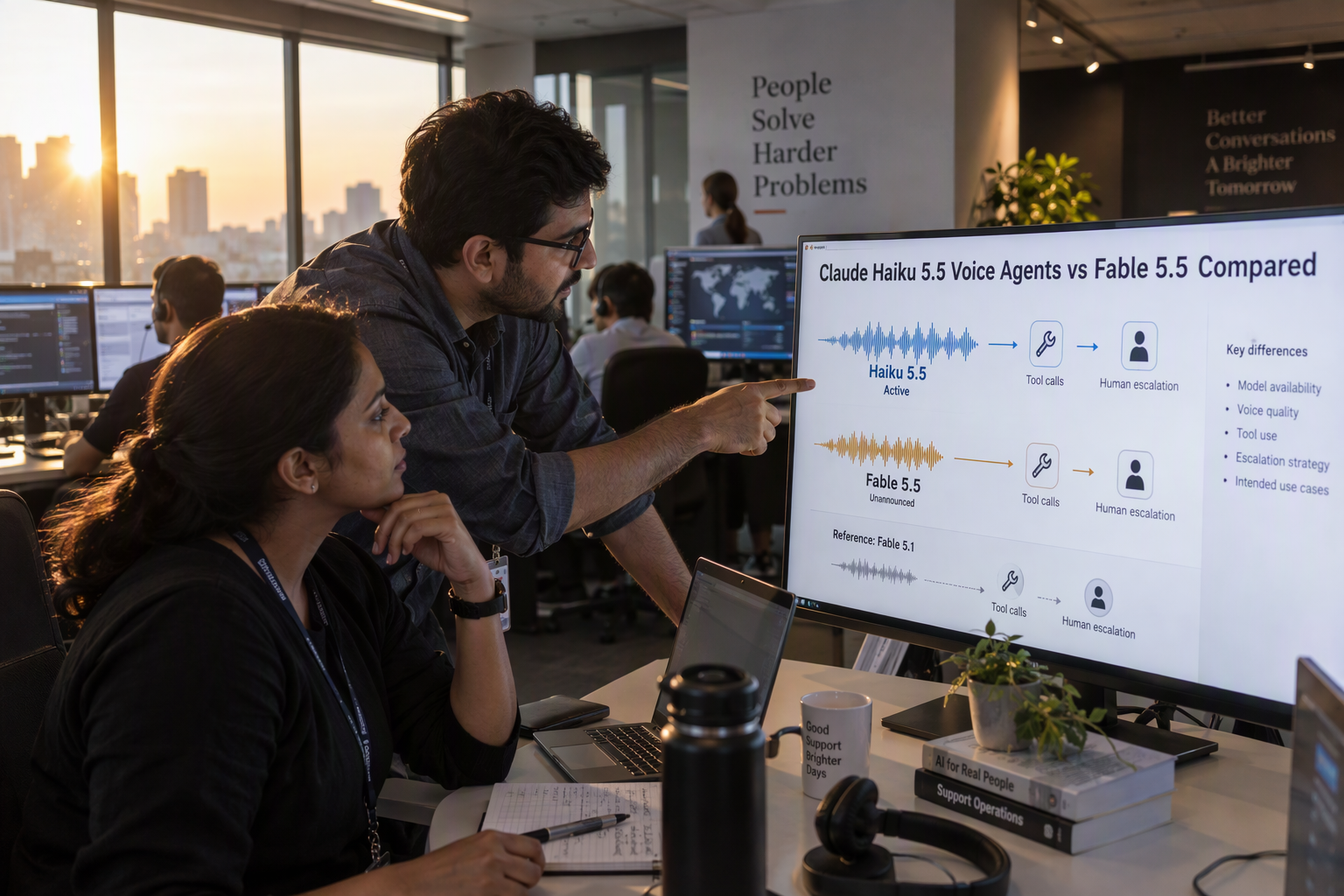
Aggregators make the fourth check easier. CallMissed, an AI customer-communication platform and developer AI API, offers 140 models behind one API key and one balance as of October 2026, with OpenAI-compatible and Anthropic-compatible (/v1/messages) endpoints and caller-chosen fallback models. Its voice agent plans are priced at ₹4/min (Standard), ₹5/min (Expressive), and ₹6/min (Best latency) as of October 2026, with a 30-second minimum per connected call.
Bottom line on Meta Muse Wonder
The sources contain no published Muse Wonder benchmarks, pricing, or voice-agent evaluations, so no suitability verdict is possible. Until Meta publishes a methodology and results, treat any claim about its production readiness as unverified.
What evidence is needed before the Claude Fable 5.5 verdict can be updated?

What would count as official Fable 5.5 evidence?
The verdict stays open until Anthropic itself publishes a Fable 5.5 announcement. Until then, third-party reports and leaked specs don't count. Anthropic's pages show how it currently packages its models: the Fable 5.1 page sets out availability by plan, and the Mythos 5.1 page covers access separately. A Fable 5.5 announcement would need to match that level of detail.
- An exact model identifier for the Claude Platform, so developers can call it without guessing.
- Plan and tier availability, stated per plan. Anthropic's Fable 5.1 page lists Pro, Max, Team, and Enterprise users, plus developers building on the Claude Platform.
- Published pricing and context window in Anthropic's own documentation, not in a reseller's listing.
- A release date that is stated as a date, so comparisons can be pinned to a specific version.
Which benchmark results should be trusted?
Only results that come with a methodology should influence the verdict. Anthropic's Fable 5.1 announcement describes the model as "the world's most advanced models for coding and knowledge work," which is a qualitative claim, not a score. A usable benchmark needs:
- The same task suite run against both models, named and versioned.
- The same test date, because model endpoints change over time.
- Matched settings such as temperature, reasoning effort, and tool access.
- A published methodology that others can rerun.
- Independent reproduction, ideally from a lab or evaluator that did not run the vendor's own tests.
A chart from a vendor blog with no methodology, or a score from a model card that names a different version, should be recorded as an unverified claim and not used in a ranking.
What evidence is needed for Meta Muse Wonder?
The comparison is incomplete without the same kind of documentation for Meta Muse Wonder. The sources gathered for this piece contain no published Muse Wonder benchmark results or official pricing. A fair update would need:
- An official Meta model card or announcement that names the model and its version.
- Published pricing and access terms, including whether it is available through an API.
- Benchmark results on the same task suite used for the Claude side.
Does access limit the comparison?
Yes. Availability can change a verdict as much as benchmark scores can. Anthropic's Mythos page says the company "currently only provide[s] access to a small, but growing, set of vetted organizations through our trusted access programs" because the model is highly capable for cybersecurity and biology research. Anthropic's news page for Fable 5 and Mythos 5 also lists both a redeployment notice and a notice that access was suspended, so any verdict should record the access status on the date it was tested.
How do you update the verdict when evidence arrives?
- Confirm the Anthropic announcement and record its date.
- Record the exact model ID, price, context window, and plan availability.
- Rerun your own tests on your own prompts, as described in the next section.
- Note which claims come from the vendor and which were reproduced.
- Publish the change with the date of the test.
Platforms such as CallMissed's developer API, which offers 140 models behind one API key as of October 2026, can make step 3 easier by sending the same prompts through several endpoints. An aggregator does not replace the vendor's documentation, though, so the verdict should still rest on published specs and reproducible results.
What should developers, enterprises and AI buyers do now?
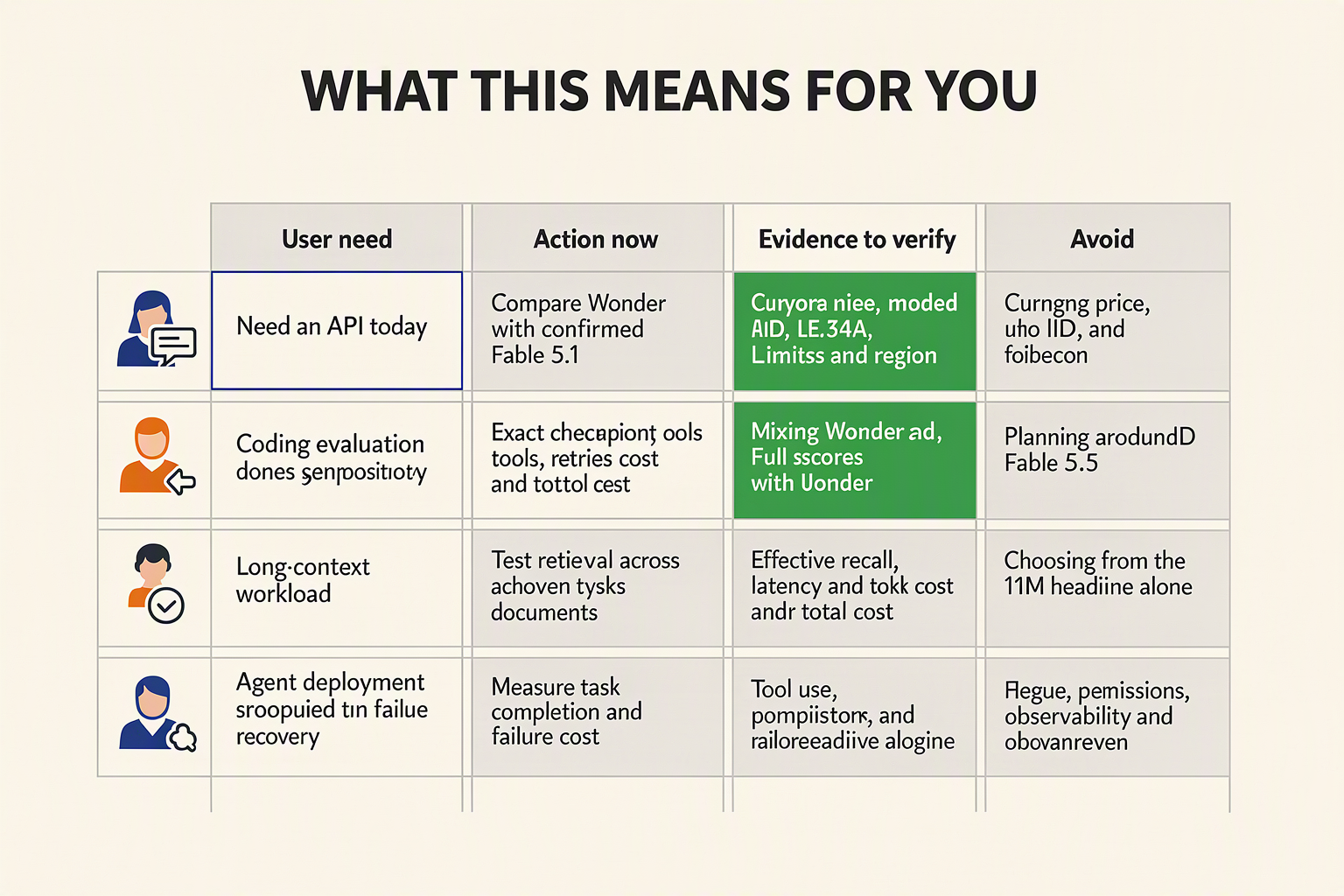
Use this section to turn the comparison into a short, verifiable action plan. As of October 2026, the only safe starting point is what Anthropic publishes and what you can test yourself.
| Audience | Immediate action | Evidence to rely on | Watch for |
|---|---|---|---|
| Developers | Pin only model IDs you can confirm in the Claude Platform | Anthropic lists Claude Fable 5.1 for developers building on the Claude Platform | Unannounced labels such as "Fable 5.5" with no model ID |
| Developers | Test through one gateway so you can swap models without rewriting code | CallMissed's API offers 140 models behind one key and one balance, with OpenAI-compatible and Anthropic-compatible (/v1/messages) endpoints (as of October 2026) | Default rate limits per key: Free 60, Starter 500, Pro 3,000, Enterprise 10,000 requests per minute |
| Enterprises | Confirm which plan tier your users need | Anthropic says Fable 5.1 is available to Pro, Max, Team, and Enterprise users | Mythos 5.1 is limited to a small set of vetted organizations through trusted access programs |
| Enterprises | Build a fallback model for every production workflow | Anthropic suspended access to Claude Fable 5 and Claude Mythos 5, then later announced they were redeployed | Single-model dependency during provider disruptions |
| AI buyers | Ask for a published methodology before accepting any score | The same task suite, test date, and matched settings are the minimum for fair comparison | Vendor-only benchmark slides with no task list |
| Security and compliance teams | Plan verification for dual-use workloads | Anthropic's Cyber Verification Program says generally available models such as Claude Fable 5.1 have conservative cyber safeguards | Cybersecurity or biology tasks that may hit safeguards |
How should you run a fair test this week?
Run your own evaluation on your own tasks, because no published Meta Muse Wonder results or official Fable 5.5 benchmarks exist to lean on. Keep the test narrow enough to finish in days.
- Collect 50 to 100 real tasks from your production logs, with representative edge cases.
- Write a scoring rubric before running anything, covering accuracy, format compliance, latency, and cost per successful task.
- Use matched settings such as temperature, system prompt, context length, and tool access for every model.
- Record the date and model ID for each run, so results stay tied to a verifiable version.
- Repeat the run after any vendor announcement, since model behavior and availability can change.
What should enterprises check before committing?
Enterprises should treat availability and access as part of the comparison, not an afterthought. A model that is strong on a benchmark but unavailable to your users, or unavailable under your contract tier, is not a usable option.
- Confirm plan eligibility for every team that will use the model.
- Check data handling and safeguards with your legal and security teams, especially for cybersecurity or biology use cases.
- Document a rollback path that you can switch to within hours.
Keep the bar for claims high. If a vendor cannot name a model ID, a publish date, a price, and a task suite, the claim is marketing until proven otherwise.
Frequently Asked Questions
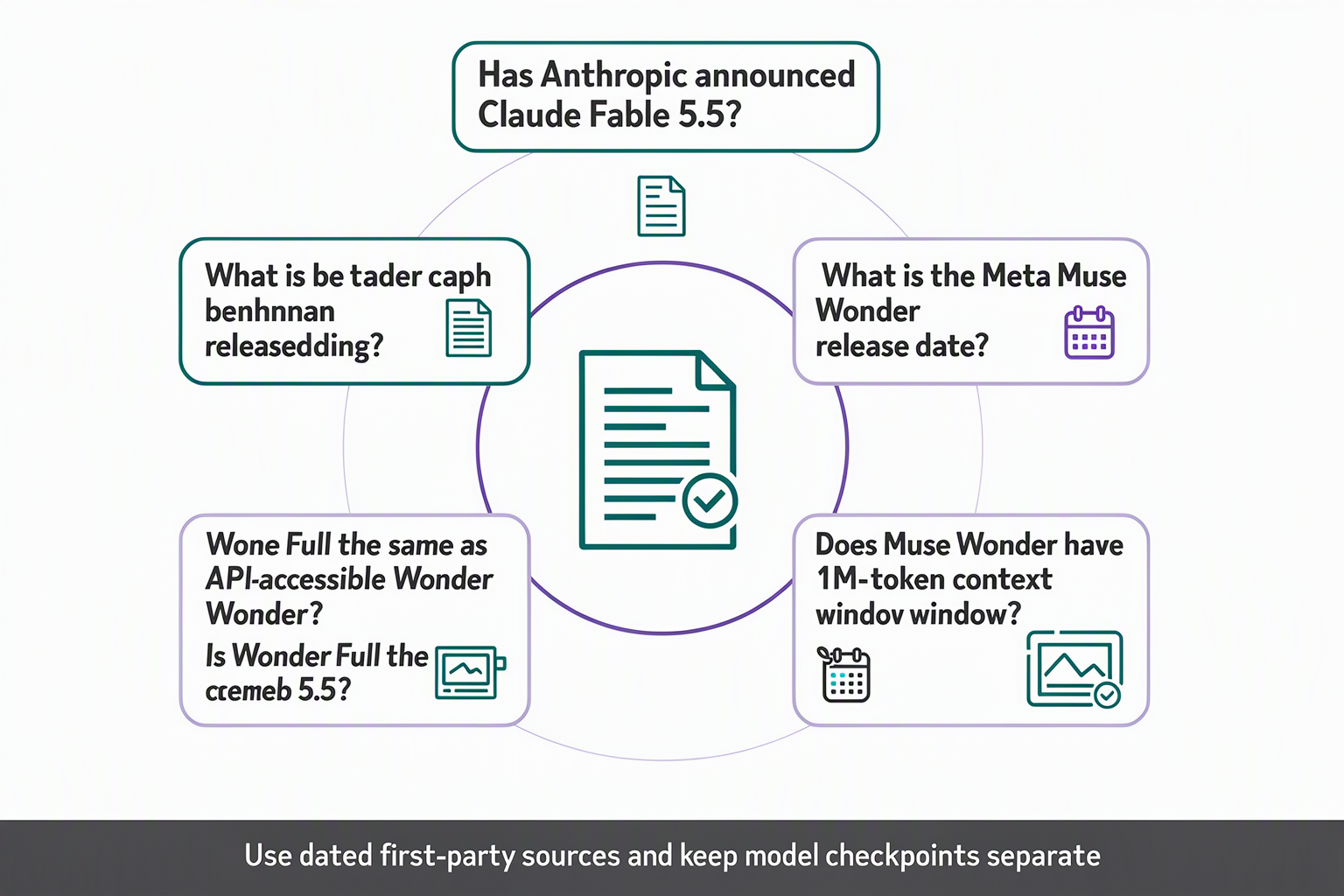
What is the Meta Muse Wonder release date?
What is Meta Muse Wonder API pricing?
What is the Meta Muse Wonder context window?
What is Wonder Full, and how does it compare with Meta Muse Wonder?
Is Claude Fable 5.5 available yet?
How do you fairly compare Meta Muse Wonder with Claude models?
Conclusion
As of October 14, 2026, a fair Claude Fable 5.5 vs Meta Muse Wonder benchmark does not exist. Anthropic has not announced Fable 5.5, and no verified Meta Muse Wonder results or pricing have been published. Until those numbers appear, treat any head-to-head score as marketing, not measurement.
- Only confirmed Anthropic models, such as Claude Fable 5.1, can be evaluated today.
- A valid comparison needs the same task suite, the same test date, matched settings, and a published methodology.
- Vendor claims should be separated from measured results before they inform a purchase.
- Your own tests on real workloads are more useful than leaderboards built on someone else's prompts.
Watch for three signals: an official Anthropic announcement with a model ID and pricing, a Meta publication with reproducible methodology, and independent evaluators running both models on identical suites.
Teams that want to run that test without rewriting code can use an aggregator. CallMissed's developer API offers 140 models behind one API key and one balance, with OpenAI-compatible and Anthropic-compatible endpoints, so switching models for a side-by-side test is a configuration change. To explore how AI communication is evolving, check out CallMissed, an AI infrastructure platform powering voice agents and multilingual chatbots for businesses.
Which workload in your stack would you test first?
Related Reading
- Muse Wonder vs Claude Opus 5.5 vs Fable 5.1: What Holds Up
- Claude Fable 5.1 Benchmarks: Coding Performance, Evidence, and Caveats
- Claude Fable 5.5 Release Date: What's Confirmed (Oct 2026)