Claude Fable 5.5 vs Sonnet 5.5: Verified Comparison



Claude Fable 5.5 vs Sonnet 5.5 explained with verified coding, agent, speed, cost, context and migration evidence as of October 14, 2026.
Claude Fable 5.5 vs Sonnet 5.5: Verified Comparison
How do you compare two AI models when one of them does not officially exist? That is the central problem with Claude Fable 5.5 vs Sonnet 5.5: as of October 14, 2026, Anthropic has launched Claude Sonnet 5.5, but it has not announced or released Claude Fable 5.5.
The distinction matters because model names can quickly become detached from verified product information. Anthropic’s official Fable page identifies Claude Fable 5.1 as its available Fable model and describes it as the company’s “most capable model for coding and knowledge work.” Meanwhile, Anthropic calls Claude Sonnet 5.5 the second model in the Claude 5.5 family and positions it as a faster, lower-cost complement to Claude Opus 5.5—not Fable 5.5.
There is also a measurable reason developers should reassess their model choices now. Anthropic reported in October 2026 that Claude Sonnet 5.5 runs more than 30% faster than Claude Sonnet 5 and costs up to 30% less per task. Those improvements can materially affect the economics of coding assistants and AI agents that make repeated tool calls, process large repositories, or run continuously in production.
A responsible comparison therefore cannot invent Fable 5.5 benchmark scores, API pricing, context limits, or agent capabilities. The useful comparison is between the available Claude Sonnet 5.5 and Claude Fable 5.1, today’s closest usable Fable reference, while clearly separating documented facts from assumptions about a possible future release.
This guide will examine:
- Coding performance considerations, including repository-scale work, debugging, iteration speed, and complex reasoning
- AI-agent suitability, including long-horizon tasks, tool use, orchestration, latency, and cost
- Verified availability and positioning from Anthropic’s announcements, release notes, and model documentation
- What cannot yet be compared, from unconfirmed Fable 5.5 specifications to unsupported benchmark claims
- How to choose today, rather than waiting for a model that Anthropic has not launched
This question also reflects a broader move toward model orchestration instead of permanent lock-in. As of October 2026, CallMissed’s OpenAI- and Anthropic-compatible developer API provides one balance for 140 models and supports caller-selected fallback models, illustrating how infrastructure can let teams route different tasks according to capability, latency, and cost.
The conclusion may be less dramatic than a benchmark showdown, but it is more useful: Sonnet 5.5 can be tested and deployed now; Fable 5.5 cannot yet be evaluated honestly.
What can you actually compare? Sonnet 5.5 is available, while Fable 5.5 remains unannounced as of October 14, 2026
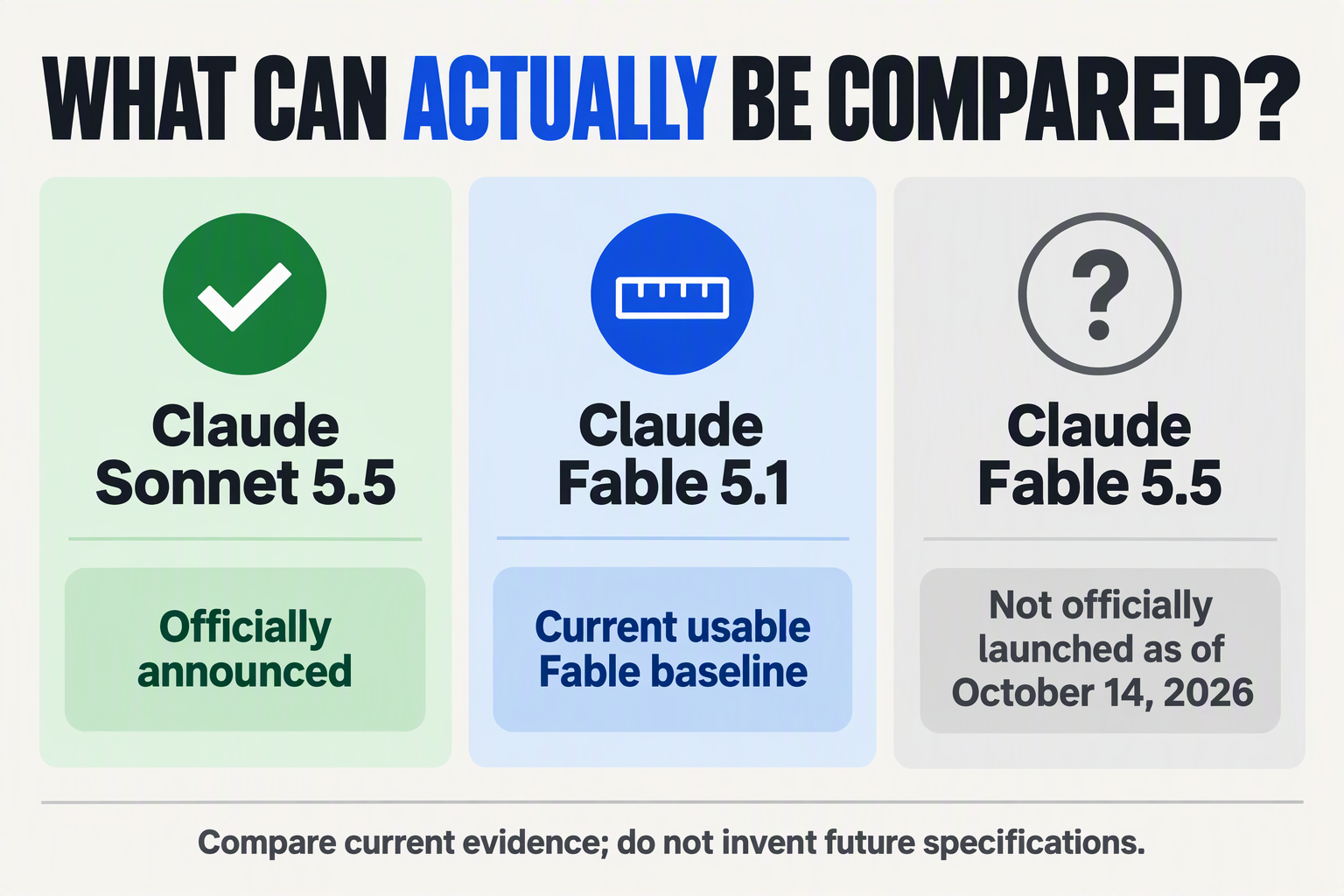
You can compare Claude Sonnet 5.5 with Claude Fable 5.1, but you cannot make an evidence-based Claude Fable 5.5 vs Sonnet 5.5 comparison. As of October 14, 2026, Anthropic provides official information for Sonnet 5.5 and Fable 5.1, while no announcement, model page, pricing sheet, system card, or API documentation confirms Fable 5.5.
Is Claude Fable 5.5 available?
No. Anthropic’s Fable product page identifies Claude Fable 5.1—not Fable 5.5—as the available model and calls Fable 5.1 its “most capable model for coding and knowledge work.”
Anthropic’s October 2026 materials consistently name other members of the current lineup:
- Anthropic describes Claude Sonnet 5.5 as the second model in the Claude 5.5 family.
- Anthropic positions Sonnet 5.5 as a faster, lower-cost complement to Claude Opus 5.5.
- Anthropic’s Cyber Verification Program names Opus 5.5, Sonnet 5.5, and Mythos 5.1 among its most capable models.
- Anthropic’s published Fable materials continue to reference Fable 5 or Fable 5.1, depending on the page’s publication date and context.
This absence does not prove that Anthropic will never launch Fable 5.5. It means any claimed release date, price, context window, benchmark result, or coding improvement would be speculation on October 14, 2026.
What Sonnet 5.5 facts can developers verify?
Claude Sonnet 5.5 can be evaluated using a shipping model, official documentation, and production workloads. Anthropic reported in October 2026 that Claude Sonnet 5.5 runs more than 30% faster than Sonnet 5 and costs up to 30% less for most work.
Developers can therefore test Sonnet 5.5 on measurable criteria such as:
- Coding accuracy: successful patches, test-pass rates, regression frequency, and review acceptance.
- Agent reliability: tool-selection accuracy, recovery from failed calls, and completion rates for multistep tasks.
- Responsiveness: time to first token, total task duration, and latency across repeated tool loops.
- Economics: cost per resolved issue, completed workflow, or accepted pull request.
- Operational fit: API behavior, safety constraints, prompt compatibility, and failure handling.
These workload-level measurements are usually more actionable than a single benchmark because coding agents combine model reasoning with tools, repositories, test suites, and orchestration logic.
Why is Fable 5.1 the appropriate comparison model?
Claude Fable 5.1 is the closest available Fable reference because Anthropic explicitly positions the Fable line for frontier reasoning, coding, knowledge work, and long-horizon agentic tasks. Anthropic’s model-orchestration webinar contrasts Fable’s frontier reasoning role with Sonnet’s workhorse role, giving teams a defensible basis for comparing specialization versus speed and cost.
Fable 5.1 also has documented implementation details. Anthropic states that preserved thinking applies to Claude Fable 5.1 and Opus 5.5 for new API accounts created on or after August 31, 2026, preventing those accounts from editing Claude’s prior context.
The valid comparison is therefore Sonnet 5.5 versus Fable 5.1 under identical coding and agent evaluations. Results should be labelled by exact model version; they should not be presented as predictions for an unannounced Fable 5.5.
Why is Claude Fable 5.1 the closest usable baseline—and why can it not predict Fable 5.5?

Claude Fable 5.1 is the closest usable baseline because it is the latest documented Fable model and preserves the product line’s emphasis on frontier reasoning, coding, and long-horizon agentic work. However, it is a reference point—not a proxy for an unannounced Fable 5.5, whose architecture, pricing, speed, safeguards, and benchmark results remain unknown as of October 14, 2026.
Why is Fable 5.1 the right baseline for a Fable comparison?
A useful baseline should be available for testing, officially documented, and close enough in product positioning to illuminate likely use cases. Claude Fable 5.1 meets those conditions; Claude Fable 5.5 does not.
Anthropic’s model-orchestration webinar described the Fable line as intended for “frontier reasoning and long-horizon agentic work,” while positioning Sonnet as the workhorse default. That distinction gives developers a practical framework for tests:
- Repository-scale coding: Can the model trace dependencies, plan multi-file changes, and preserve constraints?
- Long-running agents: Does performance remain reliable across repeated reasoning and tool-use steps?
- Knowledge work: Can the model synthesize extensive evidence without losing important qualifications?
- Difficult debugging: Does it identify root causes rather than merely suggesting plausible patches?
- Orchestration: Are the quality gains sufficient to justify routing only the hardest tasks to Fable?
Fable 5.1 also reflects operational changes relevant to agent developers. Anthropic states that Claude Fable 5.1 introduced “preserved thinking,” which prevents API accounts created on or after August 31, 2026, from editing Claude’s prior context. That behavior can affect agent architectures that previously modified reasoning history between turns, so a realistic evaluation must include API semantics—not just coding scores.
Why can Fable 5.1 not predict Fable 5.5 performance?
Model-family names do not guarantee linear improvements. A hypothetical Fable 5.5 could change several variables simultaneously:
- Capability: Coding accuracy and long-horizon reliability could improve unevenly across tasks.
- Economics: Input, output, caching, or tool-use costs could change independently of quality.
- Latency: Faster generation could come with different reasoning defaults or usage limits.
- Agent behavior: Tool selection, context management, and instruction adherence could shift.
- Safety controls: New deployment policies could alter how the model handles cybersecurity, biology, or autonomous actions.
Anthropic’s 2026 releases demonstrate why simple extrapolation is unsafe. Anthropic’s newsroom states as of October 14, 2026 that Claude Opus 5.5 performs at the level of Claude Fable 5.1 on most work while costing 40% less to run than Opus 5. In other words, a newer model in another tier can approach an earlier flagship’s performance while changing the cost hierarchy.
Likewise, Anthropic reports that Claude Sonnet 5.5 is more than 30% faster than Sonnet 5 and costs up to 30% less for most work as of October 2026. Those gains concern the Sonnet lineage; they provide no mathematical basis for assigning equivalent improvements to Fable.
How should developers use the baseline responsibly?
Treat Fable 5.1 as the current high-capability test candidate, not as estimated Fable 5.5 performance. Benchmark Fable 5.1 and Sonnet 5.5 on the same repositories, prompts, tools, iteration limits, and quality rubrics, then report results using exact model identifiers and test dates.
Any future Fable 5.5 should trigger a fresh evaluation. Until Anthropic publishes specifications and provides access, projected scores or pricing are speculation rather than a model comparison.
Which Sonnet 5.5 and Fable developments are confirmed, and which Fable 5.5 details remain unknown?
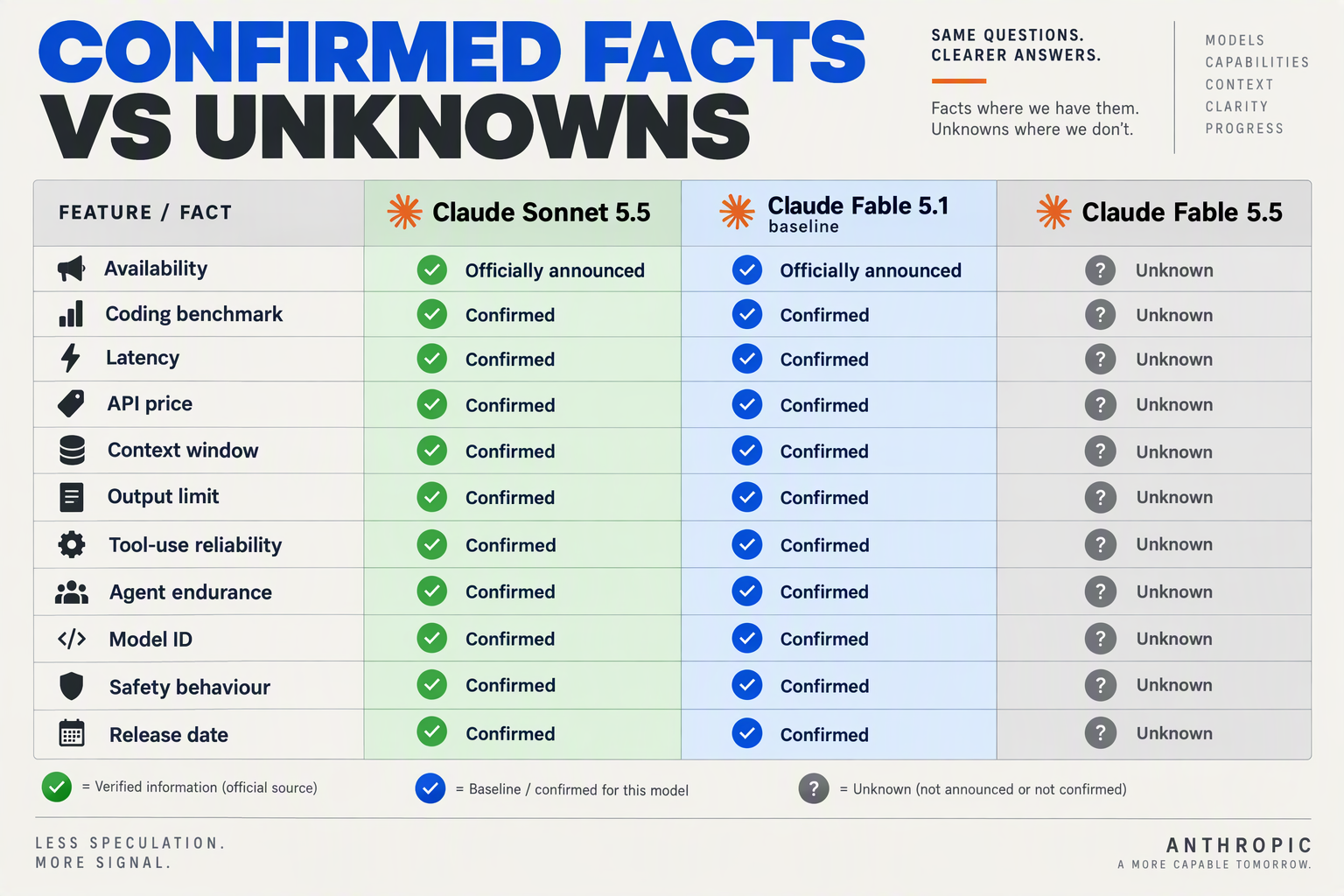
Anthropic has confirmed Claude Sonnet 5.5 and Claude Fable 5.1, but it has not confirmed Claude Fable 5.5. As of October 14, 2026, any Fable 5.5 release date, pricing, benchmarks, context window, API identifier, or agent capability should therefore be treated as unknown—not extrapolated from Sonnet 5.5 or earlier Fable models.
What has Anthropic officially confirmed?
The evidence establishes an asymmetric comparison: Sonnet 5.5 has documented improvements, while the latest available Fable reference remains Fable 5.1.
| Comparison point | Claude Sonnet 5.5 | Latest confirmed Fable evidence | Evidence status |
|---|---|---|---|
| Model availability | Officially announced and available | Claude Fable 5.1 is listed on Anthropic’s Fable page | Confirmed as of October 14, 2026 |
| Family position | Second model in the Claude 5.5 family | No Fable 5.5 family member announced | Confirmed / unknown |
| Product positioning | Faster, lower-cost complement to Claude Opus 5.5 | Fable 5.1 is described as Anthropic’s “most capable model for coding and knowledge work” | Confirmed |
| Speed | More than 30% faster than Sonnet 5 | No official Fable 5.5 speed figure | Confirmed / unknown |
| Cost development | Up to 30% less expensive than Sonnet 5 for most work | No Fable 5.5 API price or cost comparison | Confirmed / unknown |
| Agent and security development | No Fable-specific inference is valid | Fable 5.1 introduced preserved thinking for qualifying new API accounts | Confirmed only for Fable 5.1 |
Anthropic reported in October 2026 that Claude Sonnet 5.5 runs more than 30% faster than Claude Sonnet 5 and costs up to 30% less for most work. This is a comparison against Sonnet 5, not against Fable 5.1 or a hypothetical Fable 5.5.
Anthropic’s October 2026 announcement also calls Sonnet 5.5 a “faster, lower-cost complement” to Claude Opus 5.5. That wording matters because it does not establish Sonnet 5.5 as a replacement for Fable or provide evidence of a direct Sonnet-versus-Fable hierarchy.
Which Fable developments are real?
Several Fable-related developments are documented, but they apply to Claude Fable 5 or Fable 5.1, not Fable 5.5:
- Anthropic’s Fable product page identifies Claude Fable 5.1 as the available model and emphasizes coding, knowledge work, and research capabilities.
- Anthropic’s model-orchestration webinar characterizes Fable 5 as suitable for frontier reasoning and long-horizon agentic work, while describing Sonnet 5 as a workhorse default.
- Anthropic stated in 2026 that Fable 5.1 and Opus 5.5 introduced preserved thinking. For API accounts created on or after August 31, 2026, prior thinking context cannot be edited—a security measure intended to strengthen defenses against distillation attacks.
- Anthropic’s October 2026 newsroom says Opus 5.5 performs at the level of Fable 5.1 on most work and costs 40% less to run than Opus 5. This provides ecosystem context, not a Sonnet 5.5 benchmark against Fable.
What remains unknown about Fable 5.5?
Until Anthropic publishes an announcement, model card, API documentation, or pricing page, the following remain unverified:
- Release date and general availability
- Coding and agent benchmark scores
- Context and output-token limits
- Latency, throughput, and API pricing
- Tool-use, reasoning, and computer-use improvements
- Safety controls and deployment restrictions
The defensible baseline is therefore Sonnet 5.5 versus Fable 5.1, with every Fable 5.5 field marked “not announced.”
What do Claude Sonnet 5.5 coding benchmarks actually prove—and what remains untested?
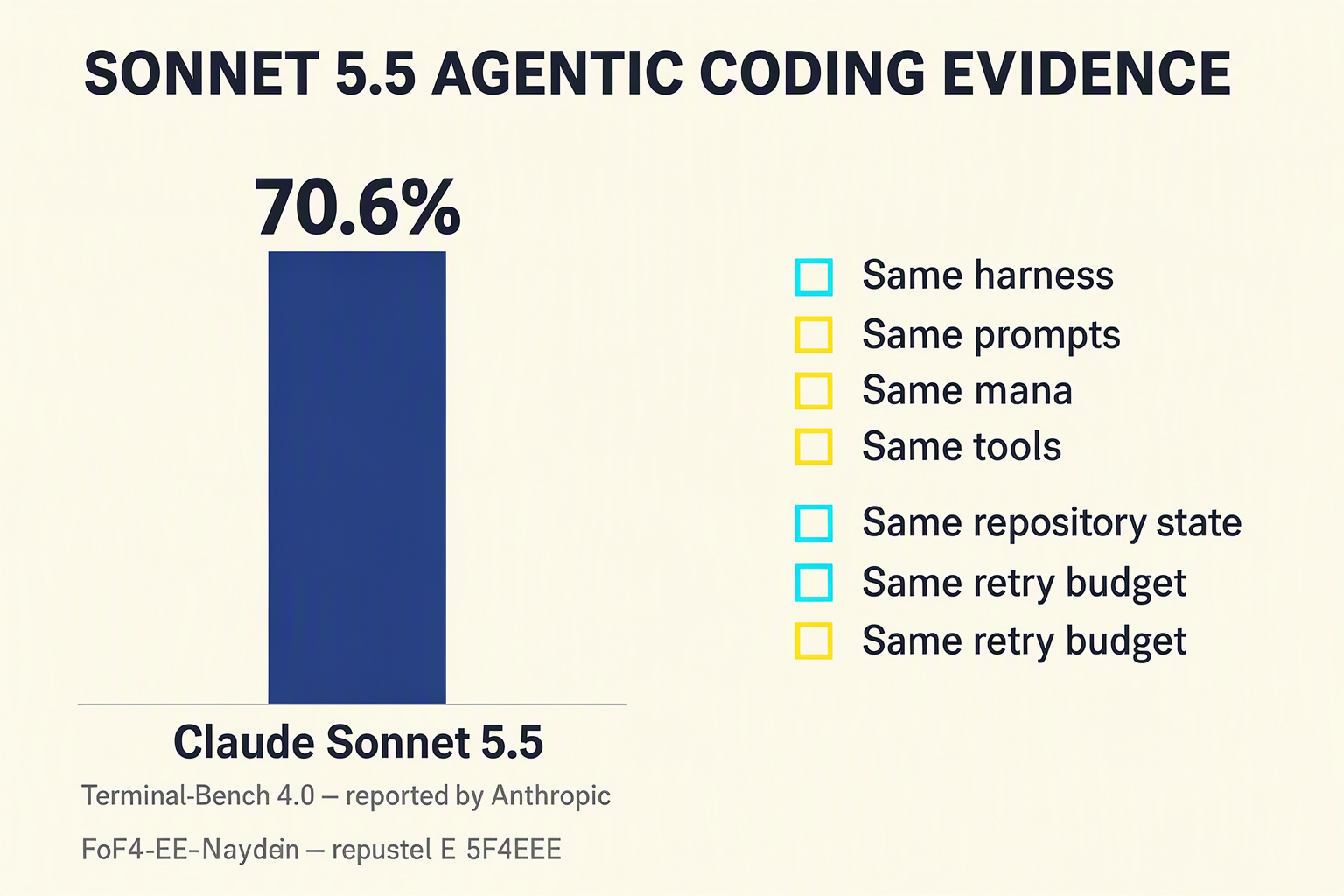
Claude Sonnet 5.5’s published evidence proves that Anthropic has improved speed and cost relative to Sonnet 5; it does not prove that Sonnet 5.5 is universally better at software engineering or long-running AI agents. Benchmark claims should be read as controlled indicators, not guarantees for a particular repository, toolchain, or production workflow.
What does Anthropic’s Sonnet 5.5 evidence establish?
Anthropic describes Claude Sonnet 5.5 as a “clear upgrade” over Claude Sonnet 5 and as a faster, lower-cost complement to Claude Opus 5.5. That positioning supports three limited conclusions:
- The correct baseline is Sonnet 5. The announcement makes a generational comparison within the Sonnet line, not a direct comparison with an unreleased Fable 5.5.
- Inference speed has improved. Anthropic reported in October 2026 that Claude Sonnet 5.5 runs more than 30% faster than Sonnet 5.
- Typical operating costs may be lower. Anthropic reported in October 2026 that Claude Sonnet 5.5 costs up to 30% less for most work, although “up to” does not mean every prompt or agent run receives that reduction.
These figures matter for coding agents because latency compounds. An agent completing 20 sequential model turns cannot parallelize every planning decision, tool result, correction, and verification step. Faster responses can therefore shorten the whole task even when raw code quality remains unchanged.
However, speed and cost statistics do not independently establish higher rates of correct patches, fewer regressions, or better architectural decisions.
What do coding benchmarks fail to measure?
A coding benchmark usually tests a defined task set under controlled conditions. Production engineering introduces variables that may be absent from that setup:
- Repository context: Performance can change with monorepos, generated code, sparse documentation, or proprietary frameworks.
- Tool configuration: Results depend on whether the model can search files, run tests, inspect logs, use a terminal, and revise failed patches.
- Scaffolding: Prompt design, retry policies, context compression, and agent loops can affect outcomes as much as the underlying model.
- Software quality: A patch may pass visible tests while introducing security flaws, maintenance debt, or failures in untested paths.
- Human review effort: Benchmark success rarely captures how long engineers spend correcting, explaining, or safely merging the output.
A headline score should consequently be treated as evidence that a model performed well under that benchmark’s harness, not that it will resolve the same percentage of issues in an organization’s private codebase.
What remains untested for Sonnet 5.5 and Fable 5.5?
As of October 14, 2026, the available evidence does not answer several practical questions:
- How reliably Sonnet 5.5 completes multi-hour migrations without drifting from requirements
- Whether its faster responses produce better end-to-end agent completion times after retries
- How performance changes across TypeScript, Python, Java, Rust, mobile code, and infrastructure-as-code
- Whether lower model cost is offset by additional tool calls or failed attempts
- How it compares with Claude Fable 5.5, for which no official model or benchmark results exist
Anthropic’s Fable documentation describes Claude Fable 5.1 as its “most capable model for coding and knowledge work,” while Anthropic’s orchestration webinar positions Fable for “frontier reasoning and long-horizon agentic work.” Those are useful product signals, but they are not substitute scores for Fable 5.5.
How should teams validate Sonnet 5.5 for coding?
Run an internal evaluation using representative, previously completed tickets. Measure task success, tests passed, regressions, elapsed time, token or API cost, tool-call count, retries, and reviewer minutes.
The decisive benchmark is not the highest public score. It is whether Claude Sonnet 5.5 delivers correct, reviewable changes at an acceptable total cost on your own repositories and agent infrastructure.
How should you compare Claude Sonnet 5.5 price, speed and context without misleading buyers?
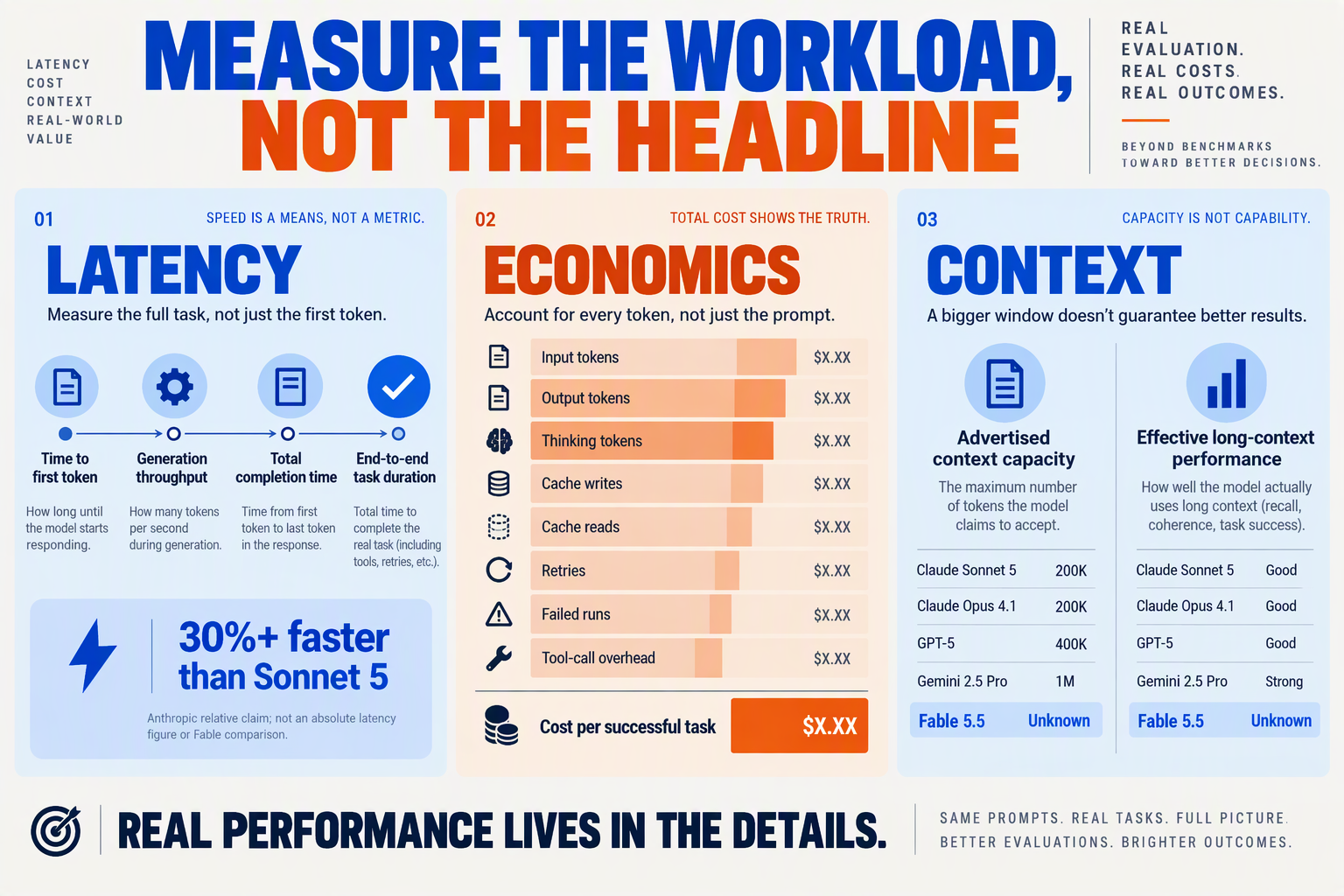
Compare Claude Sonnet 5.5 using measured cost per completed task, end-to-end latency, and usable context—not headline token prices or an assumed Claude Fable 5.5 specification. As of October 14, 2026, Anthropic has not published Fable 5.5 pricing, speed, or context limits, so buyers should use Claude Fable 5.1 as the clearly labelled reference point.
What does Claude Sonnet 5.5 actually cost?
Anthropic describes Claude Sonnet 5.5 as a “faster, lower-cost complement to Claude Opus 5.5.” Anthropic reported in October 2026 that Claude Sonnet 5.5 costs up to 30% less than Claude Sonnet 5 for most work, but “up to” is not a universal discount across every prompt or agent workflow.
A defensible cost comparison should include:
- Input and output tokens, calculated separately
- Cached versus uncached context, where applicable
- Reasoning or thinking-token consumption
- Retries, failed tool calls, and repair turns
- Search, sandbox, storage, and third-party tool charges
- Tokens repeatedly sent during long agent sessions
Use this practical metric:
Cost per successful task = total model and tool spend ÷ accepted task completions
For example, a cheaper model that requires three debugging attempts may cost more than a higher-priced model that produces an accepted patch on its first attempt. Report the median cost alongside the p90 cost, because a small number of runaway agent sessions can materially affect production budgets.
No equivalent calculation can yet be made for Fable 5.5. Any article presenting a Fable 5.5 token price as of October 14, 2026 is relying on speculation rather than an announced Anthropic product.
How should buyers measure model speed?
Anthropic stated in October 2026 that Claude Sonnet 5.5 runs more than 30% faster than Claude Sonnet 5. That is useful directional evidence, but buyers still need workload-specific testing because “speed” can describe several different measurements.
Track at least four values:
- Time to first token, which shapes interactive coding responsiveness
- Output tokens per second, which matters for long code generation
- Tool-call turnaround, including API and sandbox delays
- End-to-end task time, from prompt submission to validated result
For coding agents, the fourth metric is usually the most commercially meaningful. A fast initial response provides little benefit if the model subsequently makes unnecessary repository searches, repeats tests, or enters a correction loop.
How should context windows be compared fairly?
Advertised context capacity is not the same as reliable working context. Compare official input and output limits only when Anthropic publishes them for the exact model identifier; then test whether the model can retrieve constraints, follow instructions, and modify the correct files at increasing context lengths.
A useful repository-scale evaluation should test:
- Recall from the beginning, middle, and end of the prompt
- Accuracy across multiple dependent files
- Performance after several tool results enter the conversation
- Instruction retention during long-running agent loops
- Cost and latency as context grows
Context-handling rules can also differ by model and account. Anthropic said in 2026 that new API accounts created on or after August 31, 2026 cannot edit prior context when using preserved thinking with Claude Fable 5.1 and Claude Opus 5.5. Buyers should therefore document model-specific conversation semantics, not merely compare maximum token numbers.
The honest procurement summary is straightforward: benchmark Sonnet 5.5 now, benchmark Fable 5.1 when a frontier Fable reference is needed, and leave every Fable 5.5 field marked “not announced” until Anthropic publishes verifiable specifications.
Which model is better for tool use and long-running AI agents: Sonnet 5.5 or Fable 5.1?
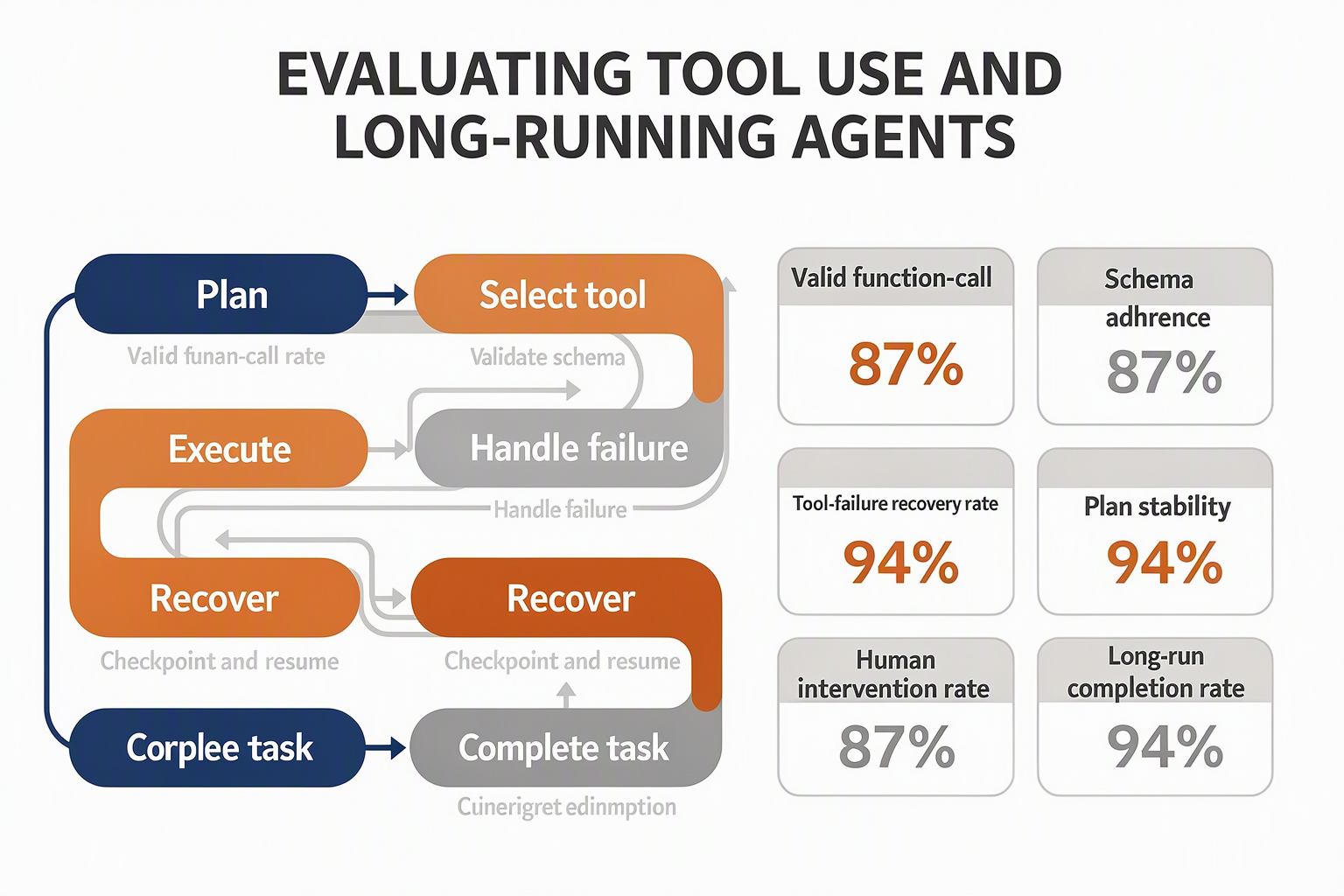
Claude Fable 5.1 is the stronger documented candidate for difficult, long-horizon agentic work, while Claude Sonnet 5.5 is likely the more practical default for tool-heavy production agents that prioritize speed and operating cost. No defensible verdict exists for Fable 5.5, because Anthropic had not announced that model as of October 14, 2026.
Is Fable 5.1 better for long-running AI agents?
Anthropic explicitly described Claude Fable 5 as a model for “frontier reasoning and long-horizon agentic work” in its model-orchestration webinar. Anthropic’s Fable product page also calls Claude Fable 5.1 its “most capable model for coding and knowledge work.”
Those statements support choosing Fable 5.1 when an agent must:
- Plan and execute a complex sequence of dependent actions
- Maintain coherence while researching, coding, testing, and revising
- Diagnose ambiguous failures instead of repeatedly retrying tools
- Handle repository-scale changes where an early mistake can propagate
- Exercise judgment before taking consequential or difficult-to-reverse actions
However, Anthropic has not supplied a verified Fable 5.1 versus Sonnet 5.5 tool-use benchmark in the provided announcements. “Most capable” and “long-horizon” indicate intended positioning, but they do not establish a universal win across every API, browser, terminal, or Model Context Protocol tool.
When is Sonnet 5.5 better for tool use?
Claude Sonnet 5.5 is the more compelling option when an agent performs many short reasoning-and-action cycles. Anthropic reported in October 2026 that Sonnet 5.5 runs more than 30% faster than Sonnet 5 and costs up to 30% less for most work.
That improvement compounds in agents that repeatedly:
- Read application state.
- Select and call a tool.
- Parse the result.
- Update a plan.
- Continue until a completion condition is met.
For example, an agent making 40 tool calls may spend more time waiting on model turns than on the tools themselves. Faster inference can therefore improve end-to-end completion time even if tool execution speed remains unchanged. Lower model cost also matters because failed calls, validation passes, and recovery attempts increase total token consumption.
Anthropic describes Sonnet 5.5 as a faster, lower-cost complement to Claude Opus 5.5. It does not claim that Sonnet 5.5 surpasses Fable 5.1 on long-horizon reasoning, so that broader conclusion should not be inferred.
How should teams test Sonnet 5.5 against Fable 5.1?
Run both models through identical, replayable agent tasks and measure:
- Task completion rate, not merely whether tools were called
- Invalid or unnecessary tool calls
- Recovery rate after tool errors
- Total model turns and tokens per successful task
- Wall-clock completion time
- Cost per successful outcome
- Human intervention and rollback frequency
Also account for platform behavior. Anthropic stated that Fable 5.1 introduced preserved thinking for API accounts created on or after August 31, 2026, preventing those accounts from editing Claude’s prior context. Agent frameworks that rewrite reasoning history should verify compatibility rather than assuming identical context-management behavior.
The practical decision is workload-specific: start with Sonnet 5.5 for high-volume, latency-sensitive orchestration, and evaluate Fable 5.1 for the hardest long-running tasks where reasoning quality may outweigh additional runtime or cost. Treat any claim about Fable 5.5 tool use as speculation until Anthropic publishes the model and supporting evaluations.
How should teams interpret Anthropic’s model positioning and other expert evidence?

Teams should treat Anthropic’s positioning as a guide to intended use, not as proof that one Claude model will perform better on their codebase or agent workflow. As of October 14, 2026, official documentation supports testing Claude Sonnet 5.5 and Claude Fable 5.1; there is no equivalent evidence package for an unannounced Claude Fable 5.5.
What does Anthropic’s model positioning actually tell teams?
Anthropic describes Claude Fable 5.1 as its “most capable model for coding and knowledge work.” In an Anthropic webinar, the company more specifically positioned the Fable line for “frontier reasoning and long-horizon agentic work,” while describing Claude Sonnet 5 as the “workhorse default.”
Those labels suggest a practical division:
- Fable 5.1: investigate for difficult debugging, architectural reasoning, research-heavy coding, and agents completing extended sequences.
- Sonnet 5.5: investigate for frequent coding interactions, production agents, and workflows where responsiveness and operating cost matter.
- Neither label guarantees the result: “most capable” and “workhorse” are product-positioning terms, not workload-specific measurements.
Anthropic calls Claude Sonnet 5.5 a faster, lower-cost complement to Claude Opus 5.5 rather than a direct replacement for Fable. This matters because the Claude lineup is not necessarily a simple ladder where every later model name maps neatly to one capability tier.
How strong is Anthropic’s performance evidence?
Anthropic’s strongest quantitative Sonnet 5.5 claim concerns improvement over its direct predecessor. Anthropic reported in October 2026 that Claude Sonnet 5.5 runs more than 30% faster than Claude Sonnet 5 and costs up to 30% less for most work.
That evidence is commercially relevant, but teams should interpret its boundaries carefully:
- It compares Sonnet 5.5 with Sonnet 5, not with Fable 5.1 or a hypothetical Fable 5.5.
- “Up to 30% less” is a maximum, so realized savings may vary with prompts, output length, tool calls, caching, and retry behavior.
- “For most work” is broad, and does not establish performance on a particular repository, programming language, or agent harness.
Another useful clue comes from Anthropic’s broader portfolio. Anthropic stated in September 2026 that Claude Opus 5.5 performs at the level of Claude Fable 5.1 on most work and costs 40% less to run than Opus 5. This reinforces why teams should evaluate models by workload rather than assume that family names alone establish a permanent ranking.
Which sources deserve the most weight?
Use an evidence hierarchy when making a deployment decision:
- Model and API documentation: availability, supported controls, context handling, and operational constraints.
- System cards: capability evaluations, safety testing, and responsible-deployment decisions.
- Release notes: dated product changes that may affect integrations.
- Vendor benchmarks: useful directional evidence, but still first-party.
- Independent evaluations: valuable only when prompts, tools, budgets, and scoring methods resemble the intended workload.
- Internal trials: the most decision-relevant evidence for production.
Operational details can be as important as benchmark scores. Anthropic reported that preserved thinking applies to Claude Fable 5.1 and Claude Opus 5.5 for new API accounts created on or after August 31, 2026, preventing those accounts from editing Claude’s prior thinking context. Agent teams should therefore test state management and orchestration behavior—not merely code-generation accuracy.
The defensible conclusion is straightforward: Anthropic’s positioning supports Fable 5.1 as the higher-ambition reasoning candidate and Sonnet 5.5 as the speed-and-economics candidate, but only controlled workload testing can determine the better production choice.
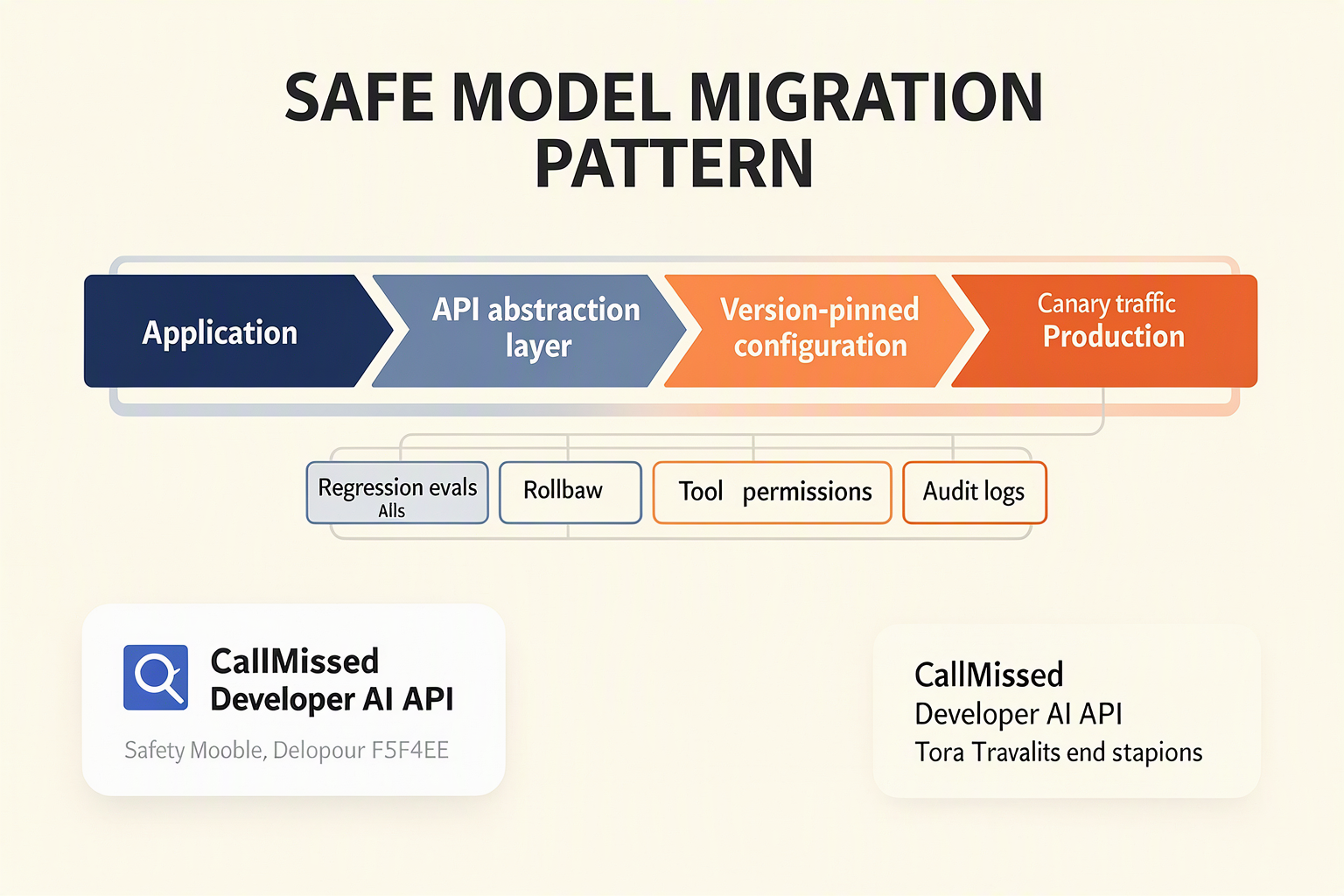
How can you reduce migration risk before any Fable 5.5 release, including with an Anthropic-compatible API layer?
_Section generation failed: (sqlalchemy.dialects.postgresql.asyncpg.Error) <class 'asyncpg.exceptions.LockNotAvailableError'>: canceling statement due to lock timeout
[SQL: UPDATE blog_drafts SET state=$1::JSONB, updated_at=$2::TIMESTAMP WITHOUT TIME ZONE WHERE blog_drafts.id = $3::INTEGER]
[parameters: ('{"brief": "Create an evidence-led comparison: Claude Fable 5.5 vs Claude Sonnet 5.5 for coding and AI agents. Make clear Fable 5.5 is not officially ... (94401 characters truncated) ... "gpt-5.6-sol", "keyword_intel_done": true, "must_include_keywords": ["Claude Fable 5.5 vs Sonnet 5.5", "Sonnet 5.5 coding", "Fable 5.5 benchmarks"]}', datetime.datetime(2026, 10, 14, 21, 36, 23, 711006), 825)]
(Background on this error at: https://sqlalche.me/e/20/dbapi)_
What should you choose now, and how should you run a reproducible model evaluation?
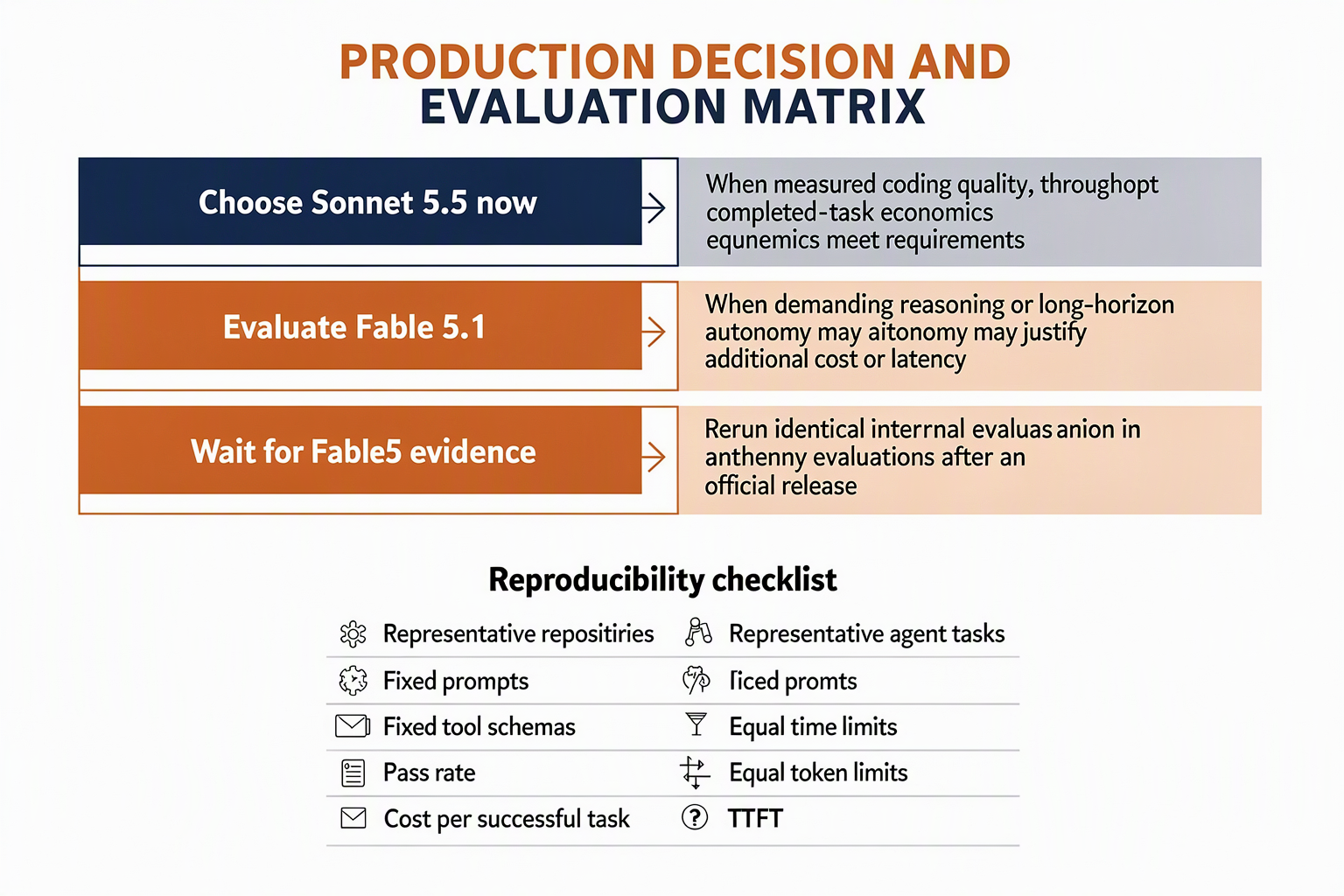
Choose Claude Sonnet 5.5 as the production default when throughput, responsiveness, and operating cost matter; evaluate Claude Fable 5.1 for the hardest coding and long-horizon agent tasks. Do not select “Claude Fable 5.5” until Anthropic officially releases it with documented specifications, pricing, and an accessible model endpoint.
Which Claude model should you choose today?
Anthropic described Claude Fable 5.1 as its “most capable model for coding and knowledge work” in 2026, making it the relevant Fable candidate for difficult repository analysis, architecture decisions, and extended agent workflows. However, higher capability does not automatically produce the best production economics.
Anthropic reported in October 2026 that Claude Sonnet 5.5 runs more than 30% faster than Sonnet 5 and costs up to 30% less for most work. These are comparisons with Sonnet 5—not Fable 5.1—but they support testing Sonnet 5.5 as the first-choice model for frequent, latency-sensitive tasks.
| Workload or decision | Model to test first | Evidence-based rationale | Primary evaluation metric |
|---|---|---|---|
| Interactive coding assistant | Sonnet 5.5 | Anthropic positions it as a faster, lower-cost model | Accepted changes per minute |
| High-volume code review | Sonnet 5.5 | Speed and cost compound across many pull requests | Cost per valid finding |
| Complex repository migration | Fable 5.1 | Anthropic positions Fable for frontier reasoning and coding | Tests passed without regression |
| Long-horizon tool-using agent | Fable 5.1 | Anthropic associates Fable with long-horizon agentic work | Successful completion rate |
| Mixed production workload | Route between both | Easy and difficult tasks may have different optimal models | Quality-adjusted cost |
| Proposed Fable 5.5 deployment | Wait | No official model is available as of October 14, 2026 | Release and API verification |
How do you run a reproducible coding evaluation?
Build a private benchmark from work your developers actually perform rather than relying exclusively on public leaderboards.
- Select representative tasks. Include bug fixes, feature implementation, test generation, refactoring, repository navigation, and code review. A practical starting set is 30 tasks run three times per model.
- Freeze the environment. Record the repository commit, dependencies, compiler, test suite, system prompt, user prompt, tool definitions, context files, and inference settings.
- Apply equal budgets. Give each model the same task instructions and comparable limits for time, tokens, tool calls, and retries. Document any model-specific reasoning controls instead of silently changing them.
- Grade executable outcomes. Measure tests passed, regressions introduced, security defects, human review time, completion latency, input and output tokens, and total API cost.
- Review failures blindly. Hide model names from reviewers where possible and classify failures such as incorrect edits, fabricated APIs, incomplete tool use, or unnecessary changes.
How should AI-agent evaluations differ?
Agent tests must evaluate the entire trajectory, not merely the final response. Log every tool request, tool result, retry, handoff, termination decision, and token charge.
Use scenarios with deterministic test environments, then report:
- End-to-end task completion rate
- Median and tail latency
- Cost per successful completion
- Tool-call accuracy and retry count
- Human interventions per run
- Damage from failed actions, not just failure frequency
As of October 2026, CallMissed’s OpenAI- and Anthropic-compatible developer API supports request logs and caller-selected fallback models, providing one way to test routing without permanently coupling an application to one model. Whatever infrastructure you use, preserve raw traces and publish the evaluation date: model behavior, pricing, and availability can change, while Fable 5.5 remains an untestable hypothesis until Anthropic releases it.
Frequently Asked Questions
Is Claude Fable 5.5 available for a Claude Fable 5.5 vs Sonnet 5.5 comparison?
Is Claude Sonnet 5.5 or Claude Fable 5.1 better for coding?
Which Claude model should I use for long-running AI agents?
Are there verified Claude Fable 5.5 vs Sonnet 5.5 coding benchmarks?
How should developers test Sonnet 5.5 against Fable 5.1?
Should I wait for Claude Fable 5.5 or deploy Sonnet 5.5 now?
Conclusion
The verified conclusion is straightforward: Claude Sonnet 5.5 is available to test and deploy, while Claude Fable 5.5 remains unannounced as of October 14, 2026. Any credible decision today must compare Sonnet 5.5 with Claude Fable 5.1—the closest usable Fable reference—rather than treating speculation as product data.
- Sonnet 5.5 offers measurable operational gains. Anthropic reported in October 2026 that Claude Sonnet 5.5 runs more than 30% faster than Sonnet 5 and costs up to 30% less per task.
- Fable 5.1 remains the documented Fable option. Anthropic describes Claude Fable 5.1 as its “most capable model for coding and knowledge work,” making it the relevant choice for evaluating demanding reasoning and long-horizon tasks.
- Workflow testing matters more than hypothetical benchmarks. Coding accuracy, tool reliability, iteration speed, latency, and total agent cost should be measured against representative repositories and production traces.
- Fable 5.5 claims require official evidence. Watch for an Anthropic announcement, model documentation, system card, API pricing, context limits, and reproducible evaluations before drawing conclusions.
The broader direction is toward model orchestration, not permanent dependence on one model. As of October 2026, developers can explore CallMissed, whose OpenAI- and Anthropic-compatible API provides one balance for 140 models and supports caller-selected fallbacks.
If Fable 5.5 launches, will its verified gains justify switching—or will smarter routing matter more than the model name?
Related Reading
- Claude Fable 5.5 vs GPT-6 Astra: Verified Facts as of 2026
- GPT-6 Sol vs Claude Sonnet 5.5: Verified Comparison
- GPT-6 Astra vs Claude Fable 5.1: Verified 2026 Comparison