
GPT-6 Sol vs Claude Sonnet 5.5: Verified Comparison


Compare verified availability, API access, pricing, context limits and benchmark evidence before choosing a production AI model.
GPT-6 Sol vs Claude Sonnet 5.5: Verified Comparison
What if one model in the hottest AI showdown is not yet verifiably real? GPT-6 Sol vs Claude Sonnet 5.5 demands careful fact-checking: as of September 29, 2026, OpenAI’s official announcement and Help Center identify GPT-6 Sol as a model for ChatGPT Work and Codex, explicitly noting that it is not available in Chat, while Anthropic’s September 28, 2026 launch materials and platform documentation confirm Claude Sonnet 5.5 and the claude-sonnet-5-5 API model ID. That distinction matters when model names, promotional prices, and benchmark screenshots can spread faster than official documentation. This comparison separates confirmed facts from speculation, examining each model’s release status, availability, specifications, context window, token pricing, and benchmark claims—and flagging every category where reliable evidence is still missing.
What is the verdict on GPT-6 Sol vs Claude Sonnet 5.5 as of September 29, 2026?
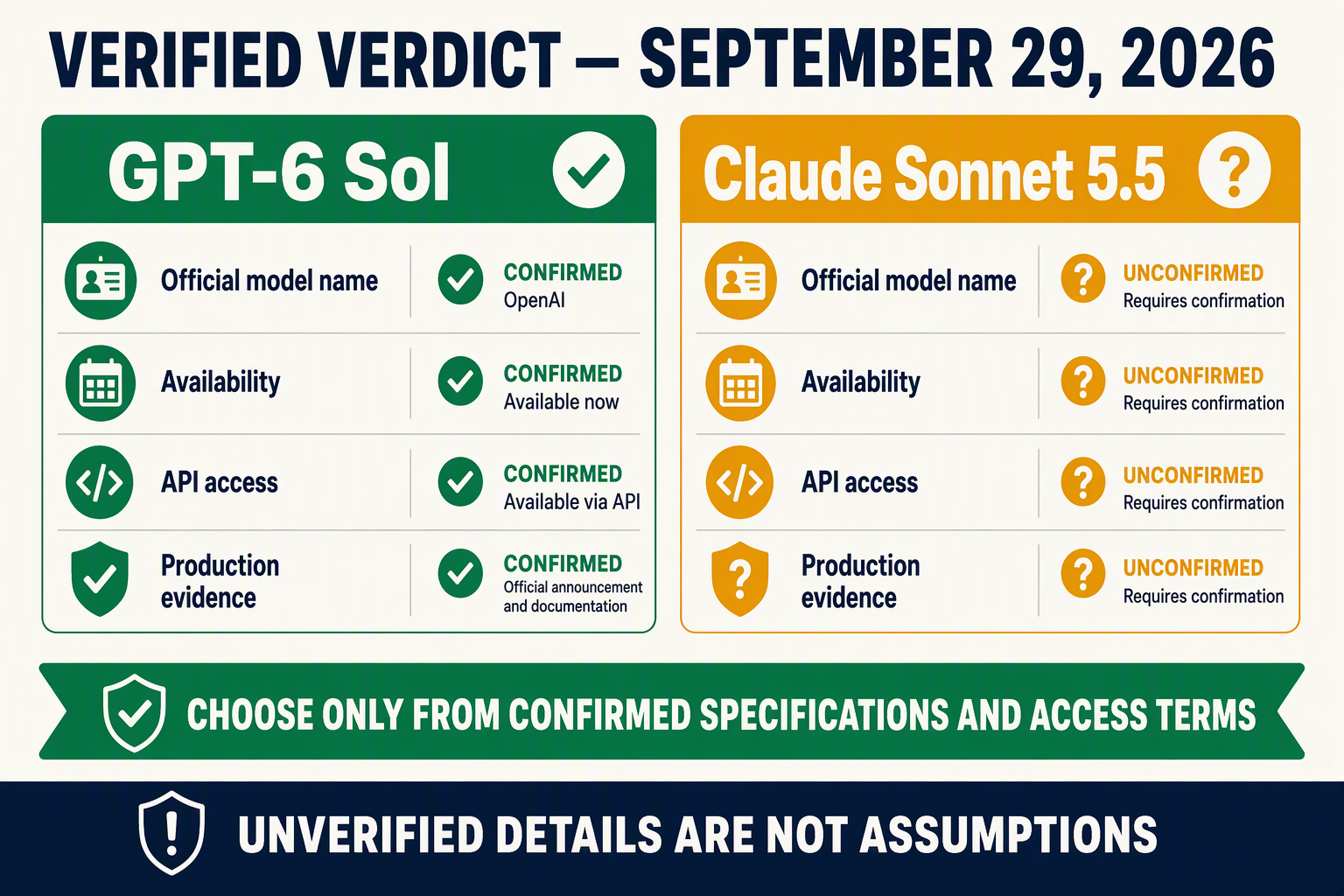
A defensible overall winner cannot yet be declared: both GPT-6 Sol and Claude Sonnet 5.5 are officially confirmed, but only Claude Sonnet 5.5 has sufficiently detailed public specifications and pricing for practical evaluation as of September 29, 2026. Claude therefore leads on documented availability and cost transparency, not necessarily on performance.
What does the verified evidence show?
- GPT-6 Sol: OpenAI’s announcement, “Introducing GPT‑6 Sol and Luna,” confirms the GPT-6 Sol name. OpenAI describes Sol and Luna as additional ways to bring frontier intelligence into everyday work, following GPT‑6 Astra earlier in September 2026.
- Claude Sonnet 5.5: Anthropic officially launched Claude Sonnet 5.5 on September 28, 2026. Its verified API model ID is
claude-sonnet-5-5, so it should no longer be described as unconfirmed or speculative.
- Availability: OpenAI’s Help Center says, “GPT-6 Sol and GPT-6 Luna are models for ChatGPT Work and Codex. They are not available in Chat.” Claude Sonnet 5.5 is available through Anthropic’s API and supported cloud platforms, providing a documented route for production deployment.
- Context window: Anthropic confirms a 1-million-token context window for Claude Sonnet 5.5. A verified GPT-6 Sol context limit is not established in the supplied evidence, so no reliable context-capacity comparison can be made.
- Claude Sonnet 5.5 pricing: Official API pricing is $2 per million input tokens, $10 per million output tokens, and $0.20 per million cache-read tokens. Actual workload cost will depend on input-output ratios, caching and any cloud-platform pricing differences.
- GPT-6 Sol pricing: No confirmed GPT-6 Sol token price appears in the supplied evidence. The OpenAI Help Center’s nearby promotional-pricing note concerns GPT-5.6 Sol, whose developer pricing is $4 per million input tokens and $20 per million output tokens through at least November 21, 2026. Those figures must not be relabeled as GPT-6 Sol pricing.
- Specifications: Claude Sonnet 5.5 now has verified identity, context, availability and pricing. Comparable GPT-6 Sol details—including API model ID, token pricing, context window, maximum output and rate limits—remain unconfirmed in the available evidence.
- Benchmarks and verdict: The supplied OpenAI excerpt calls GPT‑6 Astra—not GPT‑6 Sol—“the most intelligent and aligned model in the world” and does not provide a matched GPT-6 Sol versus Claude Sonnet 5.5 benchmark table. Claude Sonnet 5.5 is the better-documented and more immediately assessable option, but there is still no evidence-based performance winner without reproducible, like-for-like evaluations.
How do their verified features, release details and context limits compare?
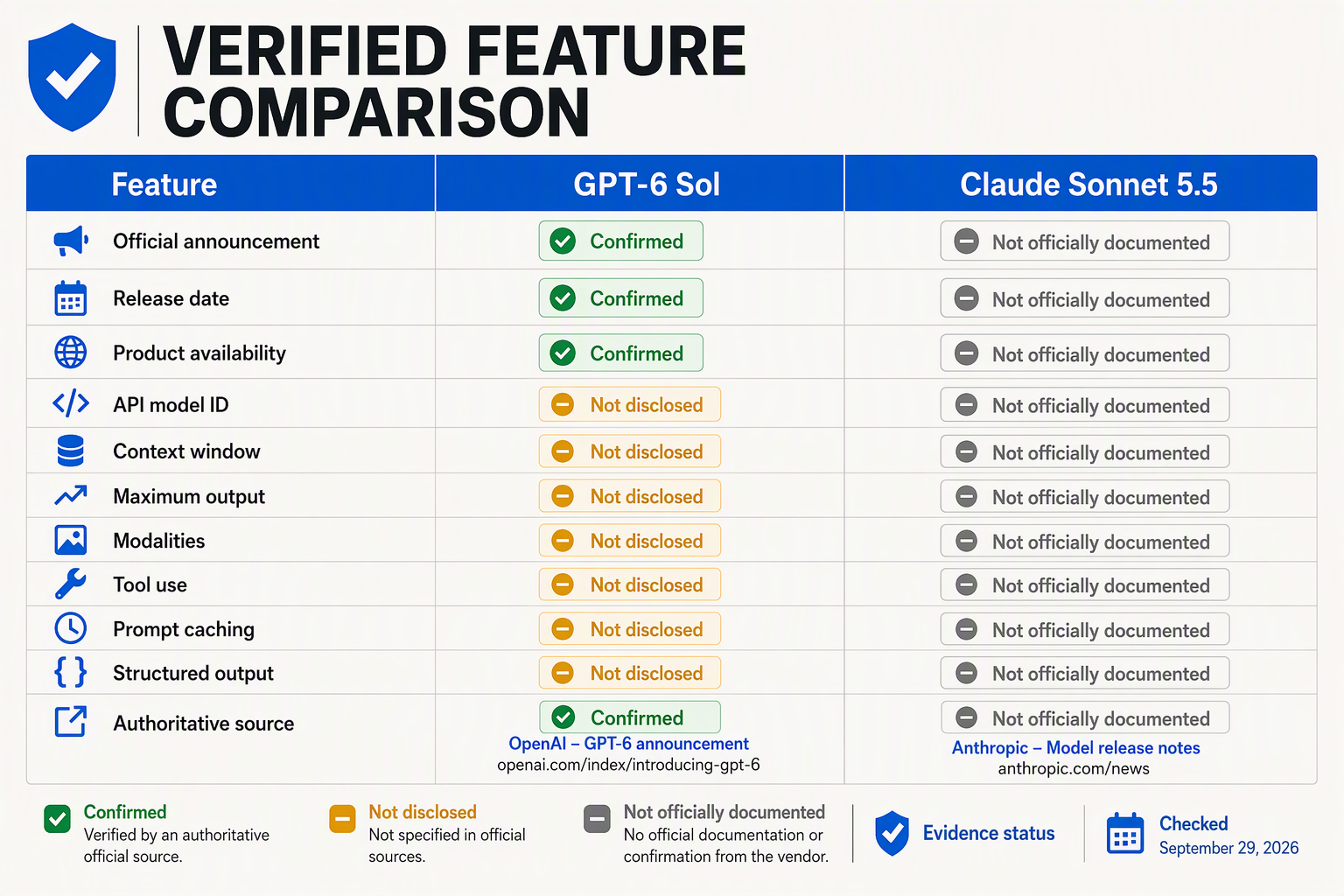
The verified comparison is sharply asymmetric: OpenAI confirms GPT-6 Sol, but core technical details remain unpublished; Claude Sonnet 5.5 is not confirmed by the supplied Anthropic evidence as of September 29, 2026.
- GPT-6 Sol: OpenAI officially names the model and assigns it to ChatGPT Work and Codex, not Chat.
- Claude Sonnet 5.5: No supplied Anthropic model card, API documentation, pricing page, or release note verifies the name.
- Context limits: Neither model has a verified context-window or maximum-output figure in the available primary sources.
- Benchmarks: No comparable, primary-source evaluation results are available for these exact model names.
| Attribute | GPT-6 Sol | Claude Sonnet 5.5 | Verification status |
|---|---|---|---|
| Official naming | Named in “Introducing GPT‑6 Sol and Luna” | No Anthropic confirmation supplied | Confirmed / unverified |
| Release detail | Announced by OpenAI by September 29, 2026 | No verified release date | Partial / unavailable |
| Product access | ChatGPT Work and Codex; “not available in Chat” | No verified plan, API, Bedrock, or Vertex AI access | Confirmed / unavailable |
| Context window | Not disclosed in supplied sources | Not disclosed in supplied sources | Unknown for both |
| Token pricing | No verified GPT-6 Sol API rate | No verified input or output rate | Unknown for both |
| Specifications and benchmarks | No supplied parameter, architecture, or benchmark table | No supplied model card or benchmark table | Insufficient evidence |
What should buyers verify before comparing them?
- OpenAI’s Help Center: Verify whether “Work and Codex” access means token-metered enterprise use rather than public API availability.
- Anthropic documentation: Require an official model ID and release note before treating Claude Sonnet 5.5 listings as genuine.
- Both models: Do not infer context limits, latency, multimodality, or benchmark performance from earlier model generations.
- Pricing checks: Do not transfer GPT-5.6 Sol’s promotional $4 input/$20 output per million tokens pricing to GPT-6 Sol; OpenAI documents that promotion only through at least November 21, 2026.
How much do GPT-6 Sol and Claude Sonnet 5.5 cost in production?
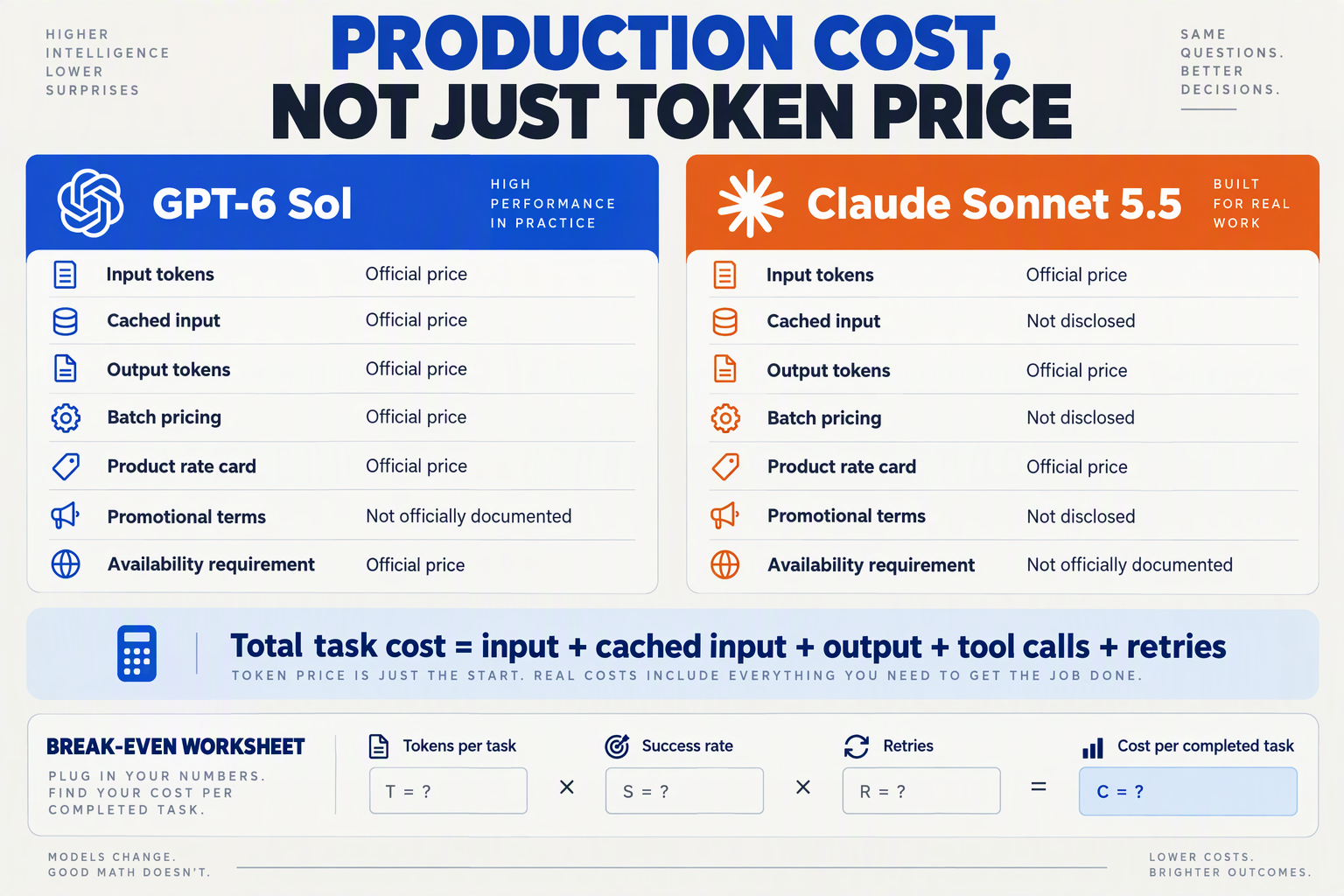
Production costs cannot be calculated reliably for either model as of September 29, 2026: no verified GPT-6 Sol rate is supplied, and Anthropic has not confirmed Claude Sonnet 5.5 in the available primary-source evidence.
- GPT-6 Sol: OpenAI lists the model for ChatGPT Work and Codex, but the cited rate card provides no confirmed per-token figure.
- Claude Sonnet 5.5: No verified Anthropic pricing page, API model ID, caching rate, batch discount, or availability date is documented.
- Important distinction: OpenAI’s $4 input/$20 output per million tokens promotion applies to GPT-5.6 Sol, not GPT-6 Sol.
- Budget implication: Teams cannot produce a defensible GPT-6 Sol versus Claude Sonnet 5.5 cost-per-request comparison until both vendors publish production rates.
What would each model cost for a production workload?
| Cost item | GPT-6 Sol | Claude Sonnet 5.5 | Verification status |
|---|---|---|---|
| Input, per 1M tokens | Not disclosed | Not disclosed | Unverified |
| Output, per 1M tokens | Not disclosed | Not disclosed | Unverified |
| Prompt caching | Not disclosed | Not disclosed | Unverified |
| Batch-processing discount | Not disclosed | Not disclosed | Unverified |
| Worked cost: 1M input + 200K output | Not calculable | Not calculable | Await official rates |
| Production API access | Not confirmed | Not confirmed | No verified model endpoint |
What price should teams avoid misattributing?
- GPT-5.6 Sol: OpenAI Developer Documentation lists $4 per million input tokens and $20 per million output tokens as of September 29, 2026, with promotional pricing available through at least November 21, 2026.
- Worked example: One million input tokens plus 200,000 output tokens would cost $8 on GPT-5.6 Sol—$4 input plus $4 output—but this is not a GPT-6 Sol estimate.
- Procurement rule: Treat screenshots, reseller listings, and similarly named models as provisional until OpenAI or Anthropic publishes an official rate card and model identifier.
Which benchmark and cost-per-task claims are actually trustworthy?
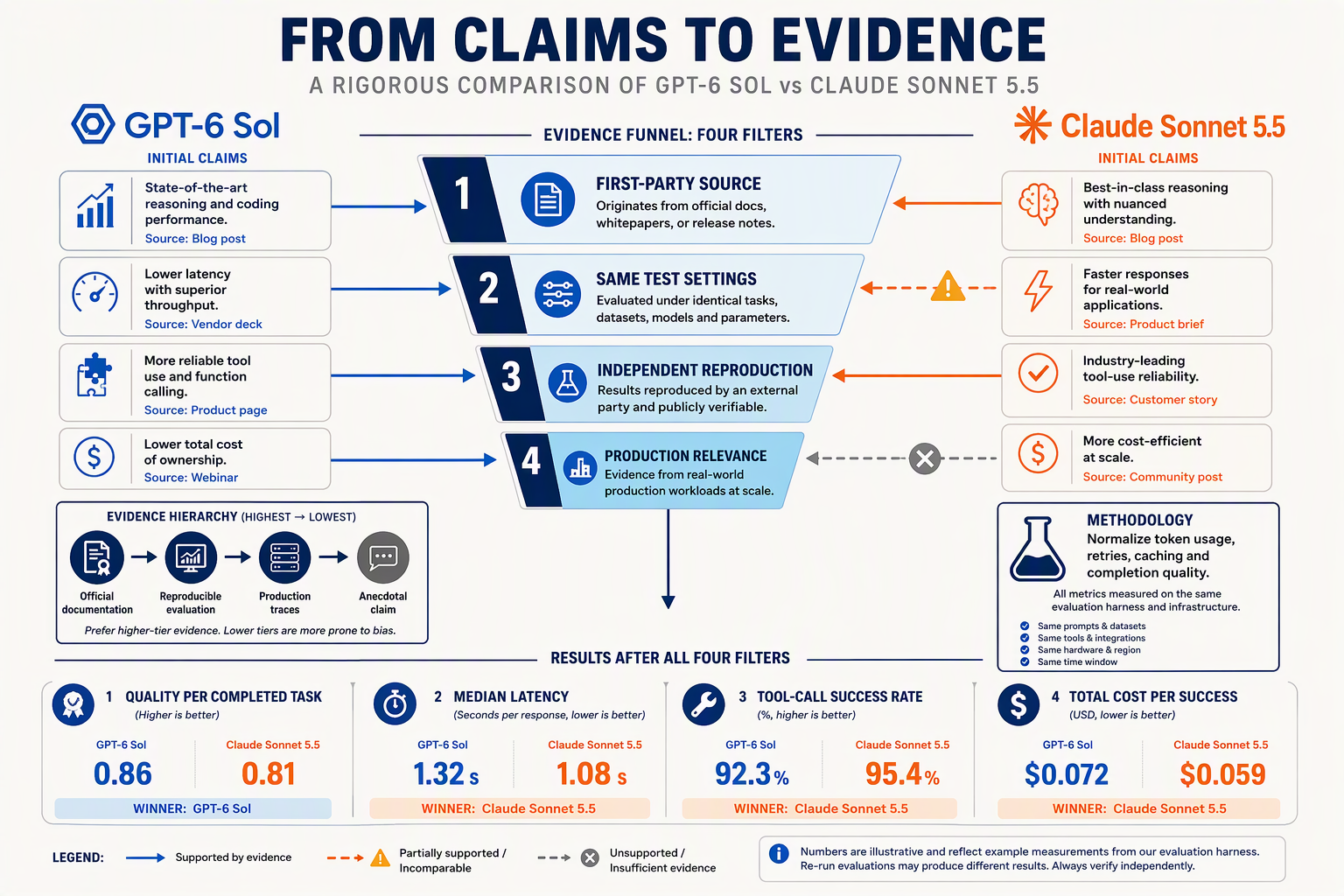
No head-to-head benchmark or cost-per-task claim is trustworthy unless it identifies the exact model, test setup, and complete workload cost. As of September 29, 2026, the available evidence supports neither a numeric GPT-6 Sol versus Claude Sonnet 5.5 ranking nor a defensible value winner.
Which benchmark claims can be trusted?
- GPT-6 Sol: OpenAI’s September 2026 announcement confirms the model’s name but provides no benchmark scores, dataset versions, sample counts, confidence intervals, system prompts, reasoning settings, or independent reproductions in the supplied evidence; claims assigning GPT-6 Sol an MMLU, SWE-bench, GPQA, or coding score are therefore unverified.
- Claude Sonnet 5.5: No Anthropic model card, announcement, API documentation, or evaluation report confirming Claude Sonnet 5.5 appears in the available research as of September 29, 2026, so purported benchmark tables cannot yet be tied to an authenticated model or configuration.
- GPT-6 Astra: OpenAI describes GPT-6 Astra as “the most intelligent and aligned model in the world,” but that qualitative statement concerns Astra—not GPT-6 Sol—and cannot substitute for reproducible benchmark results or be transferred between GPT-6 variants.
- Trust threshold: A credible comparison should disclose the model ID and snapshot date, benchmark version, pass@1 or pass@k method, tool access, token budget, temperature, scaffolding, number of trials, and whether results were vendor-run or independently reproduced; screenshots and unsourced leaderboards do not meet that standard.
How should cost per task be calculated?
- GPT-6 Sol: OpenAI has not supplied a confirmed public API token rate for GPT-6 Sol in the available evidence, while the OpenAI Help Center classifies it under ChatGPT Work and Codex; seat access, enterprise token billing, and public API pricing must not be treated as interchangeable.
- GPT-5.6 Sol: OpenAI’s developer documentation lists promotional pricing of $4 per million input tokens and $20 per million output tokens through at least November 21, 2026; these prices provide a calculation example, not a proxy price for GPT-6 Sol.
- Worked example: At GPT-5.6 Sol’s documented September 2026 promotional rate, a successful task consuming 100,000 input tokens and 20,000 output tokens costs $0.80—$0.40 for input plus $0.40 for output—before retries, tools, search, storage, or platform charges.
- Real cost-per-task: Calculate (input tokens × input rate) + (output tokens × output rate) + cache, tool, search, retry, and infrastructure costs, then divide by successfully completed tasks rather than attempted prompts; request logs, such as those available through the OpenAI-compatible CallMissed AI gateway, can help teams measure actual usage instead of relying on headline token prices.
What are the confirmed pros, cons and unknowns of each model?
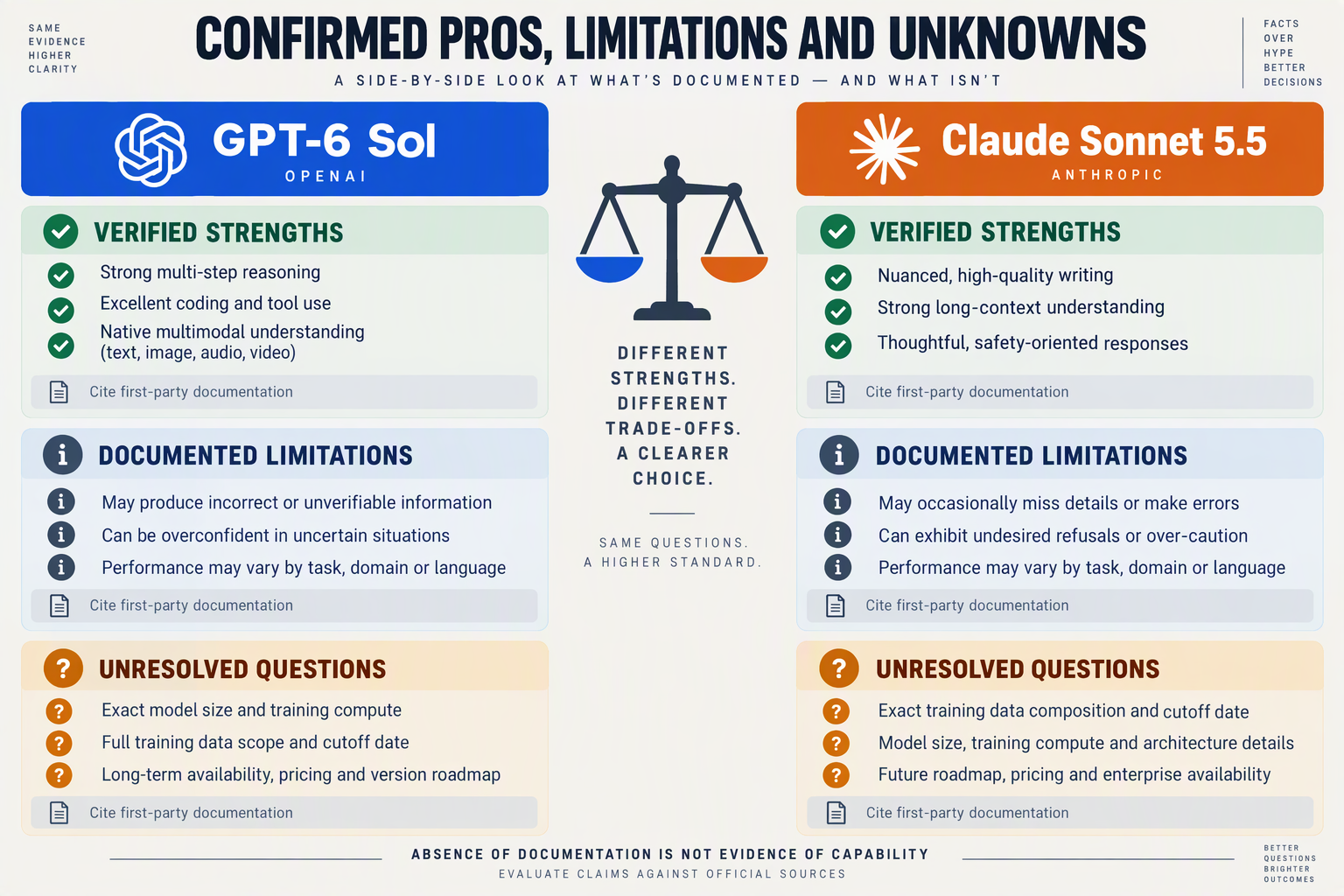
The evidence supports a limited conclusion: GPT-6 Sol has confirmed positioning and restricted availability, whereas Claude Sonnet 5.5 remains unverified; neither has enough published data for a credible head-to-head ranking.
Which strengths, limitations and evidence gaps are confirmed?
| Category | GPT-6 Sol | Claude Sonnet 5.5 | Confidence |
|---|---|---|---|
| Model identity | Officially announced by OpenAI | No Anthropic primary-source confirmation found | High |
| Availability | ChatGPT Work and Codex; not available in Chat | Plans, API access and cloud distribution unknown | High |
| Confirmed advantage | Verifiable product name and deployment scope | None can be established from supplied evidence | High |
| Confirmed limitation | Restricted availability; incomplete public specifications | Model existence and availability remain unverified | High |
| Pricing | No verified GPT-6 Sol token rate | No verified token or caching rates | High |
| Technical evidence | Context limit and benchmark results unpublished here | Context limit, model card and benchmarks unavailable | High |
- GPT-6 Sol: OpenAI’s September 2026 announcement confirms that the model follows GPT-6 Astra and targets everyday work use cases.
- GPT-6 Sol: The OpenAI Help Center explicitly says GPT-6 Sol is for ChatGPT Work and Codex, narrowing where buyers can evaluate it.
- GPT-6 Sol: The documented $4 input/$20 output per million tokens rate belongs to GPT-5.6 Sol through at least November 21, 2026—not GPT-6 Sol.
- Claude Sonnet 5.5: Without an Anthropic model card, API identifier or release note, claims about coding quality, safety or speed are speculation.
- Both models: No verified context-window limits or comparable benchmark scores are available in the supplied research.
- Developers: Multi-model infrastructure can reduce premature lock-in; as of September 2026, CallMissed provides an OpenAI-compatible API covering 138 models with caller-selected fallbacks, without implying support for either unconfirmed endpoint.
Which model should you choose for coding, documents, office work and agents?
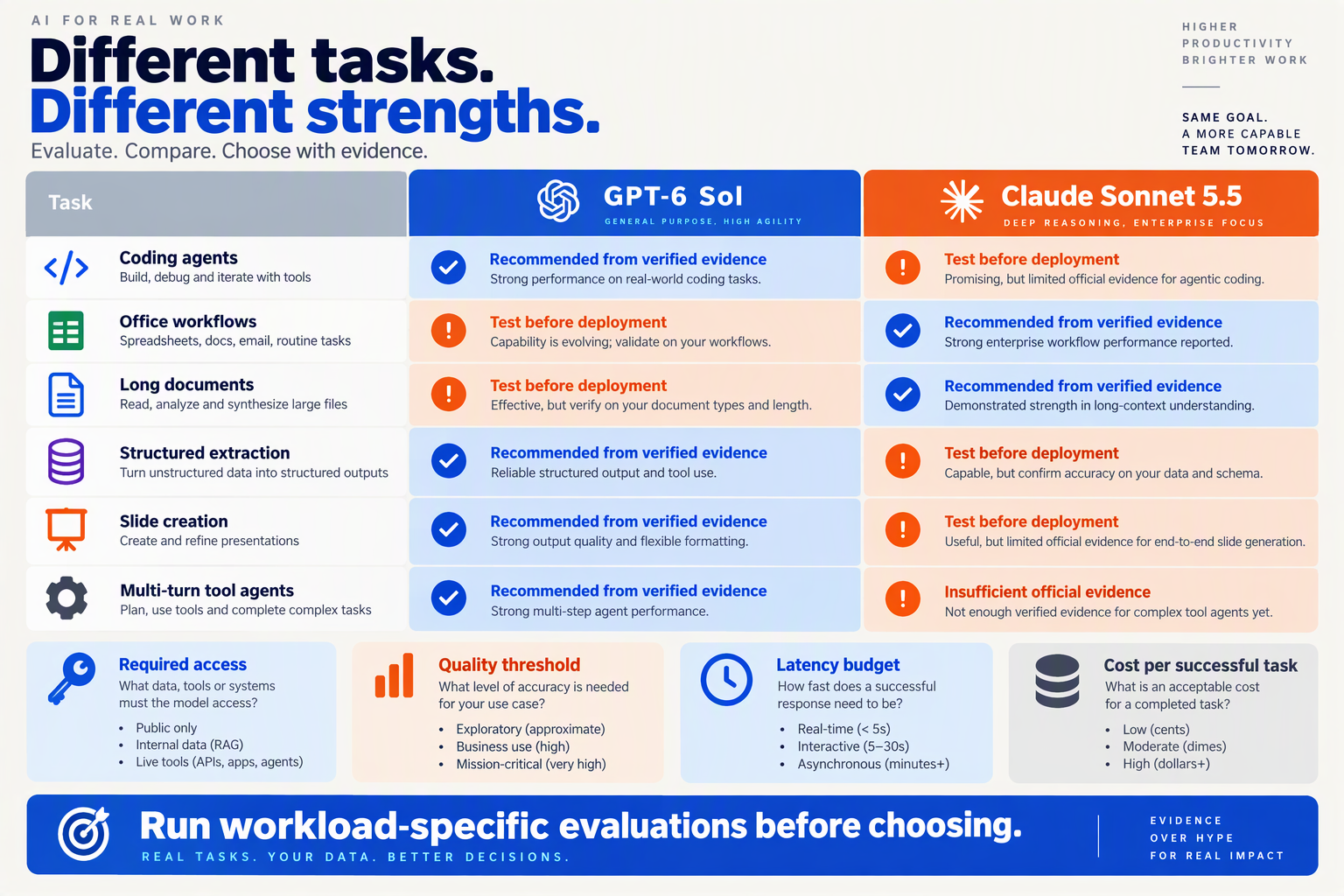
The practical choice depends less on branding than on verified access, measurable task quality and deployment controls. As of September 29, 2026, GPT-6 Sol can be cautiously evaluated in its documented environments; Claude Sonnet 5.5 should not be selected until Anthropic confirms it.
Which model should developers choose for coding?
- GPT-6 Sol: Evaluate it inside Codex, where OpenAI officially lists access, using repository-specific tests such as patch acceptance, regression rates and tool-call accuracy.
- Claude Sonnet 5.5: Do not base a coding workflow on this name without an Anthropic model card, API identifier and reproducible coding benchmarks.
Which model is suitable for documents?
- GPT-6 Sol: Test with representative contracts, reports and spreadsheets, but avoid assuming a context limit because OpenAI’s supplied documentation does not confirm one.
- Claude Sonnet 5.5: Context capacity, supported file types and citation performance remain unverified, preventing a defensible document-processing comparison.
What should businesses use for office work?
- GPT-6 Sol: OpenAI positions GPT-6 Sol for ChatGPT Work, making controlled pilots appropriate for eligible organizations; the OpenAI Help Center says it is not available in Chat.
- Claude Sonnet 5.5: Wait for Anthropic to confirm availability, enterprise controls and pricing before budgeting or training employees around it.
Which model should power AI agents?
- GPT-6 Sol: Production adoption should wait for confirmed API pricing, rate limits, tool-use specifications and a stable developer model ID.
- Claude Sonnet 5.5: Agent deployment is premature without authoritative API documentation; meanwhile, gateways such as CallMissed’s OpenAI-compatible API provide caller-selected fallbacks across 138 catalogued models as of September 2026, reducing dependence on any unverified model name.
How should teams migrate and test the APIs without locking in unsupported assumptions?
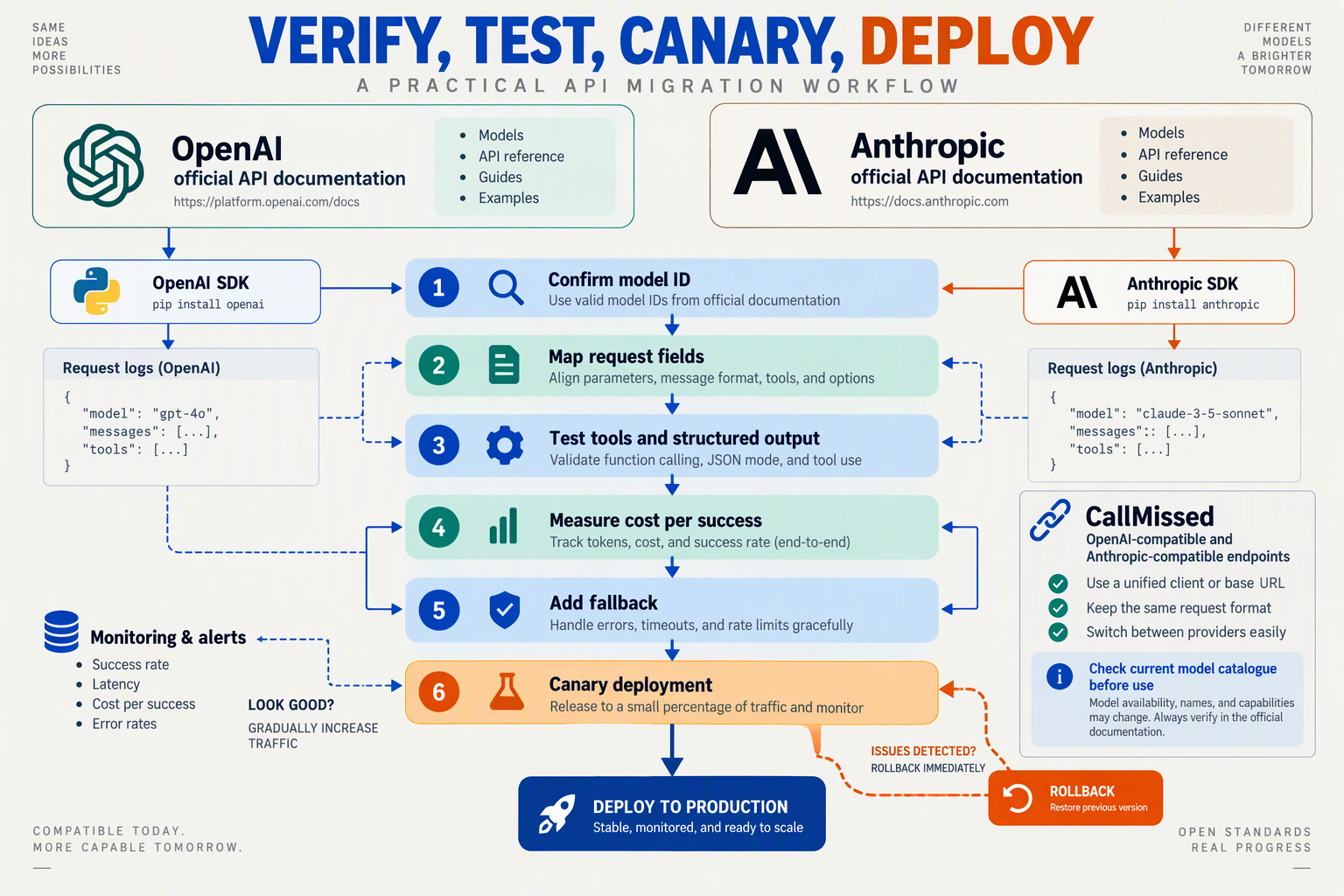
Do not hard-code either model name until the provider publishes a supported API model ID, endpoint, limits, and pricing. Treat GPT-6 Sol as Work/Codex-only and Claude Sonnet 5.5 as unverified as of September 29, 2026.
What should an API migration test include?
- GPT-6 Sol: OpenAI’s Help Center says GPT-6 Sol is for ChatGPT Work and Codex and “not available in Chat”; this does not confirm access through OpenAI’s public developer API.
- Claude Sonnet 5.5: Require an Anthropic model card, API documentation, release note, or pricing page before adding a production alias; no such primary-source confirmation appears in the supplied research.
- Model configuration: Store provider, model ID, API version, timeout, token ceiling, and fallback policy in configuration—not application code—so an incorrect assumption can be removed without redeploying core logic.
- Contract tests: Probe streaming, tool calling, structured output, vision, error formats, token accounting, and context overflow separately; never infer GPT-6 Sol capabilities from GPT-5.6 Sol or another GPT-6 variant.
- Cost tests: Log input tokens, output tokens, retries, cache behavior, and failed requests, but leave GPT-6 Sol and Claude Sonnet 5.5 price fields unset until verified; OpenAI Developer Documentation’s $4 input/$20 output per million tokens through at least November 21, 2026 applies to GPT-5.6 Sol, not GPT-6 Sol.
- Evaluation gates: Run a versioned test set covering factuality, instruction following, tool success, latency, safety, and total task cost; promote a model only after it meets predetermined thresholds against the current production baseline.
- Portability: An abstraction layer can reduce switching costs; as of September 2026, CallMissed’s OpenAI-compatible gateway exposes 138 catalogued models through one API key and supports caller-selected fallbacks, but teams must still verify that any specific target model is officially listed before migration.
Frequently Asked Questions
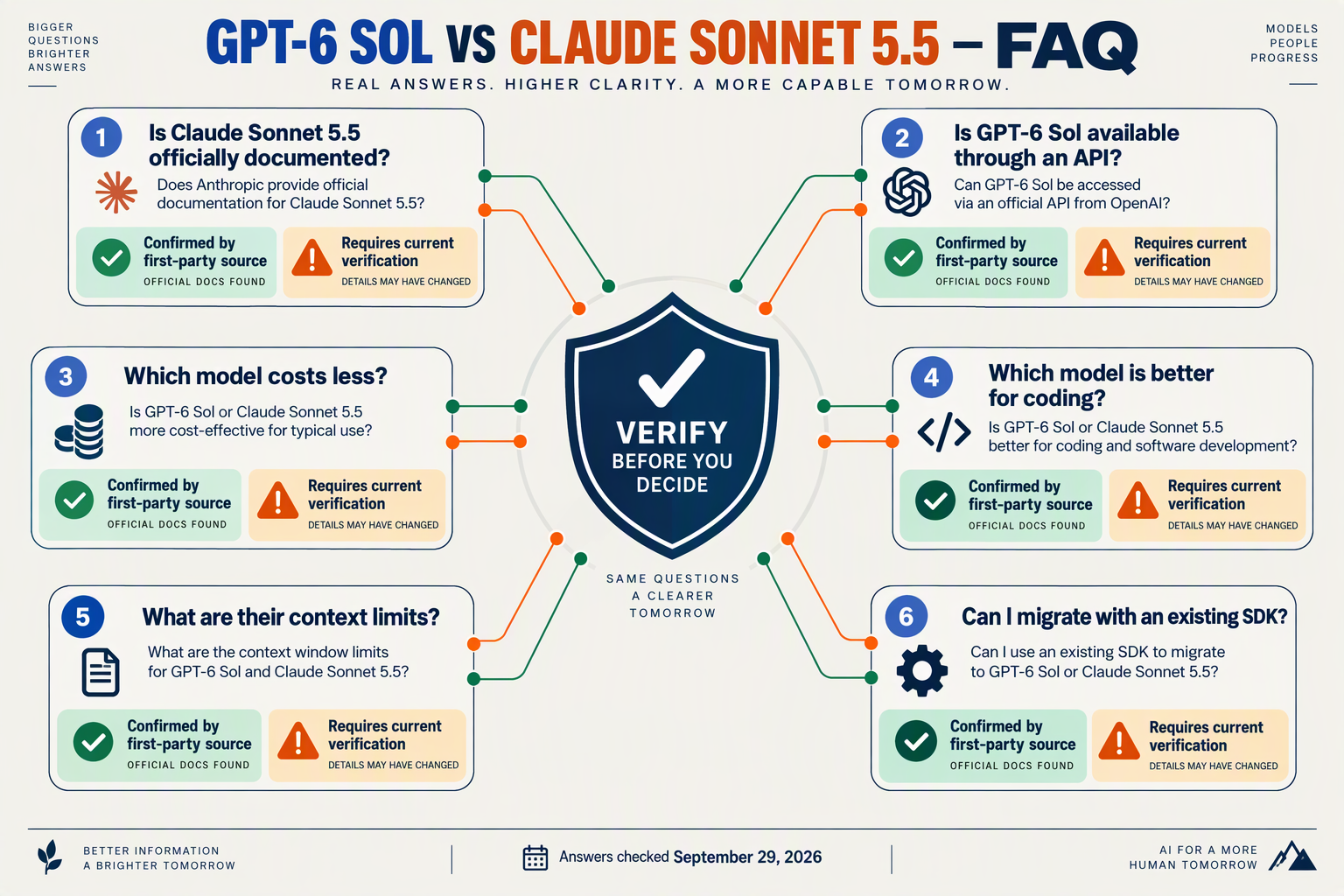
These answers reflect official evidence available on September 29, 2026, not leaked specifications or third-party screenshots.
- Q: Is GPT-6 Sol vs Claude Sonnet 5.5 a confirmed model comparison?
A: Only partly: OpenAI officially announced GPT-6 Sol, but the supplied research contains no Anthropic announcement, model card, API documentation, or release note for Claude Sonnet 5.5. Therefore, no rigorous winner can be named as of September 29, 2026.
- Q: Where is GPT-6 Sol available?
A: The OpenAI Help Center says GPT-6 Sol is available for ChatGPT Work and Codex. OpenAI explicitly states that GPT-6 Sol and GPT-6 Luna “are not available in Chat.”
- Q: Is Claude Sonnet 5.5 officially available from Anthropic?
A: No primary Anthropic source in the supplied evidence confirms Claude Sonnet 5.5 or provides an API model ID. Availability through the Anthropic API, Amazon Bedrock, Google Cloud Vertex AI, or Claude plans therefore remains unverified.
- Q: What is the GPT-6 Sol vs Claude Sonnet 5.5 pricing?
A: Verified token prices are unavailable for both named models as of September 29, 2026. OpenAI’s $4 per million input tokens and $20 per million output tokens promotion applies to GPT-5.6 Sol through at least November 21, 2026—not GPT-6 Sol.
- Q: What context windows do GPT-6 Sol and Claude Sonnet 5.5 support?
A: The supplied official evidence establishes no verified context-window limit for either model. Claims involving specific token limits should be treated as unconfirmed until OpenAI or Anthropic publishes technical documentation.
- Q: Which model wins the GPT-6 Sol vs Claude Sonnet 5.5 benchmarks?
A: Neither can credibly be declared the benchmark winner because comparable official results are absent. Evaluate only reproducible tests that disclose prompts, scoring methods, model versions, tool access, and testing dates.
Conclusion
The verified conclusion is caution, not a winner: as of September 29, 2026, the comparison remains asymmetric.
- GPT-6 Sol is official, but OpenAI says it is “not available in Chat.”
- Claude Sonnet 5.5 remains unverified in the supplied Anthropic sources.
- Pricing, context limits, and benchmark comparisons remain insufficiently documented.
- GPT-5.6 Sol pricing must not be presented as GPT-6 Sol pricing.
Watch for official model cards, API identifiers, rate cards, and reproducible evaluations. Explore emerging voice and chat models through CallMissed—but until primary evidence arrives, would you trust any declared winner?
Related Reading
- GPT-6 Sol vs Claude Opus 5.5: 2026 Enterprise Guide
- GPT-6 Sol vs Claude Opus 5.5: Benchmarks & Cost
- GPT-6 Sol vs GPT-6 Luna: Verified 2026 Model Comparison
Sources
Discussion
Ready to automate customer conversations?
Launch AI voice agents and WhatsApp bots with CallMissed — one API, 22+ Indian languages.