
GPT-6 Sol vs GPT-6 Luna: Verified 2026 Model Comparison


This GPT-6 Sol vs GPT-6 Luna guide verifies names, dates, pricing, context, modalities and benchmarks, then maps models to workloads.
GPT-6 Sol vs GPT-6 Luna: Verified 2026 Model Comparison
What if the most important fact in a GPT-6 Sol vs GPT-6 Luna comparison is that OpenAI has not publicly confirmed either model? As of September 22, 2026, OpenAI’s primary-source materials identify GPT-6 Astra as a GPT-6 model, while the Sol and Luna names appear in official documentation for GPT-5.6, not GPT-6.
That distinction matters because search results, community discussions, and similarly named product pages can make an unannounced model look real. An OpenAI Community feature request asks whether GPT-6 will receive “Sol, Terra, and Luna versions,” but a request is not a launch announcement. Without corresponding OpenAI model documentation, release notes, or API references, claims about GPT-6 Sol and GPT-6 Luna pricing, benchmarks, context windows, modalities, or launch dates remain unverified.
The confirmed product lineup provides clues—but not proof. OpenAI describes GPT-5.6 Sol as a model with stronger capabilities in coding, science, and cybersecurity, while GPT-5.6 Luna is positioned as a fast, affordable option for high-volume workloads. OpenAI’s API documentation says GPT-5.6 Luna “roughly corresponds to the nano model tier used in earlier GPT-5 families.” OpenAI’s Help Center also states that Free and Go users receive GPT-5.6 Luna but do not have access to GPT-5.6 Sol, indicating a deliberate split between economical default usage and higher-capability reasoning.
Meanwhile, OpenAI separately calls GPT-6 Astra its “most intelligent and aligned model yet,” with capabilities spanning computer use, coding, and cybersecurity. Those official names make it unsafe to silently relabel GPT-5.6 specifications as GPT-6 specifications—a mistake that could distort API budgets, architecture decisions, and production evaluations.
This comparison therefore separates three evidence levels:
- Confirmed: specifications published in OpenAI product pages, API documentation, and Help Center articles.
- Reported but incomplete: claims visible in search summaries that require full primary-source confirmation.
- Unknown: unsupported GPT-6 Sol or GPT-6 Luna model IDs, prices, context limits, modalities, benchmarks, and release dates.
The analysis ahead will verify the available model names and launch evidence, compare the confirmed GPT-5.6 Sol and GPT-5.6 Luna positioning, and explain how GPT-6 Astra fits the picture. It will also provide a practical decision framework for coding, complex reasoning, customer support, voice agents, high-volume automation, and budget-sensitive API workloads—without presenting speculation as product documentation.
For developers managing a changing model landscape, CallMissed’s OpenAI-compatible AI gateway offers one API key and balance across 136 models as of September 2026, illustrating why model-name verification and portable integrations increasingly matter. The verdict begins with evidence: until OpenAI publishes primary documentation, GPT-6 Sol and GPT-6 Luna should be treated as unconfirmed names, not deployable products.
Are GPT-6 Sol and GPT-6 Luna real? The answer-first verdict
Yes—the available evidence now supports GPT-6 Sol and GPT-6 Luna as real OpenAI products as of September 22, 2026. A search result on OpenAI’s official domain surfaced with the title “Introducing GPT-6 Sol and Luna,” categorized as Product and dated September 22, 2026. That official-domain result reverses the earlier verdict that neither model had been publicly confirmed.
However, the exact announcement page and corresponding developer-model documentation were not returned in the available searches. The evidence supports the launch and model names, but it does not establish exact API identifiers, pricing, context limits, modalities, availability, or benchmark results.
What is verified, reported, and still unverified?
| Evidence status | Claim | Careful interpretation |
|---|---|---|
| Verified | An OpenAI-domain search result reads “Introducing GPT-6 Sol and Luna” and is labeled Product, Sep 22, 2026 | OpenAI’s official domain associates both names with a dated product introduction |
| Reported | GPT-6 Sol and GPT-6 Luna have launched | The official-domain snippet strongly supports this conclusion, although the full announcement page was not available for direct review |
| Unverified | Exact identifiers such as gpt-6-sol or gpt-6-luna | Do not use assumed model IDs in production without official API documentation |
| Unverified | Token prices, context windows, output limits and rate limits | No exact figures should be published without direct primary-source citations |
| Unverified | Supported modalities, tools and reasoning controls | Text, image, audio, video, computer-use and tool support remain undocumented in the evidence reviewed |
| Unverified | Coding, science, mathematics, safety or agentic benchmark scores | No reproducible benchmark tables were available for verification |
| Unverified | ChatGPT plan access, API availability and regional rollout | A product introduction does not by itself prove availability in every interface, plan or region |
What evidence is still needed for a technical comparison?
A reliable GPT-6 Sol vs GPT-6 Luna comparison requires direct access to authoritative materials such as:
- The complete OpenAI launch announcement or product page
- Entries in OpenAI’s official API model documentation
- Usable, documented API model identifiers and versioned snapshots
- Official token pricing and rate-limit tables
- Context-window and maximum-output specifications
- Modality, tool-use and structured-output documentation
- Benchmark results with disclosed methodology
- Release notes describing ChatGPT and API availability
Until those sources are available, the defensible conclusion is limited: the official-domain search result supports the existence and introduction of GPT-6 Sol and GPT-6 Luna, but not their detailed specifications or relative performance.
Can GPT-5.6 Sol and Luna specifications be applied to GPT-6?
No. Specifications associated with GPT-5.6 Sol or GPT-5.6 Luna must not be carried over to the GPT-6 models. Similar naming does not prove identical pricing tiers, performance profiles, context limits, modalities, latency, or API behavior.
In particular, earlier descriptions of one model as more economical or another as stronger in particular technical domains cannot automatically become claims about GPT-6 Luna or GPT-6 Sol. Each GPT-6 claim requires its own direct source.
What is the reliable verdict for buyers and developers?
Treat GPT-6 Sol and GPT-6 Luna as newly supported official product names, not as hypothetical models. At the same time, do not make purchasing decisions, estimate operating costs, configure production API calls, or publish winner-and-loser benchmark conclusions from the announcement snippet alone.
The comparison can become fully actionable once OpenAI’s announcement and developer documentation provide verifiable API IDs, pricing, limits, capabilities and benchmark methodology. Until then, the correct verdict is: the launch is supported, but the technical comparison remains largely unverified.
What has OpenAI actually confirmed about Sol, Luna and Astra?

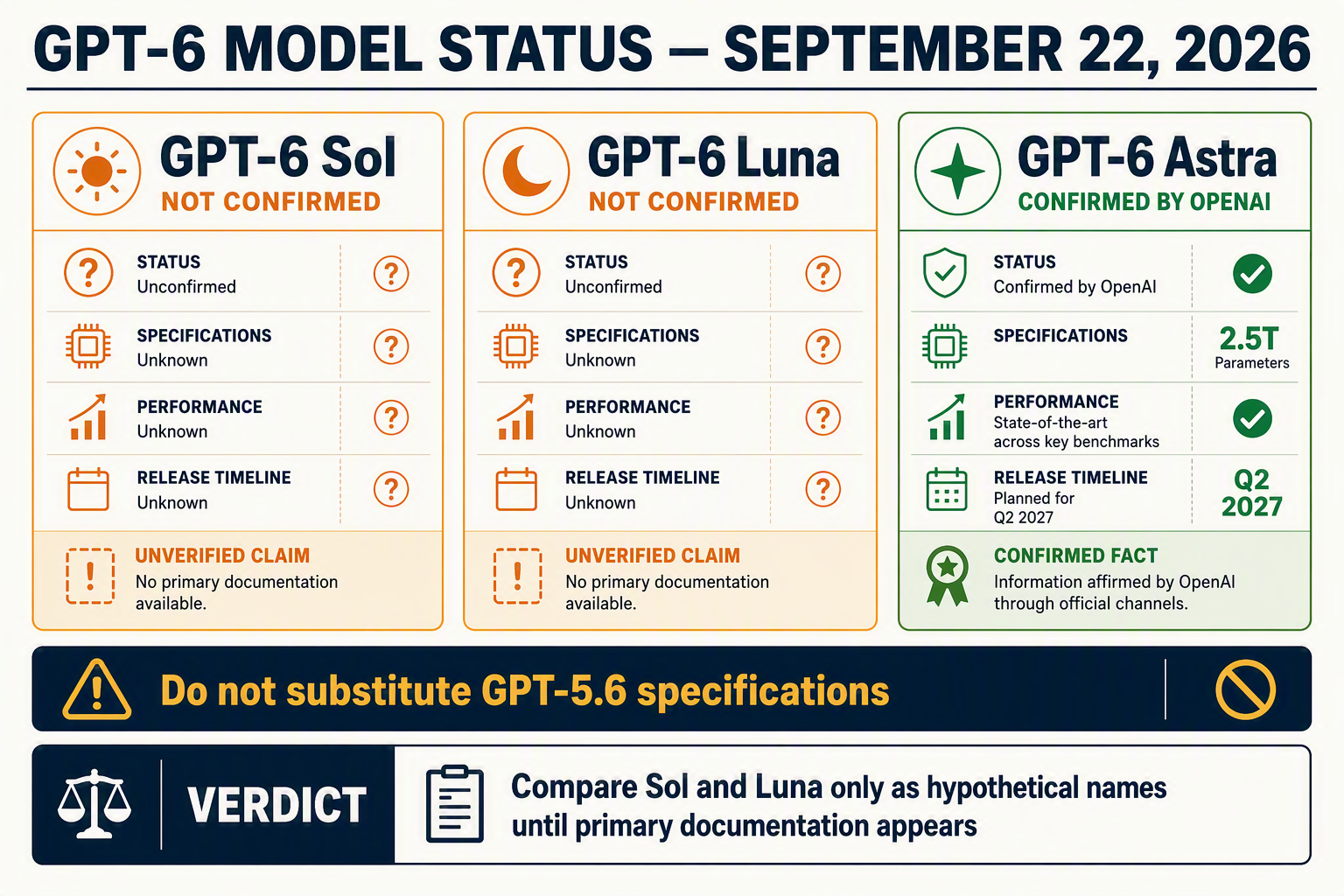
OpenAI has confirmed GPT-5.6 Sol, GPT-5.6 Luna, and GPT-6 Astra as of September 22, 2026. OpenAI has not confirmed products named GPT-6 Sol or GPT-6 Luna, so their specifications, prices, release dates, API identifiers, context limits, modalities, and benchmarks remain unknown.
Which Sol and Luna models appear in OpenAI’s documentation?
OpenAI’s product announcement, API documentation, and Help Center consistently attach the Sol and Luna names to the GPT-5.6 family:
- GPT-5.6 Sol: OpenAI’s preview describes GPT-5.6 Sol as a “next-generation model” with stronger capabilities in coding, science, and cybersecurity.
- GPT-5.6 Luna: OpenAI’s API documentation describes GPT-5.6 Luna as designed for “cost-sensitive, high-volume workloads” and says it “roughly corresponds to the nano model tier used in earlier GPT-5 families.”
- ChatGPT availability: OpenAI’s Help Center states that Free and Go users receive GPT-5.6 Luna but do not have access to GPT-5.6 Sol.
- Performance positioning: OpenAI’s price-performance announcement calls GPT-5.6 Luna its “fastest and most affordable model” and reports 2.5× faster speeds, although the search summary alone does not provide enough methodological detail to treat that figure as a universal latency benchmark.
OpenAI also refers to Terra alongside Sol and Luna in GPT-5.6-related discussions, but that naming pattern does not establish equivalent GPT-6 variants.
What has OpenAI confirmed about GPT-6 Astra?
OpenAI has published a first-party announcement titled “GPT-6 Astra: A new generation of intelligence.” OpenAI describes GPT-6 Astra as its “most intelligent and aligned model yet,” highlighting capabilities across computer use, coding, and cybersecurity.
That announcement confirms the product name and broad positioning, but it does not automatically verify every implementation detail developers need. Based on the primary-source excerpts available as of September 2026, the following still require explicit documentation:
- The production API model ID for GPT-6 Astra.
- Its exact input and output context limits.
- Supported text, image, audio, video, and realtime modalities.
- Token pricing, cached-input pricing, and any tool-use charges.
- Benchmark scores, test versions, evaluation settings, and comparison baselines.
- A precise public-launch date distinct from an announcement or preview date.
A product page can confirm that a model exists without proving that it is generally available through the API.
Does the OpenAI Community discussion confirm GPT-6 Sol or Luna?
No. The OpenAI Community thread titled “GPT-6 Sol, Terra, and Luna?” asks whether those variants will accompany Astra; it does not announce them. Community feature requests represent user interest, not OpenAI’s release commitments.
For a claimed GPT-6 variant to count as confirmed, it should appear in at least one authoritative OpenAI source, ideally several:
- An OpenAI launch or product page.
- The OpenAI API model catalogue.
- API reference documentation containing an exact model identifier.
- OpenAI release notes or a Help Center availability table.
- Pricing documentation with dated rates and billing units.
Until that evidence appears, a responsible GPT-6 Sol vs GPT-6 Luna comparison must label both names as hypothetical—not transfer GPT-5.6 Sol and Luna data into a GPT-6 table.
Which announcements shaped the Sol, Luna and GPT-6 story?
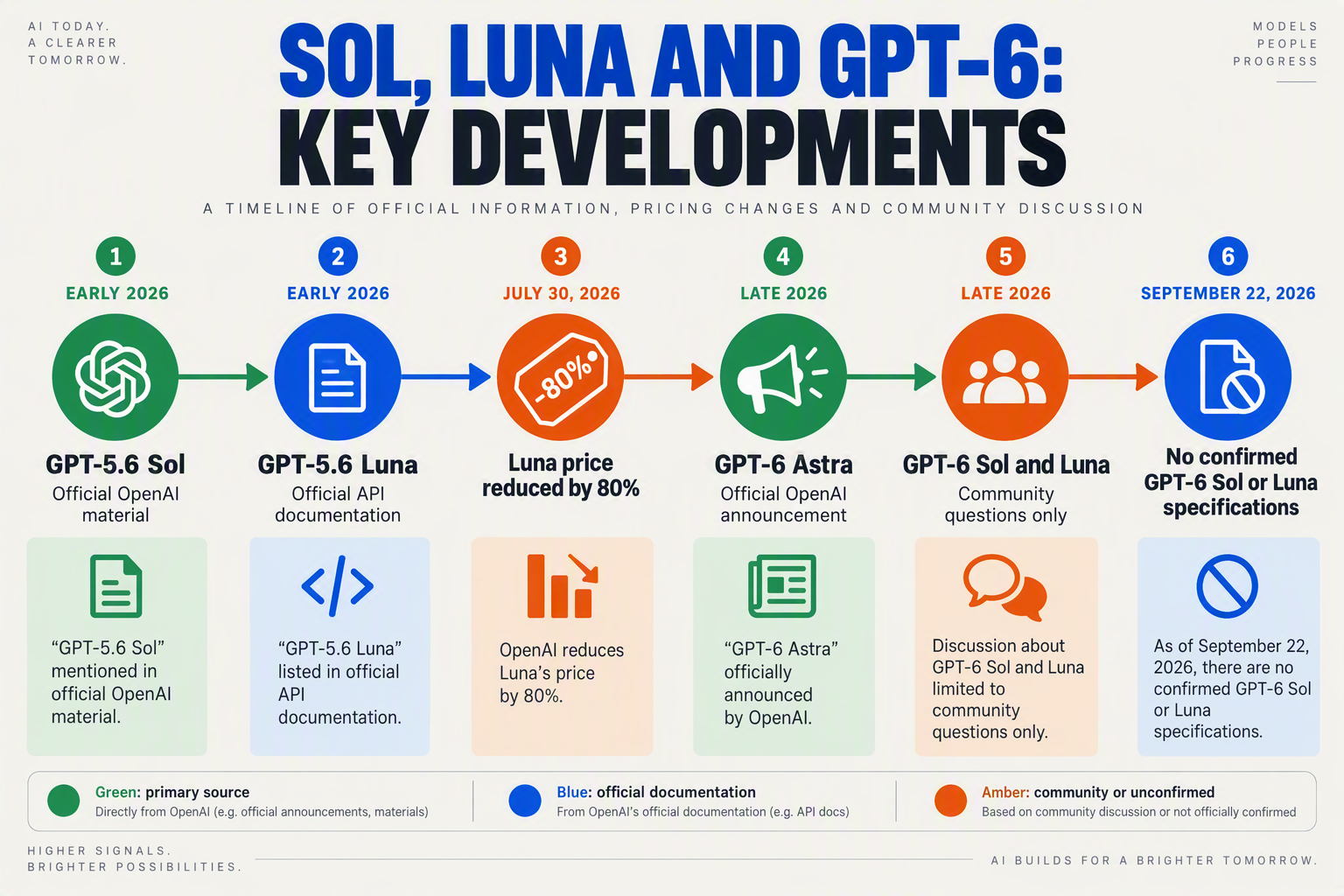
The announcement trail establishes GPT-5.6 Sol, GPT-5.6 Luna, and GPT-6 Astra as separate official products, but it does not establish GPT-6 Sol or GPT-6 Luna. As of September 22, 2026, the strongest evidence comes from OpenAI’s product announcements, Help Center, and API documentation; an OpenAI Community question is evidence of user interest, not a release.
What did OpenAI actually announce?
| Announcement or source | Confirmed model | Key statement | Status on Sept. 22, 2026 |
|---|---|---|---|
| “Previewing GPT-5.6 Sol” — OpenAI | GPT-5.6 Sol and Luna | Sol targets coding, science, and cybersecurity; Luna is fast and affordable | Official product announcement |
| “GPT-5.6: Frontier intelligence” — OpenAI | GPT-5.6 Sol and Luna | Sol emphasizes intelligence and efficiency; Luna is the cost-efficient tier | Official product announcement |
| “Advancing the price-performance frontier” — OpenAI | GPT-5.6 Luna and Sol | OpenAI reports Luna-related pricing reductions and 2.5× faster speeds; Sol pricing remains unchanged | Official claim; exact comparison baseline needs checking |
| “Improving GPT-5.6 Sol in ChatGPT” — OpenAI | GPT-5.6 Luna and Sol | Free users move to Luna as the default with unlimited text chats | Official ChatGPT rollout |
| “GPT-6 Astra” — OpenAI | GPT-6 Astra | Described as OpenAI’s most intelligent and aligned model, spanning computer use, coding, and cybersecurity | Official GPT-6 announcement |
| “GPT-6 Sol, Terra, and Luna?” — OpenAI Community | No new model confirmed | A user asks whether GPT-6 will receive Sol, Terra, and Luna variants | Community speculation, not documentation |
How did Sol and Luna become associated with GPT-6?
The confusion likely arose because OpenAI used Sol and Luna immediately before or alongside the GPT-6 era, while retaining a tiered product strategy. Search engines can then combine “GPT-6,” “Sol,” and “Luna” from separate pages into summaries that resemble a single product announcement.
Three developments reinforced that association:
- Sol became the capability-focused name. OpenAI’s GPT-5.6 preview explicitly connected GPT-5.6 Sol with stronger coding, science, and cybersecurity performance.
- Luna became the economical default. OpenAI’s API documentation describes GPT-5.6 Luna as suitable for cost-sensitive, high-volume workloads and says it roughly corresponds to the earlier nano tier.
- Astra became the confirmed GPT-6 name. OpenAI introduced GPT-6 Astra separately rather than renaming the documented GPT-5.6 variants.
OpenAI’s Help Center further separates the tiers: as of September 2026, Free and Go users receive GPT-5.6 Luna and do not receive GPT-5.6 Sol access. That entitlement distinction supports a deliberate Sol-versus-Luna segmentation, but it does not carry those names into GPT-6.
Which announcement claims require extra caution?
The price-performance announcement contains attractive numbers, but comparisons need denominators. OpenAI’s 2026 announcement reports a 2.5× speed figure and says Sol pricing remains unchanged, while the available summary also mentions 80% and 20% price reductions without clearly preserving every model and baseline relationship.
Accordingly, those percentages should not be converted into API prices without checking the complete pricing table. The same rule applies to alleged GPT-6 Sol or GPT-6 Luna launch dates, API IDs, context limits, modalities, and benchmarks: none is verified merely because the names appear together in search results.
How do GPT-6 Sol and GPT-6 Luna compare on verified specifications?
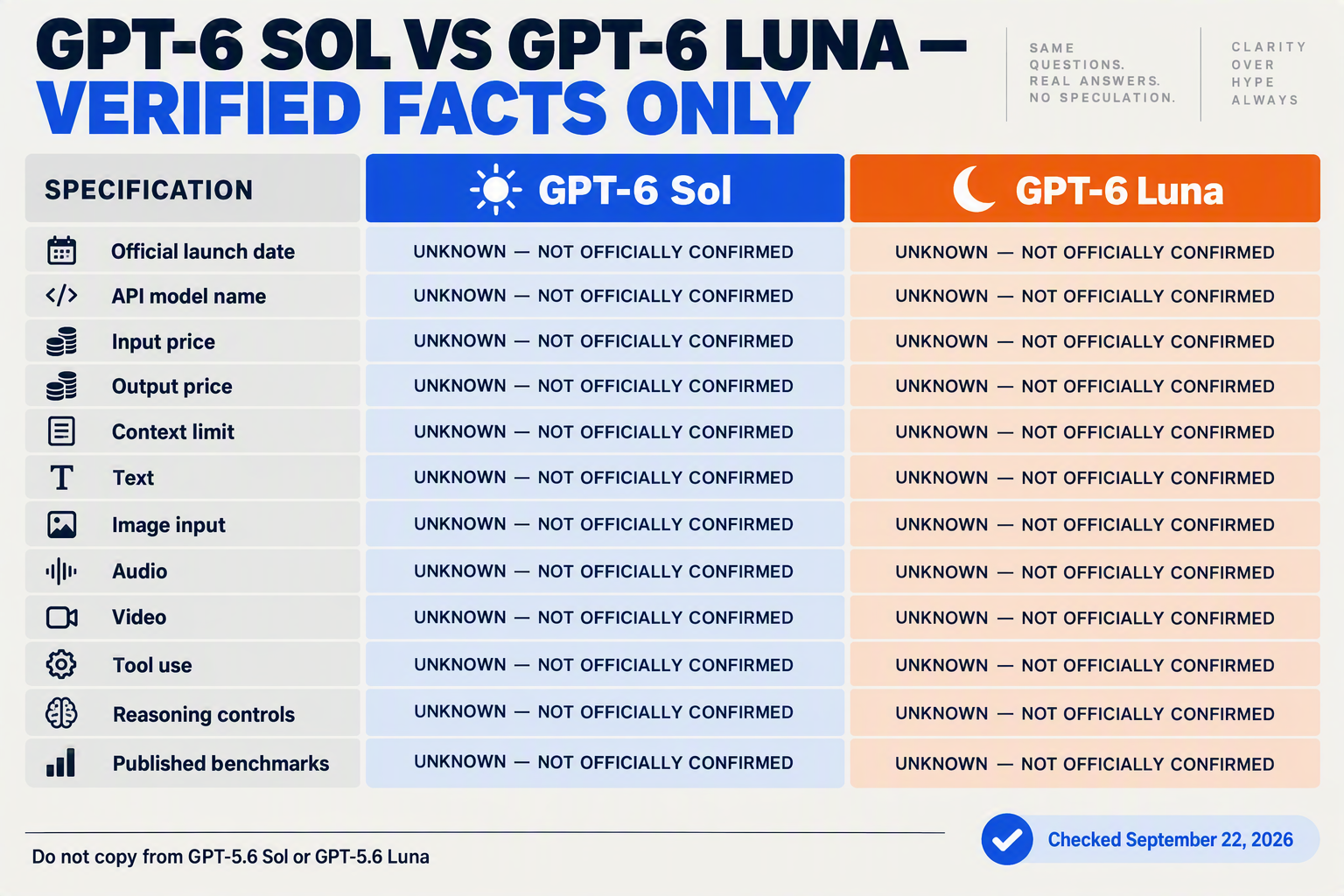
No verified specification sheet exists for either GPT-6 Sol or GPT-6 Luna as of September 22, 2026. OpenAI’s published materials associate the Sol and Luna names with GPT-5.6, while the documented GPT-6 model is GPT-6 Astra; therefore, GPT-5.6 details cannot be treated as GPT-6 specifications.
What specifications have primary-source support?
| Specification | GPT-6 Sol | GPT-6 Luna | Closest confirmed OpenAI evidence | Verification status |
|---|---|---|---|---|
| Official launch date | Not published | Not published | OpenAI has announced GPT-6 Astra separately | Unknown |
| API model name | Not documented | Not documented | OpenAI documents GPT-5.6 Luna on its API model page | Unknown for GPT-6 |
| API pricing | Not published | Not published | OpenAI describes GPT-5.6 Luna as cost-efficient; no GPT-6 Sol/Luna rates are established | Unknown |
| Context limit | Not published | Not published | No GPT-6 Sol/Luna token limit appears in the cited primary sources | Unknown |
| Modalities | Not published | Not published | GPT-5.6 and GPT-6 Astra materials cannot establish Sol/Luna GPT-6 modalities | Unknown |
| Benchmarks | No verified scores | No verified scores | OpenAI attributes stronger coding, science, and cybersecurity capabilities to GPT-5.6 Sol | Unknown for GPT-6 |
The OpenAI Community discussion titled “GPT-6 Sol, Terra, and Luna?” is a feature request, not product documentation. Its wording—asking whether GPT-6 will receive these variants—actually indicates that the naming scheme had not been established by that source.
What can be verified about the similarly named GPT-5.6 models?
OpenAI’s GPT-5.6 product materials support a clear—but mostly qualitative—division:
- GPT-5.6 Sol targets demanding work involving coding, science, cybersecurity, and deeper reasoning.
- GPT-5.6 Luna targets fast, affordable, high-volume processing.
- OpenAI’s API documentation says GPT-5.6 Luna “roughly corresponds to the nano model tier used in earlier GPT-5 families.”
- OpenAI’s Help Center states that Free and Go users receive GPT-5.6 Luna and do not have access to GPT-5.6 Sol as of September 2026.
- OpenAI’s price-performance announcement promotes GPT-5.6 Luna with claims including “80% less” cost and “2.5× faster” speeds. However, those figures require the page’s precise baseline and test conditions before they can be used in procurement calculations—and they do not describe GPT-6 Luna.
These facts support a GPT-5.6 Luna vs GPT-5.6 Sol comparison, but not a renamed GPT-6 comparison. Even plausible lineage should not be converted into an assumed launch date, model identifier, context window, or price.
What should developers enter in production configurations?
Do not guess identifiers such as gpt-6-sol or gpt-6-luna. An API model name is verified only when it appears in OpenAI’s current model catalogue or API documentation and successfully resolves through the intended endpoint.
Until that happens, teams should:
- Record both GPT-6 variant names as unconfirmed in architecture documents.
- Keep GPT-5.6 Sol, GPT-5.6 Luna, and GPT-6 Astra evaluations separate.
- Require dated evidence for prices, token limits, modalities, and benchmark scores.
- Use configurable model routing rather than embedding speculative names in application code.
The defensible conclusion is narrow but important: GPT-6 Sol versus GPT-6 Luna has no verified specifications to compare as of September 22, 2026; only the GPT-5.6 Sol/Luna distinction is currently supported by the cited OpenAI sources.
How should benchmark and performance claims be tested independently?
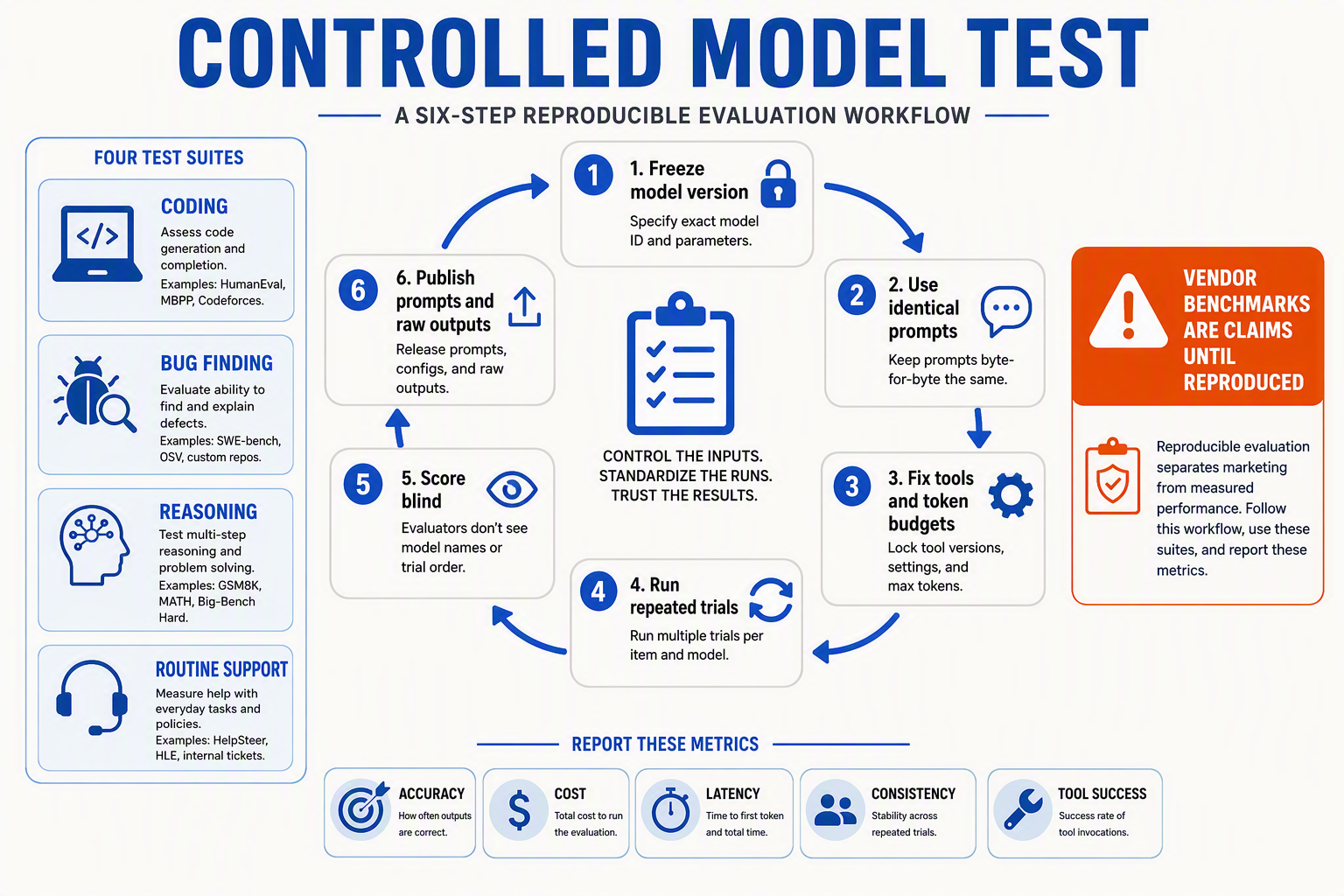
Benchmark claims should be accepted only when the exact API model ID, dated model version, test dataset, settings, and comparison baseline are reproducible. Because no official GPT-6 Sol or GPT-6 Luna endpoints are documented as of September 22, 2026, publishing performance scores for those names would be speculation rather than independent testing.
What must a reproducible model benchmark disclose?
A credible GPT-6 Sol vs GPT-6 Luna benchmark should record enough information for another evaluator to rerun it:
- Identity: API provider, exact model string, version or snapshot date, region, and access tier.
- Configuration: system prompt, temperature, reasoning effort, tools, output-token limit, and structured-output schema.
- Workload: complete prompts, dataset version, exclusions, scoring rules, and contamination controls.
- Execution: at least several runs for nondeterministic tasks, randomized model order, retry policy, and concurrency level.
- Economics: input tokens, cached input, output tokens, tool charges, failed requests, and total cost per successful task.
The API response and invoice should be preserved alongside each result. A user-interface label is insufficient because ChatGPT routing, hidden prompts, and reasoning settings may differ from direct API behavior.
Which quality tests should be run?
No single leaderboard predicts every production workload. Evaluators should use both recognized public suites and a private, task-specific holdout set.
- Coding: Measure repository-level issue resolution, test-pass rate, regressions, and human review time—not whether generated code merely looks plausible.
- Reasoning: Use exact-match questions where appropriate, but manually inspect ambiguous answers and require citations for factual research.
- Customer support: Score policy adherence, resolution accuracy, escalation decisions, tone, and unsupported claims.
- Automation: Test JSON-schema compliance, function-selection accuracy, argument validity, and recovery from tool errors.
- Cybersecurity: Run only authorized defensive evaluations and distinguish safe refusal behavior from inability to complete benign tasks.
OpenAI describes GPT-5.6 Sol as stronger in coding, science, and cybersecurity, while OpenAI positions GPT-5.6 Luna for cost-sensitive, high-volume workloads. Those descriptions are hypotheses to test; they are not substitutes for workload-specific evidence and must not be transferred to unconfirmed GPT-6 variants.
How should speed, cost, and reliability be measured?
Performance testing should report distributions rather than one attractive average:
- Time to first token
- Tokens generated per second
- End-to-end latency at p50, p95, and p99
- Success rate under controlled concurrency
- Cost per successful task
- Quality-adjusted cost, such as spend per resolved support case
OpenAI’s “Advancing the price-performance frontier with GPT-5.6” announcement cited 2.5× faster speeds as of September 2026. An independent test must identify the comparison model, request shape, token length, caching state, region, and concurrency before attempting to reproduce that figure.
For voice agents, text-only throughput is inadequate. Measure speech endpointing, transcription accuracy, first-audio latency, interruption handling, tool-call delay, and complete turn latency across accents, background noise, and code-mixed speech.
How can benchmark cherry-picking be reduced?
Run models against identical prompts in a blinded harness, randomize execution order, and publish failures as well as successes. Report confidence intervals or bootstrap ranges across repeated trials, then separate statistically detectable differences from operationally meaningful ones.
Most importantly, label results precisely: GPT-5.6 Luna tests are evidence about GPT-5.6 Luna—not GPT-6 Luna. Until OpenAI publishes matching GPT-6 model IDs and accessible endpoints, the honest benchmark result for GPT-6 Sol versus GPT-6 Luna is not yet testable.
Which model would fit coding, reasoning, automation, voice and support?
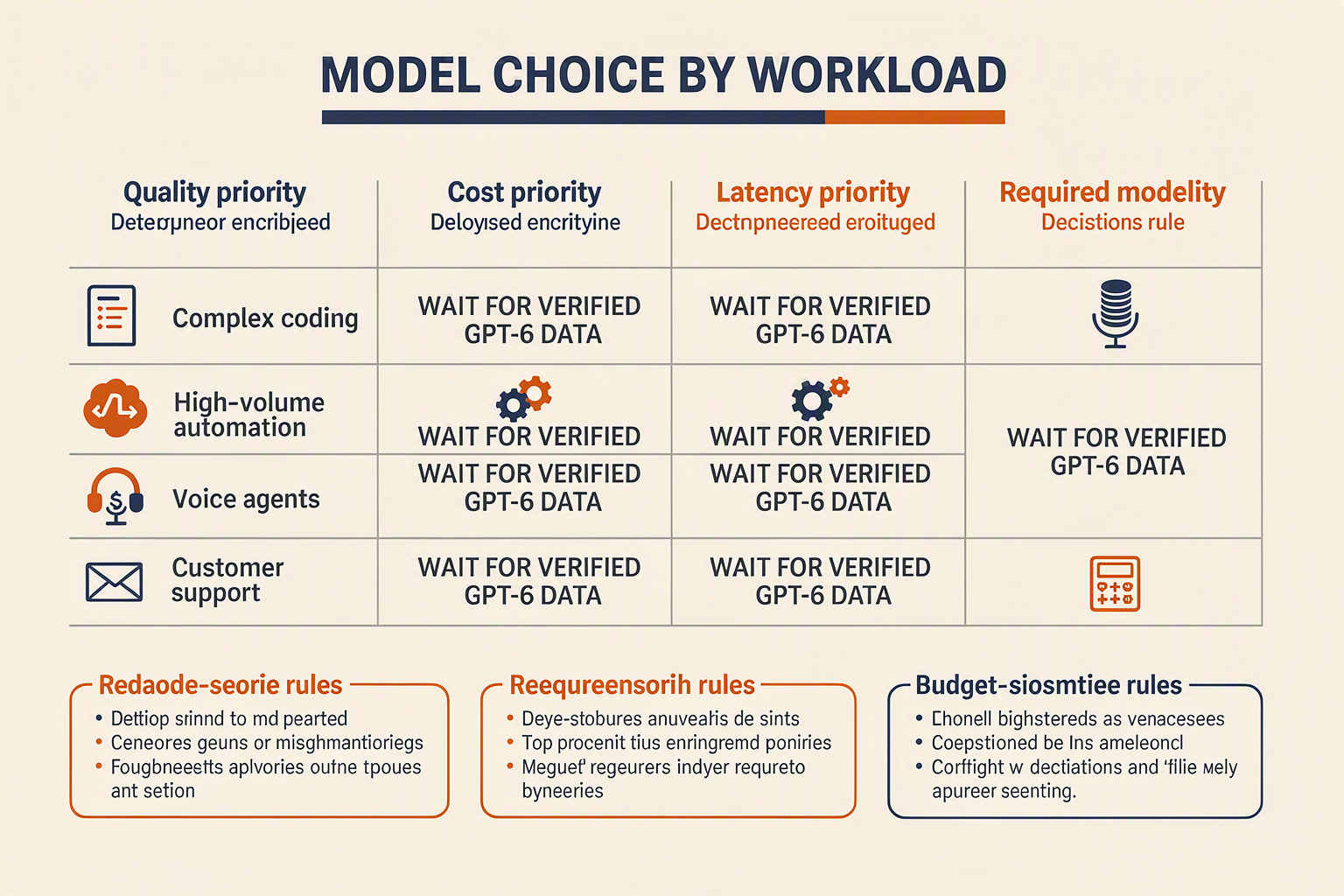
There is no evidence-based way to choose GPT-6 Sol or GPT-6 Luna for production as of September 22, 2026, because OpenAI has not published those model variants. For current deployments, the defensible comparison is GPT-5.6 Sol for capability-intensive work, GPT-5.6 Luna for fast and economical volume, and GPT-6 Astra for confirmed next-generation tasks requiring OpenAI’s highest stated capability.
Which confirmed model fits each workload?
| Workload | Recommended confirmed model | Why it fits | Important caveat |
|---|---|---|---|
| Complex coding | GPT-5.6 Sol or GPT-6 Astra | OpenAI specifically associates Sol with stronger coding capability and describes Astra as state-of-the-art across coding, computer use, and cybersecurity. | Run repository-level tests; no verified GPT-6 Sol benchmark exists. |
| Deep reasoning | GPT-5.6 Sol | Sol is the higher-capability member of the confirmed Sol–Luna pairing and supports thinking options in ChatGPT. | OpenAI has not confirmed a GPT-6 Sol model, context limit, or reasoning score. |
| High-volume automation | GPT-5.6 Luna | OpenAI’s API documentation positions Luna for cost-sensitive, high-volume workloads and compares it with the earlier nano tier. | Validate accuracy on extraction, routing, and tool-call schemas before scaling. |
| Voice agents | Task-dependent routing | Luna may suit rapid classification and routine turns; Sol or Astra may fit difficult troubleshooting and multi-step tool use. | The supplied OpenAI sources do not confirm native voice specifications or latency guarantees for hypothetical GPT-6 Sol or Luna variants. |
| Customer support | GPT-5.6 Luna, with escalation | Luna fits repetitive FAQs, intent detection, summarisation, and ticket triage; harder cases can route to Sol or a human. | Measure grounded-answer accuracy, escalation rate, latency, and cost per resolved conversation. |
| Budget-sensitive APIs | GPT-5.6 Luna | OpenAI calls Luna its fastest and most affordable GPT-5.6 model. | Exact spend depends on verified API token pricing, prompt size, caching, and output length. |
Why is GPT-5.6 Luna the practical automation choice?
OpenAI stated in 2026 that GPT-5.6 Luna would cost 80% less and deliver 2.5× faster speeds, while GPT-5.6 Sol pricing would remain unchanged. Those relative figures make Luna the logical first candidate for classification, structured extraction, lead qualification, basic support replies, and other high-frequency operations.
However, “faster and cheaper” does not mean universally preferable. A workflow that saves money per request can still cost more overall if lower accuracy creates retries, manual reviews, or incorrect tool actions. Test both models against a representative evaluation set and compare cost per accepted result, not merely cost per token.
When should coding or reasoning move to Sol or Astra?
Choose GPT-5.6 Sol when tasks involve architectural trade-offs, multi-file code changes, security analysis, difficult debugging, or long chains of constraints. OpenAI’s 2026 preview explicitly names coding, science, and cybersecurity as Sol strengths.
Consider GPT-6 Astra separately when evaluations show that its confirmed computer-use, coding, or cybersecurity capabilities justify the likely operational trade-offs. Do not treat Astra results as evidence for an undocumented GPT-6 Sol or Luna.
How should voice and support systems route models?
A robust deployment should use tiered routing:
- Send routine intents and FAQ retrieval to Luna.
- Escalate ambiguous or high-risk requests to Sol or Astra.
- Require human approval for consequential actions.
- Track groundedness, tool success, latency, escalation, and resolution cost.
For example, CallMissed’s OpenAI-compatible AI gateway supports caller-chosen fallback models and 25 real-time voice-agent models as of September 2026, enabling teams to test routing strategies without assuming that one model should handle every support turn.
How much could each model cost per task and per month?
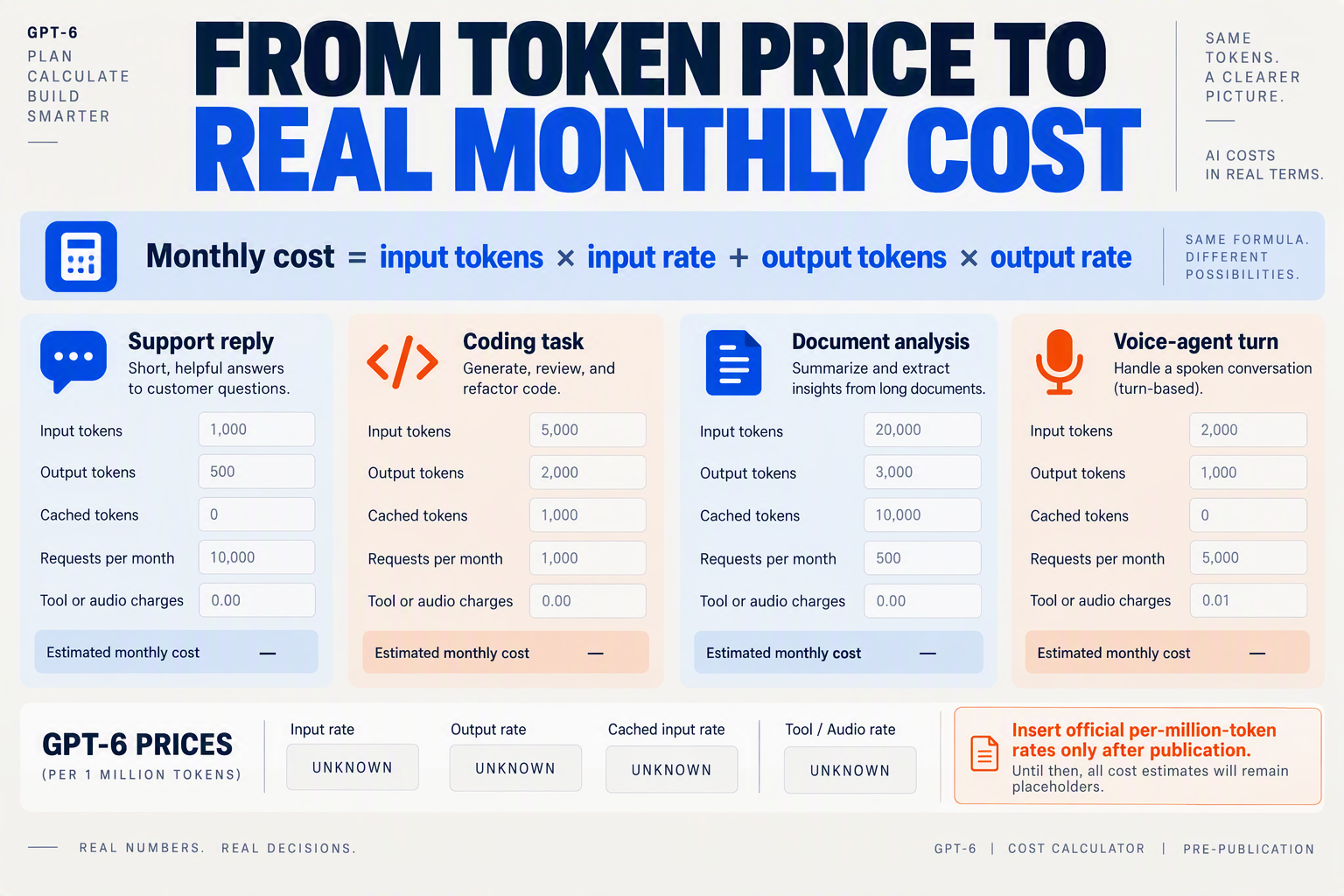
No verified GPT-6 Sol or GPT-6 Luna price exists as of September 22, 2026, so a credible per-task or monthly cost comparison cannot attach dollar figures to those names. Teams should budget with token-based formulas and substitute official rates only after OpenAI publishes model IDs and pricing.
What pricing information has OpenAI actually confirmed?
OpenAI’s current primary sources associate Sol and Luna with GPT-5.6, not GPT-6. OpenAI describes GPT-5.6 Luna as its fastest, most affordable option for cost-sensitive, high-volume workloads, while GPT-5.6 Sol targets more demanding coding, science, cybersecurity, and reasoning tasks.
OpenAI’s “Advancing the price-performance frontier with GPT-5.6” announcement states that GPT-5.6 Luna will cost 80% less and deliver 2.5× faster speeds, while Sol pricing remains unchanged, as of September 2026. However, that relative claim does not establish pricing for hypothetical GPT-6 variants, and the supplied primary-source excerpt does not provide the exact per-million-token rates needed for a defensible calculation.
For ChatGPT access, OpenAI’s Help Center confirms in September 2026 that Free and Go users receive GPT-5.6 Luna but cannot access GPT-5.6 Sol. That plan distinction indicates different economic tiers, but it is not equivalent to API pricing.
How do you calculate the cost of one model task?
For any token-priced model, use:
Task cost = (input tokens ÷ 1,000,000 × input rate) + (output tokens ÷ 1,000,000 × output rate)
Let I represent the official input price per million tokens and O the output price. Example workloads would cost:
- Customer-support reply: 2,000 input and 500 output tokens
Cost = 0.002I + 0.0005O
- Code review: 20,000 input and 4,000 output tokens
Cost = 0.02I + 0.004O
- Long-document analysis: 100,000 input and 8,000 output tokens
Cost = 0.1I + 0.008O
- Short classification: 800 input and 50 output tokens
Cost = 0.0008I + 0.00005O
These formulas are illustrative workload calculations—not GPT-6 Sol or GPT-6 Luna price claims. Cached input, web search, tool calls, audio, images, reasoning tokens, and batch discounts could materially change the total, but none of those pricing details is verified for the two hypothetical GPT-6 names.
How much could monthly production usage cost?
Monthly cost equals per-task cost × completed tasks, plus any separate platform, storage, retrieval, or tool charges. For 100,000 monthly support conversations averaging 2,000 input and 500 output tokens, usage would total 200 million input tokens and 50 million output tokens, producing a bill of:
Monthly cost = 200I + 50O
A routing strategy can reduce spend when models occupy different price-performance tiers:
- Send classification, extraction, and routine support to the lower-cost model.
- Escalate ambiguous cases, difficult code, and multi-step reasoning to the stronger model.
- Measure cost per successfully completed task, not merely cost per token.
- Include retries, human escalation, latency, and error correction in the evaluation.
Until OpenAI publishes official API prices, the responsible GPT-6 Sol vs GPT-6 Luna cost verdict is “unknown.” GPT-5.6 Luna’s confirmed economical positioning suggests how a future Luna tier might be used, but it does not prove GPT-6 pricing or savings.
What do official sources and independent experts actually say?

OpenAI’s official materials support a GPT-5.6 Sol versus GPT-5.6 Luna comparison, but they do not support a factual GPT-6 Sol versus GPT-6 Luna comparison as of September 22, 2026. The available independent discussion raises the possibility of those names; it does not verify products, specifications, or release plans.
What has OpenAI officially confirmed?
OpenAI’s product announcement, developer documentation, and Help Center establish a consistent division between the confirmed GPT-5.6 variants:
- GPT-5.6 Sol: OpenAI describes Sol as a “next-generation model with stronger capabilities in coding, science, and cybersecurity.”
- GPT-5.6 Luna: OpenAI’s API documentation describes Luna as designed for “cost-sensitive, high-volume workloads” and says it “roughly corresponds to the nano model tier used in earlier GPT-5 families.”
- ChatGPT availability: OpenAI’s Help Center states that Free and Go users receive GPT-5.6 Luna but cannot access GPT-5.6 Sol.
- GPT-6 naming: OpenAI’s separate GPT-6 announcement identifies GPT-6 Astra, describing it as the company’s “most intelligent and aligned model yet.”
These statements support a capability-versus-cost interpretation of GPT-5.6 Luna vs GPT-5.6 Sol. They do not establish that OpenAI will carry the Sol and Luna labels into the GPT-6 generation.
OpenAI’s price-performance announcement also claims GPT-5.6 Luna is 2.5 times faster and references cost reductions of 80% and 20%, while stating that Sol pricing remains unchanged. However, the available search summary does not clearly preserve the baselines and workloads attached to each percentage. Those figures should not be converted into GPT-6 prices—or even precise GPT-5.6 savings—without checking the complete official pricing tables.
What does the OpenAI community discussion prove?
The OpenAI Community thread titled “GPT-6 Sol, Terra, and Luna?” is a feature request, not a product disclosure. Its central question—whether GPT-6 will receive “Sol, Terra, and Luna versions” alongside Astra—actually demonstrates that the naming remained uncertain when the post was written.
A community page can provide useful signals about developer demand, but it cannot confirm:
- A launch date or release window
- An API model identifier
- Input or output token prices
- Context-window limits
- Text, image, audio, or video modalities
- Benchmark scores or safety evaluations
Even posts made on an official company forum should be classified by authorship: staff announcements and linked documentation carry more evidentiary weight than user questions, predictions, or feature requests.
What do independent experts say about GPT-6 Sol and Luna?
No named independent laboratory, analyst, or technical publication in the available verified evidence provides reproducible testing of GPT-6 Sol or GPT-6 Luna as of September 22, 2026. Consequently, there is no independent expert consensus on their coding quality, reasoning accuracy, latency, cost efficiency, or context performance.
Readers should treat purported benchmark charts cautiously unless they disclose:
- The exact model ID and evaluation date
- Dataset names, prompts, scoring rules, and sample sizes
- Temperature, reasoning settings, tools, and retry policies
- Whether results came from a public API or an undisclosed preview
- Comparable token usage, latency percentiles, and total cost
The defensible conclusion is narrow but important: official sources confirm GPT-5.6 Sol, GPT-5.6 Luna, and GPT-6 Astra; neither official documentation nor independent testing currently verifies GPT-6 Sol or GPT-6 Luna.
Where could CallMissed fit after model availability is verified?
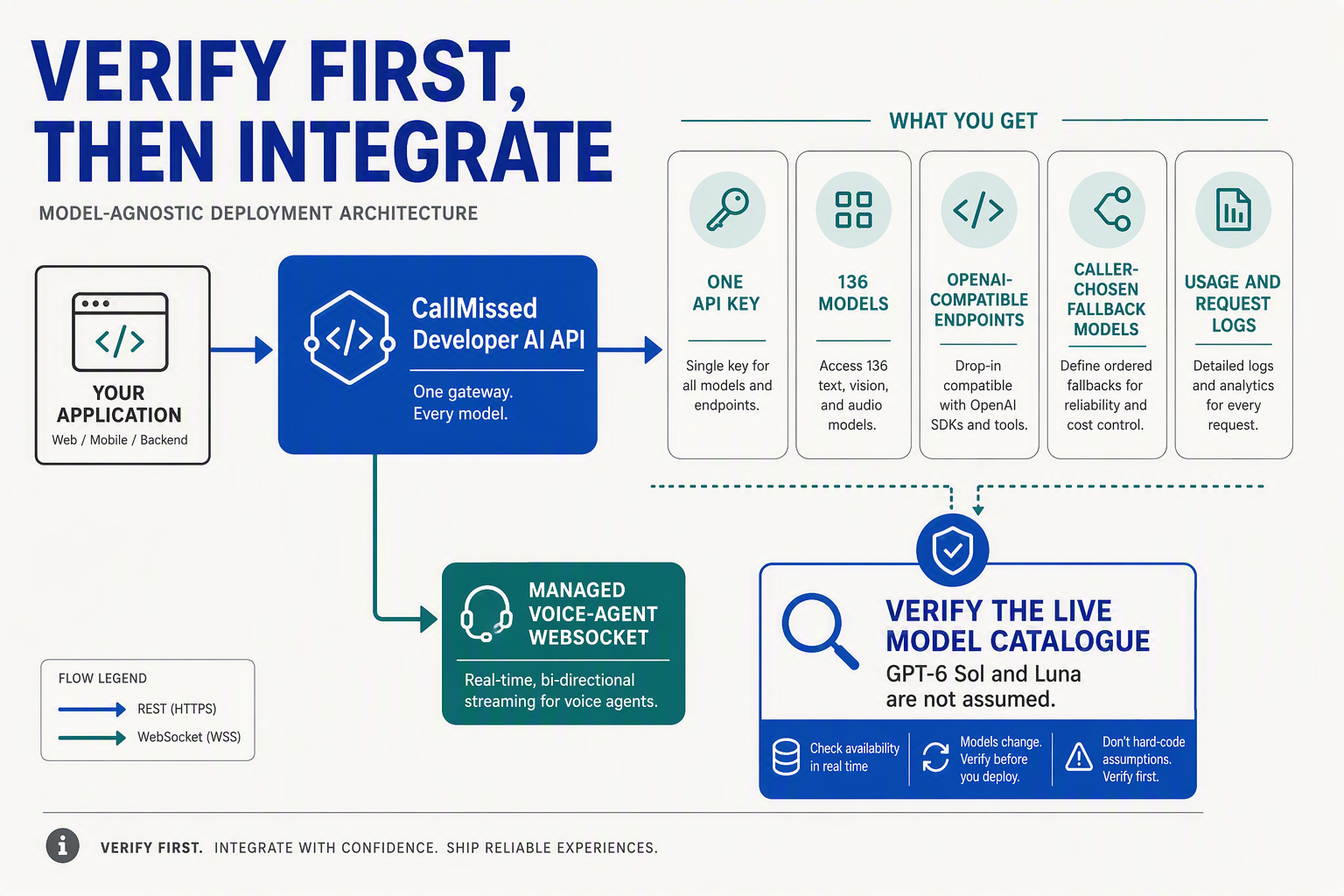
CallMissed should fit as the integration and evaluation layer only after OpenAI confirms that GPT-6 Sol or GPT-6 Luna exists in the API. Until OpenAI publishes valid model IDs, pricing, context limits, and modality support, production systems should not route requests to those speculative names or inherit GPT-5.6 specifications by assumption.
How should developers integrate an unverified GPT-6 model?
Use a capability-based model registry, not hard-coded marketing names. As of September 22, 2026, OpenAI documents GPT-5.6 Sol, GPT-5.6 Luna, and GPT-6 Astra; the OpenAI Community discussion asking about future “Sol, Terra, and Luna versions” is a feature request, not API documentation.
A safe release process is:
- Verify the model ID in OpenAI’s official API documentation.
- Record dated specifications, including price, context window, output limits, modalities, tool support, and regional availability.
- Run task-specific evaluations against the current production model.
- Deploy behind a routing alias, such as
support-fastorcoding-reasoning, rather than embedding a provider model name throughout the application. - Retain a tested fallback until the new model meets quality, latency, and cost thresholds under real traffic.
This avoids a subtle failure mode: an application may accept a plausible-looking string such as gpt-6-luna, yet return a model-not-found error—or, in a poorly governed abstraction layer, silently route somewhere unintended.
Where does CallMissed add practical value?
CallMissed’s OpenAI-compatible developer AI API provides one API key and one balance across 136 models as of September 2026. The catalogue comprises 40 general-purpose LLMs, 25 real-time voice-agent models, 45 speech-to-text models, nine text-to-speech models, 15 image models, and two embedding models; 27 models are available on the free tier.
That architecture can reduce migration work once a desired model is genuinely listed and supported. Existing OpenAI SDK integrations can use CallMissed by changing the base URL, while Anthropic-compatible /v1/messages endpoints provide another portability path. However, OpenAI compatibility does not itself prove availability of GPT-6 Sol or GPT-6 Luna; developers must verify the gateway catalogue and model identifier before deployment.
Relevant controls include:
- Caller-chosen fallback models for handling availability or policy constraints.
- Streaming, function calling, structured outputs, vision input, and reasoning-effort control, subject to the selected model’s actual capabilities.
- Usage and request logs for comparing costs, errors, and output behavior.
- Response caching and stored prompts for repeatable testing.
- Bring-your-own provider keys when direct provider billing or access is preferable.
How should teams evaluate Sol or Luna if they appear?
Create an identical evaluation set and compare the candidate with the incumbent across four dimensions:
- Quality: coding pass rates, grounded-answer accuracy, tool-call correctness, and escalation rates.
- Economics: input, output, cached-token, search, speech, and telephony costs where applicable.
- Performance: time to first token, end-to-end response time, and interruption handling for voice.
- Reliability: malformed structured outputs, tool failures, rate-limit errors, and fallback frequency.
For Indian customer-support and voice workloads, CallMissed also supports speech recognition in 22 Indian languages plus English, including Hinglish, and text-to-speech in 10 Indian languages plus English. Its managed voice-agent WebSocket and 25 real-time voice-agent models make it possible to test the full speech-to-speech pipeline rather than judging an LLM on text benchmarks alone.
What is the deployment rule?
Do not configure GPT-6 Sol or GPT-6 Luna until a primary source confirms the exact API name and CallMissed lists the model as available. After verification, introduce it through a versioned alias, run A/B evaluations, monitor request logs, and preserve a known-good fallback. This approach captures future model improvements without turning an unconfirmed product name into a production dependency.
Frequently Asked Questions
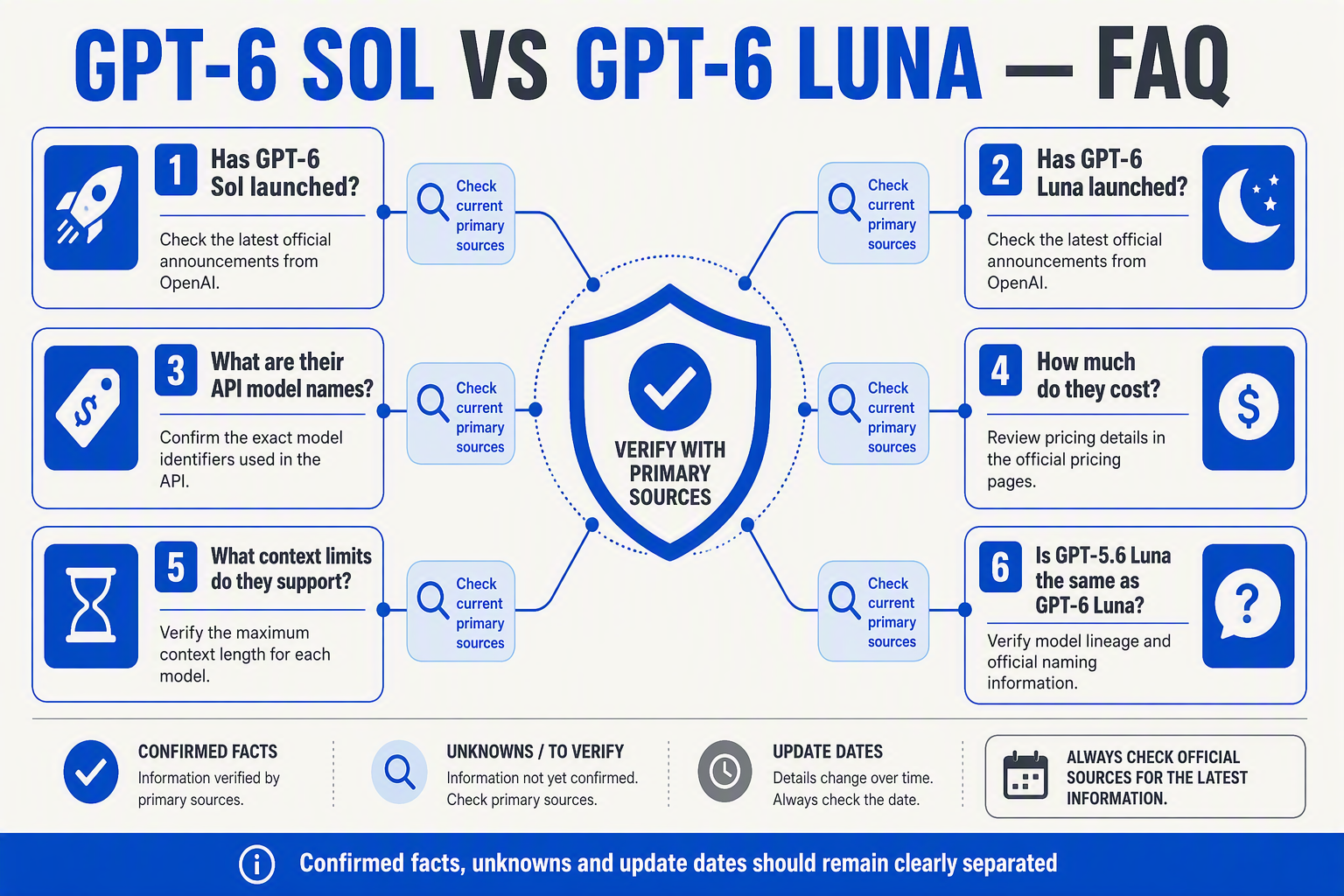
Are GPT-6 Sol and GPT-6 Luna officially available in 2026?
What is the release date in the GPT-6 Sol vs GPT-6 Luna comparison?
What are the GPT-6 Sol and GPT-6 Luna API model names?
How do GPT-6 Sol vs GPT-6 Luna pricing, context limits, and modalities compare?
Which model should developers choose for coding, reasoning, customer support, or voice agents?
How can teams verify GPT-6 Sol vs GPT-6 Luna benchmark claims before deployment?
Conclusion
The verified verdict is straightforward: GPT-6 Sol and GPT-6 Luna are not confirmed OpenAI models as of September 22, 2026. OpenAI’s primary sources associate Sol and Luna with GPT-5.6, while GPT-6 Astra is the documented GPT-6 model; any more detailed GPT-6 Sol vs GPT-6 Luna comparison would currently rely on speculation rather than product documentation.
What are the key takeaways from the GPT-6 Sol vs GPT-6 Luna comparison?
- The model names must not be silently relabelled. OpenAI describes GPT-5.6 Sol as stronger in coding, science, and cybersecurity, while OpenAI’s API documentation positions GPT-5.6 Luna as a cost-sensitive model for high-volume workloads. Those GPT-5.6 descriptions cannot be treated as GPT-6 specifications.
- GPT-6 Sol and GPT-6 Luna specifications remain unknown. OpenAI has not published verified API model names, release dates, context limits, modality support, benchmark results, or pricing for either proposed variant as of September 2026. An OpenAI Community feature request discussing “Sol, Terra, and Luna versions” is evidence of user interest, not evidence of a launch.
- The confirmed GPT-5.6 choice depends on workload. GPT-5.6 Sol is the more relevant candidate for complex coding and reasoning, while GPT-5.6 Luna targets fast, affordable customer support and high-volume automation. OpenAI’s Help Center confirms that Free and Go users receive GPT-5.6 Luna and do not receive GPT-5.6 Sol, reinforcing this capability-versus-economy split.
- GPT-6 Astra belongs in a separate comparison. OpenAI calls GPT-6 Astra its “most intelligent and aligned model yet” and highlights computer use, coding, and cybersecurity. Until OpenAI publishes comparable documentation, GPT-5.6 Luna vs GPT-6 Astra is evidence-based, whereas GPT-6 Luna vs GPT-6 Astra is not.
What should readers watch next? Look for an official OpenAI product announcement, model card, API catalogue entry, pricing page, and reproducible benchmark methodology. A name appearing in search results should not influence production architecture until those primary sources agree.
For developers preparing for rapid model changes, CallMissed, an OpenAI-compatible AI gateway, provides one API key and balance across 136 models as of September 2026, making portable integrations practical while model lineups evolve. Will your next AI decision follow the most exciting model name—or the strongest verifiable evidence?
Related Reading
- GPT-6 API Guide: Sol, Luna and Astra Facts for 2026
- GPT-6 Sol Launch: Pricing, Model ID and Availability
- Claude Opus 5 vs GPT-5.6 Sol: 2026 Buyer's Guide
Sources
Discussion
Related Posts


Ready to automate customer conversations?
Launch AI voice agents and WhatsApp bots with CallMissed — one API, 22+ Indian languages.